Search Results: "ag"

25 January 2012

Bartosz Feński: Sentelic touchpad

With the latest changes in driver for Sentelic touchpad I m eventually able to use two-finger scrolling, and disable touchpad while typing. Middle-button emulation and on pad click & drag doesn t work yet, though. Edge scrolling either. Anyway it starts to be really usable and there is some progress to merge this driver with mainline kernel. I believe last time I was compiling kernel was around 2.4.18 and only because at that time I was maintaining router for some network and needed some special iptables extensions. Happily it hasn t changed too much since then and I can compile 3.2.1 without problem ;)

Petter Reinholdtsen: Setting up a new school with Debian Edu/Squeeze

The next version of Debian Edu / Skolelinux will include a new tool sitesummary2ldapdhcp, which can be used to quickly set up all the computers in a school without much manual labour. Here is a short summary on how to use it to set up a new school. First, install a combined Main Server and Thin Client Server as the central server in the network. Next, PXE boot all the client machines as thin clients and wait 5 minutes after the last client booted to allow the clients to report their existence to the central server. When this is done, log on to the central server and run sitesummary2ldapdhcp -a in the konsole to use the collected information to generate system objects in LDAP. The output will look similar to this:
% sitesummary2ldapdhcp -a
info: Updating machine tjener.intern [10.0.2.2] id ether-00:01:02:03:04:05.
info: Create GOsa machine for auto-mac-00-01-02-03-04-06 [10.0.16.20] id ether-00:01:02:03:04:06.
Enter password if you want to activate these changes, and ^c to abort.
Connecting to LDAP as cn=admin,ou=ldap-access,dc=skole,dc=skolelinux,dc=no
enter password: *******
% 
After providing the LDAP administrative password (the same as the root password set during installation), the LDAP database will be populated with system objects for each PXE booted machine with automatically generated names. The final step to set up the school is then to log into GOsa, the web based user, group and system administration system to change system names, add systems to the correct host groups and finally enable DHCP and DNS for the systems. All clients that should be used as diskless workstations should be added to the workstation-hosts group. After this is done, all computers can be booted again via PXE and get their assigned names and group based configuration automatically. We plan to release beta3 with the updated version of this feature enabled this weekend. You might want to give it a try. Update 2012-01-28: When calling sitesummary2ldapdhcp to add new hosts, one need to add the option -a. I forgot to mention this in my original text, and have added it to the text now.

Bartosz Feński: Cracow against ACTA

Wow that s really big demonstration.
I ve just uploaded video with people walking near Wawel castle plenty of people during almost 20 minutes.
I suppose there was more than 50k people and wonder what s going to be shown in TV ;) I really like it.

Pietro Abate: new thinkpad x220

This summer my beloved thinkpad x301 died in a cloud of smoke. It was exactly 3 years and 20 days old while my warranty was valid only for 3 years. Now, don't tell me this is a coincidence. Anyway. After about 5 months, I finally managed to convince my employer to get me a new thinkpad, the x220. My specs includes a 128G SSD , 4G of RAM, 2.4Gz processor, camera and fingerprint reader. It's a pity that the x300 series is not in production anymore. They were light, with a solid battery and a large screen. The X1 just don't cut it. Even though it can be consider the successor of the x300, its battery life is just not enough for my needs. On the other hand, the x220 is a very nice machine : the screen is a bit smaller then the X300, but it is light, with a very powerful processor, good battery and it feels very solid. In my opinion lenovo should have packed the new hw of the x220 in the chassis of the x300, maybe with small compromise on the battery life (I got the big battery and I can squeeze almost 7 hs with a single charge) but clearly this was not a good business choice... Installing debian on this laptop is not immediate because none of the official debian installers are shipped with a recent kernel (as in 3.x series). Since with the official debian installer I cannot have neither the driver for the Ethernet card or the driver for the wirelles card, I opted to use a custom installer built by kmuto (http://kmuto.jp/debian/d-i/ ) . Using this installer the ethernet card is recognized immediately and it's easy to proceed with the installation as usual. Another option would have been to add the binary blog for the wireless chip, but apparently the deb installer supports only WEP auth, while all my access point are WPA. I didn't spend too much time on the wireless setup, so it might well be that is indeed possible to install using a WPA access point. Last time I installed a laptop, I used the automatic partition option to have lvm on top of a lucks encrypted partition, only to discover later that the default dimensions of the partitions were a bit too small for me. For example, by default the boot partition is only 256Mb. This is plenty if you want to have only one kernel image installed at each given time, but if you want more then one kernel, memtest and for example a grml rescue iso, it's easy to run out of space. So I proceed to manually partition the disc creating a boot partition of 512M, and using the rest as a luks encrypted device with lvm on top and 3 logical volumes : sys (15G), swap (4G) and home (the rest). For my daily use having 15G on my laptop for /usr, /var, etc should more the enough... Next step was to install the system. Since in recent times I got extremely pissed off with gnome 3, I've decided to dump it completely and go back to awesome. But since awesome all by itself is a bit sad, I paired it up with xfce. Everything works, except the automount, and I'm still trying to figure out how to make it work. Apparently is a consolkit problem... I'll write another post about the xfce4 + awsome setup soon... Today I've also started playing with the finger print reader. It seems working, but I haven't managed yet to use it in conjunction with pam for authentication ... more to come. And... On last closing remark : during the last 5 months I've used a dell latitude e6410 ... Gosh. I feel I'm on anther planet. The keyboard of a thinkpad give you pleasure, not pain, from 2 to 4G of RAM is a big jump and from a conventional HD to a SSD ... well... it seems I'm flyinggggg :) I've the impression my productivity just went up 50% !!! If you work with your laptop everyday get a good laptop. It is well worth the investment ...

Russell Coker: SE Linux Status in Debian 2012-01

Since my last SE Linux in Debian status report [1] there have been some significant changes. Policy Last year I reported that the policy wasn t very usable, on the 18th of January I uploaded version 2:2.20110726-2 of the policy packages that fixes many bugs. The policy should now be usable by most people for desktop operations and as a server. Part of the delay was that I wanted to include support for systemd, but as my work on systemd proceeded slowly and others didn t contribute policy I could use I gave up and just released it. Systemd is still a priority for me and I plan to use it on all my systems when Wheezy is released. Kernel Some time between Debian kernel 3.0.0-2 and 3.1.0-1 support for an upstream change to the security module configuration was incorporated. Instead of using selinux=1 on the kernel command line to enable SE Linux support the kernel option is security=selinux. This change allows people to boot with security=tomoyo or security=apparmor if they wish. No support for Smack though. As the kernel silently ignores command line parameters that it doesn t understand so there is no harm in having both selinux=1 and security=selinux on both older and newer kernels. So version 0.5.0 of selinux-basics now adds both kernel command-line options to GRUB configuration when selinux-activate is run. Also when the package is upgraded it will search for selinux=1 in the GRUB configuration and if it s there it will add security=selinux. This will give users the functionality that they expect, systems which have SE Linux activated will keep running SE Linux after a kernel upgrade or downgrade! Prior to updating selinux-basics systems running Debian/Unstable won t work with SE Linux. As an aside the postinst file for selinux-basics was last changed in 2006 (thanks Erich Schubert). This package is part of the new design of SE Linux in Debian and some bits of it haven t needed to be changed for 6 years! SE Linux isn t a new thing, it s been in production for a long time. Audit While the audit daemon isn t strictly a part of SE Linux (each can be used without the other) it seems that most of the time they are used together (in Debian at least). I have prepared a NMU of the new upstream version of audit and uploaded it to delayed/7. I want to get everything related to SE Linux up to date or at least with comparable versions to Fedora. Also I sent some of the Debian patches for the auditd upstream which should reduce the maintenance effort in future. Libraries There have been some NMUs of libraries that are part of SE Linux. Due to a combination of having confidence in the people doing the NMUs and not having much spare time I have let them go through without review. I m sure that I will notice soon enough if they don t work, my test systems exercise enough SE Linux functionality that it would be difficult to break things without me noticing. Play Machine I am now preparing a new SE Linux Play Machine running Debian/Unstable. I wore my Play Machine shirt at LCA so I ve got to get one going again soon. This is a good exercise of the strict features of SE Linux policy, I ve found some bugs which need to be fixed. Running Play Machines really helps improve the overall quality of SE Linux. Related posts:
  1. Status of SE Linux in Debian LCA 2009 This morning I gave a talk at the Security mini-conf...
  2. SE Linux in Debian I have now got a Debian Xen domU running the...
  3. Debian SE Linux Status At the moment I ve got more time to work on...

Jon Dowland: Music for Our Future

cover
In 2010, a collaboration between the SyFy channel, Create Digital Music, XLR8R and Pitchfork created "Music for our Future": a compilation album of free music inspired by the TV show "Caprica". XLR8R hosted it but their page for the release has subsequently disappeared. A few people here and there on the 'net have been asking for a copy, so here it is on archive.org: http://www.archive.org/details/MusicForOurFuture. Some background info, photos etc. via CDM.

24 January 2012

James Morrison: Appengine

I've been working with appengine for a few months now. I've managed to find out the hard way that appcfg.py rollback is useless. I've learned to create a git branch for each refactoring I start on. The git branch also includes a new app version for the branch. When push all my changes to my live site, I upload one last time to the new app. Merge my branch into the master then change the live version from the old one to the new one.

I haven't learned how this work flow translates to having multiple developers. Hopefully, it is simple enough that other people can follow.

I also use make since it's an easy way to automate tasks. I hear redo is good, but for python, I'm not really compiling anything, I'm simply writing shell scripts and make is a great shell script dispatcher.

James Morrison: Make is still my friend


The following is a makefile fragment I seem to start each of my appengine projects with.

GAEPATH = $(HOME)/bin/google_appengine
PORT=8081

PYLINTS = $(wildcard *.py */*.py */*/*.py)
PYLINTFILES = $(patsubst %.py,.%.lint,$(notdir $(PYLINTS)))
PYLINT = $(join $(dir $(PYLINTS)),$(PYLINTFILES))

PYTHONPATH=$(GAEPATH):$(GAEPATH)/lib/yaml/lib:$(GAEPATH)/lib/webob:$(GAEPATH)/lib/django_0_96:.

APP=new-app

run:
$(GAEPATH)/dev_appserver.py ./ --port=$(PORT) --datastore_path=/tmp/$(APP).dev_appserver.datastore


.%.lint: %.py
@PYTHONPATH=$(PYTHONPATH) pychecker --only --no-miximport $?
@touch $@


lint: $(PYLINT)


clean:
-rm $ PYLINT


.PHONY: run lint clean


James Morrison: CMYK images in PDFs

For the few of you out there that are parsing PDFs manually in python, JPEG images (including CMYK images) can be extracted with the following code fragment.
  # reader is a PDFReader object from pyPdf, value is the operand to a Do operator. 
from PIL import Image, ImageChops

xobject = reader.getObject(value)
if xobject['/Filter'] == '/DCTDecode':
raw_data = xobject.getRawData()
if xobject['/ColorSpace'] == '/DeviceRGB':
_CreateFile('image/jpeg', filename, raw_data))
else:
f = cStringIO.StringIO(raw_data)
of = cStringIO.StringIO()
i = Image.open(f)
if xobject['/ColorSpace'] == '/DeviceCMYK':
i = ImageChops.invert(i)
i.convert('RGB').save(of, 'JPEG')
_CreateFile('image/jpeg', filename, of.getvalue())

The CMYK images I found in the PDFs needed to inverted. PIL versions before 1.1.7 would do that for you, but version 1.1.7 removed in the ImageChops.invert() call.

Tim Retout: Lenovo X121e 3G with ModemManager

Recently, I tried to get 3G working on my Lenovo ThinkPad X121e - it has an Ericsson F5521gw mobile broadband card. This is supported by ModemManager, but all I got were unknown errors (276 and 272). Searching online, there were very few results (hence this short note) - just previous unrelated Linux kernel issues. I found someone with the same problem on Fedora, but no solution, so I started off by filing a bug report with Debian. Of course, then I found the Arch user who had filed the same bug on Launchpad, and had discovered that resetting the BIOS to its default settings fixes the issue. If only that page mentioned the keywords "Ericsson", or "Lenovo"... So after all that, it was just some weird BIOS issue. I hate hardware.

Sylvain Beucler: OpenGL ES 2.0 using Android NDK

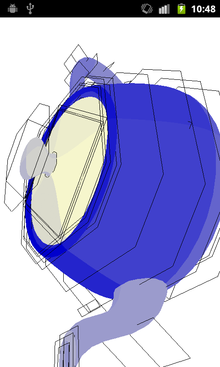
Teapot on Android I got myself a second-hand Samsung Galaxy S at last, and started hacking on it! The very first thing I wanted to try was porting the OpenGL wikibook C++ samples, that we wrote with OpenGL ES 2 in mind. I started writing a minimal GLUT-compatible wrapper to run the samples as-is, using the Android NDK, and I'm making progress :) The Android NDK is getting nicer with Android 2.3, though it still feels less supported than Java apps (e.g. the resize events seem buggy and the keycodes header is incomplete...). Nonetheless, it's nice to be able to write C++ portable apps. You can see how to use the wrapper, and how it works internally, at: http://en.wikibooks.org/wiki/OpenGL_Programming/Installation/Android One of the limitations is that GLES2 is not a true subset of OpenGL 2.1, in particular: I needed to pre-process these differences away, checking on GL_ES_VERSION_2_0 in the C++ source code to define a GLES2 macro in the shaders:
#ifdef GLES2
varying lowp vec4 f_color;
# else
varying vec4 f_color;
#endif
Is there a better way?

Stefano Zacchiroli: hardware sponsorship for Debian Developers

A few days ago Yves-Alexis Perez asked me how many hardware sponsorship request I usually get from Debian Developers, that is how many people ask me to use Debian money to buy material that can improve their work on Debian and indirectly Debian itself. The answer is "too few".
Making it easier for our developers to improve Debian is a worthwhile investment of money donated to Debian. Of course such a use of money should be motivated (i.e. you should be able to justify how the material you're asking for would improve Debian and why it should be Debian paying for it) and transparent (i.e. you should periodically report about what you're doing with material that Debian has bought for you to use). The above two principles are what I've tried to convey in a new section of the sponsoring guidelines wiki page I've been maintaining for a while. Comments and improvements highly welcome! Equally welcome are advocacy messages for hardware sponsoring to other fellow Developers, as suggested by Corsac.

Michal Čihař: It's too early for GSoC 2012

It looks like with start of the new year, people started to ask for phpMyAdmin's projects for GSoC 2012. Given that we have no information whether there will be Google Summer of Code this year and whether we will be chosen to participate, these questions look quite premature. On the other side you can start contributing any time and if you are already known in the community, you might have better chance being accepted. So forget speaking about hypothetical GSoC projects for now and start fixing some bugs, which is something much more needed right now (given that 3.5 is in alpha state). If you are looking for more information, we have basic facts for developers on our website, there is also a wiki page mentioning some tasks for junior developers.

Filed under: English Phpmyadmin 0 comments Flattr this!

Charles Plessy: Strange Megumi

It is since two days that all my emails, @debian.org included, are in parked somewhere between the sender and my MX, as my server broke at a moment where I strictly had no time (dealine for a grant application). It is an OpenRD Ultimate with a second hand SSD. I was quite happy to have an ARM system available to test some packages like T-COFFEE, but it looks like I will have to do without. Apparently, the machine permanently reboots. I did not manage to access to the USB serial port; there are no 10 seconds where the USB port is not disconnected / reconnected. Both ethernet port LEDs blink together synchronously with the disconnections. Removing the drive did not solve the problem. The SSD itself is fine, and I did not find in the logs hints for software problems. Strange coincidence, the last log file that was modified is daemon.log, which indicates the connection of so-called megumi-PC to our unprotected, but to my knowledge never visited, wireless network. After this, nothing.

Gunnar Wolf: BugCon friends, are you trying to scare away 50%+ of the target audience?

You are scaring away much more than that. I just came across an invitation for BugCon 2012. BugCon is a Mexican conference devoted to computer security I cannot comment on its level or value because, although it's a topic that has long interested me, I must recognize each day I feel less of an expert, nowadays finding myself at the level of a "sysadmin who tries not to be too dumb for his own job security". Oh, and also because it would be completely off-topic for this post. If you look at Vendetta's (the main organizer) blog post, it will probably give you the impression that the conference is just an excuse for the afterparty: Lets go see some b00bs! Do you think your fellow female hackers will have any interest in joining a bunch of sex-starved, hormone-infested teenagers who only want to pwn a website and grab more pr0n? Do you think females will feel welcome (or even mildly safe) between you? I would not think so. And I also think you are alienating any professional who might have any interest in joining your community, be it as a member, as a mentor, or whatnot. I cannot right now do a coherent post on this topic, but I can reference you to what I have seen (and read) over the last almost 10 years, when the issue was first brought up to our attention. I am very glad to see that, at least in the Free Software area, there has been a real change of mindset. I hope you are in time to think about it and rectify. Oh, and not the description of an incident, but a very interesting and thoughtful take on this: [pdf] Interesting analysis by Hannah Wallach on the numbers and motivations of women in Free Software groups. I don't know if Hannah has published this in article form, but many interesting points can be understood by looking at the presentation. My good friend Vendetta: I don't mean this post (longer than what I originally intended) as a way to say you and the conference you are organizing for the third year (IIRC) already is unprofessional or targetted to pimply teenagers. I know the work you have put in it. I hope you see the points I'm trying to drive You are of course free to have whatever afterparty you have. But, if as the main organizer, you are giving the images of nice chicks at Hooters more weight and relevance than to the conference itself... you are doing yourself a disservice. I hope you can rectify it, and make BugCon attractive to hacker women as well.

Julian Andres Klode: Managing system package selections using custom meta packages

Over the last years, I have developed a variety of metapackages for managing the package selections of the systems I administrate. The meta packages are organized like this:
jak-standard
Standard packages for all systems
jak-desktop
Standard packages for all desktop systems (GNOME 3 if possible, otherwise GNOME 2)
jak-printing
Print support
jak-devel
Development packages
jak-machine-<X>
The meta package defining the computer X
Each computer has a jak-machine-X package installed. This package is marked as manually installed, all other packages are marked as automatically installed. The machine packages have the attribute XB-Important: yes set in debian/control. This creates an Important: yes field. This field is not official, but APT recognizes it and does not remove those packages (the same field is set for the APT package by APT when building the cache, as APT should not be removed either by APT). It seems to work a bit like Essential, with the exception that non-installed packages are not installed automatically on dist-upgrade. The meta packages are created using seed files similar to Ubuntu. In contrast to Ubuntu, I m not using germinate to create the packages from the seeds, but a custom dh_germinate_lite that simply takes a seed file and creates the correct substvars. It s faster than germinate and really simplistic. It also does not handle Recommends currently. The whole result can be seen on http://anonscm.debian.org/gitweb/?p=users/jak/jak-meta.git. Maybe that s useful for some people. And if you happen to find some packages in the seeds that are deprecated, please let me know. Oh, and yes, some packages (such as the letterman one) are internal software not publically available yet [letterman is a simple GUI for creating letters using LaTeX]. While I m at it, I also built Ubuntu s version of wine1.2 for i386 squeeze. It can be found in
deb http://people.debian.org/~jak/debian/ squeeze main (it still needs a few changes to be correct though, I ll upload a jak2 build soon). I also built updated sun-java6 packages for my parents (mostly needed due to the plugin, some websites do not work with the IcedTea one), but can t share the binaries due to licensing requirements. I may push out a source repository, though, so others can build those packages themselves. I ll let you know once that s done.
Filed under: Debian, General

Rapha&#235;l Hertzog: Answering questions of Debian users on various support channels

When you start your journey with Debian, you tend to have lots of questions. You ll find some answers in various documentations but there always are remaining questions. Those can be asked on various support channels: Those are the places where you can also start your journey as a Debian contributor instead of asking questions, you just have to answer questions of other users! Let me share some advice if you want to do some user support. User support is difficult It s not always an easy task. Some users are more skilled than others and there might be difficulties related to the language, English is not always the native language of a user who asks a question in English. Be respectful and courteous when you answer user questions, even if they made mistakes. You re effectively representing Debian and you should give out a good image of the project. If you don t have the patience or the time needed to do a good answer, don t reply and let someone else take care of this user. I invite you to read (and follow!) the Debian Community Guidelines. Avoid RTFM answers, instead you should show the users how they could have found (alone) the solution to their problem. We don t want to scare people away, we want to grow our community. But it s also rewarding In some cases, the problem reported by the user will be a real problem and you ll have an opportunity to file a good bug report, thus helping to improve Debian for everybody. Often, you don t even have the answer to the user s question. But you re more skilled than him/her to do researches on the web, or you know of a good documentation that might contain the relevant bits of information, in any case you re doing further research to help this user. In this process, you also grow your own skills since you re learning stuff that you didn t know yet. At least that s how I learned many things during my first year in the Debian community there s no reason why you couldn t learn lots of stuff that way, in particular if you also read the answers of other skilled people on those channels (it takes a bit of training to learn who are the skilled people though). I still believe that doing user support is one of the best ways to join the Debian community and to start contributing. It helps you to grow your skills, and to slowly progress from average user to advanced user .
If you want to start contributing to Debian, click here to subscribe to my newsletter and get future updates for new contributors. You can also follow me on Identi.ca, Google+, Twitter and Facebook.

5 comments Liked this article? Click here. My blog is Flattr-enabled.

C.J. Adams-Collier: SOPA response from Representative Rick Larsen, WA 2nd District

Below is an email I received from Representative Rick Larsen s office. I don t recall ever having identifying myself as PVT Adams-Collier in any communications with his office, though I could have done so at some point. Maybe. I also don t recall contacting his office directly concerning SOPA. I blogged a few things and mentioned him on facebook a couple of times, though. It is good to know that I don t always have to go directly to my representative to have my voice heard. For those playing along at home, I think the best course of action would be for producers to perform searches for their work on peer-to-peer file sharing search engines such as http://thepiratebay.org/ and http://scrapetorrent.com/. If producers find that their work is being distributed in a way which is contrary to their wishes, I advise the producer or their agent to contact the individuals operating seeds with high share ratio in order to ensure that they perform AAA before accepting new peers into the swarm. Those seed operators who refuse to negotiate reasonable AAA terms should be issued C&D orders, and legal action should be taken, should they fail to comply with the request. [edit 2012-01-24T05:27:44] It would probably be wise to impose a minimum fee of $5 for seed operators per content package they distribute. This will encourage them to pass this fee on to their subscribers in a legal and responsible manner. I recommend that it be distributed in the same fair and concise way in which the tickets are distributed for toll violations on the Tacoma Narrows Bridge. Ask me how I know. This will provide content producers a valuable distribution channel which is closely in touch with the consumers of the producers media. I believe that if the producer puts forth effort in good faith to develop and maintain relationships with key distribution points, we will see a situation where both content producers and consumers get what they want. The authorization phase of the AAA system could charge a Payment Card Industry or bitcoin account a reasonable fee. My employer produces content delivery appliances which would serve quite well the role of AAA gateway. For an example of this use case in action (sans account billing), I recommend contacting seeding participants of the Debian CD/DVD swarms. I will proxy such requests if there is interest. An alternative might be a tool developed for the online gaming community with a strange name: http://www.evenbalance.com/

Dear Pvt. Adams-Collier: Thank you for contacting me about the Stop Online Piracy Act (SOPA) and the Protect IP Act (PIPA). I wanted to update you on my views on this important issue. I am opposed to SOPA and PIPA in their current forms. I believe that these bills create unacceptable threats to free speech and free access to the internet. I have heard from many of you in Northwest Washington who are deeply concerned about the potential impacts of SOPA and PIPA. Online piracy is a serious problem that costs U.S. businesses billions of dollars. Government agencies must be empowered to stop and prosecute intellectual property thieves. But in doing so we cannot undermine freedom of speech or jeopardize the free flow of information on the internet. I will work with my colleagues to see that any final anti-online piracy legislation protects the internet and does not encroach on free speech rights. Please be assured that I will keep your thoughts in mind should I have the opportunity to vote on any legislation that would impact online piracy and internet freedom on the House floor. Again, thank you for contacting me. I encourage you to contact me in the future about this or any other issue of importance to you. Sincerely, Rick Larsen
United States Representative
Washington State, 2nd District
[edit 2012-01-24T05:28:09] Sincerely, C.J. Adams-Collier
San Juan County Democratic Central Committee (*whew*) PCO
San Juan County, Washington State, Orcas 3 District

Paul Tagliamonte: Hey look! Openstates data!

Sweet! npr s site is using some OpenStates data, the project I m currently working on at sunlight labs. If you feel like affecting change in US politics, and know Python, we could use some help (it s a F/OSS project!) over on github Keep being awesome!

Lior Kaplan: RTL status for Libre Office 3.5.0

As LibreOffice is approaching its final 3.5.0 release, I d like to sum up the RTL status for RC1. So far, 6 RTL related bugs were resolved in the 3.5 cycle (#32530, #34222, #40950, #43790, #43793, #44078), and a few minor issues reported directly to the developer s mailing list got quick responses. Most importantly, the new features of page break and header/footer not only support RTL but actually looks good. During the LibreOffice conference I was suggested to help with these features, providing feedback, and I m glade the needed attention was given to it. Besides that, a few l10n and translation issues were solved in the process of doing the Hebrew translation (which also reflects on other RTL languages). At a few cases, these issue because a general l10n issues which affects all the languages. In general, I found the core developers responsive to mails about RTL support. I m sure the talk about RTL problems during the conference helped, as well as being more active in the project and having more personal acquaintance with the developers. That s being said, RTL support for LibreOffice still has problems, which I hope will be pushed during the 3.5.x cycles (full list at Bug 43808, the rtl meta bug). As to get some focus regarding was is to be done, I m listing the top problems:
  1. #44657 RTL UI: Horizontal scrollbar in calc main window is broken
  2. #33302 brackets inverted in rtl text (mac only)
  3. #37692 RTL list numbering reverses its direction
  4. #42070 - RTL support in broken in presenter Console extension
  5. #32531 - Incorrect cursor key movement between table cells of different directionality
  6. #104515 - RTL UI: moving active embedded object to the left moves it to the right (reported for OO.org, but verified in LibO)
  7. #37128 - Writer saves text alignment of RTL paragraph not according to the ODF specification
I hoped to have the first two done for 3.5.0, but didn t succeed in getting them fixed. Will keep trying
Filed under: i18n & l10n, Israeli Community, LibreOffice

Next.

Previous.