Search Results: "will"

24 November 2007

Adam Rosi-Kessel: ADR for Property Damage in China

As a litigator, I’m always interested in novel and more efficient mechanism for resolving disputes, especially where the transaction costs of fighting it out in court can trump the benefits to either party. This process (full article not available online) for resolving property damage claims in China is about as streamlined as it gets:
Near the Lama Temple, as we waited to make the last left turn of the day, we were hit by another car. The driver backed into our side and then pulled away. There wasn’t time to fumble with my crutches, so I hopped out on my good leg. Fortunately, traffic was backed up, and I caught him in about seven hops. I pounded on the window. “You hit my car!” The driver looked up, surprised: a one-legged foreigner, hopping mad and smacking the glass. He stepped out and apologized, saying that he hadn’t felt the impact. Together, we inspected the Jetta–fresh dent above the left rear wheel. The man said, “I’ll give you a hundred.” That was about thirteen dollars. In China, after a minor accident people usually settle the matter on the street, in cash. This routine has become a standard part of life–once, I saw two small children playing a game in which they repeatedly rammed their bikes and shouted, “Pei qian! Pei qian!” — “Compensate! Compensate!” Leslie used her cell phone to call the rental company. Mr. Liu didn’t sound the least bit surprised to hear that we’d had another accident. All he said was “Ask for two hundred.” “That’s too much,” the other driver said. “This is really minor.” “It’s not our decision.” “Well, then, we’ll have to call the police,” he said, but it was clear that he didn’t want to do this. A dozen bystanders had gathered around the cars, which were parked in the middle of the snowy street. With Chinese accidents, the crowd is more like a jury than an audience, and a middle-aged woman bent over to inspect the dent. She stood up and announced, “A hundred is enough.” “What do you have to do with it?” Leslie snapped. “You can’t even drive!” That must have been correct, because the woman shut up. But the driver refused to pay two hundred. “Should we accept one-fifty?” Leslie asked me, in English. Lao-tzu said it best: A man standing on crutches in the snow will not bargain long over a dent to a crappy Jetta rental. Later that day, Leslie returned the car and the one-fifty in cash. Mr. Liu noticed that another light cover had been broken when she hit the brick wall. He said, happily, “What did you kill this time?” When I hit the dog, the same cover was twelve dollars; this time, he asked for only three. It must have been a special price because we did so well at the Lama Temple.
I don’t think this system would work to resolve patent infringement disputes, but it might make sense for some of our domestic fender-benders. Technorati Tags: ,

Michal Čihař: I hate this system

My girlfriend has to use Windows, because university she studies does not give her another option. Now she got some crap on which she should do some statistics. This crap is being called SAS. I have not yet seen how does it look like, but I already enjoyed funny hours with it's installer. As I'm currently on the other side of world, I have to do all remotely... The basic problem is simple: I do not have much space on C: drive and it does not provide option to install on another drive. First she tried to install it herself, the setup fucked up so much, that it deleted NTLDR and friends from root folder, so Windows didn't boot up again. Fortunately there is also Debian on that machine, so she booted to it, I installed ntfs-3g and restored needed files from Windows XP installation CD (the recovery console did not work, don't ask me why). So great, after about one hour we have back working Windows! Now I still did not have idea what is the problem. However the failure appeared when the crap was trying to install some special JRE it has included. When I started the installer for this JRE manually, it showed that there is not enough space. Why the hell did not the original installer show this? Well I did some cleanup on the disk and I got 1GB of free space. Hope that it will be enough. No. Somewhere near 58% installation is fucked up again with error -2147483648. Wow nice number! Looking at disk space, it's down to few kilobytes. So again the same problem! Okay, let's clean it up more and hopefully installer will resume. But I should not hope for anything good from this installer. The only option it now gives me is to reboot. Reboot, start again installer and let's see what will break this time. Now it found out that some Microsofts runtime is missing. Why it was not missing last time? Okay, let's install it and (of course) we need another reboot. System started up, installer launched and it seems to go on quite well, only the last few percents are taking incredibly long, but the crap seems to finally installed and it even runs! Few questions: Why they do not check for required space in installer? Why do they force me to disable anti virus during installation? Why does not remote desktop from Windows work? Why is there such mess in Windows, especially in Windows folder? Why are temporary files located all over the disk? As last but not least thing I would like to thanks everybody who made ntfs-3g and VNC work, I would never fix this without these tools.

23 November 2007

Aigars Mahinovs: TurboGears widget errors

I am making a small project with TurboGears and I am just loving the widgets and the identity framework. There are some rough spots, like the documentation, but luckily for the most pars you can just launch an ipython interpreter and use tab completion to look at what functions are available. But then I got this error:
Traceback (most recent call last):
File "./start-foo.py", line 23, in
from foo.controllers import Root
File “…Foo/foo/controllers.py”, line 22, in
action=”save_settings”
File “/var/lib/python-support/python2.5/turbogears/widgets/meta.py”, line 169, in widget_init
validator = generate_schema(self.validator, widgets)
File “/var/lib/python-support/python2.5/turbogears/widgets/meta.py”, line 277, in generate_schema
if widget.is_named:
AttributeError: type object ‘SettingsFields’ has no attribute ‘is_named’

And I could not find any help on this. Luckily I found Lucas manual and by comparing the code I found that in this part of the code:
settings_form = widgets.TableForm(
fields=SettingsFields,
action="save_settings"
)
Instead of passing the whole SettingsFields class, an instance of it needs to be passed ( as in “fields=SettingsFields(),” ). Cann’t wait to see all the goodies they are making now in TG 2.0, but considering my experience, I will wait until they update the documentation for it before diving in.

Russell Coker: Election 2007

I am a member of the Greens. The main reason for joining them is that they have principles. The Greens Charter [1] guides everything, policy must comply with the charter and candidates agree to uphold the policies which have been ratified if they get elected. There are no “non-core promises“. The policies of the Greens are all positive. The major parties have some mean-spirited policies that aim to help Australians by making things worse for people in other countries. Unfortunately for them the world is very inter-connected at the moment, so it’s difficult to harm other countries without harming yourself in the process. As you might expect the Greens are very positive towards the environment. Anyone who expects to live for more than 30 years (or who has children) should be very concerned about this. Currently even the most cautious estimates of the scope of the climate change problem by reputable scientists suggest that there will be serious problems in the next few decades. If you are young or have children then you should vote for the Greens (that covers most people). Many religious groups have determined that God wants them to help the environment, for example the Australian Anglican Church General Synod 2007 resolved that “the Anglican Communion’s 5th mark of mission to safeguard the integrity of creation and sustain and renew the life of the earth; and recognises that human activity contributing to Climate change is one of the most pressing ethical issues of our time”. Anglicans and believers in other religions that have similar ideas should vote for the Greens. The Greens have policies that are very positive towards minority groups. If you are not a straight-white-Christian then this is a strong reason for voting for the Greens. If you are a straight-white-Christian but have compassion for others (as advocated in the Bible) then again voting for the Greens is the right thing to do. The Greens policies are humane towards people in unfortunate situations, including drug addicts, the mentally ill, and the unemployed. When considering who to vote for keep in mind that at some future time you or a close friend or relative may fall into one of those categories. Finally the Howard government’s industrial relations legislation is very bad for the majority of workers. If the Greens get the balance of power in the Senate then they will be able to get such laws significantly changed or removed. The Greens election web site is here [2]. As an aside, I never liked Paul Keating (our last Prime Minister) until I read his op-ed piece in The Age about John Howard [3]. Also here is an interesting article on preferences and why the major parties want people to misunderstand the Australian electoral system [4]. In summary if you vote for the Greens as your first preference and they don’t win, then your second preference gets counted, and if that party doesn’t win then the third preference counts, etc. So if you have the two major parties in last and second-last position then your second-last preference may make an impact on the result! Putting Greens in the #1 position does not “waste” your vote. Parties get government funding based on the number of #1 votes, vote for the Greens as your first preference and you effectively give them $2 for their next campaign. Finally when a party wins an election they immediately look at where the #1 votes went and often adjust their policies to please the people. Vote #1 for the Greens and if Labour wins they will have more of an incentive to adopt policies that are similar to those of the Greens.

22 November 2007

Neil Williams: Debian GPE team

I'd better put some details of this somewhere, so here goes.
Moray Allen and I have formed a Debian GPE team at Alioth. The idea is to gather all the GPE packaging stuff onto a mailing list as a single point of contact for all things related to GPE - the G Palmtop Environment.
I'm now busy updating the GPE packages to add the Debian GPE team as Uploader and taking advantage of these uploads to also add cross building support for all these packages for Emdebian as well as the normal upload tasks for keeping up with the Debian Menu transition and fixing lintian warnings that arose since the last upload, etc.
My basic idea is that everything under the "Debian GPE team" banner should be cross-buildable - it's only logical.
Once dpkg is fixed to once again allow cross-building properly, I'll upload these packages to Emdebian and lots more of their dependencies.
Next task is to file a few more ITP bugs and make good on my existing ones so that GPE can be a complete environment within Debian and Emdebian.

Jonathan McDowell: Getting Linux talking to a Nortel VPN

At work we're currently in a managed office, which means we don't control the network in any way. As a result we're all individually VPNing back to the lab network in the US. Not a great situation, but it does the job while we work out what's happening with our own building and a local lab. The HQ end is running on a Nortel Contivity. This causes a bit of a problem; I need a working VPN setup in order to work, but the Nortel stuff is non standard. How to get it going under Linux so I can switch from XP to Debian? I found 3 options, in order of preference: vpnc There's a Nortel branch of vpnc, though it's from an old release (0.3.2). There are some reports of it working ok, and quite a few of problems. vpnc gains points for being entirely Free software. http://ubuntuforums.org/showthread.php?t=441042 has some further details. Novell VPN client Novell have a hacked up version of ipsec-tools that adds http://forge.novell.com/modules/xfmod/project/?turnpike, a framework for different types of IKE. They have a novell-nortelplugins package that has a binary plugin supposedly supporting Nortel VPN access. Not quite as nice as vpnc, but it's still userland and does use the kernel's IPSEC stack. Apani Nortel client Apani do a commerical Nortel VPN client for Linux, as well as Windows CE/MacOS and Solaris. It's not that up to date (supports up to kernel 2.6.18, though there are patches that get it working on 2.6.22) and involves a binary blob kernel driver, but they do claim to offer support for it and it's where Nortel will point you for single client licenses. I have, of course, ended up with the (paid for) Apani client. I tried vpnc and the Novell client but couldn't get any degree of success from them. VPN remote ends don't really provide a lot of feedback (which is understandable - it hardly wants to tell me if I'm failing on a username, password, or something entirely different) and I don't have any access to the Contivity device to read its logs. I think the main issue is that my connection has no IPSEC group id or password, and both vpnc and the Novell stuff ask for that. The Apani client is happy with just my username and password, which I think is used for some corruption of xauth. At some point I'll try fighting vpnc again, but for the moment I have my VPN connection working under Debian and thus I'm back to Debian at work. As an added bonus the reaction of my coworkers has been good - instead of "Why would you want to?" I've had comments like "I wish I'd installed Linux when I started." and "Actually, I might do that myself after Christmas."

Russell Coker: Drugs and an Election

As mentioned in my previous post [1] the government is using our money to advertise its policies. I previously covered the “Internet as a threat to children” issue, the other big one is drugs. The first significant message in the “Talking with your kids about drugs” document concerns the criminal penalties for drug use. That could largely be removed if the penalties were dramatically decreased and if hard drugs were administered to registered addicts for a nominal fee. Forcing addicts to commit crimes or work as prostitutes to pay for their addiction just doesn’t work, economically or socially. The next message is that parents should be involved in their children’s lives and be trusted enough that their children will accept advice. A large part of this would be related to the amount of time spent with children which is determined to a large degree by the amount of time not spent working. As I mentioned in my previous post it seems that the actions of the Howard government over the last 10 years has made things significantly worse in this regard by forcing more parents to spend large amounts of their time working (including situations where both parents work full-time) just to pay for a home. One notable omission from the document was any mention of alcohol problems (apart from when mixed with illegal drugs). By many metrics alcohol causes more harm than all the illegal drugs combined. The US attempted to prohibit alcohol and failed dismally, and alcohol is legal in most countries. The government doesn’t want to adopt a harm-minimisation approach to drugs (which bears some similarities to the approach taken to alcohol) and therefore is stuck trying to claim that one somewhat addictive mind-altering substance is somehow inherently different to all other mind-altering substances. The document provided no information at all on harm minimisation. The idea seems to be that it’s better for some children to die of overdoses than for other children to potentially be less scared of the consequences of drug use. The problem is that children are very bad at assessing personal risk so they simply won’t be scared off. It’s best to provide equipment for testing drug purity etc to reduce the harm. The list of reasons for young people to try drugs starts with “availability and acceptability of the drug“, Parmesan cheese is more available and acceptable than any drug but I’ve been avoiding it at every opportunity since I was very young. :-# More serious reasons in the list include “rebellion“, “depression“, “as a way to relax or cope with stress, boredom or pain“, and “to feel OK, at least temporarily (self-medication)“. But predictably there was nothing in the document about why children might consider that their life sucks to badly that they want to rebel in that way, be depressed, stressed, bored, or in pain to a degree that drugs seem like the solution. It seems unreasonable to believe that the school system isn’t a significant part of the cause of teenage problems. Flag poles for flying the Australian Flag [2] seems to be John Howard’s idea of a solution to school problems. I believe that the solution to school problems (both in terms of education and protection of children) is smaller classes, better supervision, an active program to eradicate bullying, and better salaries for teachers. I’ve written about related issues in my school category. I believe that the best thing for individual families to do is to home-school their children from the age of 12 instead of sending them to a high-school (which is much more damaging than a primary school). Another significant issue is drug pushers. They are usually drug users who try to finance their own drug use by selling to others. As most drug users get the same idea there is a lot of competition for sales and therefore they try to encourage more people to use drugs to get more customers. In the Netherlands, Coffee Shops sell a range of the milder drugs at reasonable prices which removes the street market and therefore the pushers. When drugs are produced commercially the quality is standardised which dramatically reduces the risk of infection and overdoses. When drugs are sold by legal companies they are not sold to children (a typical pusher can be expected to sell to anyone). The document has 3.5 pages of information about some of the illegal drugs (out of 23 pages total). They include all the most severe symptoms that most users don’t encounter. If someone reads that information and then talks to a drug user they will be laughed at. They also group drugs in an unreasonable way, for example listing “marijuana” and “hashish” as synonyms and list problems that are caused indirectly. If alcohol was included in that list it would include beer and methylated spirits (ethanol mixed with methanol to supposedly make it undrinkable - rumoured to be consumed by homeless people) in the same section and imply that blindness and other bad results of drinking “metho” apply to beer. It would also say that alcohol kills many people through drunk-driving and is responsible for rapes, wife-beating, and any other crime which can statistically shown to be more likely to be committed by a drunk person. A final issue with the document is that it advises parents to be “informed, up-front and honest” when talking to their children about drugs. Unfortunately the document itself doesn’t demonstrate such qualities. By omitting all information on harm minimisation it is not being up-front at all, and by not mentioning alcohol it’s simply being dishonest. Anyone who tries to convince someone else to not use illegal drugs can expect to hear “but you drink alcohol” as the immediate response from the drug user, it’s necessary to have sensible answers to that issue if you want to be effective in discouraging drug use.

Wouter Verhelst: Four DVDs

A week or two ago, I went to the local standaard boekhandel to use the gift certificate that my mother had bought me for my birthday (which was in may). For the 50 of that certificate, I bought me the Dutch version of 1984, plus 4 DVD boxes: one with Hitchcock's Psycho, one containing Superman Returns, another one of Dances with wolves, and a final box containing David Lynch's masterpiece Mulholland Drive. Not a bad deal, I must say; especially as the latter two boxes were on a "buy one, get one free" promotion, where those boxes each had a second DVD with a different movie. For Dances with wolves, I forgot which one it is; but for Mulholland Drive, that was The Singing Detective. Now if anyone ever tells me that 20 for a DVD with a single movie is a reasonable price, then, well, hah. Anyway. I hadn't seen Psycho before; but in a past life where I did drama school, we had some classes about this movie. As a result, some of its secrets were spoiled, and I didn't enjoy it as much as I probably would have had I not had this knowledge beforehand. Still, it was an enjoyable experience. If you've never seen this movie, shame on you! Go to the local video store, and rent it. Preferably in its original black & white form, not the 1998 remake. Dances with wolves is a pretty interesting movie, too. Of course, as I'd seen part of it before, I already knew that. Superman Returns is not bad, as a no-brainer entertainment movie. It's nothing beyond that, however. Finally, Mulholland Drive is strange. Back in 2001, when the movie first came out, I went to see it at the local movie theatre; it is one of those complex movies which, once you've finished seeing it, will still leave you puzzled until you see it a few more times. Few other movies ever manage to do that to me (I think the only other one is Pulp Fiction). At the time, I planned to watch the movie again as soon as possible, but for various reasons that didn't happen; and now, after six years, I had almost completely forgotten the plot. Which is good, really—I enjoyed it much more. And I think I got it, this time; rather than trying to find the logic in the plot, I just went with the flow, which helps a lot. The other two I still have to see. But hey, there's still time, right? Oh, and 1984? It's nice how you want to scream and yell when the system completely takes over Winston's mind. An interesting book.

Russell Coker: Internet and an Election

Before the election was called the Howard government (being unethical in every way) started using public money to campaign. Part of this election campaign was two documents sent out to every home (AFAIK) coupled with a media campaign, one was about children and drugs, the other was about children and the Internet. I have to wonder how many people were fooled by this, including a picture of John Howard on the first page after the index made it pretty clear what the purpose was. Before I analyse the content of the documents one thing to keep in mind is the cost of the Iraq war, which the Sydney Morning Herald [1] estimates at $3,000,000,000. Note that this doesn’t include the life-long medical and psychiatric care that some veterans will require or the cost to the economy of such people not being productive tax-payers. It does note that 121 employees of the Australian military have been discharged on medical grounds. If each of those 121 people was disabled in a way that significantly impacted their life then the cost could be as much as $242,000,000. Let’s not assume that everyone who is currently serving and regarded as completely fit will be fine in 10 years time either. The Prime Minister gives a personal introduction to each document, the “NetAlert” document states that $189,000,000 is being spent to protect children on the Internet. The “Talking with your kids about drugs” document states that “more than $1.4 billion” has been spent to combat illicit drug use, I’m not sure what time period that covers - it seems to be his entire 10 years as PM so that would be $140,000,000 per annum. Obviously declaring a war of aggression against Saddam Hussein is something that he considers to be more important than protecting Australian children. Now the content of the NetAlert document. It starts with $84,800,000 to provide access to “the best available internet filtering technology“. I have to wonder, how much would it cost to develop some new Internet filtering software from scratch, or what the opportunity cost might be to re-assign resources from organisations such as CSIRO to the task. I expect that in either case the total would be a lot less than $84,800,000. Developing free software for the task would be a much better use of resources and would also allow cooperation with similar programs in other countries. In the unlikely event that $40,000,000 was required to develop such free software it probably wouldn’t be difficult to get a few other governments to kick in some money and make it $10,000,000 per country. Of course saving $70,000,000 doesn’t sound like much (a mere $3 per person in the country), but it is significantly more than the Free Trade Agreement with the US [2] was supposed to bring in (from memory it was promoted as improving the economic position of the country by $50,000,000 but the best available information is that it made our balance of trade worse). $43,500,000 in additional funding for the police to combat online child sex exploitation is small but OK (it would be better if some of that $84,800,000 had been saved on filtering software and allowed greater expenditure in this area). But it should be noted how child rape in Aboriginal communities is used as a political issue and nothing constructive is done about the problem [3]. I believe that protecting children against rape is far more important than controlling illegal porn (which is where the majority of that $43,500,000 will go). Another possible avenue of research would be on more secure computer systems for Australian homes. It’s all very well to install some filtering software, but if the PC running the software in question is hacked then it’s immediately turned off. Attacks that involve turning web cameras on without the knowledge or consent of the owner are not uncommon either, it’s not unreasonable for a child to get out of bed and then do some homework on their computer before getting dressed - with an insecure computer and a web-cam connected this could be a bad thing… If the Australian government was to mandate that all government data be stored in open formats and that all communication with government computer systems can be done with free software (as a matter of principle you should not have to buy expensive software to communicate with your government) then the incidence of insecure desktop OSs would decrease. The document does recommend some basic OS security mechanisms, but if you use an OS that is insecure by design it’s not going to work. The core message of NetAlert is that children should be supervised when using the net. There is one significant problem with this, full supervision of children requires that at least one parent is not working full-time. In a previous post I compared median house prices and median incomes [4] with the conclusion that even with both parents working it’s difficult to afford a house. It would be difficult for a single income that is below the median to be used to pay the rent on a decent house. So it seems that a significant portion (maybe the vast majority) of Australian families will be forced to do what the government would consider to be a compromise of the Internet safety of their children by having both parents working full-time jobs to pay off a large mortgage (or in some cases merely to pay rent). I believe that making houses more affordable would improve the protection of children and provide other significant benefits for society. If you look at chart 1 and chart 2 on the House Prices research note from the Australian Parliamentary Library [5] you can see a significant increase in the difference between CPI increases and house prices increases since 1996 (when John Howard became Prime Minister) and a significant increase in the ratio of house prices to average income. The charts only include data up to 2006 so don’t show the effects of the Howard government’s “workplace reform” which lowers wages for many people who are below the median income. John Howard is responsible for houses being less affordable and parents being forced to spend more time working and less time supervising their children, I find it offensive that he now tells people to spend more time supervising their children. The document does have some good basic advice about how to supervise children and what level of supervision is necessary. The problem is that children from an early age know more than the typical parents. I doubt the ability of typical Australian parents to implement some of the supervision suggestions on 12yo children. I have been considering writing my own documents on how to filter and monitor child Internet access but the main problem is determining ways of doing so that can be implemented by someone who is not a computer expert. In summary, the Howard government is responsible for reducing the supervision of children and therefore exacerbating the problems that they are claiming to solve. Their NetAlert program provides some information that can’t be implemented by the majority of Australians and entirely skips some of the most sensible steps such as using only secure OSs on machines that will be used on the Internet. I believe that Fedora and CentOS should be recommended by the government in this regard because of the combination of good security by default (of which SE Linux is only one component) and the ease of use. Computers are cheap enough that most families with good Internet connections (the ones at risk in this regard) have multiple computers so no extra cost would be incurred.

David Welton: Android, Hecl and scripting

Aside from my hard drive crash, I've been working to figure out the best way to integrate Android and Hecl. Since Hecl has been a small, simple, humble language suitable for J2ME (or JavaME or whatever), that has meant in the past that it hasn't really been able to utilize more complex or advanced Java features like reflection, because they aren't present in the J2ME API. Android's more complete implementation of "Java" (yes, I know about the VM, but the programming language I'm writing in is still Java) opens up a number of possibilities. First on my list of things to do was aim for a generic access layer for Java objects using reflection, so that you can do things like this:
$button settext "blah blah"
Now that we have that working, I also wanted to be able to create new Android widgets from Hecl, which is where things get tricky. The "problem" is that I want something that feels like a scripting language, not simply a reflection of the underlying Java. For instance, the XML description of a button looks like this:
<Button id="@+id/execute"
android:layout_width="fill_parent"
android:layout_height="wrap_content"
android:text="Execute"
/>
Which is actually not so bad in terms of verbosity. The Java code is uglier, in my opinion:
Button button = new Button(activity);
button.setLayoutParams(new LinearLayout.LayoutParams(LayoutParams.FILL_PARENT, LayoutParams.WRAP_CONTENT));
button.setText("Execute");
Especially the LayoutParams business, that is nowhere near as clear as the XML, where it's very obvious what values you're giving to what parameters. You wouldn't know that from the Java code without looking up the constructor for the LinearLayout.LayoutParams class. Now, with Hecl I could of course write the code by hand to make things 'friendlier', but I'm worried that if I have to do that too much, it will take a long time to cover the rather extensive API, and it will also bloat the code. The ideal solution would be subvert the XML stuff for my own purposes, however, that's proving tricky. My first idea was to utilize the AttributeSet parameter that you pass to many View derived objects' constructors, in order to transform code like this:
button -text hello -layout_width 100 -layout_height 34
Into something that Android can digest. Unfortunately, that's proving difficult, as the internals of Android barf on the class I'm passing them, even though it, to my knowledge, implements the AttributeSet interface without any problems. This really made me wish that they would hurry up and release the source code, because I would have a far better understanding of the relationship between the XML attributes and the Java methods if I had access to what's going on under the hood. Harumph. My next attempt was a hack that takes things like -text and transforms them into calls to setText, but that isn't as good, because you need a little bit more custom code for things like the layout parameters, which require special handling. However, lacking the source code, or some help from the Google folks with access to it (which isn't likely over the next few days as they're doubtless off consuming turkeys), it looks like that's what I'll have to do.

Kartik Mistry: The festival story Or how to deal with dirty .diff.gz

* Once upon a time, I adopted ‘festival‘ and ‘speech-tools‘ packages. Updated it to my standard style of packaging (learned from different mentors) and fixed long pending bugs. I came to know that there is ‘New Upstream Version’ available from long time. Somehow, .diff.gz was so dirty that didn’t dare to touch it and apply and build the packages. Then, Kumar came and handed over me a nice little script.
#!/usr/bin/awk -f
/^—/
name = $2;
sub(/^[^[\/]+\//, “”, name);
gsub(/\//, “_”, name);
if (name !~ /\.diff$/)
name = name “.diff”;


print $0 >> name;
What it will do? gunzip your dirty .diff.gz and run it over .diff. It will split single .diff in multiple .diff s. You now need to merge or un-merge it manually (ah!). Dpatch can also converts .diff.gz in single patch (then you need to split it yourself! Correct me if I’m wrong!!) We are now able to successfully packaged festival and speech-tools. Thanks a lot to Kumar for help, patient and tweaks! I am now quilt lover! Package will be maintain using ‘collab-maint’ in near future. Ah, learning git for it!

Raphael Geissert: freshmeat.php: a watch helper

Yesterday I posted to -qa about a watch helper script I wrote so freshmeat projects can be used in watch files.


By the time of writing this post there hasn't been any reply yet, which actually disappoints me.
So abusing a little on the fact that my posts are visible on planet.d.o I'd like to know what is everybody's opinion (replying to my message on -qa is preferred to seeing some blog post comments :)).

Freshmeat by providing an XML file with the project's information seems to be addressing the common problems caused when trying to keep track of upstream in a more-or-less automated way.

I really hope this script is put together with sf.php at qa.debian.org/watch/ to make it possible for even more packages to use watch files to keep up with upstream versions :).
And about the xml-fetching *problem* I'm open to suggestions and preferred ways of doing it.

Next thing to do is write some similar script for the kde,maemo,gnome,xfce,debian,qt,etc - apps,look,art,themes,etc .org websites (this will require some collaboration on the site's side unless I play with some regexes, again, to extract the information and generate some listings like with freshmeat.php).

21 November 2007

Wouter Verhelst: Debian work

Been a while since I did so much Debian work in a fairly short time. Today, I finished work on belpic 2.6.0, the support software for the Belgian electronic ID card. My initial builds wouldn't work since I made some stupid (no, really, stupid) errors in properly using that ugly beast, but eventually I saw the light. Working packages are now in incoming, and will soon be on a Debian Mirror Near You(TM). Oh, in case you wonder: the difference between 2.6.0 upstream and 2.5.9 upstream is pretty small, mostly some housekeeping bugfixes; meaning, if 2.5.9 is working for you, there's probably no need to worry about getting the update. I've also added some extra changes to the packaging bits, so that you now no longer have to install the -dev packages just so you can use the browser plugins. Isn't that nice. I did some more work on getting emile, the Early Mac Image LoadEr, to work properly again. Unfortunately, after the initial 0.10-1 upload that I did to Debian, none of my other builds managed to actually work on my test machine. Since I don't want to break existing machines that are using emile, I didn't think to upload those non-working binaries; but now with #451415, I can't ignore that problem any longer. I think I've nailed it now, though, and once barok (my IIci) has finished building (which will take a few hours), the packages should work. Cross your fingers. Finally, I've also prepared an upstream bugfix update of nbd, the userland support tools for the Network Block Device in the Linux kernel, and have uploaded a package from that release into Debian. As if that wasn't enough, and since I genuinely care about the state of my packages in Debian derivatives, I've poked some Ubuntu-people to get it synced there, too. I guess I'm back in shape now.

Daniel Burrows: Good ideas in customer service: kill the hold period

The lender for one of my student loans has apparently started using a rather cool system to manage incoming customer service calls. If all the call-takers are busy, then instead of forcing you to sit there listening to a call telling you how important your business is to them, they let you request a call-back. They ask you to enter a phone number where they can reach you, then give you a time window in which they'll be calling (in my case I think it was about two minutes wide). When my turn came up, they called me and I was able to speak with a human immediately.
This is such a huge improvement over the typical call center experience that I'm amazed it hasn't caught on more broadly.


I'm guessing that this option will be available in more and more places as companies computerize their telephone systems. Another nice twist, if there are any telephony guys reading this, would be to allow me to request the customer service call from a Web page, eliminating the toll-free call altogether and presumably saving some expense for the company.

An interesting question for me is how they generate those estimates of when they'll be able to help you. I'm guessing that they use some queueing theory to estimate the most likely wait time for the next incoming customer, but this is something I have only a fuzzy awareness of. However they did it, the estimate seemed accurate enough to me.

Russell Coker: BoingBoing and Licenses

Today I was thrilled to see that Cory Doctorow (who among other things wrote one of my favourite Sci-fi novels [1]) copied one of my blog posts on to BoingBoing.net [2]. Then I reviewed the licence conditions (which had previously been contained in the About Page and is now a post on my documents blog [3]) and discovered that I had not permitted such use! In the second part of this post (not included in the RSS feed) I have the old and new license conditions for my blog content. My plan is that my document blog [4] will have the current version of such documents while this blog will have every iteration along the way. The new version of my license explicitly permits BoingBoing to do what they want with my content. I don’t have any objection to what Cory did, and I would have been rather unhappy if he had sent me an email saying “I wanted to feature your post on BoingBoing but sorry you miss out because of your license”. But his procedure does not work well. Now I am wondering, how do I construct a license agreement that permits my content to be used by big popular sites that give my blog new readers and my ideas a wider audience while denying the content to sploggers who just want to use my patterns of words for google hits? How do I permit my content to be used by people who contribute as much to the community as Cory but deny it to talentless people who want to exploit my work while contributing nothing to the world? How can I ensure that people who want to reference my work can learn about the licence conditions (the About Page apparently doesn’t work)? These are serious questions and I invite suggestions as to how to solve them. The fact that I have forgiven Cory for not abiding by my license and granted him permission to do the same thing again whenever he wishes is not the ideal solution. For authors to find people who copy their work and respond with forgiveness or DMCA take-down notices according to who does the copying and the reason for it is a losing game and a distraction from the work of creating the useful content. I understand the BoingBoing situation, they deliver summaries and copies of blog posts rapidly and frequently. Discovering conditions of use and asking for clarification from the authors (which may take days or weeks) would really affect the process. Also anyone who reads my blog would probably realise that I want to have such posts copied on sites such as BoingBoing. (more…)

20 November 2007

Daniel Burrows: cwidget gets a Web page

I spent some time last weekend putting together the infrastructure to generate a basic Web page for cwidget. The Web page is generated by Ikiwiki (thanks to the incomparable Joey Hess for a really nice piece of code there) and doubles as the cwidget documentation; it will be included in the next upload of libcwidget-doc. It can be found in the source tree under doc/ikiwiki.

It's currently a bit skeletal: in particular, it really needs some tutorial/HOWTO material for new users. But it at least has all the basic information that I personally expect from a project Web site.


I was playing with ikiwiki for a week or so prior to setting this Web site up, and the more I use it the more impressed I am. When I get my new Slicehost instance set up (probably next weekend), this blog will probably migrate to an ikiwiki installation over there. Being able to edit my posts offline (about half my hacking time is offline), being able to expose a change history for posts, and not having to maintain an installation of a monster PHP program (as the docs put it, if you don't run the CGI then ikiwiki has the security implications of cat(1)), are all absolutely killer features for me, and I look forward to expanding my use of this tool. Joey has struck gold yet again.

Russell Coker: RAID and Bus Bandwidth

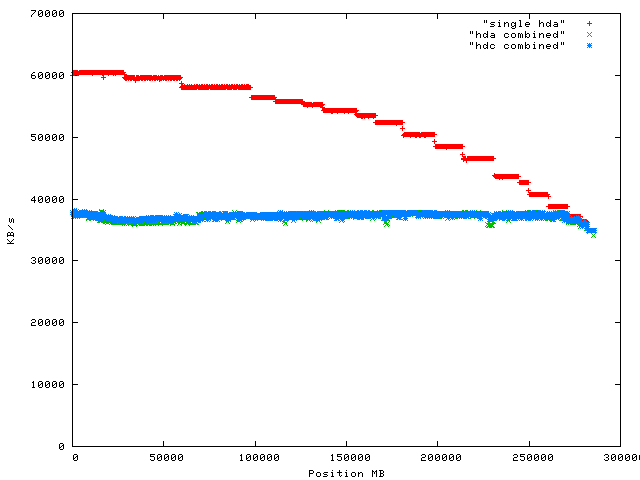
As correctly pointed out by cmot [1] my previous post about software RAID [2] made no mention of bus bandwidth. I have measured the bus bottlenecks of a couple of desktop machines running IDE disks with my ZCAV [3] benchmark (part of the Bonnie++ suite). The results show that two typical desktop machines had significant bottlenecks when running two disks for contiguous read operations [4]. Here is one of the graphs which shows that when two disks were active (on different IDE cables) the aggregate throughput was just under 80MB/s on a P4 1.5GHz while the disks were capable of delivering up to 120MB/s:
On a system such as the above P4 using software RAID will give a performance hit when compared to a hardware RAID device which is capable of driving both disks at full speed. I did not benchmark the relative speeds of read and write operations (writing is often slightly slower), but if for the sake of discussion we assume that read and write give the same performance then software RAID would only give 2/3 the performance of a theoretical perfect hardware RAID-1 implementation for large contiguous writes. On a RAID-5 array the bandwidth for large contiguous writes is the data size multiplied by N/(N-1) (where N is the number of disks), and on a RAID-6 array it is N/(N-2). For the case of a four disk RAID-6 array that would give the same overhead as writing to a RAID-1 and for the case of a minimal RAID-5 array it would be 50% more writes. So from the perspective of “I need X bandwidth, can my hardware deliver it” if I needed 40MB/s of bandwidth for contiguous writes then a 3 disk RAID-5 might work but a RAID-1 definitely would hit a bottleneck. Given that large contiguous writes to a RAID-1 is a corner case and that minimal sized RAID-5 and RAID-6 arrays are rare in most cases there should not be a significant overhead. As the number of seeks increases the actual amount of data transferred gets quite small. A few years ago I was running some mail servers which had a very intense IO load, four U320 SCSI disks in a hardware RAID-5 array was a system bottleneck - yet the IO was only 600KB/s of reads and 3MB/s of writes. In that case seeks were the bottleneck and write-back caching (which is another problem area for Linux software RAID) was necessary for good performance. For the example of my P4 system, it is quite obvious that with a four disk software RAID array consisting of disks that are reasonably new (anything slightly newer than the machine) there would be some bottlenecks. Another problem with Linux software RAID is that traditionally it has had to check the consistency of the entire RAID array in the case of an unexpected power failure. Such checks are the best way to get all disks in a RAID array fully utilised (Linux software RAID does not support reading from all disks in a mirror and checking that they are consistent for regular reads), so of course the issue of a bus bottleneck becomes an issue. Of course the solution to these problems is to use a server for server tasks and then you will not run out of bus bandwidth so easily. In the days before PCI-X and PCIe there were people running Linux software RAID-0 across multiple 3ware hardware controllers to get better bandwidth. A good server will have multiple PCI buses so getting an aggregate throughput greater than PCI bus bandwidth is possible. Reports of 400MB/s transfer rates using two 64bit PCI buses (each limited to ~266MB/s) were not uncommon. Of course then you run into the same problem, but instead of being limited to the performance of IDE controllers on the motherboard in a desktop system (as in my test machine) you would be limited to the number of PCI buses and the speed of each bus. If you were to install enough disks to even come close to the performance limits of PCIe then I expect that you would find that the CPU utilisation for the XOR operations is something that you want to off-load. But then on such a system you would probably want the other benefits of hardware RAID (dynamic growth, having one RAID that has a number of LUNs exported to different machines, redundant RAID controllers in the same RAID box, etc). I think that probably 12 disks is about the practical limit of Linux software RAID due to these issues and the RAID check speed. But it should be noted that the vast majority of RAID installations have significantly less than 12 disks. One thing that cmot mentioned was a RAID controller that runs on the system bus and takes data from other devices on that bus. Does anyone know of such a device?

Benjamin Mako Hill: Free Culture Distilled for Free Software Folks

I've posted an an article on my website called Free Culture Advanced which I wrote for the last edition of the Free Software Foundation Members' Bulletin which went out several months ago. The bulletin is one of things you get when you become an associate member of the FSF. The article makes the case for free culture and a freedom definition in terms that are directed to and I hope will resonate with folks from the free software community. I've posted versions of the article in HTML, PDF, and LaTeX.

MJ Ray: ASTEFAQ: Will I get the BBC on the Costa Blanca with a small dish?

CHRISTOPHER MCKINLEY asked:
"I live on the costa blanca spain. I have been told that bbc and itv are to start broadcasting a free to air service which we will be adle to pick up on a small dish. It's scheduled to start in Feb/March 2008. Could you tell me if this is true?"
No, I can't tell whether that's true. The BBC/ITV Freesat service is expected to start in 2008 and I think March is meant to be when Channel 4's Sky encryption contract finishes, so I guess that's where that date comes from. That seems highly probable to me. Then again, Freesat has been advertised as launching in 2006 before. However, I doubt that BBC and ITV will move off of the Astra 2D spot beam that they moved to when they went free-to-air and back to the wider beams needed for small dish reception on the Costa Blanca. So, it will still not work for you. Sorry. (I'm not too cross about that, because the main terrestial Spanish channels seem to be encrypted on satellite.)

Mart&iacute;n Ferrari: The times they are a-changin'

I had lost interest in the DM thing. Since August, when I asked for advocacies, those were posted to the newmaint list, and then nothing happened. Also, since a few days ago my NM process is running again, and there was the questioning about people becoming DM when they're close to finishing NM. Today, Gunnar sent a mail encouraging people in the Perl group to become DM, and I answered with those arguments. To my surprise, Joey Hess contacted me to tell me that my application ahd slipped under the radar for being too early and that I could be added now to the keyring. So I gathered all the required data and sent a bug report. A couple of hours later this message surprised me to no end: I am already a Debian Maintainer!!111one!! I must say that I'm completely stunned, I'd have expected to wait a couple of weeks, or months... This feels so... un-debian! :) I very happy for two reasons: obviously because now I can upload my own packages, but also because maybe this can finally make a difference for Debian. Thanks to everybody who has helped this to happen, and hope that more good changes are on our way! Now, if you excuse me, I'll have a beer to celebrate. Tomorrow I will start pestering my sponsors for their last sponsored uploads :) Tags: Planet Debian, Planeta Debian, Planet Lugfi, Debian

Next.

Previous.


