Search Results: "zed"

27 July 2015

Michael Stapelberg: dh-make-golang: creating Debian packages from Go packages

Recently, the pkg-go team has been quite busy, uploading dozens of Go library packages in order to be able to package gcsfuse (a user-space file system for interacting with Google Cloud Storage) and InfluxDB (an open-source distributed time series database). Packaging Go library packages (!) is a fairly repetitive process, so before starting my work on the dependencies for gcsfuse, I started writing a tool called dh-make-golang. Just like dh-make itself, the goal is to automatically create (almost) an entire Debian package. As I worked my way through the dependencies of gcsfuse, I refined how the tool works, and now I believe it s good enough for a first release. To demonstrate how the tool works, let s assume we want to package the Go library github.com/jacobsa/ratelimit:
midna /tmp $ dh-make-golang github.com/jacobsa/ratelimit
2015/07/25 18:25:39 Downloading "github.com/jacobsa/ratelimit/..."
2015/07/25 18:25:53 Determining upstream version number
2015/07/25 18:25:53 Package version is "0.0~git20150723.0.2ca5e0c"
2015/07/25 18:25:53 Determining dependencies
2015/07/25 18:25:55 
2015/07/25 18:25:55 Packaging successfully created in /tmp/golang-github-jacobsa-ratelimit
2015/07/25 18:25:55 
2015/07/25 18:25:55 Resolve all TODOs in itp-golang-github-jacobsa-ratelimit.txt, then email it out:
2015/07/25 18:25:55     sendmail -t -f < itp-golang-github-jacobsa-ratelimit.txt
2015/07/25 18:25:55 
2015/07/25 18:25:55 Resolve all the TODOs in debian/, find them using:
2015/07/25 18:25:55     grep -r TODO debian
2015/07/25 18:25:55 
2015/07/25 18:25:55 To build the package, commit the packaging and use gbp buildpackage:
2015/07/25 18:25:55     git add debian && git commit -a -m 'Initial packaging'
2015/07/25 18:25:55     gbp buildpackage --git-pbuilder
2015/07/25 18:25:55 
2015/07/25 18:25:55 To create the packaging git repository on alioth, use:
2015/07/25 18:25:55     ssh git.debian.org "/git/pkg-go/setup-repository golang-github-jacobsa-ratelimit 'Packaging for golang-github-jacobsa-ratelimit'"
2015/07/25 18:25:55 
2015/07/25 18:25:55 Once you are happy with your packaging, push it to alioth using:
2015/07/25 18:25:55     git push git+ssh://git.debian.org/git/pkg-go/packages/golang-github-jacobsa-ratelimit.git --tags master pristine-tar upstream
The ITP is often the most labor-intensive part of the packaging process, because any number of auto-detected values might be wrong: the repository owner might not be the Upstream Author , the repository might not have a short description, the long description might need some adjustments or the license might not be auto-detected.
midna /tmp $ cat itp-golang-github-jacobsa-ratelimit.txt
From: "Michael Stapelberg" <stapelberg AT debian.org>
To: submit@bugs.debian.org
Subject: ITP: golang-github-jacobsa-ratelimit -- Go package for rate limiting
Content-Type: text/plain; charset=utf-8
Content-Transfer-Encoding: 8bit
Package: wnpp
Severity: wishlist
Owner: Michael Stapelberg <stapelberg AT debian.org>
* Package name    : golang-github-jacobsa-ratelimit
  Version         : 0.0~git20150723.0.2ca5e0c-1
  Upstream Author : Aaron Jacobs
* URL             : https://github.com/jacobsa/ratelimit
* License         : Apache-2.0
  Programming Lang: Go
  Description     : Go package for rate limiting
 GoDoc (https://godoc.org/github.com/jacobsa/ratelimit)
 .
 This package contains code for dealing with rate limiting. See the
 reference (http://godoc.org/github.com/jacobsa/ratelimit) for more info.
TODO: perhaps reasoning
midna /tmp $
After filling in all the TODOs in the file, let s mail it out and get a sense of what else still needs to be done:
midna /tmp $ sendmail -t -f < itp-golang-github-jacobsa-ratelimit.txt
midna /tmp $ cd golang-github-jacobsa-ratelimit
midna /tmp/golang-github-jacobsa-ratelimit master $ grep -r TODO debian
debian/changelog:  * Initial release (Closes: TODO) 
midna /tmp/golang-github-jacobsa-ratelimit master $
After filling in these TODOs as well, let s have a final look at what we re about to build:
midna /tmp/golang-github-jacobsa-ratelimit master $ head -100 debian/**/*
==> debian/changelog <==                            
golang-github-jacobsa-ratelimit (0.0~git20150723.0.2ca5e0c-1) unstable; urgency=medium
  * Initial release (Closes: #793646)
 -- Michael Stapelberg <stapelberg@debian.org>  Sat, 25 Jul 2015 23:26:34 +0200
==> debian/compat <==
9
==> debian/control <==
Source: golang-github-jacobsa-ratelimit
Section: devel
Priority: extra
Maintainer: pkg-go <pkg-go-maintainers@lists.alioth.debian.org>
Uploaders: Michael Stapelberg <stapelberg@debian.org>
Build-Depends: debhelper (>= 9),
               dh-golang,
               golang-go,
               golang-github-jacobsa-gcloud-dev,
               golang-github-jacobsa-oglematchers-dev,
               golang-github-jacobsa-ogletest-dev,
               golang-github-jacobsa-syncutil-dev,
               golang-golang-x-net-dev
Standards-Version: 3.9.6
Homepage: https://github.com/jacobsa/ratelimit
Vcs-Browser: http://anonscm.debian.org/gitweb/?p=pkg-go/packages/golang-github-jacobsa-ratelimit.git;a=summary
Vcs-Git: git://anonscm.debian.org/pkg-go/packages/golang-github-jacobsa-ratelimit.git
Package: golang-github-jacobsa-ratelimit-dev
Architecture: all
Depends: $ shlibs:Depends ,
         $ misc:Depends ,
         golang-go,
         golang-github-jacobsa-gcloud-dev,
         golang-github-jacobsa-oglematchers-dev,
         golang-github-jacobsa-ogletest-dev,
         golang-github-jacobsa-syncutil-dev,
         golang-golang-x-net-dev
Built-Using: $ misc:Built-Using 
Description: Go package for rate limiting
 This package contains code for dealing with rate limiting. See the
 reference (http://godoc.org/github.com/jacobsa/ratelimit) for more info.
==> debian/copyright <==
Format: http://www.debian.org/doc/packaging-manuals/copyright-format/1.0/
Upstream-Name: ratelimit
Source: https://github.com/jacobsa/ratelimit
Files: *
Copyright: 2015 Aaron Jacobs
License: Apache-2.0
Files: debian/*
Copyright: 2015 Michael Stapelberg <stapelberg@debian.org>
License: Apache-2.0
Comment: Debian packaging is licensed under the same terms as upstream
License: Apache-2.0
 Licensed under the Apache License, Version 2.0 (the "License");
 you may not use this file except in compliance with the License.
 You may obtain a copy of the License at
 .
 http://www.apache.org/licenses/LICENSE-2.0
 .
 Unless required by applicable law or agreed to in writing, software
 distributed under the License is distributed on an "AS IS" BASIS,
 WITHOUT WARRANTIES OR CONDITIONS OF ANY KIND, either express or implied.
 See the License for the specific language governing permissions and
 limitations under the License.
 .
 On Debian systems, the complete text of the Apache version 2.0 license
 can be found in "/usr/share/common-licenses/Apache-2.0".
==> debian/gbp.conf <==
[DEFAULT]
pristine-tar = True
==> debian/rules <==
#!/usr/bin/make -f
export DH_GOPKG := github.com/jacobsa/ratelimit
%:
	dh $@ --buildsystem=golang --with=golang
==> debian/source <==
head: error reading  debian/source : Is a directory
==> debian/source/format <==
3.0 (quilt)
midna /tmp/golang-github-jacobsa-ratelimit master $
Okay, then. Let s give it a shot and see if it builds:
midna /tmp/golang-github-jacobsa-ratelimit master $ git add debian && git commit -a -m 'Initial packaging'
[master 48f4c25] Initial packaging                                                      
 7 files changed, 75 insertions(+)
 create mode 100644 debian/changelog
 create mode 100644 debian/compat
 create mode 100644 debian/control
 create mode 100644 debian/copyright
 create mode 100644 debian/gbp.conf
 create mode 100755 debian/rules
 create mode 100644 debian/source/format
midna /tmp/golang-github-jacobsa-ratelimit master $ gbp buildpackage --git-pbuilder
[ ]
midna /tmp/golang-github-jacobsa-ratelimit master $ lintian ../golang-github-jacobsa-ratelimit_0.0\~git20150723.0.2ca5e0c-1_amd64.changes
I: golang-github-jacobsa-ratelimit source: debian-watch-file-is-missing
P: golang-github-jacobsa-ratelimit-dev: no-upstream-changelog
I: golang-github-jacobsa-ratelimit-dev: extended-description-is-probably-too-short
midna /tmp/golang-github-jacobsa-ratelimit master $
This package just built (as it should!), but occasionally one might need to disable a test and file an upstream bug about it. So, let s push this package to pkg-go and upload it:
midna /tmp/golang-github-jacobsa-ratelimit master $ ssh git.debian.org "/git/pkg-go/setup-repository golang-github-jacobsa-ratelimit 'Packaging for golang-github-jacobsa-ratelimit'"
Initialized empty shared Git repository in /srv/git.debian.org/git/pkg-go/packages/golang-github-jacobsa-ratelimit.git/
HEAD is now at ea6b1c5 add mrconfig for dh-make-golang
[master c5be5a1] add mrconfig for golang-github-jacobsa-ratelimit
 1 file changed, 3 insertions(+)
To /git/pkg-go/meta.git
   ea6b1c5..c5be5a1  master -> master
midna /tmp/golang-github-jacobsa-ratelimit master $ git push git+ssh://git.debian.org/git/pkg-go/packages/golang-github-jacobsa-ratelimit.git --tags master pristine-tar upstream
Counting objects: 31, done.
Delta compression using up to 8 threads.
Compressing objects: 100% (25/25), done.
Writing objects: 100% (31/31), 18.38 KiB   0 bytes/s, done.
Total 31 (delta 2), reused 0 (delta 0)
To git+ssh://git.debian.org/git/pkg-go/packages/golang-github-jacobsa-ratelimit.git
 * [new branch]      master -> master
 * [new branch]      pristine-tar -> pristine-tar
 * [new branch]      upstream -> upstream
 * [new tag]         upstream/0.0_git20150723.0.2ca5e0c -> upstream/0.0_git20150723.0.2ca5e0c
midna /tmp/golang-github-jacobsa-ratelimit master $ cd ..
midna /tmp $ debsign golang-github-jacobsa-ratelimit_0.0\~git20150723.0.2ca5e0c-1_amd64.changes
[ ]
midna /tmp $ dput golang-github-jacobsa-ratelimit_0.0\~git20150723.0.2ca5e0c-1_amd64.changes   
Uploading golang-github-jacobsa-ratelimit using ftp to ftp-master (host: ftp.upload.debian.org; directory: /pub/UploadQueue/)
[ ]
Uploading golang-github-jacobsa-ratelimit_0.0~git20150723.0.2ca5e0c-1.dsc
Uploading golang-github-jacobsa-ratelimit_0.0~git20150723.0.2ca5e0c.orig.tar.bz2
Uploading golang-github-jacobsa-ratelimit_0.0~git20150723.0.2ca5e0c-1.debian.tar.xz
Uploading golang-github-jacobsa-ratelimit-dev_0.0~git20150723.0.2ca5e0c-1_all.deb
Uploading golang-github-jacobsa-ratelimit_0.0~git20150723.0.2ca5e0c-1_amd64.changes
midna /tmp $ cd golang-github-jacobsa-ratelimit 
midna /tmp/golang-github-jacobsa-ratelimit master $ git tag debian/0.0_git20150723.0.2ca5e0c-1
midna /tmp/golang-github-jacobsa-ratelimit master $ git push git+ssh://git.debian.org/git/pkg-go/packages/golang-github-jacobsa-ratelimit.git --tags master pristine-tar upstream
Total 0 (delta 0), reused 0 (delta 0)
To git+ssh://git.debian.org/git/pkg-go/packages/golang-github-jacobsa-ratelimit.git
 * [new tag]         debian/0.0_git20150723.0.2ca5e0c-1 -> debian/0.0_git20150723.0.2ca5e0c-1
midna /tmp/golang-github-jacobsa-ratelimit master $
Thanks for reading this far, and I hope dh-make-golang makes your life a tiny bit easier. As dh-make-golang just entered Debian unstable, you can install it using apt-get install dh-make-golang. If you have any feedback, I m eager to hear it.

Dirk Eddelbuettel: Evading the "Hadley tax": Faster Travis tests for R

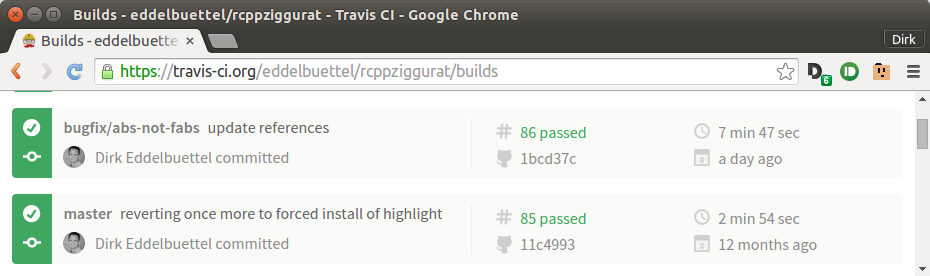
Hadley is a popular figure, and rightly so as he successfully introduced many newcomers to the wonders offered by R. His approach strikes some of us old greybeards as wrong---I particularly take exception with some of his writing which frequently portrays a particular approach as both the best and only one. Real programming, I think, is often a little more nuanced and aware of tradeoffs which need to be balanced. As a book on another language once popularized: "There is more than one way to do things." But let us leave this discussion for another time. As the reach of the Hadleyverse keeps spreading, we sometimes find ourselves at the receiving end of a cost/benefit tradeoff. That is what this post is about, and it uses a very concrete case I encountered yesterday. As blogged earlier, the RcppZiggurat package was updated. I had not touched it in a year, but Brian Ripley had sent a brief and detailed note concerning something flagged by the Solaris compiler (correctly suggesting I replace fabs() with abs() on integer types). (Allow me to stray from the main story line here for a second to stress just how insane a work load he is carrying, essentially for all of us. R and the R community are so just so indebted to him for all his work---which makes the usual social media banter about him so unfortunate. But that too shall be left for another time.) Upon making the simple fix, and submitting to GitHub the usual Travis CI was triggered. And here is what I saw: first travis build in a year
All happy, all green. Previous build a year ago, most recent build yesterday, both passed. But hold on: test time went from 2:54 minutes to 7:47 minutes for an increase of almost five minutes! And I knew that I had not added any new dependencies, or altered any build options. What did happen was that among the dependencies of my package, one had decided to now also depend on ggplot2. Which leads to a chain of sixteen additional packages being loaded besides the four I depend upon---when it used to be just one. And that took five minutes as all those packages are installed from source, and some are big and take a long time to compile. There is however and easy alternative, and for that we have to praise Michael Rutter who looks after a number of things for R on Ubuntu. Among these are the R builds for Ubuntu but also the rrutter PPA as well as the c2d4u PPA. If you have not heard this alphabet soup before, a PPA is a package repository for Ubuntu where anyone (who wants to sign up) can upload (properly setup) source files which are then turned into Ubuntu binaries. With full dependency resolution and all other goodies we have come to expect from the Debian / Ubuntu universe. And Michael uses this facility with great skill and calm to provide us all with Ubuntu binaries for R itself (rebuilding what yours truly uploads into Debian), as well as a number of key packages available via the CRAN mirrors. Less know however is this "c2d4u" which stands for CRAN to Debian for Ubuntu. And this builds on something Charles Blundell once built under my mentorship in a Google Summer of Code. And Michael does a tremdous job covering well over a thousand CRAN source packages---and providing binaries for all. Which we can use for Travis! What all that means is that I could now replace the line
 - ./travis-tool.sh install_r RcppGSL rbenchmark microbenchmark highlight
which implies source builds of the four listed packages and all their dependencies with the following line implying binary installations of already built packages:
 - ./travis-tool.sh install_aptget libgsl0-dev r-cran-rcppgsl r-cran-rbenchmark r-cran-microbenchmark r-cran-highlight
In this particular case I also needed to build a binary package of my RcppGSL package as this one is not (yet) handled by Michael. I happen to have (re-)discovered the beauty of PPAs for Travis earlier this year and revitalized an older and largely dormant launchpad account I had for this PPA of mine. How to build a simple .deb package will also have to left for a future post to keep this more concise. This can be used with the existing r-travis setup---but one needs to use the older, initial variant in order to have the ability to install .deb packages. So in the .travis.yml of RcppZiggurat I just use
before_install:
## PPA for Rcpp and some other packages
- sudo add-apt-repository -y ppa:edd/misc
## r-travis by Craig Citro et al
- curl -OL http://raw.github.com/craigcitro/r-travis/master/scripts/travis-tool.sh
- chmod 755 ./travis-tool.sh
- ./travis-tool.sh bootstrap
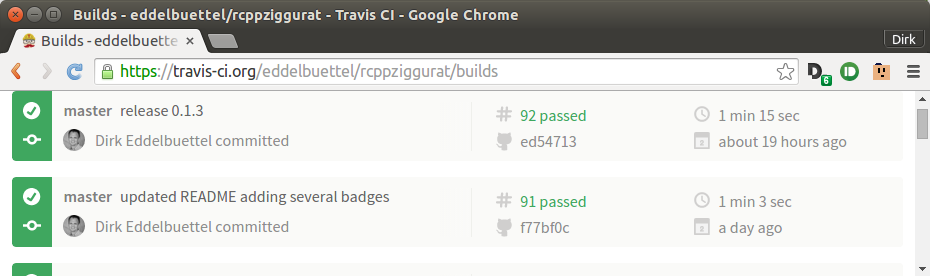
to add my own PPA and all is good. If you do not have a PPA, or do not want to create your own packages you can still benefit from the PPAs by Michael and "mix and match" by installing from binary what is available, and from source what is not. Here we were able to use an all-binary approach, so let's see the resulting performance: latest travis build
Now we are at 1:03 to 1:15 minutes---much better. So to conclude, while the every expanding universe of R packages is fantastic for us as users, it can be seen to be placing a burden on us as developers when installing and testing. Fortunately, the packaging infrastructure built on top of Debian / Ubuntu packages can help and dramatically reduce build (and hence test) times. Learning about PPAs can be a helpful complement to learning about Travis and continued integration. So maybe now I need a new reason to blame Hadley? Well, there is always snake case ...

Follow-up: The post got some pretty immediate feedback shortly after I posted it. Craig Citro pointed out (quite correctly) that I could use r_binary_install which would also install the Ubuntu binaries based on their R packages names. Having built R/CRAN packages for Debian for so long, I am simply more used to the r-cran-* notations, and I think I was also the one contributing install_aptget to r-travis ... Yihui Xie spoke up for the "new" Travis approach deploying containers, caching of packages and explicit whitelists. It was in that very (GH-based) discussion that I started to really lose faith in the new Travis approach as they want use to whitelist each and every package. With 6900 and counting at CRAN I fear this simply does not scale. But different approaches are certainly welcome. I posted my 1:03 to 1:15 minutes result. If the "New School" can do it faster, I'd be all ears.

This post by Dirk Eddelbuettel originated on his Thinking inside the box blog. Please report excessive re-aggregation in third-party for-profit settings.

26 July 2015

Gregor Herrmann: RC bugs 2015/30

this week, besides other activities, I again managed to NMU a few packages as part of the GCC 5 transition. & again I could build on patches submitted by various HP engineers & other helpful souls.

25 July 2015

Steve Kemp: We're in Finland now.

So we've recently spent our first week together in Helsinki, Finland. Mostly this has been stress-free, but there are always oddities about living in new places, and moving to Europe didn't minimize them. For the moment I'll gloss over the differences and instead document the computer problem I had. Our previous shared-desktop system had a pair of drives configured using software RAID. I pulled one of the drives to use in a smaller-cased system (smaller so it was easier to ship). Only one drive of a pair being present make mdadm scream, via email, once per day, with reports of failure. The output of cat /proc/mdstat looked like this:
md2 : active raid1 sdb6[0] [LVM-storage-area]
      1903576896 blocks super 1.2 2 near-copies [2/1] [_U]
md1 : active raid10 sdb5[1] [/root]
      48794112 blocks super 1.2 2 near-copies [2/1] [_U]
md0 : active raid1 sdb1[0]  [/boot]
      975296 blocks super 1.2 2 near-copies [2/1] [_U]
See the "_" there? That's the missing drive. I couldn't remove the drive as it wasn't present on-disk, so this failed:
mdadm --fail   /dev/md0 /dev/sda1
mdadm --remove /dev/md0 /dev/sda1
# repeat for md1, md2.
Similarly removing all "detached" drives failed, so the only thing to do was to mess around re-creating the arrays with a single drive:
lvchange -a n shelob-vol
mdadm --stop /dev/md2
mdadm --create /dev/md2 --level=1 --raid-devices=1 /dev/sdb6 --force
..
I did that on the LVM-storage area, and the /boot partition, but "/" is still to be updated. I'll use knoppix/similar to do it next week. That'll give me a "RAID" system which won't alert every day. Thanks to the joys of re-creation the UUIDs of the devices changed, so /etc/mdadm/mdadm.conf needed updating. I realized that too late, when grub failed to show the menu, because it didn't find it's own UUID. Handy recipe for the future:
set prefix=(md/0)/grub/
insmod linux
linux (md/0)/vmlinuz-3.16.0-0.bpo.4-amd64 root=/dev/md1
initrd (md/0)//boot/initrd.img-3.16.0-0.bpo.4-amd64
boot

21 July 2015

Dmitry Shachnev: GNOME Flashback 3.16 available in archive, needs your help

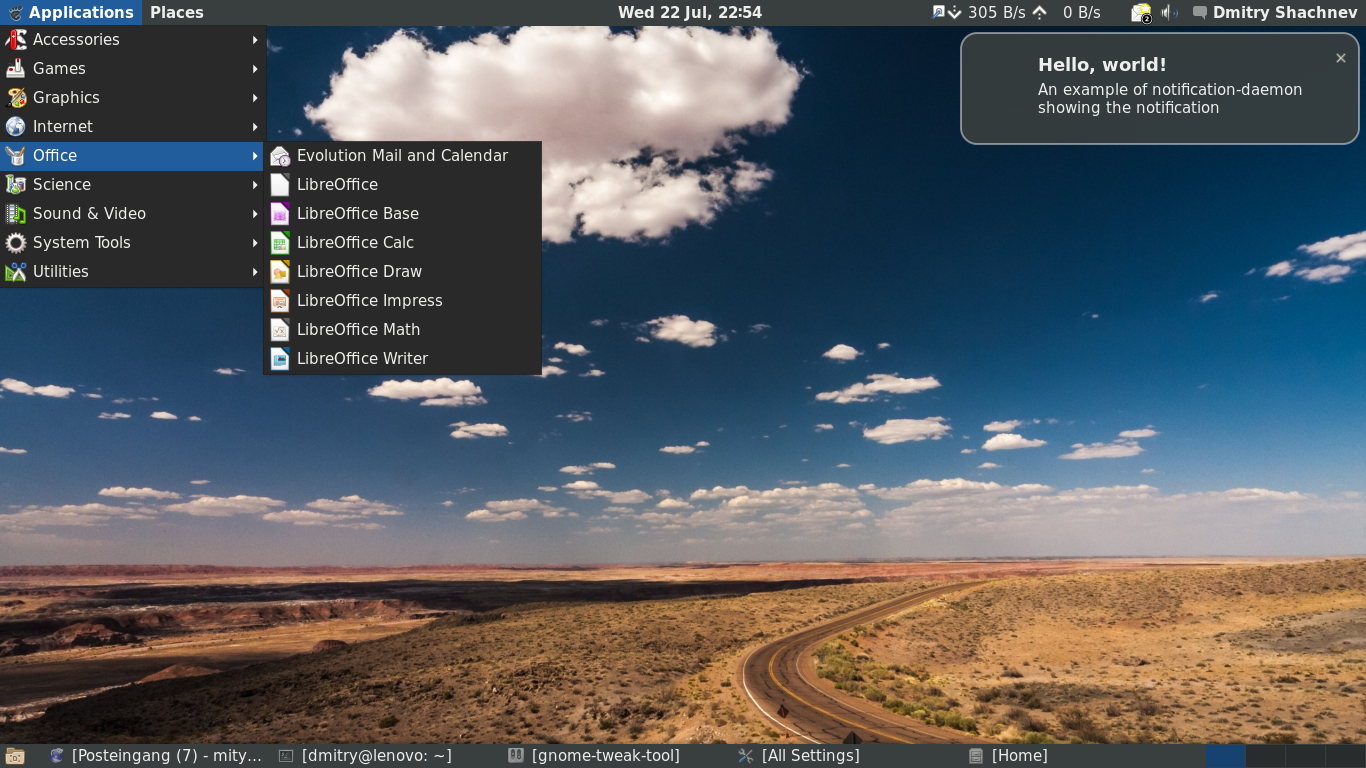
Some time ago GNOME Flashback 3.16/3.17 packages landed in Debian testing and Ubuntu wily. GNOME Flashback is the project which continues the development of components of classic GNOME session, including the GNOME Panel, the Metacity window manager, and so on. Screenshot The full changelog can be found in official announcement mail by Alberts and in changelog.gz files in each package, but I want to list the most imporant improvements in this release (compared to 3.14): Sounds interesting? Contribute! If you are interested in helping us, please write to our mailing list: gnome-flashback-list@gnome.org. The current TODO list is:

  1. Notification Daemon needs GTK notification support.
  2. GNOME Flashback needs screenshot, screencast, keyboard layout switching and bluetooth status icon.
  3. Fix/replace deprecated function usage in all modules.
  4. libstatus-notifier get it in usable state, create a new applet for gnome-panel.

20 July 2015

Niels Thykier: Performance tuning of lintian, take 2

The other day, I wrote about our recent performance tuning in lintian. Among other things, we reduced the memory usage by ~33%. The effect was also reproducible on libreoffice (4.2.5-1 plus its 170-ish binaries, arch amd64), which started at ~515 MB and was reduced to ~342 MB. So this is pretty great in its own right But at this point, I have seen what was in Pandora s box . By which, I mean the two magical numbers 1.7kB per file and 2.2kB per directory in the package (add +250-300 bytes per entry in binary packages). This is before even looking at data from file(1), readelf, etc. Just the raw index of the package. Depending on your point of view, 1.7-2.2kB might not sound like a lot. But for the lintian source with ~1 500 directories and ~3 300 non-directories, this sums up to about 6.57MB out of the (then) usage at 12.53MB. With the recent changes, it dropped to about 1.05kB for files and 1.5kB for dirs. But even then, the index is still 4.92MB (out of 8.48MB). This begs the question, what do you get for 1.05kB in perl? The following is a dump of the fields and their size in perl for a given entry:
lintian/vendors/ubuntu/main/data/changes-file/known-dists: 1077.00 B
  _path_info: 24.00 B
  date: 44.00 B
  group: 42.00 B
  name: 123.00 B
  owner: 42.00 B
  parent_dir: 24.00 B
  size: 42.00 B
  time: 42.00 B
  (overhead): 694.00 B
With time, date, owner and group being fixed sized strings (at most 15 characters). The size and _path_info fields being integers, parent_dir a reference (nulled). Finally, the name being a variable length string. Summed the values take less than half of the total object size. The remainder of ~700 bytes is just overhead . Time for another clean up: Which leaves us now with:
lintian/vendors/ubuntu/main/data/changes-file/known-dists: 698.00 B
  _path_info: 24.00 B
  date_time: 56.00 B
  name: 123.00 B
  parent_dir: 24.00 B
  size: 24.00 B
  (overhead): 447.00 B
Still a ~64% overhead, but at least we reduced the total size by 380 bytes (585 bytes for entries in binary packages). With these changes, the memory used for the lintian source index is now down to 3.62MB. This brings the total usage down to 7.01MB, which is a reduction to 56% of the original usage (a.k.a. the-almost-but-not-quite-50%-reduction ). But at least the results also carried over to libreoffice, which is now down to 284.83 MB (55% of original). The chromium-browser (source-only, version 32.0.1700.123-2) is down to 111.22MB from 179.44MB (61% of original, better results expected if processed with binaries). In closing, Lintian 2.5.34 will use slightly less memory than 2.5.33.
Filed under: Debian, Lintian

Daniel Pocock: RTC status on Debian, Ubuntu and Fedora

Zoltan (Zoltanh721) recently blogged about WebRTC for the Fedora community and Fedora desktop. https://fedrtc.org has been running for a while now and this has given many people a chance to get a taste of regular SIP and WebRTC-based SIP. As suggested in Zoltan's blog, it has convenient integration with Fedora SSO and as the source code is available, people are welcome to see how it was built and use it for other projects. Issues with Chrome/Chromium on Linux If you tried any of FedRTC.org, rtc.debian.org or meet.jit.si using Chrome/Chromium on Linux, you may have found that the call appears to be connected but there is no media. This is a bug and the Chromium developers are on to it. You can work around this by trying an older version of Chromium (it still works with v37 from Debian wheezy) or Firefox/Iceweasel. WebRTC is not everything WebRTC offers many great possibilities for people to quickly build and deploy RTC services to a large user base, especially when using components like JSCommunicator or the DruCall WebRTC plugin for Drupal. However, it is not a silver bullet. For example, there remain concerns about how to receive incoming calls. How do you know which browser tab is ringing when you have many tabs open at once? This may require greater browser/desktop integration and that has security implications for JavaScript. Whether users on battery-powered devices can really leave JavaScript running for extended periods of time waiting for incoming calls is another issue, especially when you consider that many web sites contain some JavaScript that is less than efficient. Native applications and mobile apps like Lumicall continue to offer the most optimized solution for each platform although WebRTC currently offers the most convenient way for people to place a Call me link on their web site or portal. Deploy it yourself The RTC Quick Start Guide offers step-by-step instructions and a thorough discussion of the architecture for people to start deploying RTC and WebRTC on their own servers using standard packages on many of the most popular Linux distributions, including Debian, Ubuntu, RHEL, CentOS and Fedora.

Ritesh Raj Sarraf: Micro DD meetup

A couple of us DDs met here on the weekend. It is always a fun time, being part of these meetings. We talked briefly about the status of Cross Compilation in Debian, on the tools that simplify the process. Next we touched upon licensing, discussing the benefits of particular licenses (BSD, Apache, GPL) from the point of view of the consumer. The consumer being an individual just wanting to use/improve software, to a consumer who's building a (free / non-free) product on top of it. I think the overall conclusion was that there are 2 major licenses at a high level: Ones those allow you take the code and not give back, and the others which allow you to take code only if you are ready to share the enhancements back and forward. Next we briefly touched upon systemd. Given that I recently spent a good amount of time talking to the systemd maintainer while fixing bugs in my software, it was natural for me to steer that topic. At the end, more people are now enthused to learn the paradigm shift. The other topic where we spent time was on Containers. It is impressive to see how quick, and how many, products have now spun out of cgroups. The topic moved to cgroups, thanks to systemd, one of the prime consumers of cgroups. While demonstrating the functionalities of Linux Containers (LXC), I realized that systemd has a tool in place to serve the same use case. So, once back home, I spent some time figuring out the possibility to replace my lxc setup, with that of systemd-nspawn. Apart from a minor bug, almost everything else seems to work find with systemd-nspawn. So, following is the config detail of my container, as used in lxc. And to replace lxc, I need to fill is almost all of it with systemd-nspawn.
rrs@learner:~$ sudo cat /var/lib/lxc/deb-template/config
# Template used to create this container: /usr/share/lxc/templates/lxc-debian
# Parameters passed to the template:
# For additional config options, please look at lxc.container.conf(5)
# CPU
lxc.cgroup.cpuset.cpus = 0,1
lxc.cgroup.cpu.shares = 1234
# Mem
lxc.cgroup.memory.limit_in_bytes = 2000M
lxc.cgroup.memory.soft_limit_in_bytes = 1500M
# Network
lxc.network.type = veth
lxc.network.hwaddr = 00:16:3e:0c:c5:d4
lxc.network.flags = up
lxc.network.link = lxcbr0
# Root file system
lxc.rootfs = /var/lib/lxc/deb-template/rootfs
# Common configuration
lxc.include = /usr/share/lxc/config/debian.common.conf
# Container specific configuration
lxc.mount = /var/lib/lxc/deb-template/fstab
lxc.utsname = deb-template
lxc.arch = amd64
# For apt
lxc.mount.entry = /var/cache/apt/archives var/cache/apt/archives none defaults,bind 0 0
lxc.mount.entry = /var/tmp/lxc var/tmp/lxc none defaults,bind 0 0
2015-07-20 / 16:28:58         
The equivalent of the above, in systemd-nspawn is:
sudo systemd-nspawn -n -b --machine deb-template --network-bridge=lxcbr0 --bind /var/cache/apt/archives/
The only missing bit is CPU and Memory, which I'm yet to try, is documented as doable with the systemctl --property= interface
      --property=
           Set a unit property on the scope unit to register for the machine. This only
           applies if the machine is run in its own scope unit, i.e. if --keep-unit is not
           used. Takes unit property assignments in the same format as systemctl
           set-property. This is useful to set memory limits and similar for machines.
With all this in place, using containers under systemd is a breeze.
rrs@learner:~/Community/Packaging/multipath-tools (experimental)$ sudo machinectl list
MACHINE      CLASS     SERVICE
deb-template container nspawn
1 machines listed.
2015-07-20 / 16:44:07         
rrs@learner:~/Community/Packaging/multipath-tools (experimental)$ sudo machinectl status deb-template
deb-template
           Since: Mon 2015-07-20 16:13:58 IST; 30min ago
          Leader: 9064 (systemd)
         Service: nspawn; class container
            Root: /var/lib/lxc/deb-template/rootfs
           Iface: lxcbr0
         Address: 172.16.10.12
                  fe80::706d:e4ff:fec5:bfc8%3
              OS: Debian GNU/Linux stretch/sid
            Unit: machine-deb\x2dtemplate.scope
                   9064 /lib/systemd/systemd --system --deserialize 14
                   system.slice
                     systemd-journald.service
                       9092 /lib/systemd/systemd-journald
                     ssh.service
                       9160 /usr/sbin/sshd -D
                     console-getty.service
                       9166 /bin/login --     
                       9171 -bash
                       9226 dhclient host0
Jul 20 16:13:58 learner systemd[1]: Started Container deb-template.
Jul 20 16:13:58 learner systemd[1]: Starting Container deb-template.
2015-07-20 / 16:44:15         

Categories:

Keywords:

Like:

18 July 2015

John Goerzen: True Things About Learning to Fly

I ve been pretty quiet for the last few months because I m learning to fly. I want to start with a few quotes about aviation. I have heard things like these from many people and can vouch for their accuracy:
Anyone can learn to fly. Learning to fly is one of the hardest things you ll ever do. It is totally worth it. Being a pilot will give you a new outlook on life. You ll be amazed at what radios do a 3000ft. Have you ever had an 3000-foot antenna tower? The world is glorious at 1000ft up. Share your enthusiasm with those around you. You have a perspective very few ever see, except for a few seconds on the way to 35,000ft.
Earlier this month, I flew solo for the first time the biggest milestone on the way to getting the pilot s license. Here s a photo my flight instructor took as I was coming in to land that day. landing Today I took my first flight to another airport. It wasn t far about 20 miles away but it was still a thrill. I flew about 1500ft above the ground, roughly above a freeway that happened to be my route. From that height, things still look three-dimensional. The grain elevator that marked out the one small town, the manufacturing plant at another, the college at the third. Bales of hay dotting the fields, the occasional tractor creeping along a road, churches sticking up above the trees. These are places I ve known for decades, and now, suddenly, they are all new. What a time to be alive! I am glad that our world is still so full of wonder and beauty.

16 July 2015

Norbert Preining: Recent silence scientific freak weeks

If you wonder why it was so silent here over the last weeks, there is a simple explanation: I am on scientific freak weeks  As you might know, in my main profession I am logician, mathematician, computer scientist at the Japan Advanced Institute of Science and Technology (btw, searching urgently for a new job, in case someone is interested!!!). purity The last weeks have been very busy with attenting and presenting at LICS 2015 (Logic in Computer Science), followed by a workshop on Proofs as Processes organized by myself, then a presentation at CCA 2015 (Conference on Computability and Complexity in Analysis), and now working with visitors on our hyper natural deduction system. Above all that, there is also my lecture on Logical Decision Procedures at JAIST that a colleague and I a creating on the fly. All in all a very busy July, but I hope that after the weekend, and another workshop at JAIST, things settle down around beginning of August.
Email this to someonePrint this pageShare on FacebookShare on Google+Tweet about this on TwitterShare on LinkedInFlattr the author

12 July 2015

Dirk Eddelbuettel: RcppRedis 0.1.4

A small update to RcppRedis arrived on CRAN a few days ago. One of the unit tests failed as we (still) initialized the rredis package (loaded only for a comparison) in a form long-internalized by Bryan Lewis, its author. No actual changes to functionality were; the only other changes is cosmetic and in response a R CMD check requirement where the curl binary seemingly fails to follow redirects so we removed the (official !) redis.io URL.
Changes in version 0.1.4 (2015-07-04)
  • Minor update to unit test setup for rredis.
  • No longer list URLs to Redis as automated CRAN tests for URL validity choke on redirects.
Courtesy of CRANberries, there is also a diffstat report for the most recent release. More information is on the RcppRedis page.

This post by Dirk Eddelbuettel originated on his Thinking inside the box blog. Please report excessive re-aggregation in third-party for-profit settings.

7 July 2015

Petter Reinholdtsen: MPEG LA on "Internet Broadcast AVC Video" licensing and non-private use

After asking the Norwegian Broadcasting Company (NRK) why they can broadcast and stream H.264 video without an agreement with the MPEG LA, I was wiser, but still confused. So I asked MPEG LA if their understanding matched that of NRK. As far as I can tell, it does not. I started by asking for more information about the various licensing classes and what exactly is covered by the "Internet Broadcast AVC Video" class that NRK pointed me at to explain why NRK did not need a license for streaming H.264 video:
According to a MPEG LA press release dated 2010-02-02, there is no charge when using MPEG AVC/H.264 according to the terms of "Internet Broadcast AVC Video". I am trying to understand exactly what the terms of "Internet Broadcast AVC Video" is, and wondered if you could help me. What exactly is covered by these terms, and what is not? The only source of more information I have been able to find is a PDF named AVC Patent Portfolio License Briefing, which states this about the fees:
  • Where End User pays for AVC Video
    • Subscription (not limited by title) 100,000 or fewer subscribers/yr = no royalty; > 100,000 to 250,000 subscribers/yr = $25,000; >250,000 to 500,000 subscribers/yr = $50,000; >500,000 to 1M subscribers/yr = $75,000; >1M subscribers/yr = $100,000
    • Title-by-Title - 12 minutes or less = no royalty; >12 minutes in length = lower of (a) 2% or (b) $0.02 per title
  • Where remuneration is from other sources
    • Free Television - (a) one-time $2,500 per transmission encoder or (b) annual fee starting at $2,500 for > 100,000 HH rising to maximum $10,000 for >1,000,000 HH
    • Internet Broadcast AVC Video (not title-by-title, not subscription) no royalty for life of the AVC Patent Portfolio License
Am I correct in assuming that the four categories listed is the categories used when selecting licensing terms, and that "Internet Broadcast AVC Video" is the category for things that do not fall into one of the other three categories? Can you point me to a good source explaining what is ment by "title-by-title" and "Free Television" in the license terms for AVC/H.264? Will a web service providing H.264 encoded video content in a "video on demand" fashing similar to Youtube and Vimeo, where no subscription is required and no payment is required from end users to get access to the videos, fall under the terms of the "Internet Broadcast AVC Video", ie no royalty for life of the AVC Patent Portfolio license? Does it matter if some users are subscribed to get access to personalized services? Note, this request and all answers will be published on the Internet.
The answer came quickly from Benjamin J. Myers, Licensing Associate with the MPEG LA:
Thank you for your message and for your interest in MPEG LA. We appreciate hearing from you and I will be happy to assist you. As you are aware, MPEG LA offers our AVC Patent Portfolio License which provides coverage under patents that are essential for use of the AVC/H.264 Standard (MPEG-4 Part 10). Specifically, coverage is provided for end products and video content that make use of AVC/H.264 technology. Accordingly, the party offering such end products and video to End Users concludes the AVC License and is responsible for paying the applicable royalties. Regarding Internet Broadcast AVC Video, the AVC License generally defines such content to be video that is distributed to End Users over the Internet free-of-charge. Therefore, if a party offers a service which allows users to upload AVC/H.264 video to its website, and such AVC Video is delivered to End Users for free, then such video would receive coverage under the sublicense for Internet Broadcast AVC Video, which is not subject to any royalties for the life of the AVC License. This would also apply in the scenario where a user creates a free online account in order to receive a customized offering of free AVC Video content. In other words, as long as the End User is given access to or views AVC Video content at no cost to the End User, then no royalties would be payable under our AVC License. On the other hand, if End Users pay for access to AVC Video for a specific period of time (e.g., one month, one year, etc.), then such video would constitute Subscription AVC Video. In cases where AVC Video is delivered to End Users on a pay-per-view basis, then such content would constitute Title-by-Title AVC Video. If a party offers Subscription or Title-by-Title AVC Video to End Users, then they would be responsible for paying the applicable royalties you noted below. Finally, in the case where AVC Video is distributed for free through an "over-the-air, satellite and/or cable transmission", then such content would constitute Free Television AVC Video and would be subject to the applicable royalties. For your reference, I have attached a .pdf copy of the AVC License. You will find the relevant sublicense information regarding AVC Video in Sections 2.2 through 2.5, and the corresponding royalties in Section 3.1.2 through 3.1.4. You will also find the definitions of Title-by-Title AVC Video, Subscription AVC Video, Free Television AVC Video, and Internet Broadcast AVC Video in Section 1 of the License. Please note that the electronic copy is provided for informational purposes only and cannot be used for execution. I hope the above information is helpful. If you have additional questions or need further assistance with the AVC License, please feel free to contact me directly.
Having a fresh copy of the license text was useful, and knowing that the definition of Title-by-Title required payment per title made me aware that my earlier understanding of that phrase had been wrong. But I still had a few questions:
I have a small followup question. Would it be possible for me to get a license with MPEG LA even if there are no royalties to be paid? The reason I ask, is that some video related products have a copyright clause limiting their use without a license with MPEG LA. The clauses typically look similar to this:
This product is licensed under the AVC patent portfolio license for the personal and non-commercial use of a consumer to (a) encode video in compliance with the AVC standard ("AVC video") and/or (b) decode AVC video that was encoded by a consumer engaged in a personal and non-commercial activity and/or AVC video that was obtained from a video provider licensed to provide AVC video. No license is granted or shall be implied for any other use. additional information may be obtained from MPEG LA L.L.C.
It is unclear to me if this clause mean that I need to enter into an agreement with MPEG LA to use the product in question, even if there are no royalties to be paid to MPEG LA. I suspect it will differ depending on the jurisdiction, and mine is Norway. What is MPEG LAs view on this?
According to the answer, MPEG LA believe those using such tools for non-personal or commercial use need a license with them:
With regard to the Notice to Customers, I would like to begin by clarifying that the Notice from Section 7.1 of the AVC License reads: THIS PRODUCT IS LICENSED UNDER THE AVC PATENT PORTFOLIO LICENSE FOR THE PERSONAL USE OF A CONSUMER OR OTHER USES IN WHICH IT DOES NOT RECEIVE REMUNERATION TO (i) ENCODE VIDEO IN COMPLIANCE WITH THE AVC STANDARD ("AVC VIDEO") AND/OR (ii) DECODE AVC VIDEO THAT WAS ENCODED BY A CONSUMER ENGAGED IN A PERSONAL ACTIVITY AND/OR WAS OBTAINED FROM A VIDEO PROVIDER LICENSED TO PROVIDE AVC VIDEO. NO LICENSE IS GRANTED OR SHALL BE IMPLIED FOR ANY OTHER USE. ADDITIONAL INFORMATION MAY BE OBTAINED FROM MPEG LA, L.L.C. SEE HTTP://WWW.MPEGLA.COM The Notice to Customers is intended to inform End Users of the personal usage rights (for example, to watch video content) included with the product they purchased, and to encourage any party using the product for commercial purposes to contact MPEG LA in order to become licensed for such use (for example, when they use an AVC Product to deliver Title-by-Title, Subscription, Free Television or Internet Broadcast AVC Video to End Users, or to re-Sell a third party's AVC Product as their own branded AVC Product). Therefore, if a party is to be licensed for its use of an AVC Product to Sell AVC Video on a Title-by-Title, Subscription, Free Television or Internet Broadcast basis, that party would need to conclude the AVC License, even in the case where no royalties were payable under the License. On the other hand, if that party (either a Consumer or business customer) simply uses an AVC Product for their own internal purposes and not for the commercial purposes referenced above, then such use would be included in the royalty paid for the AVC Products by the licensed supplier. Finally, I note that our AVC License provides worldwide coverage in countries that have AVC Patent Portfolio Patents, including Norway. I hope this clarification is helpful. If I may be of any further assistance, just let me know.
The mentioning of Norwegian patents made me a bit confused, so I asked for more information:
But one minor question at the end. If I understand you correctly, you state in the quote above that there are patents in the AVC Patent Portfolio that are valid in Norway. This make me believe I read the list available from <URL: http://www.mpegla.com/main/programs/AVC/Pages/PatentList.aspx > incorrectly, as I believed the "NO" prefix in front of patents were Norwegian patents, and the only one I could find under Mitsubishi Electric Corporation expired in 2012. Which patents are you referring to that are relevant for Norway?
Again, the quick answer explained how to read the list of patents in that list:
Your understanding is correct that the last AVC Patent Portfolio Patent in Norway expired on 21 October 2012. Therefore, where AVC Video is both made and Sold in Norway after that date, then no royalties would be payable for such AVC Video under the AVC License. With that said, our AVC License provides historic coverage for AVC Products and AVC Video that may have been manufactured or Sold before the last Norwegian AVC patent expired. I would also like to clarify that coverage is provided for the country of manufacture and the country of Sale that has active AVC Patent Portfolio Patents. Therefore, if a party offers AVC Products or AVC Video for Sale in a country with active AVC Patent Portfolio Patents (for example, Sweden, Denmark, Finland, etc.), then that party would still need coverage under the AVC License even if such products or video are initially made in a country without active AVC Patent Portfolio Patents (for example, Norway). Similarly, a party would need to conclude the AVC License if they make AVC Products or AVC Video in a country with active AVC Patent Portfolio Patents, but eventually Sell such AVC Products or AVC Video in a country without active AVC Patent Portfolio Patents.
As far as I understand it, MPEG LA believe anyone using Adobe Premiere and other video related software with a H.264 distribution license need a license agreement with MPEG LA to use such tools for anything non-private or commercial, while it is OK to set up a Youtube-like service as long as no-one pays to get access to the content. I still have no clear idea how this applies to Norway, where none of the patents MPEG LA is licensing are valid. Will the copyright terms take precedence or can those terms be ignored because the patents are not valid in Norway?

5 July 2015

Robert Edmonds: Git packaging workflow for py-lmdb

Recently, I packaged the py-lmdb Python binding for the LMDB database library. This package is going to be team maintained by the pkg-db group, which is responsible for maintaining BerkeleyDB and LMDB packages. Below are my notes on (re-)Debianizing this package and how the Git repository for the source package is laid out. The upstream py-lmdb developer has a Git-centric workflow. Development is done on the master branch, with regular releases done as fast-forward merges to the release branch. Release tags of the form py-lmdb_X.YZ are provided. The only tarballs provided are the ones that GitHub automatically generates from tags. Since these tarballs are synthetic and the content of these tarballs matches the content on the corresponding tag, we will ignore them in favor of using the release tags directly. (The --git-pristine-tar-commit option to gbp-buildpackage will be used so that .orig.tar.gz files can be replicated so that the Debian archive will accept subsequent uploads, but tarballs are otherwise irrelevant to our workflow.) To make it clear that the release tags come from upstream's repository, they should be prefixed with upstream/, which would preferably result in a DEP-14 compliant scheme. (Unfortunately, since upstream's release tags begin with py-lmdb_, this doesn't quite match the pattern that DEP-14 recommends.) Here is how the local packaging repository is initialized. Note that git clone isn't used, so that we can customize how the tags are fetched. Instead, we create an empty Git repository and add the upstream repository as the upstream remote. The --no-tags option is used, so that git fetch does not import the remote's tags. However, we also add a custom fetch refspec refs/tags/*:refs/tags/upstream/* so that the remote's tags are explicitly fetched, but with the upstream/ prefix.
$ mkdir py-lmdb
$ cd py-lmdb
$ git init
Initialized empty Git repository in /home/edmonds/debian/py-lmdb/.git/
$ git remote add --no-tags upstream https://github.com/dw/py-lmdb
$ git config --add remote.upstream.fetch 'refs/tags/*:refs/tags/upstream/*'
$ git fetch upstream
remote: Counting objects: 3336, done.
remote: Total 3336 (delta 0), reused 0 (delta 0), pack-reused 3336
Receiving objects: 100% (3336/3336), 2.15 MiB   0 bytes/s, done.
Resolving deltas: 100% (1958/1958), done.
From https://github.com/dw/py-lmdb
 * [new branch]      master     -> upstream/master
 * [new branch]      release    -> upstream/release
 * [new branch]      win32-sparse-patch -> upstream/win32-sparse-patch
 * [new tag]         last-cython-version -> upstream/last-cython-version
 * [new tag]         py-lmdb_0.1 -> upstream/py-lmdb_0.1
 * [new tag]         py-lmdb_0.2 -> upstream/py-lmdb_0.2
 * [new tag]         py-lmdb_0.3 -> upstream/py-lmdb_0.3
 * [new tag]         py-lmdb_0.4 -> upstream/py-lmdb_0.4
 * [new tag]         py-lmdb_0.5 -> upstream/py-lmdb_0.5
 * [new tag]         py-lmdb_0.51 -> upstream/py-lmdb_0.51
 * [new tag]         py-lmdb_0.52 -> upstream/py-lmdb_0.52
 * [new tag]         py-lmdb_0.53 -> upstream/py-lmdb_0.53
 * [new tag]         py-lmdb_0.54 -> upstream/py-lmdb_0.54
 * [new tag]         py-lmdb_0.56 -> upstream/py-lmdb_0.56
 * [new tag]         py-lmdb_0.57 -> upstream/py-lmdb_0.57
 * [new tag]         py-lmdb_0.58 -> upstream/py-lmdb_0.58
 * [new tag]         py-lmdb_0.59 -> upstream/py-lmdb_0.59
 * [new tag]         py-lmdb_0.60 -> upstream/py-lmdb_0.60
 * [new tag]         py-lmdb_0.61 -> upstream/py-lmdb_0.61
 * [new tag]         py-lmdb_0.62 -> upstream/py-lmdb_0.62
 * [new tag]         py-lmdb_0.63 -> upstream/py-lmdb_0.63
 * [new tag]         py-lmdb_0.64 -> upstream/py-lmdb_0.64
 * [new tag]         py-lmdb_0.65 -> upstream/py-lmdb_0.65
 * [new tag]         py-lmdb_0.66 -> upstream/py-lmdb_0.66
 * [new tag]         py-lmdb_0.67 -> upstream/py-lmdb_0.67
 * [new tag]         py-lmdb_0.68 -> upstream/py-lmdb_0.68
 * [new tag]         py-lmdb_0.69 -> upstream/py-lmdb_0.69
 * [new tag]         py-lmdb_0.70 -> upstream/py-lmdb_0.70
 * [new tag]         py-lmdb_0.71 -> upstream/py-lmdb_0.71
 * [new tag]         py-lmdb_0.72 -> upstream/py-lmdb_0.72
 * [new tag]         py-lmdb_0.73 -> upstream/py-lmdb_0.73
 * [new tag]         py-lmdb_0.74 -> upstream/py-lmdb_0.74
 * [new tag]         py-lmdb_0.75 -> upstream/py-lmdb_0.75
 * [new tag]         py-lmdb_0.76 -> upstream/py-lmdb_0.76
 * [new tag]         py-lmdb_0.77 -> upstream/py-lmdb_0.77
 * [new tag]         py-lmdb_0.78 -> upstream/py-lmdb_0.78
 * [new tag]         py-lmdb_0.79 -> upstream/py-lmdb_0.79
 * [new tag]         py-lmdb_0.80 -> upstream/py-lmdb_0.80
 * [new tag]         py-lmdb_0.81 -> upstream/py-lmdb_0.81
 * [new tag]         py-lmdb_0.82 -> upstream/py-lmdb_0.82
 * [new tag]         py-lmdb_0.83 -> upstream/py-lmdb_0.83
 * [new tag]         py-lmdb_0.84 -> upstream/py-lmdb_0.84
 * [new tag]         py-lmdb_0.85 -> upstream/py-lmdb_0.85
 * [new tag]         py-lmdb_0.86 -> upstream/py-lmdb_0.86
$
Note that at this point we have content from the upstream remote in our local repository, but we don't have any local branches:
$ git status
On branch master
Initial commit
nothing to commit (create/copy files and use "git add" to track)
$ git branch -a
  remotes/upstream/master
  remotes/upstream/release
  remotes/upstream/win32-sparse-patch
$
We will use the DEP-14 naming scheme for the packaging branches, so the branch for packages targeted at unstable will be called debian/sid. Since I already made an initial 0.84-1 upload, we need to start the debian/sid branch from the upstream 0.84 tag and import the original packaging content from that upload. The --no-track flag is passed to git checkout initially so that Git doesn't consider the upstream release tag upstream/py-lmdb_0.84 to be the upstream branch for our packaging branch.
$ git checkout --no-track -b debian/sid upstream/py-lmdb_0.84
Switched to a new branch 'debian/sid'
$
At this point I imported the original packaging content for 0.84-1 with git am. Then, I signed the debian/0.84-1 tag:
$ git tag -s -m 'Debian release 0.84-1' debian/0.84-1
$ git verify-tag debian/0.84-1
gpg: Signature made Sat 04 Jul 2015 02:49:42 PM EDT using RSA key ID AAF6CDAE
gpg: Good signature from "Robert Edmonds <edmonds@mycre.ws>" [ultimate]
gpg:                 aka "Robert Edmonds <edmonds@fsi.io>" [ultimate]
gpg:                 aka "Robert Edmonds <edmonds@debian.org>" [ultimate]
$
New upstream releases are integrated by fetching new upstream tags and non-fast-forward merging into the packaging branch. The latest release is 0.86, so we merge from the upstream/py-lmdb_0.86 tag.
$ git fetch upstream --dry-run
[...]
$ git fetch upstream
[...]
$ git checkout debian/sid
Already on 'debian/sid'
$ git merge --no-ff --no-edit upstream/py-lmdb_0.86
Merge made by the 'recursive' strategy.
 ChangeLog                        46 ++++++++++++++
 docs/index.rst                   46 +++++++++++++-
 docs/themes/acid/layout.html      4 +-
 examples/dirtybench-gdbm.py       6 ++
 examples/dirtybench.py           19 ++++++
 examples/nastybench.py           18 ++++--
 examples/parabench.py             6 ++
 lib/lmdb.h                       37 ++++++-----
 lib/mdb.c                       281 ++++++++++++++++++++++++++++++++++++++++++++++++++++++++++++---------------------
 lib/midl.c                        2 +-
 lib/midl.h                        2 +-
 lib/py-lmdb/preload.h            48 ++++++++++++++
 lmdb/__init__.py                  2 +-
 lmdb/cffi.py                    120 ++++++++++++++++++++++++-----------
 lmdb/cpython.c                   86 +++++++++++++++++++------
 lmdb/tool.py                      5 +-
 misc/gdb.commands                21 ++++++
 misc/runtests-travisci.sh         3 +-
 misc/runtests-ubuntu-12-04.sh    28 ++++----
 setup.py                          2 +
 tests/crash_test.py              22 +++++++
 tests/cursor_test.py             37 +++++++++++
 tests/env_test.py                73 +++++++++++++++++++++
 tests/testlib.py                 14 +++-
 tests/txn_test.py                20 ++++++
 25 files changed, 773 insertions(+), 175 deletions(-)
 create mode 100644 lib/py-lmdb/preload.h
 create mode 100644 misc/gdb.commands
$
Here I did some additional development work like editing the debian/gbp.conf file and applying a fix for #790738 to make the package build reproducibly. The package is now ready for an 0.86-1 upload, so I ran the following gbp dch command:
$ gbp dch --release --auto --new-version=0.86-1 --commit
gbp:info: Found tag for topmost changelog version '6bdbb56c04571fe2d5d22aa0287ab0dc83959de5'
gbp:info: Continuing from commit '6bdbb56c04571fe2d5d22aa0287ab0dc83959de5'
gbp:info: Changelog has been committed for version 0.86-1
$
This automatically generates a changelog entry for 0.86-1, but it includes commit summaries for all of the upstream commits since the last release, which I had to edit out. Then, I used gbp buildpackage with BUILDER=pbuilder to build the package in a clean, up-to-date sid chroot. After checking the result, I signed the debian/0.86-1 tag:
$ git tag -s -m 'Debian release 0.86-1' debian/0.86-1
$
The package is now ready to be pushed to git.debian.org. First, a bare repository is initialized:
$ ssh git.debian.org
edmonds@moszumanska:~$ cd /srv/git.debian.org/git/pkg-db/
edmonds@moszumanska:/srv/git.debian.org/git/pkg-db$ umask 002
edmonds@moszumanska:/srv/git.debian.org/git/pkg-db$ mkdir py-lmdb.git
edmonds@moszumanska:/srv/git.debian.org/git/pkg-db$ cd py-lmdb.git/
edmonds@moszumanska:/srv/git.debian.org/git/pkg-db/py-lmdb.git$ git --bare init --shared
Initialized empty shared Git repository in /srv/git.debian.org/git/pkg-db/py-lmdb.git/
edmonds@moszumanska:/srv/git.debian.org/git/pkg-db/py-lmdb.git$ echo 'py-lmdb Debian packaging' > description
edmonds@moszumanska:/srv/git.debian.org/git/pkg-db/py-lmdb.git$ mv hooks/post-update.sample hooks/post-update
edmonds@moszumanska:/srv/git.debian.org/git/pkg-db/py-lmdb.git$ chmod a+x hooks/post-update
edmonds@moszumanska:/srv/git.debian.org/git/pkg-db/py-lmdb.git$ logout
Shared connection to git.debian.org closed.
Then, we add a new debian remote to our local packaging repository. Per our repository conventions, we need to ensure that only branch names matching debian/* and pristine-tar and tag names matching debian/* and upstream/* are pushed to the debian remote when we run git push debian, so we add a a set of remote.debian.push refspecs that correspond to these conventions. We also add an explicit remote.debian.fetch refspec to fetch tags.
$ git remote add debian ssh://git.debian.org/git/pkg-db/py-lmdb.git
$ git config --add remote.debian.push 'refs/tags/debian/*'
$ git config --add remote.debian.push 'refs/tags/upstream/*'
$ git config --add remote.debian.push 'refs/heads/debian/*'
$ git config --add remote.debian.push 'refs/heads/pristine-tar'
$ git config --add remote.debian.fetch 'refs/tags/*:refs/tags/*'
We now run the initial push to the remote Git repository. The --set-upstream option is used so that our local branches will be configured to track the corresponding remote branches. Also note that the debian/* and upstream/* tags are pushed as well.
$ git push debian --set-upstream
Counting objects: 3333, done.
Delta compression using up to 8 threads.
Compressing objects: 100% (1083/1083), done.
Writing objects: 100% (3333/3333), 1.37 MiB   0 bytes/s, done.
Total 3333 (delta 2231), reused 3314 (delta 2218)
To ssh://git.debian.org/git/pkg-db/py-lmdb.git
 * [new branch]      pristine-tar -> pristine-tar
 * [new branch]      debian/sid -> debian/sid
 * [new tag]         debian/0.84-1 -> debian/0.84-1
 * [new tag]         debian/0.86-1 -> debian/0.86-1
 * [new tag]         upstream/last-cython-version -> upstream/last-cython-version
 * [new tag]         upstream/py-lmdb_0.1 -> upstream/py-lmdb_0.1
 * [new tag]         upstream/py-lmdb_0.2 -> upstream/py-lmdb_0.2
 * [new tag]         upstream/py-lmdb_0.3 -> upstream/py-lmdb_0.3
 * [new tag]         upstream/py-lmdb_0.4 -> upstream/py-lmdb_0.4
 * [new tag]         upstream/py-lmdb_0.5 -> upstream/py-lmdb_0.5
 * [new tag]         upstream/py-lmdb_0.51 -> upstream/py-lmdb_0.51
 * [new tag]         upstream/py-lmdb_0.52 -> upstream/py-lmdb_0.52
 * [new tag]         upstream/py-lmdb_0.53 -> upstream/py-lmdb_0.53
 * [new tag]         upstream/py-lmdb_0.54 -> upstream/py-lmdb_0.54
 * [new tag]         upstream/py-lmdb_0.56 -> upstream/py-lmdb_0.56
 * [new tag]         upstream/py-lmdb_0.57 -> upstream/py-lmdb_0.57
 * [new tag]         upstream/py-lmdb_0.58 -> upstream/py-lmdb_0.58
 * [new tag]         upstream/py-lmdb_0.59 -> upstream/py-lmdb_0.59
 * [new tag]         upstream/py-lmdb_0.60 -> upstream/py-lmdb_0.60
 * [new tag]         upstream/py-lmdb_0.61 -> upstream/py-lmdb_0.61
 * [new tag]         upstream/py-lmdb_0.62 -> upstream/py-lmdb_0.62
 * [new tag]         upstream/py-lmdb_0.63 -> upstream/py-lmdb_0.63
 * [new tag]         upstream/py-lmdb_0.64 -> upstream/py-lmdb_0.64
 * [new tag]         upstream/py-lmdb_0.65 -> upstream/py-lmdb_0.65
 * [new tag]         upstream/py-lmdb_0.66 -> upstream/py-lmdb_0.66
 * [new tag]         upstream/py-lmdb_0.67 -> upstream/py-lmdb_0.67
 * [new tag]         upstream/py-lmdb_0.68 -> upstream/py-lmdb_0.68
 * [new tag]         upstream/py-lmdb_0.69 -> upstream/py-lmdb_0.69
 * [new tag]         upstream/py-lmdb_0.70 -> upstream/py-lmdb_0.70
 * [new tag]         upstream/py-lmdb_0.71 -> upstream/py-lmdb_0.71
 * [new tag]         upstream/py-lmdb_0.72 -> upstream/py-lmdb_0.72
 * [new tag]         upstream/py-lmdb_0.73 -> upstream/py-lmdb_0.73
 * [new tag]         upstream/py-lmdb_0.74 -> upstream/py-lmdb_0.74
 * [new tag]         upstream/py-lmdb_0.75 -> upstream/py-lmdb_0.75
 * [new tag]         upstream/py-lmdb_0.76 -> upstream/py-lmdb_0.76
 * [new tag]         upstream/py-lmdb_0.77 -> upstream/py-lmdb_0.77
 * [new tag]         upstream/py-lmdb_0.78 -> upstream/py-lmdb_0.78
 * [new tag]         upstream/py-lmdb_0.79 -> upstream/py-lmdb_0.79
 * [new tag]         upstream/py-lmdb_0.80 -> upstream/py-lmdb_0.80
 * [new tag]         upstream/py-lmdb_0.81 -> upstream/py-lmdb_0.81
 * [new tag]         upstream/py-lmdb_0.82 -> upstream/py-lmdb_0.82
 * [new tag]         upstream/py-lmdb_0.83 -> upstream/py-lmdb_0.83
 * [new tag]         upstream/py-lmdb_0.84 -> upstream/py-lmdb_0.84
 * [new tag]         upstream/py-lmdb_0.85 -> upstream/py-lmdb_0.85
 * [new tag]         upstream/py-lmdb_0.86 -> upstream/py-lmdb_0.86
Branch pristine-tar set up to track remote branch pristine-tar from debian.
Branch debian/sid set up to track remote branch debian/sid from debian.
$
After the initial push, we need to configure the remote repository so that clones will checkout the debian/sid branch by default:
$ ssh git.debian.org
edmonds@moszumanska:~$ cd /srv/git.debian.org/git/pkg-db/py-lmdb.git/
edmonds@moszumanska:/srv/git.debian.org/git/pkg-db/py-lmdb.git$ git symbolic-ref HEAD refs/heads/debian/sid
edmonds@moszumanska:/srv/git.debian.org/git/pkg-db/py-lmdb.git$ logout
Shared connection to git.debian.org closed.
We can check if there are any updates in upstream's Git repository with the following command:
$ git fetch upstream --dry-run -v
From https://github.com/dw/py-lmdb
 = [up to date]      master     -> upstream/master
 = [up to date]      release    -> upstream/release
 = [up to date]      win32-sparse-patch -> upstream/win32-sparse-patch
 = [up to date]      last-cython-version -> upstream/last-cython-version
 = [up to date]      py-lmdb_0.1 -> upstream/py-lmdb_0.1
 = [up to date]      py-lmdb_0.2 -> upstream/py-lmdb_0.2
 = [up to date]      py-lmdb_0.3 -> upstream/py-lmdb_0.3
 = [up to date]      py-lmdb_0.4 -> upstream/py-lmdb_0.4
 = [up to date]      py-lmdb_0.5 -> upstream/py-lmdb_0.5
 = [up to date]      py-lmdb_0.51 -> upstream/py-lmdb_0.51
 = [up to date]      py-lmdb_0.52 -> upstream/py-lmdb_0.52
 = [up to date]      py-lmdb_0.53 -> upstream/py-lmdb_0.53
 = [up to date]      py-lmdb_0.54 -> upstream/py-lmdb_0.54
 = [up to date]      py-lmdb_0.56 -> upstream/py-lmdb_0.56
 = [up to date]      py-lmdb_0.57 -> upstream/py-lmdb_0.57
 = [up to date]      py-lmdb_0.58 -> upstream/py-lmdb_0.58
 = [up to date]      py-lmdb_0.59 -> upstream/py-lmdb_0.59
 = [up to date]      py-lmdb_0.60 -> upstream/py-lmdb_0.60
 = [up to date]      py-lmdb_0.61 -> upstream/py-lmdb_0.61
 = [up to date]      py-lmdb_0.62 -> upstream/py-lmdb_0.62
 = [up to date]      py-lmdb_0.63 -> upstream/py-lmdb_0.63
 = [up to date]      py-lmdb_0.64 -> upstream/py-lmdb_0.64
 = [up to date]      py-lmdb_0.65 -> upstream/py-lmdb_0.65
 = [up to date]      py-lmdb_0.66 -> upstream/py-lmdb_0.66
 = [up to date]      py-lmdb_0.67 -> upstream/py-lmdb_0.67
 = [up to date]      py-lmdb_0.68 -> upstream/py-lmdb_0.68
 = [up to date]      py-lmdb_0.69 -> upstream/py-lmdb_0.69
 = [up to date]      py-lmdb_0.70 -> upstream/py-lmdb_0.70
 = [up to date]      py-lmdb_0.71 -> upstream/py-lmdb_0.71
 = [up to date]      py-lmdb_0.72 -> upstream/py-lmdb_0.72
 = [up to date]      py-lmdb_0.73 -> upstream/py-lmdb_0.73
 = [up to date]      py-lmdb_0.74 -> upstream/py-lmdb_0.74
 = [up to date]      py-lmdb_0.75 -> upstream/py-lmdb_0.75
 = [up to date]      py-lmdb_0.76 -> upstream/py-lmdb_0.76
 = [up to date]      py-lmdb_0.77 -> upstream/py-lmdb_0.77
 = [up to date]      py-lmdb_0.78 -> upstream/py-lmdb_0.78
 = [up to date]      py-lmdb_0.79 -> upstream/py-lmdb_0.79
 = [up to date]      py-lmdb_0.80 -> upstream/py-lmdb_0.80
 = [up to date]      py-lmdb_0.81 -> upstream/py-lmdb_0.81
 = [up to date]      py-lmdb_0.82 -> upstream/py-lmdb_0.82
 = [up to date]      py-lmdb_0.83 -> upstream/py-lmdb_0.83
 = [up to date]      py-lmdb_0.84 -> upstream/py-lmdb_0.84
 = [up to date]      py-lmdb_0.85 -> upstream/py-lmdb_0.85
 = [up to date]      py-lmdb_0.86 -> upstream/py-lmdb_0.86
We can check if any co-maintainers have pushed updates to the git.debian.org repository with the following command:
$ git fetch debian --dry-run -v
From ssh://git.debian.org/git/pkg-db/py-lmdb
 = [up to date]      debian/sid -> debian/debian/sid
 = [up to date]      pristine-tar -> debian/pristine-tar
 = [up to date]      debian/0.84-1 -> debian/0.84-1
 = [up to date]      debian/0.86-1 -> debian/0.86-1
 = [up to date]      upstream/last-cython-version -> upstream/last-cython-version
 = [up to date]      upstream/py-lmdb_0.1 -> upstream/py-lmdb_0.1
 = [up to date]      upstream/py-lmdb_0.2 -> upstream/py-lmdb_0.2
 = [up to date]      upstream/py-lmdb_0.3 -> upstream/py-lmdb_0.3
 = [up to date]      upstream/py-lmdb_0.4 -> upstream/py-lmdb_0.4
 = [up to date]      upstream/py-lmdb_0.5 -> upstream/py-lmdb_0.5
 = [up to date]      upstream/py-lmdb_0.51 -> upstream/py-lmdb_0.51
 = [up to date]      upstream/py-lmdb_0.52 -> upstream/py-lmdb_0.52
 = [up to date]      upstream/py-lmdb_0.53 -> upstream/py-lmdb_0.53
 = [up to date]      upstream/py-lmdb_0.54 -> upstream/py-lmdb_0.54
 = [up to date]      upstream/py-lmdb_0.56 -> upstream/py-lmdb_0.56
 = [up to date]      upstream/py-lmdb_0.57 -> upstream/py-lmdb_0.57
 = [up to date]      upstream/py-lmdb_0.58 -> upstream/py-lmdb_0.58
 = [up to date]      upstream/py-lmdb_0.59 -> upstream/py-lmdb_0.59
 = [up to date]      upstream/py-lmdb_0.60 -> upstream/py-lmdb_0.60
 = [up to date]      upstream/py-lmdb_0.61 -> upstream/py-lmdb_0.61
 = [up to date]      upstream/py-lmdb_0.62 -> upstream/py-lmdb_0.62
 = [up to date]      upstream/py-lmdb_0.63 -> upstream/py-lmdb_0.63
 = [up to date]      upstream/py-lmdb_0.64 -> upstream/py-lmdb_0.64
 = [up to date]      upstream/py-lmdb_0.65 -> upstream/py-lmdb_0.65
 = [up to date]      upstream/py-lmdb_0.66 -> upstream/py-lmdb_0.66
 = [up to date]      upstream/py-lmdb_0.67 -> upstream/py-lmdb_0.67
 = [up to date]      upstream/py-lmdb_0.68 -> upstream/py-lmdb_0.68
 = [up to date]      upstream/py-lmdb_0.69 -> upstream/py-lmdb_0.69
 = [up to date]      upstream/py-lmdb_0.70 -> upstream/py-lmdb_0.70
 = [up to date]      upstream/py-lmdb_0.71 -> upstream/py-lmdb_0.71
 = [up to date]      upstream/py-lmdb_0.72 -> upstream/py-lmdb_0.72
 = [up to date]      upstream/py-lmdb_0.73 -> upstream/py-lmdb_0.73
 = [up to date]      upstream/py-lmdb_0.74 -> upstream/py-lmdb_0.74
 = [up to date]      upstream/py-lmdb_0.75 -> upstream/py-lmdb_0.75
 = [up to date]      upstream/py-lmdb_0.76 -> upstream/py-lmdb_0.76
 = [up to date]      upstream/py-lmdb_0.77 -> upstream/py-lmdb_0.77
 = [up to date]      upstream/py-lmdb_0.78 -> upstream/py-lmdb_0.78
 = [up to date]      upstream/py-lmdb_0.79 -> upstream/py-lmdb_0.79
 = [up to date]      upstream/py-lmdb_0.80 -> upstream/py-lmdb_0.80
 = [up to date]      upstream/py-lmdb_0.81 -> upstream/py-lmdb_0.81
 = [up to date]      upstream/py-lmdb_0.82 -> upstream/py-lmdb_0.82
 = [up to date]      upstream/py-lmdb_0.83 -> upstream/py-lmdb_0.83
 = [up to date]      upstream/py-lmdb_0.84 -> upstream/py-lmdb_0.84
 = [up to date]      upstream/py-lmdb_0.85 -> upstream/py-lmdb_0.85
 = [up to date]      upstream/py-lmdb_0.86 -> upstream/py-lmdb_0.86
$
We can check if anything needs to be pushed from our local repository to the git.debian.org repository with the following command:
$ git push debian --dry-run -v
Pushing to ssh://git.debian.org/git/pkg-db/py-lmdb.git
To ssh://git.debian.org/git/pkg-db/py-lmdb.git
 = [up to date]      debian/sid -> debian/sid
 = [up to date]      pristine-tar -> pristine-tar
 = [up to date]      debian/0.84-1 -> debian/0.84-1
 = [up to date]      debian/0.86-1 -> debian/0.86-1
 = [up to date]      upstream/last-cython-version -> upstream/last-cython-version
 = [up to date]      upstream/py-lmdb_0.1 -> upstream/py-lmdb_0.1
 = [up to date]      upstream/py-lmdb_0.2 -> upstream/py-lmdb_0.2
 = [up to date]      upstream/py-lmdb_0.3 -> upstream/py-lmdb_0.3
 = [up to date]      upstream/py-lmdb_0.4 -> upstream/py-lmdb_0.4
 = [up to date]      upstream/py-lmdb_0.5 -> upstream/py-lmdb_0.5
 = [up to date]      upstream/py-lmdb_0.51 -> upstream/py-lmdb_0.51
 = [up to date]      upstream/py-lmdb_0.52 -> upstream/py-lmdb_0.52
 = [up to date]      upstream/py-lmdb_0.53 -> upstream/py-lmdb_0.53
 = [up to date]      upstream/py-lmdb_0.54 -> upstream/py-lmdb_0.54
 = [up to date]      upstream/py-lmdb_0.56 -> upstream/py-lmdb_0.56
 = [up to date]      upstream/py-lmdb_0.57 -> upstream/py-lmdb_0.57
 = [up to date]      upstream/py-lmdb_0.58 -> upstream/py-lmdb_0.58
 = [up to date]      upstream/py-lmdb_0.59 -> upstream/py-lmdb_0.59
 = [up to date]      upstream/py-lmdb_0.60 -> upstream/py-lmdb_0.60
 = [up to date]      upstream/py-lmdb_0.61 -> upstream/py-lmdb_0.61
 = [up to date]      upstream/py-lmdb_0.62 -> upstream/py-lmdb_0.62
 = [up to date]      upstream/py-lmdb_0.63 -> upstream/py-lmdb_0.63
 = [up to date]      upstream/py-lmdb_0.64 -> upstream/py-lmdb_0.64
 = [up to date]      upstream/py-lmdb_0.65 -> upstream/py-lmdb_0.65
 = [up to date]      upstream/py-lmdb_0.66 -> upstream/py-lmdb_0.66
 = [up to date]      upstream/py-lmdb_0.67 -> upstream/py-lmdb_0.67
 = [up to date]      upstream/py-lmdb_0.68 -> upstream/py-lmdb_0.68
 = [up to date]      upstream/py-lmdb_0.69 -> upstream/py-lmdb_0.69
 = [up to date]      upstream/py-lmdb_0.70 -> upstream/py-lmdb_0.70
 = [up to date]      upstream/py-lmdb_0.71 -> upstream/py-lmdb_0.71
 = [up to date]      upstream/py-lmdb_0.72 -> upstream/py-lmdb_0.72
 = [up to date]      upstream/py-lmdb_0.73 -> upstream/py-lmdb_0.73
 = [up to date]      upstream/py-lmdb_0.74 -> upstream/py-lmdb_0.74
 = [up to date]      upstream/py-lmdb_0.75 -> upstream/py-lmdb_0.75
 = [up to date]      upstream/py-lmdb_0.76 -> upstream/py-lmdb_0.76
 = [up to date]      upstream/py-lmdb_0.77 -> upstream/py-lmdb_0.77
 = [up to date]      upstream/py-lmdb_0.78 -> upstream/py-lmdb_0.78
 = [up to date]      upstream/py-lmdb_0.79 -> upstream/py-lmdb_0.79
 = [up to date]      upstream/py-lmdb_0.80 -> upstream/py-lmdb_0.80
 = [up to date]      upstream/py-lmdb_0.81 -> upstream/py-lmdb_0.81
 = [up to date]      upstream/py-lmdb_0.82 -> upstream/py-lmdb_0.82
 = [up to date]      upstream/py-lmdb_0.83 -> upstream/py-lmdb_0.83
 = [up to date]      upstream/py-lmdb_0.84 -> upstream/py-lmdb_0.84
 = [up to date]      upstream/py-lmdb_0.85 -> upstream/py-lmdb_0.85
 = [up to date]      upstream/py-lmdb_0.86 -> upstream/py-lmdb_0.86
Everything up-to-date
Finally, in order to set up a fresh local clone of the git.debian.org repository that's configured like the local repository created above, we have to do the following:
$ git clone --origin debian ssh://git.debian.org/git/pkg-db/py-lmdb.git
Cloning into 'py-lmdb'...
remote: Counting objects: 3333, done.
remote: Compressing objects: 100% (1070/1070), done.
remote: Total 3333 (delta 2231), reused 3333 (delta 2231)
Receiving objects: 100% (3333/3333), 1.37 MiB   1.11 MiB/s, done.
Resolving deltas: 100% (2231/2231), done.
Checking connectivity... done.
$ cd py-lmdb
$ git remote add --no-tags upstream https://github.com/dw/py-lmdb
$ git config --add remote.upstream.fetch 'refs/tags/*:refs/tags/upstream/*'
$ git fetch upstream
remote: Counting objects: 56, done.
remote: Total 56 (delta 25), reused 25 (delta 25), pack-reused 31
Unpacking objects: 100% (56/56), done.
From https://github.com/dw/py-lmdb
 * [new branch]      master     -> upstream/master
 * [new branch]      release    -> upstream/release
 * [new branch]      win32-sparse-patch -> upstream/win32-sparse-patch
$ git branch --track pristine-tar debian/pristine-tar 
Branch pristine-tar set up to track remote branch pristine-tar from debian.
$ git config --add remote.debian.push 'refs/tags/debian/*'
$ git config --add remote.debian.push 'refs/tags/upstream/*'
$ git config --add remote.debian.push 'refs/heads/debian/*'
$ git config --add remote.debian.push 'refs/heads/pristine-tar'
$ git config --add remote.debian.fetch 'refs/tags/*:refs/tags/*'
$
This is a fair amount of effort beyond a simple git clone, though, so I wonder if anything can be done to optimize this.

1 July 2015

Steve McIntyre: Quick trip to Sweden

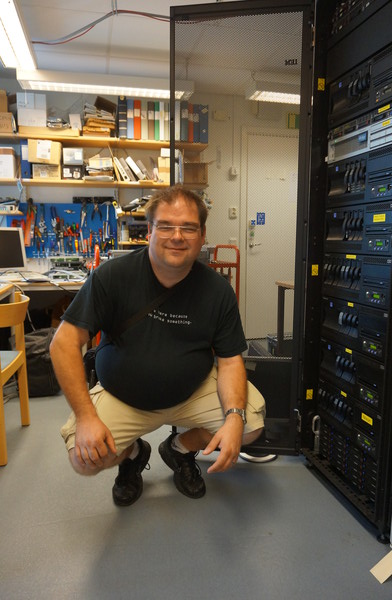
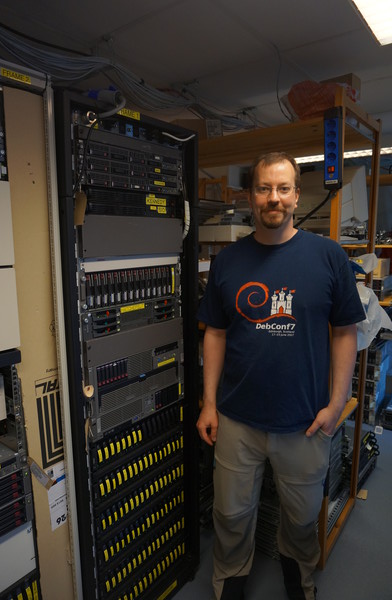
Jo and I spent a few days in Sweden and had an awesome time! The main reason for being there was Leif and Maria's wedding way up north in Skellefte . They cunningly organised their ceremony for the Midsummer weekend, which was an excellent plan - we had a full weekend of partying while we were there. :-) the happy couple We had some time to ourselves while we were there, so we wandered about a little and got to see some of the beautiful coastal countryside. Trund n Then on the way home we stopped off in Ume to visit Mattias Wadenstein (maswan) and his wife Melanie, and he showed me around some of the machines that he's been admining on behalf of Debian. Maybe I'm a sad geek, but I feel quite a bond with one of the machines there, pettersson.debian.org. It's the official CD build machine for Debian, and I've been responsible for thrashing it really hard for the last 5 years or so... :-) Pettersson and friends Massive thanks to the University of Ume and their Academic Computer Club for hosting Debian machines and serving all the CD images for us! maswan and a lot of disks The only downsides from the trip were the massive tiredness (midnight sun is pretty, but notconducive to sleep!) the mosquito bites and the nasty plague^Wcold that we picked up while we were there... Ah well. :-)

27 June 2015

Christian Perrier: Bugs #780000 - 790000

Thorsten Glaser reported Debian bug #780000 on Saturday March 7th 2015, against the gcc-4.9 package. Bug #770000 was reported as of November 18th so there have been 10,000 bugs in about 3.5 months, which was significantly slower than earlier. Matthew Vernon reported Debian bug #790000 on Friday June 26th 2015, against the pcre3 package. Thus, there have been 10,000 bugs in 3.5 months again. It seems that the bug report rate stabilized again. Sorry for missing bug #780000 annoucement. I'm doing this since....November 2007 for bug #450000 and it seems that this lack of attention is somehow significant wrt my involvment in Debian. Still, this involvment is still here and I'll try to "survive" in the project until we reach bug #1000000...:-) See you for bug #800000 annoucement and the result of the bets we placed on the date it would happen.

20 June 2015

Norbert Preining: Localizing a WordPress Blog

There are many translation plugins available for WordPress, and most of them deal with translations of articles. This might be of interest for others, but not for me. If you have a blog with visitors from various language background, because you are living abroad, or writing in several languages, you might feel tempted to provide visitors with a localized environment , meaning that as much as possible is translated into the native language of the visitor, without actually translating content but allowing to. xili-languages1 In my case I am writing mostly in English and Japanese, but sometimes (in former times) in Italian and now and then in my mother tongue, German. Visitors from my site are from all over the world, but at least for Japanese visitors I wanted to provide a localized environment. This blog describes how to get as much as possible translated of your blog, and here I mean not the actual articles, because this is the easy part and most translation plugins handle that fine, but the things around the articles (categories, tags, headers, ). Starting point and aims My starting point was a blog where I already had language added as extra taxonomy, and have tagged all articles with a language. But I didn t have any other translation plugin installed or used. Furthermore, I am using a child theme of the main theme in use (that is always a good idea anyway!). And of course, the theme you are using should be prepared for translation, that is that most literal strings in the theme source code are wrapped in __( ... ) or _e( ... ) calls. And by the way, if you don t have the language taxonomy, don t worry, that will come in automatically. One more thing: The following descriptions are not for the very beginner. I expect certain fluency with WordPress, where for example themese and plugins keep their files, as well as PHP programming experience is needed for some of the steps. With this starting point my aims were quite clear: Translation plugins There is a huge bunch of translation plugins, localization plugins, or internationalization plugins out there, and it is hard to select one. I don t say that what I propose here is the optimal solution, just one that I was pointed at by a colleague, namely utilizing the xili-language plugin. Installation and initial setup Not much to say here, just follow the usual procedure (search, install, activate), followed by the initial setup of xili-language. If you haven t had a language taxonomy by now, you can add languages from the preference page of xili-language, first tab. After having added some languages you should have something similar to the above screen shot. Having defined your languages, you can assign a language to your articles, but for now nothing has actually changed on the blog pages. xili-languages2As I already mentioned, I assume that you are using a child theme. In this case you should consult the fourth tab of the xili-language settings page, called Managing language files, where on the right you should see / set up things in a way that translations in the child theme override the ones in the main theme, see screen shot on the right. I just mention here that there is another xili plugin, xili-dictionary, that can do a lot of things for you when it comes to translation but I couldn t figure out its operation mode, so I switched back (i.e., uninstalled that plugin) and used normal .po/.mo files as described in the next section. Adding translations po and mo files Translations are handled in normal (at least for the Unix world) gettext format. Matthias wrote about this in this blog. In principle you have to: The contents of the po files are described in Matthias blog, and in the following when I say add a translation, then I mean: adding a stanza
msgid "some string"
msgstr "translation of some string"
to the po file, and not forgetting to recompile it to mo file. So let us go through a list of changes I made to translate various pieces of the blog appearance: Translation of categories This is the easiest part, simply throw in the names of your categories into the respective local-DD_LL.po file, and be ready. In my case I used local-ja.po which besides other categories contains stanzas like:
msgid "Travel"
msgstr " "
Translation of widget titles In most cases the widget titles are already automatically translated, if the plugin/widget author cared for it, meaning that he called the widget_title filter on the title. If this does not happen, please report this to the widget/plugin author. I have done this for example for the simple links plugin, which I use for various elements of the side-bar. The author was extremely responsive and the fix will be in the next release is already in the latest release big thanks! Translation of tags This is a bit a problem, as the tags appear in various places on my blog: next to the title line and the footer of each blog, as well as in the tag cloud in the side bar. Furthermore, I want to translate tags instead of having related tag groups as provided by xili tidy tags plugin, so we have to deal with the various appearances of tags one by one: Tags on the main page shown by the theme This is the easier part in my case I had already a customized content.php and content-single.php in my child theme folder. If not, you need to copy the one from the parent theme and change the appearance of it to translate tags. Since this is something that depends on the specific theme, I cannot give detailed advice, but if you see something like:
$tags_list = get_the_tag_list( '', __( ', ', 'mistylake' ) );
(here the get_the_tag_list is the important part), then you can replace this by the following code:
$posttags = get_the_tags();
$first = 1;
$tag_list = '';
if ($posttags)  
  foreach($posttags as $tag)  
    if ($first == 1)  
      $first = 0;
      else  
      $tag_list = $tag_list . __( ', ', 'mistylake' );
     
    $tag_list = $tag_list . '<a href="' . esc_url( home_url( '/tag/' . $tag->slug ) ) . '">' . __($tag->name, 'mistylake') . '</a>';
   
 
(there are for sure simpler ways ) This code loops over the tags and translates them using the __ function. Note that the second parameter must be the text domain of the parent theme. If you have done this right and the web site is still running (I recommend testing it on a test installation I had white pages many times due to php programming errors), and of course you have actual translations available and are looking at a localized version of the web site, then the list of tags as shown by your theme should be translated. Tag cloud widget This one is a tricky one: The tag cloud widget comes by default with WordPress, but doesn t translate the tags. I tried a few variants (e.g. creating a new widget as extension of the original tag cloud widget, and only changing the respective functions), but that didn t work out at all. I finally resorted to a trick: Reading the code of the original widget, I saw that it applies the tag-sort-filter filter on the array of tags. That allows us to hook into the tag cloud creating and translate the tags. You have to add the following code to your child theme s functions.php:
function translate_instead_of_sort($tags)  
  foreach ( (array) $tags as $tag )  
    $tag->name = __( $tag->name , 'mistylake' );
   
  return $tags;
 
add_action('tag_cloud_sort', 'translate_instead_of_sort');
xili-languages3(again, don t forget to change the text domain in the __(.., ..) call!) There might be some more things one could do, like changing the priority to be used after the sorting, or sort directly, but I haven t played around with that. Using the above code and translating several of the tags, the tag cloud now looks like the screenshot on the right I know, it could use some tweaking. Also, now the untranslated tags are sorted all before the translated, things one probably can address with the priority of the filter.
Having done the above things, my blog page when Japanese is selected is now mostly in Japanese, with of course the exception the actual articles, which are in a variety of languages. Open problems There are a few things I haven t managed till now to translate, and they are mostly related to the Jetpack plugin, but not only: I have a few ideas how to tackle this problem: With Jetpack the biggest problem seems that all the strings are translated in a different text domain. So one should be able to add some code to the functions.php to override/add translations to the jetpack text domain. But somehow it didn t work out in my case. The same goes for things that are in the WordPress core and use the translation functions without a text domain so I guess the translation function will use the main WordPress translation files/text domain. Conclusion The good thing of the xili-language plugin is that it does not change the actual posts (some plugins save the translations in the the post text), and is otherwise not too intrusive IMHO. Still, it falls short of allowing to translate various parts of the blog, including the widget areas. I am not sure whether there are better plugins for this usage scenario, I would be surprised if not, but all the plugins I have seen were doing a bit too much on the article translation side and not enough on the translation of the surroundings side. In any case, I would like to see more separation between the functionality of localization (translating the interface) and translation (translating the content). But at the moment I don t have enough impetus to write my own plugin for this. If you have any suggestions for improvement, please let me know! Enjoy.

17 June 2015

DebConf team: Striving for more diversity at DebConf15 (Posted by DebConf Team)

DebConf is not just for Debian Developers, we welcome all members of our community active in different areas, like translation, documentation, artwork, testing, specialized derivatives, and many other ways that help make Debian better. In fact, we would like to open DebConf to an even broader audience, and we strongly believe that more diversity at DebConf and in the Debian community will significantly help us towards our goal of becoming the Universal Operating System. The DebConf team is proud to announce that we have started designing a specific diversity sponsorship programme to attract people to DebConf that would otherwise not consider attending our conference or not be able to join us. In order to apply for this special sponsorship, please write an email to outreach@debian.org, before July 6th, about your interest in Debian and your sponsorship needs (accomodation, travel). Please include a sentence or two about why you are applying for a Diversity Sponsorship. You can also nominate people you think should be considered for this sponsorship programme. Please feel free to send this announcement on to groups or individuals that could be interested in this sponsorship programme. And we re also looking forward to your feedback. We re just getting started and you can help shape these efforts.

16 June 2015

C.J. Adams-Collier: Trip Report: UW signing-party

Dear Debian Users, I met last night with a friend from many years ago and a number of students of cryptography. I was disappointed to see the prevalence of black hat, anti-government hackers at the event. I was hoping that civilized humanity had come to agree that using cryptography for deception, harm to others and plausible deniability is bad, m kay? When one speaks of the government as they, nobody s going to get anywhere really quick. Let s take responsibility for the upkeep of the environment in which we find ourselves, please. Despite what I perceived as a negative focus of the presentation, it was good to meet with peers in the Seattle area. I was very pleasantly surprised to find that better than half of the attendees were not male, that many of the socioeconomic classes of the city were represented, as were those of various ethnic backgrounds. I am really quite proud of the progress of our State University, even if I m not always in agreement with the content that they re polluting our kids brains with. I guess I should roll up my sleeves and get busy, eh? V/R, C.J.

15 June 2015

Lunar: Reproducible builds: week 7 in Stretch cycle

What happened about the reproducible builds effort for this week: Presentations On June 7th, Reiner Herrmann presented the project at the Gulaschprogrammiernacht 15 in Karlsruhe, Germany. Video and audio recordings in German are available, and so are the slides in English. Toolchain fixes Daniel Kahn Gillmor's report on help2man started a discussion with Brendan O'Dea and Ximin Luo about standardizing a common environment variable that would provide a replacement for an embedded build date. After various proposals and research by Ximin about date handling in several programming languages, the best solution seems to define SOURCE_DATE_EPOCH with a value suitable for gmtime(3).
  1. Martin Borgert wondered if Sphinx could be changed in a way that would avoid having to tweak debian/rules in packages using it to produce HTML documentation.
Daniel Kahn Gillmor opened a new report about icont producing unreproducible binaries. Packages fixed The following 32 packages became reproducible due to changes in their build dependencies: agda, alex, c2hs, clutter-1.0, colorediffs-extension, cpphs, darcs-monitor, dispmua, haskell-curl, haskell-glfw, haskell-glib, haskell-gluraw, haskell-glut, haskell-gnutls, haskell-gsasl, haskell-hfuse, haskell-hledger-interest, haskell-hslua, haskell-hsqml, haskell-hssyck, haskell-libxml-sax, haskell-openglraw, haskell-readline, haskell-terminfo, haskell-x11, jarjar-maven-plugin, kxml2, libcgi-struct-xs-perl, libobject-id-perl, maven-docck-plugin, parboiled, pegdown. The following packages became reproducible after getting fixed: Some uploads fixed some reproducibility issues but not all of them: Patches submitted which did not make their way to the archive yet: reproducible.debian.net A new variation to better notice when a package captures the environment has been introduced. (h01ger) The test on Debian packages works by building the package twice in a short time frame. But sometimes, a mirror push can happen between the first and the second build, resulting in a package built in a different build environment. This situation is now properly detected and will run a third build automatically. (h01ger) OpenWrt, the distribution specialized in embedded devices like small routers, is now being tested for reproducibility. The situation looks very good for their packages which seems mostly affected by timestamps in the tarball. System images will require more work on debbindiff to be better understood. (h01ger) debbindiff development Reiner Herrmann added support for decompling Java .class file and .ipk package files (used by OpenWrt). This is now available in version 22 released on 2015-06-14. Documentation update Stephen Kitt documented the new --insert-timestamp available since binutils-mingw-w64 version 6.2 available to insert a ready-made date in PE binaries built with mingw-w64. Package reviews 195 obsolete reviews have been removed, 65 added and 126 updated this week. New identified issues: Misc. Holger Levsen reported an issue with the locales-all package that Provides: locales but is actually missing some of the files provided by locales. Coreboot upstream has been quick to react after the announcement of the tests set up the week before. Patrick Georgi has fixed all issues in a couple of days and all Coreboot images are now reproducible (without a payload). SeaBIOS is one of the most frequently used payload on PC hardware and can now be made reproducible too. Paul Kocialkowski wrote to the mailing list asking for help on getting U-Boot tested for reproducibility. Lunar had a chat with maintainers of Open Build Service to better understand the difference between their system and what we are doing for Debian.

13 June 2015

Steve Kemp: I'm still moving, but ..

Previously I'd mentioned that we were moving from Edinburgh to Newcastle, such that my wife could accept a position in a training-program, and become a more specialized (medical) doctor. Now the inevitable update: We're still moving, but we're no longer moving to Newcastle, instead we're moving to Helsinki, Finland. Me? I care very little about where I end up. I love Edinburgh, I always have, and I never expected to leave here, but once the decision was made that we needed to be elsewhere the actual destination does/didn't matter too much to me. Sure Newcastle is the home of Newcastle Brown Ale, and has the kind of proper-Northern accents I both love and miss but Finland has Leip juusto, Saunas, and lovely people. Given the alternative - My wife moves to Finland, and I do not - Moving to Helsinki is a no-brainer. I'm working on the assumption that I can keep my job and work more-remotely. If that turns out not to be the case that'll be a real shame given the way the past two years have worked out. So .. 60 days or so left in the UK. Fun.

Next.

Previous.