Search Results: "sten"

12 February 2015

Raphaël Hertzog: Freexian s report about Debian Long Term Support, January 2015

Like each month, here comes a report about the work of paid contributors to Debian LTS. Individual reports In January, 48 work hours have been equally split among 4 paid contributors. Their reports are available: Evolution of the situation During the last month, the number of paid work hours has made a noticeable jump: we re now at 58 hours per month. At this rate, we would need 3 more months to reach our minimal goal of funding the equivalent of a half-time position. Unfortunately, the number of new sponsors actually in the process is not likely to be enough to have a similar raise next month. So, as usual, we are looking for more sponsors. In terms of security updates waiting to be handled, the situation looks a bit worse than last month: the dla-needed.txt file lists 37 packages awaiting an update (7 more than last month), the list of open vulnerabilities in Squeeze shows about 63 affected packages in total (7 more than last month). The increase is not too worrying, but the waiting time before an issue is dealt with is sometimes more problematic. To be able to deal with all incoming issues in a timely manner, the LTS team needs more resources: some months will have more issues than usual, some issues will be longer to handle than others, etc. Thanks to our sponsors The new sponsors of the month are in bold.

No comment Liked this article? Click here. My blog is Flattr-enabled.

10 February 2015

Petter Reinholdtsen: Nude body scanner now present on Norwegian airport

Aftenposten, one of the largest newspapers in Norway, today report that three of the nude body scanners now is put to use at Gardermoen, the main airport in Norway. This way the travelers can have their body photographed without cloths when visiting Norway. Of course this horrible news is presented with a positive spin, stating that "now travelers can move past the security check point faster and more efficiently", but fail to mention that the machines in question take pictures of their nude bodies and store them internally in the computer, while only presenting sketch figure of the body to the public. The article is written in a way that leave the impression that the new machines do not take these nude pictures and only create the sketch figures. In reality the same nude pictures are still taken, but not presented to everyone. They are still available for the owners of the system and the people doing maintenance of the scanners, as long as they are taken and stored. Wikipedia have a more on Full body scanners, including example images and a summary of the controversy about these scanners. Personally I will decline to use these machines, as I believe strip searches of my body is a very intrusive attack on my privacy, and not something everyone should have to accept to travel.

8 February 2015

Keith Packard: Altos1.6

AltOS 1.6 TeleDongle v3.0 support and bug fixes Bdale and I are pleased to announce the release of AltOS version 1.6. AltOS is the core of the software for all of the Altus Metrum products. It consists of firmware for our cc1111, STM32L151, STMF042, LPC11U14 and ATtiny85 based electronics and Java-based ground station software. This is a major release of AltOS, including support for our new TeleDongle v3.0 board and a selection of bug fixes AltOS Firmware TeleDongle v3.0 added along with some fixes Our updated ground station, TeleDongle v3.0, works just like the original TeleDongle, but is an all-new design: AltOS Bug Fixes We also fixed a few bugs in the firmware: AltosUI and TeleGPS applications A few minor new features are in this release Bug Fixes There are a bunch of minor bug fixes, including the usual collection of attempts to make stuff behave better on Windows platforms.

3 February 2015

Thorsten Alteholz: USB 3.0 hub and Gigabit LAN adapter

Recently I bought an USB 3.0 Hub with three USB 3.0 ports and one Gigabit LAN port. It is manufactured by Delock and I purchased it from Reichelt (Delock 62440). Under Wheezy the USB part is recognized without problems but the kernel (3.2.0-4) does not have a driver for the ethernet part.
The USB Id is idVendor=0b95 and idProduct=1790, the manufacturer is ASIX Elec. Corp. and the product is: AX88179. So Google led me to a product page at Asix, where I could download the driver for kernel 2.6.x and 3.x.

mkdir -p /usr/local/src/asix/ax88179
cd /usr/local/src/asix/ax88179
wget www.asix.com.tw/FrootAttach/driver/AX88179_178A_LINUX_DRIVER_v1.13.0_SOURCE.tar.bz2
tar -jxf AX88179_178A_LINUX_DRIVER_v1.13.0_SOURCE.tar.bz2
cd AX88179_178A_LINUX_DRIVER_v1.13.0_SOURCE
apt-get install module-assistant
module-assistant prepare
make
make install
modprobe ax88179_178a.ko
After editing /etc/network/interfaces and doing an ifup eth1, voila, I have a new network link. I hope the hardware is as good as the installation has been easy.

2 February 2015

Thorsten Alteholz: My Debian Activities in January 2015

FTP assistant This month at the beginning of the year has been rather quiet as well. All in all I marked 50 packages for accept and rejected only 17 packages. Squeeze LTS This was my seventh month that I did some work for the Squeeze LTS initiative, started by Raphael Hertzog at Freexian. This month I got assigned a workload of 12h and I spent these hours to upload new versions of: In doing so, preparing the upload for php5 consumed most of the time as support from Upstream for the old version in Squeeze no longer exists. Oddly enough, a simple one-line-patch seems to have created a regression I also sponsored the upload of [DLA 133-1] unrtf security update, [DLA 134-1] curl security update and [DLA 130-1] firebird2.1 security update. Many thanks to Nguyen Cong from Toshiba who prepared the patches for these packages. I also uploaded two DLAs for polarssel ([DLA 129-1] polarssl security update and [DLA 144-1] polarssl security update) although no LTS sponsor indicated any interest. Other packages Thanks to the relentless QA work of Andreas Beckmann, his piuparts tests detected an issue in the greylistd package. If greylistd has been installed in Wheezy, removed but not purged afterwards, the whole system dist-upgraded to Jessie and afterwards greylistd is installed again, there would be an error message. RC bug taken, fixed package uploaded and unblock request approved.

24 January 2015

Diego Escalante Urrelo: Link Pack #05

Lever Rukhin Photographs Los Angeles From His Car
Lever Rukhin shoots the sketchiest parts of Los Angeles from his car, taking a really unique perspective that helps you perceive what LA looks like, if you were in a car An experience that is apparently common to all LA people. People drive too much in the US :-). It s a very interesting interview that goes well with his full site: Lev Rukhin. What I love about this, besides the whole premise, is that Lev went the extra mile and actually hacked his car to make the images he wanted:
Phoblographer: It looks like many of these images have artificial lighting in them. What s your gear setup, and how do you introduce so much light into the scene from your car? Lever: About 9 months ago, I affixed a Mola beauty dish onto the roof rack of my 75 Volvo and juice it with a profoto bi-tube. This takes a bit of practice, as making a turn changes the light completely, which I always try to keep balanced. The Canon 5D3 with a 24mm f1.4 is set up on a tripod. The strobe has allowed me to capture more detail as well as creating a somewhat surreal feel to the sets.
Lev Rukhin Lev Rukhin http://www.levrukhin.com/
The Invisible Woman: A conversation with Bj rk
Bj rk is that Icelandic singer we all hear about but never really pay much attention to because her music is too smart for our simple ears. In this interview she goes over how her latest album is a very personal work, and unexpectedly (?) ends talking about how problematic it s been to be a female auteur in her generation. I have seen the same problem she denounces about people assuming that the male members of a team did all the work while the women just sticked to making coffee and sandwiches. I ve worked with exceptional women that don t get enough credit, but I ve also worked with potentially exceptional women who don t give themselves enough credit. It s a very interesting read, specially since it comes from someone who couldn t be higher in the art food chain. Bj rk is god-damn Bj rk. Only thing that bugs me is that Pitchfork decided to hold back most of the interview for publishing next month. I ll try to go back and read it in full, but I wonder if the technique works for them or if perhaps they are missing the opportunity for a bigger impact. But I digress.
Pitchfork: The world has a difficult time with the female auteur. B: I have nothing against Kanye West. Help me with this I m not dissing him this is about how people talk about him. With the last album he did, he got all the best beatmakers on the planet at the time to make beats for him. A lot of the time, he wasn t even there. Yet no one would question his authorship for a second. If whatever I m saying to you now helps women, I m up for saying it. For example, I did 80% of the beats on Vespertine and it took me three years to work on that album, because it was all microbeats it was like doing a huge embroidery piece. Matmos came in the last two weeks and added percussion on top of the songs, but they didn t do any of the main parts, and they are credited everywhere as having done the whole album. [Matmos ] Drew [Daniel] is a close friend of mine, and in every single interview he did, he corrected it. And they don t even listen to him. It really is strange.
In Defense of the Selfie Stick
Miguel proposes a different take on the consequences of the selfies stick:
When you ask someone to take a picture of you, technically, they are the photographer, and they own the copyright of your picture. ( ) All of a sudden, your backpacking adventure in Europe requires you to pack a stack of legal contracts. Now your exchange goes from Can you take a picture of us? to Can you take a picture of us, making sure that the church is on the top right corner, and also, I am going to need you to sign this paper .
I don t know what s with the selfie stick hate. Let people have fun, it doesn t hurt. If anything, it prevents them from asking you to take their photo, and if we already established you are the kind of people not a big fan of strangers, all the better, right? Why Top Tech CEOs Want Employees With Liberal Arts Degrees
Here s a small extra. When I decided to pursue a humanities/art formal training, I got many naysayers telling me that I was screwing up not specializing even more as a formal (titled) engineer. I argued then, and now, that if I was gonna pay for training, I might as well pay for training outside my comfort zone. The result resonates perfectly with this article. Of course, it s not like the thing is settled, but I can back the various quotes in there. Working with purely technical/engineering types can be an echo chamber, and having trained myself in the humanities and arts I have become incredibly much more sensitive to the human factor of things. I used to think I was already good at this (because we hacker types have lots of confidence), but studying humanities like human communication, social conflict and development, film language, etc; it all has made me a much more capable hacker of things. There s also a nice argument to be made about joining the arts when you are already highly skilled on technical matters. Like Robert Rodr guez s teacher (mentioned in his diary/book Rebel Without a Cause, which I also have to review soon) used to say (generous paraphrasing here): the world is of those who can be their own creative and their own technician.
Both Yi and Sheer recognize that the scientific method is valuable, with its emphasis on logic and reason, especially when dealing with data or engineering problems. But they believe this approach can sometimes be limiting. When I collaborate with people who have a strictly technical background, says Yi, the perspective I find most lacking is an understanding of what motivates people and how to balance multiple factors that are at work outside the realm of technology.
Interesting food for thought, specially if you know an engineer that ditches the arts as of little value for personal growth in their careers/life.
Read more Link Pack, you ll love it

22 January 2015

Diego Escalante Urrelo: Link Pack #04

Writing Your Way to Happiness (nytimes.com)
Researches believe that the way we think about, and remember, our story can be so powerful that it can actually influence our happiness and success. It s a nice little article summarizing actual research. The main study referred put fresh university students to test: a group received tools to rewrite their memory and story of their academic performance, another group didn t. The first group improved their grades and had only 1 student drop school within a year, the other group had 4 drop outs and no specific improvement. I ve been thinking about this as I recently rewrote my About page and also started writing down some past Travel journals. Looking back and rewriting your own story is incredibly empowering, it s a fantastic rush of confidence and self-assertion. Memory is always betraying us, and remembering our success is not particularly high on the list of things to keep.
The concept is based on the idea that we all have a personal narrative that shapes our view of the world and ourselves. But sometimes our inner voice doesn t get it completely right. Some researchers believe that by writing and then editing our own stories, we can change our perceptions of ourselves and identify obstacles that stand in the way of better health. It may sound like self-help nonsense, but research suggests the effects are real. Students who had been prompted to change their personal stories improved their grade-point averages and were less likely to drop out over the next year than the students who received no information. In the control group, which had received no advice about grades, 20 percent of the students had dropped out within a year. But in the intervention group, only 1 student or just 5 percent dropped out.
Old Masters at the Top of Their Game (nytimes.com)
Fantastic read on how these artists defy the conventions of old meaning useless. Masters at their art, they haven t quit nor have laid to rest and cash their reputation. They keep making, they stay alive (physically and metaphorically) through art. No rush to get to their age, but still a really interesting letter from the future . Full of cheat codes, read this now.
Now I am 79. I ve written many hundreds of essays, 10 times that number of misbegotten drafts both early and late, and I begin to understand that failure is its own reward. It is in the effort to close the distance between the work imagined and the work achieved wherein it is to be found that the ceaseless labor is the freedom of play, that what s at stake isn t a reflection in the mirror of fame but the escape from the prison of the self. T. H. White, the British naturalist turned novelist to write The Once and Future King, calls upon the druid Merlyn to teach the lesson to the young prince Arthur: You may grow old and trembling in your anatomies, you may lie awake at night listening to the disorder of your veins, you may miss your only love, you may see the world about you devastated by evil lunatics, or know your honour trampled in the sewers of baser minds. There is only one thing for it then to learn. Learn why the world wags and what wags it. That is the only thing which the mind can never exhaust, never alienate, never be tortured by, never fear or distrust, and never dream of regretting.
A Life with a View (ribbonfarm.com)
A somewhat tricky read, but with a nice payback. Take your time, and savor it slowly. It s a very interesting look into how we keep wanting new stuff, and how we shield from ourselves by looking for the place with no yearns , the place where we won t want anything anymore doesn t exist. Chains very well into the reads I shared a few days ago on practical contentment.
The arrival fallacy is about seeking a life from which one can look with a complacent equanimity upon the rest of reality, without yearning. It is an ideal of a life that is defined primarily by blindness to itself. You yearn while you see your life as others see it, until you arrive at a situation where you can disappear into the broader background, and see comfortably without being seen discomfittingly, especially by yourself. Once you re there, the yearning stops, so the theory goes. Of course it is a laughably bad theory.
How To Escape From A Moving Car (mrporter.com)
By Adam Kirley, stunt double for Daniel Craig in the crazy crane scene of Casino Royale (where 007 jumps from monkey nuts high to donkey bonkers high, a badger bum crazy distance). Really funny, and one of those things I always find myself thinking Almost as much as what to do in case of a Post Office Showdown (xkcd.com)
Everyone s first instinct is to put their hands or legs down first. That s the worst thing you can do: you will break something. The pointy parts of your body hurt elbows, knees, hips, ankles. Put your fists under your chin, and bring your elbows together. Keep your chin tucked in to your chest to protect your head. The best point of impact is the back of the shoulder and your back. If you dive out directly onto your shoulder you ll break it.
What the World Looks Like with Social Anxiety (collegehumor.com)
Funny vignettes about how the world looks like when you are socially anxious. I can only really identify with the last one:
cfd04d22a6dfa4fb858dee8d3d5592afShea Strauss.
Helsinki Bus Station Theory (fotocommunity.com)
Don t get off the bus. Art comes to those who wait and persevere. At first, you replicate the same route others have done, but only if you stay long enough in such path you begin to find your own path. Although perhaps a little more classic in conception, this is an interesting text advising artists to don t give up just because they don t compare well to the masters of their current art or genre. Only those who persevere will catch up and diverge from the masters. You could say that diverging early is also a way to find your path, but there s still a case to be made for learning from those who came before. Whether you want to imitate them, or rebel against them, you still need to know them. My take: it doesn t hurt to pick up some biographies or works from past masters and see what made them masters. Create your master genealogy, kinda like in Steal Like an Artist (which I recently read but haven t got around to write about yet).
Georges Braque has said that out of limited means, new forms emerge. I say, we find out what we will do by knowing what we will not do. And so, if your heart is set on 8 10 platinum landscapes in misty southern terrains, work your way through those who inspire you, ride their bus route and damn those who would say you are merely repeating what has been done before. Wait for the months and years to pass and soon your differences will begin to appear with clarity and intelligence, when your originality will become visible, even the works from those very first years of trepidation when everything you did seemed so done before.
At 90, She s Designing Tech For Aging Boomers (npr.org)
The inspiring tale of a 90 year old woman who joined IDEO to contribute a unique point of view to the design process. You can never stop learning, life never ceases to be interesting. It s short, and not incredibly shocking, but that this has happened somewhere as referenced and revered as IDEO says a lot.
And for the bulging demographic of baby boomers growing old, Beskind has this advice: Embrace change and design for it.

Previously on Link Pack

18 January 2015

Chris Lamb: Adjusting a backing track with SoX

Earlier today I came across some classical sheet music that included a "playalong" CD, just like a regular recording except it omits the solo cello part. After a quick listen it became clear there were two problems: SoX, the "Swiss Army knife of sound processing programs", can easily adjust the latter, but to remedy the former it must be provided with a dimensionless "cent" unit ie. 1/100th of a semitone rather than the 442Hz and 440Hz reference frequencies. First, we calculate the cent difference with: https://d1icoid1cnixnp.cloudfront.net/yadt/blog.Image/image/original/24.jpeg Next, we rip the material from the CD:
$ sudo apt-get install ripit flac
[..]
$ ripit --coder 2 --eject --nointeraction
[..]
And finally we adjust the tempo and pitch:
$ apt-get install sox libsox-fmt-mp3
[..]
$ sox 01.flac 01.mp3 pitch -7.85 tempo 1.00 # (Tuning notes)
$ sox 02.flac 02.mp3 pitch -7.85 tempo 0.95 # Too fast!
$ sox 03.flac 03.mp3 pitch -7.85 tempo 1.01 # Close..
$ sox 04.flac 04.mp3 pitch -7.85 tempo 1.03 # Too slow!
(I'm converting to MP3 at the same time it'll be more convenient on my phone.)

Guido G nther: whatmaps 0.0.9

I have released whatmaps 0.0.9 a tool to check which processes map shared objects of a certain package. It can integrate into apt to automatically restart services after a security upgrade. This release fixes the integration with recent systemd (as in Debian Jessie), makes logging more consistent and eases integration into downstream distributions. It's available in Debian Sid and Jessie and will show up in Wheezy-backports soon. This blog is flattr enabled.

16 January 2015

Raphaël Hertzog: Freexian s fifth report about Debian Long Term Support

Like each month, here comes a report about the work of paid contributors to Debian LTS. Individual reports In December 46 work hours have been equally split among 4 paid contributors (note that Thorsten and Rapha l have actually spent more hours because they took over some hours that Holger did not do over the former months). Their reports are available: Evolution of the situation Compared to last month, the number of paid work hours has almost not increased (we are at 48 hours per month). We still have a couple of new sponsors in the pipe but with the new year they did not complete the process yet. Hopefully next month will see a noticeable increase. As usual, we are looking for more sponsors to reach our our minimal goal of funding the equivalent of a half-time position. Those of you who are struggling to spend money in the last quarter due to budget overrun, now is a good time to see if you want to include Debian LTS support in your 2015 budget! In terms of security updates waiting to be handled, the situation looks similar to last month: the dla-needed.txt file lists 30 packages awaiting an update (3 more than last month), the list of open vulnerabilities in Squeeze shows about 56 affected packages in total. We do not manage to clear the backlog but it s not getting significantly worse either. Thanks to our sponsors

No comment Liked this article? Click here. My blog is Flattr-enabled.

15 January 2015

Daniel Pocock: Disk expansion

A persistent problem that I encounter with hard disks is the capacity limit. If only hard disks could expand like the Tardis. My current setup at home involves a HP Microserver. It has four drive bays carrying two SSDs (for home directories) and two Western Digital RE4 2TB drives for bulk data storage (photos, source tarballs and other things that don't change often). Each pair of drives is mirrored. I chose the RE4 because I use RAID1 and they offer good performance and error recovery control which is useful in any RAID scenario. When I put in the 2TB drives, I created a 1TB partition on each for Linux md RAID1 and another 1TB partition on each for BtrFs. Later I added the SSDs and I chose BtrFs again as it had been working well for me. Where to from here? Since getting a 36 megapixel DSLR that produces 100MB raw images and 20MB JPEGs I've been filling up that 2TB faster than I could have ever imagined. I've also noticed that vendors are offering much bigger NAS and archive disks so I'm tempted to upgrade. First I looked at the Seagate Archive 8TB drives. 2TB bigger than the nearest competition. Discussion on Reddit suggests they don't have Error Recovery Control / TLER however and that leaves me feeling they are not the right solution for me. Then I had a look at WD Red. Slightly less performant than the RE4 drives I run now, but with the possibility of 6TB per drive and a little cheaper. Apparently they have TLER though, just like the RE4 and other enterprise drives. Will 6 or 8TB create new problems? This all leaves me scratching my head and wondering about a couple of things though:
  • Will I run into trouble with the firmware in my HP Microserver if I try to use such a big disk?
  • Should I run the whole thing with BtrFs and how well will it work at this scale?
  • Should I avoid the WD Red and stick with RE4 or similar drives from Seagate or elsehwere?
If anybody can share any feedback it would be really welcome.

Michal Čihař: Weblate UI polishing

After releasing Weblate 2.0 with Bootstrap based UI, there was still lot of things to improve. Weblate 2.1 brought more consistency in using buttons with colors and icons. Weblate 2.2 will bring some improvements in other graphics elements. One of thing which was for quite long in our issue tracker is to provide own renderer for SVG status badge. So far Weblate has offered either PNG badge or external SVG rendered by shields.io. Relying on external service was not good in a long term and also caused requests to third party server on many pages, what could be considered bad privacy wise. Since this week, Weblate can render SVG badge on it's own and they are also matching current style used by other services (eg. Travis CI): Translation status One last thing which really did not fit into new UI were activity charts. In past they were rendered as PNG on server side, but for upcoming releases we have switched to use Chartist javascript library and render them as SVG on client side. This way we can nicely style them to fit into page, they scale properly and also reduce server load. You can see them in action on Hosted Weblate server: Weblate activity chart

Filed under: English phpMyAdmin SUSE Weblate 0 comments Flattr this!

12 January 2015

Russell Coker: Systemd Notes

A few months ago I gave a lecture about systemd for the Linux Users of Victoria. Here are some of my notes reformatted as a blog post: Scripts in /etc/init.d can still be used, they work the same way as they do under sysvinit for the user. You type the same commands to start and stop daemons. To get a result similar to changing runlevel use the systemctl isolate command. Runlevels were never really supported in Debian (unlike Red Hat where they were used for starting and stopping the X server) so for Debian users there s no change here. The command systemctl with no params shows a list of loaded services and highlights failed units. The command journalctl -u UNIT-PATTERN shows journal entries for the unit(s) in question. The pattern uses wildcards not regexs. The systemd journal includes the stdout and stderr of all daemons. This solves the problem of daemons that don t log all errors to syslog and leave the sysadmin wondering why they don t work. The command systemctl status UNIT gives the status and last log entries for the unit in question. A program can use ioctl(fd, TIOCSTI, ) to push characters into a tty buffer. If the sysadmin runs an untrusted program with the same controlling tty then it can cause the sysadmin shell to run hostile commands. The system call setsid() to create a new terminal session is one solution but managing which daemons can be started with it is difficult. The way that systemd manages start/stop of all daemons solves this. I am glad to be rid of the run_init program we used to use on SE Linux systems to deal with this. Systemd has a mechanism to ask for passwords for SSL keys and encrypted filesystems etc. There have been problems with that in the past but I think they are all fixed now. While there is some difficulty during development the end result of having one consistent way of managing this will be better than having multiple daemons doing it in different ways. The commands systemctl enable and systemctl disable enable/disable daemon start at boot which is easier than the SysVinit alternative of update-rc.d in Debian. Systemd has built in seat management, which is not more complex than consolekit which it replaces. Consolekit was installed automatically without controversy so I don t think there should be controversy about systemd replacing consolekit. Systemd improves performance by parallel start and autofs style fsck. The command systemd-cgtop shows resource use for cgroups it creates. The command systemd-analyze blame shows what delayed the boot process and
systemd-analyze critical-chain shows the critical path in boot delays. Sysremd also has security features such as service private /tmp and restricting service access to directory trees. Conclusion For basic use things just work, you don t need to learn anything new to use systemd. It provides significant benefits for boot speed and potentially security. It doesn t seem more complex than other alternative solutions to the same problems. https://wiki.debian.org/systemd http://freedesktop.org/wiki/Software/systemd/Optimizations/ http://0pointer.de/blog/projects/security.html

6 January 2015

Steve McIntyre: Bootstrapping arm64 in Debian

I promised to write about this a long time, ooops... :-) Another ARM port in Debian - yay! arm64 is officially a release architecture for Jessie, aka Debian version 8. That's taken a lot of manual porting and development effort over the last couple of years, and it's also taken a lot of CPU time - there are ~21,000 source packages in Debian Jessie! As is often the case for a brand new architecture like arm64 (or AArch64, to use ARM's own terminology), hardware can be really difficult to get hold of. In time this will cease to be an issue as hardware becomes more commoditised, but in Debian we really struggled to get hold of equipment for a very long time during the early part of the port. First bring-up in Debian Ports To start with, we could use ARM's own AArch64 software models to build the first few packages. This worked, but only very slowly. Then Chen Baozi and the folks running the Tianhe-2 supercomputer project in Guangzhou, China contacted us to offer access to some arm64 hardware, and this is what Wookey used for bootstrapping the new port in the unofficial Debian Ports archive. This has now become the normal way for new architectures to get into Debian. We got most of the archive built in debian-ports this way, and we could then use those results to seed the initial core set of packages in the main Debian archive. Second bring-up - moving into the main Debian archive By the time that first Debian bring-up was done, ARM was starting to produce its own "Juno" development boards, and with the help of my boss^4 James McNiven we managed to acquire a couple of those machines for use as official Debian build machines. The existing machines in China were faster, but for various reasons quite difficult to maintain as official Debian machines. So I set up the Junos as buildds just before going to DebConf in August 2014. They ran very well, and (for dev boards!) were very fast and stable. They built a large chunk of the Debian archive, but as the release freeze for Jessie grew close we weren't quite there. There was a small but persistent backlog of un-built packages that were causing us issues, plus the Juno machines are/were not quite suitable as porter boxes for Debian developers all over the world to use for debugging their packages on the new architecture. More horsepower - Linaro machines This is where Linaro came to our aid. Linaro's goal is to help improve Free and Open Source Software on ARM, and one of the more recent projects in Linaro is a cluster of servers that are made available for software developers to use to get early access to ARMv8 (arm64) hardware. It's a great way for people who are interested in this new architecture to try things out, port their software or indeed just help with the general porting effort. As Debian is seen as such an important part of the FLOSS ecosystem, we managed to negotiate dedicated access to three of the machines in that cluster for Debian's use and we set those up in October, shortly before the freeze for Jessie. Andy Doan spent a lot of his time getting these machines going for us, and then I set up two of them as build machines and one as the porter box we were still needing. With these extra machines available, we quickly caught up with the ever-busy "Needs-Build" queue and we've got sufficient build power now to keep things going for the Jessie release. We were officially added to the list of release architectures at the Cambridge mini-Debconf in November, and all is looking good now! And in the future? I've organised the loan of another arm64 machine from AMD for Debian to use for further porting and/or building. We're also expecting that more and more machines will be coming out soon as vendors move on from prototyping to producing real customer equipment. Once that's happened, more kit will be available and everybody will be able to have arm64-powered computers in the server room, on their desk and even inside their laptop! Mine will be running Debian Jessie... :-) Thanks! There's been a lot of people involved in the Debian arm64 bootstrapping at various stages, so many that I couldn't possibly credit them all! I'll highlight some, though. :-) First of all, Wookey's life has revolved around this port for the last few years, tirelessly porting, fixing and hacking out package builds to get us going. We've had loads of help from other teams in Debian, particularly the massive patience of the DSA folks with getting early machines up and running and the prodding of the ftpmaster, buildd and release teams when we've been grinding our way through ever more package builds and dependency loops. We've also had really good support from toolchain folks in Debian and ARM, fixing bugs as we've found them by stressing new code and new machines. We've had a number of other people helping by filing bugs and posting patches to help us get things built and working. And (last but not least!) thanks to all the folks who've helped us beg and borrow the hardware to make the Debian arm64 port a reality. Rumours of even more ARM ports coming soon are entirely scurrilous... *grin*

Russ Allbery: Review: Code Complete, Second Edition

Review: Code Complete, Second Edition, by Steve McConnell
Publisher: Microsoft
Copyright: June 2004
ISBN: 0-7356-1967-0
Format: Kindle
Pages: 960
As mentioned in the title, this is a review of the second edition of Code Complete, published in 2004. There doesn't appear to be a later edition at the time of this writing. I should say, as a prefix to this review, that I'm the sort of person who really likes style guides. When learning a language, a style guide is usually the second or third document I read. I enjoy debates over the clearest way to express a concept in code, trying to keep all the code in a large project consistent, and discussing the subtle trade-offs that sit on the boundary between mechanical style issues and the expressiveness of programming. I try to spend some time reading good code and getting better at expressing myself in code. Presumably, therefore, I'm the target audience for this book. It sounded good from the descriptions, so I picked it up during one of the Microsoft Press sales. The stated goal of Code Complete is to collect in one place as much as possible of the oral tradition and lore of the programming field, to try to document and communicate the techniques and approaches that make someone a good programmer. The table of contents sounds like a style guide, with entire sections on variables and statements in addition to topics like how to improve existing code and how to design a new program. If you're starting to think that a 960 page style guide sounds like a bad idea, you're wiser than I. (In my defense, I grabbed this as an ebook and didn't realize how large it was before I bought it.) I have not actually finished this book. I hate to do this: I don't like reviewing books I haven't finished (this will be the first), and I hate starting books and not finishing them. (This is probably not particularly wise, since some books aren't worth finishing, but I've gotten into a rhythm of reading and reviewing that works for me, so I try not to mess with it.) But I've been trying to finish this book off and on for about a year, I don't think it's worth the time investment, and I think I've gotten far enough in it to provide some warnings by others who are deceived by the very high ratings that it gets on Amazon and other places. The primarily problem with Code Complete is its sheer, mind-numbing comprehensiveness. It tries to provide a set of guidelines and a checklist to think about at each level of writing code. This is one of those ideas that might sound good on paper, but which completely doesn't work for me. There is no way I'm going to keep this many rules in my head, in the form of rules, while programming. Much of good style has to be done by feel, and the book I'm looking for is one that improves my feel and my sense of taste for code. What Code Complete seems to provide instead is a compilation of every thought that McConnell has ever had about programming. There's a lot of basic material, a few thoughtful statements, a ton of style advice, an endless compilation of trade-offs and concepts that one should keep in mind, and just a massive, overwhelming pile of stuff. Each chapter (and there are a lot of chapters) ends in a checklist of things that you should think about when doing a particular programming task. To give you a feel for the overwhelming level of trivia here, this is the checklist at the end of the chapter where I stopped reading, on quality assurance in software. This is one picked at random; a lot of them are longer than this.
  • Have you identified specific quality characteristics that are important to your project?
  • Have you made others aware of the project's quality objectives?
  • Have you differentiated between external and internal quality characteristics?
  • Have you thought about the ways in which some characteristics might compete with or complement others?
  • Does your project call for the use of several different error-detection techniques suited to finding several different kinds of errors?
  • Does your project include a plan to take steps to assure software quality during each stage of software development?
  • Is the quality measured in some way so that you can tell whether it's improving or degrading?
  • Does management understand that quality assurance incurs additional costs up front in order to save costs later?
I'm not saying those are bad things to think about with quality assurance, but you may notice a few issues immediately. They're very general and vague, they're not phrased in a particularly compelling or memorable way, and there are a lot of them. This falls between two stools: it's too much for the programmer who is thinking about quality as part of an overall project but not focusing on it (particularly when you consider that the book is full of checklists like this for everything from variable naming to how to structuring if statements to program debugging), but it's not nearly specific or actionable enough for someone who is focusing on quality assurance. It's not that the information isn't organized: there's a lot of structure here. And there are bits and pieces here that are occasionally interesting. McConnell is very data-driven and tries to back up recommendations with research on error rates and similar concrete measurements. It's just insufficiently filtered and without elegant or memorable summary. There is far too much here, an overwhelming quantity, and hopelessly mixed between useful tidbits and obvious observations that anyone who has been programming for a while would pick up, all presented in the same earnest but dry tone. It didn't help that there's a lot here I didn't agree with. Some of that is to be expected: I've never agreed completely with any style guide. But McConnell kept advocating variable and function naming conventions that I find rather ugly and tedious, and the general style of code he advocates feels very "bureaucratic" to me. It's not exactly wrong, but one of the things that I look for in style discussions is to be inspired by the elegant and simple way someone finds to phrase something in code. A lot of the code in this book just felt mind-numbing. It's functional, but uninteresting; perfectly adequate for a large project, but not the sort of discussion that inspires me to improve the quality of my craft. So, I didn't finish this. I gave up about halfway through. It's frustrating, since I was occasionally finding an interesting nugget of information. But they were too few and far between, and the rest of the book was mostly... boring. It's possible that I just know too much about programming to be the person for whom that McConnell was writing this book. It's certainly true that the book has not aged particularly well; it's focused on fairly old-school languages (C, C++, Java, and Visual Basic) and says almost nothing about modern language techniques, although it does have a bit about extreme programming. But whatever the reason is, it didn't work for me at all. I would rate it as one of the worst books about programming I've tried to read. And that's notably different enough from its reviews that it seems worth throwing this out there as a warning. I'm quite disappointed, since I'd heard nothing but praise for this book before picking it up. But it's not for me, and I'm now dubious of its value for any programmer outside of a fairly narrow, large-team, waterfall development process involving large numbers of people writing very large quantities of code in languages that aren't very expressive. And, well, in that situation I think one would get more benefit from changing that environment than reading this book. Rating: unfinished

3 January 2015

Rhonda D'Vine: Gossip

Happy New Year everyone! How did you celebrate the year change? I've been at the Seestadt Aspern listening to electric:indigo (who is also part of the open:sounds project powered by artists of the female:pressure collective), watching a show called "Laser-City", enjoying the really chilly air. With so much female power mentioned in the former paragraph, it is almost hard to find a matching artist/band to present you today. Almost I said, because Beth Ditto and her band Gossip are definitely up for the challenge. That woman is pure power and has a uniquely great voice. They are definitely worth listening into closer, and here are my suggestions: Like always, enjoy!

/music permanent link Comments: 0 Flattr this

2 January 2015

Gunnar Wolf: Status of the OpenPGP keyring: 1024D is a thing of the past!

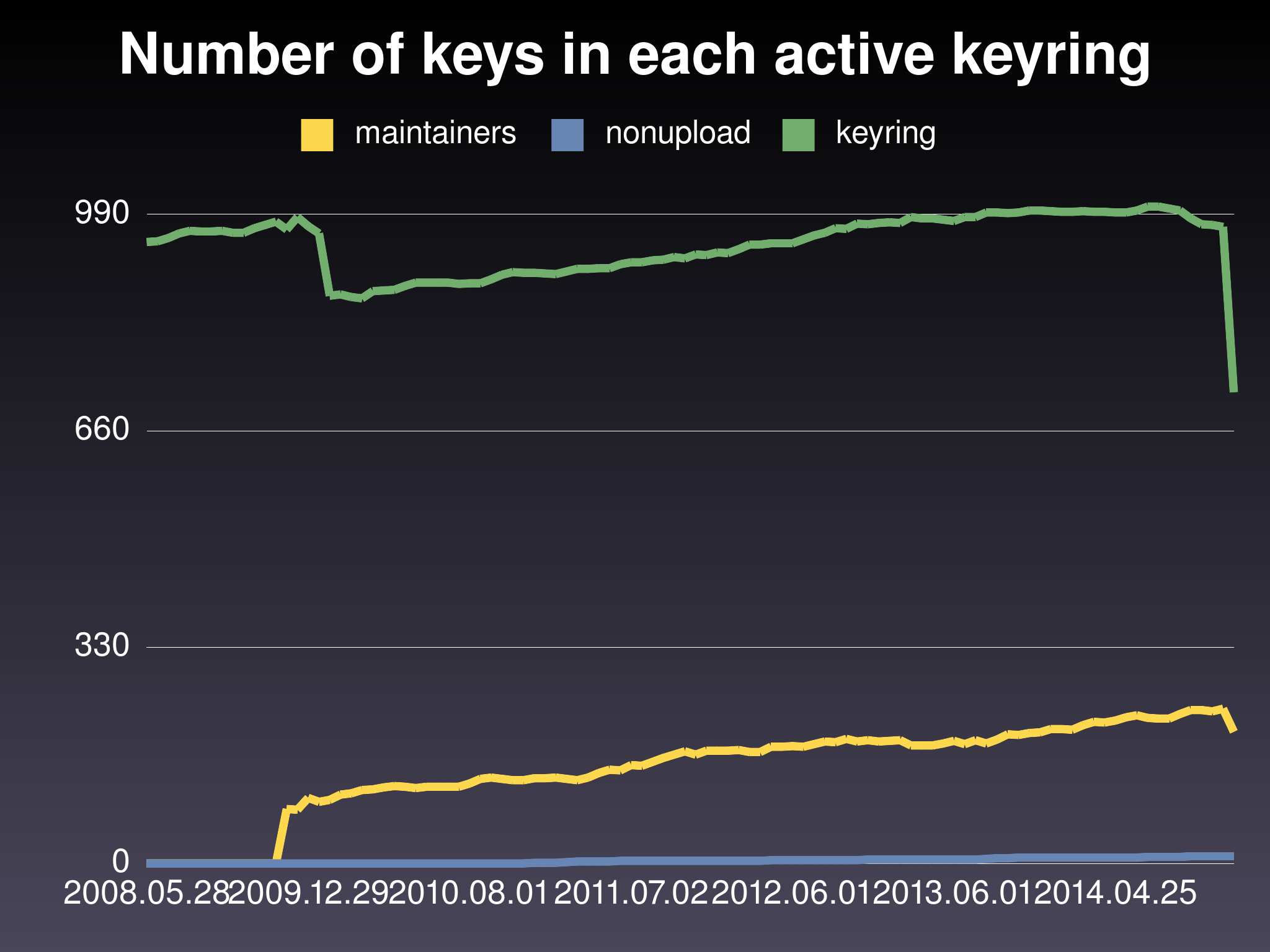
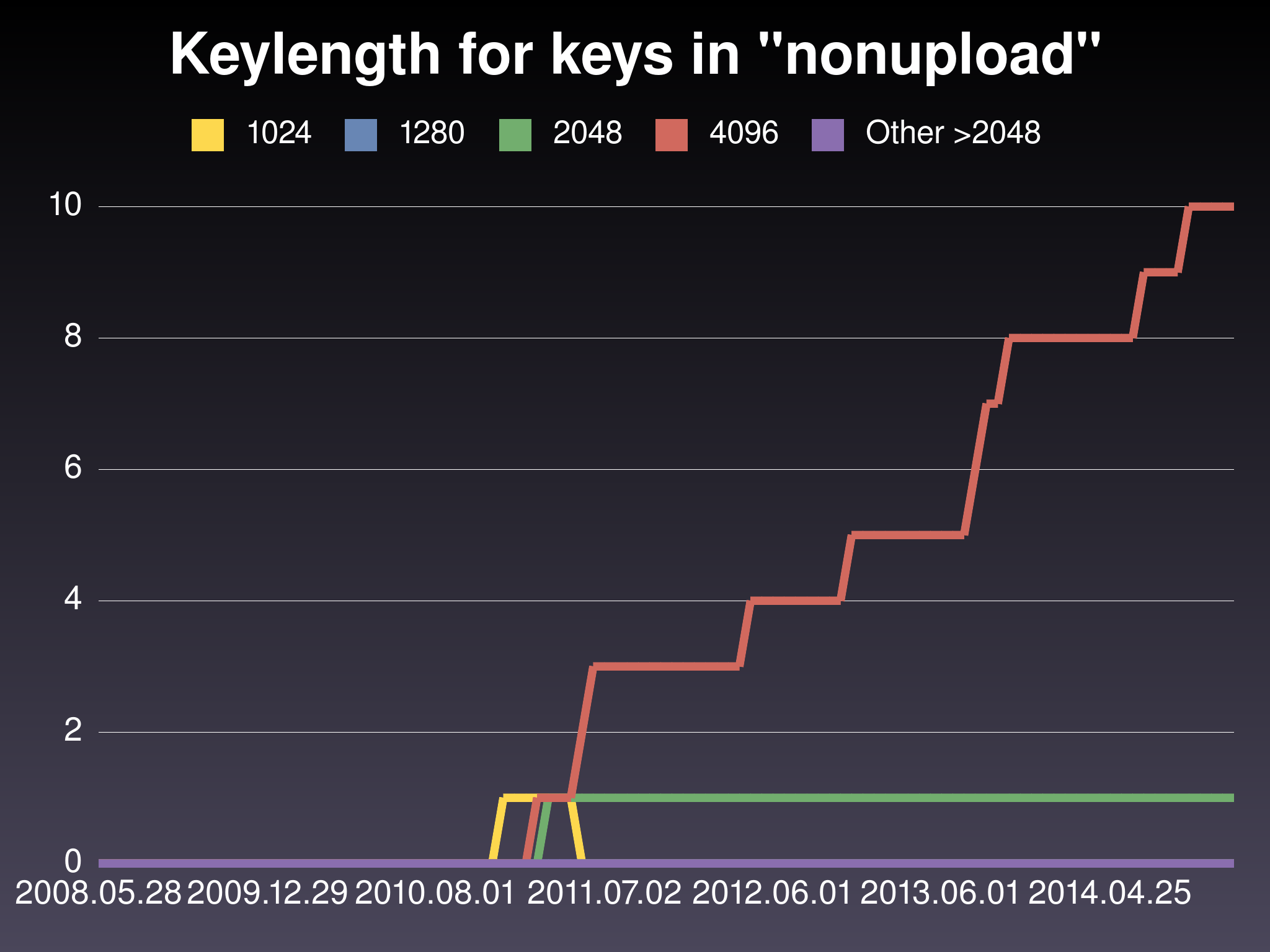
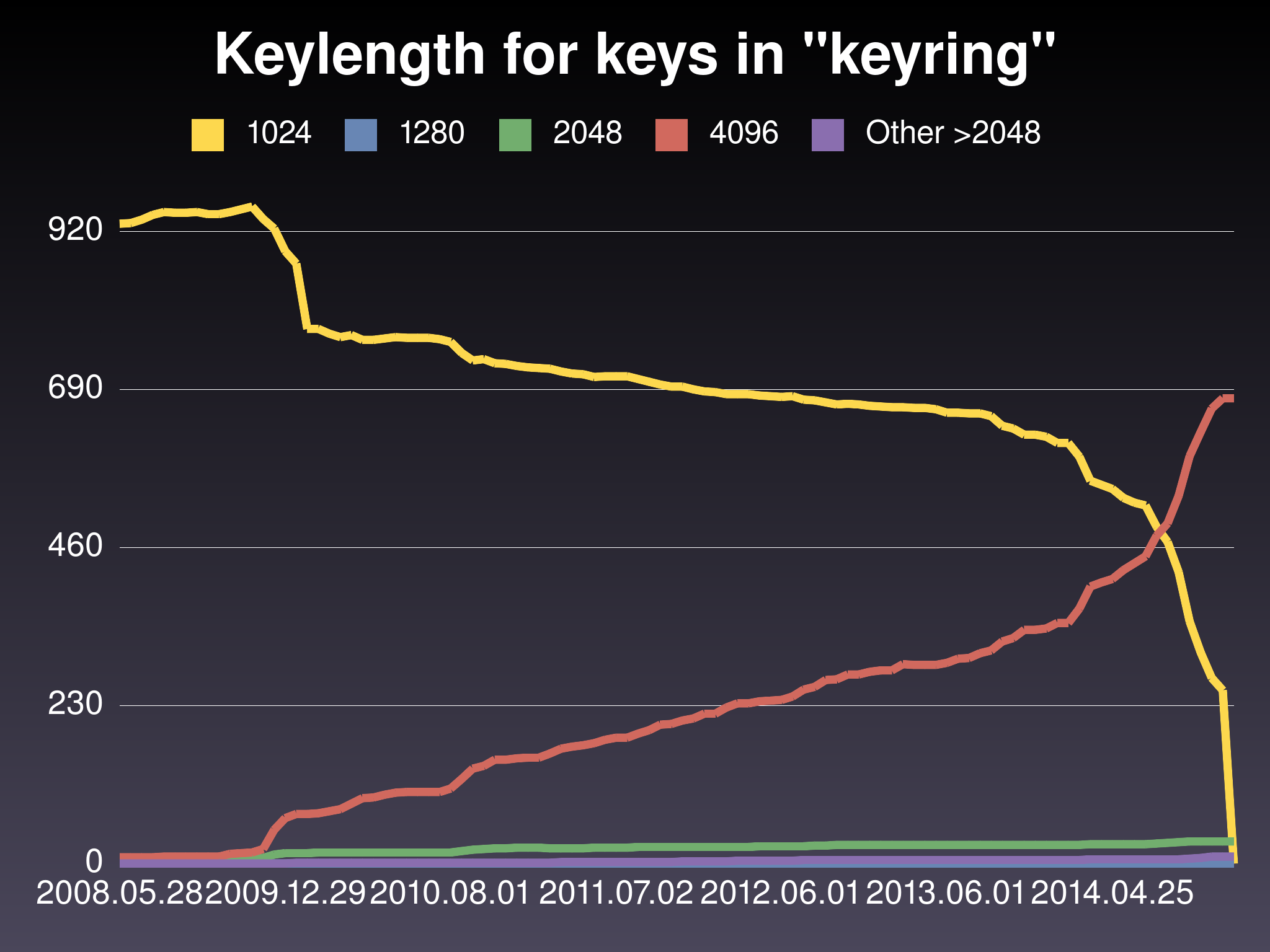
Having seen the end of December and the beginning of January, this is the time of year where we say "Happy new year!" But this is a very interesting new year: We have also went past our much announced deadline for the <2048 bit keys to be removed from the Debian keyrings. And yes, our highly efficient keyring-maint team managed to deliver on the promised time And, I'd say, with much success. Lets see the numbers Only before that, refer to Jonathan's mail to debian-devel-announce for further, fuller information. So, first of all, how do overall numbers look? Just remember, the following are not the number of DDs, just the number of active keys. That is, the holders to the 252 DD and 35 DM keys we removed are still valid Debian Developers/Maintainers, but have to get a new key accepted to perform many of their tasks in the project. The graph above shows the sharp change between tags 2014.12.31 and 2015.01.01. But my definition of success is that we managed to get the number down to just 252+35=287 from what we had back in August, when we did our DebConf presentation and started the aggressive push: 490 DD keys and 49 DM keys. Since then, 34 DDs requested their retirement, becoming emeritus, and practically all of the rest managed to get their key transition done! So, lets go again easiest-to-hardest. First, the Non-uploading Debian Developers keyring: As this is the newest keyring in existence, and is also the smallest one, we were already without <2048 keys since 2011. Nothing to see, move along. Then, as for the Debian Maintainers: We did have a sensible migration from weaker to stronger keys, but it was not as sharp as I'd have liked. That makes sense, after all, since DMs have less involvement and compromise in the project in regard to DDs. So, we only processed 15 DM keys since August, which is almost a third of the keys we needed to process to reach the ideal 100% migration. Now, as for our biggest and oldest keyring, and the one that denotes more project involvement, here is the graph for the uploading Debian Developers: And yes, here you can see the sharp turn we saw in the second half of this year: By DebConf time, we were happy because the red and yellow lines had just crossed. But we were still sitting at 490 DD keys needing to be migrated. Half of the DD keys (compared to almost a fourth for the DM keys). I'm almost sure we anticipated in our presentation (I know, I should check the video) that, by January 1st, we would have to retire around 300 keys. And I'm very, very happy and proud that we managed to get the number down to 252. And, yes, people leave things to the end: We already have some more pending requests in the Request Tracker to introduce new keys for our fellow friends who were disabled. We will be working to make keyring pushes more frequent than our usual monthly uploads until requests go back to a sane level. So, if everything runs smoothly, this will probably be the last of my posts in this regard. This has been quite an interesting (and exhausting!) experience!

Jeff Licquia: Happy 2015!

[en] Look, it s 2015. How d that happen? Blogging has been pretty much nonexistent this year, apart from a public service announcement about the Heartbleed bug and a public statement about boring encryption stuff. (Which, if you re actually interested in that sort of thing: I did finally get the requisite number of signatures and replaced my key in Debian just in time to avoid the Great Key Purge of 2014.) It s a new world. Social media has made blogs obsolete, supposedly, except that they re now too busy competing with each other (and, sometimes, their own fans) to be terribly useful. I ve tried to write a blog post about that a few times, only to delete it out of frustration and long-windedness. So there s a resolution for 2015: get past these social media issues and get back to regular communication. Maybe what I need is a good social media rant. I m sure you re all waiting on pins and needles for that one. Lots has been going on. I m an empty-nester now; the youngest kid started college this fall. I ve been busy at work and busy at skill freshening, including getting on this funky Haskell bandwagon that seems to be all the rage among the cool kids. And plenty of other things going on, some of which probably deserve their own blog posts. Maybe those will get written in 2015. Plan: write. Journey of a thousand miles starting with single steps, and all that.

John Goerzen: Sound players: Adventures with Ampache, mpd, pulseaudio, Raspberry Pi, and Logitech Media Server

I finally decided it was about time to get my whole-house sound project off the ground. As an added bonus, I d like to be able to stream music from my house to my Android phone. Some Background It was about 2.5 years ago that I last revisited the music-listening picture on Linux. I used Spotify for awhile, but the buggy nature of its support for local music eventually drove me up the wall. I have a large collection of music that will never be on Spotify (local choirs, for instance) and this was an important feature. When Google Play Music added the feature of uploading your local collection, I used that; it let me stream music from my phone in my car (using the Bluetooh link to the car). I could also listen at home on a PC, or plug my phone into various devices to play. But that was a hassle, and didn t let me have music throughout the house. Google Play is reasonable for that, but it has a number of really glaring issues. One is that it often gets album artwork wrong; it doesn t use the ID3 tags embedded in the files, but rather tries to guess . Another is that the sync is only add . Move files to another place in your collection, or re-rip them to FLAC and replace your old MP3s, and suddenly they re in Google Play twice. It won t ever see updated metadata, either quite a hassle for someone that uses Musicbrainz and carefully curates metadata. My Hardware I already have an oldish PC set up as a entertainment box running MythTV. It is a diskless system (boots PAE over the network and has NFS root) and very quiet. It has video output to my TV, and audio output via S/PDIF to my receiver. It is one logical audio frontend. My workstation in my office is another obvious place. My kitchen has a radio with a line in jack, and I also have a small portable speaker with a line in jack to make the last two options. I also have a Raspberry Pi model B that I bought awhile ago and was looking for a purpose, so I thought this should be cheap and easy, right? Well. Cheap, yes. Easy, not so much. First attempt: Ampache The Ampache project produces quite a nice piece of software. Ampache has matured significantly in the last 2.5 years, and the usability of its web-interface with HTML5 and Flash players as options is quite impressive. It is easily as usable as Google s, though its learning curve is rather more steep. There are multiple Android apps for Ampache to stream remotely. And, while most are terribly buggy and broken, there is at least one that seems to work well. Ampache can also output m3u/pls files for a standalone player. It does on-the-fly transcoding. There are some chinks in the armor, however. The set of codecs that are transcoded or passed through is a global setting, not a per-device setting. The bitrates are per-account, so you can t easily have it transcode FLAC into 320Kbps mp3 for streaming on your LAN and 128Kbps MP3 for streaming to your phone. (There are some hacks involving IP address ranges and multiple accounts, but they are poorly documented and cumbersome.) Ampache also has a feature called localplay in which it drives local players instead of remote ones. I tried to use this in combination with mpd to drive music to the whole house. Ampache s mpd interface is a bit odd; it actually loads things up into mpd s queue. Sadly it shares the same global configs as the rest. Even though mpd is perfectly capable of handling FLAC audio, the Ampache web player isn t, so you have to either make it transcode mp3 for everything or forego the web player (or use a second account that has transcode everything set). Frustratingly, not one of the Android clients for Ampache is even remotely compatible with Localplay, and some will fail in surprising ways if you have been using Localplay on the web client. So let s see how this mpd thing worked out. Ampache with mpd for whole-house audio The primary method here is to use mpd s pulseaudio driver. I configured it like so:
audio_output
type "pulse"
name "MPD stream"
#server "remote_server" # optional
sink "rtp" # optional
mixer_type "software"

Then in /etc/pulse/system.pa:
load-module module-null-sink sink_name=rtp format=s16be channels=2 rate=44100 sink_properties="device.description='RTP Multicast Sink'"
load-module module-rtp-send source=rtp.monitor
This tells Pulse to use multicast streaming to the LAN for the audio packets. Pulse is supposed to have latency synchronization to achieve perfect audio everywhere. In practice, this works somewhat poorly. Plus I have to install pulse everywhere, which inserts its tentacles way too deeply into the ALSA stack for my taste. (alsamixer suddenly turns useless by default, for instance.) But I gave it a try. After much fiddling Pulse is rather poorly documented and the interactions of configuration tools with it even more so I found a working configuration. On my MythTV box, I added:
load-module module-rtp-recv
load-module module-native-protocol-tcp auth-ip-acl=127.0.0.1;x.x.x.x
The real annoyance was getting it to set the output through the S/PDIF digital port. Finally I figured out the magic potion:
set-card-profile 0 output:iec958-stereo+input:analog-stereo
This worked reasonably well. The Raspberry Pi was a much bigger challenge, however. I put Raspbian on it easily enough, and installed Pulse. But apparently it is well-known in the Pulse community that Pulse s RTP does not work well with wifi. Multicast itself works poorly with wifi in general, and Pulse won t do unicast RTP. However, Pulse assumes very low latency and just won t work well with wifi at all. Morever, pulseaudio on the rpi is something of a difficult beast to tame. It has crackling audio, etc. I eventually got it working decently with: daemon.conf:
realtime-scheduling = yes
realtime-priority = 5
resample-method = src-sinc-fastest
default-sample-rate = 44100
default-fragments = 4
default-fragment-size-msec=20
and in system.pa, commented out the module-udev-detect and module-detect, and added:
load-module module-alsa-card device_id=0 tsched=0 fragments=10 fragment_size=640 tsched_buffer_size=4194384 tsched_buffer_watermark=262144
plus the rtp-recv and tcp protocol lines as before. This got it working with decent quality, but it was always out of sync by at least a few tenths of a second, if not a whole second, with the other rooms. Brief diversion: mplayer Many players besides pulseaudio can play the RTP streams that pulseaudio generates. mplayer, for instance, can. I found this worked on the Raspberry Pi:
mplayer -really-quiet -cache 64 -cache-min 95 -demuxer rawaudio -rawaudio format=0x20776172 rtp://224.0.0.56:46510
But this produced even worse sync. It became clear that Ampache was not going to be the right solution. Logitech Media Server I have looked at this a few times over the years, but I ve somehow skipped it. But I looked at it again now. It is an open source (GPL) server, and was originally designed to work with Logitech hardware. There are now all sorts of software clients out there. There is a helpful wiki about it, although Logitech has rebranded the thing so many times, it s not even consistent internally on what the heck it s called (is it LMS? or Squeezebox Server? or Slimserver? The answer is: yes.) LMS does no web-based streaming. At all. But I thought I d give it a try. Installation is a little weird (its .deb packages up binary perl modules for things that are already in Debian, for half a dozen architectures and many Perl versions.) I had some odd issues but eventually it worked. It scanned my media collection. I installed squeezelite on my workstation as my first player, and things worked reasonably well out of the box. I proceeded to install squeezelite on the Raspberry Pi and MythTV server (where I had to compile libsoxr for wheezy, due to an obscure error I couldn t find the cause of until I used strace). Log in to the LMS web interface, tell it to enable synchronization, and bam! Perfect synchronization! Incredible. But I ran into two issues: one was that it used a lot of CPU even on my workstation (50% or more, even when idle). Strangely, it used far less CPU on the pi than did pulseaudio. Secondly, I d get annoying clicks from it from time to time. Some debugging and investigation revealed that they were both somewhat related; it was getting out of sync with the pi and correcting. Initially I assumed this to be an issue with the pi, but tracked it down to something else. I told it to upsample to 48kHz and this made the problem go away. My command on PC hardware is:
squeezelite -a 200:10 -o dmix -u hLX -z
And on the Raspberry Pi:
squeezelite -a 800:10:16:0 -n kitchen -z
It is working perfectly now. LMS even has an Android remote control app that can control all devices together, queue up playlists, etc. Very slick. The Raspberry Pi The Raspberry Pi, even the model B+, apparently has notoriously bad audio output. I noticed this first as very low volume on the output. I found a $11 USB DAC on Amazon that seems to do the trick, so we will see. I am also using the $10 Edimax USB Wifi and it seems to work well. Other Options The big-name other option here is Sonos. They have perfect sync audio already working. But they re pricy, closed, and proprietary; you have to buy Sonos speakers, transmitters, etc. for the entire house. Their receivers start at $200, and it s at least $350 to integrate an existing stereo into the system. I d be shelling out over $1000 to use Sonos for this setup. As it is, I ve bought less than $100 of equipment (a second Pi and its accessories) and getting output that, while no doubt not quite as pristine, it still quite nice and acceptable. Quite nice. Update: LMS with Apache It turns out that Logitech Media Server can automatically save created playlists to a spot where Ampache can find them. So an Ampache streaming player can be used to access the same collection LMS uses, with full features. Nice!

1 January 2015

Thorsten Alteholz: My Debian Activities in December 2014

FTP assistant This month at the end of the year has been rather quiet as well. The holiday season is not suited for lots of REJECTs, so all in all I marked 91 packages for accept and rejected only 14 packages. But be aware, the period of grace is over now. Squeeze LTS This was my sixth month that I did some work for the Squeeze LTS initiative, started by Raphael Hertzog at Freexian. This month I got assigned a workload of 20.5h and I spent these hours to upload new versions of: This month I also sponsored the upload of [DLA 126-1] ettercap security update. As far as I know, this has been the first time that someone who is not (yet?) involved in Debian as a Debian Maintainer or Debian Developer prepared a patch for Squeeze LTS. So many thanks to Nguyen Cong for doing the work. Thanks to Toshiba as well, who allowed him to work on this package. I am sure there is more to come. As December is the time of gifts, I also uploaded [DLA 104-1] pdns-recursor security update although no LTS sponsor indicated any interest. Other packages Unfortunately the Debian Med Advent Calendar wasn t as successful as the years before. Only five bugs in packages python-mne, avifile , biomaj-watcher, trimmomatic and uc-echo have been closed. Things can only get better

Next.

Previous.