Search Results: "mt"

5 February 2011

Ian Wienand: Comcast self-setup with Netgear routers

I just got a Zoom 5341 modem to replace a very sketchy old Motorola model and so far it seems to work fine. However, the Comcast self-install switch process was not seamless. After you plug your new modem in the process starts fine, capturing your session and prompting you for your account. However at the next step it prompts you to download the Windows or Mac only client, directing you to an address http://cdn/.... It is at this point you can get stuck if you're behind a Netgear router (I have a WNDR3700) and probably others. The simple problem is that, for whatever reason, the factory firmware in this router does not pass on the domain search suffix through its inbuilt DHCP client. Without that, cdn doesn't resolve to anything, so you can't download the self-help tool and you're effectively stuck at a "can not find this page" screen. If you google at this point you can find many people who have hit this problem, and various information from erroneous suggestions that you've been hacked (?) to most people just giving up and moving into Comcast phone support hell. Assuming you now don't have internet access, you can complete the process with a quick swizzle. Somebody might be able to correct me on this, but I don't think you want to run the self-install tool from an actual computer plugged directly into the modem if you have a router in the picture, because the wrong MAC address will get registered. So, your best solution is to turn everything off, plug your computer directly into the modem, turn it on, get an address, download the tool, turn everything off, plug the router back-in to the modem and then run the self install tool. At this point, everything just worked fine for me. Netgear should probably fix this by correctly passing through the domain search suffixes in their routers. Comcast should probably fix this by doing some sort of geo-ip lookup to give clients a fully-qualified address in that webpage to download the tool even if their router is broken (or really, does downloading that file really require a content-delivery network?). You can probably fix this by running Openwrt on your router before you start. Otherwise, the Zoom modem and the Netgear WNDR3700 seem to make a very nice combination which I would reccommend.

Craig Small: JFFNMS and IPv6

ipv6-google-rrt.png One of the many Free Software projects I work on is JFFNMS, which is a network management system written in PHP. In light that the last IPv4 address blocks have now been allocated to APNIC it s probably timely to look at how to manage network devices in a new IPv6 world. First you need to get the basics sorted out and for that it is best to use the net-snmp command line utilities to check all is well. Then its onto what to do in JFFNMS itself. Now fixed with proper markup, I hope.
    strlcpy(hostname, a1, sizeof(hostname));
        if ((pptr = strchr (hostname, ':')))  
            remote_port = strtol (pptr + 1, NULL, 0);
         
Special Agent 6 All devices that are capable of being managed with SNMP have an agent. It s basically the SNMP server on the router, switch or server. The first step is to make sure it can accept and send traffic using IPv6. Depending on what the device is, it can be real simple. For example, my little Juniper router its a matter of setting the community and access control, just like IPv4 settings:
csmall@juniper1# set snmp community public clients 2001:db8:62:d0::/64
And then run snmpget on the command line to check
csmall@elmo$ snmpget -v 1 -c public udp6:2001:44b8:62:d0::4 system.sysObjectID.0
SNMPv2-MIB::sysObjectID.0 = OID: SNMPv2-SMI::enterprises.2636.1.1.1.2.41
We have success! For Linux systems that use net-snmp you will need to make the snmp daemon listen on UDPv6 ports as well as adjusting the access control. Access control is a matter of adding com2sec6 lines to /etc/snmp/snmpd.conf They are the same format as com2sec lines and are reasonably straight forward. Next, get the daemon to listen to requests on the IPv6 ports as well. The snmpd(8) man page says:
By default, snmpd listens for incoming SNMP requests on UDP port 161 on all IPv4 interfaces. However, it is possible to modify this behaviour by specifying one or more listening addresses as arguments to snmpd.
It wouldn t of killed them to put comma separated list somewhere, now would it? My /etc/default/snmpd file now looks like:
SNMPDOPTS= -Lf /dev/null -u snmp -g snmp -I -smux -p /var/run/snmpd.pid udp:127.0.0.1,udp6:[::1]:161
The bits in bold are the changes. Then its a quick check:
csmall@elmo$ snmpget -v 1 -c public udp6:[::1] system.sysObjectID.0
SNMPv2-MIB::sysObjectID.0 = OID: NET-SNMP-MIB::netSnmpAgentOIDs.10
And we have working agents! JFFNMS Changes OK, we have a working IPv6 network and snmp works across our network so we can query devices. JFFNMS uses PHP so all should be well, shouldn t it? Database Tables This is an almost classic problem with converting IPv4 to IPv6. You have 15 bytes for a IP address string 111.222.333.444 . Ipv6 can be much larger than that. JFFNMS has things like
  CREATE TABLE  hosts (
    [...]
   ip  char(20) NOT NULL default '',
A simple fix to use a char(39) or varchar(39) will do the trick. Fixing the JFFNMS code One of the most troubling problems with the host entries is that the values entered by a user can be a hostname, IP address or IP address and port separated by a colon. There are lots of bits of code that separate out the port or address by just finding the colon or use non-IPv6 aware functions like gethostbyname() that will need to be fixed. I ve got a function to check for an IPv6 address, using the inet_pton() function.
  function is_ipv6($addr)
 
  $net_addr = @inet_pton($addr);
  if ($net_addr === FALSE   strlen($net_addr) < 16)
    return FALSE;
  return TRUE;
 
PHP functions PHP still has the old IPv4 only functions, but unlike libc does not have the Address Family independent functions. The most significant absence is the replacement functions for gethostbyname(). There is dnsgetrecord() but it is quite low-level (it won t recurse lookups if you get alias or CNAME results). It s a little hit and miss in PHP-land with what functions work with IPv6 addresses and what ones do not. fsockopen() and file() do work with IPv6. PHP and SNMP To query remote devices using SNMP, JFFNMS uses the PHP SNMP functions. Unfortunately, while there is some IPv6 support in PHP, it doesn t extend to the SNMP functions. The library does it, as the net-snmp command lines use the same library, it is just that the small shim between the script and net-snmp that is PHP gets in the way. Looking at the PHP code itself you find things like
    strlcpy(hostname, a1, sizeof(hostname));
        if ((pptr = strchr (hostname, ':')))  
            remote_port = strtol (pptr + 1, NULL, 0);
         
which definitely need to be fixed for IPv6. There is also some simple address lookup going on somewhere as well which will also need to fixed. In short, JFFNMS won t be doing SNMP based queries over IPv6 until php5-snmp can do it. Reachability JFFNMS also has a different sort of query called a reachability type. It s essentially a ping from the server running JFFNMS out to the device being managed. It uses fping to do this work, but there is also a program called fping6. It s a simple matter of checking the address type and then selecting fping or fping6 to do the reachability work. The JFFNMS code soon to be pushed into git has this change in it now. Anything Else? The next stage is to find anything else that will work with IPv6. A likely candidate is the TCP and UDP port types as they use nmap to discover the ports and the fsockopen() function call to poll it. fsockopen() does handle IPv6 addresses if you escape them in square brackets.

28 January 2011

John Goerzen: Slices of 2010

A lot of people look back on their year in December. I think it doesn t make sense to look back on a year until it s done. And then take a little time to let it simmer. That s my excuse for not doing this until almost February, anyhow. 2010 started with a 3-day ordeal of taking out the trash, nearly snapping the hood off my pickup while closing it, and Greek poetry. I then dived right into reading the Odyssey, and my post suggesting we read the Old Testament of the Bible like we read Greek mythology generated almost 100 comments. I guess I said something controversial I also read a number of other books last year. Our family had quite the year. In March, Terah and I got to visit Europe for the first time. A few months later, we visited New York City for the first time and I attended Debconf10. Jacob predictably loved our train trip to NYC, calling our room in the sleeper the best place of ever. Terah had thyroid surgery, and Jacob survived a tractor accident with amazingly minor injuries. But as I look back at my posts from last year, I m struck that most of them were about more everyday, ordinary events of life. Jacob loved the switchbox he and I built, Oliver somtimes acts like Yoda, and they both loved camping. I have made probably way too many posts with photos of them last year, but I m making no promises to slow down this year! Jacob and I built a computer together, and he loves bashing random words at the Linux shell. He also developed an interest in some half-broken FRS radios, and had tons of fun with them. Eventually this kindled in interest in amatuer radio in me. At the end of 2009, I finally completed my computer science degree and mused about what I might do next. I m a curious, inquisitive person that enjoys both challenge and knowledge. I thought that perhaps I would dive into reading more, or perhaps take some more college classes. Turns out I instead picked up amateur radio one of the big unexpected twists of the year. Jacob really did kindle that interest in me, and by July I had passed my technician and general exams and was on the air. I continued to study, and passed my extra class exam in October. Since then, I ve rigged up my bicycle for amateur radio operation, made some fun contacts, set up outdoor antennas, and got going with digital operation. It has been a lot of fun, and will keep providing opportunities for a challenge for me for a very long time. Also on the technical side, I made my archive of Gopherspace available for download. It s hard to cut off the list I have dozens of other things I could mention but I suppose I should end it with the Christmas gathering / piano moving episode.

16 January 2011

John Goerzen: 24 hours with Jacob

Friday, I wrote about the train trip Jacob and I were planning to take. Here s the story about it. Friday night, Jacob was super excited. He was running around the house, talking about trains. I had him pack his own backpack with toys this time, which were you guessed it trains. Plus train track. His usual bedtime is around 7. He was still awake in his room at about 11, too excited to sleep. The train was an hour late into Newton, so got up, got ready, and then went into Jacob s room at 3:15AM. I put my arm around him and said his name softly. No response. I said, just a little louder, Jacob, it s time to wake up to go to the train station. There was about a 2-second pause and then he sat bolt upright rubbing his eyes. A couple seconds later, in a very tired but clear voice, OK dad, let s go! That is, I believe, a record for waking up speed for Jacob. We went downstairs, got coats, mittens, hats, etc. on, made sure we had the stuffed butterfly he always sleeps with, and went out the door. As usual, Jacob chattered happily during the entire 15-minute drive to the Amtrak station. One of these days I need to remember to record it because it s unique. He described things to me ranging from the difference between freight and passenger trains, to what the dining car is all about, to tractors and how to ride them safely. Newton has some winter lights , and a few places still had Christmas lights, which were of course big hits. We had to wait a few minutes at the Amtrak station, and Jacob hadn t shown any signs of slowing down yet. He wanted to look at every Amtrak poster, picture, logo, or sign in the building. This generally meant me holding him up high while he leaned over to touch it and make out a few words. Then, of course, he would pick out minute details about the trains, such as how many coach cars he thought they had, and we d visit about that for awhile. We got on at about 4:20. We found our seats, and Jacob showed no signs of calming down, despite having had only 4 hours of sleep (instead of his usual 11) so far. We checked out the buttons for lights. And, of course, he excitedly yelled out, Dad, the train is moving! He spent the next while mostly watching out his window, but also still exploring his space. Finally at about 5, I said, Jacob, I am really tired. I am going to sleep now. Will you sleep too? His response: Oh sure dad, I will sleep with my eyes open! As a result, no sleep was had for Jacob, and only a little for me. The dining car opens for breakfast at 6:30, which is normally a rather foreign time for breakfast on the train for us. But we were both awake so I figured might as well go. So Jacob and I went to the dining car. We sat with a woman going from New Mexico to Lawrence for her grandpa s funeral, though it was expected and she was having a good time on the train. Jacob turned completely shy, and refused to say a word, except maybe a few whispered into my ear. He got his favorite railroad French toast, and had me drizzle some syrup on it. I used the word drizzle for syrup the first time he had French toast on the train, and if I fail to use that word in the dining car, I will hear about it in no uncertain terms from Jacob. He loved his dining car breakfast, but we spent about an hour and a half there. He was really slow at eating because his face was pressed up against the window so much. But that was just fine; we had nowhere else to be, the person eating breakfast with us enjoyed visiting (and, apparently, scaring the dining car staff with tales of bears in the New Mexico mountains). This was what the train trip was all about, after all. We played in the lounge car for awhile. The almost floor-to-ceiling wrap-around windows provided a great view for him, and more opportunities to press his face against a window. We talked about freight trains that he saw, noticed the snow on some of them. Then we found the back of the train and he got to look out the back window. Back at our seat, he played with his toys for about 10 minutes, which was all he used them on the entire trip. There was just too much else to enjoy. When we used the restroom on the train, he d comment on how much he liked the Amtrak soap. It smells SO very very good! He wanted to wash his hands on the train. By late morning, he had decided: Dad, I LOVE this Amtrak soap. It smells like peaches! Shall your hands smell like peaches too? And, when we d get back up to our seats, he d put his hands in my face, saying, Dad, smell that! My hands smell like peaches! It was from the AMTRAK SOAP! At some point, he discovered the airline-style safety brochures in the seat back pockets. These were filled with diagrams of the train car, a few photos, and lots of icons with descriptions. I don t know how many times I read the thing to him, or really how many times he then recited it to me from memory. It was a lot. He spent hours with those brochures. Jacob had already told me that he wanted pizza for lunch, so I got him the kid-sized pizza. It wasn t all that big, and he could have devoured at least half of it when hungry. But he was getting really tired and ate only a few bites of pizza and a few chips. Pretty soon he was leaning up against me, the window, and eventually had his head on the table in some tomato sauce. But he didn t quite fall asleep by the time we went back to our seats, and of course was wide awake by that point. Jacob loves spotting the word Amtrak on things. It was very exciting when he noticed his orange juice at breakfast, and milk at lunch, were Amtrak juice and Amtrak milk due to the logo on the cups. At dinner he noticed we had Amtrak plates, and when I pointed out that his metal fork had the Amtrak logo on it, he got very excited and had to check every piece of silverware within reach. Dad, I have an Amtrak fork too! . And dad, YOU also have an Amtrak fork! We ALL have Amtrak forks! *cackling laughter* I finally insisted that Jacob lay down for some quiet time. I closed the curtains, and he finally did fall asleep less than an hour before our arrival into Galesburg. So by 2:15 he was up to 4.75 hours of sleep, I guess. We stopped in the train station briefly, then started our walk to the Discovery Depot Children s Museum, which was right nearby. Although I made no comment about it, Jacob said, Dad, there is a train museum RIGHT HERE! Yes, you re right Jacob. I can see a steam engine and some cars here. Let s go in! I don t think it s open today. It IS open shall we go check? It wasn t, and that was mighty sad though when he spotted another old caboose sitting outside the children s museum, the day suddenly seemed brighter. He complained of how cold he was, although my suggestion that he stop walking through the big piles of snowdrifts was met with a whiny, But dad, I WANT to do that! We went inside the museum (having to walk right buy the locked caboose thankfully the people at the desk promised to unlock it for us when we were ready) and Jacob started to explore. There was some wooden play trains big enough for children to climb in which he enjoyed, but in general he went from one thing to the next every minute or two as he does when he s really tired or overstimulated. Until, that is, he discovered the giant toy train table. It had a multi-level wooden track setup, and many toy trains with magnetic hitches. It was like what we have at home, only much bigger and fancier. He spent a LONG time with that. We then briefly explored the rest of the museum and went out into the caboose. It wasn t the hit it might have been, possibly because there are several at the Great Plains Transportation Museum that he gets to go in on a somewhat regular basis. After that, he was ready to go back into the museum, but I was feeling rather over-stimulated. On a day when the highs were still well below freezing, it seemed just about every family in Galesburg was crowded into the children s museum, making it loud and crowded which I don t enjoy at all. So I suggested maybe it was snack time instead. A moment s thought, then he started to pull me out of the caboose before I could get my gloves back on Yes dad, I think it IS snack time. Let s go. Let s go NOW! We walked over to Uncle Billy s Bakery (Google link or minimal website). Jacob spotted some sugar cookies shaped like mittens. Despite my reluctance to get him more sugar, he was so excited plus I had barely prevented a meltdown at lunch by promising him that he would get dessert later in the day so he picked two red mitten cookies. I got myself a wonderful peach muffin and a croissant and we sat down at one of the tables by the window. I taught Jacob how to hang his coat on his chair and he lit into those cookies. I spotted a guy at the next table over wearing a BNSF jacket, and asked him if he worked for the railroad. He had retired as an engineer a couple of years ago, and had worked various jobs before that. He grew up in Manhattan, KS and so was interested in our trip and very friendly. While we visited, Jacob devoured his cookies and increasing portions of my snack as well. He told us about a new shop The Stray Cat just two stores down that was having a grand opening event today. They make decorations and art out of basically discarded items, and had some really nifty things that I may have bought had I not been wanting for space in our backpack. Then I spotted Sweets Old-Fashioned Ice Cream, Candy, and Soda Shop across the road. I figured he d love it and I was already in for the sugar so might as well. He picked out some birthday cake flavor ice cream for himself. I got huckleberry ice cream, which he insisted on calling purpleberry and managed to get some tastes of as well. After that, we went to the train station. It was about an hour until our train would be there. I wasn t sure if we d find enough to do, but I shouldn t have worried. Earlier, we had made the happy discovery that the station s restroom featured the Amtrak soap, so there was that. Then there was the model Amtrak train in the ticket window, which Jacob kept wanting to look at while I d hold him. And also, the California Zephyr came in. We watched it arrive from the station window, saw people get off and on, and saw it leave maybe the first time Jacob has witnessed all that in person. And, of course, we looked at the pictures in that train station. The ticketmaster gave Jacob a paper conductor s hat with puzzles and mazes on the back side. And then it was time to get onto our train back home. We ate dinner Jacob again ate little and almost fell asleep and got back to our seats. I let Jacob stay awake until about 8, when he was starting to get a bit fragile. It took him awhile to fall asleep, but he finally did at about 8:30. Today he s still been all excited. He will randomly tell us about bits of the trip, that the man at supper called his grilled cheese sandwich piece little when it was really big, what we did at the ice cream store, etc. And I do think that he is now a train safety expert. All in all, I think that is probably the most excitement he s ever had in 24 hours and it was a lot of fun to be with him for it!

15 January 2011

John Goerzen: Jacob & Dad & Trains

Back in July, our family took a train trip from Kansas to New York for Debconf10. And then in September, we went to Indiana. The only train service from here leaves at about 3AM in both directions. So starting about November, Jacob started asking me, Dad, will you wake me up in the middle of the night to go to the train station TODAY? He didn t seem to get it through his head that we didn t have another trip planned, although we surely would at some point. It just couldn t possibly be, right? So around Christmas, I booked a round trip from here to Galesburg, IL for just Jacob and me. We ll get on the train at 3AM Saturday morning, get to Galesburg about noon, and then head back home at 5PM, getting home again at, well, 3:30AM. Jacob is super excited about this. When the tickets arrived, he didn t yet know about the trip. I thought he d be excited then, but the ticket sleeve had a picture of a toy train that he didn t own, so he was somewhat sad. But starting the next day he was very excited. We wrote Amtrak on the Jan. 15 spot on his pharmacy calendar (a local pharmacy gives them away free each year). He carefully checked off each day as it went past. And he s been getting increasingly excited all week. Tonight he couldn t really think, couldn t really play, couldn t really calm down. He jabbered about how he would sit by the window, how precisely I would wake him up, and his eyes would open up right away and we ll go straight there. He talked about how he will look out the window at the dark night, and was extra excited when I told him he d see snow out the window like one of the Amtrak videos he likes to watch on Youtube. He already placed his order for breakfast in the dining car: French toast with syrup on top. He ran past the computer while I was looking at things to do in Galesburg, and saw I had a map up, and immediately noticed the train tracks. Then he pointed to the station, and said, Dad, that says Galesburg Amtrak . A rather stunned dad replied, Yes indeed it does, Jacob. I guess it was some combination of pre-reading and detective skills, but that surprised me. Anyhow, this is the first trip with just Jacob and me. We re going to have a blast, I m sure. I may, however, wind up going 24 hours without sleep if his adrenaline level is any guide

12 January 2011

Mike Hommey: Attempting to track I/O with systemtap

There are several ways a program can hit the disk, and it can be hard to know exactly what s going on, especially when you want to take into account the kernel caches. This includes, but is not limited to: There are various ways to track system calls (e.g. strace) allowing to track what a program is doing with files and directories, but that doesn t tell you if you re actually hitting the disk or not. There are also various ways to track block I/O (e.g. blktrace) allowing to track actual I/O on the block devices, but it is then hard to back-track what part of which files or directories these I/O relate to. To the best of my knowledge, there are unfortunately no tools to do such tracking easily. Systemtap, however, allows to access the kernel s internals and to gather almost any kind of information from any place in a running kernel. The downside is that it means you need to know how the kernel works internally to gather the data you need ; that will limit the focus of this post. I had been playing, in the past, with Taras script, which he used a while ago to track I/O during startup. Unfortunately, it became clear something was missing in the picture, so I had to investigate what s going on in the kernel. Setting up systemtap On Debian systems, you need to install the following packages: That should be enough to pull all the required dependencies. You may want to add yourself to the stapdev and stapusr groups, if you don t want to run systemtap as root. If, like in my case, you don t have enough space left for all the files in /usr/lib/debug, you can trick dpkg into not unpacking files you don t need:
# echo path-exclude /usr/lib/debug/lib/modules/*/kernel/drivers/* > /etc/dpkg/dpkg.cfg.d/kernel-dbg
The file in /etc/dpkg/dpkg.cfg.d can obviously be named as you like, and you can adjust the path-exclude pattern to what you (don t) want. In the above case, kernel drivers debugging symbols will be ignored. Please note that this feature requires dpkg version 1.15.8 or greater. Small digression One of the first problems I had with Taras script is that systemtap would complain that it doesn t know the kernel.function("ext4_get_block") probe. It is due to a very unfortunate misfeature of systemtap, where the kernel.* probes refer to whatever is in the vmlinux image. Modules probes have a separate namespace, namely module("name").*. So for the ext4_get_block() function, this means you need to set a probe for either kernel.function("ext4_get_block") or module("ext4").function("ext4_get_block"), depending how your kernel was compiled. And you can t even use both in your script, because systemtap will complain about either being an unknown probe Tracking the right thing I was very recently pointed to a Red Hat document containing 4 useful systemtap scripts ported from dtrace, which gives me a good occasion to explain the issue at hand with the first of these scripts. This script attempts to track I/O by following read() and write() system calls. Which is not tracking I/O, it is merely tracking some system calls (Taras script had the same kind of problem with read()/write() induced I/O). You could just do the very same with existing tools like strace, and that wouldn t even require some system privileges. To demonstrate the script doesn t actually track the use of storage devices as the document claims, consider the following source code:
#include <fcntl.h>
#include <sys/stat.h>
#include <unistd.h>
/* Ensure the resulting binary is decently sized */
const char dummy[1024 * 1024] = "a";
int main(int argc, char *argv[])  
  struct stat st;
  char buf[65536];
  int i, fd = open(argv[0], O_RDONLY);
  for (i = 0; i < 100000; i++)  
    read(fd, buf, 65536);
    lseek(fd, 0, SEEK_SET);
    read(fd, buf, 65536);
    lseek(fd, 512 * 1024, SEEK_SET);
   
  close(fd);
  return 0;
 
All it does is reading some parts of the executable a lot of times (notice the trick to make the executable size at least 1MB). Not a lot of programs will actually do something as bold as reading the same data again and again (though we could probably be surprised), but this easily points the problem. Here is what the output of the systemtap script looks like for this program (stripping other unrelevant processes):
         process     read   KB tot    write   KB tot
            test   400002 25600001        0        0
Now, do you really believe 25MB have actually been read from the disk? (Note that the read() count seems odd as well, as there should only be around 200000 calls) Read-ahead, page cache and mmap() What the kernel actually does is that a read() on a file is going to check the page cache first. If there is nothing corresponding to the read() request in the page cache, then it goes down to the disk, and fills page cache. But as loading only a few bytes or kilobytes from the disk could be wasteful, the kernel also reads a few more blocks ahead, apparently with some heuristic. But read() and write() aren t the sole way a program may hit the disk. On UNIX systems, a file can be mapped in memory with the mmap() system call, and all accesses in the memory range corresponding to this mapping will be reflected on the file. There are exceptions, depending on how the mapping is established, but let s keep it simple. There is a lot of litterature on the subject if you want to document yourself on mmap(). The way the kernel will read from the file, however, is quite similar to that of read(), and uses page cache and read ahead. The systemtap script debunked above doesn t track these. I ll skip write accesses, because for now, they haven t been in my scope. Tracking some I/O with systemtap What I ve been trying to track so far has been limited to disk reads, which happen to be the only accesses occurring on shared library files. Programs and shared libraries are first being read() from, so that the dynamic linker gets the ELF headers and knows what to load, and then are mmap()ed following PT_LOAD entries in these headers. As far as my investigation in the Linux kernel code goes, fortunately, both accesses, before they end up actually hitting the disk, go through the __do_page_cache_readahead kernel function (this function was tracked in Taras script). Unfortunately, while it is called with an offset and a number of pages to read for a given file, it turns out the last pages in that number are not necessarily being read from the disk. I don t know for sure, because the latter had an effect on my observations, but some might even already be in the page cache. Going further down, we reach the VFS layer, which ends up being file-system specific. But fortunately, a bunch of (common) file-systems actually share page mapping code, and commonly use the mpage_readpage and mpage_readpages functions, both calling do_mpage_readpage to do the actual work. And this function seems to be properly called only once for each page not in the page cache already. If my reading of the kernel source is right, this however is not really where it ends, and do_mpage_readpage doesn t actually hit the disk. It seems to only gather some information (basically, a mapping between storage blocks and memory) that is going to be submitted to the block I/O layer, which itself may do some fancy stuff with it, such as reordering the I/Os depending on other requests it got from other processes, the position of the disk heads, etc. And when I say do_mpage_readpage doesn t actually hit the disk, I m again simplifying the issue, because it actually might, as there might be a need to read some metadata from the disk to know where some blocks are located. But tracking metadata reads is much harder, and I haven t investigated it. Anyways, skipping metadata, going further down after do_mpage_readpage is hard because it s difficult to back-track which block I/O is related to which read-ahead, corresponding to what read at what position in which file. do_mpage_readpage already has part of this problem because it is not called with any reference to the corresponding file. But __do_page_cache_readahead is. So knowing all the above, here is my script, the one I used to get the most recent Firefox startup data you can find in my last posts:
global targetpid;
global file_path;
probe begin  
  targetpid = target();
 
probe kernel.function("__do_page_cache_readahead")  
  if (targetpid == pid())
    file_path[tid()] = d_path(&$filp->f_path);
 
probe kernel.function("do_mpage_readpage")  
  if (targetpid == pid() && (tid() in file_path))  
    now = gettimeofday_us();
    printf("%d %s %d\n", now, file_path[tid()], $page->index*4096);
   
 
probe kernel.function("__do_page_cache_readahead").return  
  if (targetpid == pid())
    delete file_path[tid()];
 
This script needs to be used with a command given to systemtap, with the -c option, such as in the following command line:
# stap readpage.stp -c firefox
Each line of output represents a page (i.e. 4,096 bytes) being read, and contains a timestamp, the name of the file being read, and the offset in the file. As discussed above, do_mpage_readpage is not really the place the I/O actually occurs, so the timestamps are not entirely accurate, and the actual read order from disk might be slightly different, but it still is a quite reliable view in that the result should be reproducible with the same files even when they re not located on the same blocks on disk, and provided their page cache status is the same when starting the program. This systemtap script ignores writes, as well as metadata accesses (including but not limited to inodes, dentries, bitmap blocks and indirect blocks). It also doesn t account accesses to files opened with the O_DIRECT flag or similar constructs (raw devices, etc.) Read-ahead in action Back to the small example program, my systemtap script records 102 page accesses, that is, 417,792 bytes, much less than the actual binary size on my system (1,055,747 bytes). We are still far from the 25MB figure from the other systemtap script. But we are also far from the 128KiB the program actively reads (64KiB twice, leaving a hole between the two blocks). At this point, it is important to note that the ELF headers and program code all fit within a single page (4 KiB), and following the 1MiB section corresponding to the dummy variable, there are only 5,219 bytes of other ELF sections, including the .dynamic section. So even counting everything the dynamic linker needs to read, and the program code itself, we re still far from what my systemtap script records. Grouping consecutive blocks with consecutive timestamps, here is what can be observed:
Offset Length
0 16,384
983,040 73,728
16,384 262,144
524,288 65,536
(By now, you should have guessed why I wanted that big hole between the read()s ; if you want to reproduce at home, I suggest you also use my page cache flush helper) As earlier investigations showed, the first accesses by the dynamic loader are to read the ELF headers and .dynamic section. As mentioned above, these are really small. Yet, the kernel actually reads much more: 16KiB at the beginning of the file when reading the ELF headers, and 72KiB at the end when reading the .dynamic section. Subsequent accesses from the dynamic loader are obviously already covered by these accesses. Next accesses are those due to the program itself. The program actively reads 64KiB at the beginning of the file, then 64KiB starting at offset 524,288. For the first read, the kernel already had 16KiB in the page cache, so it didn t read them again, but instead of reading the remainder, it reads 256KiB. For the second read, however, it only reads the requested 64KiB. As you can see, this is far from being something like you wanted n KiB, I ll read that fixed amount now . Further testing with different read patterns (e.g. changing the hole size, read size, or reading from the dummy variable directly instead of read()ing the binary) is left as an exercise to the reader.

Russell Coker: icmptx Tunneling IP over ICMP Echo

I ve just been playing with icmptx, a system for tunneling IP over ICMP Echo which could be handy if I ever find myself blocked by firewalls. Unfortunately the documentation is lacking. Below is a sample configuration that works for me, all you have to do is to put the correct IP address in for SERVERIP in both scripts and it should work. I m not sure what the ideal value for the MTU is, 65535 is the largest possible. For transmission it usually won t make any difference as the occasions when I need such things will usually be download-only sessions and the ACK packets will be quite small. For receiving data the server has an MTU of 1500 on the Ethernet port so nothing bigger than that will come in. Presumably when downloading data the packets will be transmitted in two ICMP fragments.One interesting feature of the program is that it doesn t match requests and replies. I presume this is because any firewall that only allows one reply per echo request will probably ensure that the reply contents match the request contents, so they just assume that a firewall will let all ICMP echo/reply traffic through. The upside of this is that it should give lower round trip times than any tunneling system that polls for return data.I ve filed some Debian bug reports about it, bug #609413 is a request for it to set icmp_echo_ignore_all when it s running and also emulate the regular PING functionality. Bug #609412 is a request for it to assign the IP address to the tun0 interface. Bug #609414 is a request for the server side of it to call daemon(0,0).I won t leave this running. Having to run a virtual server with the regular ICMP functionality disabled is too much effort for the small benefit that using ICMP tunneling may offer over DNS tunneling.My configuration scripts (with the IP address removed) are below.ConfigurationServer#!/bin/sh
set -e
echo 1 > /proc/sys/net/ipv4/icmp_echo_ignore_all
icmptx -s SERVERIP &
sleep 0.5
ifconfig tun0 mtu 65535 10.10.10.1 netmask 255.255.255.0Client#!/bin/sh
set -e
killall icmptx true
icmptx -c SERVERIP &
sleep 0.5
ifconfig tun0 mtu 65535 10.10.10.2 netmask 255.255.255.0
wait

6 January 2011

Michael Prokop: Booting ISO images from within GRUB2

You might be aware of GRUB s loopback option for booting an ISO, I wrote about it in Boot an ISO via Grub2 more than a year ago. A few months ago Goswin von Brederlow came up with this idea:
grml functions great as rescue system. So it would be nice to have a boot entry for it in grub instead of having to go look for the CD when needed. To make installing and updating simple it would be great if one could install this as a normal debian package which would register itself in grub (and maybe lilo too).
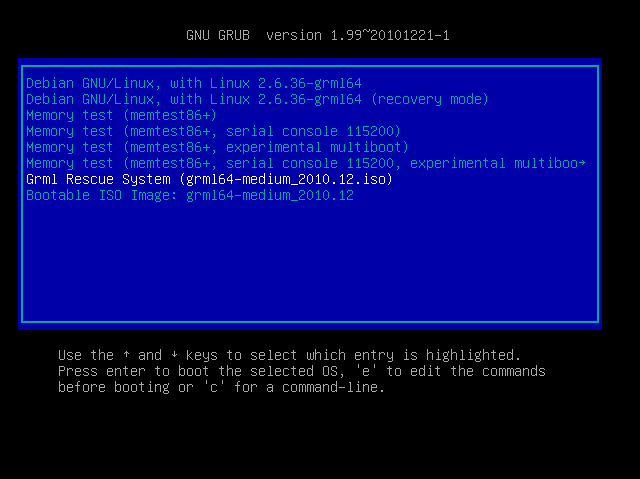
What a lovely idea: no need for a CD or USB stick as long as the bootloader and the harddisk are still working. Minimal manual intervention needed to keep it up2date and working sounds like the perfect rescue system. 8-) Now since end of 2010 a new stable version of sysadmin s favorite live system (AKA Grml 2010.12) is available and the great news is that we came up with two independent solutions known as grml-rescueboot and grub-imageboot. Having shipped them to one of my customers already I d like to write some words about it and why you should also consider using it on all your systems where GRUB2 is available. grml-rescueboot uses GRUB2 and its loopback feature for booting. Grml as well as Ubuntu provide all what s needed out-of-the-box. If you re interested in the details check out Jordan Uggla s excellent Loopback.cfg webpage in the supergrubdisk wiki. The best about it: you can provide custom bootoptions automatically when booting Grml. For example just set CUSTOM_BOOTOPTIONS= ssh=grml2011 in /etc/default/grml-rescueboot and the Grml rescue system will automatically start the OpenSSH server with the specified argument as password for user grml. Of course you can use all the other nifty bootoptions like scripts/netscript/ to further customize your Grml rescue system. [A note to other distributions like Ubuntu: I'd be interested to establish a mechanism to pass kernel options for loopback boot in a standardized way, drop me a note if you're interested in this.] grub-imageboot uses GRUB2 and syslinux memdisk to boot ISOs and floppy images. It doesn t rely on the loopback feature but instead maps the ISO into the memory directly. This is great for Linux ISOs that can t and won t support the the loopback feature (and have everything inside their initrd so the ISO doesn t have to find itself during booting), like BIOS or firmware updates. Also for example FreeDOS and Alpharev are known to work just fine. But sadly memdisk ISO emulation doesn t work with all Linux systems, as documented in the syslinux wiki. The good news is that Grml supports the memdiskfind/phram/mtdblock approach out-of-the-box. As far as I know therefore Grml is the first Debian based live system supporting memdisk ISO boot, though my patches already went to the Debian-Live project so if you re using live-boot >=2.0.14-1 or >=2.0.12-1+grml.04 your live system should be able to boot via memdisk ISO emulation as well. Summary: If you want to boot a Linux system which supports loopback.cfg use grml-rescueboot as its a more powerful tool to boot Linux live systems like Grml and Ubuntu. If you want to boot non-Linux systems (BIOS-/Firmware-Updates/FreeDOS/ .) use grub-imageboot. Alright how do you deploy this solution? Just grab and install grml-rescueboot and/or grub-imageboot. To deploy grml-rescueboot (adjust $VERSION if you want to use another flavour):
# choose Grml version:
VERSION=grml64-medium_2010.12
# create directory
mkdir -p /boot/grml
# download and verify ISO
cd /boot/grml
wget download.grml.org/$ VERSION .iso ,.md5 
md5sum -c $ VERSION .iso.md5
To deploy grub-imageboot:
# choose Grml version:
VERSION=grml64-medium_2010.12
# create directory
mkdir -p /boot/images
# download and verify ISO
cd /boot/images
wget download.grml.org/$ VERSION .iso ,.md5 
md5sum -c $ VERSION .iso.md5
That s it! Now when running update-grub you should get something like:
# update-grub
Generating grub.cfg ...
Found linux image: /boot/vmlinuz-2.6.36-grml64
Found initrd image: /boot/initrd.img-2.6.36-grml64
Found memtest86+ image: /boot/memtest86+.bin
Found memtest86+ multiboot image: /boot/memtest86+_multiboot.bin
  No volume groups found
Found Grml ISO image: /boot/grml/grml64-medium_2010.12.iso
Found memdisk: /boot/memdisk
Found iso image: /boot/images/grml64-medium_2010.12.iso
done
Voil , when rebooting your system you should see something like: Screenshot: grml-rescueboot The Grml Rescue System entry is what grml-rescueboot provides and Bootable ISO Image is what s provided by grub-imageboot. Just select the entry you d like to use, press enter and and you should get the bootsplash of the according ISO. BTW: I ve tested this with Ubuntu 10.10 too, grml-rescueboot works out-of-the-box with the Ubuntu ISO as well, it just doesn t support the memdisk ISO boot by grub-imageboot (yet). Tip: if you want to use grml-rescueboot and grub-imageboot with the same ISOs without having them twice on the disk just point the configuration option IMAGES in /etc/default/grub-imageboot to the according directory (like /boot/grml). Note: if you re using the ext 2,3,4 filesystem on the partition that s being used for /boot please be aware that you need GRUB >=1.98+20100804-12 (newer version is already available in Debian/unstable and hopefully migrates to squeeze in time) or GRUB >=1.99~20101122-1 because of the INDIRECT_BLOCKS support, see #543924 for the details. PS: We think about providing grml-rescueboot and grub-imageboot within official Debian. If you re interested in seeing integration support for other distributions as well please help and drop us a note.

Michal &#268;iha&#345;: Finding a GPL violation

As the communication in this case seems to be stuck and the issue is almost one year old, it's time to make bits of it public. The first post will just describe how I've discovered it, later will bring more details. All started innocently with bug report on Gammu that it fails to work with some Sonim phones. We started to dig some information about what extensions does Sonim use and one of obvious ways was to try their software. I picked up software for Sonim XP3.20 Quest and started to look at it (if you are not going to install them, but want to look, you need unrar and unshield to unpack it). At first look the names of DLLs looked familiar to me and running strings on the DLLs just confirmed my suspicion - the phone which is not supported by Gammu bases it's official software on it. I was able to recognize at least seven DLLs derived from (GPL licensed) Gammu (they even use same names as Gammu modules had in that time): To make the thing more interesting they use several other components released under free software licenses, where they also should provide sources for them: There might be more, but I did not want to spend more time on deep analysis, because I already had enough information.

Filed under: English Gammu Gpl 6 comments Flattr this!

4 January 2011

Gregor Herrmann: RC bugs 2010/50 - 2010/52

the release team has started to usertag [0] the remaining RC bugs yeah, another step towards the release!

here are my small contributions around RC bugs: [0] if I got it right: update: all tags combined: http://tinyurl.com/squeeze-sort (thanks to the RT for the URL & to zack for the pointer)

3 January 2011

Mike Hommey: The measured effect of I/O on application startup

I did some experiments with the small tool I wrote in previous post in order to gather some startup data about Firefox. It turns out it can t flush directories and other metadata from the page cache, making it unfortunately useless for what I m most interested in. So, I gathered various startup information about Firefox, showing how page cache (thus I/O) has a huge influence on startup. The data in this post are mean times and 95% confidence interval for 50 startups with an existing but fresh profile, in a mono-processor GNU/Linux x86-64 virtual machine (using kvm) with 1GB RAM and a 10GB raw hard drive partition over USB, running, except when said otherwise, on an i7 870 (up to 3.6GHz with Intel Turbo Boost). The Operating System itself is an up-to-date Debian Squeeze running the default GNOME environment. Firefox startup time is measured as the difference between the time in ms right before starting Firefox and time in ms as returned by javascript in a data:text/html page used as home page. Startup vs. page cache
Average startup time (ms)
Entirely cold cache (drop_caches) 5887.62 0.88%
Cold cache after boot 3382.0 0.51%
Selectively cold cache (see below) 2911.46 0.48%
Hot cache (everything previously in memory) 250.74 0.18%
The selectively cold cache case makes use of the flush program from previous post and a systemtap script used to get the list of files read during startup. This script will be described in a separate post. As you can see, profiling startup after echo 3 > /proc/sys/vm/drop_caches takes significantly more time than in the normal conditions users would experience, because of all system libraries that would normally be in the page cache being flushed, hence biasing the view one can have of the actual startup performance. Mozilla build bots were running, until recently, a ts_cold startup test that, as I understand it, had this bias (which is part of why it was stopped). The Hot cache value is also interesting because it shows that the vast majority of cold startup time is due to hard disk I/O (and no, there is no page faults number difference). I/O vs CPU Interestingly, testing on a less beefy machine (Core 2 Duo 2.2GHz) with the same USB disk and kvm setup shows something not entirely intuitive:
Average (ms)
Entirely cold cache 6748.42 1.01%
Cold cache after boot 3973.64 0.53%
Selectively cold cache 3445.7 0.43%
Hot cache 570.58 0.70%
I, for one, would have expected I/O bound startups to only be slower by around 320ms, which is roughly the hot cache startup difference, or, in other words, the CPU bound startup difference. But I figured I was forgetting an important factor. I/O vs. CPU scaling Modern processors do frequency scaling, which allows the processor to run slowly when underused, and faster when used, thus saving power. It was first used on laptop processors to reduce power drawn from the battery, allowing batteries to last longer, and is now used on desktop processors to reduce power consumption. It unfortunately has a drawback, in that it introduces some latency when the scaling kicks in. A not so nice side effect of frequency scaling is that when a process is waiting for I/O, the CPU is underused, making the CPU usually run at its slowest frequency. When the I/O ends and the process runs again, the CPU can go back to full speed. This means every I/O can induce, on top of latency because of, e.g. disk seeks, CPU scaling latency. And it actually has much more impact than I would have thought. Here are results on the same Core 2 Duo, with frequency scaling disabled, and the CPU forced to its top speed :
Average (ms)
Entirely cold cache 5824.1 1.13%
Cold cache after boot 3441.8 0.43%
Selectively cold cache 3025.72 0.29%
Hot cache 576.88 0.98%
(I would have liked to do the same on the i7, but Intel Turbo Boost complicates things and I would have needed to get two new sets of data) Update: I actually found a way to force one core at its max frequency and run kvm processes on it, giving the following results:
Average (ms)
Entirely cold cache 5395.94 0.83%
Cold cache after boot 3087.47 0.31%
Selectively cold cache 2673.64 0.21%
Hot cache 258.52 0.35%
I haven t gathered enough data to have accurate figures, but it also seems that forcing the CPU frequency to a fraction of the fastest supported frequency gives the intuitive results where the difference between all I/O bound startup times is the same as the difference for hot cache startup times. As such, I/O bound startup improvements would be best measured as an improvement in the difference between cold and hot cache startup times, i.e. (cold2 - hot2) - (cold1 - hot1), at a fixed CPU frequency. Startup vs. desktop environment We saw above that the amount of system libraries in page cache directly influences application startup times. And not all GNU/Linux systems are made equal. While the above times were obtained under a GNOME environment, some other desktop environments don t use the same base libraries, which can make Firefox require to load more of them at cold startup. The most used environment besides GNOME is KDE, and here is what cold startup looks like under KDE:
Average startup time (ms)
GNOME cold cache 3382.0 0.51%
KDE cold cache 4031.9 0.48%
It s significantly slower, yet not as slow as the entirely cold cache case. This is due to KDE not using (thus not pre-loading) some of the GNOME core libraries, yet using libraries in common, like e.g. libc (obviously), or dbus.

30 December 2010

Jonathan McDowell: Why Linux? (Part 5: Flexibility)

(This is part of a series of posts on Why Linux?) I find Linux more flexible. Maybe that's the familiarity showing, maybe it's about the package management, but it's a powerful reason for me to use it. For example, a couple of years ago I wanted to try out some iSCSI stuff against a SAN. Of course I have test boxes available I can do this on, but this was just to try out a few bits and pieces rather than anything more concrete. So I installed open-iscsi on my desktop and was able to merrily do the tests I wanted with very little additional work. Or I wanted to try out some BitKeeper to git conversion work recently. I wasn't sure how much resource it would take on a build server, and didn't want to tie things up there. So I ran it on my desktop overnight, where I could easily setup the appropriate environment and wouldn't impact on anyone else's resources. Problems talking to dodgy hardware? Linux is much better about giving you some idea what's going on, without needing to install extra software. I had a workmate grappling with an old USB music player recently; hooking it up to her Windows laptop wasn't providing a lot of joy so I attached it to my Linux box and was able to see that it did identify ok, but was disconnecting randomly at times too. Want to script querying an AD server for the current employee list and displaying who's joined and who's left since the last time you did so? I found that easy enough with the common Linux LDAP tools. I'm sure it's doable under Windows too, but I'm not sure it would be quite so simple. For bonus points add graphviz into the mix for automatic organisation charts (modulo accuracy of the AD data). This flexibility is something that helps me do my job. Sure, as I mentioned above I do have access to test boxes that I can use for this, but being able to do it on my desktop can be useful - for example if I'm offline, or on a slow network connection, or just geographically distant from my test machines so network latency is higher than I'd like. (Also, it's something that makes a Linux box a really great test box. I'm lucky in that I have a mix of OSes available to me for testing, but the one that I use most often is the Debian box. Much easier to get and install decent diagnosis tools for it that can give me packet level dumps, or do really odd stuff that turns out to be really useful.)

29 December 2010

Jon Dowland: announcing RDiffFS

It gives me pleasure to announce RDiffFS, a virtual filesystem for browsing backups created by the rdiff-backup tool. Assuming that "/backup" is the location of a series of backups created using rdiff-backup, here is a usage example:
$ rdifffs /backup/dest/ /mnt
$ ls -l /mnt
total 5
drwxr-xr-x 4 jon jon 4096 Feb  7  2010 2010-09-04T16:38:10+01:00
drwxr-xr-x 4 jon jon 4096 Feb  7  2010 2010-12-29T10:51:50Z
drwxr-xr-x 4 jon jon 4096 Feb  7  2010 2010-12-29T10:52:30Z
lr-xr-xr-x 2 jon jon   11 Jan  1  1970 current -> 2010-12-29T10:52:30Z
$ for i in /mnt/*/a; do c=$(cat "$i"); printf "%32s:\t%s\n" "$i" "$c"; done
/mnt/2010-09-04T16:38:10+01:00/a:   foo
     /mnt/2010-12-29T10:51:50Z/a:   bar
     /mnt/2010-12-29T10:52:30Z/a:   baz
                  /mnt/current/a:   baz
I will write more about the creation of rdifffs at a later date: in particular my choice of implementation language, but I don't want to clutter up this announcement with all that. Suffice to say, I started writing a "quick tool" nearly a year ago, and I have become increasingly desperate to announce it. At present, rdifffs should be considered alpha quality software. It can browse my real-world backup, albeit slowly, and with several metadata bugs. This is more than archfs can manage. It can read files from the most recent backup, and most files from incremental backups, but not all.

28 December 2010

Steve Kemp: Minor success has been achieved in reimplimenting mod_rewrite

So yesterday I mentioned the mod_rewrite-compatible proxy server. Today I've spent several hours getting to grips with that. I've progressed far enough along that the trivial cases are handled, as the following test case shows:
void
TestParamteredMatch (CuTest * tc)
 
    /**
     * We pretend this came in via the network.
     */
    char *request = "GET /login/steve.kemp/secret#password HTTP/1.1\n\n";
    /**
     * This is the mod_rewrite rule we're going to test.
     */
    char *rule    = "RewriteRule
                       ^/login/(.*)/(.*)/*$
                         /cgi-bin/index.cgi?mode=login;lname=$1;lpass=$2";
    int res = 0;
    /* Parse the HTTP request */
    struct http_request *req = http_request_new (request);
    CuAssertPtrNotNull (tc, req);
    /* Ensure it looks sane. */
    CuAssertStrEquals(tc, "/login/steve.kemp/secret#password", req->path );
    /* Create the rewrite rule */
    struct rewrite_rule *r = rewrite_rule_new (rule);
    CuAssertPtrNotNull (tc, r);
    /* Assert it contains what we think it should. */
    CuAssertStrEquals(tc, "^/login/(.*)/(.*)/*$", r->pattern );
    /* Apply - expect success (==1) */
    res = rewrite_rule_apply( r, req );
    CuAssertIntEquals (tc, 1, res );
    /* Ensure path is updated. */
    CuAssertStrEquals(tc, "/cgi-bin/index.cgi?mode=login;lname=steve.kemp;lpass=secret#password", req->path );
    free_http_request (req);
    free_rewrite_rule (r);
 
So all is good? Sadly not. I was expecting to handle a linked list of simple rules, but I've now realised that this isn't sufficient. Consider the following two (real) examples:
#
#  If the path is /robots.txt and the hostname isn't repository.steve.org.uk
# then redirect to the master one.
#
RewriteCond % http_host  !^repository\.steve\.org\.uk
RewriteRule /robots.txt$  http://repository.steve.org.uk/robots.txt [R=permanent,L]
#
#  Request for :  http://foo.repository.steve.org.uk 
#  becomes:  http://repository.steve.org.uk/cgi-bin/hgwebdir.cgi/foo/file/tip
#
RewriteCond % http_host  .
RewriteCond % http_host  !^repository.steve.org.uk [NC]
RewriteCond % http_host  ^([^.]+)\.repository.steve.org.uk [NC]
RewriteRule ^/$ http://repository.steve.org.uk/cgi-bin/hgwebdir.cgi/%1/file/tip [QSA,L]
So rather than having a simple linked list of rules for each domain I need to have a list of rules - each of which might in turn contain sub-rules. In terms of parsing this is harder than I'd like because it means I need to maintain state to marry up the RewriteCond & RewriteRules. Still the problem isn't insurmountable and I'm pleased with the progress I've made. Currently I can implement enough of mod_rewrite that I could handle all of my existing sites except the single site I have with the complex rule demonstrated above. (In all honesty I guess I could simplify my setup by dropping the wildcard hostname handling for the repository.steve.org.uk name, but I do kinda like it, and it makes for simple canonical mercurial repositories.) ObQuote: - 300

22 December 2010

Jonathan McDowell: Why Linux? (Part 4: Package Management)

(This is part of a series of posts on Why Linux?) I've run a number of distros in my time. I ended up on Debian near the end of 1999, and part of the drive for that was the number of packages available in one centralised location. Decent package management is a definite strength of Linux (or FreeBSD) over proprietary operating systems. It derives from the freedom aspect, but means you can end up with one source for all (or most) of your software, that's compiled against the same set of libraries, with one way to track what owns what. This may not seem like a big thing, especially if you're a hobbyist or are coming from a Windows background. Reinstalling is often seen as a necessary regular requirement. Personally I've got better things to do with my time. If I want to try out a piece of software I want to be able to install it safe in the knowledge I know exactly what files it owns and where there are. And I want it to be able to tell me what other common components it needs that I might not already have. Then if I decide it's not for me I can cleanly remove it and anything else it pulled in that I no longer need. Don't underestimate this. This is useful on all of my machines. I can query the version number of everything installed. I can check for updates with one command (no need for every piece of installed software to have its own updater implementation). Software can share libraries correctly rather than stashing their own private copies, meaning I get bug fixes and security updates. (Yes, sometimes authors bundle even in the Linux world. Stop it.) I'm a developer. I tend to interact with a lot of different systems, of different types. It's really handy to have access to a wide range of tools to help me with that, know that there's legally no problem with me installing them, be able to do so with a single command and, should they turn out to be unsuitable, know I can cleanly remove them with another single command. This is a definite win in the work context. Equally I've been a sysadmin for multiple machines at once. Being able to login to each of them and check that everything is up to date is damn handy. Being able to easily install software for customers tends to make you popular too. And being able to rebuild boxes (or build additional boxes to share load) with the same setup is a lot easier with a decent package manager too. And, to pre-empt any responses about how a lot of this is possible under, say, Windows, yes, it is. I've spent some time in the past building packages for commercial deployment using Novadigm's Radia tool. I'm aware that Windows integral package management has also got better over time. I still think dpkg/apt (or rpm/yum) is far more powerful. And, for the end user, mostly easier as well - distros are building pre-prepared packages for you, rather than you having to do it yourself like with Radia.

21 December 2010

Andreas Metzler: exim testers

I would appreciate if you could test the proposed fixes for the exim4 privilege escalation bug CVE-2010-4345. Preliminary binary and source packages for squeeze/sid and lenny are available here:
deb http://www.bebt.de/debian/ sid exim4+cve
deb-src http://www.bebt.de/debian/ sid exim4+cve
deb http://www.bebt.de/debian/ lenny exim4+cve
deb-src http://www.bebt.de/debian/ lenny exim4+cve
You can also browse the changes in SVN (lenny and sid) or build your own binaries.
Changelog: NEWS entry: Exim versions up to and including 4.72 are vulnerable to CVE-2010-4345. This is a privilege escalation issue that allows the exim user to gain root privileges by specifying an alternate configuration file using the -C option. The macro override facility (-D) might also be misused for this purpose. In reaction to this security vulnerability upstream has made a number of user visible changes. This package includes these changes. If exim is invoked with the -C or -D option the daemon will not regain root privileges though re-execution. This is usually necessary for local delivery, though. Therefore it is generally not possible anymore to run an exim daemon with -D or -C options. However this version of exim has been built with TRUSTED_CONFIG_LIST=/etc/exim4/trusted_configs. TRUSTED_CONFIG_LIST defines a list of configuration files which are trusted; if a config file is owned by root and matches a pathname in the list, then it may be invoked by the Exim build-time user without Exim relinquishing root privileges. As a hotfix to not break existing installations of mailscanner we have also set WHITELIST_D_MACROS=OUTGOING. i.e. it is still possible to start exim with -DOUTGOING while being able to do local deliveries. If you previously were using -D switches you will need to change your setup to use a separate configuration file. The ".include" mechanism makes this easy. The system filter is run as exim_user instead of root by default. If your setup requies root privileges when running the system filter you will need to set the system_filter_user exim main configuration option.

18 December 2010

Jonathan McDowell: Why Linux? (Part 3: It's cheap)

(This is part of a series of posts on Why Linux?) Linux, to me as an end user, is cheap. Even taking into account the fact most PCs come with a Windows licence included it's still cheaper for me to run Linux. I paid Steve minimal amounts for my first set of Debian install CDs. These days I can burn my own netinst CDs and pull the rest over the internet. I legally have access to a tremendous range of excellent software, for nothing. All the apps I need are available without having to shell out more. How is that not awesome? I get free updates, both for bugs and also for major features. I'm not left with the option of paying lots of money for the latest and greatest, or dealing with an unsupported old release with known bugs. The counter argument from my Windows using friends is often about how they didn't pay for their Windows updates nor their copy of Office. I'm unimpressed with anyone who tells me Windows is a better option, but is unprepared to pay for it. If you have to illegally obtain it in order for it to compete with Linux then you're not really comparing on equal terms, are you? Also don't tell me that Free software takes away jobs from software engineers and then pirate software, eh? Cost isn't just about the money though. I've put many hours into being involved in Debian. I've provided project resources when I was in a position to do so. I've contributed to the Linux kernel. Not quite the same as paying for it, but I think does indicate that I'm trying to give back a little too. I also accept that at an organisational level the basic cost of the software licences is often negligible compared to things like hardware, training and support. I still think cost is a compelling argument for the home user, and for decisions at an organisational level. As mentioned I realise there are issues with training and support, but I don't believe these costs are any higher than for alternative OSes. Linux also makes it remarkably easy to remotely administer machines, and perform common actions across an entire installed estate, without needing extra bolt ons from 3rd parties. Cost doesn't provide sufficient justification for an individual desktop in an organisation that has site licences for an alternative however (and in fact running Linux requires extra work on my part to do the install and maintenance compared to allowing central IT to manage my machine). So that's not a good enough reason.

Dirk Eddelbuettel: Introduction to ESS: talk and slides

We had another meeting of the Chicago R User Group last evening. This was scheduled somewhat belatedly once we learned that Drew Conway would be in town. Drew gave a very nice talk about his brand new infochimps package (for accessing the eponymous infochimps data service and marketplace). Slides are available on Drew's blog. In fact, he had already blogged about his talk before I had even started to write my slides... The user group meetings have a meme of showing how to use R with different editors, UIs, IDEs,... It started with a presentation on Eclipse and its StatET plugin. So a while ago I had offered to present on ESS, the wonderful Emacs mode for R (and as well as SAS, Stata, BUGS, JAGS, ...). And now I owe a big thanks to the ESS Core team for keeping all their documentation, talks, papers etc in their SVN archive, and particularly to Stephen Eglen for putting the source code to Tony Rossini's tutorial from useR! 2006 in Vienna there. This allowed me to quickly whip up a few slides though a good part of the presentation did involve a live demo missing from the slides. Again, big thanks to Tony for the old slides and to Stephen for making them accessible when I mentioned the idea of this talk a while back -- it allowed to put this together on short notice. And for those going to useR! 2011 in Warwick next summer, Stephen will present a full three-hour ESS tutorial which will cover ESS in much more detail.

17 December 2010

Daniel Stone: new x.org multitouch patchset posted

So, I've been working on multitouch on and off the past few months (which have included a solid ten weeks of holiday), but have finally posted the third patch series, which I think should be pretty close to final, to the list today.

Touch events look kind of similar to standard Xi 2.1 events (DeviceMotionNotify and friends), but the implementation of grabbing and event delivery is quite different from the traditional X model that we all know and love.

Firstly, touch grabs are not strictly grabs as with other input events. When a synchronous pointer or keyboard grab activates, it 'freezes' the device, stopping delivery of all further events until the grabbing client has decided what to do. The client can either pass on the event to the next client (replay), opt to continue receiving all events with the device freezing again after each event (synchronous mode), or continue receiving all events with the device unfrozen (asynchronous). While this is happening, the grabbing client is the only one receiving events, hence the name.

Touch grabs break both of these assumptions. Firstly, the device never freezes: delivery of all events (pointer, keyboard, touch, whatever) continues at full tilt, and a touch grab never affects pointer or keyboard events, with the possible future exception of pointer events that are emulated from touch events. Secondly, all clients with grabs, as well as the client with the first selection we find<super>0</super>, receive the events. An 'owner' flag is set (or unset) to indicate to the client that it does, or does not, own the touch stream in question.

The owner principle is important: the theory is that all touch streams must be considered as a whole (i.e. from init, through all the motion events, to the touch stream ending), and cannot be separated into component parts. So a client which does not own a touch stream can do gesture recognition or whathaveyou in the background, but must not act upon it until it becomes the owner. We added an extra request, XIAllowTouchEvents, to control ownership: clients can either reject ownership, passing it on to the next in line, or assert their ownership and permanently remove all other clients from the delivery list.

So it's somewhat different, but (hopefully) not without reason. The motivation behind this was to keep latency as low as humanly possible, since people seem to demand lower latencies from direct touch-based devices. Sticking to the traditional grab model would have meant a flurry of round trips between all the clients in the stack and the server, as well as maintaining huge buffers in the server for every touch event, which each client would have to transfer in turn.

This model is a compromise between my original design and Ubuntu's suggested design; both of us had far more simple designs, but oriented towards different usecases. The original Ubuntu usecase was for a global gesture recognition system, which apps would only opt out of in rare cases. My primary usecase was exactly the reverse: apps doing their own gesture recognition, with a very small, if any, global system. Hopefully it's actually the best of both worlds, rather than the worst possible intersection: I guess we'll find out. :)

At the moment, it's all largely theoretical, but some of the Nokia Qt guys are working on a port and have provided really helpful feedback, and hopefully the GTK+ multitouch branch, which was written against a much earlier and, er, speculative, version of the spec, gets updated too.

Finally, some thanks: to both Nokia and my excellent employer Collabora for sponsoring my part of this work; to Chase Douglas from Canonical for his contributions and for not just giving us the finger and vanishing when we rejected the X Gesture Extension, but hanging around and working through it; and to Peter Hutterer, for spec work and review. There were also numerous others involved earlier (including, but not limited to, Henrik Rydberg working on mtdev and others) who deserve credit, so sorry if I forgot anyone.

If you want to get it and play around with it, the patches/repositories are all laid out in my initial mail linked to earlier, as well as the follow-up mail noting the evdev repository location. The spec has more details, and will hopefully be cleaned up to be a lot less clunkily-written.

[0]: The delivery order is unchanged. For grabs, we start at the root window and proceed down the window stack to the innermost child window, activating grabs in that order. For events selected for with XISelectEvents, we start at the innermost child window, work our way up towards the root window, and stop as soon as we find one.

12 December 2010

Steve Kemp: The remote root hole in exim4 is painful

Recently I noticed a report of an alleged remote root security compromise of a machine, via the exim mailserver. At the time I wasn't sure how seriously to take it, but I followed updates on the thread and it soon became clear that there was a major problem on our hands. It later became obvious that there were two problems:
CVE-2010-4344
A remote buffer overflow, allowing the execution of arbitrary code as the user Debian-exim.
CVE-2010-4345
A privilege escelation allowing the attacker to jump from running code as Debian-exim to running code as root.
Trivial exploits are floating around the internet - and we were seeing this bug be exploited in the wild as early as yesterday afternoon. Although I can feel somewhat smug that my own personal server is running qpsmtpd ahead of exim it's still a wake-up call, and this hole has the potential to significantly expand available botnets - it is probably only a matter of days hours until we see worms taking advantage of the flaw. ObPlug: I've put together an updated version of exim4 for etch - if you're still running etch then you don't have any official security support (timely upgrading is obviously preferred) and it might be useful to have more folk pointed at that.. ObQuote: "We're all going to die down here" - Resident Evil.

Next.

Previous.


