Search Results: "eric"

17 September 2010

Erich Schubert: Random background python script

I use the following python script to choose a random background on login:
#!/usr/bin/python
import os, os.path, random, gconf
startdir="PUT YOUR FOLDER HERE"
gkey="/desktop/gnome/background/picture_filename"imgs=[]
for root, dirs, files in os.walk(startdir):
  for file in files:
    base, ext = os.path.splitext(file)
    if ext.lower() in [".jpg", ".png", ".svg"]:
      imgs.append(os.path.join(root, file))img = random.choice(imgs)gconf.client_get_default().set_string(gkey, img)
It's fairly simple, but shows the power of the python libraries. It "walks" the directory tree, collects all files of the given extensions, chooses one at random, then updates the gconf key for the Gnome background image.P.S. Yes, I know a couple of ways to do that in a shell script, too. However, then one I used failed with whitespace in file names, so I decided to rewrite it in a much more sane language ... the random involved was also a hack.

15 September 2010

Gunnar Wolf: On enjoying history, opposed to what happens around me

Portadas de los discos de Diana Uribe I have always liked learning and understanding history. Since I discovered him, for a couple of years already I always try to catch Javier Garciadiego's program Conversaciones sobre historia, Saturday 9AM in the Horizonte 108 radio station (can be listened to online). This program started by going over the events just before the beginning of the 1910 revolution in Mexico - and along slightly over five years, one hour per week and following different threads, the program has reached the end of the Cristiada, in the early 1930s. Garciadiego has a very nice, followable, amenable way of telling history, and I have recommended his program to many friends. This last June, I spent some days in Guatemala City, for DrupalCamp Centroam rica. I stayed with my good Colombian friend, Dilson, and at his house he had framed a poster of the History of the Civilizations. Of course, I got my nose close to it, guessing as many faces as possible in the lot. And he showed me his last Christmas present: Two books, each of them with 6 CDs. One is Historia de las Civilizaciones, the second one is Historia de las independencias. They are made by Colombia's very well known and well regarded historian Diana Uribe. I copied the CDs in order to listen to them later And wow, was I impressed! Diana Uribe makes a great narrative about topics that to some people would seem boring and dry. As I said, I have always found passion in understanding the human processes that have shaped civilization and brought us all the way to where we stand now. Well, Diana Uribe manages to bring more "normal" people to this passion. While looking for information on her to share in this blog post, I found so many places offering download of her disks, with apparently young people talking about how she has got them all so excited and interested in history... That's, I think, the best "thank you" any academician can get: having non-specialists say how her work has opened up the passion of one of the world's least sexy professions to them. And yes there are so many "thank you" and "I want" commentaries, so much of what I would call "fan mail", that it took me a bit to find an online library carrying both works. And yes, at ~US$50 each, I do intend to buy them. Now, why am I writing this today? Well, yes, because I finished listening to the series today, but besides During this year, most of Latin American countries conmemorate their 200 years of existence. Most of the independentist struggles in the continent started in 1809-1810. And today is the "partying" day in Mexico Says the legend that in the night between September 15 and 16, 1810, a priest who is always painted as old and charismatic called on his small town urging the people to rise and fight for independence, and as a result of that, only 11 years later Mexico was a fully independent country, spanning from Costa Rica to California, and... well, a nice and very idealized myth. A century later, in 1910, after a very long stability and growth period (attained mostly through repression, the same abstract thing named as "the people" rose against the dictator Porfirio D az, who had been Mexico's president for 30 years. The revolution deeply changed the social face of the country, but politically... After ~15 years of fighting, the result was that a 30 year long dictatorship was replaced by a 70 year long one... And our political system still has not evolved beyond that model. Now, comparing what has not improved nor even stayed the same but went backwards... A century ago, the festivities of the hundred years of independence were a time for showing pride, for showing to the guests from more "civilized" countries how ours was by then a modern, thriving country worth believing in, worth investing in: Besides the important, majestic and well built monuments that were erected and still stand today (i.e. the Column of the Independence or Hemiciclo a Ju rez, many institutions that would socially shape the next century even after D az's death, even after he had been declared not the role model we wanted after all were born: The National University (nowadays the most important university in Latin America), the National School for Professors, the Railroad Technical School and many others (see Javier Aranda's note for some more details)... The celebration was well-thought and planned. Of course, it didn't go into some darker corners, the country was as uneven and unfair as it can be for the poorer indigenous population (which back then was a majority), and what not. But this year? Well, we are expecting an impressive show tonight (which I won't see, even though I'd like to, as I no longer have a TV and even if I had wanted to go downtown for the celebration, different government branches are insisting we should just sit and watch it by TV at home as it can be too crowded... so not even that was well thought out Of course not every Mexican can go to the same square and see the same de-facto president do the ritual, but some more redundancy could be thought, spreading acts through all of the city instead of concentrating the festivities all along Reforma. But anyway Leaving aside our current de-facto ruler's inabilities to do anything worthy, which are already well known and documented... I took this opportunity to listen to a great work, and am most happy to do it, and to be able to share it with you.

12 September 2010

Theodore Ts'o: Moderate Muslims need a better PR Agency

There has been much made of recent reports that roughly half of Americans have an unfavorable view of Islam. And as usual, there are those who will try to claim that Muslims really aren t all that bad, and that Sharia is just set of nice, abstract principles which are all about the protection of life, family, education, religion, property, and human dignity. And on the other side, we have people pointing out that using Sharias as justification, there are countries which are stoning women and chopping off poor people s hands and then forbidding Muslims from arguing about whether such things are just. Worst yet, some of the more public moderate Muslims , such as Iman Rauf, refuse to criticize organizations such as Hamas, on the ground that he is a bridge builder , and it wouldn t help to criticize Hamas s terrorist activities as being anti-Isalmic. OK, so let s grant for the sake of argument the claims that Shariah really is far more than just criminal sanctions, but mainly about exhorting people to live a moral life, and that of the 1,081 pages of the two-volume Arabic text which Sherman A. Jackson (the Arthur F. Thurnau Prfessor of Arabic and Isalamic Studies at the University of Michigan) used to study Shariah, only 60 pages were devoted to criminal sanctions (i.e., the stoning and the cutting off of hands), and only 19 were devoted to Jihad. Let s even further grant the claims made by Humaira Awais Shahid that most Muslims reject Political Islam and are not even arabs. OK. But that case, wouldn t there be more Imans publically disavowing the people who advocate terrorism and suicide bombs as not being Islamic? Not all of them are bridge-builders, are they? And if so, some of them might be better deployed towards saying what Islam is not, and saying that perhaps people who espouse those beliefs are being profoundly unIslamic and saying this loudly outside of their Mosques. Oh, I understand that many Muslims feel that they shouldn t be asked to repudiate the sins of a few crazy terrorists ; just as all Christians shouldn t be held accountable for disturbed crazy rants of a small-time pastor from Gainsville, Florida. But at the same time, it seems to me that Islamic leaders should be eager to say, loudly, that what is being done in the name of their religion in Iran and Nigeria is wrong, and to denounce it. Maybe, some would say, that they are doing that and the media isn t paying attention to them. Well, the Media is surely paying attention to people like Iman Rauf, and he refuses to denounce Hamas! I would gently suggest to those Islamic leaders who feel that they and their faith haven t been given a fair shake, to hire a better PR agency; and make sure that active denunciations of that which they claim does not represent true Islam is shouted from the rooftops; published in press releases; made in press conferences. And actively denounce your fellow Muslims that you feel are shaming your religion, instead of complaining about American Islamophobia. Trying to pretend that there is absolutely no truth in why Americans might be afraid of terrorists who have been hiding under the mantle of your religion is not going to help your cause. There may be truth in the fact that many Americans don t know as much as they should about Islam and Shariah. And there may be truth that American unswerving support of Israel, despite the fact that they acted in profound and unjust ways against the Palestinians, is not only morally and ethically wrong, but has hurt American interests. I certainly believe that to be to true; I am no friend to fundamentalists of any stripe, whether they are Christian, Jewish, or Islamic; and I think the Jewish fundamentalists have almost completely taken over the Israeli political discourse. But all of that is irrelevant if the goal is reduce people e negative views towards Islam. And in any case, if you really believe that attacking innocents, and coercing religion by threatening Muslims who have fallen away from their faith with the death penalty is wrong, then it s wrong regardless of whether those innocents happened to vote for politicians who have been influenced by way too much money from AIPAC. So instead of trying to lecture Americans about their uncritical support of Israel, why not just stand witness to the fact that killing innocents is wrong, and that people who do that are not Islamic, no matter what they claim or how impressive their turban might happen to be? And maybe it might be a good idea to speak out against those who would lend support, whether moral, or financial or logistical, to people who do these unIslamic things in the name of Islam? And it may not be enough to say it once; it needs to be said again and again. Which is why it s important to hire a good PR agency. No related posts.

Alastair McKinstry: Exoclimes: the diversity of planetary scientists

I'm just back from ExoClimes 2010: Exploring the Diversity of Planetary Atmospheres. An excellent conference: the PDFs of the talks and posters are now online, and they are putting the videos of the talks up soon. But in particular the organizers deserves thanks for bringing exoplanetary scientists and observers together with climate modelers doing Earth (and Mars, Titan, Venus, ...) models.
Model complexity graph Peter Cox on model complexity
The last talk on Friday was by Peter Cox on Climate change and exoplanet sciences that was far better than expected for the "graveyard shift". One theme of the conference was the need for a 'heirarchy' of models, from simple energy-balance models to full circulation (GCM) models: using progressively more complex models to understand more bits of whats going on. Exoplanet workers mostly use simpler models, progressing now to GCMs, while Earth modellers are moving beyond GCMs to "Earth system" models including biology, etc. Peter pointed out the two styles of work: the exoplanet modelers are short of data, and risk being too speculative. We know little of what the planets are like, and concentrate on implementing physics in the models to see what they might be like. Earth modelers on the other hand are if anything swamped with data: the tendency here is to make the model fit the data, by adjusting parameters until it does so. The danger of this approach is that the model will then not work away from current present-Earth conditions. Tim Lenton pointed out some work that was done with the Met Office model, where they took the radiative transfer part of the model and tested it for other planets, and paleo-Earth conditions. The model blew up : it wasn't capable of x2 or x4 current CO2 levels. (This has since been corrected). Over dinner there were interesting discussions on the different styles within the communities. While the underlying GCMs used come from the Earth sciences, its quite common within the exoplanetary community for a researcher to work on all parts of the model: dynamics one day, radiative transfer the next. In Earth climate work people have become more specialized and someone is a 'radiative transfer' person, and won't touch other parts of the code (even if they can follow them in the huge codes we have today!). On the other hand, there is a greater tradition of model inter-comparison in Earth sciences, where we compare the model outputs to each other for some known test cases ( Held & Suarez, the CMIP5 project, etc.) Apart from some initial work by Emily Rauscher, little has been done on this in exoplanetary models; it was agreed more of this would be a good idea. Radiative transfer (the interaction of 'sunlight' with the atmosphere, where it gets absorbed, scattered and re-radiated) in particular seems to be an area that could benefit from this. In this middle ground Francois Forget showed the work on the LMDZ model and applying GCMs to terrestrial planets. They've successfully applied this model to Mars, Titan, and partially to Venus (a much tougher problem, due to its heavy clouds giving a long radiative timescale). There are problems with correctly explaining super-rotation though. This is where the atmosphere rotates faster than the planet: on Venus for example the planet rotates every 243 days, while the clouds rotate around the planet every 4 days. Sebastian Lebonnois described the possible mechanisms for Venus and Titan; Johnathan Mitchell so did some interesting work on this recently. Different regimes are involved for different rotation rates of the planet. Ralph Lorenz pointed out the lack of "real paleo-Earth" climate work at the moment. While geology has inspired a lot of work on the atmospheric composition, what with the different gas mixtures (meaning earth-model radiative transfer codes don't work) and the faster dynamics meaning super-rotation could apply (Earth's day was about 8 hours long in the Archean era), we don't have a model of the climate yet. It looks like we should treat Earth as an exoplanet. Tags , , ,

10 September 2010

Adrian von Bidder: Some Fun

Watching the Star Wars Trilogies (both old and new) has finally closed one of the major (in at least some of my collegues' view) holes in my cinematographic education. (I've seen some of the new trilogy when it came out, but not all.) Oh well ... while it's quite enjoyable to watch, it's probably at least as important to have seen them just to spot the references all over the place. Repo Man was where I found myself literally laughing out loudly all by myself. And not only because of the vintage special effects (1984). The Straight Story (Lynch) is just beautiful. Alvin Straight is your proverbial old uncle who may be a bit funny in the head but you just have to like him... If you like mind control stories, The Manchurian Candidate is for you. Now that would be a way for Debian to achieve world domination. Worth thinking about? Speaking of american politics, this reminds me of All the President's Men, which I've seen (and liked) a long time ago. I don't know enough about history to tell how close it is to reality, but it's at least a well made political thriller. Based On A True Story is the term usually used, isn't it?

Dirk Eddelbuettel: Rcpp 0.8.6

After a somewhat longer than usual break, we now have a new release of Rcpp on CRAN and in Debian. This release adds quite few things. The main one may be the addition of density, distribution, quantile and random number functions for a rather large number of statistical distribution. Usage is pretty much as it would be in R, yet it is vectorised at the C++ level. A fair number of unit tests were added too, but some work is left to do there too.
Support for complex number was enhanced both in the expressive 'sugar' context and via a few binary operators that had been missing. We also started a new vignette to provide a 'quick reference'; unfortunately this is not quite complete yet. The NEWS entry follows below:
0.8.6   2010-09-09
    o	new macro RCPP_VERSION and Rcpp_Version to allow conditional compiling
        based on the version of Rcpp
    
           #if defined(RCPP_VERSION) && RCPP_VERSION >= Rcpp_Version(0,8,6)
           ...
           #endif
    o   new sugar functions for statistical distributions (d-p-q-r functions)
	with distributions : unif, norm, gamma, chisq, lnorm, weibull, logis,
	f, pois, binom, t, beta.
    o   new ctor for Vector taking size and function pointer so that for example
    	   NumericVector( 10, norm_rand )
	generates a N(0,1) vector of size 10
    o   added binary operators for complex numbers, as well as sugar support 
    o   more sugar math functions: sqrt, log, log10, exp, sin, cos, ...
    o	started new vignette Rcpp-quickref : quick reference guide of Rcpp API
        (still work in progress)
    o	various patches to comply with solaris/suncc stricter standards
    o	minor enhancements to ConvolutionBenchmark example
    o	simplified src/Makefile to no longer require GNU make; packages using
        Rcpp still do for the compile-time test of library locations
    
As always, even fuller details are in Rcpp Changelog page and the Rcpp page which also leads to the downloads, the browseable doxygen docs and zip files of doxygen output for the standard formats. A local directory has source and documentation too. Questions, comments etc should go to the rcpp-devel mailing list off the R-Forge page

Dirk Eddelbuettel: Rcpp 0.8.6

After a somewhat longer than usual break, we now have a new release of Rcpp on CRAN and in Debian. This release adds quite few things. The main one may be the addition of density, distribution, quantile and random number function for a rather large number of statistical distribution. Usage is pretty much as it would be in R, yet it is vectorised at the C++ level. A fair number of unit tests were added too, but some work is left to do there too.
Support for complex number was enhanced both in the expressive 'sugar' context and via a few binary operators that had been missing. We also started a new vignette to provide a 'quick reference'; unfortunately this is not quite complete yet. The NEWS entry follows below:
0.8.6   2010-09-09
    o	new macro RCPP_VERSION and Rcpp_Version to allow conditional compiling
        based on the version of Rcpp
    
           #if defined(RCPP_VERSION) && RCPP_VERSION >= Rcpp_Version(0,8,6)
           ...
           #endif
    o   new sugar functions for statistical distributions (d-p-q-r functions)
	with distributions : unif, norm, gamma, chisq, lnorm, weibull, logis,
	f, pois, binom, t, beta.
    o   new ctor for Vector taking size and function pointer so that for example
    	   NumericVector( 10, norm_rand )
	generates a N(0,1) vector of size 10
    o   added binary operators for complex numbers, as well as sugar support 
    o   more sugar math functions: sqrt, log, log10, exp, sin, cos, ...
    o	started new vignette Rcpp-quickref : quick reference guide of Rcpp API
        (still work in progress)
    o	various patches to comply with solaris/suncc stricter standards
    o	minor enhancements to ConvolutionBenchmark example
    o	simplified src/Makefile to no longer require GNU make; packages using
        Rcpp still do for the compile-time test of library locations
    
As always, even fuller details are in Rcpp Changelog page and the Rcpp page which also leads to the downloads, the browseable doxygen docs and zip files of doxygen output for the standard formats. A local directory has source and documentation too. Questions, comments etc should go to the rcpp-devel mailing list off the R-Forge page

8 September 2010

Mirco Bauer: Smuxi 0.8 "Godsend" Release

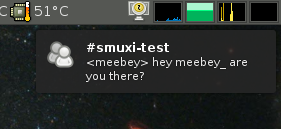
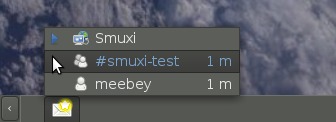
5 weeks after the 0.7.2.2 "Lovegood" release, I am very happy to announce the major feature release, 0.8 codenamed "Godsend". Major feature highlights of this release are desktop notifications (with full support of actions, icons, updates, append and sound), messaging menu / indicators (as provided by Ubuntu's Ayatana project) and working Twitter support with OAuth (basic auth was disabled by Twitter on 31st August). This version also fixes all bugs that were reported since the release of 0.7.2.2. Desktop Notifications
Messaging Menu
Further on, Smuxi comes with the following improvements in its user interface: Smuxi provides better connectivity and security by supporting: HTTP and SOCKS proxies as well as secure connections to IRC servers by using SSL with optional certificate validation. Last but not least, it comes with an enhanced Twitter experience by supporting the use of multiple Twitter accounts at the same time, reformatting tweets that contain newlines and showing the full retweet instead of a truncated version. Updated languages includes: French (Cl ment BOURGEOIS) and German (Bianca Mix) The #smuxi IRC channel can now also be found, in addition to OFTC, on other popular IRC networks such as freenode and GIMPnet. The messages on #smuxi are automatically relayed between the 3 IRC networks. If you like Smuxi and want to support it by making micro-donations, Smuxi is available on Flattr. There are also many other nice FOSS projects available on Flattr, see the Flattr-FOSS project. Smuxi is available for download from here. Binary Packages of Smuxi 0.8 are ready to be used by Debian/Experimental, Ubuntu/Maverick, Ubuntu/Lucid (via PPA), OpenSUSE, Foresight Linux, FreeBSD, and Windows.

Dirk Eddelbuettel: Straight, curly, or compiled?

Christian Robert, whose blog I commented-on here once before, had followed up on a recent set of posts by Radford Neal which had appeared both on Radford's blog and on the r-devel mailing list. Now, let me prefix this by saying that I really enjoyed Radford's posts. He obviously put a lot of time into finding a number of (all somewhat small in isolation) inefficiencies in R which, when taken together, can make a difference in performance. I already spotted one commit by Duncan in the SVN logs for R so this is being looked at. Yet Christian, on the other hand, goes a little overboard in bemoaning performance differences somewhere between ten and fifteen percent -- the difference between curly and straight braces (as noticed in Radford's first post). Maybe he spent too much time waiting for his MCMC runs to finish to realize the obvious: compiled code is evidently much faster. And before everybody goes and moans and groans that that is hard, allow me to just interject and note that it is not. It really doesn't have to be. Here is a quick cleaned up version of Christian's example code, with proper assigment operators and a second variable x. We then get to the meat and potatoes and load our Rcpp package as well as inline to define the same little test function in C++. Throw in rbenchmark which I am becoming increasingly fond of for these little timing tests, et voila, we have ourselves a horserace:
# Xian's code, using <- for assignments and passing x down
f <- function(n, x=1) for (i in 1:n) x=1/(1+x)
g <- function(n, x=1) for (i in 1:n) x=(1/(1+x))
h <- function(n, x=1) for (i in 1:n) x=(1+x)^(-1)
j <- function(n, x=1) for (i in 1:n) x= 1/ 1+x 
k <- function(n, x=1) for (i in 1:n) x=1/ 1+x 
# now load some tools
library(Rcpp)
library(inline)
# and define our version in C++
l <- cxxfunction(signature(ns="integer", xs="numeric"),
                 'int n = as<int>(ns); double x=as<double>(xs);
                  for (int i=0; i<n; i++) x=1/(1+x);
                  return wrap(x); ',
                 plugin="Rcpp")
# more tools
library(rbenchmark)
# now run the benchmark
N <- 1e6
benchmark(f(N, 1), g(N, 1), h(N, 1), j(N, 1), k(N, 1), l(N, 1),
          columns=c("test", "replications", "elapsed", "relative"),
          order="relative", replications=10)
And how does it do? Well, glad you asked. On my i7, which the other three cores standing around and watching, we get an eighty-fold increase relative to the best interpreted version:
/tmp$ Rscript xian.R
Loading required package: methods
     test replications elapsed relative
6 l(N, 1)           10   0.122    1.000
5 k(N, 1)           10   9.880   80.984
1 f(N, 1)           10   9.978   81.787
4 j(N, 1)           10  11.293   92.566
2 g(N, 1)           10  12.027   98.582
3 h(N, 1)           10  15.372  126.000
/tmp$ 
So do we really want to spend time arguing about the ten and fifteen percent differences? Moore's law gets you those gains in a couple of weeks anyway. I'd much rather have a conversation about how we can get people speed increases that are orders of magnitude, not fractions. Rcpp is one such tool. Let's get more of them.

6 September 2010

Ingo Juergensmann: Problems with IPv6 and Bridging/Xen

I've been using IPv6 on my rootserver for some time now. Last week I migrated to a new rootserver and copied my domU/VM instances over to the new hardware. Everything is working fine so far - except IPv6. The network setup is the same as on the old server: the external interface is eth0. The domU/VMs are hooked up to a bridge, called xenbr0. There's another bridge for internal communication: xenbr1. The dom0/Xen host itself seems reachable via IPv6. The /48 subnet is provided by Sixxs and is using a static 6-to-4 tunnel. But the VMs are not reliable reachable, although it is setup in the same way as it was on the old server and where it was working like a charme. The configs of the hosts are these:
Xen dom0
config old server new server
System Debian Etch
2.6.18-6-xen-amd64
linux-image-2.6.18-6-xen-amd64
linux-modules-2.6.18-6-xen-amd64
xen-hypervisor-3.0.3-1-amd64
xen-ioemu-3.0.3-1
xen-linux-system-2.6.18-6-xen-amd64
xen-tools
xen-utils-3.0.3-1
xen-utils-common
Debian Squeeze
2.6.32-5-xen-amd64
libxenstore3.0
linux-image-2.6.32-5-xen-amd64
xen-hypervisor-4.0-amd64
xen-linux-system-2.6.32-5-xen-amd64
xen-tools
xen-utils-4.0
xen-utils-common
xenstore-utils
xenwatch
/etc/sysctl.conf net.ipv4.ip_forward=1
net.ipv6.conf.all.forwarding=1
net.ipv4.conf.default.proxy_arp=1
net.ipv4.ip_forward=1
net.ipv4.ip_syncookies=1
net.ipv4.conf.all.rp_filter=1
net.ipv4.icmp_echo_ignore_broadcasts=1
/etc/xen/xend-config.sxp (network-script network-route)
(vif-script vif-bridge)
(dom0-min-mem 196)
(dom0-cpus 0)
(vif-script vif-bridge)
(network-script network-route)
(dom0-min-mem 196)
(enable-dom0-ballooning yes)
(total_available_memory 0)
(dom0-cpus 2)
(vncpasswd '')
/etc/network/interfaces # device: eth0
auto eth0
iface eth0 inet static
address 85.10.209.30
broadcast 85.10.209.31
netmask 255.255.255.224
up route add -net 85.10.209.0 netmask 255.255.255.224 gw 85.10.209.1 eth0 true
up ip route add 85.10.209.0/28 via 85.10.209.1 src 85.10.209.30 true
up route add default gw 85.10.209.1 true

auto xenbr0
iface xenbr0 inet static
address 85.10.209.30
netmask 255.255.255.224
pre-up brctl addbr xenbr0
up route add -net 78.47.85.144/29 dev xenbr0 true
up ip -6 r a 2001:6f8:90e:145::1/64 via 2001:6f8:90e:1:216:3eff:fe55:197c dev xenbr0 true
up ip -6 r a 2001:6f8:90e:146::1/64 via 2001:6f8:90e:1:216:3eff:fe2f:481d dev xenbr0 true
up ip -6 r a 2001:6f8:90e:147::1/64 via 2001:6f8:90e:1:216:3eff:fe60:68be dev xenbr0 true
up ip -6 r a 2001:6f8:90e:a100::1/64 via 2001:6f8:90e:1:216:3eff:fe70:be dev xenbr0 true

auto xenbr1
iface xenbr1 inet static
address 192.168.x.254
netmask 255.255.255.0
pre-up brctl addbr xenbr1
# some internal IPv4 routing


auto sixxs
iface sixxs inet6 v4tunnel
address 2001:6f8:900:c6e::2
netmask 64
endpoint 212.224.0.188
local 85.10.209.30
ttl 64
up ip link set mtu 1280 dev sixxs true
up ip route add default via 2001:6f8:900:c6e::1 dev sixxs true
up ip -6 route flush dev eth0 true
up ip -6 r a 2001:6f8:90e::/48 dev xenbr0 true
down ip -6 route flush dev sixxs true
# device: eth0
auto eth0
iface eth0 inet static
address 178.63.83.84
broadcast 178.63.83.127
netmask 255.255.255.192
gateway 178.63.83.65
# default route to access subnet
up route add -net 178.63.83.64 netmask 255.255.255.192 gw 178.63.83.65 eth0

auto xenbr0
iface xenbr0 inet static
address 178.63.83.84
netmask 255.255.255.192
pre-up brctl addbr xenbr0
up route add -host 178.63.83.104 dev xenbr0 true
up route add -host 178.63.83.105 dev xenbr0 true
up route add -host 178.63.83.106 dev xenbr0 true
up ip route add 178.63.123.128/26 dev xenbr0 true
up ip -6 r a 2001:6f8:90e:145::1/64 via 2001:6f8:90e:1:216:3eff:fe89:6c31 dev xenbr0 true
up ip -6 r a 2001:6f8:90e:146::1/64 via 2001:6f8:90e:1:216:3eff:fedc:af5f dev xenbr0 true
up ip -6 r a 2001:6f8:90e:147::1/64 via 2001:6f8:90e:1:216:3eff:fe08:8f40 dev xenbr0 true
up ip -6 r a 2001:6f8:90e:a100::1/64 via 2001:6f8:90e:1:216:3eff:fe70:be dev xenbr0 true
auto xenbr1
iface xenbr1 inet static
address 192.168.x.254
netmask 255.255.255.0
pre-up brctl addbr xenbr1
# some internal IPv4 routing
auto sixxs
iface sixxs inet6 v4tunnel
address 2001:6f8:900:c6e::2
netmask 64
endpoint 212.224.0.188
local 178.63.83.84
ttl 64
up ip link set mtu 1280 dev sixxs true
up ip route add default via 2001:6f8:900:c6e::1 dev sixxs true
up ip -6 route flush dev eth0 true
up ip -6 r a 2001:6f8:90e::/48 dev xenbr0 true
down ip -6 route flush dev sixxs true
The config of one of the Xen domUs is this:
sample domU config
config old server new server
system Debian Lenny
2.6.18-6-xen-amd64
Debian Lenny
2.6.32-5-xen-amd64
/etc/sysctl.conf net.ipv4.conf.default.rp_filter=1
net.ipv4.tcp_syncookies=1
net.ipv4.conf.default.forwarding=1
net.ipv6.conf.default.forwarding=1
net.ipv4.conf.eth0.proxy_arp=1
net.ipv4.conf.default.proxy_arp=1
kernel.shmmax=268435456
net.ipv4.conf.default.rp_filter=1
net.ipv4.tcp_syncookies=1
net.ipv4.conf.default.forwarding=1
net.ipv4.conf.all.forwarding=1
net.ipv6.conf.default.forwarding=1
net.ipv4.conf.eth0.proxy_arp=1
net.ipv4.conf.default.proxy_arp=1
kernel.shmmax=268435456
/etc/network/interfaces # The primary network interface
auto eth0
iface eth0 inet static
address 78.47.85.145
netmask 255.255.255.248
up ip route add 85.10.209.0/27 dev eth0
up route add default gw 85.10.209.30 dev eth0
up ip -6 address add 2001:6f8:90e:145::1/64 dev eth0 true
up ip -6 route add default via 2001:6f8:90e:1::1 true
up iptables -t nat -A POSTROUTING -s 192.168.x.96/27 -o eth0 -j MASQUERADE true

iface eth0 inet6 static
address 2001:6f8:90e:145::1
netmask 64
gateway 2001:6f8:90e:1::1 auto eth1
iface eth1 inet static
address 192.168.x.1
netmask 255.255.255.0
# The primary network interface
auto eth0
iface eth0 inet static
address 178.63.83.104
gateway 178.63.83.84
netmask 255.255.255.192
broadcast 178.63.83.127
up ip -6 address add 2001:6f8:90e:145::1/64 dev eth0 true
up ip -6 route add default via 2001:6f8:90e:1::1 src 2001:6f8:90e:1:216:3eff:fe89:6c31 true
up iptables -t nat -A POSTROUTING -s 192.168.x.96/27 -o eth0 -j MASQUERADE true

iface eth0 inet6 static
address 2001:6f8:90e:145::1
netmask 64
gateway 2001:6f8:90e:1::1

auto eth1
iface eth1 inet static
address 192.168.x.1
netmask 255.255.255.0
The dom0 seems to be reachable via IPv6 just perfectly fine. When trying to reach the domU I see packets going through the xenbr0 bridge and reaching the domU eth0 interface. The ICMP6 echo request packets (proto 58) are unanswered there, no echo replies. Strange enough it seems to work from time to time, but mostly not. I've also tried to set a generic default route like ip -6 route add default dev eth0, but still no improvement. Did I miss something when migrating to the new server? Is there any mistake in the configs? Any suggestions are appreciated! :-) UPDATE:
This is a tcpdump from the domU, doing a ping from dom0:
07:35:29.308261 IP6 fe80::e46d:25ff:fe1f:317b > ip6-allnodes: ICMP6, router advertisement, length 56
07:35:29.329411 IP6 gate-hro.ip6.windfluechter.net > vserv.windfluechter.net: ICMP6, echo request, seq 45, length 64
07:35:30.329439 IP6 gate-hro.ip6.windfluechter.net > vserv.windfluechter.net: ICMP6, echo request, seq 46, length 64
07:35:30.451991 IP6 2001:418:4001:3::c657:b0c5 > vserv.windfluechter.net: ICMP6, echo request, seq 52836, length 64
07:35:30.481124 IP6 fe80::e46d:25ff:fe1f:317b > ff02::1:ff70:be: ICMP6, neighbor solicitation, who has 2001:6f8:90e:1:216:3eff:fe70:be, length 32
07:35:31.329906 IP6 gate-hro.ip6.windfluechter.net > vserv.windfluechter.net: ICMP6, echo request, seq 47, length 64
07:35:31.481645 IP6 fe80::e46d:25ff:fe1f:317b > ff02::1:ff70:be: ICMP6, neighbor solicitation, who has 2001:6f8:90e:1:216:3eff:fe70:be, length 32
07:35:32.329284 IP6 gate-hro.ip6.windfluechter.net > vserv.windfluechter.net: ICMP6, echo request, seq 48, length 64
07:35:32.481114 IP6 fe80::e46d:25ff:fe1f:317b > ff02::1:ff70:be: ICMP6, neighbor solicitation, who has 2001:6f8:90e:1:216:3eff:fe70:be, length 32
07:35:33.329951 IP6 gate-hro.ip6.windfluechter.net > vserv.windfluechter.net: ICMP6, echo request, seq 49, length 64
07:35:34.329705 IP6 gate-hro.ip6.windfluechter.net > vserv.windfluechter.net: ICMP6, echo request, seq 50, length 64
UPDATE #2:
The issue is finally solved. The solution can be found here.

3 September 2010

Alastair McKinstry: Building a statically-linked program

I'm currently working on a Fortran program at work: a post-processing tool that takes climate data, in NetCDF format, and outputs in CMOR2 format (a NetCDF variant with climate conventions). So, it links against netcdf and cmor. Now in HPC and climate in particular, codes are typically linked statically: partially for robustness, but mostly for speed (more on which later). So, I'd like to link this statically, as I have tens of terabytes of data to process. Now, mostly I've been linking using pkg-config:
  gfortran -o nemo-rewriter nemo-rewriter.f90  pkg-config --libs --cflags nemo cmor 
pkg-config assembles the libraries. For dynamic libraries, the netcdf and cmor libraries are themselves linked to dependencies. But in the static case, all dependencies need to be on the link line, which is more complex. Never mind, it should be possible with:
  gfortran -static -o nemo-rewriter nemo-rewriter.f90  pkg-config --static --libs --cflags nemo cmor 
This should work by assembling all the required static libraries, via pkg-config dependencies. Unfortunately not every package has a .pc file, and so this fails: As of version 4.1 NetCDF allows a URL instead of a file to read, and hence depends on curl to retrieve the file. Curl has no pkg-config .pc file describing its libraries, and it fails. Never mind, lets assemble the static libraries by hand. Debian provides static versions of libraries in the -dev packages. Can I assemble a statically-linked program ? For this I need: Now here it gets interesting. To handle secure communications and authentication, curl has some complex dependencies. It has two versions. Pick the gnutls one for example: I may have missed some out, having stopped because there is no static implementation of Kerberos on Debian. But still, the idea that a simple little fortran proggie will statically link in four database libraries is silly. It appears to be no longer possible to simply statically link a program in Debian, and definitely not via pkg-config, because so many dependencies do not yet have configuration files. Tags , , ,

2 September 2010

Christian Perrier: 100% for debconf in squeeze: 6 languages can make it

Look at the status of debconf translations for top languages in the current ranking. Swedish, Russian, French, German, Portuguese, Czech can make it (have you noticed that French is not leading?). For lenny, French and German succeeeded in this. You have no idea about the tremendous and constant effort it requires for the teams...(and a little bit for me) to reach this. So, if you're the maintainer of wireshark gnumeric tripwire request-tracker3.8 bugzilla tomcat6halevt ifetch-tools isc-dhcp foomatic-filters mailgraph gitosis fts qmail, think about it. You can make 1 to 6 people happy..:-)

1 September 2010

Gunnar Wolf: Cycling, cycling everywhere!

I have been wanting to post for several days already, at least since this last Sunday. I have repeatedly bragged about taking part in the Ciclot n: The last Sunday every month, the city's government closes to automotive transit a ~33Km circuit, for cyclists to enjoy. And by cyclists, I mean people from all expertise ranges Well, the very elite bikers will not take part of such a massive thing, but there are people pedalling a couple of blocks, people taking their small kids to drive a bit, and I recognized an amazingly large proportion of people doing the whole route. Well, this last Sunday one lap was not enough for me I did two laps, ~65Km. (oh, and just for keeping the complaint current: After all, SportsTracker did release a version of thier software for the N95... But it requires Flash for using the webpage at all. I have several pointers at other applications... but am time-starved right now to start reviewing :-/ ) Anyway, I decided to do this double ciclot n in order to train for next week. If you are anywhere near Mexico City, you are invited - this is meant to be a large group ride, and looks very fun! Doble Marat n Ciclista Urbano del Bicentenario We are two weeks away from the 200 year conmemoration of the beginning of the Independence War in Mexico. A group of cyclists came up with the idea to organize a Double Marathon to celebrate! 84Km of biking in Mexico City: For some reason, the distance numbers in that map were made... in miles :-P Anyway, the planned route will be:
  1. Jardin de los periodistas ilustres (Delegaci n Venustiano Carranza)
  2. Aeropuerto Internacional de la Ciudad de M xico
  3. Circuito Bicentenario ( antes circuito interior )
  4. Monumento a La Raza - Hospital La Raza
  5. R o San Joaquin
  6. Viaducto Bicentenario ( carril confinado sin interrumpir la circulacion )
  7. Torres de Sat lite 50 aniversario
  8. Presidencia municipal de Tlalnepantla
  9. Presidencia municipal de Naucalpan
  10. Anillo Periferico Sur
  11. Secretar a de la Defensa
  12. Bosque de Chapultepec 1 y 2 secci n
  13. Segundo Piso del Distrito Federal
  14. Ciudad Universitaria patrimonio cultural de la humanidad
  15. Insurgentes Sur
  16. Miguel ngel de Quevedo
  17. Calzada de Tlapan
  18. Z calo centro historico del distrito federal
  19. Calle 16 de septiembre fin del recorrido
It looks very fun. Besides, although it is not that flat, it is one of the flattest long distance routes you will ever have. The toughest part will be IMO the Northern part of Circuito Bicentenario and possibly some bits of Perif rico towards Naucalpan. Then, a long flat stretch, with one long but not steep way up in Segundo Piso (near Las Flores), and a little stretch towards Ciudad Universitaria. Other than that, it looks very doable if you are in a moderately decent condition. And taking part in such a thing is very very worthy! As a final note... This same Sunday, it has been somewhat publicized the first D a Nacional de la Bicicleta (Bycicling National Day) will be held all over the country, kickstarting the National Cycling Crusade. Sounds nice, right? Even impressive? Yeah, but... If you look at the published information (in the page I just linked), you will see several cities are opening cyclist circuits. For one day only, which means, it does not build awareness among the population on how easy, how convenient and how fun it is to use the bicycle as means of transportation. And not only that The cyclist routes clearly make a point that cycling is a good way, at most, to have fun... But not a general habit we should all embrace. Lets see, as an example, the distances offered (only for the cities quoting route length): ...And so it goes. As you can see, several very important cities (i.e. Monterrey, Chilpancingo, Cuernavaca) put only a 2km route. 2Km by bike is... Nothing. 2Km is done at a leisurely pace in less than 15 minutes (I often sustain 20Km/h, which would mean 2Km in 6 minutes). And, in this short sample (the linked page has the information for several other states, but the pattern holds), most states are only making this in the largest city or two, completely forgetting the bulk of their territories. In my opinion, this "effort" was done backwardsly, and ends up delivering the exact opposite message to what should be done.

30 August 2010

Rapha&#235;l Hertzog: Understanding Membership Structures in Debian and Ubuntu

Debian and Ubuntu have a set of official membership roles that can be granted to regular contributors. Those roles come with rights that enable the contributors to do their work and to participate in the project governance (elections and other official decision-making processes). It s also a way for the distributions to acknowledge the work done: most contributors are proud of the status they reached. The membership structure plays an important role in the development of a distribution: it defines the kind of contributors that are welcome in the project, it sets expectations of the project towards its contributors and defines their rights. In the end, this shapes the project s ability to recruit new contributors to keep the project alive and kicking. This article introduces the existing statuses in Debian and Ubuntu, and defines the sometimes confusing jargon associated with them. The Debian Case Debian only has two types of official members: Debian Developers (DD) and Debian Maintainers (DM). The rights of the developers are codified in the Debian Constitution while those of the maintainers have been defined in a general resolution of 2007. The Debian Maintainer status is still mostly documented in a wiki page. The integration of this new status in Debian s official processes has been slow to come largely because it was introduced at that time without enough negotiation with the involved parties. Nowadays, it is preferred that people get the DM status before applying for DD. DM is a very limited role: maintainers can only upload packages that already have their name on them (either in the Maintainer or Uploaders field) and a specific flag (DM-Upload-Allowed: yes) that only Debian Developers can add. They have no other rights and limited access to Debian s resources. Besides those official roles, there are also maintainers of packages that have no official status within Debian except that they are listed in the Maintainer field of the package. They are doing the maintenance work but all uploads are done by a Debian Developer after verification of the work done (this is called sponsorship and is the only way to start with official packaging work). Once the DD trusts the maintainer, the developer will typically ask the maintainer to apply for DM status in order to be relieved from the sponsorship work. In the end, that makes three different kind of package maintainers and a lot of confusion when you discuss membership issues in particular when the New Maintainer process is the path that you follow to become a Debian Developer. Don t be fooled by the names when reading Debian s documentation! The Ubuntu Case Ubuntu had, from the start, an official Ubuntu Member status that includes all contributors: developers of course, but also documentation writers, artists, translators, etc. This status notably grants the right to vote in elections of the Community Council, the right to participate on Planet Ubuntu, and the @ubuntu.com email alias. For developers, the situation is more complicated: the wiki page lists no less than five different statuses. Initially, developers were split between Ubuntu Core Developers and the MOTU (Masters Of The Universe). The latter were responsible of the universe/multiverse sections of the archive while the former also had upload rights for the main/restricted sections. But, inspired by the Debian Maintainers concept and facing concrete problems in terms of archive management, they changed their infrastructure to offer more fine-grained control on package uploads. Ubuntu can now grant upload permissions on a package-per-package basis, but it can also delegate the right to grant upload permissions with the same granularity. This lead to the new Per-Package Uploader status which is simply an Ubuntu Member with upload rights on a limited set of packages where they have a specific expertise. The more generic Ubuntu Developers status now encompasses members of various development teams that have been delegated the right to manage upload permissions on a (usually large) package set (the current teams are Ubuntu Desktop, Mythubuntu, Kubuntu, and Edubuntu). Those teams can define their own policy to add new members provided they follow the basic rules defined by the Developer Membership Board (see this wiki page). Ubuntu Contributing Developer is an intermediate status for someone who is not yet ready for one of the other developer statuses but who has still shown enough commitment to be an Ubuntu Member. All those statuses can be obtained in a similar way: you prepare a wiki page listing your past contributions, you collect testimonials from existing members that you have worked with, you add yourself in the agenda of the next meeting of the board (or council) that grants the status that you seek, and you attend the meeting. The members of the board will decide whether you are ready for the status (or not) based on what you provided in the wiki, based on your answers during the meeting (and on a mailing-list for developers), and based on what others have to say about you. The most important boards are usually elected by the community while others are commonly appointed by the community council. Those governance bodies include Canonical employees but not as many as one would expect: two out of eight in the Developer Membership Board, two out of eight in the Community Council, but all six members of the Technical Board. The last figure, while not intended, is not surprising given the high expectations set on potential members of the technical board. Mark, as the founder, is the only person to have a permanent seat on both the Community Council and the Technical Board. Comparison of the Statuses Between Debian and Ubuntu The following table summarizes the rights given to each developer role in the two projects (Put the mouse over the abbreviations to know what they are referring to).
Rights Debian Ubuntu
DM DD UM PPU/UD MOTU UCD
Package maintenance via sponsorshipYN/AYYYN/A
Official email alias-YYYYY
Participate in votes for members-YYYYY
Participate in votes for developers-Y-YYY
Upload rights restricted to pre-approved packagesY--Y--
Upload rights restricted to a section of the archive----Y-
Unlimited upload rights-Y---Y
Number of contributors (as of 2010-07-27)117904462278563
Please note that the number of contributors are not 100% accurate for Ubuntu. A contributor can have multiple statuses (direct membership to a launchpad group) granted over time (while gaining experience). The problem has been mostly avoided by calculating differences between number of members of the various groups but it s not perfect and it can t be: some MOTU are also PPU for packages in main and it s legitimate (but I only counted them as MOTU and not as PPU). Another limitation is that members of some administrative teams are included indirectly in many teams and thus appear in the count while they should not. Anyway, this simple table makes it obvious that Ubuntu s structure offers a broader choice of statuses. They acknowledge the work of all contributors from the start while still giving the most critical rights only to those who have proven that they deserve them. Despite this difference, Debian still has a significant advantage in terms of number of developers. That number does not tell the whole story though: the Ubuntu contributors include many Canonical employees (e.g. 36 out of 63 core developers have a @canonical.com email registered on their launchpad account) that are likely to spend more time working on the distribution than the average Debian member. But even if comparing person-hours would be a challenging thought experiment, in practice it s of not much interest if both projects continue to cooperate and if more and more of the contributions flow in both directions. Debian is aware of the shortcomings of its structure. Changes to better accommodate non-packagers have been discussed several times already. The last efforts in that direction were unfortunately perceived as a solution ready to go rather than a proposal to be discussed, and the project got quickly buried by a general resolution (GR). Even if that resolution invited for further discussion and a new proposal, the truth is that when someone s initiative is corrected by way of GR, it usually kills any motivation to go forward. Possible Evolution? On the Ubuntu side, the infrastructural changes were completed recently and they don t expect any further change in the near future. They do plan, however, to expand usage of those new features so that more teams benefit from the possibility to control upload rights on packages that are relevant to them, and so that more individuals developers apply to become Per-Package Uploaders on packages that they know very well. On the Debian side, a recent discussion on the debian-project list brought back the topic of the bad terminology and it was agreed that the New Maintainer process should be renamed into something else ( New Developer process has been suggested). But Christoph Berg Debian Account Manager and hence heavily involved in the New Maintainer Team suggested that Debian would be better off implementing the long-awaited membership changes before trying to update all the documentation. It would certainly imply some more vocabulary updates. Later in the discussion, he confirmed that membership reform is on the top of the TODO list of the new maintainer team (just after the rewrite of the nm.debian.org website). What can be expected from this reform? The following answers are my own guesses based on my experience of Debian, but the project hasn t decided anything yet. Almost two years have elapsed since the previous efforts in that direction, the new maintainer team has recruited new members and is in a general better shape. Hopefully, the next episode of this saga will have a better outcome.
This article was first published in Linux Weekly News. In a comment, Mark Shuttleworth tried to explain how the Ubuntu community is being setup.
Flattr this Share/Bookmark 10 comments Support my work

Russell Coker: Interesting Developments in Islamic Culture

Shereen El Feki gave an inspiring TED talk about Islamic youth culture [1]. She shows some interesting exerpts from the 4SHBAB TV network which is known as Islamic MTV , the music video from the US was of particularly high quality while I expect high quality videos to be made in the US I don t generally expect quality Islamic videos from the US (or anywhere else really). She also notes that the videos show a kinder gentler face of Islam . She contrasts that with a clip by Haifa Wehbe [2] a Lebanese pop star who appears to have a lot in common with Britney Spears (Shereen describes her as a pan-Arab pinup-girl ). She cites the comic The 99 which has Islamic super-heros who represent the 99 attributes of Allah. One thing that I found very interesting was that the 99 character Jemi is shown using what is obviously an OLPC. This seems to indicate some very positive trends for the interaction of Islamic culture with the European and American culture which is Christian and Atheist dominated. Kavita Ramdas gave an interesting TED talk about radical women embracing tradition [3]. She highlights a woman who teaches girls to read in Afghanistan based on the religious edict that every Muslim should read the Koran and a Croatian Lesbian choir that sings traditional folk songs. Naif al-Mutawa gave an interesting TED talk about the creation of The 99 [4]. He starts by comparing some of the characters in the Justice League of America to Christian traditions and then describes the back story behind his Islamic super-heroes. His major aim is to provide positive role models for Muslim children. Apparently a cross-over production involving characters from The 99 and the Justice League of America is being developed at the moment Wonder Woman wears clothing that is less revealing than usual though. It s worth noting that Naif is a practicing psychologist who s clients include victims of political torture, so he seems to have some insight into the problems that most people will never have.

29 August 2010

Bastian Blank: New software: python-dvdvideo

After a long time, I decided to write again. I decided to start with software I wrote for my own usage that could be usefull for other people. I'll start with python-dvdvideo, a DVD-Video reader written in Python 3, and the reference tool dvd-video-backup-image, a generic DVD-Video dumper. Lets see, if this blog will see more postings in the future.
Intention I started to write this software, because libdvdread was often unable to decipher my newly purchased video DVDs. libdvdread expects a rather valid structure of the filesystem and other metadata on the disk. It will forcefully bail out on several error conditions. So I often ended patching libdvdread to make dvdbackup able to read the new disks. Usually there are two ways to create backups of such DVDs, as files or complete images. Dumping them as files have large problems if there are certain defects in the filesystem, like some space is referenced in several titlesets. I have a disk that produces 25GiB of output during such a dump. So the less problematic way to do that is to dump the complete image. That is the way I used in the tool I built on top of this.
Parts The software is devided into several parts. First a small UDF reader. On top of this comes a DVD video reader. It makes use of libdvdcss wrapper. All of this is used to implement a small tool to dump whole images. I will describe this parts here.
UDF reader The UDF reader implements a minimal set of features. I implemented only the stuff I found as needed and used in the available DVDs. This reader allows to read the lowlevel UDF, used as base of all video DVDs.
DVD video reader The dvd video reader uses the UDF reader to get the necessary information from the disk. Again this reader is quiet smallish. It only trusts the UDF for the starts of titlesets and expects that anything else is listed in the info files. This allows to read even discs with broken filesystems, which are really common.
libdvdcss wrapper The libdvdcss wrapper is implemented using ctypes. The ctypes library allows easy access to functions defines in shared object. The library allows calling of the functions and maps arguments and return values to the Python datatypes. This wrapper allows me to read also encrypted DVDs.
Image dumper This tool allows to dump a encrypted video DVD into a file. It tries to detect encrypted (video/vob files) and unencrypted (info files, otherwise used space) parts of the disk. This way it is able to dump anything, as long as it can read the filesystem and info files. However, some discs contains overlapping areas, which can't be that easily deguised. The tool includes a small conflict resolver that handles overlapping parts. It uses a set of rules to allow some types to coexist and some to be modified. On of the rules relabels things included in an info files but also a title vob as always unencrypted. With this resolver, most of the problems can be handled and we get a playable result.
License and distribution This package is licensed GPL 3 or later. It is for new distributed via Alioth.
Conclusion This tool allows me to dump all video DVDs I got my hands on in the last time. It allows me to watch the videos on my notebook that have no optical disc reader on its own. Maybe someone may need such a tool also.

28 August 2010

Erich Schubert: Facebook closing up for third party developers?

It looks a lot as if Facebook is closing up on third party developers. Seems like they've cherry picked the features they want to copy, and now are no longer interested in third parties anymore:Expect once-famous Facebook applications such as SuperPoke to disappear on the long run - their integration hooks have been pulled. The API gets more and more limited for the cash cow use case: games. And of course marketing. Oh, I forgot one type of "applications". The one that basically embeds you regular web page within a Facebook tab. Wow. That's technology!If it was really about the users, Facebook would seriously fight Facebook spam, worms and fraud. They still don't have that under control (and none of them used either of the removed features!). They do even less to prevent users from clicking on such bad links such as the Free iPad scam, which has been around for at least a week now. Or the famous "dislike button" scam. They could not spell much more clearly that they do not care about their users - they just want your data to sell more directed advertising to you. Forget about privacy, too!Now that all my three Facebook applications are pretty much dead, this comes with a good side for me: I've been considering to disable/suspend/kill my Facebook account for quite some time. But I wasn't sure if that would also kill my applications for their users. Now that they're dead anyway, there is not much keeping me anymore.

27 August 2010

Russell Coker: Links August 2010

Urban Honking has an insightful article about the Arduino and suggests that it is one of the most important factors for the development of the computer industry in the near future [1]. It compares the Arduino to the Altair. Wired has an interesting article about a company that provides a satellite kit and a launch into low Earth orbit for $8000 [2]. Arduino in space? Linux Journal has an interesting article by David Rowe about the Mesh Potato which is a Wifi mesh router that also runs VOIP [3]. One particularly interesting aspect of this article is the explanation of the way they designed and tested it. Susan Shaw gave an informative TED talk about the toxic effects of the attempts to clean up the oil spill in the Gulf of Mexico [4]. It seems that trying to disperse the oil just makes it worse, and the chemical companies are refusing to disclose the chemicals that are being used. The New York Times has an interesting article by David Leonhardt about the value of pre-school teachers [5]. Some research on the difference that good teachers can make in economic terms suggests that the make an economic difference to the children to the value of $320,000 per annum (IE a class of 16 children who were taught for a year would on average each receive a benefit of $20,000 over their lifetime). Also there are social benefits which aren t counted by that study. While I can t imagine pre-school teachers getting paid $320,000 any time soon, it does seem obvious that good teachers deserve significantly better pay. Of course one problem is how to determine which teachers are good, better test results are not a reliable indication. Paul Krugman describes America as being on the unlit, unpaved road to nowhere due to the policies of saving money by cutting funding for schools, street-lights, and roads [6]. The Chive has an amusing post about how to quit a bad job [7]. It would be good if someone really did this, I m sure that there are enough creative people who don t like their job. Hell Pizza in New Zealand published a zombie themed choose your own adventure on Youtube [8]. Unfortunately the options to choose the next segment don t work on HTML5 with Chromium so if you don t have flash you miss out. AskThePilot.com has an informative essay about airline security written by a commercial pilot [9]. The anecdote about the pilot not being allowed to take the type of knife that is issued to first and business class passengers is rather amusing. FredOnEverything.net has an interesting analysis of Wikileaks and why the Pentagon and Fox News hate it [10]. Fred is a very skillful writer, while he s not the first person to say some of these things he may have said it best. The Wikipedia page on Borosilicate glass (which is best known under the trademark Pyrex) is really interesting [11]. Borsilicate glass was formerly known as Duran and it s main characteristic that makes it suitable for lab use is resistance to Thermal Shock, but it s also harder and has a higher melting point. Apparently you can get Pyrex drinking glasses, I want some! Eben Moglen gave an interesting talk Freedom in the Cloud about the development of free servers to manage personal data and replace Facebook etc (among many other things) [12]. The Debian Wiki has an articla about designing such a system [13]. The APNIC published an interesting paper on IPv4 background radiation [14]. Apparently some /24 s receive so much random traffic (from broken applications and viruses) that they can t be delegated. IPv6 will solve this problem by making it infeasible to scan all IP addresses. Also it s interesting to note the excessive amounts of traffic to 1.0.168.192 which is from applications too broken to correctly send data to 192.168.0.1 which have been installed by sysadmins who are too incompetent to watch what is being sent out of their network.

25 August 2010

Eddy Petri&#537;or: [content:lang:ro] I wrote to my representative

This post concerns Romanian politics, internal affairs and improper direction of public funding for new hideous churches in spite of education, culture, health, technic development and old monuments. Thus I will write this in Romanian. Curious foreigners can try to read the text via Google's translation.


Din cauz c suntem n secolul XXI i consider c e o prostie imens s b g m bani n biserici n detrimentul educa iei, culturii, s n t ii, dezvolt rii tehnice i a vechilor monumente, iar politicul din Rom nia pare dornic s dea bani cultelor, am ajuns la concluzia c este cazul s -i scriu reprezntantului meu (teoretic) n Parlament, Deputatul Florin Iordache. Am aflat de ce colegiu apar in uit ndu-m aici i apoi n lista oficial cu deputa ii.


I-am trimis textul de mai jos:

M numesc Petri or Eddy i sunt unul dintre cei pe care i reprezenta i n Parlamentul Rom niei. Este pentru prima dat c nd scriu unui parlamentar care m reprezint n conducerea statului rom n i o fac pentru a-mi exprima n mod clar i r spicat ideile i opinia n ceea ce prive te subiectul pe care l voi discuta mai jos. Am 30 de ani, sunt programator, am muncit i mi-am pl tit taxele de c nd am fost angajat, din anul 4 de facultate p n n prezent, adic de vreo 6-7 ani. Nu, acest mesaj nu este un strig t de ajutor, nu a tept pomeni, nu am milogit niciodat , mereu am muncit de i v d c pentru unii parazitismul fiscal a devenit un mod de via . Din acest motiv sunt revoltat.

Sunt revoltat pentru c :
- de i pl tesc taxe i impozite care ajung la peste 60% din venitul brut, nu primesc n schimb nici un fel de servicii, nici un fel de infrastructur , nici un fel de respect, nici un fel de eficien
- de i lucrez de ceva timp, am observat c pe unde am lucrat competen a i performa a erau o necesitate; n aparatul de stat nu este cazul
- de i sunt destui ca mine care pl tesc taxe i impozite, vocile noastre sunt ignorate i banii no tri sunt arunca i pe fereastr de cei ce administreaz fondurile colectate.

Domnule deputat sunt revoltat c de 15 ani de zile dispar n medie aproximativ 4 coli zilnic i apare, tot n medie, o biseric la fiecare 2 zile, iar asta se nt mpl cu accep iunea aparatului politic. Spitalul din Caracal, ca orice alt spital din Rom nia, e prost dotat, nu exist personal suficient, nu are fonduri pentru medica ie pentru pacien i, pe scurt, este un dezastru care e pe cale s se nt mple. i cu toate astea, banii se duc spre biserici. Se fac dona ii de coli i terenuri c tre biseric , n mod ilegal i abuziv chiar n jude ul Olt.

Ultima perioad n care religia a condus lumea s-a numit Evul Mediu i cred c orice om care a tr it m car 5 ani n secolul XXI poate s observe c nu religia ne-a adus mari beneficii, ci tiin a i tehnologia. n Evul Mediu tratamentul se f cea prin s nger ri , t ieri sub limb , scoaterea argintului viu i tot felul de alte supersti ii f r nici un efect pozitiv sau chair cu efecte negative.

ntre timp umanitatea a progresat i am descoperit medicina, curentul electric, am explorat universul, am aterizat pe Lun , am pus zeci de sateli i artificiali pe orbit , am aflat foarte multe despre univers i lumea care ne nconjoar , am inventat noi materiale (plasticul, p nzele impermeabile, kevlarul), am investigat lumea f r idei preconcepute dup metoda tiin ific , iar lucrul acesta ne-a mbun t it via a n toate aspectele ei. Sperant de via a crescut de la aproximativ 30-40 de ani n Evul Mediu, la 70-80 de ani n prezent, totul datorit tiin ei aplicate. Datorit tehnologiei i tiin ei pot s v scriu aceste cuvinte i tiu c vor ajunge la dumneavoastr , nu datorit unor incanta ii sau ritualuri, nu datorit telepatiei, de i mediul sta de transmisie se apropie foarte mult de ceea ce define te ca fiind telepatie :-) . Cu toate astea, unii consider c religia trebuie finan at pentru c e religie, nici m car pentru c ar avea programe sociale, contribu ii cuantificabile reale, nu, doar pentru c este religie.


Am citit foarte multe articole din pres , articole bine documentate, i am senza ia c tr iesc ntr-o lume incon tient c nd v d cum banii care ar trebui s ajung n drumuri, coli, spitale, cercetare, medicamente, programe sociale cu real impact, ajung n noi i noi biserici de beton n timp ce monumentele istorice, bisericile din lemn, m n stirile cu adev rat valoroase sunt l sate n paragin . Asist cu o senza ie de dezgust continuu la felul n care ne batem joc de cei ce ne salveaz vie ile, medicii, de cei ce ar trebui s ne fac educa ia, profesorii, de cei ce ne sting casele dac iau foc, pompierii, i, de felul n care ridic m misticismul religios la rang de virtute. Este de-a dreptul jignitor i aberant ca alfabetizarea tiin ific n secolul XXI s fie at t de joas nc t s avem 42% din popula ie care cred c Terra este centrul universului, s avem oameni care cred c astrologia este tiin ific , s NU avem nici m car o universitate n top 500 n lume, este jignitor s fim n permanen n coada tuturor clasamentelor pozitive i n fruntea tuturor celor negative.

Recent money.ro a publicat un articol n care esitma foarte conservator c averea Bisericii Ortodoxe Rom ne se nv rte la peste 3 miliarde de euro, are scutiri de impozite, are zeci de afaceri i cu toate acestea, statul continu s scuteasc cultele de impozite, ba chiar le ofer bani ntr-una. La o asemenea avere nu cred c mai poate fi vorba de necesitatea finan rii de c tre stat. Oamenii pot decide s doneze direct c tre bisericile lor bani i nici nu mai implic pierderile inerente ce apar datorit administr rii fondurilor de c tre stat.


Statul nu este un organ aparte, statul trebuie s munceasc pentru mine, cet eanul, iar eu sunt mpotriva acestui tip de batjocorire i napoiere voluntar a noastr ndreptat mpotriva noastr . Alexandru Ioan Cuza a secularizat averile m n stirilor nchinate celor de la muntele Athos, deci unor ter i extreni rii, a a cum afl m din scrierile istoricului A.D. Xenopol, deci nu exist nici o obliga ie a statului s finan eze o institu ie anacronistic :

A.D. Xenopol Domnia lui Cuza Vod Vol.I , CAP. VIII. AI doile minister Cogalniceanu Secularizarea , pagina 291:
Nu vom atinge de c t mprejur rile care au condus la redob ndirea averilor, ajunse n st p nirea c lug rilor str ini, ating nd chestiunea nchin rei m n stirilor p n ntene c tre acele din R s rit, numai ntru c t va fi de nevoie, spre a n alege m sura seculariz rei nsu i.


Din aceste motive i multe altele, deoarece sunte i i reprezentantul meu n Parlamentul Rom niei, v cer ca s vota i pentru proiectul de lege ini iat de domnul Prigoan n ceea ce prive te t ierea finan rii personalui clerical de c tre stat i c t i a altor legi care ar putea duce la eliminarea privilegiilor pe care le au cultele, n condi iile n care singurul motiv real i corect pentru care o entitate ar putea beneficia de scutiri de taxe sau privilegii fiscale sunt doar cele ce nu urm resc interesul financiar i, totodat , au un impact social cuantificabil n mod clar.


Dac dori i, a fi bucuros s v r spund la eventualele ntreb ri sau neclarit i n ceea ce am scris, dac este nevoie.

V mul umesc anticipat!


L-am trimis joi, nc n-am primit r spuns de nici un fel. Pasul doi e s sun. M car s nnebuneasc dac tot sunt nesim i i. A a c , pute i afla de ce colegiu apar ine i i apoi pute i identifica pe cel/cea ce v reprezint n Parlament. Scrie i-le, suna i-i, a venit momentul m car s se enerveze, dac nu s - i fac m car o poleial de datorie.

24 August 2010

Felipe Sateler: Awesome people

Now talk about good news.

Next.

Previous.