Search Results: "az"

11 August 2015

Tiago Bortoletto Vaz: c3video for debconf #2

This is a follow-up to my previous post related the DebConf videoteam using a new software stack for the next conferences: http://acaia.ca/~tiago/posts/c3video-for-dc-take-1/.
Installing C3TT scripts There's a video (in German) which gives an idea about how the C3TT works: https://www.youtube.com/watch?v=K-KHbAcTo9I It basically gives the volunteers a web interface to cut and review the recordings, wich communicates with a set of scripts running in background which will automate some tasks. "Installing" the set of scripts is just a matter of placing them in a common directory and installing some Perl dependencies, mostly which are already packaged for Debian. First check it out from the svn repository (fun fact: the web interface is coded in php in a git repository, the scripts are mostly written in perl with a little of bash, in a subversion repository. Both the conference and media system is are in ruby :)
$ svn co https://subversion.fem.tu-ilmenau.de/repository/cccongress
$ mkdir /opt/crs; mv cccongress/trunk/tools /opt/crs/
A few libraries required:
$ apt-get install libboolean-perl libmath-round-perl libdatetime-perl libwww-curl-perl libconfig-inifiles-perl libxml-simple-perl
$ perl -MCPAN -e 'install XML::RPC::Fast'
In the web tracker create a project, go to all projects => workers and create a worker (I'll try to explain it later). Go edit the worker and we'll see the token and secret that should be used in the scripts to talk to the interface.
cd  /opt/crs/tools/tracker3.0
Create a file tracker-profile.sh with the follow lines (using our correct values):
export CRS_TRACKER=http://localhost/rpc
export CRS_TOKEN=2q24M7LW4Rk31YNW4tWKv8koNvyM3V4s
export CRS_SECRET=5j8SyCS35W2SBk2XIM4IWeDUqF9agG1x
We also need to build and install the fuse-vdv package from trunk/tools (if working with dv files, otherwise fuse-ts package). Next step is run the scripts. Fortunatelly a nice UI has been done using screen with multiple tabs, which can be alternated using a <Ctrl+a> <number> combination.
cd  /opt/crs/tools/tracker3.0 && /start-screenrc-dv.sh
We'll get the following:
/images/screen-c3tt-dv.png

Screen tabs from C3TT

In a next post I'll try to explain a bit of how the web system work together with the scripts and how to do a basic setup for a real conference. I hope to get there soon!

Tiago Bortoletto Vaz: c3video for debconf #1

Some context DebConf has provided live streaming and recordings from talks since 2004. We used to work with a set of scripts which worked together with Pentabarf for most of videoteam tasks, including volunteer shifts coordination, reviewing process, encoding and deployment. Things has changed since DebConf14, when Pentabarf was replaced by Summit as the conference management system. Without those old Pentabarf features and hacks we had to invent new ways of dealing with the video workflow in DebConf. We gave veyepar a try in 2014, and we will probably do it again in DebConf15. However, for a long term solution we are considering the software stack from CCC Video Operation Center, which so far I see as a free, solid and community-oriented mix of Debian-friendly tools. I will be reporting the progress on setting up and testing the CCC software strucutre for DebConf. Having the opportunity of being in DebCamp together with other videoteam folks will certainly make things easier :)
Setting up the CCC Ticket Tracker C3TT is a ticket/tracker system used by CCC for reviewing/encoding process. The web side of C3TT is written in PHP and can be cloned from http://git.fem.tu-ilmenau.de/cccongress.git. Some documentation is available at https://repository.fem.tu-ilmenau.de/trac/c3tt/wiki and from https://c3voc.de/wiki/c3tracker. What I've done so far to get it working: Installing some dependencies:
$ apt-get install postgresql-9.4 php5-pgsql php5-xsl postgresql-contrib-9.4 php5-xmlrpc php5 php5-curl
Creating database and users:
$ su -s /bin/bash postgres
$ createuser -DRS dc15
$ createdb -O dc15 c3tt
$ psql
postgres=# ALTER ROLE dc15 WITH PASSWORD 'xxx';
Basic site config using lighttpd:
$HTTP["host"] =~ "c3tt\.your\.host"  
  server.document-root = "/var/www/c3tt/Public/"
  alias.url = ("/javascript/" => "/var/www/js/")
  url.rewrite-once = ( ".*\.(js ico gif jpg png css)$" => "$0", "^(.*?)$" => "index.php/$1",)
   
Running the installer script:
$ php -q Install/install.php
This will ask you some questions, then will create the config file and populate the database. At this point you should be able to access the ticket track system from your browser. The set of scripts from C3TT doesn't need to be installed in the same host as the web side, they communicate via XML/RPC. In a next post I will report the installation and initial setup for these scripts.

8 August 2015

Christoph Egger: What's wrong with the web? -- authentication

The problem One problem to solve when doing web authentication has always been one identity provider, so you don't have to remember which username (or email address) you used for that bugtracker you used three years ago or that website. And tie it to one login ideally. Five years ago this problem seemed to be basically solved. There was OpenID and while it may not have been great it worked. You could have your own provider, your institution (university, company, foss project, ..) could have one and you could use your university-provided ID for all university stuff. Today's state Looking at the problem again today and the situation seems to have changed. To the worse. A lot. People are actively removing OpenID support. There seemed to be a replacement with, at least, proper design goals: Mozilla's persona. However this seems to be a dead end, no-one (almost) actually supports it. Then there is what people call OAuth2. However there does not seem to be such a thing as OAuth2 at all, at least not for logging into websites. So for example phabricator supports 12 different OAuth2 systems. That includes Google, Facebook, Twitter, Amazon Github and a whole bunch of other services. Each with a different implementation in the webapp of course. And of course you can not just have your university/company/.. provide an OAuth2 service for you to use -- you would need to write yet another adapter on the (foreign) website to talk to your implementation and your provider. And the strange thing, people seem to still consider OAuth2 a replacement for OpenID while it does not even provide the core functionality of the older system. Plus there does not seem to be any awareness of that all together. Other features Now of course, OpenID is not (and never was) the ultimate answer to the web authentication problem. The most obvious problem being user tracking. Your identity provider will see every website you log into, will see when you log into it and even be able to log into that website with your credentials. Of course, this problem is fully inherited by OAuth2. And in contrast to OpenID you can no longer run your own provider whom you can fully trust and who already knows about your surfing habits (because it's actually you already). Mozilla's persona might have solved that, they at least intended to. But, again, persona seems quite dead.

7 August 2015

Christoph Egger: Systemd pitfalls

logind hangs If you just updated systemd and ssh to that host seems to hang, that's just a known Bug (Debian Bug). Don't panic. Wait for the logind timeout and restart logind. restart and stop;start One thing that confused me several times and still confuses people is systemctl restart doing more than systemctl stop ; systemctl start. You will notice the difference once you have a failed service. A restart will try to start the service again. Both stop and start however will just ignore it. Rumors have it this has changed post jessie however. sysvinit-wrapped services and stop While there are certainly bugs with sysvinit services in general (I found myself several times without a local resolver as unbound failed to be started, haven't managed to debug further), the stop behavior of wrapped services is just broken. systemctl stop will block until the sysv initscript finished. It will even note the result of the action in its state. However systemctl will return with exitcode 0 and not output anything on stdout/stderr. This has been reported as Debian Bug. zsh helper I found the following zshrc snipped quite helpful in dealing with non-reported systemctl failures. On root shells it will display a list of failed services as part of the prompt. This will give proper feedback whether your systemctl stop failed, it will give feedback if you still have type=simple services and if the sysv-init script or wrapper is broken.
precmd ()  
    if [[ $UID == 0 && $+commands[systemctl] != 0 ]]
    then
      use_systemd=true
      systemd_failed=" systemctl --state=failed   grep failed   cut -d \  -f 2   tr '\n' ' ' "
    fi
 
if [[ $UID == 0 && $+commands[systemctl] != 0 ]]
then
  PROMPT=$'% $fg[red]>>  $systemd_failed$reset_color% \n'
else
  PROMPT=""
fi
PROMPT+=whateveryourpromptis
zsh completion Speaking of zsh, there's one problem that bothers me a lot and I don't have any solution for. Tab-completing the service name for service is blazing fast. Tab-completing the service name for systemctl restart takes ages. People traced down to truckloads of dbus communication for the completion but no further fix is known (to me). type=simple services As described in length by Lucas Nussbaum type=simple services are actively harmful. Proper type=forking daemons are strictly superior (they provide feedback of finished initialization and success thereof) and type=notify services are so simple there's no excuse for not using them even for private one-off hacks. Even if you're language doesn't provide libsystemd-daemon bindings:
(defun sd-notify (event-string)
  (let ((socket (make-instance 'sb-bsd-sockets:local-socket :type :datagram))
        (name (posix-getenv "NOTIFY_SOCKET"))
        (bufferlen (length event-string)))
    (when name
      (sb-bsd-sockets:socket-connect socket name)
      (sb-bsd-sockets:socket-send socket event-string bufferlen))))
This is a stable API guaranteed to not break in the future and implemented in less than ten lines of code with just basic socket functions. And if your language has support it becomes actually trivial:
    try:
        import systemd
        systemd.daemon.notify("READY=1")
    except ImportError:
        pass
Note that in both cases there is no drawback at all on systemd-free setups. It has the overhead of checking the process' environment for NOTIFY_SOCKET or for the systemd package and behaves like a simple service otherwise. Actually the idea of separating the technical aspect (daemonizing) from the semantic aspect of signalizing "initialization finished, everything's fine" is a pretty good idea and hopefully has the potential to reduce the number of services signalizing the "everything's fine" too early. It could even be ported to non-systemd init systems easily given the API.

Christoph Egger: Systemd pitfalls

logind hangs If you just updated systemd and ssh to that host seems to hang, that's just a known Bug (Debian Bug #770135). Don't panic. Wait for the logind timeout and restart logind. restart and stop;start One thing that confused me several times and still confuses people is systemctl restart doing more than systemctl stop ; systemctl start. You will notice the difference once you have a failed service. A restart will try to start the service again. Both stop and start however will just ignore it. Rumors have it this has changed post jessie however. sysvinit-wrapped services and stop While there are certainly bugs with sysvinit services in general (I found myself several times without a local resolver as unbound failed to be started, haven't managed to debug further), the stop behavior of wrapped services is just broken. systemctl stop will block until the sysv initscript finished. It will even note the result of the action in its state. However systemctl will return with exitcode 0 and not output anything on stdout/stderr. This has been reported as Debian Bug #792045. zsh helper I found the following zshrc snipped quite helpful in dealing with non-reported systemctl failures. On root shells it will display a list of failed services as part of the prompt. This will give proper feedback whether your systemctl stop failed, it will give feedback if you still have type=simple services and if the sysv-init script or wrapper is broken.
precmd ()  
    if [[ $UID == 0 && $+commands[systemctl] != 0 ]]
    then
      use_systemd=true
      systemd_failed=" systemctl --state=failed   grep failed   cut -d \  -f 2   tr '\n' ' ' "
    fi
 
if [[ $UID == 0 && $+commands[systemctl] != 0 ]]
then
  PROMPT=$'% $fg[red]>>  $systemd_failed$reset_color% \n'
else
  PROMPT=""
fi
PROMPT+=whateveryourpromptis
zsh completion Speaking of zsh, there's one problem that bothers me a lot and I don't have any solution for. Tab-completing the service name for service is blazing fast. Tab-completing the service name for systemctl restart takes ages. People traced down to truckloads of dbus communication for the completion but no further fix is known (to me). type=simple services As described in length by Lucas Nussbaum type=simple services are actively harmful. Proper type=forking daemons are strictly superior (they provide feedback of finished initialization and success thereof) and type=notify services are so simple there's no excuse for not using them even for private one-off hacks. Even if you're language doesn't provide libsystemd-daemon bindings:
(defun sd-notify (event-string)
  (let ((socket (make-instance 'sb-bsd-sockets:local-socket :type :datagram))
        (name (posix-getenv "NOTIFY_SOCKET"))
        (bufferlen (length event-string)))
    (when name
      (sb-bsd-sockets:socket-connect socket name)
      (sb-bsd-sockets:socket-send socket event-string bufferlen))))
This is a stable API guaranteed to not break in the future and implemented in less than ten lines of code with just basic socket functions. And if your language has support it becomes actually trivial:
    try:
        import systemd
        systemd.daemon.notify("READY=1")
    except ImportError:
        pass
Note that in both cases there is no drawback at all on systemd-free setups. It has the overhead of checking the process' environment for NOTIFY_SOCKET or for the systemd package and behaves like a simple service otherwise. Actually the idea of separating the technical aspect (daemonizing) from the semantic aspect of signalizing "initialization finished, everything's fine" is a pretty good idea and hopefully has the potential to reduce the number of services signalizing the "everything's fine" too early. It could even be ported to non-systemd init systems easily given the API.

6 August 2015

Eduard Sanou: Reproducible builds on Debian for GSoC 2015, 1st update

This is the second blog post I m writing about my experiences contributing to Debian for Google Summer of Code 2015 (check my first post)

Status update

First month It s been two months and a few days since the GSoC started. During the first month I worked on fixing specific packages, mainly concerning issues with timestamps, which is a very common source of unreproducibility. In many cases, during the build process files are compressed into gzip or zip archives, which store the creation time of files in the metadata. This can lead to unreproducible results when there is timezone variation between builds (easily fixed setting the timezone to UTC before the compression happens). In some cases the compressed files are generated during the build, and thus add build times in the metadata of compressed files (in this case the creation date of the files needs to be normalized somehow). As explained in my application, I finished exams on the end of June, that s why I chose to work on small fixes first, so that I could make the most out of my time between studying and finishing university projects and reports. I m happy with my first month, as I have worked as originally planned. Actually, my estimation of the number of bugs I could submit every week was surpassed in reality!

Second month Once the university was over, I started dedicating myself fully to the project. This allowed me to start working on toolchain fixes, following my original plan on working with timestamp related issues. In particular I have been working a lot in implementing a proposal for deterministic timestamps that appeared in the reproducible builds project. The idea is to define an environment variable called SOURCE_DATE_EPOCH that contains a known timestamp in Unix epoch format. With this variable exported, tools that would embed the localtime in their generated or processed files, can use this externally supplied date. This would happen only if SOURCE_DATE_EPOCH is exported, so the behaviour of the tool wouldn t change if the variable is not set. The first package I patched to implement this behaviour was gcc. The reason behind this is that there are about 420 unreproducible packages due to using the __DATE__, __TIME__ and __TIMESTAMP__ C macros. My patch changes the behavior of the macros __DATE__ and __TIME__ if SOURCE_DATE_EPOCH is exported. I submitted this patch to the gcc-patches list. Even though there was some interesting discussions in the list, the patch has not been accepted yet. Seeing how the reproducible builds idea is gaining momentum and becoming widespread, I m positive that at some point the gcc people will be more receptive for such patch. The second work with SOURCE_DATE_EPOCH was in debhelper; I patched this building tool to export the variable with the latest debian/changelog entry timestamp. With this patch, all the tools that run under dh will be able to use it to embed deterministic timestamps. Unfortunately some parts of the build process of some packages don t happen under debhelper, so the variable needs to be exported in a different way. Having submitted the debhelper patch allowed many packages to become reproducible after the tools that embedded timestamps were patched to honour SOURCE_DATE_EPOCH. As of today, the toolchain packages I have patched to do that are: gcc, libxslt, gettext, ghostscript and qt4-x11 (qhelpgenerator). I have also continued working on fixing individual packages affected by timestamps, random orderings (such as the ones from listing hash keys) and locale depending orderings; I have tagged packages in our infrastructure to note what kind of issue makes them unreproducible; I have updated some parts of the Reproducible Builds Wiki.

Impressions about reproducible builds The work I did during the first month felt a bit tedious sometimes: it didn t require much creativity or thinking as most of the fixes where quite mechanical, following a recipe. After I became free from university duties, I started looking into less trivial issues, which require more deep investigation and feel more rewarding once they are fixed. I also worked on toolchain fixes, which need more work and need more care. Fixing toolchain packages feels particularly rewarding because they can cause many packages to become reproducible at once. There is a very active community in the reproducible builds project! It s great to see so many people contributing to this project spending so many hours and putting so much effort. I ve felt very welcome from the beginning and I have gotten kind replies and helpful answers to all the questions and doubts I ve had, both from my mentor and from the other people in the project. I want to add that I m still amazed by the awesome infrastructure set up for the reproducible builds project. The team is using a Jenkins machine to continuously build packages to check for reproducibility, with irc notifications for changes, and also with a really useful web interface to list all the packages organized by issues that allows exploring them individually with all the available information. Also not only the infrastructure is used to build Debian amd64 packages, but also FreeBSD, NetBSD, OpenWRT, coreboot and lately Debian armhf with the help of a few new arm nodes.

Impressions about working on a free software project This was my first time working on a community driven free software project and I ve learned so many things. Something I learned during the first days, which is even more present in such wide project like the reproducible builds, is that contributing is not just writing patches for the features you want; you also need to convince the maintainer of the package to accept the patch! I was a bit surprised at the beginning because even if this is a Debian project, that aims to make changes to the whole distribution, decisions are not absolute for the whole Debian project. After taking decisions within the reproducible builds teams on how to approach things, we need to convince the rest of the Debian developers (mainly maintainers) to follow them, as they are allowed to disagree. So it is required to work together for solutions that makes everyone comfortable, usually with discussions on mailing lists or irc. There is another fact that I wasn t expecting before getting involved in this project. The kind of teamwork I have done previously involves having a leader who decides how stuff is done, who takes decisions when needed and oversees the whole project. There seems to be a different philosophy in Debian. Instead of having a leader, everyone tries their best, trying to convince the others that their solution is good, often by showing an implementation of the solution and providing proof that it works, rather than trying to get the solution accepted before coding it. Also, solutions and ideas are valued for their quality rather than by the position of the person submitting them, and there is no hierarchy within the group: all comments and advices are taken equally, valuing their usefulness regardless of who gives them. Usually there are no votes when deciding things. Members try their best on their approaches, trying to convince others as best as they can. And even if someone disagrees they may end up accepting the solution if they don t manage to convince the original proposer of doing things differently. The idea is to spend more time working and coding than arguing and deciding on the way to do things. So far I ve seen this approach to be very efficient :) I ve been told by my mentor that for difficult cases there exist a Debian committee that helps mediate on disagreements, but that is only used as a last option, probably when the discussion gets heated up.

Personal experience Overall I m very happy to finally having set my foot in the free software community, where I m able to contribute to the kind of software I have been using for years. The sense of community in Debian is really big, and everyone is invited to participate. I think that Google is doing an awesome job with the Google Summer of Code, not only because it gives a lot to free software but because it helps students to join the free software world as contributors (which is something that may be difficult to get into when you don t know how to begin, as it happened to myself for some time). I plan to continue contributing to the free software world, and I d encourage anyone to find projects to get involved and contribute as well! Happy hacking to everyone!

5 August 2015

Dirk Eddelbuettel: RcppArmadillo 0.5.300.4.0

armadillo image A new Armadillo release 5.300.4 was prepared by Conrad the other day, and we prepared a new corresponding RcppArmadillo release 0.5.300.4.0 which is now on CRAN and in way into Debian. Armadillo is a powerful and expressive C++ template library for linear algebra aiming towards a good balance between speed and ease of use with a syntax deliberately close to a Matlab. This release brings a considerable amount of new code extending support for sparse matrices, support for Schur decompositions, and much more as shown in the extract from NEWS file:
Changes in RcppArmadillo version 0.5.300.4 (2015-08-03)
  • Upgraded to Armadillo 5.300.4 ("Plutocrazy Incorporated")
    • added generalised Schur decomposition: qz()
    • added .has_inf() and .has_nan()
    • expanded interp1() to handle out-of-domain locations
    • expanded sparse matrix class with .set_imag() and .set_real()
    • expanded imag(), real() and conj() to handle sparse matrices
    • expanded diagmat(), reshape() and resize() to handle sparse matrices
    • faster sparse sum()
    • faster row-wise sum(), mean(), min(), max()
    • updated physical constants to NIST 2014 CODATA values
    • fixes for handling sparse submatrix views
    • Armadillo can make use of GPUs by linking with NVIDIA NVBLAS (a GPU-accelerated implementation of BLAS), or by linking with AMD ACML (which can use GPUs via OpenCL)
  • Added importFrom statements for R functions not from base
  • Added explicit Rcpp::sourceCpp() reference as well
  • Updated one formatting detail in vignette to please TeXlive2015
Courtesy of CRANberries, there is also a diffstat report for the most recent CRAN release. As always, more detailed information is on the RcppArmadillo page. Questions, comments etc should go to the rcpp-devel mailing list off the R-Forge page.

This post by Dirk Eddelbuettel originated on his Thinking inside the box blog. Please report excessive re-aggregation in third-party for-profit settings.

2 August 2015

Benjamin Mako Hill: Understanding Hydroplane Races for the New Seattleite

It s Seafair weekend in Seattle. As always, the centerpiece is the H1 Unlimited hydroplane races on Lake Washington. EllstromManufacturingHydroplaneIn my social circle, I m nearly the only person I know who grew up in area. None of the newcomers I know had heard of hydroplane racing before moving to Seattle. Even after I explain it to them i.e., boats with 3,000+ horse power airplane engines that fly just above the water at more than 320kph (200mph) leaving 10m+ (30ft) wakes behind them! most people seem more puzzled than interested. I grew up near the shore of Lake Washington and could see (and hear!) the races from my house. I don t follow hydroplane racing throughout the year but I do enjoy watching the races at Seafair. Here s my attempt to explain and make the case for the races to new Seattleites. Before Microsoft, Amazon, Starbucks, etc., there were basically three major Seattle industries: (1) logging and lumber based industries like paper manufacturing; (2) maritime industries like fishing, shipbuilding, shipping, and the navy; (3) aerospace (i.e., Boeing). Vintage hydroplane racing represented the Seattle trifecta: Wooden boats with airplane engines! The wooden U-60 Miss Thriftway circa 1955 (Thriftway is a Washinton-based supermarket that nobody outside has heard of) below is a picture of old-Seattle awesomeness. Modern hydroplanes are now made of fiberglass but two out of three isn t bad. miss_thriftwayAlthough the boats are racing this year in events in Indiana, San Diego, and Detroit in addition to the two races in Washington, hydroplane racing retains deep ties to the region. Most of the drivers are from the Seattle area. Many or most of the teams and boats are based in Washington throughout the year. Many of the sponsors are unknown outside of the state. This parochialness itself cultivates a certain kind of appeal among locals. In addition to old-Seattle/new-Seattle cultural divide, there s a class divide that I think is also worth challenging. Although the demographics of hydro-racing fans is surprisingly broad, it can seem like Formula One or NASCAR on the water. It seems safe to suggest that many of the demographic groups moving to Seattle for jobs in the tech industry are not big into motorsports. Although I m no follower of motorsports in general, I ve written before cultivated disinterest in professional sports, and it remains something that I believe is worth taking on. It s not all great. In particular, the close relationship between Seafair and the military makes me very uneasy. That said, even with the military-heavy airshow, I enjoy the way that Seafair weekend provides a little pocket of old-Seattle that remains effectively unchanged from when I was a kid. I d encourage others to enjoy it as well!

31 July 2015

Rapha&#235;l Hertzog: My Free Software Activities in July 2015

My monthly report covers a large part of what I have been doing in the free software world. I write it for my donators (thanks to them!) but also for the wider Debian community because it can give ideas to newcomers and it s one of the best ways to find volunteers to work with me on projects that matter to me. Debian LTS This month I have been paid to work 15 hours on Debian LTS. In that time I did the following: Kali Linux / Debian Stretch work kaliKali Linux wants to experiment something close to Debian Constantly Usable Testing: we have a kali-rolling release that is based on Debian Testing and we want to take a new snapshot every 4 months (in order to have 3 releases per year). More specifically we have a kali-dev repository which is exactly Debian Stretch + our own Kali packages (the kali package take precedence) updated 4 times a day, just like testing is. And we have a britney2 setup that generates kali-rolling out of kali-dev (without any requirement in terms of delay/RC bugs, it just ensures that dependencies are not broken), also 4 times a day. We have jenkins job that ensures that our metapackages are installable in kali-dev (and kali-rolling) and that we can build our ISO images. When things break, I have to fix them and I try to fix them on the Debian side first. So here are some examples of stuff I did in response to various failures: If you analyze this list, you will see that a large part of the issues we had come down to package getting removed from testing due to RC bugs. We should be able to anticipate those issues and monitor the packages that have an impact on Kali. We will probably add new jenkins job that installs all the metapackages and then run how-can-i-help -s testing-autorm --old I just submitted #794238 as a wishlist against how-can-i-help. At the same time, there are bugs that make it into testing and that I fix / work around on the Kali side. But those fixes / work around might be more useful if they were pushed to testing via testing-proposed-updates. I tried to see whether other derivatives had similar needs to see if derivatives could join their efforts at this level but it does not look like so for now. Last but not least, bugs reported on the Kali side also resulted in Debian improvements: Other Debian work Sponsorship. I sponsored multiple packages for Daniel Stender who is packaging prospector, a software that I requested earlier (through RFP bug). So I reviewed and uploaded python-requirements-detector, python-setoptconf, pylint-celery and pylint-common. During a review I also discovered a nice bug in dh-python (#793609a comment in the middle of a Build-Depends could break a package). I also sponsored an upload of notmuch-addrlookup (new package requested by a Freexian customer). Packaging. I uploaded python-django 1.7.9 in unstable and 1.8.3 in experimental to fix security issues. I uploaded a new upstream release of ditaa through a non-maintainer uploaded (again at the request of a Freexian customer). Distro Tracker. Beside the work to integrate detailed security status, I fixed the code to be compatible with Django 1.8 and modified the tox configuration to ensure that the test suite is regularly run against Django 1.8. I also merged multiple patches of Christophe Siraut (cf #784151 and #754413). Thanks See you next month for a new summary of my activities.

2 comments Liked this article? Click here. My blog is Flattr-enabled.

24 July 2015

Martin Michlmayr: Congratulations to Stefano Zacchiroli

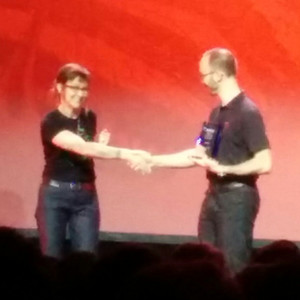
Stefano Zacchiroli receiving the O'Reilly Open Source Award I attended OSCON's closing sessions today and was delighted to see my friend Stefano Zacchiroli (Zack) receive an O'Reilly Open Source Award. Zack acted as Debian Project Leader for three years, is working on important activities at the Open Source Initiative and the Free Software Foundation, and is generally an amazing advocate for free software. Thanks for all your contributions, Zack, and congratulations!

18 July 2015

John Goerzen: True Things About Learning to Fly

I ve been pretty quiet for the last few months because I m learning to fly. I want to start with a few quotes about aviation. I have heard things like these from many people and can vouch for their accuracy:
Anyone can learn to fly. Learning to fly is one of the hardest things you ll ever do. It is totally worth it. Being a pilot will give you a new outlook on life. You ll be amazed at what radios do a 3000ft. Have you ever had an 3000-foot antenna tower? The world is glorious at 1000ft up. Share your enthusiasm with those around you. You have a perspective very few ever see, except for a few seconds on the way to 35,000ft.
Earlier this month, I flew solo for the first time the biggest milestone on the way to getting the pilot s license. Here s a photo my flight instructor took as I was coming in to land that day. landing Today I took my first flight to another airport. It wasn t far about 20 miles away but it was still a thrill. I flew about 1500ft above the ground, roughly above a freeway that happened to be my route. From that height, things still look three-dimensional. The grain elevator that marked out the one small town, the manufacturing plant at another, the college at the third. Bales of hay dotting the fields, the occasional tractor creeping along a road, churches sticking up above the trees. These are places I ve known for decades, and now, suddenly, they are all new. What a time to be alive! I am glad that our world is still so full of wonder and beauty.

17 July 2015

Simon Kainz: DUCK challenge: week 2

Just a litte update on the DUCK challenge: In the last week, the following packages were fixed and uploaded into unstable: Last week we had 10 packages uploaded & fixed, the current week resulted in 15 fixed packages. So there are currently 25 packages fixed by 20 different uploaders. I really hope i can meet you all at DebConf15!! The list of the fixed and updated packages is availabe here. I will try to update this ~daily. If I missed one of your uploads, please drop me a line. A big "Thank You" to you. There is still lots of time till the end of DebConf15 and the end of the DUCK Challenge, so please get involved. And rememeber: debcheckout fails? FIX MORE URLS

12 July 2015

Lunar: Reproducible builds: week 11 in Stretch cycle

Debian is undertaking a huge effort to develop a reproducible builds system. I'd like to thank you for that. This could be Debian's most important project, with how badly computer security has been going.

PerniciousPunk in Reddit's Ask me anything! to Neil McGovern, DPL. What happened in the reproducible builds effort this week: Toolchain fixes More tools are getting patched to use the value of the SOURCE_DATE_EPOCH environment variable as the current time:

In the reproducible experimental toolchain which have been uploaded: Johannes Schauer followed up on making sbuild build path deterministic with several ideas. Packages fixed The following 311 packages became reproducible due to changes in their build dependencies : 4ti2, alot, angband, appstream-glib, argvalidate, armada-backlight, ascii, ask, astroquery, atheist, aubio, autorevision, awesome-extra, bibtool, boot-info-script, bpython, brian, btrfs-tools, bugs-everywhere, capnproto, cbm, ccfits, cddlib, cflow, cfourcc, cgit, chaussette, checkbox-ng, cinnamon-settings-daemon, clfswm, clipper, compton, cppcheck, crmsh, cupt, cutechess, d-itg, dahdi-tools, dapl, darnwdl, dbusada, debian-security-support, debomatic, dime, dipy, dnsruby, doctrine, drmips, dsc-statistics, dune-common, dune-istl, dune-localfunctions, easytag, ent, epr-api, esajpip, eyed3, fastjet, fatresize, fflas-ffpack, flann, flex, flint, fltk1.3, fonts-dustin, fonts-play, fonts-uralic, freecontact, freedoom, gap-guava, gap-scscp, genometools, geogebra, git-reintegrate, git-remote-bzr, git-remote-hg, gitmagic, givaro, gnash, gocr, gorm.app, gprbuild, grapefruit, greed, gtkspellmm, gummiboot, gyp, heat-cfntools, herold, htp, httpfs2, i3status, imagetooth, imapcopy, imaprowl, irker, jansson, jmapviewer, jsdoc-toolkit, jwm, katarakt, khronos-opencl-man, khronos-opengl-man4, lastpass-cli, lava-coordinator, lava-tool, lavapdu, letterize, lhapdf, libam7xxx, libburn, libccrtp, libclaw, libcommoncpp2, libdaemon, libdbusmenu-qt, libdc0, libevhtp, libexosip2, libfreenect, libgwenhywfar, libhmsbeagle, libitpp, libldm, libmodbus, libmtp, libmwaw, libnfo, libpam-abl, libphysfs, libplayer, libqb, libsecret, libserial, libsidplayfp, libtime-y2038-perl, libxr, lift, linbox, linthesia, livestreamer, lizardfs, lmdb, log4c, logbook, lrslib, lvtk, m-tx, mailman-api, matroxset, miniupnpd, mknbi, monkeysign, mpi4py, mpmath, mpqc, mpris-remote, musicbrainzngs, network-manager, nifticlib, obfsproxy, ogre-1.9, opal, openchange, opensc, packaging-tutorial, padevchooser, pajeng, paprefs, pavumeter, pcl, pdmenu, pepper, perroquet, pgrouting, pixz, pngcheck, po4a, powerline, probabel, profitbricks-client, prosody, pstreams, pyacidobasic, pyepr, pymilter, pytest, python-amqp, python-apt, python-carrot, python-django, python-ethtool, python-mock, python-odf, python-pathtools, python-pskc, python-psutil, python-pypump, python-repoze.tm2, python-repoze.what, qdjango, qpid-proton, qsapecng, radare2, reclass, repsnapper, resource-agents, rgain, rttool, ruby-aggregate, ruby-albino, ruby-archive-tar-minitar, ruby-bcat, ruby-blankslate, ruby-coffee-script, ruby-colored, ruby-dbd-mysql, ruby-dbd-odbc, ruby-dbd-pg, ruby-dbd-sqlite3, ruby-dbi, ruby-dirty-memoize, ruby-encryptor, ruby-erubis, ruby-fast-xs, ruby-fusefs, ruby-gd, ruby-git, ruby-globalhotkeys, ruby-god, ruby-hike, ruby-hmac, ruby-integration, ruby-jnunemaker-matchy, ruby-memoize, ruby-merb-core, ruby-merb-haml, ruby-merb-helpers, ruby-metaid, ruby-mina, ruby-net-irc, ruby-net-netrc, ruby-odbc, ruby-ole, ruby-packet, ruby-parseconfig, ruby-platform, ruby-plist, ruby-popen4, ruby-rchardet, ruby-romkan, ruby-ronn, ruby-rubyforge, ruby-rubytorrent, ruby-samuel, ruby-shoulda-matchers, ruby-sourcify, ruby-test-spec, ruby-validatable, ruby-wirble, ruby-xml-simple, ruby-zoom, rumor, rurple-ng, ryu, sam2p, scikit-learn, serd, shellex, shorewall-doc, shunit2, simbody, simplejson, smcroute, soqt, sord, spacezero, spamassassin-heatu, spamprobe, sphinxcontrib-youtube, splitpatch, sratom, stompserver, syncevolution, tgt, ticgit, tinyproxy, tor, tox, transmissionrpc, tweeper, udpcast, units-filter, viennacl, visp, vite, vmfs-tools, waffle, waitress, wavtool-pl, webkit2pdf, wfmath, wit, wreport, x11proto-input, xbae, xdg-utils, xdotool, xsystem35, yapsy, yaz. Please note that some packages in the above list are falsely reproducible. In the experimental toolchain, debhelper exported TZ=UTC and this made packages capturing the current date (without the time) reproducible in the current test environment. The following packages became reproducible after getting fixed: Ben Hutchings upstreamed several patches to fix Linux reproducibility issues which were quickly merged. Some uploads fixed some reproducibility issues but not all of them: Uploads that should fix packages not in main: Patches submitted which have not made their way to the archive yet: reproducible.debian.net A new package set has been added for lua maintainers. (h01ger) tracker.debian.org now only shows reproducibility issues for unstable. Holger and Mattia worked on several bugfixes and enhancements: finished initial test setup for NetBSD, rewriting more shell scripts in Python, saving UDD requests, and more debbindiff development Reiner Herrmann fixed text comparison of files with different encoding. Documentation update Juan Picca added to the commands needed for a local test chroot installation of the locales-all package. Package reviews 286 obsolete reviews have been removed, 278 added and 243 updated this week. 43 new bugs for packages failing to build from sources have been filled by Chris West (Faux), Mattia Rizzolo, and h01ger. The following new issues have been added: timestamps_in_manpages_generated_by_ronn, timestamps_in_documentation_generated_by_org_mode, and timestamps_in_pdf_generated_by_matplotlib. Misc. Reiner Herrmann has submitted patches for OpenWrt. Chris Lamb cleaned up some code and removed cruft in the misc.git repository. Mattia Rizzolo updated the prebuilder script to match what is currently done on reproducible.debian.net.

7 July 2015

Lunar: Reproducible builds: week 10 in Stretch cycle

What happened about the reproducible builds effort this week: Media coverage Daniel Stender published an English translation of the article which originally appeared in Linux Magazin in Admin Magazine. Toolchain fixes Fixes landed in the Debian archive: Lunar submitted to Debian the patch already sent upstream adding a --clamp-mtime option to tar. Patches have been submitted to add support for SOURCE_DATE_EPOCH to txt2man (Reiner Herrmann), epydoc (Reiner Herrmann), GCC (Dhole), and Doxygen (akira). Dhole uploaded a new experimental debhelper to the reproducible repository which exports SOURCE_DATE_EPOCH. As part of the experiment, the patch also sets TZ to UTC which should help with most timezone issues. It might still be problematic for some packages which would change their settings based on this. Mattia Rizzolo sent upstream a patch originally written by Lunar to make the generate-id() function be deterministic in libxslt. While that patch was quickly rejected by upstream, Andrew Ayer came up with a much better one which sadly could have some performance impact. Daniel Veillard replied with another patch that should be deterministic in most cases without needing extra data structures. It's impact is currently being investigated by retesting packages on reproducible.debian.net. akira added a new option to sbuild for configuring the path in which packages are built. This will be needed for the srebuild script. Niko Tyni asked Perl upstream about it using the __DATE__ and __TIME__ C processor macros. Packages fixed The following 143 packages became reproducible due to changes in their build dependencies: alot, argvalidate, astroquery, blender, bpython, brian, calibre, cfourcc, chaussette, checkbox-ng, cloc, configshell, daisy-player, dipy, dnsruby, dput-ng, dsc-statistics, eliom, emacspeak, freeipmi, geant321, gpick, grapefruit, heat-cfntools, imagetooth, jansson, jmapviewer, lava-tool, libhtml-lint-perl, libtime-y2038-perl, lift, lua-ldoc, luarocks, mailman-api, matroxset, maven-hpi-plugin, mknbi, mpi4py, mpmath, msnlib, munkres, musicbrainzngs, nova, pecomato, pgrouting, pngcheck, powerline, profitbricks-client, pyepr, pylibssh2, pylogsparser, pystemmer, pytest, python-amqp, python-apt, python-carrot, python-crypto, python-darts.lib.utils.lru, python-demgengeo, python-graph, python-mock, python-musicbrainz2, python-pathtools, python-pskc, python-psutil, python-pypump, python-repoze.sphinx.autointerface, python-repoze.tm2, python-repoze.what-plugins, python-repoze.what, python-repoze.who-plugins, python-xstatic-term.js, reclass, resource-agents, rgain, rttool, ruby-aggregate, ruby-archive-tar-minitar, ruby-bcat, ruby-blankslate, ruby-coffee-script, ruby-colored, ruby-dbd-mysql, ruby-dbd-odbc, ruby-dbd-pg, ruby-dbd-sqlite3, ruby-dbi, ruby-dirty-memoize, ruby-encryptor, ruby-erubis, ruby-fast-xs, ruby-fusefs, ruby-gd, ruby-git, ruby-globalhotkeys, ruby-god, ruby-hike, ruby-hmac, ruby-integration, ruby-ipaddress, ruby-jnunemaker-matchy, ruby-memoize, ruby-merb-core, ruby-merb-haml, ruby-merb-helpers, ruby-metaid, ruby-mina, ruby-net-irc, ruby-net-netrc, ruby-odbc, ruby-packet, ruby-parseconfig, ruby-platform, ruby-plist, ruby-popen4, ruby-rchardet, ruby-romkan, ruby-rubyforge, ruby-rubytorrent, ruby-samuel, ruby-shoulda-matchers, ruby-sourcify, ruby-test-spec, ruby-validatable, ruby-wirble, ruby-xml-simple, ruby-zoom, ryu, simplejson, spamassassin-heatu, speaklater, stompserver, syncevolution, syncmaildir, thin, ticgit, tox, transmissionrpc, vdr-plugin-xine, waitress, whereami, xlsx2csv, zathura. The following packages became reproducible after getting fixed: Some uploads fixed some reproducibility issues but not all of them: Patches submitted which have not made their way to the archive yet: reproducible.debian.net A new package set for the X Strike Force has been added. (h01ger) Bugs tagged with locale are now visible in the statistics. (h01ger) Some work has been done add tests for NetBSD. (h01ger) Many changes by Mattia Rizzolo have been merged on the whole infrastructure: debbindiff development Version 26 has been released on June 28th fixing the comparison of files of unknown format. (Lunar) A missing dependency identified in python-rpm affecting debbindiff installation without recommended packages was promptly fixed by Michal iha . Lunar also started a massive code rearchitecture to enhance code reuse and enable new features. Nothing visible yet, though. Documentation update josch and Mattia Rizzolo documented how to reschedule packages from Alioth. Package reviews 142 obsolete reviews have been removed, 344 added and 107 updated this week. Chris West (Faux) filled 13 new bugs for packages failing to build from sources. The following new issues have been added: snapshot_placeholder_replaced_with_timestamp_in_pom_properties, different_encoding, timestamps_in_documentation_generated_by_org_mode and timestamps_in_pdf_generated_by_matplotlib.

6 July 2015

Matthew Garrett: Internet abuse culture is a tech industry problem

After Jesse Frazelle blogged about the online abuse she receives, a common reaction in various forums[1] was "This isn't a tech industry problem - this is what being on the internet is like"[2]. And yes, they're right. Abuse of women on the internet isn't limited to people in the tech industry. But the severity of a problem is a product of two separate factors: its prevalence and what impact it has on people.

Much of the modern tech industry relies on our ability to work with people outside our company. It relies on us interacting with a broader community of contributors, people from a range of backgrounds, people who may be upstream on a project we use, people who may be employed by competitors, people who may be spending their spare time on this. It means listening to your users, hearing their concerns, responding to their feedback. And, distressingly, there's significant overlap between that wider community and the people engaging in the abuse. This abuse is often partly technical in nature. It demonstrates understanding of the subject matter. Sometimes it can be directly tied back to people actively involved in related fields. It's from people who might be at conferences you attend. It's from people who are participating in your mailing lists. It's from people who are reading your blog and using the advice you give in their daily jobs. The abuse is coming from inside the industry.

Cutting yourself off from that community impairs your ability to do work. It restricts meeting people who can help you fix problems that you might not be able to fix yourself. It results in you missing career opportunities. Much of the work being done to combat online abuse relies on protecting the victim, giving them the tools to cut themselves off from the flow of abuse. But that risks restricting their ability to engage in the way they need to to do their job. It means missing meaningful feedback. It means passing up speaking opportunities. It means losing out on the community building that goes on at in-person events, the career progression that arises as a result. People are forced to choose between putting up with abuse or compromising their career.

The abuse that women receive on the internet is unacceptable in every case, but we can't ignore the effects of it on our industry simply because it happens elsewhere. The development model we've created over the past couple of decades is just too vulnerable to this kind of disruption, and if we do nothing about it we'll allow a large number of valuable members to be driven away. We owe it to them to make things better.

[1] Including Hacker News, which then decided to flag the story off the front page because masculinity is fragile

[2] Another common reaction was "But men get abused as well", which I'm not even going to dignify with a response

comment count unavailable comments

2 July 2015

Enrico Zini: italian-fattura-elettronica

Billing an Italian public administration Here's a simple guide for how I managed to bill one of my customers as is now mandated by law in Italy. Create a new virtualbox machine I would never do any of this to any system I would ever want to use for anything else, so it's virtual machine time. Install smart card software into it Descent into darkness Set up things for fattura-pa Set up things for signing locally with dike Set up things for signing locally with ArubaSign Try fattura-pa again Maybe fattura-pa would work with Oracle's Java plugin? Aftermath I shut down that virtual machine and I'm making sure I never run anything important on it. Except, of course, generating legally binding signatures as required by the Italian government. What could possibly go wrong?

Norbert Preining: An amusing lintian error Lenna

Well, there we are, trying to build another round of TeX Live packages for Debian, just to realize that the lintian error that should have been downgraded to warning (or removed) is still around, due to doubts about the license. Ok. Well, anyway, but what I found is even more funny:
E: texlive-extra source: license-problem-non-free-img-lenna texmf-dist/doc/latex/reflectgraphics/lenna.jpg
which is about one of the most used images in images processing courses, Lenna: who-is-lenna
Without comments, I just quote the lintian error it is a whole lot of fun to read.
Ref: https://en.wikipedia.org/wiki/Lenna, https://www.debian.org/vote/2012/vote_002, #771191
Info: The given source file is cropped from playboy centerfold. This image is a picture of Lena S derberg, shot by photographer Dwight Hooker, cropped from the centerfold of the November 1972 issue of Playboy magazine. According to Hutchison, Jamie (May June 2001). Culture, Communication, and an Information Age Madonna (PDF). IEEE Professional Communication Society Newsletter 45 (3). (page 5 second column second paragraph), this image is distributable but not free. Moreover, Lenna photo has been pointed to as an example of sexism in the sciences, reinforcing gender stereotypes. Please use well known and free test image. Please also submit md5sum, sha1sum, and sha256 of this file as a bug report for lintian.
How fortunate our generation is that we don t have anything else to care about Anyway, back to rebuilding orig.tars, source packages, and binary packages!

29 June 2015

Jonathan McDowell: What Jonathan Did Next

While I mentioned last September that I had failed to be selected for an H-1B and had been having discussions at DebConf about alternative employment, I never got around to elaborating on what I d ended up doing. Short answer: I ended up becoming a law student, studying for a Masters in Legal Science at Queen s University Belfast. I ve just completed my first year of the 2 year course and have managed to do well enough in the 6 modules so far to convince myself it wasn t a crazy choice. Longer answer: After Vello went under in June I decided to take a couple of months before fully investigating what to do next, largely because I figured I d either find something that wanted me to start ASAP or fail to find anything and stress about it. During this period a friend happened to mention to me that the applications for the Queen s law course were still open. He happened to know that it was something I d considered before a few times. Various discussions (some of them over gin, I ll admit) ensued and I eventually decided to submit an application. This was towards the end of August, and I figured I d also talk to people at DebConf to see if there was anything out there tech-wise that I could get excited about. It turned out that I was feeling a bit jaded about the whole tech scene. Another friend is of the strong opinion that you should take a break at least every 10 years. Heeding her advice I decided to go ahead with the law course. I haven t regretted it at all. My initial interest was largely driven by a belief that there are too few people who understand both tech and law. I started with interests around intellectual property and contract law as well as issues that arise from trying to legislate for the global nature of most tech these days. However the course is a complete UK qualifying degree (I can go on to do the professional qualification in NI or England & Wales) and the first year has been about public law. Which has been much more interesting than I was expecting (even, would you believe it, EU law). Especially given the potential changing constitutional landscape of the UK after the recent general election, with regard to talk of repeal of the Human Rights Act and a referendum on exit from the EU. Next year will concentrate more on private law, and I m hoping to be able to tie that in better to what initially drove me to pursue this path. I m still not exactly sure which direction I ll go once I complete the course, but whatever happens I want to keep a linkage between my skill sets. That could be either leaning towards the legal side but with the appreciation of tech, returning to tech but with the appreciation of the legal side of things or perhaps specialising further down an academic path that links both. I guess I ll see what the next year brings. :)

Norbert Preining: The Talos Principle Solving puzzles using SAT solvers

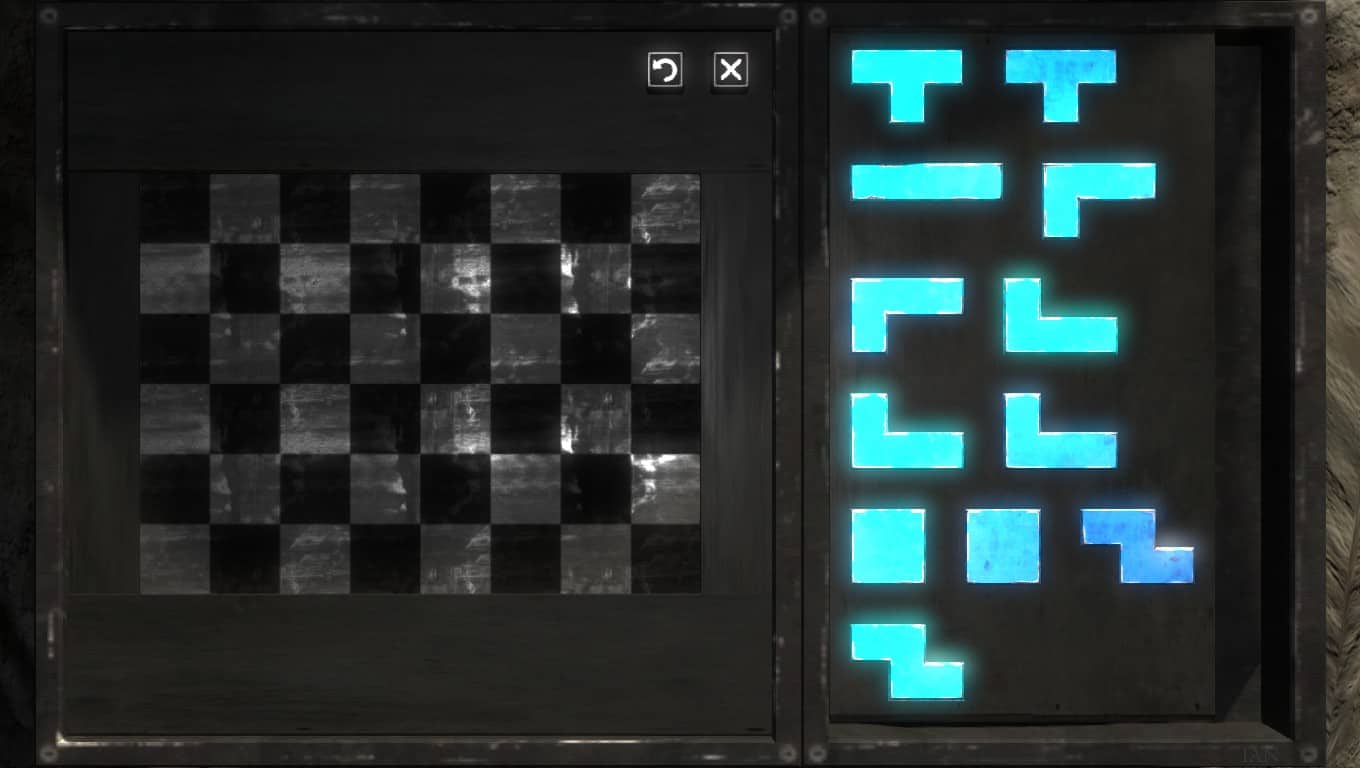
After my last post on Portal, there was a sale of The Talos Principle, so I got it and started playing. And soon I got stuck at these kind of puzzles where one has to fit in pieces into a frame. As a logician I hate to solve something by trial and error, so I decided I write a solver for these kind of puzzles, based on a propositional logic encoding and satisfiability solver. Sometimes it is good to be logician! Talos-Puzzles In the Talos Principle, access to new worlds and specific items is often blocked by gates that open by putting Sigils into the frame. Of course, collecting the sigils is the most challenging part, but that is often solvable by logical thinking. On the other hand, solving these fitting puzzles drove me crazy, so let us solve them with a SAT solver. Encoding I used a propositional encoding that for each combination of cells and sigils assigns a propositional variable, which is true if the specific sigil rests in on that cell in the final solution. That is, we have variable (encoded as x_i_j_n) where runs over the cells of the frame, and over the (numbered) sigils. Setup I have written a perl program that for a definition of a puzzle (see later), outputs SMT2 code, which then is checked for satisfiability and generation of model with the z3 solver (which is available in Debian). Necessary assertions We have to state relations between these propositional variables to obtain a proper solution, in particular we have added the following statements: Let us go through them one by one: Every field has at least on sigil on it That is an easy part by asserting

In the SMT2 code it would look like
(assert (or x_i_j_1 x_i_j_2 ... x_i_j_n))
Every field has at most one sigil on it This can be achieved by asserting for each tile and each pair of different sigil (numbers), that not both of the two hold:

and in SMT2 code:
(assert (and
  (not (and x_1_1_1 x_1_1_2))
  (not (and x_1_1_1 x_1_1_3))
...
(assert (and
  (not (and x_1_2_1 x_1_2_2))
  (not (and x_1_2_1 x_1_2_3))
...
Every sigil is used at least once This was a bit a tricky one. First I thought I want to express that every sigil is used exactly once by excluding that for one sigil there are more fields assigned to it then the sigil contains parts. So if a sigil occupies 4 tiles, then every combination of 5 tiles needs to evaluate to false. But with 8 8 or so frames, the number of combinations simply explodes to above several million, which brings my harddrive size and z3 to an end. The better idea was to say that every sigil was used at least once. Since all sigils together exactly fill the frame, this is enough. This can be done easily by assuming that for each sigil, at least one of the tiles is assigned to it:

or in SMT code for a 6 6 frame and the first sigil:
(assert (or x_1_1_n x_1_2_n ...  x_6_6_1))
Defining equations for the sigil s form Of course the most important part are the defining equations for the various sigils. Here I choose the following path: So for example for the top-most sigil in the above photo, I choose the anchor point to be the center, and if that was in , I need to assume that for the upright position

holds. In the same way, when rotated right, we need

All these options have to be disjunctively connected, in SMT code for the case where the anchor lies at (4,2).
(assert (or
  ...
  (and x_3_2_n x_4_2_n x_5_2_n x_4_3_n)
  (and x_3_3_n x_3_2_n x_3_1_n x_4_2_n)
  (and x_3_2_n x_4_2_n x_5_2_n x_4_1_n)
...
When generating these equations one has to be careful not to include rotated sigils that stick out of the frame, though. Although the above might not be the optimal encoding, the given assertions suffice to check for SAT and produce a model, which allows me to solve the riddles. Implementation in Perl To generate the SMT2 code, I used a Perl script, which is very quickly hacked together. The principle function is (already coded for the above riddle):
create_smt2_def(8,6,'a','a','b','cl','cl','cr','cr','cr','q','q','sl','sl');
where the first two arguments define the size of the frame, and the rest are codes for sigil types: This function first sets up the header of the smt2 file, followed by shipping out all the necessary variable definitions, in SMT these are defined as Boolean functions, and the other assertions (please see the Perl code linked below for details). The most interesting part are the definitions of the sigils:
  # for each piece, call the defining assertions
  for my $n (1..$nn)  
    my $p = $pieces[$n-1];
    print "(assert (or\n";
    for my $i (1..$xx)  
      for my $j (1..$yy)  
        if ($p eq 'q')   
          type_square($xx,$yy,$i,$j,$n); 
          elsif ($p eq 'a')  
          type_potest($xx,$yy,$i,$j,$n);
    ....
Every sigil type has its own definiton, in case of the a podest, the type_podest function:
sub type_potest  
  my ($xx,$yy,$i,$j,$n) = @_;
  my ($il, $jl, $ir, $jr, $iu, $ju);
  $il = $i - 1; $ir = $i + 1; $iu = $i;
  $jl = $jr = $j; $ju = $j + 1;
  do_rotate_shipout($xx,$yy, $i, $j, $n, $il, $jl, $ir, $jr, $iu, $ju);
 
This function is prototypical, one defines the tiles a sigil occupies if the anchor is placed on (i,j) for an arbitrary orientation of the sigil, and then calls do_rotate_shipout on the list of occupied tiles. This function in turn is very simple:
sub do_rotate_shipout  
  my ($xx,$yy, $i, $j, $n, @pairs) = @_ ;
  for my $g (0..3)  
    @pairs = rotate90($i, $j, @pairs);
    check_and_shipout($xx,$yy, $n, $i, $j, @pairs);
   
 
as it only rotates four times by 90 degrees, and then checks whether the rotated sigil is completely within the frame, and if yes ships out the assertion code. The rotation is done by multiplying the vector from (i,j) to the tile position with the (0 -1 1 0) matrix and adding it again to (i,j):
sub rotate90  
  my ($i, $j, @pairs) = @_ ;
  my @ret;
  while (@pairs)  
    my $ii = shift @pairs;
    my $jj = shift @pairs;
    my $ni = $i - ($jj - $j);
    my $nj = $j + ($ii - $i);
    push @ret, $ni, $nj;
   
  return @ret;
 
There are a few more functions, for those interested, the full Perl code is here: tangram.pl. There is no user interface or any config file reading done, I just edit the source code if I need to solve a riddle. Massaging the output Last but not least, the output of the z3 solver is a bit noisy, so I run the output through a few Unix commands to get only the true assignments, which gives me the location of the tiles. That is, I run the following pipeline:
perl tangram.pl   z3 -in   egrep 'define-fun true false'    sed -e 'h;s/.*//;G;N;s/\n//g'   grep true   sort
which produces a list like the following as output:
  (define-fun x_1_1_10 () Bool    true)
  (define-fun x_1_2_10 () Bool    true)
  (define-fun x_1_3_5 () Bool    true)
  (define-fun x_1_4_6 () Bool    true)
  (define-fun x_1_5_6 () Bool    true)
  (define-fun x_1_6_6 () Bool    true)
  (define-fun x_2_1_10 () Bool    true)
  (define-fun x_2_2_10 () Bool    true)
  (define-fun x_2_3_5 () Bool    true)
  ...
from which I can read up the solution that puts the tenth sigil (a square) in the lower left corner:
Talos-Puzzle-solved

Next.

Previous.