Reproducible Builds: Reproducible Builds in February 2020
Welcome to the February 2020 report from the Reproducible Builds project.
 One of the original promises of open source software is that distributed peer review and transparency of process results in enhanced end-user security. However, whilst anyone may inspect the source code of free and open source software for malicious flaws, almost all software today is distributed as pre-compiled binaries. This allows nefarious third-parties to compromise systems by injecting malicious code into ostensibly secure software during the various compilation and distribution processes.
The motivation behind the reproducible builds effort is to provide the ability to demonstrate these binaries originated from a particular, trusted, source release: if identical results are generated from a given source in all circumstances, reproducible builds provides the means for multiple third-parties to reach a consensus on whether a build was compromised via distributed checksum validation or some other scheme.
In this month s report, we cover:
- Media coverage & upstream news A new paper on reproducible containers, Ruby updates, etc.
- Distribution work More work in Debian, openSUSE & friends.
- Software development Updates and improvements to our tooling.
- Getting in touch How to contribute, more venues for discussion.
If you are interested in contributing to the project, please visit our Contribute page on our website.
Media coverage & upstream news
 Omar Navarro Leija, a PhD student at the University Of Pennsylvania, published a paper entitled Reproducible Containers that describes in detail the workings of a new user-space container tool called DetTrace:
All computation that occurs inside a DetTrace container is a pure function of the initial filesystem state of the container. Reproducible containers can be used for a variety of purposes, including replication for fault-tolerance, reproducible software builds and reproducible data analytics. We use DetTrace to achieve, in an automatic fashion, reproducibility for 12,130 Debian package builds, containing over 800 million lines of code, as well as bioinformatics and machine learning workflows.
There was also considerable discussion on our mailing list regarding this research and a presentation based on the paper will occur at the ASPLOS 2020 conference between March 16th 20th in Lausanne, Switzerland.
 The many virtues of Reproducible Builds were touted as benefits for software compliance in a talk at FOSDEM 2020, debating whether the Careful Inventory of Licensing Bill of Materials Have Impact of FOSS License Compliance which pitted Jeff McAffer and Carol Smith against Bradley Kuhn and Max Sills. (~47 minutes in).
Nobuyoshi Nakada updated the canonical implementation of the Ruby programming language a change such that filesystem globs (ie. calls to list the contents of filesystem directories) will henceforth be sorted in ascending order. Without this change, the underlying nondeterministic ordering of the filesystem is exposed to the language which often results in an unreproducible build.
Vagrant Cascadian reported on our mailing list regarding a quick reproducible test for the GNU Guix distribution, which resulted in 81.9% of packages registering as reproducible in his installation:
$ guix challenge --verbose --diff=diffoscope ...
2,463 store items were analyzed:
  - 2,016 (81.9%) were identical
  - 37 (1.5%) differed
  - 410 (16.6%) were inconclusive
Jeremiah Orians announced on our mailing list the release of a number of tools related to cross-compilation such as M2-Planet and mescc-tools-seed. This project attemps a full bootstrap of a cross-platform compiler for the C programming language (written in C itself) from hex, the ultimate goal being able to demonstrate fully-bootstrapped compiler from hex to the GCC GNU Compiler Collection. This has many implications in and around Ken Thompson s Trusting Trust attack outlined in Thompson s 1983 Turing Award Lecture.
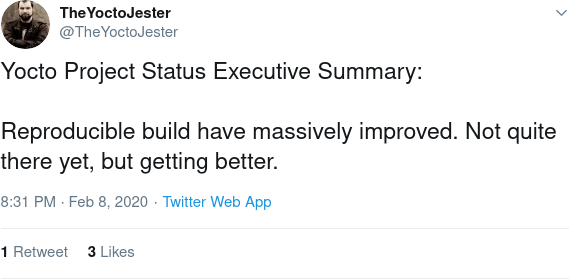
Twitter user @TheYoctoJester posted an executive summary of reproducible builds in the Yocto Project:
 Finally, Reddit user
tofflos posted to the /r/Java subreddit asking about how to achieve reproducible builds with Maven and Chris Lamb noticed that the Linux kernel documentation about reproducible builds of it is available on the kernel.org homepages in an attractive HTML format.
Distribution work
Debian
 Chris Lamb created a merge request for the core
debian-installer package to allow all arguments and options from sources.list files (such as [check-valid-until=no] , etc.) in order that we can test the reproducibility of the installer images on the Reproducible Builds own testing infrastructure. (#13)
Thorsten Glaser followed-up to a bug filed against the dpkg-source component that was originally filed in late 2015 that claims that the build tool does not respect permissions when unpacking tarballs if the umask is set to 0002.
Matthew Garrett posted to the debian-devel mailing list on the topic of Producing verifiable initramfs images as part of a wider conversation on being able to trust the entire software stack on our computers.
59 reviews of Debian packages were added, 30 were updated and 42 were removed this month adding to our knowledge about identified issues. Many issue types were noticed and categorised by Chris Lamb, including:
openstack_pkg_tools_python_shebang_and_dependenciesbuild_path_in_code_generated_by_dgbus_codegenrandom_argument_handling_in_javatools_jh_buildfortran_captures_build_path- etc.
openSUSE
 In openSUSE, Bernhard M. Wiedemann published his monthly Reproducible Builds status update as well as provided the following patches:
python-rpm-macros (do not save time-based .pyc files for tests)solfege (filesystem ordering issue sent upstream via email; package is orphaned upstream)DVDStyler (zip timestamps, submitted upstream)python-pikepdf (recreate unreproducible .pyc files)
Software development
diffoscope
 diffoscope is our in-depth and content-aware diff-like utility that can locate and diagnose reproducibility issues. It is run countless times a day on our testing infrastructure and is essential for identifying fixes and causes of nondeterministic behaviour.
Chris Lamb made the following changes this month, including uploading version
137 to Debian:
- The
sng image utility appears to return with an exit code of 1 if there are even minor errors in the file. (#950806)
- Also extract
classes2.dex, classes3.dex from .apk files extracted by apktool. (#88)
- No need to use
str.format if we are just returning the string. [ ]
- Add generalised support for ignoring returncodes [ ] and move special-casing of returncodes in zip to use
Command.VALID_RETURNCODES. [ ]
Other tools
disorderfs is our FUSE-based filesystem that deliberately introduces non-determinism into directory system calls in order to flush out reproducibility issues. This month, Vagrant Cascadian updated the Vcs-Git to specify the debian packaging branch. [ ]
reprotest is our end-user tool to build same source code twice in widely differing environments and then checks the binaries produced by each build for any differences. This month, versions 0.7.13 and 0.7.14 were uploaded to Debian unstable by Holger Levsen after Vagrant Cascadian added support for GNU Guix [ ].
Project documentation & website
 There was more work performed on our documentation and website this month. Bernhard M. Wiedemann added a Java Gradle Build Tool snippet to the
SOURCE_DATE_EPOCH documentation [ ] and normalised various terms to unreproducible [ ].
Chris Lamb added a Meson.build example [ ] and improved the documentation for the CMake [ ] to the SOURCE_DATE_EPOCH documentation, replaced anyone can with anyone may as, well, not everyone has the resources, skills, time or funding to actually do what it refers to [ ] and improved the pre-processing for our report generation [ ][ ][ ][ ] etc.
In addition, Holger Levsen updated our news page to improve the list of reports [ ], added an explicit mention of the weekly news time span [ ] and reverted sorting of news entries to have latest on top [ ] and Mattia Rizzolo added Codethink as a non-fiscal sponsor [ ] and lastly Tianon Gravi added a Docker Images link underneath the Debian project on our Projects page [ ].
Upstream patches
The Reproducible Builds project detects, dissects and attempts to fix as many currently-unreproducible packages as possible. We endeavour to send all of our patches upstream where appropriate. This month, we wrote a large number of such patches, including:
-
Bernhard M. Wiedemann (for the openSUSE distribution):
rdiff-backup fixed, build date in Python manpageclick-man fixed, toolchain, build date in Python manpagerpm report filesystem-order related nondeterminismpython-enaml report nondeterministic .enamlc compiler outputk9s datepython-xcffib fix a test with a race condition
-
Chris Lamb:
- #943956 re-opened against
snakemake.
- #950630 filed against
designate.
- #950936 filed against
pynwb.
- #950942 filed against
python-oslo.reports.
- #951357 filed against
mate-desktop (forwarded upstream).
- #951573 filed against
javatools.
- #952493 filed against
xavs2.
- #952694 filed against
snapd-glib (forwarded upstream).
- #952762 filed against
openstack-pkg-tools.
- ccextractor issues with MacOSX BSD date not understanding GNU date options
python-django (Always build the documentation in English)python_example (sort glob / readdir)
Vagrant Cascadian submitted patches via the Debian bug tracking system targeting the packages the Civil Infrastructure Platform has identified via the CIP and CIP build depends package sets:
- #950410 filed against
autogen.
- #950417 & 950416 & 950415 filed against
autoconf.
- #950419 filed against
m4.
- #950444 filed against
intltool.
- #950585 filed against
binutils-dev.
- #950603 filed against
yodl-doc.
- #950606 filed against
gdb-source.
- #950704 filed against
automake-1.15.
- #951031 filed against
libtool.
Testing framework
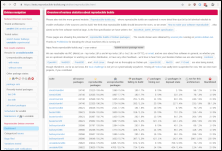 We operate a fully-featured and comprehensive Jenkins-based testing framework that powers tests.reproducible-builds.org. This month, the following changes were made by Holger Levsen:
-
Debian:
- Configured an instance of David Bremner s
builtin-pho database of .buildinfo files. This has resulted in so that we now know that Debian bullseye contains 4,557 source packages for the amd64 architecture without corresponding .buildinfo files and 25,668 source packages with .buildinfo files. [ ][ ][ ][ ][ ]
- Forward mails addressed to
buildinfo@ to the root user. [ ]
- Temporarily revert using backports [ ][ ] and use
devscripts from buster-backports [ ].
- Update URL for PureOS package set. [ ]
- Deprioritise the scheduling of older old packages in bullseye and unstable. [ ][ ]
- Treat the bullseye distribution like unstable when scheduling the
i386 architecture, to allow the latter to catch up a bit. [ ]
-
Misc/other:
- Disable the last active Alpine builder too for now. [ ]
- Improve generated HTML output. [ ][ ]
- Ignore Fedora jobs. [ ]
- Include links to failed and unstable jobs in HTML output. [ ]
- Start weighting job importance and five a lot more weight to nodes acting as a proxy for others. [ ][ ][ ]
- Add new job to calculate the overall system health for tests.reproducible-builds.org for usage with Jelle van der Waa s Reproducible Builds status display. [ ]
 In addition, Mattia Rizzolo added an Apache web server redirect for buildinfos.debian.net [ ] and reverted the reshuffling of
arm64 architecture builders [ ]. The usual build node maintenance was performed by Holger Levsen, Mattia Rizzolo [ ][ ] and Vagrant Cascadian.
Getting in touch
If you are interested in contributing to the Reproducible Builds project, please visit our Contribute page on our website. However, you can get in touch with us via:
-
IRC:
#reproducible-builds on irc.oftc.net.
-
Twitter: @ReproBuilds
-
Reddit: /r/ReproducibleBuilds
-
Mailing list:
rb-general@lists.reproducible-builds.org
$ guix challenge --verbose --diff=diffoscope ...
2,463 store items were analyzed:
- 2,016 (81.9%) were identical
- 37 (1.5%) differed
- 410 (16.6%) were inconclusive
Debian
Chris Lamb created a merge request for the core debian-installer package to allow all arguments and options from sources.list files (such as [check-valid-until=no] , etc.) in order that we can test the reproducibility of the installer images on the Reproducible Builds own testing infrastructure. (#13)
Thorsten Glaser followed-up to a bug filed against the dpkg-source component that was originally filed in late 2015 that claims that the build tool does not respect permissions when unpacking tarballs if the umask is set to 0002.
Matthew Garrett posted to the debian-devel mailing list on the topic of Producing verifiable initramfs images as part of a wider conversation on being able to trust the entire software stack on our computers.
59 reviews of Debian packages were added, 30 were updated and 42 were removed this month adding to our knowledge about identified issues. Many issue types were noticed and categorised by Chris Lamb, including:
openstack_pkg_tools_python_shebang_and_dependenciesbuild_path_in_code_generated_by_dgbus_codegenrandom_argument_handling_in_javatools_jh_buildfortran_captures_build_path- etc.
openSUSE
In openSUSE, Bernhard M. Wiedemann published his monthly Reproducible Builds status update as well as provided the following patches:
python-rpm-macros (do not save time-based .pyc files for tests)solfege (filesystem ordering issue sent upstream via email; package is orphaned upstream)DVDStyler (zip timestamps, submitted upstream)python-pikepdf (recreate unreproducible .pyc files)
Software development
diffoscope
diffoscope is our in-depth and content-aware diff-like utility that can locate and diagnose reproducibility issues. It is run countless times a day on our testing infrastructure and is essential for identifying fixes and causes of nondeterministic behaviour.
Chris Lamb made the following changes this month, including uploading version 137 to Debian:
- The
sng image utility appears to return with an exit code of 1 if there are even minor errors in the file. (#950806)
- Also extract
classes2.dex, classes3.dex from .apk files extracted by apktool. (#88)
- No need to use
str.format if we are just returning the string. [ ]
- Add generalised support for ignoring returncodes [ ] and move special-casing of returncodes in zip to use
Command.VALID_RETURNCODES. [ ]
Other tools
disorderfs is our FUSE-based filesystem that deliberately introduces non-determinism into directory system calls in order to flush out reproducibility issues. This month, Vagrant Cascadian updated the Vcs-Git to specify the debian packaging branch. [ ]
reprotest is our end-user tool to build same source code twice in widely differing environments and then checks the binaries produced by each build for any differences. This month, versions 0.7.13 and 0.7.14 were uploaded to Debian unstable by Holger Levsen after Vagrant Cascadian added support for GNU Guix [ ].
Project documentation & website
There was more work performed on our documentation and website this month. Bernhard M. Wiedemann added a Java Gradle Build Tool snippet to the SOURCE_DATE_EPOCH documentation [ ] and normalised various terms to unreproducible [ ].
Chris Lamb added a Meson.build example [ ] and improved the documentation for the CMake [ ] to the SOURCE_DATE_EPOCH documentation, replaced anyone can with anyone may as, well, not everyone has the resources, skills, time or funding to actually do what it refers to [ ] and improved the pre-processing for our report generation [ ][ ][ ][ ] etc.
In addition, Holger Levsen updated our news page to improve the list of reports [ ], added an explicit mention of the weekly news time span [ ] and reverted sorting of news entries to have latest on top [ ] and Mattia Rizzolo added Codethink as a non-fiscal sponsor [ ] and lastly Tianon Gravi added a Docker Images link underneath the Debian project on our Projects page [ ].
Upstream patches
The Reproducible Builds project detects, dissects and attempts to fix as many currently-unreproducible packages as possible. We endeavour to send all of our patches upstream where appropriate. This month, we wrote a large number of such patches, including:
-
Bernhard M. Wiedemann (for the openSUSE distribution):
rdiff-backup fixed, build date in Python manpageclick-man fixed, toolchain, build date in Python manpagerpm report filesystem-order related nondeterminismpython-enaml report nondeterministic .enamlc compiler outputk9s datepython-xcffib fix a test with a race condition
-
Chris Lamb:
- #943956 re-opened against
snakemake.
- #950630 filed against
designate.
- #950936 filed against
pynwb.
- #950942 filed against
python-oslo.reports.
- #951357 filed against
mate-desktop (forwarded upstream).
- #951573 filed against
javatools.
- #952493 filed against
xavs2.
- #952694 filed against
snapd-glib (forwarded upstream).
- #952762 filed against
openstack-pkg-tools.
- ccextractor issues with MacOSX BSD date not understanding GNU date options
python-django (Always build the documentation in English)python_example (sort glob / readdir)
Vagrant Cascadian submitted patches via the Debian bug tracking system targeting the packages the Civil Infrastructure Platform has identified via the CIP and CIP build depends package sets:
- #950410 filed against
autogen.
- #950417 & 950416 & 950415 filed against
autoconf.
- #950419 filed against
m4.
- #950444 filed against
intltool.
- #950585 filed against
binutils-dev.
- #950603 filed against
yodl-doc.
- #950606 filed against
gdb-source.
- #950704 filed against
automake-1.15.
- #951031 filed against
libtool.
Testing framework
We operate a fully-featured and comprehensive Jenkins-based testing framework that powers tests.reproducible-builds.org. This month, the following changes were made by Holger Levsen:
-
Debian:
- Configured an instance of David Bremner s
builtin-pho database of .buildinfo files. This has resulted in so that we now know that Debian bullseye contains 4,557 source packages for the amd64 architecture without corresponding .buildinfo files and 25,668 source packages with .buildinfo files. [ ][ ][ ][ ][ ]
- Forward mails addressed to
buildinfo@ to the root user. [ ]
- Temporarily revert using backports [ ][ ] and use
devscripts from buster-backports [ ].
- Update URL for PureOS package set. [ ]
- Deprioritise the scheduling of older old packages in bullseye and unstable. [ ][ ]
- Treat the bullseye distribution like unstable when scheduling the
i386 architecture, to allow the latter to catch up a bit. [ ]
-
Misc/other:
- Disable the last active Alpine builder too for now. [ ]
- Improve generated HTML output. [ ][ ]
- Ignore Fedora jobs. [ ]
- Include links to failed and unstable jobs in HTML output. [ ]
- Start weighting job importance and five a lot more weight to nodes acting as a proxy for others. [ ][ ][ ]
- Add new job to calculate the overall system health for tests.reproducible-builds.org for usage with Jelle van der Waa s Reproducible Builds status display. [ ]
In addition, Mattia Rizzolo added an Apache web server redirect for buildinfos.debian.net [ ] and reverted the reshuffling of arm64 architecture builders [ ]. The usual build node maintenance was performed by Holger Levsen, Mattia Rizzolo [ ][ ] and Vagrant Cascadian.
Getting in touch
If you are interested in contributing to the Reproducible Builds project, please visit our Contribute page on our website. However, you can get in touch with us via:
-
IRC:
#reproducible-builds on irc.oftc.net.
-
Twitter: @ReproBuilds
-
Reddit: /r/ReproducibleBuilds
-
Mailing list:
rb-general@lists.reproducible-builds.org
openstack_pkg_tools_python_shebang_and_dependenciesbuild_path_in_code_generated_by_dgbus_codegenrandom_argument_handling_in_javatools_jh_buildfortran_captures_build_path
In openSUSE, Bernhard M. Wiedemann published his monthly Reproducible Builds status update as well as provided the following patches:
python-rpm-macros(do not save time-based.pycfiles for tests)solfege(filesystem ordering issue sent upstream via email; package is orphaned upstream)DVDStyler(zip timestamps, submitted upstream)python-pikepdf(recreate unreproducible.pycfiles)
Software development
diffoscope
diffoscope is our in-depth and content-aware diff-like utility that can locate and diagnose reproducibility issues. It is run countless times a day on our testing infrastructure and is essential for identifying fixes and causes of nondeterministic behaviour.
Chris Lamb made the following changes this month, including uploading version 137 to Debian:
- The
sng image utility appears to return with an exit code of 1 if there are even minor errors in the file. (#950806)
- Also extract
classes2.dex, classes3.dex from .apk files extracted by apktool. (#88)
- No need to use
str.format if we are just returning the string. [ ]
- Add generalised support for ignoring returncodes [ ] and move special-casing of returncodes in zip to use
Command.VALID_RETURNCODES. [ ]
Other tools
disorderfs is our FUSE-based filesystem that deliberately introduces non-determinism into directory system calls in order to flush out reproducibility issues. This month, Vagrant Cascadian updated the Vcs-Git to specify the debian packaging branch. [ ]
reprotest is our end-user tool to build same source code twice in widely differing environments and then checks the binaries produced by each build for any differences. This month, versions 0.7.13 and 0.7.14 were uploaded to Debian unstable by Holger Levsen after Vagrant Cascadian added support for GNU Guix [ ].
Project documentation & website
There was more work performed on our documentation and website this month. Bernhard M. Wiedemann added a Java Gradle Build Tool snippet to the SOURCE_DATE_EPOCH documentation [ ] and normalised various terms to unreproducible [ ].
Chris Lamb added a Meson.build example [ ] and improved the documentation for the CMake [ ] to the SOURCE_DATE_EPOCH documentation, replaced anyone can with anyone may as, well, not everyone has the resources, skills, time or funding to actually do what it refers to [ ] and improved the pre-processing for our report generation [ ][ ][ ][ ] etc.
In addition, Holger Levsen updated our news page to improve the list of reports [ ], added an explicit mention of the weekly news time span [ ] and reverted sorting of news entries to have latest on top [ ] and Mattia Rizzolo added Codethink as a non-fiscal sponsor [ ] and lastly Tianon Gravi added a Docker Images link underneath the Debian project on our Projects page [ ].
Upstream patches
The Reproducible Builds project detects, dissects and attempts to fix as many currently-unreproducible packages as possible. We endeavour to send all of our patches upstream where appropriate. This month, we wrote a large number of such patches, including:
-
Bernhard M. Wiedemann (for the openSUSE distribution):
rdiff-backup fixed, build date in Python manpageclick-man fixed, toolchain, build date in Python manpagerpm report filesystem-order related nondeterminismpython-enaml report nondeterministic .enamlc compiler outputk9s datepython-xcffib fix a test with a race condition
-
Chris Lamb:
- #943956 re-opened against
snakemake.
- #950630 filed against
designate.
- #950936 filed against
pynwb.
- #950942 filed against
python-oslo.reports.
- #951357 filed against
mate-desktop (forwarded upstream).
- #951573 filed against
javatools.
- #952493 filed against
xavs2.
- #952694 filed against
snapd-glib (forwarded upstream).
- #952762 filed against
openstack-pkg-tools.
- ccextractor issues with MacOSX BSD date not understanding GNU date options
python-django (Always build the documentation in English)python_example (sort glob / readdir)
Vagrant Cascadian submitted patches via the Debian bug tracking system targeting the packages the Civil Infrastructure Platform has identified via the CIP and CIP build depends package sets:
- #950410 filed against
autogen.
- #950417 & 950416 & 950415 filed against
autoconf.
- #950419 filed against
m4.
- #950444 filed against
intltool.
- #950585 filed against
binutils-dev.
- #950603 filed against
yodl-doc.
- #950606 filed against
gdb-source.
- #950704 filed against
automake-1.15.
- #951031 filed against
libtool.
Testing framework
We operate a fully-featured and comprehensive Jenkins-based testing framework that powers tests.reproducible-builds.org. This month, the following changes were made by Holger Levsen:
-
Debian:
- Configured an instance of David Bremner s
builtin-pho database of .buildinfo files. This has resulted in so that we now know that Debian bullseye contains 4,557 source packages for the amd64 architecture without corresponding .buildinfo files and 25,668 source packages with .buildinfo files. [ ][ ][ ][ ][ ]
- Forward mails addressed to
buildinfo@ to the root user. [ ]
- Temporarily revert using backports [ ][ ] and use
devscripts from buster-backports [ ].
- Update URL for PureOS package set. [ ]
- Deprioritise the scheduling of older old packages in bullseye and unstable. [ ][ ]
- Treat the bullseye distribution like unstable when scheduling the
i386 architecture, to allow the latter to catch up a bit. [ ]
-
Misc/other:
- Disable the last active Alpine builder too for now. [ ]
- Improve generated HTML output. [ ][ ]
- Ignore Fedora jobs. [ ]
- Include links to failed and unstable jobs in HTML output. [ ]
- Start weighting job importance and five a lot more weight to nodes acting as a proxy for others. [ ][ ][ ]
- Add new job to calculate the overall system health for tests.reproducible-builds.org for usage with Jelle van der Waa s Reproducible Builds status display. [ ]
In addition, Mattia Rizzolo added an Apache web server redirect for buildinfos.debian.net [ ] and reverted the reshuffling of arm64 architecture builders [ ]. The usual build node maintenance was performed by Holger Levsen, Mattia Rizzolo [ ][ ] and Vagrant Cascadian.
Getting in touch
If you are interested in contributing to the Reproducible Builds project, please visit our Contribute page on our website. However, you can get in touch with us via:
-
IRC:
#reproducible-builds on irc.oftc.net.
-
Twitter: @ReproBuilds
-
Reddit: /r/ReproducibleBuilds
-
Mailing list:
rb-general@lists.reproducible-builds.org
diffoscope is our in-depth and content-aware diff-like utility that can locate and diagnose reproducibility issues. It is run countless times a day on our testing infrastructure and is essential for identifying fixes and causes of nondeterministic behaviour.
Chris Lamb made the following changes this month, including uploading version 137 to Debian:
- The
sngimage utility appears to return with an exit code of 1 if there are even minor errors in the file. (#950806) - Also extract
classes2.dex,classes3.dexfrom.apkfiles extracted byapktool. (#88) - No need to use
str.formatif we are just returning the string. [ ] - Add generalised support for ignoring returncodes [ ] and move special-casing of returncodes in zip to use
Command.VALID_RETURNCODES. [ ]
Other tools
disorderfs is our FUSE-based filesystem that deliberately introduces non-determinism into directory system calls in order to flush out reproducibility issues. This month, Vagrant Cascadian updated the Vcs-Git to specify the debian packaging branch. [ ]
reprotest is our end-user tool to build same source code twice in widely differing environments and then checks the binaries produced by each build for any differences. This month, versions 0.7.13 and 0.7.14 were uploaded to Debian unstable by Holger Levsen after Vagrant Cascadian added support for GNU Guix [ ].
Project documentation & website
There was more work performed on our documentation and website this month. Bernhard M. Wiedemann added a Java Gradle Build Tool snippet to the SOURCE_DATE_EPOCH documentation [ ] and normalised various terms to unreproducible [ ].
Chris Lamb added a Meson.build example [ ] and improved the documentation for the CMake [ ] to the SOURCE_DATE_EPOCH documentation, replaced anyone can with anyone may as, well, not everyone has the resources, skills, time or funding to actually do what it refers to [ ] and improved the pre-processing for our report generation [ ][ ][ ][ ] etc.
In addition, Holger Levsen updated our news page to improve the list of reports [ ], added an explicit mention of the weekly news time span [ ] and reverted sorting of news entries to have latest on top [ ] and Mattia Rizzolo added Codethink as a non-fiscal sponsor [ ] and lastly Tianon Gravi added a Docker Images link underneath the Debian project on our Projects page [ ].
Upstream patches
The Reproducible Builds project detects, dissects and attempts to fix as many currently-unreproducible packages as possible. We endeavour to send all of our patches upstream where appropriate. This month, we wrote a large number of such patches, including:
-
Bernhard M. Wiedemann (for the openSUSE distribution):
rdiff-backup fixed, build date in Python manpageclick-man fixed, toolchain, build date in Python manpagerpm report filesystem-order related nondeterminismpython-enaml report nondeterministic .enamlc compiler outputk9s datepython-xcffib fix a test with a race condition
-
Chris Lamb:
- #943956 re-opened against
snakemake.
- #950630 filed against
designate.
- #950936 filed against
pynwb.
- #950942 filed against
python-oslo.reports.
- #951357 filed against
mate-desktop (forwarded upstream).
- #951573 filed against
javatools.
- #952493 filed against
xavs2.
- #952694 filed against
snapd-glib (forwarded upstream).
- #952762 filed against
openstack-pkg-tools.
- ccextractor issues with MacOSX BSD date not understanding GNU date options
python-django (Always build the documentation in English)python_example (sort glob / readdir)
Vagrant Cascadian submitted patches via the Debian bug tracking system targeting the packages the Civil Infrastructure Platform has identified via the CIP and CIP build depends package sets:
- #950410 filed against
autogen.
- #950417 & 950416 & 950415 filed against
autoconf.
- #950419 filed against
m4.
- #950444 filed against
intltool.
- #950585 filed against
binutils-dev.
- #950603 filed against
yodl-doc.
- #950606 filed against
gdb-source.
- #950704 filed against
automake-1.15.
- #951031 filed against
libtool.
Testing framework
We operate a fully-featured and comprehensive Jenkins-based testing framework that powers tests.reproducible-builds.org. This month, the following changes were made by Holger Levsen:
-
Debian:
- Configured an instance of David Bremner s
builtin-pho database of .buildinfo files. This has resulted in so that we now know that Debian bullseye contains 4,557 source packages for the amd64 architecture without corresponding .buildinfo files and 25,668 source packages with .buildinfo files. [ ][ ][ ][ ][ ]
- Forward mails addressed to
buildinfo@ to the root user. [ ]
- Temporarily revert using backports [ ][ ] and use
devscripts from buster-backports [ ].
- Update URL for PureOS package set. [ ]
- Deprioritise the scheduling of older old packages in bullseye and unstable. [ ][ ]
- Treat the bullseye distribution like unstable when scheduling the
i386 architecture, to allow the latter to catch up a bit. [ ]
-
Misc/other:
- Disable the last active Alpine builder too for now. [ ]
- Improve generated HTML output. [ ][ ]
- Ignore Fedora jobs. [ ]
- Include links to failed and unstable jobs in HTML output. [ ]
- Start weighting job importance and five a lot more weight to nodes acting as a proxy for others. [ ][ ][ ]
- Add new job to calculate the overall system health for tests.reproducible-builds.org for usage with Jelle van der Waa s Reproducible Builds status display. [ ]
In addition, Mattia Rizzolo added an Apache web server redirect for buildinfos.debian.net [ ] and reverted the reshuffling of arm64 architecture builders [ ]. The usual build node maintenance was performed by Holger Levsen, Mattia Rizzolo [ ][ ] and Vagrant Cascadian.
Getting in touch
If you are interested in contributing to the Reproducible Builds project, please visit our Contribute page on our website. However, you can get in touch with us via:
-
IRC:
#reproducible-builds on irc.oftc.net.
-
Twitter: @ReproBuilds
-
Reddit: /r/ReproducibleBuilds
-
Mailing list:
rb-general@lists.reproducible-builds.org
rdiff-backupfixed, build date in Python manpageclick-manfixed, toolchain, build date in Python manpagerpmreport filesystem-order related nondeterminismpython-enamlreport nondeterministic.enamlccompiler outputk9sdatepython-xcffibfix a test with a race condition
- #943956 re-opened against
snakemake. - #950630 filed against
designate. - #950936 filed against
pynwb. - #950942 filed against
python-oslo.reports. - #951357 filed against
mate-desktop(forwarded upstream). - #951573 filed against
javatools. - #952493 filed against
xavs2. - #952694 filed against
snapd-glib(forwarded upstream). - #952762 filed against
openstack-pkg-tools. - ccextractor issues with MacOSX BSD date not understanding GNU date options
python-django(Always build the documentation in English)python_example(sortglob/readdir)
autogen.autoconf.m4.intltool.binutils-dev.yodl-doc.gdb-source.automake-1.15.libtool.
We operate a fully-featured and comprehensive Jenkins-based testing framework that powers tests.reproducible-builds.org. This month, the following changes were made by Holger Levsen:
-
Debian:
- Configured an instance of David Bremner s
builtin-phodatabase of.buildinfofiles. This has resulted in so that we now know that Debian bullseye contains 4,557 source packages for theamd64architecture without corresponding.buildinfofiles and 25,668 source packages with.buildinfofiles. [ ][ ][ ][ ][ ] - Forward mails addressed to
buildinfo@to therootuser. [ ] - Temporarily revert using backports [ ][ ] and use
devscriptsfrom buster-backports [ ]. - Update URL for PureOS package set. [ ]
- Deprioritise the scheduling of older old packages in bullseye and unstable. [ ][ ]
- Treat the bullseye distribution like unstable when scheduling the
i386architecture, to allow the latter to catch up a bit. [ ]
- Configured an instance of David Bremner s
-
Misc/other:
- Disable the last active Alpine builder too for now. [ ]
- Improve generated HTML output. [ ][ ]
- Ignore Fedora jobs. [ ]
- Include links to failed and unstable jobs in HTML output. [ ]
- Start weighting job importance and five a lot more weight to nodes acting as a proxy for others. [ ][ ][ ]
- Add new job to calculate the overall system health for tests.reproducible-builds.org for usage with Jelle van der Waa s Reproducible Builds status display. [ ]
In addition, Mattia Rizzolo added an Apache web server redirect for buildinfos.debian.net [ ] and reverted the reshuffling of arm64 architecture builders [ ]. The usual build node maintenance was performed by Holger Levsen, Mattia Rizzolo [ ][ ] and Vagrant Cascadian.
Getting in touch
If you are interested in contributing to the Reproducible Builds project, please visit our Contribute page on our website. However, you can get in touch with us via:
-
IRC:
#reproducible-builds on irc.oftc.net.
-
Twitter: @ReproBuilds
-
Reddit: /r/ReproducibleBuilds
-
Mailing list:
rb-general@lists.reproducible-builds.org
#reproducible-builds on irc.oftc.net.
rb-general@lists.reproducible-builds.org
This month s report was written by Bernhard M. Wiedemann, Chris Lamb and Holger Levsen. It was subsequently reviewed by a bunch of Reproducible Builds folks on IRC and the mailing list.

 Here is my monthly update covering what I have been doing in the free software world during February 2020 (






 sbuild is a tool used by those maintaining packages in Debian, and
derived distributions such as Ubuntu. When used correctly, it can
catch a lot of categories of bugs before packages are uploaded. It
does this by building the package in a clean environment, and then
running the package through the Lintian, piuparts, adequate and
autopkgtest tools. However, configuring sbuild so that it makes use
of all of these tools is cumbersome.
In response to this complexity, I wrote



 Of course, reality has trouble matching all the post-processing filters.
Plan for the week
Now on a more serious note; apart from enjoying the beautiful city of Cambridge,
here's what the team plans to do this week:
tumbleweed
Stefano wants to continue refactoring our ansible setup. A lot of things have
been added in the last year, but some of it are hacks we should remove and
implement correctly.
highvoltage
Jonathan won't be able to come to Cambridge, but plans to work remotely, mainly
on our desktop/xfce session implementation. Another pile of hacks waiting to be
cleaned!
ivodd
Ivo has been working a lot of the pre-ansible part of our installation and plans
to continue working on that. At the moment, creating an installation USB key is
pretty complicated and he wants to make that simpler.
olasd
Nicolas completely reimplemented our streaming setup for DC17 and wants to
continue working on that.
More specifically, he wants to write scripts to automatically setup and teardown
- via API calls - the distributed streaming network we now use.
Finding a way to push TLS certificates to those mirrors, adding a live stream
viewer on
 It finally happened
On the 6th of April 2017, I finally took the plunge and

 Like
 Welcome to gambaru.de. Here is my monthly report that covers what I have been doing for Debian. If you re interested in Java, Games and LTS topics, this might be interesting for you.
Debian Games
 This morning I uploaded version 0.1 of SReview, my video review and
transcoding system, to Debian experimental. There's still some work to
be done before it'll be perfectly easy to use by anyone, but I do think
I've reached the point by now where it should have basic usability by
now.
Quick HOWTO for how to use it:

 I started web development around late 1994. Some of my earliest paid web work is

](http://jmtd.net/log/coil/400x-coil.jpg)
 Narabu is a new intraframe video codec. You probably want to read
 Debian
subversion