Search Results: "ed"

8 November 2012

Paul Tagliamonte: an update on debuild.me

Between working on dput-ng, I ve been working more on debuild.me s infrastructure for the last month or so (slowly). In the end, this should support some pretty exotic setups, including a mixed AWS node farm (which scales with the package load) and physical nodes (for stuff like ARM, etc), AWS only, or real host only. I need to finish up a lot, but this shot looks like it s going to be a lot more viable. After I get back from a trip, I ll be working on this more. Soon. Soon.

Tanguy Ortolo: Licence to kill -9

The title of the next James Bond movie! Or will that be the next OpenBSD release song? ;-)
Parody of a James Bond movie poster: licence to kill -9

7 November 2012

Russell Coker: Rape Apology and LCA 2011

After a lecture at LCA 2011 included some inappropriate slides there was a long discussion on several mailing lists about the issues related to this. In February 2011 I wrote a blog post debunking some of the bogus arguments in question [1]. Of course the matter didn t end there, at LCA 2012 I was drawn into a few debates IRL about the issues, as long as there are more than a few men who want such porny pictures used in LCA talks the issue can t be properly resolved. The most serious aspect of the discussion in question is that of rape apology, the bad ideas that were presented have a real impact on the way people behave, merely making public statements saying that something is OK is going to increase the incidence of it happening. The Geek Feminism Wiki has a good page summarising the issue [2]. The Finally Feminism 101 post about Rape Culture is also worth reading in this context [3]. Recently Valeria Aurora wrote a post for the Ada Initiaive blog about the rape apology issue and how the community needs to act to prevent such behavior [4]. This inspired Matthew Garrett to write about the issue and state the position that In the absence of an apology and explanation from Ted, I ll be interacting with him to the bare minimum that I m compelled to as a result of my job [5]. I agree with Matthew s article, everything he writes is logical and I believe that it is all for the benefit of the FOSS community as a whole. I think that most guys have quietly defriended guys who are rape-positive in the past (for example when I was 12 I refused to play D&D with boys who were raping NPCs). But blogging about it, explaining the problem, and giving the offender the possibility to reform is a good idea and it s something that should be done more often. Sam Varghese has written about the issue for ITWire [6]. He has taken the wrong approach to this, he specifically claims that Matthew Garrett has kicked off what could be a damaging episode . I think that Matthew s approach is necessary and the situation demands it. If Matthew had been on holidays and I had read the TAI post earlier then I would probably have written a blog post which Sam could have described in a similar manner. So I don t think that Matthew kicked anything off (I think that someone had to do it). I also don t think that this has to be damaging it depends on how everyone reacts. On her personal blog Valerie says When I first read Ts o s comments, I couldn t sleep for two nights. I wanted to throw up every time I thought about it. I was furious and frightened at the same time. Every time I think about this, even now, I literally have nightmares. I can t bear the thought of working with him even over email, much less attending the same conferences [7]. I don t think that any of us who are seriously involved in the FOSS community have a way of avoiding this issue, allowing Valerie and other women who have the same understanding of the situation to go through that without any support is not a neutral action. I think we need to consider whether someone who gives other delegates and speakers nightmares should be welcome to attend a conference. Valerie s post makes sense to me and I can understand why she doesn t want to associated with Ted, my understanding of the issue isn t important or even required, I merely note this because I m sure that there are lots of readers who will ignore anything that a woman might say. ITWire has a follow-up article with Ted s response, Ted fails to address all the issues and seems to think that the people who disagree with him merely don t appreciate his nuance [8]. The thing is that the issue of the incidence of rape was raised in discussion to consider the probability that rape survivors would have been in the audience for the Mark Pesce talk in question. None of Ted s claims indicate that rape could be rare enough that a crowd of 500+ random people could be expected not to have multiple rape survivors so his comments weren t even relevant to the discussion. Ted seems unwilling to try to understand the position of all the people who disagree with him.

Michal Čihař: RTL languages support

While working on tool for online translating, I should have probably expected this, but somehow it surprised me - Weblate should support RTL languages. This issue was brought to me today by Yaron Shahrabani (Hebrew translator of Wine) and I simply had to look at this quite unexplored area for me. Fortunately it seems to be pretty easy, just matter of adding few html attributes to right places. I've quickly adjusted the code (the hardest thing was to get list of RTL languages) and Weblate should now properly support RTL languages on both sides - as an user interface language and as a translated language. In case you understand any of Arabic, Farsi, Hebrew, Urdu or other RTL language, I'd really like to hear from you if Weblate shows them correctly.

Filed under: English Weblate 1 comments Flattr this!

MJ Ray: Adrift @coopsutd in @coopParty workshop

image

Welney washes

Sometimes I felt at home at Cooperatives United, like at the wonderful fringe dinner at Eighth Day last Thursday night. Sometimes I felt overwhelmed by the flood, like at the cooperative party workshop on Friday morning. The workshop addressed the key questions: why do we want cooperative politicians, what could they do and what are the needs and challenges facing them? Personally, I felt the first is obvious and the answer is all the second. It s both frustrating (few ask why other movements want to influence politicians) and reassuring (no taboo topics) that the first question is asked. There were many fascinating answers to the other two questions from around the world. As so often with workshops, few hard conclusions were reached, but I think some interesting conversations were started there, which we might hear again in the future. What would I call the top challenge? Persuading open and transparent co-op members to join the party. I ve written about my difficulty with joining political parties in the past, as some forms of collective responsibility are against my beliefs and I m not sure that joining a small party will help anyone much, but I think I ll take another look at the cooperative party, all the same. The picture above is of the Welney washes, some miles south-west of Lynn. It s a stunning wetland environment, and it surprises me every time the train crosses the floods, as it did on the way to Manchester. And yes, I ve shoehorned a picture I liked into this article!

6 November 2012

Jon Dowland: Debian Day #12

A few bits and pieces:

Jon Dowland: Microsoft Windows Surface RT

Some quick first impressions of the Windows Surface RT I just can't figure out what Microsoft are aiming to achieve with this. They've overpriced it and sold it short at the same time by promising a much better amd64/x86_64 one in the future. The end-to-end secure code execution means they're stuck waiting for the app store goldrush but there's no market for people to bother porting software to it. Even the most basic apps (google link on home screen/whatever it's called) don't work/can't be installed. It's telling that Redhat, a multi-billion dollar company, don't feel it's worth investing the $99 required to get an ARM Fedora boot path signed so that you could run Fedora on the hardware. No doubt that is a convenient side effect for MS: As much as it would be nice to imagine they consider Linux enough of a threat to have purposefully locked it out, I suspect the resilient to viruses is the key reason. And indeed, in tablet land, poor Android is the most pest-ridden platform. Who would have seen that coming? The USP, if there is one, is "full office", but the text lag makes it a fairly unpleasant experience to write anything serious on it. The basic keyboard is utterly unusable, and the posh keyboard pushes the price deep into proper laptop territory. Heck, my beloved x121e, the machine I live on for work and play, cost less than the tablet with even the basic keyboard.

Jon Dowland: Chronic

I've been ill for around 18 months. I started off ill, and more recently became more ill, so that I'd mentally divided my illness into two distinct periods. The truth, it turns out, is not quite so clear-cut. My more recent period of malaise spurred me on to seek a different treatment, which has restored me to a state of well-being which I had honestly forgot existed. It's quite possibly a combination of the desired outcome of treatment and also a side-effect of the drugs I'm on at the moment but I feel both mentally and physically the best I have in a long time. My mind is burning with ideas once again. Responsibilities and chores that used to sap me now seem less daunting. Having acclimatised to a steady-seeming state of being, which turns out to not be "well", I'd started to wonder if, in some respects, I'd reached the limits of my abilities. The knock-on effect of that was, to me, to consider what the future held, in many regards, including in terms of career. There were some benefits to my prior state of being. I'd begun to learn how to relax, how to wind down, how to not bite off more than I could chew. In particular I'd stopped worshipping at the alter of multitasking and started to give proper attention to one significant task at a time, with corresponding improvements in my productivity. These useful chunks of self-discipline have fallen to the wayside a little bit now. I'm enjoying a holiday in the body-and-mind landscape of my past. I don't feel too guilty about it. I think I deserve it. But I mustn't linger here too long, lest I forget those hard-won lessons. I've not managed to follow through on a lot of things I've tried to pick up over the last year and a half: software half-finished; Debian committments uncompleted; and I've felt a lingering sense of guilt about that, but at least I now have an explanation. Currently reading: Chronic City, by Jonathan Lethem.

Michael Stapelberg: Debian Code Search

I hereby announce a new Debian project: Debian Code Search. Debian Code Search is a search engine for program source code within Debian.
It allows you to search all 17000 source packages, containing 130 GiB of
FLOSS source code (including Debian packaging) with regular expressions. You can use the search engine at http://codesearch.debian.net/
Here are a few sample queries: The corresponding thesis (and source code, of course) will be released soon
(2013-01-15 being the deadline, but I hope I can do it earlier).

Stefano Zacchiroli: bits from the DPL for October 2012

Freshly baked, bits from the DPL for October 2012.
Dear Project Members,
another month, another periodic report of DPL-ish activities, this time for October 2012. Highlights Debian on public clouds I've spent quite some time to improve Debian presence on the so called "public clouds". Following up to an inquiry of a fellow developer, I've reached out to Microsoft to investigate the possibility of having Debian as an option on Windows Azure. Around the same time, I've been approached by Amazon to have Debian as an option on the AWS marketplace. In both cases, we will need to overcome challenges of various kinds, at the technical (e.g. image preparation), bureaucratic (e.g. terms of the agreements we'll need to accept to be present), and political (e.g. chain of trust, platform freedom) levels. Up to now, discussions have been going on mostly in private, simply because they started as 1-to-1 inquiries and continued from there, but there is no good reason they should remain so. Hence, thanks to the listmasters and in particular Alexander Wirt, we have setup the new debian-cloud mailing list. If you are interested in these topics please join the list. For both Azure and AWS there is good progress on the technical part already; summaries will soon be posted on the list so that we are all on the same page. Similarly, I'll post there status reports about the bureaucratic requirements. And of course there is no reason to focus on specific clouds, if you'd like to support others and are willing to put some work to that end, please join the list and let us know. DPL helpers meeting I've already bothered you at least in my last platform and DebConf13 talk with observations about how non-scalable the DPL job is. After having collected applications of DPL helpers for a while, I've finally sat down and tried to put those applications into good use. The idea is simple: to the extend of possible, we should shift from a one-man-band job to a more "board-like" job, with people sharing an agenda, a list of outstanding tasks, and public communication. We have started slowly, setting up the #debian-dpl IRC channel and running periodic bi-weekly meetings there. You can find the meeting minutes and full logs at the usual place. We are still ramping up, so we don't have yet "fancy" stuff like a mailing list or an issue tracker entry, but they're in the working. Some of the outcome are starting to show, too (e.g. as part of recent discussions on 3rd party orphaning, or on our inbound trademark policy, or even in the forthcoming DMCA policy to make mentors.d.n an official project service). It's an experiment and a big challenge. I'm, for one thing, not yet convinced there are enough people interested in sharing the load of DPL duties (that look boring, for many tech geeks) in the long run. But I'm also convinced that the sustainability of the Debian organization model depends on this, so it's worth trying. If you're interested in the challenge and willing to volunteer some of your time, please join us on #debian-dpl . I'll take care of keeping the project informed of further evolution, in particular about the communication channels we will pick for day to day activities and accountability. Events / public communication I've spent most of my remaining Debian time in October attending events on behalf of the Project, in particular: On the topic of public communication, I've also coordinated with the press team an answer to a press inquiry about Secure Boot (which has become part of this article), and happily vouched for the Ubuntu charity marathon, adding some Debian challenges to it. Delegations As largely overdue matters, I've finalized the delegations mentioned last month, namely: FTP masters, New Members Front Desk, and Policy editors. Assets and legal stuff Miscellanea Now let's all go back to RC Bug squashing to make Wheezy a reality. SPAM-my link of the month is http://udd.debian.org/bugs.cgi and its various "views" at the bottom of the page. Cheers.
PS the day-to-day activity log for October 2012 is available at the usual place master:/srv/leader/news/bits-from-the-DPL.txt.201210

Andrew Pollock: [life] On leasing a Leaf

Circumstances have required us to become a two-car family, and I've been very keen on the Nissan Leaf for some time. It's an excellent little car. A friend had leased one, and had positive things to say about the whole leasing process, so on Saturday we leased one ourselves. Now that we've been through the process, I'm not sure why you'd ever buy a car instead of lease. We paid $4,628 as a "down payment" (of which we'll get a $2,500 rebate) and it's going to cost I think $257 a month. Maintenance for the 3 years is included in those monthly payments as is any damage to the vehicle at the end of the lease. After the 3 years you hand the car back or pay out the residual. We plan on handing the car back. We get 12,000 miles a year, after which it's 15 cents a mile. There's no way in the world we'll do 12,000 miles a year in it. The last three cars I've owned I've just paid for in cash, because I generally don't like debt and like to minimise my monthly outlays, but in the case of cars, I also don't like forking out a large wad of cash for something that instantly loses value the moment it drives off the lot. I also think that given the pace of innovation in the electric vehicle space, the new hotness in three years time will be even more awesome than the Leaf is today. It gets delivered tomorrow.

Raphaël Hertzog: My Free Software Activities in October 2012

This is my monthly summary of my free software related activities. If you re among the people who made a donation to support my work (120.46 , thanks everybody!), then you can learn how I spent your money. Otherwise it s just an interesting status update on my various projects. Dpkg At the start of the month, I reconfigured dpkg s git repository to use KGB instead of the discontinued CIA to send out commit notices to IRC (on #debian-dpkg on OFTC, aka irc.debian.org). I didn t do anything else that affects dpkg and I must say that Guillem does not make it easy for others to get involved. He keeps all his work hidden in his private for 1.17.x branch and refuses to open an official jessie branch as can be seen from the lack of answer to this mail. On the bright side, he deals with almost all incoming bugs even before I have a chance to take care of them. But it s a pity that I can never review any of his fixes because they are usually pushed shortly before an upload. Misc packaging I helped to get #689336 fixed so that the initrd properly setups the keymap before asking for a passphrase for an encrypted partition. Related to this I filed #689722 so that cryptsetup gains a dependency ensuring that the required tools for keymap setup are available. I packaged a new upstream version of zim (0.57) and also a security update for python-django that affected both Squeeze and Wheezy. I uploaded an NMU of revelation (0.4.13-1.2) so that it doesn t get dropped from Wheezy (it was on the release team list of leaf packages that would be removed if unfixed) since my wife is using it to store her passwords. I sponsored a new upstream version of ledgersmb. Debian France We managed to elect new officers for Debian France. I m taking over the role of president, Sylveste Ledru is the new treasurer and Julien Danjou is the new secretary. Thank you very much to the former officers: Carl Chenet, Aur lien Jarno and Julien Cristau. We re in the process of managing this transition which will be completed during the next mini-Debconf in Paris so that we can exchange some papers and the like. In the first tasks that I have set myself, there s recruiting two new members for the boards of directors since we re only 7 and there are 9 seats. I made a call for volunteers and we have two volunteers. If you want to get involved and help Debian France, please candidate by answering that message as soon as possible. The Debian Handbook I merged the translations contributed on debian.weblate.org (which led me to file this wishlist bug on Weblate itself) and I fixed a number of small issues that had been reported. I made an upload to Debian to incorporate all those fixes But this is still the book covering Squeeze so I started to plan the work to update it for Wheezy and with Roland we have decided who is going to take care of updating each chapter. Librement Progress is annoyingly slow on this project. Handling money for others is highly regulated, at least in the EU apparently. I only wanted an escrow account to secure the money of users of the service but opening this account requires either to be certified as a payment institution by the Autorit de contr le prudentiel or to get an exemption from the same authority (covering only some special cases) or to sign a partnership with an established payment institution. Being certified is out of scope for now since it requires a minimum of 125000 EUR in capital (which I don t have). My bank can t sign the kind of partnership that I would need. So I have to investigate whether I can make it fit in the limited cases of exemption or I need to find another payment institution that is willing to work with me. Gittip uses Balanced a payment service specialized in market places but unfortunately it s US-only if you want to withdraw money from the system. I would love a similar service in Europe If I can t position Librement as a market place for the free software world (and save each contributor the hassle to open a merchant account), then I shall fallback to the solution where Librement only provides the infrastructure but no account, and developers who want to collect donations will have to use either Paypal or any other supported merchant account to collect funds. That s why my latest spec updates concerning the donation service and the payment service mentions Paypal and the possibility of choosing your payment service for your donation form. Thanks See you next month for a new summary of my activities.

5 comments Liked this article? Click here. My blog is Flattr-enabled.

Julien Danjou: OpenStack France meetup #2

I was at the OpenStack France meetup 2 yesterday evening. This has been a wonderful evening, talking about OpenStack and all with around 30-40 people. I and Nick Barcet presented Ceilometer and have received some good feedbacks about it. We should also thanks Nebula, who sponsored the evening, and Erwan Gallen since it was nicely organized, and free beers are always enjoyable. For people interested, the slides of our Ceilometer presentations are available. This is a lighter and fresher version of the slides used by Nick and Doug at the OpenStack Design Summit. <iframe allowfullscreen="true" frameborder="0" height="479" mozallowfullscreen="true" src="https://docs.google.com/presentation/embed?id=1i30roVZp00Wvo46F4k5CT98sw2uMgaf5Lh3bSfiQ-Cg&amp;start=false&amp;loop=false&amp;delayms=3000" webkitallowfullscreen="true" width="600"></iframe>

MJ Ray: Why co-ops and social enterprises should avoid publishing Word files

I sometimes ask other co-ops and social enterprises to publish things as web pages, PDFs, ODFs or basically any standard format instead of Microsoft Word Doc files. Doc files have the practical problem that they look different even in different versions of Microsoft Word, but also, Microsoft is not a co-operative (a private-sector firm oft accused of bring a monopolist, in fact!), whereas PDF, ODF and so on are more co-operatively developed, so I feel that we should support the better alternatives. The usual first move is to PDFs. I don t like them as much as web pages (it s a file to download and open in an app or plugin, rather than something I can just read without interrupting my flow), but the process is basically the same. Just upload a PDF where you would have uploaded a Doc. Occasionally, I get a reply saying that PDF is no better than Word because Adobe are also a private-sector supplier and therefore not much different from Microsoft (not as big, though?), while doc files are an ISO standard too. I m careful to suggest using ISO PDFs rather than Adobe PDFs. Although PDF started with Adobe, it was given to an independent ISO process (currently co-chaired by someone from Microsoft, which amuses me) and so software to read it has been developed by a wide range of people, including our co-op in a small part. You can find some non-Adobe software for reading PDFs at http://pdfreaders.org there is also alternative PDF creation software, such as that built-in to libreoffice, but I don t know of a good similar listing for them. Microsoft have only given part of Doc (called Docx) to the ISO process and there is a limited range of other readers for it, which suffer the same different on every version problem as Word as far as I ve seen. There s also the added complication that Microsoft Office reportedly won t comply with the Strict standard before Office 2013 More widely, Microsoft are so un-cooperative that they don t seem to want to share a marketplace with anyone else and have been hauled in front of regulators numerous times for monopoly offences. They seem to be on their way there again. So Adobe is not great (does its best to continue marketing and extending PDF as if it had sole control), but Microsoft is much worse. ISO ODF and web pages are other possibilities. The ODF standards are mainly developed by the democratic non-profit Organization for the Advancement of Structured Information Standards, while web standards are mainly developed by an unincorporated trade consortium, the W3C. While they are not themselves co-operatives, co-operatives can be members of both of those. So, whatever the problem, please prefer to publish web pages, PDF or ODF files, rather than Microsoft Word Doc files.

Michal &#268;iha&#345;: Playing with HTML microdata

Since Google introduced support for "Rich snippets", I wanted to play with that technology a bit. I've already used microformats in the past, but today's preferred solution seems to be microdata, which plays nicely with HTML 5. To have some real data to show, I've chosen spolecneaktivity.cz, a community site for free time activities (sorry it is Czech only). It provides me XML export of some data to play with. After a little bit of hacking, I wrote a Python script to parse that and output HTML with all microdata details I've found in original XML. The output now lives at http://cihar.com/aktivity/ and Google's Structured Data Testing Tool seems to parse this just fine. The only question is whether it will show up in the results sometimes as it warns "urls are pointing to a different domain than the base url".

Filed under: English Website 0 comments Flattr this!

Russ Allbery: Review: Cerebus

Review: Cerebus, by Dave Sim
Series: Cerebus #1
Publisher: Aardvark-Vanaheim
Copyright: August 1987
Printing: July 2003
ISBN: 0-919359-08-6
Format: Graphic novel
Pages: 546
Cerebus is something of a legend in comics. Begun in December of 1977 by Dave Sim, it was one of the first entirely independent, self-published comics in a field dominated by the large work-for-hire companies like Marvel and DC. It ran for 300 issues and nearly 27 years and became one of the most influential independent comic books of all time, in part due to Sim's outspoken views in favor of creator rights and his regular use of the editorial pages in Cerebus issues to air those views. This collection (the first "phonebook") collects issues 1 through 25, with one of the amazing wrap-around covers that makes all of the phonebooks so beautiful (possibly partly by later Cerebus collaborator Gerhard, although if so it's uncredited so far as I can tell). Cerebus reliably has some of the best black-and-white art you will ever see in comics. There is some debate over where to start with Cerebus, and a faction that, for good reasons, argues for starting with the second phonebook (High Society). While these first twenty-five issues do introduce the reader to a bunch of important characters (Elrod, Lord Julius, Jaka, Artemis Roach, and Suenteus Po, for example), all those characters are later reintroduced and nothing that happens here is hugely vital for the overall story. It's also quite rough, starting as Conan parody with almost no depth. The first half or so of this collection features lots of short stories with little or no broader significance, and the early ones are about little other than Cerebus's skills and fighting abilities. That said, when reading the series, I like to start at the beginning. It is nice to follow the characters from their moment of first introduction, and it's delightful to watch Sim's ability grow (surprisingly quickly) through the first few issues. Cerebus #1 is bad: crude, simplistic artwork, almost nothing in the way of a story, and lots of purple narration. But flipping forward even to Cerebus #6 (the first appearance of Jaka), one sees a remarkable difference. By Cerebus #7, Cerebus looks like himself, the plot is getting more complex, and Sim is clearly hitting his stride. And, by the end of this collection, the art has moved from crude past competent and into truly beautiful in places. It's one of the few black-and-white comics where I never miss color. The detailed line work is more enjoyable than I think any coloring could be. The strength of Cerebus as an ongoing character slowly emerges from behind the parody. What I like the most about Cerebus is that he's neither a predestined victor (apart from the early issues that follow the Conan model most closely) nor a pure loner who stands apart from the world. He gets embroiled in political affairs, but almost always for his own reasons (primarily wealth). He has his own moral code, but it's fluid and situational; it's the realistic muddle of impulse and vague principle that most of us fall back on in our everyday life, which is remarkably unlike the typical moral code in comics (or even fiction in general). And while he is in one sense better and more powerful than anyone else in the story, that doesn't mean Cerebus gets what he wants. Most stories here end up going rather poorly for him, forcing daring escapes or frustrating cutting of losses. Sim quickly finds a voice for Cerebus that's irascible, wise, practical, and a bit world-weary, as well as remarkably unflappable. He's one of the best protagonists in comics, and that's already clear by the end of this collection. Parody is the focus of these first issues, which is a mixed bag. The early issues are fairly weak sword-and-sorcery parody (particularly Red Sonja, primarily a vehicle for some tired sexist jokes) and worth reading only for the development in Sim's art style and the growth of Cerebus as a unique voice. Sim gets away from straight parody for the middle of the collection, but then makes an unfortunate return for the final few issues, featuring parodies of Man-Thing and X-Men that I thought were more forced than funny. You have to have some tolerance for this, and (similar to early Pratchett) a lot of it isn't as funny as the author seems to think it is. That said, three of Sim's most brilliant ongoing characters are parodies, just ones that are mixed and inserted into the "wrong" genres in ways that bring them alive. Elrod of Melvinbone, a parody of Moorcock's Elric of Melnibone who speaks exactly like Foghorn Leghorn, should not work and yet does. He's the source of the funniest moments in this collection. His persistant treatment of Cerebus as a kid in a bunny suit shouldn't be as funny as it is, but it reliably makes me laugh each time I re-read this collection. Lord Julius is a straight insertion of Groucho Marx who really comes into his own in the next collection, High Society, but some of the hilarious High Society moments are foreshadowed here. And Artemis Roach, who starts as a parody of Batman and will later parody a huge variety of comic book characters, provides several delightful moments with Cerebus as straight man. I'm not much of a fan of parody, but I still think Cerebus is genuinely funny. High Society is definitely better, but I think one would miss some great bits by skipping over the first collection. Much of what makes it work is the character of Cerebus, who is in turn a wonderful straight man for Sim's wilder characters and an endless source of sharp one-liners. It's easy to really care about and root for Cerebus, even when he's being manipulative and amoral, because he's so straightforward and forthright about it. The world Sim puts him into is full of chaos, ridiculousness, and unfairness, and Cerebus is the sort of character to put his head down, make a few sarcastic comments, and then get on with it. It's fun to watch. One final note: I've always thought the "phonebook" collections were one of Sim's best ideas. Unlike nearly all comic book collections, a Cerebus phonebook provides enough material to be satisfying and has always felt like a good value for the money. I wish more comic book publishers would learn from Sim's example and produce larger collections that aren't hardcover deluxe editions (although Sim has an admitted advantage from not having to reproduce color). Followed by High Society. Rating: 7 out of 10

Cyril Brulebois: Network daemons

While I m not a big fan of clicky-clicky applications, I find it quite nice to be able to select some WEP/WPA settings in a GUI (as opposed to configuring wpa_supplicant manually) once in a while (new home, new couch by a friend s, new phone), and be done with it forever. Having mostly used Xfce over the years, I naturally came to trying out Wicd around 2006 (according to Wikipedia), and it looked like it did the job. It s been on all my laptops since then, and things were quite fine until the last laptop switch. For some (to be determined) reasons, that one comes up with a soft-blocked (rfkill) wireless LAN, which makes Wicd the biggest pain I have ever experienced as far as networking is concerned (see 4th bug report below). So I finally decided to try out that network-manager thing people apparently love to hate. A few bugs were filed in the process: I think nm-applet is the only Gtk3 application I have, meaning slightly bad visuals (no integration with the current Gtk2 theme for other applications), but besides that, everything is now running smoothly. Bottom line: contrary to Wicd, NetworkManager just works! I can t tell for sure since I m not using Gnome, but I m not sure why somebody would want to use Wicd there as it s clearly inferior on a technical level. Maybe something about the GUI/CLI? At least NetworkManager knows about netlink sockets, doesn t waste resources through useless polling, and is able to figure out when connections need kicking. That one just does its job. What triggered this Wicd NetworkManager switch is a look at the linux source, which reminded me of some strange polling noticed while playing around with auditd, as mentioned in #692417; that and the no network at boot-up unless one triggers several actions in a Wicd client bit.

5 November 2012

Dirk Eddelbuettel: RInside 0.2.9

A new version 0.2.9 of RInside arrived on CRAN earlier today; Windows binaries have already been built too. RInside provides a set of convenience classes which facilitate embedding of R inside of C++ applications and programs, using the classes and functions provided by the Rcpp R and C++ integration package. This release adds a few new features as detailed in the extract from the NEWS below. A key new feature is the added support for resilience to bad user input based on discussions and an initial (but altered) patch by Theodore Lytras. There are a few ways that this can be deployedon so we also added two more example programs detailing it. The featured Qt example and the Wt example have been updated to use this too. Another feature that may be quite useful for some is the additonal attempt to find a value for R_HOME if none has been set. The value is typically found at compile time of the RInside package which poses a problem for those using the Windows build -- which is shipped as a binary reflecting the value of the build system. One alternative has always been to build the package locally too to get the local value, or to set it explicitly. But because the error behaviour a cryptic message of Cannot open base package is confusing to many, we now try to call the R function which gets this value from the registry. This may need more tweaking and testing, and if you use RInside on the Windows platform I would appreciate feedback. The complete list of changes since the last release are summarized below in the corresponding NEWS file entry:
Changes in RInside version 0.2.9 (2012-11-04)
  • Applied (modified) patch by Theodore Lytras which lets RInside recover from some parsing errors and makes RInside applications more tolerant of errors
  • Added non-throwing variants of parseEval() and parseEvalQ()
  • Modified Qt and Wt examples of density estimation applications to be much more resilient to bad user input
  • On Windows, have RInside use R's get_R_HOME() function to get R_HOME value from registry if not set by user
  • Added note to examples/standard/Makefile.win that R_HOME may need to be set to run the executables so either export your local value, or re-install RInside from source to have it reflected in the library build of libRinside
  • Updated CMake build support for standard, armadillo and eigen
  • Improved CMake builds of examples/standard, examples/eigen and examples/armadillo by detecting architecture
CRANberries also provides a short report with changes from the previous release. More information is on the RInside page. Questions, comments etc should go to the rcpp-devel mailing list off the Rcpp R-Forge page.

Alberto Garc a: Igalia at LinuxCon Europe

I came to Barcelona with a few other Igalians this week for LinuxCon, the Embedded
Linux Conference
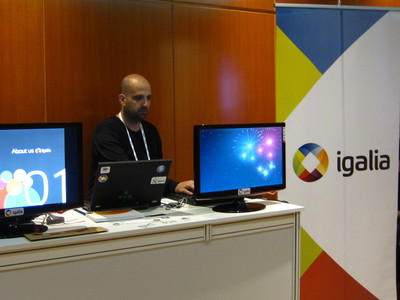
and the KVM Forum. We are sponsoring the event and we have a couple of presentations this year, one about QEMU, device drivers and industrial hardware (which I gave today, slides here) and the other about the Grilo multimedia framework (by Juan Su rez). We ll be around the whole week so you can come and talk to us anytime. You can find us at our booth on the ground floor, where you ll also be able to see a few demos of our latest work and get some merchandising.
Igalia booth

Russ Allbery: WebAuth 4.3.3

So, funny story. And by funny, I mean "doh." We had a production outage of our WebLogin servers a bit before I went on vacation because the hardware load balancer died, and then when it came back the load was so heavy that the WebLogin servers were overwhelmed with connections. WebLogin, due to the way that it involves accepting an Apache connection and then turning around and connecting back to itself to talk to the WebKDC, has a tendency to get into overload deadlocks. Worse, because the WebLogin script runs under FastCGI, when it deadlocks waiting for Apache to reply to it, mod_fastcgi decides that the script isn't responding and starts killing all the scripts. It's an obnoxious meltdown scenario. I want to find some way of getting around this (such as running WebLogin via ngnix and running the WebKDC on another port), but in the short term the best solution is to just increase MaxClients to handle more load. The limitation there is the amount of memory on the servers, which was a problem since they were built 32-bit (for historical reasons). So, this weekend I started working on rebuilding them all 64-bit. Imagine my surprise when I installed WebAuth and WebLogin on the newly-built 64-bit system and it segfaulted. It turns out that when allocating memory for a struct, it's good to allocate enough memory for the whole struct, not just for a pointer to the struct. (This is exactly the reason why I hate typedefs for structs in C, but in this case it was XS code where I don't have a good alternative, and I didn't pay close enough attention.) So, lots of debugging later, along with a detour to set up comprehensive valgrind testing of WebAuth (at least all the parts of it that aren't the Apache modules), this release fixes one uninitialized memory error and one memory allocation size error. The latter is theoretically exploitable, although since it's inside Perl XS code with pretty sharply bounded external inputs, it's going to be pretty complicated to figure out how to exploit it and therefore I decided it didn't warrant an explicit advisory. Obviously, anyone running earlier versions of mod_webkdc or WebLogin (4.2.0 or later, sigh) should upgrade to this release. You can get the latest release from the official WebAuth distribution site or from my WebAuth distribution pages.

Next.

Previous.