Search Results: "ag"

27 February 2012

Iustin Pop: doc-rfc update

Thanks to Thomas' help and gentle reminder, I finally managed to upload a new version of doc-rfc. Why is this noteworthy? It's not really, I just wanted to say: any package for which running lintian on it takes around 5 times the build time, is special .

Jon Dowland: American Psycho

American Psycho is a novel by Bret Easton Ellis. It's a first person stream-of-consciousness novel about a mid-to-late twenties Wall Street banker during the late-eighties-early-nineties. Patrick Bateman is a vain, self-obsessed pleasure-seeker, surrounded by a gaggle of similarly self-obsessed bankers and socialites. Bateman and his friends idle away their days thinking about what restaurants to secure dinner bookings; which nightclubs to be seen at; where to score cocaine and pick up women. They compete with one another on points of dress etiquette, and the relative degree of luxury demonstrated by their attire. They are all relatively interchangeable: the reader could be excused for mixing the identi-kit bankers up, and indeed they are frequently confused for each other, and other people, throughout the novel. Bateman describes in vivid detail nearly every item of clothing worn by both his male and female associates, describing both their cut and which fashion house they have come from, occasionally passing judgement. The murders are typically described with the same vivid detail as his more public activities. As well as a yuppie, Bateman is a psychotic, and probably a serial killer: there is a small amount of ambiguity, partially due to the frequent confusions of identity between the various male banker characters in the book. It's possible that Bateman has fantasised his killer side, or embellished it. He's clearly an unreliable narrator. It takes a relatively long time before this aspect of his personality emerges. It's also possible that he is a killer, but the people he kills are so interchangeable that nobody notices, or cares. There is a passage towards the end of the book that strays into Hollywood action-thriller levels of absurdity, possibly the only moment in the book where you have difficulty believing that the events could have occurred as described. Bateman tries repeatedly to talk to people about his crimes, but never succeeds in holding people's attention, or being taken seriously. This particular theme reaches a particularly amusing climax. Reportedly Ellis wrote the novel without the violent scenes and later added them in. I can believe that. The novel is carefully constructed to manipulate the reader in a way I've never been aware of before. The everyday and the horrific mesh to make the whole seem very consistent and lucid. There is a small surreal element woven into the story which is so subtle and downplayed that you can't withdraw into the safety of "this is a fantasy". Similar scenes recur over and over: heading to a restaurant. Heading to a club. Sex. Murder. Ellis uses repetition to lull you into a false sense of security before hitting you hard with an about-face, mid-sentence, like a movie jump-cut. This book has the dubious distinction of being the second novel ever to have made me feel physically queezy after reading a passage (and I was reading the other book in a car, which may have been a contributing factor). The book has been criticised for the level of violence meted out against women. Numerically, Bateman describes a roughly even number of male and female murders. However his female victims are dispatched with a shockingly higher level of planned sadism: most of his male victims are opportunistic rather than planned. Some critics theorise that the even male/female victim count is a deliberate pre-emption on the part of the author from criticism for the violence against women. I don't quite see the argument, here: Bateman is not a sympathetic character. He's a monster, and the fact he's a sexist monster is only one unpleasant facet of many. To me, the disdain and hatred shown towards homeless people was a far more prevalent problem, not least because it wasn't limited to murders, or even Bateman: many of the other characters are cruel towards them. What would this book be, without the murder? Quite similar to a number of Ellis' other stories, if their blurbs are anything to go by: explorations of the emptiness of the lives of privileged, upper class contemporary Americans. Is the psychopathy central to the story? I think so. The contrast between the corporate and the murderous is at the core. Would I recommend this novel? I'd hesitate to do so to anyone with a nervous disposition: otherwise, it has left a lasting impression and a desire to discuss it further, which you can take as praise. There's a good critical review at the M/C Journal.

Bartosz Feński: downtimed

I ve just started to use it. Next time I m able to show you how stable is Zenbook under Linux. Right now it s not helpful:
fenio@zenbook ~ $ downtimes
Maybe the system has not been down yet?
downtimes: can not open /var/lib/downtimed/downtimedb: No such file or directory
fenio@zenbook ~ $
Next time it will really ;)

Mark Brown: Yahoo! Groups spam

Yahoo! Groups have for a long time had big problems with allowing people to create obvious spam groups (randomly generated names, no meaningful description and so on) and then add people without any confirmation. This was annoying but at least they have an obvious abuse reporting link in the subscription mails. Sadly rather than improve the situation they appear to have just changed the link to not be a direct link to the reporting form but instead to be a generic help page. The link didn t change, the content just got even less useful. I m strongly tempted to just block all of Yahoo! from the mail systems I control.

Michal Čihař: phpMyAdmin translations status

With first RC for phpMyAdmin 3.5, we're really close to final release, so let's again look at translations status. Here comes fourth round of translation status update. Since last update we have three new translations at 100%: There are few which are really close to 100% and I hope they will get there soon: As you can see, there is still lot of languages missing, this might be your opportunity to contribute to phpMyAdmin.

Filed under: English Phpmyadmin 2 comments Flattr this!

Christian Perrier: 2012 update 12 for Debian Installer localization

Status for D-I level 1 (core D-I files): Status for D-I level 2 (packages that have localized material that may appear during default installs, such as iso-codes, tasksel, etc.): Status for D-I level 3 (packages that have localized material that may appear during non-default installs, such as win32-loader) Full 100% completeness (hall of fame) for 9 languages: Bulgarian, Czech, German, French, Indonesian, Polish, Portuguese, Russian, Slovak

Leandro Gómez: DebConf needs you!

The 13th Debian Conference is just around the corner. DebConf12 will be held in Managua, Nicaragua, July 8-14, 2012, and we need your help! Why should I care? DebConf is the annual conference for Debian contributors and interested users. Previous Debian Conferences have featured speakers and attendees from around the world (DebConf11 had attendees from 46 different countries). DebConf helps share the knowledge and experiences of individual developers with the entire community. It also helps promote enthusiasm for specialized areas of development and encourages discussions about Debian s future. The benefits that DebConf brings to the Debian project as a whole, and the larger Free Software community, will improve Debian and by extension will help improve GNU/Linux for everyone, whether they use Debian (or a Debian derivative), or any other distribution. How can I help? DebConf is a lot to organize and pay for. We invite you to help that this is going to be a successfull event.

Andrew McMillan: 2012 DAViCal User Survey

Back in 2005 I saw that a new open standard was being developed for calendaring, and I thought it would be a great idea to implement it. Nothing too complicated - just a really simple implementation... And thus was born the "Really Simple CalDAV Store". A few years later, when I got about 90% of the way through implementing the base CalDAV specification, I realised that "Really Simple" and "Calendar" don't actually happen in the universe we inhabit, so after much deliberation the project got renamed to "DAViCal". Now, in 2012, DAViCal is one of the leading CalDAV servers available, and I spend quite a lot of my time helping people who want to use it. Earlier in the year I was looking at the web server logs and noticed that in a four week period (i.e. as far as my logs go back) there had been several thousand unique sources of hits on the URL that DAViCal uses internally to find out what the latest version is when you browse to the '/setup.php' page. This got me wondering how many DAViCal installations there are out there, and how big they might be, and so forth but since DAViCal is free open source software, there isn't a simple way to answer those questions. I thought that it must be time to run a survey of DAViCal users everywhere to try and find out what the scale of the penetration is. How big (and how small) are the installations running DAViCal? What... Well: lets save the questions for the actual place where you can put answers :-) So click here and take the survey right now... you know you want to :-)

26 February 2012

Jan Wagner: Booth at Chemnitzer Linux-Tage 2012 (CLT14)

Also this year the Debian Project is running a booth at Chemnitzer Linux-Tage. Unfortunately this year we are lacking a bit manpower compared to the last years. Actually we have 6 persons at our wiki without knowing how much time everybody will be present at the booth. It would be really cool, if we can prevent us from having a D j vu.
So if you want to visit one of the best community focused OpenSource events in germany and can invest some time helping to run our booth, have a look into the report from last year and the organization wiki. If you feel you want to be part of this enjoyable event, please get in touch with me. As the registration for the booth is closing on 28th February, don t wait too long! ;)

Gregor Herrmann: RC bugs 2012/08

here comes my usual report about my work on RC bugs. this time a bit more "added a comment" or "sent a patch" but also some uploads.

Joachim Breitner: GHC 7.4.1 speeds up arbtt by a factor of 22

More than two years ago I wrote arbtt, a tool that silently records what programs you are using and allows you to do statistics on that data later, based on rules that you define afterwards, hence the name automatic rule based time tracker. I wasn t doing much with it recently (the last release has been half a year ago), but it nevertheless was running on my machine and by now has tracked a total time span of 248 days in 350000 records. Yesterday, I had a use for it again: measuring the time spent creating a certain document with LaTeX. So I added a rule to my categorize.cfg and ran arbtt-stats. I knew that it was not very fast, and that my data set has grown considerably since I last used it. And indeed, it took more than 6 minutes to process the data and spit out the result. Since I m currently working on the GHC 7.4.1 transition in Debian anyways, I decided to check what happens if I compile the code with that version of the Haskell compiler, instead of the previous version 7.0.4. And behold: The whole process took merely 17.3 seconds to complete! At first I did not believe it, but the result was identical, both binaries were built with the same option, i.e. no profiling enabled or anything like that. Wouldn t you also like to have such speed ups for free, just by waiting for someone else to improve their work?

I tried to find out the reason for the speed up and created profiling output from both the old and the new binary. The old binary spends 83% of the time in Categorize.checkRegex, which basically just call Text.Regex.PCRE.Light.match. Since the version of pcre-light is the same in both binaries, I conclude that the Foreign Function Interface that GHC provides to interact with C libraries (libpcre in this case) is much faster now, although I do not find any mention in the release notes. And even if I do not count the 83% time spent in checkRegex, the code from the new compiler is still 2.7 times faster. Thanks, GHC devs, great work!

Flattr this post

Bartosz Feński: reaver ACCEPTED into unstable

Just got mail about it:
Accepted:
reaver_1.4-2.debian.tar.gz
to main/r/reaver/reaver_1.4-2.debian.tar.gz
reaver_1.4-2.dsc
to main/r/reaver/reaver_1.4-2.dsc
reaver_1.4-2_amd64.deb
to main/r/reaver/reaver_1.4-2_amd64.deb
reaver_1.4.orig.tar.gz
to main/r/reaver/reaver_1.4.orig.tar.gz Override entries for your package:
reaver_1.4-2.dsc extra net
reaver_1.4-2_amd64.deb extra net Announcing to debian-devel-changes@lists.debian.org
Closing bugs: 653758 Thank you for your contribution to Debian.
Now let s see how portable is it ;)

Craig Small: psmisc 22.16 Released

psmisc version 22.16 was released today. It is a bugfix release that bascially fixes a problem around strings in C. Process name lengths are only supposed to be 16 characters long, so a 17 bye buffer is ok; until you have processes with brackets which means the string is 18 characters. The next wrinkle is that at times the brackets are stripped out so matches fail because the lengths don t quite line up. You ll see this with the debian 22.15-2 version of psmisc where killall won t find long-named processes. So, 22.16 fixes all that. Test Processes It really shows that psmisc needs a set of tests like procps has already. The difficulty with both is that its not simple in the DejaGNU framework to make test processes. These are not the programs within the package but other processes that the programs can work on. There really needs to be an equivalent to touch for processes just for this sort of thing. Creating processes is rather simple, but ensuring they go away is the tricky part, or they die with certain signals.

John Goerzen: Timelessness of an Old Pickup

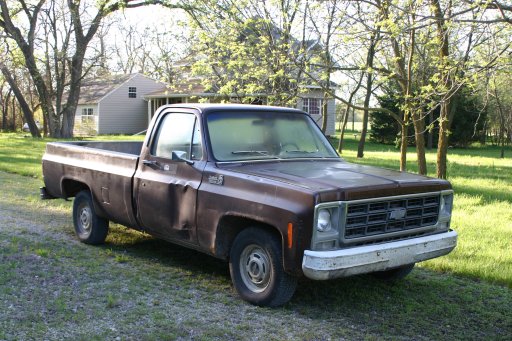
Our society is one that is pretty well defined by timeliness. TV programs start at a precise time, down to the second. Schools have elaborate timekeeping systems. Even church services are carefully timed. We know how fast we re going, and our GPS or phones tell us when we ll get there. And we re pretty confident that we will, in fact, get there. Somehow this doesn t apply to our pickup. This pickup, in case you re wondering, is a thing of stories, shall we say. After a particularly frustrating experience with it one week (oh yes, the battle extended several days), I likened it to the Greek gods. And Terah had a good laughing fit when I began a sentence with The reason there s a towel connecting the brake pedal to the steering wheel But I guess the thrifty side of me won out, and somewhere along the line, I relented. My brother fixed up the carburetor. I got it a new battery. The flat tire is repaired. The starter broke, and I got it replaced. And I even got an oil change. Fancy, I know. So today, when I needed to take some backbreaking junk off the yard, I was hoping the pickup would work. I hadn t driven it in months, and any manner of catastrophe could have struck it in that time. So I was mildly relieved when it started on the 6th try. That is, quite seriously, quite the improvement, and shows how skilled a mechanic my brother is. The speedometer, of course, isn t working. The odometer stupidly reads 21531 or something like that (it was only a 5-digit odometer, broke long ago, so who knows how many miles it really has.) And I like to keep things like grease and heavy ancient air conditioners (one of the things I was hauling) away from my watch, so I wasn t wearing it. The result: I have no idea what time it is, how fast I m going, when I ll get there, IF I ll get there, or all those things. I set out, and made it a good half mile before it died as I was rounding a corner at the bottom of the hill. Always a great place for a finicky old stick-shift vehicle to die, right? Anyhow, a few random adjustments to the choke later, and the thing sputtered then roared (and I do mean roared) back to life. A little lurching up the hill and I was back on my way. Now, I was stuck there in the middle of the road, but it was a country road, so I d have probably had a good hour to get it fixed before worrying about blocking anybody s way. My first stop: my great uncle s place. He has a scrap metal for charity project going on. He is looking for old motors, air conditioners, dehumidifiers, etc. He takes them apart, separates out the metals, sells them, and donates the result to MCC, a world relief agency. I knew I had an old dehumidifier in the basement, and thought I remembered seeing an old window air conditioner in the elevator. That thing is probably the single heaviest object I have ever moved without help. I have a bandaid to prove it. It was way too heavy to carry, so I kind of rolled it, side to side, from the side of the elevator on to the pickup. If you were watching, you d have heard me making struggling noises, followed by BANG rattle rattle rattle pause struggling noises . BANG rattle rattle rattle as I rolled it along the ground, and waited for the internal bits to settle after each quarter turn. So anyway, eventually I got it to the pickup, and then had the sickening realization: I have no way to get this thing up there. Oops. I eventually placed it on top of an old tire rim, balanced it there as I knelt down, and somehow still not quite sure how managed to lift the entire thing a few feet until I could get some leverage to shove it onto the pickup. I later commented to my dad that it was a Chrysler brand air conditioner, somewhat to my surprise, and he said that it was probably my great-grandpa s. That was a surprise. Anyhow, back to the pickup. I drove down the few miles to my great grandpa s place, not really knowing how fast I was going. I smelled the familiar smells of the old pickup: exhaust fumes, oil on hot surfaces it shouldn t be on, a touch of hot antifreeze. You never have any doubt about whether the engine is running. It was sort of nice to not know, or particularly care, how fast I was going, or what time it was. Sometimes I d idly wonder, but you know, it didn t really matter and there wasn t a thing I could do about it anyhow. I got to uncle s place, unloaded the junk sorta dropped the air conditioner off the back of the pickup with a terrific BANG, then rolled it all the way to his trailer and got back in. On to town. I hadn t put gas in the pickup in a few years, and I suspected it was getting low. (The gas gauge, you guessed it, doesn t work right either.) Plus we had some large recyclables built up and it was time to get rid of them. And for that, I had to drive on the highway a ways. The speed limit there is 65MPH. I have no idea how fast I was going, but it wasn t 65. Maybe it was 45. I got passed a lot, but nobody looked particularly surprised that a pickup that looks like mine wasn t going 65. Partway there, I smelled a different smoke smell. Not an oil smoke, but more of a grassy or wood smoke. Hmm, I thought. That s odd. Hope it s not coming from the pickup. I didn t really see smoke anywhere else, so I just drove on until I couldn t smell it anymore. I unloaded the recyclables, then went to the gas station. As the pump readout neared $50, I decided: 1) the gas tank really was pretty empty, and 2) I just can t put more gas in it anymore. That would be more than the truck s worth. So I drove home. The drive home was into the wind. My face got pretty cold I always drive with the windows open to prevent carbon monoxide poisoning (remember the fumes?) I got home and prepared to pack up the pickup close the windows, replace the bungee cord holding the brake pedal up, etc. I then thought I d have a look under the hood to see if there was anything, well, on fire. Nope, but there was a packrat nest that fell down as soon as the wind hit it. Source of grassy-smelling smoke identified. It s amazing what difference simple lack of knowledge makes sometimes. Not knowing what time it is or how fast I m going means I don t have to worry about those things. I wonder how society has changed simply because accurate and cheap watches are available. I kind of like driving the old truck. It s a bit of an adventure, a bit of a challenge, a bit of randomness, and a bit of an escape from the normal and predictable. Not a bad deal for a $75 vehicle.
Iustin Pop: First running event of 2012

Today I had the first running race of 2012. Well, actually, it was my first race in Switzerland ever so double first. And, if I have to be precise, it was my first run with a shiny new Garmin 910XT; while I had it ordered for more than a month, out-of-stock and other delays converged such that I received the new toy the evening before the run. After getting it, I walked around a bit to confirm it's not DOA, read the manual, and hoped it's not too different in basic operation to my old Garmin. So a triple first. Also, (this is the last one, I promise!) this was the first time I ran with a foot pod (pedometer), so it was the first time I got actual cadence measurements. The run I went to the Bremgarter Reusslauf, which is an 11km flat run held in the woods near Bremgarten, a very very nice small town. I have never before visited it (even though it's quite close to Z rich), and I was pleasantly surprised by it. I should go sometimes back and visit a bit more. The weather was cloudy (and just a tiny bit foggy), a bit cold but not much. From this point of view, it was good running weather, but it detracted from the scenery. Otherwise, the course itself was very very enjoyable, I could have used a camera lots. At one point, in the middle of the (light, not dense) woods, the course passed beneath the arm of an excavator which was like a mechanical arch (in the middle of nature); at another point, we crossed the river, and the sight was so nice I had to stop myself from stopping and admiring the view . The course is marked as a 'flat' one, but I've read some blog posts saying that this is not entirely true, so I was prepared for 'the worst'. Actually, I found it to be surprisingly well behaved; even though the finish was near the start, it seemed to me to be 60% downhill, 30% flat and only 10% somewhat-uphill. Garmin 910XT I didn't quite know what to expect, upgrading from my Forerunner 205. I read the very nice review on dcrainmaker, but in practice I didn't know what to expect (review awesome, but soo detailed). The new toy seems more stylish, so I expected worse UI or behaviour. On the contrary, it worked very well; much more responsive to changes in direction/pace (my 205 used to delays tens before adjusting the pace, the 910 is very fast), and new minor features (like auto-lap) were nice (I was able to track average speed on each 1KM lap, very useful). It's a ++ on the upgrade, with the big downside that so far it doesn't seem to work under Linux . It also has a barometric altimeter, but I didn't calibrate it (explicitly); so while the absolute measurements might be off, the relative elevation changes were much more sane than with 205 (GPS is not too good at elevation changes, as far as I know). One funny thing about the delays in getting the device: before the race, another runner asks me (note: the conversation was in German, accuracy not guaranteed):
Is that the new Garmin? Yes, it is, just got it last evening. (showing me his identical watch) Ha! Me too, I got this only two days ago!
So yes, I think a few people were happy to get their new toy before the race. I also have now a heartbeat sensor, but as I never used one before, I didn't want to try it the first time during a race; so I skipped on that. The foot pod on the other hand is practically ignorable, so I took that along (sometime I think I run just because there are nice running toys ). As to accuracy, it was quite OK; it measured 10.86 km instead of the official 11 km, but most/all of the difference was in the first km of the run (inaccuracy while starting to run? who knows). I'll have to see how the watch performs while cycling (uh, I didn't do that in a long while) or swimming ( I didn't do that in an even longer while), but for running it's a good upgrade from my old watch. Results My normal run pace is about 6min/km, which is quite slow. So I didn't expect anything of the race, except to finish it. There were lots of people participating (> 2,600 in the main 11km category). I started slow, because I know I usually start too fast and get tired quickly. This allowed me to not feel the first, and only, significant hill, and after that it was or seemed all downhill (literally, I mean, not figuratively), so in the end I had (for me) a very good time. By the Garmin, I run 10.86 km in 59:01, to an average 5.26 min/km. By the official results, I had 11 km in 58:56, with a pace of 5.21 min/km. I have never before run 10k faster than 5:30, so I was very very happy. As for individual laps (1 km) as recorded by the Garmin: On the overall ranking, I ended up 362 out of 394 in my category. Hah! I'll try to remember this race simply for my own pace results, and ignore the ranking . Honestly I'm not sure how people can run twice as fast need to train more! The foot pod gave me a cadence of 83 steps per minute (average, max 88). This was quite surprising for me, I expected to be significantly below the much talked about 90 steps per minute. But anyway, I have lots of work ahead of me to improve my running speed. Overall, it was an excellent day, and I'm looking forward to the next races in/around Z rich. But I should be careful not to overdo-it, like I do whenever I get excited about something .

25 February 2012

Andreas Barth: Traveling to DebConf 11 - M nchen to Zagreb

These articles cover my way to DebConf 11 through Hrvatska and Bosna i Hercegovina. After telling my initial plans to go by train (mostly) and bus (where it couldn't be avoided) on IRC, I was warned that public transport is quite bad and unreliable. Also, as I live in M nchen, of course this part of Europe was always known as "near" and "could be visited any time" (which means "one never gets to it"; and I can still remember the time when it was Yugoslavia - there are and always were many people living here from that part of Europe; in fact, it's nearer than some parts of Germany). I plan to publish more parts of my way within the next days. Already at home I also learned that most trains in Hrvatska (and all in Bosna i Hercegovina) are not part of the usual train information system, so it was a bit more advanced to find out the appropriate connections. And in both countries there are only a few trains running, so one shouldn't miss a train ("few" means e.g. two per day and direction - but one at most unappropriate times, so really only one suiteable). The first day saw me boarding the Suburban train (S-Bahn) at my usual station, changing platforms and trains at M nchen Ost station and then I was sitting in a train to Zagreb. Nothing strange there, except that the coach I had an seat reserved in was missing. I learned later on that it happens more often that the coach from Serbia is not there because it's technically too unfit to send it to Germany -- and usually, there will be more coaches added in Ljubljana. Border checks were uneventfull but at the slovenijan border my passport was stamped (not sure why, didn't happen on the way back).
Train in sterreich After arriving in Zagreb and dropping off my luggage in the hotel, I first got some Kunas and then bought my ticket to Split for the next day (as a direct ticket from M nchen to Split was not available). After having done that, I took a brief tour through Zagreb until it became dark, with visiting some of the tourist places.
Zagreb

Russ Allbery: Copyright format 1.0 published

Four and a half years after Sam Hocevar started a draft proposal on the Debian Wiki, we've published revision 1.0 of the machine-readable format for debian/copyright files. The format (as DEP-5) has been in widespread use for some time, but there have been multiple versions of the format and multiple transitional versioned URLs. Everyone can now update to the same version of the document and use a stable format URL. Below is the text of the annoucement that I just sent to debian-devel-announce. Version 1.0 of the machine-readable format for debian/copyright files (the culmination of the DEP-5 process) has now been published. The canonical URL (and also the URL to use in the Format field in such files) is:
http://www.debian.org/doc/packaging-manuals/copyright-format/1.0/
For those who have adopted various iterations of the DEP-5 format for your packages, please consider updating to this format the next time you revise your package. Use of this format in Debian packages is optional. Thanks to all of the people who have contributed to this work over its long evolution. Particular thanks go to Steve Langasek, Charles Plessy, and Lars Wirzenius, who kept this document moving through its extended DEP discussion process, and Sam Hocevar, who started this work in 2007. The copyright format specification is now being maintained as part of the debian-policy package and will follow the same update process that's used for other parts of Policy. See:
http://wiki.debian.org/PolicyChangesProcess
for that process. For this specification, we're trying something new for Debian technical policies. This document is versioned, and older versions of the specification will be maintained to not invalidate older references in copyright files that have not been moved to newer versions. This is similar to the way that specifications are handled by some other projects, particularly the freedesktop.org standards. The plan, going forward, is that informative changes (changes that do not change the requirements or the contents of compliant copyright files) will be made following the same relaxed procedure as other informative changes to Policy, and new versions will only informative changes will be published with the same version number. So the existing 1.0 document may receive further improvements in wording, examples, or similar changes that don't modify its meaning. Normative changes (changes that change requirements for compliant files, which includes addition of new standardized license short names) will follow the normative Policy change process, including formal seconds. Once normative changes are accepted, the next release of this specification will receive a new version number (1.1, for example). The previous version, prior to the normative changes, will be frozen, and from that point forward will not be changed except as required to continue to publish it. This includes further informative changes. We will continue publishing these frozen older versions of the standard on www.debian.org and in the debian-policy package for some time: possibly forever, and at least as long as they're still referred to by packages distributed by the project. The hope is that this will provide a good balance between specification stability, editing for clarity, and specification changes to meet changing requirements, while not invalidating the URLs in older files and while continuing to provide the information required to interpret older files.

David Bremner: First steps with Racket PLoT

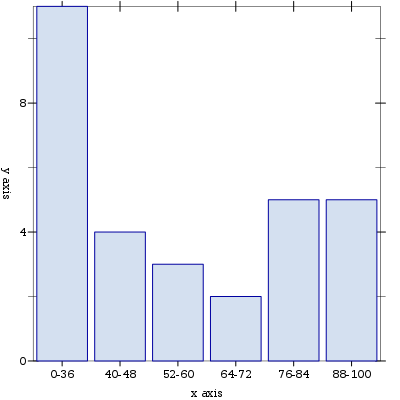
I have been in the habit of using R to make e.g. histograms of test scores in my courses. The main problem is that I don't really need (or am too ignorant to know that I need) the vast statistical powers of R, and I use it rarely enough that its always a bit of a struggle to get the plot I want. racket is a programming language in the scheme family, distinguished from some of its more spartan cousins by its "batteries included" attitude. I recently stumbled upon the PLoT graph (information visualization kind, not networks) plotting module and was pretty impressed with the Snazzy 3D Pictures. So this time I decided try using PLoT for my chores. It worked out pretty well; of course I am not very ambitious. Compared to using R, I had to do a bit more work in data preparation, but it was faster to write the Racket than to get R to do the work for me (again, probably a matter of relative familiarity). racket-hist.png
#lang racket/base
(require racket/list)
(require plot)
(define marks (build-list 30 (lambda (n) (random 25))))
(define out-of 25)
(define breaks '((0  9) (10 12) (13 15) (16 18) (19 21) (22 25)))
(define (per-cent n)
  (ceiling (* 100 (/ n out-of))))
(define (label l)
  (format "~a-~a" (per-cent (first l)) (per-cent (second l))))
(define (buckets l)
  (let ((sorted (sort l <)))
    (for/list ([b breaks])
          (vector (label b)
           (count (lambda (x) (and 
                    (<= x ( second b))
                    (>= x ( first b))))
               marks)))))
(plot
 (list
  (discrete-histogram 
  (buckets marks)))
 #:out-file "racket-hist.png")

24 February 2012

Guido G nther: Iodine plugin for network-manager

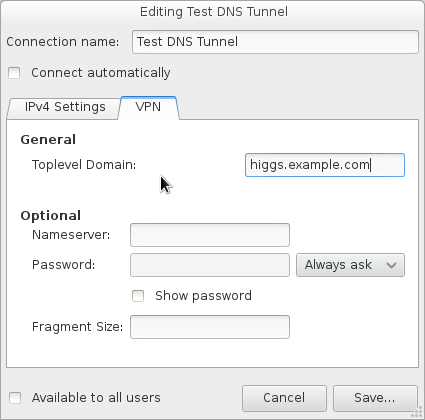
During FOSDEM I finally got around to hack on a iodine plugin for network manager. Given a suitably prepared server on the other end this allows you to tunnel connections over DNS when all other traffic is firewalled. The basic configuration only needs the domain name set: Network Manager Iodine Configuration You can grab the sources from git.gnome.org, a Debian package is also available. This blog is flattr enabled.

Richard Hartmann: zsh pound-insert

Ben Hutchings writes:
There is an alternative to using C-c, and that is M-#. This adds a '#' to the start of the line, commenting it out, and then behaves as if you pressed Return. The result is that the command is cancelled but still remains on-screen and in your history. You can then copy the command later using the mouse or keyboard.
Naturally, there is a zsh equivalent for this (there always is...): pound-insert. Quoth the manpage:
pound-insert
If there is no # character at the beginning of the buffer, add one to the beginning of each line. If there is one, remove a # from each line that has one. In either case, accept the current line. The INTERACTIVE_COMMENTS option must be set for this to have any usefulness.
So if you want the same for zsh, a simple
bindkey '^[#' pound-insert

is all you need. Update: Clint Adams noted another way to do (almost) the same.

Next.

Previous.