Search Results: "will"

11 January 2008

Felipe Augusto van de Wiel: 11 Jan 2008

Bits from the Debian i18n meeting (Extremadura 2007)
From December 12th to December 15th, Junta de Extremadura hosted another one of the Debian Meetings; five i18n guys shared ideas, food, buses and fun with the Debian KDE maintainers. We would like to thank Extremadura for hosting us during the Hispalinux Meeting 2007, the event was held at Universad de Derecho (Law University) in Caceres, Spain.

These are the minutes, results and notes from our work, it is a brief description but hopefully complete of what we have done and what is still missing/pending.

Thanks to Cesar (cek) we had the chance to work on churro (i18n.debian.net) locally; the server is still running a 2.4 kernel because of some "tick" problems with 2.6 series, the last one tried was 2.6.21 and we should try newer ones, in order to support upgrades and not get stuck with 2.4, we hope Cesar will find time to test new Debian kernels.

First, let me introduce everybody to the services, robots and resources being hosted by i18n.d.n:

  • MoinMoin wiki for local and simple reference documentation, it contains all the links to the below resources. (http://i18n.debian.net/wiki/)
  • Pootle experimental server
  • dl10n scripts, aka dl10n robots (codename Lion), these scripts are responsible for the status of pseudo URLs used by some translation teams, by the Project Smith and by the NMU Priority List for i18n NMU Campaign
  • Synchronization of the i18n material used by the Debian website to generate translation statistics about PO and PO-debconf
  • Generation of Compendium PO files per-language
  • Different types of statistics
  • Other non user-visible services like a full source mirror for stable, testing, unstable and experimental, used by the scripts and robots.
  • DDTP, Debian Descriptions Translation Project
  • DDTSS, The Debian Distributed Translation Server Satellite, a web front-end for DDTP, now integrated to DDTP to use the Database back-end instead of the e-mail interface.


And, at some point, we found important to state clear the acronyms and names used in related DDTP projects/tools:
  • DDTS, Debian Description Translation Server, this is the main "back-end" used in DDTP, it tends to be the interface between translator tools (present and future ones) and the database;
  • ddt.cgi is a CGI interface that is able to provide info for specific packages or translations, including diffs, related packages and active/inactive descriptions.
  • DDTC which is the old (and still functional) command line client for DDTP.


We took the chance to organize a few things on churro, old accounts were cleaned out and removed, we moved from /org to /srv and got more GBs of space to the "playground". Old files were also removed and some are schedule to deletion on early 2008. With the reallocation of /org we also find some more space to /home and /var, we reorganize some of the links on the web space (specially to remove services from people's accounts), and we changed the mirror script to also synchronize the Packages and Contents files.

Grisu and Martijn worked mainly on DDTP and DDTSS integration. DDTSS now provides statistics for stable, testing and unstable, we are also working with Debian Med to provide support and infrastructure to a specific audience, like packages related to Medicine. The conversion to talk directly with DDTP/DDTS database also provided:

  • Fetching new translations is almost instantaneous and marks translation as requested (avoiding duplicated works via the e-mail interface).
  • After sufficient reviews occurred, the upload is instant
  • Committed DDTS / DDTSS / DDTP website generation into SVN
    • Added READMEs for the above directories


DDTSS now announces the user using authentication because of its integration with the Database backend used by DDTP. Quick trivia: DDTP is now a compound of 25 languages occupying 18 GBytes.

A few days before the meeting we had the offer to use "AUTOBYHAND" to upload a package with the Translation-* files. The package is now called 'ddtp-translations' and we worked during the meeting to create scripts to build the package and to test it on the archive side. This approach allow Debian i18n Team to upload new translations and remove old ones (or inactive ones) without bother FTP Master Team. Special thanks to Anthony Town, he has been working with us to prove tips, fixes and info on how to produce the package and the scripts. The code is available in the debian-l10n SVN under pkg-ddtp-translations:
http://svn.debian.org/viewsvn/debian-l10n/pkg-ddtp-translations

In our case, "BYHAND" processing consists of a simple tarball of the main,contrib,non-free /i18n/Translation-*, we decide to work on a set of scripts to make it easier to create new packages (ddtp-translations) in a consistent way and keeping debian/changelog up-to-date. We also made some suggestions to the script what will run on the archive side to check the tarball structure, base on the examples of debian-maintainers and debtags (tags-override).

One of our initial targets for the meeting with regards to Pootle and Debian was to try big PO files per language, fortunately, Nicolas and Friedel were able to increase Pootle performance enough to get a few languages from DDTP loaded in Pootle. Using the upstream Pootle-diet branch, which uses a database back-end for the generation of statistics, the time to browse the DDTP POs of a language (~20.000 files) went down to a dozen of seconds.

Speaking about Pootle, Friedel gave us a good picture of what is coming next in terms of Pootle's development. There are improvements planned in the areas of permissions and rights delegation, as well as file management (for projects and templates). Improved management of terminology projects is also planned.

Improvements in the QA capabilities of the translate toolkit and Pootle are planned to help with the "false positives" of the pofilter checks. Better reuse of existing translations will become possible by using better translation memory techniques. There is also work planned on formats and converters involving, for example, XLIFF, TMX, TRADOS and WordFast.

Another pending task for quite a while was the CVS migration to SVN, it is now done, with a new layout. Commits to the CVS were disabled and every single script or resource depending on CVS should be changed to use SVN. For now, we are publishing (via HTTP) the status files generated by the pseudo-urls robots until we can fix the scripts to re-enable the commit of the files. You can find them here: http://i18n.debian.net/debian-l10n/status/

We are pretty happy with the changes and results of the work during those days, but we still have some items pending on our TODO list:

  • More advertisement and usage information about PO Compendiums
    There are two use cases are identified:
    • Filling new PO files.
    • QA work to find inconsistent translations.
    Maybe Eddy would love to do that? :-)
  • Extend the duration of the statistics history. (Nekral)
  • Debian packages of the services running on churro
    • DDTP (Grisu)
    • DDTSS (Martijn)
    • dl10n (Nekral)
  • DDTP: add some scripts to handle packages with version in the description (e.g. kernel and kernel modules) (Martijn)
  • DDTP: Standard generation of the translation tarballs (faw)
  • DDTP: document the bracketed stats on the main page (faw)
  • DDTC: should be updated to match the current features. Documentation to ease integration with procmail. (Nekral - low priority)
  • Implement mail service for translation teams with their own robots (e.g. Dutch) (faw)
  • Collect data from http://www.debian.org/devel/website/stats/ (Nekral)
  • http://www.debian.org/intl/l10n/po/,
    http://www.debian.org/intl/l10n/po-debconf/
    are built based on the churro material. It would make more sense to build these statistics on churro (Nekral)
    • We could "fork" the page and add some fancy new features on these pages (Nekral)
    • Add information from the coordination page to indicate that a translation is ongoing. (Nekral)
  • Pootle: missing review indication. Hard with PO back-end. (Friedel)


There are a couple more reports to be sent but they are more focused on i18n specific questions, tools and plans for 2008. So, probably those will be sent only to debian-i18n mail list. If you are interested, please, stay tuned. :-)
Posted on d-d-a: http://lists.debian.org/debian-devel-announce/2008/01/msg00002.html
And a big thanks to Nicolas François (aka nekral), he helped me a lot making notes, preparing the text and reviewing it; and was patient enough to wait for the report while I was solving some personal problems.

Anthony Towns: LCA Sponsors

An article by Sam Varghese appeared on ITwire today, entitled linux.conf.au: What is Novell doing here?:
A GNU/Linux system does not normally load modules that are not released under an approved licence. So why should Australia’s national Linux conference take on board a sponsor who engages in practices that are at odds with the community? What am I talking about? A company which should not be in the picture has poked its nose in as a sponsor. Novell, which indicated the level of its commitment to FOSS by signing a deal with Microsoft in November 2006, will be one of the supporting sponsors for the conference.
Novell was also a minor sponsor of the 2007 conference, and Sam wrote an article in January expressing similar thoughts, which included this quote from Bruce Perens:
“I’d rather they hadn’t accepted a Novell sponsorship. It wasn’t very clueful of them, given Novell’s recent collaboration with Microsoft in spreading fear and doubt about Linux and software patents,” Perens said.
Ultimately, I think that’s a mistaken view. Linux.conf.au is what it is thanks to the contributions of four groups:
the organisers
who create the conference, get a venue, organise a schedule of events, help the speakers and attendees to get there, and generally make it easy for everyone to just get immersed in cool Linux stuff
the speakers
who provide the core of the schedule, the reason for attendees to go, and a core depth of awesome technical knowledge and ideas
the attendees
who fill in the organisational/content gaps that the organisers and speakers miss, who make for fascinating corridor and dinner conversations, who make side events like the miniconfs, the hackfest or open day interesting, and who pay the rego fees that lets the conference happen
the sponsors
who provide a chunk of money to fill out the conference budget letting us commit to venues and events earlier (when we might otherwise have to wait to see how many people come), and let us do extra things that registration fees alone wouldn’t cover
Obviously sometimes you have to exclude people from participating, but that’s mostly only if they’re actually causing trouble for the event. For sponsors, that pretty much means trying to interfere in the conference itself, or not paying on time. Otherwise, if you’re contributing to the conference, and not causing problems, you certainly should be recognised for that, as far as I can see. For me, the same thing would apply if Microsoft was offering to sponsor the conference – if they’re willing to contribute, and not cause problems, I’m all for it. If they happen to not be doing anything constructive in Linux-space anywhere else, well, it seems perfectly fine to me to start contributing by helping make linux.conf.au awesome. In Microsoft’s case that would be hard, because all the people going “oh my gosh, Microsoft, Linux! Wolves, sheeps! Hell, snow!” along with possible mixed messages from Microsoft and our long-term major sponsors HP and IBM about the future of Linux and whatnot could really distract us from all the cool technical stuff the conference is fundamentally about. I don’t think there’s anything Microsoft could offer to justify that much disruption, but having more of the world’s software companies involved in free software would probably be worth a bit of hassle, if the disruption could be minimised. Ultimately, I guess my disagreement comes down to these couple of comments from Sam’s article:
Asked whether it was right that Novell should be allowed to be a sponsor for a conference such as this - which, in my view, is a privilege - […] […] Novell, obviously, is hoping that, as public memory is woefully short, it will be able to wriggle its way back into the community. Providing such leeway is, in my opinion, a big mistake.
In my opinion, the ability to contribute to open source isn’t a privelege, it’s something that should be open to everyone, including people who’ve made mistakes in the past: and that’s precisely what the “free” in free software is all about. OTOH, if you want to see who’s been participating most in the Linux world lately, you’re much better off looking at the list of speakers than sponsors. Novell (or at least SuSE) folks giving talks in the main conference this year seem to include John Johansen and Nick Piggin. Interestingly, the count of HP folks seems a bit low this year, with only two that I can see, which leaves them not only merely equalling Novell/SuSE, but beaten by both Intel and Catalyst. Tsk! I guess we’ll have to wait and see if that changes when we can see the list of attendees’ companies in the booklet this year…

10 January 2008

Kartik Mistry: The geeky dream

* What a dream it was: Apple OpenSourced the Mac OS X but the restriction were, it can only built and used on Apple hardware! I wake up and found that Kavin is slapping me with his little hand for this dirty geeky dream. I will read the book to interpret this dream now and probably this is effect of too much traveling by our dear Indian Railways.

Robert Collins: 11 Jan 2008

thank you lazyweb; A number of folk have written to me pointing out Netem. One in particular, Yusuf Goolamabbas even provided a set of wrapper scripts for Netem that I'm going to be digging into next week. Netem is built around various lower level tools like tc, which is good (tc is what I was using year ago). I'm hopeful it will be really easy to use, and will blog something when I've used it in anger :)

Christine Spang: MIT Athena: Not Dead Yet

(Disclaimer: I work for MIT Information Services & Technology blah blah blah I am a student blah blah these are only my words and do not represent the opinion(s) of my employer.) Way back in the day in 1983, MIT started something it called Project Athena, which had the goal of investigating how computers could be used to enhance education at MIT. This project became the origin of such pieces of software as the X Window System and Kerberos, as well as a campus-wide network of workstations all running similar software. In 1991, Project Athena ended, but the Athena system continued on, taken over by MIT Information Systems. It’s 2008, and Athena still exists at MIT—walk into a computing cluster, and chances are all the machines will be running Athena software. (Unless that particular cluster has been taken over be Athena’s evil sibling, often referenced as “WinAthena”, which often seems to be maintained by no one, and whose existence is sometimes denied by those who maintain and support Real Athena. Not many machines have suffered this agonizing fate, luckily.) Unfortunately, as the years have progressed recently, fewer and fewer resources have been put into the development of Athena. In many ways it is no longer on the cutting edge of things as it has been in the past, though it is certainly still useful. Some students these days, however, even think of Athena as only “their MIT email” or maybe use it occasionally to print something in a cluster on the way to class. I’ve seen people grow frustrated and storm out of a cluster due to things like instructions for using a flash drive that involve more steps than just plugging it in. While on the one hand it’s easy to laugh at people for a lack of patience or being open to a computing system that is not either Windows or Mac and perhaps a bit more complicated on the surface, on the other hand, some of these things really should just work by now, and on other UNIX-based systems they do—but Athena has lagged behind. When you log into an Athena workstation for the first time, you are confronted with what looks like this: Clean MIT Athena login That’s GNOME 2.8, and it looks kind of like the GNOME 2.8 default but uglier. When you look under the hood, there are pieces of the system that obviously originated in a time where nothing better existed and so something new had to be created—the “xlogin” login system doesn’t support PAM, and the login path involves a hairy maze of scripts that perform various tasks. Under the hood, the base OS is currently RHEL 4 or Solaris 10. I still can’t remember what the right options are to feed RPM whenever I need some information that I think I should be able to get from it. These things were once necessary but today just look crufty. Some people have tossed around the idea that everyone has a laptop these days and thus clusters are uselessly expensive, but it’s been met with a lot of resistance. I’m all for progress, but I use clusters all the time! They’re one thing that makes it an easy choice for me to have a really portable laptop, because when I really need computing power or screen space on campus away from my room, there is always a cluster nearby. They’re also nice isolated places that can be associated with “work mode”, which is good for productivity. Beyond all this, Athena provides a common platform that all technical classes can depend on, from providing standard and specialized academic software to standing as a baseline of “make sure your code works on this before handing it in because that is how it will be graded”. At any rate, things are finally happening on this front. Athena can’t stay RHEL 4 forever—while AFS allows non-system software to be easily updated for all machines without requiring any OS release, hardware moves on and compatibility is lost, and the rest of the world is coming up with new awesome things that Athena machines are missing out on. A student group that I am vaguely involved with, SIPB, took the early initiative with this and created DebAthena, which takes stock Debian and Ubuntu and allows it to closely resemble an Athena environment. We even run a campus Linux dialup using the packages. (I won’t claim to have done much work on DebAthena myself because, well, I didn’t.) Amazingly, the Athena release team has decided to work with the SIPB on the next release of Athena. So, what I really just wasted over 600 words prepping for is to say that Athena 10 will be based on Ubuntu. This is only relatively new news, but I am lame about finishing blog posts. There are a variety of reasons why Ubuntu was chosen over Debian. Some of them are lame and some of them are not. Even so, I am excited about this prospect—and it should be possible to peripherally support Debian in such a way that was not possible with Athena 9.4. I really like Athena. Even coming to MIT with a background in Linux there has been a steep learning curve, though, and I think that things could be better. Lots of people here have their first encounter with a ‘nix system in the form of Athena, and we should strive to make that experience as good as possible. I’m kind of skeptical on the expected release date of this upcoming summer, but as long as it happens soon it will be a big step forward. In some ways it’s kind of sad that I’m excited about a big part of a research institution catching up with others—but inertia is a strong force, and dealing with thousands of workstations is no trivial task. I kind of long for the exciting days of creating new big pieces of free software like X. I bet I imagine those days as being better than they actually were.

Adeodato Sim : Gotcha

When piping something to procmail, which comes from, say, crm114, be sure it has a From_ line, or it will not be correctly appended to mailboxes (procmail won’t add the From_ line itself). One way of adding this line is invoking procmail via formail, as in formail -ds procmail.

9 January 2008

Cameron Dale: DebTorrent 0.1.5: Now With Status Updates

It's been a while, but a new update to DebTorrent is available in unstable. There is also a new version of the helper apt-transport-debtorrent (0.2.0) to go with it, which was mostly the cause of the long delay (due to a pending apt transition to testing). It is now highly recommended to install both, read below for new reasons why. One of the previous problems with debtorrent was the incorrect status updates displayed by apt, due to it not being aware of pieces of large files that have already downloaded. Using these new versions together will help to improve the update status messages shown during a download. Now, apt-get update will display a status at the bottom that will look something like:
DebTorrent: 837MiB left at 319 KiB/s (46m03s)
You may not be able to see it all if there are multiple updates to different mirrors under way. In aptitude, the status will appear on a line by itself at the bottom of the list of downloaded files. The status line will update about once per second, and should give a good indication of how much time is really left. The other (incorrect) status information presented by apt/aptitude will still be there but you can ignore it. I've only tested apt and aptitude, so I'm not sure how (or if) synaptic, adept or gnome-apt will display these messages, though they are general apt status messages, usually used for displaying the status while logging into an FTP server. This should also fix another problem that debtorrent can have with downloading large files (usually on slower connections). Since apt can't see the download happening for a long time, the connection would sometimes time out. With these status updates the connection is constantly active, so the timeouts shouldn't be a problem when downloading large packages (although they may still occur when doing an apt-get update, as there are no status updates during that process). I did implement a better solution, as suggested by Micha Politowski on the wiki. This solution uses the creation of sparse files to let apt know how much of a file has actually been downloaded. However, apt doesn't understand how a single process can download multiple files in prarallel, so it only follows the last file that was started, and complains when a file finishes that was not the last one that started. I've disabled that for now while I see if it's possible to modify apt to work better in this situation. Here are the changes for debtorrent: And for apt-transport-debtorrent:

Christian Perrier: Feeling older and proud

My son Jean-Baptiste turns 20 today and I have this strange feeling of big pride and seeing time flowing around me. I still see that little thing I discovered on Jan 10th 1988 and compare it to the current young man who conducts his life pretty well (no gf as of now, I'm always surprised that none discovered the gem JB is....). This year will anyway be a year of big pride with Sophie turning 18 (age of majority, driving license, french 'baccalaureat'....) and Magali turning 16. So, well, I just wanted to share this with people who're still not bored with that blog.

Simon Law: DemoCamp CUSEC 2


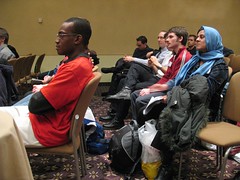
Audience
Originally uploaded by sfllaw.
It s been a long time since I ve written about our local unconferences, but a neat one coming up is DemoCamp CUSEC 2. It s attached to the Canadian Undergraduate Software Engineering Conference, which is being held in Montr al again. Last year, I did a demonstration on how to cook an omelette, with it being a metaphor for software engineering. This year, I m going to do something more prosaic and run a round of Powerpoint karaoke, under the guise of getting people to practise their presentation skills. Or it will be a convincing argument against its use. Show up if you can! Present something you ve been working on! (There are still some slots left.) It ll be exciting. DemoCamp CUSEC 2
Thursday, 17 January 2008
19:00 21:00
Centre Mont-Royal
2200 rue Mansfield
Free admission
( Sign up Google Maps )

Robert Collins: 10 Jan 2008

Dear lazyweb, In bzr development we are now working primarily on network performance. One of the key things about being sure we have improved things is automated, repeatable benchmarks. And for that to be useful in networking environments we need to control latency and bandwidth and packet loss. I know this isn't a new problem, but it was about 5 years ago that I last did this sort of thing. What are the best tools today (for linux :)). Ideally I'd be able to bring up a bunch of local addresses like 127.0.1.1 or 127.0.0.2, with different properties - such that traffic from 127.0.0.1 to 127.0.0.2 will simulate being uploaded over adsl, and 127.0.0.2 to 127.0.0.1 will simulate being downloaded over adsl.

Martin F. Krafft: Down and up and down and up

You are probably using DHCP on the machine currently in front of you. The Dynamic Host Configuration Protocol is a way for your computer to obtain an Internet address from a pool of available addresses, and to return it to the pool when you no longer need it. Basically every Internet service provider uses DHCP, or something similar. As a network operating system, Linux has DHCP support (and had it for ages). In true Unix fashion, Debian sports at least four DHCP clients. Debian s default is dhcp3-client, also known as dhclient. The theory is that the client requests an address lease from the server and periodically renews it. This process yields a number of events, to which the operating system can react. For instance, initially, the client issues a PREINIT event to get the interface into a state where it can talk on the network, and a BOUND event as soon as it acquired a lease, or FAIL if it, uh, failed. After a certain period of time, the client tries to renew the lease. If it succeeds, it issues a RENEW event; if it fails, it yields EXPIRE. So much for the theory. It seems that dhclient is rather stupid, which I tried to document in bug #459813 it does things differently: given a lease, after a certain period of time, it just issues an EXPIRE event, which causes the operating system to deconfigure the interface and take down connectivity. Then, the client spits out a PREINIT event, followed by BOUND or FAIL, as appropriate. I have not quite investigated what all this means, but this much is for sure: periodically, your machine goes offline, only to come back online a second later. If this were Windows, one would probably knock on wood and be glad that it works at all. But we re on Linux here, Debian even, so this cannot be. I d love to be proven wrong, so if you have a minute, please try to verify. One way of doing so is to insert
echo "$(date) got $reason" >> /tmp/dhclient-script.reasons

towards the top of /sbin/dhclient-script and monitor the output file. Once your client renews, it should read:
Wed Jan  9 11:53:27 CET 2008 got RENEW

but instead you ll see
Wed Jan  9 11:53:27 CET 2008 got EXPIRE
Wed Jan  9 11:53:28 CET 2008 got PREINIT
Wed Jan  9 11:53:33 CET 2008 got BOUND

and if you look closely enough, your interface will be unconfigured those seconds between EXPIRE and BOUND. I only spent about 2 hours with dhclient last night, as part of my efforts on netconf, but I already found bug #459813 and bug #459818, two bugs which don t suggest that dhclient is quality software. If I find more, I ll have to consider a different client, hoping that there are others which separate the DHCP client from the operating system calls in a similar way as dhclient does. NP: The Flower Kings: @Live Recording, Uppsala City Theatre, Sweden, 10 February 2003

David Welton: Nefarious Network Solutions

  1. Go to http://www.networksolutions.com/
  2. Type in a silly domain name (not something you actually care about!).
  3. In a few minutes, they will have registered that domain themselves, locking you into buying it from them if you actually want it.
They're overpriced anyway, but that's really sleazy.

8 January 2008

Russell Coker: Weather in Melbourne

Some people have been asking about the weather in Melbourne in late-January in terms of what to wear for Linux.Conf.Au. It is probably impossible to predict weather for a particular day this far ahead. But predicting a range for the week is not difficult. I think that you should expect at least one day that is really hot with a peak of 37C or more and reasonable humidity with a possibility of another two days the same or similar. A day with a peak of 42C or more is not unlikely over the course of a week. You should expect a range of temperatures, one or two days that are reasonably cool with a maximum of 25C would not be unexpected. Some heavy rain in short bursts is a possibility (based on the past few weeks - prior to that there was little rain and it’s possible that there may be some time without rain again), there is probably no need for a rain-coat if you have the option of waiting ~30 mins for the rain to pass before going outside. I expect that if there is any rain at a time when conference delegates are about to go out somewhere then things will be delayed. I suggest that you wear jeans while on the plane but expect to wear shorts for your entire time in Australia. A t-shirt is a reasonable option but if you plan to be outside much then wear a long-sleeved shirt. As I don’t expect to be doing much work in traditional offices in the near future I’m wearing business shirts when I go outside, long sleeves with a collar is good for protecting against sun-burn and as they are light they keep me cool (t-shirts are tighter and thicker and keep you hot). However when at LCA I will be wearing t-shirts that I designed (which should be well suited to being inside and I don’t plan to do much outside during that week). A Scott e Vest [1] is a good thing to wear. It has heaps of pockets for your electronic gear, is reasonably light, and can be worn on top of a t-shirt. The Scott company also sells a TEC shirt which is a long-sleeved shirt with plenty of pockets. I’ve had a Scott e Vest for a number of years and I might have to get myself a TEC shirt.

Stefano Zacchiroli: crappy hardware and debctrl stats

debian/control field stats moved i.e.: crappy hardware and the virtual hosting panacea sockmel.bononia.it is a machine hosted in a galaxy far far away from me (Rome, about 400 km from Bologna). It is also a machine whose hardware is getting worst each passing day. Hence, it is an unreliable machine. That's why I've just moved the Homepage and Vcs-XXX field statistics to upsilon.cc, which at least is a virtual hosting where other people is dealing for me with crappy hardware. It's also a personal domain of mine, which will stay with me even if I will change again location. Here are the new stat URLs: The links to them I was aware of have already been fixed, let me know if you are aware of others. Uff ...

Simon Huggins: Books (part 2)

[ Apologies for Debian planet readers expecting something pithy and Debian related. This isn't. But then pkg-xfce packaging just continues. We get more bugs, we fix some of them (if you have a dual-headed setup and want to help us fix or reproduce more we'd love to hear from you). Corsac became a DD at last and has made me more or less redundant in a good way. I should probably investigate libburnia again and prod George Danchev about #450873 since basically it seems to just need the ubuntu packaging brought across into Debian to replace libburn etc. But anyway, on with the irrelevant stuff... ] Books part 1 was back in April and I've since found myself with some time on my hands before I get a new job so here we go again.
Making Money - Terry Pratchett
This was a Christmas present and I quite enjoyed it and enjoyed the character but didn't really think it lived up to the laugh a minute Pratchett books that I remembered from the good old days.
The Lovely Bones - Alice Seebold
This is quite a weird concept for a book given that it's from the point of view of a dead girl in heaven but it seems to work. It's very well done and I enjoyed it.
Alex Rider series - Anthony Horowitz
I had seen Stormbreaker and wanted to read some more of these as light holiday reading. They work well for that. There's enough plot to keep me interested but not enough to make them at all hard to read. I read a couple of them in French when I was in France (in between traipsing between different bits of Paris since the m tro workers were on strike). I wish they'd been around when I was younger.
My Sister's Keeper - Jodi Picoult
Ooh this is a really, really good book. I loved it except perhaps for the very end but I can forgive it that. The idea is that she's suing her parents for the rights to her own body because she was conceived as a donor for her sister to fight off her sister's leukaemia. It's a very thought provoking read with several interesting characters with their own stories woven together.
The Language Instinct - Steven Pinker
This book is fascinating to me. It takes ideas mainly from linguistics, evolution and psychology and explains a theory that seems to hold together and is well illustrated and explained. The central point is that we all are born with the ability to develop a universal grammar from an early age which can be adapted to any human language and which sticks around in the young child and then disappears. If you have any interest in language at all read this book.
A Spot of Bother - Mark Haddon
I found this a bit hard to get into as essentially it's about the normal lives of a family (albeit quite a special family). It doesn't really grab you. Towards the end though I was interested to find out how it would all unravel and was pleased with it.
The Mephisto Club - Tess Gerritsen
This is a nice, honest thriller that does what you expect. It keeps you flicking the pages wanting to know what happens next.
The God Delusion - Richard Dawkins
I quite enjoyed this and did find new arguments against religion but I don't think he's going to convert anyone with this book. Of course I'd recommend anyone read it because it raises lots of interesting points but it's polemic essentially.
The Blind Watchmaker - Richard Dawkins
I enjoyed this though it builds on previous work I'd read. I guess if you're just interested in evolution then read this and not the God Delusion.
The Raw Shark Texts - Steven Hall
I was recommended this by a friend. It's very surreal possibly a bit too surreal for me but I enjoyed it nonetheless.
Do Androids Dream of Electric Sheep? - Philip K Dick
I hadn't read the book and saw it at a friend's and borrowed it. You probably all know what it's like. I'm glad I read it because of the references to it but it's not my normal reading material.
Harry Potter and the Deathly Hallows - J K Rowling
I had to read this of course to finish off the series but I thought it was a lot better than some of the others. I think I enjoyed the first, the one with the tri-wizarding championship and this one the most.
Love in Idleness - Charlotte Mendelson
This is well written and you really get into the character that's painted for you. I really liked some of the descriptions of justifying things to yourself and coping with boredom.
Blood, Sweat & Tea - Tom Reynolds
This was an interesting look at the life of a paramedic and if you don't already read Random acts of reality then read the book first and start reading the blog.
Telling Lies - Paul Ekman
This came from my Blink/Tipping Point reading and I found it hard going. It was interesting but quite detailed and not really a book for late night reading. The theories in it are very interesting though and explain why you probably aren't as good at detecting things as you think you might be and how to look for factors that will help you.
The Man Who Mistook His Wife for a Hat - Oliver Sacks
I read this ages ago and it was fascinating. It's about a number of different cases of problems with the brain. Often physical defects in various areas of the brain that cause odd problems and how it sheds light on how things relate. I really enjoyed it.
As always, do please punt your own recommendations at me.

7 January 2008

Christian Perrier: Unknown territories: there are spiders

dpkg and apt have been uploaded the same day to unstable. Why do I suspect that some things could break? :-) shadow transitioned to testing today as well. So I think that Nicolas will soon upload shadow 4.1.0-1 to unstable. This one could bite, also.

David Nusinow: Finally

A few years back I asked Branden Robinson for access to the X Strike Force SVN repository in order to improve the X server's autodetection, with the goal of stealing what I could from knoppix. At the time, users were constantly wandering in to #debian saying that they had used knoppix to create an XF86Config-4 and then they used that file on their Debian installations. They were also constantly whining about how Debian wasn't doing as good a job. So I decided to do something about it, and took a look at what knoppix was actually doing so much better than us, and I was surprised to find that they pretty much just wrote a skeleton configuration file and let the X server fill in the details. I had no idea the server was capable of such things. So Branden graciously gave me SVN access and I began comparing the knoppix method to the script called by "dpkg-reconfigure xserver-xfree86" and realized that we probably couldn't adopt the same method because we had tons of checks for portability. So I put the problem on the backburner for few weeks and worked on something else for a while.

Well, somewhere in between then and now I got sucked in to transitioning Debian to X.org (using the aforementioned SVN access) and then working on all the things that went along with maintaining X in Debian, some well and others less so. Between transitioning to Xorg, and then transitioning to a modular Xorg, even with the ability to steal Ubuntu's packages it still took about two full years with me being a rookie and all that. There were tons of people who worked on this with me, but it was just a damn big job. Eventually though, etch released with modular X packages, and we were running at a pretty good pace with upstream, so it was time to revisit the problem of configuration again after the two year detour.

The problem of configuration had been reframed for me by having looked at what knoppix was doing and discussions with upstream. Upstream was starting to come to the conclusion that we shouldn't have a config file at all, and that the server should be smart enough to do everything by itself. It was already partially there, it just needed a push in the right direction. This was a major shift in how I thought of it. Coming from a Debian background, where the answer is to always just regenerate or edit your config file, having the server work things out for you was a totally alien idea. But I have my deepest roots in the Macintosh world, so immediately fell in love with it. The problem was that the server had a whole body of code to use if you had no config file at all, and another, with far less automagic goodness, if you had a config file, even if it was a 0 byte file. The goal became to have the server work really well with a minimal config file, so you could override what you don't like in the defaults and let the server figure things out for itself at boot. The way forward was to translate as much of the logic in our configure script in to the X server itself as possible.

Ubuntu had put in a lot of work in to the configuration setup that we automatically benefitted from, so given that most users were happy with things as they were, I was able to carve away at the problem without disrupting anything. And there was a lot to carve out, as the script that runs the config is an absolute mess that was slated by Branden for a rewrite all those years ago. Early on I picked off the low hanging fruits like the font path and modules. Similarly, Redhat's Adam Jackson had also been working on this problem, and he killed off the ServerLayout section as well as putting in lots of critical fixes all over the place elsewhere. More recently, I've gone and cut explicit modesetting out of the configure script. Hardcoding this information is generally a bad idea in the randr 1.2 world, and most of the drivers will do as good or better job of figuring out the modes than our config script would. This let us jettison using the xresprobe program to ask the monitor for the settings to use. This cut out a lot of the code that we had to deal with, simplifying the configure script and letting us all benefit from upstream's work. This leaves a big gaping hole in user configuration, which is something I'm looking to address in a few weeks, but for now there are workarounds like editing your xorg.conf manually to make things work.

Finally, yesterday I was able to upload a version of the script that no longer uses the discover program to figure out what driver to load. I've patched the server to do this at runtime. If there's no driver listed it simply scans the PCI bus, picks out your primary video card, and loads the first driver that claims to support that PCI ID. This let us jettison the last external dependency that the configure script had, so now we have a relatively small chunk of shell script with no external C code and a simplified setup. At this point we're now shipping a more skeletal config file than knoppix ever did simply because it wasn't possible to ship something like this before and have the server work at all. This is a huge milestone for me because finally, after over three years, the problem I originally set out to work on with X is done. There's still bugs to uncover and fix with all of this, but I'm convinced that what we have now is superior to our old method. Eventually, with any luck, xorg.conf will just fade away for most people. There's a lot to work on before that happens though, but I'm happy to have finally gotten here.

Russell Coker: Oaks on Market

A few days ago I stayed in an apartment at the Oaks on Market [1] hotel which I booked through www.WotIf.com. The WotIf price was $159 per night - the list price was $376 per night. It was possible to get extra beds for $30 each per night if you wanted to get more people in the room. All rooms are of the Suite / Apartment [2] style. The room was a basic (twin or queen) room, it was quite large and well equipped. The TV in the room was quite large and TFT, it had a range of inputs which seemed to include everything other than VGA and DVI (if I was running a hotel every TV would have VGA or DVI input for laptops). All the basic kitchen facilities were there, including a microwave oven, a stove, and a toaster. There was even dish-washing liquid! The hotel pool (indoor and heated) is 25M long and 1.2M deep, there is a spa and a sauna. The pool isn’t cleaned as well as it might be, there was a band-aid stuck on a wall and sand and other stuff on the floor of the pool (including a hair elastic with a rusty clip - it had apparently been in the pool long enough to rust). The hotel is a short tram ride from the LCA venue, walking to LCA would be possible too (I walked further than that when at Dunedin). I can’t claim that this hotel is better than others, but it would do. Having a pool is a good thing, I recommend that all delegates bring their bathers for pool parties - the weather will probably demand such things.

6 January 2008

Andrew Pollock: [life] Post-op, Day 3

Slow day today. I slept at home, and got in at around 9:40am. Sarah didn't sleep well again overnight, her O2 saturation levels kept dropping below 90% because she wasn't breathing deeply enough in her sleep, and that causes an alarm to go off. So she was pretty flat when I first got in, but she picked up as the day went along, and was fairly chirpy by around 11am. The doctor came by and explained the photos that we've been given, so I'll have to try and regurgitate all of it and update the captions. Her lungs are still looking a bit suboptimal. The third lobe on the right lung isn't inflating well apparently. They said something about there being some fluid as well, although the nurse said she can't hear anything. All that said, she spent a lot of time in a chair today, and her O2 saturation levels have been the best they've been since she was in the ICU. So good, that they're trialing having her off oxygen while she attempts to take a nap as I write. Her blood sugar levels are settling down. I think they're still slightly elevated, but not to the point that insulin is required. She only needed insulin with lunch yesterday, so it definitely looks like it's improving. She's already been on her three walks today, by 4pm. An occupational therapist came by, and went through the sternal precautions again, and showed us how to get in and out of bed without putting undue pressure on the sternum, and Sarah's been getting out of bed unassisted from horizontal since. Her pain has been quite manageable. So while today started out looking like it was going to be a small backward step, I think it's still a good move forward. Sarah's continuing her breathing exercises, so I'm sure her lungs will sort themselves out in the next day or two. I guess they'll take another chest x-ray this afternoon, although it's getting a bit late in the day. Sarah's starting to get a bit of cabin fever, but I think today's been pretty slow, in part because we deferred having visitors on account of her being not up to it in the morning.

David Nusinow: First In A Totally Disconnected Series of Posts

I want to echo what Brice has said so well already. X is full of interesting problems and important things to work on. When you consider the free software that's out there, very little of it comes close to the importance of X in your day to day life. When we've done our job well, you don't even think about it because it just works, but when X fails it's like a minor catastrophe. Working on the kernel is largely considered to be something glorious and grand, but people tend to ignore X even though it plays very much in the same domain as the kernel. So working on X you not only get to play with interesting problems that are similar to the ones that the kernel folks get to play with, but you also get to work on software that's critically important and makes a significant difference in people's day to day lives.

Furthermore, X.org is a great organization to work in. The number of core contributers is very few (maybe 20 all told) so everyone knows who everyone else is and people are willing to help others out by answering questions about how things work. Reflecting this, the XSF has turned in to a fantastic team over the past few years, and it's one I couldn't be prouder to be a part of. Julien and Brice are doing insanely fantastic work, and we're constantly pushing to do a better job at just about everything, from collaborating with Ubuntu to using the best cutting edge tools out there for our work.

Despite all this though, as Brice said, we're overwhelmed by everything. We're still carrying hundreds of bugs in the Debian BTS alone, most of which we'll never have a chance to look at again. As mentioned elsewhere on planet upstream is totally swamped as well. There's just too many critical projects that need doing (new drivers, fixed drivers, adding capabilities to the server, and that's ignoring day to day needs like documentation and patch review) and too few people to do them effectively. We have a wonderful set of things to do and a great group of people to mentor motivated people to do them, and yet we're still lacking contributers to this critically important set of software.

So as Brice said, if you want to get involved in something that's essentially important to Linux and Free Software, if you want to get involved in something with great problems and really fantastic opportunities to make a difference, you can't do much better than getting involved in X. Brice's method of getting involved in processing bug reports is a perfect way to start. Another is to write much needed documentation. Another is to simply help the XSF maintain some small piece of the Xorg stack, be it a driver for some hardware that you own (the XSF only really runs two or three video drivers collectively so we badly need driver maintainers), or just start poking at something you're curious but mystified about like how mesa or the X server work. There's no magic to any of it, and while it can get complicated I promise that you will become a better coder or maintainer by working on something as challenging as X. You don't have to understand it all from the start, just picking a small thing to work on will be greatly appreciated. So drop us a note on the debian-x list or drop in to #debian-x on oftc and we'll help you get going.

Next.

Previous.