Search Results: "ed"

29 November 2012

Roland Mas: Wii(gh2)midi yet again

Not that I'm bored or anything, but I spent some more time on this since last month, and apparently some people are interested enough, so here's the recent news about wiigh2midi. Also, since the code moved (and it doesn't harm mentioning it again): Wiimidi is developed with Bazaar, and the public branch is at https://alioth.debian.org/~lolando/bzr/wiimidi/trunk/. So, to grab a copy:
 bzr checkout https://alioth.debian.org/~lolando/bzr/wiimidi/trunk/
Patches welcome, of course! Also, I'll be interested to hear about your applications. I've been told about a Wiimote-powered foot controller, which is exactly the kind of unpredictable results I was hoping to achieve by publishing my code. Keep it up, I want to hear about Wiimote-controlled robot dinosaurs next! Update: Wiimidi now has its dedicated page at Wiimidi.

Peter Palfrader: Driving your firefox like vim

Driving your firefox like vim Recently a friend of mine pointed out pentadactyl to me. It's a firefox add-on to drive your browser in a vim-like style. I had tried vimperator in the past and didn't like it very much back then, but a lot has improved since then. Obviously there's a learning curve involved, like in many great tools, but I think for me it was worth it. I have it now enabled in all my firefoxes/iceweasels. Aloha,

Steve Kemp: Simple website creation tools

I host a number of websites which are mostly static in nature, these are often hand-crafted, but three of them us a slightly hacked up creation of my own. Given a master "template" the file foo.skx gets massaged into foo.html. Sadly I added features randomly, and now I have three template-driven sites which are handled slightly differently. This put me in the position of having to choose between two options: Simplifying my life is good. So I examined a list of static site generators, and a few more found by searching github. Other than doing clever things by knowing which page is "current" I needed to do only minimal magic: Webgen looked like a good fit, but I couldn't get per-page templates to work out. Either they would work, or I would get weird errors about blocks not being known. Webby worked, but I didn't like it. Poole was the next one that I got far down the road with, but it allowed only a single site-wide template. Shame because otherwise I loved its flexibility enought to tolerate writing "macros" in Python. I've still got to test more out, but it is a fun process. I fully intend to adopt an existing tool, and not keep working on my own. Tonight I'm going to look at a few more.

Wouter Verhelst: HELMo talk about Debian

About a month and a half ago, I got an email from someone studying at the HELMo institute for higher eduction in Li ge, Belgium, inviting me to talk at their conference which was held today. In the email, they asked me to talk about "Debian and Open Source", which is such a wide subject that I could talk about it all day; and then they gave me 20 minutes to do it. So I picked "Debian", and focused a bit more on that, only to find out when I saw their schedule that they'd put "Open Source" there instead. Hrm. Oh well. The talk itself went pretty good. I believe I managed a good balance between introducing Debian to those who've not heard of it before, and explaining to those who have, how this Debian thing works (or is supposed to work). The fact that the audience consisted of first- and second-year IT students made this easier (in case you were wondering: the third-year students, who're supposed to graduate at the end of this eyar, organized the thing). I got some interesting questions afterwards (which is always a good sign), and only positive comments as well (which is even better). After me, Lionel Dricot held a talk which was titled "Pirate Party", but which could be summarized as his personal history into the open source world, followed by some parallels between the open source world and the pirate party.That, too, was an interesting talk, even if I'm not sure I'd vote for the pirate party (which isn't even possible in Mechelen, but ignoring that). All in all, a nice use of my time.

Michal Čihař: Multi part progress in Weblate

Weblate is still evolving and it recently got new feature to allow better overview of translation status - multi part progress bars. The motivation to show more information is to have better overview of the translation. The numbers have been always shown withing Weblate, but making it graphical gives it much better visibility: Multi part progress in Weblate I'm still unsure about colors to use for highlighting different state - the failed checks should not be too different from translated strings as they might contain quite some false positives while fuzzy strings need to be really different as they absolutely need attention from translator. If you have better ideas about color scheme, please let me know! You can see live example at Polish summary at l10n.cihar.com.

Filed under: English Weblate 3 comments Flattr this!

Russ Allbery: Review: American Gods

Review: American Gods, by Neil Gaiman
Publisher: HarperTorch
Copyright: July 2001
Printing: May 2002
ISBN: 0-380-78903-5
Format: Mass market
Pages: 588
At the start of American Gods, Shadow is in prison. He's done three years of a sentence of six and is about to get released on parole. He has a wife and a job waiting for him and every hope of getting back to a good life. None of that happens. The day he's released, he finds out his wife died in a car accident. The job is gone too; it was an offer from his best friend, who died in the same accident. Numb, an ex-con, with no job prospects, he's recruited by a strange man named Wednesday, with the help of a leprechaun named Mad Sweeney, to drive Wednesday around the country, run errands for him, hurt people if absolutely necessary, and hold his vigil if he dies. And that's how Shadow is drawn into the conflict between old gods and young, between the gods that immigrants brought to America from the old world and the flashy new gods of technology and media that America is creating for itself. With native American gods and cultural legends watching around the edges. I first read American Gods shortly after it came out and before I started writing reviews, so this is a re-read. It's a book I'm glad I re-read before reviewing. The first time I read it, I was thoroughly engrossed and thought it was excellent. This time, I was entertained, but surprised at how slowly it moved, how disconnected it sometimes felt, and how little substance there was to the plot. Reading American Gods involves spending lots of time with Shadow, and I think one's reactions to this book will vary a lot based on how much one likes him as a character. Shadow is very withdrawn, very detached from the world, and quietly matter-of-fact in how he goes through his life. He's been through some major shocks and has been severed fairly thoroughly from society by three years in prison, and he doesn't reconnect easily. To some readers, such as myself, this comes across as taciturn competence and quiet observation, two things that I greatly enjoy reading about. I liked Shadow, liked reading between the lines for hints at his feelings, and sympathized a lot with his emotional state. But I can easily see an alternative reading that makes him a cipher or, worse, a blank spot in the book into which the reader has to insert themselves. One has to work at seeing Shadow's character and finding some sympathy for the degree to which he stays separate from the world. American Gods does have a plot, but it's the sort of plot that allows for endless digressions, background stories, and side meetings. In that, it reminded me less of Gaiman's other novels and more of several arcs of Sandman. I think it's worthwhile to think of this less as a novel and more as an extended ramble through the world as Gaiman sees it, full of mythology, stories, quirky people understanding the world in their own ways, and upwellings of the sacred and significant in the most unexpected of places. For example, the holy places of America in American Gods, analogous to the multiple small sacred places and old ruins in Europe, are roadside attractions, via a line of argument that makes much more sense than it has any right to and demonstrates a canny understanding of the expression of American entrepreneurial culture. As with much Gaiman, reading with Wikipedia or another mythological resource at hand is a good idea. Even if you have a good general knowledge of the most common mythology studied in the US, you probably won't recognize many of the figures Gaiman draws on: Czernobog, for example, or Wisakedjak. Part of the fun of this book is seeing Gaiman humanize them and embed them in modern culture and modern concerns while retaining their mythological edge and strangeness. As any reader of Sandman can tell you, this is one of Gaiman's strengths as a writer, and he does it well here. The bits with the undertakers Mr. Ibis and Mr. Jacquel (Thoth and Anubis) are absolutely brilliant and probably the best sections of the book (although Sam's exchange with the Men in Black is a strong contender).
"Back in my day, we had it all set up. You lined up when you died, and you'd answer for your evil deeds and for your good deeds, and if your evil deeds outweighed a feather, we'd feed your soul and your heart to Ammet, the Eater of Souls." "He must have eaten a lot of people." "Not as many as you'd think. It was a really heavy feather. We had it made special. You had to be pretty damn evil to tip the scales on that baby."
Like so much of Gaiman's work, this is the sort of book that contributed a half-dozen quotes to my quote file during my first reading. Gaiman always impresses me by not only managing to portray gods as human without losing the numinous edge, but sustaining that portrayal through very extended contact with the same god. And despite the interlude with the undertakers, the long interlude in small-town life in Lakeside, and the numerous other digressions and meanderings of a book that's not in much of a hurry to get anywhere, there is a plot and a definite conclusion, and Gaiman has some interesting twists in store at the end of that road. There's a lot of philosophical currents going on under the surface, not all of which cohere, but Gaiman does pull a lot of them together. The resolution can be a bit of an anticlimax, but I think it's a fitting one that's true to the nature of the story. I didn't enjoy this as much on the second reading as I did on the first. It didn't feel quite as coherent as I'd remembered it, and the meandering pace occasionally made the story feel stretched. But I do like Shadow, I love spending time in Gaiman's head and with his portrayals of deities, and American Gods is a treasure of great quotes. If you enjoy Gaiman's other work and aren't looking for a lot of plot and forward-moving energy, this is definitely recommended. Rating: 7 out of 10

28 November 2012

Alexander Wirt: Begging for an ingress invitation :)

I am really annoyed of those people constantly posting Ingress updates on google+, maybe its time to test it on my own... So if someone has an invitation he can be sure I will be thankful ;)

Ian Campbell: It Lives! Xen running on 64-bit ARM

For the last few weeks I've been working on getting Xen running on 64-bit ARM (AArch64), using the Fast Models. This morning I finally solved the last bug (a pretty dumb one as it turns out) and booted domain 0 to a prompt! A screenshot is worth 1,000 words, although you'll just have to trust me that this is running under Xen :-): Xen on ARM64 Prompt At the moment I'm using the same 32-bit dom0 kernel as we run on the 32-bit port of Xen, obviously we eventually want to support both 32- and 64-bit guests. In fact we went to a fair bit of trouble with the 32-bit port to try and ensure that the hypercall ABI would be the same for both and avoid the need for a compatibility layer (Stefano's talk from XenSummit in the summer has some details on that). Combined with Debian bug #599161 finally being tracked down and fixed upstream all in all this is shaping up to be a pretty good week!

Alberto Garc a: QEMU and open hardware: SPEC and FMC TDC

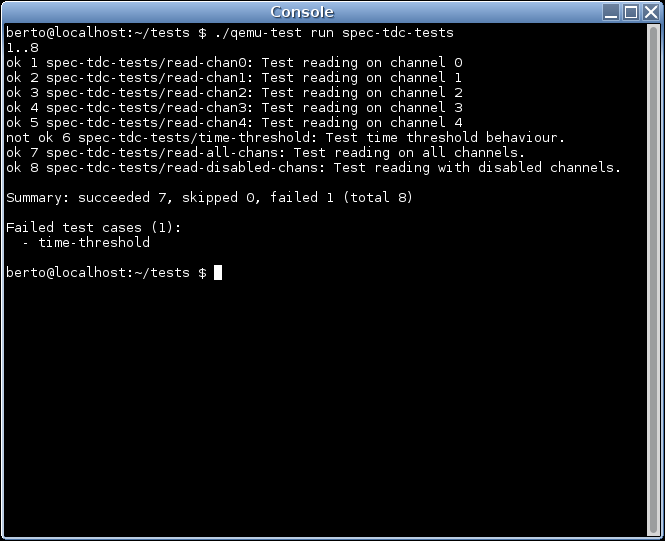
Working with open hardware Some weeks ago at LinuxCon EU in Barcelona I talked about how to use QEMU to improve the reliability of device drivers. At Igalia we have been using this for some projects. One of them is the Linux IndustryPack driver. For this project I virtualized two boards: the TEWS TPCI200 PCI carrier and the GE IP-Octal 232 module. This work helped us find some bugs in the device driver and improve its quality. Now, those two boards are examples of products available in the market. But fortunately we can use the same approach to develop for hardware that doesn t exist yet, or is still in a prototype phase. Such is the case of a project we are working on: adding Linux support for this FMC Time-to-digital converter.
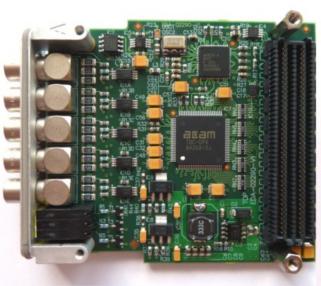
FMC TDC
This piece of hardware is designed by CERN and is published under the CERN Open Hardware Licence, which, in their own words is to hardware what the General Public Licence (GPL) is to software . The Open Hardware repository hosts a number of projects that have been published under this license. Why we use QEMU So we are developing the device driver for this hardware, as my colleague Samuel explains in his blog. I m the responsible of virtualizing it using QEMU. There are two main reasons why we want to do this:
  1. Limited availability of the hardware: although the specification is pretty much ready, this is still a prototype. The board is not (yet) commercially available. With virtual hardware, the whole development team can have as many boards as it needs.
  2. Testing: we can test the software against the virtual driver, force all kinds of conditions and scenarios, including the ones that would probably require us to physically damage the board.
While the first point might be the most obvious one, testing the software is actually the one we re more interested in. My colleague Miguel wrote a detailed blog post on how we have been using QEMU to do testing. Writing the virtual hardware Writing a virtual version of a particular piece of hardware for this purpose is not as hard as it might look. First, the point is not to reproduce accurately how the hardware works, but rather how it behaves from the operating system point of view: the hardware is a black box that the OS talks to. Second, it s not necessary to have a complete emulation of the hardware, there s no need to support every single feature, particularly if your software is not going to use it. The emulation can start with the basic functionality and then grow as needed. The FMC TDC, for example, is an FMC card which is in our case connected to a PCIe bridge called SPEC (also available in the Open Hardware repository). We need to emulate both cards in order to have a working system, but the emulation is, at the moment, treating both as if they were just one, which makes it a bit easier to have a prototype and from the device driver point of view doesn t really make a difference. Later the emulation can be split in two as I did with with TPCI200 and IP-Octal 232. This would allow us to support more FMC hardware without having to rewrite the bridging code. There s also code in the emulation to force different kind of scenarios that we are using to test if the driver behaves as expected and handles errors correctly. Those tests include the simulation of input in the any of the lines, simulation of noise, DMA errors, etc.
Tests
And we have written a set of test cases and a continuous integration system, so the driver is automatically tested every time the code is updated. If you want details on this I recommend you again to read Miguel s post.

Russ Allbery: Review: Emissaries from the Dead

Review: Emissaries from the Dead, by Adam-Troy Castro
Series: Andrea Cort #1
Publisher: Eos
Copyright: March 2008
ISBN: 0-06-144372-7
Format: Mass market
Pages: 387
As a small child, Andrea Cort was a colonist on Bocai, part of a utopian project to create a mixed human and Bocaian community. Until, that is, all the members of the community woke up one day and started horrifically murdering each other for reasons that none of the survivors could ever explain. Now, she's protected from extradition by a life contract with the Diplomatic Corps and serves them as a special investigator. The scene of the investigation of this book is the strange habitat One One One. The habitat was created by the AIsource, an alliance of artificial intelligences now independent of their original creators. It's in deep space, far from any sun, and would have remained entirely unknown to the other inhabitants of the galaxy if the AIsource hadn't announced its presence. The choice to announce it was baffling, since it contains a sentient species entirely under the control of the AIsource, something that's against the shared rules of all the other species, but which they wouldn't have known about if the AIsource hadn't drawn their attention to it. After extensive negotiations, one unofficial human research group has been allowed access, and now two of the members of that group have been murdered. That's where Andrea comes in. This is Castro's first original solo novel, but he has a background in short fiction in the SF, fantasy, and horror genres and some previous collaborations and shared universe writing. The horror shows through a bit more than I'd personally prefer: the preface briefly describing Andrea's past would have been sufficient, but Castro goes back and shows it in horrific and gruesome detail as a flashback. His fight scenes are also strangely and disturbingly detailed. If you have a sensitive stomach, be aware that you may want to skim some parts of this. The overall construction of this novel, though, is not horror. It's an SF murder mystery, about halfway between a procedural and a noir detective story. Andrea does follow a coherent procedure and uses an investigative technique more sophisticated than stirring the pot and seeing what jumps out, making it not quite noir, but it has the noir tendency towards story progress via attacks on the detective and quite a lot of ongoing tension. It also involves quite a lot of setup; be aware going in that we get over a hundred pages of description of the various research group members, the details of the crimes, possible motives, and the details of the artificial habitat without a lot of forward progress on understanding the crime. Castro puts a lot of work into the design of the habitat despite leaving it mostly in the background. It could easily serve as the backdrop of a more typical Big Dumb Object SF novel. The habitable zone where the research team is and where all of Andrea's investigations take place is the effective "top" of the habitat, covered in dense foilage to which the native sentient species clings and crawls its entire life. Below is an effectively infinite fall into crushing acidic atmosphere. Castro managed to not set off my dislike of heights too badly, in part because he focuses more on Andrea's own dislike of heights rather than vividly describing the drop, but it's a constant presence throughout the novel and adds a persistant background tension. It also leads to some minor but neat clashes of perspective in conversations with the native species. For most of the book, I would have described Emissaries from the Dead as an enjoyable but not horribly original detective novel with a neat science fiction background. But there are several interesting ending twists that I won't spoil and some decisions that quite surprised me. They don't have a large effect on the plot of this book, but they make for a fascinating hook and setup for later books in the series (and I see there is a sequel). It's definitely not the sort of thing that you want spoiled before reading this book, so avoid reading blurbs and details about the sequel before reading this one. I wouldn't go out of my way to hunt down this book, but it's solid, enjoyable detective SF with a surprisingly good ending. I can see why it won the Philip K. Dick award (for best SF paperback original). Mildly recommended. Followed by The Third Claw of God. Rating: 7 out of 10

NOKUBI Takatsugu: BPS in Tokyo

I had attend to Debian Bug Squashing Party in Tokyo at 24th Nov. 2012. The place was provided by Plat Home Co., Ltd. The attendee was about 7 people, it s not so many men.
My big problem is unblocking file-mmagic package. I sent an unblocking request mail, but it has invalid From email address, so I couldn t trace the discussion.
My fault is changing source format to 3.0(quilt). It is a big change for testing.
Now I am making a new package for testing-proposed-update.
It seems about 10 RC bugs had closed by all attendees. Thank you the attendees, especially the cordinator Hideki Yamane.
The network in the place had provied by OpenBlocks, the product of Plat Home.

Paul Tagliamonte: debuild.me update

It s working! (ish) Here are some snapshots (and fully automated as much as I could) This comprises a lot of work, so I m fairly proud of it. Feel free to browse over at debuild.me. Patches & feedback welcome!

Dirk Eddelbuettel: Rcpp 0.10.1

A the new Rcpp release 0.10.1 arrived this morning on CRAN (as already has Windows binaries) and in Debian. This is a follow-up to the recent 0.10.0 release which extends the exciting new Rcpp-attributes and Rcpp-sugar work further, and as in a number of other areas as detailed below in the NEWS sections. This release brings an change to some of the binary interfaces. If you have packages using Rcpp, you will most likely have to reinstall them from source. Some change were made to const correctness as well as other aspects, and it seems that we have temporarily broken the excellent RcppEigen and RcppOctave packages. We are looking into this, and are sorry about the bug. The complete NEWS entry for 0.10.1 is below; more details are in the ChangeLog file in the package and on the Rcpp Changelog page.
Changes in Rcpp version 0.10.1 (2012-11-26)
  • Changes in Rcpp sugar:
    • New functions: setdiff, union_, intersect setequal, in, min, max, range, match, table, duplicated
    • New function: clamp which combines pmin and pmax, e.g. clamp( a, x, b) is the same as pmax( b, pmin(x, a) )
    • New function: self_match which implements something similar to match( x, unique( x ) )
  • Changes in Rcpp API:
    • The Vector template class (hence NumericVector ...) get the is_na and the get_na static methods.
    • New helper class no_init that can be used to create a vector without initializing its data, e.g. : IntegerVector out = no_init(n) ;
    • New exception constructor requiring only a message; stop function to throw an exception
    • DataFrame gains a nrows method
  • Changes in Rcpp attributes:
    • Ability to embed R code chunks (via specially formatted block comments) in C++ source files.
    • Allow specification of argument defaults for exported functions.
    • New scheme for more flexible mixing of generated and user composed C++ headers.
    • Print warning if no export attributes are found in source file.
    • Updated vignette with additional documentation on exposing C++ interfaces from packages and signaling errors.
  • Changes in Rcpp modules:
    • Enclose .External invocations in BEGIN_RCPP/END_RCPP
  • Changes in R code :
    • New function areMacrosDefined
    • Additions to Rcpp.package.skeleton:
      • attributes parameter to generate a version of rcpp_hello_world that uses Rcpp::export.
      • cpp_files parameter to provide a list of C++ files to include the in the src directory of the package.
  • Miscellaneous changes:
    • New example 'pi simulation' using R and C++ via Rcpp attributes
Thanks to CRANberries, you can also look at a diff to the previous release 0.10.0. As always, even fuller details are on the Rcpp Changelog page and the Rcpp page which also leads to the downloads, the browseable doxygen docs and zip files of doxygen output for the standard formats. A local directory has source and documentation too. Questions, comments etc should go to the rcpp-devel mailing list off the R-Forge page

27 November 2012

Christian Perrier: Tristan da Cunha

I happen to be a great fan of ocean races, so like many, particularly here in France, I'm following the Vend e Globe ocean race, alone around the world on 60-feet IMOCA race ships, without stop or assistance. In its early editions, Vend e Globe was easy to explain : start from Les Sables d'Olonne and come back there after going around Antarctica by leaving it to starboard. Period. Now, it's a bit more complicated as, for security reasons, the sailors have to pass a few points meant to prevent them from going too south (during first editions, some sailors went as south as 65 S). Sailors are currently heading "down" the Atlantic and will probably pass in the vicinity of the Tristan da Cunha island. This island has always been fascinating to me. It is the remotest point inf the world with a permanent population. The closest inhabited land is over 2800km away. 271 people live there. No airport. No regular ship line. Only fishing boats from time to time and that's all. It's probably hard to imagine what is the life there....but I find this fascinating, in some way. Maybe one of these parts of the world where I would like to go and never will. And there's even a volcano (indeed, the island *is* a volcano) : I wonder if there is a Linux user over there...

Benjamin Drung: Code name for Ubuntu 18.04 LTS

Every Ubuntu release gets an alliterative code name from Mark Shuttleworth. It is a composition of an adjective and an animal. The upcoming Ubuntu 13.04 has the code name Raring Ringtail . Since nearly the beginning, the code names follow the alphabetical order. We will reach the letter Z with Ubuntu 17.04 if no letters are skipped. Will we wrap then and begin with A again? At UDS-R in Copenhagen, Mark Shuttleworth jokingly said between Jono Bacon s introduction and Mark s keynote speech, that vegetables will be used once we run out of letters. He proposed the code name for Ubuntu 18.04 LTS: Brilliant Broccoli!

Daniel Kahn Gillmor: more proprietary workarounds, sigh

In supporting a labful of Debian GNU/Linux machines with NFS-mounted home directories, i find some of my users demand a few proprietary programs. Adobe Flash is one of the most demanded, in particular because some popular streaming video services (like Amazon Prime and Hulu) seem to require it. I'm not a fan of proprietary network services, but i'm happy to see that Amazon Prime takes Linux support seriously enough to direct users to Adobe's Linux Flash "Protected Content" troubleshooting page (Amazon Prime's rival NetFlix, by comparison, has an abysmal record on this platform). Of course, none of this will work on any platform but i386, since the flash player is proprietary software and its proprietors have shown no interest in porting it or letting others port it :( One of the main issues with proprietary network services is their inclination to view their customer as their adversary, as evidenced by various DRM schemes. In two examples, the Flash Player's DRM module appears to arbitrarily break when you use one home directory across multiple machines. Also, the DRM module appears to depend on HAL, which is being deprecated by most of the common distributions. Why bother with this kind of gratuitous breakage? We know that video streaming can and does work fine without DRM. With modern browsers, freely-formatted video, and HTML5 video tags, video just works, and it works under the control of the user, on any platform. But Flash appears to throw up unnecessary hurdles, requiring not only proprietary code, but deprecated subsystems and fiddly workarounds to get it functional. I'm reminded of Mako's concept of "antifeatures" -- how much engineering time and effort went into making this system actually be less stable and reliable than it would have otherwise been? How could that work have been better-directed? Tags: antifeatures, flash, hal, proprietary, streaming

26 November 2012

Christoph Berg: Shared Memory and Swapping

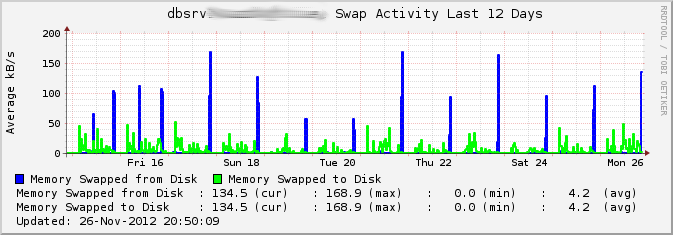
We have this PostgreSQL server with plenty of RAM that is still using some of its swap over the day (up to 600MB). Then suddenly everything is swapped in again. It turned out the reason is there are two clusters running, and the second one isn't used as heavily as the first one. Disk I/O activity of the first cluster slowly evicts pages from the second shared buffers cache to swap, and then the daily pg_dump run reads them back every evening. I was not aware of an easy way to get numbers for "amount of SysV shared memory swapped to disk", but some googling led to shmctl(2):
#define _GNU_SOURCE 1
#include <sys/ipc.h>
#include <sys/shm.h>
#include <stdio.h>
#include <unistd.h>
int main ()
 
        struct shm_info info;
        int max;
        long PAGE_SIZE = sysconf(_SC_PAGESIZE);
        max = shmctl(0, SHM_INFO, (struct shmid_ds *) &info);
        printf ("max: %d\nshm_tot: %ld\nshm_rss: %ld\nshm_swp: %ld\n",
                        max,
                        info.shm_tot * PAGE_SIZE,
                        info.shm_rss * PAGE_SIZE,
                        info.shm_swp * PAGE_SIZE);
        return 0;
 
The output looks like this:
max: 13
shm_tot: 13232308224
shm_rss: 12626661376
shm_swp: 601616384
Update: Mark points out that ipcs -mu shows the same information. Thanks for the hint!
# ipcs -mu
------ Shared Memory Status --------
segments allocated 2
pages allocated 3230544
pages resident  3177975
pages swapped   51585
Swap performance: 0 attempts     0 successes

Stefano Zacchiroli: mini debconf paris 2012

rc bugs, cloud, and getting involved This past week-end has been rather intense. In addition to another, non free software related event I was volunteering for, I had the pleasure to participate in the 2nd Paris mini DebConf. Once again, the organization has been great and the average quality of the talks have been very high. I'd say talk quality is now totally up to par with the yearly full blown DebConf (and yes, talks have been in English :-P ). If I had to single the talk that intrigued me the most, I'd name Joss' talk on large GNOME deployments: it's full of insights on the GNOME architecture and of tips useful to all power users, no matter the size of your GNOME "deployment". For more info on the talks have a look at the program. To catch up with the talks you missed you can peruse the slides there and/or keep an eye on http://video.debian.net, where we usually post conference videos "when they are ready". At the conference I've also witnessed the usual healthy mix of country origins that I remember from the previous Paris mini DebConf. Once again I've been happy to meet (and host!) Debian friends from many countries including Germany, Switzerland, Italy, Greece, Finland, you name it. Kudos to the organizers (hi Sylvestre and Mehdi!) and to all the volunteers who made this possible. On my part, I didn't have any full blown talk scheduled (ETOOMANYTALKS struck me this month ) but I did book two lightning talks slots that I've used for: On the subject of lightning talks, I also recommend to promote Lucas' talk on how to get involved in Debian. It's dense and straight to the point, able to both convey useful tips and point wannabe contributors to the most useful contributions they can make to Debian.

Michal &#268;iha&#345;: Weblate 1.3 at SUSE Studio

Finally, I've managed to update SUSE Studio images with Weblate to recently released 1.3. So you can now fetch there various images for your virtual machines or clouds. There is also new support for SUSE Cloud or OpenStack in SUSE Studio, so you can enjoy these as well. Within this version, I've upgraded the system to openSUSE 12.2 and included MTA in the image, so that you can send out registration emails. You can find more information about Weblate at http://weblate.org/.

Filed under: English Suse Weblate 0 comments Flattr this!

John Sullivan: Santiago de Compostela

I've put up my nearly unedited, unsorted, and uncommented photos from my recent trip to Santiago de Compostela, Spain, for the Libre Software World Conference. It was a beautiful place (and a great conference) -- I hope to write more about it soon.

Next.

Previous.