Search Results: "ag"

15 March 2012

Erich Schubert: ELKI applying for GSoC 2012

I've submitted an organization application to the Google Summer of Code 2012 for ELKI - an open source data mining framework I'm working on.
ELKI
I hope I can get spots for 1-2 students to help implementing additional state of the art methods, to allow for even more broad comparisons. Acceptance notification will be tomorrow. I have no idea how high out chances are of getting accepted. We're open source, as part of the university we have a proven record of educating students (in fact, around two dozen have by now contributed to ELKI, although not all of this has been "released" yet). We're rather small compared to e.g. Gnome, Debian or Apache and just a few years old. But I believe we are trying to fill an important gap in the research and open source interaction: way too many algorithms get published in science, but are never made available as source code to test and compare. This is where we try to step in: make many largely overlooked methods available. Of course we also have k-means (who hasn't?), but there is much more than just k-means! And there are plenty of methods often cited in scientific literature, yet nobody seems to have a working implementation of them ...

While most people equal data mining to prediction and classification (both of which are actually more machine learning topics), ELKI is strong on cluster analysis and outlier detection as well as index structures. Plus, it is much more flexible than other frameworks. For example, we allow almost arbitrary combinations of algorithms and distance functions. So with our tool, you can easily test your own distance function by plugging it into various algorithms. Otherwise we could just have used Weka.
The other reason why we did not extend Weka (or used R) is that we actually wanted to not just implement some algorithms, but actually be able to study the effects of index structures on the algorithms. And in my opinion, this is actually the key difference between true data mining and ML, AI or "statistics". In ML and statistics, the key objective is the result quality. Which is often rather easy to measure, too. For "full" data mining, one also needs to consider all the issues of actually managing the data, indexing it to accelerate computations. Plus, the prime objective is to discover something new, that you did not know before.
Of course these things cannot be completely separated. You can of course discover patterns and rules in the data that will allow you to make good predictions. But data mining is not just prediction and classification!

The next release of ELKI, 0.5, will be released in early april. ELKI 0.4 is already available in Debian testing and Ubuntu. The next release has a focus on comparing clustering results, including an experimental visualization for clustering differences, which will be presented at the ICDE 2012 conference.
On the big to-do list is a lot of stuff. In particular, ELKI is currently mostly useful for research, as it is too difficult to use for the average business guy wanting to do data mining. You can think of it more as a prototyping system: try out what works for you, then implement that within your larger project in an integrated and optimized way. The other big thing that I'm unhappy with is the visualization speed. SVG is great for print export, but Batik can be really slow, and the XML-DOM-API isn't exactly "accessible" to students wanting to add new visualizations. Right now, it is all useful and okay for my kind of experiments, but it could be so much more if we could solve the speed (and memory) issues of the pure SVG based approach. I'd love to see something much faster here, but with a SVG export for editing and printing.

Kenshi Muto: Squeeze amd64/i386 d-i images with Linux kernel 3.2.4 bpo, and WPA support

After a long silence, I updated the bpo Debian-installer for Debian GNU/Linux 6.0.4, Squeeze. You know, you can take it from http://kmuto.jp/debian/d-i/.

Debian Med: Bits from Debian Med team (Posted by Andreas Tille)

Hi,

in this bits:
  1. Debian Med Bug Squashing Advent Calendar 2011
  2. Anniversary of Debian Med
  3. Second Debian Med sprint (Southport, 27th-29th January 2012)
  4. Mentoring of Month (MoM)
  5. DDs who came to Debian because of Debian Med
  6. Future plans
  7. General lessons learned

Debian Med Bug Squashing Advent Calendar 2011In December last year Thorsten Alteholz has started a nice QA initiative which might be interesting for other teams next Advent. The Debian Med team was able to fix about 70 bugs in this time. Thanks to Thorsten for this nice piece of motivation and thanks to everybody who took part in the bug squashing.

Anniversary of Debian MedOn Mon, 7 Jan 2002 the Debian Med project was first officially announced. I submitted a short blog posting about this and perhaps you might like to see a long sequence of talks about this topic.

Second Debian Med sprint (Southport, 27th-29th January 2012)In end of January 2012 the Debian Med team has met to the second sprint. As last year I would call this a very successfull event and I would recommend other teams to instanciate such meetings as well. Feel free to read my more verbose report.

Mentoring of Month (MoM)I have started this project for the following reasons:
I made a short summary how the first MoM project worked (see at bottom).

DDs who came to Debian because of Debian MedAfter realising that several members of the Debian Med team finally became DDs I made a little survey to find out about their reasons to become DD / DM. I came to the conclusion that a Blend could be a nice entry point for people to join Debian because newcomers can identify themselves with a known topic (the scope of the Blend - in this case medicine and bioinformatics) first and learn Debian rules in a team with common interest. This perfectly fits my expectation which I had from the beginning 10 years ago and I would be very happy if other Blends would follow this example to be nice, inviting and try to *actively* ask people for cooperation (see some simple rules which I learned in this process below). In the teammetrics GSOC project some graphs were created where you can see the level of contribution of these people (and other team members).

Future plansCurrently some heavy work regarding bringing bibliographic references about packages straight into package information is going on. This topic is specifically interesting in Biology because programs are frequently connected to some publication about the methods used inside the code. This topic is as well relevant to Debian Science and DebiChem. Thanks to the patient work done by Charles Plessy we now have about 70 packages featuring debian/upstream files featuring bibliographic references and there is ongoing work to move these data to UDD to enable further usage. We are in the process of final polishing the format and finishing scripts for the import. If people are interested to join this effort this would be the right moment to raise their hand.

General lessons learned
  1. Do not let wait anybody who wants to do work.
  2. Newcomers are frequently shy - try to invite them kindly and patiently.
  3. Tell people verbosely about your project - it is astonishing how less people know and what wrong assumptions they make about your project.

Kind regards
Andreas.

14 March 2012

Stefano Zacchiroli: not a catchy headline

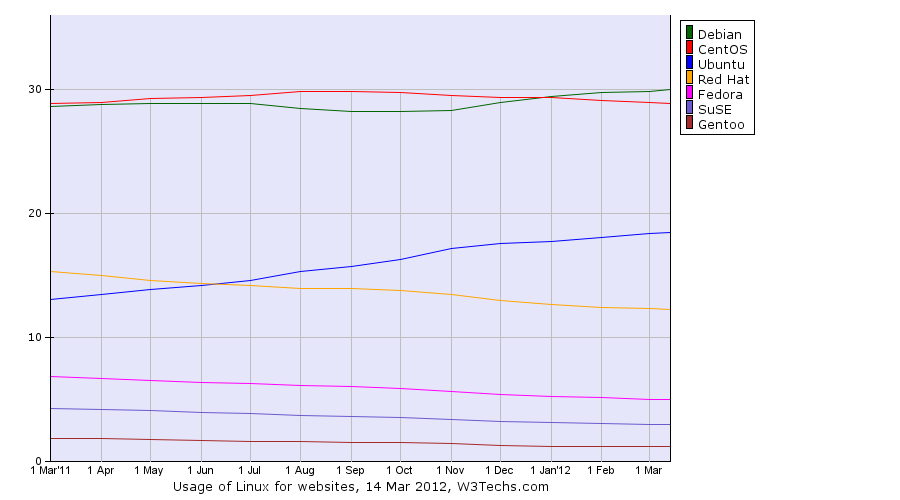
As we're doing trends today, I got curious about Debian. I don't particularly care about popularity contests other than popcon, and Debian choices surely aren't driven by them. But hey, curiosity is curiosity, right? So, here are today's w3techs trends for websites using GNU/Linux, with all lines shown:
Debian: 30%; CentOS: 28,9%; Ubuntu: 18,4%; Red Hat: 12,2%; Fedora: 5%; SuSE: 3%; Gentoo: 1,2%
(As thou shall always read methodologies before stats, here is the technologies overview page.) Debian is the top entrant with 30% of the websites using GNU/Linux. What I find interesting is that Debian has jumped at first place in January 2012, significantly after the release of our current stable release, Squeeze, that dates back to February 2011. It is also interesting to see community distros (Debian and CentOS) starkly ahead of commercially backed distros. That is what I find most fascinating about our projects. Whether that will remain the case or not is, for me, one of the big questions of the decade for the self-determination of Free Software communities.

Erich Schubert: Google Scholar, Mendeley and unreliable sources

Google Scholar and Mendeley need to do more quality control.
Take for example the article
A General Framework for Increasing the Robustness of PCA-Based Correlation Clustering Algorithms
Hans-Peter Kriegel, Peer Kr ger, Erich Schubert, Arthur Zimek
Scientific and Statistical Database Management (SSDBM 2008)
(part of my diploma thesis).
Apparently, someone screwed up entering the data into Mendeley and added the editors to the authors. Now Google happily imported this data into Google Scholar, and keeps on reporting the authors incorrectly, too. Of course, many people will again import this incorrect data into their bibtex files, upload it to Mendeley and others...
Yet, neither Google Scholar nor Mendeley has an option for reporting such an error. They don't even realize that maybe Springerlink - where the DOI points to - is the more reliable source.
On the contrary, Google Scholar just started suggesting to me that the editors are coauthors ...
They really need to add an option to fix such errors. There is nothing wrong with having errors in gathered data, but you need to have a way of fixing them.

Michal Čihař: Weblate 0.6

Continuing with fast release pace for Weblate, I've just released version 0.6. It brings few bug fixes adds quality checks for translations and configurable access control. Full list of changes for 0.6: You can find more information about Weblate on it's website, the code is hosted on Github. If you are curious how it looks, you can try it out on demo server. You can login there with demo account using demo password or register your own user. Weblate is now also being used https://l10n.cihar.com/ as official translating service for phpMyAdmin, Gammu, Weblate itself and others.

Filed under: English Weblate 3 comments Flattr this!

Lars Wirzenius: New Obnam mailing list

Thanks to Daniel Silverstone, pepperfish.net is now hosting a new mailing list for Obnam. See the mailman page for details. (I used to write my own mailing list software. I'm done with that. It's an awful hobby to have, and I don't even want to host any lists myself anymore. So I'm grateful for Daniel for doing this for me.)

Lisandro Damián Nicanor Pérez Meyer: QtSerialPort: a new hope

Some time ago I wrote about the status of Qt-based libs for using the serial port. Some days later I was pointed to the QtSerialPort project. The good news on this is that this is a project aimed to enter into Qt 5.

I have tested the lib with some apps that originally used QExtSerialPort. So far, so good. The license terms seems pretty OK (it wouldn't have got that far in the Qt code review if it weren't).

In the meantime, I received a reply to one of my messages from an upstream dev of QSerialPort (note that is Q and not Qt). He was very kind, but considering the effort to get QtSerialPort inside Qt itself, I think it's better to try to develop with this last lib.

Maybe I should try to package it and upload it to experimental.

Richard Hartmann: FOSDEM 2012, the aftermath

FOSDEM 2012 was very nice, as expected. This year, I decided to stop consuming only and getting more involved. I helped staff the token sale and held two Lightning Talks. This turned out to be an awesome experience. During the beer event, we sold 4600 beer tokens (FOSDEM does not earn anything from this; all proceeds go to Cafe Delirium). The sale was staffed with one to three people at all times which made for a constant but mostly bearable workload. While the others made good-natured fun of me and my German efficiency, I like to think that I helped make things run a tad more smoothly. Along those lines, we will have a sign asking people for exact change and/or to buy stacks that can be paid in bills if possible, next year; that should help streamline the whole thing even more. All in all, it turned out to be quite stressful, but tons of fun. I am looking forward to chuck in again next year. The two Lighting Talks (vcsh on Saturday and git-annex on Sunday) I held very rather well received. Feedback after the talks and online was very positive which is always nice. There's been a slight increase in help requests and generic questions, so I assume people are trying vcsh and git-annex as a consequence of those talks, which is even nicer. Also, I met a lot of people. Most of the meetings were pre-arranged, some by chance. Carrying a name tag at all times, I was approached by several people who knew me online but didn't know my face. I will try to always carry a name tag on conferences now and I suggest others do the same. Finally, a huge thank you to everyone who helped make FOSDEM happen; you rock!

Richard Hartmann: Open Source Days 2012

I will be visiting the Open Source Days 2012 next weekend to talk about how to Gitify your life; if you want to meat (sic) up, do let me know. Compared to FOSDEM, I have 150% of the time for ~250% of the content which means I will need to cut some corners, content-wise. That's a pity, but that's the way it is; we will see how it goes. Never having been there before, I am looking forward to both Copenhagen and the Open Source Days. In somewhat related news, FOSDEM's vcsh talk (slides, video) and git-annex talk (slides, video) have been uploaded completely. Thanks to FOSDEM's/Debian's video team; you're awesome! In less related news, I have had the questionable honour of updating and installing one copy of Windows 7, respectively. I guess it's nice that Intel's driver installation utility tells you it expects a maximum of 12 reboots until a fresh installation is set up and if you would like to enter your username & password to auto-login. That Windows itself only took about half a dozen reboots until the several hundreds of updates were installed was a welcome surprise; Windows XP was even worse. Now, if anyone can tell me why audio drivers need a download of 380 MiB, that would be appreciated. Not that this was an uncommon size for every single driver, mind. Installed Size of linux-image-3.2.0-2-amd64 is 104,820.0 kB, btw. On the plus side, Windows 7 was able to automagically download a printer driver once I told it what the network printer's, which it refused to autodiscover, brand and model were.

Richard Hartmann: Open Source Days 2012, the aftermath

Open Source Days Open Source Days were nice, especially the meating(sic) of and talking to old friends and new people. I got to discuss Mercurial with two of its developers which was very interesting indeed. It's funny how similar git and Mercurial are in some regards and how different in others. Overall, it feels a bit as if Mercurial is not quite as distributed as git. Its local, sliding revision index feels like disaster waiting to happen, to me. On the other hand, Mercurials ability to not check out large files to your local repository sounds very git-annex-ish, which is nice. Choice is good :) My talk about how to gitify your life (slides, no video) went extremely well. Within my time-slot, there were a total of six talks, and lunch(!), in parallel. About 300 people attended OSD on Sunday and of those, many were at booths, stands, eating, etc. My personal turnout was 50-70 listeners so I was well above mathematical average and from what I heard, my talk was the most-visited one during that time. Add the fact that several people asked me to put up the resource links up again after the talk so they could take pictures and I would say this talk really was a success. Ego-stroking? Yes. Vanity? Most likely. Being able to see that people can really want to learn about what you have to say? Priceless. It's a real pity that there was no video recording, but it's obviously too late to do anything about that. Joey Hess asked me to at least make an audio recording on my laptop, but that turned out to be a lot of useless white noise with faint mumbling in between. Maybe I should at least get a small microphone or recorder so I will always have an audio copy. I already did order a presentation clickie with built-in laser pointer so I won't have to rely on possibly non-existent conference infra, any more. If there's any interest, I may re-record the talk as audio, else I will just try to get another speaker slot at another conference, with video recording, and link that. Denmark Barring the airport, central station, bus, hotel, venue, and metro, I did not see anything of Copenhagen. That's a pity, but I didn't want to leave the conference early. To continue my recent tradition of dumping random observations about places I visit onto my blog, here goes:

13 March 2012

Don Armstrong: Debbugs forcemerge support

One of the earliest features I wrote for the Debian bug tracking system (Debbugs) after joining the team was support for forcibly merging bugs. Originally, merging two bugs required that the bugs be in exactly the same state before merging them; forcemerge removed this requirement. Unfortunately, the way I originally implemented this was shortsighted, and merely forced the merge partners to have the same values as the merge master. This meant that owners, blocking bugs, and many other things were silently changed, which meant that people weren't notified of changes, and bugs could end up in an inconsistent state. A while ago, I decided to fix this by calculating the changes required to actually merge the bugs, making those changes, and then merging the bugs normally; thus, doing everything that a maintainer would normally have done for them. This necessitated abstracting out the entire control apparatus into the Debbugs::Control module. Now that it's complete, you can do the following:
> forcemerge 1 2
Bug #1 [foo] new title
Bug #2  Done: foo@bugs.something  [foo] foo
Unset bug forwarded-to-address
Severity set to 'wishlist' from 'grave'
3 was blocked by: 2
3 was not blocking any bugs.
Removed blocking bug(s) of 3: 2
2 was blocked by: 4
2 was not blocking any bugs.
Removed blocking bug(s) of 2: 4
Bug reopened
Removed annotation that bug was owned by bar@baz.com.
Removed indication that 2 affects bleargh
Removed tag(s) unreproducible and moreinfo.
Merged 1 2
> thanks
Stopping processing here.
and bug 2 now is merged with 1 and matches the state of 1. [The above is the control output from the appropriate bit of the 06_mail_handling.t test.] This change also means that I'll be able to finally write support for control@ operations at submit@ time. Also, all of the bug modifications that happen at submit@ or nnn@ time (setting title, found, etc.) will be implemented as calls to Debbugs::Control so we can eventually keep a postgresql database updated in addition to the flatfile database.

Paul Tagliamonte: OpenStates Hackathon

The OpenStates / GASP hackathon here at PyCon is going killer. We ve got a bunch of brandy-new contributors hacking away, and sending in pull requests. We re squashing bugs like crazy, and it s going super well. Shout-out to all the new contributors!

Michal Čihař: phpMyAdmin translations status

We're heading towards final phpMyAdmin 3.5, so let's again look at translations status. Here comes fifth round of translation status update. Since last update we one less translation (it was not really complete, the po file missed few strings) at 100%: There are few which are really close to 100% and I hope they will get there soon: As you can see, there is still lot of languages missing, this might be your opportunity to contribute to phpMyAdmin. Also you are welcome to translate phpMyAdmin 3.5 using new translation server.

Filed under: English Phpmyadmin 0 comments Flattr this!

Russell Coker: Airtasker Outsourcing Small Jobs

Airtasker.com is a new company that is dedicated to outsourcing small jobs [1]. It s still in a beta phase and has no way of making money the worker is paid directly by the employer and there s no facility for either of them to pay Airtasker, I would really like to know what the business model will be before considering whether to use it. It also doesn t seem to operate outside of Sydney which seems quite strange, how hard can it be to have separate Google maps instances for each city in Australia? The jobs that are advertised seem to be mostly household repair tasks and from the member list it appears that some people who already run small service businesses are trying to use Airtasker to get more work. There are also a lot of delivery tasks such as buying something from a shop and delivering it and driving a car from Melbourne to Sydney (good for someone who wants a subsidised interstate holiday). But there are some unusual tasks such as pretending to be someone s girlfriend to make his mother stop nagging him. It will be interesting to see whether this takes off. One thing that I might use it for is delivering computer equipment in the CBD. Some of my clients have no good parking near their office so I end up carrying computer gear from a tram stop or an inconvenient parking spot to their office. I d rather have someone paid to do at least half the work in carrying the gear and the rates that are being discussed on Airtasker are well within the range that my clients would be happy to pay. Related posts:
  1. outsourcing bad for corporations but good for the world There is ongoing discussion about whether outsourcing is good or...
  2. Fragmenting Information about Jobs A comment on my previous post about my Linux Jobs...
  3. IT Jobs and Working Conditions Mark Glossop has written about the best designs for offices...

Martin-Éric Racine: Ubuntu: LTS to LTS+1 upgrade leaves cruft

Over the past few weeks, I upgraded my Ubuntu hosts to the Precise release due to be published next month. While the upgrade on my desktops from Oneiric to Precise went mostly well, the upgrade of my terminal server from Lucid to Precise was more daunting. In short: too many packages leave an undue amount of cruft behind, namely tons of obsolete configuration files that are not correctly handled by maintainer scripts, to either delete obsolete files or to rename them to the currently valid filename. At Debian, these oversights are periodically monitored using piuparts and reported to the package maintainer, but Ubuntu doesn't seem to offer this sort of automated Quality Assurance process yet. Perhaps this would be something worth developing? PS: For those who wonder how I spotted those obsolete configuration files, I simply enabled the FLAUSCH environment variable before running upgrade-system.

David Bremner: Converting nauty packaging to git-debpatch

I've been experimenting with a new packaging tool/workflow based on marking certain commits on my integration branch for export as quilt patches. In this post I'll walk though converting the package nauty to this workflow.
  1. Add a control file for the gitpkg export hook, and enable the hook: (the package is already 3.0 (quilt))
    % echo ':debpatch: upstream..master' > debian/source/git-patches
    % git add debian/source/git-patches && git commit -m'add control file for gitpkg quilt export'
    % git config gitpkg.deb-export-hook /usr/share/gitpkg/hooks/quilt-patches-deb-export-hook
    
    This says that all commits reachable from master but not from upstream should be checked for possible export as quilt patches.
  2. This package was previously maintained in the "recommend topgit style" with the patches checked in on a seperate branch, so grab a copy.
     % git archive --prefix=nauty/ build   (cd /tmp ; tar xvf -)
    
    More conventional git-buildpackage style packaging would not need this step.
  3. Import the patches. If everything is perfect, you can use qit quiltimport, but I have several patches not listed in "series", and quiltimport ignores series, so I have to do things by hand.
    % git am  /tmp/nauty/debian/patches/feature/shlib.diff
    
  4. Mark my imported patch for export.
    % git debpatch +export HEAD
    
  5. git debpatch list outputs the following
    afb2c20 feature/shlib
    Export: true
    makefile.in    241 +++++++++++++++++++++++++++++++++--------------------------
    1 files changed, 136 insertions(+), 105 deletions(-)
    
    The first line is the subject line of the patch, followed by any notes from debpatch (in this case, just 'Export: true'), followed by a diffstat. If more patches were marked, this would be repeated for each one. In this case I notice subject line is kindof cryptic and decide to amend.
     git commit --amend
    
  6. git debpatch list still shows the same thing, which highlights a fundemental aspect of git notes: they attach to commits. And I just made a new commit, so
    git debpatch -export afb2c20
    git debpatch +export HEAD
    
  7. Now git debpatch list looks ok, so we try git debpatch export as a dry run. In debian/patches we have 0001-makefile.in-Support-building-a-shared-library-and-st.patch series That looks good. Now we are not going to commit this, since one of our overall goal is to avoid commiting patches. To clean up the export, rm -rf debian/patches
  8. gitpkg master exports a source package, and because I enabled the appropriate hook, I have the following
     % tar tvf ../deb-packages/nauty/nauty_2.4r2-1.debian.tar.gz   grep debian/patches
     drwxr-xr-x 0/0               0 2012-03-13 23:08 debian/patches/
     -rw-r--r-- 0/0             143 2012-03-13 23:08 debian/patches/series
     -rw-r--r-- 0/0           14399 2012-03-13 23:08 debian/patches/0001-makefile.in-Support-building-a-shared-library-and-st.patch
    
    Note that these patches are exported straight from git.
  9. I'm done for now so
    git push 
    git debpatch push
    
the second command is needed to push the debpatch notes metadata to the origin. There is a corresponding fetch, merge, and pull commands. More info

Joachim Breitner: ghc-heap-view: Complete referential opacity

During the last week, I created ghc-heap-view, a library to investigate the actual memory representation of Haskell values. It is inspired by vacuum and the GHCi debugger, but goes beyond them by allowing the user to look inside thunks and functions and see what other values they refer to. Let me demonstrate it by running the included demo: ghc-heap-view-demo Here are a four different lists, where the first three are already evaluated.
The first one, l, was defined as a top level constant as
> l = [1,2,3]
and is now found at 0x00000000006d1750/2 (where the /2 is the pointer tag information) and fully evaluated:
  ConsClosure  info = StgInfoTable  ptrs = 2, nptrs = 0, tipe = CONSTR_STATIC, srtlen = 1 , 
                 ptrArgs = [0x00000000006d16e0/1,0x00000000006d1730/2],
                 dataArgs = [], descr = "ghc-prim:GHC.Types.:" 
The second one, l2, is locally defined
> let l2 = 4:l
and now found at 0x00007fdce19fe4b0/2. See how the cons-cell references l!
  ConsClosure  info = StgInfoTable  ptrs = 2, nptrs = 0, tipe = CONSTR_2_0, srtlen = 1 ,
                 ptrArgs = [0x00000000006dca50/1,0x00000000006d1750/2],
                 dataArgs = [],
                 descr = "ghc-prim:GHC.Types.:" 
And the binding
> args <- map length  fmap  getArgs
evaluates to the one , global empty list at 0x00000000006db640/1:
  ConsClosure  info = StgInfoTable  ptrs = 0, nptrs = 0, tipe = CONSTR_NOCAF_STATIC, srtlen = 0 ,
                 ptrArgs = [],
                 dataArgs = [],
                 descr = "ghc-prim:GHC.Types.[]" 
And now we have, at 0x00007fdce19fe4c8, the concatenation of them, but unevaluated:
> let x = l ++ l2 ++ args
The thunk keeps a reference to l2 and args, but not l, as that is at a static address, unless you are running this in GHCi:
  ThunkClosure  info = StgInfoTable  ptrs = 2, nptrs = 0, tipe = THUNK_2_0, srtlen = 1 ,
                  ptrArgs = [0x00007fdce19fe4b0/2,0x00000000006db640/1],
                  dataArgs = [] 
Now to some more closure types. m and m' locally bound of type the unboxed type Int#, with values 42 resp. 23.
> let f = \x n -> take (I# m + I# x) n ++ args
  t = f m' l2
So here is (0x00007fdce1937d50/2), referencing its free variables args and 42:
  FunClosure  info = StgInfoTable  ptrs = 1, nptrs = 1, tipe = FUN_1_1, srtlen = 65553 ,
                ptrArgs = [0x00000000006db640/1],
                dataArgs = [42] 
And t is a thunk that applies f (also referenced here) to an unboxed value (23) and l2:
  ThunkClosure  info = StgInfoTable  ptrs = 2, nptrs = 1, tipe = THUNK, srtlen = 0 ,
                  ptrArgs = [0x00007fdce19fe4b0/2,0x00007fdce1937d50/2],
                  dataArgs = [23] 
Lastly, here is the standard example for self reference:
> let x = id (:) () x
This is what x (0x00007fdce1947940) looks like, at least without -O:
  ThunkClosure  info = StgInfoTable  ptrs = 0, nptrs = 0, tipe = THUNK, srtlen = 1 ,
                  ptrArgs = [],
                  dataArgs = [] 
So it is unevaluated. Let us evaluate it using seq. Now we have, still at 0x00007fdce1947940:
  IndClosure  info = StgInfoTable  ptrs = 1, nptrs = 0, tipe = BLACKHOLE, srtlen = 0 ,
                indirectee = 0x00007fdce194cc98/2 
The thunk was replaced by an indirection. If we look at the target, 0x00007fdce194cc98/2, we see that it is a newly created cons-cell referencing the original location of x:
  ConsClosure  info = StgInfoTable  ptrs = 2, nptrs = 0, tipe = CONSTR_2_0, srtlen = 1 ,
                 ptrArgs = [0x00000000006db620/1,0x00007fdce1947940],
                 dataArgs = [],
                 descr = "ghc-prim:GHC.Types.:" 
After running the garbage collector (performGC), we find that the address of x is now 0x00007fdce19f30d0/2 and that the self-reference is without indirections:
  ConsClosure  info = StgInfoTable  ptrs = 2, nptrs = 0, tipe = CONSTR_2_0, srtlen = 1 ,
                 ptrArgs = [0x00000000006db620/1,0x00007fdce19f30d0/2],
                 dataArgs = [],
                 descr = "ghc-prim:GHC.Types.:" 
Future plans The output of ghc-heap-view is not really pretty yet; even the indentation in this blog post was added manually by me, so this really needs a pretty printer providing a nicer, possibly more compact representation, including something like what vacuum provides. Maybe vacuum can be ported to use this library, and also include the thunk s and function s references in the output. Maybe also the GHCi debugger can be extended to show more information about unevaluated expressions using this. Internally, the library is not very polished yet either. It only handles those closures types that I have seen so far, and is likely to break horribly if run in a threaded or debugging enabled runtime. How it works Obviously, this is not standard Haskell 98 code, but rather deep trickery involving the GHC API and some C code. Initially I tried to use the API that vacuum and the GHCi debugger rely on, which is an operation
unpackClosure# :: a -> (# Addr#, Array# b, ByteArray# #)
which takes any Haskell value and returns the address to its info table, the pointers and the non-pointer-data in the closure. Unfortunately, it was not complete in that it was meant only for data closures and will for other closure types, e.g. thunks, return no data and no pointers (as can be seen in the code). So I implemented my own version of this operation:
foreign import prim "slurpClosurezh" slurpClosure# :: Any -> (# Addr#, ByteArray#, Array# b #)
where the returned ByteArray# contains the complete closure, including extra information fields such as the arity of a function. The Array# is again the list of pointers in the closure. At first glance, this is a duplication, as the pointers are of course also contained in the ByteArray#. But as soon as the GHC runtime reigns again, a garbage collector run can happen, the referenced values will move somewhere else, and the words that once were pointers in the ByteArray# become useless. But the corresponding entries in the Array# are updated by the garbage collector, as it knows that these are pointers, and not just words. This way, we get both a faithful copy of the closure on the heap and useful references to the contained data. Here is a demonstration of this effect:
$ ghci -XMagicHash -package ghc-heap-view
GHCi, version 7.4.1: http://www.haskell.org/ghc/  :? for help
Loading package ghc-prim ... linking ... done.
[..]
Loading package ghc-7.4.1 ... linking ... done.
Loading package ghc-heap-view-0.1 ... linking ... done.
Prelude> let  a = [1,2,3,4]; b = 5:a 
Prelude> :m + GHC.HeapView 
Prelude GHC.HeapView> rawHeapData <- getClosureRaw b
Prelude GHC.HeapView> rawHeapData 
(0x000000004080d658,[1082185320,140040739366568,140040739365928],[0x00007f5dc68626a8,0x00007f5dc6862428])
Prelude GHC.HeapView> System.Mem.performGC
Prelude GHC.HeapView> rawHeapData 
(0x000000004080d658,[1082185320,140040739366568,140040739365928],[0x00007f5dc41b3ad8,0x00007f5dc41b3b28]) 
The function rawHeapData is a thin wrapper around slurpClosure# which turns the primitive array in normal lists. Note that the second component of the triple is unchanged, but the third is updated by the garbage collector. Of course this means that the Show instance for the data type that ghc-heap-view uses to reference values is not referential transparent either. The foreign function import above is of type prim , i.e. does not call a C function but rather a Cmm function. Cmm is a reduced C that GHC uses internally to compile the Haskell code to, and most primitive operations are implemented in this language although I do quickly call regular C from my Cmm code to do the more complicated stuff, mainly figuring out what words of the closure are pointers. The knowledgeable reader might notice that I am passing a boxed value of type Any to the foreign function. This is currently not possible with foreign prim functions, and to actually use that code, you need the patch in GHC ticket #5931. But you can use ghc-heap-view without that as well (and the Cabal package will by default use that path), using the following hack to obtain the pointer to a Haskell value on the Heap as an unboxed type that can pass to the primitive operation:
foreign import prim "slurpClosurezh" slurpClosure'# :: Word#  -> (# Addr#, ByteArray#, Array# b #)
data Ptr' a = Ptr' a
aToWord# :: Any -> Word#
aToWord# a = case Ptr' a of mb@(Ptr' _) -> case unsafeCoerce# mb :: Word of W# addr -> addr
slurpClosure# :: Any -> (# Addr#, ByteArray#, Array# b #)
slurpClosure# a = slurpClosure'# (aToWord# a)
This works because a Word and a Ptr' have the same closure layout, only differing in the fact that one stores an a, and the other stores a Word#. Once we obtained the raw representation of the closure, we do the parsing in Haskell. Using the info table and the raw closure, we have enough information to tell which words have to be replaced by the appropriate pointer (which might already have been updated by the garbage collector) in the pointers list. This work was supported by a scholarship from the Deutsche Telekom Stiftung.

Flattr this post

Vasudev Kamath: Tag Generation problem in Jekyll

After converting my blog to use Jekyll and hosting it on Github one problem I faced is missing tagging feature for post. I quickly came across this I used plugin from the site and copied and modified some files from authors websites git repository. Only way to use tags on Github was to generate tags locally and move it to Github. To put more light on the point Github disables jekyll plugin so it won't generate the tags after you push your changes to Github repository. You need to follow these steps.
  1. Create posts
  2. Generate site locally by running jekyll
  3. Copy out _site/tag to your website root folder
I did this and it worked. But funny part was when I created new post and tagged it and followed above step for some reason tags won't reflect on respective tag's page and I had no clue why. After banging head for a while I noticed that Previously coped tag folder in site's root is overwriting the tags generated by Jekyll plugin!. Gosh so much for my stupidity :). Now I've written a script to generate tags after writing each new post. It deletes the existing tag directory first and then regenerates tag and copies it out to website root and then it commits the tag directory. Here it is
#!/bin/sh
TAG=tag/
SITE=_site/
if [ -d $ TAG  ]; then
    echo "Deleting $ TAG  directory..."
    rm -rf $ TAG 
fi
echo "Regenerating Site..."
jekyll
echo "Copying $ TAG  ..."
cp -a $ SITE /$ TAG  .
echo "Commiting Changes..."
git commit $ TAG  -m "Latest TAG build"
Hope that helps. Cya!

12 March 2012

Stefano Zacchiroli: debian contributions to the linux kernel

The statistics of the "who wrote Linux x.y.z" series date back to at least 2.6.20. According to my experience talking with users and Free Software enthusiasts, those statistics really make a dent in the public perception of who is giving back upstream. Obviously, one should not take a single upstream, even if it is as important as the Linux kernel, as a measure of how much a given Free Software entity is giving back upstream overall. But users still seem to be fascinated by them. As a result, I have often had to answer the question: why Debian doesn't show up on those statistics?. My answer has always been something along the lines that Debian Developers who maintain Linux kernel packages, the almighty Debian Kernel Team, do that mostly as part of their volunteer engagement in Debian. As a consequence, they do not earmark their contributions as if they worked for a company and they add up to the hobbyist count instead (although you can you can routinely spot individual Debian Kernel Team members among the most active contributors for specific Linux releases). The above is the true and honest answer. But every time I've given it, I couldn't help feeling that the user who asked went home with a "yeah, well" afterthought. If you don't want to take my word of it, fine. Here is what Greg K-H had to say about Debian contributions in a recent blog post about the stable Linux kernel:
I would personally like to thank the Debian kernel developers, specifically Ben Hutchings, Maximilian Attems, Dann Frazier, Bastian Blank, and Moritz Muehlenhoff. They went above and beyond what any "normal" developer would have done, ferreting patches out of the kernel.org releases and the different vendor kernels and bug tracking systems, backporting them to the 2.6.32 kernel, testing, and then forwarding them on to me. Their dedication to their user community is amazing for such a "volunteer" group of developers. I firmly believe that without their help, the 2.6.32 kernel would not have been the success that it was. The users of Red Hat and SuSE products owe them a great debt. Buy them a beer the next time you see them, they more than deserve it.
I'll take good care of following his wise advice. Please do the same.
(Thanks to Sylvestre for pointing me to Greg's blog post.)

Next.

Previous.