Search Results: "ed"

6 December 2012

Leo 'costela' Antunes: Silly Wal(l Cloc)k 2.0

So I finally got the first laser-cut version of the Silly Wal(l Cloc)k done: The back plate was cut from a 1mm plexiglass sheet using this SVG. The black parts were spray painted with matte black and inserted back into the hollowed out sections (I should have made pictures of the pieces before assembling; too lazy to do it now). This proved out to be somewhat problematic, since keeping the small pieces (the chin and the white part of the suitcase handle) in place isn t really easy without gluing everything together, which I wanted to avoid because I m not sure what effect the glue might have on plexiglass in the long term. Another problem was the fact that the plexiglass sheet is white, but slightly translucent. Since the back piece of the clock is black, this caused the white parts to look dirty . As a workaround for both problems I ended up using a thin white cardboard sheet as additional background, where the small hollowed out pieces could be affixed and the translucency of the plexiglass could be hidden. On the other hand, the 1mm thickness for the plexiglass turned out to be perfect for the clock hands (or feet). I think it would still have worked with 2mm, but that might be too heavy for the puny clock torque and they might start snagging on each other. Careful eyes will also note that I made a stupid mistake when writing down the dimensions for the back plate and it ended up being slightly smaller than the available space. Not my brightest moment, but it worked out alright with the additional cardboard background. The next iteration will probably be made with a different two-color plexiglass sheet that can be engraved. Let s see how that works out. Related: Silly Wal(l Cloc)k

Steve Kemp: December 2012 Software Updates

Some brief software updates:
Custodian
This is the monitoring tool I wrote for Bytemark. It still rocks, and has run over 10 million tests without failure.I'd love more outside feedback, even if just to say "documentation needs work".
Slaughter
This is my sysadmin tool for multiple hosts - consider it cfengine-lite, or cfengine-trivial more likely. The 2.x release is finally out, and features pluggable transports. That means your central server can be running HTTP, RSYNC, FTP, or anything you like. 90% of the changes came from or were inspired by Csillag Tamas, to whom I owe a debt of thanks.
Templer
A static-site generator, written in Perl. I use this to generate blogspam.net, and other sites from simple layouts. Tutorial available online.
redis-document-store
A trivial hack which allows using Redis as a schema-less document storage system. Assuming you never delete documents it is simple, transparent, and already in live use for Debian Administration
Random Comment on Templer:
Although I've made extensive notes on common static site generators, and they will be discussed at length in the near future, I do want to highlight one problem common to 90% of them: Symbolic links. For example webgen fails my simple test:
~/hg/websites$ webgen create test.example.com
~/hg/websites$ cd test.example.com/src/
~/hg/websites/test.example.com/src$ mkdir jquery-1.2.3
~/hg/websites/test.example.com/src$ touch jquery-1.2.3/jquery.js
~/hg/websites/test.example.com/src$ ln -s jquery-1.2.3 jquery
~/hg/websites/test.example.com$ webgen
Starting webgen...
...
Finished
~/hg/websites/test.example.com$ ls out/    grep jq
jquery-1.2.3
Here we see creating a symlink to a directory has not produced a matching symlink in the output. Something I use frequently. for example. Some tools mangled symlinked directories, or files, some ignore them completely. Neither is acceptible.

Olivier Berger: A 30 minutes introduction to git

I ve been looking for a set of slides that I could have reused to make a 30 minutes introduction to my colleagues at the computer science department. Finding none that would be suitable (i.e. including graphical examples and not only being the canvas for a workshop), I tried to proceed with making one of my own. I ve reused the document git concepts simplified, whose content seemed quite good, and have converted it to a set of slides. Here s the result, which has been reworked a bit vs. the original git concepts simplified : <iframe allowfullscreen="allowfullscreen" frameborder="0" height="356" marginheight="0" marginwidth="0" mozallowfullscreen="mozallowfullscreen" scrolling="no" src="http://www.slideshare.net/slideshow/embed_code/15517872" style="border:1px solid #CCC;border-width:1px 1px 0;margin-bottom:5px" webkitallowfullscreen="webkitallowfullscreen" width="427"> </iframe>
An introduction to git from olberger
Here s the PDF version. Note that if you prefer a version that aligns more with the original, here s also an older version, in : https://github.com/olberger/git-notes/tree/master/gcs Update: For the lone reader that cannot attend my presentation, I should recommend to read first the HTML version by Sitaram at git concepts simplified, as the slides miss some details (which I ve kept in the beamer notes only), then only refer to my slides in a second time, for some additions. If you want the org-mode source (containing the dot source of the diagrams), contact me. I ll maybe upload the source into some Git repo whan I have enough demand/time ;)

Petter Reinholdtsen: Scripting the Cerebrum/bofhd user administration system using XML-RPC

Where I work at the University of Oslo, we use the Cerebrum user administration system to maintain users, groups, DNS, DHCP, etc. I've known since the system was written that the server is providing an XML-RPC API, but I have never spent time to try to figure out how to use it, as we always use the bofh command line client at work. Until today. I want to script the updating of DNS and DHCP to make it easier to set up virtual machines. Here are a few notes on how to use it with Python. I started by looking at the source of the Java bofh client, to figure out how it connected to the API server. I also googled for python examples on how to use XML-RPC, and found a simple example in the XML-RPC howto. This simple example code show how to connect, get the list of commands (as a JSON dump), and how to get the information about the user currently logged in:
#!/usr/bin/env python
import getpass
import xmlrpclib
server_url = 'https://cerebrum-uio.uio.no:8000';
username = getpass.getuser()
password = getpass.getpass()
server = xmlrpclib.Server(server_url);
#print server.get_commands(sessionid)
sessionid = server.login(username, password)
print server.run_command(sessionid, "user_info", username)
result = server.logout(sessionid)
print result
Armed with this knowledge I can now move forward and script the DNS and DHCP updates I wanted to do.

James Bromberger: Official Debian Images on Amazon Web Services EC2

Please Note: this article is written from my personal perspective as a Debian Developer, and is not the opinion or expression of my employer.
Amazon Web Service s EC2 offers customers a number of Operating Systems to run. There are many Linux Distributions available, however for all this time, there has never been an Official Debian Image or Amazon Machine Image (AMI), created by Debian. For some Debian users this has not been an issue as there are several solutions of creating your own personal AMI. However for the AWS Users who wanted to run a recognised image, it has been a little confusing at times; several Debian AIMs have been made available by other customers, but the source of those images has not been Debian . In October 2012 the AWS Marketplace engaged in discussions with the Debian Project Leader, Stefano Zacchiroli. A group of Debian Developers and the wider community formed to generated a set of AMIs using Anders Ingemann s ec2debian-build-ami script. These AMIs are published in the AWS Marketplace, and you can find the listing here: No fees are collected for Debian for the use of these images via the AWS Marketplace; they are listed here for your convenience. This is the same AMI that you may generate yourself, but this one has been put together by Debian Developers. If you plan to use this AMI, I suggest you read http://wiki.debian.org/Cloud/AmazonEC2Image, and more explicity, SSH as the user admin and then sudo -i to root. Additional details Anders Ingemann and others maintain a GitHub project called ec2debian-build-ami which generates a Debian AMI. This script supports several desired features, an was also updated to add in some new requirements. This means the generated image supports: Debian Stable (Squeeze; 6.0.6 at this point in time) does not contain the cloud-init package, and neither does Debian Testing (Wheezy). A fresh AWS account (ID 379101102735) was used for the initial generation of this image. Any Debian Developer who would like access is welcome to contact me. Minimal charges for the resource utilisation of this account (storage, some EC2 instances for testing) are being absorbed by Amazon for this. Co-ordination of this effort is held on the debian-cloud mailing list. The current Debian stable is 6.0.6 Squeeze , and we re in deep freeze for the Wheezy release. Squeeze has a Xen kernel that works on the Parallel Virtual Machine (PVM) EC2 instance, and hence this is what we support on EC2. (HVM images are a next phase, being headed up by Yasuhiro Akarki <ar@d.o>). Marketplace Listing The process of listing in the AWS Marketplace was conducted as follows: This image went out on the 19th of November 2012. Additional documentation was put into the Wiki at: http://wiki.debian.org/Cloud/AmazonEC2Image/Squeeze A CloudFormation template may help you launch a Debian instance by containing a mapping to the relevent AMI in the region you re using: see the wiki link above. What s Next The goal is to continue stable releases as they come out. Further work is happening to support generation of Wheezy images, and HVM (which may all collapse into one effort with a Linux 3.x kernel in Wheezy). If you re a Debian Developer and would like a login to the AWS account we ve been using, then please drop me a line. Further work to improve this process has come from Marcin Kulisz, who is starting to package ec2debian-build-ami into a Debian: this will complete the circle of the entire stack being in main (one day)! Thanks goes to Stefano, Anders, Charles, and everyone who contributed to this effort. Resources

Dirk Eddelbuettel: RInside 0.2.10

The new maintenance release 0.2.10 of RInside is now on CRAN, including Windows binaries. RInside provides a set of convenience classes which facilitate embedding of R inside of C++ applications and programs, using the classes and functions provided by the Rcpp R and C++ integration package. This release helps with an update to stack checking, required by a recent change in R itself. The NEWS extract below has more details.
Changes in RInside version 0.2.10 (2012-12-05)
  • Adjusted to change in R which requires turning checking of the stack limit off in order to allow for access from multiple threads as in the Wt examples. As there are have been no side-effects, this is enabled by default on all platforms (with the exception of Windows).
  • Added new threads example directory with a simple example based on a Boost mutex example.
  • Disabled two examples (passing an external function down) which do not currently work; external pointer use should still work.
CRANberries also provides a short report with changes from the previous release. More information is on the RInside page. Questions, comments etc should go to the rcpp-devel mailing list off the Rcpp R-Forge page.

Kurt Roeckx: iDEAL and ING

For the e-webshops site I run I started implementing iDEAL because we have a lot customers in the Netherlands. iDEAL is a standard used in the Netherlands to do online payments. We needed to open a bank account for that in the Netherlands, so we did that with ING in October. It first took them a month to reject us, stating we needed to register our company in Belgium. Of course we're already registered, we couldn't be in business in the first place if we weren't. After pointing them to the government website it seems to have sorted itself out a few days later. So once we were approved I could actually start to test the software for iDEAL. It uses XML sig which I think is a horrible standard. Once I started testing it I directly ran into a problem. They give me an error back saying that the signature wasn't valid. So I contacted them about 2 weeks ago and have yet to get answer back that's useful. So far it went like this:
So I'm now back to step 1.

5 December 2012

Michael Stapelberg: RC bugs

I recently worked on the following RC bugs:

Francesca Ciceri: recipe for a bsp

Take a well known FLOSS friendly hotel located in the German region of Nordrhein-Westfalen. Take a bunch of nasty Release Critical bugs affecting the next Debian stable release. Add a dozen of Debian Developers and contributors (allocating slots for two Italians and a Spaniard). Add a couple of packs of Haribo, some Parmigiano-Reggiano, various liters of Club Mate and Salmiakki candies. Lock the doors (well, metaphorically speaking) for an entire weekend and mix all. You'll end up with a great Bug Squashing Party! On Monday morning, you'll wake up with: The only thing to do, then, will be to thanks Rhonda for organizing it and all the people who participated for making it a success.

Russell Coker: Ingress

Today Google sent me an invite for Ingress their latest augmented reality game [1]. The fact that they sent me the invitation while the Google Play store page for Ingress [2] tells me that it s not available in my country (Australia) is interesting. Google obviously aren t using their Big Brother powers effectively! The way to install Ingress if you are in Australia, New Zealand, or other countries where it s not supported is to do a Google search on the words Ingress and APK and take the highest available version (1.08 at the moment). Then you will find a web site that offers it with no authentication and the potential of getting a trojan version. Forcing people to install the software in an insecure manner doesn t seem to be in the best interests of Google. I first installed the game on my Sony Ericsson Xperia X10 which has a 1 GHz Qualcomm Snapdragon QSD8250 CPU and runs Android 2.3.3 compiled by Sony-Ericsson and performance was terrible. It often would fail to respond to the UI effectively, it would process touch actions after I had repeated them because they didn t seem to have registered, scrolling text at the same speed as playing audio was apparently impossible. Then I briefly tried running it on my Samsung Galaxy S which has a 1 GHz (ARM Cortex A8) CPU and runs Android 2.3.7 with a CyanogenMod-7.1.0-GalaxyS build. It seemed to be a bit faster but the difference was small enough that I could have imagined it. I tried it on the cheap Onix tablet I bought from Aldi this morning [3] but it refused to work every time I tried and eventually crashed the tablet and forced me to use the reset button. Finally I tried it on a Kogan Agora 10 tablet running Android 4.0.4 with what Kogan describes as a 1GHz ARMv7 CPU and it seemed a lot more usable. I haven t yet tried actually playing the game on the Kogan Agora tablet, but the fact that I can read the messages from other players is a significant improvement over the experience on the phones. On the phones the poor performance of the UI made it almost impossible to read messages from other players, now it s merely extremely annoying. I m very disappointed with this. Almost three years ago I reviewed the Seer augmented reality software from IBM that performed tasks that are more demanding and did it well [4]. The IBM Seer software ran on a HTC Hero which had a 528 MHz Qualcomm MSM7600A CPU, it s really disappointing that Ingress can t run well on modern phones particularly as the augmented reality part of the game which I ve seen so far is not much different to what Google Maps, Osmand, and other mapping programs do. The IBM Seer software was good enough to drive the purchase of new phones. When I first got an Android phone almost two years ago I wanted to run such augmented reality software and it was a factor that determined my choice of phone. Unfortunately I still haven t found anything to live up to that promise. IBM s software was tailored to the Australian Open even a tennis fan would find it to be of little interest for about 360 days of the year and I haven t found any other augmented reality software that is useful and works well (please let me know if there s something I ve missed). I find it difficult to imagine that anyone would be inspired to change their phone purchase plans after seeing a demo of Ingress on any hardware that I own. It seems that it will probably be usable on my Xperia X10 and all features should work on the Kogan Agora tablet, but I don t think that any of them will allow the game to live up to the hype.

Raphael Geissert: Introducing: a bashism a week

No matter how many scripting programming languages exist, it appears that shell programming is here to stay around. In many cases it is fast, it "does the job", and best of all: it is available "everywhere". The shell is used by makefiles, on every call to system(), and whatnot.

However, it is a real pain, implementations differ from the standards, some implementations still in use pre-date them, they leave room for undefined behaviour, and bugs in the implementations are nothing but unknown. You can't just specify a given shell interpreter and think you've dealt with the problem. Writing shell scripts that are portable among many platforms is a nightmare, if even possible.

Surprisingly, in spite of all that, a great amount of shell scripts appear to work flawlessly in many systems.

The switch from bash to dash as the default shell interpreter in Debian wasn't done without quite some work (more if you list archived bug reports), and the work ain't over.

For the following months I will be writing about different "bashisms" every Wednesday, hopefully helping people write slightly-more-portable shell scripts. The posts are going to be focused on widely-seen bashisms, probably ignoring those that Debian's policy defines as required to be implemented.

The term "bashism" must be understood as any feature or behaviour not required by SUSv3 (aka POSIX:2001), no matter what its origins are or even if the behaviour is not exhibited by the bash shell.

One of the key points is documenting the script's requirements, starting by specifying the right shell interpreter in the shebang.

Let's see what comes out of this experiment.

As a matter of fact, I have a few months worth of posts written already. All posts are going to be published at scheduled dates, just like this very post.

Russell Coker: Cheap Android Tablet from Aldi

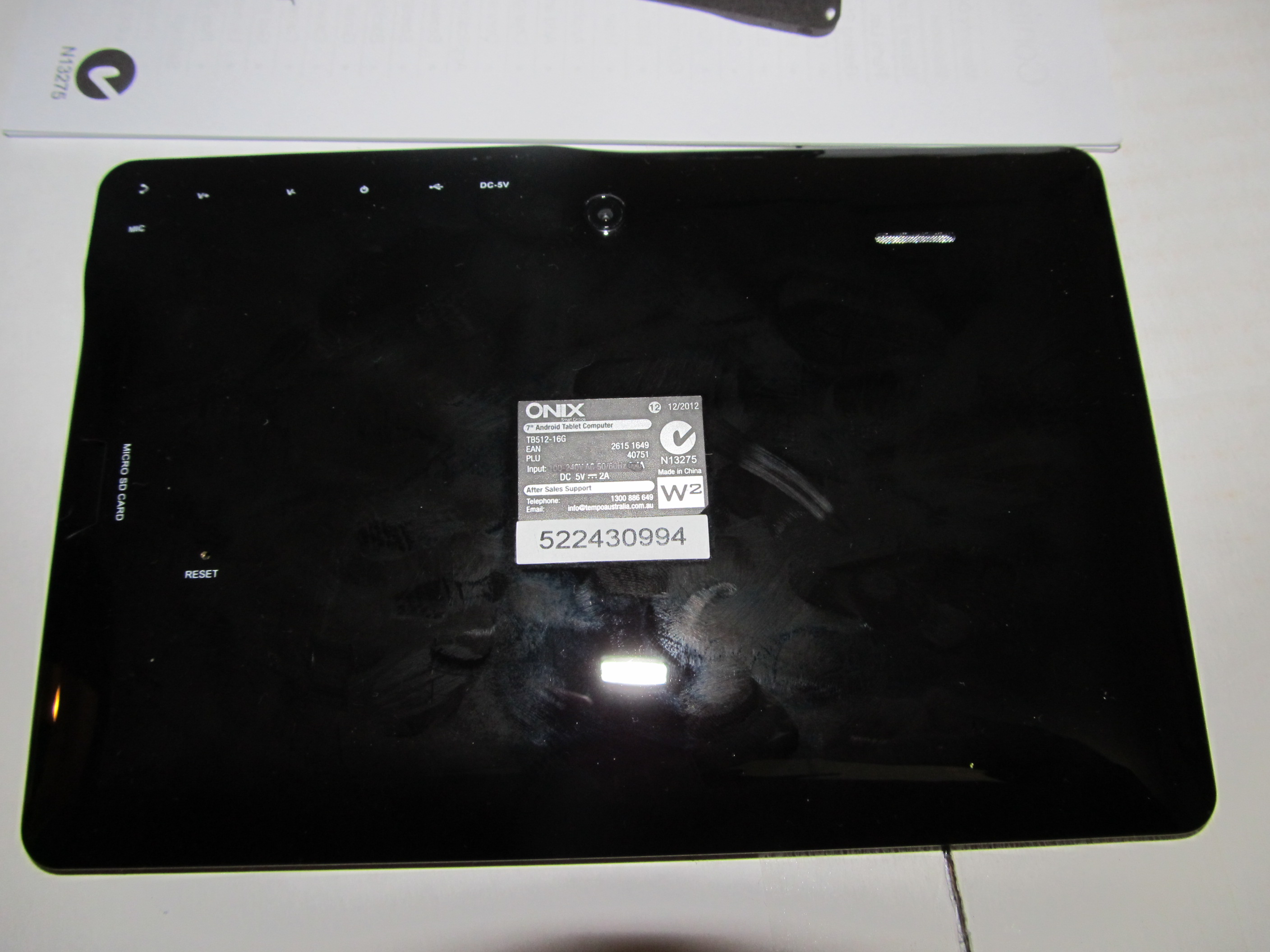
back of the onix 7 inch tabletfront of the onix 7 inch tablet and cover of manual I ve just bought a 7 Onix tablet from Aldi. It runs Android 4.0.4, has a 1GHz Cortex A8 CPU, 512M of RAM, 16G of flash storage, and a 800*480 display. They are selling rapidly and I don t know how long they will last probably you could get a returned one next week if you can t get one today. But if you like pink then you may be able to get one (the black ones are selling out first). The tablet seems like a nice piece of hardware, solid construction and it feels nice to hold. Mine has a minor screen defect, but that s the sort of
thing you expect from a cheap device, apart from that the display is good. The Wifi doesn t seem to have as good a range as some other devices (such as my phones and the more expensive 10 tablet I got from Kogan). This isn t a
problem for me (the data intensive uses for this device will be in the same room as the AP) but could be a killer for some people. If you have your phone or a dedicated 3G Wifi AP in your pocket while using the tablet then it should be fine, but if you have an AP at the wrong end of your house then you could be in trouble. I found Youtube unusable due to slow downloading even when sitting next to my AP but I can play videos downloaded from iView that are on my local web server (which is more important to me). I expect that I will be able to play local copies of TED talks too. The camera is bad by phone camera standards, fortunately I have no interest in using a tablet as a camera. I had no real problems with the Google Play store (something that caused problems for some users of an earlier Aldi Android tablet). Generally the tablet works well. The people who build Android for modern devices seem remarkably stupid when it comes to partitioning, every device I ve seen has only a small fraction of the storage usable for apps. This tablet is the worst I ve ever seen, it has 16G of storage of which there is 512M partitioned for apps of which only 400M is free when you first get the device! It comes pre-installed with outdated versions of the Facebook client and Google Maps (which isn t very useful on a Wifi device) and some other useless things. If you upgrade them to the latest versions then you ll probably lose another 100M of the 512M! Fortunately the Android feature to run apps from the VFAT partition works so I haven t been prevented from doing anything by this problem yet. In conclusion, it s not the greatest Android tablet. But you don t expect a great tablet for $100. What I hoped for was a somewhat low spec tablet that works reasonably well and that s what I got. I m happy.

4 December 2012

Michael Stapelberg: RC bugs

I recently worked on the following RC bugs:

Daniel Kahn Gillmor: Error messages are your friend (postgres is good)

Here is a bit of simple (yet subtly-flawed) sql, which produces different answers on different database engines:
0 dkg@pip:~$ cat test.sql
drop table if exists foo;
create table foo (x int, y int);
insert into foo VALUES (1,3);
insert into foo VALUES (1,5);
select y from foo group by x;
0 dkg@pip:~$ sqlite3 < test.sql
5
0 dkg@pip:~$ mysql -N dkg < test.sql
3
0 dkg@pip:~$ psql -qtA dkg < test.sql
ERROR:  column "foo.y" must appear in the GROUP BY clause or be used in an aggregate function
LINE 1: select y from foo group by x;
               ^
0 dkg@pip:~$ 
are two of the many reasons postgresql is my database engine of choice.Tags: errors, postgresql, sql

Andrea Veri: My favorite WordPress Plugins

It took me a while to build a complete WordPress blog with all the things I needed, from modifying the default Twenty Eleven theme to broadcasting my posts directly on Twitter. WordPress has a nice selection of plugins and given the fact I spent a few days evaluating all the possibilities, I decided to share my own setup to speed up the process in case you are willing to build a WordPress powered blog. The plugins: And a few modifications I made on my Child theme for the Twenty Eleven theme to suit my needs: Remove the navigation buttons on the header. On the Child theme s style.css:
#access, #branding .only-search #s, .entry-header .comments-link  
display: none;
 
Remove the gray line on the top of the header s banner. On the Child theme s style.css:
#branding  
border-top: none;
 
.and a little tip about WordPress itself: have you ever wondered how you could install/update/remove a WordPress theme or plugin without FTP access? Here s how! On the config.php file:
/*** Updates WordPress without FTP credentials. ***/
define('FS_METHOD','direct');
If you know any other handy WordPress Tip or Plugin, please share!

Michal &#268;iha&#345;: PyGtk in virtualenv on Travis

Weblate is using Travis CI for continuous integration. That in turn uses virtualenv to test against different Python version. Unfortunately one of dependencies in Weblate are PyCairo and PyGtk (actually Pango for text rendering) and these does not support installation using distutils. Fortunately this can be workarounded, but it took me some time to make all this properly. Ffirst you need to choose correct versions not as I did mistakenly mixed PyGObject 3 with PyGtk 2. The next step is to manually run configure and make with correct paths to install within virtualenv. For example for Gtk it looks like following:
wget http://ftp.gnome.org/pub/GNOME/sources/pygtk/2.24/pygtk-2.24.0.tar.bz2
tar xf pygtk-2.24.0.tar.bz2
cd pygtk-2.24.0
export PKG_CONFIG_PATH=/home/travis/virtualenv/python$TRAVIS_PYTHON_VERSION/lib/pkgconfig
./configure --prefix=/home/travis/virtualenv/python$TRAVIS_PYTHON_VERSION/
make
make install
The complete Travis configuration file can be found in Weblate's Git repository.

Filed under: English Weblate 0 comments Flattr this!

Russell Coker: Recruiting at a LUG Meeting

I m at the main meeting of Linux Users of Victoria (my local LUG). A couple of recruiting agents from Interpro [1] are here and have been working the crowd, one of them is on each side of the room and it seems that their plan is to speak to every person at the meeting and ask about whether they are looking for work. It is apparently difficult for them to find good Linux candidates and they hope to find people here (they are mainly looking for a senior programmer/team leader and an experienced sysadmin). One of my friends is looking for work but he s got two interviews for arranged for this week so they will have to be quick if they want to get him. I guess this means that the economy must be going well, or at least it s not too difficult for Linux people to find work (which is what matters the most to me). Attending the meeting and talking to people is a good business idea for the recruiters and is generally good for members of the group. Before the meeting starts and during the intermission people just hang out and talk, asking them if they are looking for work generally won t harm anyone and can really help some people. I wouldn t want to see multiple agencies doing this at every meeting, but I think that having it happen occasionally is a good thing.

Russ Allbery: Review: The Borrowers

Review: The Borrowers, by Mary Norton
Series: The Borrowers #1
Illustrator: Beth Krush
Illustrator: Joe Krush
Publisher: Sandpiper
Copyright: 1953
Printing: 1986
ISBN: 0-15-204737-9
Format: Trade paperback
Pages: 180
Arrietty is a 14-year-old girl who lives under the clock. Well, actually, she lives under the kitchen floor, but the entrance to her family's passageway is under the clock, from which they get their name. She sleeps in an old cigar box, her living room is wallpapered with strips cut from letters (and decorated with postage stamps), and she keeps a journal in a miniature book that's half the size she is. Arrietty, and her parents Pod and Homily, are Borrowers. The Borrowers is a classic series of children's books by Mary Norton about miniature people who, at least in this first book, live in the walls and take things. Not big things, but all the little things: the blotter paper, the pins, the stray sock, old postage stamps, empty matchboxes, and the occasional thimble. With these things, they build their furniture, their clothes, and their homes, safely hidden in the walls and other secret places, always wary of the "human beans" (as Arrietty's mother tends to call them). That life is, of course, a remarkable simulation of middle-class, class-conscious British life, which is much of the fun. Arrietty's family lives in the home of an elderly woman who's confined to bed, so it's quiet, safe, and driven entirely by routine. They only have to watch out for the maid and the gardener, and they keep regular schedules. That's just the way the Borrowers like it; predictable and quiet. Which is why they get caught entirely by surprise when a boy shows up, recovering from illness in the country, and spots Pod on one of his borrowing runs. This is technically a re-read, but I read the original series so long ago that I barely remembered it. Not that there is all that much to remember, at least in the way of plot. This first book follows one of the standard plots for children's books of this type (although it follows Arrietty as the viewpoint character rather than the more common choice of the boy): boy discovers hidden creatures, hidden creatures are afraid, boy turns out to want to make friends with them, they strike up a friendship, peril nonetheless ensues. If you've read many children's books, you've probably read this before; The Mouse and the Motorcycle is an obvious example (and, in terms of plot, a somewhat better book). Arrietty is a typical protagonist, her parents are silly (and a bit flighty, particularly her mother), and the boy is, disappointingly, almost a non-entity. But you don't read The Borrowers for the plot. The brilliance of this book is in the descriptions of what they use, how they use it, and how they construct their ingenious homes. Norton captures much of the wonder of other miniaturization stories (the movie Honey, I Shrunk the Kids is an obvious example), but takes it one step further into clever and thoughtful repurposing. The book is full of off-hand descriptions of how everyday objects become different everyday objects for miniature people, giving it the same delight that one gets from descriptions of how model railroad dioramas or hand-made doll houses are constructed. The detailed (if busy) illustrations by the Krushes help tremendously with visualization and make the descriptions even more fun. This is very much a children's book based on an exploration of a single great idea, so don't expect too much in the way of plot or deep characterization. It's also not science fiction; there isn't any realistic extrapolation of culture. The Borrowers all behave like perfectly ordinary English people without any further explanation because, of course, that's what they would do. Re-reading it as an adult, I wished there was a bit more meat to it. But the ingenuity is still a delight. It's great fun to spend a couple of hours imagining how one would construct the miniature accouterments of everyday life. Followed by The Borrowers Afield. Rating: 7 out of 10

3 December 2012

Michael Stapelberg: RC bugs

I recently worked on the following RC bugs:

Next.

Previous.