Search Results: "xam"

18 May 2020

Arturo Borrero Gonz lez: A better Toolforge: upgrading the Kubernetes cluster

Logos This post was originally published in the Wikimedia Tech blog, and is authored by Arturo Borrero Gonzalez and Brooke Storm. One of the most successful and important products provided by the Wikimedia Cloud Services team at the Wikimedia Foundation is Toolforge. Toolforge is a platform that allows users and developers to run and use a variety of applications that help the Wikimedia movement and mission from the technical point of view in general. Toolforge is a hosting service commonly known in the industry as a Platform as a Service (PaaS). Toolforge is powered by two different backend engines, Kubernetes and GridEngine. This article focuses on how we made a better Toolforge by integrating a newer version of Kubernetes and, along with it, some more modern workflows. The starting point in this story is 2018. Yes, two years ago! We identified that we could do better with our Kubernetes deployment in Toolforge. We were using a very old version, v1.4. Using an old version of any software has more or less the same consequences everywhere: you lack security improvements and some modern key features. Once it was clear that we wanted to upgrade our Kubernetes cluster, both the engineering work and the endless chain of challenges started. It turns out that Kubernetes is a complex and modern technology, which adds some extra abstraction layers to add flexibility and some intelligence to a very old systems engineering need: hosting and running a variety of applications. Our first challenge was to understand what our use case for a modern Kubernetes was. We were particularly interested in some key features: Soon enough we faced another Kubernetes native challenge: the documentation. For a newcomer, learning and understanding how to adapt Kubernetes to a given use case can be really challenging. We identified some baffling patterns in the docs. For example, different documentation pages would assume you were using different Kubernetes deployments (Minikube vs kubeadm vs a hosted service). We are running Kubernetes like you would on bare-metal (well, in CloudVPS virtual machines), and some documents directly referred to ours as a corner case. During late 2018 and early 2019, we started brainstorming and prototyping. We wanted our cluster to be reproducible and easily rebuildable, and in the Technology Department at the Wikimedia Foundation, we rely on Puppet for that. One of the first things to decide was how to deploy and build the cluster while integrating with Puppet. This is not as simple as it seems because Kubernetes itself is a collection of reconciliation loops, just like Puppet is. So we had to decide what to put directly in Kubernetes and what to control and make visible through Puppet. We decided to stick with kubeadm as the deployment method, as it seems to be the more upstream-standardized tool for the task. We had to make some interesting decisions by trial and error, like where to run the required etcd servers, what the kubeadm init file would look like, how to proxy and load-balance the API on our bare-metal deployment, what network overlay to choose, etc. If you take a look at our public notes, you can get a glimpse of the number of decisions we had to make. Our Kubernetes wasn t going to be a generic cluster, we needed a Toolforge Kubernetes service. This means we don t use some of the components, and also, we add some additional pieces and configurations to it. By the second half of 2019, we were working full-speed on the new Kubernetes cluster. We already had an idea of what we wanted and how to do it. There were a couple of important topics for discussions, for example: We will describe in detail the final state of those pieces in another blog post, but each of the topics required several hours of engineering time, research, tests, and meetings before reaching a point in which we were comfortable with moving forward. By the end of 2019 and early 2020, we felt like all the pieces were in place, and we started thinking about how to migrate the users, the workloads, from the old cluster to the new one. This migration plan mostly materialized in a Wikitech page which contains concrete information for our users and the community. The interaction with the community was a key success element. Thanks to our vibrant and involved users, we had several early adopters and beta testers that helped us identify early flaws in our designs. The feedback they provided was very valuable for us. Some folks helped solve technical problems, helped with the migration plan or even helped make some design decisions. Worth noting that some of the changes that were presented to our users were not easy to handle for them, like new quotas and usage limits. Introducing new workflows and deprecating old ones is always a risky operation. Even though the migration procedure from the old cluster to the new one was fairly simple, there were some rough edges. We helped our users navigate them. A common issue was a webservice not being able to run in the new cluster due to stricter quota limiting the resources for the tool. Another example is the new Ingress layer failing to properly work with some webservices s particular options. By March 2020, we no longer had anything running in the old Kubernetes cluster, and the migration was completed. We then started thinking about another step towards making a better Toolforge, which is introducing the toolforge.org domain. There is plenty of information about the change to this new domain in Wikitech News. The community wanted a better Toolforge, and so do we, and after almost 2 years of work, we have it! All the work that was done represents the commitment of the Wikimedia Foundation to support the technical community and how we really want to pursue technical engagement in general in the Wikimedia movement. In a follow-up post we will present and discuss more in-depth about some technical details of the new Kubernetes cluster, stay tuned! This post was originally published in the Wikimedia Tech blog, and is authored by Arturo Borrero Gonzalez and Brooke Storm.

17 May 2020

Steve Kemp: Some brief sysbox highlights

I started work on sysbox again recently, adding a couple of simple utilities. (The whole project is a small collection of utilities, distributed as a single binary to ease installation.) Imagine you want to run a command for every line of STDIN, here's a good example:
 $ cat input   sysbox exec-stdin "youtube-dl  "
Here you see for every (non-empty) line of input read from STDIN the command "youtube-dl" has been executed. " " gets expanded to the complete line read. You can also access individual fields, kinda like awk. (Yes youtube-dl can read a list of URLs from a file, this is an example!) Another example, run groups for every local user:
$ cat /etc/passwd   sysbox exec-stdin --split=: groups  1 
Here you see we have split the input-lines read from STDIN by the : character, instead of by whitespace, and we've accessed the first field via " 1 ". This is certainly easier for scripting than using a bash loop. On the topic of bash; command-completion for each subcommand, and their arguments, is now present:
$ source <(sysbox bash-completion)
And I've added a text-based UI for selecting files. You can also execute a command, against the selected file:
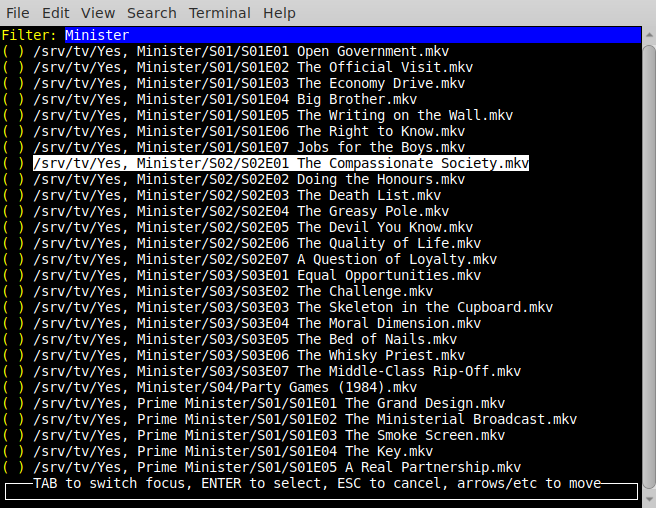
$ sysbox choose-file -exec "xine  " /srv/tv
This is what that looks like: /2020/05/17-choose-file.png You'll see: As well as choosing files, you can also select from lines read via STDIN, and you can filter the command in the same way as before. (i.e. " " is the selected item.) Other commands received updates, so the calculator now allows storing results in variables:
$ sysbox calc
calc> let a = 3
3
calc> a / 9 * 3
1
calc> 1 + 2 * a
7
calc> 1.2 + 3.4
4.600000

Erich Schubert: Contact Tracing Apps are Useless

Some people believe that automatic contact tracing apps will help contain the Coronavirus epidemic. They won t. Sorry to bring the bad news, but IT and mobile phones and artificial intelligence will not solve every problem. In my opinion, those that promise to solve these things with artificial intelligence / mobile phones / apps / your-favorite-buzzword are at least overly optimistic and blinder Aktionismus (*), if not naive, detachted from reality, or fraudsters that just want to get some funding. (*) there does not seem to be an English word for this doing something just for the sake of doing something, without thinking about whether it makes sense to do so Here are the reasons why it will not work:
  1. Signal quality. Forget detecting proximity with Bluetooth Low Energy. Yes, there are attempts to use BLE beacons for indoor positioning. But these use that you can learn fingerprints of which beacons are visible at which points, combined with additional information such as movement sensors and history (you do not teleport around in a building). BLE signals and antennas apparently tend to be very prone to orientation differences, signal reflections, and of course you will not have the idealized controlled environment used in such prototypes. The contacts have a single device, and they move this is not comparable to indoor positioning. I strongly doubt you can tell whether you are close to someone, or not.
  2. Close vs. protection. The app cannot detect protection in place. Being close to someone behind a plexiglass window or even a solid wall is very different from being close otherwise. You will get a lot of false contacts this way. That neighbor that you have never seen living in the appartment above will likely be considered a close contact of yours, as you sleep next to each other every day
  3. Low adoption rates. Apparently even in technology affine Singapore, fewer than 20% of people installed the app. That does not even mean they use it regularly. In Austria, the number is apparently below 5%, and people complain that it does not detect contact But in order for this approach to work, you will need Chinese-style mass surveillance that literally puts you in prison if you do not install the app.
  4. False alerts. Because of these issues, you will get false alerts, until you just do not care anymore.
  5. False sense of security. Honestly: the app does not pretect you at all. All it tries to do is to make the tracing of contacts easier. It will not tell you reliably if you have been infected (as mentioned above, too many false positives, too few users) nor that you are relatively safe (too few contacts included, too slow testing and reporting). It will all be on the quality of about 10 days ago you may or may not have contact with someone that tested positive, please contact someone to expose more data to tell you that it is actually another false alert .
  6. Trust. In Germany, the app will be operated by T-Systems and SAP. Not exactly two companies that have a lot of fans SAP seems to be one of the most hated software around. Neither company is known for caring about privacy much, but they are prototypical for business first . Its trust the cat to keep the cream. Yes, I know they want to make it open-source. But likely only the client, and you will still have to trust that the binary in the app stores is actually built from this source code, and not from a modified copy. As long as the name T-Systems and SAP are associated to the app, people will not trust it. Plus, we all know that the app will be bad, given the reputation of these companies at making horrible software systems
  7. Too late. SAP and T-Systems want to have the app ready in mid June. Seriously, this must be a joke? It will be very buggy in the beginning (because it is SAP!) and it will not be working reliably before end of July. There will not be a substantial user before fall. But given the low infection rates in Germany, nobody will bother to install it anymore, because the perceived benefit is 0 one the infection rates are low.
  8. Infighting. You may remember that there was the discussion before that there should be a pan-european effort. Except that in the end, everybody fought everybody else, countries went into different directions and they all broke up. France wanted a centralized systems, while in Germany people pointed out that the users will not accept this and only a distributed system will have a chance. That failed effort was known as Pan-European Privacy-Preserving Proximity Tracing (PEPP-PT) vs. Decentralized Privacy-Preserving Proximity Tracing (DP-3T) , and it turned out to have become a big clusterfuck . And that is just the tip of the iceberg.
Iceleand, probably the country that handled the Corona crisis best (they issued a travel advisory against Austria, when they were still happily spreading the virus at apres-ski; they massively tested, and got the infections down to almost zero within 6 weeks), has been experimenting with such an app. Iceland as a fairly close community managed to have almost 40% of people install their app. So did it help? No: The technology is more or less I wouldn t say useless [ ] it wasn t a game changer for us. The contact tracing app is just a huge waste of effort and public money. And pretty much the same applies to any other attempts to solve this with IT. There is a lot of buzz about solving the Corona crisis with artificial intelligence: bullshit! That is just naive. Do not speculate about magic power of AI. Get the data, understand the data, and you will see it does not help. Because its real data. Its dirty. Its late. Its contradicting. Its incomplete. It is all what AI currently can not handle well. This is not image recognition. You have no labels. Many of the attempts in this direction already fail at the trivial 7-day seasonality you observe in the data For example, the widely known John Hopkins Has the curve flattened trend has a stupid, useless indicator based on 5 day averages. And hence you get the weekly up and downs due to weekends. They show pretty up and down indicators. But these are affected mostly by the day of the week. And nobody cares. Notice that they currently even have big negative infections in their plots? There is no data on when someone was infected. Because such data simply does not exist. What you have is data when someone tested positive (mostly), when someone reported symptons (sometimes, but some never have symptoms!), and when someone dies (but then you do not know if it was because of Corona, because of other issues that became just worse because of Corona, or hit by a car without any relation to Corona). The data that we work with is incredibly delayed, yet we pretend it is live . Stop reading tea leaves. Stop pretending AI can save the world from Corona.

Matthew Palmer: Private Key Redaction: UR DOIN IT RONG

Because posting private keys on the Internet is a bad idea, some people like to redact their private keys, so that it looks kinda-sorta like a private key, but it isn t actually giving away anything secret. Unfortunately, due to the way that private keys are represented, it is easy to redact a key in such a way that it doesn t actually redact anything at all. RSA private keys are particularly bad at this, but the problem can (potentially) apply to other keys as well. I ll show you a bit of Inside Baseball with key formats, and then demonstrate the practical implications. Finally, we ll go through a practical worked example from an actual not-really-redacted key I recently stumbled across in my travels.

The Private Lives of Private Keys Here is what a typical private key looks like, when you come across it:
-----BEGIN RSA PRIVATE KEY-----
MGICAQACEQCxjdTmecltJEz2PLMpS4BXAgMBAAECEDKtuwD17gpagnASq1zQTYEC
CQDVTYVsjjF7IQIJANUYZsIjRsR3AgkAkahDUXL0RSECCB78r2SnsJC9AghaOK3F
sKoELg==
-----END RSA PRIVATE KEY-----
Obviously, there s some hidden meaning in there computers don t encrypt things by shouting BEGIN RSA PRIVATE KEY! , after all. What is between the BEGIN/END lines above is, in fact, a base64-encoded DER format ASN.1 structure representing a PKCS#1 private key. In simple terms, it s a list of numbers very important numbers. The list of numbers is, in order:
  • A version number (0);
  • The public modulus , commonly referred to as n ;
  • The public exponent , or e (which is almost always 65,537, for various unimportant reasons);
  • The private exponent , or d ;
  • The two private primes , or p and q ;
  • Two exponents, which are known as dmp1 and dmq1 ; and
  • A coefficient, known as iqmp .

Why Is This a Problem? The thing is, only three of those numbers are actually required in a private key. The rest, whilst useful to allow the RSA encryption and decryption to be more efficient, aren t necessary. The three absolutely required values are e, p, and q. Of the other numbers, most of them are at least about the same size as each of p and q. So of the total data in an RSA key, less than a quarter of the data is required. Let me show you with the above toy key, by breaking it down piece by piece1:
  • MGI DER for this is a sequence
  • CAQ version (0)
  • CxjdTmecltJEz2PLMpS4BX n
  • AgMBAA e
  • ECEDKtuwD17gpagnASq1zQTY d
  • ECCQDVTYVsjjF7IQ p
  • IJANUYZsIjRsR3 q
  • AgkAkahDUXL0RS dmp1
  • ECCB78r2SnsJC9 dmq1
  • AghaOK3FsKoELg== iqmp
Remember that in order to reconstruct all of these values, all I need are e, p, and q and e is pretty much always 65,537. So I could redact almost all of this key, and still give all the important, private bits of this key. Let me show you:
-----BEGIN RSA PRIVATE KEY-----
..............................................................EC
CQDVTYVsjjF7IQIJANUYZsIjRsR3....................................
........
-----END RSA PRIVATE KEY-----
Now, I doubt that anyone is going to redact a key precisely like this but then again, this isn t a typical RSA key. They usually look a lot more like this:
-----BEGIN RSA PRIVATE KEY-----
MIIEogIBAAKCAQEAu6Inch7+mWtKn+leB9uCG3MaJIxRyvC/5KTz2fR+h+GOhqj4
SZJobiVB4FrE5FgC7AnlH6qeRi9MI0s6dt5UWZ5oNIeWSaOOeNO+EJDUkSVf67wj
SNGXlSjGAkPZ0nRJiDjhuPvQmdW53hOaBLk5udxPEQbenpXAzbLJ7wH5ouLQ3nQw
HwpwDNQhF6zRO8WoscpDVThOAM+s4PS7EiK8ZR4hu2toon8Ynadlm95V45wR0VlW
zywgbkZCKa1IMrDCscB6CglQ10M3Xzya3iTzDtQxYMVqhDrA7uBYRxA0y1sER+Rb
yhEh03xz3AWemJVLCQuU06r+FABXJuY/QuAVvQIDAQABAoIBAFqwWVhzWqNUlFEO
PoCVvCEAVRZtK+tmyZj9kU87ORz8DCNR8A+/T/JM17ZUqO2lDGSBs9jGYpGRsr8s
USm69BIM2ljpX95fyzDjRu5C0jsFUYNi/7rmctmJR4s4uENcKV5J/++k5oI0Jw4L
c1ntHNWUgjK8m0UTJIlHbQq0bbAoFEcfdZxd3W+SzRG3jND3gifqKxBG04YDwloy
tu+bPV2jEih6p8tykew5OJwtJ3XsSZnqJMwcvDciVbwYNiJ6pUvGq6Z9kumOavm9
XU26m4cWipuK0URWbHWQA7SjbktqEpxsFrn5bYhJ9qXgLUh/I1+WhB2GEf3hQF5A
pDTN4oECgYEA7Kp6lE7ugFBDC09sKAhoQWrVSiFpZG4Z1gsL9z5YmZU/vZf0Su0n
9J2/k5B1GghvSwkTqpDZLXgNz8eIX0WCsS1xpzOuORSNvS1DWuzyATIG2cExuRiB
jYWIJUeCpa5p2PdlZmBrnD/hJ4oNk4oAVpf+HisfDSN7HBpN+TJfcAUCgYEAyvY7
Y4hQfHIdcfF3A9eeCGazIYbwVyfoGu70S/BZb2NoNEPymqsz7NOfwZQkL4O7R3Wl
Rm0vrWT8T5ykEUgT+2ruZVXYSQCKUOl18acbAy0eZ81wGBljZc9VWBrP1rHviVWd
OVDRZNjz6nd6ZMrJvxRa24TvxZbJMmO1cgSW1FkCgYAoWBd1WM9HiGclcnCZknVT
UYbykCeLO0mkN1Xe2/32kH7BLzox26PIC2wxF5seyPlP7Ugw92hOW/zewsD4nLze
v0R0oFa+3EYdTa4BvgqzMXgBfvGfABJ1saG32SzoWYcpuWLLxPwTMsCLIPmXgRr1
qAtl0SwF7Vp7O/C23mNukQKBgB89DOEB7xloWv3Zo27U9f7nB7UmVsGjY8cZdkJl
6O4LB9PbjXCe3ywZWmJqEbO6e83A3sJbNdZjT65VNq9uP50X1T+FmfeKfL99X2jl
RnQTsrVZWmJrLfBSnBkmb0zlMDAcHEnhFYmHFuvEnfL7f1fIoz9cU6c+0RLPY/L7
n9dpAoGAXih17mcmtnV+Ce+lBWzGWw9P4kVDSIxzGxd8gprrGKLa3Q9VuOrLdt58
++UzNUaBN6VYAe4jgxGfZfh+IaSlMouwOjDgE/qzgY8QsjBubzmABR/KWCYiRqkj
qpWCgo1FC1Gn94gh/+dW2Q8+NjYtXWNqQcjRP4AKTBnPktEvdMA=
-----END RSA PRIVATE KEY-----
People typically redact keys by deleting whole lines, and usually replacing them with [...] and the like. But only about 345 of those 1588 characters (excluding the header and footer) are required to construct the entire key. You can redact about 4/5ths of that giant blob of stuff, and your private parts (or at least, those of your key) are still left uncomfortably exposed.

But Wait! There s More! Remember how I said that everything in the key other than e, p, and q could be derived from those three numbers? Let s talk about one of those numbers: n. This is known as the public modulus (because, along with e, it is also present in the public key). It is very easy to calculate: n = p * q. It is also very early in the key (the second number, in fact). Since n = p * q, it follows that q = n / p. Thus, as long as the key is intact up to p, you can derive q by simple division.

Real World Redaction At this point, I d like to introduce an acquaintance of mine: Mr. Johan Finn. He is the proud owner of the GitHub repo johanfinn/scripts. For a while, his repo contained a script that contained a poorly-redacted private key. He since deleted it, by making a new commit, but of course because git never really deletes anything, it s still available. Of course, Mr. Finn may delete the repo, or force-push a new history without that commit, so here is the redacted private key, with a bit of the surrounding shell script, for our illustrative pleasure:
#Add private key to .ssh folder
cd /home/johan/.ssh/
echo  "-----BEGIN RSA PRIVATE KEY-----
MMMMMMMMMMMMMMMMMMMMMMMMMMMMMMMMMMMMMMMMMMMMMMMMMMMMMMMMMMMMMMMM
NNNNNNNNNNNNNNNNNNNNNNNNNNNNNNNNNNNNNNNNNNNNNNNNNNNNNNNNNNNNNNNN
KKKKKKKKKKKKKKKKKKKKKKKKKKKKKKKKKKKKKKKKKKKKKKKKKKKKKKKKKKKKKKKK
 
MIIJKgIBAAKCAgEAxEVih1JGb8gu/Fm4AZh+ZwJw/pjzzliWrg4mICFt1g7SmIE2
TCQMKABdwd11wOFKCPc/UzRH/fHuQcvWrpbOSdqev/zKff9iedKw/YygkMeIRaXB
fYELqvUAOJ8PPfDm70st9GJRhjGgo5+L3cJB2gfgeiDNHzaFvapRSU0oMGQX+kI9
ezsjDAn+0Pp+r3h/u1QpLSH4moRFGF4omNydI+3iTGB98/EzuNhRBHRNq4oBV5SG
Pq/A1bem2ninnoEaQ+OPESxYzDz3Jy9jV0W/6LvtJ844m+XX69H5fqq5dy55z6DW
sGKn78ULPVZPsYH5Y7C+CM6GAn4nYCpau0t52sqsY5epXdeYx4Dc+Wm0CjXrUDEe
Egl4loPKDxJkQqQ/MQiz6Le/UK9vEmnWn1TRXK3ekzNV4NgDfJANBQobOpwt8WVB
rbsC0ON7n680RQnl7PltK9P1AQW5vHsahkoixk/BhcwhkrkZGyDIl9g8Q/Euyoq3
eivKPLz7/rhDE7C1BzFy7v8AjC3w7i9QeHcWOZFAXo5hiDasIAkljDOsdfD4tP5/
wSO6E6pjL3kJ+RH2FCHd7ciQb+IcuXbku64ln8gab4p8jLa/mcMI+V3eWYnZ82Yu
axsa85hAe4wb60cp/rCJo7ihhDTTvGooqtTisOv2nSvCYpcW9qbL6cGjAXECAwEA
AQKCAgEAjz6wnWDP5Y9ts2FrqUZ5ooamnzpUXlpLhrbu3m5ncl4ZF5LfH+QDN0Kl
KvONmHsUhJynC/vROybSJBU4Fu4bms1DJY3C39h/L7g00qhLG7901pgWMpn3QQtU
4P49qpBii20MGhuTsmQQALtV4kB/vTgYfinoawpo67cdYmk8lqzGzzB/HKxZdNTq
s+zOfxRr7PWMo9LyVRuKLjGyYXZJ/coFaobWBi8Y96Rw5NZZRYQQXLIalC/Dhndm
AHckpstEtx2i8f6yxEUOgPvV/gD7Akn92RpqOGW0g/kYpXjGqZQy9PVHGy61sInY
HSkcOspIkJiS6WyJY9JcvJPM6ns4b84GE9qoUlWVF3RWJk1dqYCw5hz4U8LFyxsF
R6WhYiImvjxBLpab55rSqbGkzjI2z+ucDZyl1gqIv9U6qceVsgRyuqdfVN4deU22
LzO5IEDhnGdFqg9KQY7u8zm686Ejs64T1sh0y4GOmGsSg+P6nsqkdlXH8C+Cf03F
lqPFg8WQC7ojl/S8dPmkT5tcJh3BPwIWuvbtVjFOGQc8x0lb+NwK8h2Nsn6LNazS
0H90adh/IyYX4sBMokrpxAi+gMAWiyJHIHLeH2itNKtAQd3qQowbrWNswJSgJzsT
JuJ7uqRKAFkE6nCeAkuj/6KHHMPsfCAffVdyGaWqhoxmPOrnVgECggEBAOrCCwiC
XxwUgjOfOKx68siFJLfHf4vPo42LZOkAQq5aUmcWHbJVXmoxLYSczyAROopY0wd6
Dx8rqnpO7OtZsdJMeBSHbMVKoBZ77hiCQlrljcj12moFaEAButLCdZFsZW4zF/sx
kWIAaPH9vc4MvHHyvyNoB3yQRdevu57X7xGf9UxWuPil/jvdbt9toaraUT6rUBWU
GYPNKaLFsQzKsFWAzp5RGpASkhuiBJ0Qx3cfLyirjrKqTipe3o3gh/5RSHQ6VAhz
gdUG7WszNWk8FDCL6RTWzPOrbUyJo/wz1kblsL3vhV7ldEKFHeEjsDGroW2VUFlS
asAHNvM4/uYcOSECggEBANYH0427qZtLVuL97htXW9kCAT75xbMwgRskAH4nJDlZ
IggDErmzBhtrHgR+9X09iL47jr7dUcrVNPHzK/WXALFSKzXhkG/yAgmt3r14WgJ6
5y7010LlPFrzaNEyO/S4ISuBLt4cinjJsrFpoo0WI8jXeM5ddG6ncxdurKXMymY7
:::::::::::::::::::::::::::::::::::::::::::::::::::::::::::::.::
:::::::::::::::::::::::::::.::::::::::::::::::::::::::::::::::::
LLLLLLLLLLLLLLLLLLLLLLLLLLLLLLLLLLLLLLLLLLLLLLLLLLLLLLLLLLLLLLlL


YYYYYYYYYYYYYYYYYYYYYyYYYYYYYYYYYYYYYYYYYYYYYYYYYYYYYYYYYYYYYY
gff0GJCOMZ65pMSy3A3cSAtjlKnb4fWzuHD5CFbusN4WhCT/tNxGNSpzvxd8GIDs
nY7exs9L230oCCpedVgcbayHCbkChEfoPzL1e1jXjgCwCTgt8GjeEFqc1gXNEaUn
O8AJ4VlR8fRszHm6yR0ZUBdY7UJddxQiYOzt0S1RLlECggEAbdcs4mZdqf3OjejJ
06oTPs9NRtAJVZlppSi7pmmAyaNpOuKWMoLPElDAQ3Q7VX26LlExLCZoPOVpdqDH
KbdmBEfTR4e11Pn9vYdu9/i6o10U4hpmf4TYKlqk10g1Sj21l8JATj/7Diey8scO
sAI1iftSg3aBSj8W7rxCxSezrENzuqw5D95a/he1cMUTB6XuravqZK5O4eR0vrxR
AvMzXk5OXrUEALUvt84u6m6XZZ0pq5XZxq74s8p/x1JvTwcpJ3jDKNEixlHfdHEZ
ZIu/xpcwD5gRfVGQamdcWvzGHZYLBFO1y5kAtL8kI9tW7WaouWVLmv99AyxdAaCB
Y5mBAQKCAQEAzU7AnorPzYndlOzkxRFtp6MGsvRBsvvqPLCyUFEXrHNV872O7tdO
GmsMZl+q+TJXw7O54FjJJvqSSS1sk68AGRirHop7VQce8U36BmI2ZX6j2SVAgIkI
9m3btCCt5rfiCatn2+Qg6HECmrCsHw6H0RbwaXS4RZUXD/k4X+sslBitOb7K+Y+N
Bacq6QxxjlIqQdKKPs4P2PNHEAey+kEJJGEQ7bTkNxCZ21kgi1Sc5L8U/IGy0BMC
PvJxssLdaWILyp3Ws8Q4RAoC5c0ZP0W2j+5NSbi3jsDFi0Y6/2GRdY1HAZX4twem
Q0NCedq1JNatP1gsb6bcnVHFDEGsj/35oQKCAQEAgmWMuSrojR/fjJzvke6Wvbox
FRnPk+6YRzuYhAP/YPxSRYyB5at++5Q1qr7QWn7NFozFIVFFT8CBU36ktWQ39MGm
cJ5SGyN9nAbbuWA6e+/u059R7QL+6f64xHRAGyLT3gOb1G0N6h7VqFT25q5Tq0rc
Lf/CvLKoudjv+sQ5GKBPT18+zxmwJ8YUWAsXUyrqoFWY/Tvo5yLxaC0W2gh3+Ppi
EDqe4RRJ3VKuKfZxHn5VLxgtBFN96Gy0+Htm5tiMKOZMYAkHiL+vrVZAX0hIEuRZ
JJJJJJJJJJJJJJJJJJJJJJJJJJJJJJJJJJJJJJJJJJJJJJJJJJJJJJJJJJJJJJJJ
MMMMMMMMMMMMMMMMMMMMMMMMMMMMMMMMMMMMMMMMMMMMMMMMMMMMMMMMMMMMMMMM
-----END RSA PRIVATE KEY-----" >> id_rsa
Now, if you try to reconstruct this key by removing the obvious garbage lines (the ones that are all repeated characters, some of which aren t even valid base64 characters), it still isn t a key at least, openssl pkey doesn t want anything to do with it. The key is very much still in there, though, as we shall soon see. Using a gem I wrote and a quick bit of Ruby, we can extract a complete private key. The irb session looks something like this:
>> require "derparse"
>> b64 = <<EOF
MIIJKgIBAAKCAgEAxEVih1JGb8gu/Fm4AZh+ZwJw/pjzzliWrg4mICFt1g7SmIE2
TCQMKABdwd11wOFKCPc/UzRH/fHuQcvWrpbOSdqev/zKff9iedKw/YygkMeIRaXB
fYELqvUAOJ8PPfDm70st9GJRhjGgo5+L3cJB2gfgeiDNHzaFvapRSU0oMGQX+kI9
ezsjDAn+0Pp+r3h/u1QpLSH4moRFGF4omNydI+3iTGB98/EzuNhRBHRNq4oBV5SG
Pq/A1bem2ninnoEaQ+OPESxYzDz3Jy9jV0W/6LvtJ844m+XX69H5fqq5dy55z6DW
sGKn78ULPVZPsYH5Y7C+CM6GAn4nYCpau0t52sqsY5epXdeYx4Dc+Wm0CjXrUDEe
Egl4loPKDxJkQqQ/MQiz6Le/UK9vEmnWn1TRXK3ekzNV4NgDfJANBQobOpwt8WVB
rbsC0ON7n680RQnl7PltK9P1AQW5vHsahkoixk/BhcwhkrkZGyDIl9g8Q/Euyoq3
eivKPLz7/rhDE7C1BzFy7v8AjC3w7i9QeHcWOZFAXo5hiDasIAkljDOsdfD4tP5/
wSO6E6pjL3kJ+RH2FCHd7ciQb+IcuXbku64ln8gab4p8jLa/mcMI+V3eWYnZ82Yu
axsa85hAe4wb60cp/rCJo7ihhDTTvGooqtTisOv2nSvCYpcW9qbL6cGjAXECAwEA
AQKCAgEAjz6wnWDP5Y9ts2FrqUZ5ooamnzpUXlpLhrbu3m5ncl4ZF5LfH+QDN0Kl
KvONmHsUhJynC/vROybSJBU4Fu4bms1DJY3C39h/L7g00qhLG7901pgWMpn3QQtU
4P49qpBii20MGhuTsmQQALtV4kB/vTgYfinoawpo67cdYmk8lqzGzzB/HKxZdNTq
s+zOfxRr7PWMo9LyVRuKLjGyYXZJ/coFaobWBi8Y96Rw5NZZRYQQXLIalC/Dhndm
AHckpstEtx2i8f6yxEUOgPvV/gD7Akn92RpqOGW0g/kYpXjGqZQy9PVHGy61sInY
HSkcOspIkJiS6WyJY9JcvJPM6ns4b84GE9qoUlWVF3RWJk1dqYCw5hz4U8LFyxsF
R6WhYiImvjxBLpab55rSqbGkzjI2z+ucDZyl1gqIv9U6qceVsgRyuqdfVN4deU22
LzO5IEDhnGdFqg9KQY7u8zm686Ejs64T1sh0y4GOmGsSg+P6nsqkdlXH8C+Cf03F
lqPFg8WQC7ojl/S8dPmkT5tcJh3BPwIWuvbtVjFOGQc8x0lb+NwK8h2Nsn6LNazS
0H90adh/IyYX4sBMokrpxAi+gMAWiyJHIHLeH2itNKtAQd3qQowbrWNswJSgJzsT
JuJ7uqRKAFkE6nCeAkuj/6KHHMPsfCAffVdyGaWqhoxmPOrnVgECggEBAOrCCwiC
XxwUgjOfOKx68siFJLfHf4vPo42LZOkAQq5aUmcWHbJVXmoxLYSczyAROopY0wd6
Dx8rqnpO7OtZsdJMeBSHbMVKoBZ77hiCQlrljcj12moFaEAButLCdZFsZW4zF/sx
kWIAaPH9vc4MvHHyvyNoB3yQRdevu57X7xGf9UxWuPil/jvdbt9toaraUT6rUBWU
GYPNKaLFsQzKsFWAzp5RGpASkhuiBJ0Qx3cfLyirjrKqTipe3o3gh/5RSHQ6VAhz
gdUG7WszNWk8FDCL6RTWzPOrbUyJo/wz1kblsL3vhV7ldEKFHeEjsDGroW2VUFlS
asAHNvM4/uYcOSECggEBANYH0427qZtLVuL97htXW9kCAT75xbMwgRskAH4nJDlZ
IggDErmzBhtrHgR+9X09iL47jr7dUcrVNPHzK/WXALFSKzXhkG/yAgmt3r14WgJ6
5y7010LlPFrzaNEyO/S4ISuBLt4cinjJsrFpoo0WI8jXeM5ddG6ncxdurKXMymY7
EOF
>> b64 += <<EOF
gff0GJCOMZ65pMSy3A3cSAtjlKnb4fWzuHD5CFbusN4WhCT/tNxGNSpzvxd8GIDs
nY7exs9L230oCCpedVgcbayHCbkChEfoPzL1e1jXjgCwCTgt8GjeEFqc1gXNEaUn
O8AJ4VlR8fRszHm6yR0ZUBdY7UJddxQiYOzt0S1RLlECggEAbdcs4mZdqf3OjejJ
06oTPs9NRtAJVZlppSi7pmmAyaNpOuKWMoLPElDAQ3Q7VX26LlExLCZoPOVpdqDH
KbdmBEfTR4e11Pn9vYdu9/i6o10U4hpmf4TYKlqk10g1Sj21l8JATj/7Diey8scO
sAI1iftSg3aBSj8W7rxCxSezrENzuqw5D95a/he1cMUTB6XuravqZK5O4eR0vrxR
AvMzXk5OXrUEALUvt84u6m6XZZ0pq5XZxq74s8p/x1JvTwcpJ3jDKNEixlHfdHEZ
ZIu/xpcwD5gRfVGQamdcWvzGHZYLBFO1y5kAtL8kI9tW7WaouWVLmv99AyxdAaCB
Y5mBAQKCAQEAzU7AnorPzYndlOzkxRFtp6MGsvRBsvvqPLCyUFEXrHNV872O7tdO
GmsMZl+q+TJXw7O54FjJJvqSSS1sk68AGRirHop7VQce8U36BmI2ZX6j2SVAgIkI
9m3btCCt5rfiCatn2+Qg6HECmrCsHw6H0RbwaXS4RZUXD/k4X+sslBitOb7K+Y+N
Bacq6QxxjlIqQdKKPs4P2PNHEAey+kEJJGEQ7bTkNxCZ21kgi1Sc5L8U/IGy0BMC
PvJxssLdaWILyp3Ws8Q4RAoC5c0ZP0W2j+5NSbi3jsDFi0Y6/2GRdY1HAZX4twem
Q0NCedq1JNatP1gsb6bcnVHFDEGsj/35oQKCAQEAgmWMuSrojR/fjJzvke6Wvbox
FRnPk+6YRzuYhAP/YPxSRYyB5at++5Q1qr7QWn7NFozFIVFFT8CBU36ktWQ39MGm
cJ5SGyN9nAbbuWA6e+/u059R7QL+6f64xHRAGyLT3gOb1G0N6h7VqFT25q5Tq0rc
Lf/CvLKoudjv+sQ5GKBPT18+zxmwJ8YUWAsXUyrqoFWY/Tvo5yLxaC0W2gh3+Ppi
EDqe4RRJ3VKuKfZxHn5VLxgtBFN96Gy0+Htm5tiMKOZMYAkHiL+vrVZAX0hIEuRZ
EOF
>> der = b64.unpack("m").first
>> c = DerParse.new(der).first_node.first_child
>> version = c.value
=> 0
>> c = c.next_node
>> n = c.value
=> 80071596234464993385068908004931... # (etc)
>> c = c.next_node
>> e = c.value
=> 65537
>> c = c.next_node
>> d = c.value
=> 58438813486895877116761996105770... # (etc)
>> c = c.next_node
>> p = c.value
=> 29635449580247160226960937109864... # (etc)
>> c = c.next_node
>> q = c.value
=> 27018856595256414771163410576410... # (etc)
What I ve done, in case you don t speak Ruby, is take the two chunks of plausible-looking base64 data, chuck them together into a variable named b64, unbase64 it into a variable named der, pass that into a new DerParse instance, and then walk the DER value tree until I got all the values I need. Interestingly, the q value actually traverses the split in the two chunks, which means that there s always the possibility that there are lines missing from the key. However, since p and q are supposed to be prime, we can sanity check them to see if corruption is likely to have occurred:
>> require "openssl"
>> OpenSSL::BN.new(p).prime?
=> true
>> OpenSSL::BN.new(q).prime?
=> true
Excellent! The chances of a corrupted file producing valid-but-incorrect prime numbers isn t huge, so we can be fairly confident that we ve got the real p and q. Now, with the help of another one of my creations we can use e, p, and q to create a fully-operational battle key:
>> require "openssl/pkey/rsa"
>> k = OpenSSL::PKey::RSA.from_factors(p, q, e)
=> #<OpenSSL::PKey::RSA:0x0000559d5903cd38>
>> k.valid?
=> true
>> k.verify(OpenSSL::Digest::SHA256.new, k.sign(OpenSSL::Digest::SHA256.new, "bob"), "bob")
=> true
and there you have it. One fairly redacted-looking private key brought back to life by maths and far too much free time. Sorry Mr. Finn, I hope you re not still using that key on anything Internet-facing.

What About Other Key Types? EC keys are very different beasts, but they have much the same problems as RSA keys. A typical EC key contains both private and public data, and the public portion is twice the size so only about 1/3 of the data in the key is private material. It is quite plausible that you can redact an EC key and leave all the actually private bits exposed.

What Do We Do About It? In short: don t ever try and redact real private keys. For documentation purposes, just put KEY GOES HERE in the appropriate spot, or something like that. Store your secrets somewhere that isn t a public (or even private!) git repo. Generating a dummy private key and sticking it in there isn t a great idea, for different reasons: people have this odd habit of reusing demo keys in real life. There s no need to encourage that sort of thing.
  1. Technically the pieces aren t 100% aligned with the underlying DER, because of how base64 works. I felt it was easier to understand if I stuck to chopping up the base64, rather than decoding into DER and then chopping up the DER.

14 May 2020

Iustin Pop: New internet provider

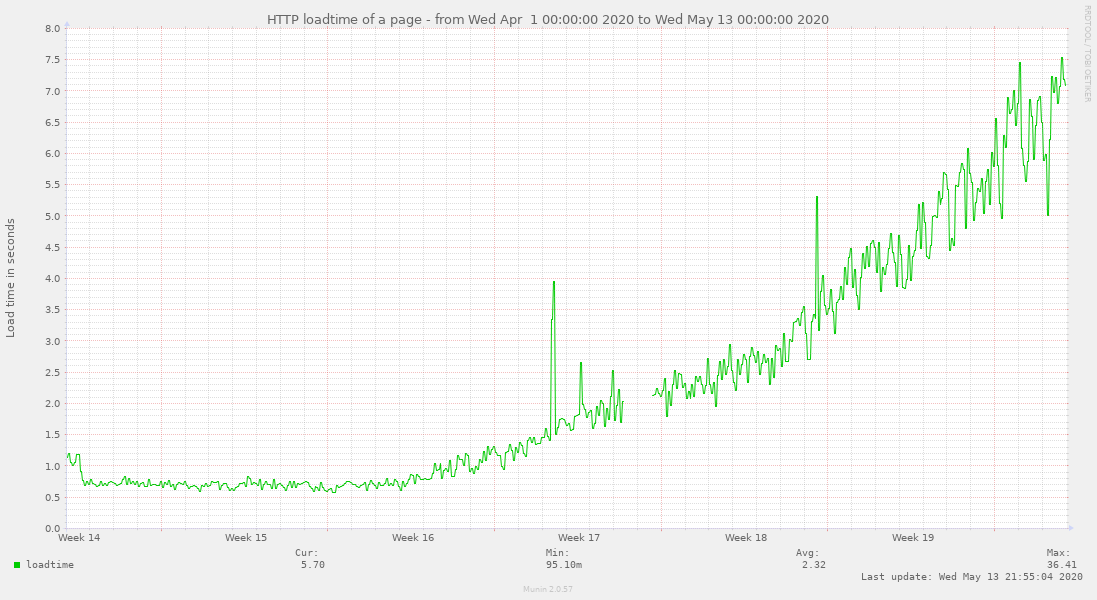
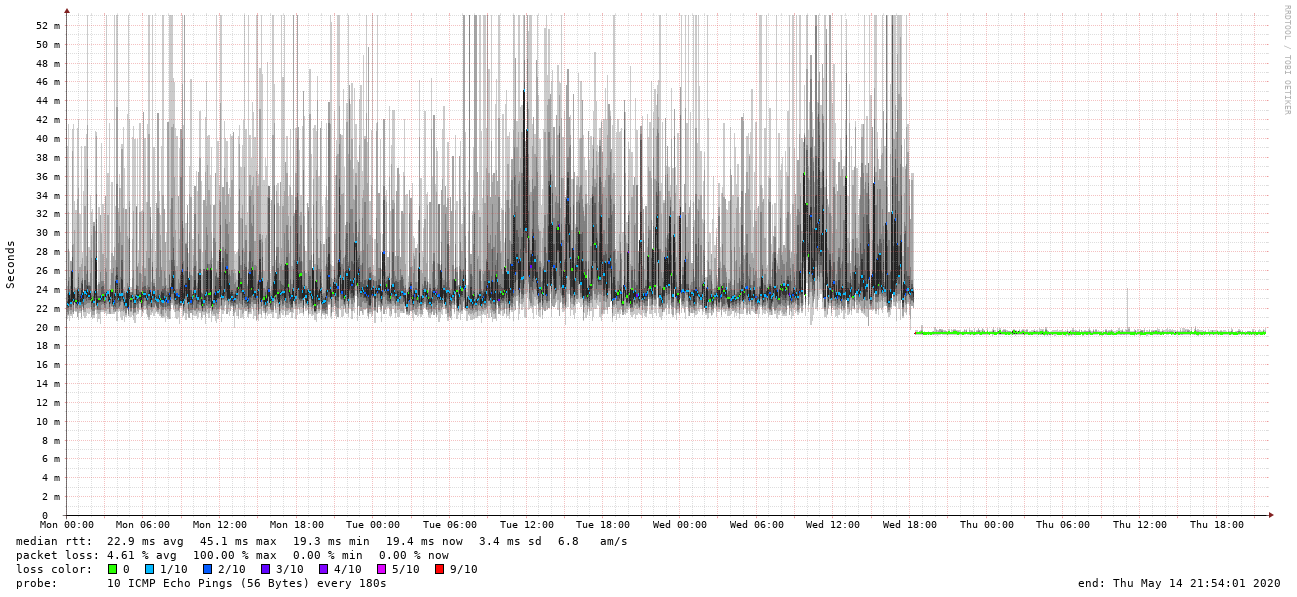
Note: all this is my personal experience, on my personal machines, and I don t claim it to be the absolute truth. Also, I don t directly call out names, although if you live in Switzerland it s pretty easy to guess who the old provider is from some hints. For a long time, I wanted to move away from my current (well, now past) provider, for a multitude of reasons. The main being that the company is very classic company, with classic support system, that doesn t work very well - I had troubles with their billing system that left me out cold without internet for 15 days, but for the recent few years, they were mostly OK, and changing to a different provider would have meant me routing a really long Ethernet cable around the apartment, so I kept postponing it. Yes, self-inflicted pain, I know. Until the entire work-from-home thing, when the usually stable connection start degrading in a very linear fashion day-by-day (this is a graph that basically reflects download bandwidth):
1+ month download bandwidth test 1+ month download bandwidth test
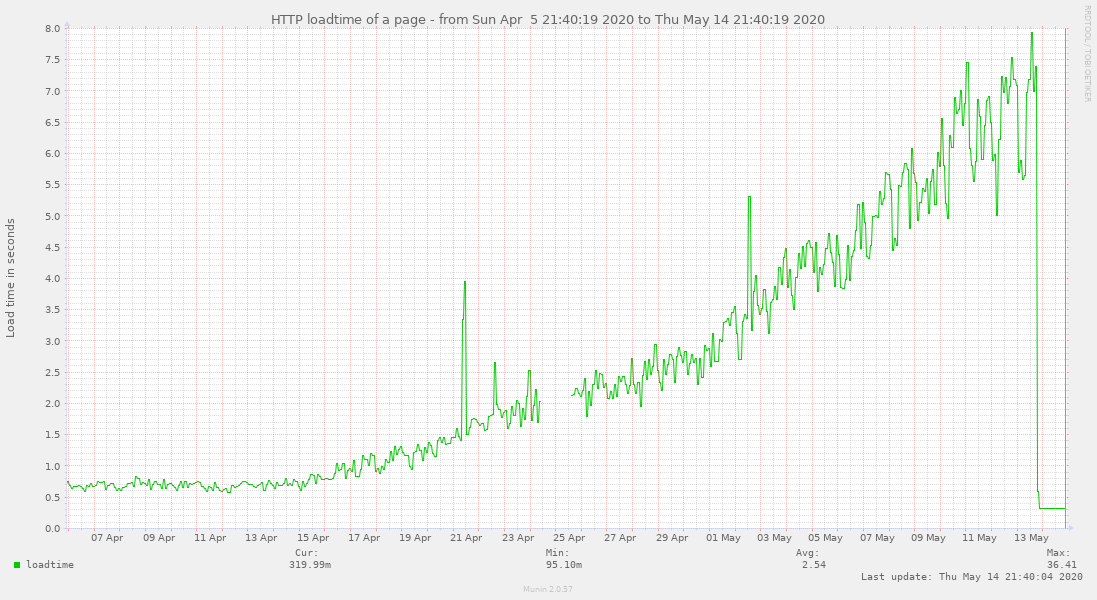
At first, I didn t realise this, as even 100Mbps is still fast enough. But once the connection went below (I believe) 50Mbps, it became visible in day to day work. And since I work daily from home yeah. Not fun. So I started doing speedtest.net - and oh my, ~20Mbps was a good result, usually 12-14Mbps. On a wired connection. On a connection that officially is supposed to be 600Mbps down. The upload speed was spot on, so I didn t think it was my router, but: Nothing helped. Once in a blue moon, speedtest would give me 100Mbps, but like once every two days, then it would be back and showing 8Mbps. Eight! It ended up as even apt update was tediously slow, and kernel downloads took ages The official instructions for dealing with bad internet are a joke: And the best part: If you are not satisfied with the results, read our internet optimisation guide. If you are still not happy, use our community forums or our social platforms. Given that it was a decline over 3-weeks, that I don t know of any computer component that would degrade this steadily but not throw any other errors, and that my upload speed was all good, I assumed it s the provider. Maybe I was wrong, but I wanted to do this anyway for a long while, so I went through the find how to route cable, check if other provider socket is good, order service, etc. dance, and less than a week later, I had the other connection. Now, of course, bandwidth works as expected:
1+ month updated bandwidth test 1+ month updated bandwidth test
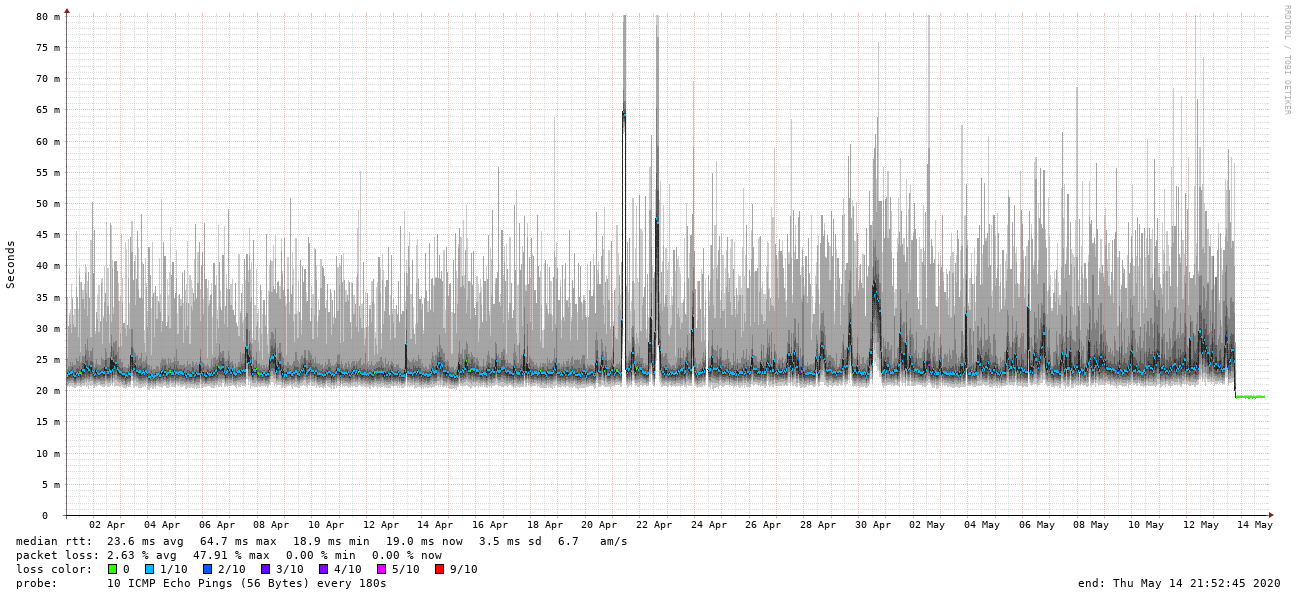
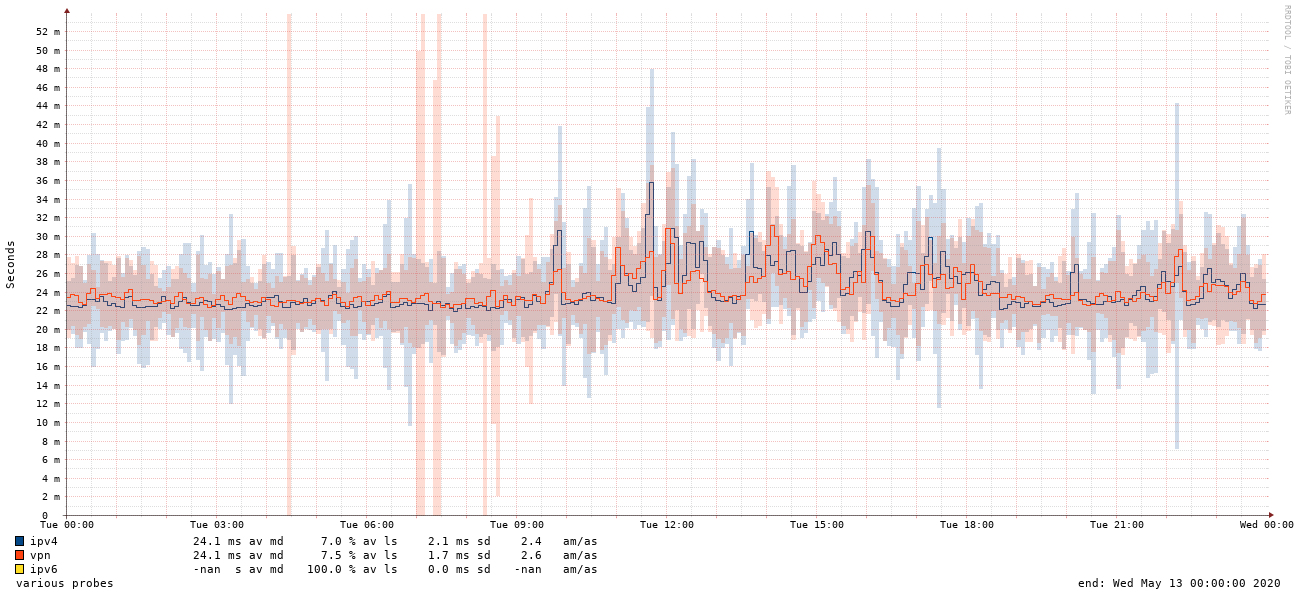
Both download and upload are fine (the graph above is just download). Latency is also much better, towards many parts of the internet that matter. But what is shocking is the difference in jitter to some external hosts I care about. On the previous provider, a funny thing was that both outgoing and incoming pings had both more jitter and packet loss when done directly (IPv4 to IPv4) than when done over a VPN. This doesn t make sense, since VPN is just overhead over IPv4, but the graphs show it, and what I think happens is that a VPN flow is cached in the provider s routers, whereas a simple ping packet not. But, the fact that there s enough jitter for a ping to a not-very-far host doesn t make me happy. Examples, outgoing:
Outgoing smokeping to public IPv4 Outgoing smokeping to public IPv4
Outgoing smokeping over VPN Outgoing smokeping over VPN
And incoming:
Incoming smokeping to public IPv4 Incoming smokeping to public IPv4
Incoming smokeping over VPN Incoming smokeping over VPN
Both incoming and outgoing show this weirdness - more packet loss and more jitter over VPN. Again, this is not a problem in practice, or not much, but makes me wonder what other shenanigans happen behind the scenes. You can also see clearly when the work from home traffic entered the picture and started significantly degrading my connection, even over the magically better VPN connection. Switching to this week s view shows the (in my opinion) dramatic improvement in consistency of the connection:
Outgoing current week smokeping to public IPv4 Outgoing current week smokeping to public IPv4
Outgoing current week smokeping over VPN Outgoing current week smokeping over VPN
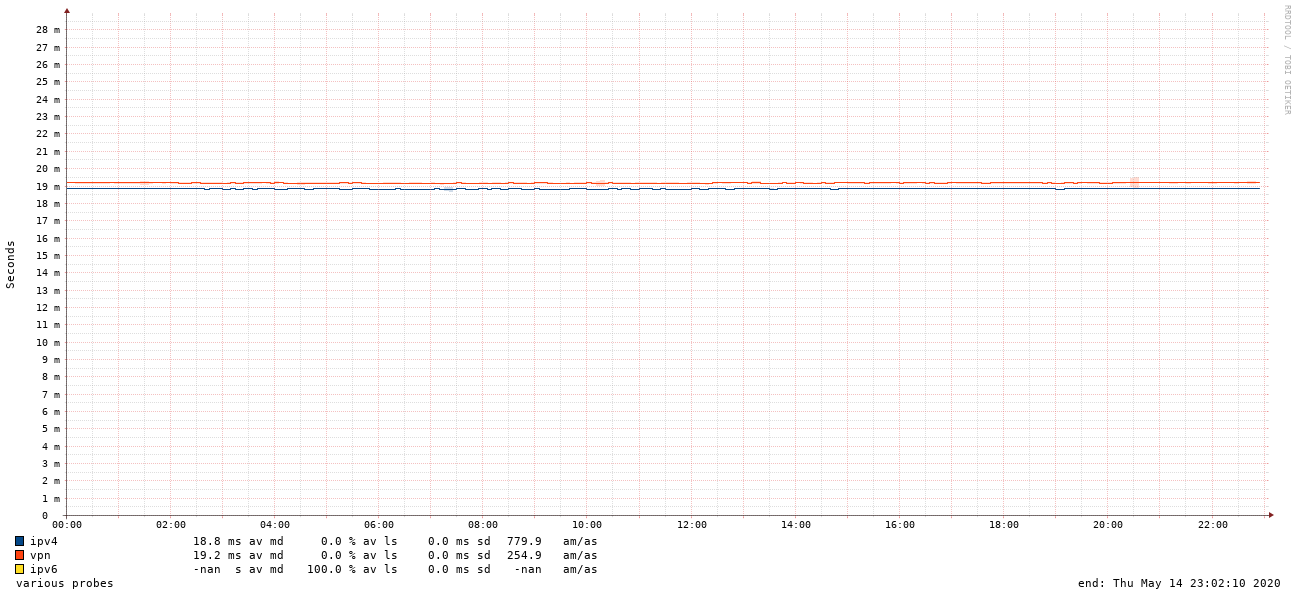
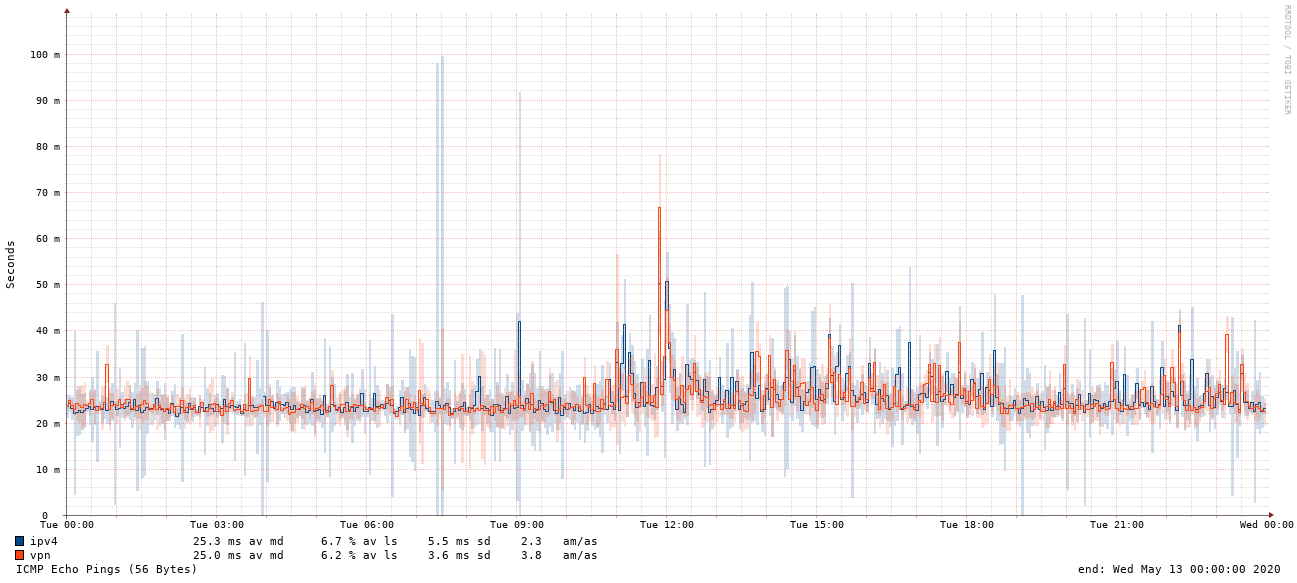
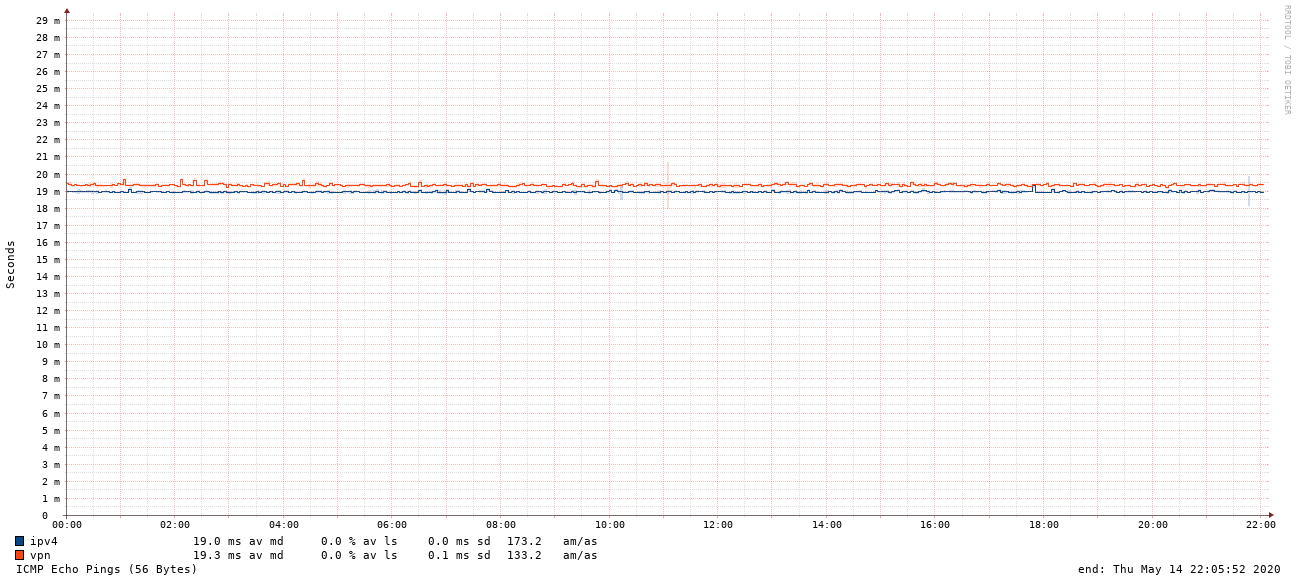
No more packet loss, no more jitter. You can also see my VPN being temporarily down during provider switchover because my firewall was not quite correct for a moment. And the last drill down, at high resolution, one day before and one day after switchover. Red is VPN, blue is plain IPv4, yellow is the missing IPv6 connection :) Incoming old:
Incoming 1-day smokeping, old provider Incoming 1-day smokeping, old provider
and new:
Incoming 1-day smokeping, new provider Incoming 1-day smokeping, new provider
Outgoing old:
Outgoing 1-day smokeping, old provider Outgoing 1-day smokeping, old provider
and new:
Outgoing 1-day smokeping, new provider Outgoing 1-day smokeping, new provider
This is what I expect, ping-over-VPN should of course be slower than plain ping. Note that incoming and outgoing have slightly different consistency, but that is fine for me :) The endpoints doing the two tests are different, so this is expected. Reading the legend on the graphs for the incoming connection (similar story for outgoing): So to my previous provider: it can be done better. Or at least, allow people easier ways to submit performance issue problems. For me, the moral of the story is that I should have switched a couple of years ago, instead of being lazy. And that I m curious to see how IPv6 traffic will differ, if at all :) Take care, everyone! And thanks for looking at these many graphs :)

12 May 2020

Daniel Silverstone: The Lars, Mark, and Daniel Club

Last night, Lars, Mark, and I discussed Jeremy Kun's The communicative value of using Git well post. While a lot of our discussion was spawned by the article, we did go off-piste a little, and I hope that my notes below will enlighten you all as to a bit of how we see revision control these days. It was remarkably pleasant to read an article where the comments section wasn't a cesspool of horror, so if this posting encourages you to go and read the article, don't stop when you reach the bottom -- the comments are good and useful too.
This was a fairly non-contentious article for us though each of us had points we wished to bring up and chat about it turned into a very convivial chat. We saw the main thrust of the article as being about using the metadata of revision control to communicate intent, process, and decision making. We agreed that it must be possible to do so effectively with Mercurial (thus deciding that the mention of it was simply a bit of clickbait / red herring) and indeed Mark figured that he was doing at least some of this kind of thing way back with CVS. We all discussed how knowing the fundamentals of Git's data model improved our ability to work wih the tool. Lars and I mentioned how jarring it has originally been to come to Git from revision control systems such as Bazaar (bzr) but how over time we came to appreciate Git for what it is. For Mark this was less painful because he came to Git early enough that there was little more than the fundamental data model, without much of the porcelain which now exists. One point which we all, though Mark in particular, felt was worth considering was that of distinguishing between published and unpublished changes. The article touches on it a little, but one of the benefits of the workflow which Jeremy espouses is that of using the revision control system as an integral part of the review pipeline. This is perhaps done very well with Git based workflows, but can be done with other VCSs. With respect to the points Jeremy makes regarding making commits which are good for reviewing, we had a general agreement that things were good and sensible, to a point, but that some things were missed out on. For example, I raised that commit messages often need to be more thorough than one-liners, but Jeremy's examples (perhaps through expedience for the article?) were all pretty trite one-liners which perhaps would have been entirely obvious from the commit content. Jeremy makes the point that large changes are hard to review, and Lars poined out that Greg Wilson did research in this area, and at least one article mentions 200 lines as a maximum size of a reviewable segment. I had a brief warble at this point about how reviewing needs to be able to consider the whole of the intended change (i.e. a diff from base to tip) not just individual commits, which is also missing from Jeremy's article, but that such a review does not need to necessarily be thorough and detailed since the commit-by-commit review remains necessary. I use that high level diff as a way to get a feel for the full shape of the intended change, a look at the end-game if you will, before I read the story of how someone got to it. As an aside at this point, I talked about how Jeremy included a 'style fixes' commit in his example, but I loathe seeing such things and would much rather it was either not in the series because it's unrelated to it; or else the style fixes were folded into the commits they were related to. We discussed how style rules, as well as commit-bisectability, and other rules which may exist for a codebase, the adherence to which would form part of the checks that a code reviewer may perform, are there to be held to when they help the project, and to be broken when they are in the way of good communication between humans. In this, Lars talked about how revision control histories provide high level valuable communication between developers. Communication between humans is fraught with error and the rules are not always clear on what will work and what won't, since this depends on the communicators, the context, etc. However whatever communication rules are in place should be followed. We often say that it takes two people to communicate information, but when you're writing commit messages or arranging your commit history, the second party is often nebulous "other" and so the code reviewer fulfils that role to concretise it for the purpose of communication. At this point, I wondered a little about what value there might be (if any) in maintaining the metachanges (pull request info, mailing list discussions, etc) for historical context of decision making. Mark suggested that this is useful for design decisions etc but not for the style/correctness discussions which often form a large section of review feedback. Maybe some of the metachange tracking is done automatically by the review causing the augmentation of the changes (e.g. by comments, or inclusion of design documentation changes) to explain why changes are made. We discussed how the "rebase always vs. rebase never" feeling flip-flopped in us for many years until, as an example, what finally won Lars over was that he wants the history of the project to tell the story, in the git commits, of how the software has changed and evolved in an intentional manner. Lars said that he doesn't care about the meanderings, but rather about a clear story which can be followed and understood. I described this as the switch from "the revision history is about what I did to achieve the goal" to being more "the revision history is how I would hope someone else would have done this". Mark further refined that to "The revision history of a project tells the story of how the project, as a whole, chose to perform its sequence of evolution." We discussed how project history must necessarily then contain issue tracking, mailing list discussions, wikis, etc. There are exist free software projects where part of their history is forever lost because, for example, the project moved from Sourceforge to Github, but made no effort (or was unable) to migrate issues or somesuch. Linkages between changes and the issues they relate to can easily be broken, though at least with mailing lists you can often rewrite URLs if you have something consistent like a Message-Id. We talked about how cover notes, pull request messages, etc. can thus also be lost to some extent. Is this an argument to always use merges whose message bodies contain those details, rather than always fast-forwarding? Or is it a reason to encapsulate all those discussions into git objects which can be forever associated with the changes in the DAG? We then diverted into discussion of CI, testing every commit, and the benefits and limitations of automated testing vs. manual testing; though I think that's a little too off-piste for even this summary. We also talked about how commit message audiences include software perhaps, with the recent movement toward conventional commits and how, with respect to commit messages for machine readability, it can become very complex/tricky to craft good commit messages once there are multiple disparate audiences. For projects the size of the Linux kernel this kind of thing would be nearly impossible, but for smaller projects, perhaps there's value. Finally, we all agreed that we liked the quote at the end of the article, and so I'd like to close out by repeating it for you all... Hal Abelson famously said:
Programs must be written for people to read, and only incidentally for machines to execute.
Jeremy agrees, as do we, and extends that to the metacommit information as well.

Petter Reinholdtsen: Debian Edu interview: Yvan Masson

It has been way too long since my last interview, but as the Debian Edu / Skolelinux community is still active, and new people keep showing up on the IRC channel #debian-edu and the debian-edu mailing list, I decided to give it another go. I was hoping someone else might pick up the idea and run with it, but this has not happened as far as I can tell, so here we are This time the announcement of a new free software tool to create a school year book triggered my interest, and I decided to learn more about its author. Who are you, and how do you spend your days? My name is Yvan MASSON, I live in France. I have my own one person business in computer services. The work consist of visiting my customers (person's home, local authority, small business) to give advise, install computers and software, fix issues, and provide computing usage training. I spend the rest of my time enjoying my family and promoting free software. What is your approach for promoting free software? When I think that free software could be suitable for someone, I explain what it is, with simple words, give a few known examples, and explain that while there is no fee it is a viable alternative in many situations. Most people are receptive when you explain how it is better (I simplify arguments here, I know that it is not so simple): Linux works on older hardware, there are no viruses, and the software can be audited to ensure user is not spied upon. I think the most important is to keep a clear but moderated speech: when you try to convince too much, people feel attacked and stop listening. How did you get in contact with the Skolelinux / Debian Edu project? I can not remember how I first heard of Skolelinux / Debian Edu, but probably on planet.debian.org. As I have been working for a school, I have interest in this type of project. The school I am involved in is a school for "children" between 14 and 18 years old. The French government has recommended free software since 2012, but they do not always use free software themselves. The school computers are still using the Windows operating system, but all of them have the classic set of free software: Firefox ESR, LibreOffice (with the excellent extension Grammalecte that indicates French grammatical errors), SumatraPDF, Audacity, 7zip, KeePass2, VLC, GIMP, Inkscape What do you see as the advantages of Skolelinux / Debian Edu? It is free software! Built on Debian, I am sure that users are not spied upon, and that it can run on low end hardware. This last point is very important, because we really need to improve "green IT". I do not know enough about Skolelinux / Debian Edu to tell how it is better than another free software solution, but what I like is the "all in one" solution: everything has been thought of and prepared to ease installation and usage. I like Free Software because I hate using something that I can not understand. I do not say that I can understand everything nor that I want to understand everything, but knowing that someone / some company intentionally prevents me from understanding how things work is really unacceptable to me. Secondly, and more importantly, free software is a requirement to prevent abuses regarding human rights and environmental care. Humanity can not rely on tools that are in the hands of small group of people. What do you see as the disadvantages of Skolelinux / Debian Edu? Again, I don't know this project enough. Maybe a dedicated website? Debian wiki works well for documentation, but is not very appealing to someone discovering the project. Also, as Skolelinux / Debian Edu uses OpenLDAP, it probably means that Windows workstations cannot use centralized authentication. Maybe the project could use Samba as an Active Directory domain controller instead, allowing Windows desktop usage when necessary. (Editors note: In fact Windows workstations can use the centralized authentication in a Debian Edu setup, at least for some versions of Windows, but the fact that this is not well known can be seen as an indication of the need for better documentation and marketing. :) Which free software do you use daily? Nothing original: Debian testing/sid with Gnome desktop, Firefox, Thunderbird, LibreOffice Which strategy do you believe is the right one to use to get schools to use free software? Every effort to spread free software into schools is important, whatever it is. But I think, at least where I live, that IT professionals maintaining schools networks are still very "Microsoft centric". Schools will use any working solution, but they need people to install and maintain it. How to make these professionals sensitive about free software and train them with solutions like Debian Edu / Skolelinux is a really good question :-)

10 May 2020

NOKUBI Takatsugu: Virtual Background using webcam

I made a webpage to produce virtual background with webcam. https://knok.github.io/virtbg/ Sorcecode:
https://github.com/knok/knok.github.io/tree/master/virtbg Some online meeting software (Zoom, Microsoft Teams) supports virtual background, but I want to use other software like Jitsi (or google meet), so I made it. To make this, I referred the article Open Source Virtual Background .
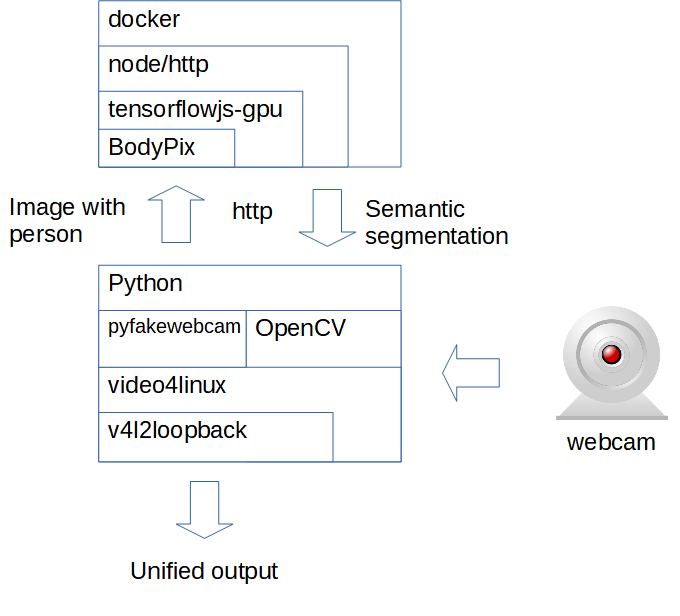
The following figure is the diagram.
It depends on docker, GPU, v4l2loopback (only works on Linux), so I want to make more generic solution. To make as a webpage, and using OBS
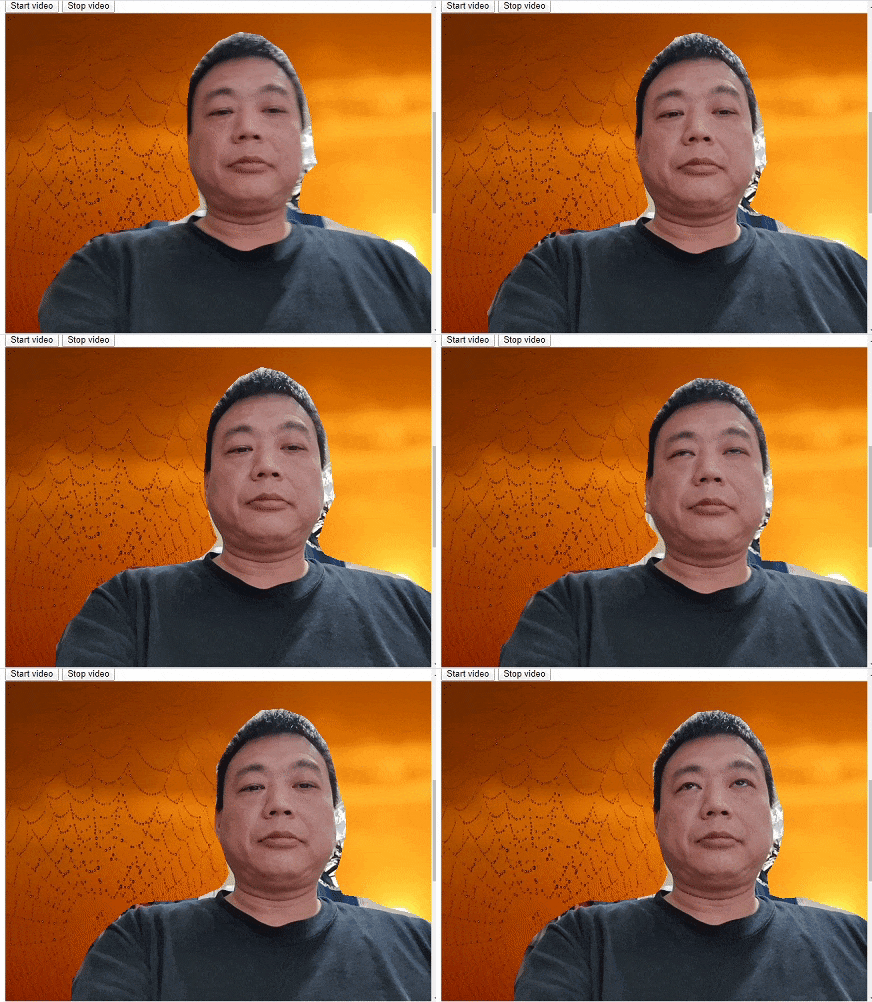
Studio with plugins (obs-v4l2sink, OBS-VirtualCam or OBS (macOS) Virtual Camera) you can use the solution on more platforms. To make as a single webpage, I can reduce overhead using inter-process commuication using http via docker. This is an example animation:
y4069-ju7wv.gif
Using jisti snapshot:
image.png
Unfortunately, BodyPix releases only pretraind models, no training data. I need more improvements:

8 May 2020

Petter Reinholdtsen: Jami as a Zoom client, a trick for password protected rooms...

Half a year ago, I wrote about the Jami communication client, capable of peer-to-peer encrypted communication. It handle both messages, audio and video. It uses distributed hash tables instead of central infrastructure to connect its users to each other, which in my book is a plus. I mentioned briefly that it could also work as a SIP client, which came in handy when the higher educational sector in Norway started to promote Zoom as its video conferencing solution. I am reluctant to use the official Zoom client software, due to their copyright license clauses prohibiting users to reverse engineer (for example to check the security) and benchmark it, and thus prefer to connect to Zoom meetings with free software clients. Jami worked OK as a SIP client to Zoom as long as there was no password set on the room. The Jami daemon leak memory like crazy (approximately 1 GiB a minute) when I am connected to the video conference, so I had to restart the client every 7-10 minutes, which is not a great. I tried to get other SIP Linux clients to work without success, so I decided I would have to live with this wart until someone managed to fix the leak in the dring code base. But another problem showed up once the rooms were password protected. I could not get my dial tone signaling through from Jami to Zoom, and dial tone signaling is used to enter the password when connecting to Zoom. I tried a lot of different permutations with my Jami and Asterisk setup to try to figure out why the signaling did not get through, only to finally discover that the fundamental problem seem to be that Zoom is simply not able to receive dial tone signaling when connecting via SIP. There seem to be nothing wrong with the Jami and Asterisk end, it is simply broken in the Zoom end. I got help from a very skilled VoIP engineer figuring out this last part. And being a very skilled engineer, he was also able to locate a solution for me. Or to be exact, a workaround that solve my initial problem of connecting to password protected Zoom rooms using Jami. So, how do you do this, I am sure you are wondering by now. The trick is already documented from Zoom, and it is to modify the SIP address to include the room password. What is most surprising about this is that the automatically generated email from Zoom with instructions on how to connect via SIP do not mention this. The SIP address to use normally consist of the room ID (a number), an @ character and the IP address of the Zoom SIP gateway. But Zoom understand a lot more than just the room ID in front of the at sign. The format is "[Meeting ID].[Password].[Layout].[Host Key]", and you can hear see how you can both enter password, control the layout (full screen, active presence and gallery) and specify the host key to start the meeting. The full SIP address entered into Jami to provide the password will then look like this (all using made up numbers):
sip:657837644.522827@192.168.169.170
Now if only jami would reduce its memory usage, I could even recommend this setup to others. :) As usual, if you use Bitcoin and want to show your support of my activities, please send Bitcoin donations to my address 15oWEoG9dUPovwmUL9KWAnYRtNJEkP1u1b.

6 May 2020

Reproducible Builds: Reproducible Builds in April 2020

Welcome to the April 2020 report from the Reproducible Builds project. In our regular reports we outline the most important things that we and the rest of the community have been up to over the past month. What are reproducible builds? One of the original promises of open source software is that distributed peer review and transparency of process results in enhanced end-user security. But whilst anyone may inspect the source code of free and open source software for malicious flaws, almost all software today is distributed as pre-compiled binaries. This allows nefarious third-parties to compromise systems by injecting malicious code into seemingly secure software during the various compilation and distribution processes.

News It was discovered that more than 725 malicious packages were downloaded thousands of times from RubyGems, the official channel for distributing code for the Ruby programming language. Attackers used a variation of typosquatting and replaced hyphens and underscores (for example, uploading a malevolent atlas-client in place of atlas_client) that executed a script that intercepted Bitcoin payments. (Ars Technica report) Bernhard M. Wiedemann launched ismypackagereproducibleyet.org, a service that takes a package name as input and displays whether the package is reproducible in a number of distributions. For example, it can quickly show the status of Perl as being reproducible on openSUSE but not in Debian. Bernhard also improved the documentation of his unreproducible package to add some example patches for hash issues. [ ]. There was a post on Chaos Computer Club s website listing Ten requirements for the evaluation of Contact Tracing apps in relation to the SARS-CoV-2 epidemic. In particular:
4. Transparency and verifiability: The complete source code for the app and infrastructure must be freely available without access restrictions to allow audits by all interested parties. Reproducible build techniques must be used to ensure that users can verify that the app they download has been built from the audited source code.
Elsewhere, Nicolas Boulenguez wrote a patch for the Ada programming language component of the GCC compiler to skip -f.*-prefix-map options when writing Ada Library Information files. Amongst other properties, these .ali files embed the compiler flags used at the time of the build which results in the absolute build path being recorded via -ffile-prefix-map, -fdebug-prefix-map, etc. In the Arch Linux project, kpcyrd reported that they held their first rebuilder workshop . The session was held on IRC and participants were provided a document with instructions on how to install and use Arch s repro tool. The meeting resulted in multiple people with no prior experience of Reproducible Builds validate their first package. Later in the month he also announced that it was now possible to run independent rebuilders under Arch in a hands-off, everything just works solution to distributed package verification. Mathias Lang submitted a pull request against dmd, the canonical compiler for the D programming languageto add support for our SOURCE_DATE_EPOCH environment variable as well the other C preprocessor tokens such __DATE__, __TIME__ and __TIMESTAMP__ which was subsequently merged. SOURCE_DATE_EPOCH defines a distribution-agnostic standard for build toolchains to consume and emit timestamps in situations where they are deemed to be necessary. [ ] The Telegram instant-messaging platform announced that they had updated to version 5.1.1 continuing their claim that they are reproducible according to their full instructions and therefore verifying that its original source code is exactly the same code that is used to build the versions available on the Apple App Store and Google Play distribution platforms respectfully. Lastly, Herv Boutemy reported that 97% of the current development versions of various Maven packages appear to have a reproducible build. [ ]

Distribution work In Debian this month, 89 reviews of Debian packages were added, 21 were updated and 33 were removed this month adding to our knowledge about identified issues. Many issue types were noticed, categorised and updated by Chris Lamb, including: In addition, Holger Levsen filed a feature request against debrebuild, a tool for rebuilding a Debian package given a .buildinfo file, proposing to add --standalone or --one-shot-mode functionality.
In openSUSE, Bernhard M. Wiedemann made the following changes: In Arch Linux, a rebuilder instance has been setup at reproducible.archlinux.org that is rebuilding Arch s [core] repository directly. The first rebuild has led to approximately 90% packages reproducible contrasting with 94% on the Reproducible Build s project own ArchLinux status page on tests.reproducible-builds.org that continiously builds packages and does not verify Arch Linux packages. More information may be found on the corresponding wiki page and the underlying decisions were explained on our mailing list.

Software development

diffoscope Chris Lamb made the following changes to diffoscope, the Reproducible Builds project s in-depth and content-aware diff utility that can locate and diagnose reproducibility issues (including preparing and uploading versions 139, 140, 141, 142 and 143 to Debian which were subsequently uploaded to the backports repository):
  • Comparison improvements:
    • Dalvik .dex files can also serve as APK containers so restrict the narrower identification of .dex files to files ending with this extension and widen the identification of APK files to when file(1) discovers a Dalvik file. (#28)
    • Add support for Hierarchical Data Format (HD5) files. (#95)
    • Add support for .p7c and .p7b certificates. (#94)
    • Strip paths from the output of zipinfo(1) warnings. (#97)
    • Don t uselessly include the JSON similarity percentage if it is 0.0% . [ ]
    • Render multi-line difference comments in a way to show indentation. (#101)
  • Testsuite improvements:
    • Add pdftotext as a requirement to run the PDF test_metadata text. (#99)
    • apktool 2.5.0 changed the handling of output of XML schemas so update and restrict the corresponding test to match. (#96)
    • Explicitly list python3-h5py in debian/tests/control.in to ensure that we have this module installed during a test run to generate the fixtures in these tests. [ ]
    • Correct parsing of ./setup.py test --pytest-args arguments. [ ]
  • Misc:
    • Capitalise Ordering differences only in text comparison comments. [ ]
    • Improve documentation of FILE_TYPE_HEADER_PREFIX and FALLBACK_FILE_TYPE_HEADER_PREFIX to highlight that only the first 16 bytes are used. [ ]
Michael Osipov created a well-researched merge request to return diffoscope to using zipinfo directly instead of piping input via /dev/stdin in order to ensure portability to the BSD operating system [ ]. In addition, Ben Hutchings documented how --exclude arguments are matched against filenames [ ] and Jelle van der Waa updated the LLVM test fixture difference for LLVM version 10 [ ] as well as adding a reference to the name of the h5dump tool in Arch Linux [ ]. Lastly, Mattia Rizzolo also fixed in incorrect build dependency [ ] and Vagrant Cascadian enabled diffoscope to locate the openssl and h5dump packages on GNU Guix [ ][ ], and updated diffoscope in GNU Guix to version 141 [ ] and 143 [ ].

strip-nondeterminism strip-nondeterminism is our tool to remove specific non-deterministic results from a completed build. In April, Chris Lamb made the following changes:
  • Add deprecation plans to all handlers documenting how or if they could be disabled and eventually removed, etc. (#3)
  • Normalise *.sym files as Java archives. (#15)
  • Add support for custom .zip filename filtering and exclude two patterns of files generated by Maven projects in fork mode. (#13)

disorderfs disorderfs is our FUSE-based filesystem that deliberately introduces non-determinism into directory system calls in order to flush out reproducibility issues. This month, Chris Lamb fixed a long-standing issue by not drop UNIX groups in FUSE multi-user mode when we are not root (#1) and uploaded version 0.5.9-1 to Debian unstable. Vagrant Cascadian subsequently refreshed disorderfs in GNU Guix to version 0.5.9 [ ].

Upstream patches The Reproducible Builds project detects, dissects and attempts to fix as many currently-unreproducible packages as possible. We endeavour to send all of our patches upstream where appropriate. This month, we wrote a large number of such patches, including: In addition, Bernhard informed the following projects that their packages are not reproducible:
  • acoular (report unknown non-determinism)
  • cri-o (report a date issue)
  • gnutls (report certtool being unable to extend certificates beyond 2049)
  • gnutls (report copyright year variation)
  • libxslt (report a bug about non-deterministic output from data corruption)
  • python-astropy (report a future build failure in 2021)

Project documentation This month, Chris Lamb made a large number of changes to our website and documentation in the following categories:
  • Community engagement improvements:
    • Update instructions to register for Salsa on our Contribute page now that the signup process has been overhauled. [ ]
    • Make it clearer that joining the rb-general mailing list is probably a first step for contributors to take. [ ]
    • Make our full contact information easier to find in the footer (#19) and improve text layout using bullets to separate sections [ ].
  • Accessibility:
    • To improve accessibility, make all links underlined. (#12)
    • Use an enhanced foreground/background contrast ratio of 7.04:1. (#11)
  • General improvements:
  • Internals:
    • Move to using jekyll-redirect-from over manual redirect pages [ ][ ] and add a redirect from /docs/buildinfo/ to /docs/recording/. (#23)
    • Limit the website self-check to not scan generated files [ ] and remove the old layout checker now that I have migrated all them [ ].
    • Move the news archive under the /news/ namespace [ ] and improve formatting of archived news links [ ].
    • Various improvements to the draft template generation. [ ][ ][ ][ ]
In addition, Holger Levsen clarified exactly which month we ceased to do weekly reports [ ] and Mattia Rizzolo adjusted the title style of an event page [ ]. Marcus Hoffman also started a discussion on our website s issue tracker asking for clarification on embedded signatures and Chris Lamb subsequently replied and asked Marcus to go ahead and propose a concrete change.

Testing framework We operate a large and many-featured Jenkins-based testing framework that powers tests.reproducible-builds.org that, amongst many other tasks, tracks the status of our reproducibility efforts as well as identifies any regressions that have been introduced.
  • Chris Lamb:
    • Print the build environment prior to executing a build. [ ]
    • Drop a misleading disorderfs-debug prefix in log output when we change non-disorderfs things in the file and, as it happens, do not run disorderfs at all. [ ]
    • The CSS for the package report pages added a margin to all <a> HTML elements under <li> ones, which was causing a comma/bullet spacing issue. [ ]
    • Tidy the copy in the project links sidebar. [ ]
  • Holger Levsen:
    • General:
    • Debian:
      • Reduce scheduling frequency of the buster distribution on the arm64 architecture, etc.. [ ][ ]
      • Show builds per day on a per-architecture basis for the last year on the Debian dashboard. [ ]
      • Drop the Subgraph OS package set as development halted in 2017 or 2018. [ ]
      • Update debrebuild to version from the latest version of devscripts. [ ][ ]
      • Add or improve various parts of the documentation. [ ][ ][ ]
    • Work on a Debian rebuilder:
      • Integrate sbuild. [ ][ ][ ][ ][ ]
      • Select a random .buildinfo file and attempt to build and compare the result. [ ][ ][ ][ ]
      • Improve output and related output formatting. [ ][ ][ ][ ][ ]
      • Outline next steps for the development of the tool. [ ][ ][ ]
      • Various refactoring and code improvements. [ ][ ][ ]
Lastly, Mattia Rizzolo fixed some log parsing code regarding potentially-harmless warnings from package installation [ ][ ] and the usual build node maintenance was performed by Holger Levsen [ ][ ][ ] and Mattia Rizzolo [ ][ ][ ].

Misc news On our mailing list this month, Santiago Torres asked whether we were still publishing releases of our tools to our website and Chris Lamb replied that this was not the case and fixed the issue. Later in the month Santiago also reported that the signature for the disorderfs package did not pass its GPG verification which was also fixed by Chris Lamb. Hans-Christoph Steiner of the Guardian Project asked whether there would be interest in making our website translatable which resulted in a WIP merge request being filed against the website and a discussion on how to track translation updates.
If you are interested in contributing to the Reproducible Builds project, please visit our Contribute page on our website. However, you can get in touch with us via:

This month s report was written by Bernhard M. Wiedemann, Chris Lamb, Daniel Shahaf, Holger Levsen, Jelle van der Waa, kpcyrd, Mattia Rizzolo and Vagrant Cascadian. It was subsequently reviewed by a bunch of Reproducible Builds folks on IRC and the mailing list.

4 May 2020

Dima Kogan: Redirection and /dev/stderr

I just hit some unexpected unix-ism (or maybe Linux-ism?) that I'd like to mention here. I found a workaround, but if anybody knows what's actually happening and can enlighten me, please send me an email, and I'll update the post. OK, so I have a program that does stuff, and outputs its progress to stderr. And I'm invoking this from a shell script that also outputs stuff to stderr. A minimized sample:
echo "Outer print 1111" > /dev/stderr
perl -E 'say STDERR ("1111 1111 1111 1111 1111 1111 1111 1111\n")'
echo "Outer print 2222" > /dev/stderr
perl -E 'say STDERR ("2222 2222 2222 2222 2222 2222 2222 2222\n")'
Let's call this dothing.sh. This works just fine. Now let's say I want to log the output to a file. Naturally I do this:
./dothing.sh 2> /tmp/log
Surprisingly, this does not work:
$ bash dothing.sh 2> /tmp/log && cat /tmp/log
Outer print 2222
2222 2222 2222 2222 2222 2222 2222 2222
$ bash dothing.sh 2> /tmp/log && xxd /tmp/log
0000000: 4f75 7465 7220 7072 696e 7420 3232 3232  Outer print 2222
0000010: 0a00 0000 0000 0000 0000 0000 0000 0000  ................
0000020: 0000 0000 0000 0000 0032 3232 3220 3232  .........2222 22
0000030: 3232 2032 3232 3220 3232 3232 2032 3232  22 2222 2222 222
0000040: 3220 3232 3232 2032 3232 3220 3232 3232  2 2222 2222 2222
0000050: 0a0a                                     ..
The 1111 prints are gone, and we now have a block of binary 0 bytes in there for some reason. I had been assuming that writes to stderr block until they're finished. So I can, without thinking about it, mix writing to fd 2 and opening, and then writing to /dev/stderr. Apparently the right way to do this is to write to fd 2 in the script directly, instead of opening /dev/stderr:
echo "Outer print 1111" >&2
perl -E 'say STDERR ("1111 1111 1111 1111 1111 1111 1111 1111\n")'
echo "Outer print 2222" >&2
perl -E 'say STDERR ("2222 2222 2222 2222 2222 2222 2222 2222\n")'
Why?

Update So I poked at it for a bit more, and it turns out that the obvious scapegoat (buffering) is actually not the issue. The problem is this:

$ ls -l /dev/stderr(:A)
-rw-r--r-- 1 dima dima 36 May  4 17:02 /tmp/log
:A is the zsh syntax for recursive link-following. /dev/stderr is thus ultimately a link to /tmp/log. So the file on disk /tmp/log is being opened for writing and written-to twice at the same time
  • once in the outer 2>/tmp/log redirection
  • again in the inner >/dev/stderr redirection
Now we know. Thanks to Larry Doolittle for pointers.

3 May 2020

Sean Whitton: Processing mail from discussion lists differently

I realised this week that for some years I have been applying Inbox Zero indiscriminately to all e-mail that I receive, but this does not make sense, and has some downsides. My version of Inbox Zero works very well when applied to mail addressed directly to me, and for mail to certain mailing lists, where each post to the list might as well be addressed directly to me, in addition to the list. However, I also receive by e-mail the following things to which I now believe Inbox Zero should not be applied: I believe that applying Inbox Zero to these sorts of things is not only incorrect but is actually harming my engagement with these mediums. Let us distinguish

  1. processing e-mail this means applying the Inbox Zero decision procedure to incoming messages, at set times during the day (I do it once, around 4pm)
  2. browsing and sometimes catching up RSS articles and list mail looking through unread items, replying if I think I have something useful to say, leaving things for later, and occasionally marking all as read if I ve not had time for that group of lists lately.
These should be kept apart. The easy case to see is why you shouldn t apply the browsing/catching up approach to e-mail which should rather be processed that s just the original wisdom of Inbox Zero. And clearly you don t want ever to have to resort to just marking all mail addressed directly to you as read. What goes wrong, then, if you misapply the processing mentality to e-mail which should, rather, be browsed/caught up? Well, the core of Inbox Zero is deciding whether to read and reply to something right now, add it to your todo list to handle later, or decide the mail cannot be dealt with quickly but is not important enough to go on that todo list. If you apply this to RSS articles and discussion list mail, then the third option is basically ruled out, because almost nothing on mailing lists or on blogs that I follow is important enough to go on my list of Real Tasks. But then you re faced with either reading the article/post right now, or discarding it. There is no option to leave the item marked as unread and then maybe come back to it, or postpone discarding it until you ve decided to catch up the group. Applying Inbox Zero to discussion lists and RSS feeds creates a false sense of urgency. I ve realised that my implicit response to this has been reluctance to subscribe to new mailing lists and feeds, because I don t have things set up to allow me to read them in a leisurely way. But then I m missing out on discussions and writing that might be relevant and beneficial to me if I could only approach them when I m in a frame of mind other than time to get my inbox down to zero . This also means that subscribing to new mailing lists just in order to post something has an unreasonably high cost: introducing all mail on those lists into my Inbox Zero processing window. So, what s needed is to make the virtual folder views which I use to read new mail correspond cleanly to the distinction between mail to be processed and mail to be browsed. I.e. for each virtual folder it should be clear whether mail there is to be processed or to be browsed. Then I can continue to use my processing views once per day, and access the browsing views at leisure. (Indeed, I ve created a keybinding to cycle through the new browsing views, and another to catch them up.) As I mentioned, some list mail ought to be processed. For example, I want to process rather than browse the debian-policy mailing list, as one of the Policy Editors. With notmuch, it s easy to include this mail in the relevant processing views (I ve long had one processing view for weekdays and another for weekends). Additionally, I ve used a bit of Emacs Lisp to create a dynamic uncategorised unread view which catches mail to be browsed which (i) doesn t show up in one of the other virtual folders for mail to be browsed, and (ii) doesn t show up in one of the processing views. So now subscribing to a mailing list is cheap: mail will end up in the uncategorised view, and I can decide whether to leave it there for a low traffic list; create a new virtual folder for the list (trivial as it s all just more Emacs Lisp, no actual moving of files required); or unsubscribe. I ve been experiencing nostalgia for my time in secondary school when my friends and I had all sorts of interesting stuff flowing into our mailstores, from RSS feeds to each other s blogs where we d post both our own content and links elsewhere, RSS feeds to stranger s blogs, and e-mails sent to each other with links. We didn t have to worry about processing anything back then, as our e-mail accounts were used for intellectual enrichment but not the completion of tasks. I think I can recapture something of that with my new virtual folders for browsing.

Evgeni Golov: Remote management for OpenWRT devices without opening inbound connections

Everyone is working from home these days and needs a decent Internet connection. That's especially true if you need to do video calls and the room you want to do them has the worst WiFi coverage of the whole flat. Well, that's exactly what happened to my parents in law. When they moved in, we knew that at some point we'll have to fix the WiFi - the ISP provided DSL/router/WiFi combo would not cut it, especially not with the shape of the flat and the elevator shaft in the middle of it: the flat is essentially a big C around said shaft. But it was good enough for email, so we postponed that. Until now. The flat has wired Ethernet, but the users MacBook Air does not. That would have been too easy, right? So let's add another access point and hope the situation improves. Luckily I still had a TP-Link Archer C7 AC1750 in a drawer, which I could quickly flash with a fresh OpenWRT release, disable DHCPd and configure the same SSID and keys as the main/old WiFi. But I didn't know which channels would be best in the destination environment. Under normal circumstances, I'd just take the AP, drive to my parents in law and finish the configuration there. Nope, not gonna happen these days. So my plan was to finish configuration here, put the AP in a box and on the porch where someone can pick it up. But this would leave me without a way to further configure the device once it has been deployed - I was not particularly interested in trying to get port forwarding configured via phone and I was pretty sure UPnP was disabled in the ISP router. Installing a Tor hidden service for SSH was one possibility, setting up a VPN and making the AP a client another. Well, or just creating a reverse tunnel with SSH! sshtunnel Creating a tunnel with OpenSSH is easy: ssh -R127.0.0.1:2222:127.0.0.1:22 server.example.com will forward localhost:2222 on server.example.com to port 22 of the machine the SSH connection originated from. But what happens if the connection dies? Adding a while true; do ; done around it might help, but I would really like not to reinvent the wheel here! Thankfully, somebody already invented that particular wheel and OpenWRT comes with a sshtunnel package that takes care of setting up and keeping up such tunnels and documentation how to do so. Just install the sshtunnel package, edit /etc/config/sshtunnel to contain a server stanza with hostname, port and username and a tunnelR stanza referring said server plus the local and remote sides of the tunnel and you're good to go.
config server home
  option user     user
  option hostname server.example.com
  option port     22
config tunnelR local_ssh
  option server         home
  option remoteaddress  127.0.0.1
  option remoteport     2222
  option localaddress   127.0.0.1
  option localport      22
The only caveat is that sshtunnel needs the OpenSSH client binary (and the package correctly depends on it) and OpenWRT does not ship the ssh-keygen tool from OpenSSH but only the equivalent for Dropbear. As OpenSSH can't read Dropbear keys (and vice versa) you'll have to generate the key somewhere else and deploy it to the OpenWRT box and the target system. Oh, and OpenWRT defaults to enabling password login via SSH, so please disable that if you expose the box to the Internet in any way! Using the tunnel After configuring and starting the service, you'll see the OpenWRT system logging in to the configured remote and opening the tunnel. For some reason that connection would not show up in the output of w -- probably because there was no shell started or something, but logs show it clearly. Now it's just a matter of connecting to the newly open port and you're in. As the port is bound to 127.0.0.1, the connection is only possible from server.example.com or using it as a jump host via OpenSSH's ProxyJump option: ssh -J server.example.com -p 2222 root@localhost. Additionally, you can forward a local port over the tunneled connection to create a tunnel for the OpenWRT webinterface: ssh -J server.example.com -p 2222 -L8080:localhost:80 root@localhost. Yes, that's a tunnel inside a tunnel, and all the network engineers will go brrr, but it works and you can access LuCi on http://localhost:8080 just fine. If you don't want to type that every time, create an entry in your .ssh/config:
Host openwrt
  ProxyJump server.example.com
  HostName localhost
  Port 2222
  User root
  LocalForward 8080 localhost:80
And we're done. Enjoy easy access to the newly deployed box and carry on.

Fran ois Marier: Backing up to a GnuBee PC 2

After installing Debian buster on my GnuBee, I set it up for receiving backups from my other computers.

Software setup I started by configuring it like a typical server but without a few packages that either take a lot of memory or CPU: I changed the default hostname:
  • /etc/hostname: foobar
  • /etc/mailname: foobar.example.com
  • /etc/hosts: 127.0.0.1 foobar.example.com vogar localhost
and then installed the avahi-daemon package to be able to reach this box using foobar.local. I noticed the presence of a world-writable directory and so I tightened the security of some of the default mount points by putting the following in /etc/rc.local:
mount -o remount,nodev,nosuid /etc/network
mount -o remount,nodev,nosuid /lib/modules
chmod 755 /etc/network
exit 0

Hardware setup My OS drive (/dev/sda) is a small SSD so that the GnuBee can run silently when the spinning disks aren't needed. To hold the backup data on the other hand, I got three 4-TB drives drives which I setup in a RAID-5 array. If the data were valuable, I'd use RAID-6 instead since it can survive two drives failing at the same time, but in this case since it's only holding backups, I'd have to lose the original machine at the same time as two of the 3 drives, a very unlikely scenario. I created new gpt partition tables on /dev/sdb, /dev/sdbc, /dev/sdd and used fdisk to create a single partition of type 29 (Linux RAID) on each of them. Then I created the RAID array:
mdadm /dev/md127 --create -n 3 --level=raid5 -a /dev/sdb1 /dev/sdc1 /dev/sdd1
and waited more than 24 hours for that operation to finish. Next, I formatted the array:
mkfs.ext4 -m 0 /dev/md127
and added the following to /etc/fstab:
/dev/md127 /mnt/data/ ext4 noatime,nodiratime 0 2
To reduce unnecessary noise and reduce power consumption, I also installed hdparm:
apt install hdparm
and configured all spinning drives to spin down after being idle for 10 minutes by putting the following in /etc/hdparm.conf:
/dev/sdb  
       spindown_time = 120
 
/dev/sdc  
       spindown_time = 120
 
/dev/sdd  
       spindown_time = 120
 
and then reloaded the configuration:
 /usr/lib/pm-utils/power.d/95hdparm-apm resume
Finally I setup smartmontools by putting the following in /etc/smartd.conf:
/dev/sda -a -o on -S on -s (S/../.././02 L/../../6/03)
/dev/sdb -a -o on -S on -s (S/../.././02 L/../../6/03)
/dev/sdc -a -o on -S on -s (S/../.././02 L/../../6/03)
/dev/sdd -a -o on -S on -s (S/../.././02 L/../../6/03)
and restarting the daemon:
systemctl restart smartd.service

Backup setup I started by using duplicity since I have been using that tool for many years, but a 190GB backup took around 15 hours on the GnuBee with gigabit ethernet. After a friend suggested it, I took a look at restic and I have to say that I am impressed. The same backup finished in about half the time.

User and ssh setup After hardening the ssh setup as I usually do, I created a user account for each machine needing to backup onto the GnuBee:
adduser machine1
adduser machine1 sshuser
adduser machine1 sftponly
chsh machine1 -s /bin/false
and then matching directories under /mnt/data/home/:
mkdir /mnt/data/home/machine1
chown machine1:machine1 /mnt/data/home/machine1
chmod 700 /mnt/data/home/machine1
Then I created a custom ssh key for each machine:
ssh-keygen -f /root/.ssh/foobar_backups -t ed25519
and placed it in /home/machine1/.ssh/authorized_keys on the GnuBee. On each machine, I added the following to /root/.ssh/config:
Host foobar.local
    User machine1
    Compression no
    Ciphers aes128-ctr
    IdentityFile /root/backup/foobar_backups
    IdentitiesOnly yes
    ServerAliveInterval 60
    ServerAliveCountMax 240
The reason for setting the ssh cipher and disabling compression is to speed up the ssh connection as much as possible given that the GnuBee has avery small RAM bandwidth. Another performance-related change I made on the GnuBee was switching to the internal sftp server by putting the following in /etc/ssh/sshd_config:
Subsystem      sftp    internal-sftp

Restic script After reading through the excellent restic documentation, I wrote the following backup script, based on my old duplicity script, to reuse on all of my computers:
# Configure for each host
PASSWORD="XXXX"  # use  pwgen -s 64  to generate a good random password
BACKUP_HOME="/root/backup"
REMOTE_URL="sftp:foobar.local:"
RETENTION_POLICY="--keep-daily 7 --keep-weekly 4 --keep-monthly 12 --keep-yearly 2"
# Internal variables
SSH_IDENTITY="IdentityFile=$BACKUP_HOME/foobar_backups"
EXCLUDE_FILE="$BACKUP_HOME/exclude"
PKG_FILE="$BACKUP_HOME/dpkg-selections"
PARTITION_FILE="$BACKUP_HOME/partitions"
# If the list of files has been requested, only do that
if [ "$1" = "--list-current-files" ]; then
    RESTIC_PASSWORD=$PASSWORD restic --quiet -r $REMOTE_URL ls latest
    exit 0
# Show list of available snapshots
elif [ "$1" = "--list-snapshots" ]; then
    RESTIC_PASSWORD=$GPG_PASSWORD restic --quiet -r $REMOTE_URL snapshots
    exit 0
# Restore the given file
elif [ "$1" = "--file-to-restore" ]; then
    if [ "$2" = "" ]; then
        echo "You must specify a file to restore"
        exit 2
    fi
    RESTORE_DIR="$(mktemp -d ./restored_XXXXXXXX)"
    RESTIC_PASSWORD=$PASSWORD restic --quiet -r $REMOTE_URL restore latest --target "$RESTORE_DIR" --include "$2"   exit 1
    echo "$2 was restored to $RESTORE_DIR"
    exit 0
# Delete old backups
elif [ "$1" = "--prune" ]; then
    # Expire old backups
    RESTIC_PASSWORD=$PASSWORD restic --quiet -r $REMOTE_URL forget $RETENTION_POLICY
    # Delete files which are no longer necessary (slow)
    RESTIC_PASSWORD=$PASSWORD restic --quiet -r $REMOTE_URL prune
    exit 0
# Catch invalid arguments
elif [ "$1" != "" ]; then
    echo "Invalid argument: $1"
    exit 1
fi
# Check the integrity of existing backups
RESTIC_PASSWORD=$PASSWORD restic --quiet -r $REMOTE_URL check   exit 1
# Dump list of Debian packages
dpkg --get-selections > $PKG_FILE
# Dump partition tables from harddrives
/sbin/fdisk -l /dev/sda > $PARTITION_FILE
/sbin/fdisk -l /dev/sdb > $PARTITION_FILE
# Do the actual backup
RESTIC_PASSWORD=$PASSWORD restic --quiet --cleanup-cache -r $REMOTE_URL backup / --exclude-file $EXCLUDE_FILE
I run it with the following cronjob in /etc/cron.d/backups:
30 8 * * *    root  ionice nice nocache /root/backup/backup-machine1-to-foobar
30 2 * * Sun  root  ionice nice nocache /root/backup/backup-machine1-to-foobar --prune
in a way that doesn't impact the rest of the system too much. Finally, I printed a copy of each of my backup script, using enscript, to stash in a safe place:
enscript --highlight=bash --style=emacs --output=- backup-machine1-to-foobar   ps2pdf - > foobar.pdf
This is actually a pretty important step since without the password, you won't be able to decrypt and restore what's on the GnuBee.

1 May 2020

Paul Wise: FLOSS Activities April 2020

Changes

Issues

Review

Administration
  • myrepos: fix the forum
  • Debian: restart non-responsive tor daemon, restart processes due to OOM, apply debian.net changes for DD with expired key
  • Debian wiki: approve accounts
  • Debian QA services: deploy changes, auto-disable oldoldstable pockets

Communication

Sponsors The purple-discord work was sponsored by my employer. All other work was done on a volunteer basis.

30 April 2020

Jonathan McDowell: Let's talk about work/life balance in lock down

A SYNCNI article passed by on my Twitter feed this morning, talking about balancing work life balance while working from home in these times of COVID-19 inspired lock down. The associated Twitter thread expressed an interest in some words of advice from men to other men (because of course the original article has the woman having to do all the balancing). This post does not contain the words of advice searched for, but it hopefully at least offers some reassurance that if you re finding all of this difficult you re not alone. From talking to others I don t think there s anything particularly special we re doing in this house; a colleague is taking roughly the same approach, and some of the other folk I ve spoken to in the local tech scene seem to be doing likewise. First, the situation. Like many households both my wife and I work full time. We have a small child (not even a year and a half old yet). I work for a software startup, my wife is an HR business partner for a large multinational, dealing with employees all over the UK and Ireland. We re both luckily able to work from home easily - our day to day work machines are laptops, our employers were already setup with the appropriate VPN / video conferencing etc facilities. Neither of us has seen any decrease in workload since lock down; there are always more features and/or bugs to work on when it comes to a software product, and, as I m sure you can imagine, there has been a lot more activity in the HR sphere over the past 6 weeks as companies try to work out what to do. On top of this our childcare arrangements, like everyone else s, are completely gone. Nursery understandably shut down around the same time as the schools (slightly later, but not by much) and contact with grandparents is obviously out (which they re finding hard). So we re left with trying to fit 2 full time jobs in with full time childcare, of a child who up until recently tried to go down stairs by continuing to crawl forward. Make no mistake, this is hard. I know we are exceptionally lucky in our situation, but that doesn t mean we re finding it easy. We ve adopted an approach of splitting the day up. I take the morning slot (previously I would have got up with our son anyway), getting him up and fed while my wife showers. She takes over for a bit while I shower and dress, then I take over again in time for her to take her daily 8am conference call. My morning is mostly taken up with childcare until nap time; I try to check in first thing to make sure there s nothing urgent, and get a handle on what I might have to work on later in the day. My local team mates know they re more likely to get me late morning and it s better to arrange meetings in the afternoon. Equally I work with a lot of folk on the US West coast, so shifting my hours to be a bit later is not a problem there. After nap time (which, if we re lucky, takes us to lunch) my wife takes over. As she deals with UK/Ireland folk she often ends up having to take calls even while looking after our son; generally important meetings can be moved to the morning and meetings with folk who understand there might be a lot of pot banging going on in the background can happen in the afternoon. Having started late I generally work late - past the point where I d normally get home; if I m lucky I pop my head in for bath time, but sometimes it s only for a couple of minutes. We alternate cooking; usually based on work load + meetings. For example tonight I m cooking while my wife catches up on some work after having put our son to bed. Last night I had a few meetings so my wife cooked. So what s worked for us? Splitting the day means we can plan with our co-workers. We always make sure we eat together in the evening, and that generally is the cut-off point for either of us doing any work. I m less likely to be online in the evening because my study has become the place I work. That means I m not really doing any of my personal projects - this definitely isn t a case of being at home during lock down and having lots of time to achieve new things. It s much more of case of trying to find a sustainable way to get through the current situation, however long it might last.

29 April 2020

Ian Jackson: subdirmk 1.0 - ergonomic preprocessing assistant for non-recursive make

I have made the 1.0 release of subdirmk. subdirmk is a tool to help with writing build systems in make, without use of recursive make. Why Peter Miller's 1997 essay Recursive Make Considered Harmful persuasively argues that it is better to arrange to have a single make invocation with the project's complete dependency tree, rather than the conventional $(MAKE) -C subdirectory approach. This has become much more relevant with modern projects which tend to be large and have deep directory trees. Invoking make separately for each of these subdirectories can be very slow. Nowadays everyone needs to run a parallel build, but with the recursive make approach great discipline is needed to avoid introducing races which cause the build to sometimes fail. There are various new systems which aim to replace make. My general impression of these is that they mostly threw away the good parts of make (often, they discard the flexibility, and the use of the shell command as the basic unit of execution, making them hard to extend), or make other unfortunate assumptions. And there are a lot of programming-language-specific systems - a very unsatisfactory development. Having said all that, I admit I haven't properly evaluated every make competitor. Other reasons for staying with make including that it is widely available, relatively widely understood, and has a model relatively free of high-level abstract concepts. (I like my languages with high-level concepts, but not my build systems.) But, with make, I found that actually writing a project's build system in non-recursive make was not very ergonomic. So with some help and prompting from Mark Wooding, I have made a tool to help. What subdirmk is a makefile preprocessor and aggregator, typically run from autoconf. subdirmk provides convenience syntaxes for references to per-directory variables and pathnames. It also helps by providing a little syntactic sugar for GNU make's macro facilities, which are awkward to use in raw make. subdirmk's features are triggered by the sigil &. The syntax is carefully designed to avoid getting in the way of makefile programming (and programming of shell commands in make rules). subdirmk is fully documented in the README. There is a demo in the example directory (which also serves as part of the test suite). What's new The version number. I have not felt the need to make any changes since releasing 0.4 in mid-February. The last non-docs change was a (backwards-compatible) extension, in late January, to pass through unaltered GNU make's new grouped multiple targets syntax. Advantages and disadvantages of subdirmk Compared to recursive make, subdirmk is easier and simpler, although you do have to decorate a lot of your variables and filenames with & to indicate that they are directory-local. It is much easier to avoid writing parallel make bugs. You naturally get properly working per-subdirectory targets. subdirmk-based nonrecursive make is much, much faster than recursive make. Compared to many other recent build system tools, subdirmk retains all the flexibility and extensibility of make, and operates at a fairly low level of abstraction. subdirmk-based makefiles can easily invoke other build systems. make knows it's not the only thing in the universe. You can adopt subdirmk incrementally or partially, gradually bringing your recursive submakefiles into the unified build. The build system code in subdirmk's Dir.sd.mk files will be readily navigable by most readers; much will be familiar. Because subdirmk is a small collection of (fairly simple) scripting and makefile code, there is no need to build it; you can simply ship it with your project using git-subtree. For an autoconf-based project, there need be no change to how your users and downstreams invoke your build. On the other hand the price you (continue to) pay is make's punctation soup, which subdirmk adds a new sigil to. subdirmk-based makefiles are terse and help you use make's facilities to abstract away repetition, but that can make them dense. The new & sigil will faze some readers. Currently, the provided mechanism for incorporating subdirmk into your project assumes you are using autoconf but not automake. It would be possible to use subdirmk with autoconf-less projects, or with automake-based ones, but I haven't done the glue work to make that easy. subdirmk does require GNU make and it assumes you have perl installed. But GNU make is very portable, and perl is very widely available. (The perl used is very conservative.) The make competitors are, themselves, even less standard build tools. I don't think a build-dependency on GNU make, or perl, is a significant barrier nowadays, for most projects. Note about comment moderation I have deliberately been vague about other build systems and avoided specific criticisms or references. I don't want the comments to become a build system advocacy debate. Comments may be screened and moderated accordingly. Pointers to other obscure build system tools are very welcome. If you want to write a survey of build tools, or a critique of subdirmk, please do so on your own blog; I would be happy to consider linking to it.

comment count unavailable comments

Craig Small: Sending data in a signal

The well-known kill system call has been around for decades and is used to send a signal to another process. The most common use is to terminate or kill another process by sending the KILL or TERM signal but it can be used for a form of IPC, usually around giving the other process a kick to do something. One thing that isn t as well known is besides sending a signal to a process, you can send some data to it. This can either be an integer or a pointer and uses similar semantics to the known kill and signal handler. I came across this when there was a merge request for procps. The main changes are using sigqueue instead of kill in the sender and using a signal action not a signal handler in the receiver. To illustrate this feature, I have a small set of programs called sender and receiver that will pass an integer between them. The Sender The sender program is extremely simple, use a random(ish) from time masked to two bytes, put it in the required union and send the lot to sendqueue.
# include <signal.h>
# include <stdlib.h>
# include <stdio.h>
# include <time.h>
int main(int argc, char **argv)
 
    union sigval sigval;
    pid_t pid;
    if (argc < 2   (pid = atoi(argv[1])) < 0)
	return EXIT_FAILURE;
    sigval.sival_int = time(NULL) &amp; 0xff;
    printf("sender: sending %d to PID %d\n",
        sigval.sival_int, pid);
    sigqueue(pid, SIGUSR1, sigval);
    return EXIT_SUCCESS;
 
The key lines are 13 and 16 where the random (ish) integer is stored in the sigval union and then sent to the other process with the sigqueue. The receiver The receiver just sets up the signal handler, sends its PID (so I know what to tell the sender) and sits in a sleeping loop.
# include <stdio.h>
# include <stdlib.h>
# include <sys/types.h>
# include <unistd.h>
# include <signal.h>
void signal_handler(int signum, siginfo_t *siginfo, void *ucontext)
 
    if (signum != SIGUSR1) return;
    if (siginfo->si_code != SI_QUEUE) return;
    printf("receiver: Got value %d\n",
	    siginfo->si_int);
 
int main(int argc, char **argv)
 
    pid_t pid = getpid();
    struct sigaction signal_action;
    printf("receiver: PID is %d\n", pid);
    signal_action.sa_sigaction = signal_handler;
    sigemptyset (&amp;signal_action.sa_mask);
    signal_action.sa_flags = SA_SIGINFO;
    sigaction(SIGUSR1, &amp;signal_action, NULL);
    while(1) sleep(100);
    return EXIT_SUCCESS;
 
Lines 16-26 setup the signal handler. The main difference here is SA_SIGINFO used for the signal flags and sigaction references a sa_sigaction function rather than sa_handler. We need to use a different function because the sigaction only is passed the signal number but we need more information, including the integer that the sender process stored in sigval. Lines 7-14 are the signal handler function itself. It first checks that the receiver process got the correct signal (SIGUSR1 in this case) and that we got this signal from sigqueue because the type is SI_QUEUE. Checking the type of signal is important because different signals give you different data. For example, if you signalled this process with kill then si_int is undefined. The result As a proof of concept, the results are not terribly exciting. We see the sender say what it will be sending and the receiver saying it got it. It was useful to get some results, especially when things went wrong.
$ ./receiver &amp;
[1] 370216
receiver: PID is 370216
$ ./sender 370216
sender: sending 133 to (gdPID 370216
receiver: Got value 133
Gotchas While testing the two process there was two gotchas I encountered. GDB and the siginfo structure The sigaction manual page shows a simple siginfo_t structure, however when looking at what is passed to the signal handler, it s much more complicated.
(gdb) p *siginfo
$2 =  si_signo = 10, si_errno = 0, si_code = -1, __pad0 = 0, _sifields =  _pad =  371539, 1000, 11, 32766, 0 <repeats 24 times> , _kill =  si_pid = 371539, si_uid = 1000 , _timer =  si_tid = 371539, 
      si_overrun = 1000, si_sigval =  sival_int = 11, sival_ptr = 0x7ffe0000000b , _rt =  si_pid = 371539, si_uid = 1000, si_sigval =  sival_int = 11, sival_ptr = 0x7ffe0000000b , _sigchld =  
      si_pid = 371539, si_uid = 1000, si_status = 11, si_utime = 0, si_stime = 0 , _sigfault =  si_addr = 0x3e80005ab53, si_addr_lsb = 11, _bounds =  _addr_bnd =  _lower = 0x0, _upper = 0x0 , _pkey = 0 , 
    _sigpoll =  si_band = 4294967667539, si_fd = 11 , _sigsys =  _call_addr = 0x3e80005ab53, _syscall = 11, _arch = 32766 
(gdb) p siginfo->_sifields._rt.si_sigval.sival_int
$3 = 11
So the integer is stored in a union in a structure in a structure. Much harder to find than just simply sival_int. The pointer is just a pointer So perhaps sending an integer is not enough. The sigval is a union with an integer and a pointer. Could a string be sent instead? I changed line 13 of the sender so it used a string instead of an integer.
    sigval.sival_ptr = "Hello, World!"
The receiver needed a minor adjustment to print out the string. I tried this and the receiver segmentation faulted. What was going on? The issue is the set of system calls does a simple passing of the values. So if the sender sends a pointer to a string located at 0x1234567 then the receiver will have a pointer to the same location. When the receiver tries to dereference the sival_ptr, it is pointing to memory that is not owned by it but by another process (the sender) so it segmentation faults. The solution would be to use shared memory between the processes. The signal queue would then use the pointer to the shared memory and, in theory, all would be well.

Petter Reinholdtsen: GnuCOBOL, a free platform to learn and use COBOL - nice free software

The curiosity got the better of me when Slashdot reported that New Jersey was desperately looking for COBOL programmers, and a few days later it was reported that IBM tried to locate COBOL programmers. I thus decided to have a look at free software alternatives to learn COBOL, and had the pleasure to find GnuCOBOL was already in Debian. It used to be called Open Cobol, and is a "compiler" transforming COBOL code to C or C++ before giving it to GCC or Visual Studio to build binaries. I managed to get in touch with upstream, and was impressed with the quick response, and also was happy to see a new Debian maintainer taking over when the original one recently asked to be replaced. A new Debian upload was done as recently as yesterday. Using the Debian package, I was able to follow a simple COBOL introduction and make and run simple COBOL programs. It was fun to learn a new programming language. If you want to test for yourself, the GnuCOBOL Wikipedia page have a few simple examples to get you startet. As I do not have much experience with COBOL, I do not know how standard compliant it is, but it claim to pass most tests from COBOL test suite, which sound good to me. It is nice to know it is possible to learn COBOL using software without any usage restrictions, and I am very happy such nice free software project as this is available. If you as me is curious about COBOL, check it out. As usual, if you use Bitcoin and want to show your support of my activities, please send Bitcoin donations to my address 15oWEoG9dUPovwmUL9KWAnYRtNJEkP1u1b.

26 April 2020

Russ Allbery: Review: The Last Goodbye

Review: The Last Goodbye, by Matt Potter
Publisher: Silvertail
Copyright: 2014-2016
Printing: 2016
ISBN: 1-909269-42-5
Format: Kindle
Pages: 308
In the contested space between the interested amateur and the trained expert lies the enthusiast. A topic has, for often inexplicable reasons, caught fire in their thoughts and become a mild obsession. They may not have formal training or systematic conceptual grounding beneath their interest, but they partly make up for that lack with sustained fascination. They research widely and obscurely about their particular focus, develop novel theories, see distinctions and classifications that few others would bother to investigate, and present their discoveries to anyone who will stand still long enough. And occasionally, when that interest happens to coincide with writing skill, they produce some surprisingly excellent essays or books. Matt Potter's enthusiasm is resignation letters.
Every damaging resignation letter, every cornered truth attack, every out-of-control speech by a former friend, is more than just an inconvenience, to be countered with positive spin and internal memos: it's an open challenge to the official version of the story, the perfectly controlled brand. They are breaks in an otherwise perfectly planned, smoothly executed narrative of the powerful. Holes in the program code. A rare, irresistible chance to hack into history's shiny, unstoppable operation.
The Last Goodbye: A History of the World in Resignation Letters is not, in truth, a history of the world. It is, first and foremost, a taxonomy, because there are types of resignation letters. The opening chapter, the truth bomb, is the type that one would expect upon discovering that someone wrote a book on the topic (that wasn't advice on how to write a good one). But there are other types, less heavy on the fireworks but just as fascinating. The unquotable expert construction. The knife in the back. The incoherent scream of rage. But also the surprisingly gentle and graceful conclusion.
It is the question that the letters themselves try in vain to answer, over and over again even as they explain, analyse, protest and bear witness to a million other details. The question is: Why? All the forces in the universe stack up against unburdening ourselves in a resignation letter. Professionally, it can be suicide. In practical terms, it is often self-defeating. Self-help books coach against unleashing its force; colleagues and confidantes urge caution, self-restraint. And yet we do it, and damn the consequences. We have no choice but to speak in sorrow, love, grief, cold anger, thirst for revenge, wounded pride, the pain of injustice, loyalty, pangs of regret, throes of vengeful madness, deluded righteousness, panic, black distress, isolation, ecstasies of martyrdom, and a million other shades of human extremity we need to say our piece even as we leave the stage.
The risk of the enthusiast's book is that the lack of structural grounding can leave the conclusions unsupported. A fair critique of this book is that it contains a lot of amateur sociology. Potter has a journalist's eye for motive and narrative, but some of his conclusions may not be warranted. But he compensates for the lack of rigor with, well, enthusiasm. Potter is fascinated by resignation letters and the insight they offer, and that fascination is irresistibly contagious. It's probably obvious that the chapters on truth bombs, fuck yous, and knives in the back have visceral appeal. The resignation letter as a force of truth-telling, as the revenge of a disregarded peon, as a crack in the alliance between the powerful that may let some truth shine through, is what got me to buy this book. And Potter doesn't disappoint; he quotes from both famous and nearly unknown examples, dissects the writing and the intent, and gives us a ringside seat to a few effective acts of revenge. That's not the best part of this book, though. The chapter that I will remember the longest is Potter's dissection of the constructed resignation letter. The carefully drafted public relations statement, the bland formality, the attempt to make a news story disappear. The conversation-ender. It's a truism that any area of human endeavor involves more expertise than those who have only observed it from the outside will realize, but I had never thought to apply that principle to the ghost-written resignation letter. The careful non-apology, the declaration that one has "become a distraction," the tell-tale phrasing of "spending more time with my family" is offensive in its bland dishonesty. But Potter shows that the blandness is expertly constructed to destroy quotability. Those statements are nearly impossible to remember or report on because they have been built that way: nouns carefully separated from verbs, all force dissipated by circuities and modifiers, and subtle grammatical errors introduced to discourage written news from including direct quotes. Potter's journalism background shines here because he can describe the effect on news reporting. He walks the reader through the construction to reveal that the writing is not incompetent but instead is skillfully bad in a way that causes one's attention to skitter off of it. The letter vanishes into its own vagueness. The goal is to smother the story in such mediocrity that it becomes forgettable. And it works. I've written several resignation letters of my own. Somewhat unusually, I've even sent several of them, although (as Potter says is typical) fewer than I've written. I've even written (and sent) the sort of resignation letter that every career advisor will say to never send. Potter's discussion of the motives and thought process behind those letters rang true for me. It's a raw and very human moment, one is never in as much control of it as one wishes, the cracks and emotions break through in the writing, and often those letters are trying to do far too many things at the same time. But it's also a moment in which one can say something important and have others listen, which can be weirdly challenging to do in the normal course of a job. Potter ends this book beautifully by looking at resignation letters that break or transcend the mold of most of the others he's examined: letters where the author seems to have found some peace and internal understanding and expresses that simply and straightforwardly. I found this surprisingly touching after the emotional roller-coaster of the rest of the book, and a lovely note on which to end. This is a great book. Potter has a good eye for language and the emotion encoded in it, a bracing preference for the common worker or employee over the manager or politician, and the skill to produce some memorable turns of phrase. Most importantly, he has the enthusiast's love of the topic. Even if you don't care about resignation letters going in, it will be hard to avoid some fascination with them by the end of this book. Recommended. This book was originally published as F*ck You and Goodbye in the UK. Rating: 8 out of 10

Next.

Previous.