Search Results: "will"

13 May 2023

Sergio Durigan Junior: Ubuntu debuginfod and source code indexing

You might remember that in my last post about the Ubuntu debuginfod service I talked about wanting to extend it and make it index and serve source code from packages. I m excited to announce that this is now a reality since the Ubuntu Lunar (23.04) release. The feature should work for a lot of packages from the archive, but not all of them. Keep reading to better understand why.

The problem While debugging a package in Ubuntu, one of the first steps you need to take is to install its source code. There are some problems with this:
  • apt-get source required dpkg-dev to be installed, which ends up pulling in a lot of other dependencies.
  • GDB needs to be taught how to find the source code for the package being debugged. This can usually be done by using the dir command, but finding the proper path to be is usually not trivial, and you find yourself having to use more complex commands like set substitute-path, for example.
  • You have to make sure that the version of the source package is the same as the version of the binary package(s) you want to debug.
  • If you want to debug the libraries that the package links against, you will face the same problems described above for each library.
So yeah, not a trivial/pleasant task after all.

The solution Debuginfod can index source code as well as debug symbols. It is smart enough to keep a relationship between the source package and the corresponding binary s Build-ID, which is what GDB will use when making a request for a specific source file. This means that, just like what happens for debug symbol files, the user does not need to keep track of the source package version. While indexing source code, debuginfod will also maintain a record of the relative pathname of each source file. No more fiddling with paths inside the debugger to get things working properly. Last, but not least, if there s a need for a library source file and if it s indexed by debuginfod, then it will get downloaded automatically as well.

but not a perfect one In order to make debuginfod happy when indexing source files, I had to patch dpkg and make it always use -fdebug-prefix-map when compiling stuff. This GCC option is used to remap pathnames inside the DWARF, which is needed because in Debian/Ubuntu we build our packages inside chroots and the build directories end up containing a bunch of random cruft (like /build/ayusd-ASDSEA/something/here). So we need to make sure the path prefix (the /build/ayusd-ASDSEA part) is uniform across all packages, and that s where -fdebug-prefix-map helps. This means that the package must honour dpkg-buildflags during its build process, otherwise the magic flag won t be passed and your DWARF will end up with bogus paths. This should not be a big problem, because most of our packages do honour dpkg-buildflags, and those who don t should be fixed anyway.

especially if you re using LTO Ubuntu enables LTO by default, and unfortunately we are affected by an annoying (and complex) bug that results in those bogus pathnames not being properly remapped. The bug doesn t affect all packages, but if you see GDB having trouble finding a source file whose full path starts without /usr/src/..., that is a good indication that you re being affected by this bug. Hopefully we should see some progress in the following weeks.

Your feedback is important to us If you have any comments, or if you found something strange that looks like a bug in the service, please reach out. You can either send an email to my public inbox (see below) or file a bug against the ubuntu-debuginfod project on Launchpad.

12 May 2023

Holger Levsen: 20230512-Debian-Reunion-Hamburg-2023

Small reminder for the Debian Reunion Hamburg 2023 from May 23 to 30 As in previous years there will be a rather small Debian Reunion Hamburg 2023 event taking place from May 23rd until the 30th (with the 29th being a public holiday in Germany and elsewhere). We'll have days of hacking (inside and outside), a day trip and a small cheese & wine party, as well as daily standup meetings to learn what others are doing, and there shall also be talks and workshops. At the moment there are even still some beds on site available and the CfP is still open! For more information on all of this: please check the above wiki page! May the force be with you.

11 May 2023

Shirish Agarwal: India Press freedom, Profiteering, AMD issues in the wild.

India Press Freedom Just about a week back, India again slipped in the Freedom index, this time falling to 161 out of 180 countries. The RW again made lot of noise as they cannot fathom why it has been happening so. A recent news story gives some idea. Every year NCRB (National Crime Records Bureau) puts out its statistics of crimes happening across the country. The report is in public domain. Now according to report shared, around 40k women from Gujarat alone disappeared in the last five years. This is a state where BJP has been ruling for the last 30 odd years. When this report became viral, almost all national newspapers the news was censored/blacked out. For e.g. check out newindianexpress.com, likewise TOI and other newspapers, the news has been 404. The only place that you can get that news is in minority papers like siasat. But the story didn t remain till there. While the NCW (National Commission of Women) pointed out similar stuff happening in J&K, Gujarat Police claimed they got almost 39k women back. Now ideally, it should have been in NCRB data as an addendum as the report can be challenged. But as this news was made viral, nobody knows the truth or false in the above. What BJP has been doing is whenever they get questioned, they try to muddy the waters like that. And most of the time, such news doesn t make to court so the party gets a freebie in a sort as they are not legally challenged. Even if somebody asks why didn t Gujarat Police do it as NCRB report is jointly made with the help of all states, and especially with BJP both in Center and States, they cannot give any excuse. The only excuse you see or hear is whataboutism unfortunately

Profiteering on I.T. Hardware I was chatting with a friend yesterday who is an enthusiast like me but has been more alert about what has been happening in the CPU, motherboard, RAM world. I was simply shocked to hear the prices of motherboards which are three years old, even a middling motherboard. For e.g. the last time I bought a mobo, I spent about 6k but that was for an ATX motherboard. Most ITX motherboards usually sold for around INR 4k/- or even lower. I remember Via especially as their mobos were even cheaper around INR 1.5-2k/-. Even before pandemic, many motherboard manufacturers had closed down shop leaving only a few in the market. As only a few remained, prices started going higher. The pandemic turned it to a seller s market overnight as most people were stuck at home and needed good rigs for either work or leisure or both. The manufacturers of CPU, motherboards, GPU s, Powersupply (SMPS) named their prices and people bought it. So in 2023, high prices remained while warranty periods started coming down. Governments also upped customs and various other duties. So all are in hand in glove in the situation. So as shared before, what I have been offered is a 4 year motherboard with a CPU of that time. I haven t bought it nor do I intend to in short-term future but extremely disappointed with the state of affairs

AMD Issues It s just been couple of hard weeks apparently for AMD. The first has been the TPM (Trusted Platform Module) issue that was shown by couple of security researchers. From what is known, apparently with $200 worth of tools and with sometime you can hack into somebody machine if you have physical access. Ironically, MS made a huge show about TPM and also made it sort of a requirement if a person wanted to have Windows 11. I remember Matthew Garett sharing about TPM and issues with Lenovo laptops. While AMD has acknowledged the issue, its response has been somewhat wishy-washy. But this is not the only issue that has been plaguing AMD. There have been reports of AMD chips literally exploding and again AMD issuing a somewhat wishy-washy response.  Asus though made some changes but is it for Zen4 or only 5 parts, not known. Most people are expecting a recession in I.T. hardware this year as well as next year due to high prices. No idea if things will change, if ever

9 May 2023

C.J. Collier: Instructions for installing Proxmox onto the Qotom device

These instructions are for qotom devices Q515P and Q1075GE. You can order one from Amazon or directly from Cherry Ni <export03@qotom.com>. Instructions are for those coming from Windows. Prerequisites: To find your windows network details, run the following command at the command prompt:
netsh interface ip show addresses
Here s my output:
PS C:\Users\cjcol> netsh interface ip show addresses "Wi-Fi"
Configuration for interface "Wi-Fi"
    DHCP enabled:                         Yes
    IP Address:                           172.16.79.53
    Subnet Prefix:                        172.16.79.0/24 (mask 255.255.255.0)
    Default Gateway:                      172.16.79.1
    Gateway Metric:                       0
    InterfaceMetric:                      50
Did you follow the instructions linked above in the prerequisites section? If not, take a moment to do so now.
Open Rufus and select the proxmox iso which you downloaded. You may be warned that Rufus will be acting as dd.
Don t forget to select the USB drive that you want to write the image to. In my example, the device is creatively called NO_LABEL .
You may be warned that re-imaging the USB disk will result in the previous data on the USB disk being lost.
Once the process is complete, the application will indicate that it is complete.
You should now have a USB disk with the Proxmox installer image on it. Place the USB disk into one of the blue, USB-3.0, USB-A slots on the Qotom device so that the system can read the installer image from it at full speed. The Proxmox installer requires a keyboard, video and mouse. Please attach these to the device along with inserting the USB disk you just created. Press the power button on the Qotom device. Press the F11 key repeatedly until you see the AMI BIOS menu. Press F11 a couple more times. You ll be presented with a boot menu. One of the options will launch the Proxmox installer. By trial and error, I found that the correct boot menu option was UEFI OS Once you select the correct option, you will be presented with a menu that looks like this. Select the default option and install. During the install, you will be presented with an option of the block device to install to. I think there s only a single block device in this celeron, but if there are more than one, I prefer the smaller one for the ProxMox OS. I also make a point to limit the size of the root filesystem to 16G. I think it will take up the entire volume group if you don t set a limit. Okay, I ll do another install and select the correct filesystem. If you read this far and want me to add some more screenshots and better instructions, leave a comment.

Dirk Eddelbuettel: crc32c 0.0.1 on CRAN: New Package

Happy to announce a new package: crc32c. This arose out of a user request to add crc32c (which is related to but differnt from crc32 without the trailing c) to my digest package. Which I did (for now in a branch), using the software-fallback version of crc32c from the reference implementation by Google at their crc32c repo. However, the Google repo also offers hardware-accelerated versions and switches at run-time. So I pondered a little about how to offer the additional performance without placing a dependency burden on all users of digest. Lo and behold, I think I found a solution by reusing what R offers. First off, the crc32c package wraps the Google repo cleanly and directly. We include all the repo code but not the logging or benchmarking code. This keeps external dependencies down to just cmake. Which while still rare in the CRAN world is at least not entirely uncommon. So now each time you build the crc32c R package, the upstream hardware detection is added transparently thanks in part to cmake. We build libcrc32c.a as a static library and include it in the R package and its own shared library. And we added exporting of three key functions, directly at the C level, along with exporting one C level function of package that other packages can call. The distinction matters. The second step of offering a function R can call (also from other packages) is used and documented. By means of an Imports: statement to instantiate the package providing the functionality, the client package obtains access to a compiled functions its R code can then call. A number of other R packages use this. But what is less well known is that we can do the same with C level functions. Again, it takes an imports statement but once that is done we can call C to C . Which is quite nice. I am working currently on the branch in digest which motivated this, and it can import the automagically hardware-accelerated functionality on the suitable hardware. Stay tuned for a change in digest. I also won and lost the CRAN lottery for once: the package made it through the new package checks without any revisions. Only to then immediately fail on the CRAN machines using gcc-13 as a -fPIC was seen as missing when making the shared library. Even though both my CI and the r-universe builds were all green. Ah well. So a 0.0.2 release will be coming in a day or two. If you like this or other open-source work I do, you can now sponsor me at GitHub.

This post by Dirk Eddelbuettel originated on his Thinking inside the box blog. Please report excessive re-aggregation in third-party for-profit settings.

6 May 2023

Reproducible Builds: Reproducible Builds in April 2023

Welcome to the April 2023 report from the Reproducible Builds project! In these reports we outline the most important things that we have been up to over the past month. And, as always, if you are interested in contributing to the project, please visit our Contribute page on our website.

General news Trisquel is a fully-free operating system building on the work of Ubuntu Linux. This month, Simon Josefsson published an article on his blog titled Trisquel is 42% Reproducible!. Simon wrote:
The absolute number may not be impressive, but what I hope is at least a useful contribution is that there actually is a number on how much of Trisquel is reproducible. Hopefully this will inspire others to help improve the actual metric.
Simon wrote another blog post this month on a new tool to ensure that updates to Linux distribution archive metadata (eg. via apt-get update) will only use files that have been recorded in a globally immutable and tamper-resistant ledger. A similar solution exists for Arch Linux (called pacman-bintrans) which was announced in August 2021 where an archive of all issued signatures is publically accessible.
Joachim Breitner wrote an in-depth blog post on a bootstrap-capable GHC, the primary compiler for the Haskell programming language. As a quick background to what this is trying to solve, in order to generate a fully trustworthy compile chain, trustworthy root binaries are needed and a popular approach to address this problem is called bootstrappable builds where the core idea is to address previously-circular build dependencies by creating a new dependency path using simpler prerequisite versions of software. Joachim takes an somewhat recursive approach to the problem for Haskell, leading to the inadvertently humourous question: Can I turn all of GHC into one module, and compile that? Elsewhere in the world of bootstrapping, Janneke Nieuwenhuizen and Ludovic Court s wrote a blog post on the GNU Guix blog announcing The Full-Source Bootstrap, specifically:
[ ] the third reduction of the Guix bootstrap binaries has now been merged in the main branch of Guix! If you run guix pull today, you get a package graph of more than 22,000 nodes rooted in a 357-byte program something that had never been achieved, to our knowledge, since the birth of Unix.
More info about this change is available on the post itself, including:
The full-source bootstrap was once deemed impossible. Yet, here we are, building the foundations of a GNU/Linux distro entirely from source, a long way towards the ideal that the Guix project has been aiming for from the start. There are still some daunting tasks ahead. For example, what about the Linux kernel? The good news is that the bootstrappable community has grown a lot, from two people six years ago there are now around 100 people in the #bootstrappable IRC channel.

Michael Ablassmeier created a script called pypidiff as they were looking for a way to track differences between packages published on PyPI. According to Micahel, pypidiff uses diffoscope to create reports on the published releases and automatically pushes them to a GitHub repository. This can be seen on the pypi-diff GitHub page (example).
Eleuther AI, a non-profit AI research group, recently unveiled Pythia, a collection of 16 Large Language Model (LLMs) trained on public data in the same order designed specifically to facilitate scientific research. According to a post on MarkTechPost:
Pythia is the only publicly available model suite that includes models that were trained on the same data in the same order [and] all the corresponding data and tools to download and replicate the exact training process are publicly released to facilitate further research.
These properties are intended to allow researchers to understand how gender bias (etc.) can affected by training data and model scale.
Back in February s report we reported on a series of changes to the Sphinx documentation generator that was initiated after attempts to get the alembic Debian package to build reproducibly. Although Chris Lamb was able to identify the source problem and provided a potential patch that might fix it, James Addison has taken the issue in hand, leading to a large amount of activity resulting in a proposed pull request that is waiting to be merged.
WireGuard is a popular Virtual Private Network (VPN) service that aims to be faster, simpler and leaner than other solutions to create secure connections between computing devices. According to a post on the WireGuard developer mailing list, the WireGuard Android app can now be built reproducibly so that its contents can be publicly verified. According to the post by Jason A. Donenfeld, the F-Droid project now does this verification by comparing their build of WireGuard to the build that the WireGuard project publishes. When they match, the new version becomes available. This is very positive news.
Author and public speaker, V. M. Brasseur published a sample chapter from her upcoming book on corporate open source strategy which is the topic of Software Bill of Materials (SBOM):
A software bill of materials (SBOM) is defined as a nested inventory for software, a list of ingredients that make up software components. When you receive a physical delivery of some sort, the bill of materials tells you what s inside the box. Similarly, when you use software created outside of your organisation, the SBOM tells you what s inside that software. The SBOM is a file that declares the software supply chain (SSC) for that specific piece of software. [ ]

Several distributions noticed recent versions of the Linux Kernel are no longer reproducible because the BPF Type Format (BTF) metadata is not generated in a deterministic way. This was discussed on the #reproducible-builds IRC channel, but no solution appears to be in sight for now.

Community news On our mailing list this month: Holger Levsen gave a talk at foss-north 2023 in Gothenburg, Sweden on the topic of Reproducible Builds, the first ten years. Lastly, there were a number of updates to our website, including:
  • Chris Lamb attempted a number of ways to try and fix literal : .lead appearing in the page [ ][ ][ ], made all the Back to who is involved links italics [ ], and corrected the syntax of the _data/sponsors.yml file [ ].
  • Holger Levsen added his recent talk [ ], added Simon Josefsson, Mike Perry and Seth Schoen to the contributors page [ ][ ][ ], reworked the People page a little [ ] [ ], as well as fixed spelling of Arch Linux [ ].
Lastly, Mattia Rizzolo moved some old sponsors to a former section [ ] and Simon Josefsson added Trisquel GNU/Linux. [ ]

Debian
  • Vagrant Cascadian reported on the Debian s build-essential package set, which was inspired by how close we are to making the Debian build-essential set reproducible and how important that set of packages are in general . Vagrant mentioned that: I have some progress, some hope, and I daresay, some fears . [ ]
  • Debian Developer Cyril Brulebois (kibi) filed a bug against snapshot.debian.org after they noticed that there are many missing dinstalls that is to say, the snapshot service is not capturing 100% of all of historical states of the Debian archive. This is relevant to reproducibility because without the availability historical versions, it is becomes impossible to repeat a build at a future date in order to correlate checksums. .
  • 20 reviews of Debian packages were added, 21 were updated and 5 were removed this month adding to our knowledge about identified issues. Chris Lamb added a new build_path_in_line_annotations_added_by_ruby_ragel toolchain issue. [ ]
  • Mattia Rizzolo announced that the data for the stretch archive on tests.reproducible-builds.org has been archived. This matches the archival of stretch within Debian itself. This is of some historical interest, as stretch was the first Debian release regularly tested by the Reproducible Builds project.

Upstream patches The Reproducible Builds project detects, dissects and attempts to fix as many currently-unreproducible packages as possible. We endeavour to send all of our patches upstream where appropriate. This month, we wrote a large number of such patches, including:

diffoscope development diffoscope version 241 was uploaded to Debian unstable by Chris Lamb. It included contributions already covered in previous months as well a change by Chris Lamb to add a missing raise statement that was accidentally dropped in a previous commit. [ ]

Testing framework The Reproducible Builds project operates a comprehensive testing framework (available at tests.reproducible-builds.org) in order to check packages and other artifacts for reproducibility. In April, a number of changes were made, including:
  • Holger Levsen:
    • Significant work on a new Documented Jenkins Maintenance (djm) script to support logged maintenance of nodes, etc. [ ][ ][ ][ ][ ][ ]
    • Add the new APT repo url for Jenkins itself with a new signing key. [ ][ ]
    • In the Jenkins shell monitor, allow 40 GiB of files for diffoscope for the Debian experimental distribution as Debian is frozen around the release at the moment. [ ]
    • Updated Arch Linux testing to cleanup leftover files left in /tmp/archlinux-ci/ after three days. [ ][ ][ ]
    • Mark a number of nodes hosted by Oregon State University Open Source Lab (OSUOSL) as online and offline. [ ][ ][ ]
    • Update the node health checks to detect failures to end schroot sessions. [ ]
    • Filter out another duplicate contributor from the contributor statistics. [ ]
  • Mattia Rizzolo:


If you are interested in contributing to the Reproducible Builds project, please visit our Contribute page on our website. However, you can get in touch with us via:

5 May 2023

Dima Kogan: mrcal 2.3 released!

Today I released mrcal 2.3 (the release notes are available here). Once again, in the code there are lots of useful improvements, but nothing major. The big update in this release is the documentation. Much of it was improved and extended, especially practical guides in the how-to-calibrate page and the recipes. Major updates are imminent. I'm about to merge the cross-projection uncertainty branch and the triangulated-points-in-the-solver branch to study chessboard-less calibrations and structure from motion. Neither of these are novel, but mrcal's improved lens models and uncertainty propagation will hopefully produce better results.

Jonathan Dowland: sidebar dividers for mutt

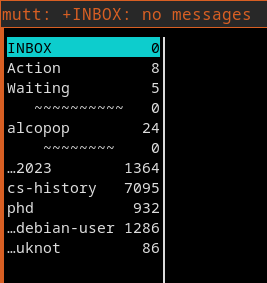
I wanted to start using (neo)mutt's sidebar and I wanted a way of separating groups of mail folders in the list. To achieve that I interleaved a couple of fake "divider" folder names. It looks like this:
  Screenshot of neomutt with sidebar   Screenshot of neomutt with sidebar
This was spurred on by an attempt to revamp my personal organisation. I've been using mutt for at least 20 years (these days neomutt), which, by default, does not show you a list of mail folders all the time. The default view is an index of your default mailbox, from which you can view a mail (pager view), switch to a mailbox, or do a bunch of other things, some of which involve showing a list of mailboxes. But the list is not omnipresent. That's somewhat of a feature, if you believe that you don't need to see that list until you are actually planning to pick from it. There's an old and widespread "sidebar" patch for mutt (which neomutt ships out of the box). It reserves a portion of the left-hand side of the terminal to render a list of mailboxes. It felt superfluous to me so I never really thought to use it, until now: I wanted to make my Inbox functional again, and to achieve that, I needed to move mail out of it which was serving as a placeholder for a particular Action, or as a reminder that I was Waiting on a response. What was stopping me was a feeling I'd forget to check other mailboxes. So, I need to have them up in my face all the time to remind me. Key for me, to make it useful, is to control the ordering of mailboxes and to divide them up using the interleaved fake mailboxes. The key configuration is therefore
set sidebar_sort_method = 'unsorted'
mailboxes =INBOX =Action =Waiting
mailboxes '=   ~~~~~~~~' # divider
...
My groupings, for what it's worth, are: the key functional mailboxes (INBOX/Action/Waiting) come first; last, is reference ('2023' is the name of my current Archive folder; the other folders listed are project-specific reference and the two mailing lists I still directly subscribe to). Sandwiched in between is currently a single mailbox which is for a particular project for which it makes sense to have a separate mailbox. Once that's gone, so will that middle section. For my work mail I do something similar, but the groupings are
  1. INBOX/Action/Waiting
  2. Reference (Sent Mail, Starred Mail)
  3. More reference (internal mailing lists I need to closely monitor)
  4. Even more reference (less important mailing lists)
As with everything, these approaches are under constant review.

Valhalla's Things: Hiking Slippers

Posted on May 5, 2023
image When I travel for a few days I don t usually1 bring any other shoe than the ones I m wearing, plus some kind of slippers for use inside hotel / B&B rooms. It s good for not carrying useless weight, but it always leave me with a vague feeling of what if my only shoes break , followed by on a Sunday, when the shops are closed . So I started to think in the general direction of hiking sandals, shoes that are designed to be worn when resting, and lightweight to carry, but are a passable substitute for regular shoes in case of an accident to the main ones, maybe with the help of an extra pair of socks2 (or when crossing fords, but that s not really a usecase I have). My requirements are easier than the ones for real hiking sandals, since I m only going to be walking on paved streets (or at most easy unpaved ones), and the weight considerations are a thing, but not as strict as if I had to carry these on my back while hiking many hours in a day. My first attempt was a pair of hiking sandals from things I already had in my stash, with vibram soles, neoprene padding and polyester webbing. After a couple fixes they sort of worked, but they had a few big issues.
  • While comfortable when worn, the neoprene made the sandals hard to make, as it tended to deform while being assembled.
  • Polyester webbing is slippery. Some strips of hot glue in strategical places helped, but they weren t perfect and in time they are peeling off.
  • Most importantly, to make the sandals stable enough to wear while walking I had to add a strap around the ankle that needs closing: this makes it a bit of a hassle to use the sandals, say, when waking up in the middle of the night for metabolic reasons.
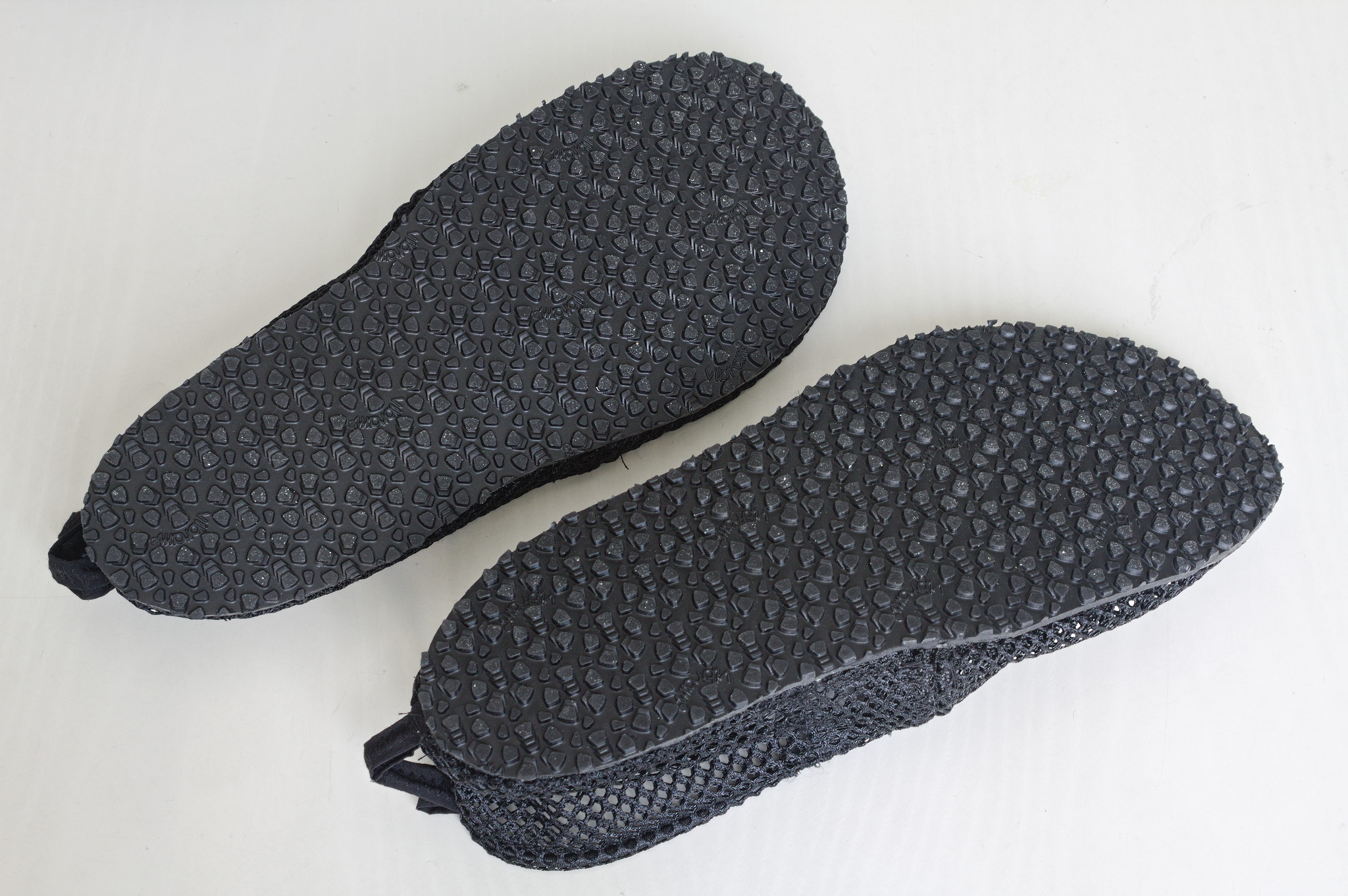
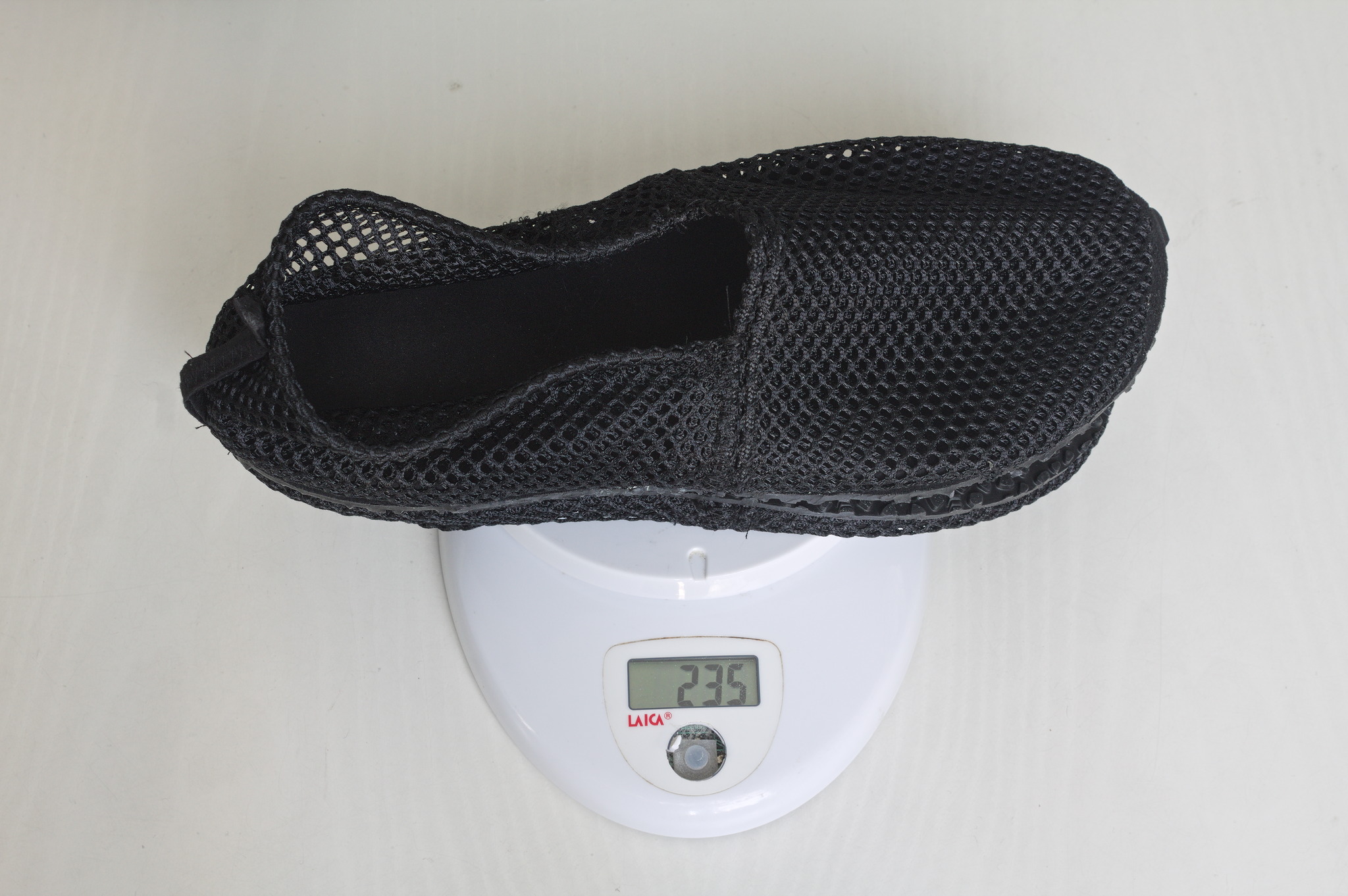
And then, one day I made my linen slippers, and that lead me to think again about the problem: what if I made a pair of slippers with a rubber sole, technical materials and maybe uppers made of net, so that they would be lightweight, breathable and possibly even still suitable in case I ever need to cross a ford. This was also readily attainable from the stash: some polycotton for the sole lining, elastic mesh for the uppers, EVA foam for padding and vibram soles. I decided to assemble most of them by machine, and it was quick and painless (possibly also thanks to the elasticity of the mesh) image For the soles I may have gone a bit overboard with the vibram claw, but:
  • I already had it in the stash;
  • if I need to wear them on an unpaved road, they are going to be suitable;
  • why not?
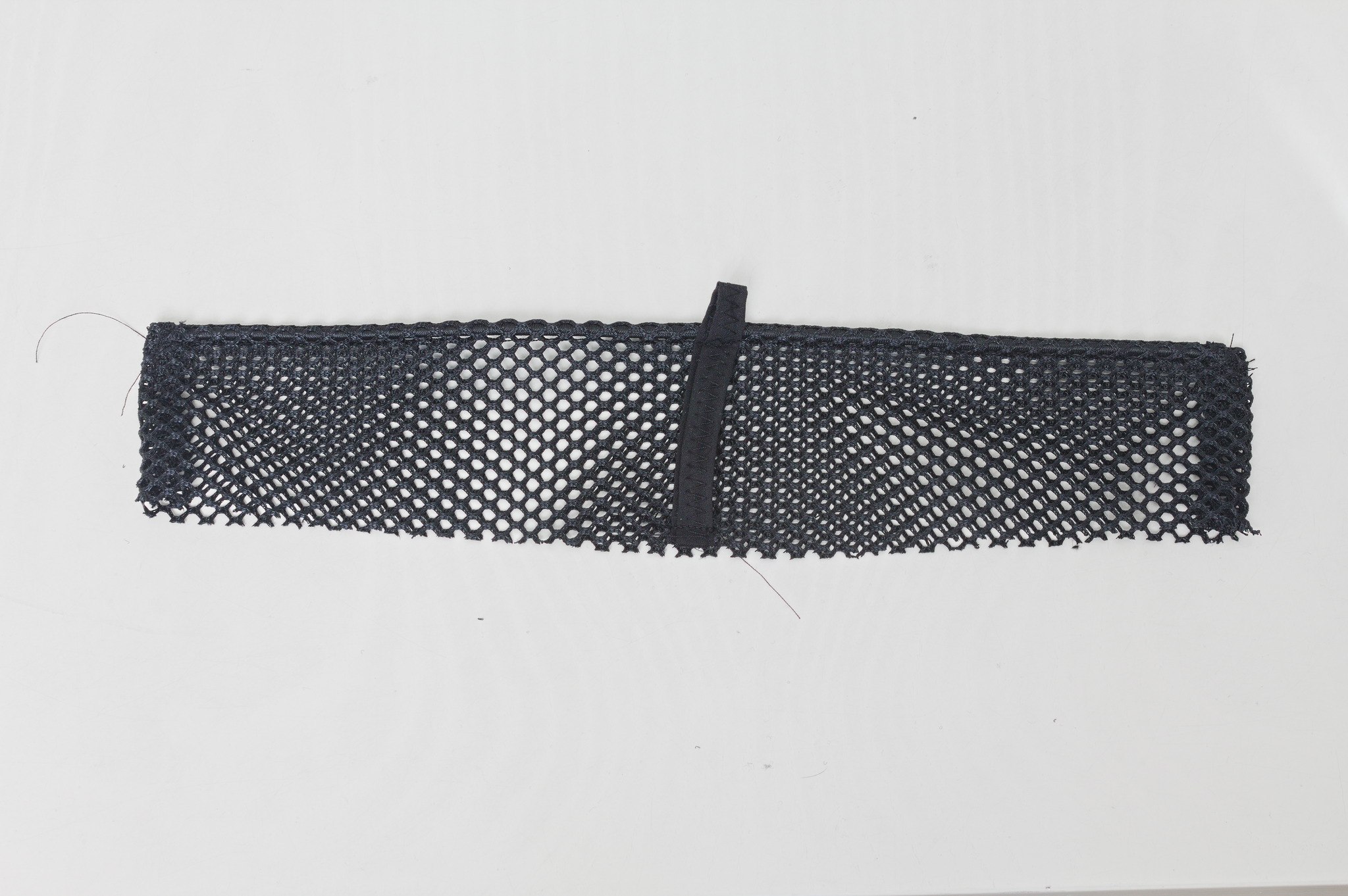
The soles were glued to the slippers rather than being sewn, as I don t think there is a reasonable way to sew these soles; I hope it won t cause durability issues later on (if it does, there will be an update) the slippers on a kitchen scale As for the finished weight, at 235 g for the pair I thought I could do better, but apparently shoes are considered ultralight if they are around 500 g? Using just one layer of mesh rather than two would probably help, but it would have required a few changes to the pattern, and anyway I don t really to carry them around all day. image I ve also added a loop of fabric (polycotton) to the centre back to be able to hang the slippers to the backpack when wet or dirty; a bit of narrow webbing may have been better, but I didn t have any in my stash. The pattern is the same as that used for the linen slippers, and of course it s released as #FreeSoftWear. I ve worn these for a few days around the home and they worked just fine, except for the fact that I had to re-glue the sole in a few places (but I suspect it was glued badly in the first place, since the other sole had no issues). Right now I have no plans to travel, so I don t know how much I will be able to test these in the next few months, but sooner or later I will (or I ll keep wearing them at home after I ve thoroughly tested the linen ones), and if there are issues I will post them here on the blog (and add a link to this post).

  1. the exception would be when I m also bringing some kind of costume, and even there it s not always true.
  2. and one should always carry an extra pair of clean socks, as they are useful for so many things, as Pratchett reminds us.

4 May 2023

Matthew Garrett: Twitter's e2ee DMs are better than nothing

(Edit 2023-05-10: This has now launched for a subset of Twitter users. The code that existed to notify users that device identities had changed does not appear to have been enabled - as a result, in its current form, Twitter can absolutely MITM conversations and read your messages)

Elon Musk appeared on an interview with Tucker Carlson last month, with one of the topics being the fact that Twitter could be legally compelled to hand over users' direct messages to government agencies since they're held on Twitter's servers and aren't encrypted. Elon talked about how they were in the process of implementing proper encryption for DMs that would prevent this - "You could put a gun to my head and I couldn't tell you. That's how it should be."

tl;dr - in the current implementation, while Twitter could subvert the end-to-end nature of the encryption, it could not do so without users being notified. If any user involved in a conversation were to ignore that notification, all messages in that conversation (including ones sent in the past) could then be decrypted. This isn't ideal, but it still seems like an improvement over having no encryption at all. More technical discussion follows.

For context: all information about Twitter's implementation here has been derived from reverse engineering version 9.86.0 of the Android client and 9.56.1 of the iOS client (the current versions at time of writing), and the feature hasn't yet launched. While it's certainly possible that there could be major changes in the protocol between now launch, Elon has asserted that they plan to launch the feature this week so it's plausible that this reflects what'll ship.

For it to be impossible for Twitter to read DMs, they need to not only be encrypted, they need to be encrypted with a key that's not available to Twitter. This is what's referred to as "end-to-end encryption", or e2ee - it means that the only components in the communication chain that have access to the unencrypted data are the endpoints. Even if the message passes through other systems (and even if it's stored on other systems), those systems do not have access to the keys that would be needed to decrypt the data.

End-to-end encrypted messengers were initially popularised by Signal, but the Signal protocol has since been incorporated into WhatsApp and is probably much more widely used there. Millions of people per day are sending messages to each other that pass through servers controlled by third parties, but those third parties are completely unable to read the contents of those messages. This is the scenario that Elon described, where there's no degree of compulsion that could cause the people relaying messages to and from people to decrypt those messages afterwards.

But for this to be possible, both ends of the communication need to be able to encrypt messages in a way the other end can decrypt. This is usually performed using AES, a well-studied encryption algorithm with no known significant weaknesses. AES is a form of what's referred to as a symmetric encryption, one where encryption and decryption are performed with the same key. This means that both ends need access to that key, which presents us with a bootstrapping problem. Until a shared secret is obtained, there's no way to communicate securely, so how do we generate that shared secret? A common mechanism for this is something called Diffie Hellman key exchange, which makes use of asymmetric encryption. In asymmetric encryption, an encryption key can be split into two components - a public key and a private key. Both devices involved in the communication combine their private key and the other party's public key to generate a secret that can only be decoded with access to the private key. As long as you know the other party's public key, you can now securely generate a shared secret with them. Even a third party with access to all the public keys won't be able to identify this secret. Signal makes use of a variation of Diffie-Hellman called Extended Triple Diffie-Hellman that has some desirable properties, but it's not strictly necessary for the implementation of something that's end-to-end encrypted.

Although it was rumoured that Twitter would make use of the Signal protocol, and in fact there are vestiges of code in the Twitter client that still reference Signal, recent versions of the app have shipped with an entirely different approach that appears to have been written from scratch. It seems simple enough. Each device generates an asymmetric keypair using the NIST P-256 elliptic curve, along with a device identifier. The device identifier and the public half of the key are uploaded to Twitter using a new API endpoint called /1.1/keyregistry/register. When you want to send an encrypted DM to someone, the app calls /1.1/keyregistry/extract_public_keys with the IDs of the users you want to communicate with, and gets back a list of their public keys. It then looks up the conversation ID (a numeric identifier that corresponds to a given DM exchange - for a 1:1 conversation between two people it doesn't appear that this ever changes, so if you DMed an account 5 years ago and then DM them again now from the same account, the conversation ID will be the same) in a local database to retrieve a conversation key. If that key doesn't exist yet, the sender generates a random one. The message is then encrypted with the conversation key using AES in GCM mode, and the conversation key is then put through Diffie-Hellman with each of the recipients' public device keys. The encrypted message is then sent to Twitter along with the list of encrypted conversation keys. When each of the recipients' devices receives the message it checks whether it already has a copy of the conversation key, and if not performs its half of the Diffie-Hellman negotiation to decrypt the encrypted conversation key. One it has the conversation key it decrypts it and shows it to the user.

What would happen if Twitter changed the registered public key associated with a device to one where they held the private key, or added an entirely new device to a user's account? If the app were to just happily send a message with the conversation key encrypted with that new key, Twitter would be able to decrypt that and obtain the conversation key. Since the conversation key is tied to the conversation, not any given pair of devices, obtaining the conversation key means you can then decrypt every message in that conversation, including ones sent before the key was obtained.

(An aside: Signal and WhatsApp make use of a protocol called Sesame which involves additional secret material that's shared between every device a user owns, hence why you have to do that QR code dance whenever you add a new device to your account. I'm grossly over-simplifying how clever the Signal approach is here, largely because I don't understand the details of it myself. The Signal protocol uses something called the Double Ratchet Algorithm to implement the actual message encryption keys in such a way that even if someone were able to successfully impersonate a device they'd only be able to decrypt messages sent after that point even if they had encrypted copies of every previous message in the conversation)

How's this avoided? Based on the UI that exists in the iOS version of the app, in a fairly straightforward way - each user can only have a single device that supports encrypted messages. If the user (or, in our hypothetical, a malicious Twitter) replaces the device key, the client will generate a notification. If the user pays attention to that notification and verifies with the recipient through some out of band mechanism that the device has actually been replaced, then everything is fine. But, if any participant in the conversation ignores this warning, the holder of the subverted key can obtain the conversation key and decrypt the entire history of the conversation. That's strictly worse than anything based on Signal, where such impersonation would simply not work, but even in the Twitter case it's not possible for someone to silently subvert the security.

So when Elon says Twitter wouldn't be able to decrypt these messages even if someone held a gun to his head, there's a condition applied to that - it's true as long as nobody fucks up. This is clearly better than the messages just not being encrypted at all in the first place, but overall it's a weaker solution than Signal. If you're currently using Twitter DMs, should you turn on encryption? As long as the limitations aren't too limiting, definitely! Should you use this in preference to Signal or WhatsApp? Almost certainly not. This seems like a genuine incremental improvement, but it'd be easy to interpret what Elon says as providing stronger guarantees than actually exist.

comment count unavailable comments

Holger Levsen: 20230504-Debian-Reunion-Hamburg-2023

Small reminder for the Debian Reunion Hamburg 2023 from May 23 to 30 As in previous years there will be a rather small Debian Reunion Hamburg 2023 event taking place from May 23rd until the 30th (with the 29th being a public holiday in Germany and elsewhere). We'll have days of hacking (inside and outside), a day trip and a small cheese & wine party, as well as daily standup meetings to learn what others are doing, and there shall also be talks and workshops. At the moment there are even still some beds on site available! For more information on all of this: please check the above wiki page! May the force be with you.

Emanuele Rocca: UEFI Secure Boot on the Raspberry Pi

UPDATE: this post unexpectedly ended up on Hacker News and I received a lot of comments. The two most important points being made are (1) that Secure Boot on the RPi as described here is not actually truly secure. An attacker who successfully gained root could just mount the firmware partition and either add their own keys to the EFI variable store or replace the firmware altogether with a malicious one. (2) The TianCore firmware cannot be used instead of the proprietary blob as I mentioned. What truly happens is that the proprietary blob is loaded onto the VideoCore cores, then TianoCore is loaded onto the ARM cores. Thanks for the corrections.

A port of the free software TianoCore UEFI firmware can be used instead of the proprietary boot blob to boot the Raspberry Pi. This allows to install Debian on the RPi with the standard Debian Installer, and it also makes it possible to use UEFI Secure Boot. Note that Secure Boot had been broken on arm64 for a while, but it s now working in Bookworm!.

Debian Installer UEFI boot
To begin, you ll need to download the appropriate firmware files for the RPi3 or RPi4. I ve got a Raspberry Pi 3 Model B+ myself, so the rest of this document will assume an RPi3 is being installed.
Plug the SD card you are going to use as the RPi storage device into another system. Say it shows up as /dev/sdf. Then:
# Create an msdos partition table
$ sudo parted --script /dev/sdf mklabel msdos
# Create, format, and label a 10M fat32 partition
$ sudo parted --script /dev/sdf mkpart primary fat32 0% 10M
$ sudo mkfs.vfat /dev/sdf1
$ sudo fatlabel /dev/sdf1 RPI-FW
# Get the UEFI firmware onto the SD card
$ sudo mount /dev/sdf1 /mnt/data/
$ sudo unzip Downloads/RPi3_UEFI_Firmware_v1.38.zip -d /mnt/data/
$ sudo umount /mnt/data
At this point, the SD card can be used to boot the RPi, and you ll get a UEFI firmware.
Download the Bookworm RC 2 release of the installer, copy it to a USB stick as described in the Installation Guide, and boot your RPi from the stick. If for some reason booting from the stick does not happen automatically, enter the firmware interface with ESC and choose the USB stick from Boot Manager.
Proceed with the installation as normal, paying attention not to modify the firmware partition labeled RPI-FW. I initially thought it would be nice to reuse the firmware partition as ESP partition as well. However, setting the esp flag on makes the RPi unbootable. Either configuring the partition as ESP in debian-installer, or manually with sudo parted --script /dev/sda set 1 esp on, breaks boot. In case you accidentally do that, set it back to off and the edk2 firmware will boot again.
What I suggest doing in terms of partitioning is: (1) leave the 10M partition created above for the firmware alone, and (2) create another 512M or so ESP partition for EFI boot.
The installation should go smoothly till the end, but rebooting won t work. Doh. This is because of an important gotcha: the Raspberry Pi port of the TianoCore firmware we are using does not support setting UEFI variables persistently from a "High Level Operating System (HLOS)", which is the debian-installer in our case. Persistently is the keyword there: variables can be set and modified regularly with efibootmgr or otherwise, but crucially the modifications do not survive reboot. However, changes made from the firmware interface itself are persistent. So enter the firmware with ESC right after booting the RPi, select Boot Maintenance Manager Boot Options Add Boot Option Your SD card Your ESP partition EFI debian shimaa64.efi. Choose a creative name for your boot entry (eg: "debian"), save and exit the firmware interface. Bookworm should be booting fine at this point!

Enabling Secure Boot
Although the TianoCore firmware does support Secure Boot, there are no keys enrolled by default. To add the required keys, copy PK-0001.der, DB-0001.der, DB-0002.der, KEK-0001.der, and KEK-0002.der to a FAT32 formatted USB stick.
Here s a summary of the Subject field for each of the above:
PK-0001.der.pem
        Subject: O = Debian, CN = Debian UEFI Secure Boot (PK/KEK key), emailAddress = debian-devel@lists.debian.org
DB-0001.der.pem
        Subject: C = US, ST = Washington, L = Redmond, O = Microsoft Corporation, CN = Microsoft Windows Production PCA 2011
DB-0002.der.pem
        Subject: C = US, ST = Washington, L = Redmond, O = Microsoft Corporation, CN = Microsoft Corporation UEFI CA 2011
KEK-0001.der.pem
        Subject: O = Debian, CN = Debian UEFI Secure Boot (PK/KEK key), emailAddress = debian-devel@lists.debian.org
KEK-0002.der.pem
        Subject: C = US, ST = Washington, L = Redmond, O = Microsoft Corporation, CN = Microsoft Corporation KEK CA 2011
Plug the stick into the RPi, boot and enter the firmware interface with ESC. Select Device Manager Secure Boot Configuration Secure Boot Mode choose Custom Mode Custom Secure Boot Options PK Options Enroll PK choose PK-0001.der. Do the same for DB Options, this time choose DB-0001.der and DB-0002.der. As you may have guessed by now, the same must be done for KEK Options, but adding KEK-0001.der and KEK-0002.der. Save, exit, reboot. If everything went well, your RPi now has booted with Secure Boot enabled.
See https://wiki.debian.org/SecureBoot for the details on how to check whether Secure Boot has been enabled correctly and much more.

Valhalla's Things: Linen Slippers

Posted on May 4, 2023
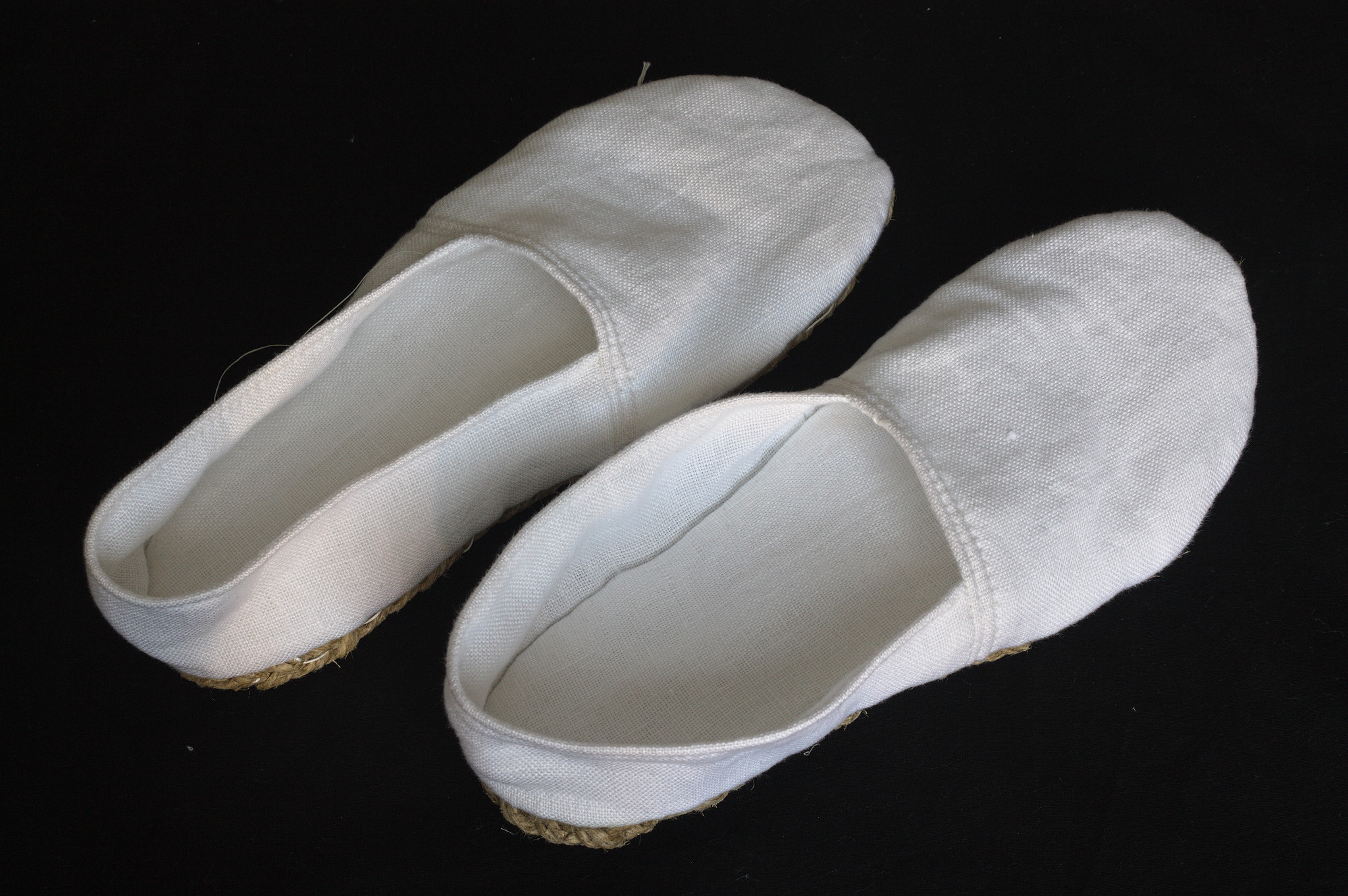
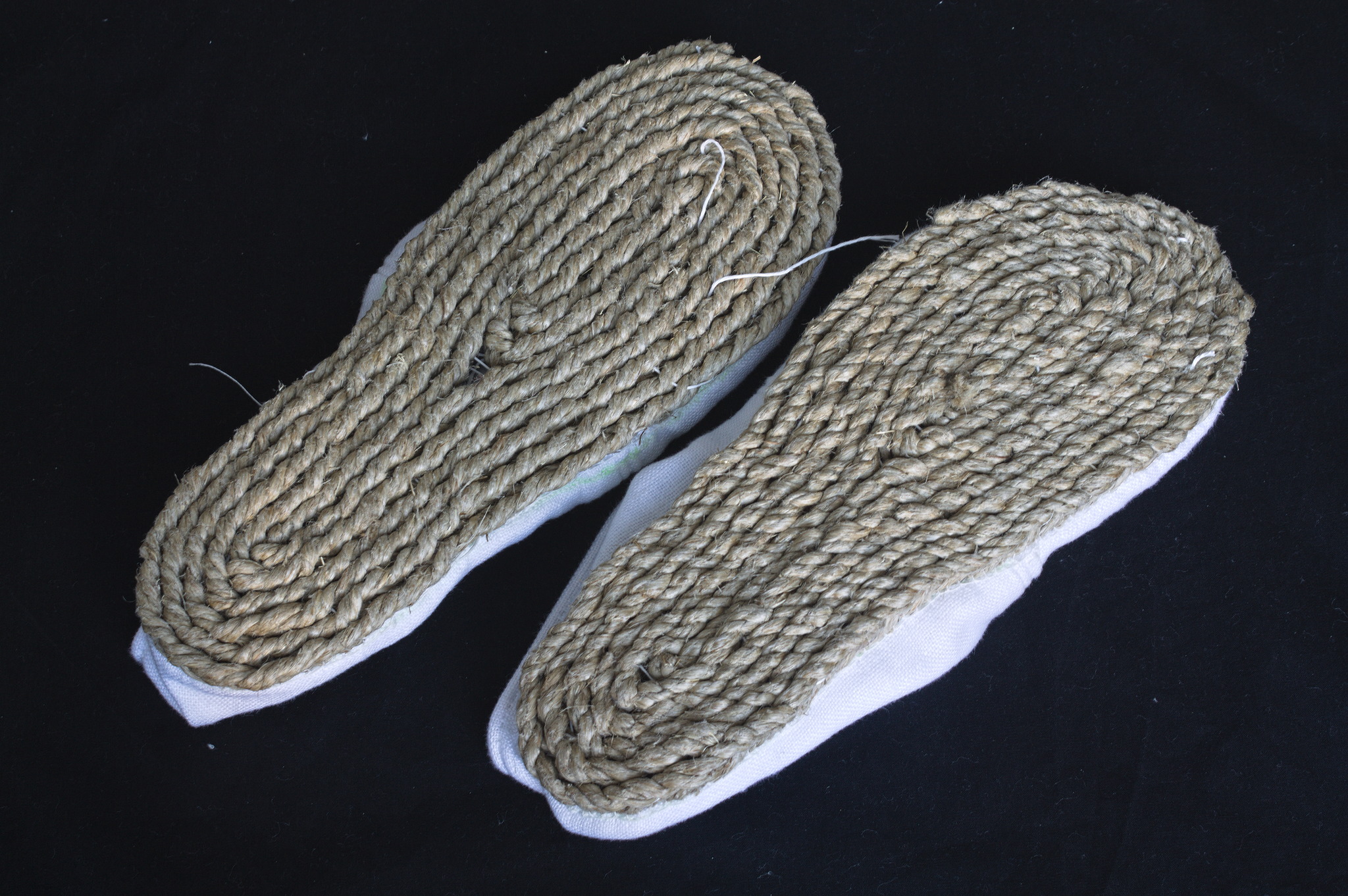
A pair of espadrille-like slippers in white fabric. I hate going out to buy shoes. Even more so I hate buying home shoes, which is what I spend most of my life in, also because no matter what I buy they seem to disintegrate after a season or so. So, obviously, I ve been on a quest to make my own. As a side note, going barefoot (with socks) would only move the wear issue to the socks, so it s not really a solution, and going bare barefoot on ceramic floors is not going to happen, kaythanksbye. For the winter I m trying to make knit and felted slippers; I ve had partial success, and they should be pretty easy to mend (I ve just had to do the first mend, with darning and needle felting, and it seems to have worked nicely). For the summer, I ve been thinking of something sewn, and with the warm season approaching (and the winter slippers needing urgent repairs) I decided it was time to work on them. I already had a shaped (left/right) pattern for a sole from my hiking sandals attempts (a topic for another post), so I started by drafting a front upper, and then I started to have espadrille feeling and decided that a heel guard was needed. As for fabric, looking around in the most easily accessible part of the Stash I ve found the nice heavyweight linen I m using for my Augusta Stays, of which I still have a lot and which looked almost perfect except for one small detail: it s very white. I briefly thought about dyeing, but I wanted to start sewing NOW to test the pattern, so, yeah, maybe it will happen one day, or maybe I ll have patchy dust-grey slippers. If I ll ever have a place where I can do woad dyeing a blue pair will happen, however. Contrary to the typical espadrillas I decided to have a full lining, and some padding between the lining and the sole, using cotton padding leftovers from my ironing board. To add some structure I also decided to add a few rows of cording (and thus make the uppers in two layers of fabric), to help prevent everything from collapsing flat. As for the sole, that s something that is still causing me woes: I do have some rubber sole sheets (see hiking sandals above), but I suspect that they require glueing, which I m not sure would work well with the natural fabric uppers and will probably make repairs harder to do. In the past I tried to make some crocheted rope soles and they were a big failure: they felt really nice on the foot, but they also self-destroyed in a matter of weeks, which is not really the kind of sole I m looking for. the slippers with the braided soles on top. Now I have some ~ 3 mm twine that feels much harsher on the hands while working it (and would probably feel harsher on the feet, but that s what the lining and padding are for), so I hope it may be a bit more resistant, and I tried to make a braided rope sole. Of course, I have published the pattern and instructions for the slippers as well as those for the braided rope sole as #FreeSoftWear. Now what is left is trying everything under daily use, and I hope I will have updates on this at the end of the season, rather than soon :D
2 May 2023

Neil Williams: Carrying Grief

This isn't a book review, although the reason that I am typing this now is because of a book, You Are Not Alone: from the creator and host of Griefcast, Cariad Lloyd, ISBN: 978-1526621870 and I include a handful of quotes from Cariad where there is really no better way of describing things. Many people experience death for the first time as a child, often relating to a family pet. Death is universal but every experience of death is unique. One of the myths of grief is the idea of the Five Stages but this is a misinterpretation. Denial, Anger, Bargaining, Depression and Acceptance represent the five stage model of death and have nothing to do with grief. The five stages were developed from studying those who are terminally ill, the dying, not those who then grieve for the dead person and have to go on living without them. Grief is for those who loved the person who has died and it varies between each of those people just as people vary in how they love someone. The Five Stages end at the moment of death, grief is what comes next and most people do not grieve in stages, it can be more like a tangled knot. Death has a date and time, so that is why the last stage of the model is Acceptance. Grief has no timetable, those who grieve will carry that grief for the rest of their lives. Death starts the process of grief in those who go on living just as it ends the life of the person who is loved. "Grief eases and changes and returns but it never disappears.". I suspect many will have already stopped reading by this point. People do not talk about death and grief enough and this only adds to the burden of those who carry their grief. It can be of enormous comfort to those who have carried grief for some time to talk directly about the dead, not in vague pleasantries but with specific and strong memories. Find a safe place without distractions and talk with the person grieving face to face. Name the dead person. Go to places with strong memories and be there alongside. Talk about the times with that person before their death. Early on, everything about grief is painful and sad. It does ease but it remains unpredictable. Closing it away in a box inside your head (as I did at one point) is like cutting off a damaged limb but keeping the pain in a box on the shelf. You still miss the limb and eventually, the box starts leaking. For me, there were family pets which died but my first job out of university was to work in hospitals, helping the nurses manage the medication regimen and providing specialist advice as a pharmacist. It will not be long in that environment before everyone on the ward gets direct experience of the death of a person. In some ways, this helped me to separate the process of death from the process of grief. I cared for these people as patients but these were not my loved ones. Later, I worked in specialist terminal care units, including providing potential treatments as part of clinical trials. Here, it was not expected for any patient to be discharged alive. The more aggressive chemotherapies had already been tried and had failed, this was about pain relief, symptom management and helping the loved ones. Palliative care is not just about the patient, it involves helping the loved ones to accept what is happening as this provides comfort to the patient by closing the loop. Grief is stressful. One of the most common causes of personal stress is bereavement. The death of your loved one is outside of your control, it has happened, no amount of regret can change that. Then come all the other stresses, maybe about money or having somewhere to live as a result of what else has changed after the death or having to care for other loved ones. In the early stages, the first two years, I found it helpful to imagine my life as a box containing a ball and a button. The button triggers new waves of pain and loss each time it is hit. The ball bounces around the box and hits the button at random. Initially, the button is large and the ball is enormous, so the button is hit almost constantly. Over time, both the button and the ball change size. Starting off at maximum, initially there is only one direction of change. There are two problems with this analogy. First is that the grief ball has infinite energy which does not happen in reality. The ball may get smaller and the button harder to hit but the ball will continue bouncing. Secondly, the life box is not a predictable shape, so the pattern of movement of the ball is unpredictable. A single stress is one thing, but what has happened since has just kept adding more stress for me. Shortly before my father died 5 years ago now, I had moved house. Then, I was made redundant on the day of the first anniversary of my father's death. A year or so later, my long term relationship failed and a few months after that COVID-19 appeared. As the country eased out of the pandemic in 2021, my mother died (unrelated to COVID itself). A year after that, I had to take early retirement. My brother and sister, of course, share a lot of those stressors. My brother, in particular, took the responsibility for organising both funerals and did most of the visits to my mother before her death. The grief is different for each of the surviving family. Cariad's book helped me understand why I was getting frequent ideas about going back to visit places which my father and I both knew. My parents encouraged each of us to work hard to leave Port Talbot (or Pong Toilet locally) behind, in no small part due to the unrestrained pollution and deprivation that is common to small industrial towns across Wales, the midlands and the north of the UK. It wasn't that I wanted to move house back to our ancestral roots. It was my grief leaking out of the box. Yes, I long for mountains and the sea because I'm now living in a remorselessly flat and landlocked region after moving here for employment. However, it was my grief driving those longings - not for the physical surroundings but out of the shared memories with my father. I can visit those memories without moving house, I just need to arrange things so that I can be undisturbed and undistracted. I am not alone with my grief and I am grateful to my friends who have helped whilst carrying their own grief. It is necessary for everyone to think and talk about death and grief. In respect of your own death, no matter how far ahead that may be, consider Advance Care Planning and Expressions of Wish as well as your Will. Talk to people, document what you want. Your loved ones will be grateful and they deserve that much whilst they try to cope with the first onslaught of grief. Talk to your loved ones and get them to do the same for themselves. Normalise talking about death with your family, especially children. None of us are getting out of this alive and we will all leave behind people who will grieve.

Dirk Eddelbuettel: RQuantLib 0.4.18 on CRAN: Maintenance

A new release 0.4.18 of RQuantLib arrived at CRAN earlier today, and will be uploaded to Debian as well. QuantLib is a very comprehensice free/open-source library for quantitative finance; RQuantLib connects it to the R environment and language. This release of RQuantLib comes about six months after the previous maintenance release. It brings a few small updates triggered by small changes in the QuantLib releases 1.29 and 1.30. It also contains updates reflecting changes in the rgl package kindly contributed by Duncan Murdoch. Last but not least, Jeroen Ooms helped with two pull requests updating builds on, repspectively, macOS and Windows by updating the pre-made libraries of QuantLib.

Changes in RQuantLib version 0.4.18 (2023-05-01)
  • Use of several rgl functions was updated to a new naming scheme in the package (kindly contributed by Duncan Murdoch in #174)
  • A default argument is now given for option surface plots
  • Changed call from SwaptionVolCube1 to SabrSwaptionVolatilityCube (conditional on using QuantLib 1.30 or later)
  • Some other deprecation warnings were tweaked as in QL test file
  • Builds for macOS and Windows were updated with more library build (changes kindly contributed by Jeron Ooms in #176 and #175)
  • Some remaining throw calls were replace by Rcpp::stop

Courtesy of my CRANberries, there is also a diffstat report for the this release. As always, more detailed information is on the RQuantLib page. Questions, comments etc should go to the new rquantlib-devel mailing list. Issue tickets can be filed at the GitHub repo. If you like this or other open-source work I do, you can now sponsor me at GitHub.

This post by Dirk Eddelbuettel originated on his Thinking inside the box blog. Please report excessive re-aggregation in third-party for-profit settings.

1 May 2023

Gunnar Wolf: Scanning heaps of 8mm movies

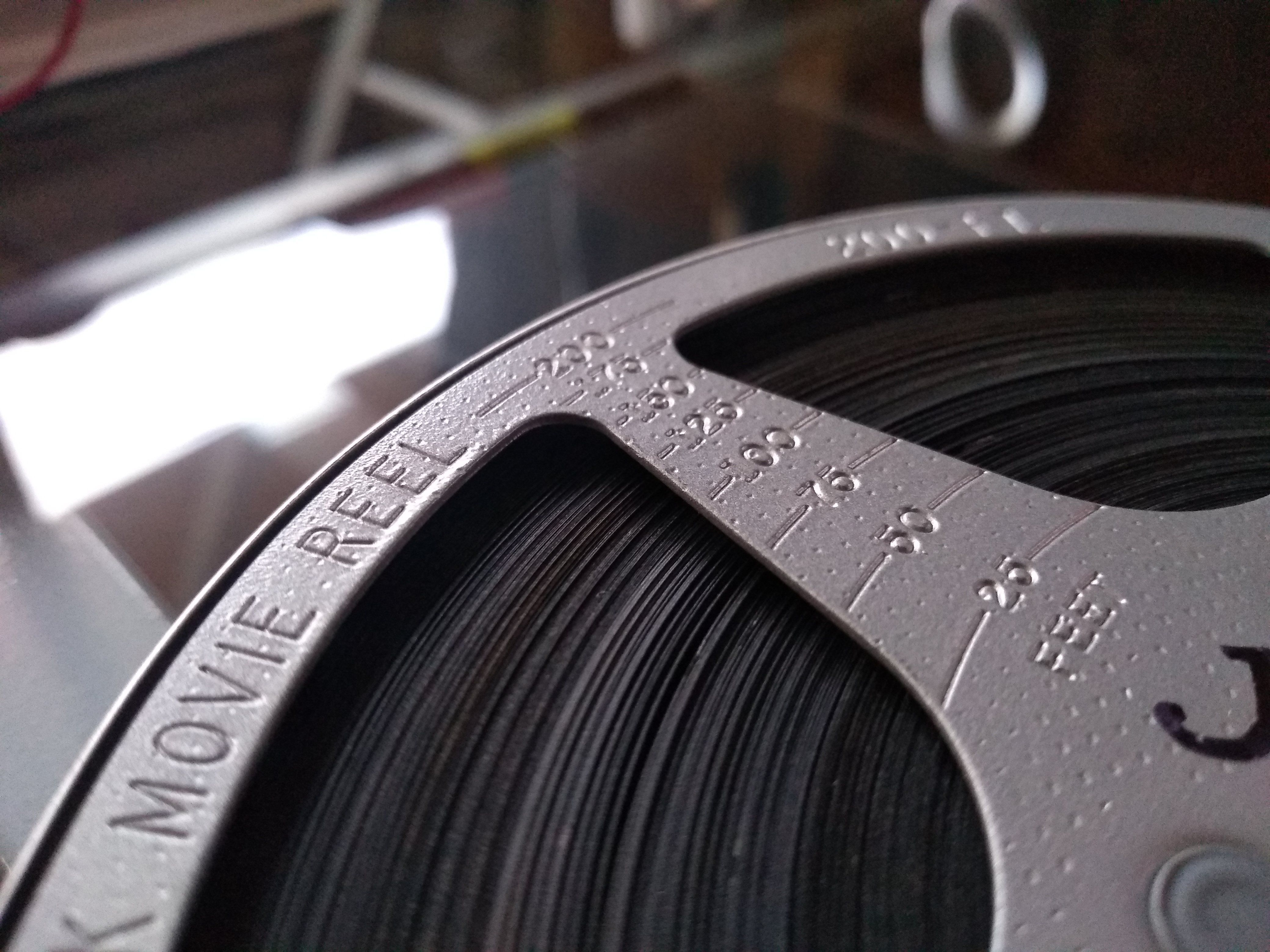
After my father passed away, I brought home most of the personal items he had, both at home and at his office. Among many, many (many, many, many) other things, I brought two of his personal treasures: His photo collection and a box with the 8mm movies he shot approximately between 1956 and 1989, when he was forced into modernity and got a portable videocassette recorder. I have talked with several friends, as I really want to get it all in a digital format, and while I ve been making slow but steady advances scanning the photo reels, I was particularly dismayed (even though it was most expected most personal electronic devices aren t meant to last over 50 years) to find out the 8mm projector was no longer in working conditions; the lamp and the fans work, but the spindles won t spin. Of course, it is quite likely it is easy to fix, but it is beyond my tinkering abilities and finding photographic equipment repair shops is no longer easy. Anyway, even if I got it fixed, filming a movie from a screen, even with a decent camera, is a lousy way to get it digitized. But almost by mere chance, I got in contact with my cousin Daniel, ho came to Mexico to visit his parents, and had precisely brought with him a 8mm/Super8 movie scanner! It is a much simpler piece of equipment than I had expected, and while it does present some minor glitches (i.e. the vertical framing slightly loses alignment over the course of a medium-length film scanning session, and no adjustment is possible while the scan is ongoing), this is something that can be decently fixed in post-processing, and a scanning session can be split with no ill effects. Anyway, it is quite uncommon a mid-length (5min) film can be done without interrupting i.e. to join a splice, mostly given my father didn t just film, but also edited a lot (this is, it s not just family pictures, but all different kinds of fiction and documentary work he did). So, Daniel lent me a great, brand new, entry-level film scanner; I rushed to scan as many movies as possible before his return to the USA this week, but he insisted he bought it to help preserve our family s memory, and given we are still several cousins living in Mexico, I could keep hold of it so any other of the cousins will find it more easily. Of course, I am thankful and delighted! So, this equipment is a Magnasonic FS81. It is entry-level, as it lacks some adjustment abilities a professional one would surely have, and I m sure a better scanner will make the job faster but it s infinitely superior to not having it! The scanner processes roughly two frames per second (while the nominal 8mm/Super8 speed is 24 frames per second), so a 3 minute film reel takes a bit over 35 minutes And a long, ~20 minute film reel takes Close to 4hr, if nothing gets in your way :- And yes, with longer reels, the probability of a splice breaking are way higher than with a short one not only because there is simply a longer film to process, but also because, both at the unwinding and at the receiving reels, mechanics play their roles. The films don t advance smoothly, but jump to position each frame in the scanner s screen, so every bit of film gets its fair share of gentle tugs. My professional consultant on how and what to do is my good friend Chema Serralde, who has stopped me from doing several things I would regret later otherwise (such as joining spliced tapes with acidic chemical adhesives such as Kola Loka, a.k.a. Krazy Glue even if it s a bit trickier to do it, he insisted me on best using simple transparent tape if I m not buying fancy things such as film-adhesive). Chema also explained me the importance of the loopers (las Lupes in his technical Spanish translation), which I feared increased the likelihood of breaking a bit of old glue due to the angle in which the film gets pulled but if skipped, result in films with too much jumping. Not all of the movies I have are for public sharing Some of them are just family movies, with high personal value, but probably of very little interest to others. But some are! I have been uploading some of the movies, after minor post-processing, to the Internet Archive. Among them: Anyway, I have a long way forward for scanning. I have 20 3min reels, 19 5min reels, and 8 20min reels. I want to check the scanning quality, but I think my 20min reels are mostly processed (we paid for scanning them some years ago). I mostly finished the 3min reels, but might have to go over some of them again due to the learning process. And Well, I m having quite a bit of fun in the process!

Russ Allbery: Review: The Amazing Maurice and His Educated Rodents

Review: The Amazing Maurice and His Educated Rodents, by Terry Pratchett
Series: Discworld #28
Publisher: HarperCollins
Copyright: 2001
Printing: 2008
ISBN: 0-06-001235-8
Format: Mass market
Pages: 351
The Amazing Maurice and His Educated Rodents is the 28th Discworld novel and the first marketed for younger readers. Although it has enough references to establish it as taking place on Discworld, it has no obvious connections with the other books and doesn't rely on any knowledge of the series so far. This would not be a bad place to start with Terry Pratchett and see if his writing style and sense of humor is for you. Despite being marketed as young adult, and despite Pratchett's comments in an afterward in the edition I own that writing YA novels is much harder, I didn't think this was that different than a typical Discworld novel. The two main human characters read as about twelve and there were some minor changes in tone, but I'm not sure I would have immediately labeled it as YA if I hadn't already known it was supposed to be. There are considerably fewer obvious pop culture references than average, though; if that's related, I think I'll prefer Pratchett's YA novels, since I think his writing is stronger when he's not playing reference bingo. Maurice (note to US readers: Maurice is pronounced "Morris" in the UK) is a talking cat and the mastermind of a wandering con job. He, a stupid-looking kid with a flute (Maurice's description), and a tribe of talking rats travel the small towns of Discworld. The rats go in first, making a show of breaking into the food, swimming in the cream, and widdling on things that humans don't want widdled on. Once the townspeople are convinced they have a plague of rats, the kid with the flute enters the town and offers to pipe the rats away for a very reasonable fee. He plays his flute, the rats swarm out of town, and they take their money and move on to the next town. It's a successful life that suits Maurice and his growing hoard of gold very well. If only the rats would stop asking pointed questions about the ethics of this scheme. The town of Bad Blintz is the next on their itinerary, and if the rats have their way, will be the last. Their hope is they've gathered enough money by now to find an island, away from humans, where they can live their own lives. But, as is always the case for one last job in fiction, there's something uncannily wrong about Bad Blintz. There are traps everywhere, more brutal and dangerous ones than they've found in any other town, and yet there is no sign of native, unintelligent rats. Meanwhile, Maurice and the boy find a town that looks wealthy but has food shortages, a bounty on rats that is absurdly high, and a pair of sinister-looking rat-catchers who are bringing in collections of rat tails that look suspiciously like bootlaces. The mayor's daughter discovers Maurice can talk and immediately decides she has to take them in hand. Malicia is very certain of her own opinions, not accustomed to taking no for an answer, and is certain that the world follows the logic of stories, even if she has to help it along. This is truly great stuff. I think this might be my favorite Discworld novel to date, although I do have some criticisms that I'll get to in a moment. The best part are the rats, and particularly the blind philosopher rat Dangerous Beans and his assistant Peaches. In the middle of daring infiltration of the trapped sewers in scenes reminiscent of Mission: Impossible, the rats are also having philosophical arguments. They've become something different than the unaltered rats that they call the keekees, but what those differences mean is harder to understand. The older rats are not happy about too many changes and think the rats should keep acting like rats. The younger ones are discovering that they're afraid of shadows because now they understand what the shadows hint at. Dangerous Beans is trying to work out a writing system so that they can keep important thoughts. One of their few guides is a children's book of talking animals, although they quickly discover that the portrayed clothing is annoyingly impractical. But as good as the rats are, Maurice is nearly as much fun in an entirely different way. He is unapologetically out for himself, streetwise and canny in a way that feels apt for a cat, gets bored and mentally wanders off in the middle of conversations, and pretends to agree with people when that's how he can get what he wants. But he also has a weird sense of loyalty and ethics that only shows up when something is truly important. It's a variation on the con man with a heart of gold, but it's a very well-done variation that weaves in a cat's impatience with and inattention to anything that doesn't directly concern them. I was laughing throughout the book. Malicia is an absolute delight, the sort of character who takes over scenes through sheer force of will, and the dumb-looking kid (whose name turns out to be Keith) is a perfect counterbalance: a laid-back, quiet boy who just wants to play his music and is almost entirely unflappable. It's such a great cast. The best part of the plot is the end. I won't spoil it, so I'll only say that Pratchett has the characters do the work on the aftermath that a lot of books skip over. He doesn't have any magical solutions for the world's problems, but he's so very good at restoring one's faith that maybe sometimes those solutions can be constructed. My one complaint with this book is that Pratchett introduces a second villain, and while there are good in-story justifications for it and it's entangled with the primary plot, he added elements of (mild) supernatural horror and evil that I thought were extraneous and unnecessary. He already had enough of a conflict set up without adding that additional element, and I think it undermined the moral complexity of the story. I would have much rather he kept the social dynamics of the town at the core of the story and used that to trigger the moments of sacrifice and philosophy that made the climax work. The Discworld books by this point have gotten very good, but each book seems to have one element like that where it felt like Pratchett took the easy way out of a plot corner or added some story element that didn't really work. I feel like the series is on the verge of having a truly great book that rises above the entire series to date, but never quite gets there. That caveat aside, I thoroughly enjoyed this and had trouble putting it down. Mrs. Frisby and the Rats of Nimh was one of my favorite books as a kid, and this reminded me of it in some good ways (enough so that I think some of the references were intentional). Great stuff. If you were to read only one Discworld book and didn't want to be confused by all the entangled plot threads and established characters, I would seriously consider making it this one. Recommended. Followed by Night Watch in publication order. There doesn't appear to be a direct plot sequel, more's the pity. Rating: 8 out of 10

30 April 2023

Valhalla's Things: Programming the ESP32-C3-DevKit-Lipo with Arduino

Posted on April 30, 2023
A few months ago we may have bought a few ESP32-C3-DevKit-Lipo boards from Olimex. Since every time I go back to working with them I ve forgotten how to do so, and my old notes on the fediverse are hard to find, this is the full procedure.

Setup I start by sort-of-following https://docs.espressif.com/projects/arduino-esp32/en/latest/installing.html
  • Install arduino from the distribution packages (version 1.8 is ok).
  • Under File Preferences, add the development URL to the Additional Boards Manager URLs field. (on 2023-04-30 that s https://espressif.github.io/arduino-esp32/package_esp32_dev_index.json).
  • Under Tools Board Boards Manager make sure that you install a version of esp32 by Espressif Systems that is above 2.0 (on 2023-04-30 there is a 2.0.8 that works).

Programming
  • Under Tools Board ESP32 Arduino select ESP32C3 Dev Module.
  • Under Tools USB CDC On Boot select Enabled.
You can now compile and upload your sketches. If something goes wrong, to force the board to bootloader mode bring GPIO9 to GND. Note that the serial port device /dev/ttyACM0 only appears when in bootloader mode, but uploading sketches and the serial monitor will still work even if the port is not set in the arduino IDE.

Matthew Palmer: dev-dependencies and Rust's unused_crate_dependencies lint

I m in the process of getting super-strict about the code quality of cretrit, the comparison-revealing encryption library that underlies the queryable encryption of the Enquo project. While I m going to write a whole big thing about Rust linting in the future, I bumped across a rather gnarly problem that I thought was worth sharing separately. The problem, in short, is that the unused_crate_dependencies lint interacts badly with crates that are only needed for benchmarking, such as (in my case) criterion. Rust has a whole bucketload of lints that can help your codebase adhere to certain standards, by warning (or exploding) if the problem is detected. The unused_crate_dependencies lint, as the name suggests, gets snippy when there s a crate listed in your Cargo.toml that doesn t appear to be used anywhere. All well and good so far. However, while Rust has the ability to specify crates needed for running the testsuite (the [dev-dependencies] section of Cargo.toml) separately from crates needed for actually using this thing ([dependencies]), it doesn t have a way to specify crates needed for running the benchmarks . That is a problem when you re using something like criterion for benchmarking, because it doesn t get refered to at all in your project code it only gets used in the benchmarks. When building your codebase for running the test suite, the compiler sees that you ve specified criterion as one of your testsuite dependencies , but it never gets used in your testsuite. This causes the unused_crate_dependencies lint to lose its tiny mind, and make your build look ugly (or fail). Thankfully, the solution is very simple, once you know the trick (this could be the unofficial theme song of the entire Rust ecosystem). You need to refer to the criterion crate somewhere in the code that gets built during the testsuite. The lint tells you most of what you need to do (like most things Rust, it tries hard to be helpful), but since it s a development dependency, you need a little extra secret sauce. All you need to do is add these two lines to the bottom of your src/lib.rs (or src/main.rs for a binary crate):

#[cfg(test)]
use criterion as _;
For the less Rust-literate, this means when the build-time configuration flag test is set, import the criterion crate, but don t, like, allow it to actually be referred to . This is enough to make the lint believe that the dependency is being used, and making it only happen when the test build-time config flag is set avoids the ugliness of it trying to refer to the crate during regular builds (which would fail, because criterion is only a dev-dependency). Simple? Yes. Did it take me a lot of skull-sweat to figure out? You betcha. That s why I m writing it down even if everyone else already knows this, at least future Matt will find this post next time he trips over this problem.

29 April 2023

Enrico Zini: Gtk4 model-backed radio button in Python

Gtk4 has interesting ways of splitting models and views. One that I didn't find very well documented, especially for Python bindings, is a set of radio buttons backed by a common model. The idea is to define an action that takes a string as a state. Each radio button is assigned a string matching one of the possible states, and when the state of the backend action is changed, the radio buttons are automatically updated. All the examples below use a string for a value type, but anything can be used that fits into a GLib.Variant. The model This defines the action. Note that enables all the usual declarative ways of a status change:
mode = Gio.SimpleAction.new_stateful(
        name="mode-selection",
        parameter_type=GLib.VariantType("s"),
        state=GLib.Variant.new_string(""))
gtk_app.add_action(self.mode)
The view
def add_radio(model: Gio.SimpleAction, id: str, label: str):
    button = Gtk.CheckButton(label=label)
    # Tell this button to activate when the model has the given value
    button.set_action_target_value(GLib.Variant.new_string(id))
    # Build the name under which the action is registesred, plus the state
    # value controlled by this button: clicking the button will set this state
    detailed_name = Gio.Action.print_detailed_name(
            "app." + model.get_name(),
            GLib.Variant.new_string(id))
    button.set_detailed_action_name(detailed_name)
    # If the model has no current value set, this sets the first radio button
    # as selected
    if not model.get_state().get_string():
        model.set_state(GLib.Variant.new_string(id))
Accessing the model To read the currently selected value:
current = model.get_state().get_string()
To set the currently selected value:
model.set_state(GLib.Variant.new_string(id))

Next.

Previous.