Search Results: "tim"

2 February 2024

Ian Jackson: UPS, the Useless Parcel Service; VAT and fees

I recently had the most astonishingly bad experience with UPS, the courier company. They severely damaged my parcels, and were very bad about UK import VAT, ultimately ending up harassing me on autopilot. The only thing that got their attention was my draft Particulars of Claim for intended legal action. Surprisingly, I got them to admit in writing that the disbursement fee they charge recipients alongside the actual VAT, is just something they made up with no legal basis. What happened Autumn last year I ordered some furniture from a company in Germany. This was to be shipped by them to me by courier. The supplier chose UPS. UPS misrouted one of the three parcels to Denmark. When everything arrived, it had been sat on by elephants. The supplier had to replace most of it, with considerable inconvenience and delay to me, and of course a loss to the supplier. But this post isn t mostly about that. This post is about VAT. You see, import VAT was due, because of fucking Brexit. UPS made a complete hash of collecting that VAT. Their computers can t issue coherent documents, their email helpdesk is completely useless, and their automated debt collection systems run along uninfluenced by any external input. The crazy, including legal threats and escalating late payment fees, continued even after I paid the VAT discrepancy (which I did despite them not yet having provided any coherent calculation for it). This kind of behaviour is a very small and mild version of the kind of things British Gas did to Lisa Ferguson, who eventually won substantial damages for harassment, plus 10K of costs. Having tried asking nicely, and sending stiff letters, I too threatened litigation. I would have actually started a court claim, but it would have included a claim under the Protection from Harassment Act. Those have to be filed under the Part 8 procedure , which involves sending all of the written evidence you re going to use along with the claim form. Collating all that would be a good deal of work, especially since UPS and ControlAccount didn t engage with me at all, so I had no idea which things they might actually dispute. So I decided that before issuing proceedings, I d send them a copy of my draft Particulars of Claim, along with an offer to settle if they would pay me a modest sum and stop being evil robots at me. Rather than me typing the whole tale in again, you can read the full gory details in the PDF of my draft Particulars of Claim. (I ve redacted the reference numbers). Outcome The draft Particulars finally got their attention. UPS sent me an offer: they agreed to pay me 50, in full and final settlement. That was close enough to my offer that I accepted it. I mostly wanted them to stop, and they do seem to have done so. And I ve received the 50. VAT calculation They also finally included an actual explanation of the VAT calculation. It s absurd, but it s not UPS s absurd:
The clearance was entered initially with estimated import charges of 400.03, consisting of 387.83 VAT, and 12.20 disbursement fee. This original entry regrettably did not include the freight cost for calculating the VAT, and as such when submitted for final entry the VAT value was adjusted to include this and an amended invoice was issued for an additional 39.84. HMRC calculate the amount against which VAT is raised using the value of goods, insurance and freight, however they also may apply a VAT adjustment figure. The VAT Adjustment is based on many factors (Incidental costs in regards to a shipment), which includes charge for currency conversion if the invoice does not list values in Sterling, but the main is due to the inland freight from airport of destination to the final delivery point, as this charge varies, for example, from EMA to Edinburgh would be 150, from EMA to Derby would be 1, so each year UPS must supply HMRC with all values incurred for entry build up and they give an average which UPS have to use on the entry build up as the VAT Adjustment. The correct calculation for the import charges is therefore as follows: Goods value divided by exchange rate 2,489.53 EUR / 1.1683 = 2,130.89 GBP Duty: Goods value plus freight (%) 2,130.89 GBP + 5% = 2,237.43 GBP. That total times the duty rate. X 0 % = 0 GBP VAT: Goods value plus freight (100%) 2,130.89 GBP + 0 = 2,130.89 GBP That total plus duty and VAT adjustment 2,130.89 GBP + 0 GBP + 7.49 GBP = 2,348.08 GBP. That total times 20% VAT = 427.67 GBP As detailed above we must confirm that the final VAT charges applied to the shipment were correct, and that no refund of this is therefore due.
This looks very like HMRC-originated nonsense. If only they had put it on the original bills! It s completely ridiculous that it took four months and near-litigation to obtain it. Disbursement fee One more thing. UPS billed me a 12 disbursement fee . When you import something, there s often tax to pay. The courier company pays that to the government, and the consignee pays it to the courier. Usually the courier demands it before final delivery, since otherwise they end up having to chase it as a debt. It is common for parcel companies to add a random fee of their own. As I note in my Particulars, there isn t any legal basis for this. In my own offer of settlement I proposed that UPS should:
State under what principle of English law (such as, what enactment or principle of Common Law), you levy the disbursement fee (or refund it).
To my surprise they actually responded to this in their own settlement letter. (They didn t, for example, mention the harassment at all.) They said (emphasis mine):
A disbursement fee is a fee for amounts paid or processed on behalf of a client. It is an established category of charge used by legal firms, amongst other companies, for billing of various ancillary costs which may be incurred in completion of service. Disbursement fees are not covered by a specific law, nor are they legally prohibited. Regarding UPS disbursement fee this is an administrative charge levied for the use of UPS deferment account to prepay import charges for clearance through CDS. This charge would therefore be billed to the party that is responsible for the import charges, normally the consignee or receiver of the shipment in question. The disbursement fee as applied is legitimate, and as you have stated is a commonly used and recognised charge throughout the courier industry, and I can confirm that this was charged correctly in this instance.
On UPS s analysis, they can just make up whatever fee they like. That is clearly not right (and I don t even need to refer to consumer protection law, which would also make it obviously unlawful). And, that everyone does it doesn t make it lawful. There are so many things that are ubiquitous but unlawful, especially nowadays when much of the legal system - especially consumer protection regulators - has been underfunded to beyond the point of collapse. Next time this comes up I might have a go at getting the fee back. (Obviously I ll have to pay it first, to get my parcel.) ParcelForce and Royal Mail I think this analysis doesn t apply to ParcelForce and (probably) Royal Mail. I looked into this in 2009, and I found that Parcelforce had been given the ability to write their own private laws: Schemes made under section 89 of the Postal Services Act 2000. This is obviously ridiculous but I think it was the law in 2009. I doubt the intervening governments have fixed it. Furniture Oh, yes, the actual furniture. The replacements arrived intact and are great :-).

comment count unavailable comments

31 January 2024

Dirk Eddelbuettel: dtts 0.1.2 on CRAN: Maintenance

Leonardo and I are happy to announce the release of a very minor maintenance release 0.1.2 of our dtts package which has been on CRAN for a little under two years now. dtts builds upon our nanotime package as well as the beloved data.table to bring high-performance and high-resolution indexing at the nanosecond level to data frames. dtts aims to offers the time-series indexing versatility of xts (and zoo) to the immense power of data.table while supporting highest nanosecond resolution. This release follows yesterday s long-awaited release of data.table version 1.5.0 which had been some time in the making as the first new major.minor release since Matt drifted into being less active and the forefront. The release also renamed the one C-level API accessor to data.table (which was added, if memory serves, by Leonardo with our use in mind). So we have to catch up to the renamed identifier; this release does that, and adds a versioned imports statement on data.table. The short list of changes follows.

Changes in version 0.1.2 (2024-01-31)
  • Update the one exported C-level identifier from data.table following its 1.5.0 release and a renaming
  • Routine continuous integration updates

Courtesy of my CRANberries, there is also a report with diffstat for this release. Questions, comments, issue tickets can be brought to the GitHub repo. If you like this or other open-source work I do, you can now sponsor me at GitHub.

This post by Dirk Eddelbuettel originated on his Thinking inside the box blog. Please report excessive re-aggregation in third-party for-profit settings.

Bits from Debian: New Debian Developers and Maintainers (November and December 2023)

The following contributors got their Debian Developer accounts in the last two months: The following contributor was added as Debian Maintainer in the last two months: Congratulations!
Valhalla's Things: Macrame Bookbag

Posted on January 31, 2024
Tags: madeof:atoms, craft:macrame
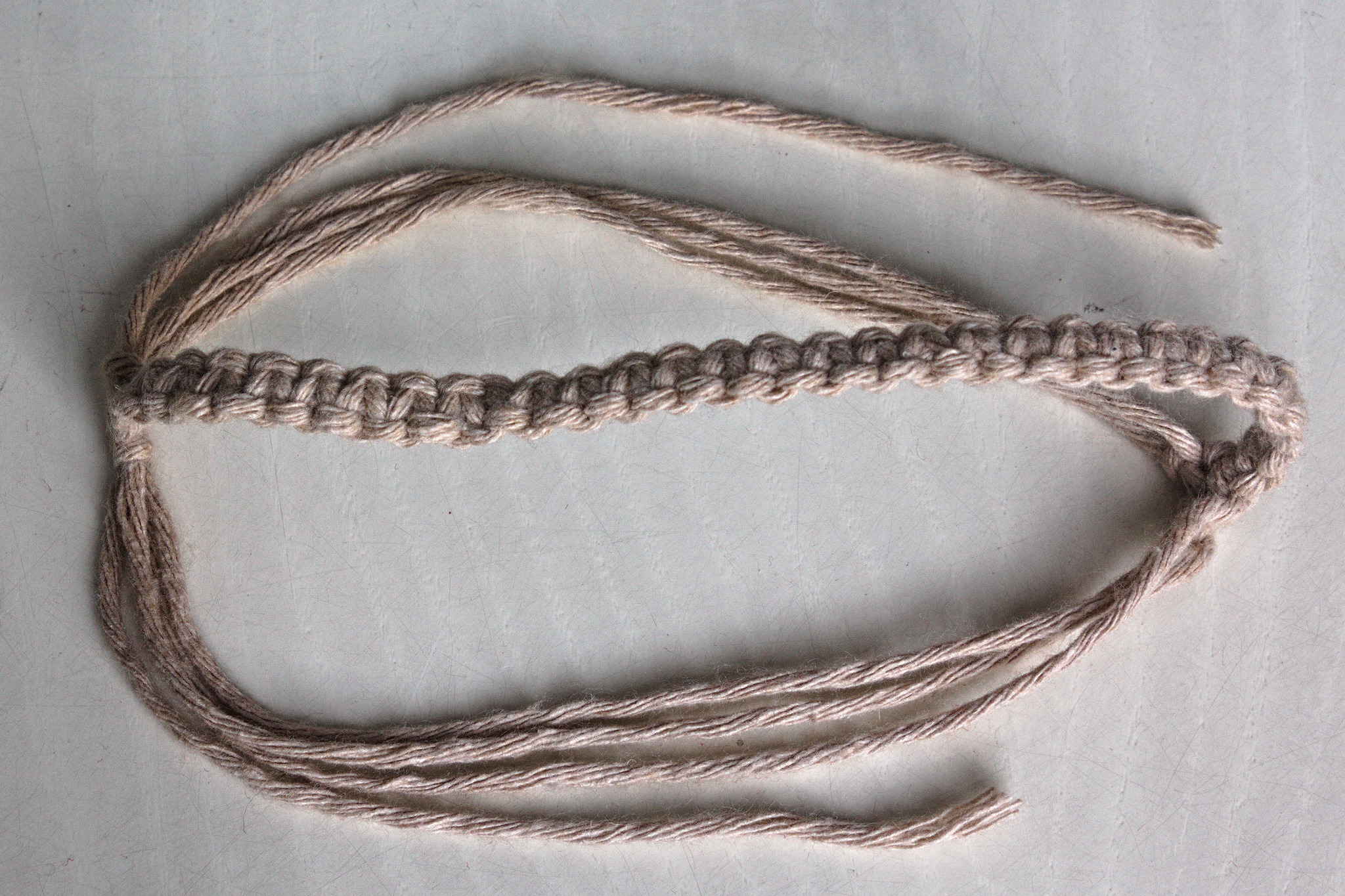
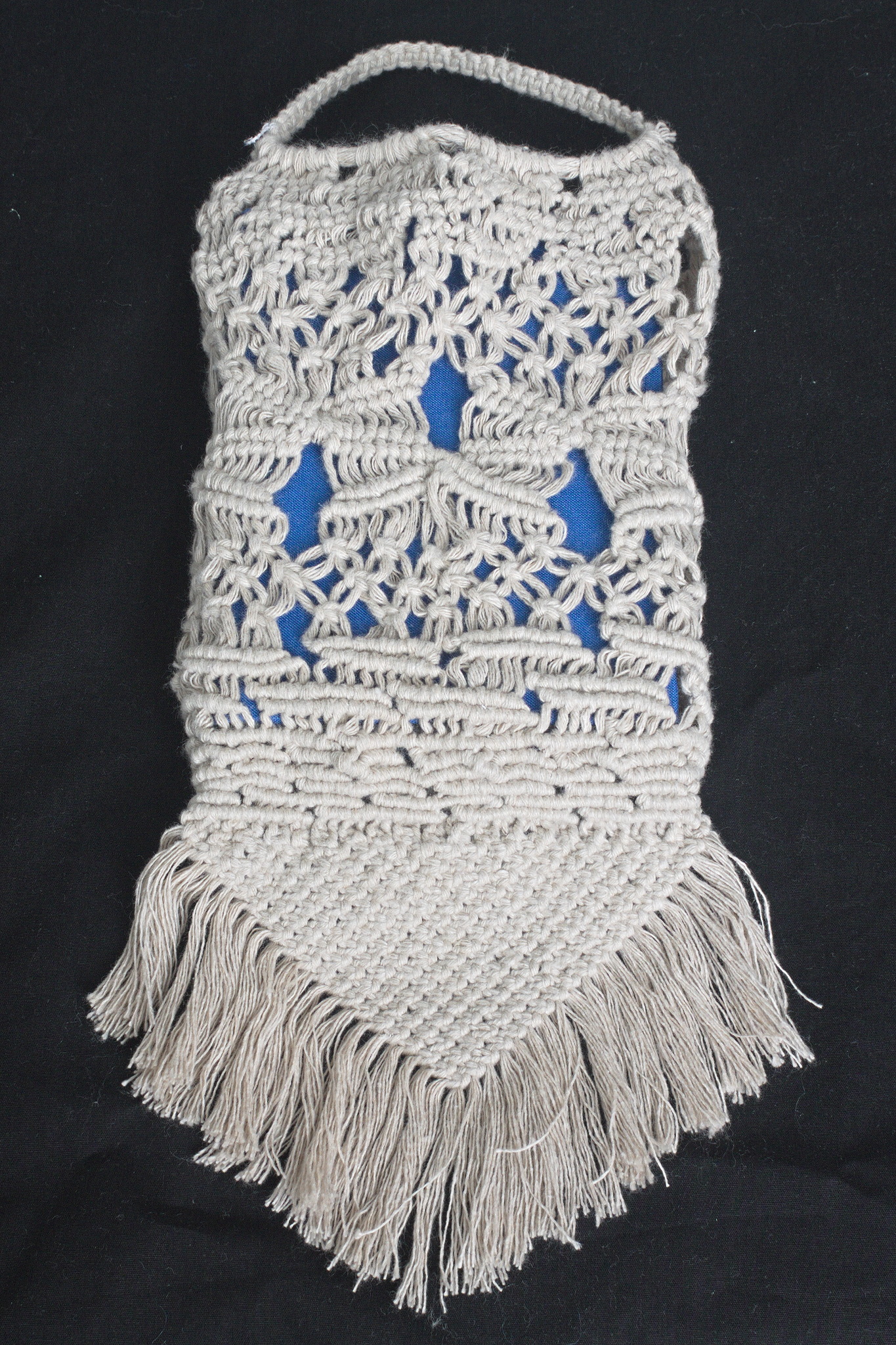
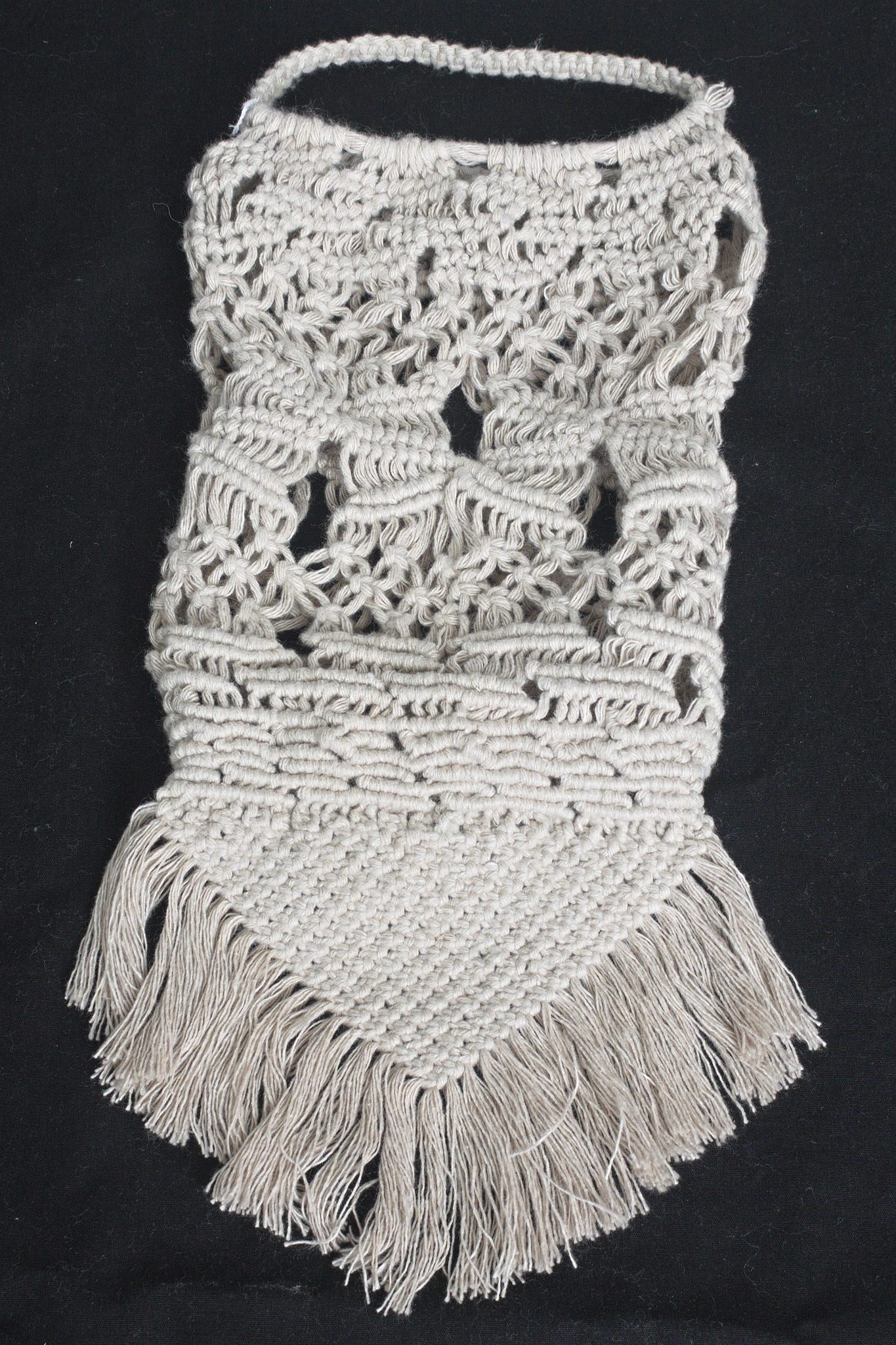
a macrame bag in ~3 mm ecru yarn, with very irregular knots of different types, holding a book with a blue cover. The bottom part has a rigid single layer triangle and a fringe. In late 2022 I prepared a batch of drawstring backpacks in cotton as reusable wrappers for Christmas gifts; however I didn t know what cord to use, didn t want to use paracord, and couldn t find anything that looked right in the local shops. With Christmas getting dangerously closer, I visited a craft materials website for unrelated reasons, found out that they sold macrame cords, and panic-bought a few types in the hope that at least one would work for the backpacks. I got lucky, and my first choice fitted just fine, and I was able to finish the backpacks in time for the holidays. And then I had a box full of macrame cords in various sizes and types that weren t the best match for the drawstring in a backpack, and no real use for them. I don t think I had ever done macrame, but I have made friendship bracelets in primary school, and a few Friendship Bracelets, But For Real Men So We Call Them Survival Bracelets(TM) more recently, so I didn t bother reading instructions or tutorials online, I just grabbed the Ashley Book of Knots to refresh myself on the knots used, and decided to make myself a small bag for an A6 book. I choose one of the thin, ~3 mm cords, Tre Sfere Macram Barbante, of which there was plenty, so that I could stumble around with no real plan. A loop of four cords, with a handle made of square knots that keeps it together. I started by looping 5 m of cord, making iirc 2 rounds of a loop about the right size to go around the book with a bit of ease, then used the ends as filler cords for a handle, wrapped them around the loop and worked square knots all over them to make a handle. Then I cut the rest of the cord into 40 pieces, each 4 m long, because I had no idea how much I was going to need (spoiler: I successfully got it wrong :D ) I joined the cords to the handle with lark head knots, 20 per side, and then I started knotting without a plan or anything, alternating between hitches and square knots, sometimes close together and sometimes leaving some free cord between them. And apparently I also completely forgot to take in-progress pictures. I kept working on this for a few months, knotting a row or two now and then, until the bag was long enough for the book, then I closed the bottom by taking one cord from the front and the corresponding on the back, knotting them together (I don t remember how) and finally I made a rigid triangle of tight square knots with all of the cords, progressively leaving out a cord from each side, and cutting it in a fringe. I then measured the remaining cords, and saw that the shortest ones were about a meter long, but the longest ones were up to 3 meters, I could have cut them much shorter at the beginning (and maybe added a couple more cords). The leftovers will be used, in some way. And then I postponed taking pictures of the finished object for a few months. The same bag, empty and showing how the sides aren't straight. Now the result is functional, but I have to admit it is somewhat ugly: not as much for the lack of a pattern (that I think came out quite fine) but because of how irregular the knots are; I m not confident that the next time I will be happy with their regularity, either, but I hope I will improve, and that s one important thing. And the other important thing is: I enjoyed making this, even if I kept interrupting the work, and I think that there may be some other macrame in my future.
30 January 2024

Antoine Beaupr : router archeology: the Soekris net5001

Roadkiller was a Soekris net5501 router I used as my main gateway between 2010 and 2016 (for r seau and t l phone). It was upgraded to FreeBSD 8.4-p12 (2014-06-06) and pkgng. It was retired in favor of octavia around 2016. Roughly 10 years later (2024-01-24), I found it in a drawer and, to my surprised, it booted. After wrangling with a RS-232 USB adapter, a null modem cable, and bit rates, I even logged in:
comBIOS ver. 1.33  20070103  Copyright (C) 2000-2007 Soekris Engineering.
net5501
0512 Mbyte Memory                        CPU Geode LX 500 Mhz 
Pri Mas  WDC WD800VE-00HDT0              LBA Xlt 1024-255-63  78 Gbyte
Slot   Vend Dev  ClassRev Cmd  Stat CL LT HT  Base1    Base2   Int 
-------------------------------------------------------------------
0:01:2 1022 2082 10100000 0006 0220 08 00 00 A0000000 00000000 10
0:06:0 1106 3053 02000096 0117 0210 08 40 00 0000E101 A0004000 11
0:07:0 1106 3053 02000096 0117 0210 08 40 00 0000E201 A0004100 05
0:08:0 1106 3053 02000096 0117 0210 08 40 00 0000E301 A0004200 09
0:09:0 1106 3053 02000096 0117 0210 08 40 00 0000E401 A0004300 12
0:20:0 1022 2090 06010003 0009 02A0 08 40 80 00006001 00006101 
0:20:2 1022 209A 01018001 0005 02A0 08 00 00 00000000 00000000 
0:21:0 1022 2094 0C031002 0006 0230 08 00 80 A0005000 00000000 15
0:21:1 1022 2095 0C032002 0006 0230 08 00 00 A0006000 00000000 15
 4 Seconds to automatic boot.   Press Ctrl-P for entering Monitor.
 
                                            
                                                  ______
                                                    ____  __ ___  ___ 
            Welcome to FreeBSD!                     __   '__/ _ \/ _ \
                                                    __       __/  __/
                                                                      
    1. Boot FreeBSD [default]                     _     _   \___ \___ 
    2. Boot FreeBSD with ACPI enabled             ____   _____ _____
    3. Boot FreeBSD in Safe Mode                    _ \ / ____   __ \
    4. Boot FreeBSD in single user mode             _)   (___         
    5. Boot FreeBSD with verbose logging            _ < \___ \        
    6. Escape to loader prompt                      _)  ____)    __   
    7. Reboot                                                         
                                                  ____/ _____/ _____/


    Select option, [Enter] for default      
    or [Space] to pause timer  5            
  
Copyright (c) 1992-2013 The FreeBSD Project.
Copyright (c) 1979, 1980, 1983, 1986, 1988, 1989, 1991, 1992, 1993, 1994
        The Regents of the University of California. All rights reserved.
FreeBSD is a registered trademark of The FreeBSD Foundation.
FreeBSD 8.4-RELEASE-p12 #5: Fri Jun  6 02:43:23 EDT 2014
    root@roadkiller.anarc.at:/usr/obj/usr/src/sys/ROADKILL i386
gcc version 4.2.2 20070831 prerelease [FreeBSD]
Timecounter "i8254" frequency 1193182 Hz quality 0
CPU: Geode(TM) Integrated Processor by AMD PCS (499.90-MHz 586-class CPU)
  Origin = "AuthenticAMD"  Id = 0x5a2  Family = 5  Model = a  Stepping = 2
  Features=0x88a93d<FPU,DE,PSE,TSC,MSR,CX8,SEP,PGE,CMOV,CLFLUSH,MMX>
  AMD Features=0xc0400000<MMX+,3DNow!+,3DNow!>
real memory  = 536870912 (512 MB)
avail memory = 506445824 (482 MB)
kbd1 at kbdmux0
K6-family MTRR support enabled (2 registers)
ACPI Error: A valid RSDP was not found (20101013/tbxfroot-309)
ACPI: Table initialisation failed: AE_NOT_FOUND
ACPI: Try disabling either ACPI or apic support.
cryptosoft0: <software crypto> on motherboard
pcib0 pcibus 0 on motherboard
pci0: <PCI bus> on pcib0
Geode LX: Soekris net5501 comBIOS ver. 1.33 20070103 Copyright (C) 2000-2007
pci0: <encrypt/decrypt, entertainment crypto> at device 1.2 (no driver attached)
vr0: <VIA VT6105M Rhine III 10/100BaseTX> port 0xe100-0xe1ff mem 0xa0004000-0xa00040ff irq 11 at device 6.0 on pci0
vr0: Quirks: 0x2
vr0: Revision: 0x96
miibus0: <MII bus> on vr0
ukphy0: <Generic IEEE 802.3u media interface> PHY 1 on miibus0
ukphy0:  none, 10baseT, 10baseT-FDX, 100baseTX, 100baseTX-FDX, auto, auto-flow
vr0: Ethernet address: 00:00:24:cc:93:44
vr0: [ITHREAD]
vr1: <VIA VT6105M Rhine III 10/100BaseTX> port 0xe200-0xe2ff mem 0xa0004100-0xa00041ff irq 5 at device 7.0 on pci0
vr1: Quirks: 0x2
vr1: Revision: 0x96
miibus1: <MII bus> on vr1
ukphy1: <Generic IEEE 802.3u media interface> PHY 1 on miibus1
ukphy1:  none, 10baseT, 10baseT-FDX, 100baseTX, 100baseTX-FDX, auto, auto-flow
vr1: Ethernet address: 00:00:24:cc:93:45
vr1: [ITHREAD]
vr2: <VIA VT6105M Rhine III 10/100BaseTX> port 0xe300-0xe3ff mem 0xa0004200-0xa00042ff irq 9 at device 8.0 on pci0
vr2: Quirks: 0x2
vr2: Revision: 0x96
miibus2: <MII bus> on vr2
ukphy2: <Generic IEEE 802.3u media interface> PHY 1 on miibus2
ukphy2:  none, 10baseT, 10baseT-FDX, 100baseTX, 100baseTX-FDX, auto, auto-flow
vr2: Ethernet address: 00:00:24:cc:93:46
vr2: [ITHREAD]
vr3: <VIA VT6105M Rhine III 10/100BaseTX> port 0xe400-0xe4ff mem 0xa0004300-0xa00043ff irq 12 at device 9.0 on pci0
vr3: Quirks: 0x2
vr3: Revision: 0x96
miibus3: <MII bus> on vr3
ukphy3: <Generic IEEE 802.3u media interface> PHY 1 on miibus3
ukphy3:  none, 10baseT, 10baseT-FDX, 100baseTX, 100baseTX-FDX, auto, auto-flow
vr3: Ethernet address: 00:00:24:cc:93:47
vr3: [ITHREAD]
isab0: <PCI-ISA bridge> at device 20.0 on pci0
isa0: <ISA bus> on isab0
atapci0: <AMD CS5536 UDMA100 controller> port 0x1f0-0x1f7,0x3f6,0x170-0x177,0x376,0xe000-0xe00f at device 20.2 on pci0
ata0: <ATA channel> at channel 0 on atapci0
ata0: [ITHREAD]
ata1: <ATA channel> at channel 1 on atapci0
ata1: [ITHREAD]
ohci0: <OHCI (generic) USB controller> mem 0xa0005000-0xa0005fff irq 15 at device 21.0 on pci0
ohci0: [ITHREAD]
usbus0 on ohci0
ehci0: <AMD CS5536 (Geode) USB 2.0 controller> mem 0xa0006000-0xa0006fff irq 15 at device 21.1 on pci0
ehci0: [ITHREAD]
usbus1: EHCI version 1.0
usbus1 on ehci0
cpu0 on motherboard
pmtimer0 on isa0
orm0: <ISA Option ROM> at iomem 0xc8000-0xd27ff pnpid ORM0000 on isa0
atkbdc0: <Keyboard controller (i8042)> at port 0x60,0x64 on isa0
atkbd0: <AT Keyboard> irq 1 on atkbdc0
kbd0 at atkbd0
atkbd0: [GIANT-LOCKED]
atkbd0: [ITHREAD]
atrtc0: <AT Real Time Clock> at port 0x70 irq 8 on isa0
ppc0: parallel port not found.
uart0: <16550 or compatible> at port 0x3f8-0x3ff irq 4 flags 0x10 on isa0
uart0: [FILTER]
uart0: console (19200,n,8,1)
uart1: <16550 or compatible> at port 0x2f8-0x2ff irq 3 on isa0
uart1: [FILTER]
Timecounter "TSC" frequency 499903982 Hz quality 800
Timecounters tick every 1.000 msec
IPsec: Initialized Security Association Processing.
usbus0: 12Mbps Full Speed USB v1.0
usbus1: 480Mbps High Speed USB v2.0
ad0: 76319MB <WDC WD800VE-00HDT0 09.07D09> at ata0-master UDMA100 
ugen0.1: <AMD> at usbus0
uhub0: <AMD OHCI root HUB, class 9/0, rev 1.00/1.00, addr 1> on usbus0
ugen1.1: <AMD> at usbus1
uhub1: <AMD EHCI root HUB, class 9/0, rev 2.00/1.00, addr 1> on usbus1
GEOM: ad0s1: geometry does not match label (255h,63s != 16h,63s).
uhub0: 4 ports with 4 removable, self powered
Root mount waiting for: usbus1
uhub1: 4 ports with 4 removable, self powered
Trying to mount root from ufs:/dev/ad0s1a
The last log rotation is from 2016:
[root@roadkiller /var/log]# stat /var/log/wtmp      
65 61783 -rw-r--r-- 1 root wheel 208219 1056 "Nov  1 05:00:01 2016" "Jan 18 22:29:16 2017" "Jan 18 22:29:16 2017" "Nov  1 05:00:01 2016" 16384 4 0 /var/log/wtmp
Interestingly, I switched between eicat and teksavvy on December 11th. Which year? Who knows!
Dec 11 16:38:40 roadkiller mpd: [eicatL0] LCP: authorization successful
Dec 11 16:41:15 roadkiller mpd: [teksavvyL0] LCP: authorization successful
Never realized those good old logs had a "oh dear forgot the year" issue (that's something like Y2K except just "Y", I guess). That was probably 2015, because the log dates from 2017, and the last entry is from November of the year after the above:
[root@roadkiller /var/log]# stat mpd.log 
65 47113 -rw-r--r-- 1 root wheel 193008 71939195 "Jan 18 22:39:18 2017" "Jan 18 22:39:59 2017" "Jan 18 22:39:59 2017" "Apr  2 10:41:37 2013" 16384 140640 0 mpd.log
It looks like the system was installed in 2010:
[root@roadkiller /var/log]# stat /
63 2 drwxr-xr-x 21 root wheel 2120 512 "Jan 18 22:34:43 2017" "Jan 18 22:28:12 2017" "Jan 18 22:28:12 2017" "Jul 18 22:25:00 2010" 16384 4 0 /
... so it lived for about 6 years, but still works after almost 14 years, which I find utterly amazing. Another amazing thing is that there's tuptime installed on that server! That is a software I thought I discovered later and then sponsored in Debian, but turns out I was already using it then!
[root@roadkiller /var]# tuptime 
System startups:        19   since   21:20:16 11/07/15
System shutdowns:       0 ok   -   18 bad
System uptime:          85.93 %   -   1 year, 11 days, 10 hours, 3 minutes and 36 seconds
System downtime:        14.07 %   -   61 days, 15 hours, 22 minutes and 45 seconds
System life:            1 year, 73 days, 1 hour, 26 minutes and 20 seconds
Largest uptime:         122 days, 9 hours, 17 minutes and 6 seconds   from   08:17:56 02/02/16
Shortest uptime:        5 minutes and 4 seconds   from   21:55:00 01/18/17
Average uptime:         19 days, 19 hours, 28 minutes and 37 seconds
Largest downtime:       57 days, 1 hour, 9 minutes and 59 seconds   from   20:45:01 11/22/16
Shortest downtime:      -1 years, 364 days, 23 hours, 58 minutes and 12 seconds   from   22:30:01 01/18/17
Average downtime:       3 days, 5 hours, 51 minutes and 43 seconds
Current uptime:         18 minutes and 23 seconds   since   22:28:13 01/18/17
Actual up/down times:
[root@roadkiller /var]# tuptime -t
No.        Startup Date                                         Uptime       Shutdown Date   End                                                  Downtime
1     21:20:16 11/07/15      1 day, 0 hours, 40 minutes and 12 seconds   22:00:28 11/08/15   BAD                                  2 minutes and 37 seconds
2     22:03:05 11/08/15      1 day, 9 hours, 41 minutes and 57 seconds   07:45:02 11/10/15   BAD                                  3 minutes and 24 seconds
3     07:48:26 11/10/15    20 days, 2 hours, 41 minutes and 34 seconds   10:30:00 11/30/15   BAD                        4 hours, 50 minutes and 21 seconds
4     15:20:21 11/30/15                      19 minutes and 40 seconds   15:40:01 11/30/15   BAD                                   6 minutes and 5 seconds
5     15:46:06 11/30/15                      53 minutes and 55 seconds   16:40:01 11/30/15   BAD                           1 hour, 1 minute and 38 seconds
6     17:41:39 11/30/15     6 days, 16 hours, 3 minutes and 22 seconds   09:45:01 12/07/15   BAD                4 days, 6 hours, 53 minutes and 11 seconds
7     16:38:12 12/11/15   50 days, 17 hours, 56 minutes and 49 seconds   10:35:01 01/31/16   BAD                                 10 minutes and 52 seconds
8     10:45:53 01/31/16     1 day, 21 hours, 28 minutes and 16 seconds   08:14:09 02/02/16   BAD                                  3 minutes and 48 seconds
9     08:17:56 02/02/16    122 days, 9 hours, 17 minutes and 6 seconds   18:35:02 06/03/16   BAD                                 10 minutes and 16 seconds
10    18:45:18 06/03/16   29 days, 17 hours, 14 minutes and 43 seconds   12:00:01 07/03/16   BAD                                 12 minutes and 34 seconds
11    12:12:35 07/03/16   31 days, 17 hours, 17 minutes and 26 seconds   05:30:01 08/04/16   BAD                                 14 minutes and 25 seconds
12    05:44:26 08/04/16     15 days, 1 hour, 55 minutes and 35 seconds   07:40:01 08/19/16   BAD                                  6 minutes and 51 seconds
13    07:46:52 08/19/16     7 days, 5 hours, 23 minutes and 10 seconds   13:10:02 08/26/16   BAD                                  3 minutes and 45 seconds
14    13:13:47 08/26/16   27 days, 21 hours, 36 minutes and 14 seconds   10:50:01 09/23/16   BAD                                  2 minutes and 14 seconds
15    10:52:15 09/23/16   60 days, 10 hours, 52 minutes and 46 seconds   20:45:01 11/22/16   BAD                 57 days, 1 hour, 9 minutes and 59 seconds
16    21:55:00 01/18/17                        5 minutes and 4 seconds   22:00:04 01/18/17   BAD                                 11 minutes and 15 seconds
17    22:11:19 01/18/17                       8 minutes and 42 seconds   22:20:01 01/18/17   BAD                                   1 minute and 20 seconds
18    22:21:21 01/18/17                       8 minutes and 40 seconds   22:30:01 01/18/17   BAD   -1 years, 364 days, 23 hours, 58 minutes and 12 seconds
19    22:28:13 01/18/17                      20 minutes and 17 seconds
The last few entries are actually the tests I'm running now, it seems this machine thinks we're now on 2017-01-18 at ~22:00, while we're actually 2024-01-24 at ~12:00 local:
Wed Jan 18 23:05:38 EST 2017
FreeBSD/i386 (roadkiller.anarc.at) (ttyu0)
login: root
Password:
Jan 18 23:07:10 roadkiller login: ROOT LOGIN (root) ON ttyu0
Last login: Wed Jan 18 22:29:16 on ttyu0
Copyright (c) 1992-2013 The FreeBSD Project.
Copyright (c) 1979, 1980, 1983, 1986, 1988, 1989, 1991, 1992, 1993, 1994
        The Regents of the University of California. All rights reserved.
FreeBSD 8.4-RELEASE-p12 (ROADKILL) #5: Fri Jun  6 02:43:23 EDT 2014
Reminders:
 * commit stuff in /etc
 * reload firewall (in screen!):
    pfctl -f /etc/pf.conf ; sleep 1
 * vim + syn on makes pf.conf more readable
 * monitoring the PPPoE uplink:
   tail -f /var/log/mpd.log
Current problems:
 * sometimes pf doesn't start properly on boot, if pppoe failed to come up, use
   this to resume:
     /etc/rc.d/pf start
   it will kill your shell, but fix NAT (2012-08-10)
 * babel fails to start on boot (2013-06-15):
     babeld -D -g 33123 tap0 vr3
 * DNS often fails, tried messing with unbound.conf (2014-10-05) and updating
   named.root (2016-01-28) and performance tweaks (ee63689)
 * asterisk and mpd4 are deprecated and should be uninstalled when we're sure
   their replacements (voipms + ata and mpd5) are working (2015-01-13)
 * if IPv6 fails, it's because netblocks are not being routed upstream. DHCPcd
   should do this, but doesn't start properly, use this to resume (2015-12-21):
     /usr/local/sbin/dhcpcd -6 --persistent --background --timeout 0 -C resolv.conf ng0
This machine is doomed to be replaced with the new omnia router, Indiegogo
campaign should ship in april 2016: http://igg.me/at/turris-omnia/x
(I really like the motd I left myself there. In theory, I guess this could just start connecting to the internet again if I still had the same PPPoE/ADSL link I had almost a decade ago; obviously, I do not.) Not sure how the system figured the 2017 time: the onboard clock itself believes we're in 1980, so clearly the CMOS battery has (understandably) failed:
> ?
comBIOS Monitor Commands
boot [drive][:partition] INT19 Boot
reboot                   cold boot
download                 download a file using XMODEM/CRC
flashupdate              update flash BIOS with downloaded file
time [HH:MM:SS]          show or set time
date [YYYY/MM/DD]        show or set date
d[b w d] [adr]           dump memory bytes/words/dwords
e[b w d] adr value [...] enter bytes/words/dwords
i[b w d] port            input from 8/16/32-bit port
o[b w d] port value      output to 8/16/32-bit port
run adr                  execute code at adr
cmosread [adr]           read CMOS RAM data
cmoswrite adr byte [...] write CMOS RAM data
cmoschecksum             update CMOS RAM Checksum
set parameter=value      set system parameter to value
show [parameter]         show one or all system parameters
?/help                   show this help
> show
ConSpeed = 19200
ConLock = Enabled
ConMute = Disabled
BIOSentry = Enabled
PCIROMS = Enabled
PXEBoot = Enabled
FLASH = Primary
BootDelay = 5
FastBoot = Disabled
BootPartition = Disabled
BootDrive = 80 81 F0 FF 
ShowPCI = Enabled
Reset = Hard
CpuSpeed = Default
> time
Current Date and Time is: 1980/01/01 00:56:47
Another bit of archeology: I had documented various outages with my ISP... back in 2003!
[root@roadkiller ~/bin]# cat ppp_stats/downtimes.txt
11/03/2003 18:24:49 218
12/03/2003 09:10:49 118
12/03/2003 10:05:57 680
12/03/2003 10:14:50 106
12/03/2003 10:16:53 6
12/03/2003 10:35:28 146
12/03/2003 10:57:26 393
12/03/2003 11:16:35 5
12/03/2003 11:16:54 11
13/03/2003 06:15:57 18928
13/03/2003 09:43:36 9730
13/03/2003 10:47:10 23
13/03/2003 10:58:35 5
16/03/2003 01:32:36 338
16/03/2003 02:00:33 120
16/03/2003 11:14:31 14007
19/03/2003 00:56:27 11179
19/03/2003 00:56:43 5
19/03/2003 00:56:53 0
19/03/2003 00:56:55 1
19/03/2003 00:57:09 1
19/03/2003 00:57:10 1
19/03/2003 00:57:24 1
19/03/2003 00:57:25 1
19/03/2003 00:57:39 1
19/03/2003 00:57:40 1
19/03/2003 00:57:44 3
19/03/2003 00:57:53 0
19/03/2003 00:57:55 0
19/03/2003 00:58:08 0
19/03/2003 00:58:10 0
19/03/2003 00:58:23 0
19/03/2003 00:58:25 0
19/03/2003 00:58:39 1
19/03/2003 00:58:42 2
19/03/2003 00:58:58 5
19/03/2003 00:59:35 2
19/03/2003 00:59:47 3
19/03/2003 01:00:34 3
19/03/2003 01:00:39 0
19/03/2003 01:00:54 0
19/03/2003 01:01:11 2
19/03/2003 01:01:25 1
19/03/2003 01:01:48 1
19/03/2003 01:02:03 1
19/03/2003 01:02:10 2
19/03/2003 01:02:20 3
19/03/2003 01:02:44 3
19/03/2003 01:03:45 3
19/03/2003 01:04:39 2
19/03/2003 01:05:40 2
19/03/2003 01:06:35 2
19/03/2003 01:07:36 2
19/03/2003 01:08:31 2
19/03/2003 01:08:38 2
19/03/2003 01:10:07 3
19/03/2003 01:11:05 2
19/03/2003 01:12:03 3
19/03/2003 01:13:01 3
19/03/2003 01:13:58 2
19/03/2003 01:14:59 5
19/03/2003 01:15:54 2
19/03/2003 01:16:55 2
19/03/2003 01:17:50 2
19/03/2003 01:18:51 3
19/03/2003 01:19:46 2
19/03/2003 01:20:46 2
19/03/2003 01:21:42 3
19/03/2003 01:22:42 3
19/03/2003 01:23:37 2
19/03/2003 01:24:38 3
19/03/2003 01:25:33 2
19/03/2003 01:26:33 2
19/03/2003 01:27:30 3
19/03/2003 01:28:55 2
19/03/2003 01:29:56 2
19/03/2003 01:30:50 2
19/03/2003 01:31:42 3
19/03/2003 01:32:36 3
19/03/2003 01:33:27 2
19/03/2003 01:34:21 2
19/03/2003 01:35:22 2
19/03/2003 01:36:17 3
19/03/2003 01:37:18 2
19/03/2003 01:38:13 3
19/03/2003 01:39:39 2
19/03/2003 01:40:39 2
19/03/2003 01:41:35 3
19/03/2003 01:42:35 3
19/03/2003 01:43:31 3
19/03/2003 01:44:31 3
19/03/2003 01:45:53 3
19/03/2003 01:46:48 3
19/03/2003 01:47:48 2
19/03/2003 01:48:44 3
19/03/2003 01:49:44 2
19/03/2003 01:50:40 3
19/03/2003 01:51:39 1
19/03/2003 11:04:33 19   
19/03/2003 18:39:36 2833 
19/03/2003 18:54:05 825  
19/03/2003 19:04:00 454  
19/03/2003 19:08:11 210  
19/03/2003 19:41:44 272  
19/03/2003 21:18:41 208  
24/03/2003 04:51:16 6
27/03/2003 04:51:20 5
30/03/2003 04:51:25 5
31/03/2003 08:30:31 255  
03/04/2003 08:30:36 5
06/04/2003 01:16:00 621  
06/04/2003 22:18:08 17   
06/04/2003 22:32:44 13   
09/04/2003 22:33:12 28   
12/04/2003 22:33:17 6
15/04/2003 22:33:22 5
17/04/2003 15:03:43 18   
20/04/2003 15:03:48 5
23/04/2003 15:04:04 16   
23/04/2003 21:08:30 339  
23/04/2003 21:18:08 13   
23/04/2003 23:34:20 253  
26/04/2003 23:34:45 25   
29/04/2003 23:34:49 5
02/05/2003 13:10:01 185  
05/05/2003 13:10:06 5
08/05/2003 13:10:11 5
09/05/2003 14:00:36 63928
09/05/2003 16:58:52 2
11/05/2003 23:08:48 2
14/05/2003 23:08:53 6
17/05/2003 23:08:58 5
20/05/2003 23:09:03 5
23/05/2003 23:09:08 5
26/05/2003 23:09:14 5
29/05/2003 23:00:10 3
29/05/2003 23:03:01 10   
01/06/2003 23:03:05 4
04/06/2003 23:03:10 5
07/06/2003 23:03:38 28   
10/06/2003 23:03:50 12   
13/06/2003 23:03:55 6
14/06/2003 07:42:20 3
14/06/2003 14:37:08 3
15/06/2003 20:08:34 3
18/06/2003 20:08:39 6
21/06/2003 20:08:45 6
22/06/2003 03:05:19 138  
22/06/2003 04:06:28 3
25/06/2003 04:06:58 31   
28/06/2003 04:07:02 4
01/07/2003 04:07:06 4
04/07/2003 04:07:11 5
07/07/2003 04:07:16 5
12/07/2003 04:55:20 6
12/07/2003 19:09:51 1158 
12/07/2003 22:14:49 8025 
15/07/2003 22:14:54 6
16/07/2003 05:43:06 18   
19/07/2003 05:43:12 6
22/07/2003 05:43:17 5
23/07/2003 18:18:55 183  
23/07/2003 18:19:55 9
23/07/2003 18:29:15 158  
23/07/2003 19:48:44 4604 
23/07/2003 20:16:27 3
23/07/2003 20:37:29 1079 
23/07/2003 20:43:12 342  
23/07/2003 22:25:51 6158
Fascinating. I suspect the (IDE!) hard drive might be failing as I saw two new files created in /var that I didn't remember seeing before:
-rw-r--r--   1 root    wheel        0 Jan 18 22:55 3@T3
-rw-r--r--   1 root    wheel        0 Jan 18 22:55 DY5
So I shutdown the machine, possibly for the last time:
Waiting (max 60 seconds) for system process  bufdaemon' to stop...done
Waiting (max 60 seconds) for system process  syncer' to stop...
Syncing disks, vnodes remaining...3 3 0 1 1 0 0 done
All buffers synced.
Uptime: 36m43s
usbus0: Controller shutdown
uhub0: at usbus0, port 1, addr 1 (disconnected)
usbus0: Controller shutdown complete
usbus1: Controller shutdown
uhub1: at usbus1, port 1, addr 1 (disconnected)
usbus1: Controller shutdown complete
The operating system has halted.
Please press any key to reboot.
I'll finally note this was the last FreeBSD server I personally operated. I also used FreeBSD to setup the core routers at Koumbit but those were replaced with Debian recently as well. Thanks Soekris, that was some sturdy hardware. Hopefully this new Protectli router will live up to that "decade plus" challenge. Not sure what the fate of this device will be: I'll bring it to the next Montreal Debian & Stuff to see if anyone's interested, contact me if you can't show up and want this thing.

Matthew Palmer: Why Certificate Lifecycle Automation Matters

If you ve perused the ActivityPub feed of certificates whose keys are known to be compromised, and clicked on the Show More button to see the name of the certificate issuer, you may have noticed that some issuers seem to come up again and again. This might make sense after all, if a CA is issuing a large volume of certificates, they ll be seen more often in a list of compromised certificates. In an attempt to see if there is anything that we can learn from this data, though, I did a bit of digging, and came up with some illuminating results.

The Procedure I started off by finding all the unexpired certificates logged in Certificate Transparency (CT) logs that have a key that is in the pwnedkeys database as having been publicly disclosed. From this list of certificates, I removed duplicates by matching up issuer/serial number tuples, and then reduced the set by counting the number of unique certificates by their issuer. This gave me a list of the issuers of these certificates, which looks a bit like this:
/C=BE/O=GlobalSign nv-sa/CN=AlphaSSL CA - SHA256 - G4
/C=GB/ST=Greater Manchester/L=Salford/O=Sectigo Limited/CN=Sectigo RSA Domain Validation Secure Server CA
/C=GB/ST=Greater Manchester/L=Salford/O=Sectigo Limited/CN=Sectigo RSA Organization Validation Secure Server CA
/C=US/ST=Arizona/L=Scottsdale/O=GoDaddy.com, Inc./OU=http://certs.godaddy.com/repository//CN=Go Daddy Secure Certificate Authority - G2
/C=US/ST=Arizona/L=Scottsdale/O=Starfield Technologies, Inc./OU=http://certs.starfieldtech.com/repository//CN=Starfield Secure Certificate Authority - G2
/C=AT/O=ZeroSSL/CN=ZeroSSL RSA Domain Secure Site CA
/C=BE/O=GlobalSign nv-sa/CN=GlobalSign GCC R3 DV TLS CA 2020
Rather than try to work with raw issuers (because, as Andrew Ayer says, The SSL Certificate Issuer Field is a Lie), I mapped these issuers to the organisations that manage them, and summed the counts for those grouped issuers together.

The Data
Lieutenant Commander Data from Star Trek: The Next Generation Insert obligatory "not THAT data" comment here
The end result of this work is the following table, sorted by the count of certificates which have been compromised by exposing their private key:
IssuerCompromised Count
Sectigo170
ISRG (Let's Encrypt)161
GoDaddy141
DigiCert81
GlobalSign46
Entrust3
SSL.com1
If you re familiar with the CA ecosystem, you ll probably recognise that the organisations with large numbers of compromised certificates are also those who issue a lot of certificates. So far, nothing particularly surprising, then. Let s look more closely at the relationships, though, to see if we can get more useful insights.

Volume Control Using the issuance volume report from crt.sh, we can compare issuance volumes to compromise counts, to come up with a compromise rate . I m using the Unexpired Precertificates colume from the issuance volume report, as I feel that s the number that best matches the certificate population I m examining to find compromised certificates. To maintain parity with the previous table, this one is still sorted by the count of certificates that have been compromised.
IssuerIssuance VolumeCompromised CountCompromise Rate
Sectigo88,323,0681701 in 519,547
ISRG (Let's Encrypt)315,476,4021611 in 1,959,480
GoDaddy56,121,4291411 in 398,024
DigiCert144,713,475811 in 1,786,586
GlobalSign1,438,485461 in 31,271
Entrust23,16631 in 7,722
SSL.com171,81611 in 171,816
If we now sort this table by compromise rate, we can see which organisations have the most (and least) leakiness going on from their customers:
IssuerIssuance VolumeCompromised CountCompromise Rate
Entrust23,16631 in 7,722
GlobalSign1,438,485461 in 31,271
SSL.com171,81611 in 171,816
GoDaddy56,121,4291411 in 398,024
Sectigo88,323,0681701 in 519,547
DigiCert144,713,475811 in 1,786,586
ISRG (Let's Encrypt)315,476,4021611 in 1,959,480
By grouping by order-of-magnitude in the compromise rate, we can identify three bands :
  • The Super Leakers: Customers of Entrust and GlobalSign seem to love to lose control of their private keys. For Entrust, at least, though, the small volumes involved make the numbers somewhat untrustworthy. The three compromised certificates could very well belong to just one customer, for instance. I m not aware of anything that GlobalSign does that would make them such an outlier, either, so I m inclined to think they just got unlucky with one or two customers, but as CAs don t include customer IDs in the certificates they issue, it s not possible to say whether that s the actual cause or not.
  • The Regular Leakers: Customers of SSL.com, GoDaddy, and Sectigo all have compromise rates in the 1-in-hundreds-of-thousands range. Again, the low volumes of SSL.com make the numbers somewhat unreliable, but the other two organisations in this group have large enough numbers that we can rely on that data fairly well, I think.
  • The Low Leakers: Customers of DigiCert and Let s Encrypt are at least three times less likely than customers of the regular leakers to lose control of their private keys. Good for them!
Now we have some useful insights we can think about.

Why Is It So?
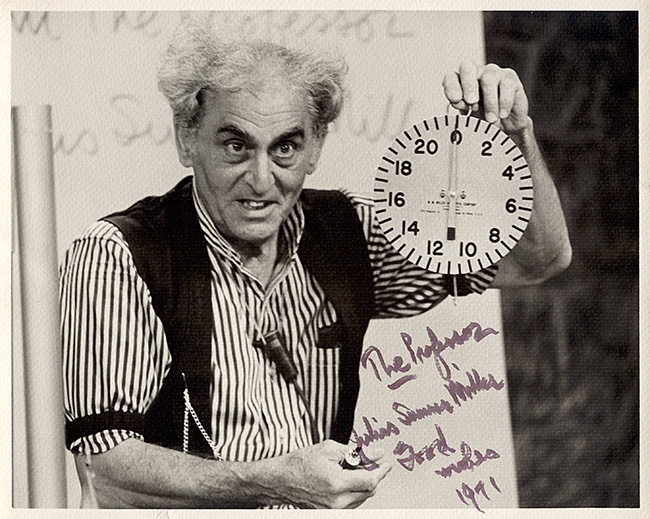
Professor Julius Sumner Miller If you don't know who Professor Julius Sumner Miller is, I highly recommend finding out

All of the organisations on the list, with the exception of Let s Encrypt, are what one might term traditional CAs. To a first approximation, it s reasonable to assume that the vast majority of the customers of these traditional CAs probably manage their certificates the same way they have for the past two decades or more. That is, they generate a key and CSR, upload the CSR to the CA to get a certificate, then copy the cert and key somewhere. Since humans are handling the keys, there s a higher risk of the humans using either risky practices, or making a mistake, and exposing the private key to the world. Let s Encrypt, on the other hand, issues all of its certificates using the ACME (Automatic Certificate Management Environment) protocol, and all of the Let s Encrypt documentation encourages the use of software tools to generate keys, issue certificates, and install them for use. Given that Let s Encrypt has 161 compromised certificates currently in the wild, it s clear that the automation in use is far from perfect, but the significantly lower compromise rate suggests to me that lifecycle automation at least reduces the rate of key compromise, even though it doesn t eliminate it completely.

Explaining the Outlier The difference in presumed issuance practices would seem to explain the significant difference in compromise rates between Let s Encrypt and the other organisations, if it weren t for one outlier. This is a largely traditional CA, with the manual-handling issues that implies, but with a compromise rate close to that of Let s Encrypt. We are, of course, talking about DigiCert. The thing about DigiCert, that doesn t show up in the raw numbers from crt.sh, is that DigiCert manages the issuance of certificates for several of the biggest hosted TLS providers, such as CloudFlare and AWS. When these services obtain a certificate from DigiCert on their customer s behalf, the private key is kept locked away, and no human can (we hope) get access to the private key. This is supported by the fact that no certificates identifiably issued to either CloudFlare or AWS appear in the set of certificates with compromised keys. When we ask for all certificates issued by DigiCert , we get both the certificates issued to these big providers, which are very good at keeping their keys under control, as well as the certificates issued to everyone else, whose key handling practices may not be quite so stringent. It s possible, though not trivial, to account for certificates issued to these hosted TLS providers, because the certificates they use are issued from intermediates branded to those companies. With the crt.sh psql interface we can run this query to get the total number of unexpired precertificates issued to these managed services:
SELECT SUM(sub.NUM_ISSUED[2] - sub.NUM_EXPIRED[2])
  FROM (
    SELECT ca.name, max(coalesce(coalesce(nullif(trim(cc.SUBORDINATE_CA_OWNER), ''), nullif(trim(cc.CA_OWNER), '')), cc.INCLUDED_CERTIFICATE_OWNER)) as OWNER,
           ca.NUM_ISSUED, ca.NUM_EXPIRED
      FROM ccadb_certificate cc, ca_certificate cac, ca
     WHERE cc.CERTIFICATE_ID = cac.CERTIFICATE_ID
       AND cac.CA_ID = ca.ID
  GROUP BY ca.ID
  ) sub
 WHERE sub.name ILIKE '%Amazon%' OR sub.name ILIKE '%CloudFlare%' AND sub.owner = 'DigiCert';
The number I get from running that query is 104,316,112, which should be subtracted from DigiCert s total issuance figures to get a more accurate view of what DigiCert s regular customers do with their private keys. When I do this, the compromise rates table, sorted by the compromise rate, looks like this:
IssuerIssuance VolumeCompromised CountCompromise Rate
Entrust23,16631 in 7,722
GlobalSign1,438,485461 in 31,271
SSL.com171,81611 in 171,816
GoDaddy56,121,4291411 in 398,024
"Regular" DigiCert40,397,363811 in 498,732
Sectigo88,323,0681701 in 519,547
All DigiCert144,713,475811 in 1,786,586
ISRG (Let's Encrypt)315,476,4021611 in 1,959,480
In short, it appears that DigiCert s regular customers are just as likely as GoDaddy or Sectigo customers to expose their private keys.

What Does It All Mean? The takeaway from all this is fairly straightforward, and not overly surprising, I believe.

The less humans have to do with certificate issuance, the less likely they are to compromise that certificate by exposing the private key. While it may not be surprising, it is nice to have some empirical evidence to back up the common wisdom. Fully-managed TLS providers, such as CloudFlare, AWS Certificate Manager, and whatever Azure s thing is called, is the platonic ideal of this principle: never give humans any opportunity to expose a private key. I m not saying you should use one of these providers, but the security approach they have adopted appears to be the optimal one, and should be emulated universally. The ACME protocol is the next best, in that there are a variety of standardised tools widely available that allow humans to take themselves out of the loop, but it s still possible for humans to handle (and mistakenly expose) key material if they try hard enough. Legacy issuance methods, which either cannot be automated, or require custom, per-provider automation to be developed, appear to be at least four times less helpful to the goal of avoiding compromise of the private key associated with a certificate.

Humans Are, Of Course, The Problem
Bender, the robot from Futurama, asking if we'd like to kill all humans No thanks, Bender, I'm busy tonight
This observation that if you don t let humans near keys, they don t get leaked is further supported by considering the biggest issuers by volume who have not issued any certificates whose keys have been compromised: Google Trust Services (fourth largest issuer overall, with 57,084,529 unexpired precertificates), and Microsoft Corporation (sixth largest issuer overall, with 22,852,468 unexpired precertificates). It appears that somewhere between most and basically all of the certificates these organisations issue are to customers of their public clouds, and my understanding is that the keys for these certificates are managed in same manner as CloudFlare and AWS the keys are locked away where humans can t get to them. It should, of course, go without saying that if a human can never have access to a private key, it makes it rather difficult for a human to expose it. More broadly, if you are building something that handles sensitive or secret data, the more you can do to keep humans out of the loop, the better everything will be.

Your Support is Appreciated If you d like to see more analysis of how key compromise happens, and the lessons we can learn from examining billions of certificates, please show your support by buying me a refreshing beverage. Trawling CT logs is thirsty work.

Appendix: Methodology Limitations In the interests of clarity, I feel it s important to describe ways in which my research might be flawed. Here are the things I know of that may have impacted the accuracy, that I couldn t feasibly account for.
  • Time Periods: Because time never stops, there is likely to be some slight mismatches in the numbers obtained from the various data sources, because they weren t collected at exactly the same moment.
  • Issuer-to-Organisation Mapping: It s possible that the way I mapped issuers to organisations doesn t match exactly with how crt.sh does it, meaning that counts might be skewed. I tried to minimise that by using the same data sources (the CCADB AllCertificates report) that I believe that crt.sh uses for its mapping, but I cannot be certain of a perfect match.
  • Unwarranted Grouping: I ve drawn some conclusions about the practices of the various organisations based on their general approach to certificate issuance. If a particular subordinate CA that I ve grouped into the parent organisation is managed in some unusual way, that might cause my conclusions to be erroneous. I was able to fairly easily separate out CloudFlare, AWS, and Azure, but there are almost certainly others that I didn t spot, because hoo boy there are a lot of intermediate CAs out there.

29 January 2024

Russell Coker: Thinkpad X1 Yoga Gen3

I just bought myself a Thinkpad X1 Yoga Gen3 for $359.10. I have been quite happy with the Thinkpad X1 Carbon Gen5 I ve had for just over a year (apart from my mistake in buying one with lost password) [1] and I normally try to get more use out of a computer than that. If I divide total cost by the time that I ve had it working that comes out to about $1.30 per day. I would pay more than that for a laptop and I have paid much more than that for laptops in the past, but I prefer not to. I was initially tempted to buy a new Thinkpad by the prices of high end X1 devices dropping, this new Yoga has 16G of RAM and a 2560*1440 screen that s a good upgrade from 8G with 1920*1080. The CPU of my new Thinkpad is a quad core i5-8350U that rates 6226 [2] and is a decent upgrade from the dual core i5-6300U that rates 3239 [3] although that wasn t a factor as I found the old CPU fast enough. The Yoga Gen3 has a minimum weight of 1.4Kg and mine might not be the lightest model in the range while the old Carbon weighs 1.14Kg. I can really feel the difference. It s also slightly larger but fortunately still fits in the pocket of my Scottware jacket. The higher resolution screen and more RAM were not sufficient to make me want to spend some money. The deciding factor is that as I m working on phones with touch screens it is a benefit to use a laptop with a touch screen so I can do more testing. The Yoga I bought was going cheap because the touch part of the touch screen is broken but the stylus still works, this is apparently a common failure mode of the Yoga. The Yoga has a brighter screen than the Carbon and seems to have better contrast. I think Lenovo had some newer technology for that generation of laptops or maybe my Carbon is slightly defective in that regard. It s a hazard of buying second hand that if something basically works but isn t quite as good as it should be then you will never know. I m happy with this purchase and I recommend that everyone who buys laptops secondhand the way I do only get 1440p or better displays. I ve currently got the Kitty terminal emulator [4] setup with 9 windows that each have 103 or 104 columns and 26 or 28 rows of text. That s a lot of terminals on a laptop screen!

Russ Allbery: Review: Bluebird

Review: Bluebird, by Ciel Pierlot
Publisher: Angry Robot
Copyright: 2022
ISBN: 0-85766-967-2
Format: Kindle
Pages: 458
Bluebird is a stand-alone far-future science fiction adventure. Ten thousand years ago, a star fell into the galaxy carrying three factions of humanity. The Ascetics, the Ossuary, and the Pyrites each believe that only their god survived and the other two factions are heretics. Between them, they have conquered the rest of the galaxy and its non-human species. The only thing the factions hate worse than each other are those who attempt to stay outside the faction system. Rig used to be a Pyrite weapon designer before she set fire to her office and escaped with her greatest invention. Now she's a Nightbird, a member of an outlaw band that tries to help refugees and protect her fellow Kashrini against Pyrite genocide. On her side, she has her girlfriend, an Ascetic librarian; her ship, Bluebird; and her guns, Panache and Pizzazz. And now, perhaps, the mysterious Ginka, a Zazra empath and remarkably capable fighter who helps Rig escape from an ambush by Pyrite soldiers. Rig wants to stay alive, help her people, and defy the factions. Pyrite wants Rig's secrets and, as leverage, has her sister. What Ginka wants is not entirely clear even to Ginka. This book is absurd, but I still had fun with it. It's dangerous for me to compare things to anime given how little anime that I've watched, but Bluebird had that vibe for me: anime, or maybe Japanese RPGs or superhero comics. The storytelling is very visual, combat-oriented, and not particularly realistic. Rig is a pistol sharpshooter and Ginka is the type of undefined deadly acrobatic fighter so often seen in that type of media. In addition to her ship, Rig has a gorgeous hand-maintained racing hoverbike with a beautiful paint job. It's that sort of book. It's also the sort of book where the characters obey cinematic logic designed to maximize dramatic physical confrontations, even if their actions make no logical sense. There is no facial recognition or screening, and it's bizarrely easy for the protagonists to end up in same physical location as high-up bad guys. One of the weapon systems that's critical to the plot makes no sense whatsoever. At critical moments, the bad guys behave more like final bosses in a video game, picking up weapons to deal with the protagonists directly instead of using their supposedly vast armies of agents. There is supposedly a whole galaxy full of civilizations with capital worlds covered in planet-spanning cities, but politics barely exist and the faction leaders get directly involved in the plot. If you are looking for a realistic projection of technology or society, I cannot stress enough that this is not the book that you're looking for. You probably figured that out when I mentioned ten thousand years of war, but that will only be the beginning of the suspension of disbelief problems. You need to turn off your brain and enjoy the action sequences and melodrama. I'm normally good at that, and I admit I still struggled because the plot logic is such a mismatch with the typical novels I read. There are several points where the characters do something that seems so monumentally dumb that I was sure Pierlot was setting them up for a fall, and then I got wrong-footed because their plan worked fine, or exploded for unrelated reasons. I think this type of story, heavy on dramatic eye-candy and emotional moments with swelling soundtracks, is a lot easier to pull off in visual media where all the pretty pictures distract your brain. In a novel, there's a lot of time to think about the strategy, technology, and government structure, which for this book is not a good idea. If you can get past that, though, Rig is entertainingly snarky and Ginka, who turns out to be the emotional heart of the book, is an enjoyable character with a real growth arc. Her background is a bit simplistic and the villains are the sort of pure evil that you might expect from this type of cinematic plot, but I cared about the outcome of her story. Some parts of the plot dragged and I think the editing could have been tighter, but there was enough competence porn and banter to pull me through. I would recommend Bluebird only cautiously, since you're going to need to turn off large portions of your brain and be in the right mood for nonsensically dramatic confrontations, but I don't regret reading it. It's mostly in primary colors and the emotional conflicts are not what anyone would call subtle, but it delivers a character arc and a somewhat satisfying ending. Content warning: There is a lot of serious physical injury in this book, including surgical maiming. If that's going to bother you, you may want to give this one a pass. Rating: 6 out of 10

Michael Ablassmeier: qmpbackup 0.28

Over the last weekend i had some spare time to improve qmpbackup a little more, the new version: and some minor code reworks. Hope its useful for someone.

28 January 2024

Niels Thykier: Annotating the Debian packaging directory

In my previous blog post Providing online reference documentation for debputy, I made a point about how debhelper documentation was suboptimal on account of being static rather than online. The thing is that debhelper is not alone in this problem space, even if it is a major contributor to the number of packaging files you have to to know about. If we look at the "competition" here such as Fedora and Arch Linux, they tend to only have one packaging file. While most Debian people will tell you a long list of cons about having one packaging file (such a Fedora's spec file being 3+ domain specific languages "mashed" into one file), one major advantage is that there is only "the one packaging file". You only need to remember where to find the documentation for one file, which is great when you are running on wetware with limited storage capacity. Which means as a newbie, you can dedicate less mental resources to tracking multiple files and how they interact and more effort understanding the "one file" at hand. I started by asking myself how can we in Debian make the packaging stack more accessible to newcomers? Spoiler alert, I dug myself into rabbit hole and ended up somewhere else than where I thought I was going. I started by wanting to scan the debian directory and annotate all files that I could with documentation links. The logic was that if debputy could do that for you, then you could spend more mental effort elsewhere. So I combined debputy's packager provided files detection with a static list of files and I quickly had a good starting point for debputy-based packages.
Adding (non-static) dpkg and debhelper files to the mix Now, I could have closed the topic here and said "Look, I did debputy files plus couple of super common files". But I decided to take it a bit further. I added support for handling some dpkg files like packager provided files (such as debian/substvars and debian/symbols). But even then, we all know that debhelper is the big hurdle and a major part of the omission... In another previous blog post (A new Debian package helper: debputy), I made a point about how debputy could list all auxiliary files while debhelper could not. This was exactly the kind of feature that I would need for this feature, if this feature was to cover debhelper. Now, I also remarked in that blog post that I was not willing to maintain such a list. Also, I may have ranted about static documentation being unhelpful for debhelper as it excludes third-party provided tooling. Fortunately, a recent update to dh_assistant had provided some basic plumbing for loading dh sequences. This meant that getting a list of all relevant commands for a source package was a lot easier than it used to be. Once you have a list of commands, it would be possible to check all of them for dh's NOOP PROMISE hints. In these hints, a command can assert it does nothing if a given pkgfile is not present. This lead to the new dh_assistant list-guessed-dh-config-files command that will list all declared pkgfiles and which helpers listed them. With this combined feature set in place, debputy could call dh_assistant to get a list of pkgfiles, pretend they were packager provided files and annotate those along with manpage for the relevant debhelper command. The exciting thing about letting debpputy resolve the pkgfiles is that debputy will resolve "named" files automatically (debhelper tools will only do so when --name is passed), so it is much more likely to detect named pkgfiles correctly too. Side note: I am going to ignore the elephant in the room for now, which is dh_installsystemd and its package@.service files and the wide-spread use of debian/foo.service where there is no package called foo. For the latter case, the "proper" name would be debian/pkg.foo.service. With the new dh_assistant feature done and added to debputy, debputy could now detect the ubiquitous debian/install file. Excellent. But less great was that the very common debian/docs file was not. Turns out that dh_installdocs cannot be skipped by dh, so it cannot have NOOP PROMISE hints. Meh... Well, dh_assistant could learn about a new INTROSPECTABLE marker in addition to the NOOP PROMISE and then I could sprinkle that into a few commands. Indeed that worked and meant that debian/postinst (etc.) are now also detectable. At this point, debputy would be able to identify a wide range of debhelper related configuration files in debian/ and at least associate each of them with one or more commands. Nice, surely, this would be a good place to stop, right...?
Adding more metadata to the files The debhelper detected files only had a command name and manpage URI to that command. It would be nice if we could contextualize this a bit more. Like is this file installed into the package as is like debian/pam or is it a file list to be processed like debian/install. To make this distinction, I could add the most common debhelper file types to my static list and then merge the result together. Except, I do not want to maintain a full list in debputy. Fortunately, debputy has a quite extensible plugin infrastructure, so added a new plugin feature to provide this kind of detail and now I can outsource the problem! I split my definitions into two and placed the generic ones in the debputy-documentation plugin and moved the debhelper related ones to debhelper-documentation. Additionally, third-party dh addons could provide their own debputy plugin to add context to their configuration files. So, this gave birth file categories and configuration features, which described each file on different fronts. As an example, debian/gbp.conf could be tagged as a maint-config to signal that it is not directly related to the package build but more of a tool or style preference file. On the other hand, debian/install and debian/debputy.manifest would both be tagged as a pkg-helper-config. Files like debian/pam were tagged as ppf-file for packager provided file and so on. I mentioned configuration features above and those were added because, I have had a beef with debhelper's "standard" configuration file format as read by filearray and filedoublearray. They are often considered simple to understand, but it is hard to know how a tool will actually read the file. As an example, consider the following:
  • Will the debhelper use filearray, filedoublearray or none of them to read the file? This topic has about 2 bits of entropy.
  • Will the config file be executed if it is marked executable assuming you are using the right compat level? If it is executable, does dh-exec allow renaming for this file? This topic adds 1 or 2 bit of entropy depending on the context.
  • Will the config file be subject to glob expansions? This topic sounds like a boolean but is a complicated mess. The globs can be handled either by debhelper as it parses the file for you. In this case, the globs are applied to every token. However, this is not what dh_install does. Here the last token on each line is supposed to be a directory and therefore not subject to globs. Therefore, dh_install does the globbing itself afterwards but only on part of the tokens. So that is about 2 bits of entropy more. Actually, it gets worse...
    • If the file is executed, debhelper will refuse to expand globs in the output of the command, which was a deliberate design choice by the original debhelper maintainer took when he introduced the feature in debhelper/8.9.12. Except, dh_install feature interacts with the design choice and does enable glob expansion in the tool output, because it does so manually after its filedoublearray call.
So these "simple" files have way too many combinations of how they can be interpreted. I figured it would be helpful if debputy could highlight these difference, so I added support for those as well. Accordingly, debian/install is tagged with multiple tags including dh-executable-config and dh-glob-after-execute. Then, I added a datatable of these tags, so it would be easy for people to look up what they meant. Ok, this seems like a closed deal, right...?
Context, context, context However, the dh-executable-config tag among other are only applicable in compat 9 or later. It does not seem newbie friendly if you are told that this feature exist, but then have to read in the extended description that that it actually does not apply to your package. This problem seems fixable. Thanks to dh_assistant, it is easy to figure out which compat level the package is using. Then tweak some metadata to enable per compat level rules. With that tags like dh-executable-config only appears for packages using compat 9 or later. Also, debputy should be able to tell you where packager provided files like debian/pam are installed. We already have the logic for packager provided files that debputy supports and I am already using debputy engine for detecting the files. If only the plugin provided metadata gave me the install pattern, debputy would be able tell you where this file goes in the package. Indeed, a bit of tweaking later and setting install-pattern to usr/lib/pam.d/ name , debputy presented me with the correct install-path with the package name placing the name placeholder. Now, I have been using debian/pam as an example, because debian/pam is installed into usr/lib/pam.d in compat 14. But in earlier compat levels, it was installed into etc/pam.d. Well, I already had an infrastructure for doing compat file tags. Off we go to add install-pattern to the complat level infrastructure and now changing the compat level would change the path. Great. (Bug warning: The value is off-by-one in the current version of debhelper. This is fixed in git) Also, while we are in this install-pattern business, a number of debhelper config files causes files to be installed into a fixed directory. Like debian/docs which causes file to be installed into /usr/share/docs/ package . Surely, we can expand that as well and provide that bit of context too... and done. (Bug warning: The code currently does not account for the main documentation package context) It is rather common pattern for people to do debian/foo.in files, because they want to custom generation of debian/foo. Which means if you have debian/foo you get "Oh, let me tell you about debian/foo ". Then you rename it to debian/foo.in and the result is "debian/foo.in is a total mystery to me!". That is suboptimal, so lets detect those as well as if they were the original file but add a tag saying that they are a generate template and which file we suspect it generates. Finally, if you use debputy, almost all of the standard debhelper commands are removed from the sequence, since debputy replaces them. It would be weird if these commands still contributed configuration files when they are not actually going to be invoked. This mostly happened naturally due to the way the underlying dh_assistant command works. However, any file mentioned by the debhelper-documentation plugin would still appear unfortunately. So off I went to filter the list of known configuration files against which dh_ commands that dh_assistant thought would be used for this package.
Wrapping it up I was several layers into this and had to dig myself out. I have ended up with a lot of data and metadata. But it was quite difficult for me to arrange the output in a user friendly manner. However, all this data did seem like it would be useful any tool that wants to understand more about the package. So to get out of the rabbit hole, I for now wrapped all of this into JSON and now we have a debputy tool-support annotate-debian-directory command that might be useful for other tools. To try it out, you can try the following demo: In another day, I will figure out how to structure this output so it is useful for non-machine consumers. Suggestions are welcome. :)
Limitations of the approach As a closing remark, I should probably remind people that this feature relies heavily on declarative features. These include:
  • When determining which commands are relevant, using Build-Depends: dh-sequence-foo is much more reliable than configuring it via the Turing complete configuration we call debian/rules.
  • When debhelper commands use NOOP promise hints, dh_assistant can "see" the config files listed those hints, meaning the file will at least be detected. For new introspectable hint and the debputy plugin, it is probably better to wait until the dust settles a bit before adding any of those.
You can help yourself and others to better results by using the declarative way rather than using debian/rules, which is the bane of all introspection!

26 January 2024

Bastian Venthur: Investigating popularity of Python build backends over time

Inspired by a Mastodon post by Fran oise Conil, who investigated the current popularity of build backends used in pyproject.toml files, I wanted to investigate how the popularity of build backends used in pyproject.toml files evolved over the years since the introduction of PEP-0517 in 2015. Getting the data Tom Forbes provides a huge dataset that contains information about every file within every release uploaded to PyPI. To get the current dataset, we can use:
curl -L --remote-name-all $(curl -L "https://github.com/pypi-data/data/raw/main/links/dataset.txt")
This will download approximately 30GB of parquet files, providing detailed information about each file included in a PyPI upload, including:
  1. project name, version and release date
  2. file path, size and line count
  3. hash of the file
The dataset does not contain the actual files themselves though, more on that in a moment. Querying the dataset using duckdb We can now use duckdb to query the parquet files directly. Let s look into the schema first:
describe select * from '*.parquet';
 
    column_name     column_type    null    
      varchar         varchar     varchar  
 
  project_name      VARCHAR       YES      
  project_version   VARCHAR       YES      
  project_release   VARCHAR       YES      
  uploaded_on       TIMESTAMP     YES      
  path              VARCHAR       YES      
  archive_path      VARCHAR       YES      
  size              UBIGINT       YES      
  hash              BLOB          YES      
  skip_reason       VARCHAR       YES      
  lines             UBIGINT       YES      
  repository        UINTEGER      YES      
 
  11 rows                       6 columns  
 
From all files mentioned in the dataset, we only care about pyproject.toml files that are in the project s root directory. Since we ll still have to download the actual files, we need to get the path and the repository to construct the corresponding URL to the mirror that contains all files in a bunch of huge git repositories. Some files are not available on the mirrors; to skip these, we only take files where the skip_reason is empty. We also care about the timestamp of the upload (uploaded_on) and the hash to avoid processing identical files twice:
select
    path,
    hash,
    uploaded_on,
    repository
from '*.parquet'
where
    skip_reason == '' and
    lower(string_split(path, '/')[-1]) == 'pyproject.toml' and
    len(string_split(path, '/')) == 5
order by uploaded_on desc
This query runs for a few minutes on my laptop and returns ~1.2M rows. Getting the actual files Using the repository and path, we can now construct an URL from which we can fetch the actual file for further processing:
url = f"https://raw.githubusercontent.com/pypi-data/pypi-mirror- repository /code/ path "
We can download the individual pyproject.toml files and parse them to read the build-backend into a dictionary mapping the file-hash to the build backend. Downloads on GitHub are rate-limited, so downloading 1.2M files will take a couple of days. By skipping files with a hash we ve already processed, we can avoid downloading the same file more than once, cutting the required downloads by circa 50%. Results Assuming the data is complete and my analysis is sound, these are the findings: There is a surprising amount of build backends in use, but the overall amount of uploads per build backend decreases quickly, with a long tail of single uploads:
>>> results.backend.value_counts()
backend
setuptools        701550
poetry            380830
hatchling          56917
flit               36223
pdm                11437
maturin             9796
jupyter             1707
mesonpy              625
scikit               556
                   ...
postry                 1
tree                   1
setuptoos              1
neuron                 1
avalon                 1
maturimaturinn         1
jsonpath               1
ha                     1
pyo3                   1
Name: count, Length: 73, dtype: int64
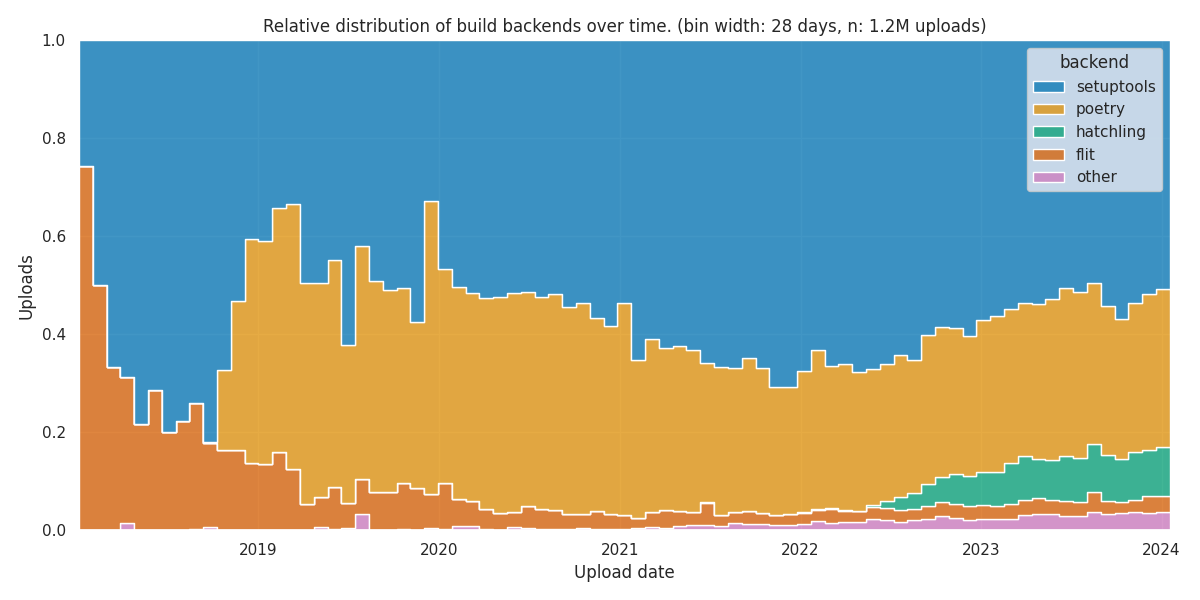
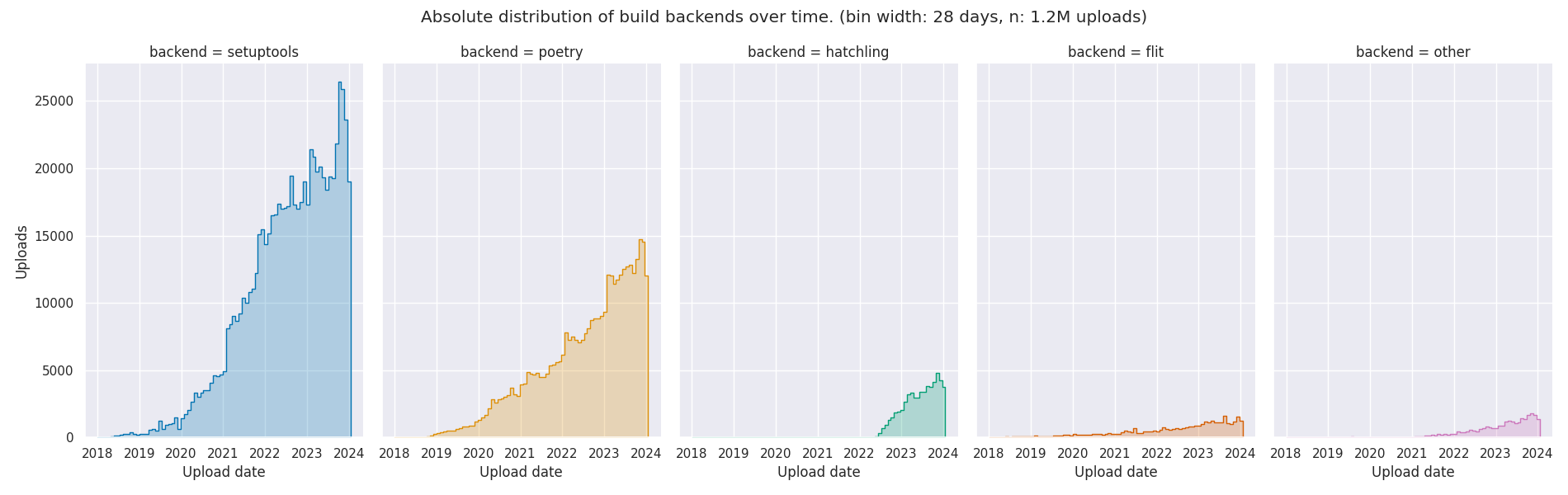
We pick only the top 4 build backends, and group the remaining ones (including PDM and Maturin) into other so they are accounted for as well. The following plot shows the relative distribution of build backends over time. Each bin represents a time span of 28 days. I chose 28 days to reduce visual clutter. Within each bin, the height of the bars corresponds to the relative proportion of uploads during that time interval: Relative distribution of build backends over time Looking at the right side of the plot, we see the current distribution. It confirms Fran oise s findings about the current popularity of build backends: Between 2018 and 2020 the graph exhibits significant fluctuations, due to the relatively low amount uploads utizing pyproject.toml files. During that early period, Flit started as the most popular build backend, but was eventually displaced by Setuptools and Poetry. Between 2020 and 2020, the overall usage of pyproject.toml files increased significantly. By the end of 2022, the share of Setuptools peaked at 70%. After 2020, other build backends experienced a gradual rise in popularity. Amongh these, Hatch emerged as a notable contender, steadily gaining traction and ultimately stabilizing at 10%. We can also look into the absolute distribution of build backends over time: Absolute distribution of build backends over time The plot shows that Setuptools has the strongest growth trajectory, surpassing all other build backends. Poetry and Hatch are growing at a comparable rate, but since Hatch started roughly 4 years after Poetry, it s lagging behind in popularity. Despite not being among the most widely used backends anymore, Flit maintains a steady and consistent growth pattern, indicating its enduring relevance in the Python packaging landscape. The script for downloading and analyzing the data can be found in my GitHub repository. It contains the results of the duckb query (so you don t have to download the full dataset) and the pickled dictionary, mapping the file hashes to the build backends, saving you days for downloading and analyzing the pyproject.toml files yourself.

25 January 2024

Jonathan Dowland: I'm going to FOSDEM 2024

I'm attending FOSDEM 2024. Perhaps I'll see you there! For the first time, I'm giving some talks, both in the Free Java Devroom (UB5.132) on Saturday 3rd. They are

Joachim Breitner: GHC Steering Committee Retrospective

After seven years of service as member and secretary on the GHC Steering Committee, I have resigned from that role. So this is a good time to look back and retrace the formation of the GHC proposal process and committee. In my memory, I helped define and shape the proposal process, optimizing it for effectiveness and throughput, but memory can be misleading, and judging from the paper trail in my email archives, this was indeed mostly Ben Gamari s and Richard Eisenberg s achievement: Already in Summer of 2016, Ben Gamari set up the ghc-proposals Github repository with a sketch of a process and sent out a call for nominations on the GHC user s mailing list, which I replied to. The Simons picked the first set of members, and in the fall of 2016 we discussed the committee s by-laws and procedures. As so often, Richard was an influential shaping force here.

Three ingredients For example, it was him that suggested that for each proposal we have one committee member be the Shepherd , overseeing the discussion. I believe this was one ingredient for the process effectiveness: There is always one person in charge, and thus we avoid the delays incurred when any one of a non-singleton set of volunteers have to do the next step (and everyone hopes someone else does it). The next ingredient was that we do not usually require a vote among all members (again, not easy with volunteers with limited bandwidth and occasional phases of absence). Instead, the shepherd makes a recommendation (accept/reject), and if the other committee members do not complain, this silence is taken as consent, and we come to a decision. It seems this idea can also be traced back on Richard, who suggested that once a decision is requested, the shepherd [generates] consensus. If consensus is elusive, then we vote. At the end of the year we agreed and wrote down these rules, created the mailing list for our internal, but publicly archived committee discussions, and began accepting proposals, starting with Adam Gundry s OverloadedRecordFields. At that point, there was no secretary role yet, so how I did become one? It seems that in February 2017 I started to clean-up and refine the process documentation, fixing bugs in the process (like requiring authors to set Github labels when they don t even have permissions to do that). This in particular meant that someone from the committee had to manually handle submissions and so on, and by the aforementioned principle that at every step there ought to be exactly one person in change, the role of a secretary followed naturally. In the email in which I described that role I wrote:
Simon already shoved me towards picking up the secretary hat, to reduce load on Ben.
So when I merged the updated process documentation, I already listed myself secretary . It wasn t just Simon s shoving that put my into the role, though. I dug out my original self-nomination email to Ben, and among other things I wrote:
I also hope that there is going to be clear responsibilities and a clear workflow among the committee. E.g. someone (possibly rotating), maybe called the secretary, who is in charge of having an initial look at proposals and then assigning it to a member who shepherds the proposal.
So it is hardly a surprise that I became secretary, when it was dear to my heart to have a smooth continuous process here. I am rather content with the result: These three ingredients single secretary, per-proposal shepherds, silence-is-consent helped the committee to be effective throughout its existence, even as every once in a while individual members dropped out.

Ulterior motivation I must admit, however, there was an ulterior motivation behind me grabbing the secretary role: Yes, I did want the committee to succeed, and I did want that authors receive timely, good and decisive feedback on their proposals but I did not really want to have to do that part. I am, in fact, a lousy proposal reviewer. I am too generous when reading proposals, and more likely mentally fill gaps in a specification rather than spotting them. Always optimistically assuming that the authors surely know what they are doing, rather than critically assessing the impact, the implementation cost and the interaction with other language features. And, maybe more importantly: why should I know which changes are good and which are not so good in the long run? Clearly, the authors cared enough about a proposal to put it forward, so there is some need and I do believe that Haskell should stay an evolving and innovating language but how does this help me decide about this or that particular feature. I even, during the formation of the committee, explicitly asked that we write down some guidance on Vision and Guideline ; do we want to foster change or innovation, or be selective gatekeepers? Should we accept features that are proven to be useful, or should we accept features so that they can prove to be useful? This discussion, however, did not lead to a concrete result, and the assessment of proposals relied on the sum of each member s personal preference, expertise and gut feeling. I am not saying that this was a mistake: It is hard to come up with a general guideline here, and even harder to find one that does justice to each individual proposal. So the secret motivation for me to grab the secretary post was that I could contribute without having to judge proposals. Being secretary allowed me to assign most proposals to others to shepherd, and only once in a while myself took care of a proposal, when it seemed to be very straight-forward. Sneaky, ain t it?

7 Years later For years to come I happily played secretary: When an author finished their proposal and public discussion ebbed down they would ping me on GitHub, I would pick a suitable shepherd among the committee and ask them to judge the proposal. Eventually, the committee would come to a conclusion, usually by implicit consent, sometimes by voting, and I d merge the pull request and update the metadata thereon. Every few months I d summarize the current state of affairs to the committee (what happened since the last update, which proposals are currently on our plate), and once per year gathered the data for Simon Peyton Jones annually GHC Status Report. Sometimes some members needed a nudge or two to act. Some would eventually step down, and I d sent around a call for nominations and when the nominations came in, distributed them off-list among the committee and tallied the votes. Initially, that was exciting. For a long while it was a pleasant and rewarding routine. Eventually, it became a mere chore. I noticed that I didn t quite care so much anymore about some of the discussion, and there was a decent amount of naval-gazing, meta-discussions and some wrangling about claims of authority that was probably useful and necessary, but wasn t particularly fun. I also began to notice weaknesses in the processes that I helped shape: We could really use some more automation for showing proposal statuses, notifying people when they have to act, and nudging them when they don t. The whole silence-is-assent approach is good for throughput, but not necessary great for quality, and maybe the committee members need to be pushed more firmly to engage with each proposal. Like GHC itself, the committee processes deserve continuous refinement and refactoring, and since I could not muster the motivation to change my now well-trod secretarial ways, it was time for me to step down. Luckily, Adam Gundry volunteered to take over, and that makes me feel much less bad for quitting. Thanks for that! And although I am for my day job now enjoying a language that has many of the things out of the box that for Haskell are still only language extensions or even just future proposals (dependent types, BlockArguments, do notation with ( foo) expressions and Unicode), I m still around, hosting the Haskell Interlude Podcast, writing on this blog and hanging out at ZuriHac etc.

24 January 2024

Dirk Eddelbuettel: RApiDatetime 0.0.9 on CRAN: Maintenance

A new maintenance release of our RApiDatetime package is now on CRAN RApiDatetime provides a number of entry points for C-level functions of the R API for Date and Datetime calculations. The functions asPOSIXlt and asPOSIXct convert between long and compact datetime representation, formatPOSIXlt and Rstrptime convert to and from character strings, and POSIXlt2D and D2POSIXlt convert between Date and POSIXlt datetime. Lastly, asDatePOSIXct converts to a date type. All these functions are rather useful, but were not previously exported by R for C-level use by other packages. Which this package aims to change. This release responds to a CRAN request to clean up empty macros and sections in Rd files. Moreover, because the windows portion of the corresponding R-internal code underwent some changes, our (#ifdef conditional) coverage here is a little behind and created a warning under the newer UCRT setup. So starting with this release we are back to OS_type: unix meaning there will not be any Windows builds at CRAN. If you would like that to change, and ideally can work in the Windows portion, do not hesitate to get in touch. Details of the release follow based on the NEWS file.

Changes in RApiDatetime version 0.0.9 (2024-01-23)
  • Replace auto-generated stale RApitDatetime-package.Rd with macro-filled stanza to satisfy CRAN request.

Courtesy of my CRANberries, there is also a diffstat report for this release. If you like this or other open-source work I do, you can sponsor me at GitHub.

This post by Dirk Eddelbuettel originated on his Thinking inside the box blog. Please report excessive re-aggregation in third-party for-profit settings.

Thomas Lange: FAI 6.2 released

After more than one a year, a new minor FAI version is available, but it includes some interesting new features. Here a the items from the NEWS file: fai (6.2) unstable; urgency=low In the past the command fai-cd was only used for creating installation ISOs, that could be used from CD or USB stick. Now it possible to create a live ISO. Therefore you create your live chroot environment using 'fai dirinstall' and then convert it to a bootable live ISO using fai-cd. See man fai-cd(8) for an example. Years ago I had the idea to use the remaining disk space on an USB stick after copying an ISO onto it. I've blogged about this recently: https://blog.fai-project.org/posts/extending-iso-images/ The new FAI version includes the tool mk-data-partition for adding a data partition to the ISO itself or to an USB stick. FAI detects this data partition, mounts it to /media/data and can then use various configurations from it. You may want to copy your own set of .deb packages or your whole FAI config space to this partition. FAI now automatically searches this partition for usable FAI configuration data and packages. FAI will install all packages from pkgs/<CLASSNAME> if the equivalent class is defined. Setting FAI_CONFIG_SRC=detect:// now looks into the data partition for the subdirectory 'config' and uses this as the config space. So it's now possible to modify an existing ISO (that is read-only) and make changes to the config space. If there's no config directory in the data partition FAI uses the default location on the ISO. The tool fai-kvm, which starts virtual machines can now boot an ISO not only as CD but also as USB stick. Sometimes users want to adjust the list of disks before the partitioning is startet. Therefore FAI provides several new functions including You can select individual disks by their model name or even the serial number. Two new FAI flags were added (tmux and screen) that make it easy to run FAI inside a tmux or screen session. And finally FAI uses systemd. Yeah! This technical change was waiting since 2015 in a merge request from Moritz 'Morty' Str be, that would enable using systemd during the installation. Before FAI still was using old-style SYSV init scripts and did not started systemd. I didn't tried to apply the patch, because I was afraid that it would need much time to make it work. But then in may 2023 Juri Grabowski just gave it a try at MiniDebConf Hamburg, and voil it just works! Many, many thanks to Moritz and Juri for their bravery. The whole changelog can be found at https://tracker.debian.org/media/packages/f/fai/changelog-6.2 New ISOs for FAI are also available including an example of a Xfce desktop live ISO: https://fai-project.org/fai-cd/ The FAIme service for creating customized installation ISOs will get its update later. The new packages are available for bookworm by adding this line to your sources.list: deb https://fai-project.org/download bookworm koeln

22 January 2024

Paul Tagliamonte: Writing a simulator to check phased array beamforming

Interested in future updates? Follow me on mastodon at @paul@soylent.green. Posts about hz.tools will be tagged #hztools.

If you're on the Fediverse, I'd very much appreciate boosts on my toot!
While working on hz.tools, I started to move my beamforming code from 2-D (meaning, beamforming to some specific angle on the X-Y plane for waves on the X-Y plane) to 3-D. I ll have more to say about that once I get around to publishing the code as soon as I m sure it s not completely wrong, but in the meantime I decided to write a simple simulator to visually check the beamformer against the textbooks. The results were pretty rad, so I figured I d throw together a post since it s interesting all on its own outside of beamforming as a general topic. I figured I d write this in Rust, since I ve been using Rust as my primary language over at zoo, and it s a good chance to learn the language better.
This post has some large GIFs

It make take a little bit to load depending on your internet connection. Sorry about that, I'm not clever enough to do better without doing tons of complex engineering work. They may be choppy while they load or something. I tried to compress an ensmall them, so if they're loaded but fuzzy, click on them to load a slightly larger version.
This post won t cover the basics of how phased arrays work or the specifics of calculating the phase offsets for each antenna, but I ll dig into how I wrote a simple simulator and how I wound up checking my phase offsets to generate the renders below.

Assumptions I didn t want to build a general purpose RF simulator, anything particularly generic, or something that would solve for any more than the things right in front of me. To do this as simply (and quickly all this code took about a day to write, including the beamforming math) I had to reduce the amount of work in front of me. Given that I was concerend with visualizing what the antenna pattern would look like in 3-D given some antenna geometry, operating frequency and configured beam, I made the following assumptions: All anetnnas are perfectly isotropic they receive a signal that is exactly the same strength no matter what direction the signal originates from. There s a single point-source isotropic emitter in the far-field (I modeled this as being 1 million meters away 1000 kilometers) of the antenna system. There is no noise, multipath, loss or distortion in the signal as it travels through space. Antennas will never interfere with each other.

2-D Polar Plots The last time I wrote something like this, I generated 2-D GIFs which show a radiation pattern, not unlike the polar plots you d see on a microphone. These are handy because it lets you visualize what the directionality of the antenna looks like, as well as in what direction emissions are captured, and in what directions emissions are nulled out. You can see these plots on spec sheets for antennas in both 2-D and 3-D form. Now, let s port the 2-D approach to 3-D and see how well it works out.

Writing the 3-D simulator As an EM wave travels through free space, the place at which you sample the wave controls that phase you observe at each time-step. This means, assuming perfectly synchronized clocks, a transmitter and receiver exactly one RF wavelength apart will observe a signal in-phase, but a transmitter and receiver a half wavelength apart will observe a signal 180 degrees out of phase. This means that if we take the distance between our point-source and antenna element, divide it by the wavelength, we can use the fractional part of the resulting number to determine the phase observed. If we multiply that number (in the range of 0 to just under 1) by tau, we can generate a complex number by taking the cos and sin of the multiplied phase (in the range of 0 to tau), assuming the transmitter is emitting a carrier wave at a static amplitude and all clocks are in perfect sync.
 let observed_phases: Vec<Complex> = antennas
.iter()
.map( antenna   
let distance = (antenna - tx).magnitude();
let distance = distance - (distance as i64 as f64);
((distance / wavelength) * TAU)
 )
.map( phase  Complex(phase.cos(), phase.sin()))
.collect();
At this point, given some synthetic transmission point and each antenna, we know what the expected complex sample would be at each antenna. At this point, we can adjust the phase of each antenna according to the beamforming phase offset configuration, and add up every sample in order to determine what the entire system would collectively produce a sample as.
 let beamformed_phases: Vec<Complex> = ...;
let magnitude = beamformed_phases
.iter()
.zip(observed_phases.iter())
.map( (beamformed, observed)  observed * beamformed)
.reduce( acc, el  acc + el)
.unwrap()
.abs();
Armed with this information, it s straight forward to generate some number of (Azimuth, Elevation) points to sample, generate a transmission point far away in that direction, resolve what the resulting Complex sample would be, take its magnitude, and use that to create an (x, y, z) point at (azimuth, elevation, magnitude). The color attached two that point is based on its distance from (0, 0, 0). I opted to use the Life Aquatic table for this one. After this process is complete, I have a point cloud of ((x, y, z), (r, g, b)) points. I wrote a small program using kiss3d to render point cloud using tons of small spheres, and write out the frames to a set of PNGs, which get compiled into a GIF. Now for the fun part, let s take a look at some radiation patterns!

1x4 Phased Array The first configuration is a phased array where all the elements are in perfect alignment on the y and z axis, and separated by some offset in the x axis. This configuration can sweep 180 degrees (not the full 360), but can t be steared in elevation at all. Let s take a look at what this looks like for a well constructed 1x4 phased array: And now let s take a look at the renders as we play with the configuration of this array and make sure things look right. Our initial quarter-wavelength spacing is very effective and has some outstanding performance characteristics. Let s check to see that everything looks right as a first test. Nice. Looks perfect. When pointing forward at (0, 0), we d expect to see a torus, which we do. As we sweep between 0 and 360, astute observers will notice the pattern is mirrored along the axis of the antennas, when the beam is facing forward to 0 degrees, it ll also receive at 180 degrees just as strong. There s a small sidelobe that forms when it s configured along the array, but it also becomes the most directional, and the sidelobes remain fairly small.
Long compared to the wavelength (1 ) Let s try again, but rather than spacing each antenna of a wavelength apart, let s see about spacing each antenna 1 of a wavelength apart instead. The main lobe is a lot more narrow (not a bad thing!), but some significant sidelobes have formed (not ideal). This can cause a lot of confusion when doing things that require a lot of directional resolution unless they re compensated for.

Going from ( to 5 ) The last model begs the question - what do things look like when you separate the antennas from each other but without moving the beam? Let s simulate moving our antennas but not adjusting the configured beam or operating frequency. Very cool. As the spacing becomes longer in relation to the operating frequency, we can see the sidelobes start to form out of the end of the antenna system.

2x2 Phased Array The second configuration I want to try is a phased array where the elements are in perfect alignment on the z axis, and separated by a fixed offset in either the x or y axis by their neighbor, forming a square when viewed along the x/y axis. Let s take a look at what this looks like for a well constructed 2x2 phased array: Let s do the same as above and take a look at the renders as we play with the configuration of this array and see what things look like. This configuration should suppress the sidelobes and give us good performance, and even give us some amount of control in elevation while we re at it. Sweet. Heck yeah. The array is quite directional in the configured direction, and can even sweep a little bit in elevation, a definite improvement from the 1x4 above.

Long compared to the wavelength (1 ) Let s do the same thing as the 1x4 and take a look at what happens when the distance between elements is long compared to the frequency of operation say, 1 of a wavelength apart? What happens to the sidelobes given this spacing when the frequency of operation is much different than the physical geometry? Mesmerising. This is my favorate render. The sidelobes are very fun to watch come in and out of existence. It looks absolutely other-worldly.

Going from ( to 5 ) Finally, for completeness' sake, what do things look like when you separate the antennas from each other just as we did with the 1x4? Let s simulate moving our antennas but not adjusting the configured beam or operating frequency. Very very cool. The sidelobes wind up turning the very blobby cardioid into an electromagnetic dog toy. I think we ve proven to ourselves that using a phased array much outside its designed frequency of operation seems like a real bad idea.

Future Work Now that I have a system to test things out, I m a bit more confident that my beamforming code is close to right! I d love to push that code over the line and blog about it, since it s a really interesting topic on its own. Once I m sure the code involved isn t full of lies, I ll put it up on the hztools org, and post about it here and on mastodon.

Russell Coker: Storage Trends 2024

It has been less than a year since my last post about storage trends [1] and enough has changed to make it worth writing again. My previous analysis was that for <2TB only SSD made sense, for 4TB SSD made sense for business use while hard drives were still a good option for home use, and for 8TB+ hard drives were clearly the best choice for most uses. I will start by looking at MSY prices, they aren't the cheapest (you can get cheaper online) but they are competitive and they make it easy to compare the different options. I'll also compare the cheapest options in each size, there are more expensive options but usually if you want to pay more then the performance benefits of SSD (both SATA and NVMe) are even more appealing. All prices are in Australian dollars and of parts that are readily available in Australia, but the relative prices of the parts are probably similar in most countries. The main issue here is when to use SSD and when to use hard disks, and then if SSD is chosen which variety to use. Small Storage For my last post the cheapest storage devices from MSY were $19 for a 128G SSD, now it s $24 for a 128G SSD or NVMe device. I don t think the Australian dollar has dropped much against foreign currencies, so I guess this is partly companies wanting more profits and partly due to the demand for more storage. Items that can t sell in quantity need higher profit margins if they are to have them in stock. 500G SSDs are around $33 and 500G NVMe devices for $36 so for most use cases it wouldn t make sense to buy anything smaller than 500G. The cheapest hard drive is $45 for a 1TB disk. A 1TB SATA SSD costs $61 and a 1TB NVMe costs $79. So 1TB disks aren t a good option for any use case. A 2TB hard drive is $89. A 2TB SATA SSD is $118 and a 2TB NVMe is $145. I don t think the small savings you can get from using hard drives makes them worth using for 2TB. For most people if you have a system that s important to you then $145 on storage isn t a lot to spend. It seems hardly worth buying less than 2TB of storage, even for a laptop. Even if you don t use all the space larger storage devices tend to support more writes before wearing out so you still gain from it. A 2TB NVMe device you buy for a laptop now could be used in every replacement laptop for the next 10 years. I only have 512G of storage in my laptop because I have a collection of SSD/NVMe devices that have been replaced in larger systems, so the 512G is essentially free for my laptop as I bought a larger device for a server. For small business use it doesn t make sense to buy anything smaller than 2TB for any system other than a router. If you buy smaller devices then you will sometimes have to pay people to install bigger ones and when the price is $145 it s best to just pay that up front and be done with it. Medium Storage A 4TB hard drive is $135. A 4TB SATA SSD is $319 and a 4TB NVMe is $299. The prices haven t changed a lot since last year, but a small increase in hard drive prices and a small decrease in SSD prices makes SSD more appealing for this market segment. A common size range for home servers and small business servers is 4TB or 8TB of storage. To do that on SSD means about $600 for 4TB of RAID-1 or $900 for 8TB of RAID-5/RAID-Z. That s quite affordable for that use. For 8TB of less important storage a 8TB hard drive costs $239 and a 8TB SATA SSD costs $899 so a hard drive clearly wins for the specific case of non-RAID single device storage. Note that the U.2 devices are more competitive for 8TB than SATA but I included them in the next section because they are more difficult to install. Serious Storage With 8TB being an uncommon and expensive option for consumer SSDs the cheapest price is for multiple 4TB devices. To have multiple NVMe devices in one PCIe slot you need PCIe bifurcation (treating the PCIe slot as multiple slots). Most of the machines I use don t support bifurcation and most affordable systems with ECC RAM don t have it. For cheap NVMe type storage there are U.2 devices (the enterprise form of NVMe). Until recently they were too expensive to use for desktop systems but now there are PCIe cards for internal U.2 devices, $14 for a card that takes a single U.2 is a common price on AliExpress and prices below $600 for a 7.68TB U.2 device are common that s cheaper on a per-TB basis than SATA SSD and NVMe! There are PCIe cards that take up to 4*U.2 devices (which probably require bifurcation) which means you could have 8+ U.2 devices in one not particularly high end PC for 56TB of RAID-Z NVMe storage. Admittedly $4200 for 56TB is moderately expensive, but it s in the price range for a small business server or a high end home server. A more common configuration might be 2*7.68TB U.2 on a single PCIe card (or 2 cards if you don t have bifurcation) for 7.68TB of RAID-1 storage. For SATA SSD AliExpress has a 6*2.5 hot-swap device that fits in a 5.25 bay for $63, so if you have 2*5.25 bays you could have 12*4TB SSDs for 44TB of RAID-Z storage. That wouldn t be much cheaper than 8*7.68TB U.2 devices and would be slower and have less space. But it would be a good option if PCIe bifurcation isn t possible. 16TB SATA hard drives cost $559 which is almost exactly half the price per TB of U.2 storage. That doesn t seem like a good deal. If you want 16TB of RAID storage then 3*7.68TB U.2 devices only costs about 50% more than 2*16TB SATA disks. In most cases paying 50% more to get NVMe instead of hard disks is a good option. As sizes go above 16TB prices go up in a more than linear manner, I guess they don t sell much volume of larger drives. 15.36TB U.2 devices are on sale for about $1300, slightly more than twice the price of a 16TB disk. It s within the price range of small businesses and serious home users. Also it should be noted that the U.2 devices are designed for enterprise levels of reliability and the hard disk prices I m comparing to are the cheapest available. If NAS hard disks were compared then the price benefit of hard disks would be smaller. Probably the biggest problem with U.2 for most people is that it s an uncommon technology that few people have much experience with or spare parts for testing. Also you can t buy U.2 gear at your local computer store which might mean that you want to have spare parts on hand which is an extra expense. For enterprise use I ve recently been involved in discussions with a vendor that sells multiple petabyte arrays of NVMe. Apparently NVMe is cheap enough that there s no need to use anything else if you want a well performing file server. Do Hard Disks Make Sense? There are specific cases like comparing a 8TB hard disk to a 8TB SATA SSD or a 16TB hard disk to a 15.36TB U.2 device where hard disks have an apparent advantage. But when comparing RAID storage and counting the performance benefits of SSD the savings of using hard disks don t seem to be that great. Is now the time that hard disks are going to die in the market? If they can t get volume sales then prices will go up due to lack of economy of scale in manufacture and increased stock time for retailers. 8TB hard drives are now more expensive than they were 9 months ago when I wrote my previous post, has a hard drive price death spiral already started? SSDs are cheaper than hard disks at the smallest sizes, faster (apart from some corner cases with contiguous IO), take less space in a computer, and make less noise. At worst they are a bit over twice the cost per TB. But the most common requirements for storage are small enough and cheap enough that being twice as expensive as hard drives isn t a problem for most people. I predict that hard disks will become less popular in future and offer less of a price advantage. The vendors are talking about 50TB hard disks being available in future but right now you can fit more than 50TB of NVMe or U.2 devices in a volume less than that of a 3.5 hard disk so for storage density SSD can clearly win. Maybe in future hard disks will be used in arrays of 100TB devices for large scale enterprise storage. But for home users and small businesses the current sizes of SSD cover most uses. At the moment it seems that the one case where hard disks can really compare well is for backup devices. For backups you want large storage, good contiguous write speeds, and low prices so you can buy plenty of them. Further Issues The prices I ve compared for SATA SSD and NVMe devices are all based on the cheapest devices available. I think it s a bit of a market for lemons [2] as devices often don t perform as well as expected and the incidence of fake products purporting to be from reputable companies is high on the cheaper sites. So you might as well buy the cheaper devices. An advantage of the U.2 devices is that you know that they will be reliable and perform well. One thing that concerns me about SSDs is the lack of knowledge of their failure cases. Filesystems like ZFS were specifically designed to cope with common failure cases of hard disks and I don t think we have that much knowledge about how SSDs fail. But with 3 copies of metadata BTFS or ZFS should survive unexpected SSD failure modes. I still have some hard drives in my home server, they keep working well enough and the prices on SSDs keep dropping. But if I was buying new storage for such a server now I d get U.2. I wonder if tape will make a comeback for backup. Does anyone know of other good storage options that I missed?

20 January 2024

Niels Thykier: Making debputy: Writing declarative parsing logic

In this blog post, I will cover how debputy parses its manifest and the conceptual improvements I did to make parsing of the manifest easier. All instructions to debputy are provided via the debian/debputy.manifest file and said manifest is written in the YAML format. After the YAML parser has read the basic file structure, debputy does another pass over the data to extract the information from the basic structure. As an example, the following YAML file:
manifest-version: "0.1"
installations:
  - install:
      source: foo
      dest-dir: usr/bin
would be transformed by the YAML parser into a structure resembling:
 
  "manifest-version": "0.1",
  "installations": [
      
       "install":  
         "source": "foo",
         "dest-dir": "usr/bin",
        
      
  ]
 
This structure is then what debputy does a pass on to translate this into an even higher level format where the "install" part is translated into an InstallRule. In the original prototype of debputy, I would hand-write functions to extract the data that should be transformed into the internal in-memory high level format. However, it was quite tedious. Especially because I wanted to catch every possible error condition and report "You are missing the required field X at Y" rather than the opaque KeyError: X message that would have been the default. Beyond being tedious, it was also quite error prone. As an example, in debputy/0.1.4 I added support for the install rule and you should allegedly have been able to add a dest-dir: or an as: inside it. Except I crewed up the code and debputy was attempting to look up these keywords from a dict that could never have them. Hand-writing these parsers were so annoying that it demotivated me from making manifest related changes to debputy simply because I did not want to code the parsing logic. When I got this realization, I figured I had to solve this problem better. While reflecting on this, I also considered that I eventually wanted plugins to be able to add vocabulary to the manifest. If the API was "provide a callback to extract the details of whatever the user provided here", then the result would be bad.
  1. Most plugins would probably throw KeyError: X or ValueError style errors for quite a while. Worst case, they would end on my table because the user would have a hard time telling where debputy ends and where the plugins starts. "Best" case, I would teach debputy to say "This poor error message was brought to you by plugin foo. Go complain to them". Either way, it would be a bad user experience.
  2. This even assumes plugin providers would actually bother writing manifest parsing code. If it is that difficult, then just providing a custom file in debian might tempt plugin providers and that would undermine the idea of having the manifest be the sole input for debputy.
So beyond me being unsatisfied with the current situation, it was also clear to me that I needed to come up with a better solution if I wanted externally provided plugins for debputy. To put a bit more perspective on what I expected from the end result:
  1. It had to cover as many parsing errors as possible. An error case this code would handle for you, would be an error where I could ensure it sufficient degree of detail and context for the user.
  2. It should be type-safe / provide typing support such that IDEs/mypy could help you when you work on the parsed result.
  3. It had to support "normalization" of the input, such as
           # User provides
           - install: "foo"
           # Which is normalized into:
           - install:
               source: "foo"
4) It must be simple to tell  debputy  what input you expected.
At this point, I remembered that I had seen a Python (PYPI) package where you could give it a TypedDict and an arbitrary input (Sadly, I do not remember the name). The package would then validate the said input against the TypedDict. If the match was successful, you would get the result back casted as the TypedDict. If the match was unsuccessful, the code would raise an error for you. Conceptually, this seemed to be a good starting point for where I wanted to be. Then I looked a bit on the normalization requirement (point 3). What is really going on here is that you have two "schemas" for the input. One is what the programmer will see (the normalized form) and the other is what the user can input (the manifest form). The problem is providing an automatic normalization from the user input to the simplified programmer structure. To expand a bit on the following example:
# User provides
- install: "foo"
# Which is normalized into:
- install:
    source: "foo"
Given that install has the attributes source, sources, dest-dir, as, into, and when, how exactly would you automatically normalize "foo" (str) into source: "foo"? Even if the code filtered by "type" for these attributes, you would end up with at least source, dest-dir, and as as candidates. Turns out that TypedDict actually got this covered. But the Python package was not going in this direction, so I parked it here and started looking into doing my own. At this point, I had a general idea of what I wanted. When defining an extension to the manifest, the plugin would provide debputy with one or two definitions of TypedDict. The first one would be the "parsed" or "target" format, which would be the normalized form that plugin provider wanted to work on. For this example, lets look at an earlier version of the install-examples rule:
# Example input matching this typed dict.
#    
#       "source": ["foo"]
#       "into": ["pkg"]
#    
class InstallExamplesTargetFormat(TypedDict):
    # Which source files to install (dest-dir is fixed)
    sources: List[str]
    # Which package(s) that should have these files installed.
    into: NotRequired[List[str]]
In this form, the install-examples has two attributes - both are list of strings. On the flip side, what the user can input would look something like this:
# Example input matching this typed dict.
#    
#       "source": "foo"
#       "into": "pkg"
#    
#
class InstallExamplesManifestFormat(TypedDict):
    # Note that sources here is split into source (str) vs. sources (List[str])
    sources: NotRequired[List[str]]
    source: NotRequired[str]
    # We allow the user to write  into: foo  in addition to  into: [foo] 
    into: Union[str, List[str]]
FullInstallExamplesManifestFormat = Union[
    InstallExamplesManifestFormat,
    List[str],
    str,
]
The idea was that the plugin provider would use these two definitions to tell debputy how to parse install-examples. Pseudo-registration code could look something like:
def _handler(
    normalized_form: InstallExamplesTargetFormat,
) -> InstallRule:
    ...  # Do something with the normalized form and return an InstallRule.
concept_debputy_api.add_install_rule(
  keyword="install-examples",
  target_form=InstallExamplesTargetFormat,
  manifest_form=FullInstallExamplesManifestFormat,
  handler=_handler,
)
This was my conceptual target and while the current actual API ended up being slightly different, the core concept remains the same.
From concept to basic implementation Building this code is kind like swallowing an elephant. There was no way I would just sit down and write it from one end to the other. So the first prototype of this did not have all the features it has now. Spoiler warning, these next couple of sections will contain some Python typing details. When reading this, it might be helpful to know things such as Union[str, List[str]] being the Python type for either a str (string) or a List[str] (list of strings). If typing makes your head spin, these sections might less interesting for you. To build this required a lot of playing around with Python's introspection and typing APIs. My very first draft only had one "schema" (the normalized form) and had the following features:
  • Read TypedDict.__required_attributes__ and TypedDict.__optional_attributes__ to determine which attributes where present and which were required. This was used for reporting errors when the input did not match.
  • Read the types of the provided TypedDict, strip the Required / NotRequired markers and use basic isinstance checks based on the resulting type for str and List[str]. Again, used for reporting errors when the input did not match.
This prototype did not take a long (I remember it being within a day) and worked surprisingly well though with some poor error messages here and there. Now came the first challenge, adding the manifest format schema plus relevant normalization rules. The very first normalization I did was transforming into: Union[str, List[str]] into into: List[str]. At that time, source was not a separate attribute. Instead, sources was a Union[str, List[str]], so it was the only normalization I needed for all my use-cases at the time. There are two problems when writing a normalization. First is determining what the "source" type is, what the target type is and how they relate. The second is providing a runtime rule for normalizing from the manifest format into the target format. Keeping it simple, the runtime normalizer for Union[str, List[str]] -> List[str] was written as:
def normalize_into_list(x: Union[str, List[str]]) -> List[str]:
    return x if isinstance(x, list) else [x]
This basic form basically works for all types (assuming none of the types will have List[List[...]]). The logic for determining when this rule is applicable is slightly more involved. My current code is about 100 lines of Python code that would probably lose most of the casual readers. For the interested, you are looking for _union_narrowing in declarative_parser.py With this, when the manifest format had Union[str, List[str]] and the target format had List[str] the generated parser would silently map a string into a list of strings for the plugin provider. But with that in place, I had covered the basics of what I needed to get started. I was quite excited about this milestone of having my first keyword parsed without handwriting the parser logic (at the expense of writing a more generic parse-generator framework).
Adding the first parse hint With the basic implementation done, I looked at what to do next. As mentioned, at the time sources in the manifest format was Union[str, List[str]] and I considered to split into a source: str and a sources: List[str] on the manifest side while keeping the normalized form as sources: List[str]. I ended up committing to this change and that meant I had to solve the problem getting my parser generator to understand the situation:
# Map from
class InstallExamplesManifestFormat(TypedDict):
    # Note that sources here is split into source (str) vs. sources (List[str])
    sources: NotRequired[List[str]]
    source: NotRequired[str]
    # We allow the user to write  into: foo  in addition to  into: [foo] 
    into: Union[str, List[str]]
# ... into
class InstallExamplesTargetFormat(TypedDict):
    # Which source files to install (dest-dir is fixed)
    sources: List[str]
    # Which package(s) that should have these files installed.
    into: NotRequired[List[str]]
There are two related problems to solve here:
  1. How will the parser generator understand that source should be normalized and then mapped into sources?
  2. Once that is solved, the parser generator has to understand that while source and sources are declared as NotRequired, they are part of a exactly one of rule (since sources in the target form is Required). This mainly came down to extra book keeping and an extra layer of validation once the previous step is solved.
While working on all of this type introspection for Python, I had noted the Annotated[X, ...] type. It is basically a fake type that enables you to attach metadata into the type system. A very random example:
# For all intents and purposes,  foo  is a string despite all the  Annotated  stuff.
foo: Annotated[str, "hello world"] = "my string here"
The exciting thing is that you can put arbitrary details into the type field and read it out again in your introspection code. Which meant, I could add "parse hints" into the type. Some "quick" prototyping later (a day or so), I got the following to work:
# Map from
#      
#        "source": "foo"  # (or "sources": ["foo"])
#        "into": "pkg"
#      
class InstallExamplesManifestFormat(TypedDict):
    # Note that sources here is split into source (str) vs. sources (List[str])
    sources: NotRequired[List[str]]
    source: NotRequired[
        Annotated[
            str,
            DebputyParseHint.target_attribute("sources")
        ]
    ]
    # We allow the user to write  into: foo  in addition to  into: [foo] 
    into: Union[str, List[str]]
# ... into
#      
#        "source": ["foo"]
#        "into": ["pkg"]
#      
class InstallExamplesTargetFormat(TypedDict):
    # Which source files to install (dest-dir is fixed)
    sources: List[str]
    # Which package(s) that should have these files installed.
    into: NotRequired[List[str]]
Without me (as a plugin provider) writing a line of code, I can have debputy rename or "merge" attributes from the manifest form into the normalized form. Obviously, this required me (as the debputy maintainer) to write a lot code so other me and future plugin providers did not have to write it.
High level typing At this point, basic normalization between one mapping to another mapping form worked. But one thing irked me with these install rules. The into was a list of strings when the parser handed them over to me. However, I needed to map them to the actual BinaryPackage (for technical reasons). While I felt I was careful with my manual mapping, I knew this was exactly the kind of case where a busy programmer would skip the "is this a known package name" check and some user would typo their package resulting in an opaque KeyError: foo. Side note: "Some user" was me today and I was super glad to see debputy tell me that I had typoed a package name (I would have been more happy if I had remembered to use debputy check-manifest, so I did not have to wait through the upstream part of the build that happened before debhelper passed control to debputy...) I thought adding this feature would be simple enough. It basically needs two things:
  1. Conversion table where the parser generator can tell that BinaryPackage requires an input of str and a callback to map from str to BinaryPackage. (That is probably lie. I think the conversion table came later, but honestly I do remember and I am not digging into the git history for this one)
  2. At runtime, said callback needed access to the list of known packages, so it could resolve the provided string.
It was not super difficult given the existing infrastructure, but it did take some hours of coding and debugging. Additionally, I added a parse hint to support making the into conditional based on whether it was a single binary package. With this done, you could now write something like:
# Map from
class InstallExamplesManifestFormat(TypedDict):
    # Note that sources here is split into source (str) vs. sources (List[str])
    sources: NotRequired[List[str]]
    source: NotRequired[
        Annotated[
            str,
            DebputyParseHint.target_attribute("sources")
        ]
    ]
    # We allow the user to write  into: foo  in addition to  into: [foo] 
    into: Union[BinaryPackage, List[BinaryPackage]]
# ... into
class InstallExamplesTargetFormat(TypedDict):
    # Which source files to install (dest-dir is fixed)
    sources: List[str]
    # Which package(s) that should have these files installed.
    into: NotRequired[
        Annotated[
            List[BinaryPackage],
            DebputyParseHint.required_when_multi_binary()
        ]
    ]
Code-wise, I still had to check for into being absent and providing a default for that case (that is still true in the current codebase - I will hopefully fix that eventually). But I now had less room for mistakes and a standardized error message when you misspell the package name, which was a plus.
The added side-effect - Introspection A lovely side-effect of all the parsing logic being provided to debputy in a declarative form was that the generated parser snippets had fields containing all expected attributes with their types, which attributes were required, etc. This meant that adding an introspection feature where you can ask debputy "What does an install rule look like?" was quite easy. The code base already knew all of this, so the "hard" part was resolving the input the to concrete rule and then rendering it to the user. I added this feature recently along with the ability to provide online documentation for parser rules. I covered that in more details in my blog post Providing online reference documentation for debputy in case you are interested. :)
Wrapping it up This was a short insight into how debputy parses your input. With this declarative technique:
  • The parser engine handles most of the error reporting meaning users get most of the errors in a standard format without the plugin provider having to spend any effort on it. There will be some effort in more complex cases. But the common cases are done for you.
  • It is easy to provide flexibility to users while avoiding having to write code to normalize the user input into a simplified programmer oriented format.
  • The parser handles mapping from basic types into higher forms for you. These days, we have high level types like FileSystemMode (either an octal or a symbolic mode), different kind of file system matches depending on whether globs should be performed, etc. These types includes their own validation and parsing rules that debputy handles for you.
  • Introspection and support for providing online reference documentation. Also, debputy checks that the provided attribute documentation covers all the attributes in the manifest form. If you add a new attribute, debputy will remind you if you forget to document it as well. :)
In this way everybody wins. Yes, writing this parser generator code was more enjoyable than writing the ad-hoc manual parsers it replaced. :)

Thomas Koch: Know your tools - simple backup with rsync

Posted on June 9, 2022
I ve been using rsync for years and still did not know its full powers. I just wanted a quick and dirty simple backup but realised that rsnapshot is not in Debian anymore. However you can do much of rsnapshot with rsync alone nowadays. The --link-dest option (manpage) solves the part of creating hardlinks to a previous backup (found here). So my backup program becomes this shell script in ~/backups/backup.sh:
#!/bin/sh
SERVER="$ 1 "
BACKUP="$ HOME /backups/$ SERVER "
SNAPSHOTS="$ BACKUP /snapshots"
FOLDER=$(date --utc +%F_%H-%M-%S)
DEST="$ SNAPSHOTS /$ FOLDER "
LAST=$(ls -d1 $ SNAPSHOTS /????-??-??_??-??-?? tail -n 1)
rsync \
  --rsh="ssh -i $ BACKUP /sshkey -o ControlPath=none -o ForwardAgent=no" \
  -rlpt \
  --delete --link-dest="$ LAST " \
  $ SERVER ::backup "$ DEST "
The script connects to rsync in daemon mode as outlined in section USING RSYNC-DAEMON FEATURES VIA A REMOTE-SHELL CONNECTION in the rsync manpage. This allows to reference a module as the source that is defined on the server side as follows:
[backup]
path = /
read only = true
exclude from = /srv/rsyncbackup/excludelist
uid = root
gid = root
The important bit is the read only setting that protects the server against somebody with access to the ssh key to overwrit files on the server via rsync and thus gaining full root access. Finally the command prefix in ~/.ssh/authorized_keys runs rsync as daemon with sudo and the specified config file:
command="sudo rsync --config=/srv/rsyncbackup/config --server --daemon ."
The sudo setup is left as an exercise for the reader as mine is rather opinionated. Unfortunately I have not managed to configure systemd timers in the way I wanted and therefor opened an issue: Allow retry of timer triggered oneshot services with failed conditions or asserts . Any help there is welcome!

19 January 2024

Russell Coker: 2.5Gbit Ethernet

I just decided to upgrade the core of my home network from 1Gbit to 2.5Gbit. I didn t really need to do this, it was only about 5 years ago that I upgrade from 100Mbit to 1Gbit. but it s cheap and seemed interesting. I decided to do it because a 2.5Gbit switch was listed as cheap on Ozbargain Computing [1], that was $40.94 delivered. If you are in Australia and like computers then Ozbargain is a site worth polling, every day there s interesting things at low prices. The seller of the switch is KeeplinkStore [2] who distinguished themselves by phoning me from China to inform me that I had ordered a switch with a UK plug for delivery to Australia and suggesting that I cancel the order and make a new order with an Australian plug. It wouldn t have been a big deal if I had received a UK plug as I ve got a collection of adaptors but it was still nice of them to make it convenient for me. The switch basically does what it s expected to do and has no fan so it s quiet. I got a single port 2.5Gbit PCIe card for $18.77 and a dual port card for $34.07. Those cards are a little expensive when compared to 1Gbit cards but very cheap when compared to the computers they are installed in. These cards use the Realtek RTL8125 chipset and work well. I got a USB-3 2.5Gbit device for $17.43. I deliberately didn t get USB-C because I still use laptops without USB-C and most of the laptops with USB-C only have a single USB-C port which is used for power. I don t plan to stop using my 100Mbit USB ethernet device because most of the time I don t need a lot of speed. But sometimes I do things like testing auto-install on laptops and then having something faster than Gigabit is good. This card worked at 1Gbit speed on a 1Gbit network when used with a system running Debian/Bookworm with kernel 6.1 and worked at 2.5Gbit speed when connected to my LicheePi RISC-V system running Linux 5.10, but it would only do 100Mbit on my laptop running Debian/Unstable with kernel 6.6 (Debian Bug #1061095) [3]. It s a little disappointing but not many people have such hardware so it probably doesn t get a lot of testing. For the moment I plan to just use a 1Gbit USB Ethernet device most of the time and if I really need the speed I ll just use an older kernel. I did some tests with wget and curl to see if I could get decent speeds. When using wget 1.21.3 on Debian/Bookworm I got transfer speeds of 103MB/s and 18.8s of system CPU time out of 23.6s of elapsed time. Curl on Debian/Bookworm did 203MB/s and took 10.7s of system CPU time out of 11.8s elapsed time. The difference is that curl was using 100KB read buffers and a mix of 12K and 4K write buffers while wget was using 8KB read buffers and 4KB write buffers. On Debian/Unstable wget 1.21.4 uses 64K read buffers and a mix of 4K and 60K write buffers and gets a speed of 208MB/s. As an experiment I changed the read buffer size for wget to 256K and that got the speed up to around 220MB/s but it was difficult to measure as the occasional packet loss slowed things down. The pattern of writing 4K and then writing the rest continued, it seemed related to fwrite() buffering. For anyone else who wants to experiment with the code, the wget code is simpler (due to less features) and the package builds a lot faster (due to fewer tests) so that s the one to work on. The client machine for these tests has a E5-2696 v3 CPU, this doesn t compare well to some of the recent AMD CPUs on single-core performance but is still a decently powerful system. Getting good performance at Gigabit speeds on an ARM or RISC-V system is probably going to be a lot harder than getting good performance at 2.5Gbit speeds on this system. In conclusion 2.5Gbit basically works apart from a problem with new kernels and a problem with the old version of wget. I expect that when Debian/Trixie is released (probably mid 2025) things will work well. For good transfer rates use wget version 1.21.4 or newer or use curl. As an aside I use a 1500byte MTU because I have some 100baseT systems on my LAN and the settings regarding TCP acceleration etc are all the defaults.

Next.

Previous.