Search Results: "tats"

21 July 2007

Russell Coker: Column Width in Blogs

I have just been reading the LinuxWorld Community blog which seems to be mostly Don Marti’s personal blog (currently there seems to be no-one else blogging on that site). One thing that disappointed me is that the theme designer made it look good at a width of 1000 pixels and no other size. At a smaller width the adverts on the right are cut off (more of a problem for the site owner than for the readers) and at a larger width you have a thin column of text in the middle of the screen. A quick test revealed that while my own blog looks good in wide windows it doesn’t work too well in 800 pixel width and gets very bad at lower widths - my blog would be essentially unusable at 640×480 resolution as the text column in the middle (the most important column) is the one that reduces in size. The LinuxWorld blog has a minimum size of 1000 pixels for the scaling so it allows horizontal scrolling in 640 pixel width and remains quite readable. The top entry in a google search for web size stats is Browser News which claims that 12% of web browsers are on 800 pixel wide screens. The next link I found claims that as of January 2007 there are 26% of web users with screens that have higher than 1024×768 resolution and 14% with 800×600. Apart from the first couple of months of blogging my blog has always looked good in screens greater than 1000 pixels wide, but not having it work at 800×600 is a problem. The first thing I did was alter the style.css file for the Blueline theme for Wordpress to use 100% of the display width (not 86%). Wasting 14% of the screen width is not a good thing when using a width-intensive three-column theme. This change made my blog work well in 800 pixel width and be bearable in 640 pixel width. The other change was to use min-width: 700px; in the style.css sections blogtitle, container, and navigation. This means that at 640 pixel width the text column will take more than 1/3 of the screen and should be quite readable (unless the reader has an unusually large font setting). The down-side to this is that if your window width is less than 700 pixels then you will have some horizontal scrolling, but I think that this is an acceptable trade-off. I was forced to confront this issue when talking to a prospective client about the potential for blogs to be used in his business, he loaded up my blog on an ancient windows machine and it didn’t look very good at all, this coincidentally happened a few hours after I had been reading the LinuxWorld blog on a big screen.

19 July 2007

Julien Danjou: rebuildd 0.2.0 released

I just released rebuildd 0.2.0 and uploaded it to NEW queue. Lot of changes expected, and got lot of changes. Database is quite stable now, but not compatible with previous release (but who cares). The main change is the rewrite of the Web server, which is now standalone (and so optional) and use a new framework, webpy, which is finally quite cool. I'd like to enhance a bit more the Web interface, but it's getting on my nerves so I think I'm going to let others do it. :-) Some stats between 0.1.0 and 0.2.0:
 30 files changed, 1032 insertions(+), 355 deletions(-)

18 July 2007

Russell Coker: IEA predicts global oil crisis

The ABC reports that an oil shortage is predicted soon. The International Energy Agency predicts that oil supply problems will start within the next five years. Oil production has been dropping over the last two years (we have passed the “peak oil” point) and demand is steadily increasing. Regardless of wars oil prices will increase significantly in the near future. According to the Australian Bureau of Statistics the average age of Australian cars was 10.7 years at the end of 1998. So the vast majority of the current fuel-hungry cars on Australian roads will still be in use in five years time - if the owners can afford them. The government needs to start providing tax incentives for fuel efficient cars and to end tax incentives for inefficient cars. Currently 4WD vehicles have reduced taxes and the tax deduction for a business car is based on the engine size (get a less efficient car and get a bigger tax deduction). The government claims to be protecting the economy (at the expense of the environment). But with the way things currently work the economy will be destroyed in less than five years. Even though the government cares little for the environment (in spite of the effect that climate change is having on farmers) they need to do something if they want to fulfill their claims of protecting the economy! Thanks to Chris Samuel for informing me of this.

15 July 2007

Julien Danjou: rebuildd 2.0 features

Ahaha, no sorry, no 2.0 features for rebuildd yet. I'm a bit lazy about implementing the Web interface, The problem is that everything is quite ready for it as you can see on demo server, but I can't convince myself to do HTML. I'm bad and even using mako templates and looking on different Python Web frameworks can't help me. I can't bear doing HTML pages, I don't know how to do clean things with CSS. And I don't want to learn. A friend pointed me to Paste which should do a lot of things for me, but I'm too lazy to try to read this. Actually, everything on the job-management side is quite ok. I'm just lacking of a Web interface to have a nicer overview of what's going on. Anyway, I still like to do useless coding on client eye candy: rebuildd-job stats By the way, any help would be welcome.

5 July 2007

Michael Janssen: :

Yesterday was pretty much a long day of preparation and presenting. The day started with no internet, possibly for the entire island of Kos, I wasn't really every that clear on the whole of it. Apparently there are 2 underwater lines coming to Kos island and both had been severed or put out of service by someone. This was a bad thing, because I had intended to finish some final experiments and do some statistics on results, and Excel wasn't working. I suspect it is because I hadn't installed the updating tool of Office 2004 for Mac. Anyway I could do what I needed to do with R or Gnumeric, but they were both not installed yet. No internet = no new applications.

I finished the experiments and data gathering and the internet came back on just in time for me to download Gnumeric and get some of the stats working correctly. The final presentation didn't change that much, only changing on one slide and adding one small table, but the added result was significant enough to justify all of the work that it entailed. Indeed, it proved that the entire premise of the paper and simulation was valid. That made me feel all warm and fuzzy inside.

The talk was at 3:30, the first in a session which was mostly unrelated papers. I don't feel as bad because many of the other papers were kind of a hodge-podge as well, and we were probably all placed in the session because we didn't really fit anywhere else. I met a nice researcher who was chairing the session because the actual chair was presenting in another session (something we had worked out with software in the ICRA2006 schedule, but apparently wasn't taken into account here). The actual presentation went well, and Nikos lent me his laser pointer which added a little to the presentation I believe. Nikos said the talk was good, but I also got a comment that it was well-presented later in the day from a unrelated researcher. I was so-so about the presentation until I got the unsolicited comment.

After the talk I called up Diana on Skype and chatted for a while, but the network was too flaky at the conference, so she called my cell phone. Using Skype is one of the things that I have done more in this trip than I have done before ever. It is really a wonderful program and network for people who are far away from each other, and it actually has much more impact when you consider the costs of calling home with other methods. I estimate I saved about $200 in just three days of Skype calling instead of regular calling, even with calling to cell phones in the US every once in a while, and with Diana calling my Hellenic cell phone when my network was flaky as well. It is much more of a disruptive technology in the non-US world where every call isn't already paid for.

The banquet was next. Usually I don't like going to banquets, but this was set up different than the normal ones that accompany these conferences. Instead of a large service crew bringing out fancy food to a large set of tables, it was setup in a buffet with a large selection of Greek food so you could pick and choose your favorites and even go back for more food if you liked. I ended up trying a large variety of foods and discovering some new tastes that I hadn't had before. It was throughly enjoyable especially when listening to the others at my table of which three or four were Greek.

Then it was back to the hotel by bus, and an early bedtime in order to stock up on sleep for the long hours in the next day. Today I plan on just relaxing, sleeping a bit when I get tired, and maybe trying out some local snacks. I've already arranged for a Taxi. The last installment will be written from the Athens airport tomorrow.

Comments: (0) Trackbacks: (0)

Comments
  1. No comments
Trackbacks
  1. No Trackbacks

19 June 2007

DebConf team: Damn statistics ;-) (Posted by Holger Levsen)

Looking at the munin stats of the video streams watched (link only works from the DebConf7 network) today was a bit disappointing. About 40 viewers in average for all four rooms combined, worldwide and on the local network together. The upper talk room alone had a peek of 35 viewers today. But I think (or hope?) the streams were and are still useful, since they allow Debian contributors to participate in DebConf, who otherwise couldn’t. So if you’re one of those, please let us know what you think about the streams, and recordings as well. What I am really happy about is the software framework we created before and during DebCamp and DebConf. IMO it is really impressive and very very helpful, compared to previous workflows. Ben already blogged a about it a bit. Unsurprisingly the documentation can be improved still and it’s not the only thing that can be improved. And we do have more great stuff in the pipeline for DebConf8 :-)

18 June 2007

Pablo S. Torralba: IPMI

IPMI stands for "Intelligent Platform Management Interface", an interesting feature deployed on nowadays servers. I can't forget that question I made some months ago about an extra ethernet port on the IBM server machines we were working with on those days. The answer was quite simple: it is almost of no use at all; at most you can get some stats and diagnostics but it is mainly intended for hardware technicians.

Liars (or ignorants)! Anyway, it is quite useful. It is the IPMI port which can be used for several managements actions (even from the running system) such as power cycle the machine, get some stats, establish a watchdog interface and the like.

Uses?, are they need to be told?. As a first glance you can get reports about the machine from the operating system itself without the need of physical access to the datacenter. You can also restart a machine which is failing to reboot by itself in case you can login one more time in the system. But... even more, you can do all that (and more) from a remote system (don't exhitate, it is password protected, at least, in case you configure it so). So the next obvious uses are for cluster fencing and stonith (shot the other node in the head) without the need of power control hardware.

It is a pity we didn't knew that when we configured the SAP cluster in my previous job despite the serial cable almost did it work. Sure Mr Navas will be interested in knowing about this technology :-)

Oh, a simple example:

# ipmitool -I open chassis status
System Power : on
Power Overload : false
Power Interlock : inactive
Main Power Fault : false
Power Control Fault : false
Power Restore Policy : always-off
Last Power Event :
Chassis Intrusion : inactive
Front-Panel Lockout : inactive
Drive Fault : false
Cooling/Fan Fault : false
Sleep Button Disable : not allowed
Diag Button Disable : allowed
Reset Button Disable : not allowed
Power Button Disable : allowed
Sleep Button Disabled: false
Diag Button Disabled : true
Reset Button Disabled: false
Power Button Disabled: true


Another one:

ipmitool -I open chassis power reset

Ooooooops. Next post after crash :-)

13 June 2007

Lucas Nussbaum: maintainer wanted for next generation tetrinet server!

You probably all know tetrinet - if you don’t, you should really try that game. There are several servers for that game out there, and one of them is tetrinetx. It is packaged in Debian, but it has several problems: A few years ago, I worked with a few friends on improving tetrinetx. This resulted in: This is hosted on sourceforge under the name tetrinetx-ng, but it hasn’t seen any activity for the last two years. It would really be great if a tetrinet fan could take over the project and start making it alive again. Then tetrinet.debian.net could support tetrifast ;) Also, I could try to setup a server with tetrinetx-ng. Someone wants to host tetrifast.debian.net for me ? Needed: MySQL DB + Apache (for the stats), + not being afraid of insecure code (doesn’t need to run as root)

9 June 2007

Matthew Palmer: Project Honeypot: The Joining

After asking last week if anyone had any experience with Project Honeypot, I got one response, from Chris Samuel, who was pretty positive about the whole thing:
I'm one of the people contributing, from the stats on my site it appears I've contributed to the identification of 6 harvesters and a comment spammer. I'm only running it on one site at the moment, but it seems to be a useful service and once it's up and running it seems fairly inconspicuous.
I decided to give it a go myself, and signed up. It's pretty nifty the way it all works. You can do a number of different things to be part of the project, from linking to other people's honeypots (through the trivial act of adding some HTML to your web pages), or you can setup a honeypot of your own (which is done in an ingenious manner, and just requires you to be able to run one of a bunch of different forms of dynamic script -- about ten minutes work, tops). You can also contribute a domain (or subdomain) which the project will use as a spamtrap domain -- all you have to do there is add an MX record. The use of lots of different domains makes it harder for spammers to filter known spamtrap domains out of their lists. In exchange you get good karma from helping to identify network abusers, and you can monitor chunks of IP space (such as space that your company sub-leases to others, for example) for evidence of abuse, or use the collected data to block abusers from your own web servers through the project's http:BL service. The http:BL, for me, is probably the most valuable "payback". It lists IP addresses that have been used recently by comment spammers, address harvesters, and other abusers of HTTP resources. It's not a list of spam sources, though -- there's no shortage of DNSBLs for that. The project has an Apache module that can query the list and re-route or block requests from those IP addresses, and there's also a Wordpress plugin that queries the list (not that I use Wordpress, but it's an example of what can be done). Unlike Chris, I haven't helped to identify any bad activity yet, but there's been some activity on my honeypot, so I'm hoping that I'll catch someone soon. I think it's worth getting involved and contributing what you can -- there's very little cost involved (I got all my resources setup inside of an hour, and I haven't noticed any increased load on my server or bandwidth), and everyone wants to stop Internet abuse. So please, take a look at the project and consider joining.

8 June 2007

Riku Voipio: state of arm port

All doom and gloom? far away from that.

The good:

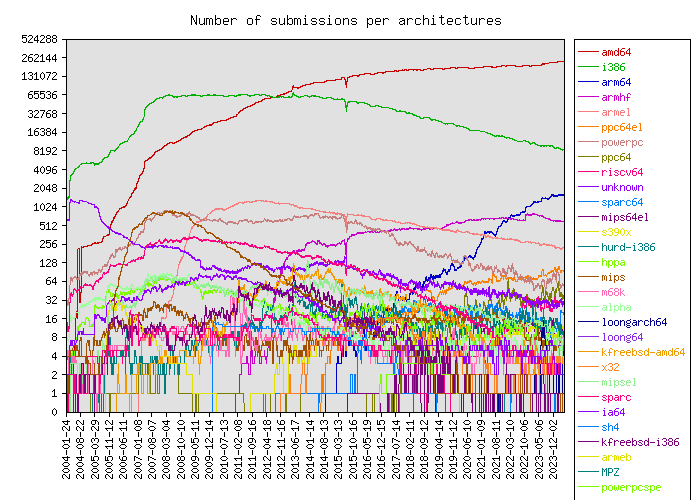
* Arm port is now third most popular port according to popcon.
* This mostly thanks to the popularity of Linksys NSLU-2, a tiny 80 computer able to run Debian. Do you have a old pentium sucking up electricity in your closet? Do a service to earth and replace it with a NSLU-2!
* Armel (Arm EABI) is now at "63.41% up-to-date. That's 4515 packages built out of 7121". See the fancy Graph for the progress. Catching up sid has been achieved with just two buildd's (Thecus N2100) in my apartment and Aurelien Jarno building selected packages. Plus of course pioneering work from Lennert Buytenhek and people who created EABI in upstream.
* All core packages except apt (which hasn't seen a upload to sid since etch) have now armel support in official Debian packages.
* the old arm port has started catching up in up-to-dateness again, now that all buildd's have a recent enough kernel for glibc 2.5 (2.6.12+)

The bad:

* We need someone to take responsibility on the toolchain for arm. Java is semi broken on arm, Fortran, Java and objc need work for armel.
* There is still communications problems. It took quite a while to find out why glibc 2.5 doesn't work on some buildd's.
* People have lost interest in Bigendian arm port after nslu-2 started working with the regular Little-Endian arm port. General consensus is that bigendian port would only matter for highend networking gear.

The future:

* More supported devices. Now we support NSLU-2, Thecus N2100 and a few related IOP based devices plus netwinders. Arm boasts their partners shipped 2450 Million units based Arm technology in 2006. Would you like to run Debian on your brand new scsi RAID card? mp3 player? Cellphone? Internet Tablet? Washing machine? Your choice!
* Better recovery options. Many arm devices are headless, and if it crashes or doesn't boot, figuring out what went wrong is tricky. This is not really arm specific, but comes up often enough in debian-arm list.
* Anti-bloat festival. Many arm devices have very little storage and RAM available. To run debian on these, we need to figure out who to get rid of extra FAT. Less bloated software is everyones advantage.

17 May 2007

Andrew Stribblehill: Timing random disk seeks

I asked an interviewee how long it takes for a disk seek, and he replied that he thought it was between 4 and 8 milliseconds. Speaking with colleagues, the conventional wisdom was that it was around 10 ms. I was unsatisfied so I thought I would try it for myself.

time sudo perl -we '$disk="/dev/sda"; $n=1500; $blocks= blockdev --getsz $disk ; if (!$blocks) print "Enter capacity in manufacturer GB\n: "; $blocks=1953125*(
) ; use Time::HiRes "time"; open DISK, $disk; $start=time; for (0..$n) seek DISK, int(rand($blocks))*512, 0; sysread DISK, $x, 512 die; $now=time; $times[int(($now-$start)*1000)]++; $x=$now-$start; $s2+=$x**2; $s+=$x; $start=$now ; for (0..$#times) if ($t=$times[$_]) $tot+=$t; $median =$_ if $tot>=$n/2; printf "%3d %s\n", $_, "x" x ($t/2) . ($t%2?":":"") ; printf "\nTook %3.4gs for %d seeks of %s (%d GB)\n", $s, $n, $disk, $blocks/2097152; printf "Mean: %2.03gms; Median: %d-%dms; Std dev: %2.03gms\n", 1000*$s/$n, $median-1, $median, 1000*sqrt($s2/$n - ($s/$n)**2);’
It should be obvious that before you run this, you should check for yourself that it doesn’t do anything dangerous. Or at least check that $disk is set appropriately for your hardware and operating system. If you don’t have blockdev, estimate the number of 512-byte blocks and set $blocks to that value. (There are 1953125 blocks in a hard disk manufacturer’s "Gigabyte".) The graph it produces prints an ‘x’ for two seeks of a given number of milliseconds and a trailing ‘:’ if there was one left over. For me, on my one year old Linux 2.6.18 workstation with a 160 "GB" Western Digital (WDC WD1600JS — quoted seek time 8.9 ms) the typical output is:
  0 :
  3 :
  4 :
  5 x:
  6 xxxx:
  7 xxxxxxx
  8 xxxxxxxxxxx:
  9 xxxxxxxxxxxxxxxxx
 10 xxxxxxxxxxxxxxxxxxxxxxx
 11 xxxxxxxxxxxxxxxxxxxxxxxxxxxx:
 12 xxxxxxxxxxxxxxxxxxxxxxxxx
 13 xxxxxxxxxxxxxxxxxxxxxxxxxxxxxxx:
 14 xxxxxxxxxxxxxxxxxxxxxxxxxxxxxxxxxxxx
 15 xxxxxxxxxxxxxxxxxxxxxxxxxxxxxxxxxxxxxxxxxxxxx:
 16 xxxxxxxxxxxxxxxxxxxxxxxxxxxxxxxxxxxxxxxxxxxxxxxxxxxxxx
 17 xxxxxxxxxxxxxxxxxxxxxxxxxxxxxxxxxxxxxxxxxxxxxxxxxxxxxxxxxxxxxx:
 18 xxxxxxxxxxxxxxxxxxxxxxxxxxxxxxxxxxxxxxxxxxxxxxxxxxxxxx:
 19 xxxxxxxxxxxxxxxxxxxxxxxxxxxxxxxxxxxxxxxxxxxxxxxxxxxxxxxxxx
 20 xxxxxxxxxxxxxxxxxxxxxxxxxxxxxxxxxxxxxxxxxxxxxxxxxxxxx
 21 xxxxxxxxxxxxxxxxxxxxxxxxxxxxxxxxxxxxxxxxxxxxx
 22 xxxxxxxxxxxxxxxxxxxxxxxxxxxxxxxxxxxxxxxxx:
 23 xxxxxxxxxxxxxxxxxxxxxxxxxxxxxxxxxxxxx:
 24 xxxxxxxxxxxxxxxxxxxxxxxxxxxxxx:
 25 xxxxxxxxxxxxxxxxxxxxxxxxxxxxx:
 26 xxxxxxxxxxxxxxxxxx
 27 xxxxxxxxxxxxxxx
 28 xxxxxx:
 29 xxxxx:
 30 xxxx
 31 :
 32 :
 34 x
 35 :
 57 :
Took 27.69s for 1500 seeks of /dev/sda (149 GB)
Mean: 18.5ms; Median: 17-18ms; Std dev: 5.24ms
real    0m27.859s
user    0m0.116s
sys     0m0.044s
Why might I care? 18 milliseconds is almost a lifetime compared with anything else a modern PC does. It’s slower than my monitors’ refresh period! I can read around 1 MB from disk, 10 MB over a GigE link or 20 MB from RAM in this time. I can ping from Ireland to England, crossing 40 routers there and back, in the time it takes for my disk head to seek. Every time you read something from a previously unread file, it costs on average EIGHTEEN MILLISECONDS even before it starts reading. That’s just 55 in a second. This has obvious implications for I/O program performance, i.e. that of most servers. If anyone has a concern about my method, I’d be interested to hear it. I’d also like to see the timings for different disks. Either post the whole histogram or just the stats, plus the make and model of the disk. On Linux you can get this from dmesg or hdparm -I device. Update: I’ve made the script more robust under non-existence of blockdev.

Steve Kemp: Would you choose to walk or stay

Once upon a time I wrote a collection of shell scripts for managing virtual hosting. Combined these allow me to easily. These work well, but every now and again I think I want a web-based control panel . After mulling this over for a while and remembering how many of the existing control panels are tricky I m actually going to do it. There are two hard parts: The last point is the part I m worrying about right now. So far I have a list of mail domains, and a list of web domains and the two are unrelated. This becomes obvious when they are listed:
DomainFacilities
steve.org.ukMAIL
bar.steve.org.ukWEB
foo.steve.org.ukWEB
See? No link I d expect to see the domains listed as just steve.org.uk with links to Mail showing the mail setup, and web showing the subdomains. Or maybe they really should be listed seperately I can t decide. (For reference here is my live listing of domains where the problem becomes obvious. Note that you ll not have permissions to see my server stats ) So I need to decide how to handle this I also need to be "inspired" by OSWD. I think the plan right now is to store all data in a database, then regenerate the plain text configuration files on demand. That should give me the best approach if I restrict myself to running HTTPS on a custom port and avoid the ability to modify the files by hand Feel free to tell me this is misguided, or inspired. Although I remember the last time I talked about control panels and I m still not seeing a good solution. I want to be able to:

15 May 2007

Russell Coker: Planet feed polling frequency

From reading my web stats yesterday it seems that one Planet has polled by blog feed 1693 times over the first 14.25 days of this month. This is about 5 polls per hour. Another Planet has polled my blog 994 times for an average of about 3 hits per hour. How frequently does it make sense to poll blogs? Speaking for myself I think that waiting an extra 10 minutes to see my latest blog post isn’t going to hurt anyone, and encouraging Planet readers to reload the page so frequently probably isn’t doing them a favour either. For my own personal Planet installation (which mainly aggregates other Linux Planets for my own personal use) I have it poll the feeds every four hours. For a Planet installation designed for general readership it would make sense to have it poll more frequently. Maybe once every hour or once every half-hour. When I initially set up my own planet installation I aggregated the entire feed list of Planet Debian and Planet Linux Australia and it generally took between 10 and 30 minutes to poll all the feeds with 20 minutes being common (Planet does not support parallel downloads). So for a moderate sized Planet with frequent polling you might have one poll end after the next cron job for a poll has begun. It’s a pity that Planet doesn’t support pings. Will the next version do so? I would rather have my blog ping the Planets that I know of that aggregate my content and save thousands of needless polls while also giving a faster update. Finally if you need a fast response for a dialogue then probably blogs and Planets are not the communication mechanism to use, a mailing list would probably be more appropriate.

5 May 2007

Thijs Kinkhorst: New key

Hey everybody! Getting tired of hex numbers? Here's another one: E0D3 FAAA 6F50 A5DA 9D5B 2938 3396 1588 E1C2 1845!!! It's the fingerprint of my new GPG key, which is more secure than my previous one for a variety of reasons, and it has my birthday (not year) as the date. Wow! Today I revoked my key 0x165EE79B from 1997-06-23. I'll revoke my 0x957D58CF key from 2003-10-28 in due time, when the new one has been in active use for a decent while.

4 May 2007

Cord Beermann: private Spamstats April 2007


you see my Spamstats for the time i run an own server for my domain.

The input consists mainly from cord@Wunder-Nett.org that is in existence since mid-1996, and a (tuned) catch all on cord.de.


In 05/2004 i had a big downtime due to broken Harddisk and/or cheap IDE-Cables (which was finally solved in 2006).

In 11/2004 i became Debian-Listmaster, and forwarded the listmaster-mails to my system.

In 08/2005 i stopped forwarding listmaster-Mail and the admin-mail from LUG-OWL and let them drop into a local Mailbox on the specific servers.

In 06/2006 The power supply of my server died, and HaJo had a fitting spare device, so i took it to the local hardware gods (C&M sorry, only Flash) and they put implanted it, they also replaced all Fans (6 of which 4 were stuck) and replaced the IDE-Cables. Now i even could switch on DMA without risking a crash. (Man, 3years of crippled server). As you see, the system is now able to accept even more spam.

In 12/2006 i added greylisting on my server. My 2nd MX currently doesn't do greylisting.


Management-summary: With massive filtering i can keep mail somewhat useable for me.

2 May 2007

Michal Čihař: What happened on last day of April?

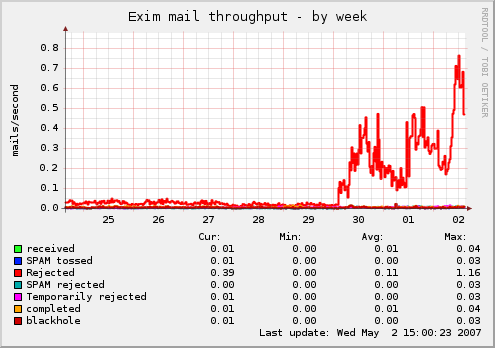
I just looked on server statistics and I was shocked by amount of spam and viruses rejected during last three days. Is there some new virus for Windows which tries random email addresses on all servers it can reach? I didn't analyse those messages, as they are rejected at RCPT time, because sender tries random addresses which do not work on my server. For now I try to reduce them by blacklisting in iptables, but this doesn't seem to help much as IP addresses change too often. I think that graph shows best what big change has happened: Mail graphs Update: It seems to be new Sober variant causing this mess.

17 April 2007

Michal Čihař: Migration to Subversion completed

Today last batch of Wammu and python-gammu has been converted to Subversion. It was almost painless, it only required lot of CPU time. All project pages should now link to Subversion repositories and snapshots. Also all projects now have publicly available statistics on http://www.ohloh.net and http://cia.vc. Unfortunately for python-gammu and Wammu are statistics a bit messed up - for Wammu ohloh didn't find license header, which is in almost every file, in python-gammu, doc string comments are not counted as being comments, so without it project has obviously to low comments ratio. Anyway I was quite impressed by code grow of Wammu in last half year, because I still thing I don't have enough time for Wammu. However if their stats are true, the code amount grows quite fast in last months.

16 April 2007

Michal Čihař: Gammu switched to Subversion

As continuation of migration to Subversion, Gammu now also uses Subversion as version control. This is now pretty standard version control system, so you can easily use latest development source. Besides this, using Subversion brings us possibility to use various free services to work with this repository. If you want to follow development, you can use RSS feeds on CIA.vc. For code statistics hungry people, there is Ohloh service, which directly analyses repository. There might be also other useful tools, if you want some integration, just tell me.

10 April 2007

Bastian Blank: Not so funny kernel build failures

It happened again. The linux-2.6 2.6.20-1 release failed for arches which we don't build snapshots for. This means that none of them was ever built in the time after I commited the whole stuff. As this happens over and over again I consider this a real problem now. So the following arches needs new debian-kernel maintainers: alpha, hppa, and mips.

7 April 2007

Eddy Petrișor: Thanks...

The answer to my previous question is "to be". That happened thanks to a bunch of people, in no particular order:
Updates:

Next.

Previous.