Search Results: "rul"

30 January 2013

James Morrison: Married

In response to my own post from 7 years ago Bachelorhood, I would like to announce that I am a much better married man than Simon. My bachelorhood days are truly over, my laundry goes in a laundry basket, my clothes are always put away (whether I like it or not). My fridge is plugged in, has real food in it; I have a cell phone (actually numerous cell phones); I have an awesome custom made table; lastly I have a TV in my house. Bachelorhood officially ended last year, 30 years was a good run :)

Bastian Venthur: Synchronizing Google Mail Contacts with Thunderbird

Dear Lazyweb, can anyone recommend a good Thunderbird extension which allows for synchronizing the address book with Google mail? So far I tried Google Contacts, but something went wrong with the syncing and some contacts where deleted on both sides. To avoid this problem, one can use Google Contacts in read-only mode (it will only fetch contacts from Google, but never write to it) but then you have to import new Thunderbird contacts to Google mail manually. Google introduced CardDav in December 2012, which allows for syncing of contacts, but since Thunderbird s development is apparently on hold this is probably not gonna be supported out-of-the-box. There are some other extensions for Thunderbird, but since synchronization is hard and a lot more complicated than: replace newer version with older one I m looking for something mature and well tested. Before someone suggests it, I know Evolution has this feature built-in. I gave it a try last week and found so many other grave bugs with the calendar and newsgroups that Evolution is simply unfit for my needs. I really like Thunderbird and want to stick with it for a few more years until I have to look for something else. Yours truly, Basti

Russ Allbery: Quick Module::Build note

I'm struggling a little to keep to a schedule since the weekend, so I both didn't follow my normal evening exercise schedule nor did I write this up earlier when I could add more details. Ah well. But I'm still going to post something today, since I like this streak of (mostly) providing some useful or at least hopefully entertaining content. Today, I converted the Perl module build system inside WebAuth to use Module::Build instead of ExtUtils::MakeMaker, and it was a rousing success. I highly recommend doing this, and am going to be doing this with all of my other Perl packages, both embedded in larger packages and standalone. I have several packages where Perl XS modules are embedded within a larger Autoconf and Automake project that includes a shared library used by the Perl module. The largest problem with doing this is integrating the build systems in such a way that the Perl module is built against the in-tree version of the shared library, rather than some version of it that may already be on the system. I've managed to do this with ExtUtils::MakeMaker, but it was horribly ugly, involving overriding internal target rules and setting a bunch of other variables. With Module::Build and ExtUtils::CBuilder, it's much easier and even sensible. Both support standard ways of overriding Config settings, which provides just the lever required. So this:
    our $PATH = '@abs_top_builddir@/lib/.libs';
    my $lddlflags = $Config lddlflags ;
    my $additions = "-L$PATH @LDFLAGS@";
    $lddlflags =~ s%(^  )-L% $additions -L%;
    package MY;
    sub const_loadlibs  
        my $loadlibs = shift->SUPER::const_loadlibs (@_);
        $loadlibs =~ s%^(LD_RUN_PATH =.*[\s:])$main::PATH(: \n)%$1$2%m;
        return $loadlibs;
     
    package main;
(comments stripped to just show the code) became this:
    my @LDFLAGS = qw(-L@abs_top_builddir@/lib/.libs @LDFLAGS@);
    my $LDDLFLAGS = join q   , @LDFLAGS, $Config lddlflags ;
plus adding config => lddlflags => $LDDLFLAGS to the standard Module::Build configuration. So much better! At some point, I'll write up a set of guidelines on how to embed Perl XS modules into Automake projects.

28 January 2013

Russell Coker: My SE Linux Status Report LCA 2013

This morning I gave a status report on SE Linux. The talk initially didn t go too well, I wasn t in the right mental state for it and I moved through the material too fast. Fortunately Casey Schaufler asked some really good questions which helped me to get back on track. The end result seemed reasonably good. Here s a summary of the things I discussed: Transaction hooks for RPM to support SE Linux operations. This supports signing packages to indicate their security status and preventing packages from overwriting other packages or executing scripts in the wrong context. There is also work to incorporate some of the features of that into dpkg for Debian. Some changes to libraries to allow faster booting. Systems with sysvinit and a HDD won t be affected but with systemd and SSD it makes a real difference. Mostly Red Hat s work. Filename transition rules to allow the initial context to be assigned based on file name were created in 2011 but are not starting to get used. When systemd is used for starting/stopping daemons some hacks such as run_init can be avoided. Fedora is making the best progress in this regard due to only supporting systemd while the support for other init systems will limit what we can do for Debian. This improves security by stopping terminal buffer insertion attacks while also improving reliability by giving the daemon the same inherited settings each time it s executed. Labelled NFS has been accepted as part of the NFSv4.2 specification. This is a big deal as labelled NFS work has been going for many years without hitting such a milestone in the past. ZFS and BTRFS support but we still need to consider management issues for such snapshot based filesystems. Filesystem snapshots have the potential to interact badly with relabelling if we don t develop code and sysadmin practices to deal with it properly. The most significant upstream focus of SE Linux development over the last year is SE Android. I hope that will result in more work on the X Access Controls for use on the desktop. During question time I also gave a 3 minute lightning talk description of SE Linux.

27 January 2013

Gregor Herrmann: RC bugs 2013/04

yeah, the RC bug count is going down, mostly due to the bug squashing party taking place in cambridge, uk, this weekend (with participation of some release team members). here are my contributions during the last week:

Russell Coker: LCA 2012

LCA 2013 [1] is starting so it seems like time to finish my write-up of LCA 2012. As usual it was a great conference, although I got sick immediately after getting there which reduced my ability to attend. Android A major unofficial theme of the conference was Android. Most delegates seemed to have Android phones, the Samsung Galaxy S and Galaxy Nexus seemed to be the most popular phones. Many delegates had two or more phones for development purposes. A large portion of the casual conversation at the conference concerned Android. There were a couple of really interesting talks about the Serval mesh networking project [2] which involves Android phones running in ad-hoc Wifi mode for long range communication without any official base station. Serval allows transferring messages, pictures, and voice calls. If you need to get longer range you can mount one phone in a convenient place and other phones will decide to use it as a relay there is no need to have a dedicated relay device (such as a mobile phone tower or Wifi access point). Serval is supposed to work with Wifi access points but due to Java not exposing some networking details to the higher levels of software the code that was available at the time of the conference didn t support networks other than a /24, which meant that the conference Wifi network didn t work with Serval. As an aside most people at the conference who installed Serval were using a development version that was newer than the version on the Android market. I can t remember what the extra features were though. Serval was designed for emergency situations, it can be installed on phones (and pushed to other phones via Wifi) in the field and allow communications when the infrastructure is broken. Also it s designed with some aim of circumventing censorship which among other things means that there are no facilities for tracking use. I think it would be really handy to be able to in some way track viewing of or interest in images that are transported via the mesh (maybe by something similar in concept to Google +1). Then in a crowd sourced environment people who take photos would be encouraged in their work by audience appreciation. One thing that interests me is the possibility of using Serval on a cruise ship. A cruise ship is an environment where mobile phone calls are unreasonably expensive, cabin phones aren t much use (who pays for a cruise and hangs out in their cabin?), and where there is usually a Wifi network installed. If a ship has a single bridged Wifi network that allows connecting to Wifi before authenticating for Internet access (which is probably the common case) then you could transport VOIP over that network without paying and without incurring any expense on the cruise company. One of the Serval developers assured me that this should be possible, of course a cruise ship with 3,000 passengers probably doesn t use a /24 for their Wifi so the current versions of Serval won t work At the geek my dinner event (a party where everyone brought $20 of food/drink which was cooked by volunteers) an artist showed me some art work that she created on her Samsung Galaxy Note (which was the biggest phone on sale at the time), it was very impressive. She recommended Picasso Mirror Draw, Sketch Free, Sketch Book Mobile Express, and Freenote as free graphical programs for Android. Samsung has a Noteworthy Project advertising campaign based on the artistic uses of the Galaxy Note which has some good videos of artists [3]. Chris Neugebauer and Paris Buttfield-Addison gave an informative and amusing talk about Android UI development (this link has the video) [4]. It s a pity that I missed seeing that one live but fortunately the video is of high quality. Accommodation picture of women cleaning As I ve become interested in Sociology I couldn t help but notice the pictures that accompanied the rules about cleaning the dormitory (which were displayed over the kitchen sink), it seems to imply that cleaning is only women s work. I wonder whether the people who created that poster deliberately chose pictures of women or whether they just chose the first available pictures from a collection of stock photos. Someone who was near my dorm room seemed to not realise how their alarm impacts other people. For the first two mornings I was woken repeatedly after 6AM by someone who was pressing the snooze button on their alarm. When sleeping in close proximity to other people the reasonable options involve some combination of having no loud alarm, immediately turning the alarm off and getting up (not pressing snooze to have it go off repeatedly), and setting the alarm for a time when almost everyone wants to get up (EG 1 hour before the first session). Networking Chris Neugebauer organised the Unprofessional Delegates Networking Session which was a great event. It was an event held at the same time as the Professional Delegates Networking Session with the difference being that you had to pay $5 for food and there was no free drink. A lot of great people attended the UPDNS so I m glad I don t pay for the PDNS. It seems that we won t have a UPDNS this year unfortunately. Conclusion LCA is always great fun and very educational. I recommend attending every year.

26 January 2013

Vipin Nair: Final Project (1/N): Introducing Simple Realtime Notification Service

I am building a realtime notification system as my final semester project. The end product is a simple API that can be used by third party to push real time notification to client applications running on multiple platforms that include browsers and devices. Ideally, if your device can connect to the internet, it should be able to receive notifications. The non functional system requirements are pretty ambitious with scalability, availability and latency guarantees being the most important. Maybe little too ambitious for someone like me but then I will learn a lot in this process and its more fun when its challenging. To address the scalability issues, we ll have to distribute the system. A single system will not scale beyond a point and we need to be able to distribute the load over nodes effectively to be able to serve clients while maintaining the quality of service guarantees. With distribution comes a whole lot of other problems like latency, coordination and handling failures. We have a theorem that officially states that you cannot have the pie and eat it too; its called the CAP theorem. It says that you cannot have have a system that is Consistent, Available and Partition tolerant at the same time (Partition tolerance here refers to the ability of a system to continue operating in the event of partial failures). You can have any two but not all three in varying degrees. In a way this is good because you do not go chasing the holy grail because you know it doesn t exist. CAP Twelve Years Later: How the Rules Have Changed is a good read for some sensible advice when applying CAP theorem to real world scenarios. Reading Notes on Distributed Systems for Young Bloods by Jeff Hodges is highly recommended for anyone starting to work on distributed systems. All the commons assumptions that you may have when you are building a distributed system is wrong, so wrong that it is sort of standardized now under the title Fallacies of Distributed Computing. A more detailed article is available here. I will be using concepts as given in the Amazon Dynamo paper to make the system highly available. This one is big and will a get a blog post of its own. The notification service that I am building at its core is a Publish/Subscribe system with soft real time guarantees. Right now I am clueless about how to deal with latency guarantees but I hope to figure it out soon. Websockets will be the application layer protocol that ll be used to push to browsers and for the trasport layer protocol I hear the MQTT protocol fits to a T. More on this later. I will updating my blog as the project progresses, documenting all the design decisions and the rationale behind them. The code will be available online. This is not something new and I am aware of tools that can do this. While I will try to improve on what already exists, the point is, as mentioned earlier, to learn something new and build what will be considered good software. I have never attended a distributed systems theory class, so I am reading up on that as well. Vector clocks are really cool, if you ask me. If you think this is too big, to be accomplished by a single student programmer in a semester s worth of effort, I wouldn t deny that but then when you pick the right tools for a job, things become a lot more easier and you can afford to be ambitious. Erlang for the win! Feel free to comment on what I am building as I may be potentially unaware of a lot of things I should be knowing. I could use all your suggestions/advice to make things better.

24 January 2013

Hideki Yamane: net-snmp package

Current net-snmp package maintainers are busy, so now I'm trying to update it. One of maintainers Jochen Friedrich kindly checked my experimental package (thank!), and point MIB files should be removed to upload to Debian out (at least).

Anyway, current changelog is here (a little bit long). If you want to try it, get dsc file and build it.


net-snmp (5.7.2~dfsg-1~0.1) UNRELEASED; urgency=low
* Non-maintainer upload.
* New upstream version 5.7.2 (Closes: #557348, #631063, #684388, #599929,
#673197, #581185, #558356, #568550, #514842, #445608, #557186, #411858,
#428824, #611837)
* debian/control
- set "Standards-Version: 3.9.4"
- set "Build-Depends: debhelper (>= 9)" to enable hardening
- set "Build-Depends: automake", instead of automake1.9
- drop "Build-Depends: python-central", use dh_python2 by default, instead
- remove duplicational "Priority:" and "Section:" fields
- make it "Multi-Arch" enable
- add description for non-free snmp-mibs-downloader for users' convinience
(Closes: #561124)
- add "Build-Depends: libmysqld-dev" to support MySQL
- add "Build-Depends: dh-autoreconf"
- use python-all (2.6.6-3~) instead of python-all-dev (>= 2.5.4-1~), python
(>=2.3.5-7) for Build-Depends
- add "Build-Depends: python2.7-dev"
- s/libsnmp-python/python-netsnmp/ as Python Policy compliant (Closes: #661899)
* debian/compat
- set 9
* debian/*.install
- split into *.manpages
* debian/fixman: drop it.
* debian/*.manpages (Closes: #505149)
- remove unnecessary"snmp" from tail of all man pages
* debian/libsnmp-base.install
- move /usr/share/mibs to /usr/share/snmp/mibs (probably, previous setting
was just wrong...)
- install all mibs/*.txt
* debian/libsnmp-dev.install
- change from "usr/lib/*" to "usr/lib/*/*" to deal with Multi-Arch
* debian/libsnmp30.install
- change from "usr/lib/*.so" to "usr/lib/*/*.so" to deal with Multi-Arch
* debian/snmp.dirs: remove it since unnecessary
* debian/snmpd.dirs: remove lintian overrides direcotry, add /etc/snmp
* debian/libsnmp-dev.dirs: add it
* debian/libsnmp-perl.examples: add it since dh_installexamples target in
previous debian/rules doesn't work correctly.
* debian/patches
- remove all *.README files
- add fix_typo_in_snmpd.conf.patch (Closes: #603593)
Thanks to Slavko <linux@slavino.sk>
- add fix_logging_option.patch (Closes: #616437)
- add fix_snmpcheck_perl_path.patch to provide snmpcheck (Closes: #44373)
- add net-snmp-config_multi-arch.patch to enable Multi-Arch
- add fix_regular_expression.patch enable to build under Multi-Arch
- add to snmptranslate.1.patch fix lintian "hyphen-used-as-minus-sign"
warnings
- add fix_spelling_error.patch to fix typo
- adjust and refresh 03_makefiles.patch
- drop 25_duplicate_iftable.patch and 44_nlist_kvm.patch since it cannot be
applied to current code.
- drop 32_mnttab_path.patch since it was merged to upstream as
configure.d/config_os_misc4
- drop 56_manpage.patch since most of patches are merged, and others are
unnecessary because upstream files are disappeared.
- refresh 61_vacm_missing_dependency_check.patch
- drop 63_fix_shell.patch since it was merged to upstream
- reapplied 64_missing_lib.patch since upstream source has been changed.
- drop 65_CVE-2012-2141.patch since it was merged to upstream
- drop 66_formatstrings.patch since almost merged to upstream, some of
code are changed in upstream and become unnecessary.
- move 08_defaultconfig.patch to debian/snmptrapd.conf
* debian/rules
- enable hardening
(TODO: building perl module would be failed without -pie)
- specify LDFLAGS to enable hardening
- add "--with autotools-dev,autoreconf"
- export DEB_BUILD_MAINT_OPTIONS to enable hardening
- drop "dh --with python-central" (Closes: #616913)
- drop "include /usr/share/python/python.mk"
- remove "$(PYVERS:%=debian/python-install-stamp-%)"
- move exist python targets under override_dh_install
- remove unnecessary .PHONY lines
- enable tests by removing no instructions with dh_auto_test line
- set DEB_HOST_MULTIARCH to enable Multi-Arch
- enable install snmpcheck
- don't specify to copy files but install them by using .install file
(mostly)
- enable mysql support
- enable AES support (Closes: #447705)
- don't make symlink for /usr/share/doc/libsnmp-perl since other are okay
but it has examples files.
- snmpd doc files link to libsnmp (Closes: #453124)
- adjust dh_strip for dbg package.
- adjust dh_clean target
- remove override_dh_auto_build since LD_RUN_PATH is clearly specified
during building perl modules
- add mibII/mta_sendmail to build modules (Closes: #641608)
* debian/clean
- most listed files are cared by autotools-dev, so removed.
* debian/snmp.conf: fix typo (Closes: #623499, #647468)
* debian/snmpd.init
- force remove pid files (Closes: #528104)

-- Hideki Yamane <henrich@debian.org> Wed, 18 Jul 2012 13:39:41 +0900

And if I can put it to Debian, then I hope someone will maintain it...

22 January 2013

Jon Dowland: Possible future coding project

Re-implement ikiwiki, or something like it, in go. See how much the language's features and philosophy colour the design. In particular I'm wondering how much the first-class treatment of concurrency might change how you structure things: one thread per page, or hot pages... you'd want to approach it with lots of micro-locks rather than one big lock to rule them all. I can see some future ikiwiki refactoring work being a bit like the Linux Kernel's efforts to get rid of their big kernel lock. See also: Joey's proposed Haskell ikiwiki rewrite. I may be remembering wrong, but I thought he had some beginning code up somewhere. Perhaps I'm conflating it with John Goerzen's one-time OfflineIMAP rewrite, which might also be lost to the sands of time...

Russ Allbery: Review: Fantasy & Science Fiction, March/April 2011

Review: Fantasy & Science Fiction, March/April 2011
Editor: Gordon van Gelder
Issue: Volume 120, No. 3 & 4
ISSN: 1095-8258
Pages: 258
Charles de Lint's book review column sticks with the sorts of things he normally reviews: urban and contemporary fantasy and young adult. Predictably, I didn't find that much of interest. But I was happy to see that not all the reviews were positive, and he talked some about how a few books didn't work. I do prefer seeing a mix of positive and negative (or at least critical) reviews. James Sallis's review column focuses entirely on Henry Kuttner and C.L. Moore (by way of reviewing a collection). I'm always happy to see this sort of review. But between that and de Lint's normal subject matter, this issue of F&SF was left without any current science fiction reviews, which was disappointing. Lucius Shepard's movie review column features stunning amounts of whining, even by Shepard's standards. The topic du jour is how indie films aren't indie enough, mixed with large amounts of cane-shaking and decrying of all popular art. I find it entertaining that the F&SF film review column regularly contains exactly the sort of analysis that one expects from literary gatekeepers who are reviewing science fiction and fantasy. Perhaps David Langford should consider adding an "As We See Others" feature to Ansible cataloging the things genre fiction fans say about popular movies. "Scatter My Ashes" by Albert E. Cowdrey: The protagonist of this story is an itinerant author who has been contracted to write a family history (for $100K, which I suspect is a bit of tongue-in-cheek wish fulfillment) and has promptly tumbled into bed with his employer. But he is somewhat serious about the writing as well, and is poking around in family archives and asking relatives about past details. There is a murder (maybe) in the family history, not to mention some supernatural connections. Those familiar with Cowdrey's writing will recognize the mix of historical drama, investigation, and the supernatural. Puzzles are, of course, untangled, not without a bit of physical danger. Experienced fantasy readers will probably guess at some of the explanation long before the protagonist does. Like most Cowdrey, it's reliably entertaining, but I found it a bit thin. (6) "A Pocketful of Faces" by Paul Di Filippo: Here's a bit of science fiction, and another mystery, this time following the basic model of a police procedural. The police in this case are enforcing laws around acceptable use of "faces" in a future world where one can clone someone's appearance from their DNA and then mount it on a programmable android. As you might expect from that setup, the possibilities are lurid, occasionally disgusting, and inclined to give the police nightmares. After some scene-setting, the story kicks in with the discovery of the face of a dead woman who, at least on the surface, no one should have any motive to clone. There were a few elements of the story that were a bit too disgusting for me, but the basic mystery plot was satisfying. I thought the ending was a let-down, however. Di Filippo tries to complicate the story and, I thought, went just a little too far, leaving motives and intent more confusing than illuminating. (6) "The Paper Menagerie" by Ken Liu: Back to fantasy, this time using a small bit of magic to illustrate the emotional conflicts and difficulties of allegiance for second-generation immigrants. Jack is the son of an American farther and a Chinese mother who was a mail-order bride. He's young at the start of the story and struggling with the embarassment and humiliation that he feels at his mother's history and the difficulties he has blending in with other kids, leading to the sort of breathtaking cruelty that comes so easily from teenagers who are too self-focused and haven't yet developed adult empathy. I found this very hard to read. The magic is beautiful, personal, and very badly damaged by the cruelty in ways that can never really be fixed. It's a sharp reminder of the importance of being open-hearted, but it's also a devastating reminder that the lesson is normally learned too late. Not the story to read if you're prone to worrying about how you might have hurt other people. (6) "The Evening and the Morning" by Sheila Finch: This long novella is about a third of the issue and is, for once, straight science fiction, a somewhat rare beast in F&SF these days. It's set in the far future, among humans who are members of the Guild of Xenolinguists and among aliens called the Venatixi, and it's about an expedition back to the long-abandoned planet of Earth. I had a lot of suspension of disbelief problems with the setup here. While Earth has mostly dropped out of memory, there's a startling lack of curiosity about its current condition among the humans. Finch plays some with transportation systems and leaves humanity largely dependent on other races to explain the failure to return to Earth, but I never quite bought it. It was necessary to set up the plot, which is an exploration story with touches of first contact set on an Earth that's become alien to the characters, but it seemed remarkably artificial to me. But, putting that aside, I did get pulled into the story. Its emotional focus is one of decline and senescence, a growing sense of futility, that's halted by exploration, mystery, and analysis. The question of what's happened on Earth is inherently interesting and engaging, and the slow movement of the story provides opportunities to build up to some eerie moments. The problem, continuing a theme for this issue, is the ending. Some of the reader's questions are answered, but most of the answers are old, well-worn paths in science fiction. The emotional arc of the story is decidedly unsatisfying, at least to me. I think I see what Finch was trying to do: there's an attempted undermining of the normal conclusion of this sort of investigation to make a broader point about how to stay engaged in the world. But it lacked triumph and catharsis for me, partly because the revelations that we get are too pedestrian for the build-up they received. It's still an interesting story, but I don't think it entirely worked. (6) "Night Gauntlet" by Walter C. DeBill, Jr., et al.: The full list of authors for this story (Walter C. DeBill, Jr., Richard Gavin, Robert M. Price, W.H. Pugmire, Jeffrey Thomas, and Don Webb) provides one with the first clue that it's gone off the rails. Collaborative storytelling, where each author tries to riff off the work of the previous author while spinning the story in a different direction, is something that I think works much better orally, particularly if you can watch facial expressions while the authors try to stump each other. In written form, it's a recipe for a poorly-told story. That's indeed what we get here. The setup is typical Cthulhu mythos stuff: a strange scientist obsessed with conspiracy theories goes insane, leaving behind an office with a map of linkages between apparently unrelated places. The characters in the story also start going insane for similar reasons, leading up to a typical confrontation with things man was not meant to know, or at least pay attention to. If you like that sort of thing, you may like this story better than I did, but I thought it was shallow and predictable. (3) "Happy Ending 2.0" by James Patrick Kelly: More fantasy, this time of the time travel variety. (I call it fantasy since there's no scientific explanation for the time travel and it plays a pure fantasy role in the story.) That's about as much as I can say without giving away the plot entirely (it's rather short). I can see what Kelly was going for, and I think he was largely successful, but I'm not sure how to react to it. The story felt like it reinforced some rather uncomfortable stereotypes about romantic relationships, and the so-called happy ending struck me as the sort of situation that was going to turn very nasty and very uncomfortable about five or ten pages past where Kelly ended the story. (5) "The Second Kalandar's Tale" by Francis Marion Soty: The main question I have about this story is one that I can't answer without doing more research than I feel like doing right now: how much of this is original to Soty and how much if it is straight from Burton's translation of One Thousand and One Nights. Burton is credited for the story, so I suspect quite a lot of this is from the original. Whether one would be better off just reading the original, or if Soty's retelling adds anything substantial, are good questions that I don't have the background to answer. Taken as a stand-alone story, it's not a bad one. It's a twisting magical adventure involving a djinn, a captive woman, some rather predictable fighting over the woman, and then a subsequent adventure involving physical transformation and a magical battle reminiscent of T.H. White. (Although I have quite likely reversed the order of inspiration if as much of this is straight from Burton as I suspect.) Gender roles, however, are kind of appalling, despite the presence of a stunningly powerful princess, due to the amount of self-sacrifice expected from every woman in the story. Personally, I don't think any of the men in the story are worth anywhere near the amount of loyalty and bravery that the women show. Still, it was reasonably entertaining throughout, in exactly the way that I would expect a One Thousand and One Nights tale to be. Whether there's any point in reading it instead of the original is a question I'll leave to others. (7) "Bodyguard" by Karl Bunker: This is probably the best science fiction of the issue. The first person protagonist is an explorer living with an alien race, partly in order to flee the post-singularity world of uploaded minds and apparent stagnation that Earth has become. It's a personal story that uses his analysis of alien mindsets (and his interaction with his assigned alien bodyguard) to flesh out his own desires, emotional background, and reactions to the world. There are some neat linguistic bits here that I quite enjoyed, although I wish they'd been developed at even more length. (The alien language is more realistic than it might sound; there are some human languages that construct sentences in a vaguely similar way.) It's a sad, elegiac story, but it grew on me. (7) "Botanical Exercises for Curious Girls" by Kali Wallace: One has to count this story as science fiction as well, although for me it had a fantasy tone because the scientific world seems to play by fantasy rules from the perspective of the protagonist. Unpacking that perspective is part of the enjoyment of the story. At the start, she seems to be a disabled girl who is being cared for by a strange succession of nurses who vary by the time of day, but as the story progresses, it becomes clear that something much stranger is going on. There are moments that capture a sense of wonder, reinforced by the persistantly curious and happy narrative voice, but both are undercut by a pervasive sense of danger and dread. This is a light story written about rather dark actions. My biggest complaint with the story is that it doesn't so much end as wander off into the sunset. It set up conflict within a claustrophobic frame, so I can understand the thematic intent of breaking free of that frame, but in the process I felt like the story walked away from all of the questions and structure that it created and ended in a place that felt less alive with potential than formless and oddly pointless. I think I wanted it to stay involved and engaged with the environment it had created. (6) "Ping" by Dixon Wragg: I probably should just skip this, since despite the table of contents billing and the full title introduction, it's not a story. It's a two-line joke. But it's such a bad two-line joke that I had to complain about it. I have no idea why F&SF bothered to reprint it. (1) "The Ifs of Time" by James Stoddard: This certainly fits with the Arabian Nights story in this issue. The timekeeper of a vast and rambling castle (think Gormenghast taken to the extreme) wanders into a story-telling session in a distant part of the castle. The reader gets to listen to four (fairly good) short stories about time, knowledge, and memory, told in four very different genres. All of this does relate to why the timekeeper is there, and the frame story is resolved by the end, but the embedded stories are the best part; each of them is interesting in a different way, and none of them outlast their welcome. This was probably the strongest story of this issue. (7) Rating: 6 out of 10

20 January 2013

Gregor Herrmann: RC bugs 2013/03

& again, I was not very active in my RCBW work this week. at least one bug fixed, & another one will be taken care of by the package maintainers.

18 January 2013

Russ Allbery: Review: Soulless

Review: Soulless, by Gail Carriger
Series: Parasol Protectorate #1
Publisher: Orbit
Copyright: October 2009
ISBN: 0-316-07165-X
Format: Kindle
Pages: 357
Alexia Tarabotti is a spinster in London society in the time of Queen Victoria. She is possessed of a hopelessly overwrought and society-focused mother, two half-sisters whose only thoughts are for fashion and gossip, a mixed Italian heritage, an unpopular body shape and complexion, and a secret. In a world in which vampire hives, werewolf packs, and the occasional ghost are out of hiding and openly participating in society, and where the Bureau of Unnatural Registry (headed by a particularly intimidating werewolf who is also an earl) keeps track of the undead, Alexia is something still rarer, and not entirely acceptable. She is preternatural, able to draw the supernatural out of the undead with a touch. She has no soul. In Carriger's Victorian urban fantasy, laced with a gentle helping of steampunk, vampires, werewolves, and ghosts all have similar conditions. All three are undead; even the change for werewolves happens after normal death. But the change doesn't happen to everyone killed by the corresponding type of undead. The requirements are quite exacting and include the quantity of soul in the person being changed. Only those with a surfeit of soul, too much to stay dead, can be successfully changed. Vampires and werewolves both are surrounded by hopeful humans, called drones and clavigers respectively, who hope to be transformed and gain immortality. But no one can tell in advance how much soul someone has. Alexia is the precise opposite of the undead. Rather than a surfeit of soul, she has none at all, a condition inherited from her father but unknown to the rest of her family. Her kind, the preternatural, make up the vampire and werewolf hunters of legend, called soul-suckers, curse-breakers, and exorcists by the supernatural set. She's viewed with great suspicion by most, but with fascination by some for her ability to revert them to humanity with physical contact. Not that this has been helpful in finding a husband, or, really, for much of anything else in her life. Soulless opens with Alexia being accousted by a rogue vampire in the library, where she went for refuge from a private ball. Not only does he not know who she is, despite every hive in the area telling all of their new vampires about her, but he doesn't seem to even know what a preternatural is, and she has to kill him with her parasol. That is the first unusual occurance in an escalating mystery involving new vampires appearing from nowhere, loner vampires and werewolves disappearing, and a truly prodigious use of chloroform. Not to mention quite a few encounters with Lord Maccon, Earl of Woolsey, the Alpha werewolf who runs the Bureau of Unnatural Registry. The start of Soulless feels a bit uneven and stilted until the story gets moving and the reader gets used to Carriger's voice. It's written in the style of a comedy of manners and takes delight in long words and a semi-formal style. For example:
The vampire recovered his equanimity quickly enough. He reared away from Alexia, knocking over a nearby tea trolley. Physical contact broken, his fangs reappeared. Clearly not the sharpest of prongs, he then darted forward from the neck like a serpent, diving in for another chomp. "I say!" said Alexia to the vampire. "We have not even been introduced!"
Sometimes this works. Sometimes it doesn't. The frequency with which it works seemed to me to increase as the book went along. The best thing this book has going for it is the character of Alexia Tarabotti. Rather than the typical kick-ass female protagonist of a modern urban fantasy novel, Alexia is not cynical, battle-hardened, or courageously sarcastic. Her attitude for most of the book is something closer to bemusement crossed with exasperation. She sees herself as an outsider, has largely given up on fitting into any sort of proper society, and has little use for the expectations of her family. But she's still embedded within her culture, still shocked (at least momentarily) by breaches in etiquette, and quite able to fit in, if a bit uncomfortably. Her delightfully logical tone and constant open-minded self-analysis is what made this book for me. The plot is fairly straightforward (and has a bit too much anti-science flavor for me). The romance angle, which is reasonably obvious from early on in the book, was entertaining mostly in Alexia's combination of thoughtful analysis (based in part on her father's extensive and not entirely acceptable library) and runaway physical reactions, although I thought the latter was slightly overdone. But all the elements of the story improve noticably towards the end of the book. I was unenthused by the halfway point, but by the time I finished Soulless, I decided I would probably read the sequel. This is more in the enjoyably fun reading pile than a book that I would go to great effort to acquire, and it has a somewhat rocky start, but I enjoyed it and would mildly recommend it. Followed by Changeless. Rating: 7 out of 10

17 January 2013

Francesca Ciceri: T-Shirt Surgery: DebConf11 t-shirt redux

Please DO TRY this at home debconf11 t-shirt before and after the surgery Here's a little tutorial on how to modify a plain t-shirt, inspired by this one. What you'll need: Step 1: the neckline cutting the neckline Put the t-shirt on a flat surface, then start cutting out the collar, to create a new neckline: cut two slits about 2 cm from the collar (from both sides), then cut out a circle. Flip the tee and do the same on the back side. Step 2: the bottom hem cutting the bottom hem Try your shirt on and mark the desired lenght. I decided to create a curved hem, to make it more feminine: to do it, you'll just need to cut an half-moon shape on the bottom line of the t-shirt. Step 3: the shoulder strap (optional) adding a shoulder strap Just to add a little twist, I decided to sew a ribbon as shoulder strap. You'll just need to measure the required lenght with the tee on, and mark the place to sew the ribbon. After sewing the strap, you can also add a little bow on the front side. Don't throw away the scraps, use them to make a fabric necklace! Some resources on t-shirt surgery:

Tollef Fog Heen: Gitano git hosting with ACLs and other shininess

gitano is not entirely unlike the non-web, server side of github. It allows you to create and manage users and their SSH keys, groups and repositories from the command line. Repositories have ACLs associated with them. Those can be complex ("allow user X to push to master in the doc/ subtree) or trivial ("admin can do anything"). Gitano is written by Daniel Silverstone, and I'd like to thank him both for writing it and for holding my hand as I went stumbling through my initial gitano setup. Getting started with Gitano can be a bit tricky, as it's not yet packaged and fairly undocumented. Until it is packaged, it's install from source time. You need luxio, lace, supple, clod, gall and gitano itself. luxio needs a make install LOCAL=1, the others will be installed to /usr/local with just make install. Once that is installed, create a user to hold the instance. I've named mine git, but you're free to name it whatever you would like. As that user, run gitano-setup and answer the prompts. I'll use git.example.com as the host name and john as the user I'm setting this up for. To create users, run ssh git@git.example.com user add john john@example.com John Doe, then add their SSH key with ssh git@git.example.com as john sshkey add workstation < /tmp/john_id_rsa.pub. To create a repository, run ssh git@git.example.com repo create myrepo. Out of the box, this only allows the owner (typically "admin", unless overridden) to do anything with it. To change ACLs, you'll want to grab the refs/gitano/admin branch. This lives outside of the space git usually use for branches, so you can't just check it out. The easiest way to check it out is to use git-admin-clone. Run it as git-admin-clone git@git.example.com:myrepo ~/myrepo-admin and then edit in ~/myrepo-admin. Use git to add, commit and push as normal from there. To change ACLs for a given repo, you'll want to edit the rules/main.lace file. A real-world example can be found in the NetSurf repository and the lace syntax might be useful. A lace file consists of four types of lines: Rules are processed one by one, from the top and terminate whenever a matching allow or deny is found. Conditions can either be matches to an update, such as ref refs/heads/master to match updates to the master branch. To create groupings, you can use the anyof or allof verbs in a definition. Allows and denials are checked against all the definitions listed and if all of them match, the appropriate action is taken. Pay some attention to what conditions you group together, since a basic operation (is_basic_op, aka op_read and op_write) happens before git is even involved and you don't have a tree at that point, so rules like:
define is_master ref refs/heads/master
allow "Devs can push" op_is_basic is_master
simply won't work. You'll want to use a group and check on that for basic operations and then have a separate rule to restrict refs.

16 January 2013

Francois Marier: Moving from Blogger to Ikiwiki and Branchable

In order to move my blog to a free-as-in-freedom platform and support the great work that Joey (of git-annex fame) and Lars (of GTD for hackers fame) have put into their service, I decided to convert my Blogger blog to Ikiwiki and host it on Branchable. While the Ikiwiki tips page points to some old instructions, they weren't particularly useful to me. Here are the steps I followed.

Exporting posts and comments from Blogger Thanks to Google letting people export their own data from their services, I was able to get a full dump (posts, comments and metadata) of my blog in Atom format. To do this, go into "Settings Other" then look under "Blog tools" for the "Export blog" link.

Converting HTML posts to Markdown Converting posts from HTML to Markdown involved a few steps:
  1. Converting the post content using a small conversion library to which I added a few hacks.
  2. Creating the file hierarchy that ikiwiki requires.
  3. Downloading images from Blogger and fixing their paths in the article text.
  4. Extracting comments and linking them to the right posts.
The Python script I wrote to do all of the above will hopefully be a good starting point for anybody wanting to migrate to Ikiwiki.

Maintaining old URLs In order to make sure I wouldn't break any existing links pointing to my blog on Blogger, I got the above Python script to output a list of Apache redirect rules and then found out that I could simply email these rules to Joey and Lars to get them added to my blog. My rules look like this:
# Tagged feeds
Redirect permanent /feeds/posts/default/-/debian http://feeding.cloud.geek.nz/tags/debian/index.rss
Redirect permanent /search/label/debian http://feeding.cloud.geek.nz/tags/debian
# Main feed (needs to come after the tagged feeds)
Redirect permanent /feeds/posts/default http://feeding.cloud.geek.nz/index.rss
# Articles
Redirect permanent /2012/12/keeping-gmail-in-separate-browser.html http://feeding.cloud.geek.nz/posts/keeping-gmail-in-separate-browser/
Redirect permanent /2012/11/prefetching-resources-to-prime-browser.html http://feeding.cloud.geek.nz/posts/prefetching-resources-to-prime-browser/

Collecting analytics Since I am no longer using Google Analytics on my blog, I decided to take advantage of the access log download feature that Joey recently added to Branchable. Every night, I download my blog's access log and then process it using awstats. Here is the cron job I use:
#!/bin/bash
BASEDIR=/home/francois/documents/branchable-logs
LOGDIR=/var/log/feedingthecloud
# Download the current access log
LANG=C LC_PAPER= ssh -oIdentityFile=$BASEDIR/branchable-logbot b-feedingthecloud@feedingthecloud.branchable.com logdump > $LOGDIR/access.log
It uses a separate SSH key I added through the Branchable control panel and outputs to a file that gets overwritten every day. Next, I installed the awstats Debian package, and configured it like this:
$ cat /etc/awstats/awstats.conf.local
SiteDomain=feedingthecloud.branchable.com
LogType=W
LogFormat=1
LogFile="/var/log/feedingthecloud/access.log"
Even if you're not interested in analytics, I recommend you keep an eye on the 404 errors for a little while after the move. This has helped me catch a critical redirection I had forgotten.

Limiting Planet feeds One of the most common things that happen right after someone migrates to a new blogging platform is the flooding of any aggregator that subscribes to their blog. The usual cause being the change in post identifiers. Unsurprisingly, Ikiwiki already had a few ways to avoid this problem. I chose to simply modify each tagged feed and limit them to the posts added after the move to Branchable.

Switching DNS Having always hosted my blog on a domain I own, all I needed to do to move over to the new platform without an outage was to change my CNAME to point to feedingthecloud.branchable.com. I've kept the Blogger blog alive and listening on feeding.cloud.geek.nz to ensure that clients using a broken DNS resolver (which caches records for longer than requested via the record's TTL) continue to see the old posts.

15 January 2013

Petter Reinholdtsen: Using modalias info to find packages handling my hardware

Yesterday, I wrote about the modalias values provided by the Linux kernel following my hope for better dongle support in Debian. Using this knowledge, I have tested how modalias values attached to package names can be used to map packages to hardware. This allow the system to look up and suggest relevant packages when I plug in some new hardware into my machine, and replace discover and discover-data as the database used to map hardware to packages. I create a modaliases file with entries like the following, containing package name, kernel module name (if relevant, otherwise the package name) and globs matching the relevant hardware modalias.
Package: package-name
Modaliases: module(modaliasglob, modaliasglob, modaliasglob)
It is fairly trivial to write code to find the relevant packages for a given modalias value using this file. An entry like this would suggest the video and picture application cheese for many USB web cameras (interface bus class 0E01):
Package: cheese
Modaliases: cheese(usb:v*p*d*dc*dsc*dp*ic0Eisc01ip*)
An entry like this would suggest the pcmciautils package when a CardBus bridge (bus class 0607) PCI device is present:
Package: pcmciautils
Modaliases: pcmciautils(pci:v*d*sv*sd*bc06sc07i*)
An entry like this would suggest the package colorhug-client when plugging in a ColorHug with USB IDs 04D8:F8DA:
Package: colorhug-client
Modaliases: colorhug-client(usb:v04D8pF8DAd*)
I believe the format is compatible with the format of the Packages file in the Debian archive. Ubuntu already uses their Packages file to store their mappings from packages to hardware. By adding a XB-Modaliases: header in debian/control, any .deb can announce the hardware it support in a way my prototype understand. This allow those publishing packages in an APT source outside the Debian archive as well as those backporting packages to make sure the hardware mapping are included in the package meta information. I've tested such header in the pymissile package, and its modalias mapping is working as it should with my prototype. It even made it to Ubuntu Raring. To test if it was possible to look up supported hardware using only the shell tools available in the Debian installer, I wrote a shell implementation of the lookup code. The idea is to create files for each modalias and let the shell do the matching. Please check out and try the hw-support-lookup shell script. It run without any extra dependencies and fetch the hardware mappings from the Debian archive and the subversion repository where I currently work on my prototype. When I use it on a machine with a yubikey inserted, it suggest to install yubikey-personalization:
% ./hw-support-lookup
yubikey-personalization
%
When I run it on my Thinkpad X40 with a PCMCIA/CardBus slot, it propose to install the pcmciautils package:
% ./hw-support-lookup
pcmciautils
%
If you know of any hardware-package mapping that should be added to my database, please tell me about it. It could be possible to generate several of the mappings between packages and hardware. One source would be to look at packages with kernel modules, ie packages with *.ko files in /lib/modules/, and extract their modalias information. Another would be to look at packages with udev rules, ie packages with files in /lib/udev/rules.d/, and extract their vendor/model information to generate a modalias matching rule. I have not tested any of these to see if it work. If you want to help implementing a system to let us propose what packages to install when new hardware is plugged into a Debian machine, please send me an email or talk to me on #debian-devel.

14 January 2013

Robert Collins: Multi-machine parallel testing of nova with testrepository

I recently added a formal interface to testrepository to enable cross-machine scaling of test runs. As testrepository is still a static scheduler, this isn t perfect, but its quite a minimal interface, which makes it easy to implement. I will likely evolve it in reaction to feedback and experience. In the long term I d love to have a super generic tool that matches that interface, so the project VCS copy of .testr.conf can just call out to it. However I don t yet have that, but I do have a simple by-hand implementation that I use to run nova s tests across my personal laptop, desktop and work laptop. Testr models this by assuming each test running process can be mapped to a single instance id (which could be a chroot, vm, cloud instances, ) and then running one or more commands in the instance, before disposing of it. This by hand implementation consists of 4 things:
  1. A tiny script to rsync my source directory to the relevant places before I run tests. (This takes <2seconds on my home wifi).
  2. A script to allocate instance ids (I just use ints)
  3. A script to discard them
  4. And a script to copy tempfiles onto the target machine and run a given command.
I do my testing in lxc containers, because I like my primary environment to be free of project-specific quirks and workarounds. lxc is not needed though, if you don t want it. So, to set this up for yourself:
  1. on each host, make an lxc container (e.g. following) http://wiki.openstack.org/DependsOnUbuntu
  2. start them all (lxc-start -n nova -d)
  3. Make SSH config entries for the lxc containers, so you can get at them remotely. (make sure your host * rules are at the end of the file otherwise the master overrides won t work [and you might not notice for some time...]):
    Host desktop-nova.lxc
    # lxc addresses may be present on localhost too, so namespace the control
    # path to avoid connecting to the wrong container.
      ControlPath ~/.ssh/master-lxc-%r@%h:%p
      hostname 10.0.3.19
      ProxyCommand ssh 192.168.1.106 nc -q0 %h %p
    Host hplaptop-nova.lxc
    # lxc addresses may be present on localhost too, so namespace the control
    # path to avoid connecting to the wrong container.
      ControlPath ~/.ssh/master-lxc-%r@%h:%p
      hostname 10.0.3.244
      ProxyCommand ssh 192.168.1.116 nc -q0 %h %p
  4. make a script to copy your nova source tree to each test location. I called mine sync
    #!/bin/bash           
    cd $(dirname $0)
    echo syncing in $(pwd) 
    (rsync -a . desktop-nova.lxc:source/openstack/nova --delete-after && echo dell done) &
    (rsync -a . hplaptop-nova.lxc:source/openstack/nova --delete-after && echo hp done)
  5. Make sure you have the base directory on each location
    ssh desktop-nova.lxc mkdir -p source/openstack
    ssh hplaptop-nova.lxc mkdir -p source/openstack
  6. Sync your code over.
    ./sync
  7. And check tests run by running a few.
    ssh hplaptop-nova.lxc "cd source/openstack/nova && ./run_tests.sh compute"
    ssh hplaptop-nova.lxc "cd source/openstack/nova && ./run_tests.sh compute"
    This will check the test environment: we re not going to be running tests on each node via run-tests or even testr (because it gets immediately meta), but if this fails, later attempts won t work. Your test virtualenv is inside the source tree, so it is copied implicitly by the sync.
  8. Decide what concurrency you want. For me, I picked 12: I have a desktop i7 with 4 cores, and two laptops with 2 cores each, and hyperthreads are on on all of them I m going to set a concurrency figure of 12 between the cores (8) and threads (16) counts, and possibly balance it more in future. A higher number assumes less contention between ALU s and other elements of the core pipeline, and I expect quite some contention because most of nova s unittests are CPU bound not I/O. If the test servers are not busy, I can always raise it later.
  9. Create scripts to create / dispose / execute logical worker threads.
  10. Creation. I call this instance-provision and all it does is find the lowest ints not currently allocated and return them.
    #!/usr/bin/env python
    import os.path
    import sys
    if not os.path.isdir('.instances'):
        os.mkdir('.instances')
    running_ids = os.listdir('.instances')
    count = int(sys.argv[1])
    top = count + len(running_ids)
    ids = [str(i) for i in range(top)]
    new = set(ids) - set(running_ids)
    for id in new:
        file('.instances/%s' % id, 'w').close()
    print(' '.join(new))
  11. Disposal is easy: remove the file marking the instance as in-use.
    #!/bin/bash
    echo freeing $@
    cd .instances
    rm $@
  12. Execution is a little trickier. We need to run some commands locally, and other ones by copying in temp files that testr has setup to the machine sshing to the remote machine, cd ing to the right directory, sourcing the virtual env, and finally running the command.
    #!/bin/bash
    instance="$(($1 % 4))"
    case $instance in
    [0]) node=
         local="true"
         ;;
    [1]) node=hplaptop-nova.lxc
         local=""
         ;;
    [2-3]) node=desktop-nova.lxc
         local=""
         ;;
    *)   echo "Unknown instance $instance" >&2
         exit 1
         ;;
    esac
    shift
    files=
    # accumulate files to copy
    while [ "--" != "$1" ]; do 
    files="$files $1"
    shift ; done 
    shift   
    if [ -n "$files" -a -z "$local" ]; then
        echo copying $files to node.
        for f in $files; do
            rsync $f $node:$(dirname $f) ;
        done
    fi  
    if [ -n "$local" ]; then
        eval $@
    else
        echo ssh to $node
        ssh $node "cd source/openstack/nova && . .venv/bin/activate && $@"
    fi
  13. Finally, tell testr how to use this. (Don t commit this change to nova, as it would break other people). Add this to your .testr.conf.
    test_run_concurrency=echo 12
    instance_provision=./instance-provision $INSTANCE_COUNT
    instance_execute=./instance-execute $INSTANCE_ID $FILES -- $COMMAND
    instance_dispose=./instance-dispose $INSTANCE_IDS
Now, when you run testr run parallel, it will run across your machines. Just do a ./sync before running tests to get the code out there. It is possible to wrap all of this up via automation (or to include just-in-time provisioned cloud instances), but I like the results of still rough scripts here it strikes a good balance between effort, reliability and performance.

12 January 2013

Russ Allbery: Review: Asimov's, April/May 2011

Review: Asimov's Science Fiction, April/May 2011
Editor: Sheila Williams
Issue: Volume 35, No. 4 & 5
ISSN: 1065-2698
Pages: 192
Williams's editorial this issue is about the tendency of SF to take a rose-colored view of the world, which on the surface seems odd given the tendency of recent SF towards dystopia. But she makes a good point that the portrayal of the past is rose-colored, linking that into the current steampunk trend. She doesn't take the argument quite as far as I'd like, but I'm glad to see editorials raising points like this. I'm inclined to think that a lot of the rose-colored frame of the past is because few of us want to read about real historic conditions at any length, even for edification, because the stench and discomfort isn't fun to read about. Silverberg's column is another discussion of programmatic plot generators, which mostly makes the point that plot ideas are the easy part of writing. James Gunn contributes an extended biography of Isaac Asimov that probably won't be new to long-time genre readers but may fill in some details (although it politely sticks to mostly flattering material). Spinrad's book review column is one of his better ones; it looks at two novels by China Mi ville and two by Ian McDonald and explores differences in world-building. Spinrad predictably makes the case in favor of science fiction with rules and against the New Weird, but the discussion along the way was worth reading. "The Day the Wires Came Down" by Alexander Jablokov: Speaking of steampunk, here's an example. There is even an airship, although the primary technological focus is suspended street cars. Jablokov postulates a city-wide transportation network of suspended carriages called telpher cars, along with a city built around the telpher cables: stores on roofs, windows displaying merchandise to passing cars, and even a history of heated competition and dirty tricks between competing telpher networks. The story is set, as the title would indicate, on the last day of the network. It's being shut down for cost, with some hints that progress is destroying something precious. There is a plot here, revolving around some mysteries of the history of the telpher network and the roles of several people in that history. But the story is primarily a celebration of old technology. It's a rail fan's story recast with a steampunk technology, featuring the same mix of fascination with mechanics and a sense that the intricate details are falling out of common knowledge (and perhaps usefulness). As a story, it's a bit slow-moving, but I enjoyed the elegiac tone. (7) "An Empty House with Many Doors" by Michael Swanwick: This is a very short story, more of an emotional profile, involving a man's reaction to the death of his wife. Oh, and parallel universes. It's sort of the inverse of Niven's classic "All the Myriad Ways." Similar to Niven's story, I found the idea vaguely interesting but the conclusion and emotional reaction unbelievable and alien. (5) "The Homecoming" by Mike Resnick: Resnick tends to yank on the heart-strings rather sharply in his stories, so I knew roughly what to expect when a father comes home to find his son is visiting. A son who, rather against his father's wishes, has been significantly altered to be able to live with aliens. Throw in a mother with serious dementia, and you can probably predict what Resnick does with this. Still, most of the story is a two-sided conversation, and I thought he succeeded in doing justice to both sides, even though one of them was destined to lose. (6) "North Shore Friday" by Nick Mamatas: Illegal Greek immigrants, a family-run system for getting them married off before the INS catch them, government psi probes and eavesdropping on thoughts, joint projects between computer and religion departments, secret government experiments, and even ghosts... this story is a complex mess, with numerous thoughts stuck into small boxes and scattered through the surface story. It's one of those stories where figuring out what's going on, and even how to read the story in a sensible way, is much of the fun. If you find that fun, that is; if not, it will probably be frustrating. I wished there was a bit more plot, but there's something delightful about how much stuff Mamatas packs into it. (6) "Clockworks" by William Preston: This is a prequel to Preston's earlier "Helping Them Take the Old Man Down". Like that story, it's primarily a pulp adventure, but layered with another level of analysis and thoughtfulness that tries to embed the pulp adventure in our understanding of human behavior and the nature of the world, although this one stays a bit more pulp than its predecessor. As with Preston's other story, we don't get directly in the head of the Old Man (here, just called the man, but identifiable from clues in both stories as Doc Savage); instead, the protagonist is a former villain named Simon Lukic who the man hopes to have fixed by operating on his brain. The undercurrent that lies beneath a more typical pulp adventure is the question of whether Lukic is actually healed. I think there was a bit too much daring-do and human perfection, but it's a perfectly servicable pulp story with some depth. (6) "The Fnoor Hen" by Rudy Rucker: If you've read any of Rucker's work before, you probably know what to expect: a mind-boggling blizzard of mathematically-inspired technobabble that turns into vaguely coherent surrealism. (You can probably tell that I'm not much of a fan, although the clear good humor in these stories makes it hard to dislike them too much.) There's a mutated chicken and some sort of alternate mathematical space and then something that seems like magic... I'd be lying if I said that I followed this story. If you like Rucker, this seems like the sort of thing that you'd like. (4) "Smoke City" by Christopher Barzak: At the start of this story, I thought it was going to be an emotional parable about immigration. The progatonist lives two lives: one in our world, and one in the Smoke City of industry, a world of hard labor, pollution, and little reward, with families in both. But nearly all of the story is set within Smoke City, and the parable turns out to be a caustic indictment of industry and its exploitation of labor. I kind of wish Barzak hadn't used rape as a metaphor, but when the captains of industry show up, I can't argue with how deeply and accurately the story shoves in the knife. There isn't much subtlety here, but it's still one of the better stories in this issue. (7) "A Response from EST17" by Tom Purdom: I'm very happy to see Purdom's writing appearing regularly. His stories are always quiet and matter-of-fact, and at first seem to miss emotional zest, but they almost always grow on me. He lets the reader fill in their own emotional reactions to events, and there's always a lot going on. This story is a first-contact story, except that the "humans" here are not human at all. They're automated probes sent by two separate human civilizations, with different programming and different governance algorithms, and they quickly start competing negotiations. The aliens they've discovered similarly have factions, who start talking to the different probes in an elaborate dance of gathering information without giving too much away. The twist is that this pattern has replayed itself many times in the past, and information itself can be a weapon. I enjoyed this one from start to finish. (7) "The One That Got Away" by Esther M. Friesner: Friesner is best known, at least to me, for humorous fantasy, and this story is advertised as such from early on. The first-person protagonist is a prostitute in a seaside town. She's bemused to finally be invited over by a sailor who's been eyeing her all evening, but that sailor has something else in mind than normal business. For much of this story, the fantasy element is unclear; when it finally comes, it was an amusing twist. (7) "The Flow and Dream" by Jack Skillingstead: This is a mildly interesting variation on the old SF story of hibernating humans (on a generation ship or elsewhere) waking up to a transformed world. Here, it's not a ship, it's a planet, and the hiberation was to wait for terraforming rather than for transit. The twist comes from an excessively literal computer and the fun of putting together the pieces. Sadly, the story trails off at the end without much new to say. (5) "Becalmed" by Kristine Kathryn Rusch: "Becalmed" takes place immediately before "Becoming One with the Ghosts" and explains the incident that created the situation explored in that story. The first-person protagonist of "Becalmed" is a linguist, an expert in learning alien languages so that the Fleet can understand the civilizations that it runs across. But something went horribly wrong at their last stop, something that she's largely suppressed, and now she's confined to quarters and possibly in deep trouble. As is the ship; they're in foldspace, and they have been for days. "Becalmed" is structed like a mystery, centered around recovering the protagonist's memories. It's also a bit of a legal procedural; the ship is trying to determine what to do with her and to what degree she's responsible. But the heart of the story is a linguistic and cultural puzzle. This is another great SF story from Rusch, whose name on a cover will make me eager to start reading a new magazine. I love both angles on the universe she's built, but I think I like the Fleet even better than the divers. The Fleet captures some of the magic of the original Star Trek, but with much more mature characters, more believable situations, and a more sensible and nuanced version of the Prime Directive. Rusch writes substantial, interesting plots that hold my interest. I'd love to see more like this. (8) Rating: 7 out of 10

6 January 2013

Neil Williams: bootstrapping arm64

I'm still working on perl-cross-debian (just uploaded 0.0.2) and there's more to do on that with upstream but part of the reason to work on perl cross-building is to do what I can to help with the ARM64 port.

So, I went back to Wookey's talk at DebConf12 which leads to the current list of cross-build results for arm64 and started through the list.

coreutils is listed as failing but that was an archive error (MD5sum hash mismatch), so that just needs a retry. I don't have access to that buildd, yet, so nothing I can do there.

Next on the list (excluding those just waiting for build-deps) was klibc.

aarch64-linux-gnu-gcc -Wp,-MD,usr/klibc/.__static_init.o.d -nostdinc -iwithprefix
include -I/ PKGBUILDDIR /usr/include/arch/x86_64 -Iusr/include/arch/x86_64
-I/ PKGBUILDDIR /usr/include/bits64
-Iusr/include/bits64 -I/ PKGBUILDDIR /usr/klibc/../include
-Iusr/klibc/../include -I/ PKGBUILDDIR /usr/include -Iusr/include
-I/ PKGBUILDDIR /linux/include -Ilinux/include
-I/ PKGBUILDDIR /linux/arch/x86/include -Ilinux/arch/x86/include
-D__KLIBC__=2 -D__KLIBC_MINOR__=0 -D_BITSIZE=64 -fno-stack-protector -fwrapv -m64 -Os
-fno-asynchronous-unwind-tables -fomit-frame-pointer -falign-functions=1 -falign-jumps=1 -falign-loops=1
-W -Wall -Wno-sign-compare -Wno-unused-parameter -c -o usr/klibc/__static_init.o usr/klibc/__static_init.c
aarch64-linux-gnu-gcc: error: unrecognized command line option '-m64'
make[4]: *** [usr/klibc/__static_init.o] Error 1


Turns out that this is a build failure I understood, at least initially. A little digging and a trivial patch was begun:

--- a/usr/klibc/arch/arm/MCONFIG
+++ b/usr/klibc/arch/arm/MCONFIG
@@ -30,6 +30,13 @@
ifeq ($(CONFIG_AEABI),y)
KLIBCREQFLAGS += -mabi=aapcs-linux -mno-thumb-interwork
else
+# aarch64
+ifeq ($(CONFIG_AARCH64),y)
+KLIBCREQFLAGS +=
+KLIBCOPTFLAGS += -mgeneral-regs-only
+else
KLIBCREQFLAGS += -mabi=apcs-gnu -mno-thumb-interwork
endif
endif
+endif
+

Alongside a trivial change to debian/rules

ifeq ($(DEB_HOST_ARCH),arm64)
DEB_MAKE_ENVVARS := ARCH=arm CONFIG_AARCH64=y CPU_ARCH=armv8-a CPU_TUNE=generic
endif

OK, then things get a bit more awkward,

....
code/debian/cross/klibc/klibc-2.0.1/linux/arch/arm/include -Ilinux/arch/arm/include -D__KLIBC__=2
-D__KLIBC_MINOR__=0 -D_BITSIZE=32 -fno-stack-protector -fwrapv -fno-exceptions -Os
-march=armv8-a -mtune=generic -mgeneral-regs-only -W -Wall -Wno-sign-compare -Wno-unused-parameter
-c -o ../foo.o usr/klibc/arch/arm/crt0.S
usr/klibc/arch/arm/crt0.S: Assembler messages:
usr/klibc/arch/arm/crt0.S:19: Error: operand 1 should be an integer register -- mov r0,sp'
usr/klibc/arch/arm/crt0.S:20: Error: operand 1 should be an integer register -- mov r1,#0'

Hmm. Assembly, well, yes, I've done assembly before, I know what mov should normally do, sp is likely to be the stack pointer .... where's my AARCH64 assembly PDF again... PRD03-GENC-010197 ...

OK, so maybe the r0 and r1 should be x0 and x1, hmm, that at least doesn't raise assembly errors. So a tentative change:

--- a/usr/klibc/arch/arm/crt0.S
+++ b/usr/klibc/arch/arm/crt0.S
@@ -15,9 +15,13 @@
#ifdef __thumb__
.thumb_func
#endif
-
+#ifdef __aarch64__
+_start: mov x0, sp
+ mov x1, #0
+ bl __libc_init
+#else
_start: mov r0, sp
mov r1, #0
bl __libc_init
-
+#endif
.size _start,.-_start

Next stage, however, leaves me quite a bit more lost:

....
klibc-2.0.1/linux/arch/arm/include -Ilinux/arch/arm/include
-D__KLIBC__=2 -D__KLIBC_MINOR__=0 -D_BITSIZE=32 -fno-stack-protector -fwrapv -fno-exceptions -Os
-march=armv8-a -mtune=generic -mgeneral-regs-only -W -Wall -Wno-sign-compare -Wno-unused-parameter
-c -o usr/klibc/arch/arm/setjmp.o usr/klibc/arch/arm/setjmp.S
usr/klibc/arch/arm/setjmp.S: Assembler messages:
usr/klibc/arch/arm/setjmp.S:32: Error: unknown mnemonic stmia' -- stmia r0, r4,r5,r6,r7,r8,r9,r10,fp,sp,lr '
usr/klibc/arch/arm/setjmp.S:33: Error: operand 1 should be an integer register -- mov r0,#0'
usr/klibc/arch/arm/setjmp.S:34: Error: operand 1 should be an integer register -- mov pc,lr'
usr/klibc/arch/arm/setjmp.S:42: Error: unknown mnemonic ldmia' -- ldmia r0, r4,r5,r6,r7,r8,r9,r10,fp,sp,lr '
usr/klibc/arch/arm/setjmp.S:43: Error: unknown mnemonic movs' -- movs r0,r1'
usr/klibc/arch/arm/setjmp.S:44: Error: unknown mnemonic moveq' -- moveq r0,#1'
usr/klibc/arch/arm/setjmp.S:45: Error: operand 1 should be an integer register -- mov pc,lr'
make[5]: *** [usr/klibc/arch/arm/setjmp.o] Error 1


So now I'm out of my depth of AARCH64 assembly (apart from the recurrence of mov r0 vs mov x0 etc.). If the above is useful then maybe someone can work out what is wrong with setjmp.S or whether AARCH64 just means that klibc needs to gain a arch/arm64/ directory and not try to duplicate each entire assembly block within #ifdef clauses.

I don't really know where else to put an incomplete investigation like this, so it's here for anyone to find.

(Oh, and if you're reading those arm64 cross-build logs, then a few hundred occurrences of ldconfig: /usr/lib/aarch64-linux-gnu/*.so is for unknown machine 183. in every build log (success or fail) is apparently entirely normal until more packages get fixed. Really slows down scanning the build log. :-(

I may try busybox or libusb next. libusb looks like a classic "you might have told me to cross-compile but I'm going to use g++ anyway because I know best" cross-building problem, indicative of yet another BDBS. sigh.

Resources:
Getting started with 64-bit ARM development
ARMv8 images for developers
AArch64 for everyone, Marcin Juszkiewicz
Howto/HelloAarch64 - Linaro wiki
AArch64 gcc options

5 January 2013

Ian Wienand: Position Independent Code and x86-64 libraries

A comment pointed out that the original article from 2008 made a few simplifications that were a bit misleading, so I have taken some time to update this. Thanks for the feedback. If you've ever tried to link non-position independent code into a shared library on x86-64, you should have seen a fairly cryptic error about invalid relocations and missing symbols. Hopefully this will clear it up a little. Let's start with a small program to illustrate.
int global = 100;
int function(int i)  
    return i + global;
 
Firstly, inspect the disassembley of this function:
$gcc -c function.c
$objdump --disassemble function.o
0000000000000000 <function>:
   0:   55                      push   %rbp
   1:   48 89 e5                mov    %rsp,%rbp
   4:   89 7d fc                mov    %edi,-0x4(%rbp)
   7:   8b 05 00 00 00 00       mov    0x0(%rip),%eax        # d <function+0xd>
   d:   03 45 fc                add    -0x4(%rbp),%eax
  10:   c9                      leaveq
  11:   c3                      retq
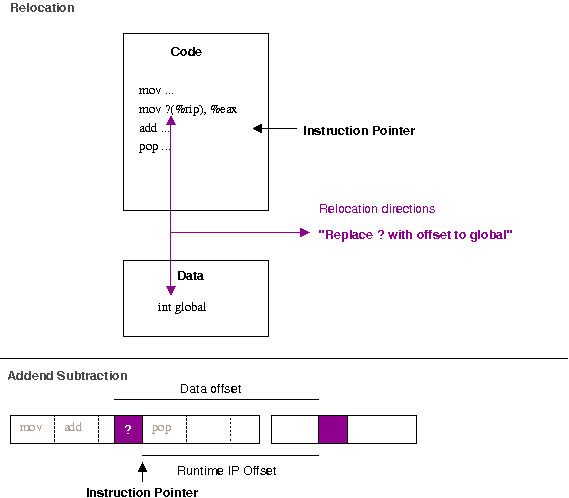
Lets just go through that for clarity: The IP relative move is really the trick here. We know from the code that it has to move the value of the global variable here. The zero value is simply a place holder - the compiler currently does not determine the required address (i.e. how far away from the instruction pointer the memory holding the global variable is). It leaves behind a relocation -- a note that says to the linker "you should determine the correct address of foo (global in our case), and then patch this bit of the code to point to that addresss". Relocations with addend The top portion of the image above gives some idea of how it works. We can examine relocations in binaries with the readelf tool.
$ readelf --relocs ./function.o
Relocation section '.rela.text' at offset 0x518 contains 1 entries:
  Offset          Info           Type           Sym. Value    Sym. Name + Addend
000000000009  000800000002 R_X86_64_PC32     0000000000000000 global + fffffffffffffffc
There are many different types of relocations for different situations; the exact rules for different relocation types are described in the ABI documentation for the architecture. The R_X86_64_PC32 relocation is defined as "the base of the section the symbol is within, plus the symbol value, plus the addend". The addend makes it look more tricky than it is; remember that when an instruction is executing the instruction pointer points to the next instruction to be executed. Therefore, to correctly find the data relative to the instruction pointer, we need to subtract the extra. This can be seen more clearly when layed out in a linear fashion (as in the bottom of the above diagram). If you try and build a shared object (dynamic library) with an object file with this type of relocation, you should get something like:
$ gcc -shared function.c
/usr/bin/ld: /tmp/ccQ2ttcT.o: relocation R_X86_64_32 against  a local symbol' can not be used when making a shared object; recompile with -fPIC
/tmp/ccQ2ttcT.o: could not read symbols: Bad value
collect2: ld returned 1 exit status
If you look back at the disassembly, we notice that the R_X86_64_32 relocation has left only 4-bytes (32-bits) of space left for the relocation entry (the zeros in 7: 8b 15 00 00 00 00). So why does this matter when you're creating a shared library? The first thing to remember is that in a shared library situation, we can not depend on the local value of global actually being the one we want. Consider the following example, where we override the value of global with a LD_PRELOAD library.
$ cat function.c
int global = 100;
int function(int i)  
    return i + global;
 
$ gcc -fPIC -shared -o libfunction.so function.c
$ cat preload.c
int global = 200;
$ gcc -shared preload.c -o libpreload.so
$ cat program.c
#include <stdio.h>
int function(int i);
int main(void)  
   printf("%d\n", function(10));
 
$ gcc -L. -lfunction program.c -o program
$ LD_LIBRARY_PATH=. ./program
110
$ LD_PRELOAD=libpreload.so LD_LIBRARY_PATH=. ./program
210
If the code in libfunction.so were to have a fixed offset into its own data section, it will not be able to be overridden at run-time by the value provided by libpreload.so. Additionally, there are only 4-bytes available to patch in for the address of global -- since a shared library could conceivably be loaded anywhere in the 64-bit (8-byte) address space we therefore need 8-bytes of space to cover ourselves for all possible addresses global might turn up at. The two basic possibilities for an object file are to be either linked into an executable or linked into a shared-library. In the executable case, the value of global will be in the exectuable's data section, which should definitely be reachable with a 32-bit offset of the current instruction-pointer. The instruction-pointer relative address can simply be patched in and the executable is finalised. But what about the shared-library case, where we know the value of global could essentially be anywhere within the 64-bit address space? It is possible to leave 8-bytes of space for the address of global, by telling gcc to use the large-code model. e.g.
$ gcc -c -mcmodel=large function.c
$ objdump --disassemble ./function.o
./function.o:     file format elf64-x86-64
Disassembly of section .text:
0000000000000000 <function>:
   0:  55                      push   %rbp
   1:  48 89 e5                mov    %rsp,%rbp
   4:  89 7d fc                mov    %edi,-0x4(%rbp)
   7:  48 b8 00 00 00 00 00    movabs $0x0,%rax
   e:  00 00 00
  11:  8b 10                   mov    (%rax),%edx
  13:  8b 45 fc                mov    -0x4(%rbp),%eax
  16:  01 d0                   add    %edx,%eax
  18:  5d                      pop    %rbp
  19:  c3                      retq
However, this creates a problem if you really want to share this code. By having to patch in an address of global directly, this means the run-time code above does not remain unchanged. Two separate processes therefore can't share this code -- they each need separate copies that are identical but for their own addresses of global patched into it. By enabling Position Independent Code (PIC, with the flag -fPIC) you can ensure the code remains share-able. PIC means that the output binary does not expect to be loaded at a particular base address, but is happy being put anywhere in memory (compare the output of readelf --segments on a binary such as /bin/ls to that of any shared library). This is obviously critical for implementing lazy-loading (i.e. only loaded when required) shared-libraries, where you may have many libraries loaded in essentially any order at any location. Of course, any problem in computer science can be solved with a layer of abstraction and that is essentially what is done when compiling with -fPIC. To examine this case, let's see what happens with PIC turned on.
$ gcc -fPIC -shared -c  function.c
$ objdump --disassemble ./function.o
./function.o:     file format elf64-x86-64
Disassembly of section .text:
0000000000000000 <function>:
   0:   55                      push   %rbp
   1:   48 89 e5                mov    %rsp,%rbp
   4:   89 7d fc                mov    %edi,-0x4(%rbp)
   7:   48 8b 05 00 00 00 00    mov    0x0(%rip),%rax        # e <function+0xe>
   e:   8b 00                   mov    (%rax),%eax
  10:   03 45 fc                add    -0x4(%rbp),%eax
  13:   c9                      leaveq
  14:   c3                      retq
It's almost the same! We setup the frame pointer with the first two instructions as before. We push the first argument into memory in the pre-allocated "red-zone" as before. Then, however, we do an IP relative load of an address into rax. Next we de-reference this into eax (e.g. eax = *rax in C) before adding the incoming argument to it and returning.
$ readelf --relocs ./function.o
Relocation section '.rela.text' at offset 0x550 contains 1 entries:
  Offset          Info           Type           Sym. Value    Sym. Name + Addend
00000000000a  000800000009 R_X86_64_GOTPCREL 0000000000000000 global + fffffffffffffffc
The magic here is again in the relocations. Notice this time we have a P_X86_64_GOTPCREL relocation. This says "replace the data at offset 0xa with the global offset table (GOT) entry of global. Global Offset Table operation with data variables As shown above, the GOT ensures the abstraction required so symbols can be diverted as expected. Each entry is essentially a pointer to the real data (hence the extra dereference in the code above). Since we can assume the GOT is at a fixed offset from the program code within plus or minus 2Gib, the code can use a 32-bit IP relative address to gain access to the table entries. So, taking a look a the final shared-library binary we see a final offset hard-coded
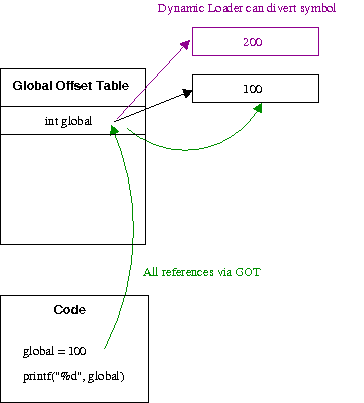
$ gcc -shared -fPIC -o libfunction.so function.c
$ objdump --disassemble ./libfunction.so
00000000000006b0 <function>:
 6b0:  55                      push   %rbp
 6b1:  48 89 e5                mov    %rsp,%rbp
 6b4:  89 7d fc                mov    %edi,-0x4(%rbp)
 6b7:  48 8b 05 8a 02 20 00    mov    0x20028a(%rip),%rax        # 200948 <_DYNAMIC+0x1d8>
 6be:  8b 10                   mov    (%rax),%edx
 6c0:  8b 45 fc                mov    -0x4(%rbp),%eax
 6c3:  01 d0                   add    %edx,%eax
 6c5:  5d                      pop    %rbp
 6c6:  c3                      retq
 6c7:  90                      nop
Every process who wants to share this code just needs to make sure they have their unique address of global at 0x20028a(%rip). Since each process has a separate address-space, this means they can all have different values for global but share the same code! Thus the default of the small-code model is sensible. It is exceedingly rare for an executable to need more than 4-byte offsets for a relative access to a variable in it's data region, so using a full 8-byte value would just be a waste of space. Although leaving 8-bytes would allow access to the variable anywhere in the 64-bit address space; when building a shared library, you really want to use -fPIC to ensure the library can actually be shared, which introduces a different relocation and access to data via the GOT. This should explain why gcc -shared function.c works on x86-32, but does not work on x86-64. Inspecting the code reveals why:
$ objdump --disassemble ./function.o
00000000 <function>:
   0:   55                      push   %ebp
   1:   89 e5                   mov    %esp,%ebp
   3:   a1 00 00 00 00          mov    0x0,%eax
   8:   03 45 08                add    0x8(%ebp),%eax
   b:   5d                      pop    %ebp
   c:   c3                      ret
$ readelf --relocs ./function.o
Relocation section '.rel.text' at offset 0x2ec contains 1 entries:
 Offset     Info    Type            Sym.Value  Sym. Name
00000004  00000701 R_386_32          00000000   global
We start out the same, with the first two instructions setting up the frame pointer. However, next we load a memory value into eax -- as we can see from the relocation information, the address of global. Next we add the incoming argument from the stack (0x8(%ebp)) to the value in this memory location; implicitly dereferencing it. But since we only have a 32-bit address-space, the 4-bytes allocated is enough to access any possible address. So while this can work, you're not creating position-independent code and hence not enabling code-sharing. The disadvantage of PIC code is that you require "bouncing" through the GOT, which requires more loads and reads to find an address than directly referencing it. However, if your program is at the point that this is becoming a performance issue you're probably not reading this blog! Hopefully, this helps clear up that possibly cryptic error message. Further searches around position-independent code, global-offset tables and code-sharing should also yield you more information if it remains unclear.

Next.

Previous.