Search Results: "ana"

12 January 2022

Michael Prokop: Revisiting 2021

* Uhm yeah, so this shirt didn t age well. :) Mainly to recall what happened, I m once again revisiting my previous year (previous edition: 2020). 2021 was quite challenging overall. It started with four weeks of distance learning at school. Luckily at least at school things got back to "some kind of normal" afterwards. The lockdowns turned out to be an excellent opportunity for practising Geocaching though, and that s what I started to do with my family. It s a great way to grab some fresh air, get to know new areas, and spend time with family and friends I plan to continue doing this. :) We bought a family season ticket for Freib der (open-air baths) in Graz; this turned out to be a great investment I enjoyed the open air swimming with family, as well as going for swimming laps on my own very much, and plan to do the same in 2022. Due to the lockdowns and the pandemics, the weekly Badminton sessions sadly didn t really take place, so I pushed towards the above-mentioned outdoor swimming and also some running; with my family we managed to do some cycling, inline skating and even practiced some boulder climbing. For obvious reasons plenty of concerts I was looking forward didn t take place. With my parents we at least managed to attend a concert performance of Puccinis Tosca with Jonas Kaufmann at Schlo bergb hne Kasematten/Graz, and with the kids we saw "Robin Hood" in Oper Graz and "Pippi Langstrumpf" at Studiob hne of Oper Graz. The lack of concerts and rehearsals once again and still severely impacts my playing the drums, including at HTU BigBand Graz. :-/ Grml-wise we managed to publish release 2021.07, codename JauKerl. Debian-wise we got version 11 AKA bullseye released as new stable release in August. For 2021 I planned to and also managed to minimize buying (new) physical stuff, except for books and other reading stuff. Speaking of reading, 2021 was nice I managed to finish more than 100 books (see Mein Lesejahr 2021 ), and I d like to keep the reading pace. Now let s hope for better times in 2022!

11 January 2022

Russ Allbery: Review: Hench

Review: Hench, by Natalie Zina Walschots
Publisher: William Morrow
Copyright: September 2020
ISBN: 0-06-297859-4
Format: Kindle
Pages: 403
Anna Tromedlov is a hench, which means she does boring things for terrible people for money. Supervillains need a lot of labor to keep their bases and criminal organizations running, and they get that labor the same way everyone else does: through temporary agencies. Anna does spreadsheets, preferably from home on her couch. On-site work was terrifying and she tried to avoid it, but the lure of a long-term contract was too strong. The Electric Eel, despite being a creepy sleazeball, seemed to be a manageable problem. He needed some support at a press conference, which turns out to be code for being a diversity token in front of the camera, but all she should have to do is stand there. That's how Anna ends up holding the mind control device to the head of the mayor's kid when the superheroes attack, followed shortly by being thrown across the room by Supercollider. Left with a complex fracture of her leg that will take months to heal, a layoff notice and a fruit basket from Electric Eel's company, and a vaguely menacing hospital conversation with the police (including Supercollider in a transparent disguise) in which it's made clear to her that she is mistaken about Supercollider's hand-print on her thigh, Anna starts wondering just how much damage superheroes have done. The answer, when analyzed using the framework for natural disasters, is astonishingly high. Anna's resulting obsession with adding up the numbers leads to her starting a blog, the Injury Report, with a growing cult following. That, in turn, leads to a new job and a sponsor: the mysterious supervillain Leviathan. To review this book properly, I need to talk about Watchmen. One of the things that makes superheroes interesting culturally is the straightforwardness of their foundational appeal. The archetypal superhero story is an id story: an almost pure power fantasy aimed at teenage boys. Like other pulp mass media, they reflect the prevailing cultural myths of the era in which they're told. World War II superheroes are mostly all-American boy scouts who punch Nazis. 1960s superheroes are a more complex mix of outsider misfits with a moral code and sarcastic but earnestly ethical do-gooders. The superhero genre is vast, with numerous reinterpretations, deconstructions, and alternate perspectives, but its ur-story is a good versus evil struggle of individual action, in which exceptional people use their powers for good to defeat nefarious villains. Watchmen was not the first internal critique of the genre, but it was the one that everyone read in the 1980s and 1990s. It takes direct aim at that moral binary. The superheroes in Watchmen are not paragons of virtue (some of them are truly horrible people), and they have just as much messy entanglement with the world as the rest of us. It was superheroes re-imagined for the post-Vietnam, post-Watergate era, for the end of the Cold War when we were realizing how many lies about morality we had been told. But it still put superheroes and their struggles with morality at the center of the story. Hench is a superhero story for the modern neoliberal world of reality TV and power inequality in the way that Watchmen was a superhero story for the Iran-Contra era and the end of the Cold War. Whether our heroes have feet of clay is no longer a question. Today, a better question is whether the official heroes, the ones that are celebrated as triumphs of individual achievement, are anything but clay. Hench doesn't bother asking whether superheroes have fallen short of their ideal; that answer is obvious. What Hench asks instead is a question familiar to those living in a world full of televangelists, climate denialism, manipulative advertising, and Facebook: are superheroes anything more than a self-perpetuating scam? Has the good superheroes supposedly do ever outweighed the collateral damage? Do they care in the slightest about the people they're supposedly protecting? Or is the whole system of superheroes and supervillains a performance for an audience, one that chews up bystanders and spits them out mangled while delivering simplistic and unquestioned official morality? This sounds like a deeply cynical premise, but Hench is not a cynical book. It is cynical about superheroes, which is not the same thing. The brilliance of Walschots's approach is that Anna has a foot in both worlds. She works for a supervillain and, over the course of the book, gains access to real power within the world of superheroic battles. But she's also an ordinary person with ordinary problems: not enough money, rocky friendships, deep anger at the injustices of the world and the way people like her are discarded, and now a disability and PTSD. Walschots perfectly balances the tension between those worlds and maintains that tension straight to the end of the book. From the supervillain world, Anna draws support, resources, and a mission, but all of the hope, true morality, and heart of this book comes from the ordinary side. If you had the infrastructure of a supervillain at your disposal, what would you do with it? Anna's answer is to treat superheroes as a destructive force like climate change, and to do whatever she can to drive them out of the business and thus reduce their impact on the world. The tool she uses for that is psychological warfare: make them so miserable that they'll snap and do something too catastrophic to be covered up. And the raw material for that psychological warfare is data. That's the foot in the supervillain world. In descriptions of this book, her skills with data are often called her superpower. That's not exactly wrong, but the reason why she gains power and respect is only partly because of her data skills. Anna lives by the morality of the ordinary people world: you look out for your friends, you treat your co-workers with respect as long as they're not assholes, and you try to make life a bit better for the people around you. When Leviathan gives her the opportunity to put together a team, she finds people with skills she admires, funnels work to people who are good at it, and worries about the team dynamics. She treats the other ordinary employees of a supervillain as people, with lives and personalities and emotions and worth. She wins their respect. Then she uses their combined skills to destroy superhero lives. I was fascinated by the moral complexity in this book. Anna and her team do villainous things by the morality of the superheroic world (and, honestly, by the morality of most readers), including some things that result in people's deaths. By the end of the book, one could argue that Anna has been driven by revenge into becoming an unusual sort of supervillain. And yet, she treats the people around her so much better than either the heroes or the villains do. Anna is fiercely moral in all the ordinary person ways, and that leads directly to her becoming a villain in the superhero frame. Hench doesn't resolve that conflict; it just leaves it on the page for the reader to ponder. The best part about this book is that it's absurdly grabby, unpredictable, and full of narrative momentum. Walschots's pacing kept me up past midnight a couple of times and derailed other weekend plans so that I could keep reading. I had no idea where the plot was going even at the 80% mark. The ending is ambiguous and a bit uncomfortable, just like the morality throughout the book, but I liked it the more I thought about it. One caveat, unfortunately: Hench has some very graphic descriptions of violence and medical procedures, and there's an extended torture sequence with some incredibly gruesome body horror that I thought went on far too long and was unnecessary to the plot. If you're a bit squeamish like I am, there are some places where you'll want to skim, including one sequence that's annoyingly intermixed with important story developments. Otherwise, though, this is a truly excellent book. It has a memorable protagonist with a great first-person voice, an epic character arc of empowerment and revenge, a timely take on the superhero genre that uses it for sharp critique of neoliberal governance and reality TV morality, a fascinatingly ambiguous and unsettled moral stance, a gripping and unpredictable plot, and some thoroughly enjoyable competence porn. I had put off reading it because I was worried that it would be too cynical or dark, but apart from the unnecessary torture scene, it's not at all. Highly recommended. Rating: 9 out of 10

10 January 2022

Louis-Philippe V ronneau: Grading using the Wacom Intuos S

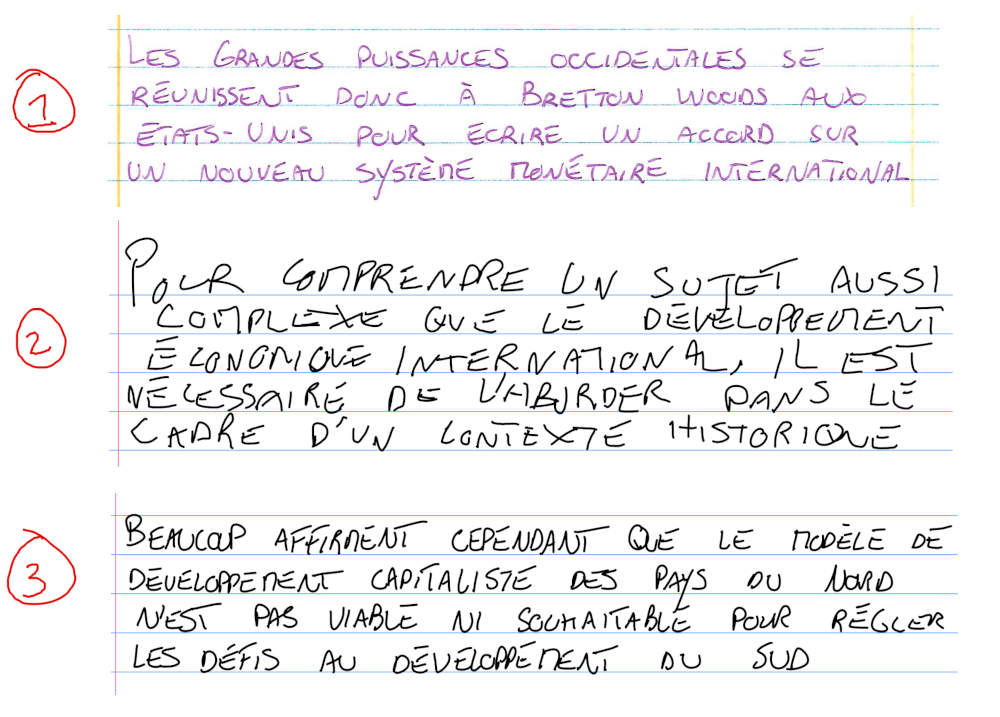
I've been teaching economics for a few semesters already and, slowly but surely, I'm starting to get the hang of it. Having to deal with teaching remotely hasn't been easy though and I'm really hoping the winter semester will be in-person again. Although I worked way too much last semester1, I somehow managed to transition to using a graphics tablet. I bought a Wacom Intuos S tablet (model CTL-4100) in late August 2021 and overall, I have been very happy with it. Wacom Canada offers a small discount for teachers and I ended up paying 115 CAD (~90 USD) for the tablet, an overall very reasonable price. Unsurprisingly, the Wacom support on Linux is very good and my tablet worked out of the box. The only real problem I had was by default, the tablet sometimes boots up in Android mode, making it unusable. This is easily solved by pressing down on the pad's first and last buttons for a few seconds, until the LED turns white. The included stylus came with hard plastic nibs, but I find them too slippery. I eventually purchased hard felt nibs, which increase the friction and makes for a more paper-like experience. They are a little less durable, but I wrote quite a fair bit and still haven't gone through a single one yet. Learning curve Learning how to use a graphical tablet took me at least a few weeks! When writing on a sheet of paper, the eyes see what the hand writes directly. This is not the case when using a graphical tablet: you are writing on a surface and see the result on your screen, a completely different surface. This dissociation takes a bit of practise to master, but after going through more than 300 pages of notes, it now feels perfectly normal. Here is a side-by-side comparison of my very average hand-writing2:
  1. on paper
  2. using the tablet, the first week
  3. using the tablet, after a couple of months
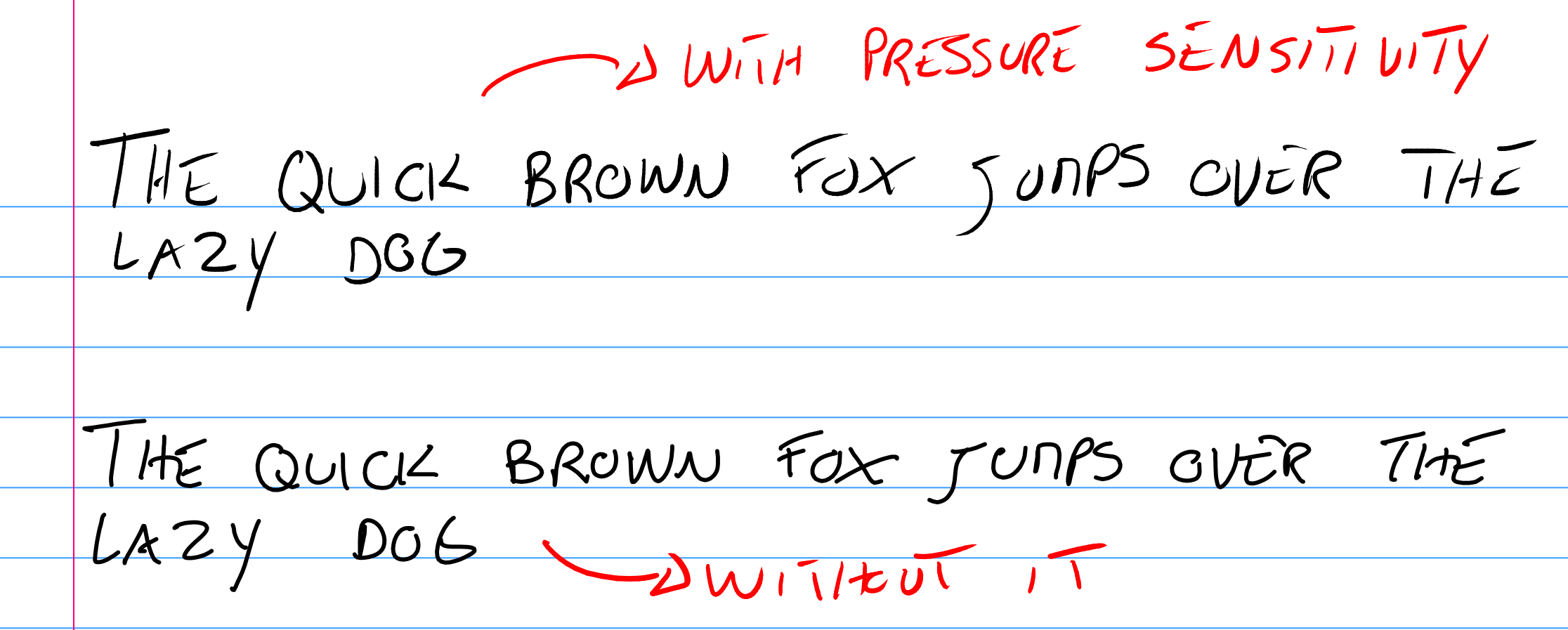
Comparison of my writing, on paper, using the tablet and using the tablet after a few weeks I still prefer the result of writing on paper, but I think this is mostly due to me not using the pressure sensitivity feature. The support in xournal wasn't great, but now that I've tried it in xournalpp (more on this below), I think I will be enabling it in the future. The result on paper is also more consistent, but I trust my skills will improve over time. Pressure sensitivity on vs off Use case The first use case I have for the tablet is grading papers. I've been asking my students to submit their papers via Moodle for a few semesters already, but until now, I was grading them using PDF comments. The experience wasn't great3 and was rather slow compared to grading physical copies. I'm also a somewhat old-school teacher: I refuse to teach using slides. Death by PowerPoint is real. I write on the blackboard a lot4 and I find it much easier to prepare my notes by hand than by typing them, as the end result is closer to what I actually end up writing down on the board. Writing notes by hand on sheets of paper is a chore too, especially when you revisit the same materiel regularly. Being able to handwrite digital notes gives me a lot more flexibility and it's been great. So far, I have been using xournal to write notes and grade papers, and although it is OK, it has a bunch of quirks I dislike. I was waiting for xournalpp to be packaged in Debian, and it now is5! I'm looking forward to using it next semester. Towards a better computer monitor I have also been feeling the age of my current computer monitor. I am currently using an old 32" 1080p TV from LG and up until now, I had been able to deal with the drawbacks. The colors are pretty bad and 1080p for such a large display isn't great, but I got used to it. What I really noticed when I started using my graphics tablet was the input lag. It's bad enough that there's a clear jello effect when writing and it eventually gives me a headache. It's so bad I usually prefer to work on my laptop, which has a nicer but noticeably smaller panel. I'm currently looking to replace this aging TV6 by something more modern. I have been waiting out since I would like to buy something that will last me another 10 years if possible. Sadly, 32" high refresh rate 4K monitors aren't exactly there yet and I haven't found anything matching my criteria. I would probably also need a new GPU, something that is not easy to come by these days.
  1. I worked at two colleges at the same time, teaching 2 different classes (one of which I was giving for the first time...) to 6 groups in total. I averaged more than 60h per week for sure.
  2. Yes, I only write in small caps. Students love it, as it's much easier to read on the blackboard.
  3. Although most PDF readers support displaying comments, some of my more clueless students still had trouble seeing them and I had to play tech support more than I wanted.
  4. Unsurprisingly, my students also love it. One of the most common feedback I get at the end of the semester is they hate slides too and are very happy I'm one of the few teachers who writes on the board.
  5. Many thanks to Barak A. Pearlmutter for maintaining this package.
  6. It dates back from 2010, when my mom replaced our old CRT by a flat screen. FullHD TVs were getting affordable and I wasn't sad to see our tiny 20-something inches TV go. I eventually ended up with the LG flatscreen a few years later when I moved out in my first apartment and my mom got something better.

9 January 2022

Russell Coker: Video Conferencing (LCA)

I ve just done a tech check for my LCA lecture. I had initially planned to do what I had done before and use my phone for recording audio and video and my PC for other stuff. The problem is that I wanted to get an external microphone going and plugging in a USB microphone turned off the speaker in the phone (it seemed to direct audio to a non-existent USB audio output). I tried using bluetooth headphones with the USB microphone and that didn t work. Eventually a viable option seemed to be using USB headphones on my PC with the phone for camera and microphone. Then it turned out that my phone (Huawei Mate 10 Pro) didn t support resolutions higher than VGA with Chrome (it didn t have the advanced settings menu to select resolution), this is probably an issue of Android build features. So the best option is to use a webcam on the PC, I was recommended a Logitech C922 but OfficeWorks only has a Logitech C920 which is apparently OK. The free connection test from freeconference.com [1] is good for testing out how your browser works for videoconferencing. It tests each feature separately and is easy to run. After buying the C920 webcam I found that it sometimes worked and sometimes caused a kernel panic like the following (partial panic log included for the benefit of people Googling this Logitech C920 problem):
[95457.805417] BUG: kernel NULL pointer dereference, address: 0000000000000000
[95457.805424] #PF: supervisor read access in kernel mode
[95457.805426] #PF: error_code(0x0000) - not-present page
[95457.805429] PGD 0 P4D 0 
[95457.805431] Oops: 0000 [#1] SMP PTI
[95457.805435] CPU: 2 PID: 75486 Comm: v4l2src0:src Not tainted 5.15.0-2-amd64 #1  Debian 5.15.5-2
[95457.805438] Hardware name: HP ProLiant ML110 Gen9/ProLiant ML110 Gen9, BIOS P99 02/17/2017
[95457.805440] RIP: 0010:usb_ifnum_to_if+0x3a/0x50 [usbcore]
...
[95457.805481] Call Trace:
[95457.805484]  
[95457.805485]  usb_hcd_alloc_bandwidth+0x23d/0x360 [usbcore]
[95457.805507]  usb_set_interface+0x127/0x350 [usbcore]
[95457.805525]  uvc_video_start_transfer+0x19c/0x4f0 [uvcvideo]
[95457.805532]  uvc_video_start_streaming+0x7b/0xd0 [uvcvideo]
[95457.805538]  uvc_start_streaming+0x2d/0xf0 [uvcvideo]
[95457.805543]  vb2_start_streaming+0x63/0x100 [videobuf2_common]
[95457.805550]  vb2_core_streamon+0x54/0xb0 [videobuf2_common]
[95457.805555]  uvc_queue_streamon+0x2a/0x40 [uvcvideo]
[95457.805560]  uvc_ioctl_streamon+0x3a/0x60 [uvcvideo]
[95457.805566]  __video_do_ioctl+0x39b/0x3d0 [videodev]
It turns out that Ubuntu Launchpad bug #1827452 has great information on this problem [2]. Apparently if the device decides it doesn t have enough power then it will reconnect and get a different USB bus device number and this often happens when the kernel is initialising it. There s a race condition in the kernel code in which the code to initialise the device won t realise that the device has been detached and will dereference a NULL pointer and then mess up other things in USB device management. The end result for me is that all USB devices become unusable in this situation, commands like lsusb hang, and a regular shutdown/reboot hangs because it can t kill the user session because something is blocked on USB. One of the comments on the Launchpad bug is that a powered USB hub can alleviate the problem while a USB extension cable (which I had been using) can exacerbate it. Officeworks currently advertises only one powered USB hub, it s described as USB 3 but also maximum speed 480 Mbps (USB 2 speed). So basically they are selling a USB 2 hub for 4* the price that USB 2 hubs used to sell for. When debugging this I used the cheese webcam utility program and ran it in a KVM virtual machine. The KVM parameters -device qemu-xhci -usb -device usb-host,hostbus=1,hostaddr=2 (where 1 and 2 are replaced by the Bus and Device numbers from lsusb ) allow the USB device to be passed through to the VM. Doing this meant that I didn t have to reboot my PC every time a webcam test failed. For audio I m using the Sades Wand gaming headset I wrote about previously [3].

Fran ois Marier: Removing an alias/domain from a Let's Encrypt certificate managed by certbot

I recently got an error during a certbot renewal:
Challenge failed for domain echo.fmarier.org
Failed to renew certificate jabber-gw.fmarier.org with error: Some challenges have failed.
The following renewals failed:
  /etc/letsencrypt/live/jabber-gw.fmarier.org/fullchain.pem (failure)
1 renew failure(s), 0 parse failure(s)
due to the fact that I had removed the DNS entry for echo.fmarier.org. I tried to find a way to remove that name from the certificate before renewing it, but it seems like the only way to do it is to create a new certificate without that alternative name. First, I looked for the domains included in the certificate:
$ certbot certificates
...
  Certificate Name: jabber-gw.fmarier.org
    Serial Number: 31485424904a33fb2ab43ab174b4b146512
    Key Type: RSA
    Domains: jabber-gw.fmarier.org echo.fmarier.org fmarier.org
    Expiry Date: 2022-01-04 05:28:57+00:00 (VALID: 29 days)
    Certificate Path: /etc/letsencrypt/live/jabber-gw.fmarier.org/fullchain.pem
    Private Key Path: /etc/letsencrypt/live/jabber-gw.fmarier.org/privkey.pem
Then, deleted the existing certificate:
$ certbot delete jabber-gw.fmarier.org
and finally created a new certificate with all other names except for the obsolete one:
$ certbot certonly -d jabber-gw.fmarier.org -d fmarier.org --duplicate

Matthew Garrett: Pluton is not (currently) a threat to software freedom

At CES this week, Lenovo announced that their new Z-series laptops would ship with AMD processors that incorporate Microsoft's Pluton security chip. There's a fair degree of cynicism around whether Microsoft have the interests of the industry as a whole at heart or not, so unsurprisingly people have voiced concerns about Pluton allowing for platform lock-in and future devices no longer booting non-Windows operating systems. Based on what we currently know, I think those concerns are understandable but misplaced.

But first it's helpful to know what Pluton actually is, and that's hard because Microsoft haven't actually provided much in the way of technical detail. The best I've found is a discussion of Pluton in the context of Azure Sphere, Microsoft's IoT security platform. This, in association with the block diagrams on page 12 and 13 of this slidedeck, suggest that Pluton is a general purpose security processor in a similar vein to Google's Titan chip. It has a relatively low powered CPU core, an RNG, and various hardware cryptography engines - there's nothing terribly surprising here, and it's pretty much the same set of components that you'd find in a standard Trusted Platform Module of the sort shipped in pretty much every modern x86 PC. But unlike Titan, Pluton seems to have been designed with the explicit goal of being incorporated into other chips, rather than being a standalone component. In the Azure Sphere case, we see it directly incorporated into a Mediatek chip. In the Xbox Series devices, it's incorporated into the SoC. And now, we're seeing it arrive on general purpose AMD CPUs.

Microsoft's announcement says that Pluton can be shipped in three configurations:as the Trusted Platform Module; as a security processor used for non-TPM scenarios like platform resiliency; or OEMs can choose to ship with Pluton turned off. What we're likely to see to begin with is the former - Pluton will run firmware that exposes a Trusted Computing Group compatible TPM interface. This is almost identical to the status quo. Microsoft have required that all Windows certified hardware ship with a TPM for years now, but for cost reasons this is often not in the form of a separate hardware component. Instead, both Intel and AMD provide support for running the TPM stack on a component separate from the main execution cores on the system - for Intel, this TPM code runs on the Management Engine integrated into the chipset, and for AMD on the Platform Security Processor that's integrated into the CPU package itself.

So in this respect, Pluton changes very little; the only difference is that the TPM code is running on hardware dedicated to that purpose, rather than alongside other code. Importantly, in this mode Pluton will not do anything unless the system firmware or OS ask it to. Pluton cannot independently block the execution of any other code - it knows nothing about the code the CPU is executing unless explicitly told about it. What the OS can certainly do is ask Pluton to verify a signature before executing code, but the OS could also just verify that signature itself. Windows can already be configured to reject software that doesn't have a valid signature. If Microsoft wanted to enforce that they could just change the default today, there's no need to wait until everyone has hardware with Pluton built-in.

The two things that seem to cause people concerns are remote attestation and the fact that Microsoft will be able to ship firmware updates to Pluton via Windows Update. I've written about remote attestation before, so won't go into too many details here, but the short summary is that it's a mechanism that allows your system to prove to a remote site that it booted a specific set of code. What's important to note here is that the TPM (Pluton, in the scenario we're talking about) can't do this on its own - remote attestation can only be triggered with the aid of the operating system. Microsoft's Device Health Attestation is an example of remote attestation in action, and the technology definitely allows remote sites to refuse to grant you access unless you booted a specific set of software. But there are two important things to note here: first, remote attestation cannot prevent you from booting whatever software you want, and second, as evidenced by Microsoft already having a remote attestation product, you don't need Pluton to do this! Remote attestation has been possible since TPMs started shipping over two decades ago.

The other concern is Microsoft having control over the firmware updates. The context here is that TPMs are not magically free of bugs, and sometimes these can have security consequences. One example is Infineon TPMs producing weak RSA keys, a vulnerability that could be rectified by a firmware update to the TPM. Unfortunately these updates had to be issued by the device manufacturer rather than Infineon being able to do so directly. This meant users had to wait for their vendor to get around to shipping an update, something that might not happen at all if the machine was sufficiently old. From a security perspective, being able to ship firmware updates for the TPM without them having to go through the device manufacturer is a huge win.

Microsoft's obviously in a position to ship a firmware update that modifies the TPM's behaviour - there would be no technical barrier to them shipping code that resulted in the TPM just handing out your disk encryption secret on demand. But Microsoft already control the operating system, so they already have your disk encryption secret. There's no need for them to backdoor the TPM to give them something that the TPM's happy to give them anyway. If you don't trust Microsoft then you probably shouldn't be running Windows, and if you're not running Windows Microsoft can't update the firmware on your TPM.

So, as of now, Pluton running firmware that makes it look like a TPM just isn't a terribly interesting change to where we are already. It can't block you running software (either apps or operating systems). It doesn't enable any new privacy concerns. There's no mechanism for Microsoft to forcibly push updates to it if you're not running Windows.

Could this change in future? Potentially. Microsoft mention another use-case for Pluton "as a security processor used for non-TPM scenarios like platform resiliency", but don't go into any more detail. At this point, we don't know the full set of capabilities that Pluton has. Can it DMA? Could it play a role in firmware authentication? There are scenarios where, in theory, a component such as Pluton could be used in ways that would make it more difficult to run arbitrary code. It would be reassuring to hear more about what the non-TPM scenarios are expected to look like and what capabilities Pluton actually has.

But let's not lose sight of something more fundamental here. If Microsoft wanted to block free operating systems from new hardware, they could simply mandate that vendors remove the ability to disable secure boot or modify the key databases. If Microsoft wanted to prevent users from being able to run arbitrary applications, they could just ship an update to Windows that enforced signing requirements. If they want to be hostile to free software, they don't need Pluton to do it.

(Edit: it's been pointed out that I kind of gloss over the fact that remote attestation is a potential threat to free software, as it theoretically allows sites to block access based on which OS you're running. There's various reasons I don't think this is realistic - one is that there's just way too much variability in measurements for it to be practical to write a policy that's strict enough to offer useful guarantees without also blocking a number of legitimate users, and the other is that you can just pass the request through to a machine that is running the appropriate software and have it attest for you. The fact that nobody has actually bothered to use remote attestation for this purpose even though most consumer systems already ship with TPMs suggests that people generally agree with me on that)

comment count unavailable comments

8 January 2022

Jonathan Dowland: 2021 in Fiction

Cover for *This is How You Lose the Time War*
Cover for *Robot*
Cover for *The Glass Hotel*
Following on from last year's round-up of my reading, here's a look at the fiction I enjoyed in 2021. I managed to read 42 books in 2021, up from 31 last year. That's partly to do with buying an ereader: 33/36% of my reading (by pages/by books) was ebooks. I think this demonstrates that ebooks have mostly complemented paper books for me, rather than replacing them. My book of the year (although it was published in 2019) was This is How You Lose the Time War by Amal El-Mohtar and Max Gladstone: A short epistolary love story between warring time travellers and quite unlike anything else I've read for a long time. Other notables were The Glass Hotel by Emily St John Mandel and Robot by Adam Wi niewski-Snerg. The biggest disappointment for me was The Ministry for the Future by Kim Stanley Robinson (KSR), which I haven't even finished. I love KSRs writing: I've written about him many times on this blog, at least in 2002, 2006 and 2009, I think I've read every other novel he's published and most of his short stories. But this one was too much of something for me. He's described this novel a the end-point of a particular journey and approach to writing he's taken, which I felt relieved to learn, assuming he writes any more novels (and I really hope that he does) they will likely be in a different "mode". My "new author discovery" for 2021 was Chris Beckett: I tore through Two Tribes and America City before promptly buying all his other work. He fits roughly into the same bracket as Adam Roberts and Christopher Priest, two of my other favourite authors. 5 of the books I read (12%) were from my "backlog" of already-purchased physical books. I'd like to try and reduce my Backlog further so I hope to push this figure up next year. I made a small effort to read more diverse authors this year. 24% of the books I read (by book count and page count) were by women. 15% by page count were (loosely) BAME (19% by book count). Again I'd like to increase these numbers modestly in 2022. Unlike 2020, I didn't complete any short story collections in 2021! This is partly because there was only one issue of Interzone published in all of 2021, a double-issue which I haven't yet finished. This is probably a sad date point in terms of Interzone's continued existence, but it's not dead yet.

John Goerzen: Make the Internet Yours Again With an Instant Mesh Network

I m going to lead with the technical punch line, and then explain it: Yggdrasil Network is an opportunistic mesh that can be deployed privately or as part of a global-scale network. Each node gets a stable IPv6 address (or even an entire /64) that is derived from its public key and is bound to that node as long as the node wants it (of course, it can generate a new keypair anytime) and is valid wherever the node joins the mesh. All traffic is end-to-end encrypted. Yggdrasil will automatically discover peers on a LAN via broadcast beacons, and requires zero configuration to peer in such a way. It can also run as an overlay network atop the public Internet. Public peers serve as places to join the global network, and since it s a mesh, if one device on your LAN joins the global network, the others will automatically have visibility on it also, thanks to the mesh routing. It neatly solves a lot of problems of portability (my ssh sessions stay live as I move networks, for instance), VPN (incoming ports aren t required since local nodes can connect to a public peer via an outbound connection), security, and so forth. Now on to the explanation: The Tyranny of IP rigidity Every device on the Internet, at one time, had its own globally-unique IP address. This number was its identifier to the world; with an IP address, you can connect to any machine anywhere. Even now, when you connect to a computer to download a webpage or send a message, under the hood, your computer is talking to the other one by IP address. Only, now it s hard to get one. The Internet protocol we all grew up with, version 4 (IPv4), didn t have enough addresses for the explosive growth we ve seen. Internet providers and IT departments had to use a trick called NAT (Network Address Translation) to give you a sort of fake IP address, so they could put hundreds or thousands of devices behind a single public one. That, plus the mobility of devices changing IPs whenever they change locations has meant that a fundamental rule of the old Internet is now broken: Every participant is an equal peer. (Well, not any more.) Nowadays, you can t you host your own website from your phone. Or share files from your house. (Without, that is, the use of some third-party service that locks you down and acts as an intermediary.) Back in the 90s, I worked at a university, and I, like every other employee, had a PC on my desk with an unfirewalled public IP. I installed a webserver, and poof instant website. Nowadays, running a website from home is just about impossible. You may not have a public IP, and if you do, it likely changes from time to time. And even then, your ISP probably blocks you from running servers on it. In short, you have to buy your way into the resources to participate on the Internet. I wrote about these problems in more detail in my article Recovering Our Lost Free Will Online. Enter Yggdrasil I already gave away the punch line at the top. But what does all that mean?
  • Every device that participates gets an IP address that is fully live on the Yggdrasil network.
  • You can host a website, or a mail server, or whatever you like with your Yggdrasil IP.
  • Encryption and authentication are smaller (though not nonexistent) worries thanks to the built-in end-to-end encryption.
  • You can travel the globe, and your IP will follow you: onto a plane, from continent to continent, wherever. Yggdrasil will find you.
  • I ve set up /etc/hosts on my laptop to use the Yggdrasil IPs for other machines on my LAN. Now I can just ssh foo and it will work from home, from a coffee shop, from a 4G tether, wherever. Now, other tools like tinc can do this, obviously. And I could stop there; I could have a completely closed, private Yggdrasil network. Or, I can join the global Yggdrasil network. Each device, in addition to accepting peers it finds on the LAN, can also be configured to establish outbound peering connections or accept inbound ones over the Internet. Put a public peer or two in your configuration and you ve joined the global network. Most people will probably want to do that on every device (because why not?), but you could also do that from just one device on your LAN. Again, there s no need to explicitly build routes via it; your other machines on the LAN will discover the route s existence and use it. This is one of many projects that are working to democratize and decentralize the Internet. So far, it has been quite successful, growing to over 2000 nodes. It is the direct successor to the earlier cjdns/Hyperboria and BATMAN networks, and aims to be a proof of concept and a viable tool for global expansion. Finally, think about how much easier development is when you don t have to necessarily worry about TLS complexity in every single application. When you don t have to worry about port forwarding and firewall penetration. It s what the Internet should be.

    Ayoyimika Ajibade: Nodejs 16 and Webpack 5 transition in Debian

    What is Debian ? Debian is also known as Debian GNU/Linux is a free open-source operating system (OS) based currently on the Linux kernel or the FreeBSD kernel, developed by the community-supported Debian Project; although efforts are in place to provide Debian for other kernels, primarily for the Hurd.

    Fun fact about Debian
    • Debian was the first Linux distribution to include a package management system for easy installation and removal of software. It was also the first Linux distribution that could be upgraded without requiring reinstallation.
    • To protect your system against Trojan horses and other malevolent software, Debian's servers verify that uploaded packages come from their registered Debian maintainers.
    • Debian comes with over 59000 packages; as of this writing (precompiled software that is bundled up in a nice format for easy installation on your machine), a package manager (APT), and other utilities that make it possible to manage thousands of packages on thousands of computers as easily as installing a single application. All of it is FREE!
    • Debian is also the basis for many other distributions, most notably Ubuntu

    What is Webpack ? Webpack is a static module bundler for modern JavaScript applications. When webpack processes your application, it internally builds a dependency graph from one or more entry points and then combines every module your project needs into one or more bundles, which are static assets to serve your content from

    What is nodejs ? Node.js is an open-source, cross-platform built on Chrome's JavaScript runtime for easily building fast and scalable network applications and also developing server-side applications, Here javascript code is no longer limited to the traditional method of running on the web browser

    What does Transitioning mean in Debian? Transitioning is a concept in Debian about maintaining only one version of a library like webpack, nodejs. There is a bottleneck as other libraries and applications may not support the version we have in Debian. So we have to port that software which For example, node-mini-css-extract-plugin, node-mermaid and so many packages uses webpack. In buster we had webpack4 and in bullseye, we want to update it to webpack5. node-mini-css-extract-plugin already supports webpack5, but others like node-mermaid don't support it yet. So either we wait or we help those projects to update their webpack version. Check out this chat between my mentor and a community member on transitioning of rails6

    Getting Started with Creating or Updating packages in Debian To be able to create or maintain packages suitable for uploading to Debian you must be in a sid/unstable environment or distribution. See recommended instructions on how to setup Debian Sid via this link See link on how to debianize a new package See link for brief steps on how to update a package to its new upstream version. For more detailed content on the whys and hows of updating a package to its new upstream version visit here Note In updating to the new upstream version we have to watch out for breaking changes caused by both minor updates or major updates. As per https://semver.org major updates(e.g If the current version is 2.3.4, then 3.0 is a major update) of libraries with versions greater than 1.0 and minor updates(e.g If the current version is 0.10 then 0.11 is a minor update) of libraries with versions less than 1.0 can have breaking changes

    The overall flow of webpack5 and nodejs16 transitioning in Debian After grasping the fundamental process and flow on how to update a package, you are well on your way to transitioning . Transitioning in webpack or nodejs involves building and testing of dependencies or packages that depend on webpack or nodejs respectively called reverse-dependencies, these reverse dependencies are tested and built with the new updated version usually uploaded to the experimental distribution if reverse dependencies are built and tested successfully both reverse dependencies and dependency in this case nodejs or webpack are then uploaded to the unstable/sid distribution for further processing

    The major guidelines to follow while transitioning are
    • Find a list of reverse dependencies to fix
    • See if new upstream versions of reverse dependencies are available that supports the transitioning version
    • See if new upstream of reverse dependencies are available that supports the transitioning version works
    • Report bugs found while rebuilding and testing reverse dependencies in Debian
    • Forward bugs found while rebuilding and testing reverse dependencies upstream
    • Fix or update packages and forward patches upstream
    After a successful transitioning phase users of the Debian OS have access to the latest and also oldest installation of these packages via apt based on their preferences, which implies having the benefit of more features, bug fixes, updated security patches from those packages, all these are possible due to the community of amazing people

    7 January 2022

    Ayoyimika Ajibade: Everyone Struggles

    Starting anything new always has in it an element of uncertainty, doubt, fears, and struggle to forge ahead, this has been my current situation as an outreachy intern working on the transition of nodejs16 and webpack5 which is about updating all packages that depend on nodejs14 and webpack4 to work well with the updated version of nodejs16 and webpack5 in the Debian operations system. Juicy right! As a software developer struggling to grasp both basic and advanced knowledge of a concept can seem daunting, much like learning anything new, you can be overwhelmed when you are surrounded and know there is a whole lot of other new concept, tools, process, languages you have to learn that are linked to what you are currently learning, as you are struggling to grasp the fundamental idea of what you are currently learning. imbued in any struggle to get a solution to the problem is where innovation and inventions lie in, and our learning becomes improved as we dive into fact-finding, getting your hypothesis after a series of tests and ultimately proffering a solution Some of my struggles as I intern with Debian has been lack of skill of the shell scripting language as that is one of the core languages to understand so as to navigate your way around maintaining packages for Debian, also funny enough having just an intermediate knowledge of the javascript programming language as arguably having a basic knowledge of javascript is necessary to building and testing javascript packages in Debian as I know only the basic of javascript since my core language is Python, that I struggle with. The good thing is that the more I keep at it the faster the chance of the struggles reducing Now to the fun part! having a community of developers who have been through the struggling phase is divine, as they make your learning experience much easier, my mentors and other community member have made learning to package modules for Debian much easier as all hands are on deck to always help out with our challenges. I remember it felt so wonderful when my first contribution got merged and I became more encouraged to update more packages. These helped me a lot in the contribution stage for Debian as I better familiar with how the system worked. I m super grateful to my mentors and co-intern as they are always there to assist me.

    How I Navigate my way through my struggles I guess the first thing about any challenge is to be aware of it and admit your limitations of particular knowledge, then you move on to creatively seek solutions by asking for help from those who know the way. Voila! Now comes the part where you have to take up their solutions, ideas, opinions and make it work for your particular case scenario that is a skill set that all Software developers must-have. Going through documentation has immensely helped solve my problems much faster and build new knowledge, as I get the fundamental idea of why and how things work. I also try to break each concept down into steps, achieve my goals for each step, then build all solutions in each step together, surfing the internet to find solutions also has a huge benefit.

    Vocabulary terms Used in Debian
    1. uscan => a tool to identify and download upstream source code from the repository, also compressing it into the required format.
    2. apt => a package manager to manage packages in Debian, similar to pip in python, npm in javascript.
    3. stretch/buster/bullseye/bookworm/sid => old old stable Debian9 - The codename for the release before the previous stable release (stretch). old stable Debian10 - The previous stable release (Buster). stable Debian11 - The current stable release (Bullseye). testing Debian12 - The next-generation stable release (Bookworm). unstable - The unstable development release (Sid) where new or updated packages are introduced. To understand more on debian release cycle
    4. reverse-rebuild => is building all modules that depend on a package in Debian while building the main package.
    5. lintian => A helper tool used to check for inconsistencies and errors in a Debian Package based on Debian standards.
    6. pkg-js-tools => A collection of tools to aid packaging Node modules in Debian.
    7. dpkg-buildpackage => A command to build upstream code in an unclean chroot or environment.
    8. quilt => A patch creation and management automation script. quilt helps manage a series of patches that a Debian package maintainer needs to be applied to upstream source when building the package.
    9. autopkgtest => a script used to test an installed binary package using the source package's tests
    10. RFS => (Request For Sponsorship) Working in the Debian ecosystem includes two roles either as a Debian Maintainer with restricted rights and privileges like uploading to the Debian archive or as a Debian Developer with all rights and privileges such as uploading to the Debian archive, as a new contributor or a Debian maintainer (with few rights and privileges) in Debian you can RFS so that your pull request (PR) can be merged to the Debian archive by a Debian Developer, much like your contribution has been accepted
    There are so many terms and tools you have to get accustomed to, but they are easy to understand and use, as enough and frequently updated wiki documentation are available to guide you through, plus a whole lot of community members you can ask questions from. strength and growth come only through continuous effort and struggle. Napoleon Hill

    6 January 2022

    Jacob Adams: Linux Hibernation Documentation

    Recently I ve been curious about how hibernation works on Linux, as it s an interesting interaction between hardware and software. There are some notes in the Arch wiki and the kernel documentation (as well as some kernel documentation on debugging hibernation and on sleep states more generally), and of course the ACPI Specification

    The Formal Definition ACPI (Advanced Configuration and Power Interface) is, according to the spec, an architecture-independent power management and configuration framework that forms a subsystem within the host OS which defines a hardware register set to define power states. ACPI defines four global system states G0, working/on, G1, sleeping, G2, soft off, and G3, mechanical off1. Within G1 there are 4 sleep states, numbered S1 through S4. There are also S0 and S5, which are equivalent to G0 and G2 respectively2.

    Sleep According to the spec, the ACPI S1-S4 states all do the same thing from the operating system s perspective, but each saves progressively more power, so the operating system is expected to pick the deepest of these states when entering sleep. However, most operating systems3 distinguish between S1-S3, which are typically referred to as sleep or suspend, and S4, which is typically referred to as hibernation.

    S1: CPU Stop and Cache Wipe The CPU caches are wiped and then the CPU is stopped, which the spec notes is equivalent to the WBINVD instruction followed by the STPCLK signal on x86. However, nothing is powered off.

    S2: Processor Power off The system stops the processor and most system clocks (except the real time clock), then powers off the processor. Upon waking, the processor will not continue what it was doing before, but instead use its reset vector4.

    S3: Suspend/Sleep (Suspend-to-RAM) Mostly equivalent to S2, but hardware ensures that only memory and whatever other hardware memory requires are powered.

    S4: Hibernate (Suspend-to-Disk) In this state, all hardware is completely powered off and an image of the system is written to disk, to be restored from upon reapplying power. Writing the system image to disk can be handled by the operating system if supported, or by the firmware.

    Linux Sleep States Linux has its own set of sleep states which mostly correspond with ACPI states.

    Suspend-to-Idle This is a software only sleep that puts all hardware into the lowest power state it can, suspends timekeeping, and freezes userspace processes. All userspace and some kernel threads5, except those tagged with PF_NOFREEZE, are frozen before the system enters a sleep state. Frozen tasks are sent to the __refrigerator(), where they set TASK_UNINTERRUPTIBLE and PF_FROZEN and infinitely loop until PF_FROZEN is unset6. This prevents these tasks from doing anything during the imaging process. Any userspace process running on a different CPU while the kernel is trying to create a memory image would cause havoc. This is also done because any filesystem changes made during this would be lost and could cause the filesystem and its related in-memory structures to become inconsistent. Also, creating a hibernation image requires about 50% of memory free, so no tasks should be allocating memory, which freezing also prevents.

    Standby This is equivalent to ACPI S1.

    Suspend-to-RAM This is equivalent to ACPI S3.

    Hibernation Hibernation is mostly equivalent to ACPI S4 but does not require S4, only requiring low-level code for resuming the system to be present for the underlying CPU architecture according to the Linux sleep state docs. To hibernate, everything is stopped and the kernel takes a snapshot of memory. Then, the system writes out the memory image to disk. Finally, the system either enters S4 or turns off completely. When the system restores power it boots a new kernel, which looks for a hibernation image and loads it into memory. It then overwrites itself with the hibernation image and jumps to a resume area of the original kernel7. The resumed kernel restores the system to its previous state and resumes all processes.

    Hybrid Suspend Hybrid suspend does not correspond to an official ACPI state, but instead is effectively a combination of S3 and S4. The system writes out a hibernation image, but then enters suspend-to-RAM. If the system wakes up from suspend it will discard the hibernation image, but if the system loses power it can safely restore from the hibernation image.
    1. The difference between soft and mechanical off is that mechanical off is entered and left by a mechanical means (for example, turning off the system s power through the movement of a large red switch)
    2. It s unclear to me why G and S states overlap like this. I assume this is a relic of an older spec that only had S states, but I have not as yet found any evidence of this. If someone has any information on this, please let me know and I ll update this footnote.
    3. Of the operating systems I know of that support ACPI sleep states (I checked Windows, Mac, Linux, and the three BSDs8), only MacOS does not allow the user to deliberately enable hibernation, instead supporting a hybrid suspend it calls safe sleep
    4. The reset vector of a processor is the default location where, upon a reset, the processor will go to find the first instruction to execute. In other words, the reset vector is a pointer or address where the processor should always begin its execution. This first instruction typically branches to the system initialization code. Xiaocong Fan, Real-Time Embedded Systems, 2015
    5. All kernel threads are tagged with PF_NOFREEZE by default, so they must specifically opt-in to task freezing.
    6. This is not from the docs, but from kernel/freezer.c which also notes Refrigerator is place where frozen processes are stored :-).
    7. This is the operation that requires special architecture-specific low-level code .
    8. Interestingly NetBSD has a setting to enable hibernation, but does not actually support hibernation

    5 January 2022

    Reproducible Builds: Reproducible Builds in December 2021

    Welcome to the December 2021 report from the Reproducible Builds project! In these reports, we try and summarise what we have been up to over the past month, as well as what else has been occurring in the world of software supply-chain security. As a quick recap of what reproducible builds is trying to address, whilst anyone may inspect the source code of free software for malicious flaws, almost all software is distributed to end users as pre-compiled binaries. The motivation behind the reproducible builds effort is to ensure no flaws have been introduced during this compilation process by promising identical results are always generated from a given source, thus allowing multiple third-parties to come to a consensus on whether a build was compromised. As always, if you would like to contribute to the project, please get in touch with us directly or visit the Contribute page on our website.
    Early in December, Julien Voisin blogged about setting up a rebuilderd instance in order to reproduce Tails images. Working on previous work from 2018, Julien has now set up a public-facing instance which is providing build attestations. As Julien dryly notes in his post, Currently, this isn t really super-useful to anyone, except maybe some Tails developers who want to check that the release manager didn t backdoor the released image. Naturally, we would contend sincerely that this is indeed useful.
    The secure/anonymous Tor browser now supports reproducible source releases. According to the project s changelog, version 0.4.7.3-alpha of Tor can now build reproducible tarballs via the make dist-reprod command. This issue was tracked via Tor issue #26299.
    Fabian Keil posted a question to our mailing list this month asking how they might analyse differences in images produced with the FreeBSD and ElectroBSD s mkimg and makefs commands:
    After rebasing ElectroBSD from FreeBSD stable/11 to stable/12
    I recently noticed that the "memstick" images are unfortunately
    still not 100% reproducible.
    Fabian s original post generated a short back-and-forth with Chris Lamb regarding how diffoscope might be able to support the particular format of images generated by this command set.

    diffoscope diffoscope is our in-depth and content-aware diff utility. Not only can it locate and diagnose reproducibility issues, it can provide human-readable diffs from many kinds of binary formats. This month, Chris Lamb prepared and uploading versions 195, 196, 197 and 198 to Debian, as well as made the following changes:
    • Support showing Ordering differences only within .dsc field values. [ ]
    • Add support for XMLb files. [ ]
    • Also add, for example, /usr/lib/x86_64-linux-gnu to our local binary search path. [ ]
    • Support OCaml versions 4.11, 4.12 and 4.13. [ ]
    • Drop some unnecessary has_same_content_as logging calls. [ ]
    • Replace token variable with an anonymously-named variable instead to remove extra lines. [ ]
    • Don t use the runtime platform s native endianness when unpacking .pyc files. This fixes test failures on big-endian machines. [ ]
    Mattia Rizzolo also made a number of changes to diffoscope this month as well, such as:
    • Also recognize GnuCash files as XML. [ ]
    • Support the pgpdump PGP packet visualiser version 0.34. [ ]
    • Ignore the new Lintian tag binary-with-bad-dynamic-table. [ ]
    • Fix the Enhances field in debian/control. [ ]
    Finally, Brent Spillner fixed the version detection for Black uncompromising code formatter [ ], Jelle van der Waa added an external tool reference for Arch Linux [ ] and Roland Clobus added support for reporting when the GNU_BUILD_ID field has been modified [ ]. Thank you for your contributions!

    Distribution work In Debian this month, 70 reviews of packages were added, 27 were updated and 41 were removed, adding to our database of knowledge about specific issues. A number of issue types were created as well, including: strip-nondeterminism version 1.13.0-1 was uploaded to Debian unstable by Holger Levsen. It included contributions already covered in previous months as well as new ones from Mattia Rizzolo, particularly that the dh_strip_nondeterminism Debian integration interface uses the new get_non_binnmu_date_epoch() utility when available: this is important to ensure that strip-nondeterminism does not break some kinds of binNMUs.
    In the world of openSUSE, however, Bernhard M. Wiedemann posted his monthly reproducible builds status report.
    In NixOS, work towards the longer-term goal of making the graphical installation image reproducible is ongoing. For example, Artturin made the gnome-desktop package reproducible.

    Upstream patches The Reproducible Builds project attempts to fix as many currently-unreproducible packages as possible. In December, we wrote a large number of such patches, including:

    Testing framework The Reproducible Builds project runs a significant testing framework at tests.reproducible-builds.org, to check packages and other artifacts for reproducibility. This month, the following changes were made:
    • Holger Levsen:
      • Run the Debian scheduler less often. [ ]
      • Fix the name of the Debian testing suite name. [ ]
      • Detect builds that are rescheduling due to problems with the diffoscope container. [ ]
      • No longer special-case particular machines having a different /boot partition size. [ ]
      • Automatically fix failed apt-daily and apt-daily-upgrade services [ ], failed e2scrub_all.service & user@ systemd units [ ][ ] as well as generic build failures [ ].
      • Simplify a script to powercycle arm64 architecture nodes hosted at/by codethink.co.uk. [ ]
      • Detect if the udd-mirror.debian.net service is down. [ ]
      • Various miscellaneous node maintenance. [ ][ ]
    • Roland Clobus (Debian live image generation):
      • If the latest snapshot is not complete yet, try to use the previous snapshot instead. [ ]
      • Minor: whitespace correction + comment correction. [ ]
      • Use unique folders and reports for each Debian version. [ ]
      • Turn off debugging. [ ]
      • Add a better error description for incorrect/missing arguments. [ ]
      • Report non-reproducible issues in Debian sid images. [ ]
    Lastly, Mattia Rizzolo updated the automatic logfile parsing rules in a number of ways (eg. to ignore a warning about the Python setuptools deprecation) [ ][ ] and Vagrant Cascadian adjusted the config for the Squid caching proxy on a node. [ ]

    If you are interested in contributing to the Reproducible Builds project, please visit our Contribute page on our website. However, you can get in touch with us via:

    3 January 2022

    Ian Jackson: Debian s approach to Rust - Dependency handling

    tl;dr: Faithfully following upstream semver, in Debian package dependencies, is a bad idea. Introduction I have been involved in Debian for a very long time. And I ve been working with Rust for a few years now. Late last year I had cause to try to work on Rust things within Debian. When I did, I found it very difficult. The Debian Rust Team were very helpful. However, the workflow and tooling require very large amounts of manual clerical work - work which it is almost impossible to do correctly since the information required does not exist. I had wanted to package a fairly straightforward program I had written in Rust, partly as a learning exercise. But, unfortunately, after I got stuck in, it looked to me like the effort would be wildly greater than I was prepared for, so I gave up. Since then I ve been thinking about what I learned about how Rust is packaged in Debian. I think I can see how to fix some of the problems. Although I don t want to go charging in and try to tell everyone how to do things, I felt I ought at least to write up my ideas. Hence this blog post, which may become the first of a series. This post is going to be about semver handling. I see problems with other aspects of dependency handling and source code management and traceability as well, and of course if my ideas find favour in principle, there are a lot of details that need to be worked out, including some kind of transition plan. How Debian packages Rust, and build vs runtime dependencies Today I will be discussing almost entirely build-dependencies; Rust doesn t (yet?) support dynamic linking, so built Rust binaries don t have Rusty dependencies. However, things are a bit confusing because even the Debian binary packages for Rust libraries contain pure source code. So for a Rust library package, building the Debian binary package from the Debian source package does not involve running the Rust compiler; it s just file-copying and format conversion. The library s Rust dependencies do not need to be installed on the build machine for this. So I m mostly going to be talking about Depends fields, which are Debian s way of talking about runtime dependencies, even though they are used only at build-time. The way this works is that some ultimate leaf package (which is supposed to produce actual executable code) Build-Depends on the libraries it needs, and those Depends on their under-libraries, so that everything needed is installed. What do dependencies mean and what are they for anyway? In systems where packages declare dependencies on other packages, it generally becomes necessary to support versioned dependencies. In all but the most simple systems, this involves an ordering (or similar) on version numbers and a way for a package A to specify that it depends on certain versions of B. Both Debian and Rust have this. Rust upstream crates have version numbers and can specify their dependencies according to semver. Debian s dependency system can represent that. So it was natural for the designers of the scheme for packaging Rust code in Debian to simply translate the Rust version dependencies to Debian ones. However, while the two dependency schemes seem equivalent in the abstract, their concrete real-world semantics are totally different. These different package management systems have different practices and different meanings for dependencies. (Interestingly, the Python world also has debates about the meaning and proper use of dependency versions.) The epistemological problem Consider some package A which is known to depend on B. In general, it is not trivial to know which versions of B will be satisfactory. I.e., whether a new B, with potentially-breaking changes, will actually break A. Sometimes tooling can be used which calculates this (eg, the Debian shlibdeps system for runtime dependencies) but this is unusual - especially for build-time dependencies. Which versions of B are OK can normally only be discovered by a human consideration of changelogs etc., or by having a computer try particular combinations. Few ecosystems with dependencies, in the Free Software community at least, make an attempt to precisely calculate the versions of B that are actually required to build some A. So it turns out that there are three cases for a particular combination of A and B: it is believed to work; it is known not to work; and: it is not known whether it will work. And, I am not aware of any dependency system that has an explicit machine-readable representation for the unknown state, so that they can say something like A is known to depend on B; versions of B before v1 are known to break; version v2 is known to work . (Sometimes statements like that can be found in human-readable docs.) That leaves two possibilities for the semantics of a dependency A depends B, version(s) V..W: Precise: A will definitely work if B matches V..W, and Optimistic: We have no reason to think B breaks with any of V..W. At first sight the latter does not seem useful, since how would the package manager find a working combination? Taking Debian as an example, which uses optimistic version dependencies, the answer is as follows: The primary information about what package versions to use is not only the dependencies, but mostly in which Debian release is being targeted. (Other systems using optimistic version dependencies could use the date of the build, i.e. use only packages that are current .)
    Precise Optimistic
    People involved in version management Package developers,
    downstream developers/users.
    Package developers,
    downstream developer/users,
    distribution QA and release managers.
    Package developers declare versions V and dependency ranges V..W so that It definitely works. A wide range of B can satisfy the declared requirement.
    The principal version data used by the package manager Only dependency versions. Contextual, eg, Releases - set(s) of packages available.
    Version dependencies are for Selecting working combinations (out of all that ever existed). Sequencing (ordering) of updates; QA.
    Expected use pattern by a downstream Downstream can combine any
    declared-good combination.
    Use a particular release of the whole system. Mixing-and-matching requires additional QA and remedial work.
    Downstreams are protected from breakage by Pessimistically updating versions and dependencies whenever anything might go wrong. Whole-release QA.
    A substantial deployment will typically contain Multiple versions of many packages. A single version of each package, except where there are actual incompatibilities which are too hard to fix.
    Package updates are driven by Top-down:
    Depending package updates the declared metadata.
    Bottom-up:
    Depended-on package is updated in the repository for the work-in-progress release.
    So, while Rust and Debian have systems that look superficially similar, they contain fundamentally different kinds of information. Simply representing the Rust versions directly into Debian doesn t work. What is currently done by the Debian Rust Team is to manually patch the dependency specifications, to relax them. This is very labour-intensive, and there is little automation supporting either decisionmaking or actually applying the resulting changes. What to do Desired end goal To update a Rust package in Debian, that many things depend on, one need simply update that package. Debian s sophisticated build and CI infrastructure will try building all the reverse-dependencies against the new version. Packages that actually fail against the new dependency are flagged as suffering from release-critical problems. Debian Rust developers then update those other packages too. If the problems turn out to be too difficult, it is possible to roll back. If a problem with a depending packages is not resolved in a timely fashion, priority is given to updating core packages, and the depending package falls by the wayside (since it is empirically unmaintainable, given available effort). There is no routine manual patching of dependency metadata (or of anything else). Radical proposal Debian should not precisely follow upstream Rust semver dependency information. Instead, Debian should optimistically try the combinations of packages that we want to have. The resulting breakages will be discovered by automated QA; they will have to be fixed by manual intervention of some kind, but usually, simply updating the depending package will be sufficient. This no longer ensures (unlike the upstream Rust scheme) that the result is expected to build and work if the dependencies are satisfied. But as discussed, we don t really need that property in Debian. More important is the new property we gain: that we are able to mix and match versions that we find work in practice, without a great deal of manual effort. Or to put it another way, in Debian we should do as a Rust upstream maintainer does when they do the regular update dependencies for new semvers task: we should update everything, see what breaks, and fix those. (In theory a Rust upstream package maintainer is supposed to do some additional checks or something. But the practices are not standardised and any checks one does almost never reveal anything untoward, so in practice I think many Rust upstreams just update and see what happens. The Rust upstream community has other mechanisms - often, reactive ones - to deal with any problems. Debian should subscribe to those same information sources, eg RustSec.) Nobbling cargo Somehow, when cargo is run to build Rust things against these Debian packages, cargo s dependency system will have to be overridden so that the version of the package that is actually selected by Debian s package manager is used by cargo without complaint. We probably don t want to change the Rust version numbers of Debian Rust library packages, so this should be done by either presenting cargo with an automatically-massaged Cargo.toml where the dependency version restrictions are relaxed, or by using a modified version of cargo which has special option(s) to relax certain dependencies. Handling breakage Rust packages in Debian should already be provided with autopkgtests so that ci.debian.net will detect build breakages. Build breakages will stop the updated dependency from migrating to the work-in-progress release, Debian testing. To resolve this, and allow forward progress, we will usually upload a new version of the dependency containing an appropriate Breaks, and either file an RC bug against the depending package, or update it. This can be done after the upload of the base package. Thus, resolution of breakage due to incompatibilities will be done collaboratively within the Debian archive, rather than ad-hoc locally. And it can be done without blocking. My proposal prioritises the ability to make progress in the core, over stability and in particular over retaining leaf packages. This is not Debian s usual approach but given the Rust ecosystem s practical attitudes to API design, versioning, etc., I think the instability will be manageable. In practice fixing leaf packages is not usually really that hard, but it s still work and the question is what happens if the work doesn t get done. After all we are always a shortage of effort - and we probably still will be, even if we get rid of the makework clerical work of patching dependency versions everywhere (so that usually no work is needed on depending packages). Exceptions to the one-version rule There will have to be some packages that we need to keep multiple versions of. We won t want to update every depending package manually when this happens. Instead, we ll probably want to set a version number split: rdepends which want version <X will get the old one. Details - a sketch I m going to sketch out some of the details of a scheme I think would work. But I haven t thought this through fully. This is still mostly at the handwaving stage. If my ideas find favour, we ll have to do some detailed review and consider a whole bunch of edge cases I m glossing over. The dependency specification consists of two halves: the depending .deb s Depends (or, for a leaf package, Build-Depends) and the base .deb Version and perhaps Breaks and Provides. Even though libraries vastly outnumber leaf packages, we still want to avoid updating leaf Debian source packages simply to bump dependencies. Dependency encoding proposal Compared to the existing scheme, I suggest we implement the dependency relaxation by changing the depended-on package, rather than the depending one. So we retain roughly the existing semver translation for Depends fields. But we drop all local patching of dependency versions. Into every library source package we insert a new Debian-specific metadata file declaring the earliest version that we uploaded. When we translate a library source package to a .deb, the binary package build adds Provides for every previous version. The effect is that when one updates a base package, the usual behaviour is to simply try to use it to satisfy everything that depends on that base package. The Debian CI will report the build or test failures of all the depending packages which the API changes broke. We will have a choice, then: Breakage handling - update broken depending packages individually If there are only a few packages that are broken, for each broken dependency, we add an appropriate Breaks to the base binary package. (The version field in the Breaks should be chosen narrowly, so that it is possible to resolve it without changing the major version of the dependency, eg by making a minor source change.) When can then do one of the following: Breakage handling - declare new incompatible API in Debian If the API changes are widespread and many dependencies are affected, we should represent this by changing the in-Debian-source-package metadata to arrange for fewer Provides lines to be generated - withdrawing the Provides lines for earlier APIs. Hopefully examination of the upstream changelog will show what the main compat break is, and therefore tell us which Provides we still want to retain. This is like declaring Breaks for all the rdepends. We should do it if many rdepends are affected. Then, for each rdependency, we must choose one of the responses in the bullet points above. In practice this will often be a mass bug filing campaign, or large update campaign. Breakage handling - multiple versions Sometimes there will be a big API rewrite in some package, and we can t easily update all of the rdependencies because the upstream ecosystem is fragmented and the work involved in reconciling it all is too substantial. When this happens we will bite the bullet and include multiple versions of the base package in Debian. The old version will become a new source package with a version number in its name. This is analogous to how key C/C++ libraries are handled. Downsides of this scheme The first obvious downside is that assembling some arbitrary set of Debian Rust library packages, that satisfy the dependencies declared by Debian, is no longer necessarily going to work. The combinations that Debian has tested - Debian releases - will work, though. And at least, any breakage will affect only people building Rust code using Debian-supplied libraries. Another less obvious problem is that because there is no such thing as Build-Breaks (in a Debian binary package), the per-package update scheme may result in no way to declare that a particular library update breaks the build of a particular leaf package. In other words, old source packages might no longer build when exposed to newer versions of their build-dependencies, taken from a newer Debian release. This is a thing that already happens in Debian, with source packages in other languages, though. Semver violation I am proposing that Debian should routinely compile Rust packages against dependencies in violation of the declared semver, and ship the results to Debian s millions of users. This sounds quite alarming! But I think it will not in fact lead to shipping bad binaries, for the following reasons: The Rust community strongly values safety (in a broad sense) in its APIs. An API which is merely capable of insecure (or other seriously bad) use is generally considered to be wrong. For example, such situations are regarded as vulnerabilities by the RustSec project, even if there is no suggestion that any actually-broken caller source code exists, let alone that actually-broken compiled code is likely. The Rust community also values alerting programmers to problems. Nontrivial semantic changes to APIs are typically accompanied not merely by a semver bump, but also by changes to names or types, precisely to ensure that broken combinations of code do not compile. Or to look at it another way, in Debian we would simply be doing what many Rust upstream developers routinely do: bump the versions of their dependencies, and throw it at the wall and hope it sticks. We can mitigate the risks the same way a Rust upstream maintainer would: when updating a package we should of course review the upstream changelog for any gotchas. We should look at RustSec and other upstream ecosystem tracking and authorship information. Difficulties for another day As I said, I see some other issues with Rust in Debian. Thanks all for your attention!

    comment count unavailable comments

    Russ Allbery: Review: Crashed

    Review: Crashed, by Adam Tooze
    Publisher: Penguin Books
    Copyright: 2018
    Printing: 2019
    ISBN: 0-525-55880-2
    Format: Kindle
    Pages: 615
    The histories of the 2008 financial crisis that I have read focus almost exclusively on the United States. They also stop after the bank rescue and TARP or, if they press on into the aftermath, focus on the resulting damage to the US economy and the widespread pain of falling housing prices and foreclosure. Crashed does neither, instead arguing that 2008 was a crisis of European banks as much as American banks. It extends its history to cover the sovereign debt crisis in the eurozone, treating it as a continuation of the same crisis in a different guise. In the process, Tooze makes a compelling argument that one can draw a clear, if wandering, line from the moral revulsion at the propping up of the international banking system to Brexit and Trump. Qualifications first, since they are important for this type of comprehensive and, in places, surprising and counterintuitive history. Adam Tooze is Kathryn and Shelby Cullom Davis Professor of History at Columbia University and the director of its European Institute. His previous books have won multiple awards, and Crashed won the Lionel Gelber Prize for non-fiction on foreign policy. That it won a prize in that topic, rather than history or economics, is a hint at Tooze's chosen lens. The first half of the book is the lead-up and response to the crisis provoked by the collapse in value of securitized US mortgages and leading to the failure of Lehman Brothers, the failure in all but name of AIG, and a massive bank rescue. The financial instruments at the center of the crisis are complex and difficult to understand, and Tooze provides only brief explanation. This therefore may not be the best first book on the crisis; for that, I would still recommend Bethany McClean and Joe Nocera's All the Devils Are Here, although it's hard to beat Michael Lewis's storytelling in The Big Short. Tooze is not interested in dwelling on a blow-by-blow account of the crisis and initial response, and some of his account feels perfunctory. He is instead interested in describing its entangled global sweep. The new detail I took from the first half of Crashed is the depth of involvement of the European banks in what is often portrayed as a US crisis. Tooze goes into more specifics than other accounts on the eurodollar market, run primarily through the City of London, and the vast dollar-denominated liabilities of European banks. When the crisis struck, the breakdown of liquidity markets left those banks with no source of dollar funding to repay dollar-denominated short-term loans. The scale of dollar borrowing by European banks was vast, dwarfing the currency reserves or trade surpluses of their home countries. An estimate from the Bank of International Settlements put the total dollar funding needs for European banks at more than $2 trillion. The institution that saved the European banks was the United States Federal Reserve. This was an act of economic self-protection, not largesse; in the absence of dollar liquidity, the fire sale of dollar assets by European banks in a desperate attempt to cover their loans would have exacerbated the market crash. But it's remarkable in its extent, and in how deeply this contradicts the later public political position that 2008 was an American recession caused by American banks. 52% of the mortgage-backed securities purchased by the Federal Reserve in its quantitative easing policies (popularly known as QE1, QE2, and QE3) were sold by foreign banks. Deutsche Bank and Credit Suisse unloaded more securities on the Fed than any American bank by a significant margin. And when that wasn't enough, the Fed went farther and extended swap lines to major national banks, providing them dollar liquidity that they could then pass along to their local institutions. In essence, in Tooze's telling, the US Federal Reserve became the reserve bank for the entire world, preventing a currency crisis by providing dollars to financial systems both foreign and domestic, and it did so with a remarkable lack of scrutiny. Its swap lines avoided public review until 2010, when Bloomberg won a court fight to extract the records. That allowed the European banks that benefited to hide the extent of their exposure.
    In Europe, the bullish CEOs of Deutsche Bank and Barclays claimed exceptional status because they avoided taking aid from their national governments. What the Fed data reveal is the hollowness of those boasts. The banks might have avoided state-sponsored recapitalization, but every major bank in the entire world was taking liquidity assistance on a grand scale from its local central bank, and either directly or indirectly by way of the swap lines from the Fed.
    The emergency steps taken by Timothy Geithner in the Treasury Department were nearly as dramatic as those of the Federal Reserve. Without regard for borders, and pushing the boundary of their legal authority, they intervened massively in the world (not just the US) economy to save the banking and international finance system. And it worked. One of the benefits of a good history is to turn stories about heroes and villains into more nuanced information about motives and philosophies. I came away from Sheila Bair's account of the crisis furious at Geithner's protection of banks from any meaningful consequences for their greed. Tooze's account, and analysis, agrees with Bair in many respects, but Bair was continuing a personal fight and Tooze has more space to put Geithner into context. That context tells an interesting story about the shape of political economics in the 21st century. Tooze identifies Geithner as an institutionalist. His goal was to keep the system running, and he was acutely aware of what would happen if it failed. He therefore focused on the pragmatic and the practical: the financial system was about to collapse, he did whatever was necessary to keep it working, and that effort was successful. Fairness, fault, and morals were treated as irrelevant. This becomes more obvious when contrasted with the eurozone crisis, which started with a Greek debt crisis in the wake of the recession triggered by the 2008 crisis. Greece is tiny by the standards of the European economy, so at first glance there is no obvious reason why its debt crisis should have perturbed the financial system. Under normal circumstances, its lenders should have been able to absorb such relatively modest losses. But the immediate aftermath of the 2008 crisis was not normal circumstances, particularly in Europe. The United States had moved aggressively to recapitalize its banks using the threat of compensation caps and government review of their decisions. The European Union had not; European countries had done very little, and their banks were still in a fragile state. Worse, the European Central Bank had sent signals that the market interpreted as guaranteeing the safety of all European sovereign debt equally, even though this was explicitly ruled out by the Lisbon Treaty. If Greece defaulted on its debt, not only would that be another shock to already-precarious banks, it would indicate to the market that all European debt was not equal and other countries may also be allowed to default. As the shape of the Greek crisis became clearer, the cost of borrowing for all of the economically weaker European countries began rising towards unsustainable levels. In contrast to the approach taken by the United States government, though, Europe took a moralistic approach to the crisis. Jean-Claude Trichet, then president of the European Central Bank, held the absolute position that defaulting on or renegotiating the Greek debt was unthinkable and would not be permitted, even though there was no realistic possibility that Greece would be able to repay. He also took a conservative hard line on the role of the ECB, arguing that it could not assist in this crisis. (Tooze is absolutely scathing towards Trichet, who comes off in this account as rigidly inflexible, volatile, and completely irrational.) Germany's position, represented by Angela Merkel, was far more realistic: Greece's debt should be renegotiated and the creditors would have to accept losses. This is, in Tooze's account, clearly correct, and indeed is what eventually happened. But the problem with Merkel's position was the potential fallout. The German government was still in denial about the health of its own banks, and political opinion, particularly in Merkel's coalition, was strongly opposed to making German taxpayers responsible for other people's debts. Stopping the progression of a Greek default to a loss of confidence in other European countries would require backstopping European sovereign debt, and Merkel was not willing to support this. Tooze is similarly scathing towards Merkel, but I'm not sure it's warranted by his own account. She seemed, even in his account, boxed in by domestic politics and the tight constraints of the European political structure. Regardless, even after Trichet's term ended and he was replaced by the far more pragmatic Mario Draghi, Germany and Merkel continued to block effective action to relieve Greece's debt burden. As a result, the crisis lurched from inadequate stopgap to inadequate stopgap, forcing crippling austerity, deep depressions, and continued market instability while pretending unsustainable debt would magically become payable through sufficient tax increases and spending cuts. US officials such as Geithner, who put morals and arguably legality aside to do whatever was needed to save the system, were aghast. One takeaway from this is that expansionary austerity is the single worst macroeconomic idea that anyone has ever had.
    In the summer of 2012 [the IMF's] staff revisited the forecasts they had made in the spring of 2010 as the eurozone crisis began and discovered that they had systematically underestimated the negative impact of budget cuts. Whereas they had started the crisis believing that the multiplier was on average around 0.5, they now concluded that from 2010 forward it had been in excess of 1. This meant that cutting government spending by 1 euro, as the austerity programs demanded, would reduce economic activity by more than 1 euro. So the share of the state in economic activity actually increased rather than decreased, as the programs presupposed. It was a staggering admission. Bad economics and faulty empirical assumptions had led the IMF to advocate a policy that destroyed the economic prospects for a generation of young people in Southern Europe.
    Another takeaway, though, is central to Tooze's point in the final section of the book: the institutionalists in the United States won the war on financial collapse via massive state interventions to support banks and the financial system, a model that Europe grudgingly had to follow when attempting to reject it caused vast suffering while still failing to stabilize the financial system. But both did so via actions that were profoundly and obviously unfair, and only questionably legal. Bankers suffered few consequences for their greed and systematic mismanagement, taking home their normal round of bonuses while millions of people lost their homes and unemployment rates for young men in some European countries exceeded 50%. In Europe, the troika's political pressure against Greece and Italy was profoundly anti-democratic. The financial elite achieved their goal of saving the financial system. It could have failed, that failure would have been catastrophic, and their actions are defensible on pragmatic grounds. But they completely abandoned the moral high ground in the process. The political forces opposed to centrist neoliberalism attempted to step into that moral gap. On the Left, that came in the form of mass protest movements, Occupy Wall Street, Bernie Sanders, and parties such as Syriza in Greece. The Left, broadly, took the moral side of debtors, holding that the primary pain of the crisis should instead be born by the wealthy creditors who were more able to absorb it. The Right by contrast, in the form of the Tea Party movement inside the Republican Party in the United States and the nationalist parties in Europe, broadly blamed debtors for taking on excessive debt and focused their opposition on use of taxpayer dollars to bail out investment banks and other institutions of the rich. Tooze correctly points out that the Right's embrace of racist nationalism and incoherent demagoguery obscures the fact that their criticism of the elite center has real merit and is partly shared by the Left. As Tooze sketches out, the elite centrist consensus held in most of Europe, beating back challenges from both the Left and the Right, although it faltered in the UK, Poland, and Hungary. In the United States, the Democratic Party similarly solidified around neoliberalism and saw off its challenges from the Left. The Republican Party, however, essentially abandoned the centrist position, embracing the Right. That left the Democratic Party as the sole remaining neoliberal institutionalist party, supplemented by a handful of embattled Republican centrists. Wall Street and its money swung to the Democratic Party, but it was deeply unpopular on both the Left and the Right and this shift may have hurt them more than helped. The Democrats, by not abandoning the center, bore the brunt of the residual anger over the bank bailout and subsequent deep recession. Tooze sees in that part of the explanation for Trump's electoral victory over Hilary Clinton. This review is already much too long, and I haven't even mentioned Tooze's clear explanation of the centrality of treasury bonds to world finances, or his discussions of Russian and Ukraine, China, or Brexit, all of which I thought were excellent. This is not only an comprehensive history of both of the crises and international politics of the time period. It is also a thought-provoking look at how drastic of interventions are required to keep the supposed free market working, who is left to suffer after those interventions, and the political consequences of the choice to prioritize the stability of a deeply inequitable and unsafe financial system. At least in the United States, there is now a major political party that is likely to oppose even mundane international financial institutions, let alone another major intervention. The neoliberal center is profoundly weakened. But nothing has been done to untangle the international financial system, and little has been done to reduce its risk. The world will go into the next financial challenge still suffering from a legitimacy crisis. Given the miserly, condescending, and dismissive treatment of the suffering general populace after moving heaven and earth to save the banking system, that legitimacy crisis is arguably justified, but an uncontrolled crash of the financial system is not likely to be any kinder to the average citizen than it is to the investment bankers. Crashed is not the best-written book at a sentence-by-sentence level. Tooze's prose is choppy and a bit awkward, and his paragraphs occasionally wander away from a clear point. But the content is excellent and thought-provoking, filling in large sections of the crisis picture that I had not previously been aware of and making a persuasive argument for its continuing effects on current politics. Recommended if you're not tired of reading about financial crises. Rating: 8 out of 10

    1 January 2022

    Russ Allbery: 2021 Book Reading in Review

    In 2021, I finished and reviewed 43 books, yet another (tiny) increase over 2020 and once again the best year for reading since 2012 (which was the last time I averaged 5 books a month). The year got off to a good reading start and closed strong, but once again had sags in the spring and summer when I got behind on reviews and fell out of the habit of reading daily. This year, at least, the end-of-year catch-up was less dramatic; all but two of the books I reviewed in December were finished in December. The best books I read this year were Naomi Novik's magic boarding school fantasies A Deadly Education and The Last Graduate, which I rated a 9 and a 10 respectively. Memorable characters, some great world-building, truly exceptional characterization of a mother/daughter relationship, adroit avoidance of genre pitfalls, and two of my favorite fictional tropes: for me, this series has it all. The third and concluding book of that series is my most anticipated book of 2022. My large reviewing project of this year was a complete re-read of C.S. Lewis's The Chronicles of Narnia, starting with my 1000th published review. As you can see, I have a lot of opinions about those books; they were a huge part of my childhood, and I'd been talking about writing those reviews for years. They were the longest reviews I've published and, unusually for me, full-spoiler reviews, and they took up a lot of my reviewing energy for the year. Of the seven books in the series, I was pleased to see that The Voyage of the Dawn Treader and The Magician's Nephew held up and are still very much worth reading. The Voyage of the Dawn Treader, in particular, is an exceptional sense-of-wonder fantasy novel with a story structure that remains rare. The best non-fiction book I read in 2021 is a prosaic choice that's only of specialist interest, but JavaScript: The Definitive Guide is precisely the type of programming language manual that I look for when learning a new language. It taught me what I was hoping to learn when I picked it up. Honorable mentions are a crowded field this year; I read a lot of books that were good but not great. Worth calling out are Arkady Martine's A Desolation Called Peace (sequel to the excellent A Memory Called Empire), if for nothing else than Three Seagrass; Micaiah Johnson's impressive debut The Space Between Worlds; and Becky Chambers's last Wayfarer novel, The Galaxy, and the Ground Within. On the non-fiction side, Allie Brosh's Solutions and Other Problems is a much harder and sadder book than the exceptional Hyperbole and a Half, but it was still very much worth reading. This was another year spent reading mostly recently-published books, without much backfill of either award winners or my existing library. In 2022, I hope to balance keeping up with new books of interest with returning to series I left unfinished, award lists I left only partly explored, and books I snapped up in earlier years and then never got around to. The full analysis includes some additional personal reading statistics, probably only of interest to me.

    Chris Lamb: Favourite books of 2021: Classics

    In my three most recent posts, I went over the memoirs and biographies, the non-fiction and fiction I enjoyed in 2021. But in the last of my 2021 book-related posts, however, I'll be going over my favourite classics. Of course, the difference between regular fiction and a 'classic' is an ambiguous, arbitrary and often-meaningless distinction: after all, what does it matter if Hemingway's The Old Man and the Sea (from 1951) is a classic or not? The term also smuggles in some of the ethnocentric gatekeeping encapsulated in the term 'Western canon' too. Nevertheless, the label of 'classic' has some utility for me in that it splits up the vast amount of non-fiction I read in two... Books that just missed the cut here include: Oscar Wilde's The Picture of Dorian Gray (moody and hilarious, but I cannot bring myself to include it due to the egregious antisemitism); Tolstoy's The Kreutzer Sonata (so angry! so funny!); and finally Notes from Underground by Fyodor Dostoevsky. Of significant note, though, would be the ghostly The Turn of the Screw by Henry James.

    Heart of Darkness (1899) Joseph Conrad Heart of Darkness tells the story of Charles Marlow, a sailor who accepts an assignment from a Belgian trading company as a ferry-boat captain in the African interior, and the novella is widely regarded as a critique of European colonial rule in Africa. Loosely remade by Francis Ford Coppola as Apocalypse Now (1979), I started this book with the distinct possibility that this superb film adaptation would, for a rare treat, be 'better than the book'. However, Conrad demolished this idea of mine within two chapters, yet also elevated the film to a new level as well. This was chiefly due to how observant Conrad was of the universals that make up human nature. Some of his insight pertains to the barbarism of the colonialists, of course, but Conrad applies his shrewd acuity to the at the smaller level as well. Some of these quotes are justly famous: Ah! but it was something to have at least a choice of nightmares, for example, as well as the reference to a fastidiously turned-out colonial administrator who, with unimaginable horrors occurring mere yards from his tent, we learn he was devoted to his books, which were in applepie order . (It seems to me to be deliberately unclear whether his devotion arises from gross inhumanity, utter denial or some combination of the two.) Oh, and there's a favourite moment of mine when a character remarks that It was very fine for a time, but after a bit I did get tired of resting. Tired of resting! Yes, it's difficult to now say something original about a many-layered classic such as this, especially one that has analysed from so many angles already; from a literary perspective at first, of course, but much later from a critical postcolonial perspective, such as in Chinua Achebe's noted 1975 lecture, An Image of Africa. Indeed, the history of criticism in the twentieth century of Heart of Darkness must surely parallel the social and political developments in the Western world. (On a highly related note, the much-cited non-fiction book King Leopold's Ghost is on my reading list for 2022.) I will therefore limit myself to saying that the boat physically falling apart as it journeys deeper into the Congo may be intended to represent that our idea of 'Western civilisation' ceases to function, both morally as well as physically, in this remote environment. And, whilst I'm probably not the first to notice the potential ambiguity, when Marlow lies to Kurtz's 'Intended [wife]' in the closing section in order to save her from being exposed to the truth about Kurtz (surely a metaphor about the ignorance of the West whilst also possibly incorporating some comment on gender?), the Intended replies: I knew it. For me, though, it is not beyond doubt that what the Intended 'knows' is that she knew that Marlow would lie to her: in other words, that the alleged ignorance of everyday folk in the colonial homeland is studied and deliberate. Compact and fairly easy-to-read, it is clear that Heart of Darkness rewards even the most rudimentary analysis.

    Rebecca (1938) Daphne du Maurier Daphne du Maurier creates in Rebecca a credible and suffocating atmosphere in the shape of Manderley, a grand English mansion owned by aristocratic widower Maxim de Winter. Our unnamed narrator (a young woman seemingly na ve in the ways of the world) meets Max in Monte Carlo, and she soon becomes the second Mrs. de Winter. The tale takes a turn to the 'gothic', though, when it becomes apparent that the unemotional Max, as well as potentially Manderley itself, appears to be haunted by the memory of his late first wife, the titular Rebecca. Still, Rebecca is less of a story about supernatural ghosts than one about the things that can haunt our minds. For Max, this might be something around guilt; for our narrator, the class-centered fear that she will never fit in. Besides, Rebecca doesn't need an actual ghost when you have Manderley's overbearing housekeeper, Mrs Danvers, surely one of the creepiest characters in all of fiction. Either way, the conflict of a kind between the fears of the protagonists means that they never really connect with each other. The most obvious criticism of Rebecca is that the main character is unreasonably weak and cannot quite think or function on her own. (Isn't it curious that the trait of the male 'everyman' is a kind of physical clumsiness yet the female equivalent is shorthanded by being slightly slow?) But the na vete of Rebecca's narrator makes her easier to relate to in a way, and it also makes the reader far more capable of empathising with her embarrassment. This is demonstrated best whilst she, in one of the best evocations of this particular anxiety I have yet come across, is gingerly creeping around Manderlay and trying to avoid running into the butler. A surprise of sorts comes in the latter stages of the book, and this particular twist brings us into contact with a female character who is anything but 'credulous'. This revelation might even change your idea of who the main character of this book really is too. (Speaking of amateur literary criticism, I have many fan theories about Rebecca, including that Maxim de Winter's estate manager, Frank Crawley, is actually having an affair with Max, and also that Maxim may have a lot more involvement in Mrs Danvers final act that he lets on.) An easily accessible novel (with a great-but-not-perfect 1940 adaptation by Alfred Hitchcock, Rebecca is a real indulgence.

    A Clockwork Orange (1962) Anthony Burgess One of Stanley Kubrick's most prominent tricks was to use different visual languages in order to prevent the audience from immediately grasping the underlying story. In his 1975 Barry Lyndon, for instance, the intentionally sluggish pacing and elusive characters require significant digestion to fathom and appreciate, and the luminous and quasi-Renaissance splendour of the cinematography does its part to constantly distract the viewer from the film's greater meaning. This is very much the case in Kubrick's A Clockwork Orange as well whilst it ostensibly appears to be about a Saturnalia of violence, the 'greater meaning' of A Clockwork Orange pertains to the Christian conception of free will; admittedly, a much drier idea to bother making a film around. This is all made much clearer when reading Anthony Burgess' 1962 original novel. Alex became a 'true Christian' through the experimental rehabilitation process, and even offers to literally turn the other cheek at one point. But as Alex had no choice to do so (and can no longer choose to commit violence), he is incapable of making a free moral choice. Thus, is he really a Man? Yet whilst the book's central concern is our conception of free will in modern societies, it also appears to be a repudiation of two conservative principles. Firstly, A Clockwork Orange demolishes the idea that 'high art' leads to morally virtuous citizens. After all, if you can do a bit of the old ultra-violence whilst listening to the glorious 9th by old Ludvig van, then so much for the oft-repeated claims that culture makes you better as a person. (This, at least, I already knew from personal experience.) The other repudiation in A Clockwork Orange is in regard to the pervasive idea that the countryside is a refuge from crime and sin. By contrast, we see the gang commit their most horrific violence in rural areas, and, later, Alex is taken to the countryside by his former droogs for a savage beating. Although this doesn't seem to quite fit the novel, this was actually an important point for Burgess to include: otherwise his book could easily be read as a commentary on the corrupting influence of urban spaces, rather than of modernity itself. The language of this book cannot escape comment here. Alex narrates most of the book in a language called Nadsat, a fractured slang constructed by Burgess based on Russian and Cockney rhyming slang. (The language is strange for only a few pages, I promise. And note that 'Alex' is a very common Russian name.) Using Nadsat has the effect of making the book feel distinctly alien, but it also prevents it from prematurely aging too. Indeed, it comes as bit of a shock to realise that A Clockwork Orange was published 1962, the same year as The Beatles' released their first single, Love Me Do. I could probably say a whole lot more about this thoroughly engrossing book and its movie adaptation (eg. the meta-textual line in Kubrick's version: It's funny how the colours of the real world only seem really real when you watch them on a screen... appears verbatim in the textual original), but I'll leave it there. The book of A Clockwork Orange is not only worth the investment in the language, but is, again, somehow better than the film.

    The Great Gatsby (1925) F. Scott Fitzgerald I'm actually being a little deceitful by including this book here: I cannot really say that The Great Gatsby was a 'favourite' read of the year, but its literary merit is so undeniable (and my respect for Fitzgerald's achievement is deep enough) that the experience was one of those pleasures you feel at seeing anything done well. Here you have a book so rich in symbolic meaning that you could easily confuse the experience with drinking Coke syrup undiluted. And a text that has made the difficulty and complexity of reading character a prominent theme of the novel, as well as a technical concern of the book itself. Yet at all times you have in your mind that The Great Gatsby is first and foremost a book about a man writing a book, and, therefore, about the construction of stories and myths. What is the myth being constructed in Gatsby? The usual answer today is that the book is really about the moral virtues of America. Or, rather, the lack thereof. Indeed, as James Boice wrote in 2016:
    Could Wilson have killed Gatsby any other way? Could he have ran him over, or poisoned him, or attacked him with a knife? Not at all this an American story, the quintessential one, so Gatsby could have only died the quintessential American death.
    The quintessential American death is, of course, being killed with a gun. Whatever your own analysis, The Great Gatsby is not only magnificently written, but it is captivating to the point where references intrude many months later. For instance, when reading something about Disney's 'princess culture', I was reminded of when Daisy says of her daughter: I hope she'll be a fool that's the best thing of a girl can be in this world, a beautiful little fool . Or the billboard with the eyes of 'Doctor T. J. Eckleburg'. Or the fact that the books in Gatsby's library have never been read (so what is 'Owl Eyes' doing there during the party?!). And the only plain room in Gatsby's great house is his bedroom... Okay, fine, I must have been deluding myself: I love this novel.

    31 December 2021

    Chris Lamb: Favourite books of 2021: Fiction

    In my two most recent posts, I listed the memoirs and biographies and followed this up with the non-fiction I enjoyed the most in 2021. I'll leave my roundup of 'classic' fiction until tomorrow, but today I'll be going over my favourite fiction. Books that just miss the cut here include Kingsley Amis' comic Lucky Jim, Cormac McCarthy's The Road (although see below for McCarthy's Blood Meridian) and the Complete Adventures of Tintin by Herg , the latter forming an inadvertently incisive portrait of the first half of the 20th century. Like ever, there were a handful of books that didn't live up to prior expectations. Despite all of the hype, Emily St. John Mandel's post-pandemic dystopia Station Eleven didn't match her superb The Glass Hotel (one of my favourite books of 2020). The same could be said of John le Carr 's The Spy Who Came in from the Cold, which felt significantly shallower compared to Tinker, Tailor, Soldier, Spy again, a favourite of last year. The strangest book (and most difficult to classify at all) was undoubtedly Patrick S skind's Perfume: The Story of a Murderer, and the non-fiction book I disliked the most was almost-certainly Beartown by Fredrik Bachman. Two other mild disappointments were actually film adaptions. Specifically, the original source for Vertigo by Pierre Boileau and Thomas Narcejac didn't match Alfred Hitchock's 1958 masterpiece, as did James Sallis' Drive which was made into a superb 2011 neon-noir directed by Nicolas Winding Refn. These two films thus defy the usual trend and are 'better than the book', but that's a post for another day.

    A Wizard of Earthsea (1971) Ursula K. Le Guin How did it come to be that Harry Potter is the publishing sensation of the century, yet Ursula K. Le Guin's Earthsea is only a popular cult novel? Indeed, the comparisons and unintentional intertextuality with Harry Potter are entirely unavoidable when reading this book, and, in almost every respect, Ursula K. Le Guin's universe comes out the victor. In particular, the wizarding world that Le Guin portrays feels a lot more generous and humble than the class-ridden world of Hogwarts School of Witchcraft and Wizardry. Just to take one example from many, in Earthsea, magic turns out to be nurtured in a bottom-up manner within small village communities, in almost complete contrast to J. K. Rowling's concept of benevolent government departments and NGOs-like institutions, which now seems a far too New Labour for me. Indeed, imagine an entire world imbued with the kindly benevolence of Dumbledore, and you've got some of the moral palette of Earthsea. The gently moralising tone that runs through A Wizard of Earthsea may put some people off:
    Vetch had been three years at the School and soon would be made Sorcerer; he thought no more of performing the lesser arts of magic than a bird thinks of flying. Yet a greater, unlearned skill he possessed, which was the art of kindness.
    Still, these parables aimed directly at the reader are fairly rare, and, for me, remain on the right side of being mawkish or hectoring. I'm thus looking forward to reading the next two books in the series soon.

    Blood Meridian (1985) Cormac McCarthy Blood Meridian follows a band of American bounty hunters who are roaming the Mexican-American borderlands in the late 1840s. Far from being remotely swashbuckling, though, the group are collecting scalps for money and killing anyone who crosses their path. It is the most unsparing treatment of American genocide and moral depravity I have ever come across, an anti-Western that flouts every convention of the genre. Blood Meridian thus has a family resemblance to that other great anti-Western, Once Upon a Time in the West: after making a number of gun-toting films that venerate the American West (ie. his Dollars Trilogy), Sergio Leone turned his cynical eye to the western. Yet my previous paragraph actually euphemises just how violent Blood Meridian is. Indeed, I would need to be a much better writer (indeed, perhaps McCarthy himself) to adequately 0utline the tone of this book. In a certain sense, it's less than you read this book in a conventional sense, but rather that you are forced to witness successive chapters of grotesque violence... all occurring for no obvious reason. It is often said that books 'subvert' a genre and, indeed, I implied as such above. But the term subvert implies a kind of Puck-like mischievousness, or brings to mind court jesters licensed to poke fun at the courtiers. By contrast, however, Blood Meridian isn't funny in the slightest. There isn't animal cruelty per se, but rather wanton negligence of another kind entirely. In fact, recalling a particular passage involving an injured horse makes me feel physically ill. McCarthy's prose is at once both baroque in its language and thrifty in its presentation. As Philip Connors wrote back in 2007, McCarthy has spent forty years writing as if he were trying to expand the Old Testament, and learning that McCarthy grew up around the Church therefore came as no real surprise. As an example of his textual frugality, I often looked for greater precision in the text, finding myself asking whether who a particular 'he' is, or to which side of a fight some two men belonged to. Yet we must always remember that there is no precision to found in a gunfight, so this infidelity is turned into a virtue. It's not that these are fair fights anyway, or even 'murder': Blood Meridian is just slaughter; pure butchery. Murder is a gross understatement for what this book is, and at many points we are grateful that McCarthy spares us precision. At others, however, we can be thankful for his exactitude. There is no ambiguity regarding the morality of the puppy-drowning Judge, for example: a Colonel Kurtz who has been given free license over the entire American south. There is, thank God, no danger of Hollywood mythologising him into a badass hero. Indeed, we must all be thankful that it is impossible to film this ultra-violent book... Indeed, the broader idea of 'adapting' anything to this world is, beyond sick. An absolutely brutal read; I cannot recommend it highly enough.

    Bodies of Light (2014) Sarah Moss Bodies of Light is a 2014 book by Glasgow-born Sarah Moss on the stirrings of women's suffrage within an arty clique in nineteenth-century England. Set in the intellectually smoggy cities of Manchester and London, this poignant book follows the studiously intelligent Alethia 'Ally' Moberly who is struggling to gain the acceptance of herself, her mother and the General Medical Council. You can read my full review from July.

    House of Leaves (2000) Mark Z. Danielewski House of Leaves is a remarkably difficult book to explain. Although the plot refers to a fictional documentary about a family whose house is somehow larger on the inside than the outside, this quotidian horror premise doesn't explain the complex meta-commentary that Danielewski adds on top. For instance, the book contains a large number of pseudo-academic footnotes (many of which contain footnotes themselves), with references to scholarly papers, books, films and other articles. Most of these references are obviously fictional, but it's the kind of book where the joke is that some of them are not. The format, structure and typography of the book is highly unconventional too, with extremely unusual page layouts and styles. It's the sort of book and idea that should be a tired gimmick but somehow isn't. This is particularly so when you realise it seems specifically designed to create a fandom around it and to manufacturer its own 'cult' status, something that should be extremely tedious. But not only does this not happen, House of Leaves seems to have survived through two exhausting decades of found footage: The Blair Witch Project and Paranormal Activity are, to an admittedly lesser degree, doing much of the same thing as House of Leaves. House of Leaves might have its origins in Nabokov's Pale Fire or even Derrida's Glas, but it seems to have more in common with the claustrophobic horror of Cube (1997). And like all of these works, House of Leaves book has an extremely strange effect on the reader or viewer, something quite unlike reading a conventional book. It wasn't so much what I got out of the book itself, but how it added a glow to everything else I read, watched or saw at the time. An experience.

    Milkman (2018) Anna Burns This quietly dazzling novel from Irish author Anna Burns is full of intellectual whimsy and oddball incident. Incongruously set in 1970s Belfast during The Irish Troubles, Milkman's 18-year-old narrator (known only as middle sister ), is the kind of dreamer who walks down the street with a Victorian-era novel in her hand. It's usually an error for a book that specifically mention other books, if only because inviting comparisons to great novels is grossly ill-advised. But it is a credit to Burns' writing that the references here actually add to the text and don't feel like they are a kind of literary paint by numbers. Our humble narrator has a boyfriend of sorts, but the figure who looms the largest in her life is a creepy milkman an older, married man who's deeply integrated in the paramilitary tribalism. And when gossip about the narrator and the milkman surfaces, the milkman beings to invade her life to a suffocating degree. Yet this milkman is not even a milkman at all. Indeed, it's precisely this kind of oblique irony that runs through this daring but darkly compelling book.

    The First Fifteen Lives of Harry August (2014) Claire North Harry August is born, lives a relatively unremarkable life and finally dies a relatively unremarkable death. Not worth writing a novel about, I suppose. But then Harry finds himself born again in the very same circumstances, and as he grows from infancy into childhood again, he starts to remember his previous lives. This loop naturally drives Harry insane at first, but after finding that suicide doesn't stop the quasi-reincarnation, he becomes somewhat acclimatised to his fate. He prospers much better at school the next time around and is ultimately able to make better decisions about his life, especially when he just happens to know how to stay out of trouble during the Second World War. Yet what caught my attention in this 'soft' sci-fi book was not necessarily the book's core idea but rather the way its connotations were so intelligently thought through. Just like in a musical theme and varations, the success of any concept-driven book is far more a product of how the implications of the key idea are played out than how clever the central idea was to begin with. Otherwise, you just have another neat Borges short story: satisfying, to be sure, but in a narrower way. From her relatively simple premise, for example, North has divined that if there was a community of people who could remember their past lives, this would actually allow messages and knowledge to be passed backwards and forwards in time. Ah, of course! Indeed, this very mechanism drives the plot: news comes back from the future that the progress of history is being interfered with, and, because of this, the end of the world is slowly coming. Through the lives that follow, Harry sets out to find out who is passing on technology before its time, and work out how to stop them. With its gently-moralising romp through the salient historical touchpoints of the twentieth century, I sometimes got a whiff of Forrest Gump. But it must be stressed that this book is far less certain of its 'right-on' liberal credentials than Robert Zemeckis' badly-aged film. And whilst we're on the topic of other media, if you liked the underlying conceit behind Stuart Turton's The Seven Deaths of Evelyn Hardcastle yet didn't enjoy the 'variations' of that particular tale, then I'd definitely give The First Fifteen Lives a try. At the very least, 15 is bigger than 7. More seriously, though, The First Fifteen Lives appears to reflect anxieties about technology, particularly around modern technological accelerationism. At no point does it seriously suggest that if we could somehow possess the technology from a decade in the future then our lives would be improved in any meaningful way. Indeed, precisely the opposite is invariably implied. To me, at least, homo sapiens often seems to be merely marking time until we can blow each other up and destroying the climate whilst sleepwalking into some crisis that might precipitate a thermonuclear genocide sometimes seems to be built into our DNA. In an era of cli-fi fiction and our non-fiction newspaper headlines, to label North's insight as 'prescience' might perhaps be overstating it, but perhaps that is the point: this destructive and negative streak is universal to all periods of our violent, insecure species.

    The Goldfinch (2013) Donna Tartt After Breaking Bad, the second biggest runaway success of 2014 was probably Donna Tartt's doorstop of a novel, The Goldfinch. Yet upon its release and popular reception, it got a significant number of bad reviews in the literary press with, of course, an equal number of predictable think pieces claiming this was sour grapes on the part of the cognoscenti. Ah, to be in 2014 again, when our arguments were so much more trivial. For the uninitiated, The Goldfinch is a sprawling bildungsroman that centres on Theo Decker, a 13-year-old whose world is turned upside down when a terrorist bomb goes off whilst visiting the Metropolitan Museum of Art, killing his mother among other bystanders. Perhaps more importantly, he makes off with a painting in order to fulfil a promise to a dying old man: Carel Fabritius' 1654 masterpiece The Goldfinch. For the next 14 years (and almost 800 pages), the painting becomes the only connection to his lost mother as he's flung, almost entirely rudderless, around the Western world, encountering an array of eccentric characters. Whatever the critics claimed, Tartt's near-perfect evocation of scenes, from the everyday to the unimaginable, is difficult to summarise. I wouldn't label it 'cinematic' due to her evocation of the interiority of the characters. Take, for example: Even the suggestion that my father had close friends conveyed a misunderstanding of his personality that I didn't know how to respond it's precisely this kind of relatable inner subjectivity that cannot be easily conveyed by film, likely is one of the main reasons why the 2019 film adaptation was such a damp squib. Tartt's writing is definitely not 'impressionistic' either: there are many near-perfect evocations of scenes, even ones we hope we cannot recognise from real life. In particular, some of the drug-taking scenes feel so credibly authentic that I sometimes worried about the author herself. Almost eight months on from first reading this novel, what I remember most was what a joy this was to read. I do worry that it won't stand up to a more critical re-reading (the character named Xandra even sounds like the pharmaceuticals she is taking), but I think I'll always treasure the first days I spent with this often-beautiful novel.

    Beyond Black (2005) Hilary Mantel Published about five years before the hyperfamous Wolf Hall (2004), Hilary Mantel's Beyond Black is a deeply disturbing book about spiritualism and the nature of Hell, somewhat incongruously set in modern-day England. Alison Harte is a middle-aged physic medium who works in the various towns of the London orbital motorway. She is accompanied by her stuffy assistant, Colette, and her spirit guide, Morris, who is invisible to everyone but Alison. However, this is no gentle and musk-smelling world of the clairvoyant and mystic, for Alison is plagued by spirits from her past who infiltrate her physical world, becoming stronger and nastier every day. Alison's smiling and rotund persona thus conceals a truly desperate woman: she knows beyond doubt the terrors of the next life, yet must studiously conceal them from her credulous clients. Beyond Black would be worth reading for its dark atmosphere alone, but it offers much more than a chilling and creepy tale. Indeed, it is extraordinarily observant as well as unsettlingly funny about a particular tranche of British middle-class life. Still, the book's unnerving nature that sticks in the mind, and reading it noticeably changed my mood for days afterwards, and not necessarily for the best.

    The Wall (2019) John Lanchester The Wall tells the story of a young man called Kavanagh, one of the thousands of Defenders standing guard around a solid fortress that envelopes the British Isles. A national service of sorts, it is Kavanagh's job to stop the so-called Others getting in. Lanchester is frank about what his wall provides to those who stand guard: the Defenders of the Wall are conscripted for two years on the Wall, with no exceptions, giving everyone in society a life plan and a story. But whilst The Wall is ostensibly about a physical wall, it works even better as a story about the walls in our mind. In fact, the book blends together of some of the most important issues of our time: climate change, increasing isolation, Brexit and other widening societal divisions. If you liked P. D. James' The Children of Men you'll undoubtedly recognise much of the same intellectual atmosphere, although the sterility of John Lanchester's dystopia is definitely figurative and textual rather than literal. Despite the final chapters perhaps not living up to the world-building of the opening, The Wall features a taut and engrossing narrative, and it undoubtedly warrants even the most cursory glance at its symbolism. I've yet to read something by Lanchester I haven't enjoyed (even his short essay on cheating in sports, for example) and will be definitely reading more from him in 2022.

    The Only Story (2018) Julian Barnes The Only Story is the story of Paul, a 19-year-old boy who falls in love with 42-year-old Susan, a married woman with two daughters who are about Paul's age. The book begins with how Paul meets Susan in happy (albeit complicated) circumstances, but as the story unfolds, the novel becomes significantly more tragic and moving. Whilst the story begins from the first-person perspective, midway through the book it shifts into the second person, and, later, into the third as well. Both of these narrative changes suggested to me an attempt on the part of Paul the narrator (if not Barnes himself), to distance himself emotionally from the events taking place. This effect is a lot more subtle than it sounds, however: far more prominent and devastating is the underlying and deeply moving story about the relationship ends up. Throughout this touching book, Barnes uses his mastery of language and observation to avoid the saccharine and the maudlin, and ends up with a heart-wrenching and emotive narrative. Without a doubt, this is the saddest book I read this year.

    Russ Allbery: Review: The Space Between Worlds

    Review: The Space Between Worlds, by Micaiah Johnson
    Publisher: Del Rey
    Copyright: 2020
    ISBN: 0-593-13506-7
    Format: Kindle
    Pages: 327
    Cara is valuable because, in most places, she's dead. In the world of Earth Zero, as the employees of the Eldridge Institute call it, a scientific genius named Adam Bosch developed the ability to travel between parallel worlds. This ability is not limitless, however. One restriction is that the parallel world has to be very close; large divergences of history render them unreachable. The other restriction is that anyone who attempts to travel to a world in which the local version of themselves is still alive is rejected: physically mangled in ways that result in a very short remaining lifespan. Earth Zero has not found a way to send information between worlds without sending people there physically to collect it. Those people are traversers, and their value lies in how many of their parallel selves have died. Each death in one of the 380 worlds Earth Zero can reach means another world that person can traverse to. They are the transportation system for a network of information-gathering nodes, whose collected contents are mined for stock tips, political cautions, and other information of value. Cara is dead on 372 worlds, and thus provides valuable savings on employee salaries. These related worlds are not so much post-apocalyptic as a continuation of current wealth disparity trends, although it's also clear that the climate has gotten worse. The Eldridge Institute, which controls traversing, is based in Wiley City, a walled, climate-controlled arcology of skyscrapers with a dome that filters out the dangerous sun. Its citizens are rich, with the best social support that money can buy. They are not interested in immigrants, unless they are extremely valuable. Cara is not from Wiley City. She is from Ashtown, the encampment in the desert outside of Wiley City's walls. That's part of the explanation for her death rate; in Ashtown, there are only a few ways to survive, particularly if one is not from the stiflingly religious Rurals, and most of them are dependent on being in the good graces of the local warlord and his Mad-Max-style enforcers. Being a traverser gets Cara out of Ashtown and into Wiley City, but not as a citizen, although that's dangled vaguely as a possible future prize. She's simply an employee, on a work permit, who enjoys the comforts of Wiley City for exactly as long as she's useful. Meanwhile, she juggles the demands of her job, her attraction to her watcher Dell, and her family in Ashtown. She is profoundly, aggressively cynical. Cara is also not precisely who people think she is. The Space Between Worlds pulls off a beautifully elegant combination of two science fiction subgenres: parallel universes and time travel. Both have been part of science fiction for decades, but normally parallel universes are substantially different from each other. Major historical events go differently, Nazis win World War II, Spock has a goatee, etc. Minor deviations are more often the subject of time travel stories, as travelers attempt to tweak the past and influence the future. Johnson instead provides the minor variations and small divergences of time travel stories in a parallel world framework, with no actual time travel involved or possible. The resulting story shows the same ripple effect of small differences, but the future remains unwritten and unconstrained, which avoids the stiflingly closed feeling of most time travel plots. Against that backdrop is set a story of corporate and personal intrigue, but one with a far deeper understanding of class and place than almost all of science fiction. Cara is not from Ashtown in the normal sense of science fiction novels written by comfortably middle-class white authors about protagonists from the wrong side of the tracks, who show their merit and then never look back. Cara is from Ashtown in a way that means she misses the taste of its dirt and understands its people and feels seen there. Wiley City knows very well that she's from Ashtown, and doesn't let her forget it. This type of ambiguous relationship with place and wealth, and deep connection to where one comes from, is so rare in science fiction, and it's beautifully written here. Cara wants to be in Wiley City over the alternative; the potential loss of her job is a real threat. But at the same time she is not at home there, because she is not visible there. Everything is slightly off, she has no one she can really talk to, and her reactions don't quite fit. No one understands her the way that her family in Ashtown does. And yet, by living in Wiley City, she is becoming less at home in Ashtown as well. She is becoming an outsider. It takes about 70 pages for the story in The Space Between Worlds to really get started. Those first 70 pages is very important background information that the rest of the story builds on, but they weren't that engrossing. Once the story kicks into gear, though, it's a tense, complicated story that I had a hard time predicting and an even harder time putting down. It's not perfect (more on that in a moment), but Johnson weaves together Cara's sense of place, her family connections, her sense of self, and her internal moral compass to create a memorable protagonist in a page-turning plot with a satisfying payoff. She uses our ability to look in on several versions of each character to give them additional satisfying heft and depth. Esther, Cara's highly religious sister, is the most delightful character in this book, and that's saying a lot coming from someone who usually doesn't like highly religious characters. I do have some world-building quibbles, and came up with more when I mulled over the book after finishing it, so you may need to strengthen your suspension of disbelief. The passive information gathering via traversing made a lot of sense; the bulk import of raw materials via the industrial hatch makes less sense given the constraints of the world. (Who is loading those materials into the other side? Or are they somehow traversing them directly out of the ground? Wouldn't someone notice?) The plot also partly hinges on a bit of lost technology that is extremely difficult to square with the rest of the setting, and felt like a transparent justification for introducing Mad Max elements into the setting. The quibble I noticed the most may be unavoidable given the setting: alternate worlds with slightly different versions of the same characters creates a potential explosion in cast size, which Johnson deals with by focusing on the cross-world variations of a small number of characters. I like all of those characters, but it does give the story a bit of an incestuous feel. The politics of every world revolve around the same ten people, and no one else seems to matter (or usually even has a name). That said, a small cast is a better problem to have than a confusing cast. Johnson does a great job helping the reader keep all the characters and relationships straight across their alternate world variations. I didn't realize until after I finished the book how difficult that probably was, which is the sign of a job well done. I do also have to complain about how completely dense Cara is when it comes to Dell, but I won't say any more than that to avoid spoilers. There are some things I figured out way before Cara did, though, and that made her behavior rather frustrating. This is an extremely impressive first novel that does some lovely things with genre and even more impressive things with social class and mobility. It's a little rough in places, you have to bear with the first 70 pages, and the ending, while a fitting conclusion to the emotional arc, seemed wildly unbelievable to me given the events of the plot. But it's very much worth reading despite those flaws. Johnson respects her characters and their culture and their world, and it shows. This was one of the best science fiction novels I read in 2021. (Content warning for physical and emotional partner abuse.) Rating: 8 out of 10

    Matthew Garrett: Update on Linux hibernation support when lockdown is enabled

    Some time back I wrote up a description of my proposed (and implemented) solution for making hibernation work under Linux even within the bounds of the integrity model. It's been a while, so here's an update.

    The first is that localities just aren't an option. It turns out that they're optional in the spec, and TPMs are entirely permitted to say they don't support them. The only time they're likely to work is on platforms that support DRTM implementations like TXT. Most consumer hardware doesn't fall into that category, so we don't get to use that solution. Unfortunate, but, well.

    The second is that I'd ignored an attack vector. If the kernel is configured to restrict access to PCR 23, then yes, an attacker is never able to modify PCR 23 to be in the same state it would be if hibernation were occurring and the key certification data will fail to validate. Unfortunately, an attacker could simply boot into an older kernel that didn't implement the PCR 23 restriction, and could fake things up there (yes, this is getting a bit convoluted, but the entire point here is to make this impossible rather than just awkward). Once PCR 23 was in the correct state, they would then be able to write out a new swap image, boot into a new kernel that supported the secure hibernation solution, and have that resume successfully in the (incorrect) belief that the image was written out in a secure environment.

    This felt like an awkward problem to fix. We need to be able to distinguish between the kernel having modified the PCRs and userland having modified the PCRs, and we need to be able to do this without modifying any kernels that have already been released[1]. The normal approach to determining whether an event occurred in a specific phase of the boot process is to "cap" the PCR - extend it with a known value that indicates a transition between stages of the boot process. Any events that occur before the cap event must have occurred in the previous stage of boot, and since the final PCR value depends on the order of measurements and not just the contents of those measurements, if a PCR is capped before userland runs, userland can't fake the same PCR value afterwards. If Linux capped a PCR before userland started running, we'd be able to place a measurement there before the cap occurred and then prove that that extension occurred before userland had the opportunity to interfere. We could simply place a statement that the kernel supported the PCR 23 restrictions there, and we'd be fine.

    Unfortunately Linux doesn't currently do this, and adding support for doing so doesn't fix the problem - if an attacker boots a kernel that doesn't cap a PCR, they can just cap it themselves from userland. So, we're faced with the same problem: booting an older kernel allows the system to be placed in an identical state to the current kernel, and a fake hibernation image can be written out. Solving this required a PCR that was being modified after kernel code was running, but before userland was started, even with existing kernels.

    Thankfully, there is one! PCR 5 is defined as containing measurements related to boot management configuration and data. One of the measurements it contains is the result of the UEFI ExitBootServices() call. ExitBootServices() is called at the transition from the UEFI boot environment to the running OS, and the kernel contains code that executes before it. So, if we measure an assertion regarding whether or not we support restricted access to PCR 23 into PCR 5 before we call ExitBootServices(), this will prevent userspace from spoofing us (because userspace will only be able to extend PCR 5 after the firmware extended PCR 5 in response to ExitBootServices() being called). Obviously this depends on the firmware actually performing the PCR 5 extension when ExitBootServices() is called, but if firmware's out of spec then I don't think there's any real expectation of it being secure enough for any of this to buy you anything anyway.

    My current tree is here, but there's a couple of things I want to do before submitting it, including ensuring that the key material is wiped from RAM after use (otherwise it could potentially be scraped out and used to generate another image afterwards) and, uh, actually making sure this works (I no longer have the machine I was previously using for testing, and switching my other dev machine over to TPM 2 firmware is proving troublesome, so I need to pull another machine out of the stack and reimage it).

    [1] The linear nature of time makes feature development much more frustrating

    comment count unavailable comments

    30 December 2021

    Chris Lamb: Favourite books of 2021: Non-fiction

    As a follow-up to yesterday's post listing my favourite memoirs and biographies I read in 2021, today I'll be outlining my favourite works of non-fiction. Books that just missed the cut include: The Unusual Suspect by Ben Machell for its thrilleresque narrative of a modern-day Robin Hood (and if you get to the end, a completely unexpected twist); Paul Fussell's Class: A Guide to the American Status System as an amusing chaser of sorts to Kate Fox's Watching the English; John Carey's Little History of Poetry for its exhilarating summation of almost four millennia of verse; David Graeber's Debt: The First 5000 Years for numerous historical insights, not least its rejoinder to our dangerously misleading view of ancient barter systems; and, although I didn't treasure everything about it, I won't hesitate to gift Pen Vogler's Scoff to a number of friends over the next year. The weakest book of non-fiction I read this year was undoubtedly Roger Scruton's How to Be a Conservative: I much preferred The Decadent Society for Ross Douthat for my yearly ration of the 'intellectual right'. I also very much enjoyed reading a number of classic texts from academic sociology, but they are difficult to recommend or even summarise. These included One-Dimensional Man by Herbert Marcuse, Postmodernism: Or, the Cultural Logic of Late Capitalism by Frederic Jameson and The Protestant Ethic and the Spirit of Capitalism by Max Weber. 'These are heavy books', remarks John Proctor in Arthur Miller's The Crucible... All round-up posts for 2021: Memoir/biography, Non-fiction (this post) & Fiction (coming soon).

    Hidden Valley Road (2020) Robert Kolker A compelling and disturbing account of the Galvin family six of whom were diagnosed with schizophrenia which details a journey through the study and misunderstanding of the condition. The story of the Galvin family offers a parallel history of the science of schizophrenia itself, from the era of institutionalisation, lobotomies and the 'schizo mother', to the contemporary search for genetic markers for the disease... all amidst fundamental disagreements about the nature of schizophrenia and, indeed, of all illnesses of the mind. Samples of the Galvins' DNA informed decades of research which, curiously, continues to this day, potentially offering paths to treatment, prediction and even eradication of the disease, although on this last point I fancy that I detect a kind of neo-Victorian hubris that we alone will be the ones to find a cure. Either way, a gentle yet ultimately tragic view of a curiously 'American' family, where the inherent lack of narrative satisfaction brings a frustration and sadness of its own.

    Islands of Abandonment: Life in the Post-Human Landscape (2021) Cat Flyn In this disarmingly lyrical book, Cat Flyn addresses the twin questions of what happens after humans are gone and how far can our damage to nature be undone. From the forbidden areas of post-war France to the mining regions of Scotland, Islands of Abandonment explores the extraordinary places where humans no longer live in an attempt to give us a glimpse into what happens when mankind's impact on nature is, for one reason or another, forced to stop. Needless to say, if anxieties in this area are not curdling away in your subconscious mind, you are probably in some kind of denial. Through a journey into desolate, eerie and ravaged areas in the world, this artfully-written study offers profound insights into human nature, eschewing the usual dry sawdust of Wikipedia trivia. Indeed, I summed it up to a close friend remarking that, through some kind of hilarious administrative error, the book's publisher accidentally dispatched a poet instead of a scientist to write this book. With glimmers of hope within the (mostly) tragic travelogue, Islands of Abandonment is not only a compelling read, but also a fascinating insight into the relationship between Nature and Man.

    The Anatomy of Fascism (2004) Robert O. Paxton Everyone is absolutely sure they know what fascism is... or at least they feel confident choosing from a buffet of features to suit the political mood. To be sure, this is not a new phenomenon: even as 'early' as 1946, George Orwell complained in Politics and the English Language that the word Fascism has now no meaning except in so far as it signifies something not desirable . Still, it has proved uncommonly hard to define the core nature of fascism and what differentiates it from related political movements. This is still of great significance in the twenty-first century, for the definition ultimately determines where the powerful label of 'fascist' can be applied today. Part of the enjoyment of reading this book was having my own cosy definition thoroughly dismantled and replaced with a robust system of abstractions and common themes. This is achieved through a study of the intellectual origins of fascism and how it played out in the streets of Berlin, Rome and Paris. Moreover, unlike Strongmen (see above), fascisms that failed to gain meaningful power are analysed too, including Oswald Mosley's British Union of Fascists. Curiously enough, Paxton's own definition of fascism is left to the final chapter, and by the time you reach it, you get an anti-climatic feeling of it being redundant. Indeed, whatever it actually is, fascism is really not quite like any other 'isms' at all, so to try and classify it like one might be a mistake. In his introduction, Paxton warns that many of those infamous images associated with fascism (eg. Hitler in Triumph of the Will, Mussolini speaking from a balcony, etc.) have the ability to induce facile errors about the fascist leader and the apparent compliance of the crowd. (Contemporary accounts often record how sceptical the common man was of the leader's political message, even if they were transfixed by their oratorical bombast.) As it happens, I thus believe I had something of an advantage of reading this via an audiobook, and completely avoided re-absorbing these iconic images. To me, this was an implicit reminder that, however you choose to reduce it to a definition, fascism is undoubtedly the most visual of all political forms, presenting itself to us in vivid and iconic primary images: ranks of disciplined marching youths, coloured-shirted militants beating up members of demonised minorities; the post-war pictures from the concentration camps... Still, regardless of you choose to read it, The Anatomy of Fascism is a powerful book that can teach a great deal about fascism in particular and history in general.

    What Good are the Arts? (2005) John Carey What Good are the Arts? takes a delightfully sceptical look at the nature of art, and cuts through the sanctimony and cant that inevitably surrounds them. It begins by revealing the flaws in lofty aesthetic theories and, along the way, debunks the claims that art makes us better people. They may certainly bring joy into your life, but by no means do the fine arts make you automatically virtuous. Carey also rejects the entire enterprise of separating things into things that are art and things that are not, making a thoroughly convincing case that there is no transcendental category containing so-called 'true' works of art. But what is perhaps equally important to what Carey is claiming is the way he does all this. As in, this is an extremely enjoyable book to read, with not only a fine sense of pace and language, but a devilish sense of humour as well. To be clear, What Good are the Arts? it is no crotchety monograph: Leo Tolstoy's *What Is Art? (1897) is hilarious to read in similar ways, but you can't avoid feeling its cantankerous tone holds Tolstoy's argument back. By contrast, Carey makes his argument in a playful sort of manner, in a way that made me slightly sad to read other polemics throughout the year. It's definitely not that modern genre of boomer jeremiad about the young, political correctness or, heaven forbid, 'cancel culture'... which, incidentally, made Carey's 2014 memoir, The Unexpected Professor something of a disappointing follow-up. Just for fun, Carey later undermines his own argument by arguing at length for the value of one art in particular. Literature, Carey asserts, is the only art capable of reasoning and the only art with the ability to criticise. Perhaps so, and Carey spends a chapter or so contending that fiction has the exclusive power to inspire the mind and move the heart towards practical ends... or at least far better than any work of conceptual art. Whilst reading this book I found myself taking down innumerable quotations and laughing at the jokes far more than I disagreed. And the sustained and intellectual style of polemic makes this a pretty strong candidate for my favourite overall book of the year.

    Next.

    Previous.