Search Results: "ag"

24 March 2012

Neil Williams: Multiarch and debi

If you're in the habit of doing sudo debi at the end of a build, it's worth noting a complication with Multiarch.

Sometimes, it's tempting to rebuild (and install) a shared library with a few untested changes, however, if (like me), you have multiarch packages installed, this can cause a surprise:


dpkg: error processing ../libqof2_0.8.4-2_amd64.deb (--unpack):
trying to overwrite shared '/usr/share/doc/libqof2/changelog.Debian.gz', which is different from other instances of package libqof2:amd64


Bumping the changelog doesn't help:


dpkg: error processing libqof2:amd64 (--install):
package libqof2:amd64 0.8.4-3 cannot be configured because libqof2:armel is at a different version (0.8.4-2)
dpkg: error processing libqof2:armel (--install):
package libqof2:armel 0.8.4-2 cannot be configured because libqof2:amd64 is at a different version (0.8.4-3)


The fix for this is, of course, to remove libqof2:armel and all it's reverse dependencies and the packages can't be put back until you've built an armel version of your changes.

The way to backout the test change is a bit longwinded, depending on the complexity of your library:


sudo apt-get --reinstall install libqof2:amd64=0.8.4-2 libqof-dev:amd64=0.8.4-2 libqof2-backend-qsf:amd64=0.8.4-2 libqof2-backend-sqlite:amd64=0.8.4-2 libqof2-dbg:amd64=0.8.4-2 libqof2:armel=0.8.4-2


Hmm. I think a helper tool could be needed in the medium term here.

This also means that cross-building Emdebian Crush packages from a Wheezy / Wheezy+1 base is again looking as if it will need to happen inside a chroot, albeit with problems for the packages which are dependencies of the build tools (or the cross toolchain) itself, as the Crush packages will inevitably contain modified files. (For example, Emdebian Policy differs from Debian Policy by requiring - not forbidding - compression of debian/copyright.)

Cross-building packages which are intended to be binary compatible with Debian without conversion (including cross-built packages to use on top of Emdebian Grip) shouldn't be too affected. You just need to ensure that where the package exists in two or more versions, all installed architectures are built before any architecture is installed.

This is an additional burden compared to the world of dpkg-cross but it is key to how Multiarch allows cross-building to use sensible dependency resolution.

So, what I think we'll need is an enhancement to debi which can be passed an architecture (possibly an architecture list), debi then looks for both the native arch and the requested architecture(s), fails> if the .changes file for the extra architecture(s) isn't found or proceeds to install all packages for the native arch and arch-dependent packages for the second architecture in the same dpkg operation. As a further enhancement, debi might be able to check dpkg --print-foreign-architectures, check the output of $package:$arch against dpkg -l and either complain or automatically use the Multiarch support to look for the relevant .changes files. debi may even want to check the package (as it's working in the package top directory usually) for Multiarch support before accepting the architecture list option.

Think I need to do some reading of the debi source and see if a patch is workable...

John Goerzen: German: Suprisingly Hilarious for a 2-Year-Old

The other night, I was tucking the boys into bed. I occasionally use a few German words with them (I don t know all that many myself, but hey). They d been rather bored with it, so I had dropped it for a few months. I said to Oliver, Gute Nacht, Oliver. That means good night in German. Oliver laughed. I said it a few more times. He laughed some more. Jacob peeked down from his top bunk to see what the fun was, and pretty soon was getting into it also. Apparently I m quite the comedian, because when I said Auf Wiedersehen, Oliver burst out laughing uncontrollably. Finally he d say, Say it again! AGAIN!! And I would, and he d laugh and laugh some more. And then, I happened to say tsch ss. Jacob loved that one. He said it over and over, much to Oliver s delight. Finally I closed the door, and heard the laughter still going on behind me, as Jacob would yell out a mangled German word, and Oliver would fill the room with laughter. I was a little surprised, but figured it d end there. Not so much. The next night, I tucked them into bed like usual. I left their room, and about 10 seconds later, I heard frantic yelling from the boys room. I went back in, and poor Oliver was so upset he couldn t even say what he wanted. I finally figured out he was pleading, DAD! Say gute Nacht again! So we went through some German words again, and I left the boys much relieved. Phew. The next night, I almost repeated my horrid mistake of no German at bedtime, but Jacob stopped me before I left their room. Dad! You forgot to say tsch ss! So I did, with the boys prompting me on what words they wanted to hear. Then Jacob started asking me how to say these things in other languages. He was rather disappointed, and I think also didn t really believe me, when I only knew a few of those phrases in Spanish and French. Though he was surprised that I could come up with them in Greek. (Kali sp ra / good evening) was a hit. By this point, another day or two later, Jacob says tsch ss when I leave. Oliver wishes me gute Nacht at breakfast time. We ll have to work on that one. So, if you ever walk in the door at our house some morning, don t be surprised if our 2-year-old wishes you good night, our 5-year-old says goodbye, and they both start laughing.

Alessio Treglia: LADI Tools: first stable release is out!

During the last month I worked as upstream maintainer of LADI Tools and now I m happy to introduce the first stable release! So, to answer the usual question What s new? , here is a short description of the changes introduced (taken from the NEWS file included in the release tarball): Laditools 1.0 Lady O Apart from wladi and g15ladi, most of ladi* tools have been renamed: Moreover, a new component has joined the LADI Tools suite: ladi-player. LADI Player is a convenient, graphical VLC-style application providing an all-in-one control interface to start, stop and monitor JACK as well as the session handler. It also provides basic controls for managing studios. Goodbye PyGTK! All the code was ported to GTK+ 3 and the new GObject Introspection mechanism. Code refactoring and cleanup The code has been reorganized in order to allow the use of Python objects by 3rd party applications. To start writing code using the classes provided by laditools, simply do the following: from laditools import * Two-in-one solution for LADI System Tray Formerly laditray was an implementation of GtkStatusIcon to put a nice right-clickable icon into the system tray to allow users access JACK controls easy way. It s been mostly rewritten and now it shows an AppIndicator icon (if the library is available), or fall back to the Freedesktop.org s old-fashioned System Tray Protocol Spec-compliant icon. Project s new homepage The project s homepage is now hosted by Launchpad.net, the code is hosted by repo.or.cz and it s available here for browsing.
Please use the following links to contact the development team: New up-to-date packages will hit both Debian and Ubuntu soon!

Pablo Lorenzzoni: Annoyed by F10 key in gnome-terminal?

I am one of those people that like to map Fx keys to special functions. After all, that s what F-unction keys are for, right? So, one of the first things I do once I have to configure a new Desktop is disable F10-capture by gnome-terminal. It has been working flawlessly, until I begin using GNOME3. No matter what, F10 was still being captured. I found that this is a bug and that adding the following:
@binding-set NoKeyboardNavigation  
	unbind "<shift>F10"
 
 
*  
	gtk-key-bindings: NoKeyboardNavigation
 
to ~/.config/gtk-3.0/gtk.css serves as a workaround. Hope this helps people with the same problem.

23 March 2012

Michal &#268;iha&#345;: Roadmap for Weblate

There were no big updates from me on Weblate this week. I decided to settle down a bit and focus on bringing it close to 1.0 release. I plan to release 0.8 in one or two weeks, which should include all features. After it receives some testing and bug fixes, 0.9 will be released and if no major problems occur 1.0 will follow shortly. Right now most of the core for all features is prepared, just some user interface is missing for most of them. The 0.8 release will come with rewritten full text search (now is based on Whoosh), changes tracking (for possible review of changes made by others) and built in dictionary for frequently used terms. Along with these changes there are smaller ones as well like improvements to various consistency checks, cleaned up translate page or faster loading of translation services. Anyway if you feel something is done wrongly, it is now last chance to complain so that it is possible to do some bigger change for 1.0 release.

Filed under: English Weblate 0 comments Flattr this!

Russell Coker: Cheap NAS Devices Suck

There are some really good Network Attached Storage (NAS) devices on the market. NetApp is one company that is known for making good products [1]. The advantage of a NAS is that you have a device with NVRAM for write-back caching, a filesystem that supports all the necessary features for best performance (NetApp developed their own filesystem WAFL to provide the features they needed), and a set of quality hardware that has been tested and certified to work together. If you want a cheap NAS then you end up with something running Linux with GPL filesystems. This isn t a bad thing as such, but some of the best performance and data integrity features are available in ZFS (which isn t GPL) and BTRFS (which isn t ready for production use). Not to mention WAFL which has been providing ZFS/BTRFS type features for more than a decade. A cheap NAS will generally be sold without disks as this is the best way to keep costs down. Selling with disks either means selling lots of different variations (which means it can t be sold off the shelf) or selling packages that don t quite suit some customers (thus causing people to buy the device and replace the disks which means extra costs). This means that the vendors can t provide the guarantees about disk quality and suitability that NetApp can provide. One major problem with a NAS is that you typically can t get shell access. Commands such as rm -rf and cp -rl which are typically rather quick when performed locally can take ages when run over NFS. Also commands such as grep -R which can perform reasonably well over NFS will always perform better when run locally. Also tasks such as compiling big programs which require good disk speed as well as some CPU time can be run locally if you have a file server system that also has local accounts (IE a typical multi-user Unix server configuration), but a dedicated NAS will prevent that. I have never used a NetApp device due to my clients deciding (sometimes correctly and sometimes incorrectly IMHO) that they are too expensive. But when considering what my clients do the down-sides of lacking local code execution on a NetApp would be more than compensated in many cases by the significant performance and reliability advantages that they offer (see my post about the reliability issues in standard RAID implementations [2]). A server class system (with ECC RAM as a minimum criteria) running RAID-6 can be a fairly decent file server. That requires hardware RAID with NVRAM for the write-back cache for decent write performance, but when write performance isn t required software RAID does the job quite well. A Dell tower system will typically hold at least 4 disks which means 6TB of RAID-6 storage and is quite cheap it can be under $2000. also such a system can be easily expanded with extra Ethernet ports etc. NetApp doesn t sell products directly and doesn t list prices, but they do have some adverts for products being under $7500 . That s not really cheap but not THAT expensive when you consider the features. A hidden cost in running a NAS is having someone perform sysadmin work on it. For a relatively expensive device that offers significant features such as a NetApp Filer this expense probably isn t too great. But for a device that does what any PC running Linux can do it s noteworthy that more training or experimenting time is required. There are some special cases where small and cheap NAS appliances really make sense, such as the Apple Time Capsule for home network backups. But apart from that I don t think that cheap NAS appliances make sense. It seems that cheap NAS devices provide the biggest down-sides of expensive NAS devices (in terms of lacking local access and having a different administration interface to servers) while also having the biggest down-sides of PC servers (lacking the advanced features of WAFL and performance of a NetApp). Earlier today I started a process of reorganising some backups which included backups to a cheap NAS. I have been very unimpressed by the time taken to copy and rm files over NFS. I m sure that the job would have been completed hours ago if I had local root access to the NAS. Related posts:
  1. big and cheap USB flash devices It s often the case with technology that serious changes occur...
  2. Insider Threats and Small Storage Devices Danny Angus writes about the potential threat posed by small...
  3. Some RAID Issues I just read an interesting paper titled An Analysis of...

Eshat Cekar: Hello Planet Debian

Since I am new on the debian planet, let me introduce myself in a quick sentence: I am Eshat Cakar, a yet 25 years old maths student and system administrator from Bielefeld/Germany. I ve started maintaining KDE-related packages about a year ago and got pulled inside the Debian Qt/KDE Team shortly after. I also enjoy working [...]

Rapha&#235;l Hertzog: People behind Debian: J rg Jaspert, FTPmaster, Debian Account Manager, and more

Photo by Wouter Verhelst

J rg is a very active contributor within Debian, and has been for a long time. This explains why he holds so many roles (FTPmaster and Debian Account Manager being the 2 most important ones) Better known as Ganneff (his IRC nick), he s not exactly the typical hacker. He has no beard and used to drink milk instead of beers. :-) Check out his interview to learn more about some of the numerous ways one can get involved in Debian, managing its infrastructure and without having to be a packager. Raphael: Who are you? J rg: My name is J rg Jaspert and I m 35 years old working for a small company doing system administration and consulting work for our customers. I m married for a little while now and sometime soon a little Ganneff will be crawling out of my wife. (Whoever didn t think of the movie Alien now is just boring). Raphael: How did you start contributing to Debian? J rg: I started using Debian somewhere around 2000, 2001. Before that I had the misfortune to try SuSE and RedHat, both with a user experience that let me fully understand why people think Linux is unusable. (Due to my work I m in the unfortunate situation to have to use RedHat on two machines. Funny how they are still utter crap and worse than bad toys). And all of this lets get a Linux running here came up because I was trying to find a replacement for my beloved OS/2 installation, which I had for some years. So after I got Debian installed, good old Potato, I got myself active on our mailing lists, starting with the German user one. A bit later I replied to a question if someone can help as staff for a Debian booth somewhere. It was the most boring event I ever visited (very nice orga, unfortunately no visitors), but I got a few important things there: The software I packaged, found me a sponsor and voila, maintainer I was. Some more packages got added and at some point my sponsor turned out to be my advocate. The NM process run around 2 months, and mid April 2002 I got THE MAIL. Raphael: Some Debian developers believe that you have too many responsibilities within Debian (DAM, FTPMaster, Debconf, Partners, Planet Debian, Mirrors, ). Do you agree that it can be problematic, and if yes, are you trying to scale down? J rg: It s DebConf, tssk. And yes, I do have some extra groups and roles. And you even only list some, leaving out all I do outside Debian. But simply counting number of roles is a plain stupid way to go. Way more interesting is how much work is behind a role and how many other people are involved. And looking at those you listed I don t see any I am a SPOF. Let s look at those you listed: DAM: Here I did start out assisting James to get the huge backload down which had accumulated over time. Nowadays I am merely the one with the longest term as DAM. Christoph Berg joined in April 2008 and Enrico Zini followed during October 2010, both very active. Especially Enrico, lately with the redesign of the NM webpages. FTPMaster: The basic outline of the FTPMaster history is similar to the DAM one. I joined as an assistant, after the oh-so-famous Vancouver meeting in 2004. Together with Jeroen, we both then got the backload down which had accumulated there. He did most of the removals while I had a fun time cleaning up NEW. And we both prepared patches for the codebase. And in 2007, as the last action as DPL, Sam made me FTPMaster. Since then I haven t been alone either. In fact we have much more rotation in the team than ever before, which is a good thing. Today we are 3 FTPMasters, 4 FTP Assistants and 1 Trainee. Though we always like new blood and would welcome more volunteers. DebConf: I am very far outside the central DebConf team. I am not even a delegate here. Currently I am merely an admin, though there are 4 others with the same rights on the DebConf machines. I ve not taken any extra jobs this year, nor will I. Probably for next year again, but not 2012. Planet: I am one of three again, but then Planet is mostly running itself. Debian developers can just edit the config, cron is doing the work, not much needed here. Occasional cleanups, every now and then a mail to answer, done. In short: No real workload attached. Mirrors: My main part here is the ftpsync scriptset. Which is a small part of the actual work. The majority of it, like checking mirrors, getting them to fix errors, etc. is done by Simon Paillard (and since some time, Raphael Geissert is active there too, you might have heard about his http.debian.net). Having said that, there is stuff I could have handled better or probably faster. There always is. Right now I have 2 outstanding things I want to do a (last) cleanup on and then give away. Raphael: You got married last year. I know by experience that entertaining a relationship and/or a family takes time. How do you manage to combine this with your Debian involvement? J rg: Oh well, I first met my wife at the International Conference on OpenSource 2009 in Taiwan. So OpenSource, Debian and me being some tiny wheel in the system wasn t entirely news to her. And in the time since then she learned that there is much more behind when you are in a community like Debian, instead of just doing it for work. Even better that she met Debian people multiple times already, and knows with who I am quarreling Also, she is currently attending a language school having lots of homework in the evening. Gives me time for Debian stuff. :) How that turns out with the baby I have no idea yet. I do want to train it to like pressing the M key, so little-Ganneff can deal with NEW all on its own (M being Manual reject), but it might take a day or twenty before it gets so far. :) Raphael: Thanks to the continuous work of many new volunteers, the NEW queue is no longer a bottleneck. What are the next challenges for the FTPmaster team? J rg: Bad link, try this one. :) Also, no longer sounds like its recent. It s not, it s just that people usually recognize the negative only and not the positive parts. Well, there are a few challenges actually. The first one, even if it sounds simple, is an ongoing one: We need Debian Developers willing to do the work that is hidden behind those simple graphs. Yes, we are currently having a great FTP Team doing a splendid work in keeping that queue reasonably small this is a/THE sisyphean task per excellence. There will always be something waiting for NEW, even if you just cleaned the queue, you turn around and there is something else back in already. Spreading this workload to more people helps not burning one out. So if one or more of the readers is interested, we always like new volunteers. You simply need to be an uploading DD and have a bit of free time. For the rest we do have training procedures in place. Another one is getting the multi-archive stuff done. The goal is to end up with ONE host for all our archives. One dak installation. But separate overrides, trees, mirrors, policies and people (think RMs, backports team, security team). While this is halfway easy to think of in terms of merging backports into main it gets an interesting side note when you think of merging security into main . The security archive does have information that is limited to few people before public release of a security announce, and so we must make sure our database isn t leaking information. Or our filesystem layer handling. Or logs. Etc. Especially as the database is synced in (near) realtime to a DD accessible machine. And the filesystem data too, just a little less often. There is also a discussion about a good way to setup a PPA for Debian service. We do have a very far developed proposal here how it should work, and I really should do the finishing touches and get it to the public. Might even get a GSoC project on it. So far for some short to middle term goals. If you want to go really long term, I do think that we should get to the point where we get rid of the classical view of a source package being one (or more) tarballs plus the Debian changes. Where a new version requires the full upload of one or more of those parts of the source package. I don t know exactly where it should end up. Sure, stuff like one central DVCS, maintainers push there, the archive generates the source tarballs and prepares the mirrors do sound good for a quick glance. But there are lots of trouble and pitfalls and probably some dragons hidden here. Raphael: The Debian repositories are managed by DAK (Debian Archive Kit) which is not packaged. Thus Debian users pick tools like reprepro to manage their package repositories. Is that how things should be? J rg: Oh, Mark Hymers wants to do a package again. More power to him if he does, though yes, DAK is not exactly a quick-and-easy thing to install. But nowadays it is a trillion times easier than the past thanks to Mark s work people can now follow the instructions, scripts and whatever they find inside the setup directory. Still, it really depends on the archive size you are managing. A complex tool like dak does not make sense for someone who wants to publish one or a dozen of his own packages somewhere. Thats just like doing a finger amputation with a chainsaw it certainly works and is fun for the one with the chainsaw but you probably end up a little overdoing it. I myself am using dpkg-scan[packages sources] from a shell script but also mini-dinstall in places (never got friend with reprepro when I looked at it). Works, and for the few dozen packages those places manage it is more than enough. Also, using dak forces you into some ways of behaviour that are just what Debian wants but might not be what a user wants. Like inability to overwrite an existing file. One of the reasons why mentors.debian.net won t work with dak. Or the use of a postgres database. Or that of gpg. Sure, if you end up having more than just a dozen packages, if you have many suites and also movement between them, then dak is sure a thing to look at. And how should things be : however the user and admins of that certain install of reprepro, mini-dinstall, dak, whatever want it. This is not one-tool-for-all land :) Raphael: What is the role of Debian Account Managers (DAM)? Do you believe that DAMs have a responsibility to shape Debian by defining limits in terms of who can join and what can be done within Debian? J rg: Quote from https://lists.debian.org/debian-devel-announce/2010/10/msg00010.html:
The Debian Account Managers (DAM) are responsible for maintaining the list of members of the Debian Project, also known as Debian Developers. DAMs are authoritative in deciding who is a member of the Debian Project and can take subsequent actions such as approving and expelling Project members.
Now, aside from this quote, my OWN PERSONAL OPINION, without wearing anything even vaguely resembling a DAM hat: DAM is the one post that is entitled to decide who is a member or not. Usually that is in the way of joining (or not), which is simple enough. But every now and then this also means acting on a request to do something about whatever behaviour of a Debian Project member. I hate that (and i think one can easily replace I with WE there). But it s our job. We usually aren t quick about it. And we don t act on our own initiative when we do, we always have (numerous) other DDs complain/appeal/talk/whatever to us first. The expulsion procedure , luckily not invoked that often, does guarantee a slow process and lots of input from others. Are we the best for it? Probably not, we are just some people out of a thousand who happen to have a very similar hobby Debian. We aren t trained in dealing with the situations that can come up. But we are THE role inside Debian that is empowered to make such decisions, so naturally it ends up with us. Raphael: You did a lot of things for Debian over the years. What did bring you the most joy? Are there things that you re still bitter about? J rg: The most joy? Hrm, without being involved in Debian and SPI I would never have met my wife.
Or my current job. Or a GR against me. Not many running around with that badge, though I m still missing my own personal Serious problems with Mr. Jaspert thread. Bad you all.
Or visited so many places. Think of all the DebConfs, QA meetings, BSPs and whatever events.
Or met so many people.
Or learned so many things I would never even have come near without being DD. Raphael: Is there someone in Debian that you admire for their contributions? J rg: Yes.
Thank you to J rg for the time spent answering my questions. I hope you enjoyed reading his answers as I did. Note that older interviews are indexed on wiki.debian.org/PeopleBehindDebian.

Subscribe to my newsletter to get my monthly summary of the Debian/Ubuntu news and to not miss further interviews. You can also follow along on Identi.ca, Google+, Twitter and Facebook.

One comment Liked this article? Click here. My blog is Flattr-enabled.

Vasudev Kamath: Fixing hyde.el

Recently after changing my blog to use jekyll and Github I came across the hyde.el an emacs plugin which allows to maintain a jekyll powered blog from emacs. You can find the post by author here and source code here on Github. At first site I was very happy about plugin and started using it but I could successfully use it only once properly then whenever I launch the plugin I get error message
*zsh:cd blog path no such directory*
(Note: I'm a zsh user not sure if this error is particular to zsh only. If you face same error on other shell please let me know) After error hyde mode never showed jekyll blog properly. Looking at the source code I saw all the statements which were commands were executed using shell-command elisp function similar to following
let (
(cmd (format "cd '%s' && git diff-files --quiet '%s' > /dev/null" repo file))
(= (shell-command cmd) 1))
The cd command in the string was failing some how spoiling all other stuff!.. Probably the ~ in the path to blog was not properly expanded by shell-command, So I thought why not use elisp in built cd function instead and bingo the hyde mode works perfectly fine now!.. I've raised a pull request as I don't like to maintain a fork. Hope author will consider merging my changes. Hope this fix helps others too. Cya.

Mark Brown: ASoC updates in 3.3

Linux 3.3 was released earlier this week. Aside from a few regmap related updates it was an extremely quiet release for the ASoC framework, the next few releases look like they will be much more active:

22 March 2012

Don Armstrong: Introducing Sweavealike

I use R a lot. It's one of the primary tools I use in my day job as a scientist analyzing large datasets. If you use LaTeX with R (as I often do), you probably use Sweave to interleave R output and figures with your text describing those figures using the noweb method of literate programming. Sweavealike is a plugin for IkiWiki that tries to do some of the useful things for IkiWiki that sweave does for R and LaTeX. You use it like the following:
[[!sweavealike  echo=1 code="""
a <- 1
a <- a + 10
print(a)
"""]]
which produces this result when run:
> a <- 1
> a <- a + 10
> print(a)
[1] 11
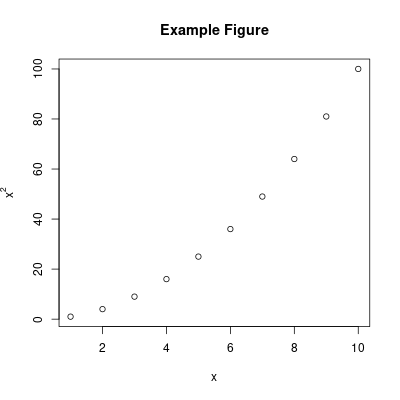
You can also generate figures with it:
[[!sweavealike  fig=1 echo=1 results="hide" code="""
plot(1:10,(1:10)^2,xlab="x",ylab=expression(x^2),main="Example Figure")
"""]]
> plot(1:10,(1:10)^2,xlab="x",ylab=expression(x^2),main="Example Figure")
The plugin itself uses the neat Statistics::R perl module to handle all of the heavy lifting. I personally plan on using this plugin to help write some more entries in my learning R series of posts that I'm beginning to work on. Hopefully I'll find and fix most of the bugs as I embark on that process so anyone else who uses the plugin won't, but feel free to e-mail me if something isn't working as it should. Finally, you shouldn't run this plugin on a publicly editable IkiWiki instance, because that would be a trivial local user exploit as R can run arbitrary code, read and write to arbitrary files, exhaust all memory, etc.

Axel Beckert: Tools for CLI Road Warriors: Tunnels

Sometime the network you re connected to is either untrusted (e.g. wireless) or castrated in some way. In both cases you want a tunnel to your trusted home base. Following I ll show you three completely different tunneling tools which may helpful while travelling. sshuttle sshuttle is a tool somewhere in between of automatic port forward and VPN. It tunnels arbitrary TCP connections and DNS through an SSH tunnel without requiring root access on the remote end of the SSH connection. So it s perfect for redirecting most of your traffic through an SSH tunnel to your favourite SSH server, e.g. to ensure your local privacy when you are online via a public, unencrypted WLAN (i.e. easy to sniff for everyone). It runs on Linux and MacOS X and only needs a Python interpreter on the remote side. Requires root access (usually via sudo) on the client side, though. It s currently available at least in Debian Unstable and Testing (Wheezy) as well as in Ubuntu since 11.04 Natty. Miredo Miredo is an free and open-source implementation of Microsoft s NAT-traversing Teredo IPv6 tunneling protocol for at least Linux, FreeBSD, NetBSD and MacOS X. Miredo includes not only a Teredo client but also a Teredo server implementation. The developer of Miredo also runs a public Miredo server, so you don t even need to install a server somewhere. If you run Debian or Ubuntu you just need to do apt-get install miredo as root and you have IPv6 connectivity. It s that easy. So it s perfect to get a dynamic IPv6 tunnel for your laptop or mobile phone independently where you are and without the need to register any IPv6 tunnel or configure the Miredo client. I usually use Miredo on my netbooks to be able to access my boxes at home (which are behind an IPv4 NAT router which is also an SixXS IPv6 tunnel endpoint) from whereever I am. iodine iodine is likely the most undermining tool in this set. It tunnels IPv4 over DNS, allowing you to make arbitrary network connections if you are on a network where nothing but DNS requests is allowed (i.e. only DNS packets reach the internet). This is often the case on wireless LANs with landing page. They redirect all web traffic to the landing page. But the network s routers try to avoid poisoning the client s DNS cache with different DNS replies as they would get after the user is logged in. So DNS packets usually pass even the local network s DNS servers unchanged, just TCP and other UDP packets are redirected until logging in. With an iodine tunnel, it is possible get a network connection to the outside on such a network anyway. On startup iodine tries to automatically find the best parameters (MTU, request type, etc.) for the current environmenent. However that may fail if any DNS server in between imposes DNS request rate limits. To be able to start such a tunnel you need to set up an iodine daemon somewhere on the internet. Choose a server which is not already a DNS server. iodine is available in many distributions, e.g. in Debian and in Ubuntu.

David Welton: I'm not good enough to work on open source software

Actually, that's not true - I've produced plenty of open source software over the years. However, in a sense, it is true: only the very best actually get paid to work on open source software full time, and I'm not one of them. People like Linus Torvalds. People like Guido van Rossum, although even he supposedly divides his time, and does not work on Python full-time. Think about that. Python is a hugely popular programming language used by many companies and individuals who get a lot of value out of it. But the creator doesn't even work on it full-time. Now, that's just one example - perhaps Guido enjoys the things that Google sends his way to work on outside of Python in any event - but I think it's representative of open source in general. Back to me: I've produced some small bits of open source code that other people find useful. Several people have even built products on Hecl that make money. But I'm not good enough to work on open source full time - I'm not one of those famous, brilliant coders who is so good that someone will find a way to pay them to work on stuff that gets given away for free. I am, however, a good enough programmer to work on people's proprietary code, and have never had too much trouble finding someone with a project they're happy to pay me for. Why is that? Because it's so much easier to funnel money back into a proprietary project. If people like the product and buy it, the company gets money, which can be used to pay the developers. With open source, millions of people might use it and get a lot of value from it, but the developer has no right to receive any of that back as cash, which he or she can use to pay for things like food and rent. So, I can code tolerably well, and I could conceivably contribute more open source code, but instead I spend my time working on proprietary code because it pays the bills. Clearly, when I can, I use open source software in these endeavors, and contribute back whenever I can, but the "secret sauce" remains closed. That's a pair of hands lost to the creation of more open source. I know I'm not alone in this, either - tons of people work on mostly proprietary projects the world over, but relatively few people get paid to work on open source code full time. So when I read about people debating the utility of copyright bring up the existence of open source as some sort of counterexample, it irritates me a bit. The right level of protection and enforcement of copyright is a complex debate that I'm not going to get into here. What I want to point out is "that which is not seen". Sure, open source exists. But how much more of it would exist it there were more money to fund work on it? How much open source software remains an idea in the developers head that does not get realized for lack of time? People often criticize the "Linux desktop" despite its extraordinary strides in recent years. Well, how much farther along would it be if there were more people paid to work on the 'boring stuff', like usability testing? Ubuntu and Redhat pay a few people to do that kind of stuff, but how many more people do Microsoft and Apple have for that kind of work? That's not to say that open source "doesn't work" or some such nonsense. It obviously works quite well, but it really shines where the currency is code, not money. Developers can and do give back lots, in terms of code, bug reports, suggestions, documentation, and so on to open source projects, which make them better for all involved. Where open source doesn't seem to work quite as well are in small, fast-moving, consumer-oriented products. My guess is that 99% of iPhone users could care less about the source code for their apps, but on the other hand, a large portion of the Emacs user base more than likely has written at least a few lines of Elisp. In any event, the point isn't to beat up on open source software, but to counter this idea that "intellectual property" is in no way shape or form necessary because the existence of open source software somehow "proves" that "things will get made just the same". Yes, maybe they will, but in lower quantities than consumers might find desirable. After all, most of us aren't good enough to work on open source software.

Brett Parker: Awesome, Gnome Power Manager and ACPI

I use awesome as my window manager, without a gnome session around it - as gnome-power-manager now depends on having a gnome-session running, I had a choice to make - I don't need or want to run a gnome-session, so I went on the hunt for a different battery monitor for my laptop. I've ended up using fdpowermon as it does just what I need and nothing more - then I edited the default acpi scripts to do what I had gnome-power-manager doing before hand, i.e. if I've unplugged the AC and I close the lid, the laptop does a s2both. Slightly more configuration, but it now does what I expect all the time (yay!). I wanted some extra keybinding from the default config of awesome in Debian, so I also created a very small rc.lua file as follows:
dofile("/etc/xdg/awesome/rc.lua")
mylayouts =  
    layouts[2],
    layouts[10],
    layouts[2],
    layouts[2],
    layouts[2],
    layouts[2],
    layouts[1],
    layouts[1],
    layouts[1]
 
for s = 1, screen.count() do
    for t = 1, 9 do
        awful.tag.setproperty(tags[s][t], "layout", mylayouts[t])
    end
end
globalkeys = awful.util.table.join(globalkeys,
    awful.key( "Control", "Mod1"  , "l", function () awful.util.spawn("/home/brettp/bin/lock-screen.sh") end)
)
root.keys(globalkeys)
This basically overrides parts of the default config and makes it so that my "tags" are vsplit for tags 1 and 3-6, maximised for tag 2 (where my browser lives) and floating for 7-9 (where the IM client sits, and I do anything involving GIMP). It does mean that I'm at the whim of the default config mostly, but as that seems to be fairly sane most of the time, that's not a problem... it also means that I'm only maintaining a small change set rather than a full rc file, and so new "features" can come in without me having to touch anything (well, other than restarting awesome...). I do need to either unmap the minimise key combo, or create an unminimise key combo that pops up a menu with the list of minimised windows in it at some point, though - because it's all too easy to press Meta4-n when you meant Meta4-m.

Pablo Lorenzzoni: GNOME 3 is like Vim.

You might know that I am testing GNOME 3. So far, so good. I was a little annoyed by the not-obvious and undocumented have-to-add-user-to-pulse-and-pulse-access procedure and the keyboard-shortcut-settings-bad-design-bug, but now sound works and my usual shortcuts are in-place I found myself liking the environment, but not sure about why I was liking it. I was always a minimalist user. At one time I convinced myself X11 (or Xorg) served as a terminal multiplexer but now, GNOME 3 is changing that with its unobstructiveness (is there such a word?). One thing that might be selling GNOME 3 to me is that it resembles Vim, my beloved text-editor and multipurpose IDE. Just think about the Overview mode as a command-mode in Vim. While working in Vim, I focus in one thing at a time, and everytime I want to do some meta thing, I Escape to the command-mode. It s just the same in GNOME 3: Overview let me do meta things and gives me the whole power of the Desktop in one screen. I am not sure I am going to keep GNOME 3 But thinking it s like Vim is a compelling argument.

Russell Coker: Links March 2012

Washington s Blog has an informative summary of recent articles about corporate psychopaths [1]. Including the fact that some banks deliberately hire psychopaths. Anu Partanen wrote an insightful article for The Atlantic about the difference between Finnish and American education systems [2]. It seems that Finland has achieved great educational success by aiming for equality with no private schools and giving the teachers and principals enough responsibility to do the job properly. Ramona Pierson gave an interesting TED talk about how she recovered from being run over by a drunk driver with the help of the residents of a senior citizens home [3]. Quyen Nguyen gave a very interesting TED talk about the use of fluorescent dyes in cancer surgery [4]. They can make cancer glow one color and nerves glow with a different color which makes it a much easier task to remove ALL the cancer without cutting the smaller nerves. James Fallows wrote an interesting article for The Atlantic about the experience of having his wife s Gmail account cracked [5]. She stored EVERYTHING in her Gmail account so this was a lot worse for her than for the typical Geek who doesn t use such accounts for storing much. James describes what the attacker did, how they did it, and what needed to be done to recover. When running a mail server it s worth considering what you would do to help a user who was attacked in that way. Charles Stross has written an interesting blog post trying to predict some future psychological and social changes [6]. Matthew Wright of Beyond Zero Emissions has written an informative article about how solar panels on home roofs save everyone money [7]. Mikko Hypponen gave an interesting TED talk about different types of online attack and how they can affect us [8]. Among other things he describes how online attacks can result in people dying. Scott Rickard gave an interesting TED talk about using maths to create SONAR pings without repitition and also the worst music ever created [9]. I found it entertaining to watch Michael Lindel (the director of chamber music for the New York Symphony) play the music, he obviously didn t enjoy that performance. Sheena Iyengar gave an interesting TED talk about the way people make choices [10]. It s useful for anyone who is going to prepare a set of options for someone else to choose from. ASD Aid is a project that uses Lego to encourage kids on the Autism Spectrum to socialise [11]. They have training manuals for using Lego in therapy. Unfortunately they have not been supported by the Lego corporation. Bilal Bomani gave an interesting and informative TED talk about NASA research into renewable aviation fuel [12]. The most interesting thing to me was the way that they were aiming for a sustainable lifecycle that didn t use resources that coule be used for food and which required minimal input once it was started. Alain de Botton gave an interesting TED talk about Atheism 2.0 [13]. He suggests that we adopt some ideas from religious organisations including lectures (sermons), celebrations, and rituals. It s interesting to think of a technology conference as a pilgrimage. Homaro Cantu and Ben Roche from Moto restaurant in Chicago gave an interesting talk about some of the unusual foods that they have produced [14]. If I visit the US again I will try and go to Chicago to eat there! Related posts:
  1. Links March 2009 Cory Doctorow has written a column for The Guardian titled...
  2. Links February 2012 Sociological Images has an interesting article about the attempts to...
  3. Links January 2012 Cops in Tennessee routinely steal cash from citizens [1]. They...

Paul Tagliamonte: Setting up uWSGI + nginx

I ve spent some time recently converting from using PHP to using Django for my web applications. As a result, I m migrating from apache2 (to be totally fair, it does have wsgi support, but I d rather re-design using the latest fad) to nginx and uWSGI. So, here s some notes to myself on setting it up again. Given
SRV="/srv/www/uwsgi"
DATA="$SRV/app/$APP"
SOCK="$SRV/sock/$APP.sock"
Invocation
exec uwsgi \
    --plugins python27 \
    --chdir   $DATA/.. \
    --socket  $SOCK \
    --chmod-socket \
    -wsgi ./$APP/django_wsgi.py
I wrote some tools to daemonize this, but I have a hunch daemontools might be better.

Richard Hartmann: Svalbard

Svalbard The things you find when cleaning out a disk; preparing for re-installation of your laptop on a larger disk once the laptop comes back from repair... I thought I had posted this in early January, but apparently not. As it would be a shame to just throw this away, here goes: I am sitting in the Oslo airport, waiting for boarding back home to start. Seeing the sun after a week of darkness still feels strange. Inital trouble It's been a very interesting week, starting with our trip to Oslo in the other direction. We spent New Year's Eve in Oslo, timing our forced overnight stay before reaching Svalbard to coincide with something interesting. The close timing of our travel meant that there was exactly one flight to Oslo we could take. Never having heard of Air Baltic before and finding out that they are a discount airline, my gut feeling told me to be be wary. I refuse to fly with those airlines on principle, not wanting to support their business model while hurting airlines with decent treatment of customers. Unfortunately, I was forced to book with them in this case. As it turns out, my gut was right. More on that below. Our plane was late in landing and my luggage was lost. As it was New Year's Eve, the staff at Oslo airport understandably wanted to be home, not at work. Still, getting them to file a report was tedious and finding out days later that the report was incomplete was, well, not good. The express train from the airport to Oslo central station had closed early without any advance notice or local signs, presumably because of NYE. The gates were simply closed and that's that. We figured out how the bus system worked, got our tickets from a vending machine, saw the one bus to central station drive away, and proceeded to wait in the outside waiting area; at least we had a front spot in the queue. While we don't get cold easily, it was funny to see Norwegians in thin clothes stand around in the biting wind, apparently being comfortable. A young mother with a baby, who didn't anticipate being forced to wait outside at -15C, as opposed to just sitting down in a train, had no warm clothes for her son; something that was fixed by wrapping him in spare clothes from Ilona's luggage. After waiting for about thirty minutes for the next bus to appear, it parked twenty or thirty meters away from the designated parking spot. The rough queue disintegrated and if not for Ilona's leaving me with luggage and backpacks and storming off to fight the masses, said mother with baby and ourselves would have waited for another thirty minutes. More than hundred people were left stranded at the airport to celebrate there or on the bus. Meh. We hurried, by taxi, from central station to hotel to harbour and arrived about five minutes to twelve. NYE itself was nice. We stood on top of the opera house and watched a rather impressive show of fireworks through the thickening mists. Norwegian fireworks pack lot more punch than German ones; you actually feel your clothes shake when they go off. Getting to Longyearbyen The flight from Troms to Longyearbyen had free in-flight Wi-Fi and flying over the edge of satellite coverage demonstrated how far we were from everywhere else rather impressively. Arriving at Longyearbyen, I fixed the lost luggage claim with the help of an extremely nice woman working at the airport. She confirmed that Air Baltic is legally required to reimburse me after an arcane system based on a virtual IMF currency to the tune of about 1.500. That may sound like a lot, but seeing as I had most of my scuba gear with me, that's not even half of what my luggage was worth. I was forced to get by New Years with what I had on my body and went shopping the next day when I could buy at least a few things. I got by with spending about 180 by going for non-fitting bargain bin clothes, wanting to reduce impact on Air Baltic. Shortly after that, my luggage arrived, unannounced. Air Baltic refused to reimburse me even though they are legally required to, again the airport staff confirmed this. But unless I sue in the country of destination, Norway, I won't see any money. Long story short: Avoid Air Baltic if possible. They will break the law to cheat you out of money when they have a reasonable expectation of getting away with it. Update: Yep, seems they got away with it unless I take legal measures. You have been warned. Longyearbyen itself was very nice. We started off with a short, guided taxi tour around the city, seeing literally everything of it as there's not a lot of Longyearbyen to start with. Dogsledding Next day, as noted earlier, we went shopping and spent the "evening" with dogsledding which turned out to be tons of fun. We helped with harnessing the dogs which is somewhat cumbersome as the dogs are so eager to burn off their energy that they want to run all over the place, not being put into a harness and snapped onto the pull-line. Never having been dogsledding before I was a bit wary, but riding over not too rough terrain is almost trivial once you get the hang of it; listen to what the musher in front of you yells and emulate the same shouts with your own dogs. If the dogs become too fast, step onto the brake pad which simply drives spikes into the snow. If the dogs slow down while going uphill, skate with one foot to help them. That's it for speed. As the dogs are following the musher's sled anyway, steering the dogs was not a concern. Fun fact: The musher used a laser pointer to steer his dogs; simple, efficient, and presumably fun. We learned, by demonstration, that sledding dogs can eat snow, take a leak, and take a dump while running at full speed and pretty much all at the same time. The dogs are left either in cages or on long chains far away from the city as they tend to bark and howl a lot. We were surprised to learn that, even when there are seals left to hang dry as dog food nearby, there are no problems with bear attacks. Apparently even the extremely aggressive and hungry one year old males will not go near dogs. Still, while out in the ice and snow, our guide carefully flooded all crevices and cliff bases to root out female bears with young ones early. They hide their children from the wind and they will attack, dogs and all, if we get too close. That's why our musher carried rifle in his sled and flare gun on his body. Snowmobile The next "morning", we drove around by snowmobile. This turned out to be extremely boring as it was a curated trip with over half a dozen snowmobiles in our group; a stark contrast to our two-sled tour the day before. The last time I went snowmobiling, we raced each other up and down a two-star black (i.e. steep, bumpy, and curvy) ski slope, jumping several meters when racing over larger bumps and crossing streets, so riding single file at 30 km/h was... anticlimatic. Again, the guide had rifle and flare gun with him. We spent the afternoon and evening walking around the city. Ice bears, part I As the ice caves and the glacier were still closed, we decided to have another walk around the city. Having planned make it a quick tour, we lost track of time due to lack of sun and ended up walking around for seven hours. A note about that trip.. If you are alone with your wife, unarmed, climbing up a very steep and slippery mountainside over a sheet of ice with deep snow underneath and loose rocks in between, and then start shining around with your flashlight under the stilts of an abandoned mine that looks like in a horror movie, the correct answer to "What are you doing?" is never ever "Looking for ice bears". Even if it's the truth, this is not an acceptable answer. I crawled up the last part on all fours, camera and tripod in hand while Ilona stayed about two dozen meters below the mines' entrance, refusing to go another step towards the mine. As soon I made it up the creaky and shaky, for a lack of a better word, let's call it ladder, she forced me to come down again. Bleh, but I guess I deserved that. Armed photographer Next day, we got final confirmation that we would not be allowed to rent snowmobiles to explore the hinterland on our own and that other for some, and I quote, "crazy Russians", no one would even attempt to cross over to Barentsburg. Thus, we ended up renting a car for the ~20 kilometers of total road length. That turned out to be a great idea as it allowed us to get away from the light and take some very nice long exposures. It was then that I got a rental rifle, as well. There is a law against leaving the town unarmed and I was not about to test my luck too much. Turns out that, as part of Germany's WWII reparations, Norway received our all hand guns and as they still function perfectly when dirty and in cold climate which makes them still popular in Svalbard, today. The Karabiner 98 Kurz which I received is built incredibly well. It's somewhat scary inasmuch every detail is designed to make this weapon ready to fire. If you hurry or are inexperienced, you will end up with an unlocked and loaded rifle after putting in the bolt. Putting the safety in and not chambering a bullet takes conscious effort and knowledge of the weapon. This is in stark contrast to other weapons I had the chance to dissect, which all defaulted to being safe. Even other military weapons such as the AK74 and the M4A1 are inherently more secure, designed to be locked and safe. The Mauser K98... not so much. As an aside, they didn't bother to remove the Reichsadler and Swastika from the rifle, contending themselves with striking out the German registration number and stamping the rifle with a Norwegian one. I guess Norwegians don't really "care" about these signs as much as we Germans do. In a way, that's a good thing I guess, at least as long as it's an indication of indifference towards the sign, not one of forgetting or ignoring the underlying issues. Still, I was very glad to have rented the rifle. While Ilona tended to stay in the running car with heat and lights on, I went out and away from the car. Even when standing near a street, a medium snow storm will make you appreciate the four powerful arguments against being eaten by a random bear which are at the ready over your shoulder. We even went to the shooting range so I could get some practice. The procedure is very trusting, as is anything in Longyearbyen. After accessing the interior of one of the houses in a particular way which I won't specify here, you simply switch on the floodlights, put up the red flag, position a target and write your name into the guest book. Once you're done shooting, toss a few coins into the bowl next to the guest book, remove the targets and flag, turn off the lights, close the door and that's that. Unfortunately, the way in was under a few meters of snow so I couldn't get in any practice shots. Ice bears, part II Later, as I was standing on a wind-polished slate of ice taking pictures of the Seed Vault (located here), I heard an ice bear roar behind (i.e. to the north of) me. I consciously remember hearing the bear, I consciously remember facing the other way around, half-crouched, rifle raised in the direction of the roar. I also consciously remember smacking the safety off and chambering a bullet after having regained control of my body. I do not remember spinning around on a wind-polished slate of ice, so treacherous I hand to balance with my arms and didn't even lift my feet when walking over it, without losing balance or footing, nor do I remember crouching and raising the gun. Evolution really is amazing; no matter what primal chord that roar struck, it certainly saved a ton of people over the years. In my case, thankfully, there was no bear to be seen down the slope. There may be no sun or anything, but the snow reflects the starlight so you tend to see surprisingly far and as I was on on the mountainside and the roar came from down from the coast, and as I had my rifle, I decided to finish the photo session while keeping the slope in close view. In hindsight, I am still glad I decided to do that as the shots came out rather nice. Next day, we drove out to Mine 12, the farthest you can away from Longyearbyen. The dump truck transporting coal alternated between driving a full load of coal back to the city and being its own snowplow. One quick trip to get coal, one slow and empty trip to plow away snow, rinse, repeat. If not for that, our 4WD would never have made it all the way up to the mine. Neither snow storms in North America nor around the Alps prepared me for what people on Longyearbyen consider normal wind in their backyard. This is where the word wind-swept was invented. The main reason that Svalbard is inhabited at all, other than the Gulf Stream, is coal. We have been told that the coal up there is of extremely high quality and while I can't say much about that, I can say that it's hard as stone. This is nice as it does not smear when you get coal all over yourself. Just shake out your jacket and pants and you are good as new. On our way back, we met two locals who had just prepared the glacier and ice caves for tourists. Had I known that in advance, I would have tried to go with them to take pictures completely away from all artificial light. Oh well, can't have everything. Speaking of not being able to have everything, the outdoor hot tub in our hotel which integrated ice bar and BBQ grill was still under several meters of snow so we couldn't use that, either. Finally, the few divers who are in Longyearbyen didn't have time to take me onto a trip while I was there. As I already missed my opportunity to dive the Arctic circle when the one diver on Gr msey happened to be on the mainland and barely missing it by diving Str tan instead, this was kind of a bummer. On the plus side, this has given me a goal to pursue and achieve. Random notes For the rest of my notes, I will resort to a largely unsorted list of bullet points as there's just too much to talk about in prose. All in all, it was well worth it. PS: If you know anyone working with Google Maps, ask them to consider improving their coverage of the Arctic. This is a real pity. As is the rest of the Arctic and the fact that Google Earth cheats you out of the North and South Pole by stretching adjacent tiles into and over them.

Richard Hartmann: Lenovo service quality

As there has been a lot of feedback to my post regarding Lenovo's hardware quality, I thought it would only be fair to follow this up now that my laptop returned from Lenovo. After waiting about 15 minutes on the phone, I got to speak to an actual human. While I really do not have a problem with foreigners and love to talk to people from other cultures, I do firmly believe that someone working in a telephone support position should have at least basic language skills, both spoken and written. This was not the case and communicating my issues, and making sure that they would be written down correctly, took a long time and was generally frustrating. I put four things into the returns package: In said letter, I specified all my issues with the laptop, how removing the UMTS card will improve, but not fix the situation, and that the power brick will deliver power for a split second and then go off for a second; rinse repeat. Not having heard from them for a week, I decided to follow up on the status. As Lenovo's web interface claimed my ticket number did not exist, I spent a total of 1 hour 47 minutes in the waiting loop, not counting the menu selections. I never even managed to even reach a human. The day before I left for Open Source Days, the laptop arrived. The ticket number still did not exist according to the web interface and they never sent email even though they had my address, but at least my issue was fixed. Or so I thought. The repair slip claimed they switched out the mainboard, a claim I can not prove/disprove. It's OK not to find a bug in the first try, especially when it's not as simple as "display cracked". It's not quite as OK to not properly test a machine before sending it back. It's definitely not OK to not care in the least and just send back a machine which you obviously did not even try to debug. How they could not replace the power brick is beyond me. Thankfully, I ordered three separate ones and that was just my on-desk one so I have two others. Still. Overall, I am not impressed.

21 March 2012

Craig Small: Back Online

I d have to say (in fact I often do) that Telstra sucks. This is the very large anonymous telco that supposedly provides a telecommunications service. Alternatively they also force me to have a phone line because it is far cheaper to buy a line and phone service instead of just a line. My website, email and pretty much everything else has been offline for almost exactly 2 days and this being the third time in 8 days it has happened. The service interruption impacts at least a large chunk if not all of the suburb I live in so you d think the second time they d look into it more, but apparently not. They don t even have technical staff oncall on Sundays either apparently. The weird thing about when I called up was they didn t know about the fault. If it was a single line that would be fine but a large bit of an exchange go and they don t know about it? It seems a little too casual to me as it wouldn t be that difficult to have some sort of alarming. I just hope that perhaps someone knew but their call centre doesn t get that information pushed down to it. I have a few sponsored debian packages that now need working on and uploading so that s what I ll be getting into once I get some more time. procps is almost ready as well with the final minor patches to be integrated.

Next.

Previous.