Search Results: "ag"

27 March 2012

Wouter Verhelst: Bjorn Monnens on Debian

If this were twitter (and if I had a twitter account, which I don't), this post would start with "RT". As it is, you'll have to make do with this link: Bjorn Monnens on why he chose Debian testing over Fedora.
This weekend I switched again to Debian 6 testing as this is also Gnome 3. I had to do the same stuff as for Fedora but I noticed already that it s much more stable and it is also much faster than Fedora. Boot is really a difference of +30 seconds.
Go team! (with apologies to those who read this blog through Planet Grep, as Bjorn is there too)

Richard Hartmann: subtle bugs

This one confused me for a moment; iperf did not do what I wanted it to do. Quoth the manpage:
CLIENT SPECIFIC OPTIONS
       -d, --dualtest
              Do a bidirectional test simultaneously

Doeth the program:
host1:~% iperf -dc host2
WARNING: option -d is not valid for server mode
------------------------------------------------------------
Client connecting to host2, TCP port 5001
TCP window size: 16.0 KByte (default)
------------------------------------------------------------
[  3] local host1 port 42220 connected with host2 port 5001
[ ID] Interval       Transfer     Bandwidth
[  3]  0.0-10.0 sec    376 MBytes    315 Mbits/sec
host1:~% iperf -c host2 -d
------------------------------------------------------------
Server listening on TCP port 5001
TCP window size: 85.3 KByte (default)
------------------------------------------------------------
------------------------------------------------------------
Client connecting to host2, TCP port 5001
TCP window size: 63.1 KByte (default)
------------------------------------------------------------
[  5] local host1 port 42221 connected with host2 port 5001
[  4] local host1 port 5001 connected with host2 port 57550
[ ID] Interval       Transfer     Bandwidth
[  5]  0.0-10.0 sec  98.7 MBytes  82.8 Mbits/sec
[  4]  0.0-10.0 sec    978 MBytes    817 Mbits/sec
host1:~% 

Ignoring the transfer rates, I invite you to spot the premature,misguided optimization. This is quite subtle and probably non-obvious during implementation. The moral of the story is to collect all data before starting to evaluate it, at least if full information is needed for correct processing. Before anyone points out the obvious, yes I filed a bug.

Timo Jyrinki: On brands, marketing and technical details

I have a few thoughts based on the yet another round of debate where marketing clashes with free software advocation and technical details. Nothing new in the debate itself, but I'm adding a couple of insights.

Marketing is not highly respected by many technical people, and neither by the people wanting more advocating than the messing up with facts and feelings that the marketing does. I'm all for advocating free software, but it's currently not something you can use for marketing to win big markets. If we advance to a world where free software is as wanted as the green values today are, it can be used in marketing as well similar to all the ecological (according to the market department at least) products today, but alas the benefits of free software are not yet as universally known. Since it doesn't say much that touches the masses, advocating has a negative marketing effect since it takes space away from the potentially "hitting" marketing moves, in those cases where you target the big masses in the first place. "Open" this and that has some marketing power in it nowadays, but it's a mess of different meanings that probably doesn't advance libre software freedoms as such. Wikipedia has probably been the biggest contributor to advancing general knowledge of software and culture libre. Disclaimer: I'm not a proper marketing person, some more professional might have better insights in this area. If I'd be a proper marketing person, I'd decorate this blog post with fancy pictures so that more people would actually read it.

Some of the marketing can be done without sacrificing any of the advocation. The fabulous Fedora campaigns, graphics, slogans and materials are a great example of those and do an important job, even though Fedora isn't reaching the big masses with it (and Fedora isn't targeted for OEMs to ship to millions either). But they do hopefully reach a lot of level people on the grassroots level. I hope as a Debian Developer that more people valuing the freedoms of free software would help also Debian as a project to reach more of its advocation potential and developers from the more proprietary world. But I'm happy that at least some free software projects have nowadays true graphical and marketing talent. Even though not as widely known, freedoms of the software users including for example privacy aspects are a potential good marketing tool toward a portion of the developer pool.

Let's not forget that Android conquered the mobile market without using the brand power of Linux. The 30+ million people who know Linux a bit deeper than just "I've heard it" already run a Linux distribution like Ubuntu, but we need hotter brands than a project name of a kernel to reach the bigger masses. Call it Ubuntu, Fedora, or something, but no matter do what it needs to ship it to millions. AFAIK mostly Ubuntu and SUSE are shipping currently via desktop/notebook OEMs, and more Ubuntu than SUSE. Others aren't concentrating on the market, which is a very difficult one. Ubuntu is doing a lot more mass population advocating for free software than Android has ever done. Note for example the time any user tries to play a video for the first time in a non-free format - Ubuntu will tell the user about the problems related to those formats and asking a permission to install a free software player for those (or buy licensed codecs), and the Ubuntu Help texts describe a lot of details about restricted formats, DRM et cetera. Not to mention what happens if the person actually wanders into the community, discovering Debian, other free software projects, free software licenses and so on. Meanwhile Android users never notice anything being wrong while watching H.264 videos or watching DRM Flash videos. Granted, like Boot2Gecko debate shows, it may be a partially similar situation on shipping desktop Linux variants as well, in order to actually ship them via partners.

Anyway, the best example of brands is MeeGo. Even the LWN editor does not get into dissecting the meaning of MeeGo on Nokia N9, because "there has been no real agreement on that in the past", but just uses the brand name as is. That is the power of brands. Technical people debate that it's not really MeeGo, it's maemo GNU/Linux with a special permission from Linux Foundation to use the MeeGo brand name, and then counter-argument with that the MeeGo is an API and maemo matches the MeeGo 1.2 API which is actually just Qt 4.7 API. And actually, as proven by the LWN example, it's not even "technical people". For most of technical people Nokia N9 is MeeGo as well. Only the people who have actually worked on it plus the couple of other people migrated from maemo and MeeGo.com communities to Mer project understand the legacy, history and the complete difference between the Maemo Harmattan platform and what MeeGo.com was. Yet at the same time like all GNU/FreeDesktop.org/Linux distributions, they are 95% same code, just all the infrastructure and packaging and polishing and history is different.

For 99.9% of people who know what MeeGo is, MeeGo is the cool Nokia smartphone, one of its kind and not sold in some of the major western markets, and/or the colorful sweet characters of meego.com shown at one time on a couple of netbooks. That is the brand, and the technical details do not matter even to the technical people unless they actually get into working on the projects directly.

To most people, the Linux brand is a mess of a lot of things, while other brands have the possibility at least to have a more differentiating and unique appearance.

Anand Kumria: An apology.

And a personal reboot. <article> All my life, so far, I've always prided myself on not having any regrets. I've told people that if I had to live my life over again, I would not change how I had acted or anything I had done. Over the last few days I've come to regret my actions. They have caused me to hurt a dear friend and, then, ultimately lose them. It all stems with not being honest. To my friend. And to myself. By not telling myself the truth about how I feel, or what I want, it has meant I have not told others the truth either. They have then acted on what I said, and when I've changed my tune or wanted more (or less), they are rightly upset. I wish I could say that this was a new thing. Like some kind of habit I picked up because it was shiny. Unfortunately as I review my life, and the various people who have come into and out of it, I can see that my inability to be truthful has been mostly constant. To be unable to articulate my needs has caused various amounts of pain to others. Sometimes that pain has come back to me, as with my friend, magnified. Other times I have escaped it. This is a personal apology from me to all that I've hurt. Some of those people are (now) deceased. Some of them no longer talk to me / interact with me at all. For what it is worth. Sorry. For those of you who are still with me, on this journey, thank you for putting up with how I have been in the past. The journey is not over but I hope the rest of it will be more truthful and, ultimately, less hurtful. Anand </article>

Diego Escalante Urrelo: All the new cool stuff in Epiphany, alias, Web

Today we released Epiphany 3.4. It includes all the fixes, enhancements and new cool features that we build since September 2011. That is 6 months of cool stuff! Xan already explained the bigger picture but I want to highlight some details in the spirit of Every Detail Matters. Improved location bar, and the new history backend The location bar suggestions now load extra-extra-fast, thanks to our new SQLite backend. Besides being extra fast, SQLite allows us to make complex queries to offer better results in the completion. Goal for 3.6: to successfully handle searches like that page, with the dog, you know, that one with the funny one . This also makes possible to have a cool Overview start page for 3.6. Much like Chrome or Opera do. An awesome UI: cleaner toolbar, loading progress That is all the chrome you are getting, kid! Less distractions, more web! All the usual tools are still available in the gear menu: Oh, and this other one is a pretty one. Check out the new load progress indicator: You might have already noticed the combined stop/reload button. Some other niceties like the new link tooltips are all over the place. I will not ruin the surprise :-) . Reliable download icons This is my friend Juanjo:
He is always happy. One day he said: Diego, my PDF documents are shown as boxes while downloading. It makes me mad! I want Juanjo to keep that happy hacker smile. So I decided to fix this. Downloads now have a better idea of the icon they should show: Page icons, now a WebKitGTK+ feature Do you notice something? Yeah, icons for every of the loaded pages. The support for this is now in WebKitGTK+, available to other applications. This means it is better supported and maintained! Redesigned about: pages For a time now we have had some geeky about: pages. One for memory (about:memory), one for plugins (about:plugins), and perhaps the most useful one, one to manage applications (about:applications): And, last but not least Less lines:
$ git diff --shortstat 3.2.0..3.4.0
328 files changed, 73211 insertions(+), 104528 deletions(-)
Unlike other browsers, Epiphany does not have dozens of engineers behind the project. This means that the more code we have to maintain, the less time we have to develop new features and to even maintain that code! Also, this makes Xan happy. But luckily Igalia has hackers like Martin Robinson who are willing to show us how hacking should be done: Epiphany 3.4.0, alias, Web. Is an awesome release. It will soon be in your distro of choice. Thanks Allan for the screenshot help!

Christian Perrier: 2012 update 17 for Debian Installer localization

Status for D-I level 1 (core D-I files): Status for D-I level 2 (packages that have localized material that may appear during default installs, such as iso-codes, tasksel, etc.): Status for D-I level 3 (packages that have localized material that may appear during non-default installs, such as win32-loader) Full 100% completeness (hall of fame) for 18 languages: Belarusian, Bulgarian, Catalan, Czech, German, French, Indonesian, Italian, Japanese, Kazakh, Dutch, Polish, Portuguese, Russian, Slovak, Swedish, Turkish, Simplified Chinese

26 March 2012

Meike Reichle: To those who wondered ...

why I ... The answer is this little lady, who has been turning our priorities (and daily/sleep routine) upside-down for the last weeks and made us incredibly happy ... and equally unresponsive. a baby in a carry-sling Please bear with us, we won't be off the face of the earth forever. :)

Vincent Sanders: NetSurf Developer Workshop

NetSurf DevelopersOver the weekend we held the NetSurf developer workshop. The event was kindly hosted by Collabora at their Cambridge offices. The provided facilities were agreed to be excellent and contributed to the success of the event.

Five developers managed to attend from around the UK John-Mark Bell, Vincent Sanders, Michael Drake, Daniel Silverstone and Rob Kendrick. In addition James Shaw, one of the project founders, made a special appearance on Saturday.

Starting from Friday afternoon we each put in over 25 hours of actual useful work and made almost 170 commits changing over 350 files, added 10,000 new lines of code and altered another 18,000.

The main aim of the event was to make the transition from using libxml2 to our own libdom library for the browser DOM tree. This was done to improve the browsers performance and size when manipulating the DOM but also gives us the ability to extend the browsers features to include dynamic rendering and Javascript

We also took the opportunity to discuss and plan other issues including:
  • User interface message handling and translation.
  • User preference handling.
  • Toolchain support.
  • Disc caching.
  • Javascript binding
  • Electronic book content handler.
Rob tackled the first parts of the messages conversion from numerous separate files into a single easy to handle file which will in future allow for easier translation and reduce message proliferation.

We made decisions on the ongoing rework of user preference handling which will be implemented in future.

The decision on the toolchain was slightly changed to be that any core or library code (non frontend/toolkit specific parts) are required to conform to the C99 standard. Frontends are permitted to recommend and use whatever tools their maintainer selects but they cannot enforce those restrictions on core code. This issue is principly because the BeOS maintainer is compiling NetSurf with g++ 2.95 which is missing several important language features we wish to use.

Developers at workThe recurring issue of disc caching was raised again and we have come up with what we hope is a reasonably elegant solution to be implemented over the forthcoming months.

Now there is a suitable DOM to bind against, the existing Javascript engine support will be properly integrated and should result in basic script support before the 3.0 release. This support will remain a build time option so NetSurf can continue to be used on platforms where the interpreter is too resource intensive to be used.

A short discussion about the possibility of integrating a basic page based content handler for epub and mobi type documents was discussed and while the idea was well received no decisions on implementation were made.

Overall the event was a resounding success and we are left with only a small handful of regressions which appear straightforward to solve. We also have a clear set of decisions on what we need to do to improve the browser.

Michal &#268;iha&#345;: phpMyAdmin translations status

phpMyAdmin 3.5 should be released on April 7, 2012, so let's again look at translations status. Here comes sixth round of translation status update. Since last update we have two more translations summing up to 11 translations at 100%: There are few which are really close to 100% and I hope they will get there soon: As you can see, there is still lot of languages missing, this might be your opportunity to contribute to phpMyAdmin. Also you are welcome to translate phpMyAdmin 3.5 using translation server.

Filed under: English Phpmyadmin 0 comments Flattr this!

Christian Perrier: 2012 update 16 for Debian Installer localization

Looks like things are pretty much stalled now. Should I conclude that we have "only" 33 active translators while we have close to 70 supported languages? Sad. Isn't it? Status for D-I level 1 (core D-I files): Status for D-I level 2 (packages that have localized material that may appear during default installs, such as iso-codes, tasksel, etc.): Status for D-I level 3 (packages that have localized material that may appear during non-default installs, such as win32-loader) Full 100% completeness (hall of fame) for 17 languages: Belarusian, Bulgarian, Catalan, Czech, German, French, Indonesian, Italian, Japanese, Kazakh, Dutch, Polish, Portuguese, Russian, Slovak, Swedish, Turkish

25 March 2012

Steve Kemp: So I have a new camera. Again.

Until recently I've had a Canon EOS 1000D, my starter-camera, and a Canon EOS 40D which is my real-camera. The 40D is older, but it probably counts as a "semi-pro" body, albeit an old mid-range one. From an image size point of view there isn't too much to tell them apart - both produce 10MP images. But from a hardware and ease of use sense the 40D has several key features which made it a compelling upgrade: Anyway both these cameras have been my friends for the past year or two, although I did buy a toy camera for those times when I didn't want to carry the DLSR around. I've made sure I only bought "posh" lens, including the fabulous and horrifically expensive 70-200 f/2.8 MK 2 lens (Just short of 2000) and I'd been wanting to use those on a full-frame camera. Now it is upgrade time once more and I've just bought the EOS 5D MK II - a full-frame camera which means I don't have to worry about crop-factors any more. So far I've only had it a couple of days but I'm in love. The output images are 21MP so I get far fewer to a (CF) card. But the detail is sublime. Future portraits and photos of people will be wonderful - although I hope they already are to a large degree! This upgrade was a hard choice. The 5D is a full-frame, but a little slow. (Faster than my 40D by a hairs-bredth) The alternative would have been a 7D which is fast, and wonderful, but still uses a cropped sensor. Given that I have fast lenses and don't do sports (often) the 5D seemed like the sanest approach. For my reference - my Canon serial numbers:
EOS 1000D1780312242
EOS 40D1230734041
EOS 5D MK II4131916951
ObQuote: "Courage is only required when facing that which you fear. " -Stargate: The Ark Of Truth

Gregor Herrmann: RC bugs 2012/12

thanks to lucas' last archive rebuild, this week offered some new & easy additional RC bugs :) here's the list:

Mike Hommey: Announcing vmfs-tools version 0.2.5

The last release of vmfs-tools (0.2.1) was almost 2 years ago. It was about time to bring some of the changes that have been available in the git repository in an official tarball. So here it is. It brings some limited VMFS 5 support and experimental extent removal, as well as some deep changes to the debugvmfs tool and various fixes. Next release (0.2.6) will have a fixed fsck, which, while it still won t fix file system inconsistencies, should at least report actual inconsistencies (which is far from being true currently). I won t give any estimation as to when this will happen, though.

Petter Reinholdtsen: Debian Edu screencast: Checking email with kmail using Kerberos authentication

The same Debian Edu developer that did the last screen cast I published, Wolfgang Schweer, has created a new screen cast showing how to set up Kmail in Debian Edu Squeze to authenticate using Kerberos, allowing users to check their local email account without providing any password. The video is embedded here in quarter size, and also available from vimeo and download as a Ogg Theora file. Check it out below. <video controls="controls" height="184" id="kmail-kerberos-movie" preload="preload" width="256"> <source src="http://ftp.skolelinux.org/skolelinux/press/screencasts/2012-03-14-Debian-Edu_Configure_Kmail_for_internal_usage.ogv" type="video/ogg; codecs="theora, vorbis""> Download video as Ogg. </video>

Christian Perrier: [life] [running] Ecotrail: done!

Everything is here. Indeed not: one can't write about the feeling you get when climbing the Old Lady stairs after 78 kilometers suffering in the woods. I was close to resigning at km55 when cramps were showing up and my left ankle (which I twisted a week before) was nothing but a big ball of pain. And I finally managed to put the head lamp and resume running in the now desert woods of western Paris. Given the probably very high rate of resigns in this race (cause by an unusual heat), this is already a great result. Now...recovering....and looking forward to the next goal: Caen marathon in early June.

Y Giridhar Appaji Nag: Moving to 4096 bit RSA GPG key AA544AA1

This is an annoucement that I am moving to my 4096 bit RSA GPG key AA544AA1, henceforth please try and use this.

I created and have (sparingly) been using this key ever since SHA1 was found to be weak, and larger RSA keys and stronger signatures began to be the norm. There weren't many signatures on the key and the WOT was not strong but it looks good now. The older key in the Debian keyring (1D389887) has also been replaced with the new key and I will revoke it when the number of signatures on the new key crosses those on the old key (that might be in an year or two, I suppose).

Fingerprint information:

Current key:

pub 1024D/1D389887 2006-04-08
Key fingerprint = 5B6B F223 B769 63E9 E2CB 0A3F E1EB BEA5 1D38 9887
uid Y Giridhar Appaji Nag <giridhar@appaji.net>
sub 2048g/73EAF0B5 2006-04-08
sub 2048R/DBBECADC 2009-04-04


New 4096R key:

pub 4096R/AA544AA1 2009-05-22
Key fingerprint = BF81 3A99 E07C D0F8 653D 9666 A8D2 CD13 AA54 4AA1
uid Y Giridhar Appaji Nag <giridhar@appaji.net>
sub 4096R/843A5776 2009-08-08

24 March 2012

Richard Hartmann: podcasts that don't suck

Funny, I had planned to use the same name for quite some time.. Good English German

Jon Dowland: qtscrob

This week I uploaded QTScrobbler to Debian. If you have a music player running Rockbox, you can configure it to write a log of what you have listened to, and when, to a .scrobbler.log file in the root of your player's file system. QTScrobbler takes such a log file and submits the contents to the last.fm audio-scrobbler website. It then deletes the log file from the player. If that sounds useful to you, give it a go!

Dirk Eddelbuettel: Initial release 0.1.0 of package RcppSMC

Hm, I realized that I announced this on Google+ (via Rcpp) as well as on Twitter, on the r-packages list, wrote a new and simple web page for it, but had not put it on my blog. So here is some catching up. Sequential Monte Carlo / Particle Filter is a (to quote the Wikipedia page I just linked to) sophisticated model estimation technique based on simulation. They are related to both Kalman Filters, and Markov Chain Monte Carlo methods. Adam Johansen has a rather nice set of C++ classes documentated in his 2009 paper in the Journal of Statistical Software (JSS). I started to play with these classes and realized that, once again, this would make perfect sense in an R extension built with the Rcpp package by Romain and myself (and in JSS too). So I put a first prototype onto R-Forge and emailed Adam who, to my pleasant surprise, was quite interested. And a couple of emails, and commits later, we are happy to present a very first release 0.1.0. I wrote a few words on a RcppSMC page on my website where you can find a few more details. But in short, we already have example functions demonstrating the backend classes by reproducing examples from
Johansen (2009)
and his example 5.1 via pfLineartBS() for a linear bootstrap example;
Doucet, Briers and Senecal (2006)
and their (optimal) block-sampling particle filter for a linear Gaussian model (serving as an illustration as the setup does of course have an analytical solution) via the function blockpfGaussianOpt()
Gordon, Salmond and Smith (1993)
and their ubiqitous nonlinear state space model via the function pfNonlinBS().
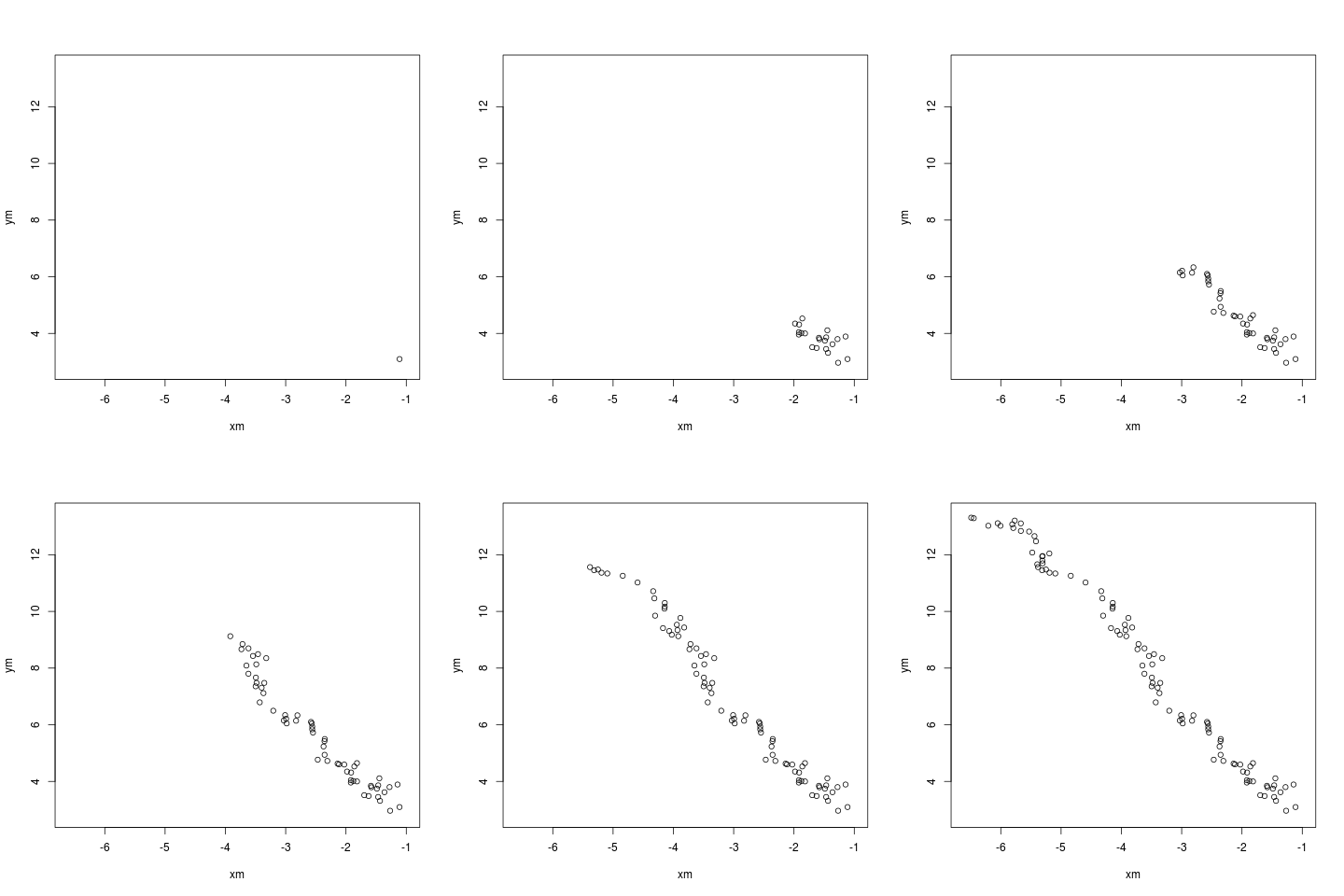
And to illustrate just why Rcpp is so cool for this, here is a little animation of a callback from the C++ code when doing the filtering on Adam's example 5.1. By passing a simple plotting function, written in R, to the C++ code, we can get a plot updated on every iteration. Here I cheated a little and used our old plot function with fixed ranges, the package now uses a more general function: Example of RcppSMC callback to R plot when estimation example 5.1 from Johansen (2009) The animation is of course due to ImageMagick glueing one hundred files into a single animated gif. More information about RcppSMC is on its page, and we intend to add more examples and extensions over time.

Paul Tagliamonte: Software that doesn't suck volume 1

As many of you know, I m highly critical of most software. Anyone that s met me in person has most likely heard my all-too-common tirades on why software makes my life worse. I figured, since I m so hard, and I ve recently found some software I feel good about using, I d start another one of my ongoing series on software I don t hate, or rather, software I might actually say I like. Out of nothing but pure luck (the author followed me on twitter, so I ended up checking out his profile, finding some stuff I liked, and checked out his github), I came across Github Notifier, which works on Chrome, Firefox and Opera. This plugin shows the octocat on the toolbar, with a count of the unread GitHub notifications. Octocat 1 The GitHub API (both V2 and V3) don t have support for getting notification counts, so this plugin / extension works by scraping the notification page. I feel OK about this because the code is pretty minimal and clean. Here s it in use (on my machine) Octocat 2 Thanks, @sindresorhus!

Next.

Previous.