Search Results: "will"

9 February 2008

Gerfried Fuchs: My Efforts in Debian

... are still there, even if I don't blog about every single bit all the time. Most of the packages I care about are in good state, I even did jump on board of irssi co-maintaining and got its bugcount down a fair bit (though I won't rest at this stage, there are still some to go) and did jump onboard of the pkg-games Team. ... which brings me to wesnoth. For quite a while I am tracking the stable releases (1.2.x) of wesnoth in unstable while the development releases (1.3.x) are followed in experimental. With the upcoming stable release 1.4 this though will change. The development branch is feature frozen and thus will be (propably) compatible with the next stable release, and furthermore the current stable release isn't expected to receive any further update. My plan is thus to upload the next development release directly to unstable. If you want to give it some additional testing before that happens pull the package from experimental now and give your feedback, thanks. Furthermore I am also tracking some packages for backports.org. I usually do the packaging of it almost synchronous to its upload into unstable although it is only allowed onto backports.org when it entered testing. For the timegap in between you can usually find it on my website repository. Directories that aren't empty there have some upload to backports pending and you can feel free to test the packages and send me feedback on them. Currently this includes bacula, slony1 and postgresql-8.3. One last note, finally it happened: apache1 isn't anymore. There were two packages left in testing until recently which got their removal requests adjusted. Thanks to everyone involved in keeping track of this and helping cleaning up the archive.

8 February 2008

Jeff Bailey: Osteopaths in the USA

In Montreal, I discovered the joy of visiting Osteopaths. An Osteopath managed to cure Leif's colic and let us sleep, and unlike a chiropractor, a treatment from Martine at Santenergie on the plateau of Montreal (shameless plug) would actually stay in effect for more than 20 minutes (Sometimes for weeks at a time).

Coming to the US, however, means learning a whole new variety of Osteo. Osteopathy was written into law early on, and has grown up as a full alternative to medical doctors - including the ability to prescribe medication. In practice what happens is that Osteopaths wind up in family practice as just another variant of MDs. The amount of "Osteopath" training that they've had compared to an MD turns out not to be that big anyway.

All hope isn't actually lost, though. There are two groups in the US, the American Academy of Osteopathy (Members recognised by the letters FAAO after their names), an the American Osteopathic Assocation (, AOA). Physicians can be fellowshipped into one or the other of these groups and they have different philosophies.

So there are three types of Osteopaths here:

1) Regular doctors (For all that it matters for the patients coming in)

2) Regular doctors who will practice some forms of Osteopathic Manipulative Medicine, but may not perform all techniques, and whom are more likely to be involved in "Integrative medicine" - helping find overall wholistic solutions to problems that might include manipulation, but might include other naturopathic solutions.

3) Osteopaths who specialise in manipulative medicine.

The downside to #3 is that these are people who've taken full medical degrees, and then had to further it with what an Osteopath would take at home. They're expensive, often don't accept any form of medical insurance, and are generally part of private practices.

With some back troubles I've been having recently, I managed to find a doctor in the #2 category who explained to me how this all works (followed by us figuring out that there's more to it than he can fix. But that's another story for later). He very kindly wrote it out for me on a napkin, so I'm copying it here before I blow my nose it in by accident. =)

MJ Ray: GP Costa degli Etruschi

RAI Sport Sat (free-to-air 13e) have highlights of GP Costa degli Etruschi at 18:00-18:30 CET today (Saturday 9th). The CyclingNews start list (beware, results will appear higher up on that page) suggests it’s the first time for most of us to see some of the big names on TV this season, including a fairly strong Milram squad supporting Alessandro Petacchi, who’s looking for his fourth win in a row at this event.

Frans Pop: Crossing an apt proxy with a mirror

Earlier today I watched the presentation Jonathan Oxer's gave during LCA about Package caching solutions. Although it was certainly an interesting presentation and although I very much agree that my current local mirror is wasting a lot of diskspace and bandwidth, I'm still not going to switch from debmirror to any of the available caching solutions, because (unless I'm really missing something) none of them scratches my itch. My local mirror currently consists of five architectures (i386, amd64, hppa, sparc and s390) and only has unstable and testing. I use it for:
  1. (fast and convenient) updating of my systems
  2. doing Debian Installer builds and installation tests
  3. test builds of installation CDs (using debian-cd)
Now, the last one is somewhat hard (debian-cd uses hardlinks to packages on a local mirror instead of retrieving packages), so let's concentrate on the first two. Caching is great if you have a large number of machines – of the same architecture and that are all likely to need roughly the same packages – sitting behind the proxy: the first one triggers the download of the package and the rest gets it almost instantaneously. It is a lot less great if you have only one, maybe two systems per architecture: most of the time you'll still end up going down that (relatively) slow ADSL connection. An important reason why I have my mirror is so that when I do my daily updates for sid or run an installation test, the packages are already available locally. I really don't want to double or even treble the time needed for installation tests just because some required packages aren't yet available locally and need to be downloaded over that slow line. So, I have my partial mirror. Somewhat tuned (I exclude some ridiculously large debug packages for example, saving about 10GB), but still with a lot of junk^Wpackages on it I'll never ever use, especially for hppa, sparc and s390 as those systems only have fairly basic installations. Getting rid of that would significantly reduce my daily sync and allow me, for example, to also have a mirror of stable and oldstable, keep old versions of packages and probably still save a lot of diskspace. Wishlist What we should have is a hybrid solution: a program that will present itself as a proxy to clients, but is smart enough to pre-fetch new packages that are likely to be needed in a sync run, based on usage date from the the proxy and configuration settings. Some ideas for features/configuration options it could have: Possibly such an implementation could even be used on some of the lower tier Debian mirrors. Unfortunately, unlike some of my esteemed colleagues, I'm not able to just whip up something like this, so I'm condemned to wait and see if there's someone else who'd like to pick up this idea. I am of course more than willing to help develop this idea further and to test it. Now, if I've totally failed in my research and something like this already exists, a pointer in the right direction would be much appreciated.

William Pitcock: Thoughts on srcinst

As eddyp wrote on Planet Debian, there is indeed a tool to roll custom builds of source packages. However, as he also mentioned, it’s written in Haskell, and may be unmaintained. One of the most commonly heard complaints I have received about Debian (and Ubuntu) is that it does not allow for easily rebuilding source packages. So, I’m going to start writing a new debian package builder for this purpose soon. It’ll probably be a package similar to pbuilder, except aimed at end users instead of developers. Here’s my plan of action: Phase 1: Phase 2: Thoughts: Anyway, that’s just a project I have planned on the side over the next few months.

Gunnar Wolf: cat STDERR rot13

Cannot help but laugh and share.
I've been triaging and trying to reproduce some oldish bugs on pkg-perl's packages. Some bugs are no longer there, some have to be forwarded upstream, and so on. Usual tasks, yes.
Until I stumbled with #406227. I just have to laugh and share! Hope nobody feels ashamed - The bug is the result of different people coding maybe under pressure and with quite different mindsets :)
For some reason I fail to understand, the submitter's test case (rot13 implemented over a HTTP proxy) is invoked in the report as ./rot13 2>/dev/null. Of course, when trying to debug a bug report, the first thing to do is not to ignore STDERR. So, off goes the 2>/dev/null. What happens next? 0 gwolf@mosca[2]/tmp$ perl ./rot13 &
[1] 4394
0 gwolf@mosca[3]/tmp$ GET -p http://localhost:8080/ http://www.debian.org/
Can't locate object method "filter" via package "UGGC::Cebkl::ObqlSvygre::fvzcyr=UNFU(0k604160)" (perhaps you forgot to load "UGGC::Cebkl::ObqlSvygre::fvzcyr=UNFU(0k604160)"?) at /usr/share/perl5/HTTP/Proxy/FilterStack.pm line 126.
500 EOF when chunk header expected
WTF... Well, at least the program name gives me a clue... Lets try to "decrypt" the error message... gwolf@mosca[4]/tmp$ echo 'UGGC::Cebkl::ObqlSvygre::fvzcyr=UNFU(0k604160)' rot13
HTTP::Proxy::BodyFilter::simple=HASH(0x604160)
hrm... How comes the filter is filtering its own code and only then refusing to find itself!? Ok, time to open up the manpage - Remember, I'm only group-maintaining this pacakge, I am not yet at all familiar with it! Ok, so the core of the filter is when the submitter states: my $proxy = new HTTP::Proxy();
$proxy->push_filter(response => new HTTP::Proxy::BodyFilter::simple(sub tr/a-zA-z/n-za-mN-ZA-M/; ));
While the manpage states it should be invoked as: my $filter = HTTP::Proxy::BodyFilter::simple->new( sub $ $_[1] =~ s/foo/bar/g; );
$proxy->push_filter( response => $filter );
Of course, once looking at it, the answer is simple: The submitter left out which element to act on in the anonymous function body - The $ $_[1] =~ part. Adding it makes gur svygre jbex nf rkcrpgrq... Err, sorry - makes the filter work as expected. Now, bonus points: For the non-Perlers out ther: How come we get the namespace translated as well? Oh, that's very simple: In Perl, as in Python (and concievably other languages I'm unaware of), the object is passed to any of its methods as the first argument. Functions in Perl receive their arguments via @_ (read: the default array). And, of course, the tr (regex-based transliteration) takes by default the first thing it sees - the object itself. And what happens when you apply a (string-oriented) regex to an object? Of course, it gets stringified - which, by default, in Perl means converting it to the closest possible description: "a hash reference blessed as an object of the class such-and-such at this memory location". That string gets worked on, and we get UGGC::Cebkl::ObqlSvygre::fvzcyr=UNFU(0k604160). This proxy does not die on very-very-short web pages, where the whole content fits on one iteration of the code (although it does not work correctly - the text remains unaltered, of course, as it was not worked on), but if the request spans several chunks, the second time the filter is called, it will be... just gibberish. Oh, and what about the extra $ (...) around $_[1]? Oh, simple: The string is passed as a scalar reference, so it can be modified in place. Yes, it's the Perl way of pass-by-reference instead of pass-by-value (the default behaviour): Of course the parameter is only passed as a value. Only that the value is incidentally a reference - but who cares? ;-) Anyway... Many oddities. I would implement the module in a completely different way, and it looks quite backwardish in my book. But then again, TIMTOWTDI.

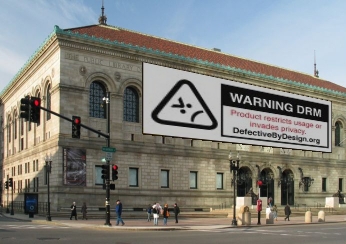
Benjamin Mako Hill: Protest DRM at the Boston Public Library

/copyrighteous/images/bpl_drm.jpg On Saturday February 9th, at 13:00, I'm going to be joining free software and anti-DRM activists to protest the use of DRM by the Boston Public Library on parts of its electronic collection. Those of us protesting are unhappy because the BPL has launched a new service powered by a company called OverDrive. The system gives BPL patrons access to books, music, and movies online -- but only if they use a Microsoft DRM system. There are lots of problems with the introduction of this system: it bars access to users of GNU/Linux and MacOS and creates a dependence on a single technology vendor for access. These are important issues, certainly. The worst problem, however, is much more fundamental. By adopting a DRM system for library content, the BPL is giving OverDrive, copyright holders, and Microsoft the ability to decide what, when, and how its patrons can and cannot read, listen, and watch these parts of the BPL collection. They are giving these companies veto power over the BPL's own ability to access this data -- both now and in the future. Cryptographically, BPL is quite literally handing over the keys to their collection. In the process, they are not only providing a disservice to their patrons. They are providing a disservice to themselves. The first-sale doctrine says that libraries can do essentially whatever they like with copies of books they purchase short of duplication, modification, or performance. Of course, copyright holders would prefer to charge a toll every time someone checks out a book. Public libraries were possible in spite of this desire because they were able to exploit power over the possession and control of their books in the interests of their patrons. With DRM, libraries will reduced to powerlessness. Of course, times have changed. As media and the ways we interact with it is increasingly digital, libraries have changed and will need to change more. But if public libraries are to succeed at their fundamental mission of spreading knowledge and serving communities, this change can't be at the expense of patrons' ability to control their own technology and libraries' ability to control their own collections. I've supported my academic library, MIT Libraries, as they took a risk and stood up to DRM when other institutions did not. And they won. BPL is the largest municipal library in the US and the third largest US library overall. It is the first library to be supported publicly, to be open to the public in the US, and to allow patrons to take home books to read and use them. BPL has an opportunity now to continue this history of leadership, of access, and of patron empowerment. If BPL stands up against DRM and in favor of its patrons' freedom and its own control of its technical destiny and collection, it may set an important precedent. If you're in or near Boston, please join me in Copley Square on Saturday to help make this happen. If you're not near Boston, please help put pressure on similar efforts in your own communities.

MJ Ray: BBC's Calendars

Fun round-up of web calendars on BBC Click this weekend. Google, Kiko and 30boxes get mentions. I'm mainly using my new phone but reviewer Rob was quite scathing about phone calendars and didn't bother to say how well the different sites integrate with handhelds. Feedback by email was invited... Are there good interoperable web calendars? Any as free software? Talking of BBC being on a different calendar to everyone else, BBC belatedly announces that iPlayer-for-Mac will come at some point in 2008. Sadly, the DG is still repeating the "only for Sony TVs"-like single-platform explanation and still not mentioning a (DRM-free?) GNU/Linux service.

7 February 2008

Russell Coker: Political Blog Posts

Currently in the US the main political parties are deciding who will contest the next presidential election. Naturally this gets some commentary from all sides. Planet Debian has syndicated two blog posts commenting on these issues, it’s interesting to compare them: First John Goerzen writes a post about an issue he (and almost everyone in the Debian community) considers important - copyright law [1]. He quotes the Randall Munroe who is the author of www.xkcd.com (described by the author as “A webcomic of romance, sarcasm, math, and language“) which is wildly popular in the free software community (I believe that there is a fan-club which has meetings). Randall’s commentary is quite interesting and I recommend reading it [2]. The most noteworthy fact is that Barak Obama has sought advice from Lawrence Lessig - who has done more for the free software community than any other lawyer. John’s post doesn’t contain much original content, but citing a lengthy post from a highly regarded source and quoting a particularly relevant paragraph make it very noteworthy. Next Jaldhar Vyas writes about “the war against Islamic terrorism” [3] and makes the claim “we are finally gaining the upper hand in Iraq“. To consider that claim it’s best to read some expert commentary. William S. Lind [4] is a widely respected conservative who is an expert on military strategy, his comments about stabilising Iraq are always interesting [5]. It’s sufficient to note that William has been predicting failure for the US occupation of Iraq right from the start and that events over the last five years have proven him correct. William S. Lind’s thoughts on Democracy are interesting too [8], I don’t agree with him in this regard (I generally disagree with him on most things other than military matters) but it’s an interesting thought. Jaldhar also claims that “Democrats on the other hand have a closer association with the media who are behind many of the sillier IP laws“, this seems to be a reference the the “liberal media” conspiracy theories. There seems no clear party association with bad IP legislation (both the Democrats and Republicans do silly things in this regard), and debunking the liberal media claims can be done simply by watching some TV (choose a couple of random news shows on different channels). Fox is not the only right-wing news outlet. Jaldhar also has a conspiracy theory about the Supreme Court and the “need to ensure that the court does not veer leftward again as it will inevitably do during a Democratic administration“, not that the Democratic party is particularly “left” by whatever definition you might apply to the word. I prefer the www.politicalcompass.org analysis which shows that all the serious contenders in the Democratic primary are Authoritarian Right [6]. So the result of the next US presidential election will determine how authoritarian and right-wing the government will be, the fact that it will be authoritarian and right-wing is beyond doubt. That said it would be good if the authoritarian right-wing government that we (*) get at least has some decent policies in regard to IP law (which is the hope for Barak Obama). John Nichols has an interesting analysis of Ann Coulter’s support of Hillary Clinton over John McCain [7]. It would be interesting to see Jaldhar’s comments on this issue. (*) I use the term “we” when talking about US politics to acknowledge the fact that the Australian government will take orders from Washington. Some pundits predict that the Greens will be the second major party in Australian politics in a couple of elections time, so maybe in 8 years time we will have an Australian government that represents Australians instead of Americans. But for the entire duration in office of the next US president (be it 4 years or 8) they will be able to get the Australian government to do almost anything that they desire.

Martin F. Krafft: Best stewart ever

I would like to suggest to my readers to ask airplane crews for explanations of their rules. If we can get a larger number of people to inquire about the reasons behind the do s and dont s on airplanes, maybe the airline companies will adopt the practice. In the context of a previous post on the lack of explanation of the motivations behind airline rules, I was utterly impressed when the steward on the Air New Zealand flight from Melbourne to Wellington asked me to turn off my music player so that I would hear when they asked us to evacuate the plane or similar. While I doubt that I would continue to listen to The Flower Kings in an exceptional event, his explanation actually got me to turn off the player, which I had previously never done (rebel me!). I know it s a bit ridiculous, but I was previously so set on the idea of small devices like a music player interfering with the airplane instruments that I failed to see this obvious bit of logic. The steward thus gets my best steward award. When you fly, ask the crew about the reasons for the rules they impose on you, the passengers! NP: The Flower Kings: Unfold the Future

Martin F. Krafft: Leaving LCA

I am 10 000 metres above sea level, on my way from Melbourne to Wellington. I am looking back at a very enjoyable week of conferencing, with LCA 2008 ending yesterday, followed by today s Open Day. The purpose of this final day is to invite the general public to learn about open-source. Individual projects present their work at booths and field questions by bypassers. Jacinta Richardson and the other organisers and helpers of the Open Day have done an amazing job. The place was buzzing and the selection of projects broad and interesting, even to me. Two talks and a series of lightning talks, as well as catered food for everyone rounded it off. I will try to have this event in mind as we organise a similar event in Buenos Aires after the forthcoming DebConf8 in Argentina. I had a splendid time at the conference and probably can t thank Donna Benjamin and her army of mignons enough for organising it. Compared to the other open-source conferences I previously attended, this one was the most professional. Good job, everyone!!! Here are the highlights: Apart from the busy programme, I particularly enjoyed the hallway track , which is usually the reason why I attend these events. I really ought to practice remembering names and faces a bit better. I am not paying enough tribute to this week with this report, but I shall conclude it regardless. Unless something very unexpected comes up, I will attend next year s LCA in Tasmania. NP: Porcupine Tree: Futile

Alastair McKinstry: Back from Holidays

Chocolate lion Cormac and Caoimhe at a patisserie with Chocolate lion in Concarneau, Brittany
So, I'm back from Holidays, to find we now have a new Government in Ireland. (An unexpected choice of government, of which more later.) We were camping in Fouesnant, in Brittany; Family & Friends might like to see the holiday snaps here). Camping in France went well. With three children aged 7, 4 and 2, there is only so much you can expect from a family holiday. Like it or not, you have to mind the toddler fairly consistently, and the older kids would like your full attention too. This is a holiday ''for'' the kids; plan also a break ''from'' the kids later (a long-weekend, with kids at grandparents, for example). This was our first time camping abroad, and its well recommended. While we went touring with a camper van with the two older children two years ago, this is different in that we were at the campsite for almost two weeks: the kids got to meet and play with others in a way they couldn't before. Also, there were good facilities at the site in Fouesnant, and the swimming pools in particular were appreciated (Caveat emptor though: there were no lifeguards or supervision. We went off-peak, and there were apparently two accidents in the time we were there: a broken kneecap and chin when people came down the slides too soon after others and collided). It was the first time the children (a) had pocket money to spend, and (b) were able to walk to a (campsite) shop to spend it. Lessons were learnt in the finiteness of pocket money, especially by Caoimhe :-(. The weather was fairly good: two wet days (though not overly so, compared to what we're used to in Galway); enough to give the 'authentic camping experience'. And for the children especially, just warm enough. Long drives South were not an option with young kids, and we wanted to see Carnac and Brittany in general. We went touring to two places: Mont St. Michel, on the way down, Carnac, and locally around Quimper and Concarneau. At seven, Cormac is beginning to be old enough to enjoy this, but Sadhbh at 2 is too young, and easily aggravated. Caoimhe can appreciate some of it, such as the well recommended Breton museum in Quimper, seeing the local costumes and clothing is just her style at the moment. We're looking forward to going back when the kids are older, or we can enjoy touring on our own. The camp site is dominated by English / Dutch / Irish. It is still term-time in Britain and Ireland, which meant the children on the site was full of 2-4 year-olds, with a shortage of playmates for Cormac. Next time, synchronise with English school times, etc. We went during Cormacs term-time because it was much cheaper (1000 Euro) than high-season. If Cormac was having difficulty in school things would have been different, as it is, we had no qualms in doing so. Things will probably be different next year with Caoimhe also in school at the same time, and we would go later. Suffice it to say I think synchonisation of school timetables is a bad idea, as it has led to these huge price differentials and parents taking their kids from school. As a friend with experience of the French school system points out, they've spent the last 40 years desynchronising their timetables ... So would we go again, or buy our own tents, etc? possibly. The brochure for next year arrived already, with large discounts for booking early ... Tags , , , , , ,

Biella Coleman: On Confidence, Geekdom, and Desire

So a few folks left some interesting comments in response to my link to the article on the rise of the alpha-girl based on the research of Harvard psychologist, Dan Kindlon. My response to both Joe and Karl is that it is worthy to lower the barriers to entry not because girls will change the cultural ecology of geekdom in positive ways (though they may) or because geekdom is inherently “omg totally awesome!!!!!!!!!!!!!!!!!!!!” but for a much more mundane reason: it may allow girls to follow interests and eventually discover a passion. I think it is a great idea if more women were involved in geekdom and open source development not because it is inherently great but because I am sure there a lot of women out there who would enjoy it (and by extension, I am sure a lot who would not). By highlighting this article I am not advocating some forced hacker-female-labor-migration-policy but pointing to the fact that social conditions outside of geekdom play a role in ensuring more participation among women. But let me explain a few things before I argue my position a little further. First a little clarification, especially now that I have read the article. By alpha the author does not mean dominant, aggressive, and totally jerky, which is what might immediately come to mind when you read/hear alpha (especially if one knows any alpha-geeks or alpha-lawyers for that matter, who are much worse, imho). And I certainly don’t want any more alpha-anything (alpha-women, alpha-dogs, alpha-cats, alpha-hamsters ) given our world is already chock-full of alpha-jerks. By using the term, the author basically means confidence, which apparently is on the rise among girls, leaving them much more likely to be go-getters, undaunted by explicit and implicit barriers and obstacles and thus more likely then ever to enter arenas that have been thought of as traditionally male or in fact totally dominated by males. If this trend is indeed in place, I think it is great and I hope that this eventually translates into more girls/women populating traditionally male areas whether it is neurology, movie directing, hacking, or surfing. What I appreciate about the article is that his research can help us question the idea that women are naturally averse to competition due to their estrogenic hormones while boys, brimming with testosterone, just love it and exude it. I never identified with that conventional well-worn script, in part because I guess I am fairly confident and somewhat competitive. Being in academia for the last 10 years, I have witnessed a lot of really confident women that have helped inspire me and keep me going, especially when times got rough. What is fascinating about the article (and by extension probably his book) is that gender parity and equity and changes in the psychological makeup of women have not changed overnight but have taken a much longer time to settle in place. We are only now bearing the fruits of structural and educational changes first instituted decades ago and that tackled some serious forms of discrimination. As a result, we are seeing girls and women donning a deeper confidence that may help them participate with more success in the arenas they want to whether it be sports or in the workplaces (though there are certainly still major barriers and issues, which are addressed in the article). So why would someone want to participate in the world of free software and hacking in particular? My first answer is there may be any number of reasons why anyone, female or male or transgender or whatever, may want to do so for the love of technology, to feel an intense belonging to a community who share your passions and who work together to create something with a lot of value, to enjoy the challenge of learning, to spread freedom to every corner of the earth, etc… It is not that geekdom is inherently fun and exciting but that it will be interesting to some slice of the population men or women (or other) and what is the harm in lowering the barriers to entry, especially if it brings enjoyment and frankly a lot of economic security too? There are a number of girls/women who already find it worthwhile and I am sure many more who would. And the point is not to create some policy to make sure that we shuttle women into hackerdom but as a society we should equip them with the necessary psychological tools so that if they think this is worthwhile, and discover that they love it, etc, they will dare to venture in there and more importantly, stay if they want to. In terms of Karls point that a lot of people are professional geeks in part because they d have trouble being anything else; like being gay, it s not a choice, I think that is far too narrow of an assessment, not to mention an outdated caricature of geeks. While there is certainly a class of socially awkward geeks (if that is what you mean??), I would say they are in the minority though they may certainly stand out precisely because they are the odd ducks and because the stereotype is so entrenched. Many geeks I have met, while they may pretty darn focused on geekdom, also have full and rich lives/personalities that cannot be easily collapsed into one immutable personality type. Yes they may be obsessed with tech but aren’t doctors, academics, musicians, lawyers sort of fanatical too? I spend like my whole week working on academic stuff (part of necessity, part out of love). And at least hacking has way better conferences and economic perks, which may help explain why people stay :-) Finally, I think you assume a little to strongly that we do what we do because we have a pre-formed existing desired to do so. While I think this is the case for many things (and I knew the minute I learned about anthropology, I wanted to be one, which was odd but it proved to be correct), I think desire is also formed as much through experience and hence the importance of exposure to different worlds and experiences. I know that there are many things I could have never imagined I would have loved–karoake and sailing are two things that come to mind—until I tried them about both took some degree of courage. In the later case, it took a lot of guts to move onto some ship at the age of 18 instead of going to college and I am so glad I did. This is an instance where confidence and an initial curiosity led to discovering a love and passion I never knew I had. So if desire can be formed and not just expressed, I think it is key to make sure people have all sorts of opportunities to cultivate the passions they never knew they had.

Russell Coker: Linux Resource Controls

Using the “ulimit” controls over process resource use it is possible to limit RAM for processes and to limit the number of processes per UID. The problem is that this often is only good for accidental problems not dealing with malicious acts. For a multi-user machine each user needs to be allowed to have two processes to be able to do anything (IE the shell and a command that they execute). A more practical limit is five processes for a single shell session (one or two background jobs, a foreground job where one process pipes data to another, and the shell). But even five processes is rather small (a single Unix pipe can have more than that). A shell server probably needs a limit of 20 processes per user if each user will have the possibility of running multiple logins. For running the occasional memory intensive process such as GCC the per-process memory limit needs to be at least 20M, if the user was to compile big C++ programs then 100M may be needed (I’ve seen a G++ process use more than 90M of memory when compiling a KDE source file). This means that a single user who can launch 20 processes which can each use 20M of memory could use 400M of memory, if they have each process write to a pages in a random order then 400M of RAM would be essentially occupied by that user. If a shell server had 512M of RAM (which until quite recently was considered a lot of memory - the first multi-user Linux machine I ran on the net had 4M of RAM) then 400M of that could be consumed by a single hostile user. Leaving 100M for the real users might make the machine unusable. Note that the “hostile user” category also encompasses someone who gets fooled by the “here’s a cool program you should run” trick (which is common in universities). I put my first SE Linux Play Machine [1] on the net in the middle of 2002 and immediately faced problems with DOS attacks. I think that the machine had 128M of RAM and because the concept was new (and SE Linux itself was new and mysterious) many people wanted to login. Having 20 shell users logged in at one time was not uncommon, so a limit of 50 processes for users was minimal. Given that GCC was a necessary part of the service (users wanted to compile their own programs to test various aspects of SE Linux) the memory limit per process had to be high. The point of the Play Machine was to demonstrate that “root” was restricted by SE Linux such that even if all Unix access control methods failed then SE Linux would still control access (with the caveat that a kernel bug still makes you lose). So as all users logged into the same account (root) the process limit had to be adequate to handle all their needs, 50 processes was effectively the bare minimum. 50 processes with 5M of memory each is more than enough to cause a machine with 128M of RAM to swap to death. One thing to note is that root owned system processes count towards the ulimit for user processes as SE Linux does not have any resource usage controls. The aim of the SE Linux project is access control not protection against covert channels [2]. This makes it a little harder to restrict things as the number of processes run by daemons such as Postfix varies a little over time so the limits have to be a little higher to compensate, while Postfix is run with no limits the processes that it creates apply to the global limit when determining whether user processes can call fork(). So it was essentially impossible to implement any resource limits on my Play Machine that would prevent a DOS. I changed the MOTD (message of the day - displayed at login time) to inform people that a DOS attack is the wrong thing to do. I implemented some resource limits but didn’t seriously expect them to help much (the machine was DOSed daily). Recently I had a user of my Play Machine accidentally DOS it and ask whether I should install any resource limits. After considering the issue I realised that I can actually do so in a useful manner nowadays. My latest Play Machine is a Xen DomU which I have now assigned 300M of RAM, I have configured the limit for root processes to be 45, as the system and my login comprise about 30 processes that leaves 15 for unprivileged (user_r) logins. Of recent times my Play Machine hasn’t been getting a lot of interest, having two people logged in at the same time is unusual so 15 processes should be plenty. Each process is limited to 20M of memory so overflowing the 300M of RAM should take a moderate amount of effort. Recently I intentionally have not used swap space on that machine to save on noise when there’s a DOS attack (on the assumption that the DOS attack would succeed regardless of the amount of swap). Now that I have put resource limits in place I have installed 400M of swap space. A hostile user can easily prevent other unprivileged users from logging in by keeping enough long-running processes active - but they could achieve the same goal by having a program kill users shells as soon as they login (which a few people did in the early days). But it should not be trivial for them to prevent me from logging in via a simple memory or process DOS attack. Update: It was email discussion with Cam McKenzie that prompted this blog psot.

6 February 2008

Michal Čihař: When non ASCII names will finally work?

By using my name in various web services I usually spot bad implementation of displaying name field in their website. I can see that over years the amount of servers which cripple my name to something like iha is getting lower, but there are still lots of them. When I find way how to report it, I usually do so and I always enjoy fields like "How to repeat". This time the guilty one is the MySQL bugtracker. PS: Fortunately all Debian pages seem to catch up this year and my name is no longer crippled in NEW queue or Lintian pages :-).

William Pitcock: Introducing dsyslog

I’ve been writing my own syslog daemon for the last couple of weeks because the other daemons are not sufficient for my needs or require you to sign obnoxious CLAs in order to contribute. I made a page about it on nenolod.net here. You can check out the repository using: $ hg clone http://hg.atheme.org/dsyslog Hopefully some of my blog readers might write some patches!

Aigars Mahinovs: Sneaky blacklisting of WiFi in HP laptops?

I’ve been there before, but somehow I hoped that HP has come to its senses, so when my girlfriend got a HP Compaq 6715b laptop with a Broadcom wifi card that does not work with the open source driver and randomly crashes under load with ndiswrapper driver, I said - “well, I’ll just get an Intel mini-PCIe wifi card and plug it in”. I should have know better. While there is no obvious impenetrable error message like on NX6110, the 6715b simply ignores any non-HP wireless cards. They do not show up in lspci and don’t even appear in Vista. I have all the latest drivers and latest BIOS. I will look a bit for a workaround, possibly along the same lines as before (make a non-HP wifi card look like a HP wifi card), but I really must say - despite all the support for Debian HP has on the server side, I will have to recommend everyone I know to never, ever buy any HP laptops! By having an easy access latch to the WiFi slot they seem to embrace user choice, but in the confines of their BIOS they just cut through the heart of it by only allowing their own cards to be installed and used. Note: it is possible that the card itself is non-functional, but given the previous experience and some similar messages on the forums about all kinds of other HP laptops .. I wouldn’t bet on that. I would love to be proven wrong on this or shown a way to either make the non-HP IPW3945 card work or how to make the original Broadcom wifi card work in a stable manner. Currently it causes 4-8 hard lockups a day if the laptop is left acting as a bittorrent seed for a few thousand clients. Now i am just too tired to deal with this reasonably and should rather head for bed.

Simon Law: Montr al Python 1 is tomorrow


Green Tree Python
Originally uploaded by nasmac.
Akoha s sister company, Standout Jobs, has been hosting Montreal on Rails for quite a while. We figured we d get into the act. So we re sponsoring the first Montr al Python gathering tomorrow. Sadly, we don t really have enough space for everyone, so we re commandeering the Standout Jobs offices upstairs. After all, what good are siblings if you can t ask them for favours? I will actually be on a train to Toronto, so I m going to miss David Goodger talking about crazy awesome stuff he does in Python. But you should go! Intimidated? Don't think that Python is for you? Worry not! Python programmers are friendly, charming, and helpful. Montr al Python 1
Thursday, 7 February 2008
18:30 21:00
Standout Jobs
3981 boul. St-Laurent #615
Free admission
( Website Facebook Google Maps )

Frank Lichtenheld: More updates about packages. debian.org,ubuntu.com

Biella Coleman: The rise of the alpha girl

Harvard psychologist Dan Kindlon predicts thet spread and rise of the alpha girl. Does this mean we will see more female software hackers and developers soon?

Next.

Previous.