
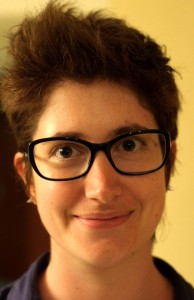
Francesca Ciceri, photo by Andrew McMillan, CC-BY-SA 2.0
I met Francesca in Debconf 11 in Banja Luka. If I recall correctly, it s Enrico Zini who introduced me to her, because she was the madamezou (her IRC nickname) who started to get involved in the publicity team. Since then and despite having a bachelor thesis to complete she got way more involved and even gained official responsibilities in the project.
Before starting with the interview, I wanted to mention that Francesca is
drafting a diversity statement for Debian I was expecting the discussions to go nowhere but she listened to all objections and managed to improve the text and build a consensus around it. Thank you for this and keep up the good work, Francesca!
Rapha l: Who are you?
Francesca: My name is Francesca, I m 30 and I studied Social Sciences. Currently I
live in Italy but I m planning to go abroad (not a lot of jobs here for
geeky social scientists). Apart for Debian and FLOSS world in general, I have unrestrained
passions for chocolate; zombie movies; sci-fi; zombie books;
knitting sewing crafting and DIY in general; zombie videogames; bicycles;
pulling apart objects to look inside them; splatter B movies, David
Foster Wallace s books, playing trumpet, and did I already mentioned zombies?
Days are too short for all this stuff, but I try to do my best.
Raphael: How did you start contributing to Debian?
Francesca: Some years ago I was stuck in bed for literally some months, due to a
grave series of migraine attacks. I wasn t able to do anything: no social
life, no books or television. So, I decided to turn on the laptop and do
something constructive with it: I was already a Debian user and it
seemed quite logical to me to try to give back to the community.
I am not a coder and I ve not studied Computer Science, so my first
step was to join an Italian Debian on-line community
(
Debianizzati) and help
with tutorials, users support, wiki management.
In a couple of months I learnt many things: helping other users with their problems forces you to do lots of research!
My first contributions to the Debian project were mostly translations of
the main website.
Translators are the perfect typos spotters: they work so precisely on the
text to be translated that they finish to do a great QA job.
This is how I ve started to contribute to the Debian website: with very
simple things, fixing typos or wrong links or misplaced wml tags.
I still remember my first commit to the website: the idea was to
undercase some tags, but it ended up that I misplaced some of them
and in addition I fixed them only in the English page and not
on the translations as well.
When after a couple of minutes, K re Thor Olsen a long time contributor
of the team and now webmaster reverted my commit, I felt so stupid and
full of shame.
But, to my great surprise, no one treated me like an idiot for that error:
Gerfried Fuchs, one of the guru of the team,
replies me in a really
helpful and polite way explaining what I did wrong and how to do
things correctly.
I think this episode was a turning point in my Debian life: there s this
idea that Debian Developers are just a bunch of arrogant assholes and
maybe it was true in the past, but for my experience they are not.
Well, at least the ones I met and work with

.
To my great surprise, no one treated me like an idiot for that error.
Since then, I joined the WWW team and helped them apply the shiny
new design provided by Kalle S derman. A lot of work was done during the
week immediately before the release of the new website.
Oh that was a week! We worked night and day to have the new design ready for February 6th, and
it was fantastic when we finally published it, simultaneously with the
release of Squeeze.
At the same time, I started to contribute more actively to the Debian
Publicity team, not only translating news but also writing them.
It can sound scary for a non native English speaker to write
something from scratch in English, but you have to keep in mind that
your text will be reviewed by native speakers before being published.
And we have some fantastic reviewers in the English localisation team:
particularly Justin B Rye, who is tireless in his effort and
more recently Moray Allan.
I think I m particularly lucky to work with all these people: there s a special
mood in both Publicity and WWW team, which makes you feel happy to do
things and at the same time pushes you to do more just because it s fun to
work with them sharing jokes, ideas, rants, patches and hugs.
Rapha l: I believe that you have been trough the new member process very quickly.
You re now a Non-Uploading Debian Developer. How was the experience and
what does this mean to you?
Francesca: Becoming a Debian Developer was not so obvious for me, because I
didn t need to be a DD for the work I do in Debian.
For instance, I don t maintain packages, so I had no reasons
to want to become a DD in order to have uploading rights.
For a while I didn t really feel the necessity of being a DD.
Luckily, some people started to pester me about it, asking me
to apply for the NM process.
I remember Martin Zobel-Helas doing this for an entire week every single
day, and Gerfried Fuchs doing it as well.
Suddenly, I realized that people I worked with felt that I
deserved the DD status and that I simply had thought
I didn t.
As a non coder and a woman, there probably was a bit of
impostor
syndrome involved. Having people encouraging me,
gave me more confidence and the desire to finally become a DD.
And so I did.
The process for non uploading DD is identical to the one to
become an uploading DD, with one exception: in the second part of the
process (named
Tasks
and Skills) instead of questions about how to create and maintain
packages, there are questions about the non packaging work you usually do
in Debian.
The
general resolution which created
the possibility to become a non uploading DD gave us
a chance to recognize the great effort of Debian contributors who
work in various area (translations, documentation, artworks, etc.)
that were not always considered as important as packaging efforts.
And this is great because if you are a regular contributor, if
you love Debian and you are committed to the project, there are no reasons
to not be an official member of it.
With regards to this, I like the metaphor used by Meike Reichle
in her recent talk about the Debian Women Project (
video
recording here):
a Debian Developer status is a lot like a
citizenship in a country that you re living in. If you live in a country
and you don t have citizenship, you can find a job, buy a house, have a
family [...] but if this country at any point in time decides to go into
a direction that you don t like, there s nothing you can do about it. You
are not in the position to make any change or to make any effect on that
country: you just live there, but there s no way that you can excercise
influence on the people who run this country.
Rapha l: You recently joined the Debian Press Team. What does it involve and
how are you managing this new responsibility?
Francesca: The Press Team is basically the armed wing of the Publicity Team: it
handles announcements that need to be kept private until the
release, moderate the debian-announce and debian-news mailing list and
maintain contacts with press people from outside the project.
The real job, so, is done within the Publicity Team.
The most important part of our work is to write announcements
and the newsletter: while the newsletter is published bi-weekly, the
announcements need to be write in a shorter timeframe.
Localization is really important in spreading Debian word, so we work
closely with translators: both announcements and DPN are usually
translated in four or five different languages.
The publicity work could be stressful, as we have strict deadlines, we
need to take quick decisions and often do last-minute changes.
Personally, I like it: I work better under pressure.
But I know that is sometimes difficult for contributors to accept
that we can t debate endlessly on details, we have just to go on and do our best in a given timeframe.
The publicity work could be stressful, as we have strict deadlines, [ ]. Personally, I like it.
Raphael: You re one of the main editor behind the Debian Project News. What s
the role and scope of this newsletter?
Francesca: Debian Project News is our beloved newsletter, direct successor of the Debian
Weekly News founded by Joey Hess in 1999 and later kept alive by Martin
Schulze. In 2007, Debian Weekly News was discontinued but in 2008 the project was
revived by Alexander Reichle Schmehl. The idea behind DPN is to provide our users an overview of what is
happening inside and outside the project.
As the core team of editors is formed by three people, the main problem
is to be able to collect enough news from various sources: in this sense
we are always glad when someone points us to interesting blogposts, mails
and articles.
DPN is also a good chance for non coders to contribute to Debian:
propose news, write paragraphs and review the draft before the
publication are quite easy tasks but very useful.
English native speakers can do a proofread (as no one of the main editors
is a native speaker) while others can always translate DPN in their
native language. People who want to help us can take a look at our
wiki
page.
DPN is also a good chance for non coders to contribute to Debian.
Just yesterday I realized that since January we don t miss or delay an issue:
so I d like to thank the fantastic team of editors, reviewers and translators
who made it possible.
The team is now working on another way of spreading Debian s message: a long-time
project is finally becoming real. Stay tuned, surprise arriving!
Raphael: You re trying to organize
IRC
training sessions but that doesn t seem to take off in Debian, while it s quite common
in the Ubuntu community. How do you explain that?
Francesca: I m not sure about it: both Debian users and contributors seemed to
appreciate this initiative in the past. I was quite surprised by the
amount of Debian members present during the various sessions and by the
amount of interesting questions asked by the users.
So the only reason I can think about is that I need to put more
enthusiasm in convincing the teams to do it: they need more
encouragement (or to be pestered more!).
I, for myself, think that IRC training sessions are a great way to
promote our work, to share our best practice, to talk about our project
to a wider audience. And I ll sure try to organize more of them.
Help, suggestions, ideas are really welcome!
Raphael: If you could spend all your time on Debian, what would you work on?
Francesca: There is a project I d like to give more love, but I always
end up without the time to do it: the debian-community.org project.
Back in 2007, Holger Levsen founded it with the aim of reducing the gap
between Debian contributors and Debian users, giving all an opportunity
to contribute, share ideas and more.
The project was discontinued and I d really like to revive it: in these
years various things have changed, but I think that the core idea of having a
node to connect existing local communities is still good and doable.
In Debian we don t have the wide and well articulated local
infrastructure present in other distributions (Ubuntu, particularly, but
also Fedora): even if I don t like too centralized structures, I think
that a better connection between the project and local groups of users
and on-line communities would be a step forward for the project.
Being part of the Events Team, I m aware of how much we need to
improve our communication with local groups.
An example is the events organization: sometimes, Publicity and Events
teams even don t know about regional Debian related
events (like booth at conferences, workshops, talks, install parties,
etc) and this is a shame because we could offer a lot of help in
organizing and promoting local events.
What we lack is better communication.
And debian-community.org project could give us exactly this. Could be a
cluster of local groups, a platform for events organization and even
a useful resource for newbies who want to find a local group near them.
I started some effort in this sense, sending
a
proposal about it, working on a
census of Debian local
groups. Any help is appreciated!
I m really curious to see how many Debian communities (from all around
the world and the web) are out there, and I d love to have members
from these communities better connected with the Debian Project.
Raphael: What s the biggest problem of Debian?
Probably the
bikeshedding feticism of almost all of us.
It s the other side of the coin of Debian s commitment to technical excellence
and our perfectionism, but sometimes it leads just to endless discussions
about details, and it is a blocker for various initiatives.
In Debian, you have to be really patient and in a way stubborn to push some changes. This is frustrating sometimes.
On the other hand, I really appreciate how people take some times to
think to each proposals, give some feedback and discuss about it: the
process could be annoying, indeed, but the result is often an improvement
of the initial proposal.
Raphael: Is there someone in Debian that you admire for their contributions?
Most of my teammates are simply brilliant and adorable and hard-working.
But I have to admit that I particularly admire David Pr vot: beside being
a webmaster he does a lot of things, from French translations to DPN editing.
All his contributions have a great quality and he s able to push you always further in
doing things and doing them better. He is a good example of how I d like to be as contributor: smart,
tireless, friendly.
Thank you to Francesca for the time spent answering my questions. I hope you enjoyed reading her answers as I did. Note that older interviews are indexed on
wiki.debian.org/PeopleBehindDebian.
Subscribe to my newsletter to get my monthly summary of the Debian/Ubuntu news and to not miss further interviews. You can also follow along on Identi.ca, Google+, Twitter and Facebook.
3 comments Liked this article? Click here. My blog is Flattr-enabled.


 In the 3.x days of KDE, there were some wonderful applications. One of them I still admire, is kscope. Recently, I stumbled upon


 A while back, I was thinking. Playing the flute or whistling on a
bottle is the exact same technique; but, in my opinion, the sound that
comes from a bottle has some interesting overtones, making for a nice
sound. Since the material of which an instrument is made is in large
part responsible for the overtones that it produces (apart from the
technique used by the musician), I wondered if nobody had ever come up
with the idea of making a flute in glass.
Turns out that, of course, this has already happened. In fact, the
modern concert flute wouldn't have been possible without one Claude
Laurent, a Parisian instrument maker who received a patent for "a new
[method of] making flutes from crystal"; part of his patent described a
method of attaching the valves to the instrument. It was this method
which was used by Theobald Boehm when he invented the fingering system
that defines the modern concert flute.
The price of an intact Laurent flute today is, of course, beyond my
budget; and it doesn't look like there are any glass flutes being made
that use the Boehm system. But that doesn't mean there aren't
any glass flutes being made anymore; indeed, a short look
around the Internet quickly turned up

 Since installing a whiteboard in our kitchen, conversations at

 I look after a lot of systems, and most of them want identical and simple backups taking of their filesystems. Currently I use


 Voting is open in the
 In (roughly) 2008 I read "Blood Music" my first Greg Bear novel and
devoured it in a weekend, in only two or three reading sessions. That happens
very rarely, and when it does I often wonder whether it's the quality of the
writing or some combination of that and your personal moods and tastes at the
time that is responsible. My next Bear was "Darwin's Radio" in mid-2010 which,
whilst good, did not provoke the same feverish read. I might write short
reviews for both at some point in the future, but right now I can't remember
either well enough to do so.
In the last few weeks I read "Hull Zero Three" which was quite a different
beast. The novel first captured my attention due to the unusual way it was
promoted: via a video, which was created using a modified Quake 2 engine. It
wasn't a great video but the novelty made it interesting.
The story begins with a first-person narrator waking up from a sort-of hyper
sleep on a generation starship that has clearly had some serious problems. He
has to run to escape danger before he has an opportunity to figure out exactly
what has happened and what he is running from, or to.
Something has gone horribly wrong on the ship: it's nowhere near where it
should be going and nobody should be awake. The narrator's memory is fractured,
fabricated and unreliable; the ship is hostile, and whilst it's mechanical, it
cyclically changes and re-arranges it's hulls in an almost organic way. He is
joined by a rotating cast of similarly confused refugees of varying shapes and
sizes. Language and cultural barriers serve to further magnify the sense of
alienation that you experience on behalf of the story teller. The troupe are
persued through the corridors by a collection of lethally efficient killer
"things", contrasting with the background by being organic in nature but
mechanical in behaviour and appearance.
The scale of the ship is necessarily massive, and Bear does an impressive job
of capturing the awe you might feel when considering it. Three huge,
cigar-shaped hulls, joined by "spars" to an enormous chunk of ice captured from
the Oort cloud on exodus from the solar system. The ice serves as a mixture of
"fuel" for the biological ship systems and as part of a shield system for the
hulls from cosmic rays. However, in part due to the narrator's confusion, it
was hard to follow the very abstract descriptions of the environment in the
earlier stages of the story. I found myself re-reading passages to try and
understand the comparisons being offered and scales presented.
In common with the two earlier Bears I've read, 'body horror' features
prominently in this story. It feels like a "Dead Space" or "Resident Evil" in
space in a hard SF novel which seriously attempt to capture real speculative
science.
Like "Blood Music", I found myself compelled to read "Hull Zero Three" at every
available opportunity. I finished it off in a very enjoyable reading session
outdoors in the spring sunshine. It was an enjoyable read, well written but not
beyond criticism, with some interesting takes on well-worn themes. Very
reminiscent of the movie "Pandorum" (which was a surprisingly good movie).
 I m in the middle of plotting and designing a library to handle loading, processing and interpreting Geo-location data.
I have a fairly substantial corpus of data (latitude data since 2010-ish, on and off), and a bit of motivation to hack something up.
So far, I would like to see a lib to do most (or all) of the following: