Search Results: "tar"

12 August 2007

Martin-Éric Racine: Fresh out of NEW university: mkelfimage

I maintain the Debian package of mkelfimage, a tool to produce Etherboot images for use with thin client environments such as LTSP, which recently entered the Debian archive. The key difference between mkelfimage and the aging mknbi is that mkelfimage does not reply upon any traditional BIOS call to produce the bootable code in the ELF image, which makes it possible to boot thin clients with LinuxBIOS as their firmware, such as the Linuterm and several other products designed by Artec. mkelfimage accomplishes its BIOS-less operation using a simplified kexec implementation. However, this also means that explicit support for each architecture must be implemented with Assembler code. As it currently stands, the upstream tarball only includes support for i386 and ia64. Since amd64 boots in 32-bit mode, it should also work there, but this is untested. This leaves support for several architectures completely uncovered for. LinuxBIOS developers have taken over the upstream code and they welcome patches towards improving support for other architectures and towards cleaning up the autoconf implementation currently in use.
Martin-Éric Racine: GR: Debian Maintainer

Rumor has it that the General Resolution on acknowledging the concept of Debian Maintainers (mere participant who are granted limited upload rights, just enough to freely work on their own packages) has passed. I'm wondering what sort of timeframe we're looking at for deploying the infrastructure needed to manage this and then start accepting requests to be added to the separate GPG keyring. Would anyone know?

Dirk Eddelbuettel: The amazing Prof. Ripley (cont'ed)

A little mini-meme got started on August 1 when Ben Bolker posted the following code to the r-devel list (and here I substituted the more standard '-' assignment operator for the less standard though-now permitted '='):
x <- readLines("http://developer.r-project.org/R.svnlog.2007")
rx <- x[grep("^r",x)]
who <- gsub(" ","",sapply(strsplit(rx,"\\ "),"[",2))
twho <- table(who)
twho["ripley"]/sum(twho)
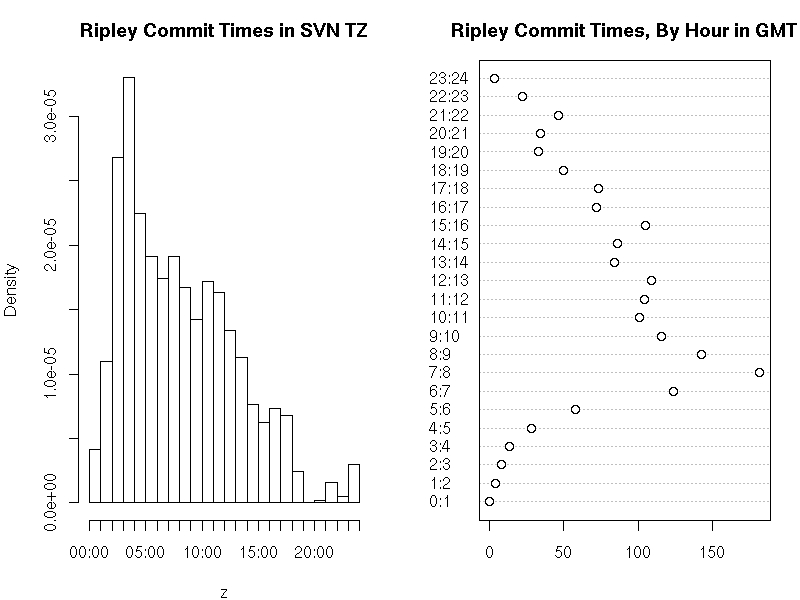
In five lines (that could be shortened to three at the expense of some readibility), the SVN log for R is downloaded directly from the website, the revision authors are extraced and then tabulated by submitter. The relative percentage of Brian Ripley is found to be a staggering 74.8% -- or about three times as much as the other fifteen committers combined. Smokes. [ Oh, and for those who don't know him, he's also got a day job which presumably entails looking after his graduate students at Oxford. Who knows, he may even teach. Kidding aside, he's actually one of the nicest persons you'll ever meet in real life. ] Now yesterday, Simon Jackman who had at first simply repeated Ben's analysis on his own blog followed up with a nice analysis (albeit typeset in a way that rendered the code inoperational, which has now been fixes) that creates both a histogram and a dotplot of commits per hour of the day. Omitting Ben's code which Simon reuses, we have the following for histogram and dotchart:
tod <- unlist(sapply(rx,function(x)strsplit(x,split=" ")[[1]][6]))
tod <- tod[who=="ripley"]
tz <- sub(pattern=".*(-[0-9] 4 ).*",replacement="\\1",x=rx)
tz <- tz[who=="ripley"]
tz <- as.numeric(tz)/100
offset <- 3600*tz
z <- strptime(tod,format="%H:%M:%S")
hist(z,"hours",main="Ripley Commit Times in SVN TZ")
h <- z - offset
h <- format(h,format="%H")
h <- factor(as.numeric(h), levels=0:23)
dotchart(table(h), main="Ripley Commit Times, By Hour in GMT",
         labels=paste(0:23,1:24,sep=":"))
This extracts the commit times, subsets to the ones by Prof. Ripley, extracts the timezones component (as strptime seemingly doesn't do that which is a pain), extracts the tz-less time via strptime into a variable 'z' for which the histogram is drawn. He then corrects the times by the tz offset expressed in seconds, formats is as hour of the day and turns it into a 'factor' (an R data type for qualitative variables which may be ordered as is the case here) and draws a dotplot. This results in the following chart: Simon Jackman's per-hour charts of Brian Ripley's commit patterns Now, nobody has looked at the time series. So we correct this and add the following:
## rather extract both  date and time
dat <- unlist(sapply(rx, function(x)  
  txt <- strsplit(x,split=" ")[[1]]
  paste(txt[5], txt[6])
 ))
## subset on Prof Ripley
dat <- dat[who == "ripley"]
## and convert to POSIXct, correcting by tz as well
datpt <- as.POSIXct(strptime(dat,format="%Y-%m-%d %H:%M:%S")) - offset
## turn into zoo -- we use a constant series of ones as each
## committ is taken as a timestamped event
datzoo <- zoo(1, order.by=datpt)
## and use zoo to aggregate into commits per date
daily <- aggregate(datzoo, as.Date(index(datzoo)), sum)
## now plot as grey bars
plot(daily, col='darkgrey', type='h', lwd=2,
     ylab="Nb of SVN commits, three-week median",
     xlab="R release dates 2.5.0 and 2.5.1 shown in orange",
     main="The amazing Prof. Ripley")
## mark the two R releases of 2007
abline(v=c(as.Date("2007-04-24"),as.Date("2007-06-28")),col='orange',lwd=1.5)
## and do a quick centered rolling median
lines(rollmedian(daily, 21, align="center"), lwd=3)
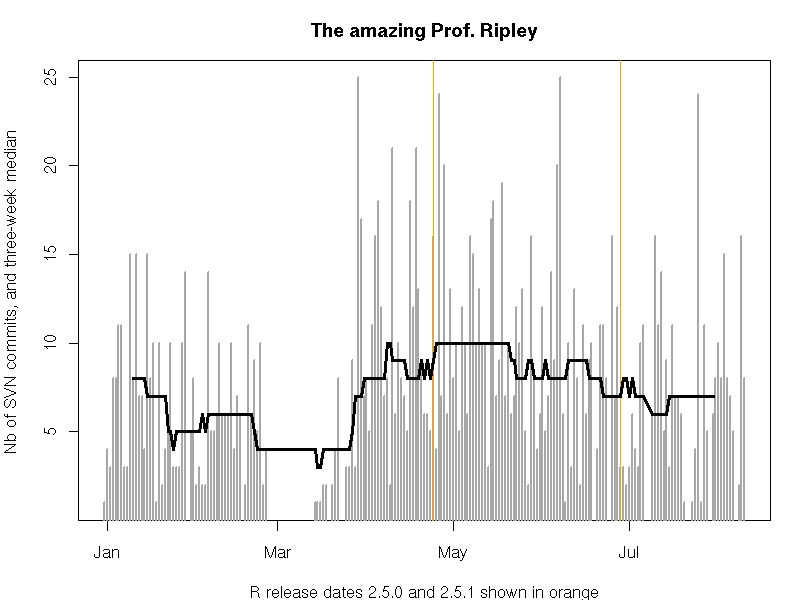
This extracts both date and time, creates a proper R time object (a so-called POSIXct type) from it, fills a zoo ('the' magic class for time series) object with it, uses zoo to aggregate commits per day and plots those in a barchart-alike (I know, I know, ...) plot to which we add the two releases as well as a rolling and centered three-week median (as a real quick hack rather than a proper smooth). Timeseries of Brian Ripley's commit patterns This shows that Prof Ripley averaged about ten commits a day before and after the release of R 2.5.0, and that he has slowed down ever so slightly since then to end up at around a mere seven commits a day. Every day. For the seven-plus months we looked at. So, anyone for analysing his r-help posting frequencies ?

Joey Hess: ikiwiki and spam

One of the reasons I was relictant to write a wiki before starting work on ikiwiki was the wiki/blog spam problem. Now that ikiwiki is reasonably mature, it's interesting to look back at how that turned out. The basic spam prevention mechanism in ikiwiki is the same as the one many wikis use: By default, it requires registration before you can edit a page. This is a pretty small stumbling block for spammers, especially since ikiwiki doesn't bother with email verification. It even prefills the login form with your username and password after you register. It would take about 5 lines of perl to defeat its registration process. Suprisingly, only one spammer has spammed any of my wikis. To defeat that spammer, I added the most common second layer defense against spam: A blacklist. Again I implemented the bare minimum, a way to blacklist a given user and ask them to "go away". Nothing to blacklist IPs, nothing more complex. That was put in place last October and I've had no problems with spam since. Around the same time, I made a change that I feared might open up a whole new class of spam, when I added openid support to ikiwiki. As far as I know, noone with an openid has tried to spam an ikiwiki wiki yet. Ikiwiki did grow one other common spam prevention tool. Josh Triplett added support for a user account creation password, so you have to know the password to get an account at all. This isn't used by default though. The only other possibly anyi-spam measure is that ikiwiki does allow locking down pages so only an admin can edit them, or so they can only be edited via commits to a revision control system. I use these methods for personal stuff like my blog, and might have cut down on the incentive to spam. Spamming a discussion page is just not as interesting as adding spam direct to my blog's rss feed. It seems likely that any new wiki system will have less spam at the beginning, especially if the spammers have to write code to bypass its registration system. That one spammer spparently did so fairly early is suprising. That no others have tried since is also suprising. My ease at blocking the spammer by simply banning them suggests that they were going after the easiest possible targets, and that it's not yet worth their while to work around even the simplest countermeasures. But if so, why did they add support for an entirely new registration system? My guess is that their existing code happened to work with ikiwiki's registration system. (This would take probably 20 lines of perl. ;-) Of course, there's all kinds of counterspam measures that I could implement if needed. By the way, if you use ikiwiki and have had problems with spam, I'm of course interested in fixing that. It'll be interesting to see when additional measures turn out to be needed, as the wiki and sites using it become better known.

Jose Carlos Garcia Sogo: SCO loses

Yes, it seems that SCO doesn't own the Unix copyrights. This means that SCO has lost the legal war against Linux that they started back in 2003, arguing that as Linux was a Unix derivative, it was using UNIX System V code in it. At the time that meant tons of articles and information to be written about this issue, as well as next year, in 2004, in which some lawsuits were filled. They even announced a lawsuit agains IBM for $1 billion. Years later, when a court rules that SCO does not own any rights over the IP, thus saying that it belongs to Novell, I have only seen this appearing in Slahsdot and some Slahsdot and some Slahsdot and some Slahsdot and some other blogs but without all the hype that should follow such a desition. For sure people reaction is quite logical, as they yet knew that this was going to happen. They knew that since the very moment that SCO was asked to point which pieces of code were under violation of their rights and they refused with vague anwers.i

11 August 2007

Alastair McKinstry: Planet 9 from Outer Space

While investigating planet formation (to justify support complement a PhD proposal on ocean planets), I found this discussion over at physicsforums following a blog entry by Dr Steinn Sigursson. (He uses Planet X in his posts but that is too frequently linked with the dwarf planet Xena Eris, and besides, Pluto has been demoted, so its Planet 9 we're looking for :-( ). The question is, how was our solar system created ?
"Looks like the outer solar system, with late heavy bombardment, would have come together nicely if there was another Neptune out there to begin with."
Basically, it appears as though there is a planet or substellar companion star out in the Oort cloud. This is not likely to be the Nemesis object of Hut's/Muller's theory, but would have been responsible for the Kuiper belt. Most of the discussion is about brown dwarfs, but following links leads to a paper by Gomes et al., simulating the possibility of outer Neptunes or Jupiters at 4000 AU or 5000 AU. The thread is all about the dynamics of such bodies, but what would they look like? Now, Hydrogen freezes solid at 14K, Helium is liquid at 4K. So we're talking about a liquid helium ocean on top, with no atmosphere worth speaking of. But Could it sustain life? Not as impossible as it seems. Ehrenreich and Cassan point out that an Ice Giant could host a liquid layer underneath an ice shell surface, heated by radiogenic energy, that could last for billions of years before freezing. So where would it be? This is the time to submit a grant proposal for more envelopes ... Tags , , , ,

MJ Ray: Deutschland-Tour and Volta a Portugal

The Deutschland-Tour 2007 is broadcast to Europe until next Saturday on ARD at 19 east and 13 east. After a wet start, Gerolsteiner's Robert F rster is leading them into today's team time trial, but it's only the second stage. The 69th Volta a Portugal is broadcast worldwide until next Wednesday on RTP Internacional and RTP Africa at all sorts of satellite positions. Candido Barbosa of Liberty Seguros (yet another cooperative cycling sponsor ) leads, but the advantage is small.

Russell Coker: Is Hand-writing Necessary?

The Washington Post has an article about handwriting, apparently for some university entrance exams in the US 85% of students write their essays in block letters. The article claims that students who have poor writing skills demonstrate lesser ability to construct sentences - and claims that this indicates that there is a link between hand-writing and mental processes. While the article didn’t cover the evidence in much detail I was left wondering whether there were any tests of teaching students to touch type and then assessing them on the same tests. I suspect that increasing the ability to record text in any way would increase the sentence length and the use of long words. While students who can only write slowly will have an incentive to write more briefly. My handwriting is quite poor, I was never able to write quickly or particularly legibly and since completing university I have had little incentive to improve my writing skills. When laptops became cheap enough for me to own one (in 1998) my hand-writing skills decreased and when I started seriously using a PDA about a year ago they decreased again. I don’t believe that my writing skills (in terms of conveying ideas and instruction to other people) have declined during this time. In fact the steadily increasing amount of writing that I have done has improved my skills a lot. I think that children should be taught cursive writing, but it shouldn’t be regarded as especially important - or more important than touch typing! Then there’s the issue of the Dvorak keyboard. If the government wanted to improve the efficiency of the nation (which is what they claim to be doing) then maybe teaching all students touch-typing on a Dvorak keyboard and subsidising the purchase of such keyboards for everyone would be better than some of the current ideas in education. Dvorak keyboards would certainly be better than flag-poles! News reports indicate that hand-writing skills are decreasing dramatically in Japan due to word-processors - and a significant number of students are never learning how to write any significant portion of the Japanese letters. But the sky doesn’t seem to be falling on them either. Mark Greenaway writes about having bad hand-writing and is apparently considering some sort of remedial course. I have to wonder how good Mark’s touch-typing skills are and whether he would benefit more from improvement in that area.

10 August 2007

Simon Richter: Why mISDN is not done yet

Life would be so awesome if there was a language to describe function calling conventions. I'd so use that to write my AmigaDOS startup code in C. In other news, I'm hacking on a replacement for amiboot; ideally it should work both as a stand-alone loader and as a filesystem driver that makes /boot accessible to AmigaDOS, so you can go without an auxiliary FastFileSystem partition.

Evan Prodromou: 22 Thermidor CCXV

Congratulations to my friends at AboutUs, who've just announced that they have a new logo. I think their old logo, the listening man, was a little too literal. Good to see a nice new look on this great community site. tags:

QuartzSlate Speaking of graphic design and UI on wikis... Jet lag and deadlines had me working late into night in Taipei last week at Wikimania 2007. I really wanted to get Keiki ready for people to look at by the time for my presentation. The other people up at this time were folks from Wikia, working to get their new QuartzSlate skin ready for lease. I think this is a beautiful skin and a nice UI. And it's another piece of convincing evidence that you can make a usable, enjoyable Web site from MediaWiki. An MW site doesn't have to be just the MonoBook skin plus a logo in the upper-left corner. I'm glad to see people breaking the mold. tags:

Wooooooow Speaking of redesigns (and I don't know why I started, actually), Vu d'ici, m-c turgeon's blog, is looking fan-effing-tastic. It's always a good read, and now it's prettier, too. tags:

Gunnar Wolf: Choose your pain: Legs or back

So I have an extra chair today at my office. Is that good?
Some weeks ago, I started noticing some stinging and numbness in my legs, specially the left one. I went to the social security, and got a simple prescription: Two weeks having a certain medicine whose name I don't remember by now. But the timing was not the best, as this happened exactly during my vacations - After finishing with this medication, I still had a full week before coming back to work. And when I came back, things seemed to be fine. But still, this does not tell me if my body is at fault, or if it is my chair instead...
At the Institute, we have basically two models of chair: The one I usually have, a bit taller and better suited for my kind of table (as its arms fit nicely just under the table (as they were designed to go together). The other, a bit shorter and rounder, but with higher arms.
The stinging in the left leg is back there - No, it does not (yet) bother me, but I trust it will. So, of course, I tried the other chair. The seat is much more ergonomical, yes, and it feels overall better - But I have to reach over to use my keyboard...
So this means I can either get a different chair by my own means, or choose between back and leg pain.
Sweet.

Holger Levsen: First three days of CCCamp

It's shortly after midnight and day one of the cccamp is "over". Which doesn't mean the "first" day is over at all, lots of intergalactic hackerparties are going on and besides, most people didn't arrive today but earlier.

I guess the most amazing thing I've seen where two people forging two different kinds of steel, something I haven't expected to see here at all :) The atmosphere, the people and their projects, the light effects and the venue are simply wow. The venue is an ex military airport turned into an open air museum and now hosting the Chaos Communication Camp 2007 with 2000 participants coming from ma ny countries and backgrounds and involved in a diversity of stuff.

The Debian gathering currently is more private camping than a open booth, though we have a huge tent to use, we have not really done so so far: today it was more important to get a decent sun shade for where our private tents are and relaxing and socialising...

The above I wrote at the end of the first night and then yesterday I was busy setting up the Debian village or corner in one of the huge Freifunk tents and getting some backlog done. Now we are having some table space (and some unused sofa space) next to the openWRT and the GnuRadio project, which gives lots of opportunities for interesting discussions, plus there are some workshops (mostly soldering) taking place in this tent as well.

And now I'll go out to go to buy some tickets for a round flight above the camp :-)

MJ Ray: Heroes

Yesterday sucked. I thought I'd try cheering myself up by doing some work for/with someone I've enjoyed collaborating with before. So this morning, I translated Christian Perrier's call for Esperanto D-I testing and Serge Leblanc had tested it before lunch. What a star! I think it's easy to see the problems and overlook good things like this. I know which I prefer, but people tend to focus on bad news more than good, don't they? Pick any debian news service and good news seems like a small fraction. Want to change that?

Julien Danjou: On media players, xmms and audacious

Last month the new thread I was afraid about has started. Called Considerations for 'xmms' removal from Debian, the maintainers of the xmms package proposed the removal of it.

I used xmms (and, before, x11amp) for something like 9 or 10 years. I know, I love it. I can't bear other
players. Amarok is heavy, rhythmbox seems like
a joke to me. I like to load my 6500 files playlist in one shot, press 'j' and jump to the song I want. I don't
see how it could be easier to use a music player.

Following the thread, I must admit that, yes, xmms is old, gtk1.2, unmaintained, etc. I had to switch, sooner is better.

So I use now Audacious. At least I try to. Last time I tested it, the search (jump, 'j' key) function was  not working. No it is, it works like xmms, and I'm
happy. I know that upstream author of audacious dislikes being compared to xmms, but, screw you, you're like xmms, and I like it, so I like audacious for this.
The plugins and the interface is like xmms, so it's great also.

However it's buggyyyyyyy. Third day of use, serious bug reported as #436557. It segfaults sometimes, or simply blocks
reading a file.

The information loading 'on demand' is so crapy compared to xmms. I mean, it's fucking slow! When I put shuffle on and I lick 'next song please', then
it hangs reading informations. xmms was doing what in a better way.

However, dear audacious-author-that-already-hates-me-for-comparing-xmms-and-audacious, I really think it'll be a real alternative for old xmms users
like me and a lot I know (yes, I know a lot of people, damn it!). Developement seems to be very active, so I'll continue to report bug and use it.

Yes, I believe in audacious.
 

Russell Coker: Microsoft Hires University Drop-Out for Recruiting Campaign

news.com.au reports that MS has hired former Miss Australia Erin McNaught to sex up the computer industry’s geeky image and describes her as a “University Drop-Out” (later in the article it’s revealed that she deferred her course so she might end up completing it). Hiring her is supposed to demonstrate that IT careers have “gone from geek to chic”. There are lots of more professional ways of demonstrating that idea. One way is to compare the median income of IT people ($54,422 according to payscale.com) to the median for the Australian population ($13,200 to $20,000 for females and $31,200 to $41,600 for males in 2006 according to the ABS) which clearly indicates that IT people get paid more than most Australians. Another way is to use adverts such as the Apple adverts for Mac vs PC, and Novell adverts for Linux vs Mac vs PC. Note how the female Linux character in the Novell adverts is cool and cute while still keeping all her clothes on. Yet another possibility would be to find some cute female MS employees and get them to do the promotion. MS is one of the largest IT companies in the world and has a large presence in Australia, surely they have enough female employees that they can find someone to do this promotion who isn’t famous for wearing a bikini! Hiring a model who is famous for swim-suit work to promote the computer industry isn’t going to affect the career choices of any but the least talented male students and if anything will scare off female students (who are already under-represented in the computer industry). The fact that the news.com.au story included a set of pictures of hew in swim-suits and lingerie with the title Erin McNaughty really says it all. It seems to me that Danni Ashe (wikipedia link) is better qualified for the MS job - after all she has even been recognised by the Guinness book of records for her work in sexing up the computer industry. Unlike Erin she has created web sites herself and started a very successful online business. Surely if being famous for wearing bikinis makes Erin suitable then being famous for wearing no clothes at all makes Danni even more suitable! :-# But seriously, has anyone ever hired the Chippendales (wikipedia) to advertise in the computer industry? There is a reason why that sort of thing doesn’t happen, and the same reason would apply to hiring an ex miss-Australia. Updated to fix a bad link.

9 August 2007

MJ Ray: Sledge Trolling Again

Steve McIntyre responded on his own blog to claim I
"blatantly missed the point, presumably to cause offence"
so I've updated the original to try to be more accurate. I didn't post to cause offence. I posted mainly because Evan simply unlinked, rather than leaving a "I've gone" post, so many readers wouldn't have realised what had happened. While I was posting, I wanted to express my disappointment at this sorry situation. That "presumably to cause offence" is typical of the public online mud-slinging I've come to expect from a few particular developers. That is trolling. It's far smarter, more subtle spin than anything I can write. I feel you'd only presume that if you already wanted to think ill of me, as it's untrue. (If you know me, I doubt you'd presume it.) If a post is "troll-like", it's probably an error. (I was taught writing by tabloid news... seriously. I try my best to overcome, but I don't always succeed when writing in a hurry, reacting to news.) Please, if anyone feels one of my posts went a bit awry, please take it up with me, either directly (email, IRC, jabber, telephone) or in the forum where it went bad. It's stupid to start criticising with a public notice in a different forum, unless you're trying to turn a mistake into a multi-modal flamewar. Myself, I had already replied in the original forum to the debian-project thread about why I disliked the unlinking suggestions. It didn't look much like a discussion: Steve McIntyre only posted once, then took no further part, and Planet Debian had already lost one valuable author. (For those who don't know, any debian developer can alter PD settings at present, but I think you'd need a brass neck to go against a stated position of debian's second-in-charge like that.) It looked like we were talking about bumping people off the planet again, without involving our users (one of our priorities?) in the discussion. So I posted.

Evan Prodromou: 21 Thermidor CCXV

So, a few weeks ago (Journal/22 Prairial CCXV) I expressed some discomfort about the Mister Wong logo. I'm very happy to see that the company has taken my and other people's uneasiness into consideration and removed the logo from their site. They've started a new Mister Wong logo contest with a grand prize of $6000 (American, assumably) and two second prizes of $3000. That's a pretty good cash-out for a logo contest; Mister Wong is also a high-profile and growing site. I hope some of my designer friends and colleagues decide to jump in. (Yeah, Brigitte, Marie-Claude, Patrick, and Mark, I mean you!) I think it's definitely an interesting challenge for someone doing identity work. I'm not going to join the contest, though. My only idea right now is to do a copy of the current Mister Wong logo (same gray suit and tie) but with a Caucasian man's face instead. The sub-title? It can't be Wong when it feels so white. Yeah, that's why I don't get the big bucks in the corporate identity biz. tags:

Back on Planet So, I got a lot of feedback about removing my blog from Planet Debian -- all of it bad. People really felt that it was important for all Debian developers to be able to say their piece on PD. So, I re-instated it this morning. I'm going to try to make some changes to fix the main thing that seems to bother people: that my post titles are the current date in the French Revolutionary Calendar. For some reason, that really gets under people's skins. Unfortunately, a few things on my (hand-coded) wiki-blog site expect that format, so it's going to be a little tricky. One thing I might do is create and distribute a Greasemonkey script for planet.debian.org (and p.d.net) that seeks out titles that look like French revolutionary calendar dates and replaces them with a random selection from an array of more typical blog post titles:
  • "Some thoughts"
  • "A funny thing happened today"
  • "What I've been doing lately"
  • "Depressing thought"
  • "Haven't blogged in a while"
  • "WTF!?!?!"
  • "My opinion"
  • "Random notes"
  • "IMHO"
  • "Snapshots from my life"
  • "Further proof that we live in a crazy world"
  • "Memo to myself"
Any other suggestions for all-purpose blog-post titles to add to the array are welcome. tags:

Steve McIntyre: *yawn*

It seems that MJ Ray can't help but wantonly misinterpret other people's words. He posted about my question to debian-project (which is fair enough), but in his own inimitable style blatantly missed the point, presumably to cause offence. I'm not suggesting banning non-Debian posts from Planet Debian at all; what I'm suggesting is removing feeds that have zero content relevant to Debian, and I started a discussion to ask for other people's opinions. Spot the difference? Mark, this kind of snide, troll-like posting is exactly the reason why people "inexplicably dislike" you. If you can't understand that, well...

Biella Coleman: Posts for the BCBS Mill

As many may recall, I wrote a couple of scathing posts about my less than stellar experiences with Blue Cross Blue Shield of New Jersey/ So, I am happy that people are finding the post and leaving their own horror stories. While it sucks that they have had problems, it is key to splatter these stories over the net. It it is a good indication that if I start my BCBS complain site, the name and domain which already exist (and the name is quite clever, imho), it will flourish. I am still on the fence about it as I am “giving” BCBS another chance to come through with the payment. I am in fact about to write my first appeal letter and send it off hopefully this weekend. In another month I should know whether they approve my claim or whether I will have to move to the second appeal process, which apparently goes to an external review board. But hopefully the posts and comments will keep coming as they are good grist for the BCBS mill.

Russell Coker: The Principles of Stupidity


  1. We always underestimate the number of stupid people

  2. The probability of a person being stupid is independent of any other characteristic of that person

  3. A stupid person is someone who causes damage to another person, or a group of people, without any advantage accruing to himself (or herself) or even with some resultant self-damage

  4. Non-stupid people always underestimate the damaging power of stupid people. They constantly forget that at any moment, and in any circumstance, associating with stupid people invariably constitutes an expensive mistake.

  5. A stupid person is the most dangerous person in existence

  6. Stupid people don t know they are stupid

The above has been floating around the net for a while. While it makes an interesting read I think that having a boolean criteria of labelling someone as stupid is not necessarily accurate. While there are a small number of people who are stupid, there are many more people who are good at some things and stupid when they act outside their area of expertise. There is a saying “never take investment advice from your dentist” which is apparently due to the incidence of con-artists targetting wealthy people (such as dentists) who sometimes then pass on the bad advice to their customers. One stupid thing that I did a few years ago was to spend more effort in choosing a mobile phone than on choosing a car. I was totally happy with my mobile phone but not totally happy with my car - and the car cost a lot more… Of course the difference between pure stupidity and tactical stupidity (for want of a better term) is that a smart person who is about to do something stupid can generally be persuaded not to do it with a logical argument. If someone had pointed out to me the fact that the amount of time spent on background research for a decision should be in some way proportional to the amount of money involved (maybe proportional to the log of the value) then I would have been convinced. So for rule 4 maybe it would be best to say taking advice from someone in an area where they are stupid is a mistake. For rules 5 and 6, if someone is known to be smart in other areas then tactical stupidity may be overlooked (until it’s too late). Update: Don Marti commented with this link http://www.math.wisc.edu/~miller/old/incomp.txt about incompetent people being unable to judge their own level of incompetence as further evidence for point 6.

Next.

Previous.