Search Results: "ag"

10 April 2012

Dirk Eddelbuettel: RcppDE 0.1.1

The RcppDE package required a bug-fix release. One of the tests compared results to those from the DEoptim package this is based upon, and these are no longer equal, leading the tests to fail. While I was at it, I finally committed a few more things that had piled up. Below are the corresponding ChangeLog entries
2012-04-08  Dirk Eddelbuettel  <edd>
        * DESCRIPTION: Release 0.1.1
        * tests/compTest.R: With the just-release DEoptim 2.2.0, results are
        no longer identical so we commented-out the stopifnot() comparison to
        not break any automated tests (as requested by the CRAN maintainers)
        * .Rbuildignore: Added a few more files which R CMD check does not
        want to see in the tarball
2011-03-07  Dirk Eddelbuettel  <edd>
        * src/evaluate.h: Also reflect '...' argument from R function we pass
        in, with thanks to Josh Ulrich for the one-line patch
        * R/DEoptim.R: No longer pass environment 'env' down
        * man/DEoptim.Rd: No longer document now unused 'env'
        * src/deoptim.cpp: Minor tweak to RcppArmadillo object creation

9 April 2012

M nica Ram rez Arceda: From non-DD to DD

Two weeks ago I became a Debian Developer. I must say this made me very very happy! In fact, I still can't believe it But what makes me really happy is to continue collaborating in this great community. When you change your status from non-DD to DD, you must do some changes in your configurations. I've written a recipe about this called Non-DD to DD steps, maybe it can be useful for future incoming DDs. If someone detects an error, please tell me, I'll be glad of fixing it. Besides this, I don't want to finish this post without thanking publicly everybody that has given me a helping hand. First of all I want to thank ana, my tireless mentor and main sponsor, and mentors list as well as mentors IRC channel, for being always there. Also, I want to thank hauke, who uploaded my first little contribution and encouraged me a lot, francesca, with who I had the pleasure to work a little bit on past IRC trainig sessions, all people who have encouraged me (including greoga, rmayorga, asheesh, jordi, anibal and Debian Women Team), hyperair for helping me on packaging, lucas for clarifying my doubts about QA massive bugs filing, all members of OpenStreetMap Team for their help, lfaraone, my AM, and finally but not less important I thank all people I met in Debconf11 that make me find out that Debian is greater than I thought (agi, frequena, gunnar, vicho, tincho, sanvila, enrico and more!). I'm sure I'm forgetting someone yes, you! But I'm sure you'll forgive me, you know, memory is not my best quality ;-) Thanks!!!

Soeren Sonnenburg: Shogun Student Applications Statistics for Google Summer of Code 2012

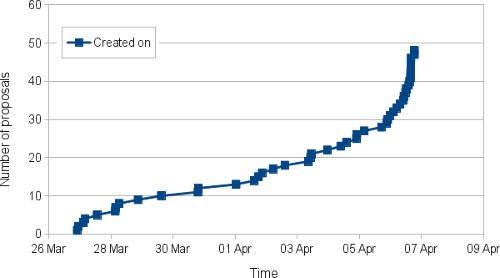
A few weeks have passed since SHOGUN has been accepted for Google Summer of Code 2012. Student application deadline was Easter Friday (April 6) and shogun received 48 proposals from 38 students. Some more detailed stats can be found in the figure below. This is a drastic drop compared with last year (about 60 students submitted 70 proposals). However, this drop can easily be explained: To even apply we required a small patch, which is a big hurdle.
  1. One has to get shogun to compile (possibly only easy under debian; for cygwin/MacOSX you have to invest quite some time to even get all of its dependencies).
  2. One has to become familiar with git, github and learn how to issue a pull request.
  3. And finally understand enough of machine learning, shogun's source code to be able to fix a bug or implement some baseline machine learning method
Nevertheless, about a dozen of proposals didn't come with a patch (even though written on the instructions page that this is required) - an easy reject. In the end the quality of proposals increased a lot and we have many very strong candidates this year. Now we will have to wait to see how many slots we will receive before we can finally start the fun :-)

Russell Coker: Guest/Link Post Spam

I ve been getting a lot of spam recently from people wanting to write guest posts or have their site included in a future links post. Guest Posts For guest posts the social convention for the planets which aggregate my blog seems to be that random guest posts are unacceptable. I could change my blog feed to have some posts excluded from the planet feeds but that s too much effort and I don t want random guest posts anyway. The only situations in which I will accept guest posts are when someone is writing what I might have written (IE they generally agree with me) or if they are a member of the free software community who doesn t have their own blog but has something relevant to say. Any applicant for a guest post who runs a business that is useless and/or evil IMHO (EG anything related to the TSA) is going to get rejected firmly. Any applicant who tells me that they can write on a wide variety of topics probably isn t capable of making me an offer that I would accept. Tell me that you can write about Linux programming or computer security and I ll be interested, but you have to provide links to your previous work. An application to write a guest post that starts with something like I liked your recent post at the above URL but I think you missed some important points, as I have some experience in that field I think I could write a guest post that would help educate your readers may be accepted. Probably the best thing to do however is to write comments on my blog, if you can write informative comments and offer to make a longer comment into a guest post then there s a good chance that I ll be interested. Generally though I will only offer the opportunity to write a guest post to someone who writes something really informative in private email or on a closed mailing list. If you can solve a technical problem about Linux that has me stumped then I will almost certainly be willing to accept a guest post about it! Links Posts There are many sites which consist of nothing but links to other sites. In the 90 s such sites were really useful but since the rise of Google their value has declined dramatically. As an aside when I ran an Internet Cafe in the 90 s I had every web browser start with the main page of my Hot Stuff list, the purpose of this was to increase the hit rate of my Squid cache by having most of the customers visit the same sites. Even back then I probably wouldn t have bothered if it wasn t for Squid hits. It must seem like an easy way to make money to create pages of links to articles with short summaries and then hope for advertising revenue, a domain sale, or the launch of some sort of profitable business once people start using the site. I wonder whether that ever works out for people. It doesn t seem like a good business model, doing something that requires little skill, which can be done by almost anyone, and which is done by many people. Maybe there are sweat-shops dedicated to this. Anyway my links posts are unlikely to ever link to any such links pages, I don t think that the people who read my blog want double indirection. I won t entirely rule out linking to a links page, but it would have to be of very high quality and related to something very technical about computers. Basically anyone who reads this should give up on the idea of submitting a links page to me, if it s good enough to make me break my policy of not linking to such things then I ll probably find it myself. Conclusion As a general rule if you want someone to publish your work then you need to look at what they are publishing and make sure that your work fits. With the recent requests for links and guest posts I ve been getting I have to wonder whether the people making the requests have even read my blog. That method of operating is unlikely to give any success at a blog that has any reasonable number of readers. I ll probably link to this from my about page or something. It might discourage some of the spammers. Related posts:
  1. Link Within Good Things about LinkWithin For the last 10 weeks I ve...
  2. Feedburner Item Link Clicks For a while I used the Item Link Clicks feature...
  3. Can you run SE Linux on a Xen Guest? I was asked Can you run SELinux on a XEN...

Christian Perrier: Languages to be deactivated in Debian Installer (take 2)

My last call, a bit alarming about some languages becoming candidates for being deactivated in D-I had some results. A few teams updated at least sublevels 1 and 2 so that their language is "safe". Still, If I follow the policy we chose in D-I, I should deactivate languages that are not complete for what we call "sublevel 1" and "sublevel 2" in code Debian Installer. At this very moment, it means that I would deactivate (stats in parenthesis are those in these sublevels, respectively): That's way too many. So, before I blog everywhere that "Debian is dying" because I have to deactivate 20 languages in the installer...or before I blog that "Ubuntu steals our translators" (which is somehow true now, as half, if not more, of active translators are indeed interested in the Ubuntu installer to be translated, not the Debian one)....do something...or the Ubuntu installer will have 20 less languages..:-)

Steve Kemp: Bye-bye AOL

Today I took that final step:
touch /srv/_global_/blacklisted/domains/aol.com
I remember, even a couple of years ago, I had friends who would mail me from their @aol.com email addresses. These days people have moved on. The two single biggest mail-providers I see in terms of spam are: I'd like to drop @yahoo.com but I have some (misguided) friends who continue to use it to mail me. I might start dropping non-friend mails from that domain, but that's a bigger job. Yes, this is a dull entry. Sorry. My existing bathroom has been ripped out and turned into this as a stepping stone into its new incarnation. I'm trapped in my office. Dust almost everywhere. Noise everywhere else. ObQuote: "There can be no understanding between the hand and the brain unless the heart acts as mediator. " - Metropolis

Christian Perrier: I'm going to DebConf12

I just booked my flights for going to Managua next July. I'll be leaving Paris on July 2nd, fly through Atlanta with Air France, then connect to Delta to Managua. A fairly simple trip that allows me to use my Air France miles..:-) Elisabeth, my wife, will join in Managua around July 14th, then we'll spend two weeks visiting Nicaragua and leave back home on July 31st. That will be a wonderful trip. See you in MGA!

Christian Perrier: QA on D-I translations

Today, I did a big bunch of QA fixes on Debian Installer translations. The D-I "spellchecker", written years ago by Davide Viti, is still functional and very helpful to spot obvious mistakes. You can find its results here. Feel free to check your own language, particularly for "unknown words" (wrt aspell spellcheckers). There are many false positives (the spellcheck has the concept of exceptions for this, which explains why French has 0 errors...), but the spellchecker can already spot many typos and minor spelling errors. It also spots wrongly written variables, unbalanced quotes and parenthesis and a few other minor things.

Craig Sanders: getting the terminal size in python

I m finally getting around to making myself learn python as more than just a read-only language. Working with Openstack kind of requires it. So far, I like it. Much more than I thought I would as an unrepentant sh and perl using systems geek. And getting over my distaste for the white-space issue is also proving to be much easier than I thought it would (although I still think that block-delimiters like make the code easier to read PyHeresy, I know) While hacking the /usr/bin/glance command to have less ugly output, and adding a csv option to list the image index in a usefully parseable format, I needed to figure out how to get the terminal size (height,width). This, cobbled together from various google search results, seems to work. It s probably not strictly-correct python idiom, and there s probably a better way of doing it. Comments and critique are welcome.
def get_terminal_size(fd=1):
    """
    Returns height and width of current terminal. First tries to get
    size via termios.TIOCGWINSZ, then from environment. Defaults to 25
    lines x 80 columns if both methods fail.
 
    :param fd: file descriptor (default: 1=stdout)
    """
    try:
        import fcntl, termios, struct
        hw = struct.unpack('hh', fcntl.ioctl(fd, termios.TIOCGWINSZ, '1234'))
    except:
        try:
            hw = (os.environ['LINES'], os.environ['COLUMNS'])
        except:  
            hw = (25, 80)
 
    return hw
 
def get_terminal_height(fd=1):
    """
    Returns height of terminal if it is a tty, 999 otherwise
 
    :param fd: file descriptor (default: 1=stdout)
    """
    if os.isatty(fd):
        height = get_terminal_size(fd)[0]
    else:
        height = 999
 
    return height
 
def get_terminal_width(fd=1):
    """
    Returns width of terminal if it is a tty, 999 otherwise
 
    :param fd: file descriptor (default: 1=stdout)
    """
    if os.isatty(fd):
        width = get_terminal_size(fd)[1]
    else:
        width = 999
 
    return width
getting the terminal size in python is a post from: Errata

Gunnar Wolf: Xilitla

On this Semana Santa (holy/major week), Regina and I took a little vacation: We went ~400Km North, to the magical Xilitla, in the Eastern part of San Luis Potos state. To get there, we went by the Sierra Gorda de Quer taro route: A beautiful but quite hard to drive road, crossing desert, forest and jungle through a very steep mountain ridge. What does hard to drive mean? It means that for ~200Km we had a speed average of 40-50Km/h. The road is in very good conditions, and traffic was quite light. And although our plans were to come back via the other ridge road (crossing Hidalgo state instead of Quer taro), we were persuaded to go the long way instead: We came back via San Luis Potos city, making ~700Km instead of ~400, but I'll concede it was a much easier drive. But although I take the road as an important part of the vacation, and although it was a very quick vacation, what is it we went to see there? Xilitla is a town at the beginning of the huasteca potosina region, with really exuberant vegetation, that captured Sir Edward James' heart back in the 1940s. Sir Edward, a noble Englishman, was good friends with several surrealist artists, and became one himself. After moving to Xilitla and buying an impressive chunk of jungle, in the 1960s he started building a surrealist garden in the middle of the jungle, which he continued to work on until his death, in 1984. We took some pictures, but of course, they pay very little tribute to the magic and beauty of the place. And going to the huasteca means going to places of nature, of many crystaline rivers. Yes, only three days (two of them spent getting there and back) are far too little to enjoy it. But even so, we went to the birth of river Huichihuay n (~45 minutes North of Xilitla) and to the Los Micos waterfalls (~20 minutes West of Ciudad Valles). Very nice places to visit, among so many others. We should go back to the huasteca soon! I uploaded many of the pictures here. They will not be syndicated on the planets that follow my blog on RSS (or for individuals following RSS, FWIW), but you will find them following the relevant links. And of course: I pay for a very cheap package on my hosting provider. Drupal often answers with an error page when the server is (even mildly) overloaded. So, feel free to hit reload if something appears unavailable.

8 April 2012

Richard Hartmann: Richuck

Q: How much wood would a Richuck chuck if a Richuck could chuck wood? A: Quite a bit. The few times in the past when I was able to get my hands onto a tree or three, I thoroughly enjoyed turning them into firewood. It's good workout, you get fresh air, and you can actually see what you accomplished with your hands. Back then, I had access to a hatchet, a felling axe and a single wedge. Splitting anything larger than 20 or 30 cm in diameter was tedious work, though still enjoyable. Two weeks ago, I was presented with several cubic meters of spruce; log diameters ranging in between 10 and 50 cm, pre-cut to two meters in length. Plus, access to a chainsaw. Yay. After some research, I ordered two helicoidal splitting wedges (they turn themselves when driven into wood), a splitting axe and a splitting maul. The rest of the equipment handed to me is probably older than I am, but still working perfectly fine. You have to admire the simple yet efficient design of the cant hook. Something I could not find an English name for is the German Sapie, in itself loosely defined as "any tool you can use to pick up, turn, drag or otherwise move logs". There's a surprising variety of these tools, but then, moving wood around has been a necessity of life for millennia so people are bound to come up with good designs. Last weekend, the chainsaw wasn't running very smoothly or much at all, resulting in hours spent coaxing it to cut at least enough for some hacking (the wood, not the computer kind). Other than our chainsaw troubles, that weekend was very pleasant and I ended up splitting tons of logs. We had the chainsaw overhauled and resharpened during the week and picked it up again on Friday, planning to resume cutting early Saturday, a plan that was spoiled by torrential downpour and hail. In the afternoon, I started splitting some left-overs around the house and used a short break from the rain to head out into the woods to where the logs are piled. The place I chose for splitting is somewhat exposed and even though the mix of rain, sleet, snow, hail, and everything in between resumed soon enough turns out you simply stop caring at some point. While temperatures were around freezing, I ended up being drenched in sweat in no time at all. There is something primordial and deeply satisfying about simply working away at these logs, ending with piles and piles of firewood. Of course, using my favourite new toy, 4.6 kg of forged stainless steel fuck you, increased said satisfaction immensely. Between the two wedges and that maul, splitting any middle-European conifers is a breeze. Add in the splitting axe for slim trunks and splitting will take less than 60 seconds per cut, no matter how many branch knots or pockets of shock-absorbing partially decayed wood you encounter. If only I've had those tools a decade and a half ago... While I am feeling muscles I forgot I had, I am planning to pursue this new-found old hobby for at least the foreseeable future. Especially since I sourced more logs and a few trees, already.

Gregor Herrmann: RC bugs 2012/14

good news: it looks like more & more people are working on RC bugs & doing NMUs. here are my contributions from this week:

Christian Perrier: Fun with ISO 3166-2 codes

I'm currently updating the ISO-3166-2 list in the iso-codes package. This is the list of countries subdivisions and official codes for these subdivisions. The funny part is that I just updated the names of states of India, some of them being often (much) more populated than most countries in the world : Maharashtra, Tamil Nadu, Andhra Pradesh, etc. And some of them larger than most countries in the world. And a few minutes after, I end up adding the 17 "quarters" of the city of Monaco. Yes, Monaco, one of the smallest countries in the world, has official subdivisions or "quartiers": Real fun..:-). And the funny part is that all this is translatable..:-)

Christian Perrier: 2012 update 19 for Debian Installer localization

Status for D-I level 1 (core D-I files): Status for D-I level 2 (packages that have localized material that may appear during default installs, such as iso-codes, tasksel, etc.): Status for D-I level 3 (packages that have localized material that may appear during non-default installs, such as win32-loader) Full 100% completeness (hall of fame) for 21 languages: Belarusian, Bulgarian, Catalan, Czech, German, Esperanto, Spanish, French, Indonesian, Italian, Japanese, Kazakh, Khmer, Dutch, Polish, Portuguese, Russian, Slovak, Swedish, Turkish, Simplified Chinese

Tim Retout: Bye, Mark.

I've finally got around to deleting my Facebook account. I'd love to claim that this was a grand gesture against privacy-invading apps, or a bid to recoup vast amounts of my spare time... but it's not, really. I rarely logged in to the site, these days, so Facebook has very little of my personal data.

Luca Falavigna: Spam review: mass-tagging nominations

If you are one of those brave souls chasing off spam from Debian mailing lists, you will probably get bored of clicking on the Spam radio buttons a lot of times, and will probably look for a quick shortcut. I submitted a patch in bug #640309, but as of today, it has not been applied yet. Waiting for the patch to be applied, I prepared a little Greasemonkey script called Debian Mass Spam that allows to mark every message as Unsure , Ham , Inappropriate , or Spam by clicking the correspondent key on the keyboard: Spam review Just press Z (for Unsure ), X (for Ham ), C (for Inappropriate ), or V (for Spam ), and you will see every radio button to change its status. I tested it on Chromium, Iceweasel (with xul-ext-greasemonkey package) and Epiphany (with epiphany-extensions package), and it seems to work properly. Too many words and no actions so far, go and kill some spam now! ;)

Olly Betts: Xapian GSoC Applications for 2012

Student applications for GSoC closed a day or so ago, and we've done an initial pass through Xapian's applications, so I thought I should post another overview, similar to last year's. We received a total of 41 applications this year (very close to last year's total of 42). Here's a graph of applications against time: Graph of student applications to Xapian in GSoC 2012 If you're an admin or a mentor, you can produce a similar graph for your own org(s) - just download this OpenDocument spreadsheet and follow the instructions inside. That total of 41 includes one duplicate and one application withdrawn by the student (we had one of each last year too). I've also gone through and marked nine spam proposals as invalid (similar to the seven we had last year). Spam proposals are things like proposals with no connection at all to Xapian, and proposals which are just a title and/or paste from our ideas list with a generic biography. So that leaves us with 30 proposals (compared to 33 last year). It's hard to really measure, but my feeling is that the average quality is higher than last year (and it was already pretty impressive last year).

Lars Wirzenius: What is a Linux distribution?

I got into a discussion recently about what a Linux distribution actually is. To some people, a distro is just a convenient way of source of binaries from which to pick what you install, either on your own computer or when creating an embedded system, or some other specific kind of system. To others it's a way of life, and the realization of the ideals of software freedom. To yet others, a distro is an outdated concept that will go away in the near-ish future, to be replaced by ... something. Here's my take: a Linux distribution is defined by the following things: Historically, there has been a lot of variation in all aspects mentioned above. Some of this variation may today be unnecessary. For example, it might be helpful for more distributions to share work on common tools, so that not everyone needs to re-invent and re-implement the same kinds of tools. However, my gut feeling is that due to the inherent interconnectedness of all things, it may be very difficult to have one set of tools to support well all workflows, policies, processes, and communities. The most important differentiating factors between the various distros are not the tools, but the community values, the perceived purpose of the distro, and the resultant criteria for choosing what to include and the workflow for developing the distro. Even when two distros use the same tools, there can be a lot of difference in the end result. Fedora and RHEL, for example, use a lot of the same infrastructure, but their purpose is entirely different. Debian and Ubuntu use mostly the same packages, even, and still there's a huge difference between the two distros: one aims at a high quality system based on free software, the other aims to support the business of one particular company. For this reason, there will always be a lot of Linux distributions around, and that is good.

Ingo Juergensmann: Grub2 fails booting from second VG

I just got a new harddisk, because my old RAID of 3x 1 TB disks are getting filled and I'm running out of space. In the end I'll have replaced my old disks by 3x 4 TB disks. Currently the setup is as this:
Kategorie:

Russell Coker: Flash Storage Update

Last month I wrote about using USB flash storage devices for my firewall and Squid proxy [1]. 4 days ago it failed, the USB device used for the root filesystem stopped accepting write requests. The USB device which is used for /var/spool/squid is still going well after almost 5 months of intensive use while the USB device for the root filesystem failed after 24 days of light use. Both USB devices were of the same model and were obtained at the same time. Presumably one of them was just defective. I m now using an old 1G USB device for the root filesystem. When using it on less ancient systems with USB 2.0 there was an obvious speed difference between the 1GB and 4GB devices. But when run on USB 1.2 they can both support the maximum speed of the port so performance probably isn t any worse. Not that it really matters for the root filesystem, the server is supposed to run without a break for long periods of time so if boot time becomes a performance issue then whatever is causing the reboots will be a much bigger problem. It s annoying to have a device fail and the failure rate for USB flash devices running 24*7 is looking rather bad at the moment. But I m confident that things will run well from now on. Related posts:
  1. USB Flash Storage For some years I have had my Internet gateway/firewall system...
  2. flash for main storage I was in a discussion about flash on a closed...
  3. Flash Storage and Servers In the comments on my post about the Dell PowerEdge...

Next.

Previous.