Search Results: "ag"

13 April 2012

Wouter Verhelst: On PHP

This dude nails it. Well, almost can't say I agree with the python bit. But other than that, yeah, pretty much what's wrong with PHP. (Add that to what google seems to consider my most popular bit of code, ever, and, well, hmpf).

Lucas Nussbaum: Update of Debian Packaging Tutorial

I ve just updated the Debian Packaging Tutorial. This new version addresses a few comments and questions I received over the past months. Note that there are also french and spanish versions of the tutorial, and I m of course open to adding other translations. The tutorial can be found in the packaging-tutorial package (PDF files are in /usr/share/doc/packaging-tutorial/), or on www.debian.org (see links above).

Martin F. Krafft: Mouse on Mars

The atmosphere in Munich s Backstage Werk just before the opening act to the Mouse on Mars was very chilled. People sat on the stairs or scattered themselves over the dance floor while low-fi ambient tunes came from the speakers. It wasn t loud, you had to try hard to hear the people mumble. I have no idea who the opening act was, and their first tune was very nice and groovy. Then ensued a noise explosion, one could only pity the electronic equipment that was being asked to perform in ways that may be described as everything else than you expect , and of course, the base beat shook the building; I am quite sure they didn t use treble at all, but I may also simply have been unable to hear it. Plus, it seemed to us that the musicians catered for what may be a widespread decrease of attention span: it was noticable how they jumped from one thing to the next, not leaving them (or their listeners) any time to get in the groove. My brother and I went outside for a bit and talked about today s music and its simplicity. We postulated the repetitiveness as the basis of a mass movement, considered scene clubs that played heavy techno to an audience that is so entirely different to who historically frequented such musical performances, and in general tried to avoid assuming a position between simplifying society and accepting that individual freedom is as eclectic as can be. When MoM opened, they continued pretty much in line with their openers and half way through the first tune, I started to wonder how long I would last, or when it would be reasonable to step outside again. I had been a little afraid this would happen, having bought and listened to their latest album Parastrophics in preparation of the concert and not being able to get into it. However, what then followed blew us away. Still heavy, still all over the place, but now they were developing sound scenes, ripping them apart, having fun playing with and teasing the audience, while putting on a groove that inevitably made your muscles twitch with the beat. David Bowie called MoM the next big thing and I have to give it to them: MoM have always had a certain aura of that s what your music is like? we can improve on that! to them, and yesterday, they continued along those lines with astounding consistency, and it felt fresh. It also felt real. They weren t just pushing buttons and computers making music, they were making music and the computers were their instruments. Between the two founding members of MoM sat Dodo Nkishi, drummer and microphone artist, and if you don t believe, fast, big breakbeat can be performed live, well, you re wrong. Most everyone in the room was dancing. And while I was more swaying in awe, watching and wondering how the heck they are doing what they are doing, I couldn t contain the bouncing any longer. They came back for an encore and there was no more stopping the crowd, Thomas or me. Three tracks later, they waved goodbye and left, but a bunch of us simply continued to dance. Thomas questioned who would last longer and I started yelling loudly for another encore. The lights turned on, I considered it a slap in the face, but I did not stop yelling. Others tuned in. And then the lights went off and the band came back. Following their 2.5 hour show, gosh was I exhausted. It was a magnificent show. If you aren t afraid of big beat electronica and you take pleasure in nonstandard art, I heartily recommend you ensure that MoM aren t soon playing near you without you there. PS: MoM will play at the (D sseldorf Open-Source Festival)[http://www.open-source-festival.de/en/] on 30 June 2012! PPS: Now I listen to Parastrophics and I am really enjoying it. NP: Mouse on Mars: Parastrophics

12 April 2012

Dirk Eddelbuettel: RcppArmadillo 0.3.0.1 released and on CRAN

Conrad Sanderson released a bug-fix version 3.0.1 following up on the very recent 3.0.0 version of his excellent Armadillo C++ template library for linear algebra. I made a new RcppArmadillo release 0.3.0.1 which just appeared on CRAN. The short NEWS entry follows below.
0.3.0.1 2012-04-12
    o   Upgraded to Armadillo release 3.0.1
          * fixes for compilation errors
          * fixes for potential aliasing issues
Courtesy of CRANberries, there is also a diffstat report for 0.3.0.1 relative to 0.3.0 As always, more detailed information is on the RcppArmadillo page. Questions, comments etc should go to the rcpp-devel mailing list off the R-Forge page.

Tanguy Ortolo: Why www. ?

Three big  W s in shades of green Many websites have addresses that use a www.- prefix. Some people are encouraging this practice, other are advising against it. I, for one, think this prefix makes sense and is really useful, so here is an explanation of my opinion. In a nutshell: the Wold Wide Web is one Internet service among many other such as domain name, mail, mailboxes or instant messenging; using a dedicated prefix allows to distribute all these services to specific servers in a convenient way.On Internet, you can expose several services, the most common being domain names (DNS), websites (HTTP), incoming mail (SMTP), outgoing mail submission (submission), mailbox fetching (POP) or consultating (IMAP) and instant messenging (XMPP). Constraints Modern Internet services can have constraints such as load balancing, failover and most importantly the possibility to use specific servers for each service instead of having all of them on the same server. Dedicated records Some service were designed or revised to take these contraints into account; this include the domain name, incoming mail and instant messenging, by using dedicated DNS records:
example.com.                    NS              roquefort.example.com.
example.com.                    MX  10          morbier.example.com.
_xmpp-server._tcp.example.com.  SRV 10 100 5269 morbier.example.com.
In that example, the name service of example.com. is provided by the server Roquefort while the incoming mail and instant messenging service are provided by Morbier Dedicated prefixes On the contrary, some services were not designed to take these constraint into account, and may be too fossilized to be revised for that; this includes the Web and mailbox service. A convenient way to work around the antiquated design of these services is to use a well known prefix:
www.example.com.                CNAME           ossau-iraty.example.com.
smtp.example.com.               CNAME           morbier.example.com.
pop.example.com.                CNAME           morbier.example.com.
imap.example.com.               CNAME           morbier.example.com.
In that example, the Web service of example.com. is provided by the server Ossay-Iraty while the email submission and mailbox services are provided by Morbier. Readability and flexibility Using dedicated records and prefixes increases the consistency and readability of a DNS zone, since it allows to refer to the servers by their canonical host name, and to define their IP addresses once and for all:
; Services
example.com.                    NS              roquefort.example.com.
example.com.                    MX  10          morbier.example.com.
pop.example.com.                CNAME           morbier.example.com.
imap.example.com.               CNAME           morbier.example.com.
www.example.com.                CNAME           ossau-iraty.example.com.
; Hosts
roquefort.example.com.          A               192.2.0.12
                                AAAA            2001:db8::12
morbier.example.com             A               192.2.0.42
                                AAAA            2001:db8::42
ossau-iraty.example.com.        A               192.2.0.51
                                AAAA            2001:db8::51
You can think of that practice as connecting dots between services and hosts:
name service    Roquefort
incoming mail   Morbier
mailboxes         Ossau-Iraty
website        
With such a DNS zone, it is very easy to identify which server is hosting each service. Using host names rather than IP addresses multiple times reduces the information duplication, which in turn facilitates future chances and reduces the risk of error (it is easier to swith the website from Ossay-Iraty to Morbier than from 192.2.0.51/2001:db8::51 to 192.2.0.42/2001:db8::42).

DebConf team: Registration open for DebConf12 (Posted by Leandro Gomez)

The Debian Project is pleased to announce that registration is now open for DebConf12, which will take place in Managua, Nicaragua, from Sunday 8 July to Saturday 14 July 2012. The conference will be preceded as usual by one week of DebCamp, from Sunday 1 July to Saturday 7 July. As previous years, three different registration options will be available: Sponsored, Professional and Corporate. Through the Sponsored category, the Debian Project intend to help some people attend who would not be able to pay for their own travel to DebConf. The Corporate category, with a USD 1300 (EUR 1000) registration fee is intended for those attending DebConf as representatives of companies. The Professional category, with a USD 650 (EUR 500) registration fee, is intended for any individual or company who wants to help the conference by paying the direct costs of their attendence. It will only be possible to apply for food and accommodation grants and/or travel grants until 15 May. For more detailed information about how to register, please see the separate announcement from the DebConf team. Call for papers Debian invites submissions of proposals for papers, presentations, discussion sessions and tutorials for its DebConf12 conference. Submissions are not limited to raditional talks: you could propose a performance, art installation, debate, or anything else. Official submissions will be accepted until 1 June 2012, 23:59 UTC. This year, we will continue to organize some talks into thematic tracks. If you have a proposal for a DebConf track, please contact <debconf-team@lists.debconf.org>. Previous examples included Debian Science, Debian Infrastructure, and Community Outreach tracks. If you would like to be a track coordinator, please volunteer on that list. Detailed information on how to submit an event are available on the mail from the DebConf team.

DebConf team: DebConf12 dates announced (Posted by Norman Garcia)

The DebConf team just sent out a press release announcing the dates for DebConf12 in Nicaragua. We hope to see many of you there!

Thomas Koch: No more self-hosting

A few years ago I started to run my own server. This was an interesting challenge back then but today I only consider it a waste of time and money. Therefore I'm searching for (a) service provider(s) to substitute my self hosted applications:

However I'm a bit insane about privacy, security and reliability. I simply want to be able to TRUST. This rules out IMHO: Google, Github, Yahoo. On the other hand I'd probably be prepared to pay an insane monthly fee for a provider that just keeps me happy.

I'd love to here your recommendations! I'm especially interested in providers that are organized as cooperatives and care about environmental issues.

Do I need to mention free software? An extra plus would be a healthy distaste for PHP.

some cooperative-style provider initiatives that I still need to evaluate:

Michal &#268;iha&#345;: phpMyAdmin needs you

phpMyAdmin is very popular tool, but for whatever reason number of contributors is not that high as you would expect in such famous project. We're not looking only for developers, basically anybody can help! Working with phpMyAdmin will give you great opportunity to participate in one of most popular free software projects (we're constantly ranked in 20 most downloaded projects on SourceForge.net for many years). You can learn a lot and extend your knowledge by cooperating with other skilled people. And of course you can use this reference in your resume :-). So how you can help? You can help with translating, writing documentation, creating video tutorials, bug screening or coding. You can see all possibilities in more details on our website.

Filed under: English Phpmyadmin 3 comments Flattr this!

Paul Tagliamonte: GeoParse update

I ve thrown a bit of work at the wall, and some of it stuck. I ve been working (slowly) on GeoParse, which is a (hopefully pythonic) library to clean, pamper, separate and really dig into fairly low-quality GPS data (like, say, from Google Latitude) Just the basics are in place now, but work s slowly progressing. Hopefully, I should have something workable in the short-term future.

11 April 2012

Tim Retout: Weekend of change

Agile processes harness change for the customer's competitive advantage. Principles behind the Agile Manifesto
After two and a half years at Smoothwall, I'm moving on - Friday is my last day. Since I joined the development team, we have adopted Agile development, set up a pretty nifty Gerrit/Jenkins code review + integration system, and introduced dpkg for package management. Along the way, I helped with a bunch of important features for the business, like a ground-up rewrite of the web filter, and time-based browsing usage quotas. I will be starting at CV-Library on Monday, for a whole new set of challenges. They're based in Fleet, so I'll have an hour-long commute each way on the train. I've been assured by an expert in these matters that facilitating wage slavery is a comparatively more ethical pursuit than facilitating internet censorship. :) To make the commute somewhat more bearable, I'm moving house on Saturday. So far, the packing's going quite well...

Erich Schubert: Are likes still worth anything?

When Facebook became "the next big thing", you had the "like" buttons pop up on various web sites. An of course "going viral" was the big thing everybody talked about, in particular SEO experts (or those that would like to be that).
But things have changed. In particular Facebook has. In the beginning, any "like" would be announced in the newsfeed to all your friends. This was what allowed likes to go viral, when your friends re-liked the link. This is what made it attractive to have like buttons on your web pages. (Note that I'm not referring to "likes" of a single Facebook post; they are something quite different!)
Once that everybody "knew" how important this was, everbody tried to make the most out of it. In particular scammers, viruses and SEO people. Every other day, some clickjacking application would flood Facebook with likes. Every backwater website was trying to get more audience by getting "liked". But at some point Facebook just stopped showing "likes". This is not bad. It is the obvious reaction when people get too annoyed by the constant "like spam". Facebook had to put an end to this.

But now that a "like" is pretty much worthless (in my opinion). Still, many people following "SEO Tutorials" are all crazy about likes. Instead, we should reconsider whether we really want to slow down our site loading by having like buttons on every page. A like button is not as lightweight as you might think it is. It's a complex JavaScript that tries to detect clickjacking attacks, and in fact invades your users' privacy, up to the point where for example in Germany it may even be illegal to use the Facebook like button on a web site.
In a few months, the SEO people will realize that the "like"s are a fad now, and will likely all try to jump the Google+ bandwagon. Google+ is probably not half as much a "dud" as many think it is (because their friends are still on Facebook and because you cannot scribble birthday wishes on a wall in Google+). The point is that Google can actually use the "+1" likes to improve everyday search results. Google for something a friend liked, and it will show up higher in the search results, and Google will show the friend who recommended it. Facebook cannot do this, because it is not a search engine (well, you can use it for searching people, although Ark probably is better at this, and one does nowhere search as many people as one does regular web searches). Unless they go into a strong partnership with Microsoft Bing or Yahoo, the "like"s can never be as important as Google "+1" likes. So don't underestimate the Google+ strategy on the long run.
There are more points where Facebook by now is much less useful as it used to be. For example event invitations. When Facebook was in full growth, you could essentially invite all your friends to your events. You could also use lists to organize your friends, and invite only the appropriate subset, if you cared enough. The problem again was: nobody cared enough. Everybody would just invite all their friends, and you would end up getting "invitation spam" several times a day. So again Facebook had to change and limit the invitation capabilities. You can no longer invite all, or even just all on one particular list. There are some tools and tricks that can work around this to some extend, but once everybody uses that, Facebook will just have to cut it down even further.
Similarly, you might remember "superpoke" and all the "gift" applications. Facebook (and the app makers) probably made a fortune on them with premium pokes and gifts. But then this too reached a level that started to annoy the users, so they had to cut down the ability of applications to post to walls. And boom, this segment essentially imploded. I havn't seen numbers on Facebook gaming, and I figure that by doing some special setup for the games Facebook managed to keep them somewhat happy. But many will remember the time when the newsfeed would be full of Farmville and Mafia Wars crap ... it just does no longer work this way.

So when working with Facebook and such, you really need to be on the move. Right now it seems that groups and applications are more useful to get that viral dream going. A couple of apps such as Yahoo currently require you to install their app (which then may post to your wall on your behalf and get your personal information!) to follow a link shared this way, and then can actively encourage you to reshare. And messages sent to a "Facebook group" are more likely to reach people that aren't direct friends of yours. When friends actually "join" an event, this is currently showing up in the news feed. But all of this can change with 0 days notice.
It will be interesting to see if Facebook can on the long run keep up with Googles ability to integrate the +1 likes into search results. It probably takes just a few success stories in the SEO community to become the "next big thing" in SEO to get +1 instead of Facebook likes. Then Google just has to wait for them to virally spread +1 adoption. Google can wait - its Google Plus growth rates aren't bad, and they have a working business model already that doesn't rely on the extra growth - they are big already and make good profits.
Facebook however is walking on a surprisingly thin line. They need a tight control on the amount of data shared (which is probably why they try to do this with "magic"). People don't want to have the impression that Facebook is hiding something from them (although it is in fact suppressing a huge part of your friends activity!), but they also don't want to get all this data spammed onto them. And in particular, it needs to give the web publishers and app developers the right amount of that extra access to the users, while in turn keeping the major spam away from the users.

Independent of the technology and actual products, it will be really interesting to see if we manage to find some way to keep the balance in "social" one-to-many communication right. It's not a fault of Facebook that many people "spam" all their friends with all their "data". Googles Circles probably isn't the final answer either. The reason why email still works rather well was probably because it makes one-to-one communication easier than one-to-many, because it isn't realtime, and because people expect you to put enough effort into composing your mails and choosing the right receipients for the message. Current "social" communication is pretty much posting everything to everyone you know adressed as "to whoever it may concern". Much of it is in fact pretty non-personal or even non-social. We have definitely reached the point where more data is shared than is being read. Twitter is probably the most extreme example of a "write-only" medium. The average number a tweet is read by a human except the original poster must be way below 1, and definitely much less than the average number of "followers".
So in the end, the answer may actually be a good automatic address book, with automatic groups and rich clients, to enable everybody to easily use email more efficiently. On the other hand, separting "serious" communication from "entertainment" communication may be well worth having a separate communications channel, and email definitely is dated and is having spam problems.

Guido G nther: Bits from the 5th Debian Groupware Meeting

This went out to d-d-a already but I figured that this might be of interest here too: The fifth Debian Groupware Meeting was held in the LinuxHotel, Essen, Germany. Eight persons attended which is an all time high! This is a short summary of what happened during the weekend:

Dirk Eddelbuettel: RcppArmadillo 0.3.0 is now on CRAN

Conrad Sanderson has released a new major version 3.0.0 of his excellent Armadillo C++ template library for linear algebra. A corresponding new release 0.3.0 of RcppArmadillo is now on CRAN. This follows four pre-releases of Armadillo which we packaged as before, but for reasons detailed in another post did not send to CRAN. All that said, here are the NEWS entries for all release since the last non-test release:
0.3.0   2012-04-10
    o   Upgraded to Armadillo release 3.0.0 "Antarctic Chilli Ranch"
          * added non-contiguous submatrix views
          * added shorthand for inverse: .i()
          * added hist() and histc()
          * faster repmat()
          * faster handling of submatrix views with one row or column 
          * faster generation of random numbers
          * faster element access in fixed size matrices
          * better detection of vector expressions by sum(), cumsum(),
            prod(), min(), max(), mean(), median(), stddev(), var() 
          * expressions X=A.i()*B and X=inv(A)*B are automatically converted
            to X=solve(A,B) 
0.2.40  2012-04-04
    o   Upgraded to Armadillo release 2.99.4 "Antarctic Chilli Ranch (Beta 4)"
          * fixes for handling expressions with fixed size matrices
0.2.39  2012-04-02
    o   Upgraded to Armadillo release 2.99.3 "Antarctic Chilli Ranch (Beta 3)"
          * faster repmat()
          * workarounds for braindead compilers (eg. Visual Studio)
0.2.38  2012-03-28
    o   Upgraded to Armadillo release 2.99.2 "Antarctic Chilli Ranch (Beta 2)"
          * added .i()
          * much faster handling of .col() and .row()
          * expressions X=A.i()*B and X=inv(A)*B are automatically converted
            to X=solve(A,B) 
0.2.37  2012-03-19
    o   Upgraded to Armadillo release 2.99.1 "Antarctic Chilli Ranch (Beta 1)"
          * added non-contiguous submatrix views
          * added hist() and histc()
          * faster handling of submatrix views
          * faster generation of random numbers
          * faster element access in fixed size matrices
          * better detection of vector expressions by sum(), cumsum(),
            prod(), min(), max(), mean(), median(), stddev(), var() 
Courtesy of CRANberries, there is also a diffstat report for 0.3.0 relative to 0.2.36 As always, more detailed information is on the RcppArmadillo page. Questions, comments etc should go to the rcpp-devel mailing list off the R-Forge page.

Craig Sanders: comments working again

how embarassing, i make a point of asking for comments and critique on my previous post but comments didn't actually work unless you're logged in. I only noticed because someone emailed me. It was the admin-ssl plugin. de-activated now, so comments are working again. A few people tried to add comments according to the log if you feel like making them again, go right ahead. thanks Craig comments working again is a post from: Errata

10 April 2012

Anand Kumria: The state of Django money.

Updated (2012-04-11): Now contains the final and correct pip install command. TL;DR: pip install django-money will give you a working set of Django fields that handle Money and Currency. Read below for how that happened. I began this Easter weekend trying to finish up one of my pet-projects and get it ready to publish. The goal of the website is to compare providers, of the same thing, from around the world. Representing prices is simple. A float will do if you are in a hurry. Except. When you need to perform calculations and you run into rounding errors. At that point you will likely discover the Decimal module. Which also works perfectly fine. And if you only ever deal in a single market that is fine. But across markets? That requires Money. Money is normally defined as a value and currency. Once you have both of those, you can then do cross-market comparison and upgrade you program to handle multi-currency easily. I hoped that I was not the only person who had realised this, so I started to look around. And I struck gold! I found Python Money. It even included appropriate Django fields as well. Unfortunately it had had no updates since 2008. . Worse it didn't work so well. I continued my search. I kept on looking and found Django Money. Even better. This separated out the Django support and the Python support. It turned out Jakewin's py-moneyed was actually a fork of Limist's py-moneyed. So I set about retrieving every fork and comparing them. <aside>Aside: There should be a git hubclone command which will add every fork of a project as an upstream so you can easily compare what has occurred and what has happened amongst them.</aside> It turns out that Jakewin's version was good, just out-of-date. It mentioned waiting until a pull request has been merged in to limist's version. Which had been done a while ago. And Jakewin's Django-money (djmoney) was nicely done too, unittests and all. It had just bitrotted compared to newer versions of Django (and South). I discovered there were a set of forks of django-money at github too. I analysed them all, and basically only jakewins's and reinbach's mattered. I created fixes for jakewins and reinbach's version. I also opened up on an issue asking limist's to tag and upload a new version of py-moneyed. I also got a response from limist and now you can do pip install py-moneyed and get a useful, working, version. And reinbach also responded and now you can do pip install django-money and get a working, usable, representation of Money within Django. It turned out to be a productive, if yak-shaving, weekend after all.

Bernd Zeimetz: working on spacewalk support for and in debian

With the latest release of Spacewalk PostgreSQL seems to be supported properly - finally. Also there are efforts to support Debian as a client system. So I'm thinking about using the upcoming BugSquashingParty in Salzburg to in the hope that you (yes, you!) are joining me! Please let me know if you are interested to work on Spacewalk related packages, even if you are not able to come to Salzburg.

Eugene V. Lyubimkin: Cupt bits

Half a year since the last status update, so here we go:

Michal &#268;iha&#345;: phpMyAdmin in GSoC 2012

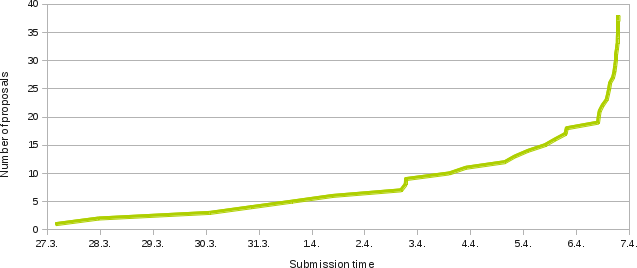
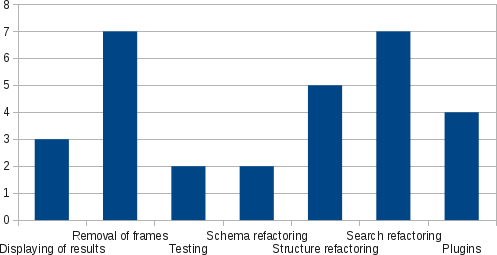
As student application period of Google Summer of Code 2012 is over, it's time to look at proposals we got for phpMyAdmin. First of all we got slightly less proposals than in past years (38 this year, 52 in 2011 and 68 in 2010). This is probably related to the fact that we heavily focus on code cleanup this year and this is definitely not that interesting topic as adding new features. I think quality has also slightly improved, but still there were few completely bogus applications for totally unrelated projects. Also as usual, people tend to leave submission for very last date: Number of applications over time (and then complain, that they don't have enough time to submit patch as described in our applicant guide). Quite unsurprisingly the most interesting topic seemed to be frames removal, where we got few really good proposals. You can see how other topics were frequent in following chart: Number of applications for various types Please note that the numbers are not 100% accurate as some proposals really did not fit into above categories. Anyway we're just waiting for last people submitting patches today and evaluation will finalize in upcoming days. Of course you will know the results from Google on April 23rd.
Filed under: English Phpmyadmin 0 comments Flattr this!

MJ Ray: DLT is better than CAPTCHA

Stop using CAPTCHAs. It s time to switch to DLT: Design, Limit and Trapdoor.
[a certain website] has the evil bad wrong Google reCaptcha on the edit page to stop disabled users, so screw it. Google s reCaptcha seems to be spreading again, obstructing more people when accessing more websites. Is there a reason for that? The re in reCaptcha stands for replace with real anti-spam, please!
I wrote the above about two years ago and it s not getting any better. I ve written similar things over the last ten years, as have many others, and I ve always sought to avoid using physical ability tests as a way to cut down spammers. Why do people keep reaching for the reCaptcha non-captcha or things that use similar bad eyetests like Mollom? So most online messages may be spam, but those physical ability tests do nothing to test for spam. They re trying to detect computer submissions (the TCHA in CAPTCHA is meant to be Telling Computers and Humans Apart), but that s really bad when the computer is helping someone with a disability to access the internet. People from the home of the CAPTCHA describe access for sight and hearing-impaired users as an important open problem for the project (Luis von Ahn, Manuel Blum and John Langford. Telling Humans and Computers Apart Automatically. In Communications of the ACM). Until that problem is closed, CAPTCHAs should be considered defective and removed whenever possible. What webmasters should do instead is DLT:
  1. Design it well: Set up sites so the spammers cannot get a quick win in the first place. Configure permissions and things like that so people have to do some work before they are trusted to post links. This is similar to the basic theory behind my Open Activism paper Fighting in the Shadows. This is much easier to do if the system is Free and Open Source Software (FOSS), too.
  2. Limit the damage: include rate limits to stop one person causing you lots of work: even with computer-assistance, few people need to post 10 forum messages every minute. Join up in co-operative anti-spam networks like blogspam.net so if they hurt you, others can see them coming. Again, it s easier to hook into a network if you re using FOSS.
  3. Trapdoor: keep a way for people to contact you if they are really blocked by your design decisions and limitation and keep a way to exempt them from the limits if needed. Make it welcoming because disabled users are tired of reporting barriers to webmasters who don t care and will never fix the web. A good multi-step eyetest-free contact form is a basic way to do this.
Have you tried this? Have your experiences been as good as our co-op s? Are there sites you don t think it would work for? A comments form is on the original of this article, as ever.

Next.

Previous.