Search Results: "ed"

3 January 2013

Tim Retout: New Year

Another year. 2012 was busy - I got moved house twice, changed jobs, and got married. In 2013, I should become a father, fingers crossed (due mid-April). Change is a familiar friend now. I just listened to Tom Armitage speaking about coding on Radio 4 - I /think/ the podcast mp3 link will work for people outside the UK, but the iPlayer probably won't. If you can get hold of it, it's worth the 20 minutes of your time. If I had to make a New Year's resolution, it would be to listen to more Radio 4 - there's such a lot of it, though. I'm going to try subscribing to some of their podcasts and listening to them on my commute - timeshifting some of the best bits. Might work.

Joey Hess: overcast

My least favorite forecast, and we've been having a lot of it lately. Since winter began (Dec 21st), my PV array has produced only 102 amp-hours of power. There have been only 3 days that could be considered sunny at all (even for a few hours). To put this in some perspective for you, Wolfram Alpha tells me that 102 amp-hours is half of a typical car battery capacity. So I've really had to scrimp & save. I disconnected my router to save power, and I plumbed the depths of the battery bank (further than it's really safe to go). And I was completely out of power for several days. So, I've bought a generator. I had to order it online, because it seems every store in the entire eastern US is completly out of stock, due to hurricane Sandy. This house has a generator shed (complete with a massive old generator that doesn't work), but I put the new, small generator in the furthest outbuilding, from where it can only barely be heard in the house. Later I'll be able to run a cable from its 12v terminal to charge the battery bank (if the sun doesn't get there first); for now it only powers my laptop. Nasty noisy smelly dirty thing, it pains me to run it. Back to the "overcast" forecast. I've heard meterologists say that one unexpected consequence of climate change seems to be that weather patterns are persisting longer, giving us this summer's weeks of neverending heat, and large, slow-moving storms. I suspect this could also explain the blankets of clouds that have been settling in for weeks at a time, on and off since mid-November. But I only have 2.5 years of not very good data. Before, I paid about as much attention to whether it was sunny as anyone else, which is to say, not really very much. Anyone know of a source of historical cloud cover data?

Michal Čihař: Free software plans for 2013

Year 2013 has just started and it's time to think how to spend my free time during this year. Weblate Weblate was my toy project number one in last year and I expect it to stay for next year as well. I have several ideas for new features, but all that depends on free time. I will most likely spend my hackweek on that as well. phpMyAdmin I think my involvement will stay at about same level at phpMyAdmin - doing few random bugfixes, mostly security ones, taking care of infrastructure for translations and wiki and mentoring few GSoC students. Gammu and Wammu Gammu and Wammu has not seen much activity from me in past year and it will probably not change. I don't use the program anymore and this pretty much limits my interest in adding new features. In case somebody active will pop up on mailing list, I'd be happy to transfer the project ownership. Mobile apps I'd like to make some progress here, I was also thinking about making some of them working on Android as well, but this involves lot of learning and time is always an issue here. Anyway this might be good challenge for hackweek as well. Debian No changes expected here :-). Others I consider pretty much anything else from my software projects abandoned or finished.

Filed under: Debian English Gammu Phpmyadmin Suse Weblate 0 comments Flattr this!

Matthew Palmer: Everything's Better With Cats

The ancient Egyptians were a pretty cool bunch, but their worship of cats really added something to their civilisation (double bonus: their word for cat was mau ). The Internet itself, while undeniably a fantastic resource, reached new heights with the introduction of LOLCats. If you are cat-poor, you can swap your shabby tat for a tabby cat, while if you ve gone a bit overboard you can sell your excess cats to cat converters. However, cats have found minimal employment in systems administration. Until now. As the day job have been early adopters of btrfs, everyone at work has been very interested in the reported hash DoS of btrfs. It has been a topic of considerable discussion around the office. However, it can be a tough topic to explain to people less well versed in the arcana of computer science. Not to be deterred, Barney, our tech writer, took the standard explanation, added some cats, and came up with an explanation of the btrfs hash DoS that your parents can understand. The density of cat-related puns is impressive. (Incidentally, if you don t need cats to understand btrfs hash DoS attacks, and live in the Sydney area, you might be interested in working for Anchor as a sysadmin).

Hideki Yamane: Hello New year, Hello Planet

This is first post to Planet Debian...

Hi, let me introduce myself a bit... I'm a Debian Developer living in Japan. I'm not a geek, programmer... but love Debian and enjoy to participate this project :-) I want to share something interesting related to Debian.


Recently, also I'm curious about Debian cloud computing service - AmazonEC2, Rackspace, WindowsAzure, Google Compute Engine and so on.
Recent two big topic for me is

Especially Aeolus is huge software stack and need to package a lot of Ruby gems, so I've joined Pkg-ruby-extras-maintainers and started packaging some gems. I'm newbie for Ruby, so please help if there's something wrong with my packaging.

Richard Hartmann: GnuPG key transition statement

-----BEGIN PGP SIGNED MESSAGE-----
Hash: SHA1,SHA512
I am transitioning GPG keys from an old 1024-bit DSA key to a new
4096-bit RSA key.  The old key will continue to be valid for some
time, but I prefer all new correspondance to be encrypted to the new
key, and will be making all signatures going forward with the new key.
This transition document is signed with both keys to validate the
transition.
If you have signed my old key, I would appreciate signatures on my new
key as well, provided that your signing policy permits that without
re-authenticating me.
The old key, which I am transitioning away from, is:
  pub   1024D/DFCA34A3 2007-10-07 [expires: 2013-10-24]
    Key fingerprint = FE23 BE62 DF18 72FB C58D  D637 FFAE 0427 DFCA 34A3
The new key, to which I am transitioning, is:
  pub   4096R/95206DD3 2013-01-02 [expires: 2016-01-02]
    Key fingerprint = DF0B FDFF 4A4D DA01 7944  1B8F 6906 4B01 9520 6DD3
To fetch the full new key from a public key server using GnuPG, run:
  gpg --keyserver keys.gnupg.net --recv-key 95206DD3
If you have already validated my old key, you can then validate that
the new key is signed by my old key:
  gpg --check-sigs 95206DD3
If you then want to sign my new key, a simple and safe way to do that
is by using caff (shipped in Debian as part of the "signing-party"
package) as follows:
  caff 95206DD3
Please contact me via e-mail at <richih.mailinglist@gmail.com>
if you have any questions about this document or this transition.
    Richard Hartmann
    richih.mailinglist@gmail.com
    2013-01-03
-----BEGIN PGP SIGNATURE-----
Version: GnuPG v1.4.12 (GNU/Linux)
iEYEARECAAYFAlDk27gACgkQ/64EJ9/KNKMGDgCeLyQy6yhEu3OB8UarJ6LYOfVY
ihgAnRSbYMrVxK+28souMHiLx4y0rSQ+iQIcBAEBCgAGBQJQ5Nu4AAoJEGkGSwGV
IG3TcbYP/je8mu+MCIiNNY8w/gN+/9S8gEGWd2p9LeN71xpCuSpBVSevAxxStV9R
2XRTfI8tf/nk27y+4073IscUTPaBkb2IhvIfCnFmOtZjP9slS2JMHOylqH3KLulQ
Cm/IbpKCAwTmQtRMzFxKoRjNPJDCVzZYpoD9r7TmIrs+iKtDQ/w/zQmtwEFWncYK
2JJqVEd+qN9REpWlKDDifcUDPGiugsICelAaUF8VMvp2ouVxQTGbz53IdAgvrX9G
vM+BAfel3W73nfF3L+08vgad0BGGMnEWcfcZ6r+DKu2WXgC8AXT0Y32sD8TiGJSd
JrWMqwec1iOd6lfOpFDdhSCFyMl5r1NiOLw5iNsETHYjysW2N1wZCicmF/8ukm/y
EpIXf3z8vtLrofGLN1jTC34Jugts8C5NNRil195Hkim36t2F97OJswNLhxt7nQ41
vhyXaBK3kwOZ1nVp6xM/yMnQzi5eVO1W/BE8Wr27O6pe3KqEx0Lv8zBzQjj4ly64
shyNRY3gzxs/KZ3p/3nrSn1AYOXIuCM3nILh89qQ/ynotrqYmpFkUorUSSOvraoQ
LN5IPH0wh8F2eDUCui2fGDEmnQ5S5mlHnIZmL3gkPVGLhNaoFQh0R8UwUO6HIxMQ
cTxv5TGL1YWtIvl0bvlEXK6MA4g0ZBXk15JZkWUD84zycr5cb79d
=DFzt
-----END PGP SIGNATURE-----

2 January 2013

Niels Thykier: Getting space for more packages

In 2011, I wrote about how small files could consume a lot of space. I meant to do a follow-up on the savings but I forgot about it until now. In 2.5.7, we started compressing some of the collected data files. Some of these are ridiculously compressable (#664794). Even better, compressing them is sometimes faster than writing them directly to the disk, so in some cases it is a pure win/win. For lintian.d.o, we also see a vast size reduction in overall size of the laboratory. I have taken a few samples occasionally. The samples were done with du(1):
$ du -csh [--apparent-size] laboratory/*
Version/date du -csh apparent-size
N/A around 20 Mar 2012 (#664794) 16G 13G
2.5.6 (Fri Apr 27 2012) 14GB N/A
2.5.6 (Mon Jun 04 2012)) N/A 12G
2.5.10.2 (Fri Sep 21 2012) 12G 8.3G
2.5.11 (Wed Jan 2 2013) 10G 6.1G
And the most awesome part of this? The comparison is quite biased against the 2.5.11 entry, which is the only entry to also process experimental (approx. 10% extra packages). Some of the early entries (2.5.6 and older ) might also have suffered from the too many links issue[1]. I only wish I had been better at collecting data points, so I could have made a proper graph of it. :) It sounds almost too good to be true, but if you look at the size of one of the linux-image packages[1], the space usage dropped from 27M to 15M between 2.5.5 to 2.5.9. Currently it is squeezed down to 14M (tested with head of the git master branch). [1] I believe is about 5-10% less binary packages processed for those runs. [2] linux-image-3.2.0-2-amd64_3.2.20-1_amd64.deb

Russ Allbery: podlators 2.5.0

podlators is the package that contains Pod::Man and Pod::Text and the pod2man and pod2text driver scripts, which convert Perl's POD documentation format into text and *roff (for man pages) output. This release is a "clearing the decks" release that rolls up various smallish feature requests and bug fixes that have been pending for a while. I want to do the same reworking to podlators that I did to Term::ANSIColor, but it's going to take longer since it's quite a bit more code. (And Term::ANSIColor took me about two days.) I didn't want to block the various pending issues on that work, so this tries to clean up all the open bugs I was aware of other than sorting out the defaults for Unicode output. (That's a much larger problem and will probably be fixed in a major release.) The primary change is that pod2man and pod2text now die by default if the POD contains syntax errors. This will hopefully flush out numerous POD documents around the world that have been carrying POD ERRORS sections around forever. I considered just warning by default but not failing, since this will also cause CPAN builds to fail, and I may fall back to that if there are too many complaints. But usually fixing the POD syntax is straightforward, and normally parsing programs will fail on syntax errors. Note that the defaults for the modules, Pod::Man and Pod::Text, continue to be to add a POD ERRORS section, since aborting inside a module isn't very friendly to the caller. There is a new option for both the modules and the driver scripts to set the error handling behavior, which can be set to die, report to standard error but continue, add a POD ERRORS section, or ignore errors entirely. Also in this release is a new nourls option that suppresses the URLs in text and *roff output for L<> codes that have anchor text, which can declutter some POD texts, and fixes for X<> formatting codes containing whitespace and small-caps handling of paragraphs consisting entirely of all-caps text. You can get the latest release from the podlators distribution page.

Petter Reinholdtsen: New IRC channel for LEGO designers using Debian

During Christmas, I have worked a bit on the Debian support for LEGO Mindstorm NXT. My son and I have played a bit with my NXT set, and I discovered I had to build all the tools myself because none were already in Debian Squeeze. If Debian support for LEGO is something you care about, please join me on the IRC channel #debian-lego (server irc.debian.org). There is a lot that could be done to improve the Debian support for LEGO designers. For example both CAD software and Mindstorm compilers are missing. :) Update 2012-01-03: A project page including links to Lego related packages is now available.

Michael Stapelberg: WIT in Debian

I just uploaded wit-2.10a to Debian experimental (it has to pass the NEW queue first, though). WIT (Wiimms ISO Tools) is a set of command-line tools to manipulate Wii and GameCube ISO images and WBFS containers. It is useful (for me) to store backups of my Wii games on a USB hard disk drive. This saves me the optical disc juggling, doesn t wear off the discs as fast and gives faster load times. Here is an example session where I format one partition of the USB hard disk with WBFS and then copy my old WBFS image over to it:
$ wwt format -v --force /dev/sde3
wwt: Wiimms WBFS Tool v2.10a r0 x86_64 - Dirk Clemens - 2013-01-02
FORMAT BLOCK DEVICE /dev/sde3 [172 GiB, hss=512]
** 1 file formatted.
$ wwt add --part /dev/sde3 /media/sde1/wbfs/The\ Legend\ of\ Zelda\ Skyward\ Sword\ \[SOUP01\]/*.wbfs
*****  wwt: Wiimms WBFS Tool v2.10a r0 x86_64 - Dirk Clemens - 2013-01-02  *****
WBFSv1 #1/1 opened: /dev/sde3
 - ADD 1/1 [SOUP01] WBFS:/media/sde1/wbfs/The Legend of Zelda Skyward Sword [SOUP01]/SOUP01.wbfs/#0
* WBFS #1: 1 disc added.
wwt add --part /dev/sde3   0,02s user 7,66s system 2% cpu 5:02,68 total
$ wwt list
ID6     1/500 discs (4 GiB)
---------------------------------------------------------------------
SOUP01  The Legend of Zelda Skyward Sword
---------------------------------------------------------------------
Total: 1/500 discs, 4176 MiB ~ 4 GiB used, 171444 MiB ~ 167 GiB free.

Raphael Geissert: A bashism a week: read

Whether for interacting with the caller, for reading the output of some command, or a file descriptor in general, the read shell command can be found in many scripts.

Unless you stick to the POSIX:2001-required "read variable_name", possibly with the -r option, you should expect problems.


dash, for instance, supports prompts but nothing else.

Remember, if you rely on any non-standard behaviour or feature make sure you document it and, if feasible, check for it at run-time.

1 January 2013

Vincent Sanders: Gource

I have used the Gource tool for a few years now to produce visualisations of project history. The results are pretty but not especially informative and mainly serve to show how well maintained a projects revision control history is.

The results do however provide something pretty to put on projectors and screens at shows when there is nothing better to be displayed.

Recently I noticed the Gource tool got updated and I decided to compile it and give it a try. After the usual building of the dependencies (including all of libboost!) the new version (0.38) gives much better results than the previous edition I had been using (0.27).

I tested it on the NetSurf git repository generating an overview for the whole ten years the project has been running which produced a six minute video which I shall be using on the NetSurf stand at our next show.

Overall if you need a historical visualisation of your projects revision history Gource is a pretty good tool. I have also used the alternative "code swarm" tool in the past but that seems to have bitrotted to death so I cannot recommend it.

Craig Small: procps 3.3.6 and Mudlet 2.0

Mudlet - Graphical MUD clientYesterday was a busy Debian day for me with the release of not one but two packages. procps procps version 3.3.6 was released both as an upstream and a Debian package. While there were many bug fixes in this release, the main new feature for it was the top inspect feature. The top inspect feature allows you to run top in the normal way then you can inspect a specific process you have selected within top for more information. Examples of this include fuser or lsof type output to see what files or libraries are open but really the limit is how clever the operator is and how often you would need this information. Even scripts can be run off this feature if you have some customised or cooked output you need to see. Once the output is there, you can search for text. There will be a small hold-up with the Debian packages as the section for the library has been moved to libs, where it should be. At least I think that s why there is a delay. procps infrastructure procps currently has only an email list and a gitorious git repository. While this works most of the time, there are two main problems with this setup. The first is that the only two ways you can report bugs is send an email to the list or create a git merge request. The email has the problem with tracking and gathering history while the git sets the bar pretty high for reporting something has gone wrong. Second problem is there is no tarball file repository. gitorious does have the feature of downloading tarballs of the tag checkpoints, but this is the raw repository. When you make a tarball with make dist there are some generated files included in the tarball that don t appear in the gitorious ones, which means its not a simple for some as you expect. So I ll be creating a project for these two features soon. Not sure where they will be but I use sourceforge for both these for a few other projects so that might be where they end up. Mudlet Mudlet, the multi-user dungeon or MUD client, has finally made it to version 2.0! It looks a lot more stable and polished at least from the scripting side than the previous RC versions but has all the features that we ve come to expect with it. The most important thing is that the developers have finally put a line in the sand and said this is version 2.0 . The Debian package was uploaded yesterday and should be on its way to your local mirror soon.

Russ Allbery: 2012 Book Reading in Review

For the year of 2012, I finished and reviewed 60 books, the same number as 2011. Given how stressful and chaotic much of the year was, I count this a major triumph. The hardest part was not the reading but the review writing; the end of the year required a significant push to finish writing reviews of all the books I'd read that year, and at one point I was reviewing things I'd read more than two months earlier. But I can enter 2013 entirely caught-up. This continues to feel like about the right pace, striking a balance between reading enough that I can pursue multiple reading goals at the same time, while leaving enough time for other projects and video games. I gave three novels a 10 out of 10 this year, but the stand-out even among that group was Elizabeth Wein's Code Name Verity. Not only was it my favorite book of the year, but it was one of the best books I've ever read. The other two 10-rated books are also highly recommended, of course: Matt Ruff's fascinating novel of multiple personalities, Set This House in Order; and C.J. Cherryh's SF classic, Cyteen. The latter was a re-read in advance of reading the sequel, Regenesis, which I also recommend if you've read and liked the last third of Cyteen. Other fiction highlights of the year were China Mi ville's Embassytown and Suzanne Collins's The Hunger Games triology, particularly the third book, Mockingjay. Embassytown continues the trend from Mi ville's The City & The City of tighter, faster-moving novels while moving into space opera and first contact territory. It keeps Mi ville in the top rank of current SFF writers, despite having some suspension of disbelief problems. Collins's world-building in The Hunger Games also has suspension of disbelief problems, but I understood why the series was so popular. I was caught by surprise by its look at violence and its after-effects and was particularly impressed by Mockingjay and Collins's chosen ending. I think this is a popular series that lives up to the hype. There were no 10 ratings in non-fiction this year, but several books nonetheless stood out. John Kenneth Galbraith's The Affluent Society is a thought-provoking book that questions the foundation of a consumer-oriented economy while perceptively pointing out how it distorts choices away from public goods. Susan Cain's Quiet is a passionate defense of introversion in an extroverted world. And, finally, Joshua Bloch's Effective Java and Damian Conway's Perl Best Practices are both insightful looks at the good and bad of their respective languages and taught me a great deal as a practicing programmer. One final highlight to mention: Eclipse Phase by Posthuman Studios is an excellent RPG sourcebook, at least from the perspective of interesting world-building. I haven't played it, but I thoroughly enjoyed reading it (and have acquired nearly all of the supplements). The full analysis includes some additional personal reading statistics, probably only of interest to me.

Vincent Sanders: I don't drink coffee I take tea my dear, I like my toast done on one side...

Choices, options, selections if you rather. These are what set us all apart from our fellow man, perhaps it is only the appearance of free will and individuality but our world is full of choice.

In software it might be argued programming is nothing more than making thousands perhaps millions of choices which result in a list of instructions for a machine incapable of making decisions of its own.

On a more mundane level sometimes a programmer cannot make a choice suitable for all expected use cases and a user option is created. These options have become something of a cause for arguments within certain sections of the open source software community especially amongst the groups that influence the graphical user experience.

The discussion should be nuanced and varied (perhaps that is my age, or maybe I am more diplomatic than I thought?) but there seems to be little compromise on this discussion which (from an outsiders point of view) splits into two viewpoints:


The reductionist group is currently winning the argument in the popular graphical environments and seem to be removing functionality which requires user choice wherever they can find it. This results in the absurd "joke" that the UI will become a single button, which they are trying to remove.

Personally my view is that an option should be present only when an option cannot be satisfactorily selected by the computer and even then a default suitable for as many users as possible should be picked.

You may ask why I have raised this topic at all? well over the last few days I have been trying to fix the preferences selection for the GTK port of NetSurf. The NetSurf project follows my view on this subject pretty closely but being a browser its very difficult to do the right thing for everyone

NetSurf has numerous frontends for the core browser, I use the term frontend because in some places the toolkit and OS are conflated (windows, cocoa) and not in others (gtk). For each frontend NetSurf is a native application, this is an important distinction, the windows and widgets a user interfaces with are produced by that platforms toolkit.
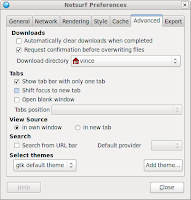
Old NetSurf Preferences Dialog
This is a deliberate choice unlike other browsers which render their UI themselves as web content, this is a beguiling solution when the authors wish there to be a single browsing "experience" with a common look and feel. However NetSurf looks and feels like a native browser for each frontend, which is what the project decided it wanted to achieve.

Given this the gtk frontend (is it a Gnome application? not sure of the distinction TBH) has had no dedicated maintainer for some time it has suffered from a bad case of bitrot from both GTK library changes and general neglect.

I have slowly been improving this situation, the browser can now be compiled with GTK version 2 (2.12 onwards) or 3, the menus and other UI elements have been translated for the supported languages and now the turn has come for the options dialog.

Oh, right, its "Preferences" not options, fair enough a common semantic throughout all applications does give a degree of homogeneousness but the word choice does seem to indicate the users control has been reduced. At this point I gained an education in just how unfriendly GTK and its tools have become towards the casual programmer.

The dialog I wanted to construct was a pretty standard tabbed layout which reflected the current options and allowed the user to change them in an obvious way. Given that I have constructed and equivalent interface in idiomatic manner for cocoa and windows I thought this would be straightforward, I was very wrong.

The interface construction tool is called glade which used to be the name of the UI "resource" file and interfaces. However the tool is still called glade but the interface is now GtkBuilder which has a different (but similar) XML based file format. Then we discover that despite it being an extensible file format the UI files are specifically versioned against the GTK library. Also why on earth can these resources not be compiled into my program? OK make them over-ridable perhaps. Generally it is yet another file to distribute and update in step with the executable.
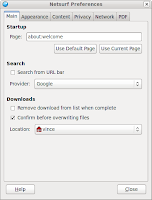
New NetSurf Properties Dialog open on Main tab
New NetSurf Preferences
So because I want to support back to version 2.12 of GTK I do not get to use any of the features from 2.16 in my UI unless I load a different UI builder file...oh and GTK3? requires a completely different version of glade and the UI files which are incompatible with gtk 2. Once this was worked round with having multiple UI files I then moved on to the next issue.

The GTK model uses function callbacks on events, these are known as signals. Perfectly reasonable but because the ui files are loaded at runtime and not compiled in there must be a way for the GTKBuilder to map the textural signal names to function pointers.

The way the GTK developers have chosen to do this is to search the global function table which means any signal handler function symbol has also to be global which means unnecessary overhead for the ELF loader increasing load times.

This lookup should have been confined to a single object or even placed in an alternative section to avoid these issues, this would not have seemed especially challenging to implement as all callback handlers have to use a preprocessor to define already (G_MODULE_EXPORT).

Another thing that makes developing GTK applications worse is the documentation, this seems to be a continuous complaint about may open source projects, which is taciturn or simply missing in many cases. GTK seems to suffer dreadfully from having multiple API versions all subtly different resulting in a lot of work on the developers part to simply find what they want.

A specific example of this is the signals and under what circumstance they occur I wanted to update all the widgets with the current configuration state whenever the options window is shown (using gtk_widget_show()) so I figured that would be the "show" signal...right? nope, never did find the right one to use, ended up with "realize" which occurs once when the dialog is created, not what I wanted, but is at least consistent and works.
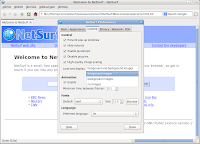
NetSurf with is Properties dialog open on the content tab
NetSurf with Preferences Dialog
Overall my impression of developing just one small dialog (60 widgets total exclusing labels and containers) for a GTK program is that the toolkit and its tooling is missing the facilities to make developers life easier when doing the drudge work that a good proportion of graphical program development.

It is not the case that one cannot do things, just that everything has to be done manually instead of having the tools do the work, and because of the documentation that tedium is magnified.

I did eventually reach the stage that the thought of writing the boilerplate to add another check button to enable "do not track" had me thinking "do they really need this or can I avoid the work?" perhaps that is why they are all reductionist?


Christian Perrier: [life] [running] 2012 summary

Yet another yearly summary of my running activities. It seems, indeed, that running has now slightly taken precedence over free software activities in my life and priorities for my free time. To my fellow free software friends: don't worry, I'm not on my way to stop investing my time in Debian. It's quite clear that I'm reducing my involvement, mostly because days only have 24 hours...not because I'm bored or tired by free software development. But, certainly, it became an important thing that running currently has a small priority over Debian nowadays, for me. So, what happened on that front in 2012 for running bubulle? I finally managed to run 2900 km during the year, which is over 400km more than 2011. This is mostly due to the increasing part of running in my daily commute : a typical work week can now be something like this: With such an organization, I can end up with weeks where I run up to 50-60 kilometers in 5 days, with peaks that may include 26km in one *work* day. I also end up having room in trains between the runs, I wonder why..:-) And, of course, during week-ends, I spend some parts of my time running too..:-). Indeed, just like for many drugs, I feel sad during days where I haven't run at all and it's usually hard for me to spend more than 2 days without. Indeed, the longest time period without running, this year, has been 9 days, just after the Caen marathon, in June. Mostly because, at that time, I reached a moment where training (and believe me, very boring and hard training) consumed all my motivation. But these moments are indeed very rare and training is mostly *never* boring for me. Mostly because I like running in the nature, in forests, woods, fields, country. Never wearing an MP3 player or any kind of such device toplay music, but just enjoying the outside, whether it's raining, winding, sunny hot. Running (particularly my daily commute) is also the moment where I *think* about my work, my technical activities, my own life, whatever. I think I even sometimes translated some software, mentally, while running..:) Indeed, there have been 205 days in this year where I ran at least once. Last year was 181 so....drug addiction is increasing. So, 2900 kilometers. That's about the distance from my place to Moscow in Russia. 282 hours (11 days18 hours.....9d21h last year). Average speed: 10,3km/h (10,5km/h last year). Cumulated height difference: 33,400 meters (27700m last year). More distance, more time, a bit slower: this is an obvious consequence of more trail running (which includes more difficulties, such as running on volcanoes!). Most active month: November with 331km. Less active month: June with 141km. This year was also a year of records: I ran 10 official races during the year : two "ultra" races (70km Le Puy-Firminy in November, by night and 80km Paris Ecotrail in March), two marathons (Caen and Val de Rueil), four half-marathons and two "short" (less than 30km) trail races. How about next^W this year? Well, my goals are currently being secured: All this of course is assuming that no injury comes up (my ankles are sometimes yelling outbut I'm fortunate enough to not have articulation problems that many runners have, particularly in knees). We'll see on January 1st 2014...:-)

Russ Allbery: Review: City of Diamond

Review: City of Diamond, by Jane Emerson
Publisher: DAW
Copyright: March 1996
ISBN: 0-88677-704-6
Format: Mass market
Pages: 624
The setting is deep into the star-faring future of humanity. Humans have settled many other worlds, thanks largely to technology from a race named the Curosa. There is a thriving network of settlement based around a sort of warp conduit network. But, standing apart from most human settlements, are three huge ships: the City of Opal, the City of Pearl, and the City of Diamond. Their inhabitants are devout members of the Redemptionist faith, a merging of Christian (primarily Catholic) belief and Curosa religion. Their ships are gifts from the now-departed Curosa, featuring drives unknown to the rest of humanity that allows them to ignore the normal transport network. They are meant to witness and spread their religion, but now, six centuries later, they primarily trade. Much of this is not apparent at the start. City of Diamond opens with Adrian Mercati, chosen heir of the current dying Protector, dodging people in what seems to be an oddly-organized city. Impudent, occasionally flippant, utterly charming, and in love with danger, he inherits the position of Protector shortly after we meet him. Emerson slowly reveals more of the nature of the ship while Adrian is shocking (and charming) the nobility and the church, and consorting with demons. Or, at least, one demon: Tal, an entirely human-appearing creature except for his eyes, who the Redemptionists claim is born without a soul. Slowly, it becomes clear that he's actually the offspring of an alien and a human, a mating of species whose children cannot socialize as human and behave in ways that seem like human sociopaths. Tal is no exception, but his interests align with Adrian's for the time. To those two viewpoint characters, Emerson adds four more: a low-rank administrator named Spider who works for Tal after Tal saved him from death by recycling, Adrian's politically-arranged bride-to-be from the rival (and even more religious) ship City of Opal, a guard from a French-descended slum on City of Opal, and a dangerously honorable and literal mercenary from an off-shoot culture of humanity that's now only a legend. This is a book that tends to sprawl. There's quite a lot going on, starting with the negotiations between City of Diamond and City of Opal to put to rest the remnants of a civil war and leading to the search for a legendary Curosa artifact on the planet they're both visiting. All of the characters have their own agendas, their own history, and their own goals, and are pursuing them in parallel and occasionally in opposition. Emerson takes the time to let all of this build. Despite that, there is very little in this book that drags or bores, and that's due primarily to the strength of the characters. Every one of the viewpoint characters is unique, bringing a different perspective to the story, and every one of them changes and grow over the course of the story. They also play off of each other in delightful ways. This is a book that makes full use of the fact that three characters make seven character interactions. For example, Tal by himself is logical but just slightly askew, Tal seen by Spider is uncomfortable and worrisome, Tal and Adrian is a dance of mutual amusement and respect, and Tal and Keylinn finding points of commonality is just delightful. I did wish that there was a bit more Keylinn and Tal and a bit less of Spider, but once Emerson built her world, introduced her characters, and got the story moving, there aren't many weak pieces. Part of the fun is figuring out the world background. There are almost no infodumps here; Emerson just starts telling stories of characters in the surroundings in which they find themselves, and the reader is left to piece things together from background description, the occasional explanation from one character to another, and parallels with long-standing SF tropes. It's not a puzzle book, but it is a book of where the reader is dropped as an alien into a fully-developed culture. In both that way and in the use of nobility, religion, and formal hierarchy against a starfaring backdrop, City of Diamond reminds me of the sort of classic space opera that led up to Star Wars but isn't seen as much these days. It's also funny. I was unsurprised to discover that Emerson is a pseudonym for Doris Egan, who (in addition to writing some other SF) is an occasional writer and producer for House. The humor isn't entirely obvious at the start, although Adrian frequently provokes a grin from the start of the book, but Tal's perceptive but obliviously blunt comments become more and more fun as the book progresses, and both Iolanthe (Adrian's bride) and Keylinn (the mercenary, sort of) are a delight. I want to see more of both of them, but sadly the book ends just as they (particularly Iolanthe) are hitting their strides. And that's the biggest problem with City of Diamond: it's a failed (or at least postponed) trilogy. As with Walter Jon Williams's Metropolitan and City on Fire, there were supposed to be more books, but apparently either the publisher lost interest or other projects took precedence. The story does come to something of a conclusion, but most of the major story arcs aren't resolved. Emerson is still bringing more guns onto the set late in the book. None of the villains truly get their just desserts, nor do most of the character arcs fully resolve, although friendships and more have formed satisfyingly by the end of the book. There is obviously far more to both these characters and this universe, including an entire ship that was never visited and an alien whose presence should prove startling. This is a great book: warm, funny, full of interesting characters, and with a nicely complex background universe. If it were complete in itself, or if the sequels had materialized, I would recommend it unreservedly. As is, you will have to weigh your dislike of unfinished stories against its stand-alone merits. But I enjoyed it a great deal. Rating: 7 out of 10

Dirk Eddelbuettel: Ragnar Relay Chicago 2012

One things I never quite got around to during 2012 was to blog about the awesome relay we ran in early June. This was the race formerly known as MC200 (for Madiston, WI, to Chicago, IL, by way of Milwaukee, WI, for about 200 miles) and is now part of the Ragnar Relay series: Ragnar Chicago. We ran as a so-called ultra team of six runners, as opposed to a regular ream of twelve. The course is cut into 36 segments; on regular teams you get 3, we each had twice that. My first leg was a combined 17 miles in what turned out to be pretty blistering heat in mid-to-late afternoon. My fellow team members were awesome in getting me lots of water an ice, and I managed to hold onto a pace of just over 8 min/miles. One of the harder runs I've had. Next was a wonderful run pretty much exactly at midnight under starry skies---about seven or so miles followed by ten more miles the next morning. We ended up coming third (yay!) beating the next time by about six or seven seconds (!!) over a total time of 25 or 26 hours. It was hard. It was fun. It was exhilirating. It may also have broken me as I haven't really run much since. So good intentions for 2013: get back into the groove.

31 December 2012

Thorsten Glaser: Not just Amigas, editors and errnos

mksh made quite some waves (machine translation of the third article) recently. Let s state it s not just Amigas ara5 is a buildd running the Atari kernel, an emulated though. On the other hand, the bare-metal Ataris used to be the fastest buildds, so I expect we get them back online soonish. I m currently fighting with some buildd software bugfixes, but once they re in, we will make more of them. Oh, and porterboxen! Does anyone want to host a VM with a porterbox? Requirements: wheezy host system (can be emulated), 1 GiB RAM, one CPU core with about 6500 BogoMIPS or more (so the emulated system has decent speed; an AMD Phenom II X4 3.2 GHz does just fine). Oh, and mksh is ported to more and more platforms, like 386BSD 0.0 with GCC 1.39, and QNX 4 with Watcom and more bugfixes are also being worked on. And let s not forget features! jupp got refreshed: it s got a bracketed paste mode, which is even auto-enabled on xterm-xfree86 (though the xterm(1) in MirBSD s a tad too old to know it; will update that later, just imported sendmail(8) 8.14.6 and lynx(1) 2.8.8dev.15 into base, more to come) and will be enhanced later (should disable auto-indent, wordwrap, status line updates, and possibly more), lots of new functions and bindings, now uses mkstemp(3) to create backup files race-free, and more (read the NEWS file). In MirBSD, Benny and I just added a number of errnos, mostly for SUSv4 compliance and being able to compile more software from pkgsrc without needing to patch. This is being tested right now (although I should probably go out and watch fireworks in less than a half-hour), together with the new imports and the bunch of small fixes we accumulate (even though most development in MirBSD is currently in mksh(1) and similar doesn t mean that all is, or worse, we were dead, which we aren t). I ll publish a new snapshot some time in January. The Grml 2012.12 also contains a pretty up-to-date MirBSD, with a boot(8/i386)loader that now ignores GUID partition table entries when deciding what to use for the a slice. If you haven t already done so, read Benjamin Mako Hill s writings!

Russ Allbery: Term::ANSIColor 4.01

It was too much to hope for that all that testing would catch everything in a 4.00 release, but it's ironic that the main bug was a bug in one of the test cases! BlueT - Matthew Lien - found that one of the tests malfunctioned when Test::Warn was not installed. Since I was cutting a new release anyway, I also improved the README somewhat and added POD documentation to the example script. You can get the latest version from the Term::ANSIColor distribution page.

Next.

Previous.