Search Results: "pm"

2 February 2017

Steinar H. Gunderson: Not going to FOSDEM but a year of Nageru

It's that time of the year :-) And FOSDEM is fun. But this year I won't be going; there was a scheduling conflict, and I didn't really have anything new to present (although I probably could have shifted around priorities to get something). But FOSDEM 2017 also means there's a year since FOSDEM 2016, where I presented Nageru, my live video mixer. And that's been a pretty busy year, so I thought I'd do a live cap from high up above. First of all, Nageru has actually been used in production we did Solskogen and Fyrrom, and both gave invaluable input. Then there have been some non-public events, which have also been useful. The Nageru that's in git right now is evolved considerably from the 1.0.0 that was released last year. diffstat shows 19660 insertions and 3543 deletions; that's counting about 2500 lines of vendored headers, though. Even though I like deleting code much more than adding it, the doubling (from ~10k to ~20k lines) represents a significant amount of new features: 1.1.x added support for non-Intel GPUs. 1.2.x added support for DeckLink input cards (through Blackmagic's proprietary drivers), greatly increasing hardware support, and did a bunch of small UI changes. 1.3.x added x264 support that's strong enough that Nageru has really displaced VLC as my go-to tool for just video-signal-to-H.264-conversion (even though it feels overkill), and also added hotplug support. 1.4.x added multichannel audio support including support for MIDI controllers, and also a disk space indicator (because when you run out of disk during production without understanding that's what happens, it really sucks), and brought extensive end-user documentation. And 1.5.x, in development right now, will add HDMI/SDI output, which, like all the previous changes, requires various rearchitecting and fixing. Of course, there are lots of things that haven't changed as well; the basic UI remains the same, including the way the theme (governing the look-and-feel of the finished video stream) works. The basic design has proved sound, and I don't think I would change a lot if I were to design something like 1.0.0 again. As a small free software project, you have to pick your battles, and I'm certainly glad I didn't start out doing something like network support (or a distributed architecture in general, really). So what's for the next year of Nageru? It's hard to say, and it will definitely depend on the concrete needs of events. A hot candidate (since I might happen to need it) is chroma keying, although good keying is hard to get right and this needs some research. There's also been some discussion around other concrete features, but I won't name them until a firm commitment has been made; priorities can shift around, and it's important to stay flexible. So, enjoy FOSDEM! Perhaps I'll return with a talk in 2018. In the meantime, I'll preparing the stream for the 2017 edition of Fyrrom, and I know for sure there will be more events, more features and more experiences to be had. And, inevitably, more bugs. :-)

Shirish Agarwal: The $100 used laptop and getting riled up.

Lenovo-ThinkPad-T500 - Source - Wikimedia commons

Lenovo-ThinkPad-T500 Source Wikimedia commons

I was reading a thread on phoronix where a student was sharing that it is or can be expensive to get even a used laptop and he shared his predicament and was hammered a bit for it to some going to the extent of questioning his life-choices. While I m not a student it still triggered something in me. I am not dirt poor but neither am I insanely rich. The same questions he has, similar questions I have had. While in his case he is probably in his early to late 20 s, I am pushing 40. Most of the money I make goes in for everyday purchases, veggies, house-rent, electricity, landline, broadband and cell phone bills. What little is left is most of the time kept for a rainy day as there is no Government pension. From what I have heard and read on the web, in the west specifically in the States, if I buy a used laptop, I usually get a 6 months 1 year warranty . Here, while you could get a used laptop for around INR 10k there is no warranty/guarantee, so I never get into that. It s buyer s beware all the time. For people who like/want FOSS or specifically something like Free DOS (like me), I had to wait for almost 6 years to get a model I was happy with, with the specs. I was ok with. Was really lucky enough to get a Thinkpad T440 with 8 GB of RAM for around INR 80k/- with Free DOS. The specs T440 Core I 5 (4300) / Dos (NEW MODEL) 20B7A1SD00 Intel Core i5 4300M (2.5 GHz / 3 MB / 5 GT/s) / Intel QM87 Chipset / Integrated 802.11 n WIFI LAN + Bluetooth 4.0 / 8GB DDR III Memory (2 DIMM SLOT) / 500 GB SATA HDD @ 7200 RPM / 14.0 HDy / FPR / Dos / 2 USB , VGA Port , RJ 45 Port /GB LAN /Track Point with 5 button Glass Touch Pad /Stereo Speakers with Dolby Enhanced Audio / 6 Cell Battery /Approx 2.14KG/ While it is/was actually pretty expensive but then wanted something which can take a beating, deal with all the heat, noise and dust (specifically where I live, right in the middle of the city). The reason I used the word lucky is that now there is no model in the T-series range which has FreeDOS on it. Of course, I hopefully will use it for another 4-5 years at the very least depending on how much it cooperates with me, I have heard that Thinkpads function for a long period of time even in dusty environments so banking on that.  What probably pissed me is the condensing note in the comment, how does he know what pressures an another individual might be in. It s almost like saying You are refugee because you made a wrong life choice or something to that effect which again is stupid. I actually feel/felt embarrassed to bring this up as I truly am lucky to be safe, secure, have food on the table, am able to sleep on a bed at night, have a workstation AND a laptop, have somewhat of a sound mind  and a body which is able to move around without any hassles. Add to that, incredibly as it may sound, was also able to see another country for a few days In relation to people being persecuted and having to run off to save their own lives or even people living on the streets, I am actually living in luxury. While I can t go through life feeling guilty for all the good things that have happened with me, I do feel disgusted when I see some people put blinding statements like that. One of the biggest reasons that GNU/Linux and Debian in particular gelled with me was that it s incredibly flexible and generous. Nobody tells me which packages I should or shouldn t have. I do right things, good, I do something wrong, an opportunity to learn and hopefully learn from my mistakes. In either case, one of the most forgiving kind of system to learn and hack on. While speaking of mistakes, could somebody look at #849684 . It almost feels like a tennis match going between the maintainers concerned. While I don t have the technical skills to ascertain who s right and who is not, it would be nice if some cooler heads can make sense and see if a way could be found out. Can somebody help ?
Filed under: Miscellenous Tagged: #debian, #Life Choices, #Thinkpad440, laptop

1 February 2017

Lars Wirzenius: Hacker Noir, chapter 2: Development setup phase

It is a new month, and time to publish the next chapter in Hacker Noir. This is chapter 2, titled "Development setup phase". I hope you enjoy it. Feedback via email, irc, identi.ca, twitter are welcome. Or come talk to me at FOSDEM if you're there.

Daniel Pocock: Going to FOSDEM, Brussels this weekend

This weekend I'm going to FOSDEM, one of the largest gatherings of free software developers in the world. It is an extraordinary event, also preceded by the XSF / XMPP Summit For those who haven't been to FOSDEM before and haven't yet made travel plans, it is not too late. FOSDEM is a free event and no registration is required. Many Brussels hotels don't get a lot of bookings on weekends during the winter so there are plenty of last minute offers available, often cheaper than what is available on AirBNB. I was speaking to somebody in London on Sunday who commutes through St Pancras (the Eurostar terminal) every day and didn't realize it goes to Brussels and only takes 2 hours to get there. One year I booked a mini-van at the last minute and made the drive from the UK with a stop in Lille for dinner on the way back, for 5 people that was a lot cheaper than the train. In other years I've taken trains from Switzerland through Paris or Luxembourg. Real-time Communication (RTC) dev-room on Saturday, 4 February On Saturday, we have a series of 23 talks about RTC topics in the RTC dev-room, including SIP, XMPP, WebRTC, peer-to-peer (with Ring) and presentations from previous GSoC students and developers coming from far and wide. The possibilities of RTC with free software will also be demonstrated and discussed at the RTC lounge in the K building, near the dev-room, over both Saturday and Sunday. Please come and say hello. Please come and subscribe to the Free-RTC-Announce mailing list for important announcements on the RTC theme and join the Free-RTC discussion list if you have any questions about the activities at FOSDEM, dinners for RTC developers on Saturday night or RTC in general. Software Defined Radio (SDR) and the Debian Hams project At 11:30 on Saturday I'll be over at the SDR dev-room to meet other developers of SDR projects such as GNU Radio and give a brief talk about the Debian Hams project and the relationship between our diverse communities. Debian Hams (also on the Debian Ham wiki) provides a ready-to-run solution for ham radio and SDR is just one of its many capabilities. If you've ever wondered about trying the RTL-SDR dongle or similar projects Debian Hams provides a great way to get started quickly. I've previously given talks on this topic at the Vienna and Cambridge mini-DebConfs (video). Ham Radio (also known as amateur radio) offers the possibility to gain exposure to every aspect of technology from the physical antennas and power systems through to software for a range of analog and digital communications purposes. Ham Radio and the huge community around it is a great fit with the principles and philosophy of free software development. In a world where hardware vendors are constantly exploring ways to limit their users with closed and proprietary architectures, such as DRM, a broad-based awareness of the entire technology stack empowers society to remain in control of the technology we are increasingly coming to depend on in our every day lives.

Russ Allbery: Review: A Closed and Common Orbit

Review: A Closed and Common Orbit, by Becky Chambers
Series: Wayfarers #2
Publisher: Harper Voyager
Copyright: October 2016
ISBN: 0-06-256942-2
Format: Kindle
Pages: 384
A Closed and Common Orbit has two threads, one that takes place twenty years in the past and one that happens simultaneously with the very end of The Long Way to a Small, Angry Planet. That second part is the motivating plot thread, but it's unfortunately impossible to talk about in any depth without seriously spoiling the previous book. You could otherwise read them out of order, but I think the previous book is too good to spoil, so you want to carefully avoid reading any descriptions of this book until after you've read The Long Way to a Small, Angry Planet. Per my normal review policy, I'm going to try to avoid spoilers, but just about everything about half of this book would give away spoilers if you're paying attention. So you may want to just go read the other book before reading this review. (It's excellent!) The part that I can safely say is that half this book is about Pepper, her partner Blue, Pepper's store and Blue's art, and her attempt to help a friend find a place and a sense of identity that she'd never asked for or expected, while keeping a very dangerous secret. That friend starts somewhat passive, but one of the things I liked the most about this story is that Pepper is neither always right in her advice nor always wrong. Sidra is wrong about some of the limitations that she thinks she has and some of the things she thinks she wants, but she's also right about other things where Pepper is wrong. She has a complicated, careful, and courageous journey. The best part of this book for me, though, was the other half, told in alternating chapters with Sidra's story. This is Pepper's own backstory, which is rather awful (although Chambers does avoid being too graphic about the most horrible parts), but is also an amazing story of someone finding her own power, her own skills, and her own identity. And building a relationship that's something quite special. At first, this seems only vaguely related to Sidra's story and the other half of the book, but they both come together in a way that's both heartbreaking and wonderful. I found this story particularly wonderful because one of my favorite SF tropes is sentient computers or sentient ships, which play a significant role in Pepper's backstory. And one of my favorite characters to read about is the technician who can cobble together fixes to things and who is always finding something to repair. Pepper is a delight, her story explains so much about how she became the person she is (and adds so much emotional heft to it), and she has a relentless, practical determination that I loved reading about. A Closed and Common Orbit doesn't have the sprawling cast of The Long Way to a Small, Angry Planet. The story is tightly focused on five characters. I think I liked that even better than the previous book, even when I was finding Sidra a bit too passive and not as interesting. Chambers's characters have so much depth, thoughtfulness, and basic decency, while still being uniquely themselves, that I feel like I could read about them for months and keep uncovering new, interesting facets. I particularly loved the occasional excerpts from the chat system where Pepper hangs out (and would have loved about three times more of them). Speaking as someone who spends a lot of time in chat, Chambers got the tone just about perfect. Just about the only complaint I have about this book is that I thought the ending was too abrupt. It's so important, the climax of Pepper's story and a hugely significant piece of character development, and I wanted more than the short scene and aftermath we got. I really wanted to spend some time feeling with the characters, savoring the emotional release. Another three or four pages would have been greatly appreciated. The Long Way to a Small, Angry Planet was a happy surprise in 2015. A Closed and Common Orbit is fully as good, if not better. If you liked the previous book, you will definitely want to read this. I pre-ordered it and then read it within months after it was released, something that I almost never do. I can hardly wait to read whatever Chambers writes next. Rating: 9 out of 10

Antoine Beaupr : My free software activities, January 2017

manpages.debian.org launched The debmans package I had so lovingly worked on last month is now officially abandoned. It turns out that another developer, Michael Stapelberg wrote his own implementation from scratch, called debiman. Both software share a similar design: they are both static site generators that parse an existing archive and call another tool to convert manpages into HTML. We even both settled on the same converter (mdoc). But while I wrote debmans in Python, debiman is written in Go. debiman also seems much faster, being written with concurrency in mind from the start. Finally, debiman is more feature complete: it properly deals with conflicting packages, localization and all sorts redirections. Heck, it even has a pretty logo, how can I compete? While debmans was written first and was in the process of being deployed, I had to give it up. It was a frustrating experience because I felt I wasted a lot of time working on software that ended up being discarded, especially because I put so much work on it, creating extensive documentation, an almost complete test suite and even filing a detailed core infrastructure best practices report In the end, I think that was the right choice: debiman seemed clearly superior and the best tool should win. Plus, it meant less work for me: Michael and Javier (the previous manpages.debian.org maintainer) did all the work of putting the site online. I also learned a lot about the CII best practices program, flask, click and, ultimately, the Go programming language itself, which I'll refer to as Golang for brievity. debiman definitely brought Golang into the spotlight for me. I had looked at Go before, but it seemed to be yet another language. But seeing Michael beat me to rebuilding the service really made me look at it again more seriously. While I really appreciate Python and I will probably still use it as my language of choice for GUI work and smaller scripts, but for daemons, network programs and servers, I will seriously consider Golang in the future. The site is now online at https://manpages.debian.org/. I even got credited in the about page which makes up for the disappointment.

Wallabako downloads Wallabag articles on my Kobo e-reader This obviously brings me to the latest project I worked on, Wallabako, my first Golang program ever. Wallabako is basically a client for the Wallabag application, which is a free software "read it later" service, an alternative to the likes of Pocket, Pinboard or Evernote. Back in April, I had looked downloading my "unread articles" into my new ebook reader, going through convoluted ways like implementing OPDS support into Wallabag, which turned out to be too difficult. Instead, I used this as an opportunity to learn Golang. After reading the quite readable golang specification over the weekend, I found the language to be quite elegant and simple, yet very powerful. Golang feels like C, but built with concurrency and memory (and to a certain extent, type) safety in mind, along with a novel approach to OO programming. The fact that everything can be compiled in one neat little static binary was also a key feature in selecting golang for this project, as I do not have much control over the platform my E-Reader is running: it is a Linux machine running under the ARM architecture, but beyond that, there isn't much available. I couldn't afford to ship a Python interpreter in there and while there are solutions there like pyinstaller, I felt that it may be so easy to deploy on ARM. The borg team had trouble building a ARM binary, restoring to tricks like building on a Raspberry PI or inside an emulator. In comparison, the native go compiler supports cross-compilation out of the box through a simple environment variable. So far Wallabako works amazingly well: when I "bag" a new article in Wallabag, either from my phone or my web browser, it will show up on my ebook reader then next time I open the wifi. I still need to "tap" the screen to fake the insertion of the USB cable, but we're working on automating that. I also need to make the installation of the software much easier and improve the documentation, because so far it's unlikely that someone unfamiliar with Kobo hardware hacking will be able to install it.

Other work According to Github, I filed a bunch of bugs all over the place (25 issues in 16 repositories), sent patches everywhere (13 pull requests in 6 repositories), and tried to fix everythin (created 38 commits in 7 repositories). Note that excludes most of my work, which happens on Gitlab. January was still a very busy month, especially considering I had an accident which kept me mostly offline for about a week. Here are some details on specific projects.

Stressant and a new computer I revived the stressant project and got a new computer. This is be covered in a separate article.

Linkchecker forked After much discussions, it was decided to fork the linkchecker project, which now lives in its own organization. I still have to write community guidelines and figure out the best way to maintain a stable branch, but I am hopeful that the community will pick up the project as multiple people volunteer to co-maintain the project. There has already been pull requests and issues reported, so that's a good sign.

Feed2tweet refresh I re-rolled my pull requests to the feed2tweet project: last time they were closed before I had time to rebase them. The author was okay with me re-submitting them, but he hasn't commented, reviewed or merged the patches yet so I am worried they will be dropped again. At that point, I would more likely rewrite this from scratch than try to collaborate with someone that is clearly not interested in doing so...

Debian uploads

Debian Long Term Support (LTS) This is my 10th month working on Debian LTS, started by Raphael Hertzog at Freexian. I took two months off last summer, which means it's actually been a year of work on the LTS project. This month I worked on a few issues, but they were big issues, so they took a lot of time. I have done a lot of work trying to backport the heading sanitization patches for CVE-2016-8743. The full report explain all the gritty details, but I ran out of time and couldn't upload the final version either. The issue mostly affects Apache servers in proxy configurations so it's not so severe as to warrant an immediate upload anyways. A lot of my time was spent battling the tiff package. The report mentions fixes for 15 CVEs and I uploaded the result in the DLA-795-1 advisory. I also worked on a small update to graphics magic for CVE-2016-9830 that is still pending because the issue is minor and we're waiting for more to pile up. See the full report for details. Finally, there was a small discussion surrounding tools to use when building and testing update to LTS packages. The resulting conversation was interesting, but it showed that we have a big documentation problem in the Debian project. There are a lot of tools, and the documentation is old and distributed everywhere. Every time I want to contribute something to the documentation, I never know where to start or go. This is why I wrote a separate debian development guide instead of contributing to existing documentation...

31 January 2017

Michal Čihař: Weblate 2.11

Exactly on the schedule, Weblate 2.11 is out today. This release brings extended stats available to users and various other improvements and bug fixes. Full list of changes: If you are upgrading from older version, please follow our upgrading instructions. You can find more information about Weblate on https://weblate.org, the code is hosted on Github. If you are curious how it looks, you can try it out on demo server. You can login there with demo account using demo password or register your own user. Weblate is also being used on https://hosted.weblate.org/ as official translating service for phpMyAdmin, OsmAnd, Aptoide, FreedomBox, Weblate itself and many other projects. Should you be looking for hosting of translations for your project, I'm happy to host them for you or help with setting it up on your infrastructure. Further development of Weblate would not be possible without people providing donations, thanks to everybody who have helped so far! The roadmap for next release is just being prepared, you can influence this by expressing support for individual issues either by comments or by providing bounty for them.

Filed under: Debian English phpMyAdmin SUSE Weblate 0 comments

Reproducible builds folks: Reproducible Builds: week 92 in Stretch cycle

Here's what happened in the Reproducible Builds effort between Sunday January 22 and Saturday January 28 2017: Media coverage Upcoming Events Reproducible work in other projects John Gilmore wrote an interesting mail about how Cygnus.com worked on reproducible builds in the early 1990s. It's eye opening to see how the dealt with basically the very same problems we're dealing with today, how they solved them and then to realize that most of this has been forgotten and bit-rotted in the last 20 years. How will we prevent history repeating itself here? Toolchain development and fixes Christoph Biedl wrote a mail describing an interesting problem in to the way binNMUs are done in Debian. Guillem Jover made a number of changes to dpkg that affect the Reproducible Builds effort within Debian: Packages reviewed and fixed, and bugs filed Chris Lamb: Dhole: Reviews of unreproducible packages 17 package reviews have been added, 4 have been updated and 6 have been removed in this week, adding to our knowledge about identified issues. 2 issue types have been added: 1 issue type has been removed: Weekly QA work During our reproducibility testing, the following FTBFS bugs have been detected and reported by: diffoscope development reprotest development buildinfo.debian.net development tests.reproducible-builds.org Misc. This week's edition was written by Chris Lamb and Holger Levsen & reviewed by a bunch of Reproducible Builds folks on IRC & the mailing lists.

30 January 2017

Michal Čihař: See you at FOSDEM

This has become sort of tradition for me, but still worth mentioning - I'm going to to FOSDEM this weekend. This time I have no talk (I somehow failed to submit anything in time), but still I'm there to meet people and listen to some talks. As I've agreed to help Software Freedom Conservancy on stand (in the H building), it's quite likely that you will find me there. You will also have unique chance to grab phpMyAdmin stickers at this stand. Also if you spot somebody wearing Weblate t-shirt, then it's most likely me ;-).

Filed under: Debian English phpMyAdmin SUSE Weblate 1 comments

29 January 2017

Reproducible builds folks: Reproducible Builds: week 91 in Stretch cycle

What happened in the Reproducible Builds effort between Sunday January 15 and Saturday January 21 2017: Media Coverage Upcoming Events Toolchain development and fixes Ximin Luo continued work on data formats, code, and test cases for SOURCE_PREFIX_MAP. He also continued to talk with the rustc team on the topic. Chris Lamb submitted a patch to implement SOURCE_DATE_EPOCH for wordwarvi, a game which gave extra points to people who built it from source within one hour. This fixes Debian #786593. Launchpad bug 1657704 was filed for them to start accepting buildinfo files. Bugs filed Reviews of unreproducible packages 10 package reviews have been added, 149 have been updated and 153 have been removed in this week, adding to our knowledge about identified issues. 2 issue types have been updated: Weekly QA work During our reproducibility testing, the following FTBFS bugs have been detected and reported by: diffoscope development diffoscope 69 was uploaded to unstable by Chris Lamb. It included contributions from: Further development continued in Git, and will be released as version 70 next week: reproducible-builds.org website development tests.reproducible-builds.org Misc. This week's edition was written by Ximin Luo, Vagrant Cascadian, Holger Levsen & Chris Lamb and reviewed by a bunch of Reproducible Builds folks on IRC & the mailing lists.

26 January 2017

Martin Michlmayr: Debian on Jetson TX1

Debian is now working on the NVIDIA Jetson TX1 developer kit, a development board based on the Tegra X1 chip (Tegra 210), a 64-bit ARM chip. We have a pre-built u-boot image in Debian as well as kernel and installer support. There are some minor kernel glitches but NVIDIA is very active upstream and I hope they'll get resolved soon. The Jetson TX1 developer kit makes a pretty good 64-bit ARM development platform. The board is supported in mainline u-boot and the mainline kernel and NVIDIA are pretty responsive to bug reports. Unfortunately, a proprietary blob is required for USB (and Ethernet is connected via USB). If you're interested in a good 64-bit ARM development platform, give Debian on the Jetson TX1 development kit a try.

22 January 2017

Shirish Agarwal: Debian contributions and World History

Beware, this would be slightly longish. Debian Contributions In the last couple of weeks, was lucky to put up a patch against debian-policy which had been bothering me for a long-long time. The problem statement is simple, man-pages historically were made by software engineers for software-engineers. The idea, probably then was you give the user some idea of what the software does and the rest the software engineer would garner from reading the source-code. But over period of time, the audience has changed. While there are still software engineers who use GNU/Linux for the technical excellence, the man-pages have not kept up with this new audience who perhaps are either not technically so sound that or they do not want to take the trouble to reading the source-code to understand how things flow. An example or examples in a man-page gives us (the lesser mortals) some insight as how the command works, how the logic flows. A good example of a man-page is the ufw man-page
EXAMPLES
Deny all access to port 53: ufw deny 53 Allow all access to tcp port 80: ufw allow 80/tcp Allow all access from RFC1918 networks to this host: ufw allow from 10.0.0.0/8
ufw allow from 172.16.0.0/12
ufw allow from 192.168.0.0/16 Deny access to udp port 514 from host 1.2.3.4: ufw deny proto udp from 1.2.3.4 to any port 514 Allow access to udp 1.2.3.4 port 5469 from 1.2.3.5 port 5469: ufw allow proto udp from 1.2.3.5 port 5469 to 1.2.3.4 port 5469
Now if we had man-pages like the above which give examples, then the user at least can try to accomplish whatever s/he is trying to do. I truly believe not having examples in a man-page kills 50% of your audience and people who could potentially use your tool. Personal wishlist The only thing (and this might be my failure) is we need a good way to search through a man-page. The only way I know is using / and try to give a pattern. Lots of times it fails because I, the user doesn t know the exact keyword which the documenter was using. What would be nice, great if we do have some sort of parser where I tell it, $this is what I m looking for and the parser tries the pattern + all its synonyms and whatever seems to be most relevant passage from the content, in this case a manpage it tells me. It would make my life a lot easier while at the same time force people to document more and more. I dunno if there has been any research or study of the relationship between good documentation and popularity of a program. I know there are lots of different tiny bits which make or break a program, one of which would definitely be documentation and in that a man-page IF it s a command-line tool. A query on Quora gives some indication https://www.quora.com/How-comprehensible-do-you-find-Unix-Linux-Man-pages although the low response rate tells its own story. there have been projects like man2html and man2pdf and others which try to make the content more accessible to people who are not used to the man-page interface but till you don t have Examples the other things can work only so far. Also if anybody talks about X project which claims to solve this problem they will have to fight manpages who have been around like forever. As can be seen in the patch, did some rookie mistakes as can be seen. I also filed a lintian bug at the same time. Hope the patch does get merged at some point in debian-policy and then a check introduced in lintian in some future release. I do agree with anarcat s assertion that it should be at the level of the manpage missing level. I am no coder but finding 14,000 binary packages without a manpage left me both shocked and surprised. I came to know about manpage-alert from the devscripts package to know which all binary packages that have been installed but not have man-pages. I hope to contribute a manpage or two if I across a package I m somewhat comfortable with. I have made a beginning of sorts by running manpage alert and putting the output in a .txt file which I would grep through manually and see if something interesting jumps at me. The learning garnered from putting the patch to the debian package resulted in another patch but this time for an upstream project altogether. As can be seen all are just baby-steps that even a non-coder can take. Another couple of bugs I filed which were fixed were of a sim called unknown-horizons . A 2D realtime strategy simulation. I had filed three bugs, two of which were fixed in 2 days, the 3rd I hope is also fixed soonish. Lastly, I spent most of the week-end poring over packages who have left files in /etc/bash_completion.d/ . I spent almost 4-5 odd hours as each package in question as well as entries found in /etc/bash-completion.d/$filename I had to find which package it belonged to first

[$] dpkg -S /etc/bash_completion.d/git-prompt
git: /etc/bash_completion.d/git-prompt
I know that dpkg-query also does the same
[$] dpkg-query -S /etc/bash_completion.d/git-prompt
git: /etc/bash_completion.d/git-prompt
But I am used to plain dpkg although do know that dpkg-query can do lot more intimate searching in various ways than dpkg can. Once the package name was established, first simulate the purge [$] sudo aptitude -s purge git

[sudo] password for shirish:
The following packages will be REMOVED:
git p
0 packages upgraded, 0 newly installed, 1 to remove and 14 not upgraded.
Need to get 0 B of archives. After unpacking 29.5 MB will be freed.
The following packages have unmet dependencies:
libgit-wrapper-perl : Depends: git but it is not going to be installed
git-extras : Depends: git (>= 1.7.0) but it is not going to be installed
bup : Depends: git but it is not going to be installed
git-remote-gcrypt : Depends: git but it is not going to be installed
git-svn : Depends: git (> 1:2.11.0) but it is not going to be installed
Depends: git ( 1:2.11.0) but it is not going to be installed
Depends: git (= 1:1.8.1) but it is not going to be installed
git-core : Depends: git (> 1:1.7.0.2) but it is not going to be installed
The following actions will resolve these dependencies:
Remove the following packages:
1) bup [0.29-2 (now, testing, unstable)]
2) fdroidserver [0.7.0-1 (now, testing, unstable)]
3) git-annex [6.20161012-1 (now, testing)]
4) git-core [1:2.11.0-2 (now, testing, unstable)]
5) git-extras [4.2.0-1 (now, testing, unstable)]
6) git-remote-gcrypt [1.0.1-1 (now, testing, unstable)]
7) git-repair [1.20151215-1 (now, unstable)]
8) git-svn [1:2.11.0-2 (now, testing, unstable)]
9) gitk [1:2.11.0-2 (now, testing, unstable)]
10) libgit-wrapper-perl [0.047-1 (now, testing, unstable)]
11) python3-git [2.1.0-1 (now, testing, unstable)]
12) svn2git [2.4.0-1 (now, testing, unstable)] Leave the following dependencies unresolved:
13) devscripts recommends libgit-wrapper-perl
14) dh-make-perl recommends git
15) fdroidserver recommends git
16) git-annex recommends git-remote-gcrypt (>= 0.20130908-6)
17) gplaycli recommends fdroidserver
18) python-rope recommends git-core
Accept this solution? [Y/n/q/?] q
Abandoning all efforts to resolve these dependencies.
Abort.
Then I made a note of all the packages being affected, saw purging all of them wouldn t call others (the Package dependency Hell), made the purge and then reinstalled anew. The reason I did this is that many a times during upgrade, either during update/upgrade sometimes the correct action doesn t happen. To take the git s example itself, there were two files git-extras and git-prompt which were in /etc/bash_completion.d/ both of which were showing their source as git. Purging git and installing git afresh removed git-extras file and git-prompt is the only one remaining. While blogging about the package, did try to grep through changelog.Debian.gz and changelog.gz in git

[shirish@debian] - [/usr/share/doc/git] - [10046]
[$] zless changelog.gz
and similarly

[shirish@debian] - [/usr/share/doc/git] - [10046]
[$] zless changelog.Debian.gz
But failed to find any mention of the now gone git-extras. Doing this with all the packages took considerable time as didn t want to deal with any potential fallout later on. For instance, ufw (uncomplicated firewall) also had an entry in /etc/bash_completion.d/, hence before purging ufw, took backup of all the rules I have made, did a successful simulation

[$] sudo aptitude -s purge ufw gufw


The following packages will be REMOVED:
gufw p ufw p
0 packages upgraded, 0 newly installed, 2 to remove and 14 not upgraded.
Need to get 0 B of archives. After unpacking 4,224 kB will be freed.
Note: Using 'Simulate' mode.
Do you want to continue? [Y/n/?] y
Would download/install/remove packages.
purged the packages, reinstalled it and then re-added all the rules. Doing it all for various sundry packages, had to do it manually as there is no one size fits all solution. A sensitive one was grub which still has an entry in /etc/bash_completion.d/grub. Doing it wrong could have resulted in a non-bootable situation. There are workarounds for that, but it would have taken quite a bit of time, energy, notes and bit of recall factor what I did the last time something like that happened. Doing it manually, being present meant I could do it rightly the first time. So, was it worth it It would be if the package maintainers do the needful and the remaining entries are moved out of /etc/bash_completion.d/ to /usr/share/bash-completions and some to my favourite /usr/share/zsh/vendor-completions/ for instance

[shirish@debian] - [/usr/share/zsh/vendor-completions] - [10064]
[$] ll -h _youtube-dl
-rw-r--r-- 1 root root 3.2K 2016-12-01 08:48 _youtube-dl But trying to get all or even major packages to use zsh-completions would be hard work and would take oodles of time and this concerns upstream stuff, also very much outside what I was sharing. World History Before, during and even after South-African experience, I was left wondering why India and South Africa, two countries who had similar histories at least the last couple of hundred years or more, the final result of Independence was so different for both the countries. It took me quite sometime to articulate that in a form of question , while the answers were interesting, from what little I know of India itself, if I were an Englishman I would never leave Hindustan . What the people answering failed to take into account was that in that era it was Hindustan or un-divided India.
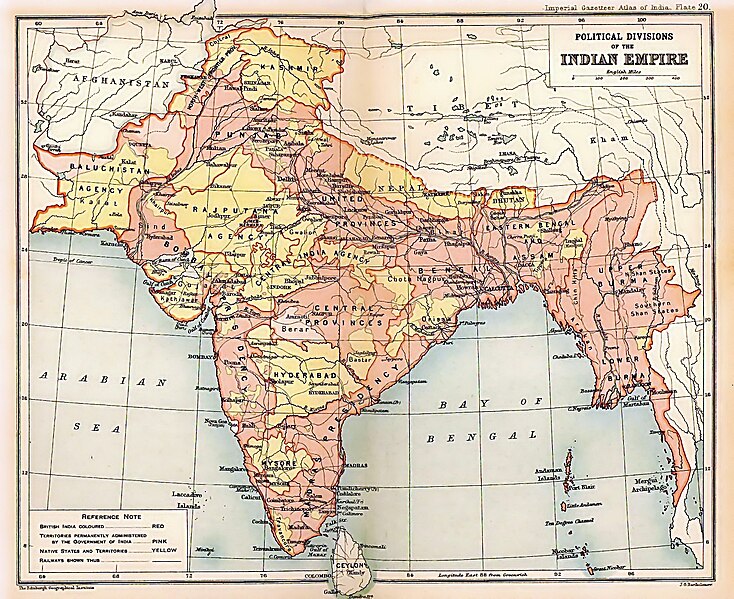
Pre-partition map of India

Pre-partition map of India

This map can be found at https://commons.wikimedia.org/wiki/File:British_Indian_Empire_1909_Imperial_Gazetteer_of_India.jpg and is part of quite a few Indian articles. I would urge people to look at the map in-depth. Except for the Central India Agency and Central India Provinces, most of the other regions were quite comfortable weather-wise. Hence I can t help but feel the assertion that Britishers didn t like India (as to live here) slightly revolting. See the excerpt/take on Dale Kennedy s The Magic Mountains: Hill Stations and the British Raj. Berkeley: University of California Press, 1996. xv + 264 pp. . A look at the list of hill stations of divided India is enough to tell that there were lot of places which either were founded by the Britishers or they chose to live there. And this is not all, there are supposed to lot of beautiful places even in Pakistan, especially in North East Frontier, Swat for instance. While today it s infamous for Taliban and Islamic Terrorism, there was a time it was known for its beauty.

The second most difficult mountain in the world - K2, Pakistan

The second most difficult mountain in the world K2, Pakistan

Trivia After Everest, K2 is the smaller one although whatever I have read of people s accounts, most people who ascended all 14 8,000 metre peaks say K2 is technically more tougher than Everest and after Everest has the highest casualty rate. Also places like the disputed North half of Pakistan Occupied Kashmir, Gilgit Baltistan, Extreme northern Punjab of Pakistan , Northern half of Khyber-Pakhtunkhawa province and Northern Balochistan all of these places would have been more than conducive to the Britishers as it is near to the British climate (snow and pleasant weather all year round). It really is a pity that Pakistan chose to become a terrorist state where it could have become one of the more toured places of Asia. I really feel nauseous and sad at the multiple chances that Pakistan frittered away, it could have been something else.
Filed under: Miscellenous Tagged: #bash-completion, #British Raj, #contributions, #debian, #debian-policy, #Debian-QA, #Hill Stations, #India Independance Movement, #lintian, #obsolete-conffiles, #unknown-horizons, #weather, #World History, adequate, Pakistan, tourism

20 January 2017

Michal Čihař: Weblate 2.10.1

This is first security bugfix release for Weblate. This has to come at some point, fortunately the issue is not really severe. But Weblate got it's first CVE ID today, so it's time to address it in a bugfix release. Full list of changes: If you are upgrading from older version, please follow our upgrading instructions. You can find more information about Weblate on https://weblate.org, the code is hosted on Github. If you are curious how it looks, you can try it out on demo server. You can login there with demo account using demo password or register your own user. Weblate is also being used on https://hosted.weblate.org/ as official translating service for phpMyAdmin, OsmAnd, Aptoide, FreedomBox, Weblate itself and many other projects. Should you be looking for hosting of translations for your project, I'm happy to host them for you or help with setting it up on your infrastructure. Further development of Weblate would not be possible without people providing donations, thanks to everybody who have helped so far!

Filed under: Debian English SUSE Weblate 0 comments

18 January 2017

Reproducible builds folks: Reproducible Builds: week 90 in Stretch cycle

What happened in the Reproducible Builds effort between Sunday January 8 and Saturday January 14 2017: Upcoming Events Reproducible work in other projects Reproducible Builds have been mentioned in the FSF high-priority project list. The F-Droid Verification Server has been launched. It rebuilds apps from source that were built by f-droid.org and checks that the results match. Bernhard M. Wiedemann did some more work on reproducibility for openSUSE. Bootstrappable.org (unfortunately no HTTPS yet) was launched after the initial work was started at our recent summit in Berlin. This is another topic related to reproducible builds and both will be needed in order to perform "Diverse Double Compilation" in practice in the future. Toolchain development and fixes Ximin Luo researched data formats for SOURCE_PREFIX_MAP and explored different options for encoding a map data structure in a single environment variable. He also continued to talk with the rustc team on the topic. Daniel Shahaf filed #851225 ('udd: patches: index by DEP-3 "Forwarded" status') to make it easier to track our patches. Chris Lamb forwarded #849972 upstream to yard, a Ruby documentation generator. Upstream has fixed the issue as of release 0.9.6. Alexander Couzens (lynxis) has made mksquashfs reproducible and is looking for testers. It compiles on BSD systems such as FreeBSD, OpenBSD and NetBSD. Bugs filed Chris Lamb: Lucas Nussbaum: Nicola Corna: Reviews of unreproducible packages 13 package reviews have been added and 13 have been removed in this week, adding to our knowledge about identified issues. 1 issue type has been added: Weekly QA work During our reproducibility testing, the following FTBFS bugs have been detected and reported by: diffoscope development Bugs in diffoscope in the last year Many bugs were opened in diffoscope during the past few weeks, which probably is a good sign as it shows that diffoscope is much more widely used than a year ago. We have been working hard to squash many of them in time for Debian stable, though we will see how that goes in the end reproducible-website development tests.reproducible-builds.org Misc. This week's edition was written by Ximin Luo, Chris Lamb and Holger Levsen and reviewed by a bunch of Reproducible Builds folks on IRC & the mailing lists.

Jonathan Dowland: RetroPie, NES Classic and Bluetooth peripherals

I wanted to write a more in-depth post about RetroPie the Retro Gaming Appliance OS for Raspberry Pis, either technically or more positively, but unfortunately I don't have much positive to write. What I hoped for was a nice appliance that I could use to play old games from the comfort of my sofa. Unfortunately, nine times out of ten, I had a malfunctioning Linux machine and the time I'd set aside for jumping on goombas was being spent trying to figure out why bluetooth wasn't working. I have enough opportunities for that already, both at work and at home. I feel a little bad complaining about an open source, volunteer project: in its defence I can say that it is iterating fast and the two versions I tried in a relatively short time span were rapidly different. So hopefully a lot of my woes will eventually be fixed. I've also read a lot of other people get on with it just fine. Instead, I decided the Nintendo Classic NES Mini was the plug-and-play appliance for me. Alas, it became the "must have" Christmas toy for 2016 and impossible to obtain for the recommended retail price. I did succeed in finding one in stock at Toys R Us online at one point, only to have the checkout process break and my order not go through. Checking Stock Informer afterwards, that particular window of opportunity was only 5 minutes wide. So no NES classic for me! My adventures in RetroPie weren't entirely fruitless, thankfully: I discovered two really nice pieces of hardware.

ThinkPad Keyboard ThinkPad Keyboard
The first is Lenovo's ThinkPad Compact Bluetooth Keyboard with TrackPoint, a very compact but pleasant to use Bluetooth keyboard including a trackpoint. I miss the trackpoint from my days as a Thinkpad laptop user. Having a keyboard and mouse combo in such a small package is excellent. My only two complaints would be the price (I was lucky to get one cheaper on eBay) and the fact it's bluetooth only: there's a micro-USB port for charging, but it would be nice if it could be used as a USB keyboard too. There's a separate, cheaper USB model.
8bitdo SFC30 8bitdo SFC30
The second neat device is a clone of the SNES gamepad by HK company 8bitdo called the SFC30. This looks and feels very much like the classic Nintendo SNES controller, albeit slightly thicker from front to back. It can be used in a whole range of different modes, including attached USB; Bluetooth pretending to be a keyboard; Bluetooth pretending to be a controller; and a bunch of other special modes designed to work with iOS or Android devices in various configurations. The manufacturer seem to be actively working on firmware updates to further enhance the controller. The firmware is presently closed source, but it would not be impossible to write an open source firmware for it (some people have figured out the basis for the official firmware). I like the SFC30 enough that I spent some time trying to get it working for various versions of Doom. There are just enough buttons to control a 2.5D game like Doom, whereas something like Quake or a more modern shooter would not work so well. I added support for several 8bitdo controllers directly into Chocolate Doom (available from 2.3.0 onwards) and into SDL2, a popular library for game development, which I think is used by Steam, so Steam games may all gain SFC30 support in the future too.

Norbert Preining: Debian/TeX Live January 2017

As the freeze of the next release is closing in, I have updated a bunch of packages around TeX: All of the TeX Live packages (binaries and arch independent ones) and tex-common. I might see whether I get some updates of ConTeXt out, too.

texlive2016-debian The changes in the binaries are mostly cosmetic: one removal of a non-free (unclear-free) file, and several upstream patches got cherrypicked (dvips, tltexjp contact email, upmendex, dvipdfmx). I played around with including LuaTeX v1.0, but that breaks horribly with the current packages in TeX Live, so I refrained from it. The infrastructure package tex-common got a bugfix for updates from previous releases, and for the other packages there is the usual bunch of updates and new packages. Enjoy! New packages arimo, arphic-ttf, babel-japanese, conv-xkv, css-colors, dtxdescribe, fgruler, footmisx, halloweenmath, keyfloat, luahyphenrules, math-into-latex-4, mendex-doc, missaali, mpostinl, padauk, platexcheat, pstring, pst-shell, ptex-fontmaps, scsnowman, stanli, tinos, undergradmath, yaletter. Updated packages acmart, animate, apxproof, arabluatex, arsclassica, babel-french, babel-russian, baskervillef, beamer, beebe, biber, biber.x86_64-linux, biblatex, biblatex-apa, biblatex-chem, biblatex-dw, biblatex-gb7714-2015, biblatex-ieee, biblatex-philosophy, biblatex-sbl, bidi, calxxxx-yyyy, chemgreek, churchslavonic, cochineal, comicneue, cquthesis, csquotes, ctanify, ctex, cweb, dataref, denisbdoc, diagbox, dozenal, dtk, dvipdfmx, dvipng, elocalloc, epstopdf, erewhon, etoolbox, exam-n, fbb, fei, fithesis, forest, glossaries, glossaries-extra, glossaries-french, gost, gzt, historische-zeitschrift, inconsolata, japanese-otf, japanese-otf-uptex, jsclasses, latex-bin, latex-make, latexmk, lt3graph, luatexja, markdown, mathspec, mcf2graph, media9, mendex-doc, metafont, mhchem, mweights, nameauth, noto, nwejm, old-arrows, omegaware, onlyamsmath, optidef, pdfpages, pdftools, perception, phonrule, platex-tools, polynom, preview, prooftrees, pst-geo, pstricks, pst-solides3d, ptex, ptex2pdf, ptex-fonts, qcircuit, quran, raleway, reledmac, resphilosophica, sanskrit, scalerel, scanpages, showexpl, siunitx, skdoc, skmath, skrapport, smartdiagram, sourcesanspro, sparklines, tabstackengine, tetex, tex, tex4ht, texlive-scripts, tikzsymbols, tocdata, uantwerpendocs, updmap-map, uplatex, uptex, uptex-fonts, withargs, wtref, xcharter, xcntperchap, xecjk, xellipsis, xepersian, xint, xlop, yathesis.

17 January 2017

Elizabeth Ferdman: 6 Week Progress Update for PGP Clean Room

One of the PGP Clean Room s aims is to provide users with the option to easily initialize one or more smartcards with personal info and pins, and subsequently transfer keys to the smartcard(s). The advantage of using smartcards is that users don t have to expose their keys to their laptop for daily certification, signing, encryption or authentication purposes. I started building a basic whiptail TUI that asks users if they will be using a smartcard:
smartcard-init.sh on Github If yes, whiptail provides the user with the opportunity to initialize the smartcard with their name, preferred language and login, and change their admin PIN, user PIN, and reset code. I outlined the commands and interactions necessary to edit personal info on the smartcard using gpg --card-edit and sending the keys to the card with gpg --edit-key <FPR> in smartcard-workflow. There s no batch mode for smartcard operations and there s no quick command for it just yet (as in quick-addkey). One option would be to try this out with command-fd/command-file. Currently, python bindings for gpgme are under development so that is another possibility. We can use this workflow to support two smartcards one for the primary key and one for the subkeys, a setup that would also support subkey rotation.

14 January 2017

Sven Hoexter: moto g falcon reactivation and exodus mod

I started to reactivate my old moto g falcon during the last days of CyanogenMod in December of 2016. First step was a recovery update to TWRP 3.0.2-2 so I was able to flash CM13/14 builds. While CM14 nightly builds did not boot at all the CM13 builds did, but up to the last build wifi connections to the internet did not work. I could actually register with my wifi (Archer C7 running OpenWRT) but all apps claim the internet connection check failed and I'm offline. So bummer, without wifi a smartphone is not much fun. I was pretty sure that wifi worked when I last used that phone about 1.5 years ago with CM11/12, so I started to dive into the forums of xda-developers to look for alternatives. Here I found out about Exodus. I've a bit of trouble trusting stuff from xda-developer forums but what the hell, the phone is empty anyway so nothing to loose and I flashed the latest falcon build. To flash it I had to clean the whole phone, format all partitions via TWRP and then sideloaded the zip image file via adb (adb from the Debian/stretch adb package works like a charm, thank you guys!). Booted and b m wifi works again! Now Exodus is a really striped down mod, to do anything useful with it I had to activate the developer options and allow USB debugging. Afterwards I could install the f-droid and Opera apk via "adb install foo.apk". Lineage OS As I could derive from another thread on xda-developers Lineage OS has the falcon still on the shortlist for 14.x nightly builds. Maybe that will be an alternative again in the future. For now Exodus is a bit behind the curve (based on Android 6.0.1 from September 2016) but at least it's functional.

12 January 2017

Ritesh Raj Sarraf: Laptop Mode Tools 1.71

I am pleased to announce the 1.71 release of Laptop Mode Tools. This release includes some new modules, some bug fixes, and there are some efficiency improvements too. Many thanks to our users; most changes in this release are contributions from our users. A filtered list of changes in mentioned below. For the full log, please refer to the git repository. Source tarball, Feodra/SUSE RPM Packages available at:
https://github.com/rickysarraf/laptop-mode-tools/releases Debian packages will be available soon in Unstable. Homepage: https://github.com/rickysarraf/laptop-mode-tools/wiki
Mailing List: https://groups.google.com/d/forum/laptop-mode-tools
1.71 - Thu Jan 12 13:30:50 IST 2017
    * Fix incorrect import of os.putenv
    * Merge pull request #74 from Coucouf/fix-os-putenv
    * Fix documentation on where we read battery capacity from
    * cpuhotplug: allow disabling specific cpus
    * Merge pull request #78 from aartamonau/cpuhotplug
    * runtime-pm: refactor listed_by_id()
    * wireless-power: Use iw and fallback to iwconfig if it not available
    * Prefer available AC supply information over battery state to determine ON_AC
    * On startup, we want to force the full execution of LMT.
    * Device hotplugs need a forced execution for LMT to apply the proper settings
    * runtime-pm: Refactor list_by_type()
    * kbd-backlight: New module to control keyboard backlight brightness
    * Include Transmit power saving in wireless cards
    * Don't run in a subshell
    * Try harder to check battery charge
    * New module: vgaswitcheroo
    * Revive bluetooth module. Use rfkill primarily. Also don't unload (incomplete list of) kernel modules
What is Laptop Mode Tools
Description: Tools for Power Savings based on battery/AC status
 Laptop mode is a Linux kernel feature that allows your laptop to save
 considerable power, by allowing the hard drive to spin down for longer
 periods of time. This package contains the userland scripts that are
 needed to enable laptop mode.
 .
 It includes support for automatically enabling laptop mode when the
 computer is working on batteries. It also supports various other power
 management features, such as starting and stopping daemons depending on
 power mode, automatically hibernating if battery levels are too low, and
 adjusting terminal blanking and X11 screen blanking
 .
 laptop-mode-tools uses the Linux kernel's Laptop Mode feature and thus
 is also used on Desktops and Servers to conserve power

Categories:

Keywords:

Like:

11 January 2017

Reproducible builds folks: Reproducible Builds: week 89 in Stretch cycle

What happened in the Reproducible Builds effort between Sunday January 1 and Saturday January 7 2017: GSoC and Outreachy updates Toolchain development Packages reviewed and fixed, and bugs filed Chris Lamb: Dhole: Reviews of unreproducible packages 13 package reviews have been added, 4 have been updated and 6 have been removed in this week, adding to our knowledge about identified issues. 2 issue types have been added/updated: Upstreaming of reproducibility fixes Merged: Opened: Weekly QA work During our reproducibility testing, the following FTBFS bugs have been detected and reported by: diffoscope development diffoscope 67 was uploaded to unstable by Chris Lamb. It included contributions from :
[ Chris Lamb ]
* Optimisations:
  - Avoid multiple iterations over archive by unpacking once for an ~8X
    runtime optimisation.
  - Avoid unnecessary splitting and interpolating for a ~20X optimisation
    when writing --text output.
  - Avoid expensive diff regex parsing until we need it, speeding up diff
    parsing by 2X.
  - Alias expensive Config() in diff parsing lookup for a 10% optimisation.
* Progress bar:
  - Show filenames, ELF sections, etc. in progress bar.
  - Emit JSON on the the status file descriptor output instead of a custom
    format.
* Logging:
  - Use more-Pythonic logging functions and output based on __name__, etc.
  - Use Debian-style "I:", "D:" log level format modifier.
  - Only print milliseconds in output, not microseconds.
  - Print version in debug output so that saved debug outputs can standalone
    as bug reports.
* Profiling:
  - Also report the total number of method calls, not just the total time.
  - Report on the total wall clock taken to execute diffoscope, including
    cleanup.
* Tidying:
  - Rename "NonExisting" -> "Missing".
  - Entirely rework diffoscope.comparators module, splitting as many separate
    concerns into a different utility package, tidying imports, etc.
  - Split diffoscope.difference into diffoscope.diff, etc.
  - Update file references in debian/copyright post module reorganisation.
  - Many other cleanups, etc.
* Misc:
  - Clarify comment regarding why we call python3(1) directly. Thanks to J r my
    Bobbio <lunar@debian.org>.
  - Raise a clearer error if trying to use --html-dir on a file.
  - Fix --output-empty when files are identical and no outputs specified.
[ Reiner Herrmann ]
* Extend .apk recognition regex to also match zip archives (Closes: #849638)
[ Mattia Rizzolo ]
* Follow the rename of the Debian package "python-jsbeautifier" to
  "jsbeautifier".
[ siamezzze ]
* Fixed no newline being classified as order-like difference.
reprotest development reprotest 0.5 was uploaded to unstable by Chris Lamb. It included contributions from:
[ Ximin Luo ]
* Stop advertising variations that we're not actually varying.
  That is: domain_host, shell, user_group.
* Fix auto-presets in the case of a file in the current directory.
* Allow disabling build-path variations. (Closes: #833284)
* Add a faketime variation, with NO_FAKE_STAT=1 to avoid messing with
  various buildsystems. This is on by default; if it causes your builds
  to mess up please do file a bug report.
* Add a --store-dir option to save artifacts.
Other contributions (not yet uploaded): reproducible-builds.org website development tests.reproducible-builds.org Misc. This week's edition was written by Chris Lamb, Holger Levsen and Vagrant Cascadian, reviewed by a bunch of Reproducible Builds folks on IRC & the mailing lists.

Next.

Previous.