Search Results: "nate"

4 February 2021

Ulrike Uhlig: On anger, misunderstandings, and hearing with different ears

Anger Anger is a feeling that is mostly taboo in our society. People tend to think that anger and rage are the same thing and reject anger. We are taught to suppress it. But: The suppression of anger can cause a lot of trouble, giving rise to virulent progeny such as malice, passive aggression, hostility, rage, sabotage, hate, blame, guilt, controlling behavior, shame, self-blame, and self-destruction. (Quoted from: Anne Katherine, Where to draw the line ). When we talk about anger, we need to distinguish between acting out anger, and feeling anger. In general, when you hear me talking about anger, I m talking about the feeling named anger in English. Anger is a normal feeling with a super power: it gives us the energy to change a situation that we consider to be unsustainable. We can express the feeling of anger verbally by saying for example: That thing makes me really angry , I can t talk right now, I am very angry about what I just heard . Let s also note that there may be other feelings lying below anger, such as sadness, frustration, grief, fear, etc. Mixing emotions This is a page from the wonderful Making Comics by Scott McCloud. (Yes, emotions are complex! See some more of Scott McCloud s pages about emotion in comics)

Bottling up feelings Most of the time, people don t get angry suddenly, even though it might seem like that from the outside. Instead, they ve been bottling up feelings for a while, and at some point, a small trigger is enough to make the bottle overflow. The reasons for bottling up feelings can be as diverse as people:
  • Low self-esteem: not thinking one has the right and the capacity to express unpleasant feelings
  • Not knowing how to express unpleasant feelings. For example not having learnt to say: I am not comfortable, I ll leave now, I ll get back to you once I know what s going on / if this is about me / if I feel like it.
  • Not trusting one s own feelings, specifically common in people who have been victims of gaslighting
  • Repressing emotions, specifically anger, sometimes to the point of not being able to feel one s own feelings anymore
  • Not being able to express disagreement and instead applying the fawn response: trying to please the other in order to avoid further conflict. See: Fight, flight, freeze, or fawn
  • Not being able to express boundaries: stop , this is enough , I don t accept this , etc.
  • Not being in a situation or a space in which feelings can be expressed freely, for example a workplace or a hierarchical situation where this might be disadvantageous
These are just some examples I can come up with in 3 minutes, the list is non exhaustive. When someone s bottle overflows, their peers can be confused and not know how to react to what they perceive as a sudden outburst while what they are seeing might just be the other person s first time tentative of saying no or stop . Oftentimes, the responsibility for the situation is then put on the shoulders of the person who supposedly exploded : they have been behaving differently than usual or not within the expectations, right? Well, it s not that simple. Conflicts are relational. The other party might have ignored signs, requests, feelings, and needs of the angry person for a while. Maybe the relationship has been deteriorating since some time? Maybe there was a power imbalance, that has never been revisited, updated, questioned? Or maybe their bottle is being filled by something else in their life and getting too small to contain all the drops of suppressed emotions. People change, and relationships change. We cannot assume that because a person has accepted something for months or years, that they always will. I think that anger can be a sign of such change or need thereof.

A message has four sides and that creates misunderstandings Friedemann Schulz von Thun has created a theory, the four-sides model, that establishes four facets of a message:
  • Fact: What is the message about?
  • Self-disclosure: What does the speaker reveal about herself (with or without intention)?
  • Relation: What is the speaker s relationship towards the receiver of the message?
  • Appeal: What does the speaker want to obtain?
Let me adapt Schulz von Thun s example to a situation that happened to me once: I came to a friend s house and I smelled some unknown thing when I entered the apartment. I asked: what s that smell? I actually never bake, so I don t know anything about whatever it is people put into cakes. I wanted to say: I don t know what that smell is, tell me what it is? She replied: You never like anything I do, my furniture gets criticized, my cake s not right, and you criticize me all the time. We ended up in such a big misunderstanding that I left her house 5 minutes after I arrived. With Schulz von Thun s model we can understand what happened here: The speaker s question What s that smell in the kitchen? has four sides:
  1. Factual: There is a smell.
  2. Self-disclosure: I don t know what it is.
  3. Relational: You know what it is.
  4. Appeal: Tell me what it is!
The receiver can hear the question with 4 different ears:
  1. Factual part: There is a smell.
  2. Self-disclosure: I don t like the smell.
  3. Relationship: You re not good at baking cake.
  4. Appeal: Don t bake cake anymore.
At this point, the receiver will probably reply: Bake the cake yourself next time!

Behind the message Sometimes, we hear more strongly with one ear than with the other ears. For example, some people hear more on the relational side and they will always hear You re not good at . Other people hear more on the appeal side and will always try to guess into a message what the other person wants or expects of them.

Form and contents of a message Getting back to anger, I think that it s often not the contents i.e. the factual facet of a message that triggers our bottle to overflow, but the (perceived) intention of the speaker, i.e. the appeal facet. For example, a speaker might have an intention to silence us by using gaslighting, or tone policing. Or a speaker wants to explicitly hurt us because that s how they learnt to deal with their own feelings of hurt. The actual relation between speaker and receiver also seems to play a role in how anger can get triggered, when we hear with the relational ear. There are many nonverbal underlying layers to our communication:
  • The position of both speaker and receiver to each other: are they equals or is there any kind of power imbalance between them? A power imbalance can be a (perceived) dependency: For example, one person in a friendship has a kid and the other one regularly helps them so that the parent has some time to advance their work or career: this can create a feeling of not being good enough by oneself and having to rely on others. Or there is indeed a dependency in which the speaker is a team lead and the receiver a subordinate.
  • The needs of each person: a need to solve problems quickly for one person might conflict with the need to be involved in decision making of the other person. (See Taibi Kahler s drivers)
  • The inner beliefs of each person: in childhood we might have constructed the inner belief: You re okay, I m not okay , or Nobody cares about what I want , or I have to be nice (friendly, hardworking, strong, etc.) all the time otherwise nobody loves me - as some examples.
So, suppose person A offers to help person B, and what person B hears instead is their overprotective mother instead of their friend. Person A might be surprised to see B overreact or disappear for a while to get back their feelings of autonomy and integrity as an adult. Or person C expresses she d like to handle problem X like this while person D might well not hear this as a proposal to handle a problem, but as a decision made without involving her. Which might propel D back to her childhood in which she could also not take decisions autonomously. Then D might react like she would react as a child, slamming a door, shout, run away, freeze, or fawn.

Communication is complex! So, whenever we hear a message, not only do we hear the message with four ears, but also, we hear it with our position, our needs, and our inner beliefs. And sometimes, our bottle is already full, and then it overflows. At that point, I find it important that both sides reflect on the situation and stay in contact. Using empathy and compassion, we can try to better understand what s going on, where we might have hurt the other person, for example, or what was being misunderstood. Did we hear only one side of the message? Do our respective strategies conflict with each other? If we cannot hear each other anymore or always hear only one side of the message, we can try to do a mediation. Obviously, if at that point one side does not actually want to solve the problem, or thinks it s not their problem, then there s not much we can do, and mediation would not help. The examples above might sound familiar to you. I chose them because I ve seen them happen around me often, and I understand them as shared patterns. While all beings on this planets are unique, we share a common humanity, for example through such patterns and common experiences.

31 January 2021

Chris Lamb: Free software activities in January 2021

Here is my monthly update covering what I have been doing in the free software world during January 2021 (previous month):

Reproducible Builds One of the original promises of open source software is that distributed peer review and transparency of process results in enhanced end-user security. However, whilst anyone may inspect the source code of free and open source software for malicious flaws, almost all software today is distributed as pre-compiled binaries. This allows nefarious third-parties to compromise systems by injecting malicious code into ostensibly secure software during the various compilation and distribution processes. The motivation behind the Reproducible Builds effort is to ensure no flaws have been introduced during this compilation process by promising identical results are always generated from a given source, thus allowing multiple third-parties to come to a consensus on whether a build was compromised. This month, I:
I also made the following changes to diffoscope, our in-depth and content-aware diff utility that can locate and diagnose reproducibility issues, releasing version 164, version 165 and version 166 as well as triaging and merging many contributions from others:

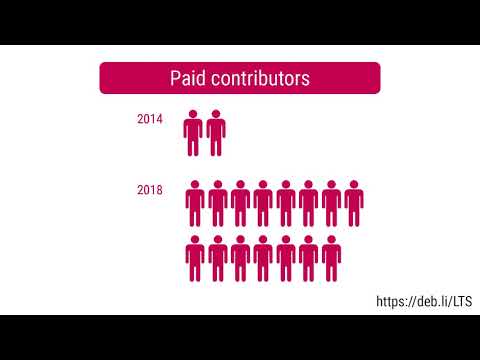
Debian Uploads Debian LTS This month I worked 18 hours on Debian Long Term Support (LTS) and 12 hours on its sister Extended LTS project. You can find out more about the project via the following video:

30 January 2021

Dirk Eddelbuettel: RcppDate 0.0.2: Regular Update

RcppDate wraps the date library by Howard Hinnant for use with R. This header-only modern C++ library has been in pretty wide-spread use for a while now, and adds to C++11/C++14/C++17 what will be (with minor modifications) the date library in C++20. Since the original 0.0.1 CRAN release I have also added this package along with RcppCCTZ and nanotime (which uses / requires both) to Debian so an apt based install is also possible for some. Release 0.0.2 arrived on CRAN yesterday. It simply updates the included library to version upstream version 3.0.0, and touches up some packaging internals for continued integration.

Changes in version 0.0.2 (2021-01-29)
  • Added GitHub Actions CI via run.sh from r-ci
  • Updated to upstream version 3.0.0 (plus newer commits)

If you like this or other open-source work I do, you can now sponsor me at GitHub.

This post by Dirk Eddelbuettel originated on his Thinking inside the box blog. Please report excessive re-aggregation in third-party for-profit settings.

29 January 2021

Jonathan McDowell: Working better with an online whiteboard

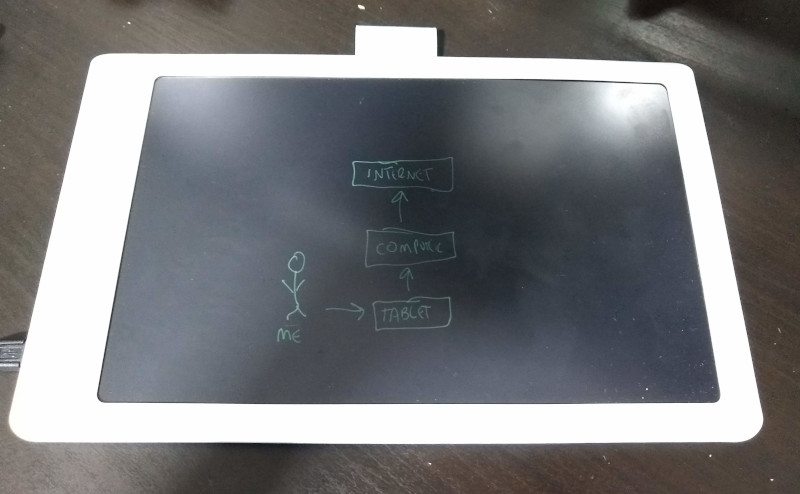
LCD Writing Tablet One of the challenges I find about being fully remote is that one of the ways I think while I explain things is I draw diagrams. I m not artistic in any manner (my brothers got that skillset), but a set of boxes and lines and some text scribbled as I talk really helps. I do think even for myself, which is obviously as easy to replicate at home as in the office; I have plenty of paper and a whiteboard in my study. It s not so easy when having a design discussion with someone remotely. Doodling with a mouse doesn t quite work; my art skills are bad enough without then factoring in the fact it s not a pen-like device I m using to do it. I ve previously tried a proper graphics tablet, but there s a disconnect between where you are writing and where the output appears. That makes doing things like labelling within a diagram, or going back to draw an update, quite difficult. Or it does if you re me anyway. The modern solution is probably a laptop with a stylus capable touchscreen, but I ve shied away from such things because I don t want fingerprints all over my screen and don t want to pay extra for something I haven t previously thought I d use. An alternative is a tablet with a stylus capable screen, but those turn out to be premium models these days (remember when resistive was the cheap option because no one wanted to use the stylus?) and mine doesn t support it. You can get capacitive styli (styluses?) but then when you lean on the tablet it all gets confused. When I m due a technology refresh of my laptop or tablet I ll perhaps factor such things in, but what to do now, when I m not entirely sure how much usage I ll get out of such a device and thus can t justify a major expense on it? Buy a random thing from the internet, of course! It turns out there are a range of LCD writing tablets out there, which let you scribble on a screen and then erase it at the press of a button. An electronic etch-a-sketch, as it were. Most of them don t count as smart , with power only needed for the erase, but there appears to have been a device called the Boogie Board Sync in the past which offered some ability to save things. Searching around I found the NEWYES 10 Bluetooth Archive Writing Tablet from BangGood. Which looked like it had enough smarts to be able to send the images over bluetooth and therefore might be hackable in some manner. At 45 it seemed a reasonable punt, so I ordered one. It arrived within 2 weeks and I was surprised to find that when plugged in as a USB device it actually presented as a tablet. So much for a hackery requirement! It was detected by the kernel fine:
kernel dmesg output
usb 1-1.2: new full-speed USB device number 19 using xhci_hcd
usb 1-1.2: New USB device found, idVendor=6161, idProduct=4d15, bcdDevice=30.00
usb 1-1.2: New USB device strings: Mfr=5, Product=6, SerialNumber=0
usb 1-1.2: Product: LetSketch
usb 1-1.2: Manufacturer: LetSketch
hid-generic 0003:6161:4D15.0010: hiddev0,hidraw4: USB HID v1.11 Device [LetSketch LetSketch] on usb-0000:00:14.0-1.2/input0
input: LetSketch LetSketch as /devices/pci0000:00/0000:00:14.0/usb1/1-1/1-1.2/1-1.2:1.1/0003:6161:4D15.0011/input/input35
hid-generic 0003:6161:4D15.0011: input,hidraw5: USB HID v1.11 Device [LetSketch LetSketch] on usb-0000:00:14.0-1.2/input1
lsusb output
Bus 001 Device 016: ID 6161:4d15  
Device Descriptor:
  bLength                18
  bDescriptorType         1
  bcdUSB               1.00
  bDeviceClass            0 
  bDeviceSubClass         0 
  bDeviceProtocol         0 
  bMaxPacketSize0        64
  idVendor           0x6161 
  idProduct          0x4d15 
  bcdDevice           30.00
  iManufacturer           5 LetSketch
  iProduct                6 LetSketch
  iSerial                 0 
  bNumConfigurations      1
  Configuration Descriptor:
    bLength                 9
    bDescriptorType         2
    wTotalLength       0x003b
    bNumInterfaces          2
    bConfigurationValue     1
    iConfiguration          0 
    bmAttributes         0xa0
      (Bus Powered)
      Remote Wakeup
    MaxPower              480mA
    Interface Descriptor:
      bLength                 9
      bDescriptorType         4
      bInterfaceNumber        0
      bAlternateSetting       0
      bNumEndpoints           1
      bInterfaceClass         3 Human Interface Device
      bInterfaceSubClass      1 Boot Interface Subclass
      bInterfaceProtocol      2 Mouse
      iInterface              0 
        HID Device Descriptor:
          bLength                 9
          bDescriptorType        33
          bcdHID               1.11
          bCountryCode            0 Not supported
          bNumDescriptors         1
          bDescriptorType        34 Report
          wDescriptorLength      18
         Report Descriptors: 
           ** UNAVAILABLE **
      Endpoint Descriptor:
        bLength                 7
        bDescriptorType         5
        bEndpointAddress     0x81  EP 1 IN
        bmAttributes            3
          Transfer Type            Interrupt
          Synch Type               None
          Usage Type               Data
        wMaxPacketSize     0x0010  1x 16 bytes
        bInterval               2
    Interface Descriptor:
      bLength                 9
      bDescriptorType         4
      bInterfaceNumber        1
      bAlternateSetting       0
      bNumEndpoints           1
      bInterfaceClass         3 Human Interface Device
      bInterfaceSubClass      1 Boot Interface Subclass
      bInterfaceProtocol      2 Mouse
      iInterface              0 
        HID Device Descriptor:
          bLength                 9
          bDescriptorType        33
          bcdHID               1.11
          bCountryCode            0 Not supported
          bNumDescriptors         1
          bDescriptorType        34 Report
          wDescriptorLength      83
         Report Descriptors: 
           ** UNAVAILABLE **
      Endpoint Descriptor:
        bLength                 7
        bDescriptorType         5
        bEndpointAddress     0x82  EP 2 IN
        bmAttributes            3
          Transfer Type            Interrupt
          Synch Type               None
          Usage Type               Data
        wMaxPacketSize     0x0010  1x 16 bytes
        bInterval               2
Device Status:     0x0003
  Self Powered
  Remote Wakeup Enabled
Nice. X wasn t happy though:
non-working Xorg log
(II) config/udev: Adding input device LetSketch LetSketch (/dev/input/event8)
(**) LetSketch LetSketch: Applying InputClass "libinput tablet catchall"
(II) Using input driver 'libinput' for 'LetSketch LetSketch'
(II) systemd-logind: got fd for /dev/input/event8 13:72 fd 34 paused 0
(**) LetSketch LetSketch: always reports core events
(**) Option "Device" "/dev/input/event8"
(**) Option "_source" "server/udev"
(II) event8  - LetSketch LetSketch: is tagged by udev as: Tablet
(EE) event8  - LetSketch LetSketch: libinput bug: missing tablet capabilities: resolution. Ignoring this device.
(II) event8  - LetSketch LetSketch: device is a tablet
(II) event8  - failed to create input device '/dev/input/event8'.
(EE) libinput: LetSketch LetSketch: Failed to create a device for /dev/input/event8
(EE) PreInit returned 2 for "LetSketch LetSketch"
(II) UnloadModule: "libinput"
I ended up digging into the libinput source to figure out what was going on here, and it turned out to be the fact there was no report of the physical size of the tablet, so no indication of what the resolution was. That s solvable with an entry in the udev hwdb for evdev devices, so I sent a patch upstream and with that applied (or just dropped into /etc/udev/hwdb.d/61-evdev-local.hwdb and then running systemd-hwdb update and replugging the device) everything looks much happier:
working Xorg log
(II) config/udev: Adding input device LetSketch LetSketch (/dev/input/event8)
(**) LetSketch LetSketch: Applying InputClass "libinput tablet catchall"
(II) Using input driver 'libinput' for 'LetSketch LetSketch'
(II) systemd-logind: got fd for /dev/input/event8 13:72 fd 86 paused 0
(**) LetSketch LetSketch: always reports core events
(**) Option "Device" "/dev/input/event8"
(**) Option "_source" "server/udev"
(II) event8  - LetSketch LetSketch: is tagged by udev as: Tablet
(II) event8  - LetSketch LetSketch: tablet 'LetSketch LetSketch' unknown to libwacom
(II) event8  - LetSketch LetSketch: device is a tablet
(II) event8  - LetSketch LetSketch: device removed
(**) Option "config_info" "udev:/sys/devices/pci0000:00/0000:00:08.1/0000:04:00.3/usb1/1-1/1-1.2/1-1.2:1.1/0003:6161:4D15.000A/input/input24/event8"
(II) XINPUT: Adding extended input device "LetSketch LetSketch" (type: TABLET, id 20)
(II) event8  - LetSketch LetSketch: is tagged by udev as: Tablet
(II) event8  - LetSketch LetSketch: tablet 'LetSketch LetSketch' unknown to libwacom
(II) event8  - LetSketch LetSketch: device is a tablet
(II) libinput: LetSketch LetSketch: needs a virtual subdevice
(**) LetSketch LetSketch Pen (0): Applying InputClass "libinput tablet catchall"
(II) Using input driver 'libinput' for 'LetSketch LetSketch Pen (0)'
(II) systemd-logind: returning pre-existing fd for /dev/input/event8 13:72
(**) LetSketch LetSketch Pen (0): always reports core events
(**) Option "Device" "/dev/input/event8"
(**) Option "_source" "_driver/libinput"
(II) libinput: LetSketch LetSketch Pen (0): is a virtual subdevice
(**) Option "config_info" "udev:/sys/devices/pci0000:00/0000:00:08.1/0000:04:00.3/usb1/1-1/1-1.2/1-1.2:1.1/0003:6161:4D15.000A/input/input24/event8"
(II) XINPUT: Adding extended input device "LetSketch LetSketch Pen (0)" (type: STYLUS, id 21)
(**) Option "AccelerationScheme" "none"
(**) LetSketch LetSketch Pen (0): (accel) selected scheme none/0
(**) LetSketch LetSketch Pen (0): (accel) acceleration factor: 2.000
(**) LetSketch LetSketch Pen (0): (accel) acceleration threshold: 4
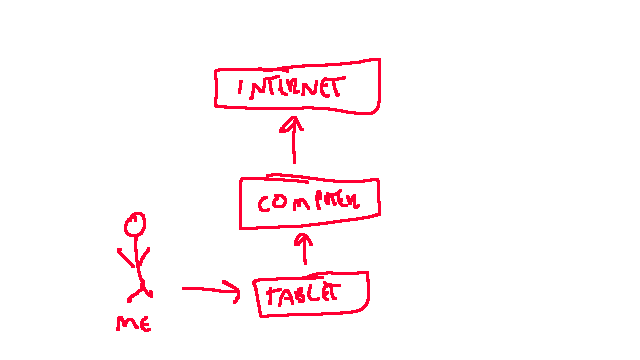
The only additional piece I ve done is tie the tablet to a single screen, so I can then full screen whichever whiteboard system I m using on that screen and have it map to the tablet - haven t worked out how to tie it to just the application window yet, but the fullscreen approach works fine, using my smaller laptop screen. To do that I use xinput list to figure out the ID of the tablet and then xinput map-to-output 23 eDP-1 to map it to the eDP-1 output (the internal laptop screen), assuming the ID that comes out of the list is 23. But is it any good? Well, the quality of the screen isn t fantastic - no fine art or anything here - but the tablet part seems fine (complete with some pressure sensitivity) and the fact I can see what I ve drawn where I m trying to draw something new makes it a lot more useful for me. I ve had a play with just screen sharing the GIMP and doodling in that, but equally work has an O365 subscription and the Microsoft Whiteboard turns out to be pretty good without anyone I m sharing with needing to install anything. Of course my artistic skills are still dreadful, but I have actually managed to use it for drawing out a couple of things while discussing them, so I m considering that a win. Saved Tablet image

27 January 2021

Russ Allbery: Review: A Deadly Education

Review: A Deadly Education, by Naomi Novik
Series: The Scholomance #1
Publisher: Del Rey
Copyright: 2020
ISBN: 0-593-12849-4
Format: Kindle
Pages: 319
Some children are born with magic, which grows as they mature. Magic attracts maleficaria: extremely deadly magical beasts that want to feast on that magic. Having innate magical ability is therefore a recipe for endless attacks from monsters and a death at a young age. This was true even for the enclaves, which are the rich, gated communities of the magical world. Hence, the Scholomance. This is a boarding school for magic users placed in the Void and protected against maleficaria as completely as possible while still letting the students graduate and leave after their senior year. Students are sent there via a teleportation spell with a weight allowance, taught magic by automated systems and magical artifacts, and left on their own to make alliances and survive. Or not survive; protected as well as possible still means that there are maleficaria everywhere, sneaking past the wards of the graduation hall and looking for snacks. The school sends cleansing fire through the halls at certain times; the rest of the time, the students either learn enough magic to defeat maleficaria themselves, form alliances with those who can, or die to feed the magic of the school. Enter Galadriel, or El as she prefers. She's not an enclave kid; she's the grumpy, misfit daughter of a hippie mother whose open-hearted devotion to healing and giving away her abilities make her the opposite of the jealously guarded power structures of the enclaves. El has no resources other than what she can muster on her own. She also has her mother's ethics, which means that although she has an innate talent for malia, drawing magic from the death of other living things, she forces herself to build her mana through rigorously ethical means. Like push-ups. Or, worse, crochet. At the start of the book, El is in her third year of four, and significantly more of her classmates are alive than normally would be. That's because of her classmate, Orion Lake, who has made a full-time hobby of saving everyone from maleficaria. His unique magical ability frees him from the constraints of mana or malia that everyone else is subject to, and he uses that to be a hero, surrounded by adoring fans. And El is thoroughly sick of it. This book is so good in so many different ways that I don't know where to start. Obviously, A Deadly Education is a twist on the boarding school novel, both the traditional and the magical kind. This is not a genre in which I'm that well-read, but even with my lack of familiarity, I noticed so many things Novik does to improve the genre tropes, starting with not making the heroic character with the special powers the protagonist. And getting rid of all the adults, which leaves way more space for rich social dynamics between the kids (complex and interesting ones that are entangled with the social dynamics outside of the school, not some simplistic Lord of the Flies take). Going alone anywhere in the school is dangerous, as is sitting at the bad tables in the cafeteria, so social cliques become a matter of literal life and death. And the students aren't just trying to survive; the ones who aren't part of enclaves are jockeying for invitations or trying to build the power to help their family and allies form their own. El is the first-person narrator of the story and she's wonderful. She's grumpy, cynical, and sarcastic, which is often good for first-person narrators, but she also has a core of ethics from her mother, and from her own decisions, that gives her so much depth. She is the type of person who knows exactly how much an ethical choice will cost her and how objectively stupid it is, and then will make it anyway out of sheer stubbornness and refuse to take credit for it. I will happily read books about characters like El until the end of time. Her mother never appears in this book, and yet she's such a strong presence because El's relationship with her matters, to both El and to the book. El could not be more unlike her mother in both personality and in magical focus, and she's exasperated by the sheer impracticality of some of her mother's ideals. And yet there's a core of love and understanding beneath that, a level at which El completely understands her mother's goals, and El relies on it even when she doesn't realize she's doing so. I don't think I've ever read a portrayal of a mother-daughter relationship this good where one of the parties isn't even present. And I haven't even gotten to the world-building, and the level to which Novik chases down and explores all the implications of this ridiculous murder machine of a school. I will offer this caveat: If you poke at the justification for creating this school in the way it was built, it's going to teeter a lot. That society thought this school was the best solution to its child mortality problem is just something you have to roll with. But once you accept that, the implications are handled so very well. The school is an inhuman character in its own right, with exasperating rules that the students learn and warn each other about. It tries to distract you with rare spellbooks or artifact materials because it's trying to kill you. The language tapes whisper horrific stories of your death. The back wall of your room is a window to the Void, from which you can demand spellbooks. You'll even get them in languages that you understand, for a generous definition of understand that may have involved glancing at one page of text, so be careful not to do that! The school replaces all of the adult teachers in the typical boarding school novel and is so much more interesting than any of them because it adds the science fiction thrill of setting as character. The world-building does mean a lot of infodumping, so be prepared for that. El likes to explain things, tell stories, and over-analyze her life, and reading this book is a bit like reading the journal of a teenage girl. For me, El's voice is so strong, authentic, stubborn, and sarcastically funny that I scarcely noticed the digressions into background material. And the relationships! Some of the turns will be predictable, since of course El's stubborn ethics will be (eventually) rewarded by the story, but the dynamic that develops between El and Orion is something special. It takes a lot to make me have sympathy with the chosen one boy hero, but Novik pulls it off without ever losing sight of the dynamics of class and privilege that are also in play. And the friendships El develops almost accidentally by being stubbornly herself are just wonderful, and the way she navigates them made me respect her even more. The one negative thing I will say about this book is that I don't think Novik quite nailed the climax. Some of this is probably because this is the first book of a series and Novik wanted to hold some social developments in reserve, but I thought El got a bit sidelined and ended up along for the ride in an action-movie sequence. Still, it's a minor quibble, and it's clear from the very end of the book that El is going to get more attention and end up in a different social position in the next book. This was a wholly engrossing and enjoyable story with a satisfying climax and only the barb of a cliffhanger in the very last line. It's the best SFF novel published in 2020 that I've read so far (yes, even better than Network Effect). Highly recommended, and I hope it gets award recognition this year. Followed by The Last Graduate (not yet published at the time of this review). Rating: 9 out of 10

26 January 2021

Russ Allbery: Review: The City We Became

Review: The City We Became, by N.K. Jemisin
Series: The Great Cities Trilogy #1
Publisher: Orbit
Copyright: March 2020
ISBN: 0-316-50985-X
Format: Kindle
Pages: 449
At an unpredictable point after a city has accumulated enough history, character, and sense of itself, it is born as a living creature. It selects an avatar who both embodies the city and helps it be born. But in that moment of birth, a city is at its most vulnerable, and that is when the Enemy attacks. The birth of cities and the Enemy attacks have happened for millennia, so the cities that have survived the process have developed a system. The most recently born goes to assist the avatar with the birthing process and help fight off Enemy attacks. But the process has become riskier and the last two cities have failed to be born, snuffed out in natural disasters despite that support. Now, it's New York City's turn. It selects its avatar and survives the initial assault with the help of S o Paulo. But something still goes wrong, and it is severely injured in the process. Complicating matters, now there are five more avatars, one for each borough, who will have to unite to fight off the Enemy. And, for the first time, the Enemy has taken human form and is attacking with reason and manipulation and intelligence, not just force. The City We Became has a great premise: take the unique sense of place that defines a city and turn it into a literalized character in a fantasy novel. The avatars are people who retain their own lives and understanding (with one exception that I'll get to in a moment), but gain an awareness of the city they represent. They can fight and repair their city through sympathetic magic and metaphor made real. The prelude that introduces this concept (adapted from Jemisin's earlier short story "The City Born Great") got too gonzo for me, but once Jemisin settles into the main story and introduces avatars with a bit more distance from the city they represent, the premise clicked. The execution, on the other hand, I thought was strained. The biggest problem is that the premise requires an ensemble cast of five borough avatars, the primary avatar, S o Paulo, and the Enemy. That's already a lot, but for the story to work each avatar has to be firmly grounded in their own unique experience of New York, which adds family members, colleagues, and roommates. That's too much to stuff into one novel, which means characters get short shrift. For example, Padmini, the avatar of Queens, gets a great introductory scene and a beautiful bit of characterization that made her one of my favorite characters, but then all but disappears for the remainder of the book. She's in the scenes, but not in a way that matters. Brooklyn and Aislyn get moments of deep characterization, but there's so much else going on that they felt rushed. And what ever happened to Manny's roommate? The bulk of the characterization in this book goes to Broncha, the Bronx avatar, a Lenape woman and a tough-as-nails administrator of a community art museum and maker space. The dynamics between her and her co-workers, her mentorship of Veneza, and her early encounters with the Woman in White are my favorite parts of the book. I thought she and Brooklyn were a useful contrast: two very different ways of finding a base of power in the city without letting go of one's ideals. But before we get to Broncha, we first meet Manny, the Manhattan avatar. Thematically, I thought what Jemisin did here was extremely clever. Manny's past is essentially erased at the start of the book, so he's making sense of this world in the same way the reader is. It makes him a useful reader insert character and parallels the typical tourist experience of arriving in Manhattan and trying to use it to make sense of New York. He's disconnected from the rest of the city because he's the dangerous newcomer with power but not a lot of understanding, which works with my model of the political dynamics of Manhattan. Unfortunately, he's not an interesting person. I appreciated what was happening at the metaphorical layer, but Manny veers between action hero and exposition prompt, and his amnesia meant I never got enough sense of him as a character to care that much about what happened to him. I thought his confrontation with the Woman in White near the start of the book, which establishes the major villain of the book, felt clunky and forced compared to her later encounters with the other characters. The Woman in White, though, is a great villain. It's clear from earlier on that the Enemy is Lovecraftian, but the Woman in White mixes mad scientist glee, manic enthusiasm, and a child-like amusement at the weirdness of humanity into the more typical tropes of tentacles, corruption, and horrific creatures. One of my qualms about reading this book is that I'm not a horror fan and don't enjoy the mental images of unspeakable monsters, but the Woman in White puts such a fascinating spin on them that I enjoyed the scenes in which she appeared. I think the book was at its best when she was trying to psychologically manipulate the characters or attack them with corrupted but pre-existing power structures. I was less interested when it turned into an action-movie fight against animated monsters. The other place Jemisin caught me by surprise is too much of a spoiler to describe in detail (and skip the next paragraph in its entirety if you want to avoid all spoilers): Jemisin didn't take the moral conflict of the book in the direction I was expecting. This book is more interested in supporting the people who are already acting ethically than in redeeming people who make bad choices. That produces a deus ex machina ending that's a bit abrupt, but I appreciated the ethical stance. Overall, I thought the premise was great but the execution was unsteady and a bit overstuffed. There are some great characters and some great scenes, but to me they felt disjointed and occasionally rushed. You also need to enjoy characters taking deep pride in the feel of a specific place and advocating for it with the vigor of a sports rivalry, along with loving descriptions of metaphors turned into magical waves of force. But, if you can roll with that, there are moments of real awe. Jemisin captured for me the joy that comes from a deeply grounded sense of connection to a place. Recommended, albeit with caveats, if you're in the mood for reading about people who love the city they live in. This is the first book of a planned trilogy and doesn't resolve the main conflict, but it reaches a satisfying conclusion. The title of the next book has not yet been announced at the time of this review. Rating: 7 out of 10

23 January 2021

Dirk Eddelbuettel: prrd 0.0.4: More tweaks

prrd facilitates the parallel running [of] reverse dependency [checks] when preparing R packages. It is used extensively for Rcpp, RcppArmadillo, RcppEigen, BH, and possibly others. prrd screenshot image The key idea of prrd is simple, and described in some more detail on its webpage and its GitHub repo. Reverse dependency checks are an important part of package development that is easily done in a (serial) loop. But these checks are also generally embarassingly parallel as there is no or little interdependency between them (besides maybe shared build depedencies). See the (dated) screenshot (running six parallel workers, arranged in split byobu session). This release brings several smaller tweaks and improvements to the summary report that had accumulated in my use since the last realease last April. We also updated the CI runners as one does these days. The release is summarised in the NEWS entry:

Changes in prrd version 0.0.4 (2021-01-23)
  • Report summary mode is now compact, more robust and reports extended CRAN summaries. (Dirk via several changes)
  • Continuous Integration now uses run.sh from r-ci

My CRANberries provides the usual summary of changes to the previous version. See the aforementioned webpage and its repo for details. For more questions or comments use the issue tracker off the GitHub repo. If you like this or other open-source work I do, you can now sponsor me at GitHub.

This post by Dirk Eddelbuettel originated on his Thinking inside the box blog. Please report excessive re-aggregation in third-party for-profit settings.

20 January 2021

Molly de Blanc: Inauguration Pie

How can I put four years into a pie? I m thinking of Inauguration Day 2017 through to today, Inauguration Day 2021. In truth things started back in 2015, when Donald Trump announced his run for the United States presidency, and I don t know how long things will continue past the moment when President-Elect Joe Biden becomes President Joe Biden. For the United States, it s been a hell of a time. For the world, it d been even worse. Every generation thinks that they lived through more than anyone else, that they had it worse. I had a Boomer tell me that the existential stress of COVID is nothing compared to the Vietnam War. I m sure when we are living through a global water crisis, I ll tell the kids that we had it bad too. Everyday I listen to the radio and read Twitter, aware that the current state of endless wars wars against terrorism and drugs, organized crime and famine, climate change and racism is global, and not limited to just what s happening to and around me. That makes it feel worse and bigger and I wonder if earlier generations can really grasp how big that is. The last four years brought me in closer working relationships with people in India and Nigeria. I would call these people my friends in that if they were in town I would want to see them and show them around. Most of them I would offer a space in my small apartment, in case they needed somewhere to sleep and wanted to save the money. We chat, though we only have the internet as opposed to elevator rides in tall office buildings and slow walks down to the shops during lunch breaks. From these relationships I have learned very little about life in India or Nigeria, and I only visited India separately from any of my colleagues there. (I went for a wedding. My visa to Nigeria was denied on account of a medical issue.) But, I follow these people on social media and see what they share, the same political and social utterances that could be the same here or virtually any other place, as long as we replace the right keywords. Exchange the name of one leader, conservative party, or government unit for another. When I first saw the #EndSARS hashtag show up, I thought the images were from Black Lives Matter protests. Stop police brutality. And that was only in the last few months. I ve had three jobs since Trump first announced his candidacy in three very different places. In the first I felt like I wasn t able to talk about the sexism and discrimination I was dealing with in the office, and how much more so my views on an organizational partnership with a government whose policies I strongly disagreed with. In the second I was able to talk about these things, but there was nothing to do about them. I ve been in love and had my heart broken three times in three very different ways that all came down to someone valuing someone else more than they valued me. Can I bake heartbreak into a pie? Is it even fair to distract from the political world with my own loss? What about COVID-19? There s bitterness and anger and tears and pain emotional and physical. There is desperation and desolation and loneliness. Covid has colored everything during the past year. It is a burden our new political leaders will take on. Biden and Harris, all of the new people in Congress, and everyone else who has taken on an elected position now must content with Covid with new levels of responsibility. Not only do their decisions affect the people they come into contact with, they now affect everyone their policies touch and perhaps even more than that. The government hired people to build walls. Our government approved it and people willingly took on the job of building those walls. Families were separated. Children were placed in inhumane conditions; children were tortured. Remember when the guards at border detention facilities were raping children? Remember when children had guards? Women were forcefully operated upon and had their bodies permanently changed without their permission, against their desires. People were executed by the state. There were so many things I ve lost track of them all. I remember bits and pieces as I write this, coming back to me like singing a song I haven t thought about in years. With each line, I remember another one. Being worried about coming home from Cuba, when the visitation rules were changed in the middle of my trip. Climate change, again and again. Pollution and microplastics and watching the country being broken into pieces and sold off in the name of economy and progress. People losing their access to healthcare, through clinics closing down and loss of insurance. What do you bake into a pie that tastes like sedition? What are the flavors of loss and racism and hate? How to you balance the sourness with subtle hints of hope, which feels to tender and fragile? Do we pair equal parts of the palatable with the unpalatable, in the name of our neatly divided senate? I have hope, of course I have hope, and I have always had hope, but now it feels thinner than ever, like a ganache or a caramel after your hand slips and you pour too much cream in. A custard or compote or curd that that refuses to thicken no matter how long you cook it. I see that things could be better, but better does not mean good and better does not mean enough. So I will put my hope into this pie. I put my pain and anger into the dough. I will put my tears and helplessness and bitterness into the filling. I will cover it sweetness and the delicate hope I ve spun out of sugar. Soon I will bake it and share it with the three other people I see because the most important thing about surviving these past years, these past months and weeks and days, is that we did it together. We will commiserate on what we ve overcome, and we will share our hope and the sweetness of the moment, as the spun sugar dissolves on our tongues. There is so much we have left to do, so much we must do. We will be angry in the future, we may be angry later today, but until then, we have pie.

15 January 2021

Dirk Eddelbuettel: Rcpp 1.0.6: Some Updates

rcpp logo The Rcpp team is proud to announce release 1.0.6 of Rcpp which arrived at CRAN earlier today, and has been uploaded to Debian too. Windows and macOS builds should appear at CRAN in the next few days. This marks the first release on the new six-months cycle announced with release 1.0.5 in July. As reminder, interim dev or rc releases will often be available in the Rcpp drat repo; this cycle there were four. Rcpp has become the most popular way of enhancing R with C or C++ code. As of today, 2174 packages on CRAN depend on Rcpp for making analytical code go faster and further (which is an 8.5% increase just since the last release), along with 207 in BioConductor. This release features six different pull requests from five different contributors, mostly fixing fairly small corner cases, plus some minor polish on documentation and continuous integration. Before releasing we once again made numerous reverse dependency checks none of which revealed any issues. So the passage at CRAN was pretty quick despite the large dependency footprint, and we are once again grateful for all the work the CRAN maintainers do.

Changes in Rcpp patch release version 1.0.6 (2021-01-14)
  • Changes in Rcpp API:
    • Replace remaining few uses of EXTPTR_PTR with R_ExternalPtrAddr (Kevin in #1098 fixing #1097).
    • Add push_back and push_front for DataFrame (Walter Somerville in #1099 fixing #1094).
    • Remove a misleading-to-wrong comment (Mattias Ellert in #1109 cleaning up after #1049).
    • Address a sanitizer report by initializing two private bool variables (Benjamin Christoffersen in #1113).
    • External pointer finalizer toggle default values were corrected to true (Dirk in #1115).
  • Changes in Rcpp Documentation:
    • Several URLs were updated to https and/or new addresses (Dirk).
  • Changes in Rcpp Deployment:
    • Added GitHub Actions CI using the same container-based setup used previously, and also carried code coverage over (Dirk in #1128).
  • Changes in Rcpp support functions:
    • Rcpp.package.skeleton() avoids warning from R. (Dirk)

Thanks to my CRANberries, you can also look at a diff to the previous release. Questions, comments etc should go to the rcpp-devel mailing list off the R-Forge page. Bugs reports are welcome at the GitHub issue tracker as well (where one can also search among open or closed issues); questions are also welcome under rcpp tag at StackOverflow which also allows searching among the (currently) 2616 previous questions. If you like this or other open-source work I do, you can sponsor me at GitHub. My sincere thanks to my current sponsors for me keeping me caffeinated.

This post by Dirk Eddelbuettel originated on his Thinking inside the box blog. Please report excessive re-aggregation in third-party for-profit settings.

Mike Gabriel: UBports: Packaging of Lomiri Operating Environment for Debian (part 04)

Before and during FOSDEM 2020, I agreed with the people (developers, supporters, managers) of the UBports Foundation to package the Unity8 Operating Environment for Debian. Since 27th Feb 2020, Unity8 has now become Lomiri. Things got delayed a little recently as my main developer contact on the upstream side was on sick leave for a while. Fortunately, he has now fully recovered and work is getting back on track. Recent Uploads to Debian related to Lomiri Over the past 3 months I worked on the following bits and pieces regarding Lomiri in Debian: The next projects / packages ahead are lomiri-ui-toolkit, integrating changes required for Lomiri into Ayatana Indicators and then moving on with several other, smaller packages. Credits Many big thanks go to Marius and Dalton for their work on the UBports project and being always available for questions, feedback, etc. Thanks to Florian Leeber for being my point of contact for topcis regarding my cooperation with the UBports Foundation.

13 January 2021

Antoine Beaupr : New phone: Pixel 4a

I'm sorry to announce that I gave up on the Fairphone series and switched to a Google Phone (Pixel 4a) running CalyxOS.

Problems in fairy land My fairphone2, even if it is less than two years old, is having major problems:
  • from time to time, the screen flickers and loses "touch" until I squeeze it back together
  • the camera similarly disconnects regularly
  • even when it works, the camera is... pretty bad: low light is basically unusable, it's slow and grainy
  • the battery can barely keep up for one day
  • the cellular coverage is very poor, in Canada: I lose signal at the grocery store and in the middle of my house...
Some of those problems are known: the Fairphone 2 is old now. It was probably old even when I got it. But I can't help but feel a little sad to let it go: the entire point of that device was to make it easy to fix. But alas, because it's sold only in Europe, local stores don't carry replacement parts. To be fair, Fairphone did offer to fix the device, but with a 2 weeks turnaround, I had to get another phone anyways. I did actually try to buy a fairphone3, from Clove. But they did some crazy validation routine. By email, they asked me to provide a photo copy of a driver's license and the credit card, arguing they need to do this to combat fraud. I found that totally unacceptable and asked them to cancel my order. And because I'm not sure the FP3 will fix the coverage issues, I decided to just give up on Fairphone until they officially ship to the Americas.

Do no evil, do not pass go, do not collect 200$ So I got a Google phone, specifically a Pixel 4a. It's a nice device, all small and shiny, but it's "plasticky" - I would have prefered metal, but it seems you need to pay much, much more to get that (in the Pixel 5). In any case, it's certainly a better form factor than the Fairphone 2: even though the screen is bigger, the device itself is actually smaller and thinner, which feels great. The OLED screen is beautiful, awesome contrast and everything, and preliminary tests show that the camera is much better than the one on the Fairphone 2. (The be fair, again, that is another thing the FP3 improved significantly. And that is with the stock Camera app from CalyxOS/AOSP, so not as good as the Google Camera app, which does AI stuff.)

CalyxOS: success The Pixel 4a not not supported by LineageOS: it seems every time I pick a device in that list, I manage to miss the right device by one (I bought a Samsung S9 before, which is also unsupported, even though the S8 is). But thankfully, it is supported by CalyxOS. That install was a breeze: I was hesitant in playing again with installing a custom Android firmware on a phone after fighting with this quite a bit in the past (e.g. htc-one-s, lg-g3-d852). But it turns out their install instructions, mostly using a AOSP alliance device-flasher works absolutely great. It assumes you know about the commandline, and it does require to basically curl sudo (because you need to download their binary and run it as root), but it Just. Works. It reminded me of how great it was to get the Fairphone with TWRP preinstalled... Oh, and kudos to the people in #calyxos on Freenode: awesome tech support, super nice folks. An amazing improvement over the ambiance in #lineageos! :)

Migrating data Unfortunately, migrating the data was the usual pain in the back. This should improve the next time I do this: CalyxOS ships with seedvault, a secure backup system for Android 10 (or 9?) and later which backs up everything (including settings!) with encryption. Apparently it works great, and CalyxOS is also working on a migration system to switch phones. But, obviously, I couldn't use that on the Fairphone 2 running Android 7... So I had to, again, improvised. The first step was to install Syncthing, to have an easy way to copy data around. That's easily done through F-Droid, already bundled with CalyxOS (including the privileged extension!). Pair the devices and boom, a magic portal to copy stuff over. The other early step I took was to copy apps over using the F-Droid "find nearby" functionality. It's a bit quirky, but really helps in copying a bunch of APKs over. Then I setup a temporary keepassxc password vault on the Syncthing share so that I could easily copy-paste passwords into apps. I used to do this in a text file in Syncthing, but copy-pasting in the text file is much harder than in KeePassDX. (I just picked one, maybe KeePassDroid is better? I don't know.) Do keep a copy of the URL of the service to reduce typing as well. Then the following apps required special tweaks:
  • AntennaPod has an import/export feature: export on one end, into the Syncthing share, then import on the other. then go to the queue and select all episodes and download
  • the Signal "chat backup" does copy the secret key around, so you don't get the "security number change" warning (even if it prompts you to re-register) - external devices need to be relinked though
  • AnkiDroid, DSub, Nextcloud, and Wallabag required copy-pasting passwords
I tried to sync contacts with DAVx5 but that didn't work so well: the account was setup correctly, but contacts didn't show up. There's probably just this one thing I need to do to fix this, but since I don't really need sync'd contact, it was easier to export a VCF file to Syncthing and import again.

Known problems One problem with CalyxOS I found is that the fragile little microg tweaks didn't seem to work well enough for Signal. That was unexpected so they encouraged me to file that as a bug. The other "issue" is that the bootloader is locked, which makes it impossible to have "root" on the device. That's rather unfortunate: I often need root to debug things on Android. In particular, it made it difficult to restore data from OSMand (see below). But I guess that most things just work out of the box now, so I don't really need it and appreciate the extra security. Locking the bootloader means full cryptographic verification of the phone, so that's a good feature to have! OSMand still doesn't have a good import/export story. I ended up sharing the Android/data/net.osmand.plus/files directory and importing waypoints, favorites and tracks by hand. Even though maps are actually in there, it's not possible for Syncthing to write directly to the same directory on the new phone, "thanks" to the new permission system in Android which forbids this kind of inter-app messing around. Tracks are particularly a problem: my older OSMand setup had all those folders neatly sorting those tracks by month. This makes it really annoying to track every file manually and copy it over. I have mostly given up on that for now, unfortunately. And I'll still need to reconfigure profiles and maps and everything by hand. Sigh. I guess that's a good clearinghouse for my old tracks I never use... Update: turns out setting storage to "shared" fixed the issue, see comments below!

Conclusion Overall, CalyxOS seems like a good Android firmware. The install is smooth and the resulting install seems solid. The above problems are mostly annoyances and I'm very happy with the experience so far, although I've only been using it for a few hours so this is very preliminary.

12 January 2021

John Goerzen: Remote Directory Tree Comparison, Optionally Asynchronous and Airgapped

Note: this is another article in my series on asynchronous communication in Linux with UUCP and NNCP. In the previous installment on store-and-forward backups, I mentioned how easy it is to do with ZFS, and some of the tools that can be used to do it without ZFS. A lot of those tools are a bit less robust, so we need some sort of store-and-forward mechanism to verify backups. To be sure, verifying backups is good with ANY scheme, and this could be used with ZFS backups also. So let s say you have a shiny new backup scheme in place, and you d like to verify that it s working correctly. To do that, you need to compare the source directory tree on machine A with the backed-up directory tree on machine B. Assuming a conventional setup, here are some ways you might consider to do that: The first two options are not particularly practical for large datasets, though I note that the second is compatible with airgapping. Using rsync requires both systems to be online at the same time to perform the comparison. What would be really nice here is a tool that would write out lots of information about the files on a system: their names, sizes, last modified dates, maybe even sha256sum and other data. This file would be far smaller than the directory tree itself, would compress nicely, and could be easily shipped to an airgapped system via NNCP, UUCP, a USB drive, or something similar. Tool choices It turns out there are already quite a few tools in Debian (and other Free operating systems) to do this, and half of them are named mtree (though, of course, not all mtrees are compatible with each other.) We ll look at some of the options here. I ve made a simple test directory for illustration purposes with these commands:
mkdir test
cd test
echo hi > hi
ln -s hi there
ln hi foo
touch empty
mkdir emptydir
mkdir somethingdir
cd somethingdir
ln -s ../there
I then also used touch to set all files to a consistent timestamp for illustration purposes. Tool option: getfacl (Debian package: acl) This comes with the acl package, but can be used with other than ACL purposes. Unfortunately, it doesn t come with a tool to directly compare its output with a filesystem (setfacl, for instance, can apply the permissions listed but won t compare.) It ignores symlinks and doesn t show sizes or dates, so is ineffective for our purposes. Example output:
$ getfacl --numeric -R test
...
# file: test/hi
# owner: 1000
# group: 1000
user::rw-
group::r--
other::r--
...
Tool option: fmtree, the FreeBSD mtree (Debian package: freebsd-buildutils) fmtree can prepare a specification based on a directory tree, and compare a directory tree to that specification. The comparison also is aware of files that exist in a directory tree but not in the specification. The specification format is a bit on the odd side, but works well enough with fmtree. Here s a sample output with defaults:
$ fmtree -c -p test
...
# .
/set type=file uid=1000 gid=1000 mode=0644 nlink=1
.               type=dir mode=0755 nlink=4 time=1610421833.000000000
    empty       size=0 time=1610421833.000000000
    foo         nlink=2 size=3 time=1610421833.000000000
    hi          nlink=2 size=3 time=1610421833.000000000
    there       type=link mode=0777 time=1610421833.000000000 link=hi
... skipping ...
# ./somethingdir
/set type=file uid=1000 gid=1000 mode=0777 nlink=1
somethingdir    type=dir mode=0755 nlink=2 time=1610421833.000000000
    there       type=link time=1610421833.000000000 link=../there
# ./somethingdir
..
..
You might be wondering here what it does about special characters, and the answer is that it has octal escapes, so it is 8-bit clean. To compare, you can save the output of fmtree to a file, then run like this:
cd test
fmtree < ../test.fmtree
If there is no output, then the trees are identical. Change something and you get a line of of output explaining each difference. You can also use fmtree -U to change things like modification dates to match the specification. fmtree also supports quite a few optional keywords you can add with -K. They include things like file flags, user/group names, various tipes of hashes, and so forth. I'll note that none of the options can let you determine which files are hardlinked together. Here's an excerpt with -K sha256digest added:
    empty       size=0 time=1610421833.000000000 \
                sha256digest=e3b0c44298fc1c149afbf4c8996fb92427ae41e4649b934ca495991b7852b855
    foo         nlink=2 size=3 time=1610421833.000000000 \
                sha256digest=98ea6e4f216f2fb4b69fff9b3a44842c38686ca685f3f55dc48c5d3fb1107be4
If you include a sha256digest in the spec, then when you verify it with fmtree, the verification will also include the sha256digest. Obviously fmtree -U can't correct a mismatch there, but of course it will detect and report it. Tool option: mtree, the NetBSD mtree (Debian package: mtree-netbsd) mtree produces (by default) output very similar to fmtree. With minor differences (such as the name of the sha256digest in the output), the discussion above about fmtree also applies to mtree. There are some differences, and the most notable is that mtree adds a -C option which reads a spec and converts it to a "format that's easier to parse with various tools." Here's an example:
$ mtree -c -K sha256digest -p test   mtree -C
. type=dir uid=1000 gid=1000 mode=0755 nlink=4 time=1610421833.0 flags=none 
./empty type=file uid=1000 gid=1000 mode=0644 nlink=1 size=0 time=1610421833.0 flags=none 
./foo type=file uid=1000 gid=1000 mode=0644 nlink=2 size=3 time=1610421833.0 flags=none 
./hi type=file uid=1000 gid=1000 mode=0644 nlink=2 size=3 time=1610421833.0 flags=none 
./there type=link uid=1000 gid=1000 mode=0777 nlink=1 link=hi time=1610421833.0 flags=none 
./emptydir type=dir uid=1000 gid=1000 mode=0755 nlink=2 time=1610421833.0 flags=none 
./somethingdir type=dir uid=1000 gid=1000 mode=0755 nlink=2 time=1610421833.0 flags=none 
./somethingdir/there type=link uid=1000 gid=1000 mode=0777 nlink=1 link=../there time=1610421833.0 flags=none 
Most definitely an improvement in both space and convenience, while still retaining the relevant information. Note that if you want the sha256digest in the formatted output, you need to pass the -K to both mtree invocations. I could have done that here, but it is easier to read without it. mtree can verify a specification in either format. Given what I'm about to show you about bsdtar, this should illustrate why I bothered to package mtree-netbsd for Debian. Unlike fmtree, the mtree -U command will not adjust modification times based on the spec, but it will report on differences. Tool option: bsdtar (Debian package: libarchive-tools) bsdtar is a fascinating program that can work with many formats other than just tar files. Among the formats it supports is is the NetBSD mtree "pleasant" format (mtree -C compatible). bsdtar can also convert between the formats it supports. So, put this together: bsdtar can convert a tar file to an mtree specification without extracting the tar file. bsdtar can also use an mtree specification to override the permissions on files going into tar -c, so it is a way to prepare a tar file with things owned by root without resorting to tools like fakeroot. Let's look at how this can work:
$ cd test
$ bsdtar --numeric -cf - --format=mtree .

. time=1610472086.318593729 mode=755 gid=1000 uid=1000 type=dir
./empty time=1610421833.0 mode=644 gid=1000 uid=1000 type=file size=0
./foo nlink=2 time=1610421833.0 mode=644 gid=1000 uid=1000 type=file size=3
./hi nlink=2 time=1610421833.0 mode=644 gid=1000 uid=1000 type=file size=3
./ormat\075mtree time=1610472086.318593729 mode=644 gid=1000 uid=1000 type=file size=5632
./there time=1610421833.0 mode=777 gid=1000 uid=1000 type=link link=hi
./emptydir time=1610421833.0 mode=755 gid=1000 uid=1000 type=dir
./somethingdir time=1610421833.0 mode=755 gid=1000 uid=1000 type=dir
./somethingdir/there time=1610421833.0 mode=777 gid=1000 uid=1000 type=link link=../there
You can use mtree -U to verify that as before. With the --options mtree: set, you can also add hashes and similar to the bsdtar output. Since bsdtar can use input from tar, pax, cpio, zip, iso9660, 7z, etc., this capability can be used to create verification of the files inside quite a few different formats. You can convert with bsdtar -cf output.mtree --format=mtree @input.tar. There are some foibles with directly using these converted files with mtree -U, but usually minor changes will get it there. Side mention: stat(1) (Debian package: coreutils) This tool isn't included because it won't operate recursively, but is a tool in the similar toolbox. Putting It Together I will still be developing a complete non-ZFS backup system for NNCP (or UUCP) in a future post. But in the meantime, here are some ideas you can reflect on: I will further develop at least one of these ideas in a future post. Bonus: cross-tool comparisons In my mtree-netbsd packaging, I added tests like this to compare between tools:
fmtree -c -K $(MTREE_KEYWORDS)   mtree
mtree -c -K $(MTREE_KEYWORDS)   sed -e 's/\(md5\ sha1\ sha256\ sha384\ sha512\)=/\1digest=/' -e 's/rmd160=/ripemd160digest=/'   fmtree
bsdtar -cf - --options 'mtree:uname,gname,md5,sha1,sha256,sha384,sha512,device,flags,gid,link,mode,nlink,size,time,uid,type,uname' --format mtree .   mtree

11 January 2021

Dirk Eddelbuettel: BH 1.75.0-0: New upstream release, added Beast

Boost Boost is a very large and comprehensive set of (peer-reviewed) libraries for the C++ programming language, containing well over 100 individual libraries. The BH package provides a sizeable subset of header-only libraries for use by R. Version 1.75.0 of Boost was released in December, right on schedule with their April, August and December releases. I now try to follow these releases at a lower (annual) cadence and prepared BH 1.75.0-0 in mid-December. Extensive reverse-depends checks revealed a need for changes in a handful of packages whose maintainers I contacted then. With one exception, everybody responded in kind and brought updated packages to CRAN which permitted us to upload the package there two days ago. And thanks to this planned and coordinated upload, the package is now available on CRAN a mere two days later. My thanks to the maintainers of these packages for helping it along; this prompt responses really are appreciated. The version on CRAN is the same as the one the drat announced in this tweet asking for testing help. If you installed that version, you are still current as no changes were required since December and CRAN now contains same file. This release adds one new library: Boost Beast, an http and websocket library built on top of Boost Asio. Other changes are highlighed below.

Changes in version 1.75.0-0 (2020-12-12)
  • Removed file NAMESPACE as the package has neither R code, nor a shared library to load
  • The file LICENSE_1_0.txt is now included (as requested in #73)
  • Added new beast library (as requested in #74)
  • Upgraded to Boost 1.75.0 (#75)

Via CRANberries, there is a diffstat report relative to the previous release. Its final line is quite impressive: 3485 files changed, 100838 insertions(+), 84890 deletions(-). Wow. Comments and suggestions about BH are welcome via the issue tracker at the GitHub repo. If you like this or other open-source work I do, you can now sponsor me at GitHub.

This post by Dirk Eddelbuettel originated on his Thinking inside the box blog. Please report excessive re-aggregation in third-party for-profit settings.

Bastian Venthur: Dear Apple,

In the light of WhatsApp s recent move to enforce new Privacy Agreements onto its users, alternative messenger services like Signal are currently gaining some more momentum. While this sounds good, it is hard to believe that this will be more than a dent in WhatsApp s user base. WhatsApp is way too ubiquitous, and the whole point of using such a service for most users is to use the one that everyone is using. Unfortunately. Convincing WhatsApp users to additionally install Signal is hard: they already have SMS for the few people that are not using WhatsApp, now expecting them to install a third app for the same purpose seems ridiculous. Android mitigates this problem a lot by allowing to make other apps like Signal the default SMS/MMS app on the phone. Suddenly people are able to use Signal for SMS/MMS and Signal messages transparently. Signal is smart enough to figure out if the conversation partner is using Signal and enables encryption, video calls and other features. If not, it just falls back to plain old SMS. All in the same app, very convenient for the user! I don t really get why the same thing is not possible on iOS? Apple is well known for taking things like privacy and security for its users seriously, and this seems like a low-hanging fruit. So dear Apple, wouldn t now be a good time to team up with WhatsApp-alternatives like Signal to help the users to make the right choice?

10 January 2021

Dirk Eddelbuettel: RcppArmadillo 0.10.1.2.2: Minor update

armadillo image Armadillo is a powerful and expressive C++ template library for linear algebra aiming towards a good balance between speed and ease of use with a syntax deliberately close to a Matlab. RcppArmadillo integrates this library with the R environment and language and is widely used by (currently) 802 other packages on CRAN. This release was needed because we use the Matrix package for some (optional) tests related to sparse matrices, and a small and subtle change and refinement in the recent 1.3.0 release of Matrix required us to make an update for the testing. Nothing has changed in how we set up, or operate on, sparse matrices. My thanks to Binxiang and Martin Maechler for feedback and suggestion on the initial fix both Binxiang and I set up independently. At the same time we upgrade some package internals related to continuous integration (for that, also see my blog post and video from earlier this week). Lastly Conrad sent in a one-line upstream fix for dealing with NaN in sign(). The full set of changes follows.

Changes in RcppArmadillo version 0.10.1.2.2 (2021-01-08)
  • Correct one unit test for Matrix 1.3.0-caused changed (Binxiang in #319 and Dirk in #322).
  • Suppress one further warning from Matrix (Dirk)
  • Apply an upstream NaN correction (Conrad in #321)
  • Added GitHub Actions CI using run.sh from r-ci (Dirk)

Courtesy of my CRANberries, there is a diffstat report relative to previous release. More detailed information is on the RcppArmadillo page. Questions, comments etc should go to the rcpp-devel mailing list off the R-Forge page. If you like this or other open-source work I do, you can sponsor me at GitHub.

This post by Dirk Eddelbuettel originated on his Thinking inside the box blog. Please report excessive re-aggregation in third-party for-profit settings.

9 January 2021

Jonathan McDowell: Free Software Activities for 2020

As a reader of Planet Debian I see a bunch of updates at the start of each month about what people are up to in terms of their Free Software activities. I m not generally active enough in the Free Software world to justify a monthly report, but I did a report of my Free Software Activities for 2019 and thought I d do another for 2020. I ended up not doing as much as last year; I put a lot of that down to fatigue about the state of the world and generally not wanting to spend time on the computer at the end of the working day.

Conferences 2020 was unsurprisingly not a great year for conference attendance. I was fortunate enough to make it to FOSDEM and CopyleftConf 2020 - I didn t speak at either, but had plenty of interesting hallway track conversations as well as seeing some good talks. I hadn t been planning to attend DebConf20 due to time constraints, but its move to an entirely online conference meant I was able to attend a few talks at least. I have to say I don t like virtual conferences as much as the real thing; it s not as easy to have the casual chats at them, and it s also harder to carve out the exclusive time when you re at home. That said I spoke at NIDevConf this year, which was also fully virtual. It s not a Free Software focussed conference, but there s a lot of crossover in terms of technologies and I spoke on my experiences with Go, some of which are influenced by my packaging experiences within Debian.

Debian Most of my contributions to Free software happen within Debian. As part of the Data Protection Team I responded to various inbound queries to that team. Some of this involved chasing up other project teams who had been slow to respond - folks, if you re running a service that stores personal data about people then you need to be responsive to requests about it. The Debian Keyring was possibly my largest single point of contribution. We re in a roughly 3 month rotation of who handles the keyring updates, and I handled 2020.02.02, 2020.03.24, 2020.06.24, 2020.09.24 + 2020.12.24 For Debian New Members I m mostly inactive as an application manager - we generally seem to have enough available recently. If that changes I ll look at stepping in to help, but I don t see that happening. I continue to be involved in Front Desk, having various conversations throughout the year with the rest of the team, but there s no doubt Mattia and Pierre-Elliott are the real doers at present. In terms of package uploads I continued to work on gcc-xtensa-lx106, largely doing uploads to deal with updates to the GCC version or packaging (5, 6 + 7). sigrok had a few minor updates, libsigkrok 0.5.2-2, libsigrokdecode 0.5.3-2 as well as a new upstream release of Pulseview 0.4.2-1 and a fix to cope with change to QT 0.4.2-2. Due to the sigrok-firmware requirement on sdcc I also continued to help out there, updating to 4.0.0+dfsg-1 and doing some fixups in 4.0.0+dfsg-2. Despite still not writing an VHDL these days I continue to try and make sure ghdl is ok, because I found it a useful tool in the past. In 2020 that meant a new upstream release, 0.37+dfsg-1 along with a couple of more minor updates (0.37+dfsg-2 + 0.37+dfsg-3. libcli had a new upstream release, 1.10.4-1, and I did a long overdue update to sendip to the latest upstream release, 2.6-1 having been poked about an outstanding bug by the Reproducible Builds folk. OpenOCD is coming up to 4 years since its last stable release, but I did a snapshot upload to Debian experimental (0.10.0+g20200530-1) and a subsequent one to unstable (0.10.0+g20200819-1). There are also moves to produce a 0.11.0 release and I uploaded 0.11.0~rc1-1 as a result. libjaylink got a bump as a result (0.2.0-1) after some discussion with upstream.

OpenOCD On the subject of OpenOCD I ve tried to be a bit more involved upstream. I m not familiar enough with the intricacies of JTAG/SWD/the various architectures supported to contribute to the core, but I pushed the config for my HIE JTAG adapter upstream and try and review patches that don t require in depth hardware knowledge.

Linux I ve been contributing to the Linux kernel for a number of years now, mostly just minor bits here and there for issues I hit. This year I spent a lot of time getting support for the MikoTik RB3011 router upstreamed. That included the basic DTS addition, fixing up QCA8K to support SGMII CPU connections, adding proper 802.1q VLAN support to QCA8K and cleaning up an existing QCOM ADM driver that s required for the NAND. There were a number of associated bugfixes/minor changes found along the way too. It can be a little frustrating at times going round the review loop with submitting things upstream, but I do find it quite satisfying when it all comes together and I have no interest in weird vendor trees that just bitrot over time.

Software in the Public Interest I haven t sat on the board of SPI since 2015 but I was still acting as the primary maintainer of the membership website (with Martin Michlmayr as the other active contributor) and hosting it on my own machine. I managed to finally extricate myself from this role in August. I remain a contributing member.

Personal projects 2020 finally saw another release (0.6.0, followed swiftly by 0.6.1 to allow the upload of 0.6.1-1 to Debian) of onak. This release finally adds various improvements to deal with the hostility shown to the OpenPGP keyserver network in recent years, including full signature verification as an option. I fixed an oversight in my Digoo/1-wire temperature decoder and a bug that turned up on ARM but not MIPS in my mqtt-arp code. I should probably package it for Debian (even if I don t upload it), as I m running it on my RB3011 now.

Thorsten Alteholz: My Debian Activities in December 2020

FTP master This month I only accepted 8 packages and like last month rejected 0. Despite the holidays 293 packages got accepted. Debian LTS This was my seventy-eighth month that I did some work for the Debian LTS initiative, started by Raphael Hertzog at Freexian. This month my all in all workload has been 26h. During that time I did LTS uploads of: Unfortunately package slirp has the same version in Stretch and Buster. So I first had to upload slirp/1:1.0.17-11 to unstable, in order to be allowed to fix the CVE in Buster and to finally upload a new version to Stretch. Meanwhile the fix for Buster has been approved by the Release Team and I am waiting for the next point release now. I also prepared a debdiff for influxdb, which will result in DSA-4823-1 in January. As there appeared new CVEs for openjpeg2, I did not do an upload yet. This is planned for January now. Last but not least I did some days of frontdesk duties. Debian ELTS This month was the thirtieth ELTS month. During my allocated time I uploaded: As well as for LTS, I did not finish work on all CVEs of openjpeg2, so the upload is postponed to January. Last but not least I did some days of frontdesk duties. Unfortunately I also had to give back some hours. Other stuff This month I uploaded new upstream versions of: I fixed one or two bugs in: I improved packaging of: Some packages just needed a source upload: and there have been even some new packages: With these uploads I finished the libosmocom- and libctl-transitions. The Debian Med Advent Calendar was again really successful this year. There was no new record, but with 109, the second most number of bugs has been closed.
year number of bugs closed
2011 63
2012 28
2013 73
2014 5
2015 150
2016 95
2017 105
2018 81
2019 104
2020 109
Well done everybody who participated. It is really nice to see that Andreas is no longer a lone wolf.

Louis-Philippe V ronneau: puppetserver 6: a Debian packaging post-mortem

I have been a Puppet user for a couple of years now, first at work, and eventually for my personal servers and computers. Although it can have a steep learning curve, I find Puppet both nimble and very powerful. I also prefer it to Ansible for its speed and the agent-server model it uses. Sadly, Puppet Labs hasn't been the most supportive upstream and tends to move pretty fast. Major versions rarely last for a whole Debian Stable release and the upstream .deb packages are full of vendored libraries.1 Since 2017, Apollon Oikonomopoulos has been the one doing most of the work on Puppet in Debian. Sadly, he's had less time for that lately and with Puppet 5 being deprecated in January 2021, Thomas Goirand, Utkarsh Gupta and I have been trying to package Puppet 6 in Debian for the last 6 months. With Puppet 6, the old ruby Puppet server using Passenger is not supported anymore and has been replaced by puppetserver, written in Clojure and running on the JVM. That's quite a large change and although puppetserver does reuse some of the Clojure libraries puppetdb (already in Debian) uses, packaging it meant quite a lot of work. Work in the Clojure team As part of my efforts to package puppetserver, I had the pleasure to join the Clojure team and learn a lot about the Clojure ecosystem. As I mentioned earlier, a lot of the Clojure dependencies needed for puppetserver were already in the archive. Unfortunately, when Apollon Oikonomopoulos packaged them, the leiningen build tool hadn't been packaged yet. This meant I had to rebuild a lot of packages, on top of packaging some new ones. Since then, thanks to the efforts of Elana Hashman, leiningen has been packaged and lets us run the upstream testsuites and create .jar artifacts closer to those upstream releases. During my work on puppetserver, I worked on the following packages:
List of packages
  • backport9
  • bidi-clojure
  • clj-digest-clojure
  • clj-helper
  • clj-time-clojure
  • clj-yaml-clojure
  • cljx-clojure
  • core-async-clojure
  • core-cache-clojure
  • core-match-clojure
  • cpath-clojure
  • crypto-equality-clojure
  • crypto-random-clojure
  • data-csv-clojure
  • data-json-clojure
  • data-priority-map-clojure
  • java-classpath-clojure
  • jnr-constants
  • jnr-enxio
  • jruby
  • jruby-utils-clojure
  • kitchensink-clojure
  • lazymap-clojure
  • liberator-clojure
  • ordered-clojure
  • pathetic-clojure
  • potemkin-clojure
  • prismatic-plumbing-clojure
  • prismatic-schema-clojure
  • puppetlabs-http-client-clojure
  • puppetlabs-i18n-clojure
  • puppetlabs-ring-middleware-clojure
  • puppetserver
  • raynes-fs-clojure
  • riddley-clojure
  • ring-basic-authentication-clojure
  • ring-clojure
  • ring-codec-clojure
  • shell-utils-clojure
  • ssl-utils-clojure
  • test-check-clojure
  • tools-analyzer-clojure
  • tools-analyzer-jvm-clojure
  • tools-cli-clojure
  • tools-reader-clojure
  • trapperkeeper-authorization-clojure
  • trapperkeeper-clojure
  • trapperkeeper-filesystem-watcher-clojure
  • trapperkeeper-metrics-clojure
  • trapperkeeper-scheduler-clojure
  • trapperkeeper-webserver-jetty9-clojure
  • url-clojure
  • useful-clojure
  • watchtower-clojure
If you want to learn more about packaging Clojure libraries and applications, I rewrote the Debian Clojure packaging tutorial and added a section about the quirks of using leiningen without a dedicated dh_lein tool. Work left to get puppetserver 6 in the archive Unfortunately, I was not able to finish the puppetserver 6 packaging work. It is thus unlikely it will make it in Debian Bullseye. If the issues described below are fixed, it would be possible to to package puppetserver in bullseye-backports though. So what's left? jruby Although I tried my best (kudos to Utkarsh Gupta and Thomas Goirand for the help), jruby in Debian is still broken. It does build properly, but the testsuite fails with multiple errors: jruby testsuite failures aside, I have not been able to use the jruby.deb the package currently builds in jruby-utils-clojure (testsuite failure). I had the same exact failure with the (more broken) jruby version that is currently in the archive, which leads me to think this is a LOAD_PATH issue in jruby-utils-clojure. More on that below. To try to bypass these issues, I tried to vendor jruby into jruby-utils-clojure. At first I understood vendoring meant including upstream pre-built artifacts (jruby-complete.jar) and shipping them directly. After talking with people on the #debian-mentors and #debian-ftp IRC channels, I now understand why this isn't a good idea (and why it's not permitted in Debian). Many thanks to the people who were patient and kind enough to discuss this with me and give me alternatives. As far as I now understand it, vendoring in Debian means "to have an embedded copy of the source code in another package". Code shipped that way still needs to be built from source. This means we need to build jruby ourselves, one way or another. Vendoring jruby in another package thus isn't terribly helpful. If fixing jruby the proper way isn't possible, I would suggest trying to build the package using embedded code copies of the external libraries jruby needs to build, instead of trying to use the Debian libraries.2 This should make it easier to replicate what upstream does and to have a final .jar that can be used. jruby-utils-clojure This package is a first-level dependency for puppetserver and is the glue between jruby and puppetserver. It builds fine, but the testsuite fails when using the Debian jruby package. I think the problem is caused by a jruby LOAD_PATH issue. The Debian jruby package plays with the LOAD_PATH a little to try use Debian packages instead of downloading gems from the web, as upstream jruby does. This seems to clash with the gem-home, gem-path, and jruby-load-path variables in the jruby-utils-clojure package. The testsuite plays around with these variables and some Ruby libraries can't be found. I tried to fix this, but failed. Using the upstream jruby-complete.jar instead of the Debian jruby package, the testsuite passes fine. This package could clearly be uploaded to NEW right now by ignoring the testsuite failures (we're just packaging static .clj source files in the proper location in a .jar). puppetserver jruby issues aside, packaging puppetserver itself is 80% done. Using the upstream jruby-complete.jar artifact, the testsuite fails with a weird Clojure error I'm not sure I understand, but I haven't debugged it for very long. Upstream uses git submodules to vendor puppet (agent), hiera (3), facter and puppet-resource-api for the testsuite to run properly. I haven't touched that, but I believe we can either: Without the testsuite actually running, it's hard to know what files are needed in those packages. What now Puppet 5 is now deprecated. If you or your organisation cares about Puppet in Debian,3 puppetserver really isn't far away from making it in the archive. Very talented Debian Developers are always eager to work on these issues and can be contracted for very reasonable rates. If you're interested in contracting someone to help iron out the last issues, don't hesitate to reach out via one of the following: As for I, I'm happy to say I got a new contract and will go back to teaching Economics for the Winter 2021 session. I might help out with some general Debian packaging work from time to time, but it'll be as a hobby instead of a job. Thanks The work I did during the last 6 weeks would be not have been possible without the support of the Wikimedia Foundation, who were gracious enough to contract me. My particular thanks to Faidon Liambotis, Moritz M hlenhoff and John Bond. Many, many thanks to Rob Browning, Thomas Goirand, Elana Hashman, Utkarsh Gupta and Apollon Oikonomopoulos for their direct and indirect help, without which all of this wouldn't have been possible.

  1. For example, the upstream package for the Puppet Agent vendors OpenSSL.
  2. One of the problems of using Ruby libraries already packaged in Debian is that jruby currently only supports Ruby 2.5. Ruby libraries in Debian are currently expected to work with Ruby 2.7, with the transition to Ruby 3.0 planned after the Bullseye release.
  3. If you run Puppet, you clearly should care: the .deb packages upstream publishes really aren't great and I would not recommend using them.

8 January 2021

Dirk Eddelbuettel: #32: Portable Continuous Integration using r-ci

Welcome to the 32th post in the rarely raucous R recommendations series, or R4 for short. This post covers continuous integration, a topic near and dear to many of us who have to recognise its added value. The popular and widely-used service at Travis is undergoing changes driven by a hard-to-argue with need for monetization. A fate that, if we re honest, lies ahead for most free services so who know, maybe one day we have to turn away from other currently ubiquitous service. Because one never knows, it can pay off to not get to tied to any one service. Which brings us to today s post and my r-ci service which allows me to run CI at Travis, at GitHub, at Azure, and on local Docker containers as the video demonstrates. It will likely also work at GitLab and other services, I simply haven t tried any others.

The slides are here. The r-ci website introduces r-ci at a high-level. This repo at GitHub contains run.sh, and can be used to raise issues, ask questions, or provide feedback. If you like this or other open-source work I do, you can sponsor me at GitHub.

This post by Dirk Eddelbuettel originated on his Thinking inside the box blog. Please report excessive re-aggregation in third-party for-profit settings.

6 January 2021

Urvika Gola: Dog tails and tales from 2020

There is no denying in the fact that 2020 was a challenging year for everybody, including animals. In India, animals such as dogs who mostly filled their bellies at street food stalls, were starving as there were no street eateries operating during a long long lockdown. I was in my home town, New Delhi, working from home like most of us. During the month of July 2020, a dog near the place I live (we fondly called her Brownie) delivered 7 pups in wilderness. I would never forget my first sight of them, inside a dirty, garbage filled land there were the cutest, cleanest, tiniest ball of fur! All of them were toppled as the land s surface was uneven.. The first instinct was to put them all together on a flat surface. After the search mission completed, this was the sight..
Brownie and her litter put together in the same land where she gave birth.
The next day, I sought help from a animal-lover person to build a temporary shed for the puppies! We came and changed sheets, cleaned the surroundings and put fresh water for Brownie until
..it started raining heavily one night and we were worried if the shed would sustain the heavy rainfall.
Next morning the first thing was to check on the pups, luckily, the pups were fine however, the entire area and their bed was damp. Without any second thought, the pups were moved from there to a safe house shelter as it was predicted that the rains will continue for a few more weeks due to monsoon. Soon, 2 months went by, from observing the pups crawl over, their eyes open and to their first bark, despite the struggles, it was an beautiful experience.
Brownie weaned off the pups and thus, they were ready for adoption! However, my biggest fear was, will anyone come forward to adopt them??

With such thoughts parallelly running in my mind, I started to post about adoption for these 7 pups.
To my biggest surprise, one by one, 5 amazing humans came forward and decided to give these pups a better life than what they would get on the streets of India. I wouldn t be able to express in words how grateful I will to be all the five dog parents who decided to adopt an Indian Street Puppy/Indies/Desi Puppy, opening up the space in their hearts and homes for the pups!

One of the 5 adopted pups is adopted by a person who hails from USA, but currently working in India. It s so heartwarming to see, that in India, despite so much awareness created against breeders and their methods, people still prefer to go for foreign bred puppy and disregard Indian/Desi Dogs.. On the other hand, there are foreigners who value the life of a Indian/Desi Dog : )

The 5 Adopted Pups who now have a permanent loving family!

The adorable, Robin !
Don and his new big brother!
The naughty and handsome, Swayze !
First Pup who got adopted Pluto
Playful and Beautiful, Bella !
If this isn t perfect, I don t know what is! God had planned loving families for them and they found it..
However, Its been almost six months now, that we haven t found a permanent home for 2 of the 7 pups, but they have the perfect foster family taking care of them right now.

UP FOR ADOPTION Delhi/NCR
Meet Momo and Beesa,
2 out of the 7 pups, who are still waiting for a forever home, currently living with a loving foster family.

Vaccinations, Deworming is done.
Female pups, 6 months old.

Now as winters are here, Along with one of my friend, who is also fostering the two pups, arranged gunny sack bags for our street, stray dogs. Two NGOs namely, Lotus Indie Foundation and We Exist Foundation who work Animal Welfare in India, were providing dog beds to ground volunteers like us. We are fortunate that they selected us and helped us to make winters less harsh for the stray dogs. However, the cold is such, I also purchased dog coats as well and put in on a few furries. After hours of running behind dogs and convincing them to wear coats, we managed to put it on a few.
Brownie, the mom dog!
This is a puppy!
She did not let us put coat on her
Another topic that needs more sensitivity is Sterilization/Neutering of dogs, that s a viable method cited by the Government to control dog population and end suffering of puppies who die under the wheels of cars. However, the implementation of this is worrisome, as it s not as robust. In a span of 6 months, I managed to get 5 dog sterilized in my area, number is not big but I feel it s a good start as an individual  When I see them now, healthier, happier, running around, with no fear of getting attacked by dogs, I can t express the content I feel. For 2 of the dogs (Brownie and her friend) I got it done personally from a private vet. For the other 3, I got it done via Municipal Corporations who do it for free for dogs, you d have to call them and they come with dog catchers and a van and drop them back in the same area, but volunteers like us have to be very vigilant and active during the whole process to follow up with them.
Dogs getting dropped off after sterilization.
My 2020 ended with this, I am not sure why I am I even writing this in my blog where mostly I focused on my technical work and experiences, but this pandemic was challenging was everybody and what we planned couldn t happen, but because of 2020, because of the pandemic, I was on WFH in my city and I was able to help a few dogs in my area have a healthy life ahead!

What I learned during this entire adventure was, there are a lot of sweet, sensitive, caring people that we are just yet to meet. Along the way, we will also meet insensitive and discouraging people, who are unwilling to change or listen, ignore them and continue your good.

Have 1 person by your side, it s so much stronger than 10 against you. Silver lining! Hope you all had some positive experiences despite the adversity faced by every single one of us.

Next.

Previous.