Search Results: "mt"

30 May 2011

Sam Dunne: Diversions Control File

So after some discussion I can share the first draft syntax of the control file that ll be used for declarative diversions
One diversion per line Blank lines and lines beginning with # are comments Two fields per diversion seperated by whitespace (Source Destination)
Hopefully the full design draft for the project will be available on Friday of this week

EDIT (30/05/2011 11AM GMT+1) I realise there will be some issues regarding spaces within file names. This will be addressed hopefully by the end of the week. If anyone happens to see anything obvious that I ve overlooked you can catch me on IRC as SCD[Eire]. I d appreciate all and any input

~Sam

28 May 2011

Vincent Bernat: SNMP support for keepalived

keepalived keepalived is an high-availability and load-balacing solution. Using VRRP, it allows you to share IP addresses between several servers or routers. At a given moment, only one of them (the master) will be handed the IP address. VRRP is usually setup for redundant routers, but you can also setup redundant services. If the master becomes unavailable or fails, one of the backups will take over the IP address. VRRP is not a cluster resource manager. It is targeted at sharing one (or several) IP between a set of hosts. If you want to share other resources with complex conditions like at least two web servers should run and the database should not run on the same node as a web server , you should look at heartbeat instead. For load-balancing, keepalived relies on IPVS, a Linux subsystem featuring layer-4 switching. keepalived will check if your servers are alive and tell it to IPVS. IPVS will handle incoming connections and send them on the appropriate alive server depending on the policy you can configure. For example, one policy is round-robin: servers are handled new connections in circular order.

keepalived & SNMP keepalived did not feature a native SNMP support. I have added complete SNMP support and I hope those patches will be accepted into mainstream. Meanwhile, you can grab keepalived with SNMP support source code from GitHub. Currently, it is based on the latest version of keepalived. Here is what you can do :
  • query the configuration of the running keepalived without parsing configuration files;
  • query runtime status (like VRRP status, priority or current state of a virtual server) without looking in the logs;
  • query runtime statistics about virtual servers (how many connections were handled by this real server, for example) without parsing the output of ipvsadm;
  • get noticed with the help of SNMP traps when something changed (VRRP transition or a real server that became unavailable);
  • changing the priority of a VRRP instance (to force a transition as master);
  • changing the weight of a real server (to remove it from a pool of servers).

Compilation To use it:
1
2
3
4
5
$ git clone https://github.com/vincentbernat/keepalived.git
$ cd keepalived
$ git checkout snmp-1.2.0
$ ./configure --enable-snmp
$ make
You get bin/keepalived which is the SNMP enabled keepalived daemon. You can use it directly or install it with make install as root. On RHEL, SNMP is not properly packaged. Try the following command instead of make:
1
$ make LDFLAGS="$(net-snmp-config --agent-libs) -lpopt -lssl -lcrypto"

Use To use it, you need to ensure that your main snmpd daemon can become a master agent. Check for the presence of master agentx line in snmpd.conf. The next step is to start keepalived with the -x switch. keepalived will connect to your main snmpd daemon. You can check the logs for a ligne like this:
May 28 17:21:19 L1 Keepalived_vrrp: NET-SNMP version 5.4.3 AgentX subagent connected

Lab To test it, we can setup a little lab with UML. You can find additional details about this kind of lab in my post about network lab with UML. Grab the complete lab from GitHub. Ensure that you correct the path to keepalived sources at the top of the setup script. keepalived & SNMP lab The lab features four web servers that will be merged into a single web service with the help of keepalived. Since, keepalived now supports full IPv6 support, we will also use IPv6 in our lab. Here is the VRRP configuration of the first keepalived :
vrrp_instance VI_1  
   state MASTER
   interface eth2
   dont_track_primary
   track_interface  
      eth0
      eth1
    
   virtual_router_id 1
   priority 150
   advert_int 2
   authentication  
      auth_type PASS
      auth_pass blibli
    
   virtual_ipaddress  
      1.1.1.15/24 dev eth0
      2001:db8::15/64 dev eth0
      192.168.1.1/24 dev eth1
      fd00::1/64 dev eth1
   
 
We define two virtual servers, one for IPv4, one for IPv6. Here is an excerpt of the configuration :
virtual_server_group VS_GROUP_IPv4  
   1.1.1.15 80
 
virtual_server group VS_GROUP_IPv4  
   delay_loop 10
   lb_algo rr
   lb_kind NAT
   protocol TCP
   real_server 192.168.1.10 80  
      weight 1
      HTTP_GET  
        url  
          path /
          status_code 200
         
        connect_timeout 10
       
    
   [...]
 
When running the lab (with ./setup), we can check that everything works as expected. From the client node, we can make several requests, both with IPv4 and IPv6:
1
2
3
4
5
6
7
8
C1# curl  http://1.1.1.15 
W3
C1# curl  http://1.1.1.15
W2
C1# wget -o /dev/null -O - 'http://[2001:db8::15]'
W3
C1# wget -o /dev/null -O - 'http://[2001:db8::15]'
W2
If we put down eth1 on L1, L2 becomes master and everything works as expected. Our client node can still do the requests.

SNMP We can query the configuration of our running keepalived from L1. The appropriate MIB is KEEPALIVED-MIB. The base OID for this MIB is .1.3.6.1.4.1.9586.100.5. It is hosted in the OID space allocated by IANA to the Debian project. For example, to get the configuration of our VRRP instance:
 1
 2
 3
 4
 5
 6
 7
 8
 9
10
11
12
13
14
15
16
17
18
19
# snmpwalk -v2c -cpublic localhost KEEPALIVED-MIB::vrrpInstanceTable
KEEPALIVED-MIB::vrrpInstanceName.1 = STRING: VI_1
KEEPALIVED-MIB::vrrpInstanceVirtualRouterId.1 = Gauge32: 1
KEEPALIVED-MIB::vrrpInstanceState.1 = INTEGER: master(2)
KEEPALIVED-MIB::vrrpInstanceInitialState.1 = INTEGER: master(2)
KEEPALIVED-MIB::vrrpInstanceWantedState.1 = INTEGER: master(2)
KEEPALIVED-MIB::vrrpInstanceBasePriority.1 = INTEGER: 150
KEEPALIVED-MIB::vrrpInstanceEffectivePriority.1 = INTEGER: 150
KEEPALIVED-MIB::vrrpInstanceVipsStatus.1 = INTEGER: allSet(1)
KEEPALIVED-MIB::vrrpInstancePrimaryInterface.1 = STRING: eth2
KEEPALIVED-MIB::vrrpInstanceTrackPrimaryIf.1 = INTEGER: tracked(1)
KEEPALIVED-MIB::vrrpInstanceAdvertisementsInt.1 = Gauge32: 2 seconds
KEEPALIVED-MIB::vrrpInstancePreempt.1 = INTEGER: preempt(1)
KEEPALIVED-MIB::vrrpInstancePreemptDelay.1 = Gauge32: 0 seconds
KEEPALIVED-MIB::vrrpInstanceAuthType.1 = INTEGER: password(1)
KEEPALIVED-MIB::vrrpInstanceLvsSyncDaemon.1 = INTEGER: disabled(2)
KEEPALIVED-MIB::vrrpInstanceGarpDelay.1 = Gauge32: 0 seconds
KEEPALIVED-MIB::vrrpInstanceSmtpAlert.1 = INTEGER: disabled(2)
KEEPALIVED-MIB::vrrpInstanceNotifyExec.1 = INTEGER: disabled(2)
We can get statistics from IPVS subsystem:
 1
 2
 3
 4
 5
 6
 7
 8
 9
10
11
# snmpwalk -v 2c -c public localhost KEEPALIVED-MIB::virtualServerTable   grep Stats
KEEPALIVED-MIB::virtualServerStatsConns.1 = Gauge32: 6 connections
KEEPALIVED-MIB::virtualServerStatsConns.2 = Gauge32: 6 connections
KEEPALIVED-MIB::virtualServerStatsInPkts.1 = Counter32: 36 packets
KEEPALIVED-MIB::virtualServerStatsInPkts.2 = Counter32: 36 packets
KEEPALIVED-MIB::virtualServerStatsOutPkts.1 = Counter32: 24 packets
KEEPALIVED-MIB::virtualServerStatsOutPkts.2 = Counter32: 24 packets
KEEPALIVED-MIB::virtualServerStatsInBytes.1 = Counter64: 2970 bytes
KEEPALIVED-MIB::virtualServerStatsInBytes.2 = Counter64: 3312 bytes
KEEPALIVED-MIB::virtualServerStatsOutBytes.1 = Counter64: 2592 bytes
KEEPALIVED-MIB::virtualServerStatsOutBytes.2 = Counter64: 3072 bytes
We can also disable a real server, for example W1:
 1
 2
 3
 4
 5
 6
 7
 8
 9
10
11
12
# snmpget -v2c -cpublic localhost KEEPALIVED-MIB::realServerAddrType.1.1 \
                                KEEPALIVED-MIB::realServerAddress.1.1
KEEPALIVED-MIB::realServerAddrType.1.1 = INTEGER: ipv4(1)
KEEPALIVED-MIB::realServerAddress.1.1 = Hex-STRING: C0 A8 01 0A 
# snmpget -v2c -cpublic localhost KEEPALIVED-MIB::realServerAddress.2.1 \
                                KEEPALIVED-MIB::realServerAddress.2.1
KEEPALIVED-MIB::realServerAddress.2.1 = Hex-STRING: FD 00 00 00 00 00 00 00 00 00 00 00 00 00 00 10 
# snmpset -v2c -cprivate localhost KEEPALIVED-MIB::realServerWeight.1.1 = 0
KEEPALIVED-MIB::realServerWeight.1.1 = INTEGER: 0
# snmpset -v2c -cprivate localhost KEEPALIVED-MIB::realServerWeight.2.1 = 0
KEEPALIVED-MIB::realServerWeight.2.1 = INTEGER: 0
From C1, you can now check that W1 is not queried anymore. Let s graph the number of connections per second each real server gets. With a simple script using rrdtool, we can get the following graph: rrdtool graph built from stats returned by keepalived SNMP agent

26 May 2011

Dirk Eddelbuettel: RcppArmadillo 0.2.20

Conrad Sanderson is preparing version 2.0.0 of his Armadillo templated C++ library for linear algebra and has released a first public beta version 1.99.2. This has been folded into a new release of the RcppArmadillo wrapper for R based on our Rcpp library. Also added in this version is a new example of a simulation of a vector autoregression process which I had blogged about earlier. The example had been prepared for the Rcpp workshop / class at last month's R/Finance conference, and demonstrates a rather nice speed gain from using Rcpp and RcppArmadillo. The short NEWS file extract follows below.
0.2.20  2011-05-25
    o   Upgraded to Armadillo release 1.99.2 "v2.0 beta 2" (and 1.99.1 before)
          * faster inverse of symmetric matrices
          * faster element access for fixed size matrices
          * faster multiplication of tiny matrices (eg. 4x4)
          * faster compund expressions containing submatrices
          * added handling of arbitrarily sized empty matrices (eg. 5x0)
          * added syl()
          * added strans()
          * added symmatu()/symmatl()
          * added submatrices of submatrices
          * htrans() has been deprecated; use trans() instead
          * trans() now takes the complex conjugate when transposing a
            complex matrix
          * .is_vec() now outputs true for empty matrices
          * most functions with matrix inputs no longer throw exceptions when
            given empty matrices (eg. 5x0)
    o   Added a new subdirectory examples/ seeded with a nice Vector
        Autoregression simulation simulation example by Lance Bachmeier
    o   Rewrote armadillo_version as to no longer require an instance 
        of arma::arma_version, with tanks to Conrad for the suggestion
And courtesy of CRANberries, here is the diff to the previous release.
Diff between RcppArmadillo versions 0.2.19 dated 2011-04-24 and 0.2.20 dated 2011-05-26
 RcppArmadillo-0.2.19/RcppArmadillo/inst/include/armadillo_bits/Col_proto.hpp               only
 RcppArmadillo-0.2.19/RcppArmadillo/inst/include/armadillo_bits/Cube_proto.hpp              only
 RcppArmadillo-0.2.19/RcppArmadillo/inst/include/armadillo_bits/GlueCube_proto.hpp          only
 RcppArmadillo-0.2.19/RcppArmadillo/inst/include/armadillo_bits/Glue_proto.hpp              only
 RcppArmadillo-0.2.19/RcppArmadillo/inst/include/armadillo_bits/Mat_proto.hpp               only
 RcppArmadillo-0.2.19/RcppArmadillo/inst/include/armadillo_bits/OpCube_proto.hpp            only
 RcppArmadillo-0.2.19/RcppArmadillo/inst/include/armadillo_bits/Op_proto.hpp                only
 RcppArmadillo-0.2.19/RcppArmadillo/inst/include/armadillo_bits/Row_proto.hpp               only
 RcppArmadillo-0.2.19/RcppArmadillo/inst/include/armadillo_bits/arma_ostream_proto.hpp      only
 RcppArmadillo-0.2.19/RcppArmadillo/inst/include/armadillo_bits/arrayops_proto.hpp          only
 RcppArmadillo-0.2.19/RcppArmadillo/inst/include/armadillo_bits/atlas_proto.hpp             only
 RcppArmadillo-0.2.19/RcppArmadillo/inst/include/armadillo_bits/auxlib_proto.hpp            only
 RcppArmadillo-0.2.19/RcppArmadillo/inst/include/armadillo_bits/blas_proto.hpp              only
 RcppArmadillo-0.2.19/RcppArmadillo/inst/include/armadillo_bits/diagview_proto.hpp          only
 RcppArmadillo-0.2.19/RcppArmadillo/inst/include/armadillo_bits/diskio_proto.hpp            only
 RcppArmadillo-0.2.19/RcppArmadillo/inst/include/armadillo_bits/eGlueCube_proto.hpp         only
 RcppArmadillo-0.2.19/RcppArmadillo/inst/include/armadillo_bits/eGlue_proto.hpp             only
 RcppArmadillo-0.2.19/RcppArmadillo/inst/include/armadillo_bits/eOpCube_proto.hpp           only
 RcppArmadillo-0.2.19/RcppArmadillo/inst/include/armadillo_bits/eOp_proto.hpp               only
 RcppArmadillo-0.2.19/RcppArmadillo/inst/include/armadillo_bits/eglue_core_proto.hpp        only
 RcppArmadillo-0.2.19/RcppArmadillo/inst/include/armadillo_bits/eop_core_proto.hpp          only
 RcppArmadillo-0.2.19/RcppArmadillo/inst/include/armadillo_bits/field_proto.hpp             only
 RcppArmadillo-0.2.19/RcppArmadillo/inst/include/armadillo_bits/fn_htrans.hpp               only
 RcppArmadillo-0.2.19/RcppArmadillo/inst/include/armadillo_bits/forward_proto.hpp           only
 RcppArmadillo-0.2.19/RcppArmadillo/inst/include/armadillo_bits/glue_conv_proto.hpp         only
 RcppArmadillo-0.2.19/RcppArmadillo/inst/include/armadillo_bits/glue_cor_proto.hpp          only
 RcppArmadillo-0.2.19/RcppArmadillo/inst/include/armadillo_bits/glue_cov_proto.hpp          only
 RcppArmadillo-0.2.19/RcppArmadillo/inst/include/armadillo_bits/glue_cross_proto.hpp        only
 RcppArmadillo-0.2.19/RcppArmadillo/inst/include/armadillo_bits/glue_join_proto.hpp         only
 RcppArmadillo-0.2.19/RcppArmadillo/inst/include/armadillo_bits/glue_kron_proto.hpp         only
 RcppArmadillo-0.2.19/RcppArmadillo/inst/include/armadillo_bits/glue_mixed_proto.hpp        only
 RcppArmadillo-0.2.19/RcppArmadillo/inst/include/armadillo_bits/glue_relational_proto.hpp   only
 RcppArmadillo-0.2.19/RcppArmadillo/inst/include/armadillo_bits/glue_solve_proto.hpp        only
 RcppArmadillo-0.2.19/RcppArmadillo/inst/include/armadillo_bits/glue_times_proto.hpp        only
 RcppArmadillo-0.2.19/RcppArmadillo/inst/include/armadillo_bits/glue_toeplitz_proto.hpp     only
 RcppArmadillo-0.2.19/RcppArmadillo/inst/include/armadillo_bits/injector_proto.hpp          only
 RcppArmadillo-0.2.19/RcppArmadillo/inst/include/armadillo_bits/lapack_proto.hpp            only
 RcppArmadillo-0.2.19/RcppArmadillo/inst/include/armadillo_bits/mtGlueCube_proto.hpp        only
 RcppArmadillo-0.2.19/RcppArmadillo/inst/include/armadillo_bits/mtGlue_proto.hpp            only
 RcppArmadillo-0.2.19/RcppArmadillo/inst/include/armadillo_bits/mtOpCube_proto.hpp          only
 RcppArmadillo-0.2.19/RcppArmadillo/inst/include/armadillo_bits/mtOp_proto.hpp              only
 RcppArmadillo-0.2.19/RcppArmadillo/inst/include/armadillo_bits/op_chol_proto.hpp           only
 RcppArmadillo-0.2.19/RcppArmadillo/inst/include/armadillo_bits/op_cor_proto.hpp            only
 RcppArmadillo-0.2.19/RcppArmadillo/inst/include/armadillo_bits/op_cov_proto.hpp            only
 RcppArmadillo-0.2.19/RcppArmadillo/inst/include/armadillo_bits/op_cumsum_proto.hpp         only
 RcppArmadillo-0.2.19/RcppArmadillo/inst/include/armadillo_bits/op_cx_scalar_proto.hpp      only
 RcppArmadillo-0.2.19/RcppArmadillo/inst/include/armadillo_bits/op_diagmat_proto.hpp        only
 RcppArmadillo-0.2.19/RcppArmadillo/inst/include/armadillo_bits/op_diagvec_proto.hpp        only
 RcppArmadillo-0.2.19/RcppArmadillo/inst/include/armadillo_bits/op_dot_proto.hpp            only
 RcppArmadillo-0.2.19/RcppArmadillo/inst/include/armadillo_bits/op_dotext_proto.hpp         only
 RcppArmadillo-0.2.19/RcppArmadillo/inst/include/armadillo_bits/op_find_proto.hpp           only
 RcppArmadillo-0.2.19/RcppArmadillo/inst/include/armadillo_bits/op_flip_proto.hpp           only
 RcppArmadillo-0.2.19/RcppArmadillo/inst/include/armadillo_bits/op_htrans_proto.hpp         only
 RcppArmadillo-0.2.19/RcppArmadillo/inst/include/armadillo_bits/op_inv_proto.hpp            only
 RcppArmadillo-0.2.19/RcppArmadillo/inst/include/armadillo_bits/op_max_proto.hpp            only
 RcppArmadillo-0.2.19/RcppArmadillo/inst/include/armadillo_bits/op_mean_proto.hpp           only
 RcppArmadillo-0.2.19/RcppArmadillo/inst/include/armadillo_bits/op_median_proto.hpp         only
 RcppArmadillo-0.2.19/RcppArmadillo/inst/include/armadillo_bits/op_min_proto.hpp            only
 RcppArmadillo-0.2.19/RcppArmadillo/inst/include/armadillo_bits/op_misc_proto.hpp           only
 RcppArmadillo-0.2.19/RcppArmadillo/inst/include/armadillo_bits/op_pinv_proto.hpp           only
 RcppArmadillo-0.2.19/RcppArmadillo/inst/include/armadillo_bits/op_princomp_cov_proto.hpp   only
 RcppArmadillo-0.2.19/RcppArmadillo/inst/include/armadillo_bits/op_princomp_proto.hpp       only
 RcppArmadillo-0.2.19/RcppArmadillo/inst/include/armadillo_bits/op_prod_proto.hpp           only
 RcppArmadillo-0.2.19/RcppArmadillo/inst/include/armadillo_bits/op_relational_proto.hpp     only
 RcppArmadillo-0.2.19/RcppArmadillo/inst/include/armadillo_bits/op_repmat_proto.hpp         only
 RcppArmadillo-0.2.19/RcppArmadillo/inst/include/armadillo_bits/op_reshape_proto.hpp        only
 RcppArmadillo-0.2.19/RcppArmadillo/inst/include/armadillo_bits/op_shuffle_proto.hpp        only
 RcppArmadillo-0.2.19/RcppArmadillo/inst/include/armadillo_bits/op_sort_proto.hpp           only
 RcppArmadillo-0.2.19/RcppArmadillo/inst/include/armadillo_bits/op_stddev_proto.hpp         only
 RcppArmadillo-0.2.19/RcppArmadillo/inst/include/armadillo_bits/op_sum_proto.hpp            only
 RcppArmadillo-0.2.19/RcppArmadillo/inst/include/armadillo_bits/op_trans_meat.hpp           only
 RcppArmadillo-0.2.19/RcppArmadillo/inst/include/armadillo_bits/op_trans_proto.hpp          only
 RcppArmadillo-0.2.19/RcppArmadillo/inst/include/armadillo_bits/op_trimat_proto.hpp         only
 RcppArmadillo-0.2.19/RcppArmadillo/inst/include/armadillo_bits/op_var_proto.hpp            only
 RcppArmadillo-0.2.19/RcppArmadillo/inst/include/armadillo_bits/podarray_proto.hpp          only
 RcppArmadillo-0.2.19/RcppArmadillo/inst/include/armadillo_bits/running_stat_proto.hpp      only
 RcppArmadillo-0.2.19/RcppArmadillo/inst/include/armadillo_bits/running_stat_vec_proto.hpp  only
 RcppArmadillo-0.2.19/RcppArmadillo/inst/include/armadillo_bits/subview_cube_proto.hpp      only
 RcppArmadillo-0.2.19/RcppArmadillo/inst/include/armadillo_bits/subview_elem1_proto.hpp     only
 RcppArmadillo-0.2.19/RcppArmadillo/inst/include/armadillo_bits/subview_field_proto.hpp     only
 RcppArmadillo-0.2.19/RcppArmadillo/inst/include/armadillo_bits/subview_proto.hpp           only
 RcppArmadillo-0.2.19/RcppArmadillo/inst/include/armadillo_bits/wall_clock_proto.hpp        only
 RcppArmadillo-0.2.20/RcppArmadillo/ChangeLog                                                  20 
 RcppArmadillo-0.2.20/RcppArmadillo/DESCRIPTION                                                10 
 RcppArmadillo-0.2.20/RcppArmadillo/inst/NEWS                                                  26 
 RcppArmadillo-0.2.20/RcppArmadillo/inst/examples                                           only
 RcppArmadillo-0.2.20/RcppArmadillo/inst/include/RcppArmadillo/Mat_meat.h                       8 
 RcppArmadillo-0.2.20/RcppArmadillo/inst/include/armadillo                                    199 -
 RcppArmadillo-0.2.20/RcppArmadillo/inst/include/armadillo_bits/Col_bones.hpp               only
 RcppArmadillo-0.2.20/RcppArmadillo/inst/include/armadillo_bits/Col_meat.hpp                  519 +++
 RcppArmadillo-0.2.20/RcppArmadillo/inst/include/armadillo_bits/Cube_bones.hpp              only
 RcppArmadillo-0.2.20/RcppArmadillo/inst/include/armadillo_bits/Cube_meat.hpp                  96 
 RcppArmadillo-0.2.20/RcppArmadillo/inst/include/armadillo_bits/GlueCube_bones.hpp          only
 RcppArmadillo-0.2.20/RcppArmadillo/inst/include/armadillo_bits/Glue_bones.hpp              only
 RcppArmadillo-0.2.20/RcppArmadillo/inst/include/armadillo_bits/Mat_bones.hpp               only
 RcppArmadillo-0.2.20/RcppArmadillo/inst/include/armadillo_bits/Mat_meat.hpp                  673 +++-
 RcppArmadillo-0.2.20/RcppArmadillo/inst/include/armadillo_bits/OpCube_bones.hpp            only
 RcppArmadillo-0.2.20/RcppArmadillo/inst/include/armadillo_bits/Op_bones.hpp                only
 RcppArmadillo-0.2.20/RcppArmadillo/inst/include/armadillo_bits/Proxy.hpp                      28 
 RcppArmadillo-0.2.20/RcppArmadillo/inst/include/armadillo_bits/ProxyCube.hpp                  20 
 RcppArmadillo-0.2.20/RcppArmadillo/inst/include/armadillo_bits/Row_bones.hpp               only
 RcppArmadillo-0.2.20/RcppArmadillo/inst/include/armadillo_bits/Row_meat.hpp                  491 +++
 RcppArmadillo-0.2.20/RcppArmadillo/inst/include/armadillo_bits/arma_ostream_bones.hpp      only
 RcppArmadillo-0.2.20/RcppArmadillo/inst/include/armadillo_bits/arma_ostream_meat.hpp          87 
 RcppArmadillo-0.2.20/RcppArmadillo/inst/include/armadillo_bits/arma_static_assert.hpp         31 
 RcppArmadillo-0.2.20/RcppArmadillo/inst/include/armadillo_bits/arma_version.hpp                6 
 RcppArmadillo-0.2.20/RcppArmadillo/inst/include/armadillo_bits/arrayops_bones.hpp          only
 RcppArmadillo-0.2.20/RcppArmadillo/inst/include/armadillo_bits/arrayops_meat.hpp             143 -
 RcppArmadillo-0.2.20/RcppArmadillo/inst/include/armadillo_bits/atlas_bones.hpp             only
 RcppArmadillo-0.2.20/RcppArmadillo/inst/include/armadillo_bits/auxlib_bones.hpp            only
 RcppArmadillo-0.2.20/RcppArmadillo/inst/include/armadillo_bits/auxlib_meat.hpp               772 ++++-
 RcppArmadillo-0.2.20/RcppArmadillo/inst/include/armadillo_bits/blas_bones.hpp              only
 RcppArmadillo-0.2.20/RcppArmadillo/inst/include/armadillo_bits/compiler_setup.hpp             17 
 RcppArmadillo-0.2.20/RcppArmadillo/inst/include/armadillo_bits/debug.hpp                      24 
 RcppArmadillo-0.2.20/RcppArmadillo/inst/include/armadillo_bits/diagmat_proxy.hpp              93 
 RcppArmadillo-0.2.20/RcppArmadillo/inst/include/armadillo_bits/diagview_bones.hpp          only
 RcppArmadillo-0.2.20/RcppArmadillo/inst/include/armadillo_bits/diagview_meat.hpp             128 
 RcppArmadillo-0.2.20/RcppArmadillo/inst/include/armadillo_bits/diskio_bones.hpp            only
 RcppArmadillo-0.2.20/RcppArmadillo/inst/include/armadillo_bits/diskio_meat.hpp               104 
 RcppArmadillo-0.2.20/RcppArmadillo/inst/include/armadillo_bits/eGlueCube_bones.hpp         only
 RcppArmadillo-0.2.20/RcppArmadillo/inst/include/armadillo_bits/eGlueCube_meat.hpp             14 
 RcppArmadillo-0.2.20/RcppArmadillo/inst/include/armadillo_bits/eGlue_bones.hpp             only
 RcppArmadillo-0.2.20/RcppArmadillo/inst/include/armadillo_bits/eGlue_meat.hpp                 14 
 RcppArmadillo-0.2.20/RcppArmadillo/inst/include/armadillo_bits/eOpCube_bones.hpp           only
 RcppArmadillo-0.2.20/RcppArmadillo/inst/include/armadillo_bits/eOp_bones.hpp               only
 RcppArmadillo-0.2.20/RcppArmadillo/inst/include/armadillo_bits/eglue_core_bones.hpp        only
 RcppArmadillo-0.2.20/RcppArmadillo/inst/include/armadillo_bits/eglue_core_meat.hpp           519 ++-
 RcppArmadillo-0.2.20/RcppArmadillo/inst/include/armadillo_bits/eop_core_bones.hpp          only
 RcppArmadillo-0.2.20/RcppArmadillo/inst/include/armadillo_bits/eop_core_meat.hpp             327 +-
 RcppArmadillo-0.2.20/RcppArmadillo/inst/include/armadillo_bits/field_bones.hpp             only
 RcppArmadillo-0.2.20/RcppArmadillo/inst/include/armadillo_bits/fn_accu.hpp                    40 
 RcppArmadillo-0.2.20/RcppArmadillo/inst/include/armadillo_bits/fn_det.hpp                      7 
 RcppArmadillo-0.2.20/RcppArmadillo/inst/include/armadillo_bits/fn_diagmat.hpp                  7 
 RcppArmadillo-0.2.20/RcppArmadillo/inst/include/armadillo_bits/fn_elem.hpp                    62 
 RcppArmadillo-0.2.20/RcppArmadillo/inst/include/armadillo_bits/fn_eye.hpp                  only
 RcppArmadillo-0.2.20/RcppArmadillo/inst/include/armadillo_bits/fn_inv.hpp                     18 
 RcppArmadillo-0.2.20/RcppArmadillo/inst/include/armadillo_bits/fn_log_det.hpp                  8 
 RcppArmadillo-0.2.20/RcppArmadillo/inst/include/armadillo_bits/fn_max.hpp                     38 
 RcppArmadillo-0.2.20/RcppArmadillo/inst/include/armadillo_bits/fn_mean.hpp                    42 
 RcppArmadillo-0.2.20/RcppArmadillo/inst/include/armadillo_bits/fn_median.hpp                  53 
 RcppArmadillo-0.2.20/RcppArmadillo/inst/include/armadillo_bits/fn_min.hpp                     38 
 RcppArmadillo-0.2.20/RcppArmadillo/inst/include/armadillo_bits/fn_ones.hpp                    45 
 RcppArmadillo-0.2.20/RcppArmadillo/inst/include/armadillo_bits/fn_prod.hpp                    20 
 RcppArmadillo-0.2.20/RcppArmadillo/inst/include/armadillo_bits/fn_randn.hpp                   10 
 RcppArmadillo-0.2.20/RcppArmadillo/inst/include/armadillo_bits/fn_randu.hpp                   12 
 RcppArmadillo-0.2.20/RcppArmadillo/inst/include/armadillo_bits/fn_stddev.hpp                  20 
 RcppArmadillo-0.2.20/RcppArmadillo/inst/include/armadillo_bits/fn_strans.hpp               only
 RcppArmadillo-0.2.20/RcppArmadillo/inst/include/armadillo_bits/fn_syl_lyap.hpp             only
 RcppArmadillo-0.2.20/RcppArmadillo/inst/include/armadillo_bits/fn_symmat.hpp               only
 RcppArmadillo-0.2.20/RcppArmadillo/inst/include/armadillo_bits/fn_trans.hpp                   35 
 RcppArmadillo-0.2.20/RcppArmadillo/inst/include/armadillo_bits/fn_var.hpp                     20 
 RcppArmadillo-0.2.20/RcppArmadillo/inst/include/armadillo_bits/fn_zeros.hpp                   12 
 RcppArmadillo-0.2.20/RcppArmadillo/inst/include/armadillo_bits/forward_bones.hpp           only
 RcppArmadillo-0.2.20/RcppArmadillo/inst/include/armadillo_bits/gemm.hpp                      337 --
 RcppArmadillo-0.2.20/RcppArmadillo/inst/include/armadillo_bits/gemm_mixed.hpp                 59 
 RcppArmadillo-0.2.20/RcppArmadillo/inst/include/armadillo_bits/gemv.hpp                      208 +
 RcppArmadillo-0.2.20/RcppArmadillo/inst/include/armadillo_bits/glue_conv_bones.hpp         only
 RcppArmadillo-0.2.20/RcppArmadillo/inst/include/armadillo_bits/glue_conv_meat.hpp             16 
 RcppArmadillo-0.2.20/RcppArmadillo/inst/include/armadillo_bits/glue_cor_bones.hpp          only
 RcppArmadillo-0.2.20/RcppArmadillo/inst/include/armadillo_bits/glue_cor_meat.hpp              12 
 RcppArmadillo-0.2.20/RcppArmadillo/inst/include/armadillo_bits/glue_cov_bones.hpp          only
 RcppArmadillo-0.2.20/RcppArmadillo/inst/include/armadillo_bits/glue_cross_bones.hpp        only
 RcppArmadillo-0.2.20/RcppArmadillo/inst/include/armadillo_bits/glue_cross_meat.hpp            47 
 RcppArmadillo-0.2.20/RcppArmadillo/inst/include/armadillo_bits/glue_join_bones.hpp         only
 RcppArmadillo-0.2.20/RcppArmadillo/inst/include/armadillo_bits/glue_join_meat.hpp             46 
 RcppArmadillo-0.2.20/RcppArmadillo/inst/include/armadillo_bits/glue_kron_bones.hpp         only
 RcppArmadillo-0.2.20/RcppArmadillo/inst/include/armadillo_bits/glue_mixed_bones.hpp        only
 RcppArmadillo-0.2.20/RcppArmadillo/inst/include/armadillo_bits/glue_relational_bones.hpp   only
 RcppArmadillo-0.2.20/RcppArmadillo/inst/include/armadillo_bits/glue_solve_bones.hpp        only
 RcppArmadillo-0.2.20/RcppArmadillo/inst/include/armadillo_bits/glue_times_bones.hpp        only
 RcppArmadillo-0.2.20/RcppArmadillo/inst/include/armadillo_bits/glue_times_meat.hpp           493 +--
 RcppArmadillo-0.2.20/RcppArmadillo/inst/include/armadillo_bits/glue_toeplitz_bones.hpp     only
 RcppArmadillo-0.2.20/RcppArmadillo/inst/include/armadillo_bits/glue_toeplitz_meat.hpp          5 
 RcppArmadillo-0.2.20/RcppArmadillo/inst/include/armadillo_bits/injector_bones.hpp          only
 RcppArmadillo-0.2.20/RcppArmadillo/inst/include/armadillo_bits/lapack_bones.hpp            only
 RcppArmadillo-0.2.20/RcppArmadillo/inst/include/armadillo_bits/mtGlueCube_bones.hpp        only
 RcppArmadillo-0.2.20/RcppArmadillo/inst/include/armadillo_bits/mtGlue_bones.hpp            only
 RcppArmadillo-0.2.20/RcppArmadillo/inst/include/armadillo_bits/mtOpCube_bones.hpp          only
 RcppArmadillo-0.2.20/RcppArmadillo/inst/include/armadillo_bits/mtOp_bones.hpp              only
 RcppArmadillo-0.2.20/RcppArmadillo/inst/include/armadillo_bits/op_chol_bones.hpp           only
 RcppArmadillo-0.2.20/RcppArmadillo/inst/include/armadillo_bits/op_cor_bones.hpp            only
 RcppArmadillo-0.2.20/RcppArmadillo/inst/include/armadillo_bits/op_cor_meat.hpp                14 
 RcppArmadillo-0.2.20/RcppArmadillo/inst/include/armadillo_bits/op_cov_bones.hpp            only
 RcppArmadillo-0.2.20/RcppArmadillo/inst/include/armadillo_bits/op_cumsum_bones.hpp         only
 RcppArmadillo-0.2.20/RcppArmadillo/inst/include/armadillo_bits/op_cumsum_meat.hpp              9 
 RcppArmadillo-0.2.20/RcppArmadillo/inst/include/armadillo_bits/op_cx_scalar_bones.hpp      only
 RcppArmadillo-0.2.20/RcppArmadillo/inst/include/armadillo_bits/op_diagmat_bones.hpp        only
 RcppArmadillo-0.2.20/RcppArmadillo/inst/include/armadillo_bits/op_diagmat_meat.hpp            10 
 RcppArmadillo-0.2.20/RcppArmadillo/inst/include/armadillo_bits/op_diagvec_bones.hpp        only
 RcppArmadillo-0.2.20/RcppArmadillo/inst/include/armadillo_bits/op_dot_bones.hpp            only
 RcppArmadillo-0.2.20/RcppArmadillo/inst/include/armadillo_bits/op_dotext_bones.hpp         only
 RcppArmadillo-0.2.20/RcppArmadillo/inst/include/armadillo_bits/op_find_bones.hpp           only
 RcppArmadillo-0.2.20/RcppArmadillo/inst/include/armadillo_bits/op_flip_bones.hpp           only
 RcppArmadillo-0.2.20/RcppArmadillo/inst/include/armadillo_bits/op_htrans_bones.hpp         only
 RcppArmadillo-0.2.20/RcppArmadillo/inst/include/armadillo_bits/op_htrans_meat.hpp             98 
 RcppArmadillo-0.2.20/RcppArmadillo/inst/include/armadillo_bits/op_inv_bones.hpp            only
 RcppArmadillo-0.2.20/RcppArmadillo/inst/include/armadillo_bits/op_inv_meat.hpp                13 
 RcppArmadillo-0.2.20/RcppArmadillo/inst/include/armadillo_bits/op_max_bones.hpp            only
 RcppArmadillo-0.2.20/RcppArmadillo/inst/include/armadillo_bits/op_max_meat.hpp                57 
 RcppArmadillo-0.2.20/RcppArmadillo/inst/include/armadillo_bits/op_mean_bones.hpp           only
 RcppArmadillo-0.2.20/RcppArmadillo/inst/include/armadillo_bits/op_mean_meat.hpp               34 
 RcppArmadillo-0.2.20/RcppArmadillo/inst/include/armadillo_bits/op_median_bones.hpp         only
 RcppArmadillo-0.2.20/RcppArmadillo/inst/include/armadillo_bits/op_median_meat.hpp            214 -
 RcppArmadillo-0.2.20/RcppArmadillo/inst/include/armadillo_bits/op_min_bones.hpp            only
 RcppArmadillo-0.2.20/RcppArmadillo/inst/include/armadillo_bits/op_min_meat.hpp                33 
 RcppArmadillo-0.2.20/RcppArmadillo/inst/include/armadillo_bits/op_misc_bones.hpp           only
 RcppArmadillo-0.2.20/RcppArmadillo/inst/include/armadillo_bits/op_pinv_bones.hpp           only
 RcppArmadillo-0.2.20/RcppArmadillo/inst/include/armadillo_bits/op_pinv_meat.hpp               10 
 RcppArmadillo-0.2.20/RcppArmadillo/inst/include/armadillo_bits/op_princomp_bones.hpp       only
 RcppArmadillo-0.2.20/RcppArmadillo/inst/include/armadillo_bits/op_princomp_cov_bones.hpp   only
 RcppArmadillo-0.2.20/RcppArmadillo/inst/include/armadillo_bits/op_prod_bones.hpp           only
 RcppArmadillo-0.2.20/RcppArmadillo/inst/include/armadillo_bits/op_prod_meat.hpp               34 
 RcppArmadillo-0.2.20/RcppArmadillo/inst/include/armadillo_bits/op_relational_bones.hpp     only
 RcppArmadillo-0.2.20/RcppArmadillo/inst/include/armadillo_bits/op_repmat_bones.hpp         only
 RcppArmadillo-0.2.20/RcppArmadillo/inst/include/armadillo_bits/op_repmat_meat.hpp             29 
 RcppArmadillo-0.2.20/RcppArmadillo/inst/include/armadillo_bits/op_reshape_bones.hpp        only
 RcppArmadillo-0.2.20/RcppArmadillo/inst/include/armadillo_bits/op_reshape_meat.hpp            32 
 RcppArmadillo-0.2.20/RcppArmadillo/inst/include/armadillo_bits/op_shuffle_bones.hpp        only
 RcppArmadillo-0.2.20/RcppArmadillo/inst/include/armadillo_bits/op_shuffle_meat.hpp            10 
 RcppArmadillo-0.2.20/RcppArmadillo/inst/include/armadillo_bits/op_sort_bones.hpp           only
 RcppArmadillo-0.2.20/RcppArmadillo/inst/include/armadillo_bits/op_stddev_bones.hpp         only
 RcppArmadillo-0.2.20/RcppArmadillo/inst/include/armadillo_bits/op_stddev_meat.hpp             34 
 RcppArmadillo-0.2.20/RcppArmadillo/inst/include/armadillo_bits/op_strans_bones.hpp         only
 RcppArmadillo-0.2.20/RcppArmadillo/inst/include/armadillo_bits/op_strans_meat.hpp          only
 RcppArmadillo-0.2.20/RcppArmadillo/inst/include/armadillo_bits/op_sum_bones.hpp            only
 RcppArmadillo-0.2.20/RcppArmadillo/inst/include/armadillo_bits/op_sum_meat.hpp                38 
 RcppArmadillo-0.2.20/RcppArmadillo/inst/include/armadillo_bits/op_symmat_bones.hpp         only
 RcppArmadillo-0.2.20/RcppArmadillo/inst/include/armadillo_bits/op_symmat_meat.hpp          only
 RcppArmadillo-0.2.20/RcppArmadillo/inst/include/armadillo_bits/op_trimat_bones.hpp         only
 RcppArmadillo-0.2.20/RcppArmadillo/inst/include/armadillo_bits/op_trimat_meat.hpp            190 +
 RcppArmadillo-0.2.20/RcppArmadillo/inst/include/armadillo_bits/op_var_bones.hpp            only
 RcppArmadillo-0.2.20/RcppArmadillo/inst/include/armadillo_bits/op_var_meat.hpp                37 
 RcppArmadillo-0.2.20/RcppArmadillo/inst/include/armadillo_bits/operator_times.hpp             12 
 RcppArmadillo-0.2.20/RcppArmadillo/inst/include/armadillo_bits/podarray_bones.hpp          only
 RcppArmadillo-0.2.20/RcppArmadillo/inst/include/armadillo_bits/podarray_meat.hpp              57 
 RcppArmadillo-0.2.20/RcppArmadillo/inst/include/armadillo_bits/promote_type.hpp               18 
 RcppArmadillo-0.2.20/RcppArmadillo/inst/include/armadillo_bits/running_stat_bones.hpp      only
 RcppArmadillo-0.2.20/RcppArmadillo/inst/include/armadillo_bits/running_stat_meat.hpp           2 
 RcppArmadillo-0.2.20/RcppArmadillo/inst/include/armadillo_bits/running_stat_vec_bones.hpp  only
 RcppArmadillo-0.2.20/RcppArmadillo/inst/include/armadillo_bits/subview_bones.hpp           only
 RcppArmadillo-0.2.20/RcppArmadillo/inst/include/armadillo_bits/subview_cube_bones.hpp      only
 RcppArmadillo-0.2.20/RcppArmadillo/inst/include/armadillo_bits/subview_cube_meat.hpp          50 
 RcppArmadillo-0.2.20/RcppArmadillo/inst/include/armadillo_bits/subview_elem1_bones.hpp     only
 RcppArmadillo-0.2.20/RcppArmadillo/inst/include/armadillo_bits/subview_elem1_meat.hpp         24 
 RcppArmadillo-0.2.20/RcppArmadillo/inst/include/armadillo_bits/subview_field_bones.hpp     only
 RcppArmadillo-0.2.20/RcppArmadillo/inst/include/armadillo_bits/subview_field_meat.hpp         37 
 RcppArmadillo-0.2.20/RcppArmadillo/inst/include/armadillo_bits/subview_meat.hpp             1423 +++++++++-
 RcppArmadillo-0.2.20/RcppArmadillo/inst/include/armadillo_bits/traits.hpp                     69 
 RcppArmadillo-0.2.20/RcppArmadillo/inst/include/armadillo_bits/typedef_u64.hpp             only
 RcppArmadillo-0.2.20/RcppArmadillo/inst/include/armadillo_bits/undefine_conflicts.hpp      only
 RcppArmadillo-0.2.20/RcppArmadillo/inst/include/armadillo_bits/unwrap.hpp                     64 
 RcppArmadillo-0.2.20/RcppArmadillo/inst/include/armadillo_bits/wall_clock_bones.hpp        only
 RcppArmadillo-0.2.20/RcppArmadillo/src/RcppArmadillo.cpp                                      27 
 253 files changed, 6400 insertions(+), 2358 deletions(-)
More information is on the RcppArmadillo page. Questions, comments etc should go to the rcpp-devel mailing list off the R-Forge page.

22 May 2011

Simon Josefsson: OpenWRT with Huawei E367 and TP-Link TL-WR1043ND

The ability to connect a 3G modem to a wireless router to form a Internet connected ad-hoc network of machines is very powerful. I ve done this many times and have written about it before (e.g., see my OpenWRT writeup page) but I recently did it with modern hardware again. Here I will use the TP-Link TL-WR1043ND wireless router (available here for around $50) together with the Huawei E367 3G UMTS/HSDPA modem. Other wireless routers and modem should work fine. The software is OpenWRT 10.03 although I hope to redo this with LibreWRT eventually. My writeup is mostly focused around what is happening around the prompt, so it is mostly a cut n'paste terminal session with a comment interlined.
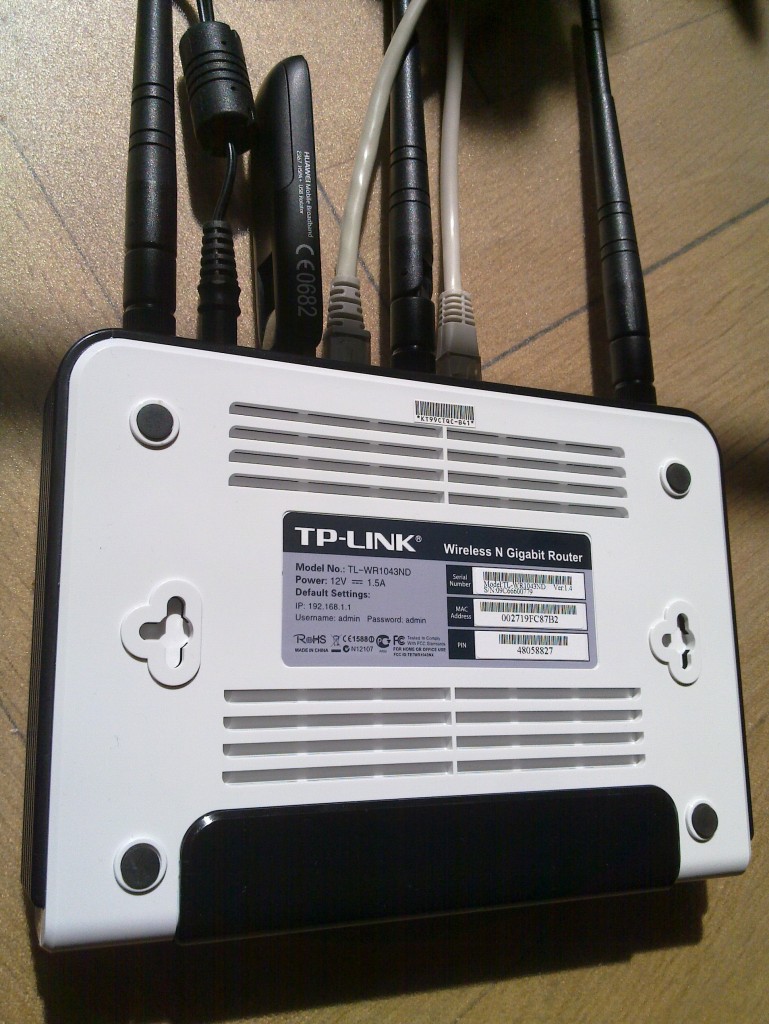
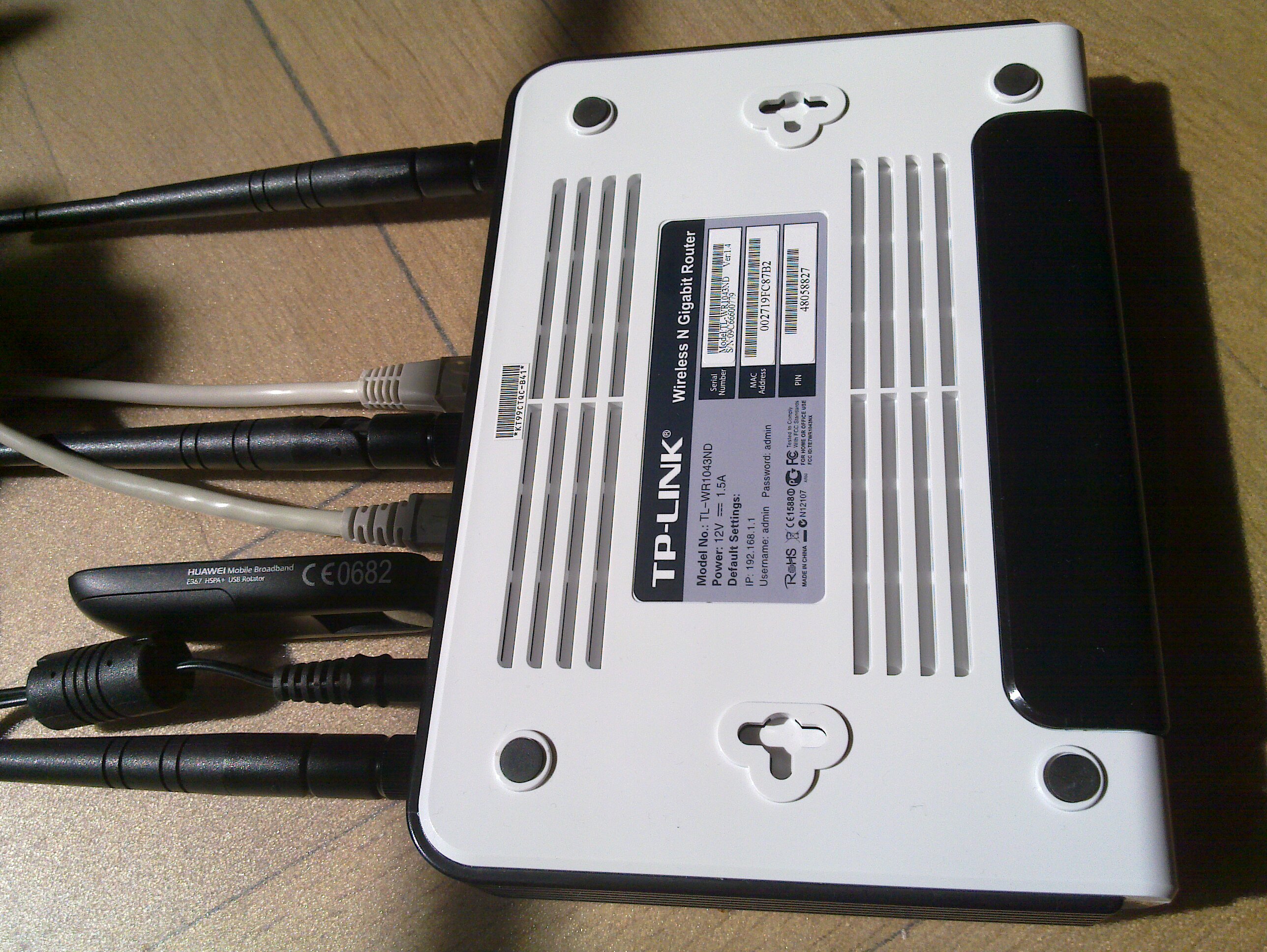
TL-WR1043ND and Huawei 367

Router and modem


The first step is to flash the firmware with OpenWRT. The OpenWRT wiki page for the TL-WR1043ND covers this in detail, and for any other hardware you should find what you need in the OpenWRT wiki. If you have already installed OpenWRT on the TL-WR1043ND, and want to wipe it out and start from scratch (like I did for this writeup) here is how to do it:
root@choco:~# cd /tmp
root@choco:/tmp# wget http://downloads.openwrt.org/backfire/10.03/ar71xx/openwrt-ar71xx-tl-wr1043nd-v1-squashfs-sysupgrade.bin
Connecting to downloads.openwrt.org (78.24.191.177:80)
openwrt-ar71xx-tl-wr 100%  *******************************   2688k 00:00:00 ETA
root@choco:/tmp# md5sum openwrt-ar71xx-tl-wr1043nd-v1-squashfs-sysupgrade.bin
9927973ba5da65d0d52e255397452b87  openwrt-ar71xx-tl-wr1043nd-v1-squashfs-sysupgrade.bin
root@choco:/tmp# mtd -r write /tmp/openwrt-ar71xx-tl-wr1043nd-v1-squashfs-sysupgrade.bin firmware
Unlocking firmware ...
Writing from /tmp/openwrt-ar71xx-tl-wr1043nd-v1-squashfs-sysupgrade.bin to firmware ...
Rebooting ...
The device will reboot automatically when it is done. After say 30 seconds, try to connect to it using the default IPv4 address 192.168.1.1. I have connected the WAN port to the Internet and connect to the router over local network connected to the router s LAN1 input. Let s configure OpenWRT, I m calling the host choco and giving it the IPv4 address 192.168.1.46. I ll also set a good root password to disable telnet, and add some SSH keys to simplify remote login.
jas@latte:~$ telnet 192.168.1.1
Trying 192.168.1.1...
Connected to 192.168.1.1.
Escape character is '^]'.
 === IMPORTANT ============================
  Use 'passwd' to set your login password
  this will disable telnet and enable SSH
 ------------------------------------------
BusyBox v1.15.3 (2010-04-06 03:14:11 CEST) built-in shell (ash)
Enter 'help' for a list of built-in commands.
  _______                     ________        __
          .-----.-----.-----.          .----.    _
     -      _     -__                   _    _ 
  _______    __ _____ __ __ ________ __    ____ 
           __  W I R E L E S S   F R E E D O M
 Backfire (10.03, r20728) --------------------------
  * 1/3 shot Kahlua    In a shot glass, layer Kahlua
  * 1/3 shot Bailey's  on the bottom, then Bailey's,
  * 1/3 shot Vodka     then Vodka.
 ---------------------------------------------------
root@OpenWrt:/# passwd
Changing password for root
New password:
Retype password:
Password for root changed by root
root@OpenWrt:/# sed -i -e 's/OpenWrt/choco/' /etc/config/system
root@OpenWrt:/# sed -i -e 's/192.168.1.1/192.168.1.46/' /etc/config/network
root@OpenWrt:/# cat>/etc/dropbear/authorized_keys
ssh-rsa AAAAB3NzaC1yc2...
^D
root@OpenWrt:/# dropbearkey -y -f /etc/dropbear/dropbear_rsa_host_key
Public key portion is:
ssh-rsa AAAA... root@OpenWrt
Fingerprint: md5 45:fd:62...
root@OpenWrt:/#
You could reboot the machine here to switch from telnet to SSH, but I ll install a bunch of packages while I m at it. Run opkg update to update the package list, and then install the wireless modules for the TL-WR1043ND.
root@OpenWrt:/# opkg update
Downloading http://downloads.openwrt.org/backfire/10.03/ar71xx/packages/Packages.gz.
Inflating http://downloads.openwrt.org/backfire/10.03/ar71xx/packages/Packages.gz.
Updated list of available packages in /var/opkg-lists/packages.
root@OpenWrt:/# opkg install kmod-ath9k wpad-mini
...
Configuring iw.
Configuring kmod-crypto-core.
Configuring kmod-crypto-arc4.
Configuring kmod-crypto-aes.
Configuring wireless-tools.
Configuring kmod-cfg80211.
Configuring kmod-mac80211.
Configuring kmod-ath.
Configuring kmod-ath9k.
Configuring crda.
Configuring wpad-mini.
root@OpenWrt:/#
Next I ll install some packages that will are needed for the modem.
root@OpenWrt:/# opkg install comgt kmod-usb-serial kmod-usb2 kmod-usb-uhci kmod-usb-ohci usb-modeswitch
...
Configuring kmod-nls-base.
Configuring kmod-usb-core.
Configuring chat.
Configuring kmod-usb-ohci.
Configuring kmod-usb2.
Configuring comgt.
Configuring usb-modeswitch.
Configuring kmod-usb-serial.
Configuring kmod-usb-uhci.
root@OpenWrt:/#
Now let s reboot the machine and try to get things to really work.
root@OpenWrt:/# sync
root@OpenWrt:/# reboot
Use SSH to connect to the router, and don t forget the use its new IPv4 address! 3G modems are notoriously known for not acting as a modem directly. Instead they often simulate a CD-ROM that will install device driver software, for inferior operating systems. Fortunately the usb_modeswitch tool fixes the hardware for us. My Huawei E367 start up with the USB vendor/product IDs 0x12d1:0 1446, you normally find this out by looking in /proc/bus/usb/devices. Here is the output on my device:
root@choco:~# cat /proc/bus/usb/devices
...
T:  Bus=01 Lev=01 Prnt=01 Port=00 Cnt=01 Dev#=  2 Spd=480 MxCh= 0
D:  Ver= 2.00 Cls=00(>ifc ) Sub=00 Prot=00 MxPS=64 #Cfgs=  1
P:  Vendor=12d1 ProdID=1446 Rev= 0.00
S:  Manufacturer=Huawei Technologies
S:  Product=HUAWEI Mobile
C:* #Ifs= 2 Cfg#= 1 Atr=c0 MxPwr=500mA
I:* If#= 0 Alt= 0 #EPs= 2 Cls=08(stor.) Sub=06 Prot=50 Driver=(none)
E:  Ad=81(I) Atr=02(Bulk) MxPS= 512 Ivl=0ms
E:  Ad=01(O) Atr=02(Bulk) MxPS= 512 Ivl=0ms
I:* If#= 1 Alt= 0 #EPs= 2 Cls=08(stor.) Sub=06 Prot=50 Driver=(none)
E:  Ad=02(O) Atr=02(Bulk) MxPS= 512 Ivl=0ms
E:  Ad=82(I) Atr=02(Bulk) MxPS= 512 Ivl=0ms
root@choco:~#
This means I have to go find a usb-modeswitch configuration for this device. Fortunately, I found it on my Debian Squeeze box in /etc/usb_modeswitch.d/12d1:1446 (from the usb-modeswitch-data package). There was a slight problem with the file, it didn t specify the correct USB vendor/product ID of the device after it has been switched . My Huawei E367 switches to 12d1:1506, so I add 1506 to the TargetProductList list. Here is the final configuration:
root@choco:~# cat>/etc/usb-modeswitch.conf
EnableLogging=1
DefaultVendor= 0x12d1
DefaultProduct=0x1446
TargetVendor=  0x12d1
TargetProductList="1001,1406,140b,140c,1412,141b,14ac,1506"
CheckSuccess=20
MessageContent="55534243123456780000000000000011062000000100000000000000000000"
root@choco:~#
Now you should be able to run usb_modeswitch to perform the switch :
root@choco:~# usb_modeswitch 
Looking for target devices ...
 No devices in target mode or class found
Looking for default devices ...
 Found default devices (1)
Accessing device 002 on bus 001 ...
Using endpoints 0x01 (out) and 0x81 (in)
Inquiring device details; driver will be detached ...
Looking for active driver ...
 No driver found. Either detached before or never attached
SCSI inquiry data (for identification)
-------------------------
  Vendor String: HUAWEI
   Model String: Mass Storage
Revision String: 2.31
-------------------------
USB description data (for identification)
-------------------------
Manufacturer: Huawei Technologies
     Product: HUAWEI Mobile
  Serial No.: not provided
-------------------------
Setting up communication with interface 0 ...
Trying to send the message to endpoint 0x01 ...
 OK, message successfully sent
Checking for mode switch (max. 20 times, once per second) ...
 Waiting for original device to vanish ...
 Original device can't be accessed anymore. Good.
 Searching for target devices ...
 Searching for target devices ...
 Searching for target devices ...
 Searching for target devices ...
 Searching for target devices ...
 Found correct target device
Mode switch succeeded. Bye.
root@choco:~#
The /proc/bus/usb/devices file will now contain information about the real device:
root@choco:~# cat /proc/bus/usb/devices
...
T:  Bus=01 Lev=01 Prnt=01 Port=00 Cnt=01 Dev#=  3 Spd=480 MxCh= 0
D:  Ver= 2.00 Cls=ef(misc ) Sub=02 Prot=01 MxPS=64 #Cfgs=  1
P:  Vendor=12d1 ProdID=1506 Rev= 0.00
S:  Manufacturer=Huawei Technologies
S:  Product=HUAWEI Mobile
C:* #Ifs= 7 Cfg#= 1 Atr=c0 MxPwr=500mA
A:  FirstIf#= 1 IfCount= 2 Cls=02(comm.) Sub=00 Prot=00
I:* If#= 0 Alt= 0 #EPs= 3 Cls=ff(vend.) Sub=01 Prot=01 Driver=(none)
E:  Ad=81(I) Atr=03(Int.) MxPS=  64 Ivl=2ms
E:  Ad=82(I) Atr=02(Bulk) MxPS= 512 Ivl=0ms
E:  Ad=01(O) Atr=02(Bulk) MxPS= 512 Ivl=4ms
I:* If#= 1 Alt= 0 #EPs= 1 Cls=ff(vend.) Sub=01 Prot=09 Driver=(none)
E:  Ad=83(I) Atr=03(Int.) MxPS=  64 Ivl=2ms
I:* If#= 2 Alt= 0 #EPs= 2 Cls=ff(vend.) Sub=01 Prot=08 Driver=(none)
E:  Ad=84(I) Atr=02(Bulk) MxPS= 512 Ivl=0ms
E:  Ad=02(O) Atr=02(Bulk) MxPS= 512 Ivl=4ms
I:* If#= 3 Alt= 0 #EPs= 2 Cls=ff(vend.) Sub=01 Prot=03 Driver=(none)
E:  Ad=85(I) Atr=02(Bulk) MxPS= 512 Ivl=0ms
E:  Ad=03(O) Atr=02(Bulk) MxPS= 512 Ivl=4ms
I:* If#= 4 Alt= 0 #EPs= 2 Cls=ff(vend.) Sub=01 Prot=02 Driver=(none)
E:  Ad=86(I) Atr=02(Bulk) MxPS= 512 Ivl=0ms
E:  Ad=04(O) Atr=02(Bulk) MxPS= 512 Ivl=4ms
I:* If#= 5 Alt= 0 #EPs= 2 Cls=08(stor.) Sub=06 Prot=50 Driver=(none)
E:  Ad=87(I) Atr=02(Bulk) MxPS= 512 Ivl=0ms
E:  Ad=05(O) Atr=02(Bulk) MxPS= 512 Ivl=0ms
I:* If#= 6 Alt= 0 #EPs= 2 Cls=08(stor.) Sub=06 Prot=50 Driver=(none)
E:  Ad=06(O) Atr=02(Bulk) MxPS= 512 Ivl=0ms
E:  Ad=88(I) Atr=02(Bulk) MxPS= 512 Ivl=0ms
root@choco:~#
Let s put that command in /etc/rc.local so that it will be run on every boot.
root@choco:~# cat /etc/rc.local
# Put your custom commands here that should be executed once
# the system init finished. By default this file does nothing.
/usr/bin/usb_modeswitch
exit 0
root@choco:~#
We are not quite ready, the usbserial module needs to be told which USB vendor/product to use. The /etc/modules.d/60-usb-serial file is used during boot to set the right parameters. You can also run rmmod followed by insmod with the proper parameters to avoid a reboot. You can use the gcom info tool to find some information about the modem. Normally you use /dev/ttyUSB0 but for some reason it does not work for me and instead I had to use /dev/ttyUSB3.
root@choco:~# cat>/etc/modules.d/60-usb-serial
usbserial vendor=0x12d1 product=0x1506 maxSize=4096
root@choco:~# rmmod usbserial
root@choco:~# insmod usbserial vendor=0x12d1 product=0x1506 maxSize=4096
root@choco:~# gcom -d /dev/ttyUSB3 info
##### Wireless WAN Modem Configuration #####
Product text:
====
Manufacturer: huawei
Model: E367
Revision: 11.807.05.00.00
IMEI: 353613040739180
+GCAP: +CGSM,+DS,+ES
OK
====
Manufacturer:           huawei
IMEI and Serial Number: 353613040739180
Manufacturer's Revision:
11.807.05.00.
Hardware Revision:      NOT
Network Locked:         ERROR:
Customisation:          NOT SUPPORT
Band settings:          (NOT)
APN:                    ERROR:
##### END #####
root@choco:~#
Let s configure network and wireless. The configurations files are /etc/config/network and /etc/config/wireless. Edit them using your favorite editor, or vi. I m setting up a PSK2 encrypted WLAN and I have a WDS to connect two wireless routers. Note that you need to use the correct PIN for your SIM card (here I m using 8328) and set the APN correctly (I m using bredband.tre.se ). Reboot after making these changes.
root@choco:~# cat /etc/config/network
config 'interface' 'loopback'
       option 'ifname'   'lo'
       option 'proto'    'static'
       option 'ipaddr'   '127.0.0.1'
       option 'netmask'  '255.0.0.0'
config 'interface' 'lan'
        option 'ifname'   'eth0.1'
        option 'type'     'bridge'
        option 'proto'    'static'
        option 'ipaddr'   '192.168.1.46'
        option 'netmask'  '255.255.255.0'
#config 'interface' 'wan'
#        option 'ifname' 'eth0.2'
#        option 'proto' 'dhcp'
config 'switch'
	option 'name' 'rtl8366rb'
        option 'reset' '1'
        option 'enable_vlan' '1'
config 'switch_vlan'
        option 'device' 'rtl8366rb'
        option 'vlan' '1'
        option 'ports' '1 2 3 4 5t'
config 'switch_vlan'
        option 'device' 'rtl8366rb'
        option 'vlan' '2'
        option 'ports' '0 5t'
config interface wan
        option ifname   ppp0
        option proto    3g
        option device   /dev/ttyUSB0
        option apn      bredband.tre.se
        option pincode  8328
root@choco:~# cat /etc/config/wireless
config wifi-device  radio0
	option type     mac80211
	option channel  5
	option macaddr	00:27:19:fc:87:b2
	option hwmode	11ng
	option htmode	HT20
	list ht_capab	SHORT-GI-40
	list ht_capab	DSSS_CCK-40
config wifi-iface
	option device   radio0
	option network  lan
	option mode     ap
	option ssid     Grisslan
	option encryption psk2
	option key	  notforyoutosee
config wifi-iface
        option device     radio0
        option network    lan
        option mode       wds
        option bssid      00:1F:C6:60:D3:11
        option ssid       GrisslanWDS
        option encryption psk2
        option key        thisisalsosecret
root@choco:~# reboot
root@choco:~#
Once the machine have rebooted, you can bring up the 3G connection by using ifup wan . Look at the log by using logread and tail the log in the background by doing logread -f & .
root@choco:~# ifup wan
Trying to set PIN
PIN set successfully
root@choco:~# logread  tail -20
May 21 13:41:20 choco local2.info chat[2419]: send (ATD*99***1#^M)
May 21 13:41:20 choco local2.info chat[2419]: expect (CONNECT)
May 21 13:41:20 choco local2.info chat[2419]: ^M
May 21 13:41:20 choco local2.info chat[2419]: ATD*99***1#^M^M
May 21 13:41:20 choco local2.info chat[2419]: CONNECT
May 21 13:41:20 choco local2.info chat[2419]:  -- got it
May 21 13:41:20 choco local2.info chat[2419]: send ( ^M)
May 21 13:41:20 choco daemon.info pppd[2412]: Serial connection established.
May 21 13:41:20 choco daemon.info pppd[2412]: Using interface ppp0
May 21 13:41:20 choco daemon.notice pppd[2412]: Connect: ppp0 <--> /dev/ttyUSB0
May 21 13:41:24 choco daemon.warn pppd[2412]: Could not determine remote IP address: defaulting to 10.64.64.64
May 21 13:41:24 choco daemon.notice pppd[2412]: local  IP address 95.209.96.115
May 21 13:41:24 choco daemon.notice pppd[2412]: remote IP address 10.64.64.64
May 21 13:41:24 choco daemon.notice pppd[2412]: primary   DNS address 80.251.201.177
May 21 13:41:24 choco daemon.notice pppd[2412]: secondary DNS address 80.251.201.178
May 21 13:41:24 choco daemon.info dnsmasq[1028]: reading /tmp/resolv.conf.auto
May 21 13:41:24 choco daemon.info dnsmasq[1028]: using nameserver 80.251.201.178#53
May 21 13:41:24 choco daemon.info dnsmasq[1028]: using nameserver 80.251.201.177#53
May 21 13:41:24 choco daemon.info dnsmasq[1028]: using local addresses only for domain lan
May 21 13:41:25 choco user.notice rdate: Synced with ptbtime1.ptb.de
root@choco:~#
Hooray! Or almost so usually the first time you connect, I often get incorrect DNS servers from the server. It shows up like this in the log:
May 21 12:25:04 choco daemon.notice pppd[1157]: primary   DNS address 10.11.12.13
May 21 12:25:04 choco daemon.notice pppd[1157]: secondary DNS address 10.11.12.14
The exact reason why this happens is beyond me. There are patches floating around for pppd, but I haven t tried them. A common workaround is to hardcode static DNS servers (like Google DNS or OpenDNS). I have come up with my own workaround, based on the observation that when the problem has occurred it will not happen again if I disconnect and reconnect. Thus I have written a small script which is invoked whenever an interface is brought up (typically the WAN interface).
# Written by Simon Josefsson May 2011.
root@choco:~# cat> /etc/hotplug.d/iface/01-reconnect-if-dns-is-broken
case "$ ACTION:-ifup " in
    ifup)
	    if grep -q 10.11.12.13 /tmp/resolv.conf.auto; then
		(sleep 30 && ifdown wan && ifup wan) &
	    fi
	    ;;
esac
root@choco:~# chmod +x /etc/hotplug.d/iface/01-reconnect-if-dns-is-broken
root@choco:~#
That s it! If you found this writeup useful, please flattr it.

20 May 2011

Tanguy Ortolo: cpio > tar

Large package icon tar and cpio tar(5) and cpio(5) are two competing archive formats, that provide almost identical features. Both are streamed formats, originally designed to be used on tapes. Their major practical difference is the style of their standard command line utilities: Peace! There is a traditional opposition between these two formats and utilities and their respective supporters. To fix this, the POSIX specification deprecated both commands in 2001, replacing them by a single one called pax(1), that can be used either in cpio-like or tar-like style. This specification also defined a pax interchange format, which these vile trolls derived from tar! Now, considering the actual practice, you can notice that tar has won, and that almost nobody uses pax. Almost every free software project I know release tarballs, not cpio archives. This is probably the reason why the GNU tar utility has evolved much more than GNU cpio: tar now integrates seamlessly with compressors such as gzip, bzip2 or xz, autodetecting the compression format when needed whereas cpio has no such features as far as I know. However, cpio is notably used by the Linux kernel for its initial memory file system, aka initrd. tar and cpio drawbacks Now I come to the title of this article: I personally prefer the cpio format over tar, although I usually use tar because of the advanced features of GNU tar. In fact, tar suffers from a drawback that usually has to be worked around: it cannot store any type of file. There exist seven file types: regular files, directories, symbolic links, character devices, block devices, FIFOs and Unix sockets. Well, tar can only represent six of them, and misses the ability to store sockets. Thus, if you try to archive your entire filesystem with tar, you may get the following output:

tar: /var/spool/postfix/private/rewrite: socket ignored
tar: /var/spool/postfix/private/bsmtp: socket ignored
If you try the same with cpio, you will see that sockets get archived without any problem. Given that the tar format has a type byte, with one reserved value, I am surprised that its 2001 revision did not use it for sockets, but for some reason it did not. In practice, programs that use sockets work around this problem by creating them at startup. To be honest, I must mention that cpio also has one significant drawback: when a file has several links, it gets copied several times in the archive. Edit: It appears that archiving sockets is completely pointless, given that they must be unlinked if they exist, and then created before they are used by a program. Thus, the question becomes: why does cpio support sockets?

7 May 2011

Jonathan McDowell: Not going to DebConf11

no-debconf11.pngI'm sad to report that I won't be attending DebConf11. I'd have loved to go, but unfortunately I couldn't get the time off work due to various schedule conflicts. I'll have to find another excuse to make it to Bosnia at some point.

26 April 2011

Jon Dowland: comment 5.comment

18 April 2011

Gerfried Fuchs: Wise Guys

My brother did invite me to the concert of the Wise Guys, a German acapella group. They are one of those special groups who are able to give a cheering live show and have this special cheek-in-tongue humour in a fair amount of their songs. This is the selection that helps me keeping my mood up though, you are invited to dig further. Hope you are able to appreciate them as much as I am. At least they are able to cheer me up a fair bit.

/music permanent link Comments: 2 Flattr this

17 April 2011

Joerg Jaspert: One Ring to [...] bind them

ring.png

Jonathan McDowell: Why Linux? (Part 7: Support)

(This is part of a series of posts on Why Linux?) This is probably a non-obvious reason to run Linux to most people. One of the complaints I've heard in the past is the lack of support for Linux. It's not really relevant to running it on a work desktop (where support is presumably from some central IT organisation), but I believe it's a red herring. Support in the Free software world can exceed that in the proprietary by an impressive margin. And that can turn out to be useful at work, even if you do suppose the existence of central IT. The support I've received for Linux and applications under it has been, on numerous occasions, excellent in a way I feel I could never expect from the commercial software world. And when it isn't, I have the choice of whomever I want to try and fix my problems, rather than being stuck with no options. I have found that if I am polite, and provide useful information, and patient, I can talk directly to the developers who make the software I use. If I have a patch they will often take it from me, or use it as a basis for the final fix. If they are no longer available, or too busy, then because I have the source I can find someone else to look at the problem, or do so myself. The chances of most large proprietary software companies giving me the time of day is low. I don't understand why small businesses think that Windows is a safer choice due to being able to get support from Microsoft. Again using experience gained at Black Cat, at one point we had a problem with IPv6 routes being updated. Signs pointed to Quagga, Simon collected relevant information and got in contact with the Quagga devs. They investigated, realised it wasn't a problem with their code, and then proceeded to find the issue in the Linux kernel, produce the fix and pass it upstream. Within hours of us reporting the problem. I'll accept that's an exceptional response that can be matched within the proprietary software world, but not without a hefty support contract and I doubt you would have got a response other than "Not our fault, talk to the other supplier", or maybe a workaround at best. More recently, I had a conversation about Linux and discard support, with one of the people who'd worked on it. Very interesting from my PoV, useful to my work (I ended up fixing something in our code base that led to the Linux support Just Working with our product) and I believe was useful to that developer too, in terms of providing some insight to the other side of the problem. I don't get that kind of access to proprietary software developers - while it could be argued that I know a lot of Free software people, I also know a lot of other programmers and they're just not able to be so open about things, so both sides lose out. Or my new laptop's ethernet wasn't supported by the kernel in squeeze. I filed a bug requesting the driver be added (and pointing to the patch). The week I wrote the first draft of this article I saw confirmation that this had been done, and will be part of the final squeeze release. I think that's pretty impressive. (Thanks, Ben.)

16 April 2011

Wouter Verhelst: Loadays 2011

Went to loadays, where I did a talk on "Single sign-on with Kerberos and LDAP". Or, at least, that was the intention when I found out that there was going to be a tutorial on LDAP the next day, I decided to focus my talk mostly on kerberos, only lightly touching LDAP. As it turned out, that was a great decision I could easily fill a whole hour on Kerberos, anyway, and though doing a kerberos setup without doing ldap too is fairly silly, doing it properly would have required more time than was assigned to me. Instead, I managed to talk the audience through most of the important theory about kerberos (things like "what is a principal", "what is a ticket", etc), and did a live demo in which I configured a kerberos realm on a virtual machine, and then used SSH to connect passwordless to that machine from a second virtual machine on the same virtual network. While I would've loved to make it even better by throwing in a kerberized HTTP configuration, I couldn't do much more than just mention the fact that it can be done as is the case for sasl-enabled protocols (imap, ldap, smtp, etc) and some other things. The talk seems to have been a success with the audience, too; the room itself was full, nobody actually left (which usually is a good sign in and of itself), and I got only positive feedback from the people who were there; one person even went so far as to say that he considerd it the best talk he'd seen thus far, today. Which I think is pretty high praise, considering how my talk was in the penultimate time slot. All in all, a good day.

15 April 2011

Jon Dowland: vote

I've just voted Stefano Zacchiroli for Debian Project Leader (DPL). The voting period closes tonight, so if you are a Debian developer and haven't yet voted, please do! Debian uses a Condorcet voting system, which to my non-expert eyes, bears some resemblance to "Single Transferrable Vote" (STV), at least compared to "First Past the Post" (FPTP). There is a debate raging in the UK as to whether Government elections should be counted based on an STV method instead of FPTP, with a referendum on the subject in May. I'm leaning towards "Yes to AV", but this opinion piece by journalist Stuart Campbell (which argues that people should spoil their ballots) is worth a read.

Patrick Schoenfeld: Last time I've used network-manager..

Theres an ongoing thread on the Debian mailing lists about making network-manager installed by default on new Debian installations. I won't say much about the thread. Its just a prototype example for Debian project discussions: Discuss everything to death and if its dead discuss a little more. And - very important - always restate the same arguments as often as you can. Or if its not your own argument you restate, restate the arguments of others. Ending with 100 times stated the same argument. Even if its already disproved.

I don't have a strong opinion about the topic in itself. However there is something I find kinda funny. A statement brought up by the people who strongly oppose network-manager as a default.
A statetement I've heard so often that I can't count it anymore.

The last time I've tried network-manager it sucked.
It often comes in different masquerades, like:

But it basically boils down to that basic essence of the sentence I've written above. Sometimes I ask people who express this opinion a simple question:

When did you test network-manager the last time?
The answers are different but again the basic essence of the answers is mostly the same (even if people would never say it that way):

A long time ago. Must have been around Etch.
And guess what: There was a time when I had a similar opinion. Must have been around Etch.
During the life cycle of network-manager between Etch and now a lot has happened. I restarted using network-manager at some point of the Lenny development.
My daily driver for the management of my network connections on my notebook. Yes, together with ifupdown because, yes, network-manager does not support every possible network-setup with all of the special cases possible. But it supports auto-configuring of wired and wireless devices. Connecting to a new encrypted network, either in a WLAN or in a 802.1x LAN, using UMTS devices, using tethering with a smart phone. And everything: on a few mouse-clicks.

Yes, it had some rough edges in that life cycle. Yes, it had that nasty upgrade bug, which was very annoying.
But face it: It developed a lot. Here are some numbers:

Diffstat between the etch version and the lenny version:
362 files changed, 36589 insertions(+), 36684 deletions(-)

Diffstat between the Lenny version and the current version in sid:
763 files changed, 112713 insertions(+), 56361 deletions(-)

The upgrade bug has been solved recently. Late. But better late then never.

So what does that mean? It means that, if your last network-manager experience was made with Lenny or even worse around Etch, you should better give it another try, if you are interested in knowing what you talk about. For now it seems that a lot of people do not know. Not even in a distance.

14 April 2011

Jon Dowland: sortpaper

sortpaper
I stumbled across this file whilst sorting through some old backups. It's a "sortpaper": a wallpaper designed to aid people with sorting out files on their desktops. I thought I would share it in case anybody thought the concept was interesting: The size/aspect of the picture probably make it less practically useful today than whenever I first made it.

12 April 2011

Guido G nther: Bits from the 4th Debian groupware meeting

This went out to d-d-a a couple of days ago already but I figured that this might be of interest here too: The fourth Debian Groupware Meeting was held in the LinuxHotel, Essen, Germany. This is a short summary of what happened during the weekend:

8 April 2011

Wouter Verhelst: Blocking newsletter spam

It's incredible how many people are of the misguided belief that just because I happen to run a company, I am automatically interested in their newsletter about whatever it is that they are doing, no matter how far it is removed from the kinds of things my company actually does. Are these people spammers? Yes, definitely, and I don't want to do business with them. But there's a major difference between this kind of mails and your common nigerian scammer or counterfeit blue pill "salesperson". Unlike the latter, some newsletter spammers are interested in forming a genuine business relationship with my company. They're going about it the wrong way, but that doesn't necessarily mean they're trying to trick me into doing something that would not be in my best interest they're not just after my money. Although their methods are wrong, that does not mean they're entirely clueless. Some of these unwanted newsletters are sent with VERP-style return paths, which suggests that if the mail bounces at SMTP time, I would no longer receive their junk. So bouncing them is what I do. Exim makes this very easy:
acl_check_mail:
  deny
	message = Your domain has been blacklisted
	log_message = domain blacklisted
	condition = $ 
			lookup $sender_address_domain 
			wildlsearch /etc/exim4/blacklist-domains 
			 true 
			 false 
		      
  accept
What this does is use a wildlsearch lookup to verify whether the domain of the envelope sender (i.e., as specified in the MAIL FROM: SMTP command) exists in the /etc/exim4/blacklist-domains file. Since we use a wildlsearch, we can use the * as a wildcard *grep.be would mean 'grep.be, or any of its subdomains', whereas *.grep.be would mean 'any of the grep.be subdomains'. This is because at least one of the people I've blacklisted that way sends their newsletter through a distributed service, and the VERP-style header is based upon the server that actually communicates with my system; and others have a subdomain for the newsletter, but don't use it (or use a different one) for regular mail. If I'm not interested in their spam, I'm probably also not interested in their other mail, so therefore the wildcard (is this overkill? Maybe, but I don't care I don't do business with spammers). This ACL is then activated for the SMTP MAIL FROM: command (search for acl_smtp_mail variable in the exim specification). This makes it impossible for the spammer to reach postmaster@ from the same domain, too, but that doesn't matter; they can always use a different address. One might be wondering why I'm using this kind of domain-based blacklisting rather than a regular bayesian spamfilter, or anything of the sorts. The reason is fairly simple: because the general format of these newsletters is distinctly different from regular spam. For instance, some of these newsletter spammers are in fact competitors who didn't bother to check who they're sending mail to. As a result, their newsletters would contain key words that would appear in mails which I send to my regular customers, too; if I were to classify them as spam in my bayesian classifier, that would increase the chance of the classifier misclassifying a mail from an actual customer as spam. Most of these are very similar in format to newsletters that I did consciously subscribe to, and which are therefore not spam, etc. Finally, bouncing mail rather than blackholing it or filing it in a separate folder (as I have spamassassin do) has the added advantage of making it clear to a newsletter spammer that their junk is not wanted. Most (though certainly not all) will then remove me from their newsletter, saving me bandwith and processing power. And since we do this at MAIL FROM: time, rather than upon completion of the RCPT TO: or DATA commands, I'm not actually giving away any information that they don't have, either.

6 April 2011

Jon Dowland: aero

aero snap was one of the launch features of Windows 7 that was quickly copied into other desktop systems (most recently, gnome 3). I've written about it before. Essentially, dragging windows to hot regions of the screen resizes those windows to occupy some area of the screen. To the top: the whole window area (maximize). To the left or right, 50% of the width of the window area, all of the height. This is a pretty useful feature that I wanted to steal for myself. There is a somewhat fragile-looking (but functional) way of achieving this using compiz and some embedded shell scripts which I used for a while, but has several drawbacks: there's no visual indication that resizing will occur; resizing occurs after a time interval and not in response to you releasing the window from its drag; it's therefore very easy to accidentally resize windows (focussing a window adjacent to an edge and parking the mouse pointer in the edge region is sufficient). Aero snap is not without its own shortcomings: whilst having side-by-side windows is great for comparing two documents, you can't arrange two windows top-to-bottom, each occupying half of the vertical height of the screen. This is very useful for working on two spreadsheets. A less interactive but more functional way of achieving this is the grid plugin for compiz and keyboard shortcuts. The grid plugin can be found in the Debian package compiz-fusion-plugins-extra.

5 April 2011

Daniel Kahn Gillmor: Debian on Thecus N8800Pro

I recently set up debian on a Thecus N8800Pro. It seems to be a decent rackmount 2U chassis with 8 3.5" hot-swap SATA drives, dual gigabit NICs, a standard DB9 RS-232 serial port, one eSATA port, a bunch of USB 2.0 connectors, and dual power supplies. I'm happy to be able to report that Thecus appears to be attempting to fulfill their obligations under the GPL with this model (i'm fetching their latest source tarball now to have a look). Internally, it's an Intel Core 2 Duo processor, two DIMMS of DDR RAM, and a PCIe slot for extensions if you like. It has two internally-attached 128MiB SSDs that it wants to boot off of. The downsides as i see them:
BIOS
The BIOS only runs over VGA, which is not easy to access. I wish it ran over the serial port. It's also not clear how one would find an upgrade to the BIOS. dmidecode reports the BIOS as:
        Vendor: Phoenix Technologies, LTD
        Version: 6.00 PG
        Release Date: 02/24/2009
RAM
The mainboard has only two DIMM sockets. It came pre-populated with two 2GiB DDR DIMMs. memtest86+ reports those DIMMs clearly, but sees only 3070MiB in aggregate. The linux kernel also sees ~3GiB of RAM, despite dmidecode and lshw reporting that the two DIMM modules each are only 1GiB in size. I'm assuming this is a bios problem. Anyone know how to get access to the full 4GiB? Should i be reporting bugs on any of these packages?
SSDs
The internal SSDs are absurdly small and very slow for both reading and writing. This isn't a big deal because i'm basically only using them for the bootloader, kernel, and initramfs. But i'm surprised that they could even find 128MiB devices in these days of $10 1GiB flash units.
processor
/proc/cpuinfo reports two cores of a Intel(R) Core(TM)2 Duo CPU T5500 @ 1.66GHz, each with ~3333 bogomips, and apparently without hardware virtualization support. It's not clear to me whether the lack of virtualization support is something that could be fixed with a BIOS upgrade.
I used Andy Millar's nice description of how to get access to the BIOS -- I found i didn't need a hacksaw to modify the VGA cable i had. just pliers to remove the outer metal shield on the side of the connector i plugged into the open socket. lshw sees four SiI 3132 Serial ATA Raid II Controller PCI devices, each of which appears to support two SATA ports. I'm currently using only four of the 8 SATA bays, so i've tried to distribute the disks so that each of them is attached to an independent PCI device (instead of having two disks on one PCI device, and another PCI device idle). I don't know if this makes a difference, though, in the RAID10 configuration i'm using. There's also a neat 2-line character-based LCD display on the front panel which apparently can be driven by talking to a serial port, though i haven't tried. Apparently there are also LEDs that might be controllable directly from the kernel via ICH7 and GPIO, but i haven't tried that yet either. Any suggestions on how to think about or proceed with a BIOS upgrade to get access to the full 4GiB of RAM, BIOS-over-serial, and/or enable hardware virtualization?Tags: n8800pro, thecus

3 April 2011

Julien Viard de Galbert: Kernel develpoment on e60

Now that I have access to the serial console on Samsung e60 reader let s build a new linux kernel for it. The e60 reader has an ARM processor, to compile the kernel we need a cross compilation toolchain.
The first option is to use the one Samsung released with the other sources. It must work, however I don t really like the idea to run binaries from unknown sources.
The second option is to build our own toolchain, we often have to do that for systems that requires patches on the compiler.
Here, Samsung s binutils look like they were taken between 2.17 and 2.18 release (they are named 2.17.50 but are still slightly different from this snapshot) but they don t seam to embed homemade patches. As for ggc I didn t take time to check.
I choose to use the emdebian cross-development toolchain lenny version. (As the article in the french open silicium magazine #1 about FriendlyARM proposes to do). Installing the cross-development toolchain on debian First the archive keys:
sudo apt-get install emdebian-archive-keyring
Then we add a /etc/apt/sources.list.d/emdebian.list file with the following content:
deb http://ftp.uk.debian.org/emdebian/toolchains lenny main
deb-src http://ftp.uk.debian.org/emdebian/toolchains lenny main
The we update the package list to install the needed packages:
sudo apt-get update
sudo apt-get install libc6-armel-cross libc6-dev-armel-cross libstdc++6-armel-cross binutils-arm-linux-gnueabi gcc-4.3-arm-linux-gnueabi g++-4.3-arm-linux-gnueabi
That s it ! We have now our cross-compilation toolchain installed from packages, so easy to update or remove. The kernel sources Samsung released it s modified 2.6.29.4 version. By cloning the kernel 2.6.29.y git branch, I could quickly see that their changes applied well to the 2.6.29.6 version (the last in the branch). In order to better sort the changes michel.s had splat them into several patches
(patchs on e60-open project). After a few trials I build a series file allowing to apply those patches with quilt or better to import them to a git branch with git quiltimport. The order I choose allows to drop easily some patches (the last ones). One particular point on those patches is that some include binary files: U-Boot Before compiling the kernel, we need the mkimage utility from U-Boot. Here, Let s build the U-Boot released by Samsung, and let s just copy the tools/mkimage to a location in our PATH (that s the only install method I could find).
make smdkc100_config
make CROSS_COMPILE=arm-linux-gnueabi-
cp tools/mkimage ~/bin/
Building linux For the config, one of the patches includes a .config. That file is a copy of config_rfs so even without the previous patch, we can get Samsung s config. Finally we can compile!
make CROSS_COMPILE=arm-linux-gnueabi- CFLAGS="-march=armv4t -mtune=cortex-a8" CXXFLAGS="-march=armv4t -mtune=cortex-a8" ARCH=arm uImage
We can then load our kernel by following The kernel testing howto from e60-open project. To load the kernel we will need the following command:
sudo dnw arch/arm/boot/uImage
That it, and it works ! Well almost, the kernel cannot find his modules. This will not be a big deal for the ones included in the sources (but the subject of a next post) but the /lib/modules/max14540.ko and lib/modules/dhd.ko modules are not included in the sources while reporting a GPL license to the kernel. Missing source code The Samsung Open Source Release Center website has a contact form, but it does not seam to work (I even booted my netbook on windows to try with IE8 without success). After browsing the french e60 forum I found their email address and mailed them, no answer so far (not even automatic). Let s wait Conclusion We can compile a kernel for the e60 reader without using the cross tools from Samsung.
There still some work to load modules as the one on the reader are copiled for 2.6.29.4 and our kernel does not want to load them. (I ve already done a few tests but that will be a next posts topic.)
But without the missing sources it will be hard for us to best use our e60 reader. Update: I got an answer from Samsung, they updated the released archive. I still have to look at it.

Next.

Previous.