Search Results: "jan"

10 January 2010

Gunnar Wolf: Winter in the tropics

Five out of six experts agree: Five out of six cats cannot be mistaken
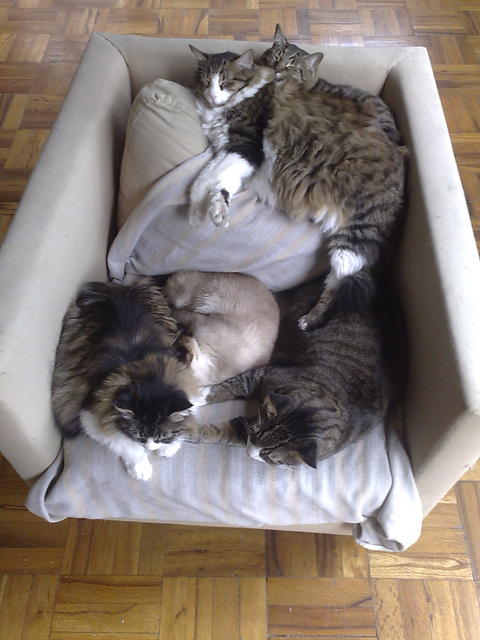
It. Is. Cold.
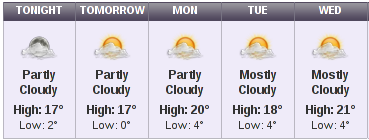
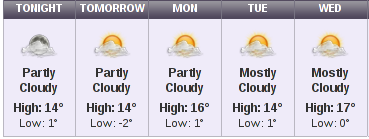
No, we are far from this very impressive picture of a fully-snowed UK seen from the sky that everybody and their dog must have seen by now. Still, in Mexico City we are experiencing the traditional one-or-two-weeks-a-year where it is genuinely cold. And, very strange being this Winter (the rainy season is Summer around here, January should be dry!) we have rain all day long. The Ajusco mountain is around 15Km south from my home, and it is the closest of the giants that surround our valley. Yesterday I managed to get some peeks at it behind the very thick layer of clouds we have. Ajusco looks really gorgeous all snowed, maybe down to the 3400m line (while the city's main area is at 2300m). This picture was not taken this year, we have snow in Ajusco almost every year (although very seldom as much as this time): (last photo is not current, we have not yet had a clear day to take a picture of our Ajusco yet this year) How does it feel? Well, I live in Coyoac n, in the flat area of the valley. Remember that houses here are not built to endure extreme temperatures (and this week is what we call extreme, of course ;-) ). According to Yahoo! Weather: And while the difference appears to be small, what about Magdalena Contreras, ~200m higher, where many people dear to me live (and have even a window pending to be installed)? People say this cold wave is the strongest in 120 years, since records are being taken. Every year people get excited, expecting that this time we will get snow. This has only happened once in at least a century, in 1966 AFAIR. I do not think this year to be atypical. Still, I have a reputation for being insensible to cold weather. Everybody wears heavy jackets while I still go to work with my usual long-sleeved shirt and that's it. But the last two days, I have been using jacket and scarf... But, of course, I don't look as gratious or cute as my cats :-

9 January 2010

Russell Coker: Another Hot Summer

Yesterday was ~30C in my area, today was well over 30C during the day (although cooler in the evening). They forecast 33C for tomorrow in Melbourne, but that means where I live it will probably be about 36C (it s always a few degrees hotter than the overall forecast for the city). Monday is predicted to be 41C and Tuesday may be 32C. I turned off my SE Linux Play Machine this morning and will probably leave it off until at least Tuesday evening. The hardware I use for the Play Machine is fairly energy efficient, but it s in a confined space with some other electronic stuff so it s best not to take chances. I ll probably leave it offline for about half the duration of January and February. I miss Amsterdam and London weather.

7 January 2010

Kumar Appaiah: Brief updates and some advice

So, while Richard is busy doing research and arranging or facilitating several Debian workshops, here I am, gulping down Idlis and Dosas by the dozen. It's been a fun visit, and I got to visit several places in my native state, but since my visit to Mumbai is rather short, I won't be able to say hello to several friends this time (Sorry Kartik). Maybe this would happen only when I am back in India on a permanent basis; let's see...Here are some general guidelines for travelers which I'd like to share:It's been a really fun trip, and I am sure I'll enjoy the rest of the trip, till I get back to my old routine and resume work.Finally, in keeping with the spirit of a blog I try to understand (albeit, in vain, I must accept), I duplicate the concept of a post from that blog, here is an up-to-date list of airports in which I have sat, but never left except by way of airplane:More updates later. Bye for now.

5 January 2010

Tiago Bortoletto Vaz: Uma vergonha


Que merda: dois lixeiros desejando felicidades do alto da suas vassouras. Dois lixeiros o mais baixo na escala do trabalho.
Boris Casoy, em sua mensagem de natal para o povo, (acidentalmente?) transmitida para todo o Brasil.

27 December 2009

Chris Lamb: Readline tab completion using Django models

The following snippet allows readline-style tab completion backed onto Django models. I am using this in management commands in preference to specifying primary keys as arguments.
class QuerySetCompleter(object):
    def __init__(self, qs, field):
        self.qs = qs
        self.field = field
        self.prefix = None
    def __call__(self, prefix, index):
        if prefix != self.prefix:
            qs = self.qs.values_list(self.field, flat=True)
            if prefix:
                qs = qs.filter(** 
                    '%s__startswith' % self.field: prefix,
                 )
            self.matching = list(qs)
            self.prefix = prefix
        try:
            return self.matching[index]
        except IndexError:
            return None
Example usage:
import readline
from mymodels import MyModel
completer = QuerySetCompleter(MyModel.objects.all(), 'name')
readline.set_completer(completer)
readline.parse_and_bind("tab: complete")
readline.set_completer_delims('')
while 1:
    print repr(raw_input(">>> "))
Pressing <tab> at this >>> prompt will complete from the name field of the MyModel model just like a regular shell would. We call readline.set_completer_delims as our items may contain word delimeters - otherwise readline would attempt a seperate completion of (eg) "Bar" if one of our items was "Foo Bar".

23 December 2009

Peter Eisentraut: Patience

Occasionally, there are concerns expressed about the adoption rate of Python 3. Now that PostgreSQL 8.5alpha3 is released with Python 3 support in PL/Python, let's see what the schedule might be until this hits real use.

Python 3.0 was released in December 2008 and was admitted to be somewhat experimental. At that point, PostgreSQL 8.4 was already in some kind of freeze, so adding a feature as signicant as Python 3 support was not feasible at that point.

In fact, we opted to do two significant rounds of fixing/enhancing/refactoring of PL/Python before tackling Python 3 support: fixed byte string (bytea) support and Unicode support. Both of those benefit Python 2 users, and they made the eventual port to Python 3 quite simple.

PostgreSQL 8.5 might release around May 2010. Debian squeeze is currently in testing and doesn't even contain Python 2.6 or Python 3.1 yet, due to some technical problems and a bit of infighting. Debian freezes in March 2010, which means without PostgreSQL 8.5 but hopefully with Python 2.6 and 3.1. The final release of squeeze should then be later in 2010, which means the earliest that a significant number of Debian users are going to look into moving any of their code at all nearer to Python 3 (via 2.6) is going to be late 2010. (Other operating system distributions will have other schedules, of course.)

The next Debian release (squeeze+1), which will presumably include PostgreSQL 8.5 or later and a solid Python 3.x environment, will then not be released before January 2012, if we believe the current 18-months-plus-slip cycle of Debian. So it will be mid-2012 until significant numbers have upgraded Debian and PostgreSQL to the then-current versions. If you are sticking to a stable and supported operating system environment, this is the earliest time you actually have the option to migrate to the Python 3 variant of PL/Python across the board for your applications. Of course in practice this is not going to be the first thing you are going to do, so by the time you actually port everything, it might be late 2012 or even 2013. Also, if you are heavily invested in PL/Python, you are probably not going to upgrade much your other Python code before PL/Python is ready.

This will then be 3 years after the PL/Python 3 code is written and 4 years after the release of Python 3.0. And 2 years before Python 2.x is expected to go out of maintenance in 2015.

So, to all users and developers: patience.

Incidentally, I fully expect to still be using IPv4 by then. ;-)

22 December 2009

Lior Kaplan: When software patents works against you


AP reports about Court: Microsoft violated patent; can t sell Word
A federal appeals court on Tuesday upheld a $290 million judgment against Microsoft Corp. and issued an injunction that will prevent the sale of its popular Word software.The court injunction is set to go into effect Jan. 11. Microsoft has said such a bar would prohibit the sale of all currently available versions of Microsoft Word and Microsoft Office.
Is it time to have a second thought about Red Hat statement of position on software patents ? Posted in Proprietary software

21 December 2009

Daniel Kahn Gillmor: January 2010 Bug-Squashing Party NYC

We're going to have a Bug-Squashing Party at the end of January 2010 in New York City. If you live in or around the tri-state area (or want to visit), are interested in learning about the process, meeting other debian folk, or just squashing some bugs in good company, you should come out and join us!
Where:
Brooklyn, New York, USA
When:
January 29th, 30th, and maybe 31st of 2010
Why:
Because them bugs need squashing!
If you plan on coming, please either sign up on the wiki page, or at least mail one of the good folks listed there, or pop into #debian-nyc on irc.oftc.net's IRC network. Tags: bsp

19 December 2009

Michael Banck: 19 Dec 2009

Tutorials at the Garching Debian Stammtisch Munich traditionally used to have a lot of Debian Developers, but over the last couple of years quite a few of us who used to be students graduated and moved elsewhere or became very busy with their day jobs. We still meet for having a beer and a chat, but not as much as some years ago. We used to meet about once a month, but in 2009 we only managed to meet four times (however, we organized a Bug Squashing Party in November and had a special meeting as Lenny Release Party in February) As the meetings are really rather informal and not necessarily very Debian related, it is difficult to attract new people this way. So Johannes Wiedersich and I decided to try a more hands-on approach by having a second meeting in Garching, in the student-run bar on the campus of the Technische Universit t M nchen (TUM). The idea was to get more of the local science, mathematics and computer science students (as well as possibly interested faculty members) involved. We tried a first time about a year ago, but after two or three meeting in late 2008 and early 2009, we lost momentum. However, we began organizing the meetings again with the start of the winter term, and had two rather successful meetings so far. For the first meeting, we basically handed out some information on how to get involved locally (the Debian-Munich list, its subscription address, the wiki etc.) and discussed Debian in general and Debconf11 in Munich in particular. About half a dozen people showed up, and two of these attended the Bug Squashing Party later that month, and another one (a faculty member) got very active in Debconf11 organization. Thus, I was quite happy with the outcame of that meeting. Some days ago, we had another meeting, and this time I was doing a live-tutorial on Debian package building. As Johannes was ill, we did not manage to announce or publicize the meeting well in advance, so only three people showed up. Still, I think it went rather OK, and we will be doing another Debian package-building tutorial for the next meeting, and possibly other turorials/workshops afterwards (ideas so far include library maintenance, Debconf, how the Debian community is organized and how to get involved in it). As doing a live-tutorial on one notebook is a bit difficult if you both have to type on it and people should see what happens, we will either use some extra hardware next time, or move to some nearby seminar room with a projector, this will be announced in advance. So if you are on Garching campus or nearby and interested in Debian development (and Debian package-building in particular), come to the next meeting on January 13th! We decided to meet on the second Wednesday of each month, at 18h. Subscribe to the Debian-Munich list to get the invitation or watch out for the flyers on the campus.

MJ Ray: Similarities between the co-op and Google

This is a bit of a silly note for a Saturday while I m currently working on translating the co-op s web pages into Esperanto. The old site was translated, but the new site launched as English-only. I d like to have other languages too, but I ll start with the one that s easiest for me as a test case to get the internationalisation working again. That means that I m currently lost in django-blocks language settings. Apparently both our co-op and Google speak Esperanto. Facebook is mostly translated. Most Plone-based sites have some translation, but often it s only the standard Plone parts and any customisations remain in English, which looks a bit odd. Have you seen Esperanto on other major websites where you weren t expecting it?

13 December 2009

Benjamin Mako Hill: Upcoming Travel

As is becoming my custom, I'm planning to spend much of December and January on the road. This time I'll be in Seattle, Japan and Wellington, New Zealand. Here's the rough schedule: Mika will also be around for everything but the NZ leg and SJ seems likely to make an appearance in Japan during the first week of January. Feel free to get in contact if you'd like to meet up in any of the places above for a coffee or beer. I'm also open to hanging out with giving talks at LUGs, GLUGs, Wikipedia groups, free culture groups, colleges or Universities along the way. Most of my time in Japan is still basically unstructured so I'm quite open to suggestions during the first couple weeks of January.

Clint Adams: Sanjana Kumar goes to the movies

I have an imaginary automobile. It is the finest hybrid of German and Japanese engineering. It has a peppy little engine and a turning radius so small it would make a baby camel cry, and a six-speed manual transmission, and it is powered by the urine of vegan bears. My imaginary father asked me why I would possibly want to buy an imaginary car with a manual transmission. Obviously, whichever marketing campaign brainwashed him in the first place wasn't strong enough on the memetics, because after borrowing my imaginary car, he shut the hell up. You see, it's considerably more fun to drive than an automatic. There are other benefits as well, of course. The primary one is that the transmission does what I want. An automatic transmission is configured for maximum comfort , so it wastes a lot of power when shifting. With a manual, you can slip from gear to gear with minimal clutch time, or in some cases, if you're feeling sassy, without using the clutch at all. You can control your engine speed so that your shift will be just as smooth as an automatic without the egregiously long clutch disengagement or shift overlap. You also can see the road in front of you, so you're always going to be smarter than an automatic transmission, unless you don't understand how slopes work or what collisions with other cars mean to your well-being. Now some NRA member is going to point out that you can get a shift kit and tweak your automatic to be less awful. While spending money on this type of thing sounds like a great idea, a shift kit is not going to bring an automatic into the same league as my car. I can still start the car when the battery's dead. I can get higher fuel efficiency (vegan bears don't exactly urinate for free). I can shift into fifth gear, and coming from a full stop, drive up a hill without stalling (this is particularly useful when a squirrel has gnawed the teeth off of all your other gears). Furthermore, shift kit or not, an automatic is absolutely no fun. Someday, when transmissions have advanced into the realm of liquid hyperspace buckminsterfullerene cones that commune with the unicorns, and they'll have cameras and radar feeding the car's computer with useful information about its surroundings so it can make intelligent shift decisions faster than a human. Then I'll have to choose between saner and more fun. That era has not yet arrived. This is a lousy metaphor for debhelper.

6 December 2009

Debian News: Brief updates: testing broken, xorg modules broken, kde4.d.n down and events in Germany

2 December 2009

Margarita Manterola: Life after DebConf8

Finally, after more than a year of preparation, and six months of very very hard work, DebConf8 has come and gone. Even if I'm not yet completely recovered from all that stress, I'm good enough to feel really happy about how things turned out. DebConf8 was a great success. We had great talks, many opportunities for developing interesting ideas, a lot of social interaction, an awesome video team that allowed more than 200 people from all around the world to be part of the conference even if they weren't in Argentina, and in general almost everyone had a very good time. It was really nice to have so many people from Debian over here, and it was specially nice to see them working and enjoying themselves so much. This was all possible thanks to our sponsors, thanks to the many hours spent during the previous months both by the DebConf orga-team (the usual suspects) and specially by the local team, which includes Tincho, Dami n, Romanella, Maxy, Sebas, Zero, Mendieta, Dererk, Melisa, Angasule, Lisandro, Nueces, and also thanks to the all help of the volunteers that came to work with us during DebCamp and DebConf, which include Tom s, Tinchito, M nica, Lucas, Germ n, Diego, Fefu, Nicol s, Mart n, Marcos, Hern n, Alejandro, Mat as, Rodrigo, Alberto and Joaqu n, and finally, DebConf wouldn't have been the great event it was without all the people that managed to travel thousands of kilometers to get here. To all of them, thanks, for making DebConf8 such a great conference Now, at last, DebConf8 is over (although there is some stuff that we still need to do before we can really forget all about it), and life goes on. Today, I did my first NMU after a long time. I'm particularly glad to have time for fixing bugs again, but I won't lie, I'm also extremely satisfied with how DebConf8 turned out. See you in Extremadura!

Andrew Pollock: [life] We're under contract

Well that all happened rather quickly. This morning, we met with our agent to go through all of the offer paperwork, at the bright and early time of 7:30am after (for me at least) a bad night's sleep staring at the ceiling. It wasn't that bad. A lot of disclosures, a lot of initialling and signing. Here's what the stack of paperwork looked like: The paperwork for our offer on the condo The existing building reports didn't come back with any red flags. There's a little bit (around $1,000) of termite damage. We put in the contract that the sellers have to fix that. The hot water tank needs to be strapped to the wall to be in earthquake compliance. We put that in the contract too. A couple of hours later, we'd got all of the paperwork out of the way, and Nick said he'd present the offer to the seller's agent at 3pm. I got a phone call at about 5pm from Nick saying that they'd accepted the offer, with all of our conditions, so we're all ready to go for closing on the 23rd. Apparently the reason the sellers are so motivated is because they borrowed against the equity in this condo to buy a house, so they're eager to close the deal. We managed to negotiate the price down slightly to $519,000 (anything lower would have been a short sale for them, and we already know all about what that can entail). Even for that price, they've made a tidy profit on the $180,000 they paid 14 years ago. So this is working out really well, timing-wise. We'll close on the 23rd, go visit Chris, Bri and Clara in Atlanta for Christmas, and then have all of January to do any work on the place before our current lease expires. Just got to wait for the finance approvals and an international money transfer now. I'm slightly miffed that I booked it yesterday at 0.90 cents, and the AUD has risen to 0.92 cents today.

29 November 2009

Jonathan McDowell: DIY laptop SSD "upgrade"

I'm due a new laptop; my Portege R200 is over 4 years old now, I find it much slower than my desktop (no surprise; P-M 1.2GHz/1.2GB vs Core 2 2GHz/4GB), it's had a new battery and it has an annoying whine on the screen unless you press the side in just the right way. It's still better for long periods of use than my EEE 901, which is why I keep it. In particular I'm off to LCA2010 in January, along with some associated travel beforehand, and I'll want more than the EEE for that, but probably not a brand new laptop. Which meant that when the R200 started throwing disk errors recently I wasn't particularly happy.

Having decided it wasn't worth buying a new 1.8" drive I looked for alternatives. eBay offered plenty of options for 1.8" IDE to CF adaptors and I picked up a Kingston 32GB CF card from eBuyer. I copied across the data from the old drive using a USB adaptor, frobbed grub sufficiently that I got it installed on the CF, then swapped out the drive for the adaptor + CF. I had to do the swap a few times; the first I forgot to have a kernel with ext2 support (the HDD was ext3, but I went back to ext2 for the CF). The second I'd done my usual trick of forgetting to populate /dev with things like console and sda* (ie enough to get to the point where udev will run). And then grub needed some prodding to boot without intervention. I got there in the end and I'm currently writing this from said laptop.

I've made a few changes to the Debian install in an attempt to make things smoother; basically the same tricks people have been using on EEEs or other slow SSD devices. No swap, Iceweasel synchronous toolkit writes disabled, filesystems mounted with noatime, /tmp on tmpfs, various daemons that I don't really use disabled. It's still noticably slower than with the HDD, particularly on writes. However it's quieter and as long as it lasts for the next 3 months I'm happy (plus after that I can reuse the 32G CF card somewhere else, which I couldn't have done with a 1.8" HDD as easily).

Now, back to eying the Lenovo X200s (ugly, trackpoint but 1440x900 display, good battery life) and Toshiba R600 (slower, lower res but pretty and trackpad).as potential replacements. Maybe there'll be something even shinier in 12" by next year...

Jan Wagner: [selfnote] Change CD-image while (HVM) domU is running

xm list grep <VMName>
xm block-list <VMName_Number>
xm block-detach <VMName_Number> <VMName_Vdev> -f
xm block-attach <VMName_Number> file:///iso/disk.iso \
hdc:cdrom r

Antti-Juhani Kaijanaho: New Netnews (Usenet) RFCs

The RFC editor has finally released They obsolete the venerable RFC 1036 (Standard for Interchange of USENET Messages) from December 1987. The new RFCs are the work of the IETF working group USEFOR, chartered November 1997 and concluded March 2009. I ve heard it was not quite the longest lived IETF working group ever. (I personally missed the group by a couple of months, since I started following Netnews and NNTP standardization in April, due to Alue.) Both RFCs are on the Standards Track, currenlty as Proposed Standards. In my opinion, they are a huge improvement over both RFC 1036 and son-of-1036 (which will probably be published as a Historic RFC real soon now).

28 November 2009

Andrew Pollock: [life] Thinking about moving

Our lease runs out at the end of January, and we're thinking about moving to a bigger place. In the four years we've been here (yeah, we just crossed the four year mark the other day) we've often thought about trying to buy as well. We go through these phases where we really feel like buying, then we run the numbers and run screaming back to the warm bosom of renting. A couple of months ago we had the most serious foray into buying. We'd just checked out the models for Mondrian and we really liked the floorplan for Bleu, and found the price to be the least breathtaking of anything we'd looked at in the Bay Area. I got as far as talking to mortgage brokers and running the numbers, and the things that killed it for us were the property taxes and homeowners association fees. The monthly repayments would have been doable, but it'd have really been a ball and chain. We're over here to see the country as much as anything else, and if the mortgage is going to be a significant impedance on our ability to travel, then there isn't really any point in doing it. So we sadly passed up on Mondrian. The three bedroom townhouses in our current complex are going for around the $2500 a month mark, which is a pretty serious jump on what we're paying now for our two bedroom one, so Sarah's been scouring Craigslist for anything better. She found a 2 bedroom plus loft condo being rented privately in Mountain View, which we took at look at on Wednesday. The immediately downsides are it's older (the kitchen and bathroom are really a bit dated) and has no data cabling (this is something I've really loved about our current place) and no microwave oven included. The upsides are it's significantly bigger (about 500 square feet larger), the kitchen has heaps of cupboards, it has a washer and dryer, a lock-up garage, a small, fairly private yard (the rent includes a gardener), and it has what looks like a communal garden bed (the thing that really caught my eye were the compost bins). So I think overall, as long as we can live with the kitchen and bathroom, it's going to be an improvement on where we are now. The windows are all double glazed, so it should be fairly well insulated. It's got a gas furnace and gas hot water, and I think the landlord pays for the water, so I think the utilities would at best come out the same as what we're paying here. We've decided to put an application in for it and see what happens. The landlord is living overseas, so we're dealing with a real estate agent for the letting. Apparently we'd be paying the rent via PayPal or something. He's got a home warranty arrangement for maintenance, which sounds like it'll be pretty good. Meanwhile, Sarah was scouring Redfin and found a house nearby that is for sale (a short sale), which is pretty reasonably priced. We've called up a real estate agent, and we're taking a look at it tomorrow, just because we can.

24 November 2009

Russell Coker: Car Drivers vs Mechanics and Free Software

In a comment on my post about Designing Unsafe Cars [1] Noel said If you don t know how to make a surgery, you don t do it. If you don t know how to drive, don t drive. And if you don t know how to use a computer, don t expect anybody fix your disasters, trojans and viruses. Later he advocates using a taxi. Now I agree about surgery apart from corner cases such as medical emergencies in remote places and large-scale disasters. I also agree that it s good to avoid driving if you aren t very good at it (that would be much better than the current fad of sub-standard drivers buying large 4WD vehicles). But I don t think that people who lack computer skills should avoid using computers. When cars were first invented everyone who owned one was either a mechanic or employed one. Driving a car often involved being well out of range of anyone else who might know how to fix it, so either the car owner or their chauffeur had to be able to fix almost any problem. As the car industry evolved the level of mechanical knowledge required to own and operate a car has steadily decreased. I expect that a significant portion of drivers don t know how to top up the oil or radiator water in their car and probably don t know what is the correct pressure for air in their tires. To a large extent I don t think this is a problem, owning a car involves regularly taking it to be serviced where professionals will (or at least should) check every aspect of the car that is likely to fail. If I used my windscreen-washer less frequently I could probably avoid opening the bonnet of the car between scheduled services! When budgeting for car ownership you just have to include regularly spending a few hundred dollars to pay for an expert to find problems and fix them with of course the occasional large expense for when something big breaks. When the computer industry matures I expect that the same practice will occur. Most people will buy computers and plan to spend small amounts of money regularly to pay people to maintain it. Currently most older people seem to plan to have a young relative take care of their PC for them essentially free mechanic services. The quality of such work will vary of course, and poorly designed OSs that are vulnerable to attack may require more support than can be provided for free. Due to deficiencies in city design it is almost essential to drive a car in most parts of the US and Australia as opposed to countries such as the Netherlands where you can survive quite well without ever driving. When a service is essential it has to be usable by people who have little skill in that area. It would be good if driving wasn t necessary, I would be happy if I never drove a car again. The need to use computers however will continue to increase. So we need to make them more available to users and to support users who can t disinfect computers etc. The only skill requirements for using a computer should be the ability to use a keyboard and a mouse! This requires a new industry in supporting PCs. Geek Squad in the US [2] seems to be the organisation that is most known for this. I expect that there will be multiple companies competing for such work in every region in the near future, just as there are currently many companies competing for the business of servicing cars. We need support for free software from such companies. Maybe existing free software companies such as Red Hat and Canonical can get into this business. One advantage of having such companies supporting software is that they would have a strong commercial incentive to avoid having it break unlike proprietary software vendors who have little incentive to do things right. The next issue is the taxi analogy. Will software as a service with Google subsidising our use of their systems [3] take over any significant part of the market? Of course the car analogy breaks down when it comes to privacy, no-one does anything remotely private in a taxi while lots of secret data is stored on a typical home computer. Google is already doing some impressive security development work which will lead towards low maintenance systems [4] as well as protecting the privacy of the users to the extent that you can trust whoever runs the servers. My parents use their computer for reading email, browsing the web, and some basic wordprocessing and spreadsheet work. The mail is on my IMAP server so all I need is to have some way to store their office documents on a server and they will pretty much have a dataless workstation. Moving their collection of photos and videos of their friends and relatives to a server will be a problem, transferring multiple gigabytes of data on a cheap Australian Internet access plan is a problem.

Next.

Previous.

