Search Results: "hug"

4 February 2010

Mike Hommey: xulrunner 1.9.1.6-2 diff stats

As part of preparing xulrunner 1.9.2 (which would lead to Iceweasel 3.6), I have gone through all the patches currently applied to the latest xulrunner release, to keep track of what should be upstreamed, what needed feedback, what patches I needed to update in upstream bugzilla, etc. As I have talked about our differences with upstream on a few occasions already, and as I was doing this grunt work anyway, I thought it would be nice to make the results public. First, a few reference numbers (excluding changes to generated configure files): A few observations on the above data: The latter used to be true, but is not anymore: xulrunner 1.9.1.6-2 added a lot of changes and is now up to: 98 files changed, 1107 insertions(+), 517 deletions(-). What happened ? will you ask me. A lot happened: the test suite, attempts at correctly installing C++ headers and IDL files, bug fixes. Work has also been done such that make clean/distclean doesn t leave stuff around and that xulrunner can be properly built twice in a row. Differences between 1.9.1.6-1 and 1.9.1.6-2 look like this: 31 files changed, 341 insertions(+), 167 deletions(-). Some were stolen from bugzilla (13 files changed, 162 insertions(+), 70 deletions(-)): Many others were sent: A few others were filed without a patch, as I felt a proper upstreamable patch needed discussion (3 files changed, 16 insertions(+), 3 deletions(-)): A few changes are related to the way we build and how we run the test suite (5 files changed, 35 insertions(+), 18 deletions(-)): Finally, a few were related to the Debian changes history (2 files changed, 1 insertions(+), 26 deletions(-)): Going through the rest of the changes between upstream and the latest Debian release, we can split in 5 categories of changes:
Those that were picked from upstream, or sent and eventually applied in 1.9.2 or trunk (12 files changed, 68 insertions(+), 41 deletions(-)): Those that were picked from bugzilla or sent there, but are not applied upstream for various reasons (29 files changed, 138 insertions(+), 209 deletions(-)): Those that were reported but for which I wanted feedback for a proper fix, yet a patch was applied in Debian because this was necessary (6 files changed, 22 insertions(+), 13 deletions(-)): Those that are yet to be sent to bugzilla (15 files changed, 111 insertions(+), 54 deletions(-)): And finally, the changes that are either Debian specific or not deemed upstreamable (30 files changed, 460 insertions(+), 77 deletions(-) ; this can sound huge, but see the details below): Note, the numbers in the various diff stats obviously don t add up, since some changes overlap. All that information doesn t account the few additional components added in debian/filemonitor and debian/extra-stuff, that account for nearly 600 lines (excluding licensing boilerplate), but I ll talk about these in another post. This analysis also helped spotting another harmless merge error (the first one was spotted a few weeks ago and just left the enable-system-lcms around, without any effect): a variable replacement in a Makefile that doesn t have any effect, since the 2 variables have the same value. Only a pointless 1 line change.

Andrew Pollock: [geek] On trying to buy a 19 inch rack

The first time we looked at this condo that we ended up buying, I looked at the cupboard under the stairs, and could visualise a small 19 inch rack in the lower part of it, with all of my computer gear in it. When we got structured cabling installed, I had the CAT-6 cabling terminated onto a basic 19 inch patch panel, with the intent of mounting this in a rack. Then it became a case of trying to find a rack. My favourite junk shop, Weird Stuff, didn't have anything that wasn't full height, so I started looking around online. There's certainly a lot of variance in price. I settled on a 26U Intellinet rack from New Tech, because based on the dimensions on the website, it would fit in the space I had in mind. When we assembled it, it became obvious that the dimensions quoted were the inside dimensions and not the outside dimensions, and it was about 4 centimetres too tall. In hindsight, I should have figured that out. 26 x 1.75 is 45.5. This is where I must give a shout out to New Tech. Sarah called them up, explained the situation, and they agreed to take the rack back, and sent us some shipping labels to ship it back. We managed to find a more simple rack, a 20U Middle Atlantic, which arrived today, and was significantly easier to put together. The only downside: no rear mounting holes. I don't think it'll be a huge problem, though. All I'm planning on mounting in the immediate future are the patch panel, some sort of cable management, a Catalyst switch, and a power strip. At some point in the future, once we stop spending money hand over fist, I'll look at getting a rack mountable server to replace the hodge podge of computers I'm currently running. What I wish we'd discovered about two days ago, was the Lack Rack. This would have been perfect (and so much cheaper).

22 January 2010

Stefano Zacchiroli: RC bugs of the week - issue 18

RCBW - #18 ... and RCBW is back! Here is this week squashes: Most of the actually fixed missing include bugs above have benefited from patches by Martin Michlmayr, thanks! Also, this week squashing has benefited from a huge list of bugs which Luk has given me, some of the not-yet-fixed bugs there are a bit trickier than usual (e.g. missing #include bugs which got intertwined over time with const char * conversions bugs, which in turn require some far reaching code changes due to the propagation of function prototypes in unexpected code parts). Since I'll be leaving tomorrow morning for the BSP in M nchengladbach, I'll have a bit of time there to dive a bit more into the issues. Actually, what I fear most now is buying train tickets from Cologne to Moenchengladbach and back, since I'm totally unable to pronounce the name of the latter city (my German sucks, actually there is no such "my German" at all). Luckily, I've been told they've wonderful ticket-selling machines in Cologne :-) See you there, and happy RC squashing!

20 January 2010

Thorsten Glaser: Various topics, and, at least *some* people think!

Marc Fleury, JBoss founder joins the ranks of Tonnerre, me, and other people requesting that MySQL (and MariaDB!) please finally die. Everyone, don't even fork it. Use a real database instead. Or, at least, SQLite. Really. We're going to FOSDEM 2010 (of course I've been at every FOSDEM that was not just an OSDEM, Benny and gecko2 are regular attendees as well, as are other projects of mine such as FreeWRT and Debian GNU/kFreeBSD, by proxy). There will be a recent MirBSD snapshot I've yet got to build, with the new floppy format ustarfs (idea, but no single line of their stinking ridiculously huge code, stolen from NetBSD ) and other improvements (albeit less than I wanted to get done by then). The days before, I'll attend the first FusionForge meeting to break up the French Cabal, with my work hat on. That is also my first time in France (outside of the Elsa ). People, make a good impression on me to overcome the classic prejudices ;-) This weekend I'm going to meet my Debian Application Manager zack, have some good beer (ugh... first this, then Paris, then good belgian beer...) and fix some bugs, all while learning even more. Sounds like fun, but I almost feel overwhelmed, in contrast to the years of much less travelling from my past. I've also started sort-of mentoring Simon, one of our apprentices at work, into the Debian processes. (On an unrelated side note, formorer recently said bpo will become bp.d.o soon. Great!) Please don't laugh at this excuse for a webpage, as I've yet to fill it in, but my CLI for the KDE Wallet is hereby deemed ready for public consumption, with a bug-fix release 2.01 (bugs actually found during preparation of a port to Debian sid and KDE 4, which is much much worse than KDE 3, plus it looks so absolutely disgusting I'm not even sure Windows Mistda is worse). I hope the package will end up in NEW soon (and once progressed to testing I may be able to make the KDE 3 variant official via lenny backports; my WTF *.deb repo will hold them until then.

There are more webpages I need to fill in... mksh's TaC, arc4random (which needs some major redesign as well) and BSD::arc4random, the RANDEX protocol (entropy exchange over IRC) and its plugins and patches, ... Not just Mac OSX (and, I hope, iPhoneOS) will soon come with mksh(1), but also Android (I prepared patches to make it /bin/sh, which works quite well although I need to find out how to make a hardlink so that #!/bin/mksh scripts will run) and Maemo, for which I wrote an mksh package in a garage project, which also needs some love w.r.t. testing on actual devices, menu integration, etc. (Please contact me if you can help with either of the three.) We also have lewellyn:#ksh making a package for the new OpenSolaris system (thanks again). People persuading Apple to put it on the jesusPhone are also welcome. (This does not mean I endorse any of these right now, I'd probably get the most of a WinCE PDA with built-in GPSr, WLAN and maybe GSM/GPRS.) English and French native speakers, please review, and Dutch native speakers may contribute a translation of, our flyers. (Source code for these is not available, sorry. Benny makes them in Quark on System 7 in Basilisk II, used to be Classic until Apple yanked it. But still, they use only free fonts, free imagery or such the MirOS Project is allowed to use, and beat every single other FOSS project flyer I've ever seen by far!) There's probably more I could write, I bet I forgot half of it anyway, but I'll leave it at that for now. Get yourself a nice cup of hot chocolate, pour an Espresso into it, and enjoy the mix with a piece of cake (I'd say strawberry or mousse-pear but all they had was cassis-cr me) and pity me for not knowing any French next month.

16 January 2010

Biella Coleman: Being Bad-Ass w/o the Arrogance

bad-ass For the first time in a long while I took a vacation in New Zealand where I am for LCA. I decided to also take a break (mostly) from the Internet but I decided to it was worth to come back to write a brief response to Clay Shirky s rant about women, which I find pretty unsettling. So the basic upshot of his entry is that for women to get ahead in this world, they need to not only behave more like men but in specific, like all the effing blow-hard jerky self-promoting men like, well Clay Shirky (I guess, right? and he in fact might be proud, I a woman, made this accusation). What I appreciate about the post is the fact that he does not pigeon hole women as caring, maternal, and meek. I have always resented the idea that women can t be assertive and confident. However, confidence and self-esteem, which I agree are vital for getting noted, does not inherently entail jerky behavior.I think Shirky s perspective might be skewed because of his home field, which is filled with just the type of guys he is describing. I call them pundit-entrepreneurs (though to be sure some are pretty darn nice). If you take the field of anthropology, for example, it has traditionally and for a long time been known for grand slam female scholars from Ruth Benedict and Margaret Mead in the past to the ones of the present like Nancy Scheper Hughes and Jean Comaroff. During grad school, I was surrounded by strong, smart, witty, confident ladies and always felt I had role models to follow and emulate. They were not, however, low-life jerks clawing their way to the top of the academic mountain leaving a trail of destruction behind their path. Then when I started to go to the tech and media academic conferences, I was soon swimming in a sea of mostly white men and the vibe was different. I was ignored and talked over a handful of times, which had never happened to me before. There was a lot more self-promotion than I had seen in other fields, in part, it seemed because the media pays more attention to this field so folks are trying to get the media light focused on them. While I don t disagree that many fields from medicine to law promote and reward blow-hards and massive unrestrained arrogance, I would rather not create a false binary between meek/low self-esteem/female and total-jerky/arrogance/confidence. Why not instead promote and highlight behavior that rewards confidence sans the arrogance? Here are some thoughtful related posts.

14 January 2010

Sandro Tosi: Matplotlib for Python Developers - PUBLISHED!

Some days are passed, but I'm still pleased to announce that

The first book about Matplotlib has been PUBLISHED!!

It was a really nice experience, it offered me the possibility to work on Matplotlib, do some really interesting stuff, and I'm quite proud of it :)

On the other hand, it was not a "straight" way: the effort I put in this was huge, practically I had to stop all other stuffs and projects I was working on (Debian included) and I was getting more and more tired as time passed. Also, sometimes Packt employees and actions were somehow problematic. but anyhow, the important thing is that THE BOOK IS OUT!!

Now I got also a nice box about the book on the sidebar of this blog!

Enjoy it!!

Sam Hartman: Open Source Accounting Software

I m developing a huge backlog of things to write about, going back as far as a couple of posts inspired by the Kerberos conference in October. However, those require more effort putting together the post, so I m going to focus on something more recent. Part of running a business even a small business like Painless Security is dealing with the administrative and bookkeeping. The normal solution seems to be Intuit s Quick Books. When I set up the company, I looked into that. However, Intuit s accessibility story starts with give up, and goes down hill from there. Apparently, screen reader vendors have offered to work with Intuit to help them, but have been turned down, or at least that s the strong implication I get from reading blogs from these accessibility vendors. So, I d definitely rather not give Intuit my money. I m also looking for a bit more than the minimum in accounting software. Keeping the books in order enough to pay taxes would be easy. However I want to be able to understand where I m making money; I want to be able to figure out if the fixed price contracts I enter into end up being good ideas. I want to understand how expensive community projects Painless Security gets involved in like Debian and IETF work are both in terms of direct costs and opportunity costs. I want to understand what sorts of work ends up being the most profitable. All of these are fairly typical management questions; solutions to varying degrees are understood. however it means I m actually going to use an accounting product more than just to track my invoices and prepare taxes. I decided to see what the open source world was like in this space. I started with Ledger SMB. Ledger SMB s main claim to fame is that it tries to be better than SQL Ledger. Being better than SQl Ledger is definitely a good thing. It worked well enough to generate invoices and income statements. It nominally had facilities to track the sort of per-project information I m looking for, but the facilities are not near good enough. Also, there were some issues things like the fact that total debits didn t particularly need or tend to sum to total credits got old after a very short while. Also, facilities for correcting mistakes were unfortunate. You could either operate in a mode where you could delete a transaction, or a mode where you reverse transactions. Deleting transactions in practice meant deleting most of a transaction; balances became out of sync and half of the transaction tended to stick around using some interfaces but not other interfaces. Database cleanup was almost always required. In principle, reversals are better. However, there is no facility to indicate that you re not expecting payment on a reversed invoice. The receivables/payables account balance out because of the reversing transaction, but both the reversing and reversed transaction end up becoming over-due. Hey, can you please send me some anti-money to clean this up? The code was dreadful; the goal was to have better abstraction than SQL Ledger. Perhaps that was achieved, but man that leaves a lot to desire. Now, I m playing with Open ERP. It wants to grow up some day to be a competitor to SAP R3. In a way that sounds good, although it does mean there s a high complexity cost. There s a lot of functionality. There s reasonably good separation between view and model (and possibly even controller). The code is often clean, although the random blocks of commented out code with no explanation cause me to cringe. Many aspects of the system seem incredibly well designed; you can approach the system through a web client, graphical client, two different RPC mechanisms, XL and Open Office plugins. However, there s this mix of missing stuff and completely broken that causes me to wonder whether I m going to be sad. First, there appears to be basically no support for the US. All addresses are European format and are hard coded. Each individual report needs to be changed. Recently, I found cases where as best I can tell debits and credits are just reversed. I ve found a case where backing up the database succeeds but generates a zero length file. I almost lost data through that last one. There s a complex set of mechanisms to deal with units-of-measure for products for example, some jobs billed in hours, some are billed in days. However other parts of the code just add quantities. Playing around with this I am reminded again that I really enjoy thinking about these sorts of problems. An interesting ERP project could be fun to work on. for example, I bet handling ERP needs for some cloud-centered company would be a lot of fun. Also, as part of looking at Open ERP, I ve more or less developed the necessary scripts to migrate a simple service company from Ledger SMB to Open ERP. There are limitations of course, but if this would be useful to you, drop me a line.

12 January 2010

David Welton: Rough Estimates of the Dollar Cost of Scaling Web Platforms - Part I

I have been pondering the idea behind this article for a while, and finally had a bit of time to implement it. The basic idea is this: certain platforms have higher costs in terms of memory per concurrent connection. Those translate into increased costs in dollar terms.
Nota Bene: Having run LangPop.com for some time, I'm used to people getting hot and bothered about this or that aspect of statistics that are rough in nature, so I'm going to try and address those issues from the start, with more detail below. Methodology All tests were run like so: my new laptop with two cores and four gigs of memory was used as a server, and my older laptop was used to run the ab (Apache Benchmark) program - they're connected via ethernet. I built up to successive levels of concurrency, running first 1 concurrent connection, 2, 10, and so on and so forth. The "server" computer is running Ubuntu 9.10, "karmic". Platforms The platforms I tested: As stated above, it's pretty obvious that using Rails or Django for something so simple is overkill: Better Tests for the Future I would like to run similar tests with a more realistic application, but I simply don't have the time or expertise to sit down and write a blog, say, for all of the above platforms. If I can find a few volunteers, I'd be happy to discuss some rough ideas about what those tests ought to look like. Some ideas: Results With that out of the way, I do think the results are meaningful, and reflect something of what I've seen on various platforms in the real world. First of all, here we look at the total "VSZ" (as ps puts it) or Virtual Size of the process(es) in memory. Much of this might be shared, between libraries, and "copy on write" where applicable. The results are impressive: Rails, followed by Django and PHP eats up a lot of memory for each new concurrent connection. Rails, which I know fairly well, most likely suffers from several problems: 1) it includes a lot of code. That's actually a good thing if you're building a reasonably sized app that makes use of all it has to offer. 2) Its garbage collector doesn't play well with "copy on write". Which is what "Enterprise Ruby" aims to fix. Django and PHP are also fairly large, capable platforms when compared to something small and light like mochiweb. That said, excuses aside, Erlang and Mochiweb are very impressive in how little additional memory they utilize when additional concurrent connections are thrown at them. I was also impressed with Jetty. I don't have a lot of experience with Java on the web (I work more with J2ME for mobile phones), so I expected something a bit more "bloated", which is the reputation Java has. As we'll see below, Jetty does take up a lot of initial memory, but subsequent concurrent connections appear to not take up much. Of course, this is also likely another 'apples and oranges' comparison and it would be good to utilize a complete Java framework, rather than just a tiny web app with one JSP file. So what's this mean in real world terms of dollars and cents? As your Rails application gets more popular, you're going to have to invest relatively more money to make it scale, in terms of memory. For this comparison, I utilized the bytes/dollar that I'm getting for my Linode, which works out to 18,889,040.85 ($79.95 for 1440 MB a month). As we can see, to have a similar amount of concurrent users is essentially free for Mochiweb, whereas with Rails, it has a significant cost. This information is particularly relevant when deciding how to monetize a site: with Erlang and Jetty it would appear that scaling up to lots of users is relatively cheap, so even a small amount of revenue per user per month is going to be a profit, whereas with Rails, scaling up to huge numbers of users is going to be more expensive, so revenue streams such as advertising may not be as viable. It's worth noting that 37 signals, the company that created Rails, is a vocal supporter of charging money for products. There's another interesting statistic that I wanted to include as well. The previous graph shows the average cost per additional concurrent user, but this one shows how much the platform costs (using when there is just one user, so it acts as a sort of baseline: As we can see, Jetty is particularly expensive from this point of view. The default settings (on Ubuntu) seem to indicate that, for instance, the basic $20 a month Linode package would not be sufficient to run Jetty, plus a database, plus other software. I think that the Apache Worker number is off a bit, and may reflect settings made to handle a large number of connections, or perhaps a different MPM would make sense. Source Code / Spreadsheet The spreadsheet I put together is here: http://spreadsheets.google.com/ccc?key=0An76R90VwaRodElEYjVYQXpFRmtreGV3MEtsaWYzbXc&hl=en And the source code (admittedly not terribly well organized) is here: http://github.com/davidw/marginalmemory/

John Goerzen: Sing to Me, Muse

(a review of Homer s Iliad)
Here, therefore, huge and mighty warrior though you be, here shall you die. - Homer (The Iliad)
And with that formidable quote, I begin my review of The Iliad. I shall not exhaust you with a rehashing of the plot; that you can find on Wikipedia. Nor shall I be spending page upon page of analyzing the beautiful imagery, the implications of our understanding of fate and destiny, or all the other things that compel English majors to write page after page on the topic. Nor even shall I try to decipher whether it is a piece of history or a piece of legend. Rather, I intend to talk about why I read it: it s a really good story.
Sing to me, O goddess Muse, the wrath of Achilles, son of Peleus, which brought countless ills upon the Acheans.
As I d be reading it, I d think to myself: Ah ha! Now here we finally have a section of the story that doesn t speak to modern life. Perhaps it was a section the fear of being enslaved or butchered by conquerors, or about pride leading both sides to fight a war they need not have, or a graphic description of a spear going clear through someone s head or neck. And then, I d have to sit and think. Are we really so far removed from that? Here we are, in a supposedly civilized world. We use remotely-operated drones to drop bombs on people, and think it naught but regrettable collateral damage when the brains and intestines of dozens of innocent victims are scattered about, killing them, all for the chance of killing one enemy. But we aren t the only ones to blame; we live in a world in which killing the innocent is often the goal. People fly airplanes into skyscrapers, drop atomic weapons to flatten entire cities, and kill noncombatants in terrible numbers. And for what? A little power, some prestige, some riches, some vengeance, some wounded pride? Slavery is not dead, either. We that can happily afford Internet access most likely abhor the thought. What, though, can we make of the fact that people are starving in this world in record numbers? That our actions may literally wipe some nations off the map? Are those people as free as we are? Do our actions repress them? I suspect you can t read the Iliad without being at least a bit introspective.
Fear, O Achilles, the wrath of heaven; think on your own father and have compassion upon me, who am the more pitiable
One of the great things about reading the Iliad is that I can learn about the culture of the ancient civilizations. Now, of course, one can read about this in history books and Wikipedia. But reading some dry sentence is different from reading a powerful story written by and for them. I know that the Iliad isn t exactly a work of history, but it sure shows what made people tick: their religion, their morals, their behavior, and what they valued. I feel that I finally have some sort of insight into their society, and I am glad of it.
The day that robs a child of his parents severs him from his own kind; his head is bowed, his cheeks are wet with tears, and he will go about destitute among the friends of his father, plucking one by the cloak and another by the shirt. Some one or other of these may so far pity him as to hold the cup for a moment towards him and let him moisten his lips, but he must not drink enough to wet the roof of his mouth; then one whose parents are alive will drive him from the table with blows and angry words.
There are gory battle scenes in the Iliad, but then there are also heart-wrenching tender moments: when Hector leaves his wife to go fight, for instance, and worries about the future of his child if he should die. That s not to say I found the entire story riveting. I would have liked it to be 1/3 shorter. The battle just dragged on and on. And yet, I will grant that there was some purpose served by that: it fatigued me as a reader, which perhaps gave me a small sense of the fatigue felt by the participants in the story.
Why, pray, must the Argives needs fight the Trojans? What made the son of Atreus gather the host and bring them?
A question that was never answered, for either side: why are we so foolish that we must go to war? One tragedy among many is that neither side got smart about it until way too late, if ever they did at all. I read The Illiad in the Butler translation, which overall I liked. Some of these quotes, however, use the Lattimore one. This completes the first item on my 2010 reading list. I leave you with this powerful hope for the future, written almost three thousand years ago. Despite my criticisms above, we have made a lot of progress, haven t we? What a beautiful ideal it is, and what a long ways we have yet to walk.
I wish that strife would vanish away from among gods and mortals, and gall, which makes a man grow angry for all his great mind, that gall of anger that swarms like smoke inside of a man s heart and becomes a thing sweeter to him by far than the dripping of honey.
Sing to me, O goddess, the anger of Achilles, that one day his story may speak less to our hearts, for then will we have outgrown it.

11 January 2010

Ian Wienand: Salton (Sim)City

I was recently driving through the California desert and came across the Salton Sea. Long story short - it rained a lot and the Colorado River overflowed a bunch of dams and dikes meant to contain it and created a huge inland sea. Oops. Some enterprising souls must have decided that despite the lack of any natural flushing dooming the sea to a salty, polluted existence, there was ripe opportunity to create a sea-side metropolis. From the ground, it is a bit of a fun ghost town to explore. The typical "everything just abandoned" type thing. But when I came to geotag some photos I took there, I was quite astonished to see this. Salton (Sim)City That looks exactly like what I used to do in SimCity. I'd use the F-U-N-D-S cheat at the start to max out my money, then build my little empire with neat roads and school and harbours and whatnot they've even got an airport! Then I'd press "go" and people would slowly move in to the residential areas, one house on one block at a time. I guess poor old Salton City never made it past "turtle speed"!

9 January 2010

Erich Schubert: Facebook Scam Groups

Facebook seems to have little interest in protecting its users from a huge flow of common scam/spam. Sure they do get active when accounts are mass hacked, and I havn't seen a "Facebook virus" for some time. Their JavaScript filtering is pretty neat, and they have implemented dereferrer pages they can use to quickly stop URLs from spreading.However, some of my friends keep on joining very dubious groups and installing very dubios applications. No wonder "FarmVille" is sometime nicknamed "ScamVille". There still is a lot of money to make in dubious ways.The big problem with Facebook is that everyone can set up groups and applications that look like they might be real. This is why people keep on installing "Mafia wars gifts" applications that have nothing to do with the actual game except the name. And sometimes not even realize they don't actually get these gifts in the real game.Even worse are the "pimp" groups. It's a classic pyramid scheme. Invite all your friends to the group, then you get extra Mafia points. Facebook really needs to stop that.A quick search for "invite proof" - these groups usually require you to post "proof" of having invited all your friends - turns up 246 groups, almost all of which promise you Mafia stuff.Searching for "getElementsByTagName" in Facebook turns up "over 500" groups. This string is a JavaScript command commonly used to auto-invite all your friends to a group. A typical mass-spread group will use this in its "join instructions".Facebook needs to combat this kind of spam/scam. And it's not too hard. Just actually check user complaints/reports, do simple searches like the ones I posted above, and have some employee go through them and just delete all these dubious mass-join groups. Pyramid schemes likely violate the Facebook TOS, and they definitely are illegal in at least Germany.

Andrew Pollock: [life/americania] TransLink, the Bay Area's best kept public transportation secret?

We're not huge users of Caltrain, because frankly, it sucks. It's way slower than driving to San Francisco, and by the time you've paid for two return tickets, you might as well have driven and paid for parking. That said, we do use it from time to time. One of the things I noticed when we first moved over here was this intriguing box on a pole, to the side of the normal ticket vending machine. It looked all battered and faded, kind of like a deprecated form of ticketing that had been phased out years ago. Except it looked too high-tech to be phased out. Fast forward to four years later, and we're using Caltrain to get back from SFO after returning from Atlanta for Christmas, and there's this "Don't forget to tag off" TransLink poster inside the carriage. I'm now officially intrigued. I did some browsing of their website on the journey home. How could this be? Hong Kong's MTR has the Octopus Card. London's Tube has the Oyster Card, and the Bay Area has TransLink? Why the hell isn't this thing being pimped out more? It's awesome! I mentioned it to a co-worker the other day, who's been in the Bay Area for 7 years, and he'd never heard of it. So I signed up for it for myself and Sarah, and two cards promptly arrived. If you sign up with an autoload of $20 or more, there's no cost for cards at all. So from now on, whenever we need to ride Caltrain (or BART or Muni, which are the public transport networks we're ever likely to use) we can just wave these cards at something and never have to worry about a ticket ever again. It's awesome. Apparently VTA is coming on board with it later this year, so that'll round things out nicely. It sounds like it's been an epic implementation, starting back in 1999, and still rolling out ten years later. Better late than never. The added bonus will be for our visitors. When they come, we can just give them these cards, and they won't have to deal with BART's utterly confusing (for casual riders) fare system. One of my favourite things about Hong Kong was the MTR and the Octopus Card. Now we just need awesome mass transit for the Bay Area. Somehow, I think that's going to take even longer than TransLink.

2 January 2010

John Goerzen: A Poem for the Rich

In Egypt s sandy silence, all alone,
Stands a gigantic Leg, which far off throws
The only shadow that the Desert knows:
I am great OZYMANDIAS, saith the stone,
The King of Kings; this mighty City shows
The wonders of my hand. The City s gone,
Nought but the Leg remaining to disclose
The site of this forgotten Babylon. We wonder, and some Hunter may express
Wonder like ours, when thro the wilderness
Where London stood, holding the Wolf in chace,
He meets some fragments huge, and stops to guess
What powerful but unrecorded race
Once dwelt in that annihilated place. Horace Smith
Many of us that can afford an Internet connection still qualify as exceedingly rich compared to, for example, many poor people in Africa. On a scale of centuries, the ancient centers of civilization and wealth tend to collapse. Even Rome, with over a million inhabitants in its day of ancient prominence, shrank to only 20,000 over the course of history. Some other ancient cities no longer dot our maps. It helps us, perhaps, to have some perspective. Those magnificent working monuments to wealth in New York, London, or Tokyo probably won t be there 1000 years from now. What will?

1 January 2010

Joey Hess: naught but a decade

This has been a big decade for me. Ten years ago, I was living in Sunnyvale, in the heart of Silicon Valley; VA had just had its crazy IPO; my unvested options were worth over a million dollars on paper. I remember sitting in first class[1] on the way out of Atlanta after the holidays and wondering what one did with a million dollars. Avoid working too much? Have a lot of interesting computers? Build a distributed house[2]? Mostly I decided to not count my chickens, which turned out to be the right choice. Six months later, I started debian-installer, in many ways my biggest project to date. In spring of '01, VA was crashing; I was sick of the Valley; gloom was everywhere. I took the hint and quit, cashed in my options for five figures, not seven, bade forewell to the many people I'd come to know, and moved back east. By reading my old journal, I can tell that subconciously, I had long before decided what to do when it was time to leave the Bay Area. So without really thinking too much about why I was able to do this, about how not just my own family, but others were indirectly making it possible, I moved to a 150 acre wooded "farm", and mostly went off and did mostly my own thing for three years. This was such a huge life change. I lived in a building affectionatly called "the shack". It was renovated from a chicken coop in the 70's and leaked during heavy rain, but I preferred it to the main house (warmer). I went back to dialup for internet. I hauled groceries and most everything half a mile in by hand. There was an outhouse and washwater hauled from a creek. I cut barely enough firewood and readapted my body from California to cold. My main tech project during this time was mooix. In some ways my largest failed project, but it was neat to be able to go off and do such a thing. This was a blissful, reflective, peaceful, amazing time. Parts were a second childhood. Somewhere in there I properly confronted my mortality. And learned to use a chainsaw. And over the course of three years, I dug myself into a rut, a hole. I wasn't going anywhere. (Except for a month in Honduras, and my first DebConf in Oslo.) In '04, I found myself talking on the phone to a cosmonaut in a house that had been without power for days in a hard winter. I realized I was ready to leave the farm if I could figure out how to do it, and I almost took him up on the job working on his new Linux distro -- but at the last minute Oslo connections suggested I work for SkoleLinux instead, and so I did. Soon after moving into a rented house in town, I was jaunting off to Brazil for a month, a great time. Followed by a productive year where I got heavily back into debian-installer, started Debian's testing security tream, and generally worked a lot. The next summer I fooled around with an RV, and sort of fell into a job with ADS. But my time on the farm had changed me, I think. I ended up going back to the farm for a year and working part time from there. During this time I also started ikiwiki and other smaller projects. One day I came back from a camping trip and found the kitchen had been torn down in my absence. Reminded unsubtly that I was not the only one with a claim to the place, I got out, though I somehow suspect not for good. For the last four years, I've been more outwardly settled, buying a house in town, continuing to work at the same job, starting little projects like pristine-tar, mr, and etckeeper. About two years in I began to feel antsy sometimes (and had a minor medical scare), and set up the yurt as a relief valve so I can have crazy adventures in the cold woods again. Still, I sometimes feel that a big change is building up. From here, this decade feels like it contained endless changes, important decisions, interesting projects, strong experiences. The 90's, containing only little things like college and moving to California, pale in comparison. Maybe the naught's will be the decade I always remember.. or maybe not. Anything could be around the corner.

  1. Bumped up due to an airline scheduling snafu, not because I was throwing money around.
  2. Concept of mine perhaps not worth explaining here although it was oddly similar to how I ended up living at the farm. Good ol' subconcious..

31 December 2009

Christian Perrier: Sandro, I made it too...

Sandro, I was about to write that I wouldn't join you in the club of Those Who Reviewed The Entire Debian Mailing Lists, at least for 2009. And, finally, in a very last rish, I ade it and completed my remaining 541 mails to review in the bloody debian-user mailing list. By the way, you could be interested in learning that I flagged all messages from the "Sponge Burning A Republican!" giant thread (probably the biggest thread in Debian mailing lists ever) as spam. That's debatable but such huge crap is definitely not something I personnally think belonging to the Debian mailing list archives..:-) To others: we still need a few other crazy minds to continue cleaning up spam from our lists archives (at least, debian-boot is in the way to become the first entirely spam-free mailing list on lists.debian.org).

30 December 2009

Christian Perrier: About properly using people's names...

I recently tried to improve my way to interact with people by mail, in my free software work. Particularly, my intent is to be "better" in using other people names and specific politeness rules. As many of my readers may guess, being involved in internationalization means interacting with people of different cultures. And, when it comes at names, this is just a nightmare..:-) Most so-called "westerners" (western of what, by the way?) are used to the common tradition we share to use people's "first" name....at first...followed by what is most often the "family" name (the one we usually get from our parents). As a consequence, it is fairly easy for me to guess that, interacting with someone named "Barack Obama", I can use "Dear Barack" if I'm in position to use his first name and "Mr Obama" if I need to show some respect distance whatever. Also, as most "western" names are quite familiar in my ears (international culture, blah blah), I can easily guess what is a first name and what is a family name (though, here, "Barack" is probably not the best example). Gender may become a little bit trickier in several cases, but, thankfully, in English, "Dear" does not change with gender (but the third person does whic sometimes leads to problems). The problem arises when interacting with many other culturally different people such as my friends in Japan, China, India, Africa, etc. Here, dammit, the habits might vary a lot and things get harder. Should I call my friend "Kenshi Muto" as "Dear Kenshi", "Kenshi-san", "Muto-san" or whatever? From my readings, I see that most Japanese people do put their family name at first. So, I should then call him "Dear Muto" if I'm very close to him (oh, maybe it's 'her', by the way, who knows?)...or maybe "Kenshi-sensei" because he (oh...or she) is a respected figure in the Japanese FLOSS community...or whatever. Damn! Thankfully, I know Kenshi for years, we're good friends and I know that he's using the "western" way to write his name. I also know he's a man : after 5 or 6 Debconfs, you know everything about people! But, of course, it becomes harder when it comes at people I never had contacts before.....and I don't want to appear as impolite, or silly so, then we jump into my daily "nightmare". Using Wikipedia for hints about Chinese, Indian (the many ones) or even Icelandic or Indigenous peoples of the Americas helps a lot, still. I can only encourage my various friends in free software to do the same. We probably all deeply appreciate when someone shows some knowledge of our culture or at least tries to do his her best to understand our culture. That is probably also part of the mutual enrichment we get in our free software activities. As a tribute for this, I now write my own name as "Christian PERRIER" in my email headers, so that people have a slightly better clue that "Perrier" is my family name and that someone who wants to be familiar with me should call me "Dear Christian". I can probably ncourage my friends all around the world to do the same. For once, using capitals is not about 'shouting' but more about helping other people to figure things out. Next blog writing about the interesting challenge we all face in free software meetings and conferences: shake hands, kiss, hug or just wave? :-)

23 December 2009

Benjamin Mako Hill: What's in a name?

Over the summer, there was a bit of a tussle at the highest level of Ubuntu governance over whether or not Canonical Ltd., the company that funds the majority of work done directly in Ubuntu, should name its file syncing and backup service Ubuntu One. Canonical's service involved a freely licensed client included in the Ubuntu distribution but, as a network service running on Canonical servers, it was not clearly a part of Ubuntu (the GNU/Linux distribution) or Ubuntu (the community) in the way the term was usually used within the community. Although the network service itself was not Franklin Street Statement free, this was not the most important issue for everyone who objected to the name. The major issue for many seemed to boil down to the fact that, free or not, Ubuntu One is a service run entirely by Canonical outside the reaches of the Ubuntu governance structures. Decisions were made and not everybody -- and maybe not anybody -- was absolutely happy with the outcome. My goal is not try to revive old arguments here. As far as I'm concerned, the issues are settled and the service is called Ubuntu One. That said, the questions raised during the episode are fundamental to Ubuntu and to other firm-sponsored FLOSS projects. Now that the dust has settled, they are worth reflecting on. From a legal perspective, there never was any ambiguity. Canonical "owns" the Ubuntu trademark. In this important sense, "Ubuntu" means whatever Canonical says it means. This is hardly new. As just one example, the Official Ubuntu Book (of which I am an author) was written by community members but became official because Canonical blessed it. But despite the fact that they don't need to, Canonical has often consulted with the community and its governance structures about trademark licensing policy. This was also not a case of Canonical not listening to the community. Canonical employees approached the Ubuntu Community Council (Ubuntu's highest governance board of which I am a member), listened carefully to concerns, and responded thoughtfully. The question was not even about a clash between what Canonical and the CC thought about the issue. An unambiguous majority of the board, including all the Canonical employees and several of the community members, supported the idea of Canonical using the trademark. The question was one about who gets to make the decisions about the Ubuntu name and about what role the community and Canonical would each play. Despite the fact that a majority of the Ubuntu community council was likely to support the proposed name, the CC was told by Canonical CEO Mark Shuttleworth that a vote was irrelevant. Canonical made it clear that decisions about the Ubuntu trademark were simply not in the CC's purview. The decision on how the name was to be used was something that Canonical was not willing to delegate to an "outside" (the firm) governance body. Few businesses would. And although I don't agree with the decision as a community representative, I might have even made the same call from Canonical's shoes. In traditional firms, it's usually pretty clear where the organization's boundary lies. In FLOSS projects -- and especially in FLOSS project like Ubuntu who are sponsored in very large part by a single for-profit company -- boundaries are fuzzier. The conversation about "Ubuntu One" can be seen as a fight over what "Ubuntu" refers to, and, more importantly, who gets to answer that question. In deciding whether to call a service "Ubuntu", a decision is made on what Ubuntu is. Names are powerful. Is Ubuntu just a Canonical project? Are Ubuntu's contributors really just Canonical contributors by proxy? I think the answer to both questions is "no" but the boundary issues involved are complicated and under constant negotiation. Every time Canonical uses the Ubuntu name itself or grants others the ability to do so, these boundary issues are negotiated, one way or another. This boundary setting work reveals an important tension that firms releasing FLOSS must all struggle with. To what extent and in what ways do communities get to decide what a FLOSS project is and to what extent do sponsoring firms get to do so? How should projects and firms do this most effectively? What should we even be optimizing for? I think that any resulting balance has a huge effect on whether a FLOSS project is, on one hand, released under a free license but run like any old corporate project or, on the other, a true "bazaar" style project where no single firm dominates -- or where they fall on that spectrum. Names and trademarks are one way that projects define their own identities and act as an important frontier in this balancing act. As every firm/project negotiates their own answers to questions of names and boundaries, there are important implications for the project's ability to attract volunteers, solicit contributions from other firms, and more. The confusion around conversations about Ubuntu One shows that we still have a lot to learn.

20 December 2009

Stefano Zacchiroli: RC bugs of the week - week 15

RCBW - week #15 Here are last weektoday squashes, by yours truly: Some highlights:

Russell Coker: I Bought the Bose QC-15

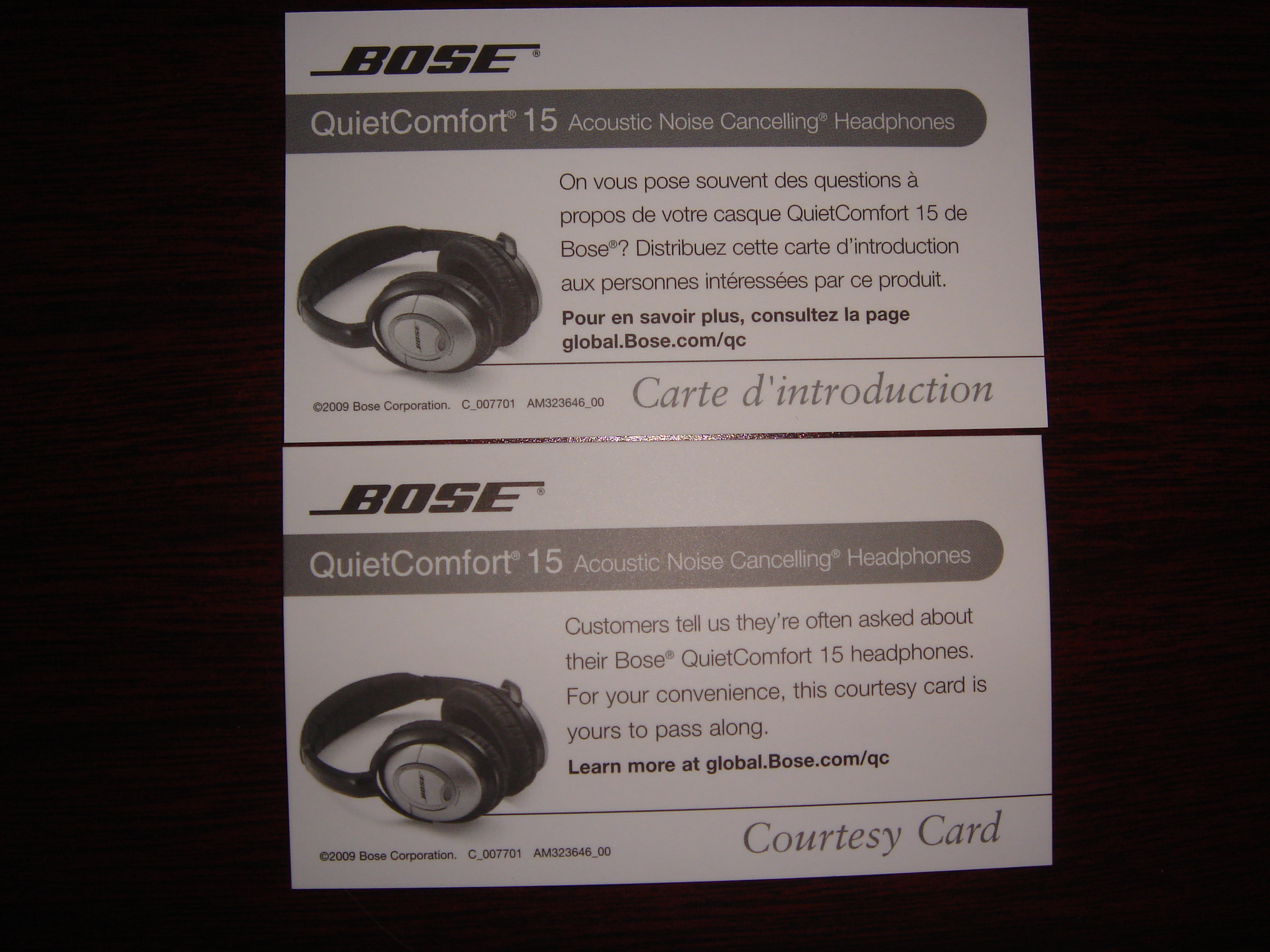
I bought the Bose QC15 noise canceling headphones for my trip back from the US. See my previous posts about Noise Canceling Headphones [1] and Testing Noise Canceling Headphones [2] for the details of my search. I first tried my new headphones in my hotel room and they worked really well at blocking the noise from the nearby road (El Camino Real in Menlo Park) as well as the noise from the heater in my room. At the airport they entirely blocked the sound of the airport air conditioning system (which was surprisingly loud I didn t realise how loud until I tried the headphones). On the flight the headphones worked really well. I used them for hours when they weren t plugged in to any source, just stopping the noise was a huge benefit. I was also able to listen to music (both MP3s on my laptop and the plane sound system) at a relatively low volume with an apparent high quality. The Bose store I visited in Stanford mall has a sound system set up to emulate the noise you experience inside a jet to demonstrate what the headset can do. It really lives up to this demonstration! I recommend them to anyone who wants over-ear noise canceling headphones and can afford $US300 + tax. But one thing to note is that not everyone likes such things my wife didn t like the sound that they generate (the least bad way to describe it is as a soft hiss). This is definitely not something you would want to buy based on reviews alone, it must be tested in-store. The main technical suggestion I can make for improvement to the QC-15 is for it to have slightly softer and thicker padding where it contacts the sides of the wearer s head. I find that my glasses prevent it from making as good contact as I would like, and that when wearing it while eating the contact is significantly broken with every jaw movement which is really annoying. A minor suggestion is that every pair of headphones should have the left and right ear pieces clearly marked, I really shouldn t have to read an instruction manual to discover which way to wear it. One thing that surprised me was the inclusion of business cards for the headset! Here is a picture:

The picture links to a larger picture that also shows the French version of the same text on the other side. I was astonished by this, encouraging happy customers to help sell your products is a reasonable and effective form of product promotion (really this is what I m doing for Bose with this blog post). But giving customers business cards is going too far anyone who wants me to hand out their business cards can offer to pay me to do so (and I probably won t accept). But if such things are considered to be a good idea then here are a few suggestions for other things that they could do:
  1. Create a Bose dating site where one can meet people who like music and traveling (this does sound appealing). In about 10 years the children of people who meet that way would start buying audio gear
  2. Start a Bose fan club.
  3. Create a template that be used by a tattoo parlor to make a Bose tattoo.
  4. Sell Bose fan t-shirts to people who aren t dedicated enough to get a tattoo.
  5. Register Bose as a religion, that gets tax free status among other benefits.
It s a pity that Bose doesn t make any water-proof noise canceling headphones. It would be something for their marketing people to wear while jumping over a shark on water skis [3]. But seriously the best thing that Bose could do to have their products promoted would be to start by printing the web site for each product on the item, my headset has two patent numbers listed which seem unlikely to provide any benefit for anyone, in that space they could have printed the global.bose.com/qc URL that is on the business card. Of course providing the URL really doesn t do any good when the URL actually is useless. It starts by giving me a page asking which country I am in the correct thing to do is to use geoip to determine the country and then give the user the option of selecting another country if that one is not ideal. Then after I select a country it doesn t take me to a specific page for the product! I could have typed in www.bose.com and got the same result (in terms of US shopping at least) while typing six fewer characters! Next like most corporate web sites the Bose site doesn t appear to be configured for longevity of URLs URLs which are clearly designed for the computer rather than humans are expected to change without warning. This discourages linking to any page that one might discover through web searches or navigating the site, and causes them to lose a lot of potential links. Having specific URLs for all the products (including the obsolete ones) that are designed firstly for humans to read and write would be a good idea. It would be really useful to be able to compare the features of new products with the ones that are going cheap on eBay. For someone who is considering buying a new product now the purchase decision would be easier if they knew that the company would provide resources to help them get a better price on eBay in a few years if they want to upgrade to a newer model. One thing to keep in mind is the fact that the reputation of a company (which makes a dramatic impact on the prices customers are prepared to pay) depends largely on a long history of making quality products. Telling customers about those historic products is one of the most sensible things that most corporations fail to do on the Internet.

Next.

Previous.