Search Results: "eric"

6 November 2010

Joey Hess: howto: create your own time zone

Tomorrow I won't have to deal with it getting dark at a soul-crushing 5:30 pm. Nor will I have to wake up blearily an hour early in the spring. Instead I will be enjoying my new, custom time zone. It's "JEST", for "Joey's Eastern (non)Standard Time", and in JEST, there is no spring forward or fall back stress. The folly of daylight savings time (Ben Franlin's best prank ever) really becomes apparent when you have solar power. It's bad enough that the sun is setting at 6:30 without compounding that by an hour. By keeping my clock set so the sun sets in midwinter at 6 pm, I will maximise what little light there is, and minimise time spent using batteries in the dark. Of course, it helps that I'm my own boss, and that most of the people I work with are probably not in a nearby timezone anyway, and that most things are done asynchronously. Since JEST is an hour ahead of local time here in the winter, I will, at worst, tend to be running early. So I only have to change my clocks one time -- and by "change", I mean create a custom timezone in Linux. Here's how to do that.
  1. Make a custom timezone file. The standard one for North America is a bewildering 3000 lines of special cases, conflicting legistlation, and historical weirdness, but I only need one: echo "Zone JEST -4:00 - JEST" > JEST.zone
  2. Compile and install it to somewhere; I put it in ~/.zoneinfo zic JEST.zone -d ~/.zoneinfo
  3. Set TZ to use it. Also TZDIR if it's not in the system directory. export TZDIR=~/.zoneinfo TZ=JEST
Update: Turns out it was easier than I thought, just setting TZ=FOO+4 will make date display a timezone "FOO" that is 4 hours behind GMT. So all I need is to set TZ=JEST+4 Result:
date: Sat Oct 30 21:43:39 JEST 2010
date -R: Sat, 30 Oct 2010 21:43:39 -0400
Previously:

3 November 2010

Tim Retout: Flattr-y will get you nowhere

Dato pointed out on my post yesterday that I had omitted to link to the Ikea catalogue. And then it hit me - I am completely failing to monetize this blog! (Sadly, Ikea aren't in a position to give me any kickbacks right now.) Since my money would be spent on innovative Swedish design in any case, I present a new microdonations system: Flattr-pack. I'll add a "Flattr-pack this!" button to everything I write, and then you can send me furniture with one easy click. Unlike other systems, this has the advantage that no one will be taking a 10% cut of your donations. Awesome! Or maybe not. For those who don't know what I'm on about, Flattr is a website that lets you donate small amounts of money to other websites. It has been proposed to use this site to support free and open source software (FOSS). Now a quick modern anthropology lesson: in a 1998 essay titled "Homesteading the Noosphere", Eric Raymond conjectured that FOSS society is a gift economy; your reputation is proportional to how much you give away. At first sight, microdonations drop neatly into this system; after all, the users are giving money away, right? And yet somehow, I don't think those users are gaining much in terms of reputation. Not in the same way as if they reported bugs, say; joined a localization team; or even just turned up to conferences and volunteered to sit on the front desk. Both types of activity could be described as "donations" - but in one case, the donation benefits the whole community around the project, and in the other it goes to just a few top developers. It's a plain old exchange economy in disguise. I do hope that those users are not dissuaded from making the more generous donations just because it's more convenient to whip out a credit card. That would not be in their long-term interests, or those of the community as a whole. I fear this scheme could also incentivize some oddly inefficient behaviour; writing blog entries purely for their donation potential, say, or even content-free search-engine optimization posts. Speaking entirely personally, I do not plan to join in.

2 November 2010

Theodore Ts'o: I have the money shot for my LCA presentation


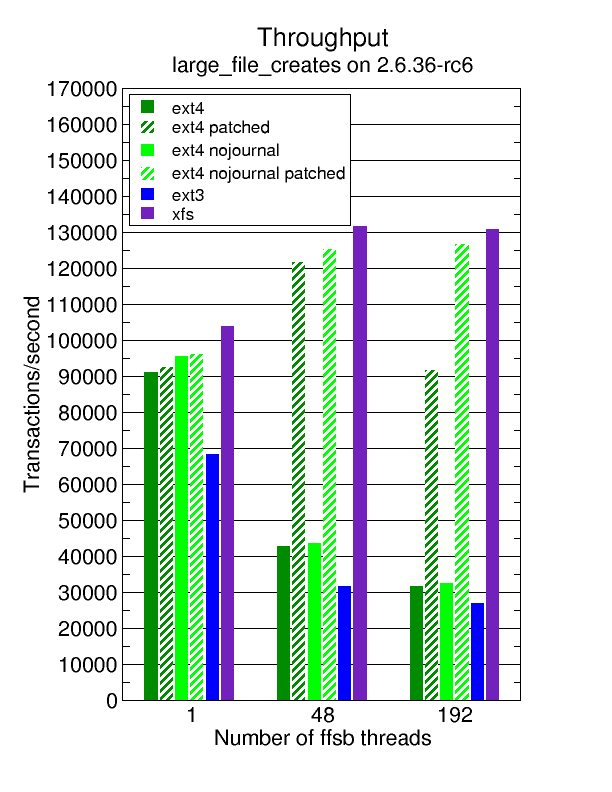
Thanks to Eric Whitney s benchmarking results, I have my money shot for my upcoming 2011 LCA talk in Brisbane, which will be about how to improve scalability in the Linux kernel, using the case study of the work that I did to improve scalability via a series of scalability patches that were developed during 2.6.34, 2.6.35, and 2.6.36 (and went into the the kernel during subsequent merge window). These benchmarks were done on a 48-core AMD system (8 sockets, 6 cores/socket) using a 24 SAS-disk hardware RAID array. Which is the sort of system which XFS has traditionally shined on, and for which ext3 has traditionally not scaled very well at. We re now within striking distance of XFS, and there s more improvements to ext4 which I have planned that should help its performance even further. This is the kind of performance improvement that I m totally psyched to see! No related posts.

Theodore Ts'o: I have the money shot for my LCA presentation


Thanks to Eric Whitney s benchmarking results, I have my money shot for my upcoming 2011 LCA talk in Brisbane, which will be about how to improve scalability in the Linux kernel, using the case study of the work that I did to improve scalability via a series of scalability patches that were developed during 2.6.34, 2.6.35, and 2.6.36 (and went into the kernel during subsequent merge window). These benchmarks were done on a 48-core AMD system (8 sockets, 6 cores/socket) using a 24 SAS-disk hardware RAID array. Which is the sort of system which XFS has traditionally shined on, and for which ext3 has traditionally not scaled very well at. We re now within striking distance of XFS, and there s more improvements to ext4 which I have planned that should help its performance even further. This is the kind of performance improvement that I m totally psyched to see! No related posts.

1 November 2010

Adnan Hodzic: I want Xperia X10 Android 2.1 update now!

Story I bought Xperia X10i this summer during DebConf10 in NYC, I loved this phone from very beginning however what bothered me was that it was still stuck on outdated Android 1.6. To get your own custom Android on it, wasn t quite possible because no one managed to hack bootloader even though some of the guys at XDA where getting pretty close. Long story made short, Sony Ericsson has finally release their Android 2.1 update, but made it available only for Nordic region, they explained it all on their blog where they also sent a message for paranoid users as they called them. I thought, if I gave it all this time I can wait a little bit longer, but then one of my friends (@sahinovic) gave me a good pointer to go in right direction with using custom ROM, Nordic for example? So this is where I got my idea. I want 2.1 update now! Please note steps below will get you Android 2.1 update, but AFAIK you ll also lose your warranty 1. Root your phone If you don t have your phone rooted, this can now be done in single click. Get X10 Root and follow instructions on screen. 2. Edit system/default.prop Get Root Explorer, mount r/w (upper right corner), edit system/default.prop Lines you re concentrating on are 1 and 3 Let s say they are:
ro.semc.version.cust=1237-0333
ro.product.name=X10_1237-0333
Edit them to look like:
ro.semc.version.cust=1234-8465
ro.product.name=X10_1234-8465
Save the file and it s gonna create automatic backup of original file. 3. Get the updates using SEUS Turn off your phone, launch SEUS, plugin in the USB cable while holding back button, SEUS is going to tell you have updates for your phone Smile Follow on screen instructions. Enjoy the update Smile Conclusion X10 is a pretty sweet phone, but with it being so closed, it also closes a lot of doors to hacking it and playing with it, great example would be this update itself, since right now Android 2.1 update is an outdated one. However 2.1 update brings new life into it, just as it s a brand new phone, it s more responsive and much much faster. And do take a backup before this update, because I lost everything from my contacts to internet settings, but all files on my sd card remained intact. If you want to discuss anything regarding this topic please do so in comment area below or find me on Twitter.

31 October 2010

Erich Schubert: The next 'terror lie' - campaign time again

There is something fishy with the latest "printer bomb" reports. One one hand, they claim the parcels were adressed to "jewish synagogues in Chicago". On the other hand, they claim they were meant to explode in the air. So: why would you address them to a synagogue then? Sending a parcel from Jemen to a synagogue probably is a sure thing to have it thoroughly checked? I don't trust any of their reports. Don't get me wrong; for example I do not believe the WTC was blown up using explosives like most of the conspiration theorists out there do. But they are not telling the truth with these parcels, either. Also given that they claimed there were way over 20 parcels sent, and the security was that weak, how come all of them were found? When they decide to make up a story for us (either for having a reason to kill more people in Jemen or just for election reasons) they should at least bother to make up a consistent story ...

30 October 2010

Erich Schubert: One month without Facebook

I disabled my Facebook account about a month ago. See the blog post when I started my Facebook hiatus for the reasons. Now, almost one month into my hiatus, I must say that it has been surprisingly easy. While I do think I probably missed some interesting things my friends are doing (or maybe even did not get invited to some parties; a lot of things are Facebook-only nowadays, unfortunately) I do have the impression that I have much more spare time and that I'm more productive. To my most important friends (in particular my girlfriend of course) I've been keeping my contact out of Facebook anyway, so I didn't lose anything there. So essentially I'm continuing my Facebook hiatus for an indefinite amount of time. I just wonder how to inform my Facebook friends that are expecting my back anytime soon ... and I do hope they'll at some point realize that some of their friends are not on Facebook by choice, but still deserve to be invited to parties and such.

29 October 2010

Colin Watson: libpipeline 1.0.0 released

In my previous post, I described the pipeline library from man-db and asked whether people were interested in a standalone release of it. Several people expressed interest, and so I've now released libpipeline version 1.0.0. It's in the Debian NEW queue, and my PPA contains packages of it for Ubuntu lucid and maverick. I gave a lightning talk on this at UDS in Orlando, and my slides are available. I hope there'll be a video at some point which I can link to. Thanks to Scott James Remnant for code review (some time back), Ian Jackson for an extensive design review, and Kees Cook and Matthias Klose for helpful conversations.

26 October 2010

Jos? Parrella: Stumbling with Mono and C# applications in Linux

In the past, I ve helped customers run native Windows applications using emulation (wine) and/or virtualization, and in few cases, native support for C# by open source projects such as Mono. But, as it s been said, there are great benefits of having source code, and I recently worked around an issue in Mono by recompiling a whole .NET project in Debian. So here s a brief guide reviewing the issues that I found and how I solved each one of them leading to a natively-compiled C# application that runs seamlessly in Debian and Windows, and please remember I m not a C#/.NET/Mono developer: That said, I had a great time fiddling with this C# application and Mono on my Debian Sid laptop. I was able to properly compile without errors nor framework-related warnings, using an IDE such as MonoDevelop, and have a full-featured native binary that s interoperable.

22 October 2010

Erich Schubert: Gnome panel applet alignment

Dear Gnome people. Is there a reliable way to right-attach panel applets? May laptop screen and my external monitor have different resolutions, and I havn't found a reliable way (except making two panels) of getting some of my applets to stick to the right. I usually keep my launchers on the left, while vairous system status icons on the right part. But when switching to a higher resolution, at most one will move to the right end of the panel at the new resolition, while the others just stay in place (i.e. left-attached at a given pixel position). There are so many smart layout managers, GTK pretty much always uses flexible layout managers, why is the Gnome panel relying pixel offsets? It has been suggested to me a couple of times that I could achieve this via gconf. However, since the gconf changes are not reflected at runtime but frequently overwritten I did not get this to work reliably even just for two applets. Thank you. If you have any comments, please email me via erich () debian org. On a side note, this is also the first true post to my new blog. :-)

21 October 2010

Axel Beckert: New upstream versions of xrootconsole and keynav in Debian Experimental

I recently uploaded new upstream versions of two neat small X tools to Debian Experimental: Both packages introduce several new features and I d be happy if users of these packages in Debian Sid or Debian Sid users curious about them could test the versions in Debian Experimental. xrootconsole 0.6 + patches xrootconsole saw no love since 2006 with the last maintainer upload having been in 2002. Nevertheless it never got kicked out of Debian just because of this. The package had been forcibly orphaned just less than a year ago. So it s no big wonder that this new upstream version I packaged was released already back in 2004. :-) But besides packaging a new upstream version, bumping Standards-Version and debhelper compatibility, fixing tons of lintian warnings and some bugs, I also added two patches which add new features not (yet) available upstream: Of course I informed upstream about these feature patches, but I haven t got any feedback yet. But I got feedback from Julien Viard de Galbert, and he ll join me in packaging xrootconsole as co-maintainer. keynav 0.20101014.3067 I adopted the Debian package of keynav recently, subscribed to the keynav mailing list (well, it s a Google group), got a nice welcome mail from the very friendly upstream developer Jordan Sissel who offered to help with any keynav issues. I told him what features I d like to see in keynav to fit better the setup where I m using it. And just a few days later there was a new upstream release including both features I suggested, some more neat new features, and one bug fix. Jordan Sissel writes in the upstream changelog (emphasis and italic text by me): Both packages will be reuploaded to Debian Sid (Unstable) after the release of Debian Squeeze (currently testing ).

20 October 2010

Julian Andres Klode: The Three Levels of Package Management

In today s Linux distributions, there are usually two to three levels of package management. In this blog post, I will explain the three levels of package management. 1. Local (dpkg, rpm) The first level of package management is the local level. This level consists of package management tools that install and/or remove packages via package archives such as .deb or .rpm files and a database of the local s system state. 2. Connected (APT, YUM, Smart) The second level of package management is the connected level. In this level, tools are fetching packages and information about them from (remote) locations known as repositories or sources . A level 2 package manager is usually built on top of a level 1 package manager, for example, APT uses dpkg but there are also cases where one tool is both, such as opkg. 3. Abstract (PackageKit, Smart) A level 3 package manager is a tool that supports different level 1 package managers via one generic interface. It may be implemented on top of a level 2 package manager (PackageKit), or may be implemented directly in level 2 (Smart). Conclusion: Merge Level 2 and 3 Most level 2 package managers share a great deal of tasks, such as solving dependency problems. Merging level 2 package management and level 3 package management would enable us to reduce the number of dependency problem solvers and combine our efforts into a few package managers. Such an implementation would need to be written in C and support all common level 1 package managers in order to be successful. As some might have guessed, this is what I plan to do with the project codenamed APT2, although work is not progressing very fast. PS: Back from vacation I spent the more than the complete last week in (mostly rainy) Corfu, Greece and am now getting back to my usual development stuff. I have already processed my news & blogs backlog (1000+ messages) and will now start with my email backlog, so don t be angry if the answer to your email takes some time.
Filed under: APT2, General

Matt Zimmerman: Ubuntu and Qt

I like to think that in the Ubuntu project, we re pragmatic about technology. This means keeping an open mind, considering alternatives, and evaluating them objectively. It means bearing in mind the needs of the user, and measuring ourselves based on how well we solve their problems (not merely our own). It is in this spirit that I have been thinking about Qt recently. We want to make it fast, easy and painless to develop applications for Ubuntu, and Qt is an option worth exploring for application developers. In thinking about this, I ve realized that there is quite a bit of commonality between the strengths of Qt and some of the new directions in Ubuntu: Overall, I think Qt has a lot to offer people who want to develop applications for (and on) Ubuntu, particularly now. It already powers popular cross-platform applications like VLC, not to mention the entire Kubuntu distribution. I missed it when this happened last year, but Qt is now available under either the LGPL 2.1 or the GPL 3.0, which should make it suitable for virtually any Ubuntu application. It has strong commercial backing as well as a large developer community. No single solution will meet all developers needs, of course, and Ubuntu supports multiple toolkits and frameworks for this reason, but Qt seems like a great tool to have in our toolbox for the road ahead.

18 October 2010

Erich Schubert: Blog moving

My blog will move soon to a new URL and software. In fact, I've written my own static HTML based blog generator, wrapping around Atom for data storage.This is why the feed will also be only available in Atom format in the future - it works a lot better, and why support 2 formats?The most important feeds are: The old URLs will be replaced by redirects anytime soon. If you notice anything being broken, please send me an email at the usual erich (AT) debian org address.

Erich Schubert: Blog moving

My blog will move soon to a new URL and software. In fact, I've written my own static HTML based blog generator, wrapping around Atom for data storage.This is why the feed will also be only available in Atom format in the future - it works a lot better, and why support 2 formats?The most important feeds are: The old URLs will be replaced by redirects anytime soon.If you notice anything being broken, please send me an email at the usual erich (AT) debian org address.

Raphaël Hertzog: Understanding Debian s release process

Currently, the main product of the Debian project is its stable release[1]. Those release come out approximately every 18-24 months. This article gives a short overview of the process leading to the next stable release. Creating a new distribution Immediately after a stable release, a new distribution is created in the Debian archive. Its initial content is a copy of the (just released) stable distribution. Its codename is decided by the release managers and there s a tradition of picking a character s name from the Toy Story movie. As an example, the wheezy distribution will be created once squeeze (aka Debian 6.0) is out. For simplicity there s a generic name to refer to the distribution used to prepare the next stable release: it s testing. In the Debian archive, testing is just a symbolic link pointing to the right directory (squeeze currently). Updating packages, working on release goals During most of the cycle, developers work on packaging new upstream versions and implementing release goals. They upload their packages in the unstable distribution. From there packages trickle to the testing distribution once they satisfy some quality checks: they must not have new release-critical bugs, they must have been built on all architectures that were previously supported, they must not break any dependency in testing, and they must have spent at least 10 days in unstable. This minimal period ensures the package has been tested and gives enough time to users to file bugs if the package is suffering from problems. If the problems are deemed release-critical, they will block the migration of the package to testing. During this part of the release cycle, the main work of the release team is ensuring that updated packages flow from unstable to testing. It can be a tricky task: package dependencies frequently tie packages together so that they can only migrate to testing together. If only one of the tied packages is not ready (for example if a new revision has been uploaded and has not spent 10 days in unstable yet), then none of them can migrate. Stabilizing, polishing, fixing release-critical issues The constant churn of new packages makes it very difficult to build a very polished release. That s why, at some point, release managers freeze the testing distribution: automatic updates are stopped and they vet every single update made to testing. They have strong requirements, the goal is to only allow updates fixing release critical bugs, or those which are low-risk and bring significant value to the user experience (like new translations, updated documentation, etc.). During freeze, some packages are also removed because the current upstream version can t be supported for the lifetime of the stable release. The freeze tends to slow down the pace of changes in unstable. Many maintainers opt to push new upstream versions in experimental instead so that if they need to update their packages in testing, they can still do it through unstable. This procedure is recommended by the release managers because it means that updates that they unblock have been tested as usual. It s not the case for updates uploaded directly to testing (through testing-proposed-updates). This behavior is rather annoying for the bleeding-edge users that use testing or unstable like a rolling release. Release time Once release managers are satisfied of the quality of the new distribution, some last minute work is needed, like generating the CD images. In the Debian archive, the release is made official by pointing the stable symbolic link to the new distribution (and the oldstable one to the previous distribution). Now it s party time, the cycle is over, and a new one can start. :-) [1] The Constantly Usable Testing project aims to make testing a first-class product like stable but with a very different update policy.
Follow me on Identi.ca, Twitter and Facebook.

Flattr this Share/Bookmark 3 comments Support my work

15 October 2010

Erich Schubert: Google Chrome rendering issues

If you are (like I do) experiencing issues with Google Chrome, in particular when it comes to applications such as Google Maps, try using the --disable-accelerated-compositing option.For me, the issues started with version 6.0 and resulted in various pages hanging at random, in particular graphics-heavy sites such as maps. For one of my own sites, markers started disappearing on maps at certain zoom levels. Only when it also occurred on the main Google Maps I stopped looking for bugs in my own site and started focusing on the browser ...

14 October 2010

Russell Coker: Links October 2010

Bruce Schneier wrote an insightful post about why designing products for wiretapping is a bad idea [1]. It seems that large parts of the Internet will be easy to tap (for both governments and criminals) in the near future unless something is done. The bad results of criminal use will outweigh any benefits of government use. Sam Watkins wrote an informative post about Android security [2]. Among other things any application can read all stored data including all photos, that s got to be a problem for anyone who photographs themself naked Rebecca Saxe gave an interesting TED talk about how brains make moral judgements [3]. Somehow she managed to speak about the Theory of Mind without mentioning Autism once. The Guardian has an amusing article by Cory Doctorow about security policies in banks [4]. He advocates promoting statistical literacy (or at least not promoting a lack of it) as a sound government policy. He also suggests allowing regulators to fine banks that get it wrong. Steven Johnson gave an interesting TED talk about Where Good Ideas Come From [5]. It s a bit slow at the start but gets good at the end. Adam Grosser gave an interesting TED talk about a fridge that was designed for use in Africa [6]. The core of the Absorption Refrigerator is designed to be heated in a pot of water in a cooking fire and it can then keep food cool for 12 hours. It s a pity that they couldn t design it to work on solar power to avoid the fuel use for the cooking fire. Josh Silver gave an interesting TED talk about liquid filled spectacles [7]. The glasses are shipped with a syringe filled with liquid at each side that is used to inflate the lenses to the desired refractive index. The wearer can just adjust the syringes until they get to the right magnification, as there are separate syringes the glasses work well with people who s eyes aren t identical (which is most people). Once the syringes are at the right spots the user can tighten some screws to prevent further transfer of liquid and cut the syringes off to give glasses that aren t overly heavy but which can t be adjusted any more, I guess that a natural extension to this would be to allow the syringes to be re-attached so that the user could adjust them every year to match declining vision. One thing that this wouldn t do is counter for Astigmatism (where the lens of the eye doesn t focus light to a point), but I guess they could make lenses to deal with a few common varieties of Astigmatism so that most people who have that problem can get a reasonable approximation. The current best effort is to make the glasses cost $19, which is 19 days salary for some of the poorest people in the world. Glasses in Australia cost up to $650 for a pair (or a more common cost of $200 or about $100 after Medicare) which would be about one day s salary. Eben Bayer gave an inspiring TED talk about one of the ways that mushrooms can save the planet [8]. He has designed molds that can be filled with Pasteurised organic waste (seed husks etc) and then seeded with fungal spores. The fungus then grows mycelium (thin fungal root fibers) through the organic waste making it into a solid structure which fits the shape of the mold. This is currently being used to replace poly-styrene foam for packaging and can apparently be used for making tiles that are fire retardant and sound proof for constructing buildings. The main benefits of the material are that it can be cheaply made without petrochemicals and that it is bio-degradable, I m not sure how the bio-degradable part would work with constructing buildings maybe they would just replace the panels every few years. Annie Lennox gave a TED talk about her Sing foundation to care for women and children who are affected by AIDS [9]. She describes the effect of AIDS in Africa as Genocide. Robert Ballard gave a very informative TED talk about exploring the oceans [10]. This was one of the most informative TED talks I ve seen and Robert is also one of the most enthusiastic speakers I ve seen, it s really worth watching! We really need more money spent on exploring the oceans. Jessa Gamble gave an interesting TED talk which suggests that the best thing to do is to go to bed at about sunset and then have a couple of hours of relaxing time during the middle of the night [11]. Apparently the subjects of body-block experiments who live for a month in a bunker without natural light or access to a clock get better sleep in this manner than they ever had in their life and feel fully awake for the first time. World Changing is a blog that has a lot of interesting articles about climate change and related issues [12]. It s worth a read. Cynthia Schneider gave an interesting TED talk about how reality competition TV is affecting reality [13]. Shows that are derived from the American Idol concept are driving a resurgence in some traditional forms of performance art while also promoting equality among other things it s apparent that winning is more important than misogyny. The Ritual of the Calling of an Engineer is an interesting concept [14]. I think it would be good to have something similar for Computer Science. Benjamin Mako Hill wrote an interesting and insightful essay about Piracy and Free Software [15].

13 October 2010

Cyril Brulebois: How many

How many bugs can be filed at once? 55 bugs in a row, so that the desired bug number is reached. It took some time to prepare all those reports, which eventually resulted in 55 successive bug numbers, on top of last-reported #599945 at the time, ta-da! I love it when a plan comes together! Just as a reminder, the main idea behind those bug reports is to get as many FTBFSes as possible reported, as previous mentioned. How many X packages can be uploaded between two dinstall runs? 14 packages. Now that things are settling down a bit on the squeeze front, I managed to have a look at X Server 1.9 (more precisely, 1.9.0.901 aka 1.9.1 rc1), which had already been worked on by Christopher James Halse Rogers (thanks!). Uploaded source packages include: So, what about the major (ati/radeon, intel, and nouveau) drivers? More on that later; if you want to test 1.9 with those, pick xserver-xorg-dev from experimental and build your driver against it. Hopefully only a few days should pass before you get an update on that topic. How many times did this blog go haywire? Possibly none, even though it was recently reworked so that http://ikibiki.org/ and http://blog.ikibiki.org/ are distinct. Some d-i or xorg tags may be added to older posts when time allows, but those shouldn t pop up in planet again. Flattr this!

Next.

Previous.