Search Results: "dom"

15 October 2016

Thorsten Alteholz: DOPOM: libmatthew-java Unix socket API and bindings for Java

While looking at the action needed -paragraph of one of my packages, I saw that a dependency was orphaned and needed a new maintainer. So I decided to restart DOPOM (Debian Orphaned Package Of the Month), that I started in 2012 with ent as the first package. This month I adopted libmatthew-java. Sure it was not a big deal as the QA-team already did a good job and kept the package in shape. But now there is one burden lifted from their shoulders. According to the Work-Needing and Prospective Packages page 956 packages are ophaned at the moment. If every Debian contributor grabs one of them, we could unwind the QA-team (no, just kidding). So similar to NEW which was down to 0 this year, can we get rid of the WNPP as well? At least for a short time?

13 October 2016

Norbert Preining: John Oliver and news in Japan

Yesterday evening I was enjoying several features by John Oliver, mostly about the upcoming election in the US (Scandals), but also one of the best features I have heard from him on Guant namo. It sadly reminded me of the completely different landscape in Japan.
news-around-the-world Not only since the unprecedented warning to close down biased broadcasters by the Ministry of Internal Affairs and Communication, but ever since Abe is building up his more and more totalitarian control over the country, the freedom of press has been on shaky grounds. Even worse, newspapers and TV outlets restrict themselves to save topics, which means: stupid talk shows, food, and above all praise of Japan and how good, how lovely, how great it is (Make Japan great again!). All this despite the fact that there would be a lot to rumble upon: covering up the truth around Fukushima, mountains of scandals around Olympia 2020, police brutality in Okinawa, the list is long. Only thinking about having something remotely similar to John Oliver on TV in Japan is as unthinkable as Trump donating all his money to a charity for immigrants. Sure enough, John Oliver is one great example out of tons of rubbish in the US, sure enough, but this one example is missing in Japan. What remains are Japanese media stations that crawl into the *** of the government, what a sad state. (Photo credit partially due to ber Arschkriecher)

11 October 2016

Vincent Sanders: The pine stays green in winter... wisdom in hardship.

In December 2015 I saw the kickstarter for the Pine64. The project seemed to have a viable hardware design and after my experience with the hikey I decided it could not be a great deal worse.

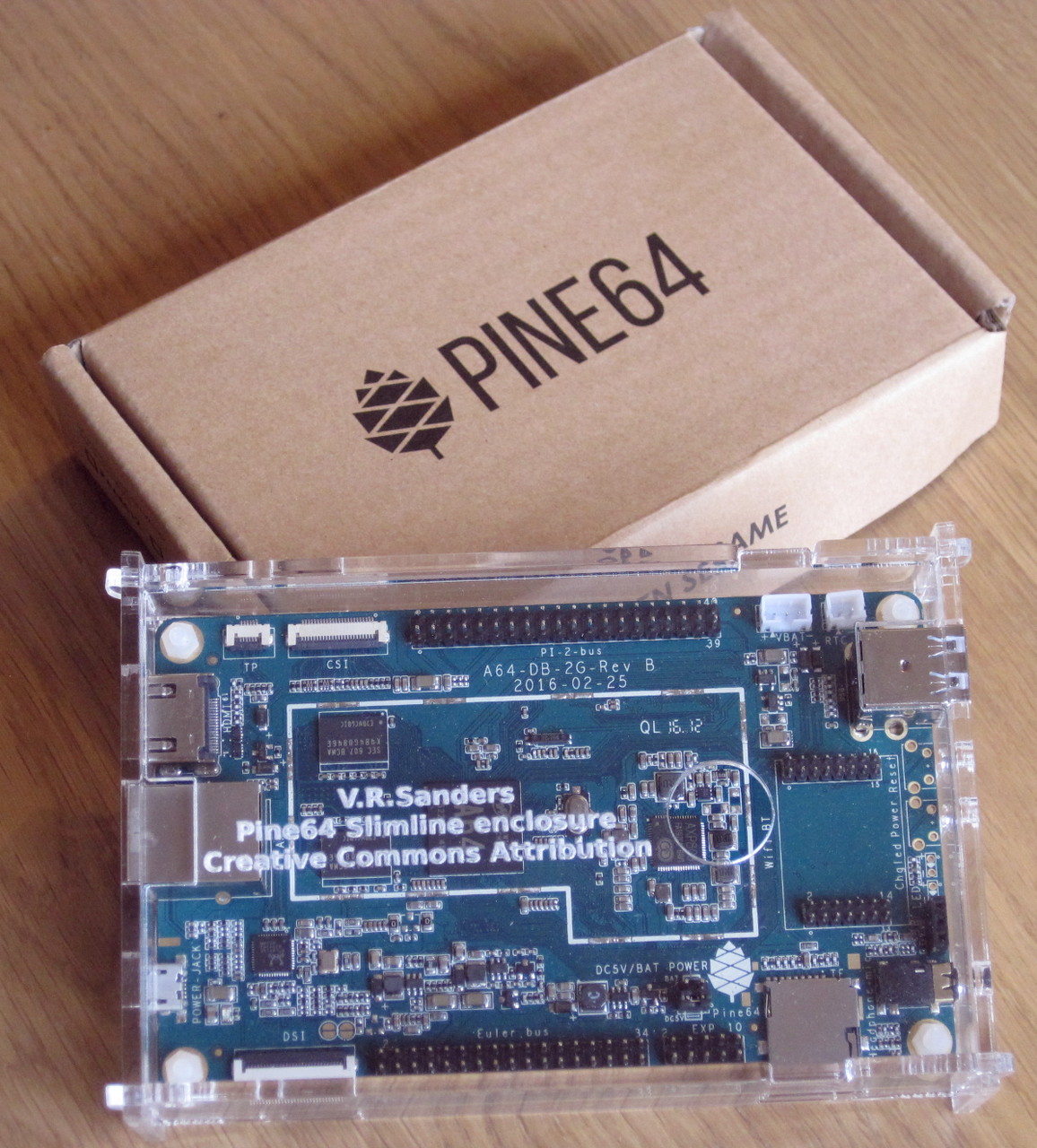
Pine64 board in my case design
The system I acquired comprises of:
Hardware based kickstarter projects are susceptible to several issues and the usual suspects occurred causing delays:
My personal view is that PINE 64 inc. handled it pretty well, much better than several other projects I have backed and as my Norman Douglas quotation suggests I think they have gained some wisdom from this.

I received my hardware at the beginning of April only a couple of months after their initial estimated shipping date which as these things go is not a huge delay. I understand some people who had slightly more complex orders were just receiving their orders in late June which is perhaps unfortunate but still well within kickstarter project norms.

As an aside: I fear that many people simply misunderstand the crowdfunding model for hardware projects and fail to understand that they are not buying a finished product, on the other side of the debate I think many projects need to learn expectation management much better than they do. Hyping the product to get interest is obviously the point of the crowdfunding platform, but over promising and under delivering always causes unhappy customers.

Pine64 board dimensions
Despite the delays in production and shipping the information available for the board was (and sadly remains) inadequate. As usual I wanted to case my board and there were no useful dimension drawings so I had to make my own from direct measurements together with a STL 3D model.

Also a mental sigh for "yet another poor form factor decision" so another special case size and design. After putting together a design and fabricating with the laser cutter I moved on to the software.

Once more this is where, once again, the story turns bleak. We find a very pretty website but no obvious link to the software (hint scroll to the bottom and find the "support" wiki link) once you find the wiki you will eventually discover that the provided software is either an Android 5.1.1 image (which failed to start on my board) or relies on some random guy from the forums who has put together his own OS images using a hacked up Allwinner Board Support Package (BSP) kernel.

Now please do not misunderstand me, I think the work by Simon Eisenmann (longsleep) to get a working kernel and Lenny Raposo to get viable OS images is outstanding and useful. I just feel that Allwinner and vendors like Pine64 Inc. should have provided something much, much better than they have. Even the efforts to get mainline support for this hardware are all completely volunteer community efforts and are are making slow progress as a result.

Assuming I wanted to run a useful OS on this hardware and not just use it as a modern work of art I installed a basic Debian arm64 using Lenny Raposo's pine64 pro site downloads. I was going to use the system for compiling and builds so used the "Debian Base" image to get a minimal setup. After generating unique ssh keys, renaming the default user and checking all the passwords and permissions I convinced myself the system was reasonably trustworthy.

The standard Debian Jessie OS runs as expected with few surprises. The main concern I have is that there are a number of unpackaged scripts installed (prefixed with pine64_) which perform several operations from reporting system health (using sysfs entries) to upgrading the kernel and bootloader.

While I understand these scripts have been provided for the novice users to reduce support burden, doing even more of the vendors job, I would much rather have had proper packages for these scripts, kernel and bootloader which apt could manage. This would have reduced image creation to a simple debootstrap giving much greater confidence in the images provenance.

The 3.10 based kernel is three years old at the time of writing and lacks a great number of features for the aarch64 ARM processors introduced since release. However I was pleasantly surprised at kvm apparently being available.

# dmesg grep -i kvm
[ 7.592896] kvm [1]: Using HYP init bounce page @b87c4000
[ 7.593361] kvm [1]: interrupt-controller@1c84000 IRQ25
[ 7.593778] kvm [1]: timer IRQ27
[ 7.593801] kvm [1]: Hyp mode initialized successfully

I installed the libvirt packages (and hence all their dependencies like qemu) and created a bridge ready for the virtual machines.

I needed access to storage for the host disc images and while I could have gone the route of using USB attached SATA as with the hikey I decided to try and use network attached storage instead. Initially I investigated iSCSI but it seems the Linux target (iSCSI uses initiator for client and target for server) support is either old, broken or unpackaged.

I turned to network block device (nbd) which is packaged and seems to have reasonable stability out of the box on modern distributions. This appeared to work well, indeed over the gigabit Ethernet interface I managed to get a sustained 40 megabytes a second read and write rate in basic testing. This is better performance than a USB 2.0 attached SSD on the hikey

I fired up the guest and perhaps I should have known better than to expect a 3.10 vendor kernel to cope. The immediate hard crashes despite tuning many variables convinced me that virtualisation was not viable with this kernel.

So abandoning that approach I attempted to run the CI workload directly on the system. To my dismay this also proved problematic. The processor has the bad habit of throttling due to thermal issues (despite a substantial heatsink) and because the storage is network attached throttling the CPU also massively impacts I/O.

The limitations meant that the workload caused the system to move between high performance and almost no progress on a roughly ten second cycle. This caused a simple NetSurf recompile CI job to take over fifteen minutes. For comparison the same task takes the armhf builder (CubieTruck) four minutes and a 64 bit x86 build which takes around a minute.

If the workload is tuned to a single core which does not trip thermal throttling the build took seven minutes. which is almost identical to the existing single core virtual machine instance running on the hikey.

In conclusion the Pine64 is an interesting bit of hardware with fatally flawed software offering. Without Simon and Lenny providing their builds to the community the device would be practically useless rather than just performing poorly. There appears to have been no progress whatsoever on the software offering from Pine64 in the six months since I received the device and no prospect of mainline Allwinner support for the SoC either.

Effectively I have spent around 50usd (40 for the board and 10 for the enclosure) on a failed experiment. Perhaps in the future the software will improve sufficiently for it to become useful but I do not hold out much hope that this will come from Pine64 themselves.

Craig Small: Changing Jabber IDs

I ve shuffled some domains around, using less of enc.com.au and more of my new domain dropbear.xyz The website should work with both, but the primary domain is dropbear.xyz Another change is my Jabber ID which used to be csmall at enc but now is same username at dropbear.xyz I think I have done all the required changes in prosody for it to work, even with a certbot certificate!

9 October 2016

Bits from Debian: Debian is participating in the next round of Outreachy!

Following the success of the last round of Outreachy, we are glad to announce that Debian will take part in the program for the next round, with internships lasting from the 6th of December 2016 to the 6th of March 2017. From the official website: Outreachy helps people from groups underrepresented in free and open source software get involved. We provide a supportive community for beginning to contribute any time throughout the year and offer focused internship opportunities twice a year with a number of free software organizations. Currently, internships are open internationally to women (cis and trans), trans men, and genderqueer people. Additionally, they are open to residents and nationals of the United States of any gender who are Black/African American, Hispanic/Latin@, American Indian, Alaska Native, Native Hawaiian, or Pacific Islander. If you want to apply to an internship in Debian, you should take a look at the wiki page, and contact the mentors for the projects listed, or seek more information on the (public) debian-outreach mailing-list. You can also contact the Outreach Team directly. If you have a project idea and are willing to mentor an intern, you can submit a project idea on the Outreachy wiki page. Here's a few words on what the interns for the last round achieved within Outreachy: Debian would not be able to participate in Outreachy without the help of the Software Freedom Conservancy, who provides administrative support for Outreachy, as well as the continued support of Debian's donors, who provide funding for the internships. If you want to donate, please get in touch with one of our trusted organizations. Debian is looking forward to welcoming new interns for the next few months, come join us!

Craig Sanders: Converting to a ZFS rootfs

My main desktop/server machine (running Debian sid) at home has been running XFS on mdadm raid-1 on a pair of SSDs for the last few years. A few days ago, one of the SSDs died. I ve been planning to switch to ZFS as the root filesystem for a while now, so instead of just replacing the failed drive, I took the opportunity to convert it. NOTE: at this point in time, ZFS On Linux does NOT support TRIM for either datasets or zvols on SSD. There s a patch almost ready (TRIM/Discard support from Nexenta #3656), so I m betting on that getting merged before it becomes an issue for me. Here s the procedure I came up with: 1. Buy new disks, shutdown machine, install new disks, reboot. The details of this stage are unimportant, and the only thing to note is that I m switching from mdadm RAID-1 with two SSDs to ZFS with two mirrored pairs (RAID-10) on four SSDs (Crucial MX300 275G at around $100 AUD each, they re hard to resist). Buying four 275G SSDs is slightly more expensive than buying two of the 525G models, but will perform a lot better. When installed in the machine, they ended up as /dev/sdp, /dev/sdq, /dev/sdr, and /dev/sds. I ll be using the symlinks in /dev/disk/by-id/ for the zpool, but for partition and setup, it s easiest to use the /dev/sd? device nodes. 2. Partition the disks identically with gpt partition tables, using gdisk and sgdisk. I need: ZFS On Linux uses partition type bf08 ( Solaris Reserved 1 ) natively, but doesn t seem to care what the partition types are for ZIL and L2ARC. I arbitrarily used bf08 ( Solaris Reserved 2 ) and bf09 ( Solaris Reserved 3 ) for easy identification. I ll set these up later, once I ve got the system booted I don t want to risk breaking my existing zpools by taking away their ZIL and L2ARC (and forgetting to zpool remove them, which I might possibly have done once) if I have to repartition. I used gdisk to interactively set up the partitions:
# gdisk -l /dev/sdp
GPT fdisk (gdisk) version 1.0.1
Partition table scan:
  MBR: protective
  BSD: not present
  APM: not present
  GPT: present
Found valid GPT with protective MBR; using GPT.
Disk /dev/sdp: 537234768 sectors, 256.2 GiB
Logical sector size: 512 bytes
Disk identifier (GUID): 4234FE49-FCF0-48AE-828B-3C52448E8CBD
Partition table holds up to 128 entries
First usable sector is 34, last usable sector is 537234734
Partitions will be aligned on 8-sector boundaries
Total free space is 6 sectors (3.0 KiB)
Number  Start (sector)    End (sector)  Size       Code  Name
   1              40            2047   1004.0 KiB  EF02  BIOS boot partition
   2            2048         2099199   1024.0 MiB  EF00  EFI System
   3         2099200         6293503   2.0 GiB     8300  Linux filesystem
   4         6293504        14682111   4.0 GiB     8200  Linux swap
   5        14682112       455084031   210.0 GiB   BF07  Solaris Reserved 1
   6       455084032       459278335   2.0 GiB     BF08  Solaris Reserved 2
   7       459278336       537234734   37.2 GiB    BF09  Solaris Reserved 3
I then cloned the partition table to the other three SSDs with this little script: clone-partitions.sh
#! /bin/bash
src='sdp'
targets=( 'sdq' 'sdr' 'sds' )
for tgt in "$ targets[@] "; do
  sgdisk --replicate="/dev/$tgt" /dev/"$src"
  sgdisk --randomize-guids "/dev/$tgt"
done
3. Create the mdadm for /boot, the zpool, and and the root filesystem. Most rootfs on ZFS guides that I ve seen say to call the pool rpool, then create a dataset called "$(hostname)-1" and then create a ROOT dataset under that. so on my machine, that would be rpool/ganesh-1/ROOT. Some reverse the order of hostname and the rootfs dataset, for rpool/ROOT/ganesh-1. There might be uses for this naming scheme in other environments but not in mine. And, to me, it looks ugly. So I ll use just $(hostname)/root for the rootfs. i.e. ganesh/root I wrote a script to automate it, figuring I d probably have to do it several times in order to optimise performance. Also, I wanted to document the procedure for future reference, and have scripts that would be trivial to modify for other machines. create.sh
#! /bin/bash
exec &> ./create.log
hn="$(hostname -s)"
base='ata-Crucial_CT275MX300SSD1_'
md='/dev/md0'
md_part=3
md_parts=( $(/bin/ls -1 /dev/disk/by-id/$ base *-part$ md_part ) )
zfs_part=5
# 4 disks, so use the top half and bottom half for the two mirrors.
zmirror1=( $(/bin/ls -1 /dev/disk/by-id/$ base *-part$ zfs_part    head -n 2) )
zmirror2=( $(/bin/ls -1 /dev/disk/by-id/$ base *-part$ zfs_part    tail -n 2) )
# create /boot raid array
mdadm "$md" --create \
    --bitmap=internal \
    --raid-devices=4 \
    --level 1 \
    --metadata=0.90 \
    "$ md_parts[@] "
mkfs.ext4 "$md"
# create zpool
zpool create -o ashift=12 "$hn" \
    mirror "$ zmirror1[@] " \
    mirror "$ zmirror2[@] "
# create zfs rootfs
zfs set compression=on "$hn"
zfs set atime=off "$hn"
zfs create "$hn/root"
zpool set bootfs="$hn/root"
# mount the new /boot under the zfs root
mount "$md" "/$hn/root/boot"
If you want or need other ZFS datasets (e.g. for /home, /var etc) then create them here in this script. Or you can do that later after you ve got the system up and running on ZFS. If you run mysql or postgresql, read the various tuning guides for how to get best performance for databases on ZFS (they both need their own datasets with particular recordsize and other settings). If you download Linux ISOs or anything with bit-torrent, avoid COW fragmentation by setting up a dataset to download into with recordsize=16K and configure your BT client to move the downloads to another directory on completion. I did this after I got my system booted on ZFS. For my db, I stoppped the postgres service, renamed /var/lib/postgresql to /var/lib/p, created the new datasets with:
zfs create -o recordsize=8K -o logbias=throughput -o mountpoint=/var/lib/postgresql \
  -o primarycache=metadata ganesh/postgres
zfs create -o recordsize=128k -o logbias=latency -o mountpoint=/var/lib/postgresql/9.6/main/pg_xlog \
  -o primarycache=metadata ganesh/pg-xlog
followed by rsync and then started postgres again. 4. rsync my current system to it. Logout all user sessions, shut down all services that write to the disk (postfix, postgresql, mysql, apache, asterisk, docker, etc). If you haven t booted into recovery/rescue/single-user mode, then you should be as close to it as possible everything non-esssential should be stopped. I chose not to boot to single-user in case I needed access to the web to look things up while I did all this (this machine is my internet gateway). Then:
hn="$(hostname -s)"
time rsync -avxHAXS -h -h --progress --stats --delete / /boot/ "/$hn/root/"
After the rsync, my 130GB of data from XFS was compressed to 91GB on ZFS with transparent lz4 compression. Run the rsync again if (as I did), you realise you forgot to shut down postfix (causing newly arrived mail to not be on the new setup) or something. You can do a (very quick & dirty) performance test now, by running zpool scrub "$hn". Then run watch zpool status "$hn". As there should be no errorss to correct, you should get scrub speeds approximating the combined sequential read speed of all vdevs in the pool. In my case, I got around 500-600M/s I was kind of expecting closer to 800M/s but that s good enough .the Crucial MX300s aren t the fastest drive available (but they re great for the price), and ZFS is optimised for reliability more than speed. The scrub took about 3 minutes to scan all 91GB. My HDD zpools get around 150 to 250M/s, depending on whether they have mirror or RAID-Z vdevs and on what kind of drives they have. For real benchmarking, use bonnie++ or fio. 5. Prepare the new rootfs for chroot, chroot into it, edit /etc/fstab and /etc/default/grub. This script bind mounts /proc, /sys, /dev, and /dev/pts before chrooting: chroot.sh
#! /bin/sh
hn="$(hostname -s)"
for i in proc sys dev dev/pts ; do
  mount -o bind "/$i" "/$ hn /root/$i"
done
chroot "/$ hn /root"
Change /etc/fstab (on the new zfs root to) have the zfs root and ext4 on raid-1 /boot:
/ganesh/root    /         zfs     defaults                                         0  0
/dev/md0        /boot     ext4    defaults,relatime,nodiratime,errors=remount-ro   0  2
I haven t bothered with setting up the swap at this point. That s trivial and I can do it after I ve got the system rebooted with its new ZFS rootfs (which reminds me, I still haven t done that :). add boot=zfs to the GRUB_CMDLINE_LINUX variable in /etc/default/grub. On my system, that s:
GRUB_CMDLINE_LINUX="iommu=noagp usbhid.quirks=0x1B1C:0x1B20:0x408 boot=zfs"
NOTE: If you end up needing to run rsync again as in step 4. above copy /etc/fstab and /etc/default/grub to the old root filesystem first. I suggest to /etc/fstab.zfs and /etc/default/grub.zfs 6. Install grub Here s where things get a little complicated. Running install-grub on /dev/sd[pqrs] is fine, we created the type ef02 partition for it to install itself into. But running update-grub to generate the new /boot/grub/grub.cfg will fail with an error like this:
/usr/sbin/grub-probe: error: failed to get canonical path of  /dev/ata-Crucial_CT275MX300SSD1_163313AADD8A-part5'.
IMO, that s a bug in grub-probe it should look in /dev/disk/by-id/ if it can t find what it s looking for in /dev/ I fixed that problem with this script: fix-ata-links.sh
#! /bin/sh
cd /dev
ln -s /dev/disk/by-id/ata-Crucial* .
After that, update-grub works fine. NOTE: you will have to add udev rules to create these symlinks, or run this script on every boot otherwise you ll get that error every time you run update-grub in future. 7. Prepare to reboot Unmount proc, sys, dev/pts, dev, the new raid /boot, and the new zfs filesystems. Set the mount point for the new rootfs to / umount-zfs-root.sh
#! /bin/sh
hn="$(hostname -s)"
md="/dev/md0"
for i in dev/pts dev sys proc ; do
  umount "/$ hn /root/$i"
done
umount "$md"
zfs umount "$ hn /root"
zfs umount "$ hn "
zfs set mountpoint=/ "$ hn /root"
zfs set canmount=off "$ hn "
8. Reboot Remember to configure the BIOS to boot from your new disks. The system should boot up with the new rootfs, no rescue disk required as in some other guides the rsync and chroot stuff has already been done. 9. Other notes 10. Useful references Reading these made it much easier to come up with my own method. Highly recommended. Converting to a ZFS rootfs is a post from: Errata

8 October 2016

Joachim Breitner: T430s T460s

Earlier this week, I finally got my new machine that came with my new position at the University of Pennsylvania: A shiny Thinkpad T460s that now replaces my T430s. (Yes, there is a pattern. It continues with T400 and T41p.) I decided to re-install my Debian system from scratch and copy over only the home directory a bit of purification does not hurt. This blog post contains some random notes that might be useful to someone or alternative where I hope someone can tell me how to fix and improve things.

Installation The installation (using debian-installer from a USB drive) went mostly smooth, including LVM on an encrypted partition. Unfortunately, it did not set up grub correctly for the UEFI system to boot, so I had to jump through some hoops (using the grub on the USB drive to manually boot into the installed system, and installing grub-efi from there) until the system actually came up.

High-resolution display This laptop has a 2560 1440 high resolution display. Modern desktop environments like GNOME supposedly handle that quite nicely, but for reasons explained in an earlier post, I do not use a desktop envrionment but have a minimalistic setup based on Xmonad. I managed to get a decent setup now, by turning lots of manual knobs:
  • For the linux console, setting
    FONTFACE="Terminus"
    FONTSIZE="12x24"
    in /etc/default/console-setup yielded good results.
  • For the few GTK-2 applications that I am still running, I set
    gtk-font-name="Sans 16"
    in ~/.gtkrc-2.0. Similarly, for GTK-3 I have
    [Settings]
    gtk-font-name = Sans 16
    in ~/.config/gtk-3.0/settings.ini.
  • Programs like gnome-terminal, Evolution and hexchat refer to the System default document font and System default monospace font . I remember that it was possible to configure these in the GNOME control center, but I could not find any way of configuring these using command line tools, so I resorted to manually setting the font for these. With the help from Alexandre Franke I figured out that the magic incarnation here is:
    gsettings set org.gnome.desktop.interface monospace-font-name 'Monospace 16'
    gsettings set org.gnome.desktop.interface document-font-name 'Serif 16'
    gsettings set org.gnome.desktop.interface font-name 'Sans 16'
  • Firefox seemed to have picked up these settings for the UI, so that was good. To make web pages readable, I set layout.css.devPixelsPerPx to 1.5 in about:config.
  • GVim has set guifont=Monospace\ 16 in ~/.vimrc. The toolbar is tiny, but I hardly use it anyways.
  • Setting the font of Xmonad prompts requires the sytax
    , font = "xft:Sans:size=16"
    Speaking about Xmonad prompts: Check out the XMonad.Prompt.Unicode module that I have been using for years and recently submitted upstream.
  • I launch Chromium (or rather the desktop applications that I use that happen to be Chrome apps) with the parameter --force-device-scale-factor=1.5.
  • Libreoffice seems to be best configured by running xrandr --dpi 194 before hand. This seems also to be read by Firefox, doubling the effect of the font size in the gtk settings, which is annoying. Luckily I do not work with Libreoffice often, so for now I ll just set that manually when needed.
I am not quite satisfied. I have the impression that the 16 point size font, e.g. in Evolution, is not really pretty, so I am happy to take suggestions here. I found the ArchWiki page on HiDPI very useful here.

Trackpoint and Touchpad One reason for me to sticking with Thinkpads is their trackpoint, which I use exclusively. In previous models, I disabled the touchpad in the BIOS, but this did not seem to have an effect here, so I added the following section to /etc/X11/xorg.conf.d/30-touchpad.conf
Section "InputClass"
        Identifier "SynPS/2 Synaptics TouchPad"
        MatchProduct "SynPS/2 Synaptics TouchPad"
        Option "ignore" "on"
EndSection
At one point I left out the MatchProduct line, disabling all input in the X server. Had to boot into recovery mode to fix that. Unfortunately, there is something wrong with the trackpoint and the buttons: When I am moving the trackpoint (and maybe if there is actual load on the machine), mouse button press and release events sometimes get lost. This is quite annoying I try to open a folder in Evolution and accidentially move it. I installed the latest Kernel from Debian experimental (4.8.0-rc8), but it did not help. I filed a bug report against libinput although I am not fully sure that that s the culprit. Update: According to Benjamin Tissoires it is a known firmware bug and the appropriate people are working on a work-around. Until then I am advised to keep my palm of the touchpad. Also, I found the trackpoint too slow. I am not sure if it is simply because of the large resolution of the screen, or because some movement events are also swallowed. For now, I simply changed the speed by writing
SUBSYSTEM=="serio", DRIVERS=="psmouse", ATTRS speed ="120"
to /etc/udev/rules.d/10-trackpoint.rules.

Brightness control The system would not automatically react to pressing Fn-F5 and Fn-F6, which are the keys to adjust the brightness. I am unsure about how and by what software component it should be handled, but the solution that I found was to set
Section "Device"
        Identifier  "card0"
        Driver      "intel"
        Option      "Backlight"  "intel_backlight"
        BusID       "PCI:0:2:0"
EndSection
so that the command line tool xbacklight would work, and then use Xmonad keybinds to perform the action, just as I already do for sound control:
    , ((0, xF86XK_Sleep),       spawn "dbus-send --system --print-reply --dest=org.freedesktop.UPower /org/freedesktop/UPower org.freedesktop.UPower.Suspend")
    , ((0, xF86XK_AudioMute), spawn "ponymix toggle")
    , ((0, 0x1008ffb2  - xF86XK_AudioMicMute - ), spawn "ponymix --source toggle")
    , ((0, xF86XK_AudioRaiseVolume), spawn "ponymix increase 5")
    , ((0, xF86XK_AudioLowerVolume), spawn "ponymix decrease 5")
    , ((shiftMask, xF86XK_AudioRaiseVolume), spawn "ponymix increase 5 --max-volume 200")
    , ((shiftMask, xF86XK_AudioLowerVolume), spawn "ponymix decrease 5")
    , ((0, xF86XK_MonBrightnessUp), spawn "xbacklight +10")
    , ((0, xF86XK_MonBrightnessDown), spawn "xbacklight -10")
The T460s does not actually have a sleep button, that line is a reminiscence from my T430s. I suspend the machine by pressing the power button now, thanks to HandlePowerKey=suspend in /etc/systemd/logind.conf.

Profile Weirdness Something strange happend to my environment variables after the move. It is clearly not hardware related, but I simply cannot explain what has changed: All relevant files in /etc look similar enough. I use ~/.profile to extend the PATH and set some other variables. Previously, these settings were in effect in my whole X session, which is started by lightdm with auto-login, followed by xmonad-session. I could find no better way to fix that than stating . ~/.profile early in my ~/.xmonad/xmonad-session-rc. Very strange.

5 October 2016

Kees Cook: security things in Linux v4.8

Previously: v4.7. Here are a bunch of security things I m excited about in Linux v4.8: SLUB freelist ASLR Thomas Garnier continued his freelist randomization work by adding SLUB support. x86_64 KASLR text base offset physical/virtual decoupling On x86_64, to implement the KASLR text base offset, the physical memory location of the kernel was randomized, which resulted in the virtual address being offset as well. Due to how the kernel s -2GB addressing works (gcc s -mcmodel=kernel ), it wasn t possible to randomize the physical location beyond the 2GB limit, leaving any additional physical memory unused as a randomization target. In order to decouple the physical and virtual location of the kernel (to make physical address exposures less valuable to attackers), the physical location of the kernel needed to be randomized separately from the virtual location. This required a lot of work for handling very large addresses spanning terabytes of address space. Yinghai Lu, Baoquan He, and I landed a series of patches that ultimately did this (and in the process fixed some other bugs too). This expands the physical offset entropy to roughly $physical_memory_size_of_system / 2MB bits. x86_64 KASLR memory base offset Thomas Garnier rolled out KASLR to the kernel s various statically located memory ranges, randomizing their locations with CONFIG_RANDOMIZE_MEMORY. One of the more notable things randomized is the physical memory mapping, which is a known target for attacks. Also randomized is the vmalloc area, which makes attacks against targets vmalloced during boot (which tend to always end up in the same location on a given system) are now harder to locate. (The vmemmap region randomization accidentally missed the v4.8 window and will appear in v4.9.) x86_64 KASLR with hibernation Rafael Wysocki (with Thomas Garnier, Borislav Petkov, Yinghai Lu, Logan Gunthorpe, and myself) worked on a number of fixes to hibernation code that, even without KASLR, were coincidentally exposed by the earlier W^X fix. With that original problem fixed, then memory KASLR exposed more problems. I m very grateful everyone was able to help out fixing these, especially Rafael and Thomas. It s a hard place to debug. The bottom line, now, is that hibernation and KASLR are no longer mutually exclusive. gcc plugin infrastructure Emese Revfy ported the PaX/Grsecurity gcc plugin infrastructure to upstream. If you want to perform compiler-based magic on kernel builds, now it s much easier with CONFIG_GCC_PLUGINS! The plugins live in scripts/gcc-plugins/. Current plugins are a short example called Cyclic Complexity which just emits the complexity of functions as they re compiled, and Sanitizer Coverage which provides the same functionality as gcc s recent -fsanitize-coverage=trace-pc but back through gcc 4.5. Another notable detail about this work is that it was the first Linux kernel security work funded by Linux Foundation s Core Infrastructure Initiative. I m looking forward to more plugins! If you re on Debian or Ubuntu, the required gcc plugin headers are available via the gcc-$N-plugin-dev package (and similarly for all cross-compiler packages). hardened usercopy Along with work from Rik van Riel, Laura Abbott, Casey Schaufler, and many other folks doing testing on the KSPP mailing list, I ported part of PAX_USERCOPY (the basic runtime bounds checking) to upstream as CONFIG_HARDENED_USERCOPY. One of the interface boundaries between the kernel and user-space are the copy_to_user()/copy_from_user() family of functions. Frequently, the size of a copy is known at compile-time ( built-in constant ), so there s not much benefit in checking those sizes (hardened usercopy avoids these cases). In the case of dynamic sizes, hardened usercopy checks for 3 areas of memory: slab allocations, stack allocations, and kernel text. Direct kernel text copying is simply disallowed. Stack copying is allowed as long as it is entirely contained by the current stack memory range (and on x86, only if it does not include the saved stack frame and instruction pointers). For slab allocations (e.g. those allocated through kmem_cache_alloc() and the kmalloc()-family of functions), the copy size is compared against the size of the object being copied. For example, if copy_from_user() is writing to a structure that was allocated as size 64, but the copy gets tricked into trying to write 65 bytes, hardened usercopy will catch it and kill the process. For testing hardened usercopy, lkdtm gained several new tests: USERCOPY_HEAP_SIZE_TO, USERCOPY_HEAP_SIZE_FROM, USERCOPY_STACK_FRAME_TO,
USERCOPY_STACK_FRAME_FROM, USERCOPY_STACK_BEYOND, and USERCOPY_KERNEL. Additionally, USERCOPY_HEAP_FLAG_TO and USERCOPY_HEAP_FLAG_FROM were added to test what will be coming next for hardened usercopy: flagging slab memory as safe for copy to/from user-space , effectively whitelisting certainly slab caches, as done by PAX_USERCOPY. This further reduces the scope of what s allowed to be copied to/from, since most kernel memory is not intended to ever be exposed to user-space. Adding this logic will require some reorganization of usercopy code to add some new APIs, as PAX_USERCOPY s approach to handling special-cases is to add bounce-copies (copy from slab to stack, then copy to userspace) as needed, which is unlikely to be acceptable upstream. seccomp reordered after ptrace By its original design, seccomp filtering happened before ptrace so that seccomp-based ptracers (i.e. SECCOMP_RET_TRACE) could explicitly bypass seccomp filtering and force a desired syscall. Nothing actually used this feature, and as it turns out, it s not compatible with process launchers that install seccomp filters (e.g. systemd, lxc) since as long as the ptrace and fork syscalls are allowed (and fork is needed for any sensible container environment), a process could spawn a tracer to help bypass a filter by injecting syscalls. After Andy Lutomirski convinced me that ordering ptrace first does not change the attack surface of a running process (unless all syscalls are blacklisted, the entire ptrace attack surface will always be exposed), I rearranged things. Now there is no (expected) way to bypass seccomp filters, and containers with seccomp filters can allow ptrace again. That s it for v4.8! The merge window is open for v4.9

2016, Kees Cook. This work is licensed under a Creative Commons Attribution-ShareAlike 3.0 License.
Creative Commons License

3 October 2016

Kees Cook: security things in Linux v4.7

Previously: v4.6. Onward to security things I found interesting in Linux v4.7: KASLR text base offset for MIPS Matt Redfearn added text base address KASLR to MIPS, similar to what s available on x86 and arm64. As done with x86, MIPS attempts to gather entropy from various build-time, run-time, and CPU locations in an effort to find reasonable sources during early-boot. MIPS doesn t yet have anything as strong as x86 s RDRAND (though most have an instruction counter like x86 s RDTSC), but it does have the benefit of being able to use Device Tree (i.e. the /chosen/kaslr-seed property) like arm64 does. By my understanding, even without Device Tree, MIPS KASLR entropy should be as strong as pre-RDRAND x86 entropy, which is more than sufficient for what is, similar to x86, not a huge KASLR range anyway: default 8 bits (a span of 16MB with 64KB alignment), though CONFIG_RANDOMIZE_BASE_MAX_OFFSET can be tuned to the device s memory, giving a maximum of 11 bits on 32-bit, and 15 bits on EVA or 64-bit. SLAB freelist ASLR Thomas Garnier added CONFIG_SLAB_FREELIST_RANDOM to make slab allocation layouts less deterministic with a per-boot randomized freelist order. This raises the bar for successful kernel slab attacks. Attackers will need to either find additional bugs to help leak slab layout information or will need to perform more complex grooming during an attack. Thomas wrote a post describing the feature in more detail here: Randomizing the Linux kernel heap freelists. (SLAB is done in v4.7, and SLUB in v4.8.) eBPF JIT constant blinding Daniel Borkmann implemented constant blinding in the eBPF JIT subsystem. With strong kernel memory protections (CONFIG_DEBUG_RODATA) in place, and with the segregation of user-space memory execution from kernel (i.e SMEP, PXN, CONFIG_CPU_SW_DOMAIN_PAN), having a place where user-space can inject content into an executable area of kernel memory becomes very high-value to an attacker. The eBPF JIT was exactly such a thing: the use of BPF constants could result in the JIT producing instruction flows that could include attacker-controlled instructions (e.g. by directing execution into the middle of an instruction with a constant that would be interpreted as a native instruction). The eBPF JIT already uses a number of other defensive tricks (e.g. random starting position), but this added randomized blinding to any BPF constants, which makes building a malicious execution path in the eBPF JIT memory much more difficult (and helps block attempts at JIT spraying to bypass other protections). Elena Reshetova updated a 2012 proof-of-concept attack to succeed against modern kernels to help provide a working example of what needed fixing in the JIT. This serves as a thorough regression test for the protection. The cBPF JITs that exist in ARM, MIPS, PowerPC, and Sparc still need to be updated to eBPF, but when they do, they ll gain all these protections immediatley. Bottom line is that if you enable the (disabled-by-default) bpf_jit_enable sysctl, be sure to set the bpf_jit_harden sysctl to 2 (to perform blinding even for root). fix brk ASLR weakness on arm64 compat There have been a few ASLR fixes recently (e.g. ET_DYN, x86 32-bit unlimited stack), and while reviewing some suggested fixes to arm64 brk ASLR code from Jon Medhurst, I noticed that arm64 s brk ASLR entropy was slightly too low (less than 1 bit) for 64-bit and noticeably lower (by 2 bits) for 32-bit compat processes when compared to native 32-bit arm. I simplified the code by using literals for the entropy. Maybe we can add a sysctl some day to control brk ASLR entropy like was done for mmap ASLR entropy. LoadPin LSM LSM stacking is well-defined since v4.2, so I finally upstreamed a small LSM that implements a protection I wrote for Chrome OS several years back. On systems with a static root of trust that extends to the filesystem level (e.g. Chrome OS s coreboot+depthcharge boot firmware chaining to dm-verity, or a system booting from read-only media), it s redundant to sign kernel modules (you ve already got the modules on read-only media: they can t change). The kernel just needs to know they re all coming from the correct location. (And this solves loading known-good firmware too, since there is no convention for signed firmware in the kernel yet.) LoadPin requires that all modules, firmware, etc come from the same mount (and assumes that the first loaded file defines which mount is correct , hence load pinning ). That s it for v4.7. Prepare yourself for v4.8 next!

2016, Kees Cook. This work is licensed under a Creative Commons Attribution-ShareAlike 3.0 License.
Creative Commons License

2 October 2016

Russell Coker: Hostile Web Sites

I was asked whether it would be safe to open a link in a spam message with wget. So here are some thoughts about wget security and web browser security in general. Wget Overview Some spam messages are designed to attack the recipient s computer. They can exploit bugs in the MUA, applications that may be launched to process attachments (EG MS Office), or a web browser. Wget is a very simple command-line program to download web pages, it doesn t attempt to interpret or display them. As with any network facing software there is a possibility of exploitable bugs in wget. It is theoretically possible for an attacker to have a web server that detects the client and has attacks for multiple HTTP clients including wget. In practice wget is a very simple program and simplicity makes security easier. A large portion of security flaws in web browsers are related to plugins such as flash, rendering the page for display on a GUI system, and javascript features that wget lacks. The Profit Motive An attacker that aims to compromise online banking accounts probably isn t going to bother developing or buying an exploit against wget. The number of potential victims is extremely low and the potential revenue benefit from improving attacks against other web browsers is going to be a lot larger than developing an attack on the small number of people who use wget. In fact the potential revenue increase of targeting the most common Linux web browsers (Iceweasel and Chromium) might still be lower than that of targeting Mac users. However if the attacker doesn t have a profit motive then this may not apply. There are people and organisations who have deliberately attacked sysadmins to gain access to servers (here is an article by Bruce Schneier about the attack on Hacking Team [1]). It is plausible that someone who is targeting a sysadmin could discover that they use wget and then launch a targeted attack against them. But such an attack won t look like regular spam. For more information about targeted attacks Brian Krebs article about CEO scams is worth reading [2]. Privilege Separation If you run wget in a regular Xterm in the same session you use for reading email etc then if there is an exploitable bug in wget then it can be used to access all of your secret data. But it is very easy to run wget from another account. You can run ssh otheraccount@localhost and then run the wget command so that it can t attack you. Don t run su otheraccount as it is possible for a compromised program to escape from that. I think that most Linux distributions have supported a switch user functionality in the X login system for a number of years. So you should be able to lock your session and then change to a session for another user to run potentially dangerous programs. It is also possible to use a separate PC for online banking and other high value operations. A 10yo PC is more than adequate for such tasks so you could just use an old PC that has been replaced for regular use for online banking etc. You could boot it from a CD or DVD if you are particularly paranoid about attack. Browser Features Google Chrome has a feature to not run plugins unless specifically permitted. This requires a couple of extra mouse actions when watching a TV program on the Internet but prevents random web sites from using Flash and Java which are two of the most common vectors of attack. Chrome also has a feature to check a web site against a Google black list before connecting. When I was running a medium size mail server I often had to determine whether URLs being sent out by customers were legitimate or spam, if a user sent out a URL that s on Google s blacklist I would lock their account without doing any further checks. Conclusion I think that even among Linux users (who tend to be more careful about security than users of other OSs) using a separate PC and booting from a CD/DVD will generally be regarded as too much effort. Running a full featured web browser like Google Chrome and updating it whenever a new version is released will avoid most problems. Using wget when you have to reason to be concerned is a possibility, but not only is it slightly inconvenient but it also often won t download the content that you want (EG in the case of HTML frames).

Russ Allbery: Review: Winds of Change

Review: Winds of Change, by Mercedes Lackey
Series: Mage Winds #2
Publisher: DAW
Copyright: August 1993
ISBN: 0-88677-563-9
Format: Mass market
Pages: 475
Winds of Change is a direct sequel to Winds of Fate. This is a more closely connected trilogy than the previous Valdemar books. It's not the sort of thing you want to read out of order. The events of Winds of Fate predictably left the multiple protagonists united and with some breathing space, but none of their problems are resolved. The Heartstone is still a mess; in fact, it may be getting worse. Elspeth needs to learn how to wield the magical power she apparently has. And there are a lot of interpersonal tensions, lingering hurt feelings, and (in the case of Elspeth and Darkwind) a truly prodigious quantity of whining that has to be worked through before the protagonists can feel safe and happy. Winds of Change is the training montage book, and wow did my memory paper over a lot of flaws in this series. This is 475 pages of not much happening, occasionally in very irritating ways. Yes, we do finally meander to a stronger conclusion than the last book, and there is much resolving of old hurts and awkward interactions, as well as a bit of discovery of true love (this is Lackey, after all). But far, far too much of the book is Elspeth and Darkwind sniping at each other, being immature, not communicating, and otherwise being obnoxious while all the people around them try to gently help. Lackey's main characterization flaw for me is that she tends to default into generating characters who badly need to be smacked upside the head, and then does so in ways and for things at odd angles to the reasons why I think they should be smacked. It can make for frustrating reading. The introduction of Firesong as a character about halfway through this book does not help. Firesong is a flamboyant, amazingly egotistical, and stunningly arrogant show-off who also happens to be a magical super-genius and hence has "earned" his arrogance. This is an intentional character design, not my idiosyncratic reaction to the character, since every other character in the book finds him insufferable as well at first. But he's also a deeply insightful healing Adept by, honestly, authorial fiat, so by the end of the novel he's helped patch up everyone's problems and the other characters have accepted his presentation as a character quirk. Sigh. So, okay, one doesn't read popcorn fantasy for its deep characterization or realistic grasp of human subtlety. But this is just way more than I can swallow. Lackey's concept of a healing Adept (which I like a great deal as a bit of world-building) necessarily involves both deep knowledge and deep empathy and connection with other people. Firesong is so utterly full of himself that there's simply no way that he could have the empathy required to do what he is shown to do here. (Lackey does try to explain this away in the book, but the explanation didn't work for me.) Every time he successfully intervenes in other people's emotional lives, he does so with a sudden personality change, some stunning insight that he previously showed no evidence of ability to understand, and somehow only enough arrogance in his presentation to prickle but not to close people's mind to whatever he's trying to say. That's not how this works. That's not how any of this works. Lackey always treats psychology as a bit of a blunt instrument, and one either learns to tolerate that or gives up on her series, but Firesong is flatly the most unbelievable emotional mentor figure in any of her books I've read. (One of the more satisfying, if slight, bits of this series comes up in the next book, where Firesong runs into someone else who can do the same thing but has actually earned the empathy the hard way, and is a bit taken aback by it.) My other complaint with this book is that Lackey adds more chapters from the viewpoint of the big bad of the series. These are deeply unpleasant, since he's a deeply unpleasant person, and seem largely unnecessary. It's vaguely interesting to follow the magical maneuverings from both sides, but there are more of these scenes than strictly necessary for that purpose, and the sheer unmitigated evil of Lackey's evil characters is a bit hard to take. Also, he somehow has vast resources of staff and assistants, and much suspension of disbelief is required to believe that anyone would continue working for this person. It's one thing to imagine people being drawn to a charismatic Hitler type; it's quite another when the boss is a brooding, imperious asshole who roams the hallways and tortures random people to death whenever he's bored. Fear and magic only go so far in maintaining a large following when you do that, and he generates dead bodies at a remarkable rate. The best characters in this series continue to be Nyara, Need, and the gryphons. I'd rather read a book just about them. Need does use a bit too much of Lackey's tough love technique (another recurring theme of this larger series), but from Need that's wholly believable; her gruff and dubious empathy is in line with her character and history and fits a talking sword extremely well. But they, despite having a bit of their own training montage, are a side story here. The climax of the story is moderately satisfying, but the book takes far too long to get to it. I remember liking this series when I first read it, and I still like some aspects of Lackey's world-building and a few of the characters, but it's much weaker than I had remembered. I can't really recommend it. Followed by Winds of Fury. Rating: 5 out of 10

1 October 2016

David Moreno: Thanks Debian

I sent this email to debian-private a few days ago, on the 10th anniversary of my Debian account creation:
Date: Fri, 14 Aug 2015 19:37:20 +0200
From: David Moreno 
To: debian-private@lists.debian.org
Subject: Retiring from Debian
User-Agent: Mutt/1.5.23 (2014-03-12)
[-- PGP output follows (current time: Sun 23 Aug 2015 06:18:36 PM CEST) --]
gpg: Signature made Fri 14 Aug 2015 07:37:20 PM CEST using RSA key ID 4DADEC2F
gpg: Good signature from "David Moreno "
gpg:                 aka "David Moreno "
gpg:                 aka "David Moreno (1984-08-08) "
[-- End of PGP output --]
[-- The following data is signed --]
Hi,
Ten years ago today (2005-08-14) my account was created:
https://nm.debian.org/public/person/damog
Today, I don't feel like Debian represents me and neither do I represent the
project anymore.
I had tried over the last couple of years to retake my involvement but lack of
motivation and time always got on the way, so the right thing to do for me is
to officially retire and gtfo.
I certainly learned a bunch from dozens of Debian people over these many years,
and I'm nothing but grateful with all of them; I will for sure carry the project
close to my heart   as I carry it with the Debian swirl I still have tattooed
on my back ;)
http://damog.net/blog/2005/06/29/debian-tattoo/
I have three packages left that have not been updated in forever and you can
consider orphaned now: gcolor2, libperl6-say-perl and libxml-treepp-perl.
With all best wishes,
David Moreno.
http://damog.net/
[-- End of signed data --]
I received a couple of questions about my decision here. I basically don t feel like Debian represents my interests and neither do I represent the project this doesn t mean I don t believe in free software, to the contrary. I think some of the best software advancements we ve made as society are thanks to it. I don t necessarily believe on how the project has evolved itself, whether that has been the right way, to regain relevancy and dominance, and if it s remained primarily a way to feed dogmatism versus pragmatism. This is the perfect example of a tragic consequence. I was very happy to learn that the current Debian Conference being held in Germany got the highest attendance ever, hopefully that can be utilized in a significant and useful way. Regardless, my contributions to Debian were never noteworthy so it s also not that big of a deal. I just need to close cycles myself and move forward, and the ten year anniversary looked like a significant mark for that. Poke me in case you wanna discuss some more. I ll always be happy to. Specially over beer :) Peace.

Kees Cook: security things in Linux v4.6

Previously: v4.5. The v4.6 Linux kernel release included a bunch of stuff, with much more of it under the KSPP umbrella. seccomp support for parisc Helge Deller added seccomp support for parisc, which including plumbing support for PTRACE_GETREGSET to get the self-tests working. x86 32-bit mmap ASLR vs unlimited stack fixed Hector Marco-Gisbert removed a long-standing limitation to mmap ASLR on 32-bit x86, where setting an unlimited stack (e.g. ulimit -s unlimited ) would turn off mmap ASLR (which provided a way to bypass ASLR when executing setuid processes). Given that ASLR entropy can now be controlled directly (see the v4.5 post), and that the cases where this created an actual problem are very rare, means that if a system sees collisions between unlimited stack and mmap ASLR, they can just adjust the 32-bit ASLR entropy instead. x86 execute-only memory Dave Hansen added Protection Key support for future x86 CPUs and, as part of this, implemented support for execute only memory in user-space. On pkeys-supporting CPUs, using mmap(..., PROT_EXEC) (i.e. without PROT_READ) will mean that the memory can be executed but cannot be read (or written). This provides some mitigation against automated ROP gadget finding where an executable is read out of memory to find places that can be used to build a malicious execution path. Using this will require changing some linker behavior (to avoid putting data in executable areas), but seems to otherwise Just Work. I m looking forward to either emulated QEmu support or access to one of these fancy CPUs. CONFIG_DEBUG_RODATA enabled by default on arm and arm64, and mandatory on x86 Ard Biesheuvel (arm64) and I (arm) made the poorly-named CONFIG_DEBUG_RODATA enabled by default. This feature controls whether the kernel enforces proper memory protections on its own memory regions (code memory is executable and read-only, read-only data is actually read-only and non-executable, and writable data is non-executable). This protection is a fundamental security primitive for kernel self-protection, so making it on-by-default is required to start any kind of attack surface reduction within the kernel. On x86 CONFIG_DEBUG_RODATA was already enabled by default, but, at Ingo Molnar s suggestion, I made it mandatory: CONFIG_DEBUG_RODATA cannot be turned off on x86. I expect we ll get there with arm and arm64 too, but the protection is still somewhat new on these architectures, so it s reasonable to continue to leave an out for developers that find themselves tripping over it. arm64 KASLR text base offset Ard Biesheuvel reworked a ton of arm64 infrastructure to support kernel relocation and, building on that, Kernel Address Space Layout Randomization of the kernel text base offset (and module base offset). As with x86 text base KASLR, this is a probabilistic defense that raises the bar for kernel attacks where finding the KASLR offset must be added to the chain of exploits used for a successful attack. One big difference from x86 is that the entropy for the KASLR must come either from Device Tree (in the /chosen/kaslr-seed property) or from UEFI (via EFI_RNG_PROTOCOL), so if you re building arm64 devices, make sure you have a strong source of early-boot entropy that you can expose through your boot-firmware or boot-loader. zero-poison after free Laura Abbott reworked a bunch of the kernel memory management debugging code to add zeroing of freed memory, similar to PaX/Grsecurity s PAX_MEMORY_SANITIZE feature. This feature means that memory is cleared at free, wiping any sensitive data so it doesn t have an opportunity to leak in various ways (e.g. accidentally uninitialized structures or padding), and that certain types of use-after-free flaws cannot be exploited since the memory has been wiped. To take things even a step further, the poisoning can be verified at allocation time to make sure that nothing wrote to it between free and allocation (called sanity checking ), which can catch another small subset of flaws. To understand the pieces of this, it s worth describing that the kernel s higher level allocator, the page allocator (e.g. __get_free_pages()) is used by the finer-grained slab allocator (e.g. kmem_cache_alloc(), kmalloc()). Poisoning is handled separately in both allocators. The zero-poisoning happens at the page allocator level. Since the slab allocators tend to do their own allocation/freeing, their poisoning happens separately (since on slab free nothing has been freed up to the page allocator). Only limited performance tuning has been done, so the penalty is rather high at the moment, at about 9% when doing a kernel build workload. Future work will include some exclusion of frequently-freed caches (similar to PAX_MEMORY_SANITIZE), and making the options entirely CONFIG controlled (right now both CONFIGs are needed to build in the code, and a kernel command line is needed to activate it). Performing the sanity checking (mentioned above) adds another roughly 3% penalty. In the general case (and once the performance of the poisoning is improved), the security value of the sanity checking isn t worth the performance trade-off. Tests for the features can be found in lkdtm as READ_AFTER_FREE and READ_BUDDY_AFTER_FREE. If you re feeling especially paranoid and have enabled sanity-checking, WRITE_AFTER_FREE and WRITE_BUDDY_AFTER_FREE can test these as well. To perform zero-poisoning of page allocations and (currently non-zero) poisoning of slab allocations, build with:
CONFIG_DEBUG_PAGEALLOC=n
CONFIG_PAGE_POISONING=y
CONFIG_PAGE_POISONING_NO_SANITY=y
CONFIG_PAGE_POISONING_ZERO=y
CONFIG_SLUB_DEBUG=y
and enable the page allocator poisoning and slab allocator poisoning at boot with this on the kernel command line:
page_poison=on slub_debug=P
To add sanity-checking, change PAGE_POISONING_NO_SANITY=n, and add F to slub_debug as slub_debug=PF . read-only after init I added the infrastructure to support making certain kernel memory read-only after kernel initialization (inspired by a small part of PaX/Grsecurity s KERNEXEC functionality). The goal is to continue to reduce the attack surface within the kernel by making even more of the memory, especially function pointer tables, read-only (which depends on CONFIG_DEBUG_RODATA above). Function pointer tables (and similar structures) are frequently targeted by attackers when redirecting execution. While many are already declared const in the kernel source code, making them read-only (and therefore unavailable to attackers) for their entire lifetime, there is a class of variables that get initialized during kernel (and module) start-up (i.e. written to during functions that are marked __init ) and then never (intentionally) written to again. Some examples are things like the VDSO, vector tables, arch-specific callbacks, etc. As it turns out, most architectures with kernel memory protection already delay making their data read-only until after __init (see mark_rodata_ro()), so it s trivial to declare a new data section ( .data..ro_after_init ) and add it to the existing read-only data section ( .rodata ). Kernel structures can be annotated with the new section (via the __ro_after_init macro), and they ll become read-only once boot has finished. The next step for attack surface reduction infrastructure will be to create a kernel memory region that is passively read-only, but can be made temporarily writable (by a single un-preemptable CPU), for storing sensitive structures that are written to only very rarely. Once this is done, much more of the kernel s attack surface can be made read-only for the majority of its lifetime. As people identify places where __ro_after_init can be used, we can grow the protection. A good place to start is to look through the PaX/Grsecurity patch to find uses of __read_only on variables that are only written to during __init functions. The rest are places that will need the temporarily-writable infrastructure (PaX/Grsecurity uses pax_open_kernel()/pax_close_kernel() for these). That s it for v4.6, next up will be v4.7!

2016, Kees Cook. This work is licensed under a Creative Commons Attribution-ShareAlike 3.0 License.
Creative Commons License

26 September 2016

Kees Cook: security things in Linux v4.3

When I gave my State of the Kernel Self-Protection Project presentation at the 2016 Linux Security Summit, I included some slides covering some quick bullet points on things I found of interest in recent Linux kernel releases. Since there wasn t a lot of time to talk about them all, I figured I d make some short blog posts here about the stuff I was paying attention to, along with links to more information. This certainly isn t everything security-related or generally of interest, but they re the things I thought needed to be pointed out. If there s something security-related you think I should cover from v4.3, please mention it in the comments. I m sure I haven t caught everything. :) A note on timing and context: the momentum for starting the Kernel Self Protection Project got rolling well before it was officially announced on November 5th last year. To that end, I included stuff from v4.3 (which was developed in the months leading up to November) under the umbrella of the project, since the goals of KSPP aren t unique to the project nor must the goals be met by people that are explicitly participating in it. Additionally, not everything I think worth mentioning here technically falls under the kernel self-protection ideal anyway some things are just really interesting userspace-facing features. So, to that end, here are things I found interesting in v4.3: CONFIG_CPU_SW_DOMAIN_PAN Russell King implemented this feature for ARM which provides emulated segregation of user-space memory when running in kernel mode, by using the ARM Domain access control feature. This is similar to a combination of Privileged eXecute Never (PXN, in later ARMv7 CPUs) and Privileged Access Never (PAN, coming in future ARMv8.1 CPUs): the kernel cannot execute user-space memory, and cannot read/write user-space memory unless it was explicitly prepared to do so. This stops a huge set of common kernel exploitation methods, where either a malicious executable payload has been built in user-space memory and the kernel was redirected to run it, or where malicious data structures have been built in user-space memory and the kernel was tricked into dereferencing the memory, ultimately leading to a redirection of execution flow. This raises the bar for attackers since they can no longer trivially build code or structures in user-space where they control the memory layout, locations, etc. Instead, an attacker must find areas in kernel memory that are writable (and in the case of code, executable), where they can discover the location as well. For an attacker, there are vastly fewer places where this is possible in kernel memory as opposed to user-space memory. And as we continue to reduce the attack surface of the kernel, these opportunities will continue to shrink. While hardware support for this kind of segregation exists in s390 (natively separate memory spaces), ARM (PXN and PAN as mentioned above), and very recent x86 (SMEP since Ivy-Bridge, SMAP since Skylake), ARM is the first upstream architecture to provide this emulation for existing hardware. Everyone running ARMv7 CPUs with this kernel feature enabled suddenly gains the protection. Similar emulation protections (PAX_MEMORY_UDEREF) have been available in PaX/Grsecurity for a while, and I m delighted to see a form of this land in upstream finally. To test this kernel protection, the ACCESS_USERSPACE and EXEC_USERSPACE triggers for lkdtm have existed since Linux v3.13, when they were introduced in anticipation of the x86 SMEP and SMAP features. Ambient Capabilities Andy Lutomirski (with Christoph Lameter and Serge Hallyn) implemented a way for processes to pass capabilities across exec() in a sensible manner. Until Ambient Capabilities, any capabilities available to a process would only be passed to a child process if the new executable was correctly marked with filesystem capability bits. This turns out to be a real headache for anyone trying to build an even marginally complex least privilege execution environment. The case that Chrome OS ran into was having a network service daemon responsible for calling out to helper tools that would perform various networking operations. Keeping the daemon not running as root and retaining the needed capabilities in children required conflicting or crazy filesystem capabilities organized across all the binaries in the expected tree of privileged processes. (For example you may need to set filesystem capabilities on bash!) By being able to explicitly pass capabilities at runtime (instead of based on filesystem markings), this becomes much easier. For more details, the commit message is well-written, almost twice as long as than the code changes, and contains a test case. If that isn t enough, there is a self-test available in tools/testing/selftests/capabilities/ too. PowerPC and Tile support for seccomp filter Michael Ellerman added support for seccomp to PowerPC, and Chris Metcalf added support to Tile. As the seccomp maintainer, I get excited when an architecture adds support, so here we are with two. Also included were updates to the seccomp self-tests (in tools/testing/selftests/seccomp), to help make sure everything continues working correctly. That s it for v4.3. If I missed stuff you found interesting, please let me know! I m going to try to get more per-version posts out in time to catch up to v4.8, which appears to be tentatively scheduled for release this coming weekend.

2016, Kees Cook. This work is licensed under a Creative Commons Attribution-ShareAlike 3.0 License.
Creative Commons License

Reproducible builds folks: Reproducible Builds: week 74 in Stretch cycle

Here is what happened in the Reproducible Builds effort between Sunday September 18 and Saturday September 24 2016: Outreachy We intend to participate in Outreachy Round 13 and look forward for new enthusiastic applications to contribute to reproducible builds. We're offering four different areas to work on: Reproducible Builds World summit #2 We are planning e a similar event to our Athens 2015 summit and expect to reveal more information soon. If you haven't been contacted yet but would like to attend, please contact holger. Toolchain development and fixes Mattia uploaded dpkg/1.18.10.0~reproducible1 to our experimental repository. and covered the details for the upload in a mailing list post. The most important change is the incorporation of improvements made by Guillem Jover (dpkg maintainer) to the .buildinfo generator. This is also in the hope that it will speed up the merge in the upstream. One of the other relevant changes from before is that .buildinfo files generated from binary-only builds will no longer include the hash of the .dsc file in Checksums-Sha256 as documented in the specification. Even if it was considered important to include a checksum of the source package in .buildinfo, storing it that way breaks other assumptions (eg. that Checksums-Sha256 contains only files part of that are part of a single upload, wheras the .dsc might not be part of that upload), thus we look forward for another solution to store the source checksum in .buildinfo. Bugs filed Reviews of unreproducible packages 250 package reviews have been added, 4 have been updated and 4 have been removed in this week, adding to our knowledge about identified issues. 4 issue types have been added: 3 issue types have been updated: Weekly QA work FTBFS bugs have been reported by: Documentation updates h01ger created a new Jenkins job so that every commit pushed to the master branch for the website will update reproducible-builds.org. diffoscope development strip-nondeterminism development reprotest development tests.reproducible-builds.org Misc. This week's edition was written by Chris Lamb, Holger Levsen and Mattia Rizzolo and reviewed by a bunch of Reproducible Builds folks on IRC.

25 September 2016

Vincent Sanders: I'll huff, and I'll puff, and I'll blow your house in

Sometimes it really helps to have a different view on a problem and after my recent writings on my Public Suffix List (PSL) library I was fortunate to receive a suggestion from my friend Enrico Zini.

I had asked for suggestions on reducing the size of the library further and Enrico simply suggested Huffman coding. This was a technique I had learned about long ago in connection with data compression and the intervening years had made all the details fuzzy which explains why it had not immediately sprung to mind.

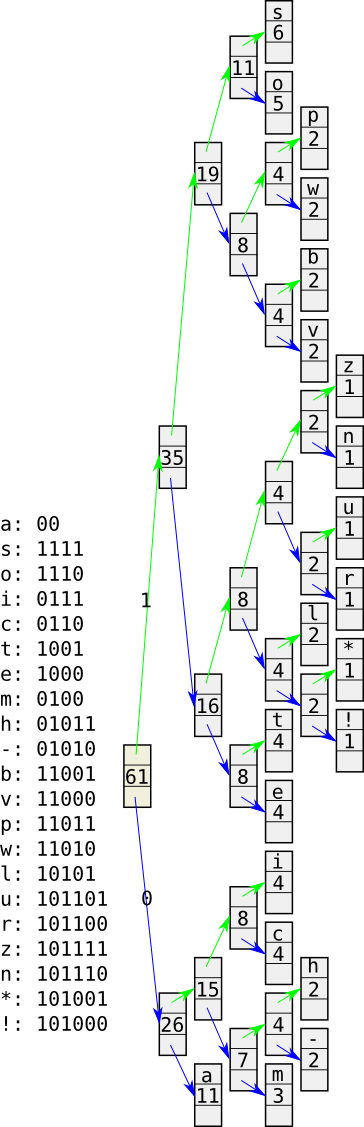
A small subset of the Public Suffix List as stored within libnspslHuffman coding named for David A. Huffman is an algorithm that enables a representation of data which is very efficient. In a normal array of characters every character takes the same eight bits to represent which is the best we can do when any of the 256 values possible is equally likely. If your data is not evenly distributed this is not the case for example if the data was english text then the value is fifteen times more likely to be that for e than k.

every step of huffman encoding tree build for the example string tableSo if we have some data with a non uniform distribution of probabilities we need a way the data be encoded with fewer bits for the common values and more bits for the rarer values. To be efficient we would need some way of having variable length representations without storing the length separately. The term for this data representation is a prefix code and there are several ways to generate them.

Such is the influence of Huffman on the area of prefix codes they are often called Huffman codes even if they were not created using his algorithm. One can dream of becoming immortalised like this, to join the ranks of those whose names are given to units or whole ideas in a field must be immensely rewarding, however given Huffman invented his algorithm and proved it to be optimal to answer a question on a term paper in his early twenties I fear I may already be a bit too late.

The algorithm itself is relatively straightforward. First a frequency analysis is performed, a fancy way of saying count how many of each character is in the input data. Next a binary tree is created by using a priority queue initialised with the nodes sorted by frequency.

The resulting huffman tree and the binary representation of the input symbols
The two least frequent items count is summed together and a node placed in the tree with the two original entries as child nodes. This step is repeated until a single node exists with a count value equal to the length of the input.

To encode data once simply walks the tree outputting a 0 for a left node or 1 for right node until reaching the original value. This generates a mapping of values to bit output, the input is then simply converted value by value to the bit output. To decode the data the data is used bit by bit to walk the tree to arrive at values.

If we perform this algorithm on the example string table *!asiabvcomcoopitamazonawsarsaves-the-whalescomputebasilicata we can reduce the 488 bits (61 * 8 bit characters) to 282 bits or 40% reduction. Obviously in a real application the huffman tree would need to be stored which would probably exceed this saving but for larger data sets it is probable this technique would yield excellent results on this kind of data.

Once I proved this to myself I implemented the encoder within the existing conversion program. Although my perl encoder is not very efficient it can process the entire PSL string table (around six thousand labels using 40KB or so) in less than a second, so unless the table grows massively an inelegant approach will suffice.

The resulting bits were packed into 32bit values to improve decode performance (most systems prefer to deal with larger memory fetches less frequently) and resulted in 18KB of output or 47% of the original size. This is a great improvement in size and means the statically linked test program is now 59KB and is actually smaller than the gzipped source data.

$ ls -alh test_nspsl
-rwxr-xr-x 1 vince vince 59K Sep 25 23:58 test_nspsl
$ ls -al public_suffix_list.dat.gz
-rw-r--r-- 1 vince vince 62K Sep 1 08:52 public_suffix_list.dat.gz

To be clear the statically linked program can determine if a domain is in the PSL with no additional heap allocations and includes the entire PSL ordered tree, the domain label string table and the huffman decode table to read it.

An unexpected side effect is that because the decode loop is small it sits in the processor cache. This appears to cause the string comparison function huffcasecmp() (which is not locale dependant because we know the data will be limited ASCII) performance to be close to using strcasecmp() indeed on ARM32 systems there is a very modest improvement in performance.

I think this is as much work as I am willing to put into this library but I am pleased to have achieved a result which is on par with the best of breed (libpsl still has a data representation 20KB smaller than libnspsl but requires additional libraries for additional functionality) and I got to (re)learn an important algorithm too.

Steinar H. Gunderson: Nageru @ Fyrrom

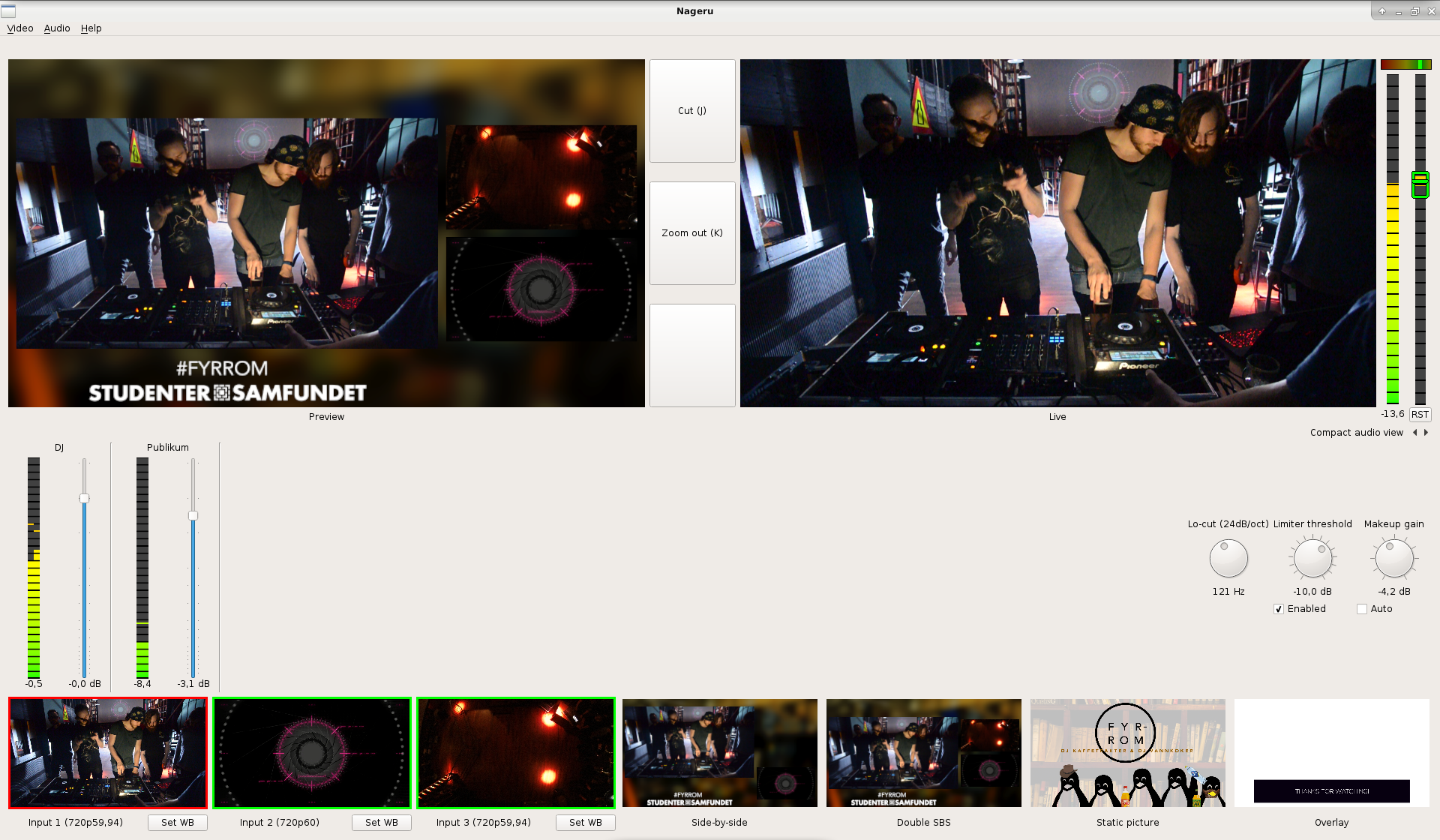
When Samfundet wanted to make their own Boiler Room spinoff (called Fyrrom more or less a direct translation), it was a great opportunity to try out the new multitrack code in Nageru. After all, what can go wrong with a pretty much untested and unfinished git branch, right? So we cobbled together a bunch of random equipment from here and there: Video equipment Hooked it up to Nageru: Nageru screenshot and together with some great work from the people actually pulling together the event, this was the result. Lots of fun. And yes, some bugs were discovered of course, field testing without followup patches is meaningless (that would either mean you're not actually taking your test experience into account, or that your testing gave no actionable feedback and thus was useless), so they will be fixed in due time for the 1.4.0 release. Edit: Fixed a screenshot link.

23 September 2016

Arturo Borrero Gonz lez: Blog moved from Blogger to Jekyllrb at GithubPages


This blog has finally moved away from blogger to jekyll, also changing the hosting and the domain. No new content will be published here.

New coordinates:

This blogger blog will remain as archive, since I don't plan to migrate the content from here to the new blog.

So, see you there!


22 September 2016

Zlatan Todori : Open Source Motion Comic Almost Fully Funded - Pledge now!

The Pepper and Carrot motion comic is almost funded. The pledge from Ethic Cinema put it on good road (as it seemed it would fail). Ethic Cinema is non profit organization that wants to make open source art (as they call it Libre Art). Purism's creative director, Fran ois T chen , is member and co-founder of Ethic Cinema. Lets push final bits so we can get this free as in freedom artwork. Notice that Pepper and Carrot is a webcomic (also available as book) free as in freedom artwork done by David Revoy who also supports this campaign. Also the support is done by Krita community on their landing page. Lets do this!

20 September 2016

Vincent Sanders: If I see an ending, I can work backward.

Now while I am sure Arthur Miller was referring to writing a play when he said those words they have an oddly appropriate resonance for my topic.

In the early nineties Lou Montulli applied the idea of magic cookies to HTTP to make the web stateful, I imagine he had no idea of the issues he was going to introduce for the future. Like most of the web technology it was a solution to an immediate problem which it has never been possible to subsequently improve.

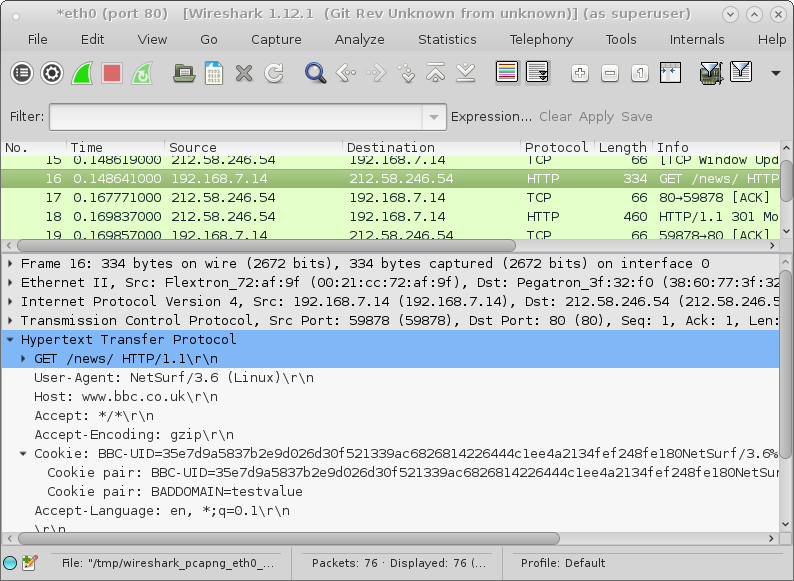
Chocolate chip cookie are much tastier than HTTP cookiesThe HTTP cookie is simply a way for a website to identify a connecting browser session so that state can be kept between retrieving pages. Due to shortcomings in the design of cookies and implementation details in browsers this has lead to a selection of unwanted side effects. The specific issue that I am talking about here is the supercookie where the super prefix in this context has similar connotations as to when applied to the word villain.

Whenever the browser requests a resource (web page, image, etc.) the server may return a cookie along with the resource that your browser remembers. The cookie has a domain name associated with it and when your browser requests additional resources if the cookie domain matches the requested resources domain name the cookie is sent along with the request.

As an example the first time you visit a page on www.example.foo.invalid you might receive a cookie with the domain example.foo.invalid so next time you visit a page on www.example.foo.invalid your browser will send the cookie along. Indeed it will also send it along for any page on another.example.foo.invalid

A supercookies is simply one where instead of being limited to one sub-domain (example.foo.invalid) the cookie is set for a top level domain (foo.invalid) so visiting any such domain (I used the invalid name in my examples but one could substitute com or co.uk) your web browser gives out the cookie. Hackers would love to be able to set up such cookies and potentially control and hijack many sites at a time.

This problem was noted early on and browsers were not allowed to set cookie domains with fewer than two parts so example.invalid or example.com were allowed but invalid or com on their own were not. This works fine for top level domains like .com, .org and .mil but not for countries where the domain registrar had rules about second levels like the uk domain (uk domains must have a second level like .co.uk).

 NetSurf cookie manager showing a supercookieThere is no way to generate the correct set of top level domains with an algorithm so a database is required and is called the Public Suffix List (PSL). This database is a simple text formatted list with wildcard and inversion syntax and is at time of writing around 180Kb of text including comments which compresses down to 60Kb or so with deflate.

A few years ago with ICANN allowing the great expansion of top level domains the existing NetSurf supercookie handling was found to be wanting and I decided to implement a solution using the PSL. At this point in time the database was only 100Kb source or 40Kb compressed.

I started by looking at limited existing libraries. In fact only the regdom library was adequate but used 150Kb of heap to load the pre-processed list. This would have had the drawback of increasing NetSurf heap usage significantly (we still have users on 8Mb systems). Because of this and the need to run PHP script to generate the pre-processed input it was decided the library was not suitable.

Lacking other choices I came up with my own implementation which used a perl script to construct a tree of domains from the PSL in a static array with the label strings in a separate table. At the time my implementation added 70Kb of read only data which I thought reasonable and allowed for direct lookup of answers from the database.

This solution still required a pre-processing step to generate the C source code but perl is much more readily available, is a language already used by our tooling and we could always simply ship the generated file. As long as the generated file was updated at release time as we already do for our fallback SSL certificate root set this would be acceptable.

wireshark session shown NetSurf sending a co.uk supercookie to bbc.co.uk
I put the solution into NetSurf, was pleased no-one seemed to notice and moved on to other issues. Recently while fixing a completely unrelated issue in the display of session cookies in the management interface and I realised I had some test supercookies present in the display. After the initial "thats odd" I realised with horror there might be a deeper issue.

It quickly became evident the PSL generation was broken and had been for a long time, even worse somewhere along the line the "redundant" empty generated source file had been removed and the ancient fallback code path was all that had been used.

This issue had escalated somewhat from a trivial display problem. I took a moment to asses the situation a bit more broadly and came to the conclusion there were a number of interconnected causes, centered around the lack of automated testing, which could be solved by extracting the PSL handling into a "support" library.

NetSurf has several of these support libraries which could be used separately to the main browser project but are principally oriented towards it. These libraries are shipped and built in releases alongside the main browser codebase and mainly serve to make API more obvious and modular. In this case my main aim was to have the functionality segregated into a separate module which could be tested, updated and monitored directly by our CI system meaning the embarrassing failure I had found can never occur again.

Before creating my own library I did consider a library called libpsl had been created since I wrote my original implementation. Initially I was very interested in using this library given it managed a data representation within a mere 32Kb.

Unfortunately the library integrates a great deal of IDN and punycode handling which was not required in this use case. NetSurf already has to handle IDN and punycode translations and uses punycode encoded domain names internally only translating to unicode representations for display so duplicating this functionality using other libraries requires a great deal of resource above the raw data representation.

I put the library together based on the existing code generator Perl program and integrated the test set that comes along with the PSL. I was a little alarmed to discover that the PSL had almost doubled in size since the implementation was originally written and now the trivial test program of the library was weighing in at a hefty 120Kb.

This stemmed from two main causes:
  1. there were now many more domain label strings to be stored
  2. there now being many, many more nodes in the tree.
To address the first cause the length of the domain label strings was moved into the unused padding space within each tree node removing a byte from each domain label saving 6Kb. Next it occurred to me that while building the domain label string table that if the label to be added already existed as a substring within the table it could be elided.

The domain labels were sorted from longest to shortest and added in order searching for substring matches as the table was built this saved another 6Kb. I am sure there are ways to reduce this further I have missed (if you see them let me know!) but a 25% saving (47Kb to 35Kb) was a good start.

The second cause was a little harder to address. The structure representing nodes in the tree I started with was at first look reasonable.

struct pnode  
uint16_t label_index; /* index into string table of label */
uint16_t label_length; /* length of label */
uint16_t child_node_index; /* index of first child node */
uint16_t child_node_count; /* number of child nodes */
;

I examined the generated table and observed that the majority of nodes were leaf nodes (had no children) which makes sense given the type of data being represented. By allowing two types of node one for labels and a second for the child node information this would halve the node size in most cases and requiring only a modest change to the tree traversal code.

The only issue with this would be that a way to indicate a node has child information. It was realised that the domain labels can have a maximum length of 63 characters meaning their length can be represented in six bits so a uint16_t was excessive. The space was split into two uint8_t parts one for the length and one for a flag to indicate child data node followed.

union pnode  
struct
uint16_t index; /* index into string table of label */
uint8_t length; /* length of label */
uint8_t has_children; /* the next table entry is a child node */
label;
struct
uint16_t node_index; /* index of first child node */
uint16_t node_count; /* number of child nodes */
child;
;

static const union pnode pnodes[8580] =
/* root entry */
.label = 0, 0, 1 , .child = 2, 1553 ,
/* entries 2 to 1794 */
.label = 37, 2, 1 , .child = 1795, 6 ,

...

/* entries 8577 to 8578 */
.label = 31820, 6, 1 , .child = 8579, 1 ,
/* entry 8579 */
.label = 0, 1, 0 ,

;

This change reduced the node array size from 63Kb to 33Kb almost a 50% saving. I considered using bitfields to try and reduce the label length and has_children flag into a single byte but such packing will not reduce the length of a node below 32bits because it is unioned with the child structure.

A possibility of using the spare uint8_t derived by bitfield packing to store an additional label node in three other nodes was considered but added a great deal of complexity to node lookup and table construction for saving around 4Kb so was not incorporated.

With the changes incorporated the test program was a much more acceptable 75Kb reasonably close to the size of the compressed source but with the benefits of direct lookup. Integrating the libraries single API call into NetSurf was straightforward and resulted in correct operation when tested.

This episode just reminded me of the dangers of code that can fail silently. It exposed our users to a security problem that we thought had been addressed almost six years ago and squandered the limited resources of the project. Hopefully a lesson we will not have to learn again any time soon. If there is a positive to take away it is that the new implementation is more space efficient, automatically built and importantly tested

Next.

Previous.