Search Results: "bod"

5 January 2016

Daniel Pocock: Promoting free software and free communications on popular social media networks

(You can Follow or Tweet about this blog on Twitter) Sites like Twitter and Facebook are not fundamentally free platforms, despite the fact they don't ask their users for money. Look at how Facebook's censors confused Denmark's mermaid statue with pornography or how quickly Twitter can make somebody's account disappear, frustrating public scrutiny of their tweets and potentially denying access to vital information in their "direct message" mailbox. Then there is the fact that users don't get access to the source code, users don't have a full copy of their own data and, potentially worst of all, if most people bothered to read the fine print of the privacy policy they would find it is actually a recipe for downright creepiness. Nonetheless, a significant number of people have accounts in these systems and are to some extent contactable there. Many marketing campaigns that have been successful today, whether they are crowdfunding, political activism or just finding a lost cat claim to have had great success because of Twitter or Facebook. Is this true? In reality, many users of those platforms follow hundreds of different friends and if they only check-in once a day, filtering algorithms show them only a small subset of what all their friends posted. Against these odds, just posting your great idea on Facebook doesn't mean that more than five people are actually going to see it. Those campaigns that have been successful have usually had something else going in their favour, perhaps it was a friend working in the media who gave their campaign a plug on his radio show or maybe they were lucky enough to be slashdotted. Maybe it was having the funds for a professional video production with models who pass off as something spontaneous. The use of Facebook or Twitter alone did not make such campaigns successful, it was just part of a bigger strategy where everything fell into place. Should free software projects, especially those revolving around free communications technology, use such platforms to promote themselves? It is not a simple question. In favour, you could argue that everything we promote through public mailing lists and websites is catalogued by Google anyway, so why not make it easier to access for those who are on Facebook or Twitter? On top of that, many developers don't even want to run their own mail server or web server any more, let alone a self-hosted social-media platform like pump.io. Even running a basic SIP proxy server for the large Debian and Fedora communities involved a lot of discussion about the approach to support it. The argument against using Facebook and Twitter is that you are shooting yourself in the foot, when you participate in those networks, you give them even more credibility and power (which you could quantify using Metcalfe's law). The Metcalfe value of their network, being quadratic rather than linear, shoots ahead of the Metcalfe value of your own solution, putting your alternative even further out of reach. On top of that, the operators of the closed platform are able to evaluate who is responding to your message and how they feel about it and use that intelligence to further undermine you. In some cases, there may be passive censorship, such as WhatsApp silently losing messages that link to rival Telegram. How do you feel about this choice? How and when should free software projects and their developers engage with mainstream social media technology? Please come and share your ideas on the Free-RTC mailing list or perhaps share and Tweet them.

3 January 2016

Carl Chenet: To be alerted if no more tweet is sent from your Twitter account: Twitterwatch

This version 0.1 of Twitterwatch is dedicated to Ian Murdock, Debian project Founder. If you use an automated system like Feed2tweet in order to feed your Twitter account from your website of any RSS feed, it is of the utmost important to know when this system is broken, because you are losing traffic because of this malfunction. At the Journal du hacker, a French-speaking FOSS website where people contribute weblinks like Hacker News or Lobste.rs, every new contribution is sent through the RSS feed to the Twitter account of the Journal du hacker. A lot of our readers only follow the news on Twitter. So if the link breaks, our readers are not fed any more :) To be alerted to this issue, I wrote a small self hosted and documented app. I m proud to introduce Twitterwatch ! It runs with Python 3.4 and the Tweepy library. You can install it from PyPI or from sources. The documentation is available on Readthedocs. You can read about how to install it, configure it and use it. It s the first release but the main features do the job already. In order to use it, you need a twitterwatch.ini file as following:
[twitter]
consumer_key=ml6jaiBnf3pkU9uIrKNIxAr3o
consumer_secret=4Cmljklzerkhfer4hlj3ljl2hfvc123rezrfsdatpokaelzerp
access_token=213416790-jgJnrJG5gz132nzerl5zerwi1ahmnwkfJFN9nr2j
access_token_secret=WjanlPgqDKlunJ4Knr11k2bnfk3jfnwkFjeriFZERj16Z
[schedule]
; duration between 2 checks in minutes
check_interval=60
[mail]
host=localhost
from=admin@myserver.org
to=foo@mylaptop.org
The most difficult part is now complete. To launch Twitterwatch, just launch the following command:
$ twitterwatch /path/to/twitterwatch.ini
Whenever no more new tweet is sent from your Twitter account during 60 minutes, you ll receive the following mail (here the user is @journalduhacker):
Title: Twitter stream of journalduhacker has stopped
Body: Twitter stream of journalduhacker has stopped since 23/12/2015 - 14:49:23
It is still pretty rough, but it does the job. New features will come whenever I need them (or if you require/open bugs/submit push requests ;) ). Write a comment to tell me what you think of it or why you use it!

2 January 2016

Daniel Pocock: The great life of Ian Murdock and police brutality in context

Tributes: (You can Follow or Tweet about this blog on Twitter) Over the last week, people have been saying a lot about the wonderful life of Ian Murdock and his contributions to Debian and the world of free software. According to one news site, a San Francisco police officer, Grace Gatpandan, has been doing the opposite, starting a PR spin operation, leaking snippets of information about what may have happened during Ian's final 24 hours. Sadly, these things are now starting to be regurgitated without proper scrutiny by the mainstream press (note the erroneous reference to SFGate with link to SFBay.ca, this is British tabloid media at its best). The report talks about somebody (no suggestion that it was even Ian) "trying to break into a residence". Let's translate that from the spin-doctor-speak back to English: it is the silly season, when many people have a couple of extra drinks and do silly things like losing their keys. "a residence", or just their own home perhaps? Maybe some AirBNB guest arriving late to the irritation of annoyed neighbours? Doesn't the choice of words make the motive sound so much more sinister? Nobody knows the full story and nobody knows if this was Ian, so snippets of information like this are inappropriate, especially when somebody is deceased. Did they really mean to leave people with the impression that one of the greatest visionaries of the Linux world was also a cat burglar? That somebody who spent his life giving selflessly and generously for the benefit of the whole world (his legacy is far greater than Steve Jobs, as Debian comes with no strings attached) spends the Christmas weekend taking things from other people's houses in the dark of the night? The report doesn't mention any evidence of a break-in or any charges for breaking-in. If having a few drinks and losing your keys in December is such a sorry state to be in, many of us could potentially be framed in the same terms at some point in our lives. That is one of the reasons I feel so compelled to write this: somebody else could be going through exactly the same experience at the moment you are reading this. Any of us could end up facing an assault as unpleasant as the tweets imply at some point in the future. At least I can console myself that as a privileged white male, the risk to myself is much lower than for those with mental illness, the homeless, transgender, Muslim or black people but as the tweets suggest, it could be any of us. The story reports that officers didn't actually come across Ian breaking in to anything, they encountered him at a nearby street corner. If he had weapons or drugs or he was known to police that would have almost certainly been emphasized. Is it right to rush in and deprive somebody of their liberties without first giving them an opportunity to identify themselves and possibly confirm if they had a reason to be there? The report goes on, "he was belligerent", "he became violent", "banging his head" all by himself. How often do you see intelligent and successful people like Ian Murdock spontaneously harming themselves in that way? Can you find anything like that in any of the 4,390 Ian Murdock videos on YouTube? How much more frequently do you see reports that somebody "banged their head", all by themselves of course, during some encounter with law enforcement? Do police never make mistakes like other human beings? If any person was genuinely trying to spontaneously inflict a head injury on himself, as the police have suggested, why wouldn't the police leave them in the hospital or other suitable care? Do they really think that when people are displaying signs of self-harm, rounding them up and taking them to jail will be in their best interests? Now, I'm not suggesting this started out with some sort of conspiracy. Police may have been at the end of a long shift (and it is a disgrace that many US police are not paid for their overtime) or just had a rough experience with somebody far more sinister. On the other hand, there may have been a mistake, gaps in police training or an inappropriate use of a procedure that is not always justified, like a strip search, that causes profound suffering for many victims. A select number of US police forces have been shamed around the world for a series of incidents of extreme violence in recent times, including the death of Michael Brown in Ferguson, shooting Walter Scott in the back, death of Freddie Gray in Baltimore and the attempts of Chicago's police to run an on-shore version of Guantanamo Bay. Beyond those highly violent incidents, the world has also seen the abuse of Ahmed Mohamed, the Muslim schoolboy arrested for his interest in electronics and in 2013, the suicide of Aaron Swartz which appears to be a direct consequence of the "Justice" department's obsession with him. What have the police learned from all this bad publicity? Are they changing their methods, or just hiring more spin doctors? If that is their response, then doesn't it leave them with a cruel advantage over those people who were deceased? Isn't it standard practice for some police to simply round up anybody who is a bit lost and write up a charge sheet for resisting arrest or assaulting an officer as insurance against questions about their own excessive use of force? When British police executed Jean Charles de Menezes on a crowded tube train and realized they had just done something incredibly outrageous, their PR office went to great lengths to try and protect their image, even photoshopping images of Menezes to make him look more like some other suspect in a wanted poster. To this day, they continue to refer to Menezes as a victim of the terrorists, could they be any more arrogant? While nobody believes the police woke up that morning thinking "let's kill some random guy on the tube", it is clear they made a mistake and like many people (not just police), they immediately prioritized protecting their reputation over protecting the truth. Nobody else knows exactly what Ian was doing and exactly what the police did to him. We may never know. However, any disparaging or irrelevant comments from the police should be viewed with some caution. The horrors of incarceration It would be hard for any of us to understand everything that an innocent person goes through when detained by the police. The recently released movie about The Stanford Prison Experiment may be an interesting place to start, a German version produced in 2001, Das Experiment, is also very highly respected. The United States has the largest prison population in the world and the second-highest per-capita incarceration rate. Many, including some on death row, are actually innocent, in the wrong place at the wrong time, without the funds to hire an attorney. The system, and the police and prison officers who operate it, treat these people as packages on a conveyor belt, without even the most basic human dignity. Whether their encounter lasts for just a few hours or decades, is it any surprise that something dies inside them when they discover this cruel side of American society? Worldwide, there is an increasing trend to make incarceration as degrading as possible. People may be innocent until proven guilty, but this hasn't stopped police in the UK from locking up and strip-searching over 4,500 children in a five year period, would these children go away feeling any different than if they had an encounter with Jimmy Saville or Rolf Harris? One can only wonder what they do to adults. What all this boils down to is that people shouldn't really be incarcerated unless it is clear the danger they pose to society is greater than the danger they may face in a prison. What can people do for Ian and for justice? Now that these unfortunate smears have appeared, it would be great to try and fill the Internet with stories of the great things Ian has done for the world. Write whatever you feel about Ian's work and your own experience of Debian. While the circumstances of the final tweets from his Twitter account are confusing, the tweets appear to be consistent with many other complaints about US law enforcement. Are there positive things that people can do in their community to help reduce the harm? Sending books to prisoners (the UK tried to ban this) can make a difference. Treat them like humans, even if the system doesn't. Recording incidents of police activities can also make a huge difference, such as the video of the shooting of Walter Scott or the UK police making a brutal unprovoked attack on a newspaper vendor. Don't just walk past a situation and assume everything is under control. People making recordings may find themselves in danger, it is recommended to use software that automatically duplicates each recording, preferably to the cloud, so that if the police ask you to delete such evidence, you can let them watch you delete it and still have a copy. Can anybody think of awards that Ian Murdock should be nominated for, either in free software, computing or engineering in general? Some, like the prestigious Queen Elizabeth Prize for Engineering can't be awarded posthumously but others may be within reach. Come and share your ideas on the debian-project mailing list, there are already some here. Best of all, Ian didn't just build software, he built an organization, Debian. Debian's principles have helped to unite many people from otherwise different backgrounds and carry on those principles even when Ian is no longer among us. Find out more, install it on your computer or even look for ways to participate in the project.

Iain R. Learmonth: Adventures at London Luton

Continuing on my journey home, once again I was asked to step into the full-body scanner. This time I was certain that I didn't want to use it, I was so angry last time that I had been forced into it that I actually threw up. It wasn't until I was in tears and asking them to take my bags off the plane, planning to take the train instead, that they gave me the manual pat-down. "Voluntary" apparently has a different meaning to the one I'm familiar with here.

Iain R. Learmonth: Fun in Hamburg Airport

Today I'm travelling home from 32c3, back to Aberdeen via London from Hamburg Airport. My experience passing through security to get to the gates this morning has angered me to the point that I had to vent. They have full-body scanners installed, which in my opinion are a massive invasion of my personal privacy. As I approached the security checkpoint, I noticed a sign where it stated that use of the scanner was not mandatory and that a manual screening process was available. Once I'd loaded my bags into the trays, I asked the security officer how to opt for the manual screening at which point I was told it was not available due to a lack of staff. I was forced to allow for an intimate scan to take place or miss my flight. I'm not really in a position to be making alternative arrangements for travel and so I had to submit but it has left me outraged. Privacy is about the ability to choose what I share and who I share it with. This was meant to be a right protected by the ECHR, but I guess human rights are outdated now we're entering 2016. Bring on the dystopian future!

1 January 2016

Russ Allbery: Review: One Salt Sea

Review: One Salt Sea, by Seanan McGuire
Series: October Daye #5
Publisher: DAW
Copyright: September 2011
ISBN: 1-101-54760-X
Format: Kindle
Pages: 368
This is the fifth book of the October Daye series. It's the best book of the series to date, at least in my opinion, but this is a series with a substantial cast and political complications. You could probably start here and work out things on the fly, since each story is largely self-contained, but much of the emotional resonance would be lost. As expected for this series, Toby's life doesn't have much time to stabilize after the events of Late Eclipses. This time, though, the initial threat is less personal and more political. The children of the rulers of the Duchy of Saltmist have been kidnapped, and war between Saltmist and the Kingdom of the Mists (Toby's home) is very near. All that stands in the way of horrible casualties, of fae that can scarce afford more death, is Toby's desperate detective work. Toby's confidence and belief in her own abilities has been growing steadily throughout this series. One of my favorite themes in fiction is someone who doesn't really believe in themselves but tries anyway, because they couldn't live with themselves if they didn't, and discovers they're more capable than they thought. In this series, I think that works best when Toby is less scared and more angry, which is very true in One Salt Sea. That's one reason why I liked this book better than either An Artificial Night or Late Eclipses. Another is that I love the politics and the depth of world-building and lore that McGuire brings to this series, and One Salt Sea is a showcase of both. We get the Undersea Duchy of Saltmist, which comes from both different traditions and different fae than the series so far. We get a plot that combines political maneuvering with a more traditional detective story than the last few books. We get more hidden traditions, past alliances and enmity that Toby didn't know about, and further development of Toby's own abilities. She has to tug hard on some threads, move between levels of the fae world, and draw on her network for uniquely fae forms of forensic analysis. I thoroughly enjoyed it, particularly the rocks. (You'll know what I mean when you get to that part.) But the best thing about this book, by far, is the Luidaeg. I've mentioned in reviews of previous books that the Luidaeg is my favorite character of the series. One Salt Sea just cements that. This is the deepest that the Luidaeg has been involved in a story: she gives Toby her mission at the start, substantial help along the way, and is deeply involved in the ending. We even learn some of her own background, and some of her own worries and pain. (And foreshadowing that there's more of this to come, which I'm eagerly looking forward to.) She's moved from a strange ally through a cautious friend to some combination of aunt and mother to Toby, while always staying her irascible and occasionally painful self. The bits with her in this book are the best so far, and there are a lot of them. It's a delightful reading experience. McGuire also uses this story to clear up a plot element that's been lingering since the first book of the series, but that never worked emotionally for me. (I'm talking about this indirectly since it's a significant spoiler.) It's a great resolution, one with heft and emotion and hard choices and pain, and largely makes up for the showing rather than telling that we've gotten in the previous books, while also (at least I suspect) graciously shuffling that plot out of the way in future books. It's a good bit of series work and personal growth for Toby, and I think frees the series to focus on the bits I enjoy the most. The ending of One Salt Sea hurts, but it's a good hurt, full of hard choices made well, bravery, and sacrifice. The best moments of this series have always had that, but I think this book is the most successful delivery of the whole package to date. This has always been a solid urban fantasy series, but I think it's getting better as it goes along. One major reason is that McGuire doesn't seem to be running out of world-building oomph. In a lot of urban fantasy, particularly the werewolf and vampire sort, I feel like the lore gets thinner, more rehashed, and more mundane as the series ages. But McGuire is still introducing new elements, showing existing elements from new directions and in new light, and has been slowly building major puzzles around Toby's life and abilities that intrigue me. And, even more rare, the eventual revelations usually live up to the preceding tension. It's certainly a recipe to keep me reading. Followed by Ashes of Honor. Rating: 9 out of 10

Matthew Garrett: The current state of boot security

I gave a presentation at 32C3 this week. One of the things I said was "If any of you are doing seriously confidential work on Apple laptops, stop. For the love of god, please stop." I didn't really have time to go into the details of that at the time, but right now I'm sitting on a plane with a ridiculous sinus headache and the pseudoephedrine hasn't kicked in yet so here we go.

The basic premise of my presentation was that it's very difficult to determine whether your system is in a trustworthy state before you start typing your secrets (such as your disk decryption passphrase) into it. If it's easy for an attacker to modify your system such that it's not trustworthy at the point where you type in a password, it's easy for an attacker to obtain your password. So, if you actually care about your disk encryption being resistant to anybody who can get temporary physical possession of your laptop, you care about it being difficult for someone to compromise your early boot process without you noticing.

There's two approaches to this. The first is UEFI Secure Boot. If you cryptographically verify each component of the boot process, it's not possible for a user to compromise the boot process. The second is a measured boot. If you measure each component of the boot process into the TPM, and if you use these measurements to control access to a secret that allows the laptop to prove that it's trustworthy (such as Joanna Rutkowska's Anti Evil Maid or my variant on the theme), an attacker can compromise the boot process but you'll know that they've done so before you start typing.

So, how do current operating systems stack up here?

Windows: Supports UEFI Secure Boot in a meaningful way. Supports measured boot, but provides no mechanism for the system to attest that it hasn't been compromised. Good, but not perfect.

Linux: Supports UEFI Secure Boot[1], but doesn't verify signatures on the initrd[2]. This means that attacks such as Evil Abigail are still possible. Measured boot isn't in a good state, but it's possible to incorporate with a bunch of manual work. Vulnerable out of the box, but can be configured to be better than Windows.

Apple: Ha. Snare talked about attacking the Apple boot process in 2012 - basically everything he described then is still possible. Apple recently hired the people behind Legbacore, so there's hope - but right now all shipping Apple hardware has no firmware support for UEFI Secure Boot and no TPM. This makes it impossible to provide any kind of boot attestation, and there's no real way you can verify that your system hasn't been compromised.

Now, to be fair, there's attacks that even Windows and properly configured Linux will still be vulnerable to. Firmware defects that permit modification of System Management Mode code can still be used to circumvent these protections, and the Management Engine is in a position to just do whatever it wants and fuck all of you. But that's really not an excuse to just ignore everything else. Improving the current state of boot security makes it more difficult for adversaries to compromise a system, and if we ever do get to the point of systems which aren't running any hidden proprietary code we'll still need this functionality. It's worth doing, and it's worth doing now.

[1] Well, except Ubuntu's signed bootloader will happily boot unsigned kernels which kind of defeats the entire point of the exercise
[2] Initrds are built on the local machine, so we can't just ship signed images

comment count unavailable comments

31 December 2015

Laura Arjona Reina: Thanks Ian, thanks Debian

I didn t know Ian Murdock but the news about his passing left me with a very strange and sad feeling, because he started the project that creates the tool that I use every day in my work, and everyday in my communication with my family and friends, and everyday for anything computer related It s like if somebody puts a treasure in your hands and you got distracted looking at it and when you head up to look at the person and say Thank you , he s gone And, in the last years, Debian for me is not just my favorite tool , I ve been slowly getting involved in the community, known some people here and there, been able to put some work to try to improve some small parts, been able to work with other people as a team, and I ve been touched many times admiring how the Debianers work, how they talk and write, how they behave to each other and to the ones that reach the community for first time, and to the world, since most of the communication and work is public I ve felt myself helped, welcomed, encouraged, empowered. Not only in my computer related skills or the improved capabilities of my humble hardware. I ve felt myself helped, welcomed, encouraged and empowered in important areas of my life (understanding other points of view, caring about the ones that don t speak aloud, enjoying diversity and becoming flexible to make it flourish, making friends ). And I like to think that I try to emulate that and help, welcome, encourage, empower others too I m learning. Thanks Ian, for this alive and growing treasure that is Debian (the OS, the community), and thanks Debian, for the past, present and future miracles.
Filed under: My experiences and opinion Tagged: Communities, Contributing to libre software, Debian, English, Moving into free software

Chris Lamb: Free software activities in December 2015

Here is my monthly update covering a large part of what I have been doing in the free software world (previously):
Debian My work in the Reproducible Builds project was also covered in more depth in Lunar's weekly reports (#31, #32, #33, #34).
LTS

This month I have been paid to work 12 hours on Debian Long Term Support (LTS). In that time I did the following:
  • Issued DLA 363-1 for libphp-phpmailer fixing a header injection vulnerability.
  • Issued DLA 365-1 for foomatic-filters correcting a shell injection vulnerability.
  • Issued DLA 369-1 for pygments fixing an issue shell injection vulnerability.
  • Issued DLA 374-1 for cacti to fix an SQL injection vulnerability.
  • Did some futher investigation of CVE-2011-5325 in busybox.

Uploads
  • python-django (1.9) New upstream release.
  • redis (3.0.6) New upstream stable release. I additionally backported this package to Debian stable.
  • redis (3.2~rc1) Uploaded upstream's "testing/next" branch to experimental for testing.
  • gunicorn (19.4.1) New upstream release.


Patches contributed

I also filed FTBFS bugs against acpid, android-platform-frameworks-base, antlr3, artemis, beignet, bisonc++, bobcat, bustle, cargo, checkbox-ng, code2html, cplay, datanommer.commands, dcmtkpp, debci, diffutils, diod, django-restricted-resource, docker-libkv, doomsday, dvdauthor, dwww, elasticsearch, elki, flask-script, freeipa, fso-frameworkd, funny-manpages, ggcov, ghc-mod, gmpc-plugins, gparted, gs-collections, guacamole-server, guncat, haskell-concrete-typerep, haskell-geniplate, haskell-nats, haskell-x509-util, hawtbuf, heimdal, htsjdk, inspircd, jboss-xnio, jenkins-winstone, jpeginfo, jruby-openssl, kaffeine, kdbg, ktp-accounts-kcm, kuser, libcommons-cli-java, libcommons-openpgp-java, libconfig-model-lcdproc-perl, libdata-faker-perl, libexplain, libgettext-commons-java, libgtk2-ex-printdialog-perl, libmoops-perl, libnet-frame-perl, libsendmail-milter-perl, libupnp, libuv, libvpx, liwc, m4, maven2, meep-mpich2, nagios-plugin-check-multi, natlog, netpipe, ocserv, ogre-1.8, orthanc-dicomweb, perspectives-extension, php-mail, php-pinba, phpseclib, pkg-haskell-tools, plastimatch, plexus-compiler, plexus-compiler-1.0, python-acme, python-crontab, python-cs, python-csscompressor, python-debian, python-distutils-extra, python-django-compressor, python-django-openstack-auth, python-django-tagging, python-pygit2, python-pyramid, python-pywcs, python-releases, python-shade, python-statsd, python-tasklib, python-tasklib, python-webm, python-websockets, regina-normal, rinetd, roboptim-core, rpm2html, rpm2html, ruby-factory-girl, ruby-fogbugz, ruby-i18n-inflector, ruby-loofah, ruby-protected-attributes, ruby-rack-contrib, ruby-rufus-scheduler, ruby-sanitize, ruby-sidetiq, ruby-sinatra, scsh-0.6, shogun, sleekxmpp, slugimage, spatial4j, sqwebmail-de, trac-announcer, ttt, txaws, umbrello, wine-gecko-2.21, xboxdrv, xfonts-wqy, xserver-xorg-video-openchrome, yorick & yoshimi.

Raphaël Hertzog: My Free Software Activities in December 2015

My monthly report covers a large part of what I have been doing in the free software world. I write it for my donators (thanks to them!) but also for the wider Debian community because it can give ideas to newcomers and it s one of the best ways to find volunteers to work with me on projects that matter to me. Debian LTS This month I have been paid to work 21.25 hours on Debian LTS. During this time I worked on the following things: Distro Tracker I put a big focus on tracker.debian.org work this month. I completed the switch of the mail interface from packages.qa.debian.org to tracker.debian.org and I announced the change on debian-devel-announce. The changes resulted in a few problems that I quickly fixed (like #807073) and some other failures seen only by me and that were generated by weird spam messages (did you know that a subject can t have a newline character but that it can be encoded and folded over multiple lines?). Related to that I fixed some services so that they send their mails to tracker.debian.org directly instead of relying on the old emails (they get forwarded for now but it would be nice to be able to get rid of that forward). I updated (with the help of Lucas Nussbaum) the service that forwards the Launchpad bugs to the tracker, I sent a patch to update the @packages.debian.org aliases (not yet applied), I updated the configuration of all git commit notice scripts in the Alioth collab-maint and python-modules project (many remain to be done). I asked Ubuntu s Merge-O-Matic to use the new emails as well (see LP 1525497). DAK and the Debian BTS still have to be updated, as of yet nobody reacted to my announce last but not least I updated many wiki pages which duplicated the instructions to setup the commit notice sent to the PTS. While on a good track I opted to tackle the long-standing RC bug that was plaguing tracker.debian.org (#789183), so I updated the codebase to rely on Twitter s bootstrap v4 instead of v2. I had to switch to something else for the icons since glyphicons is no longer provided as part of bootstrap and the actual license for the standalone version was not suitable for use. I opted for Github s Octicons. I made numerous little improvements while doing that (closing some bugs in the process) and I believe that the result is more pleasant to use. I also did a lot of bug triage and fixed a few small issues like the incomplete architecture list (#793547), or fixing a page used only by people with javascript disabled that was not working. Or the invalid links for packages still using CVS (ugh, see #561228). Misc packaging Django. After having added DEP-8 tests (as part of my LTS work, see above), I discovered that the current version in unstable did not pass its test suite so I filed the issue upstream (ticket 26016) and added the corresponding patch. And I encouraged others to update python-bcrypt in Debian to a newer version that would have worked with Django 1.9 (see #803096). I also fixed another small issue in Django (see ticket 26017 with my pull request that got accepted). I asked the release managers to consider accepting the latest 1.7.x version in jessie (see #807654) but I have gotten zero answer so far. And I m not the only one waiting an answer. It s a bit of a sad situation we still have a few weeks until the next point release but for once I do it in advance and I would love to have timely feedback. Last but not least, I started the maintaining the current LTS release (1.8.x) in jessie-backports. Tryton. I upgraded to Tryton 3.8 and discovered an issue that I filed in #806781. I sponsored 5 new tryton modules for Matthias Behrle (who is DM) as well as one security upload (for CVE-2015-0861). Debian Handbook. I uploaded a new version to Debian Unstable and requested (to the release managers) the permission to upload a backport of it to jessie so that jessie has a version of the package that documents jessie and not wheezy contrary to my other Django request, this one should be non-controversial but I also have had zero answer so far, see #807515. Misc. I filed #808583 when sbuild stopped working with Perl 5.22. I handled #807860 on publican, I found the corresponding upstream ticket and discovered a work around with the help of upstream (see here). Kali related work I reported a bug to #debian-apt about apt miscalculating download size (ending up with 18 EB!) which resulted in a fix here in version 1.1.4. Installing a meta-package that needed more than 2GB was no longer possible without this fix and we have a kali-linux-all metapackage in that situation that gets regularly installed in a Jenkins test. I added captcha support to Distro Tracker and enabled this feature on pkg.kali.org. I filed #808863 against uhd-host because it was not possible to install the package in a systemd-nspawn s managed chroot where /proc is read-only. And we started using this to test dist-upgrade from one version of Kali to the next Thanks See you next month for a new summary of my activities.

No comment Liked this article? Click here. My blog is Flattr-enabled.

29 December 2015

Daniel Pocock: Real-Time Communication in FOSDEM 2016 main track

FOSDEM is nearly here and Real-Time Communications is back with a bang. Whether you are keen on finding the perfect privacy solution, innovative new features or just improving the efficiency of existing telephony, you will find plenty of opportunities at FOSDEM. Main track Saturday, 30 January, 17:00 Dave Neary presents How to run a telco on free software. This session is of interest to anybody building or running a telco-like service or any system administrator keen to look at a practical application of cloud computing with OpenStack. Sunday, 31 January, 10:00 is my own presentation on Free Communications with Free Software. This session looks at the state of free communications, especially open standards like SIP, XMPP and WebRTC and practical solutions like DruCall (for Drupal), Lumicall (for Android) and much more. Sunday, 31 January, 11:00 Guillaume Roguez and Adrien B raud from Savoir-faire Linux present Building a peer-to-peer network for Real-Time Communication. They explain how their Ring solution, based on OpenDHT, can provide a true peer-to-peer solution. and much, much more....
  • XMPP Summit 19 is on January 28 and 29, the Thursday and Friday before FOSDEM as part of the FOSDEM Fringe.
  • The FOSDEM Beer Night on Friday, 29 January provides a unique opportunity for Real-Time Communication without software
  • The Real-Time Lounge will operate in the K building over both days of FOSDEM, come and meet the developers of your favourite RTC projects
  • The Real-Time dev-room is the successor of the previous XMPP and Telephony dev-rooms. The Real-Time dev-room is in K.3.401 and the schedule will be announced shortly.
Volunteers and sponsors still needed Please come and join the FreeRTC mailing list to find out more about ways to participate, the Saturday night dinner and other opportunities. The FOSDEM team is still fundraising. If your company derives benefit from free software and events like FOSDEM, please see the sponsorship pages.

David Bremner: Converting PDFs to DJVU

Today I was wondering about converting a pdf made from scan of a book into djvu, hopefully to reduce the size, without too much loss of quality. My initial experiments with pdf2djvu were a bit discouraging, so I invested some time building gsdjvu in order to be able to run djvudigital. Watching the messages from djvudigital I realized that the reason it was achieving so much better compression was that it was using black and white for the foreground layer by default. I also figured out that the default 300dpi looks crappy since my source document is apparently 600dpi. I then went back an compared djvudigital to pdf2djvu a bit more carefully. My not-very-scientific conclusions: Perhaps most compellingly, the output from pdf2djvu has sensible metadata and is searchable in evince. Even with the --words option, the output from djvudigital is not. This is possibly related to the error messages like
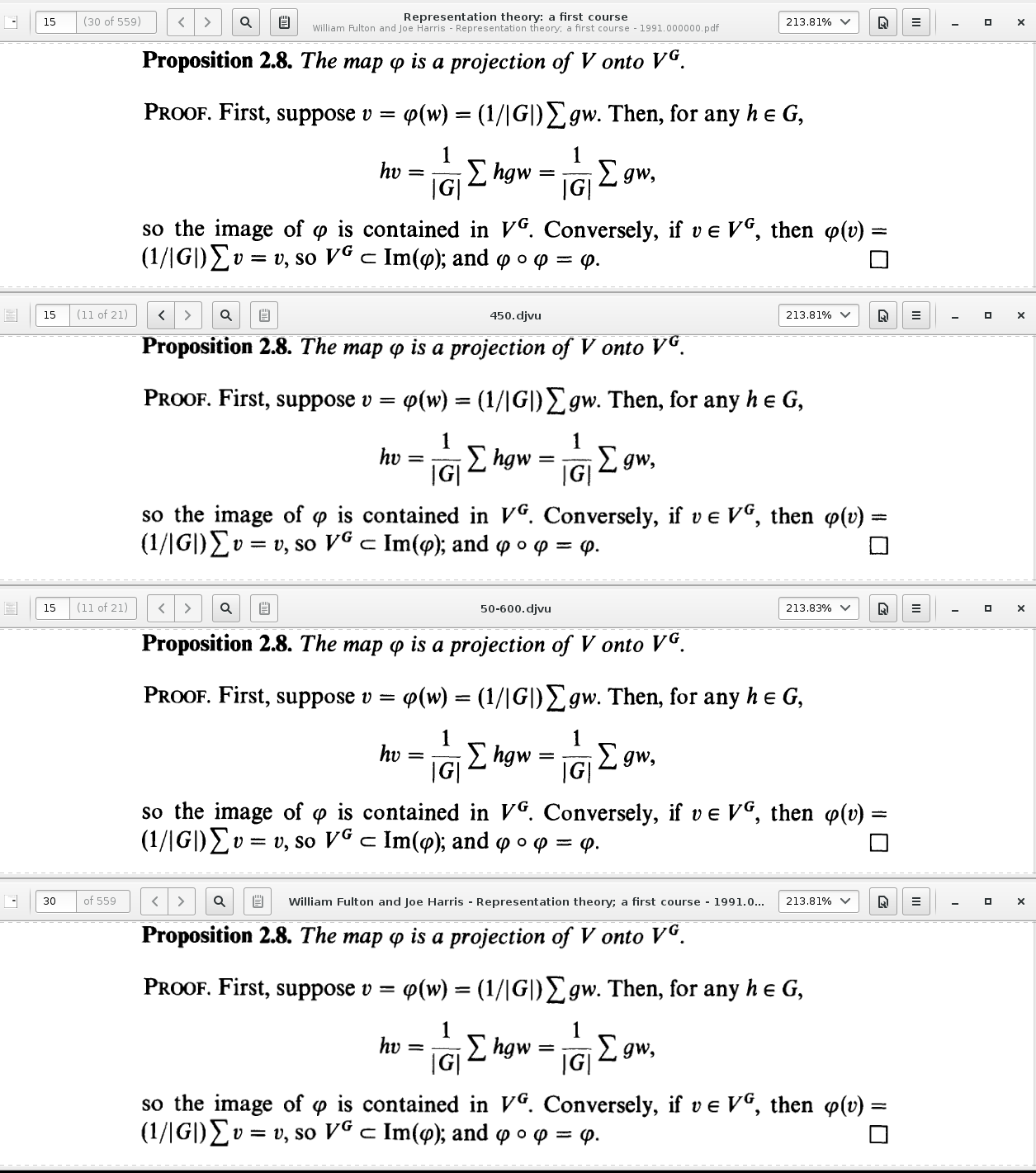
Can't build /Identity.Unicode /CIDDecoding resource. See gs_ciddc.ps .
It could well be my fault, because building gsdjvu involved guessing at corrections for several errors. Some of these issues have to do with building software from 2009 (the instructions suggestion building with ghostscript 8.64) in a modern toolchain; others I'm not sure. There was an upload of gsdjvu in February of 2015, somewhat to my surprise. AT&T has more or less crippled the project by licensing it under the CPL, which means binaries are not distributable, hence motivation to fix all the rough edges is minimal.
Version kilobytes per page position in figure
Original PDF 80.9 top
pdf2djvu --dpi=450 92.0 not shown
pdf2djvu --monochrome --dpi=450 27.5 second from top
pdf2djvu --monochrome --dpi=600 --loss-level=50 21.3 second from bottom
djvudigital --dpi=450 29.4 bottom
djvu-compare.png

Ritesh Raj Sarraf: Device Mapper Multipath status in Debian

For Debian Jessie, the multipath support relied on sysvinit scripts. So, if you were using systemd, the level of testing would have been minimal. At DebConf15, I got to meet many people whom I'd worked with, over emails, over the years. With every person, my ask was to use the SAN Storage stack in a test environement, and report bugs early. Not after the next release. This applies also to the usual downstream distribution projects. That said, today, I spent time building a Root File System on SAN setup using the following stack, of the versions that'd be part of the next stable release:
  • Linux
  • Open-iSCSI Initiator
  • Device Mapper Multipath
  • LIO Target
I'm pretty happy that nothing much has changed in terms of setup, from what has already been documented in README.Debian files. The systemd integration has been very transparent. But that is my first hand experience. I'm request all users of the above mentioned stack to build the setup and report issues, if any. Please do not wait for the last minute of the release/freeze.
root@debian-sanboot:~# systemctl status -l multipath-tools
  multipathd.service - Device-Mapper Multipath Device Controller
   Loaded: loaded (/lib/systemd/system/multipathd.service; enabled; vendor preset: enabled)
   Active: active (running) since Tue 2015-12-29 18:38:58 IST; 1min 23s ago
  Process: 246 ExecStartPre=/sbin/modprobe dm-multipath (code=exited, status=0/SUCCESS)
 Main PID: 260 (multipathd)
   Status: "running"
   CGroup: /system.slice/multipathd.service
            260 /sbin/multipathd -d -s
Dec 29 18:39:04 debian-sanboot multipathd[260]: sdb [8:16]: path added to devmap sanroot
Dec 29 18:39:04 debian-sanboot multipathd[260]: sdc: add path (uevent)
Dec 29 18:39:04 debian-sanboot multipathd[260]: sanroot: load table [0 16777216 multipath 0 0 3 1 service-time 0 1 1 8:16 1 service-time 0 1 1 8:0 1 service-time 0 1 1 8:32 1]
Dec 29 18:39:04 debian-sanboot multipathd[260]: sdc [8:32]: path added to devmap sanroot
Dec 29 18:39:04 debian-sanboot multipathd[260]: sdd: add path (uevent)
Dec 29 18:39:04 debian-sanboot multipathd[260]: sanroot: load table [0 16777216 multipath 0 0 4 1 service-time 0 1 1 8:16 1 service-time 0 1 1 8:32 1 service-time 0 1 1 8:48 1 service-time 0 1 1 8:0 1]
Dec 29 18:39:04 debian-sanboot multipathd[260]: sdd [8:48]: path added to devmap sanroot
Dec 29 18:39:13 debian-sanboot multipathd[260]: sanroot: sda - directio checker reports path is up
Dec 29 18:39:13 debian-sanboot multipathd[260]: 8:0: reinstated
Dec 29 18:39:13 debian-sanboot multipathd[260]: sanroot: remaining active paths: 4
root@debian-sanboot:~# multipath -ll
sanroot (36001405ead943c8222140268e019ba49) dm-0 LIO-ORG,IBLOCK
size=8.0G features='0' hwhandler='0' wp=rw
 -+- policy='service-time 0' prio=1 status=active
   - 4:0:0:0 sdb 8:16 active ready running
 -+- policy='service-time 0' prio=1 status=enabled
   - 3:0:0:0 sdc 8:32 active ready running
 -+- policy='service-time 0' prio=1 status=enabled
   - 5:0:0:0 sdd 8:48 active ready running
 -+- policy='service-time 0' prio=1 status=enabled
   - 2:0:0:0 sda 8:0  active ready running
root@debian-sanboot:~# iscsiadm -m session
tcp: [1] 172.16.20.40:3260,1 iqn.2003-01.org.linux-iscsi.debian.sanboot (non-flash)
tcp: [2] 172.16.20.41:3260,1 iqn.2003-01.org.linux-iscsi.debian.sanboot (non-flash)
tcp: [3] 172.16.20.42:3260,1 iqn.2003-01.org.linux-iscsi.debian.sanboot (non-flash)
tcp: [4] 172.16.20.43:3260,1 iqn.2003-01.org.linux-iscsi.debian.sanboot (non-flash)
root@debian-sanboot:~# mount   grep sanroot
/dev/mapper/sanroot on / type ext4 (rw,relatime,errors=remount-ro,stripe=8191,data=ordered)

Categories:

Keywords:

Like:

27 December 2015

Russ Allbery: Review: The Outskirter's Secret

Review: The Outskirter's Secret, by Rosemary Kirstein
Series: Steerswomen #2
Publisher: Del Rey
Copyright: 1992, 2001
Printing: 2001
ISBN: 0-345-46105-3
Format: Trade paperback
Pages: 389
This is a direct sequel to The Steerswoman, and I don't recommend starting here. I read this novel as part of The Steerswoman's Road omnibus, which is the edition reflected in the metadata (except for the page count, which is just this novel). There are a few plot constructs that occur depressingly often in SFF and almost always annoy me. One is books where nearly all of the book is just a journey from one place to another, without much interesting landscape along the way. Subtract additional points if the land is hostile and there are constant worries about food. Another is illness, or being unable to trust one's senses, or, worse, both. Somehow, this book manages to do both of those things and was still thoroughly enjoyable. This is exceptionally rare. After the conclusions reached in the previous book, Rowan and Bel are even more determined to reach the origin of the jewels on Bel's belt and gather more information. This means travel into the Outskirts, where Rowan has never been (and where people from the Inner Land almost never go). It also means close contact with Bel's people, who have an entirely different set of social rituals and who are notoriously prickly. Nearly all of The Outskirter's Secret is travel through the Outskirts while navigating Outskirter society, politics, and customs. It's anthropological fiction of a sort, particularly given the inquisitive and analytical mindset that Rowan brings to anything new. Anthropological SFF is another one of those things that normally leaves me cold, but which totally worked for me in this book. I rarely remember being this engaged in, or caring this much about, the customs and traditions of an invented and relatively primitive culture. Partly this is because Rowan's mindset continues to be fascinating and contagious. I kind of want to compare this series to Neal Stephenson's Anathem, but where Stephenson's novel was about the practice of organized science, the Steerswomen series is about the individual scholar and scientist. This could go badly in the hands of a lesser author, but Kirstein brilliantly balances analysis and theories with Rowan's child-like wonder in learning, peculiar and determined ethics, and emotional growth. She isn't a disinterested observer or an engineer with a wrench. She lets the world change her, works hard at finding her place and her own strength, and engages with it emotionally as much as she does intellectually. She's a wonderfully compelling character. Another significant factor to this book's success is the slow and deliberate way Kirstein mixes world-building revelations with the day-to-day struggles of the characters. There's much more to that than just the target of Rowan's investigations, and far more complexity and significance to the Outskirters than showed in first appearances. The world is also set up in a way that lets the readers guess various details before the characters, with their more limited knowledge, can work out: another tricky technique that Kirstein gets almost perfect. I never wanted to shake the characters for being dumb; usually, both Rowan and Bel leap to correct conclusions just shortly after the reader, and long before the reader is tired of following their thought processes. There was only one bit of world-building that took Rowan most of the book to figure out despite being obvious to me early in this novel, and I think that one was fair. She didn't have anywhere near enough information to work it out. Bel continues to be wonderful in numerous ways. But even better, Kirstein introduces us to Bel's people and highlights both similarities and differences. It's an excellent job of building a complex culture that feels human: varied, tradition-laden, practical, but also well-adapted to their environment and situation, and far more sophisticated than they might appear. I'm normally a hard sell for this sort of thing, but Kirstein got me thoroughly invested. One scene late in this novel where a tribe welcomes a newcomer is masterful and probably my favorite single moment of the series so far. Once again, unfortunately, the conclusion is a bit less than satisfying. The characters come away knowing more, planning more, but still with numerous unanswered questions. This is not a series that's in a hurry to get to major plot payoffs. Instead, it's a series that takes a close look at the cultures, relationships, emotions, and lives that it touches, and describes them in deft and engaging ways. The Outskirter's Secret is even better than The Steerswoman. Recommended. I bought the third and fourth books while only a little ways into this one and am eager to read them. Followed by The Lost Steersman. Rating: 9 out of 10

26 December 2015

Russ Allbery: Review: The Steerswoman

Review: The Steerswoman, by Rosemary Kirstein
Series: Steerswomen #1
Publisher: Del Rey
Copyright: 1989, 2003
Printing: 2003
ISBN: 0-345-46105-3
Format: Trade paperback
Pages: 264
I read this novel as part of The Steerswoman's Road omnibus, which is the edition reflected in the metadata (except for the page count, which is just this novel). Rowan is a steerswoman, a member of an order of traveling scholars in a world of generally medieval customs. This is a world of small villages and town blacksmiths, of swords, sailing ships, and lots of walking. Steerswomen (the order does include some men, but only rarely; the gender balance is left delightfully unexplained and unremarked) mostly travel routes through the Inner Lands until they decide to retire and do research and study. Sometimes, though, they get on the trail of something unexplained, and are driven to explain it. That's the case for Rowan at the start of this book: she's run across several peculiar flat jewels. No one seems to know what they are, their pattern of distribution is odd, and they're discovered in some decidedly strange places, such as embedded deep in a tree. It's a puzzle, and Rowan is determined to understand it. The Steerswoman opens with Rowan investigating a jewel owned by an innkeeper, and a chance meeting in his inn with an Outskirter who wears a whole belt of the same jewels. The Outskirters are nomadic tribes from the far west known for their prickly attitude, their ability in warfare, and their occasional raids. Those who live in the Inner Lands consider them barbarians. But Bel is curious, thoughtful, and happy to tell Rowan of the origin of her belt: her father found a huge number of the jewels embedded in the side of a cliff, far into the Outskirts. Rowan is immediately tempted to go there, but she has to report to the Archives first. Much to her surprise, Bel asks to accompany her. And then wizards start trying to kill them. The steerswomen are Kirstein's best bit of world-building and the anchor around which the rest of the story is told. Steerswomen have to answer all questions they're asked, truthfully. In return, they can ask a question of anyone and have to be answered truthfully. If anyone refuses to answer, or tells a deliberate lie, they're placed under the steerswomen's ban, and no steerswoman will answer their questions. This is woven deep into the culture of the Inner Lands... except for the wizards, who refuse to explain what they're doing or how to anyone, are under the ban, and don't care. They protect cities from dragons, build magical lighting, and occasionally start wars with other wizards in which numerous people die. They're effectively the rulers of this world insofar as it has rulers, and they're apparently quite interested in Rowan's search for these unexplained jewels. Rowan is a wonderful character. At the start of the book, she's the only steerswoman that the reader knows, so much of her early behavior is also world-building, showing us steerswomen. But as the story develops, we meet other steerswomen and Rowan develops into her own character: innocent in a way, but determined, ethical, and with a very deep store of self-knowledge and inner contemplation. I found the middle part of the book somewhat frustrating for the same reasons Rowan did. The ending lets her shine, in her own way, and it's deeply satisfying. The Steerswoman does pick up a third character along the way, a young boy named Will who hopes to become a wizard's apprentice, and to whom I never warmed. Part of the problem was structural: he's very suspicious of characters that the reader knows are entirely honorable. This is a difficult tone to pull off without irritating me, and Kirstein doesn't quite manage. She also shifts the story to the Will's perspective from time to time, and I never found his viewpoint very interesting. I warmed to him a bit by the climax, but I still don't think he added much to the story. Bel, though... Bel competes with Rowan as best character of this book. The other characters all have roles to play: Rowan is the steerswoman, integral to the world-building, and Will exemplifies another corner of the analytical process so central to this book and represents the appeal of the wizards. But Bel is just herself: irreverent, curious, loyal, dangerous, decisive, and adventurous. Rowan is the heart of the book and the primary protagonist, but I think Bel is its soul. I haven't said too much about the themes of this book, intentionally. Kirstein is doing something very interesting and subtle with the reader's expectations of a medieval world with wizards, and I think it's better experienced without spoilers. But it's also a character-driven story, a story of unlikely friendship between two very different women, and a story about the value of being true to yourself even when it's exceptionally dangerous. Rowan delighted me immediately, Bel grew on me over the course of the story, and the rough patches in the middle of the book faded in comparison to an excellent ending. Unfortunately, this is only part of a story. There is a climax, and we do know what the jewels are by the end of the book. But the journey has raised many more questions, most of which are not solved. The world has become far more complicated. Rowan has a lot left to learn and investigate. I recommend the omnibus, or getting the ebooks from Amazon where you can quickly get more, because you'll probably want to immediately start the second book. Followed by The Outskirter's Secret. Rating: 8 out of 10

25 December 2015

Thorsten Alteholz: Debian Med Bug Squashing in Advent 2015

The Debian Med Bug Squashing just ended and the Debian Med Advent Calendar is full to bursting. Like the years before, the Debian Med team performed a bug squashing event from December 1st to 24th. All bugs that have been closed during that period got an entry in the calendar. This year I am really impressed with the achievement of all participants. After the rather small quantity last year, the incredible number of 150 bugs have been closed this year! Thanks alot!
year number of bugs closed
2011 63
2012 28
2013 73
2014 5
2015 150

Norbert Preining: Plex Home Theater becomes OpenPHT release 1.5.0 for Debian sid and jessie

The nice guys from RasPlex have forked the abandoned Plex Home Theater into OpenPHT (github, Plex forum) and updated it with several improvements. Plex itself is now developing a new player called Plex Media Player, which unfortunately uses closed source components. I tried to build also the Plex Media Player for Debian, but a hitherto unreleased Qt versions is necessary, so I gave up for now. So here is a new built of OpenPHT for Debian/sid and jessie, amd64 and i386. This new package conflicts with the old plexhometheater. plex-debian-new Note also that the lines for sources.list have changed again. I will also remove the builds of plexhometheater from my server soon. sid and testing For sid use the following lines:
deb http://www.preining.info/debian/ openpht-sid main
deb-src http://www.preining.info/debian/ openpht-sid main
You can also grab the binary for amd64 directly here for amd64 and i386, you can get the source package with
dget http://www.preining.info/debian/pool/main/o/openpht/openpht_1.5.0.502-1.dsc
jessie For the stable release jessie, use the following lines:
deb http://www.preining.info/debian/ openpht-jessie main
deb-src http://www.preining.info/debian/ openpht-jessie main
You can also grab the binary for amd64 directly here for amd64 and i386, you can get the source package with
dget http://www.preining.info/debian/pool/main/o/openpht/openpht_1.5.0.502-1~bpo8+1.dsc
The release file and changes file are signed with my official Debian key 0x860CDC13. Now be ready for enjoying the next movie!

21 December 2015

Matthew Garrett: GPL enforcement is a social good

The Software Freedom Conservancy is currently running a fundraising program in an attempt to raise enough money to continue funding GPL compliance work. If they don't gain enough supporters, the majority of their compliance work will cease. And, since SFC are one of the only groups currently actively involved in performing GPL compliance work, that basically means that there will be nobody working to ensure that users have the rights that copyright holders chose to give them.

Why does this matter? More people are using GPLed software than at any point in history. Hundreds of millions of Android devices were sold this year, all including GPLed code. An unknowably vast number of IoT devices run Linux. Cameras, Blu Ray players, TVs, light switches, coffee machines. Software running in places that we would never have previously imagined. And much of it abandoned immediately after shipping, gently rotting, exposing an increasingly large number of widely known security vulnerabilities to an increasingly hostile internet. Devices that become useless because of protocol updates. Toys that have a "Guaranteed to work until" date, and then suddenly Barbie goes dead and you're forced to have an unexpected conversation about API mortality with your 5-year old child.

We can't fix all of these things. Many of these devices have important functionality locked inside proprietary components, released under licenses that grant no permission for people to examine or improve them. But there are many that we can. Millions of devices are running modern and secure versions of Android despite being abandoned by their manufacturers, purely because the vendor released appropriate source code and a community grew up to maintain it. But this can only happen when the vendor plays by the rules.

Vendors who don't release their code remove that freedom from their users, and the weapons users have to fight against that are limited. Most users hold no copyright over the software in the device and are unable to take direct action themselves. A vendor's failure to comply dooms them to having to choose between buying a new device in 12 months or no longer receiving security updates. When yet more examples of vendor-supplied malware are discovered, it's more difficult to produce new builds without them. The utility of the devices that the user purchased is curtailed significantly.

The Software Freedom Conservancy is one of the only organisations actively fighting against this, and if they're forced to give up their enforcement work the pressure on vendors to comply with the GPL will be reduced even further. If we want users to control their devices, to be able to obtain security updates even after the vendor has given up, we need to keep that pressure up. Supporting the SFC's work has a real impact on the security of the internet and people's lives. Please consider giving them money.

comment count unavailable comments

20 December 2015

Iustin Pop: Nikkor 200-500mm f5.6E ED VR tests

So, lately I've been on a telephoto lens learning curve; after the 300mm prime, I said to test a zoom lens. As I found the prime reasonably easy to adapt to (compared to shorter focal length lenses), I thought that a zoom (heavier, bigger) will be the same. Oh, I was wrong. My keeper rate for the first outdoors test was quite bad around 50% only, which (when talking only about focus/sharpness) is much below my standards. I started easy; some close or medium range shots, nothing special: Usual flower picture Lonely snag But then, moving to further distances, things became less straightforward. Shooting two pictures each time meant that usually one of them was sharp, but the other not. I got really confused at this step; the shutter speed was 1/2000s and I also had VR on; either VR was unneeded (i.e. contributing blur instead of helping) or something else was going on. After much head scratching, I think it's a combination of the following factors: So, for such style of shooting, I need to train more both photographic technique and arm strength at the gym In the meantime, it is possible to get such shots reasonably sharp, for example this picture of the (start of the) Alps taken from what is technically still Z rich city: The Alps  viewed from Z rich! I'm happy with the detail (at this distance), however I was not able to correct the colour due to the haze between me and the mountains; note that the trees on the bottom of the distance were not near me, but on the next or after-next hill. This picture confirms that with more practice things will get better. Coming back to shorter distances, and shorter focal lengths, things are looking better. We were passing somewhat near some people playing with RC-controlled planes not near enough to hear them, but near enough to see the plane quickly flying. Switched camera quickly to AF-C and Dynamic-21 focus, and - to my surprise - I was able to capture four good pictures, two so-so and four more clearly out of focus. But, for such a heavy length, hand-held and on the short notice, I was happy; the first picture is one of the so-so ones, but I kept it as I like the way the propeller is seen. All pictures at 290mm plus some cropping, 1/1250s, ISO between 900 and 1800, f/5.6 (i.e wide open): RC plane: continous focus tests RC plane #2 RC plane #3: good results! RC plane #4 RC plane #5: landing? From this exercise, the conclusion is that the lens is OK-ish for tracking, although the not-so good keeper rate tells me that I need to be careful; I'll have to see how a subject moving not left-right, but instead approaching or moving away from the camera would be tracked. But enough pictures of small planes. At 500mm, but still somewhat close, trees: Trees @ 500mm At this step I'm starting to wonder if stopping down a bit would help with the sharpness; I'll have to test that in the future. Walking some more, finally a bird in flight; one of the hopes when I took the camera/lens out was that I'll see some birds, but this was the first. 500mm, heavily cropped, but quite good result for myself (same autofocus settings as before): Bird in flight @ 500mm Bird in flight: difficult light The only problem here is, as always with crows (I think these are crows), is the black bird against the light-blue sky (not even strong blue), which means the picture has a high dynamic range; recovering the shadows on the bird is difficult. But in any case, it's clear the lens can deliver, if the photographer is good. Next, a helicopter was gracious enough to pass by (pretty close): Helicopter: close shot Two minutes later, it was quite far, but since it was going in the direction of the Alps, it gave the opportunity for a nice shot: Helicopter: flying towards the Alps This picture is less sharp, but still I like it due to composition; not successful on small screens though, only if you see it full screen. Light is very difficult though and about 10 seconds earlier would have been even better (more separation between the helicopter and the mountain). And since we're talking about planes, let's see a plane at 500m, directly overhead, and quite high: High-flying plane This picture (@500mm, cropped, 1/2000s) has the most detail of a plane flying high enough to have trails (not sure how to estimate, but at least 5km, maybe more around 7-8 I'd say) that I ever took. So yes, the lens can deliver, but it's not easy. This shot, being shot more or less straight up, had the least distance through low-altitude atmosphere, so it has less problems compared to the mountains pictures. It's still not really sharp (lens wide open), but the amount of detail I'm sold :) And to finish on a more close note: Hunting!! A long focal length lens allows one to get "close" without getting close, which means animals are not disturbed. The first picture with the cat (not shown) had the cat less alert; ears not fully up, although eyes were still seeking; this picture shows it fully alert and concentrated, like it was a wild cat hunting for its survival, and not a city cat, out just for fun. So, summary: All the best to everybody for the coming holidays, and thanks for reading.

Lars Wirzenius: FUUG grant for Obnam development: what happened then

In September, The FUUG Foundation gave me a grant to buy some hardware for Obnam development. I used this money to buy a new desktop-ish machine, see below for details. It's sat in a corner, and I use it as a server: it's not normally connected to a monitor or keyboard. It runs Obnam benchmarks. Before this, I ran Obnam benchmarks and experiments on my laptop, or on BigV virtual servers donated by Bytemark. The hardware The parts: Not to brag, but it's a nice machine. Much more power than my 2012 era laptop. The SSD is the system drive, the HDDs are for running Obnam benchmarks on. The HDDs are not RAIDed. Each drive is a PV for LVM2. All the data on those drives is scratch data: it's not valuable, and I do not care if it is lost. In fact, most of the data gets created and deleted during a benchmark run, and usually the disks are empty. The SSD contains the host operating system, and the virtual disks for all the virtual machines. I assembled the machine myself, with the help of a friend, and installed Debian jessie on it. The Debian installation is pretty bare bones, just enough to run and manage a bunch of virtual machines using libvirt and ansible. All the actual work, including benchmarks, are run in virtual machines. The benchmarks The benchmarks are run by a kludge, called obbench, and the results are published at http://benchmark.obnam.org/. Here's a snapshot of the results so far:
date many files one big file
2015-09-28 2165.0 1381.9
2015-12-06 1461.6 384.0
In a bit over two months, I've made some significant progress, I think. The two benchmarks that I currently run are: These are two extreme cases of what a backup needs to deal with: either the file metadata, or its content. They incur different costs for a backup program. Thus, two benchmarks. In both cases, the benchmark consists of an initial backup, a restore, and a second backup, without changes to the live data. The second backup is an extreme case of what backups usually do: most data usually doesn't change, so keeping that in mind for optimisation is important. The above benchmarks are synthetic: they use data that's generated by a program (genbackupdata), so that they can be reproduced. Synthetic benchmarks are useful, especially for looking at particular aspects of a program's operation for optimisation. However, they do not necessarily reflect how a program behaves in actual use. I also run, by hand, experiments with real data. I have a snapshot of our home file server and my laptop on the benchmark machine. The snapshots are static, and do not get updated. I experiment by running Obnam backups manually, the initial full backup and a no-change incremental one. In early October, I couldn't finish the initial full backups. They took too long, more than a week. Now I can finish them in about a day. This remarkable change is not evident from the synthetic benchmarks. In numbers: 572986 files in the live data, containing 4.5 TiB. Initial backup, about 18.5 hours. Incremental backup, 4m13s. This is from a local disk to a local disk. In addition to these, I've run numerous experiments on the new machine. These would have been much less easy to run on my laptop, and so I probably wouldn't have. Running benchmarks was always painful on my laptop, since it does not have the necessary disk space, and I'd really rather like to use it for other things. The results Thanks to the benchmarks and experiments I've been able to take the in-development version of Obnam from being quite impractical for real use to being in experimental use for real data. I now use the new version as my primary backup of my laptop, with two secondary backups (with the old Obnam version, and rsync) in parallel. This would not have happened this year without the extra hardware. In addition to the Obnam work, I've used the new machine to develop a test suite for vmdebootstrap. My actual development still happens on my laptop, except for things that are heavy enough to be slow on the laptop. I've made sure I can do most development purely on my laptop, while offline, including running a CI system, and testing things on two architecture and three releases of Debian. I do not want my development to be dependent on incidental things such as network access, unless I'm doing things that by their nature depend on the network, such as publishing changes or releases.

Next.

Previous.