Search Results: "tar"

2 September 2007

Bernd Zeimetz: debconf7 flashback

debconf7 flashback Somehow I didn't find the time to blog during the last weeks, so there's a lot of stuff on my blog todo list. But let's start with a little flashback , back to Debconf7 in Edinburgh. Yesterday I got a film back from the lab with photos I've taken during the daytrip-day. As a few of you probably realized I was not on the train/boat to the island in the west, mainly because Andreas (afit), Julian (codemonk) and me decided to spend the day in Ediburgh, not only for some geocaching fun but also to see a bit more of this beautiful town and area. We've also been up on Arthur's Seat, Edinburgh, where I took this panorama: Creative Commons License It will be published on placesofinterest.info, which is currently in public beta state, but definitely worth a look (just don't use IE, but I doubt you use non-free software, right?). I'll blog more about placesofinterest.info as soon as the page is finished. As usual, the pano was created with the help of The Gimp, hugin and enblend. The only commercial software involved was the software for the Imacon scanner at university. Original resolution: 24044×2551 pixel, stitched from 14 slides. If anybody is interested - large format prints for Debconf participants are available for the cost of paper and ink.

1 September 2007

Russell Coker: A New Spam Trick

One item on my todo list is to set up a bunch of email addresses on sub-domains of domains that I am responsible for (with the consent of all people involved of course) and perform various actions to get the addresses noticed by spammers and measure how effective the various anti-spam measures are. As part of such tests I would click on every URL in every message sent to some accounts and see what difference it makes. My plan is to run a set of Xen virtual machines with different configurations of some common anti-spam measures used in MTAs and see how they fare with sets of accounts with similar publicity. I am not aware of any work having been done in this area (a quick Google search turned up nothing). There are many honeypots for tracking spam sources, matching email address harvesting to spamming, etc. But I’m not aware of any research into the effectiveness of various methods of combatting spam by setting up multiple honeypots. Please inform me via comments if I have missed something! The most common advice about spam is to NEVER click on the URL that supposedly removes you from a list. By clicking on such a URL the spammer can recognise that you actually read the email and therefore know that it’s a live address and a good target for more spam. I am not aware of any good studies proving this, which is why it’s one of the things I’d like to investigate. A counter theory (for which there is also a lack of evidence AFAIK) is that spammers used to measure delivery etc but now that bot-nets are large and cheap it’s easier to just send mail to all possible addresses. Even though I am not aware of any great evidence to support the idea I avoid clicking on URLs in spam messages. Refraining from hitting the spam web-sites can’t do any harm (it’s not as if the meager contribution to their system load caused by my web browser will cause them a problem). But today I was tricked. A spammer subscribed me to a mailman mailing list, as I am subscribed to many lists (about half of which use mailman) the fact that I didn’t recognise the list name didn’t necessarily mean that I hadn’t signed up to it. After signing in I saw the list archives which had only one post concerning spam. I unsubscribed (there was no other reasonable option open to me) and sent the mailman message to SpamCop. This technique will probably be effective for a while. People will think that they subscribes to a list and forgot about it and that it’s just another list that doesn’t have strong anti-spam measures. That should greatly increase the amount of time taken to black-list the spam server. So from now on if I receive a spam via a mailing list that I am not familiar with then I’ll send it to SpamCop immediately. Also this is yet another good reason for not subscribing people to mailing lists without their consent (a practice that is far too common - it’s really not difficult to send someone an email asking whether they would like to join the list). If you subscribe me to a list without prior discussion and the first post I receive on the list is a spam then it will be sent to SpamCop and this might result in you being black-listed.

Erich Schubert: Postfix under siege

Many people will have seen their postfix reporting new errors these days, like if is overloaded:
postfix/master[7287]: warning: service "smtp" (25) has reached its process limit "100": new clients may experience noticeable delays
This is not really because your system is overloaded. To me, it looks more like a (deliberate?) malfunction of some spammers software. When you rejected it's spam mail a few times, it starts opening up lots of connections to your system, but never sends any data. They just sit there and time out.The solution is simple: limit the number of connections per client. Make sure the 'anvil' service is enabled (default at least on Debian) and then add
smtpd_client_connection_count_limit = 10
to your postfix configuration.You should now begin to see messages such as
postfix/smtpd[21680]: warning: Connection concurrency limit exceeded: 11 from unknown[210.210.247.52] for service smtp
A corean cable IP. Yeah, I don't think this would have been legitimate mail traffic anyway.Feel free to pick the limit value even lower than 10 on really busy systems (or if these 'attacks' become stronger) - most people should never need more than 2 parallel connections (note: you can send multiple emails over one connection, there isn't much to be gained by using more than one connection).

MJ Ray: Vuelta a Espa a

Eurosport are broadcasting the Vuelta a Espa a at 19 east from today with commentary in English (analogue only) and German. Scheduled times:-
Sat 01.09.2007
16:30-17:30 CET
Sun 02.09.2007
16:00-17:30 CET
Mon 03.09.2007 to Thu 06.09.2007
16:30-17:30 CET
Fri 07.09.2007 to Mon 10.09.2007
16:00-17:30 CET
Tue 11.09.2007
no show (MTB at 08:45)
Wed 12.09.2007
16:00-17:30 CET
Thu 13.09.2007
01:00-01:30 and 15:45-17:30 CET
Fri 14.09.2007 and Sat 15.09.2007
16:00-17:30 CET
TVEi are broadcasting at 13 and 19 east. Scheduled times:-
Sat 01.09.2007
16:40-18:00 CET
Sun 02.09.2007
16:40-18:30 CET
Mon 03.09.2007
16:35-18:00 CET
Tue 04.09.2007 to Sun 09.09.2007
16:40-18:00 CET
I'll post more times next week. I'd bet on a strong showing from Caisse d'Epargne after a relatively quiet TdF. Who would you tip? If you've not got your satellite set yet, some Lidl specials are still available and most Maplin branches have sets. Finding the broadcasts at 19 east is pretty easy in the UK. See my asteFAQ for hints and links. I've still not fixed my dish up properly, yet it gets most 19 east transmissions.

Guido Trotter: Ganeti

Just a couple of days ago we finally opensourced Ganeti, a cluster virtualization platform based on Xen. In the last few months I joined the Ganeti team, which is based in Zurich, and worked with them on the development of this software! I’m really happy now to be able to share the result of what we’ve been doing with the rest of the world! For more information you can have a look at the project page! Of course an ITP has been filled! (ok, actually two because I didn’t notice someone in my team had already done one!) PS I’m away for the weekend, forgot my charger and am running out of battery! I’ll be back online on monday, I guess! :)

Simon Richter: Me, myself and I

Some people have hinted that while my blog started out with the occasional bit about my life, or at least a personal opinion, during the last months it has all been technical content, and most of it rants about a particularly stupid piece of technology. So, I guess I need to get a life (again). NP: Kylie Minogue - "Disco Down"

31 August 2007

Pierre Machard: Install Debian on Dell Vostro200

Recently, at work we changed our desktop computers. I’ve been faced to difficulties with a Dell Vostro200. Vostro had no OS. The hardware is still very recent. After 2 days I finally succeed in it. : The content of my box : (lspci and lspci -v).

migus@dazibao:~$ lspci
00:00.0 Host bridge: Intel Corporation 82G33/G31/P35/P31 Express DRAM Controller (rev 02)
00:01.0 PCI bridge: Intel Corporation 82G33/G31/P35/P31 Express PCI Express Root Port (rev 02)
00:19.0 Ethernet controller: Intel Corporation 82562V-2 10/100 Network Connection (rev 02)
00:1a.0 USB Controller: Intel Corporation 82801I (ICH9 Family) USB UHCI Controller #4 (rev 02)
00:1a.1 USB Controller: Intel Corporation 82801I (ICH9 Family) USB UHCI Controller #5 (rev 02)
00:1a.2 USB Controller: Intel Corporation 82801I (ICH9 Family) USB UHCI Controller #6 (rev 02)
00:1a.7 USB Controller: Intel Corporation 82801I (ICH9 Family) USB2 EHCI Controller #2 (rev 02)
00:1b.0 Audio device: Intel Corporation 82801I (ICH9 Family) HD Audio Controller (rev 02)
00:1d.0 USB Controller: Intel Corporation 82801I (ICH9 Family) USB UHCI Controller #1 (rev 02)
00:1d.1 USB Controller: Intel Corporation 82801I (ICH9 Family) USB UHCI Controller #2 (rev 02)
00:1d.2 USB Controller: Intel Corporation 82801I (ICH9 Family) USB UHCI Controller #3 (rev 02)
00:1d.7 USB Controller: Intel Corporation 82801I (ICH9 Family) USB2 EHCI Controller #1 (rev 02)
00:1e.0 PCI bridge: Intel Corporation 82801 PCI Bridge (rev 92)
00:1f.0 ISA bridge: Intel Corporation 82801IR (ICH9R) LPC Interface Controller (rev 02)
00:1f.2 IDE interface: Intel Corporation 82801IR/IO/IH (ICH9R/DO/DH) 4 port SATA IDE Controller (rev 02)
00:1f.3 SMBus: Intel Corporation 82801I (ICH9 Family) SMBus Controller (rev 02)
00:1f.5 IDE interface: Intel Corporation 82801I (ICH9 Family) 2 port SATA IDE Controller (rev 02)
01:00.0 VGA compatible controller: ATI Technologies Inc RV516 [Radeon X1300/X1550 Series]
01:00.1 Display controller: ATI Technologies Inc RV516 [Radeon X1300 Pro] (Secondary)
02:01.0 FireWire (IEEE 1394): Agere Systems FW323 (rev 61)
So let me explain how I did.
  1. First, I used a netboot. I downloaded a recent netboot.tar.gz (from Debian website). I downloaded a daily image and use a Netboot PXE.. Not all the netboot.tar.gz are working… (That is to say, that I am not sure that all daily snapshot are working). I used this tarball:
    http://migus.nerim.net/vostro200/netboot.tar.gz
    I tried to build my own netboot.tar.gz without success. IRQ conflicts always vanished the debian-installer. I wish I had included the lastest e1000 drivers in my netboot…
  2. I had a problem of network hardware (Intel e1000 included in vostro 200 is too recent). So
  3. I decided to plug the time of my install an old 10OMb/s Ethernet card (e100 with PXE).
  4. Very quickly I had IRQ conflicts that blocked the disk detection. (SATA Controller had timeout).
  5. I passed the following arguments to the install command line acpi=off  irqpoll  vga=791
  6. Everything went well. The installer finished its work. The box rebooted.
  7. I downloaded module assistant, kernel-headers, gcc : aptitude install module-assistant gcc linux-headers-2.6.21-2
    and the e1000 driver from http://sourceforge.net/projects/e1000/. I just run make install
  8. (for lspci I ran a update-pciids (8)).
Everyting work well since :-) Conclusion :
1) Install an old PCI Ethernet card with PXE
2) Install DHCP + PXE
2a) Find a netboot.tar.gz that work without freeze. (the tarball on my website works)
2b)Do not forget to plug your USB keyboard in the usb connector just bellow your ethernet connector. (If you don’t for an unknown reason, when you type on a key, Your box get it twice….)
3) Tune the installer command line : acpi=off  irqpoll
[let’s the installer worked]
4) Download e1000 driver
5) Remove your old PCI Ethernet Card.
6) Be happy
6a)If you want to enable acpi into your desktop, once you installed your system you can try acpi=noirq irqpoll.

Biella Coleman: OA for Books vs Journals

Peter Suber provides a nice summary of the debatesaround Open Access for books vs. journals. The debate started when Karl Fogel posted a comment on my blog asking about the licensing terms for the recently released Decoding Liberation. Tonight Karl, Scott, and Samir will meet for the first time at my house. I imagine the conversation will continue to be lively!

Adam Rosi-Kessel: Targeted Spam

There should be some name for spam blog comments are actually relevant to the entry to which they respond. Might we someday reach a point when spam becomes so relevant that we actually like it? Technorati Tags:

Russell Coker: Interesting Ideas from George Monbiot

Here is a transcript of a lecture by George Monbiot about climate change and what we need to do. The latest scientific evidence suggests that we need to cut emissions to zero by 2030 to avoid significant increases in the sea level over the next century, George describes some options that will form part of a solution to this problem. Below are my comments on what I consider the most interesting (the ideas that I hadn’t heard of before), I recommend reading the full article for the rest.
  1. Have a carbon ration for each citizen. Wealthy people who want to use more resources could buy carbon rations from poorer people on an open market. That way people who use less than their ration still have an incentive to save more because the extra savings are worth money! As everyone would then have a financial incentive to reduce emissions there would be a lot of new development of methods and technologies for eliminating or compensating for carbon emissions, capitalism works!

  2. Build battery powered cars with interchangeable batteries. The idea is that you rent a battery from a fuel company, and whenever it runs low you go to a service station and swap it for a fully charged battery (for a small fee). If doing this the service station could use cheap night-time electricity to charge the batteries, and the batteries that are charged could be used to put electricity back into the grid at times of peak demand. A common idea is to have Prius+ type vehicles charge from the grid when not being used and then sell electricity back to the grid at peak times. Implementing such a system for millions of homes is technically challenging and expensive. But having a much smaller number of service stations sell larger quantities of electricity back to the grid is easier to manage.

  3. Reduce air travel by 90%. I wonder how much of this can be achieved by using high-speed trains for all national travel systems and for most travel within the EU. I have often travelled between Amsterdam and London by train, it’s much more civilised than flying.

  4. Classic quote from George on John Howard: “if Howard believes a slight reduction in consumption is a recessionary measure he ought to see what a total reduction of land area would be as a result of the melting of the west Antarctic ice sheet. The two things are just completely out of proportion..”

George Monbiot also has recently released a new book Heat: How to Stop the Planet from Burning.

John Goerzen: The Story of One Barn

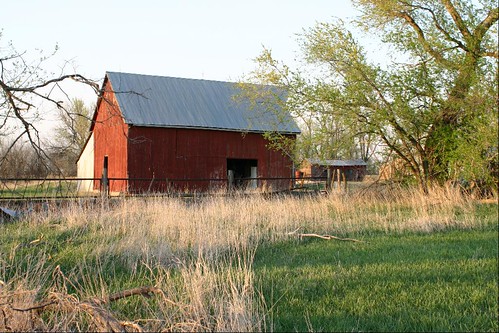
img_2575

About 80 years ago, a Kansas family -- the Janzens -- built this barn.

About 60 years ago, my grandparents moved onto the farm. Their cattle were kept right here. I remember Grandpa's red tractor being parked in the barn.

So many memories have this barn in the background. We had a visit from one of the Janzens that lived here as a child. He had fond memories of this building. My dad and his siblings once played in the deep snow in front of this barn.

Here's one memory from those times:
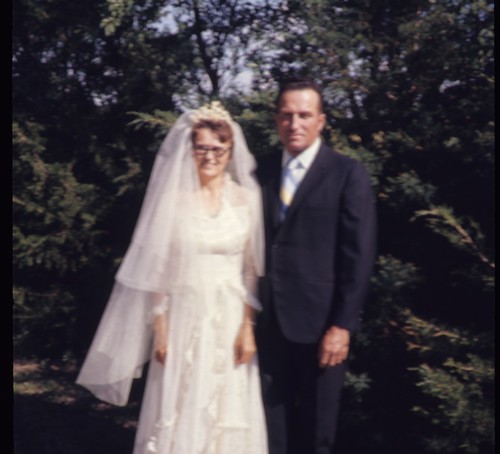
078.jpg

That's my grandma and grandpa on their 25th anniversary in 1970. It was a working barn back then, so they probably weren't standing right next to it for this picture, if you get my drift. But they were on the yard.

About 25 years ago, Grandma lost her battle with cancer. At some point or another, Grandpa had eased out of farming, so the barn had a lot less activity. I remember exploring his outbuildings when I got bored at family gatherings. And I used to mow the lawn next to it every summer when Grandpa went off to be a cook at a camp. I didn't mind mowing next to the barn. But I always tried to go past one corner of the house as fast as I could, because there were wasp and hornet nests right there.

About 7 years ago, it was time for Grandpa to move off the farm. It was getting to be too much to keep up the old house, the barn, the yard, and deal with things like freezing water pipes and water getting in through the windows. He moved to an independent-living duplex in town. He was always worried about what would happen to the farm. Over the next few years, the farm would sometimes be vacant, sometimes have renters. Some renters did some work on the house, but the barn sat. Grandpa would eventually move into the nursing home because of his Parkinson's.

Two and a half years ago, Grandpa passed away. I shared some memories from Grandpa's place at the funeral.

But what of the house, the farm now? Renters went, and it sat empty. Nothing was in great shape, and the house needed a lot of work. Perhaps the whole place would be leveled and turned back into the prairie that it once was, or used as farmland. Perhaps someone would have an interest someday.

A year and a half ago, Jacob was on the way. Terah and I had occasionally thought of buying Grandpa's place, but we never talked about it seriously. We figured that we better finally decide what we're doing, before we have a baby around, or a child in school. So in April 2006, we went out to the farm and checked it out. The picture at the top of this post is from that visit. Terah and I checked out the house, the barns, the granary, the pasture, and the creek. As we walked past one of the barns, a pigeon flew out. Terah jumped with a shout. I grew up around barns and didn't really notice it. In the big red barn, besides Grandpa's tractor, we found some remnants from years ago: some old bales, corn cobs that raccoons had found long ago, several generations of electric fencers, old appliances.

And we decided to go for it and buy the farm. This was right at a year after Grandpa died.

The family always liked to get together for Easter. What would happen for 2006? Well, they decided to have a picnic out at the farm. It was vacant, and a bit eerie. Yet they knew that we were working on buying the place and moving in. All but one took a last look through the house before our renovations began. The one person who didn't was my great aunt, Grandma's sister. She said, "I haven't been in this house for years. I remember how it looked back then. I don't want to remember how it looks now, run down like this. So I'm not going in. But once you have it all fixed up, THEN I'll go in!"

In June of 2006, we bought the farm.

One month later, we lost this barn, and two other buildings, to a fire at our yard. This is what the beautiful red barn looked like that sad afternoon last year:
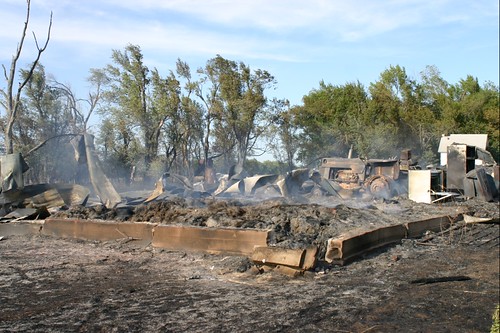
IMG_3630.JPG

As I wrote back then, nobody got hurt, the barn was insured, but "somehow, despite all these things, it still feels like we lost a little bit of Grandpa today."

2006 was a hot, dry summer. We had a patch of debris, then a patch of dirt, where the barn once stood.

7 months ago, Terah, Jacob, and I moved out to the farm. For the first time in 80 years, someone could stand in the farmhouse in the evening, look to the west, and see the colorful Kansas sunset over the pasture; the trees down by the creek; and even the neighbor's barn off in the distance. It was a beautiful sight, but it was also sad; that's not the view we had expected.

But then a surprise. This spring and summer, plants started coming up where none had grown for 80 years. But only where this barn stood -- not where the other two buildings were.

We watched as they grew tall. I'm sure decades of animals hanging out there were well appreciated by the plants.

As they grew, it looked like we might be seeing Terah's favorite flower: wild Kansas sunflowers.

And sure enough, they were.

Last weekend, Terah, Jacob, and I went out to the old barn. I took some pictures of its new appearance.

img_3429.jpg

This one stands where Grandpa's tractor used to be parked.

img_3401.jpg

And here we see a lifetime of flowers, from the old and withering, to the young just about ready to bloom.

img_3462.jpg

At the edge of the sunflowers, there's an old plow next to them. Though you might think it's barn-colored.

img_3411.jpg

Animals continue to be attracted to the area. Here's one of the smaller visitors.

img_3447.jpg

And here's a picture of almost the whole patch, right where the barn used to stand. I still mow right up to it.

I still miss the old barn. But somehow it still seems to be full of surprises and worth exploring. I wonder what next year will bring.

And I wonder if, a few years from now, Jacob will tell his friends about mowing right up to the sunflower patch, going fast to try to avoid any trouble with the bees.

30 August 2007

Michael Janssen: In my own head consume, I sit down in my room

Lately I have been tasked with a lot of writing to do. I'm writing a chapter for a book on the field that my research is in, which is a good thing for me to get done, but I started it quite late. I had to finish a 9,000-12,000 word chapter in 2 weeks. Here's how I set it up:
  1. For the first week, write 2,000 words each day.
  2. For the second week, edit the words already written.
The first half of the schedule was easier than I thought it would be. In general, writing in my field doesn't usually happen that fast, but the subject is something I'm pretty versed in, so it was not too hard to get 2,000 words out. I had a clear defined goal for each day that once I met, I could feel okay about not working on the project for the rest of the day. I also only had to write 6 days, and I was able to take the seventh day off. Both of these combined made it a lot easier to not feel guilty about being behind. Editing is a bit more abstract and ongoing than the writing part, so it's hard to tell how well it's really going. There are some easy parts like fixing grammar and proofreading to make sure you don't repeat yourself, but there are also a good portion of hard parts as well, like which sections to cut a bunch of words in, and which word choice should be made in a particular spot. I'm at the point where some things NEED to be cut because the document is too long, so I have to make some hard choices. I also met with my advisor last week and we discussed my progress toward finishing my Ph. D. I had been thinking about this problem for a while now and was glad that it was also on his mind as well. We agreed that I would set the goal for having my orals done by the end of this year (christmas). I am thinking I will use a similar tactic to the chapter that I am writing, but on a much slower schedule, so next week I will start writing 500 words a day, and do that for a couple months. This will leave me with 30,000 words that I will then edit down by quite a bit, reducing it by almost half. Hopefully this will make the process easier as it has for the chapter. If writing my thesis proposal works well this way, I hope I can use a chunk of it for the final thesis, which I want to finish one year after my orals, putting me on track for graduating at the end of 2009. I'm looking forward to that.

Russell Coker: Identifying the Distribution of a Linux System

I just needed to test something so I mounted the filesystem of one of my Xen domains in the Dom0 and chroot’d into it (I didn’t need the overhead of running a DomU for a quick test). Then strangely I found that my chroot environment had no apt-get and no dpkg installed. After a small amount of thought I realised that I had accidentally mounted the filesystem for a Fedora image instead of a Debian image. It seems to me that it might be a good idea for distributions to have shell scripts replacing the package tools for other distributions. For example dpkg on a Fedora box could be a shell script that runs echo “This system is running Fedora, you want to use rpm instead of dpkg”. Such a command would have saved me a couple of minutes of thinking. This may sound trivial, but if you consider the number of people who make such mistakes (and the even larger number of people who don’t realise that there is even more than one package tool in existence) then wasting a few K of disk space on every system to help them seems like a good idea. The minimum size of new hard drives that you can purchase seems to be 36G nowadays. So it’s not as if this would really cost anything. Please leave comments to tell me if I’m being sensible or silly. If the idea is regarded as good I’ll start filing bug reports.

Nacho Barrientos Arias: Example: How to statically and dynamically link your executables

People usually uses Google, among other things, to look for hints about how to do small tasks. Hopefully, you will find the hint you were looking for in somebody’s blog, because he or she had the same problem time ago and decided to talk about it. Last night, I was a bit bored and started writing a dumb set of files to introduce people how static and dynamic linking work, so trying to put my two cents and add a new hint to the wild wild web, I’m sharing it. The C source files are practically useless, therefore pay attention to the Makefile, the magic is in there. If you’re downloading it only to compile, execute and see what happens forget about it, the program is completely silly. Otherwise, probably the Makefile is buggy somewhere so bug reports are welcome. For teaching purposes, try, for example, breaking the ABI and see what happens. Google, index this post please! Update: This example does not cover autotools/libtool

Enrico Zini: gpl-and-business-faq

GPL and Business FAQ I sometimes happen to be in a dialogue like this:
X: According to GPL, you can sell copies of your software at any price you want, right? Me: Right. X: But your customers can in turn sell copies of your software at any price they want, right? Me: Right. X: So, the only way a GPL developer can make money is by charge for development of their software? Me: Not only for development: also for maintenance, improvements, customisation, installation, training, gadgets, support...
The market is quite big, actually. In fact, one can even make business by selling the software in a box, if one makes a box that people would like to have (for example, including things like useful documentation, a few gadgets, a support contract and a pony). The idea is that the business of selling software alone is a useless extortion that provides no particular benefit to the user (and in many cases, no particular benefits to the developer either). If you put that aside, there is a plethora of ways to charge the customers more, and for things and services that are useful to them and make them happy. Actually, if you develop a GPL software for someone who is then happy about it, they may then pass it on to other people in the same sector. Who then maybe need help with installation, support, maintenance, custom features, training, gadgets and ponies. If your software hits the spot, a niche market can end up growing by itself. The last discussion on this topic then ended up with another question:
X: Ok. But to do a good job you have to be many people at once: for example you sometimes need to be a sysadmin as well as a developer. Me: Yes. Being many people at once is what starting a company is all about.
He complained that answers like these could not be found in the Selling Free Software article of FSF: in the meantime I'll publish them here. The license of this post is GPL. The FSF and any of their regional chapters are welcome to use all or part of this text, with or without modification as they see fit, alone or included in documents that use any license they see fit, even some of the not really free ones they use sometimes, such as the one used by Selling Free Software itself :-P

Theodore Ts'o: On the benevolent dictator model

Recently, Josh Berkus blogged about The Myth of the Benevolent Dictator. In it he complained about people who try to posit that a benevolent dictator was "an unalloyed asset" to their project, and that there were many successful and valid forms project governance other than the singleton project leader. Furthermore, he argues that the best way is to form a community, and then ends by suggesting that people who say "dictatorship good" is really saying "democracy bad", and perhaps the motives of the person using that argument should be questioned.

Given that I was one of the first people (and probably the first person) to use that phrase to describe Linus's governance model, obviously I feet the need to respond to his thoughts on the matter.

First of all, the term "benevolent dictator" comes from an old saying, "the best form of government is the benevolent dictator --- there's only one problem, finding the benevolent dictator"[1]. And in my presentations where I explained the Linux project management model, I was always careful to say that there were other models that were used by other projects, and that it was interesting to study why certain management models worked for some projects but not others.

So by definition, if a project is successful with a single project leader ultimately responsible for making decisions to settle conflicts, then that leader is a "benevolent dictator"; if they aren't successful, then that would be an example of a dictator who wasn't able to be "benevolent", eh? :-)

In all seriousness, though, I agree with Josh when he says that the key part of an open source project being successful is gathering together a healthy community. But let's unpack that a little. In order for a community to be healthy, there needs to be general consensus on the values and cultural norms for that community. So for example, in the case of Debian, which Josh holds up as a successful community, not everyone has the ability to vote; you have to pass a fairly stringent process which tests your technical skills and your willingness to subscribe to Debian's core values as embedded to the Debian Social Contract. People who do not pass the New Membership process do not have the right to vote in Debian, even if they are the most rabid, fanatical users of Debian.

This brings up a key point about governance analogies; they all don't map cleanly into the real world for two closely related and extremely important reasons: (1) No one has a fundamental human right to be a member in some OSS project, and (2) No one is forced to stay in a particular OSS project. These are really two sides of the same coin, and what it means is that, as in Debian, "democracy" does not mean that everyone is entitled to political franchise, or the right to vote, and in a project which has a "benevolent dictator", the powers of the dictator is fundamentally limited by the simple fact that if he is too unreasonable, people are always free to leave or fork the project. These differences are extremely important when trying to reason about "democracy" or "dictatorship" as being good or bad as applied to open source projects.

Democracy is rarely the best way for an open source project to make decisions. For technical issues, you want the right answer, and majority vote isn't necessarily way to resolve a technical issue. As far as policy decisions, if the decision can not be made by consensus, then some percentage of the community will be unhappy with how the decision, and that can cause a huge amount of arguments and dissension. If the community has very clearly expressed values, then the number of times where such votes need to be made will be minimal.

For example, Debian has an explicit declaration of its values and mission in its Debian Social Contract; people who don't agree to the Social Contract aren't allowed to become Debian Developers and thus are not allowed to vote. But, one of the more controversial disputes that have threatened to tear apart Debian is the question of the non-free packages, and that's fundamentally because of an ambiguity in the Social Contract. On the one hand, Debian has declared that it is fundamentally 100% about Free Software, to the extent that it has adopted Richard Stallman's rather petulant request that the Linux operating system be called GNU/Linux (which admittedly is better than Lignux.) On the other hand, the Social Contract also explicitly specifies the existent of the non-free section in the distribution. Over time, this ambiguity have been the source of a lot of highly passionate debate and controversial votes that have satisfied neither the FSF fanatics nor the more Linux-like moderate position tolerating the use of proprietary as well as open source software. I submit that if Debian had either explicitly stated an FSF-centric position, and only accepted members that supported point of view, or explicitly subscribed to a position that users should be able to use whatever software they feel meets their needs, as Ubuntu has, it would avoided many arguments that have threatened to tear apart Debian.

More recently the fact that the Social Contract has been silent about whether or not Debian Developers should be paid or purely be 100% volunteer. This was never an issue in the Linux Kernel community, but for some reason it has been a highly divisive and disruptive issue inside Debian. Democratic votes have not really resolved the conflicts, and in fact some might claim that these votes have if anything hardened various Debian Developers' positions.

Going back to Josh's final point, "Next time you hear the words 'benevolent dictator' you probably want to think about the motives of the person saying it. Because the corollary to 'dictator good' is 'democracy bad', and is that a place you really want to go?", I am quite proud to stand by my convictions that for Open Source Projects, pure democracy is a bad idea. If a projects wants to be technically successful, it needs to be a meritocracy, and chose the best technical decisions; Linus does not decide by abiding with majority vote whether or not a patch should be accepted, and that's as it should be.

Even Debian's "raw democracy" doesn't let any random luser get to vote on who should be the Debian Project Leader. Decisions need to be made by people who are competent to make a valid choice. Even in real life, one could argue that the choice made by Americans, over of which 70% believed that Saddam Hussein was "very likely" or "somewhat likely" to be personally involved with the 9/11 attacks even though there has been absolutely no evidence to support this "gut feeling", made a rather disastrous choice in voting to re-elect George Bush to the presidency. Democracy without sufficient education, literacy, and intellectual curiosity to learn about what is happening in the world can result in truly disastrous choices being made. So certainly, democracy is not a panacea. In the real world, it may be the best choice of many bad choices, given how much people have suffered under military dictatorships. However, in the Open Source world, things are different because people are always free to leave one project and affiliate with another --- not an alternative most people living in dictatorships have historically had. Given these key differences, I think it is clear that for open source projects, democracy is indeed often a bad idea, and that if you if a project has a single person with a strong technical vision and good interpersonal skills, the benevolent dictator model can indeed be a very viable and successful.

Does that mean that other forms of governance can't work? Of course not! The rotating dictatorship used by Perl[2], the core-team-with-strongarm leader used by OpenBSD, the corporate dominated scheme of MySQL, the self-selecting core team model of Samba, all are successful models. I just have to strongly disagree with Josh's claim the single strong leader approach is somehow inferior to "democracy" as if democracy was somehow a magic bullet.


[1] For am early example of this quote, nine years ago, please see this message, where I'm pretty sure I authored the colon prefixed quote, and I know I was using the term "benevolent dictator" much earlier than 1998.

[2] In the early days of Perl, it also used the benevolent dictator model. Larry Wall is a great exemplar of how someone who has a strong vision of what he wanted to accomplish, and was humble and easy to work with, both on-line and in person, can make all the difference in the world for an up-and-coming open source project.

29 August 2007

Russell Coker: The Silly BMW 745h

BMW has released a new prototype hydrogen powered car. The bmwworld.com web page about it claims the cruising range is 190 miles. Added to the 400-mile range of the normal fuel tank, the 745h can go 600 miles between fill-ups. The first issue is that 10 miles are not accounted for (maybe it finishes the 190 miles of hydrogen power at the top of a hill). But more seriously the hydrogen needed to drive for 190 miles would take as much space as petrol needed to drive for 646 miles (hydrogen needs 3.4* the volume to store an equivalent amount of energy). I wonder if that BMW has any space left in the boot/trunk? Now we have some green bloggers praising BMW. An internal combustion engine that burns hydrogen will not give no emissions other than water vapour, it will produce some nitrogen oxides. The processes to produce hydrogen for fuel all consume unreasonable amounts of energy (more than is required to charge a plug-in hybrid). BMW demonstrates their level of interest by giving the cars to some celebrities. This gets some PR but no analysis of the performance. They also introduce the prototype based on one of the most expensive models (the 745) which you almost never see on the roads. If they produced a 318 or 520 that ran on hydrogen it would demonstrate some level of interest in getting this working for the mass market. If BMW wanted to make their cars more environmentally friendly they would start by adopting some of the technology from the Prius. Rumour has it that part of Toyota’s plan to make money from Prius development is in licensing the technology that they patent. A couple of years ago I test drove a BMW 316 and a Prius. The Prius was very quiet and gave a smooth ride (you might call these luxury features), and also gave decent performance (it’s widely regarded that luxury cars should perform well - pity the BMW 316 is a slug). In Australia the concept of “badge engineering” of cars is well established. When government subsidies favoured large manufacturing runs the Ford Laser and Mazda 323 were essentially the same car. Maybe BMW could adopt this concept and sell a re-badged Prius i-tech with a few extra luxury features as a BMW 4 series (it’s a much better car than the 3 series BMW). Finally bmwworld.com has an amusing FAQ about hydrogen power, here are some of the mistakes that they make:
  1. They say “About 45 billion kilograms (50 million tons) [of hydrogen] is produced every year enough hydrogen to fuel 250 million fuel cell cars“, but only if the average fuel-cell car uses 180Kg of fuel per year. According to Wikipedia hydrogen has slightly more than 3* the energy density per mass than petrol, so 180Kg of fuel would be equivalent to 540L of petrol per year. The Australian Bureau of Statistics states that in 1996 the average annual distance travelled by car (it’s not clear whether this is per car or per person) was 14,600Km while among the countries listed the lowest was Japan with 10,130. When efficiently using hydrogen in a Prius (that is quoted as using 5.4L of petrol per 100Km) you might expect that 540/5.4*100=10,000Km could be travelled on the 180Kg of hydrogen. So the FAQ claim that 250M cars could be powered by the current hydrogen production would only apply if the cars are of Prius efficiency and driven the typical distances of Japanese drivers, or the cars were 46% more efficient than the Prius and driven in the Australian manner. Of course in the US things are even worse with 17,862Km being the average distance driven which means that their hypothetical fuel-cell car would need to be 78% more efficient than a Prius.

  2. They state that “the majority of merchant hydrogen is produced by a process called steam methane reforming“. Why not just run cars on methane then? Anything that burns can be used to fuel cars, and methane has a much higher boiling point than hydrogen so it would be easier to store and transport (see the Wikipedia page on methane).

  3. In regard to hydrogen production they say “about 95% of the total global hydrogen production is captive meaning it is used at the site where it is produced“, that is of course because it’s difficult and expensive to transport hydrogen.

  4. The final amusing fact is that it is noted that most hydrogen comes from fossil-fuels. What problem are they trying to solve here? Hydrogen isn’t going to help the environment if it comes from fossil fuels, it will be more expensive than other fuels. Apart from getting government grant money for BMW it doesn’t seem to do any good.

Gunnar Wolf: Gl cklich in sterreich!

Good comrades, great chat, greater motivation.
Some good Scotch whisky, a good friend who was lumped along with me in .br by mere chance. A very good time.
A strong whisky aftertaste and numbness in the mouth. My first couple of pages of Terry Pratchet - Thanks a bunch!
My mind wanders, I go over all the nice and dear things and people
Maybe tomorrow I should restart my reading? I know Pratchett is not supposed to make much (rational) sense, but still... Although I've enjoyed this couple of pages, I'd rather let the whisky wear out before continuing with the gollem owner's life and tribulations, with his friendly treatment for his plausible but honorable assassin...
Today I saw quantum superpositions mixed with special relativity in a small (less than 200 lines) Perl module. Positronic variables go back in time, yay! Damian Conway rules.
Time to sleep, yes, if tomorrow you want to be in time for the lightning talks. Oh, BTW: great honor, great honor: One of the lightning talkers requested /me to sit on the front row "to have a friendly face to look at". Have to comply, have to do.
But... Last reflection before going away: What a better way to describe bliss in Vienna (oder auf Deutstch, ich glaube - gl cklich in sterreich;) than to go to sleep while listening to the neighbour's fucking-loud music? Of course, his fucking-loud-music is just the-Balkan-music-you-seem-to-love, so everything's berfine!
Thanks to everybody who made this possible. Specially to the Austrian friends.

David Welton: "Playing fetch" with DocBook

A while ago I wrote about the idea of "playing fetch" - meaning chasing after programming "sticks" that are basically makework. I am starting to get the feeling that the documentation system that I chose for Hecl is one such stick. I've been trying to document that lcdui commands that Wolfgang created last year. They're really cool, and give you access to pretty much everything you can do from Java, but cranking out these docs is sure time-consuming. Here's an example:
<refentry id="lcdui_date">
  <refnamediv>
<refname>lcdui.date</refname>
<refpurpose>Date/Time widget for lcdui forms</refpurpose>
  </refnamediv>
  <refsynopsisdiv>
<cmdsynopsis>
  <command>lcdui.date</command>
  <arg choice="opt">
    -date
    <replaceable>date/time in seconds</replaceable>
  </arg>
  <arg choice="opt">
    -label
    <replaceable>label</replaceable>
  </arg>
Once you finally slog through and create the documentation, it's very flexible, because you have not created just formatting instructions, but actually described each piece of the text. But... look at how often things get repeated. Aside from the repetitive XML tags, lcdui.date is more or less there three times. Ugh. Emacs + psgml mode helps some, but I still get the feeling I got suckered into doing something that should only be attempted by Big Corporations or at least large, well established projects that can afford to send people off to spend lots of time producing this kind of documentation.

Jeff Bailey: Ready to ride again!

We're in Albuquerque, NM now and have been for a couple of days. We made such excellent time across Oklahoma and Texas that we were able to stop and take a break for three nights.

Texas: Holy *crap* is Amarillo a dirty place. We spent three times what we've spend on any hotel this trip in order to get a place that we were sure was insect-free. And what we wound up with was a place over top of a bar. Luckily it wasn't all country, so we didn't mind too much. It was also (surprisingly) the best breakfast I'd had on the trip. They did hash-browns on a griddle, and had lots of ketchup (do I have to spell it catsup now?), tabasco, and pepper to go on it. Weirdly, they also had pre-mixed peanut butter and honey. Otherwise, the truck stop we stopped at had cockroaches on the floor, the bottled-water bottles were dirty on the outside, and the place smelled like an airport tarmac.

We left early and headed out to Albuquerque. Aside from the fact that whoever laid out the roads was certainly drunk at the time (We drove around in circles three times trying to get to a hotel we could see, but not find a way to legally drive to before giving up and going to a different hotel) this place is really pretty. I came here for my last meeting as a Regional Organising Consultant for Young Adult and Campus Ministry and got a chance to see a bit of the place and really wanted to show it to Angie. Instead we decided we'd had enough of driving and traveling. This hotel has laundry facilities and the town has a Whole Foods Market, so we stocked up on microwaveable foods, washed our clothes, watched TV and I finally finished Harry Potter during a nice long bath.

The next day (Yesterday), we headed out to the Puebo Cultural Centre to see the art pieces and learn a little about their successful resistance against the spanish resulting in actual land grants to the 19 local groups. We also got to see how different groups have influenced them over the years, with ancestry tracing something like 12,000 years back. From there we managed to find the old town and got to see the type of architecture that I wanted to show Angie. The little pink houses don't *just* exist in DisneyLand. ;) We went to a restaurant that looked really familiar - I think we ate there when I was here last. We had some wonderful New Mexico food and I introduced Angie to what the local sopapillas are like. Here's they're large puffy things, whereas the sopapillas in Texas and back home look like soft tortilla chips.

I've started uploading some pictures to Flickr, but it turns out that I hadn't done so since before Juniper's wedding and have over 400 pictures to send. Between hotel wireless being slow and f-spot being a fragile piece of crap I managed to upload something over 100 pictures of Leif to the family-only archives before giving up. I'll probably post the Opus pictures up on Facebook rather than flickr so that it's easier for other Opusers to find them

The next target is Flagstaff, AZ for Thursday night. We're meeting Karina and her husband for a day of wandering around the Grand Canyon, so we'll see if there's some interesting things between here and there. I suspect there will be. =)

*hugs*, all! Less than a week until I start my new job! I'm excited!

Next.

Previous.