Search Results: "ag"

5 May 2012

Dirk Eddelbuettel: RcppArmadillo 0.3.0.3

Two days ago, Conrad Sanderson released another bug-fix version 3.0.3 for the 3.0.0 branch of his excellent Armadillo C++ template library for linear algebra. The new RcppArmadillo release 0.3.0.3 which contains it appeared on CRAN yesterday. Beside Conrad's bugfixes we also added an example script for fastLm and faster linear model fits. The short NEWS entry follows below.
0.3.0.3 2012-05-03
    o   Upgraded to Armadillo release 3.0.3
          * fixes for inplace transpose of complex number matrices
          * fixes for complex number version of svd_econ()
          * fixes for potential aliasing issues with submatrix views
    o   New example script fastLm 
Courtesy of CRANberries, there is also a diffstat report for 0.3.0.3 relative to 0.3.0.2 As always, more detailed information is on the RcppArmadillo page. Questions, comments etc should go to the rcpp-devel mailing list off the R-Forge page.

Ritesh Raj Sarraf: Cancer cure drugs now more affordable

Now these are the kind of moves that needs to happen more often. Whether this will cause a negative impact on the overall market, and the further invention of drugs (including patent control), but the affordability of the medicatoin to an average citizen is a great move.The typical Chemotherapy can be on an average of 22 times. When summed up with the dosage (somewhere around 250 mg IIRC), the cost comes to approx: (22/4) * 15000 = 82k, which now, will be affordable at 27k.I guess the price slash is only for India and am not sure what the impact to the global market will look like.Quoting the article: http://www.moneycontrol.com/news/business/cipla-drug-price-cut-not-to-hurt-revenue-much-say-analysts_700380.html

Cipla cut price of its kidney cancer drug Sorafenib, which is sold under brand name Nexavar by multi-national Bayer to Rs 6,840 for a month's supply, from around Rs 28,000 earlier. Its lung cancer drug Gestinib, which is sold under brand name Iressa by AstraZeneca will cost Rs 4,250, versus Rs 10,200 earlier, and price of Temozolamide used to treat brain tumour, has been reduced by Rs 15,000 to Rs 5,000.

India's Patent Office recently issued a compulsory licence allowing Natco to make a generic copy of Sorafenib, on the payment of a royalty to Bayer, which sells the drug at around Rs 2 lakh.

Domestic sales account for 46-47% of Cipla's total sales and of that the cancer drugs portfolio is a very small portion, so these price cuts are unlikely to have any major impact on its revenue, Hitesh Mahida of Fortune Equity Brokers told moneycontrol.com

"Cipla's idea seems to be to create disruption in the market, increase its market share..." the analyst says.

Swiss pharma major Roche had earlier this year signed a manufacturing deal with India's Emcure Pharma so that its anti-cancer drugs Herceptin and MabThera could be made in India at affordable prices. Analysts say Cipla's move to slash prices could in future deter some MNCs from launching their drugs in India at all, but some may also look at doing deals like the one struck by Roche.

Meanwhile, shares of pharma major Cipla surged over 3% on Friday after brokerage CLSA upgraded the stock to "outperform" from "underperform," saying, Cipla would be strongest beneficiaries of a weakening rupee.

The rupee has been sliding sharply against the US dollar in recent days and hit over four month low of around Rs 53.78 earlier in trade.

"We expect improving margins over the coming quarters on back of a weak rupee and a low base. We expect strong operating profit growth over coming quarters led by margin expansion and high margin product supplies," CLSA's Hemant Bakhru said.

The US Food and Drugs Administration has approved Meda's drug Dymista for allergic rhinitis and the product is widely expected to reach USD 300-500 million in annual sales over the coming years. The analyst says Cipla being a partner, will benefit through product supplies over a longer term.

"Apart from approval (outside North America) related milestone payment (US$5m), we expect gradual increase in Cipla s sales from product related supplies to Meda. Assuming Cipla supplies product at 10-15% of sales, it could earn US$50-75m at peak sales," Bakhru said.

Additionally, a low base in domestic formulations could result in reasonable India growth, he adds.

Cipla shares were up 2.8% at Rs 326.60 on NSE in noon trade.

Keywords:

Russell Coker: Liberty and Mobile Phones

I own two mobile phones at the moment, I use a Samsung Galaxy S running Cyanogenmod [1] (Android 2.3.7) for most things, and I have a Sony Ericsson Xperia X10 running Android 2.1 that I use for taking photos, some occasional Wifi web browsing, and using some applications. Comparing Android Hardware The hardware for the Xperia X10 is better than that of the Galaxy S in many ways. It has a slightly higher resolution (480*854 vs 480*800), a significantly better camera (8.1MP with a flash vs 5MP without), and a status LED which I find really handy (although some people don t care about it). The only benefit of the Galaxy S hardware is that it has 16G of internal storage (of which about 2G can be used for applications) and 512M of RAM while the Xperia X10 has 1G of internal storage and 384M of RAM. These are significant issues, I have had applications run out of RAM on the Xperia X10 and I have been forced to uninstall applications to make space. Overall I consider the Xperia X10 to be a significantly better piece of hardware as I am willing to trade off some RAM and internal storage to get a better resolution screen and a better camera. The problem is that Sony Ericsson have locked down their phones as much as possible and they don t even give users the option of making a useful backup they inspired my post about 5 principles of backups [2]. The fact that the Galaxy S allows installing CyanogenMod which then gives me the liberty to do whatever I want with my phone is a massive feature. It outweighs the hardware benefits of the Sony Ericsson phones over Samsung phones prior to the Galaxy Nexus and Galaxy Note. For an individual user the ability to control their own hardware is a feature. Such an ability wouldn t be much use if there wasn t a community of software developers, so if you buy an Android phone that isn t supported by CyanogenMod or another free Android distribution then whether it is locked probably won t matter to you. But for any popular Android phone that s sold on the mass market it seems that if it s not locked then it will get a binary distribution of Android in a reasonable amount of time. Comparing with Apple It seems that Apple is the benchmark for non-free computing at the moment. The iPhone is locked down and Apple takes steps to re-lock phones that can be rooted as opposed to the Android vendors who ship phones and then don t bother to update the firmware for any reason. The Apple app market is more expensive and difficult to enter and if an app isn t in the market then you have to pay if you want to install it on a small number of development/test phones. This compares to Android where the Google market is cheaper and easier to enter and anyone can distribute an app outside the market and have people use it. But for an individual this doesn t necessarily cause any problems. I have friends and clients who use iPhones and are very happy with them. In terms of software development it s a real benefit to have a large number of systems running the same software. As Apple seems to have higher margins and larger volume than any other phone vendor as well as shipping only one phone at any time (compared to every other phone vendor which seems to ship at least 3 different products for different use cases) they are in a much better economic position to get the software development right. As far as I can tell the hardware and software of the iPhone is of very high quality. The iPad (which has a similar market position) is also a quality product. The fact that the Apple app market is more difficult to enter (both in terms of Apple liking the application and the cost of entry) also has it s advantages, I get the impression that the general quality of iPhone apps is quite high as opposed to Android where there are a lot of low quality apps and many more fraudulent apps than there should be. The lack of choice in Apple hardware (one phone and one tablet) is a disadvantage for the user. There is no option for a phone with a slide-out keyboard, a large screen (for the elderly and people with fat fingers), or any of the other features that some Android phones have. The lack of a range of sizes for the iPad is also a disadvantage. But it seems that Apple has produced hardware that is good enough for most users so there aren t many complaints about a lack of choice. It seems to me that the biggest disadvantage of the closed Apple ecosystem is for society in general. Anyone who wants to write a mobile app to do something which might be considered controversial would probably think twice about whether to develop for the iPhone/iPad as Apple could remove the app at a whim which would waste all the software development work that was invested in writing the app. Google seem to have much less interest in removing apps from their store and if they do remove an app then with some inconvenience it can be distributed on the web without involving them so the work won t be wasted. How Much Freedom Should a Vendor Provide? The Apple approach of locking everything down is clearly working for them at the moment. The Samsung approach of taking the Google prescribed code and allowing users to replace it is good for the users and works well. The Sony Ericsson approach of taking the Google code, adding some proprietary code, and then locking the phone down is bad for the users and I think it will be bad for Sony Ericsson. People are more likely to tell others about negative experiences and negative reviews are more likely to be noticed than positive reviews. So while many people are reasonably happy with Sony Ericsson products (until they find themselves unable to restore from a backup) it s still not a good situation for Sony Ericsson marketing. It seems that there are benefits to hardware vendors for being really open and for locking their users in properly. But being somewhat open isn t a good choice, particularly for a vendor that ships poor quality proprietary apps such as the Sony Ericsson ones. In terms of application distribution Google isn t as nice as they appear. The Skyhook case revealed that Google will do whatever it takes to prevent apps that compete with Google apps from being installed by default [3]. Google is also trying to make money from DRM sales via Youtube which it denies to rooted phones [4]. Again it seems to me that the best options here are being more open than Google is and being as closed as Apple. Google might gain some useful benefits from applying DRM (even though everyone with technical knowledge knows that it doesn t work) but the Skyhook shenanigans have got to be costing Google more than it s worth. How to make Android devices more Free The F-droid market is an alternative to the Google App market which only has free software [5]. On it s web site there are links to download the source for the applications, including the source and binaries for old versions. In the Google App market if an upgrade breaks your system then you just lose, with F-droid you can revert to the old version. A self-hosted OwnCloud installation for a private or semi-private cloud [6] can be used as an alternative to the Google Music store as well as for hosting any other data that you want to store online. The Open Street Map for Android (Osmand) project provides an alternative to the Google Map service [7]. Osmand allows you to download all the vector data for the regions you will ever visit so it can run without Internet access. But it doesn t have the ability to search for businesses and the search for an address functionality is clunky and doesn t accept plain text, which among other things precludes pasting data that s copied from email or SMS. While Osmand provides some important features that Google Maps will probably never provide, it doesn t provide some of the most used features of Google Maps so uninstalling Google Maps isn t a good option at the moment. The K9mail project provides a nice IMAP client for Android [8]. Use K9 with a mail server that you run and you won t need to use Gmail. There are alternatives to all the Google applications. It seems that apart from the lack of commercial data and search ability in Osmand an Android device that is used for many serious purposes wouldn t lack much if it had no Google apps. Google seems to be going too far in controlling Android. Escaping from their control and helping others to do the same seems to be good for society and good for the users who don t need apps which are only available in proprietary form. Related posts:
  1. Dual SIM Phones vs Amaysim vs Contract for Mobile Phones Currently Dick Smith is offering two dual-SIM mobile phones for...
  2. My Ideal Mobile Phone Based on my experience testing the IBM Seer software on...
  3. Old Mobile Phones as Toys In the past I have had parents ask for advice...

Wouter Verhelst: First-rate Linux support by Xerox

When buying hardware for a Linux system, often we need to hunt for their support status by searching for PCI or USB IDs in the kernel source, or by looking up the printer model on the linuxprinting.org (now freedesktop.org) openprinting database, or similar things. This is something I'm used to, and not at all unexpected anymore. And after having done it a thousand times for several customers as well as for myself, it's become routine. So in that light, I was pleasantly surprised last monday when I delivered and installed a Xerox WorkCentre 3220 at a customer last week to see that they support Linux on the same level as they do Windows and MacOS: the "system requirements" part of the manual contains a section laying out the requirements for a computer running Linux, as does the "troubleshooting" section; and when there are Linux-specific bits to be said, there'll just be a Linux-specific section in the manual to tell you what to do. Also, the CD-ROM that came with the device has a Rock Ridge extension, which means that if you pop it into a Linux system you'll see an installer for CUPS and SANE drivers. The only criticism I have is that it's an installer, and not an LSB package or some such. But hey, for once I didn't have to fight to get a printer to work properly!

Bartosz Feński: sshfs is now comaintained

Since my yesterday upload sshfs is now comaintained with Dmitry Smirnov and in fact he prepared the latest upstream version which is 2.4.
If anyone else would like to join and help improve the package further then Dmitry created Git repository for that purpose.

Axel Beckert: unburden-home-dir uploaded to Sid

Most popular web browsers cause quite a lot of I/O on a user s home directory and their cache s also take up quite some disk space with Google s Chrome/Chromium you can t even configure how much disk space should be used for the cache. This causes unnecessary network traffic and no more makes sense if the home directory itself comes over the network, e.g. via NFS or Samba. And on laptops it spins up the disks and unnecessarily costs battery power and therefore lowers the potential battery life. Such caches also costs scarce disk space on SSDs or flash cards as common in laptops, netbooks and other mobile devices, and often get backed up without any real use. To take some of this burden off our NFS servers at work I started to develop an Xsession.d hook which moves off such caches to the local disk and puts in symbolic links instead into the user s home directory when the user locally logs in. This hook quickly became a standalone Perl script named unburden-home-dir and the Xsession.d hook just a wrapper around it. Due to some unsolved issues I didn t feel it s good enough for Debian Unstable, so I uploaded it just to Debian Experimental back then. Pietro Abate s recent blog posting about unburden-home-dir on Planet Debian gave me the right kick to make another try to solve the remaining issues. And the mental distance gained over the time indeed helped and I could fix the remaining issues. So I added some polish to the package and uploaded it to Debian Unstable. If you used the previous version from experimental, you have to take care of a few things: You can follow the development of unburden-home-dir also on GitHub and on Gitorious as well as on Ohloh. Enjoy!

4 May 2012

Paul Tagliamonte: gcc 4.7 patchathon part IV

S more patches today to the grooven vibes of Home Movies. Consider helping out :)

Bartosz Feński: spice

As usual if I m trying to solve some issue there is a technology that solves it.
But it s in early stage of development, poorly packaged, stable versions lack most of the features, and basically it s recommended to use git snapshots and to patch all the software that is going to use it. I m talking about usbredir and SPICE.

Michal Čihař: Ready for Weblate 1.0

I think Weblate is really ready to be released as 1.0 release. It runs pretty stable on https://l10n.cihar.com, I got some bug reports from others, but these were quickly fixed and now nobody complains. The issue tracker lists few improvements which I plan after 1.0 which will help in user experience and performance, but I see nothing what would be needed right now. So I'm ready to release (even before deadline I have set to this milestone). Anyway you're welcome to give it some testing and complain if anything is broken. One area where I desperately need feedback are checks, which probably still miss variations for some languages.

Filed under: English Weblate 0 comments Flattr this!

Michal Čihař: S chsische Schweiz

I've enjoyed past extended weekend in S chsische Schweiz. I really like this area and we've again seen there wonderful nature and climbed thousands of steps :-). The weather was not that nice for taking photos, but still I can show few of them: Niederm hle Kleiner Winterberg Aussicht Kleiner Winterberg Aussicht Kuhstahl Aussicht Bastei Bastei

Filed under: English Photography Travelling 0 comments Flattr this!

3 May 2012

Gintautas Miliauskas: Online Haskell typechecker

Last weekend I put up haskellonline.org, which is basically a thin web frontend over ghc, the Haskell compiler. It is limited to one Haskell module, but it makes the experience of studying Haskell much more pleasurable by running the typechecker in the background as you type. Plus, it is web-based - no local installation necessary!

The thing about Haskell is that it has a fabulous type system which can weed out a broad class of bugs at compile time. However, the usual interfaces with the compiler leave a lot to be desired. Vim + ghci in a terminal of course works, but I have already been spoilt by IDEs, and the "Alt-Tab; Up; Enter; wait; Alt-Tab + jump to line manually" dance does not appeal to me at all. Emacs integration might be better, but I do not know emacs well, and it is never a good idea to start learning two things at the same time.

Note: I suspect that many of the problems I encountered were due to the fact that I use MacOSX.

I have looked a few of the existing IDEs, but that did not go well. EclipseFP did not offer any benefits over a text editor at all. I found a blog post saying that implied that it would work better with a newer version of GHC. Cue a few hours of reinstalling GHC and compiling Haskell packages, and I got the system set up, but that made the situation even worse. Eclipse would simply crash on startup every time until I wiped the configuration directory clean. So much for EclipseFP.

I also tried Leksah. At least it did not crash, nevertheless, I found it quite unwieldy, especially for learning purposes. The autocompletion is broken in annoying ways. For example, if you type "f a = a<enter>", Leksah will autocomplete the second "a" into "as". It took me a while to discover an error in my program that was due to this autocorrection mechanism.

Leksah does have a "compile in background" mode, which was admittedly a source of inspiration for haskellonline.org, but the implementation is subpar. It simply invokes the compiler and simply redirects the output to a display pane on the window. As you write code, the text in the pane constantly scrolls, which is very distracting. The implementation is also buggy. Occasionally errors are interleaved with status output:


There is also tryhaskell.org, but it does not work not nearly as well for Haskell as its cousins trypython.org and tryruby.org do for Python and Ruby, respectively. All are limited to evaluating expressions, but in Python/Ruby that actually gets you a long way, while nontrivial Haskell programs are complex static structures that are unwieldy without a persistent text editor.

Despite all the trouble, which, again, probably has to do with my choice of MacOSX, these issues do not detract from the beauty of Haskell as a language. If you are interested, I can heartily recommend learnyouahaskell.com as very good reading material, and Tony Morris's course exercises (in combination with haskellonline.org) for practice.

Wouter Verhelst: Debconf

... is drawing closer again, and today I've booked my flights. I'll be arriving in the early evening on the 1st, and leaving again on the 15th. The flights will be Brussels->London->Miami->Managua, which unfortunately means I'll have to deal with US border control, but hey. Also, in order to avoid having to get up at early-o-clock on the morning of the 1st, I'll be flying from Brussels to London on an afternoon flight on the 30th, which means I'll have an evening to spare in London. While I've been there a few times before, it's not a city that I've ever actually visited; my previous three visits were limited to Heathrow, King's Cross (IIRC; could be another train station) and driving through the city on my way from (and to) Steve's barbecue last summer. If anyone will be there as well that night and would like to meet for beer and/or keysigning, I'd be interested.

Gunnar Wolf: Co-starring: Debian Tour Managua 2012!

As stated in the 2012-04-30 edition of the Debian Project News, this weekend I will be meeting Holger Levsen (who has been there for over a week now) in Managua, Nicaragua, as part of the Debian Tour 2012, a set of talks meant to raise awareness and interest on Debian between the Nicaraguan (+Central American) user groups, university students, companies and government. Not all of the planned activities are present in the Debian Tour webpage. I know I will be giving my talk on Debian in the Free Software projects' universe, this Saturday at Universidad Centro Americana (UCA). Besides this, we will be meeting on Monday with the UCA staff to discuss some DebConf-specific issues. Sunday? Well, I hope^Wfully trust we will have interesting activities as well :)

Russell Coker: Acoustiblok/Thermablok

Acoustiblok is an interesting product for blocking sound, it works by dissipating sound energy through friction within the sound barrier materiel [1]. They sell it in varieties that are designed for use within walls and for use as fences. As it isn t solid it won t reflect sound so it can be used to line the walls to stop sound being reflected back at you. It s design is based on NASA research. The web site claims that a 3mm sheet of Acoustiblok gives a greater noise reduction than 12 inches (30.7cm) of poured concrete. I am a little dubious about that claim as I ve read a report of someone using three layers of Acoustiblok to make a quiet room for recording music (and to be used as a play-room for an Autistic child). I find it difficult to imagine someone needing a meter of concrete to stop any sort of noise that they might encounter in a residential area so the fact that someone needed three layers of Acoustiblok is an indication that it might not be quite as good as they claim (although there is the possibility that Acoustiblok was badly installed). I wonder whether the claims about concrete concern particular frequencies. The technical specifications and product comparisons page [2] shows that Acoustiblok is least effective at 130Hz where it only reduces noise by 12dB and that it s effectiveness increases to 38dB at 5KHz. So perhaps a concrete wall to stop low frequencies and Acoustiblok to stop high frequencies would be the best solution. The Australian distributor for Acoustiblok is based in Brisbane [3]. The same company also sells Thermablok [4] which is the first aerogel based insulation that I ve seen being advertised for commercial sale. I guess that it must be rather expensive as they are mostly advertising it for use as thin strips to cover stud faces (steel studs conduct heat well and can cause a lot of heat loss). A note in their FAQ says that it s available in rolls for insulating entire walls or floors. The FAQ also indicates that they sell samples suitable for science classes. They are also apparently looking for retailers, it would be nice if someone wanted to sell this in Australia. Related posts:
  1. Noise Canceling Headphones My patience with the noise of airlines has run out,...
  2. Testing Noise Canceling Headphones This evening I tested some Noise Canceling Headphones (as described...
  3. I Bought the Bose QC-15 I bought the Bose QC15 noise canceling headphones for my...

Rudy Godoy: FLISOL Puno

Past Saturday April 28 I attended to the FLISOL 2012 Puno hosted at the Casa de la Cultura in downtown Puno. It was a great experience to deliver a talk after a while, the second speech since I enrolled into the UCSP s Computer and Engineering Faculty to get my Computer Science BS degree. Puno is really a nice city with a great landscape for those like me who enjoy the sun, lakes, wonderful mountains and, as it s name says, the Andes plane 3860m above sea level. Pretty high and very cold at night indeed but a lovely place. FLISOL is short for Latin American Free Software Installation Festival that just aged 12 this year. In my talk I wanted to describe the motivations behind the Free Software movement origins. I specially remarked the fact that the movement doesn t look for technical excellence, even though this is something we thrive for, rather than preserving a common set of guidelines for protecting assets we do value such software and freedom. Later I discussed about how Debian have become a key actor in the free software ecosystem. Primarily as a huge software library, second as a building block for specialized distributions (such as Ubuntu) and third, but not the last, as a facilitator for new developments and contributions to the ecosystem, and I mentioned here the Debian GNU/Hurd project. Through such topics I explained what we do, why we do it and why they may want to contribute. There was a good reception from the audience and there were many questions on the subjects I elaborated on. I was impressed to see many Debian users, some of them power users , and even tried to help one to configure his obscure Xorg settings on his laptop (didn t succeed because lack of connectivity, will send him testing CDs eventually). I d like to thank to the organization who made a great job. The team, nearly 30 students from Universidad Nacional del Altiplano plus local activists, started working in February collecting funds and managed to gather more than 330 attendees during the almost 10 hours of the event. Also special thanks for the coffee machine that was available!

2 May 2012

Uwe Hermann: sigrok - cross-platform, open-source logic analyzer software with protocol decoder support

sigrok logo I'm happy to finally announce an open-source (GNU GPL), cross-platform (Linux, Mac OS X, FreeBSD, Windows, ...) logic analyzer software package myself and Bert Vermeulen have been working on for quite a long time now: sigrok (it groks your signals). History I originally started working on an open-source logic analyzer software named "flosslogic" in 2010, because I grew tired of almost all devices having a proprietary and Windows-only software, often with limited features, limited input/output file formats, limited usability, limited protocol decoder support, and so on. Thus, the goal was to write a portable, GPL'd, software that can talk to many different logic analyzers via modules/plugins, supports many input/output formats, and many different protocol decoders. The advantage being, that every time we add a new driver for another logic analyzer it automatically supports all the input/output formats we already have, you can use all the protocol decoders we already wrote, etc. It also works the other way around: If someone writes a new protocol decoder or file format driver, it can automatically be used with any of the supported logic analyzers out of the box. Turns out Bert Vermeulen had been working on a similar software for a while too (due to exactly the same reasons, crappy Windows software, etc.) so it was only logical that we joined forces and worked on this together. We kept Bert's name for the software package ("sigrok"), set up a SourceForge project, mailing lists, IRC channel, wiki, etc. and started working. Overview, Features You can get the lastest sigrok source code from our main git repository:
  $ git clone git://sigrok.git.sourceforge.net/gitroot/sigrok/sigrok
Here's a short overview of sigrok and its features as of today. The software consists of the following components: We're happy to hear about other (maybe special-purpose) frontends you may want to write using libsigrok/libsigrokdecode as helper libs! Firmware Saleae Logic Some logic analyzer devices require firmware to be uploaded before they can be used. As always, firmware is a bit of a pain, but here's what we currently do: For non-free firmware we provide instructions how to extract it from the vendor software or from USB dumps, if possible. For distributable firmware we have a git repo where you can get it (thanks ASIX for allowing us to distribute the ASIX Sigma/Sigma2 firmware files!).
  $ git clone git://sigrok.git.sourceforge.net/gitroot/sigrok/sigrok-firmwares
Finally, for all Cypress FX2 based logic analyzers we have an open-source (GNU GPL) firmware named fx2lafw, started by myself, but most work (and finishing the firmware) was then done by Joel Holdsworth, thanks! The support list includes Saleae Logic, CWAV USBee SX, CWAV USBee AX, Robomotic Minilogic/BugLogic3, Braintechnology USB-LPS, and many others. Get the code from the fw2lafw git repository:
  $ git clone git://sigrok.git.sourceforge.net/gitroot/sigrok/fx2lafw
Example dumps We collect various captured logic analyzer signals / protocol dumps in the sigrok-dumps git repository:
  $ git clone git://sigrok.git.sourceforge.net/gitroot/sigrok/sigrok-dumps
They can be useful for testing the sigrok command-line application, the sigrok GUIs, or the protocol decoders. We're happy to include further contributed example data in our repository, please send us .sr files of any interesting data/protocol you may come across (even if sigrok doesn't yet have a protocol decoder for that protocol). See the Example dumps wiki page for details. Packages, distros, installers sigrok Windows installer I'm currently working on updated Debian packages for sigrok (will be apt-get install sigrok to get everything), and we're happy about further packaging efforts for other distros. We have preliminary Windows installer files (using NSIS), but the Windows code needs some more fixes and portability improvements before it's really usable. On Mac OS X you can use fink/Macports to install as usual, fancier .app installer files are being worked on. Future Apart from support for more logic analyzers, input/output formats, and protocol decoders, we have a number of other plans for the next few releases. This includes support for analog data, i.e. support for (USB) oscilloscopes, multimeters, spectrum analyzers, and such stuff. This will also require additional GUI support (which could take a while). Also, we want to improve/fix the Windows support, and test/port sigrok to other architectures we come across. Performance improvements for the protocol decoding as well as more features there are also planned. Contact Feel free to contact us on the sigrok-devel mailing list, or in the IRC channel #sigrok on Freenode. There's also an identi.ca group for sigrok. We're always happy about feedback, bug reports, suggestions for improving sigrok, and patches of course!

Matthew Garrett: Anatomy of a Fedora 17 ISO image

My spare time has been limited lately, so progress on producing Mac-bootable Fedora install images has been a bit slow. Thankfully it looks like everything's gong to land in time for Fedora 17[1] so hurrah for that - all that's missing right now are the last couple of patches that make sure the boot picker displays useful labels on the drives.

So how is this accomplished? Here's a hex dump of the first few K of the image.
00000000  45 52 08 00 00 00 90 90  00 00 00 00 00 00 00 00   ER.............. 
00000010  00 00 00 00 00 00 00 00  00 00 00 00 00 00 00 00   ................ 
00000020  33 ed fa 8e d5 bc 00 7c  fb fc 66 31 db 66 31 c9   3...... ..f1.f1. 
00000030  66 53 66 51 06 57 8e dd  8e c5 52 be 00 7c bf 00   fSfQ.W....R.. .. 
00000040  06 b9 00 01 f3 a5 ea 4b  06 00 00 52 b4 41 bb aa   .......K...R.A.. 
00000050  55 31 c9 30 f6 f9 cd 13  72 16 81 fb 55 aa 75 10   U1.0....r...U.u. 
00000060  83 e1 01 74 0b 66 c7 06  f1 06 b4 42 eb 15 eb 00   ...t.f.....B.... 
00000070  5a 51 b4 08 cd 13 83 e1  3f 5b 51 0f b6 c6 40 50   ZQ......?[Q...@P 
00000080  f7 e1 53 52 50 bb 00 7c  b9 04 00 66 a1 b0 07 e8   ..SRP.. ...f.... 
00000090  44 00 0f 82 80 00 66 40  80 c7 02 e2 f2 66 81 3e   D.....f@.....f.> 
000000a0  40 7c fb c0 78 70 75 09  fa bc ec 7b ea 44 7c 00   @ ..xpu.... .D . 
000000b0  00 e8 83 00 69 73 6f 6c  69 6e 75 78 2e 62 69 6e   ....isolinux.bin 
000000c0  20 6d 69 73 73 69 6e 67  20 6f 72 20 63 6f 72 72    missing or corr 
000000d0  75 70 74 2e 0d 0a 66 60  66 31 d2 66 03 06 f8 7b   upt...f f1.f... 
000000e0  66 13 16 fc 7b 66 52 66  50 06 53 6a 01 6a 10 89   f... fRfP.Sj.j.. 
000000f0  e6 66 f7 36 e8 7b c0 e4  06 88 e1 88 c5 92 f6 36   .f.6. .........6 
00000100  ee 7b 88 c6 08 e1 41 b8  01 02 8a 16 f2 7b cd 13   . ....A...... .. 
00000110  8d 64 10 66 61 c3 e8 1e  00 4f 70 65 72 61 74 69   .d.fa....Operati 
00000120  6e 67 20 73 79 73 74 65  6d 20 6c 6f 61 64 20 65   ng system load e 
00000130  72 72 6f 72 2e 0d 0a 5e  ac b4 0e 8a 3e 62 04 b3   rror...^....>b.. 
00000140  07 cd 10 3c 0a 75 f1 cd  18 f4 eb fd 00 00 00 00   ...<.u.......... 
00000150  00 00 00 00 00 00 00 00  00 00 00 00 00 00 00 00   ................ 
This is the boot sector. One of the fun things about ISO9660 is that it doesn't have a boot sector in the usual x86 sense - firmwares are expected to read enough of the filesystem that they can find the bootloader in it and run it directly. x86 isn't really smart enough to manage that, so it uses something called El Torito[2]. In any case, this is usually empty space on an x86 CD. But with an increasing number of systems shipping without optical drives, real CD installs are decreasing in popularity. We use a piece of software called isohybrid that allows the building of ISO9660 images that can be written directly onto a USB stick. Asking a machine to boot off them will execute the boot sector located here, which then loads a real bootloader that's capable of reading ISO and booting the OS. It'll just be ignored when it's on a real CD.

There's one difference here, though. The isohybrid bootsector has been modified so that the first 32 bytes are just noops, and this has been inserted:
00000000  45 52 08 00 00 00 90 90  00 00 00 00 00 00 00 00   ER.............. 
45 52 ("ER") indicates the presence of an Apple partition map. This will become important later. 0800 indicates that it's using 2048-byte sectors. The 9090 is a lie to convince the firmware that it's not a zero-sized disk without representing dangerous code. We need an Apple partition map because some older Macs won't boot off CD unless the CD has one. But it's sitting right at the start of the boot sector, and this code is going to be executed. Thankfully, the entire Apple header decodes to
00000000  45                inc bp
00000001  52                push dx
00000002  0800              or [bx+si],al
00000004  0000              add [bx+si],al
00000006  90                nop
00000007  90                nop
00000008  0000              add [bx+si],al
0000000A  0000              add [bx+si],al
0000000C  0000              add [bx+si],al
0000000E  0000              add [bx+si],al
00000010  0000              add [bx+si],al
00000012  0000              add [bx+si],al
00000014  0000              add [bx+si],al
00000016  0000              add [bx+si],al
00000018  0000              add [bx+si],al
0000001A  0000              add [bx+si],al
0000001C  0000              add [bx+si],al
0000001E  0000              add [bx+si],al
which is completely harmless - we can execute all these instructions without any interesting changes in state. They'll all be undone by the rest of the boot sector.
000001b0  14 05 00 00 00 00 00 00  4c 1e ed 76 00 00 80 00   ........L..v.... 
000001c0  01 00 00 3f a0 89 00 00  00 00 00 50 14 00 00 fe   ...?.......P.... 
000001d0  ff ff ef fe ff ff a4 00  00 00 70 04 00 00 00 fe   ..........p..... 
000001e0  ff ff 00 fe ff ff 44 05  00 00 c0 08 00 00 00 00   ......D......... 
000001f0  00 00 00 00 00 00 00 00  00 00 00 00 00 00 55 aa   ..............U. 
This is the MBR partition table. The aim here was to produce media that would boot via BIOS just as well as it does via EFI, and it turns out that there are some systems that refuse to BIOS-boot off GPT media. So we need an MBR partition map. The first entry covers the entire disk and is of type 0. This is important, because some EFI implementations are strict about MBR parsing - if there's an MBR with overlapping partitions, the entire MBR will be ignored. Inconvenient. Fortunately, we've got the source code to this code, and it turns out that partitions of type 0 are ignored when performing this check. So, there's a partition of type 0.

Why does it cover the entire disk? Once we've booted the OS, we need to be able to read the ISO image contained on the USB stick. That means the kernel needs to be able to mount it, which means we need a partition entry that covers the entire disk. Linux is perfectly happy mounting a filesystem from a partition of type 0.

So, the next partition. This is an EFI boot partition that points at the embedded VFAT El-Torito image. Some firmware will decide that we've got an MBR and so will only boot off a partition that exists in it. So, here's an MBR partition to keep them happy.

The final partition covers the embedded HFS+ image. It's there purely for convenience - it means we can access it under Linux in order to update its contents for testing purposes.
00000200  45 46 49 20 50 41 52 54  00 00 01 00 5c 00 00 00   EFI PART....\... 
00000210  09 27 93 7e 00 00 00 00  01 00 00 00 00 00 00 00   .'.~............ 
00000220  fe 4f 14 00 00 00 00 00  30 00 00 00 00 00 00 00   .O......0....... 
00000230  de 4f 14 00 00 00 00 00  2a 26 0f 37 23 c9 7f 4f   .O......*&.7#..O 
00000240  90 df 5e fe 0a 60 1c b0  10 00 00 00 00 00 00 00   ..^.. .......... 
00000250  80 00 00 00 80 00 00 00  ec 70 63 c1 00 00 00 00   .........pc..... 
00000260  00 00 00 00 00 00 00 00  00 00 00 00 00 00 00 00   ................ 
And here we have the GPT header. Nothing complicated here, other than it indicates that the first partition descriptor is at LBA 0x10, ie byte 0x2000 - that's further into the disk than normal. That leaves us enough space to fit the Apple partition entries.

Why have a GPT at all? The EFI spec says that machines should boot fine from an MBR partition. Sadly, not all seem to. It also lets us represent the HFS+ partition in a way that makes the Mac firmware happy.
00000800  50 4d 00 00 00 00 00 03  00 00 00 01 00 00 00 10   PM.............. 
00000810  41 70 70 6c 65 00 00 00  00 00 00 00 00 00 00 00   Apple........... 
00000820  00 00 00 00 00 00 00 00  00 00 00 00 00 00 00 00   ................ 
00000830  41 70 70 6c 65 5f 70 61  72 74 69 74 69 6f 6e 5f   Apple_partition_ 
00000840  6d 61 70 00 00 00 00 00  00 00 00 00 00 00 00 00   map............. 
00000850  00 00 00 00 00 00 00 0a  00 00 00 03 00 00 00 00   ................ 
00000860  00 00 00 00 00 00 00 00  00 00 00 00 00 00 00 00   ................ 
2K into the disk, here's an Apple partition map. It's 2K into the disk because we set the sector size to 2K in the partition map header. Why did we do that? Because the default is 512 bytes, and if we'd put the partition map at 512 bytes it would have been on top of the GPT header. Why 2K rather than 1K? A couple of reasons. First, the Apple partition map is only used when we boot off an actual CD, and the CD sector size is genuinely 2K. Secondly, because CDs have a sector size of 2K, 2K is a value that's actually been tested in the real world. It's nice to avoid tempting fate.
00001000  50 4d 00 00 00 00 00 03  00 00 00 29 00 00 04 70   PM.........)...p 
00001010  45 46 49 00 00 00 00 00  00 00 00 00 00 00 00 00   EFI............. 
00001020  00 00 00 00 00 00 00 00  00 00 00 00 00 00 00 00   ................ 
00001030  41 70 70 6c 65 5f 48 46  53 00 00 00 00 00 00 00   Apple_HFS....... 
00001040  00 00 00 00 00 00 00 00  00 00 00 00 00 00 00 00   ................ 
00001050  00 00 00 00 00 00 04 70  00 00 00 33 00 00 00 00   .......p...3.... 
00001060  00 00 00 00 00 00 00 00  00 00 00 00 00 00 00 00   ................ 
*
00001800  50 4d 00 00 00 00 00 03  00 00 01 51 00 00 08 c0   PM.........Q.... 
00001810  45 46 49 00 00 00 00 00  00 00 00 00 00 00 00 00   EFI............. 
00001820  00 00 00 00 00 00 00 00  00 00 00 00 00 00 00 00   ................ 
00001830  41 70 70 6c 65 5f 48 46  53 00 00 00 00 00 00 00   Apple_HFS....... 
00001840  00 00 00 00 00 00 00 00  00 00 00 00 00 00 00 00   ................ 
00001850  00 00 00 00 00 00 08 c0  00 00 00 33 00 00 00 00   ...........3.... 
00001860  00 00 00 00 00 00 00 00  00 00 00 00 00 00 00 00   ................ 
The Apple partition map entries. One partition covers the entire disk, the other the embedded HFS+ filesystem. Why do this? Because not all Macs understand EFI El Torito, so won't EFI boot a CD unless there's an Apple partition map. Why have an HFS+ partition at all? Because the same Macs won't boot off FAT.
00002000  a2 a0 d0 eb e5 b9 33 44  87 c0 68 b6 b7 26 99 c7   ......3D..h..&.. 
00002010  d0 84 a5 d4 aa 89 e0 40  81 f9 fc e4 04 e9 c2 99   .......@........ 
00002020  00 00 00 00 00 00 00 00  10 4b 14 00 00 00 00 00   .........K...... 
00002030  00 00 00 00 00 00 00 00  49 53 4f 48 79 62 72 69   ........ISOHybri 
00002040  64 20 49 53 4f 00 49 53  4f 48 79 62 72 69 64 00   d ISO.ISOHybrid. 
00002050  41 70 70 6c 00 00 00 00  00 00 00 00 00 00 00 00   Appl............ 
00002060  00 00 00 00 00 00 00 00  00 00 00 00 00 00 00 00   ................ 
*
00002080  a2 a0 d0 eb e5 b9 33 44  87 c0 68 b6 b7 26 99 c7   ......3D..h..&.. 
00002090  68 d5 e0 27 72 83 c6 4c  a7 ae 92 dd ed 6c 89 71   h..'r..L.....l.q 
000020a0  a4 00 00 00 00 00 00 00  13 05 00 00 00 00 00 00   ................ 
000020b0  00 00 00 00 00 00 00 00  49 53 4f 48 79 62 72 69   ........ISOHybri 
000020c0  64 00 41 70 70 6c 65 00  41 70 70 6c 00 00 00 00   d.Apple.Appl.... 
000020d0  00 00 00 00 00 00 00 00  00 00 00 00 00 00 00 00   ................ 
*
00002100  00 53 46 48 00 00 aa 11  aa 11 00 30 65 43 ec ac   .SFH.......0eC.. 
00002110  68 d5 e0 27 72 83 c6 4c  a7 ae 92 dd ed 6c 89 71   h..'r..L.....l.q 
00002120  44 05 00 00 00 00 00 00  03 0e 00 00 00 00 00 00   D............... 
00002130  00 00 00 00 00 00 00 00  49 53 4f 48 79 62 72 69   ........ISOHybri 
00002140  64 00 41 70 70 6c 65 00  41 70 70 6c 00 00 00 00   d.Apple.Appl.... 
00002150  00 00 00 00 00 00 00 00  00 00 00 00 00 00 00 00   ................ 
Three GPT entries - one covers the entire CD, one covers the embedded FAT filesystem, one covers the embedded EFI filesystem. That ensures that they're all accessible to the firmware.
00008000  01 43 44 30 30 31 01 00  4c 49 4e 55 58 20 20 20   .CD001..LINUX    
00008010  20 20 20 20 20 20 20 20  20 20 20 20 20 20 20 20                    
00008020  20 20 20 20 20 20 20 20  46 65 64 6f 72 61 2d 4c           Fedora-L 
00008030  69 76 65 43 44 20 20 20  20 20 20 20 20 20 20 20   iveCD            
00008040  20 20 20 20 20 20 20 20  00 00 00 00 00 00 00 00           ........ 
00008050  c4 12 05 00 00 05 12 c4  00 00 00 00 00 00 00 00   ................ 
00008060  00 00 00 00 00 00 00 00  00 00 00 00 00 00 00 00   ................ 
00008070  00 00 00 00 00 00 00 00  01 00 00 01 01 00 00 01   ................ 
00008080  00 08 08 00 40 00 00 00  00 00 00 40 15 00 00 00   ....@......@.... 
00008090  00 00 00 00 00 00 00 17  00 00 00 00 22 00 1d 00   ............"... 
000080a0  00 00 00 00 00 1d 00 08  00 00 00 00 08 00 70 05   ..............p. 
000080b0  01 09 30 36 f0 02 00 00  01 00 00 01 01 00 20 20   ..06..........   
000080c0  20 20 20 20 20 20 20 20  20 20 20 20 20 20 20 20                    
The ISO9660 superblock. This is completely standard. From here on there's nothing terribly surprising - the CD filesystem itself is entirely normal. The only slight oddity is that we have three embedded El Torito images. The first of these is a BIOS-bootable disk image. That'll be executed whenever the CD is put in a non-EFI machine. The second is a VFAT EFI boot image. That's used for the majority of EFI systems. The third is an HFS+ EFI boot image. There's no strict requirement for the HFS+ one to be an El Torito image - CD booting on Macs is already handled by the Apple partition map. Storing it as an El Torito is purely for convenience, since it guarantees correct alignment and avoids us having to parse the entire ISO9660 image to find its location when generating the partition maps.

In summary: Three partition maps, three bootable images, support for BIOS, UEFI and Mac platforms, works whether it's burned to a CD or written directly to a USB stick. I'm pretty pleased with that.

[1] Other than an awkward bug where something goes horribly wrong during Radeon graphics init, so Radeon-based Macs aren't working too well at the moment. We're working on it.

[2] The world decided that writing a real ISO9660 driver for BIOS was hard, so came up with El Torito. El Torito is a spec for embedding disk images inside ISO9660. There's a pointer to the disk image in the Cd header, so the BIOS simply reads a few blocks off CD, finds that pointer and then sets up a bunch of disk i/o interrupts to point at the embedded filesystem rather than a real disk. From that point on, the El Torito image simply behaves like a floppy or hard drive. This was a reasonable compromise given how resource limited older BIOS implementations were.

For reasons that aren't entirely clear, UEFI doesn't mandate that implementations support ISO9660. So even though our firmware is now sufficiently capable that the only thing standing between it and emacs is someone being sufficiently bored, we still use El Torito. Fortunately the spec allows multiple El Torito images to be embedded, so we can include one that's bootable by BIOS systems and another that's bootable by UEFI systems.

comment count unavailable comments

Dirk Eddelbuettel: Boston Marathon 2012

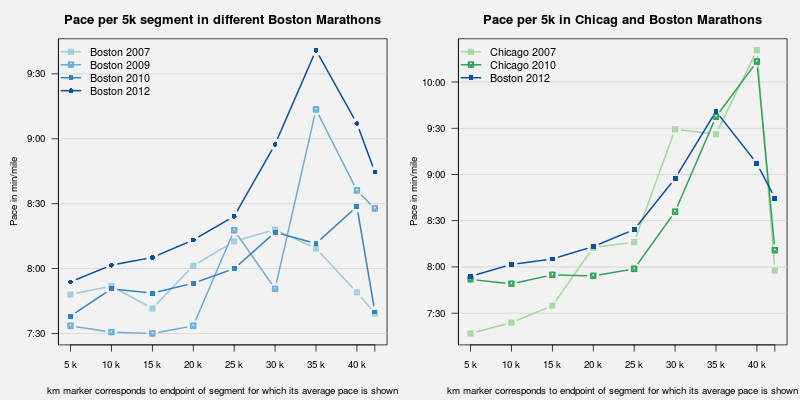
Two weeks ago I ran the 116th running of the Boston Marathon. Weather is often part of the story in Boston as e.g. my first one in 2007 happened after a storm-drenched and very wet weekend. This time, it was the opposite. Temperatures in the 60s in the morning before the start at 10:00am, which tempaeratures climbing well into the 80s for most of the race. The organizers had sent increasingly alarming email to us participants, warning about the weather conditions. And it was unpleasantly hot. Race support was great though: lots of locals had sprinklers pointed to the street; water stops were plenty and amply stocked and, being a nice summery day, lots of spectators made for lots of cheer. But heat makes for dreadful running conditions. I was pretty well trained, but I ended up running 3:43:55, or a tad slower than in Chicago 2007 (also record heat, with the race stopped around the four-hour mark) and Chicago 2009 (hot, though not that hot---but I was somewhat undertrained). Which makes this a personal worst. Oh well, stuff happens. And it was a pretty rough day---reports claimed that 2100 runners, or about 10%, were seeking some form of medical attention during or after the race which is a much higher proportion than under normal conditions. The chart below is an updated version of a chart which had appeared on my running page before. I regrouped my prior Bostons (2007, 2009 and 2010) on the left, and the Chicago runs 2007 and 2009 on the right---and each with the current Boston marathon. (Boston 2012 marathon in comparison to other Boston and Chicago marathons) So compared to the prior Boston races, I did indeed relatively poorly. Starting slower, and slowing down even more leading to about 1:45 for the first half and 1:58 for the second. Compared to the two poor Chicago races (put of the six times I have ran that race), things are not quite as bad as at least I didn't peak at over 10 min/mile. Weather will always remain a challenge. The previous marathon (which was last fall's Fox Valley 2011) was unseasonally cold and wet---making for a time fast enough to get me back to Boston. I am registered again for this one, so we will see what September brings this year.

1 May 2012

Rapha&#235;l Hertzog: My Debian Activities in April 2012

This is my monthly summary of my Debian related activities. If you re among the people who made a donation to support my work (186.38 , thanks everybody!), then you can learn how I spent your money. Otherwise it s just an interesting status update on my various projects. Dpkg News For the first time since several years, there has been a dpkg release (1.16.3) where the changelog doesn t contain any entry of my own. The 3-4 commits I did were not really worthy of a changelog entry. I must admit that it was easy to put dpkg aside given Guillem s message and given how busy I have been with my other projects. Keeping a low-profile for a while certainly doesn t hurt. But I don t intend to stop contributing to dpkg. Quite on the contrary in fact, it s something that I (usually) enjoy doing. Packaging News I packaged a new upstream release of SQL-Ledger (3.0.0) and later in the month I sponsored the upload of LedgerSMB, a fork of SQL-Ledger which unlike the former is maintained like a typical free software project. I also uploaded version 0.56 of Zim and updated WordPress to version 3.3.2 with its slew of security fixes. The Debian Administrator s Handbook Like several months now, most of my time has been directed towards the Debian Administrator s Handbook. The big news is that the liberation fund has been completed this means that the book will be published under DFSG-free licenses from the start (GPL-2+ / CC-BY-SA 3.0). We hope to publish the book next week (i.e. between May 7th and May 11th). The PDF output for the printed book is almost ready. There s some work left for the HTML/EPUB output and we have to prepare for the release of the sources as well Hopefully everything will work out like planned. Stay tuned! Thanks See you next month for a new summary of my activities.

No comment Liked this article? Click here. My blog is Flattr-enabled.

30 April 2012

Russ Allbery: Debian private repositories

Earlier this year, I switched Stanford's internal repositories from an old debarchiver setup that didn't do repository signing to something more modern and secure built on top of reprepro. While we're not doing anything particularly exciting at a technical level, I thought it might be interesting for people to see how a large site with heavy Debian usage divides up and manages its internal repositories. I put up a first draft of a writeup at Debian private repositories. This is currently fairly incomplete. One obvious thing that's missing is a pointer to the wrapper script that we use, but I know there's more. I'm happy to prioritize additional documentation based on what people would find interesting. Send me email (or mention on debian-enterprise, to which I'll also send a pointer to this) if there's anything in particular you want to hear about.

Next.

Previous.