Search Results: "ag"

23 May 2012

Anand Kumria: Lifelong learning

Below are four of my (150!) browser tabs opened, that I oddly had in sequence. Various tabs open to online learning websites. There has been much made of the pheonmen of lifelong learning and although I thought I had finished my exams when I finished University, I'm still doing them. From left to right:
Duolingo, where I am learning Spanish.
Quite a reasonable site, currently invite-only. My worry is my pronounciation will be crap though. I do wish that it did not have to use Flash to accomplish things though.
Udacity, where I am doing CS212 - Design of Computer Programs
Nice interface, annoying that it uses YouTube to host videos as that meant I had to whitelist YouTube in Flashblock.I picked this course as one of the other ones I wanted to do had already closed. I suspect I'll eventually do each of the courses they have on offer. One nice thing is that courses run every 8 weeks or so.
Codeacademy, I am currently doing their Codeyear course.
Well presented, but I find that their Javascript interface is extremely slow to startup. It consistently lags behind my typing speed by about 3 seconds.I'm using Firefox beta, so I'm always running something fairly fast and modern too.I'm primarily doing this course to see how/what they are trying to teach non-programmers. My feedback is that it is not geared towards someone with no programming knowledge. The initial 10 weeks of Javascript presentation proceeded at a very fast pace. If I weren't a programmer already, I'd have stuggled to keep up.
Coursera, here I am doing the Machine Learning class.
I'm not a fan of this interface at all, which is why I find it hard to come back to the site each week. I'm not sure exactly why though, since it uses WebM and no Flash. Hurray!!Either way, I'm doing the Machine Learning class. I tried this last time it was offered and got to week 5 same week I'm on now and then I got suddenly busy IRL, so was not able to complete the course.Unlike Udacity, courses run at set times and you have to do the work on the required dates in order to get the statement of attainment, which can be hard when you are juggling multiple things
Keep in mind, these are just the extra things I have decided to learn. I'm also learning more about Django, Puppet and Python in my work everyday. Plus I'm actually doing a Spanish course in real life too. Oh, and I have a job and I go out. I'm generally actually pushed for time. Which probably explains why I have not been keeping up with the blog. It isn't because I hate you, although it might be too ;-) , I'm just busy.

Craig Small: procps-ng 3.3.3 released

top

Top in colour mode

This weekend procps-ng version 3.3.3 was tagged and released for distribution. There have been many patches and fixes involved in this release as we move from an unchanging static sort of code into something that is easier to maintain and build on various architectures. The good thing is I m down to 1 or 2 patches in the debian archive which is a big change from the 30 or 40-odd I used to carry. For the sole metric of getting that number down, the project fork has been a success. There were some post-release bugs I found and these were more to do with the various options turned on or off rather than what you d see if you did the basic ./configure && make. One of them was how the version numbers are defined in git, but would only appear if certain files were older than others (such as aclocal.m4 versus config.h.in) Others were when certain features were turned on. The make check doesn t see all of this because it uses the default configure flags. One annoying thing of the autotools is conditionally installing man pages. This is where you don t or cannot compile a binary so you don t install the corresponding man page. The automake documentation is of course obscure about this but I cannot see a way of distributing only a man page, so we have this fiddle where a file goes into distmanMANS or EXTRA_DIST depending. Interestingly, there has been some bike-shedding around Fedora-land (see the link below) regarding the name procps-ng versus procps. Debian is lucky that we do have different upstream and package names (though not ideal) so apt-get install procps still gives you procps. There also has been discussion about merging procps-ng into util-linux whichin the short-term won t be happening.

22 May 2012

Gunnar Wolf: e-voting: Bad when it's near, worse when it's far.

Note: All of the information linked to from this post is in Spanish and related to Mexico Part of it will be translatable via automated means, some will not. Sorry, that's what I have, and it's too much text to invest the effort to hand-translate
I have been following the development of the different e-vote modalities in Mexico for several years already, although I have only managed to do so methodically in the last half year or so. If you are interested in my line of reasoning as to why I completely oppose e-voting, you can look at the short article I published in 2010 or the slightly longer and more updated version published in our book in 2011. Currently, in Mexico there are two different venues of e-vote that are being pushed: Bad and worse. The bad one will be carried out for about 10% of the population of the state of Jalisco and somewhat less for the state of Coahuila (Distrito Federal was also to be in this list, but the contract was cancelled due to the provider company delivering booths with too many problems and unable to deliver in the due time). The worse one is, fortunately, likely to have the least impact. Why? Because it regards votes cast by Distrito Federal residents (the capital entity, where part of Mexico City is located) living abroad. And it will have less impact because of the amount of the population registered for it: We are about 9 million residents in DF, and in the last election (first time IIRC there was the right to vote from abroad) there were only about 10,000 people registered for casting a (enveloped and sent by post) vote. Even if this year we the campaign for this was better (and I'm not yet sure about it), the number of voters will not be enough to make a dent on the results. I'm not going into details as to why it is bad in this post I requested information from the DF Electoral Institute (IEDF) with academic interest, to try to find more information about it, and I want to share my results with you and, of course, to request for your input on how to continue with this. On May 3rd, I sent the following request (this I am translating to English :) You can look at the receipt for the request for the original redaction) to the official contact address, oficinadeinformacionpublica@iedf.org.mx: Of course, I wasn't very optimistic when receiving this information. Still, I have to share my results: My information request was largely denied:
( )
III. The divulgation of this information harms the interest it protects
Given that, were it to be divulged it would affect the informatic security of the refered system. Anyway, we have to point out that said systems have enough measures and security provisions, so that the citizen can emit his vote in a universal, free, secret and direct way.
IV. The damage that can be produced by making this information public is larger than the public interest to know it
This is so because making this information public puts at risk the correct development of the Internet-based voting, because were the technical, purpose-specific information be made public, it could be misused to carry out informatic attacks.
It is also important to mention that a confidentiality agreement was signed with the company that developed said systems.
( )
VI. The time for the information to be reserved
It will be seven years starting at the present resolution, this information will be made public when the reserve period is over or when the target is reached, except for the confidemtial information that it could contain. ( )
In case some other person is interested in following this information, the other two points were answered, and I'll try to get some relevant information from it: So, I don't have any real conclusions yet. I'm just reporting how work is unfolding. Tomorrow evening (Wednesday May 23) I'll give a talk on the "e-voting in Mexico 2012" subject in Congreso Internacional de Software Libre in Zacatecas, Mexico. I'll talk on the situation on this and the other topics I have been able to work on.
AttachmentSize
Receipt of my information request11.64 KB
Transparency Committee resolution354.66 KB
Information request answered by UTCSTyPDP (IEDF)85.75 KB

Pietro Abate: bootstrap puppet with ganeti

Third post about ganeti. Ganet-debootstrap-instance contains a nice set of scripts to create a debian (or derivatives) image using debootstrap. Images can be configured and customized by writing simple hooks script to modify various aspects of the default installation. However writing these script is not really fun and pushing it too far can lead to long messy scripts, loosing the overall benefit of automatic configuration. Puppet is my configuration management tool of choice, but installing puppet on a new machine requires few magic incantations that the user should perform manually, or in a semi automatic mode (autosign=true) to make it work. My goal is to install puppet automatically on the newly created instance so it will run and configure the new instance at the first boot. From that moment on I'll forget about ganeti and configure all remaining services of my new VM using puppet. In order to do so, we need to install puppet (and apt-get update/upgrade...), create the ssl certificates for the client and enabling the puppet daemon on the client. We add another hook in /etc/ganeti/instance-debootstrap/hooks/ :
if [ -z "$TARGET" -o ! -d "$TARGET" ]; then
echo "Missing target directory"
exit 1
fi

LANG=C
chroot "$TARGET" apt-get -y --force-yes update
chroot "$TARGET" apt-get -y --force-yes upgrade

# install puppet on the client
chroot "$TARGET" apt-get -y --force-yes install puppet

DOMAIN=localnet.org
instance=$INSTANCE_NAME.$DOMAIN

echo "Installing puppet certificates for $instance"
puppetca clean $instance
puppetca -g $instance

mkdir -p $TARGET/etc/puppet
mkdir -p $TARGET/var/lib/puppet/ssl/private_keys/
mkdir -p $TARGET/var/lib/puppet/ssl/certs/

cp /var/lib/puppet/ssl/private_keys/$instance.pem $TARGET/var/lib/puppet/ssl/private_keys/
rm -f $TARGET/var/lib/puppet/ssl/public_keys/$instance.pem

cp /var/lib/puppet/ssl/certs/$instance.pem $TARGET/var/lib/puppet/ssl/certs/
cp /var/lib/puppet/ssl/certs/ca.pem $TARGET/var/lib/puppet/ssl/certs/

chown root. $TARGET/var/lib/puppet/ssl/private_keys/$instance.pem
chmod 0400 $TARGET/var/lib/puppet/ssl/private_keys/$instance.pem

chown root. $TARGET/var/lib/puppet/ssl/certs/$instance.pem
chmod 0640 $TARGET/var/lib/puppet/ssl/certs/$instance.pem

chown root. $TARGET/var/lib/puppet/ssl/certs/ca.pem
chmod 0641 $TARGET/var/lib/puppet/ssl/certs/ca.pem

#echo "server=puppet" >> /etc/puppet/puppet.conf

echo "START=yes" > $TARGET/etc/default/puppet
echo "DAEMON_OPTS=\"\"" >> $TARGET/etc/default/puppet
This script uses puppetca to create on the puppet (and ganeti) server the client key, sign it, and then copy it to the target machine. Notice that we create the certificate for a fqnd name $INSTANCE_NAME.$DOMAIN or otherwise puppet will complain loudly. This is not strictly needed, but if you want to do otherwise, you'll need to fiddle with the puppet configuration a bit more. The procedure to create a puppet certificate server-side is well documented on the puppet website, so if you are curious about the details duck-duck-it .

Russell Coker: Another USB Flash Failure

I previously wrote about a failure of a USB flash device in my Internet gateway [1]. I have since had another failure in the same system, so both the original 4G devices are now dead. That s two dead devices in 10 weeks. It could be that the USB devices that I got for free at an exhibition were just really cheap, I m sure that they weren t expecting them to be used in that way. The devices from the same batch which are used for their intended purpose (sneaker-net file sharing) are still working well. But in any case I m not going to resume this experiment until warmer weather. At this time of year some extra heat dissipation from computer gear in my home is more like a feature and less like a bug. The second USB device to fail appeared to have it s failure in the Ext4 journal (the errors were reported at around sector 2000), I didn t keep a record of the problem with the first device, but from memory I think it was much the same. Rumor has it that cheap flash storage devices don t implement wear-levelling to avoid patent infringement. If that rumor is correct then any filesystem that uses a fixed journal in the same way as Ext3/4 is probably unsuitable for any serious use on such devices, while a filesystem based on Copy On Write will probably perform better. In Spring I ll try using BTRFS on cheap USB flash devices and see if that works better. I have another spare device from the same batch to test so I can eliminate hardware differences. I can t do enough tests to be a good statistical sample, but if a device lasts from Spring to Autumn using BTRFS with the same use that caused failures with Ext4 in a few weeks then I will consider it a strong indication that BTRFS is better than Ext3/4 for such uses. For the next 5 months or so I ll be using a hard drive in my Internet gateway system again. Related posts:
  1. Flash Storage Update Last month I wrote about using USB flash storage devices...
  2. flash for main storage I was in a discussion about flash on a closed...
  3. USB Flash Storage For some years I have had my Internet gateway/firewall system...

Matthew Garrett: I've been a terrible person (and so have most of you)

John Scalzi recently wrote a piece on straight white male privilege. If you haven't read it already, go and do so. No rush. I'll wait.

So. Some facts:

(If you disagree with any of these then that's absolutely your right. You're wrong, but that's ok. But please do me a favour and stop reading here. Otherwise you'll just get angry and then you'll write something ill-tempered and still wrong in the comments and then I'll have to delete it and why not just save everybody the time and effort and go and eat ice cream or something instead)

I know I've said this before, but inappropriate and marginalising behaviour is rife in our community, and at all levels of our community. There's the time an open source evangelist just flat out told a woman that her experiences didn't match his so she must be an outlier. There's the time a leading kernel developer said that most rape statistics were basically made up. There's the time that I said the most useful thing Debian could do with its money would be to buy prostitutes for its developers, simultaneously sexualising the discussion, implying that Debian developers were all straight men and casting sex workers as property. These aren't the exceptions. It's endemic. Almost all of us have been part of the problem, and in doing so we've contributed to an environment that has at best driven away capable contributors. You probably don't want to know what it's done at worst.

But what people have done in the past isn't important. What's important is how we behave in the future. If you're not angry about social injustice like this then you're doing it wrong. If you're reading this then there's a pretty high probability that you're a white male. So, it's great that you're angry. You should be! As a straight white male born into a fairly well-off family, a native English speaker in an English speaking country, I have plenty of time to be angry before going back to my nice apartment and living my almost entirely discrimination-free life. So if it makes me angry, I have absolutely no way of comprehending how angry it must make the people who actually have to live with this shit on a daily basis.


(Were tampon mouse able to form and express coherent thoughts, tampon mouse would not put up with this shit)

The point isn't to be smugly self aware of our own shortcomings and the shortcomings of others. The point is to actually do something about it. If you're not already devoting some amount of your resources to improving fairness in the world, then why not? It doesn't have to be about women in technology - if you're already donating to charity or helping out at schools or engaging in local politics or any of the countless other ways an individual can help make the world a better place, large or small, then keep on doing that. But do consider that many of us have done things in the past that contributed to the alienation of an astounding number of potential community members, and if you can then please do do something to make up for it. It might be donating to groups like The Ada Initiative. It might be mentoring students for projects like the GNOME Outreach Program for Women, or working to create similar programs. Even just making our communities less toxic by pointing out unacceptable behaviour when you see it makes a huge difference.

But most importantly, be aware that it was people like me who were responsible for this problem in the first place and people like me who need to take responsibility for solving it. We can't demand the victims do that for us.

comment count unavailable comments

21 May 2012

Thomas Goirand: Unit tests for PHP: PHPUnit

PHPUnit, according to its PTS, has been in Debian since 2009. But it was orphaned, and nobody took care of it for a while. That is until few weeks ago, Luis Uribe started to work on it. Since he isn t a DD, and that I take care of, I believe, about half of the all the PHP PEAR packages in Debian, I started working with him on re-doing the work of packaging PHPUnit for Debian. Previously, the old version was quite wrong, with missing dependencies, and not really working, what a shame PHPUnit 3.6 has been in Debian SID for 3 days now. And it s working well. I m now adding runs of unit testings from upstream packages at build time (of course, only if DEB_BUILD_OPTIONS doesn t contains nocheck , as per the policy). All together, it s been quite some fun to hack this, and I m quite happy of the results, even though there s still a lot of work remaining. PHP itself is running unit tests at build time. And not just a few: more than 11000 of them. The only small issue, is that they are totally outdated. Over the time, the vardump() function has evolved, and doesn t print things the same way. One may say that it prints things in a nicer way, but as a result, many of the tests that were suppose to work, actually fails because of these differences in vardump() over time. So I started working on fixing some of the tests. It s most of the time very easy to fix, but it takes a long time to fix all these small unit tests. So far, I ve been able to fix most of what s in the tests/, Zend/tests (more than 161 tests fixed), and the beginning of ext/*/tests: for the moment: bcmath, bz2, calendar, curl, date, dba, dom, ereg, and a part of exif, which for the moment represent 214 fixed tests, and I ll try to do more fixes when I have time. I hope to send the patches upstream soon. The final goal is of course to have the build of PHP to fail if unit tests are failing as well. For the moment, unit tests do run at build time, but the build don t care of the results, which I think is stupid (it s wasting CPU cycles for no reasons, IMO). If you maintain some PEAR packages, I would welcome you to first join the PKG-PEAR team on Alioth, and team maintain your packages, switch over to pkg-php-tools and dh 8 auto-sequencer, and to follow the PKG-PHP-PEAR packaging guide lines so that we have consistency in the archive. And of course, run unit testings, by doing a build-depends on phpunit (>= 3.6). Note that unit testings in PEAR packages are tracked on the Debian wiki. This post is also a call for help, because I feel quite alone doing this work of packaging PEAR packages, which many PHP applications depend on (think about roundcube, horde, extplorer, and many more). Other teams are doing very well, like the Perl team, and there s no reason why Debian wouldn t maintain PHP libraries as well as the ones for Perl.

Dirk Eddelbuettel: RcppArmadillo 0.3.2.0

A new stable release 3.2.0 of Armadillo is now available. As usual, we have wrapped this into a new RcppArmadillo package, now at 0.3.0.2; and this version is now available via CRAN. The short NEWS entry follows below. For those interested in following RcppArmadillo eevn more closely, we generally track Conrad's Armadillo release candidates as well in SVN on R-Forge but do no longer submit these to CRAN (as the CRAN maintainers have enough incoming packages).
0.3.2.0  2012-05-21
    o   Upgraded to Armadillo release 3.2.0 "Creamfields"
          * faster eigen decomposition via "divide and conquer" algorithm
          * faster transpose of vectors and compound expressions
          * faster handling of diagonal views
          * faster handling of tiny fixed size vectors (  4 elements)
          * added unique(), for finding unique elements of a matrix
Courtesy of CRANberries, there is also a diffstat report for 0.3.2.0 relative to 0.3.0.3 As always, more detailed information is on the RcppArmadillo page. Questions, comments etc should go to the rcpp-devel mailing list off the R-Forge page.

Pietro Abate: add swap hook for ganeti-deboostrap-instance

Second post about ganeti. This time I'll talk about adding a swap partition to an image added with ganeti-deboostrap-instance. Browsing the web, it seems that an old version of the ganeti debostrap script allowed for the creation of a swap partition from the command line. The actual version in sid does not, so, if you want to add a swap partition, you need to write a small hook in /etc/ganeti/instance-debootstrap/hooks/. Part of the code below is taken from the instance-debootstrap script.
if [ $DISK_COUNT -lt 2 -o -z "$DISK_1_PATH" ]; then
log_error "Skip swap creation"
exit 0
fi

swapdev=$DISK_1_PATH

# Make sure we're not working on the root directory
if [ -z "$TARGET" -o "$TARGET" = "/" ]; then
echo "Invalid target directory '$TARGET', aborting." 1>&2
exit 1
fi

if [ "$(mountpoint -d /)" = "$(mountpoint -d "$TARGET")" ]; then
echo "The target directory seems to be the root dir, aborting." 1>&2
exit 1
fi

if [ -f /sbin/blkid -a -x /sbin/blkid ]; then
VOL_ID="/sbin/blkid -o value -s UUID"
VOL_TYPE="/sbin/blkid -o value -s TYPE"
else
for dir in /lib/udev /sbin; do
if [ -f $dir/vol_id -a -x $dir/vol_id ]; then
VOL_ID="$dir/vol_id -u"
VOL_TYPE="$dir/vol_id -t"
fi
done
fi

if [ -z "$VOL_ID" ]; then
log_error "vol_id or blkid not found, please install udev or util-linux"
exit 1
fi

if [ -n "$swapdev" ]; then
mkswap $swapdev
swap_uuid=$($VOL_ID $swapdev true )
fi

[ -n "$swapdev" -a -n "$swap_uuid" ] && cat >> $TARGET/etc/fstab <<EOF
UUID=$swap_uuid swap swap defaults 0 0
EOF
This script does two things: first it checks if the user passed a second disk argument to the gnt-instance add call. I decided arbitrarily that the second disk is going to be used a swap disk. Second it figures out the vol-id of this disk, create the swap partition and write an entry in the fstab. All in all it's a straightforward procedure, but I love when I can cut and paste easy scripts :) The call to create the instance is as follows, using a disk of 5G for the system and a disk of 1G for the swap.
gnt-instance add -t plain --disk 0:size=5G --disk 1:size=1G -B memory=1024 -o debootstrap+unstable --no-ip-check --no-name-check node1

Johannes Schauer: sisyphus wins ICRA 2012 VMAC

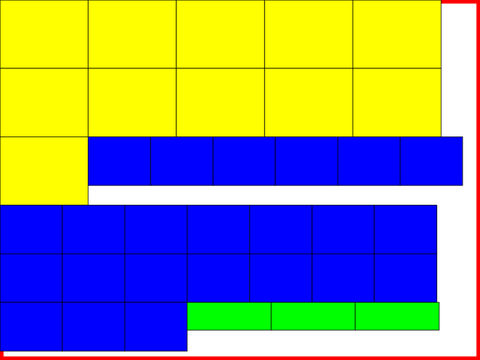
Sisyphus is a piece of software that I wrote as a member of a team from Jacobs University led by Prof. Dr. Andreas N chter. It managed to place our team first in this year's IEEE ICRA 2012 Virtual Manufacturing Automation Competition in all three rounds. The goal was, to stack a given set of boxes of different length, height and width on a pallet in a way that achieved optimal volume utilization, center of mass and interlock of the boxes. Besides the cartesian placement of a box on the pallet, the only other degree of freedom was a 90 rotation of the box around a vertical axis. Since the arrangement of boxes into a three dimensional container is NP hard (three dimensional orthogonal knapsack), I decided for a heuristic for an approximate solution. The premise is, that there are many boxes of equal height which was the case in the test cases that were available from the 2011 VMAC. Given this premise, my heuristic was, to arrange the boxes into layers of equal height and then stack these layers on top of each other. A set of boxes that would be left over or too little from the start to form its own full layer, would then be stacked on the top of the completed layers. There is a video of how this looked like. My code is now online on github and it even documented for everybody who is not me (or a potential future me of course). This blog post is about the "interesting" parts of sisyphus. You can read about the overall workings of it in the project's README. Python dict to XML and XML to Python dict The evaluation program for the challenge is reading XML files and the pallet size and the list of articles with their sizes are also given in XML format. So I had to have a way to easily read article information from XML and to easily dump my data into XML format. Luckily, all the XML involved was not making use of XML attributes at all, so the only children a node had, where other nodes. Thus, the whole XML file could be represented as an XML dictionary with keys being tagnames and the values being other dictionaries or lists or strings or integers. The code doing that uses xml.etree.ElementTree and turns out to be very simple:
from xml.etree import ElementTree

def xmltodict(element):
def xmltodict_handler(parent_element):
result = dict()
for element in parent_element:
if len(element):
obj = xmltodict_handler(element)
else:
obj = element.text
if result.get(element.tag):
if hasattr(result[element.tag], "append"):
result[element.tag].append(obj)
else:
result[element.tag] = [result[element.tag], obj]
else:
result[element.tag] = obj
return result
return element.tag: xmltodict_handler(element)

def dicttoxml(element):
def dicttoxml_handler(result, key, value):
if isinstance(value, list):
for e in value:
dicttoxml_handler(result, key, e)
elif isinstance(value, basestring):
elem = ElementTree.Element(key)
elem.text = value
result.append(elem)
elif isinstance(value, int) or isinstance(value, float):
elem = ElementTree.Element(key)
elem.text = str(value)
result.append(elem)
elif value is None:
result.append(ElementTree.Element(key))
else:
res = ElementTree.Element(key)
for k, v in value.items():
dicttoxml_handler(res, k, v)
result.append(res)
result = ElementTree.Element(element.keys()[0])
for key, value in element[element.keys()[0]].items():
dicttoxml_handler(result, key, value)
return result

def xmlfiletodict(filename):
return xmltodict(ElementTree.parse(filename).getroot())

def dicttoxmlfile(element, filename):
ElementTree.ElementTree(dicttoxml(element)).write(filename)

def xmlstringtodict(xmlstring):
return xmltodict(ElementTree.fromstring(xmlstring))

def dicttoxmlstring(element):
return ElementTree.tostring(dicttoxml(element))
Lets try this out:
>>> from util import xmlstringtodict, dicttoxmlstring
>>> xmlstring = "<foo><bar>foobar</bar><baz><a>1</a><a>2</a></baz></foo>"
>>> xmldict = xmlstringtodict(xmlstring)
>>> print xmldict
 'foo':  'baz':  'a': ['1', '2'] , 'bar': 'foobar' 
>>> dicttoxmlstring(xmldict)
'<foo><baz><a>1</a><a>2</a></baz><bar>foobar</bar></foo>'
The dict container doesnt preserve order, but as XML doesnt require that, this is also not an issue. Arranging items in layers When it was decided, that I wanted to take the layered approach, it boiled down the 3D knapsack problem to a 2D knapsack problem. The problem statement now was: how to best fit small rectangles into a big rectangle? I decided for a simple and fast approach as it is explained in Jake Gordon's blog article. There is a demo of his code and should the site vanish from the net, the code is on github. This solution seemed to generate results that were "good enough" while simple to implement and fast to execute. If you look very hard, you can still see some design similarities between my arrange_spread.py and his packer.js code. Jake Gordon got his idea from Jim Scott who wrote an article of arranging randomly sized lightmaps into a bigger texture. There is also an ActiveState Code recipe from 2005 which looks very similar to the code by Jake Gordon. The posts of Jake Gordon and Jim Scott explain the solution well, so that I dont have to repeat it. Should the above resources go offline, I made backups of them here and here. There is also a backup of the ActiveState piece here. Spreading items out The algorithm above would cram all rectangles into a top-left position. As a result, there would mostly be space at the bottom and left edge of the available pallet surface. This is bad for two reasons:
  1. the mass is distributed unequally
  2. articles on the layer above at the bottom or left edge, are prone to overhang too much so that they tumble down
Instead all articles should be spread over the available pallet area, creating small gaps between them instead big spaces at the pallet borders. Since articles were of different size, it was not clear to me from the start what "equal distribution" would even mean because it was obvious that it was not as simple as making the space between all rectangles equal. The spacing had to be different between them to accommodate for differently sized boxes. The solution I came up with, made use of the tree structure, that was built by the algorithm that arranged the rectangles in the first place. The idea is, to spread articles vertically first, recursively starting with the deepest nodes and spreading them out in their parent rectangle. And then spreading them horizontally, spreading the upper nodes first, recursively resizing and spreading child nodes. The whole recursion idea created problems of its own. One of the nicest recursive beauty is the following function:
def get_max_horiz_nodes(node):
if node is None or not node['article']:
return [], []
elif node['down'] and node['down']['article']:
rightbranch, sr = get_max_horiz_nodes(node['right'])
rightbranch = [node] + rightbranch
downbranch, sd = get_max_horiz_nodes(node['down'])
ar = rightbranch[len(rightbranch)-1]['article']
ad = downbranch[len(downbranch)-1]['article']
if ar['x']+ar['width'] > ad['x']+ad['width']:
return rightbranch, sr+[downbranch[0]]
else:
return downbranch, sd+[rightbranch[0]]
else:
rightbranch, short = get_max_horiz_nodes(node['right'])
return [node] + rightbranch, short
get_max_horiz_nodes() traverses all branches of the tree that node has below itself and returns a tuple containing the list of nodes that form the branch that stretches out widest plus the list of nodes that are in the other branches (which are shorter than the widest). Another interesting problem was, how to decide on the gap between articles. This was interesting because the number resulting of the subtraction of the available length (or width) and the sum of the articles lengths (or widths), was mostly not divisible by the amount of gaps without leaving a rest. So there had to be an algorithm that gives me a list of integers, neither of them differing by more than one to any other, that when summed up, would give me the total amount of empty space. Or in other words: how to divide a number m into n integer pieces such that each of those integers doesnt differ more than 1 from any other. Surprisingly, generating this list doesnt contain any complex loop constructs:
>>> m = 108 # total amount
>>> n = 7 # number of pieces
>>> d,e = divmod(m, n)
>>> pieces = (e)*[(d+1)]+(n-e)*[d]
>>> print pieces
[16, 16, 16, 15, 15, 15, 15]
>>> sum(pieces) == m
True
>>> len(pieces) == n
True
You can test out the algorithms that arrange rectangles and spread them out by cloning the git and then running:
PYTHONPATH=. python legacy/arrange_spread.py
The results will be svg files test1.svg and test2.svg, the latter showing the spread-out result. Here is an example how the output looks like (without the red border which is drawn to mark the pallet border): arrange_spread2.py contains an adaption of arrange_spread.py for the actual problem. Permutations without known length When creating a layer out of articles of same height, then there are four strategies that I can choose from. It is four because there are two methods that I can either use or not. I can rotate the article by 90 per default or not and I can rotate the pallet or not. So every time that I build a new layer, there are those four options. Depending on which strategy I choose, there is a different amount of possible leftover articles that did not fit into any layer. The amount is different because each strategy is more or less efficient. To try out all combinations of possible layer arrangements, I have to walk through a tree where at each node I branch four times for each individual strategy. Individual neighboring nodes might be the same but this outcome is unlikely due to the path leading to those neighboring nodes being different. To simplify, lets name the four possible strategies for each layers 0, 1, 2 and 3. I now want an algorithm that enumerates through all possible permutations of those four numbers for "some" length. This is similar to counting. And the itertools module comes with the product() method that nearly does what I want. For example, should I know that my tree does not become deeper than 8 (read: no more than eight layers will be built), then I can just run:
>>> for i in itertools.product([0,1,2,3], repeat=8):
...     print i
...
(0,0,0,0,0,0,0,0)
(0,0,0,0,0,0,0,1)
(0,0,0,0,0,0,0,2)
(0,0,0,0,0,0,0,3)
(0,0,0,0,0,0,1,0)
(0,0,0,0,0,0,1,1)
(0,0,0,0,0,0,1,2)
(0,0,0,0,0,0,1,3)
This would work if the number of layers created with each strategy was the same. But as each strategy behaves differently depending on the input, it cannot be known before actually trying out a sequence of strategies, how many layers it will yield. The strategy (0,0,0,0,0,0,0,0) might create 7 layers, resulting in (0,0,0,0,0,0,0,1), (0,0,0,0,0,0,0,2) and (0,0,0,0,0,0,0,3) yielding the same output as only the first 7 strategies count. This would create duplicates which I should not waste cpu cycles on later. It might also be that (0,0,0,0,0,0,1,0) turns out to be a combination of strategies that creates more than 8 layers in which case the whole thing fails. So what I need is a generator, that gives me a new strategy depending on how often it is asked for one. It should dynamically extend the tree of possible permutations to accommodate for any size. Since the tree will become humongous (4^11 = 4194304), already traversed nodes should automatically be cleaned so that only the nodes that make the current list of strategies stays in memory at any point in time. This sounded all complicated which made me even more surprised by how simple the solution was in the end. Here a version of the algorithm that could easily be ported to C:
class Tree:
def __init__(self, branch_factor):
self.branch_factor = branch_factor
self.root = "value": None, "parent": None, "children": []
self.current = self.root

def next(self):
if not self.current["children"]:
self.current["children"] = [ "value":val, "parent":self.current, "children":[] for val in range(self.branch_factor)]
self.current = self.current["children"][0]
return self.current["value"]

def reset(self):
if self.current["parent"]:
self.current["parent"]["children"].pop(0)
else:
return False
if self.current["parent"]["children"]:
self.current = self.root
return True
else:
self.current = self.current["parent"]
return self.reset()

def __str__(self):
return str(self.root)
It would be used like this:
>>> tree = Tree(4)
>>> print tree.next(), tree.next(), tree.next()
>>> while tree.reset():
...     print tree.next(), tree.next(), tree.next()
Which would be equivalent to calling itertools.product([1,2,3,4], 3). The special part is, that in each iteration of the loop I can call tree.next() an arbitrary amount of times, just how much it is needed. Whenever I cannot generate an additional layer anymore, I can call tree.reset() to start a new permutation. For my code I used a python specific version which is a generator:
def product_varlength(branch_factor):
root = "value": None, "parent": None, "children": []
current = root
while True:
if not current["children"]:
current["children"] = [ "value":val, "parent":current, "children":[] for val in range(branch_factor)]
current = current["children"][0]
if (yield current["value"]):
while True:
if current["parent"]:
current["parent"]["children"].pop(0)
else:
return
if current["parent"]["children"]:
current = root
break
else:
current = current["parent"]
It is used like this:
it = product_varlength(4)
print it.next(), it.send(False), it.send(False)
while True:
    print it.send(True), it.send(False), it.send(False)
Again, the expression in the loop can have any number of it.send(False). The first it.send(True) tells the generator to do a reset.

Cyril Brulebois: Fun with ints, longs, and pointers!

While investigating the case of some packages responsible for uninstallability on the s390x architecture, I stumbled upon one FTBFS on a single architecture, reported as #673590 (<insert some nice words about software shipping with a decent testsuite>). Given the int versus size_t question was asked, I grabbed this old (it s UNIX!) reference: 64-bit and Data Size Neutrality. Among other things, it describes the everything is 32-bit to 64-bit is becoming the new standard slow conversion process, where keeping compatibility with existing applications was a high priority. It has a nice description of so-called C data models, making it possible to refer to them quickly: LP32 and ILP32 in the 32-bit world; ILP64, LLP64, and LP64 in the 64-bit world. I won t go into detail here, this page has a nice table and lots of explanations about pros and cons for those. (On a personal note, I discovered those on xorg-devel@ when I saw patches floating around, which were about optimizing data sizes for this or that data model, by picking the right types.) While standards may be boring, this page makes it really easy to understand which data types to use, to ensure the best 32/64-bit compatibility possible. It s even full of dos and don ts. See the second half (Porting Issues) for details.

Christian Perrier: 14 languages to be deactivated in Debian Installer

Some more progress since my last entry.... Slovenian, Punjabi fully completed. Romanian completed for first two sublevels, hence rescued. Got signs of life from Galician, Croatian, Georgian, Malayalam, Nepali translators. But nothing happened yet Got offers to help for Welsh, Lithuanian. But nothing happened yet. Progress for Amharic in level 1 At this very moment, it means that I would deactivate 14 languages:

20 May 2012

Gregor Herrmann: RC bugs 2012/20

I was on vacations for a few days last week, therefor my list of RC bugs is a bit shorter this time. thanks again to everyone who sent patches to the BTS that I could just use.

Ana Beatriz Guerrero Lopez: long due TO-DO item: removal of Qt3 from Debian

A couple of weeks ago was the first anniversary of orphaning Qt3 in Debian, see bug 625502. In this year, Qt3 has got a few QA uploads with the most relevant change being support to multiarch. And, more importantly, nobody seemed to care enough to step into maintaining it. In the last days, I have taken a look into how much needed to be done to remove Qt3 and there were slightly more than 50 packages depending directly or indirectly from Qt3. A removal from Wheezy seemed doable given that removing packages is never a problem during the Debian freeze ;-)
All the packages affected have a bug opened since more than one year and half ago and I have pinged all the bugs with some maintainers responding quick (thanks!). I also filed some removals for packages that were clearly unmaintained and didn t seem worth keeping, with ftp-masters responding quick too (Thanks!). And finally, a couple of QA upload for orphaned software that were still useful without Qt3. There is a wiki page tracking the status of the removal if you are curious:
http://wiki.debian.org/qt3-x11-freeRemoval If in the future, you are reading this and you need Qt3 in Wheezy, you can fetch it from Debian snapshots.

Cyril Brulebois: Busy Release Team

With the sound of the freeze approaching, we have been receiving a few more transition requests lately. Thankfully, a lot of them can apparently be processed at the same time, that's why we have currently the following, crazy tracker summary: Of course there are some transitions that started because maintainers forgot how transitions are supposed to work, but we re trying to get things done anyway.

Chris Lawrence: cnlmisc 0.2 for R

The oft-promised update of the cnlmisc package for R is now posted. New in this release is a convenience method, sepplot, that produces separation plots using the separationplot package; this method works directly on model fit objects as a post-estimation call, and works with both binary and ordinal models at present. In addition, epcp now works with clm2 objects from the ordinal package. Most of this was motivated by continued work on the economic voting paper, which has also been updated. cnlmisc still has a long way to go before I submit it to CRAN, but at least it s progress, right?

19 May 2012

Matthew Garrett: Fixing Asus UX21e unexpected power off

Edit: Sigh, some further testing shows that it seems better, but not fixed. If you unplug the power while the CPU is over 80 degrees C, the machine will power off. I can't find any way of avoiding this - it seems to be handled at the embedded controller or SMM level, since as far as I can tell Linux isn't surviving long enough to even be aware that the event occurred.

Original entry:

The Asus UX21e (and maybe the UX31e?) has the irritating misfeature that it reloads the CPU thermal tables when you unplug the power. One consequence of this is that it'll automatically throttle itself much more aggressively on battery (reducing performance) but the more serious one is that the new critical power off temperature may then be lower than the temperature the CPU is currently operating at, resulting in the machine turning itself off. As far as I can tell from debugging, this is completely OS-independent - it still happens even if I stub out all the ACPI code for power supply events and there are reports of the same thing occurring on Windows. The good news is that it seems to be fixed in newer firmware versions. The even better news is that you can flash it without Windows. Just download the BIOS image from the Asus website, copy it onto a FAT formatted USB stick, insert that, go into the firmware (hit F2 on the splash screen) and start the flash program from there.

comment count unavailable comments

Thorsten Glaser: MirBSD goes webservice manpages and WTF

While wtf(1) always has been a bit central to MirBSD, and the acronym database has been accessible by CVSweb, what we never had was a DAU compatible (and shellsnippets compatible) lookup. This has now changed: the above link to the acronyms file is a persistent link to its latest version (well, latest when the website was last recompiled), tooltips may very well follow soon, and we ve got an online WTF lookup service.
Contributions to the acronym database are welcome, of course; just eMail them to tg mirbsd org. Not to stop there, our online HTML manpage search is also new, shiny, and should replace the !mbsdman DuckDuckGo hash-bang shortly. (Both of these services offer a DDG search as fallback. Note that DDG is an external service included herein by linking, under their request to spread it, and not affiliated with The MirOS Project. They do, however, donate some advertising money to Debian.)
For all those who didn t know: only manpages for software in the MirOS BSD base system and for the MirPorts Framework package tools are listed, not for third-party applications installable using ports or, recently, pkgsrc . Still, if you want to have a peek at a modern classic BSD s documentation, you re welcome. (Not to mention content like re_format(7) and style(9) and that some of our documentation is much more legible than others.) And because writing all that perl(1) made me ill, not to mention I don t even know that language, I ve hacked a bit more in the mir make(1) and mksh(1) parts of the MirWebsite, finally implementing pointing out where in the navigation sidebar the visitor currently is. We also have exciting mksh porting news involving RT trying a larger number of ancient platforms than I dare count, me fixing bugs in Linux klibc and diving into other things, learning more about why I consider me lucky for hacking a BSD operating system sorry, I want to keep this short as it s mostly an announcement. The MirWebsite source code is, of course, also available. Improvements welcome. Except for these three CGIs, our website is fully statically precompiled, and that s a good thing. Please help in making the CGIs secure.

Andrew Pollock: [life] Maker Faire 2012 trip report

The Maker Faire is one of those awesome Bay Area things that always fills me with excitement and gets my imagination going. Zoe and I went again this year to check it out, as best we could within the time constraints we had to work within (opening time and her nap time, minus travel time). She definitely enjoyed herself. We took the Caltrain, because historically driving and parking has been a bit of a nightmare. The optimal train to get to get there before it opened (at 10am) was the 9:19 train from Mountain View, which was scheduled to get in at Hayward Park a little before 10am. It just so happened that there was a Giants game on in San Francisco today as well, and the train was absolutely packed. We only got a seat because one kind gentleman was getting off and explicitly gave his seat to us. One lesson learned: don't try and take the BOB stroller on the train. Even when collapsed, it's way too bulky. For future Caltrain outings, I'll take our City Mini stroller instead, as it folds much flatter. I also took our macpac Possum child carrier backpack, and Zoe was pretty happy to just sit in it for the bulk of the time. I think it had novelty value for her, as we haven't used it for a while. I probably could have gotten away without taking a stroller at all. I was very glad I took the backpack, as it gave her a much better vantage point for everything that was going on than she would have gotten from sitting in the stroller. There was supposed to be a free shuttle from the Hayward Park station to the Maker Faire, but there was a huge crowd waiting for it, so I decided to just walk. It didn't take too long. For the return trip, I think I exited from the wrong side of the fairgrounds, and couldn't figure out the shuttles, so I just walked to Hillsdale station. At least the return train wasn't crowded. Overall, using Caltrain to get in and out was successful. Zoe was very well behaved for the ~30 minute train ride each way. The Faire was quite a bit bigger this year, and has spilled out into the parking lot on one side. I'd heard stories that O'Reilly had quadrupled booth prices as well. Trying to abide by the program was too difficult, so we mostly just wandered through the main Expo hall and looked at various booths. I just did a full read through the website of all the exhibitors to see what I missed out on. Here's some of the stuff I saw in person, or discovered via the website: Kickstarter is really becoming huge in the maker community. There were heaps of exhibitors there with (mostly robotics) projects that were past the initial prototyping phase and were seeking funding on Kickstarter to go into mass production. Some of the talks I'd have liked to have seen: Zoe was really well behaved for the entire expedition. I don't think she really gave me any grief at all. There was a brief period where she wanted me to carry her, but I managed to negotiate her back into the stroller after not long. I think her favourite was ArcBotics, which had a robot insect that would dance and wave at her. She kept asking for it to do more dancing.

Richard Hartmann: Mongolia

I will start linking to places we stayed at etc, from now on. On the one hand, we already left those places so my paranoid self can rest assured that no one will come hunt us down, on the other hand, I decided to only to name and link to those places which really deserve a mention. If they are linked here, I can whole-heartedly recommend them. Mongolia After leaving through the Russian border fortifications, Mongolia was an instant and welcome change. Trees growing right next to the tracks, branches forming a bit of a natural tunnel; the trains passing by keeping branches at bay, but the trees free to grow wherever else they pleased. A few hundred meters later below a rocky ledge, a cow had apparently fallen down and died. Partially decomposed flesh still clinging halfway to its rib-cage, it proved to be a sign of the (mostly) more laid-back attitude Mongolians tend to take. After finally getting our passports back and being allowed to leave the train, we first headed to the station to get some money. At ~1800:1, the exchange rate for Tugruk against Euro speaks volumes about inflation; imagine my surprise that the MNT 20,000 note is the largest one. It's also the one and only amount any and all ATMs will default to. We were quite surprised by how cheap everything was, even in the one single store within the station directly behind the border. In Russia, travellers expect to pay hefty markups when shopkeepers know they can charge them, not so in Mongolia. The woman in the trash Upon returning from the station, our waggon was just merrily being driving away on its own by a lone engine, something we had not anticipated or appreciated a whole lot. A woman (we hadn't noticed her before) who was busy scavenging a trash container for food for herself and her scrawny-looking son happily stopped what she was doing and, with a big smile, moved her hands around and smacked them back together, signalling us that our waggon would be attached to a different train for the subsequent journey. To put it mildly, I was stunned; we had met people eating from the trash in Russia as well (yes, I always make a point of giving them enough for a few decent meals; anyone eating out of the trash actually needs and definitely deserves something good happening to them), but they were glum and disheartened. Here, there was someone who not only had to look out for herself, but for a three or four year old boy as well, and still was just so... positive... I don't know if I would have it in me to act the same way... As an aside, even though we were just a few kilometers across the border from Russia, she did not actually take the money from me, she cupped her hands to receive it by having me place it into her hands; this is a very Asian thing in my experience and something we would see both in Mongolia and China consistently. Later, when we were back in our waggon, she passed by and happened to see the Spot Messgenger 2 dangling in front of our window, its lights blinking every five seconds. For a solid twenty minutes, until the train started moving again, she squatted down with her son, oggling the Spot. I have no idea what she was thinking it was and I had no chance to explain it to her, but she was really fascinated and just kept staring and staring. When we finally left the station, we waved to and smiled at each other, she ran after us, and then she was gone. All in all, this was one the more memorable things which happened to us. Mongolian Infrastructure When I say that Mongolians as a whole tend to be a lot more laid back than Russians, this extends to infrastructure as well, but not in the good way. Ulan Bator Little Dhingis Khan We arrived in Ulan Bator at six in the morning and started haggling with taxi drivers. Our hostel had (stale, it turned out) information about acceptable fare from station to their place on their website, 5,000 MNT was supposedly OK. Our driver tried to get 20,000, then 15,000, then 12,000, then 10,000, went down to 7,000 and finally settled for 5,000, all this interspersed with frequent "no" by us and walking away. Once on the road, he wanted to convince me that we had agreed upon 5,000 per person, something that did not quite work out for him. When we arrived, he started to tell me that he was good friends with the hostel manager and that said manager would surely want us to pay more; again, that did not work too well. He made the mistake of getting our luggage out of his trunk immediately (we always kept all our stuff in the passenger area afterwards...) before I paid and even though I only had a 10,000 or 20,000 note, I insisted on correct change. The same old dance began anew, with him edging closer to the correct change in steps of 1,000 MNT. He tried to get away several times, but I stood in his door and held it open; if he had just driven off, I couldn't have stopped him, but that thankfully didn't occur to him. After he shoved all small change (MNT is bill only, no coins) he had with him at me and wanted to make off yet again, I was close to throwing all the small crap at him, but after he, a man of maybe 1.65 meter and sitting down, tried to signal his willingness for a fist fight and me, a man of 1.94 meter and standing started laughing, he gave me 2,000 more and drove off cursing. In case you forgot, at that exchange rate, we argued about two to three Euro, but as he tried to cheat, it became a matter of principle. The Hostel, part one All parking lots and other property in Ulan Bator have a small watchtower with private 24/7 guards; said guard ambled down, let us in and woke the poor woman who was forced to let us check in. As she was Mongolian as well, we were a bit surprised when she switched from broken English to perfect German, but the owners of the OASIS are a German-Austrian couple so I guess that makes sense. Fighting through the war Traffic in Ulan Bator is war. Lonely Planet talks about the city being too newly motorized and that it did not have to develop a culture of driving, yet. This is a euphemism for "no one has any qualms maiming or killing you". Everyone is driving like mad, nudging and racing their way in front of each other. If a driver has an oppurtunity to get ahead by a few centimeters with his small car, thereby blocking the way for several buses, making a whole parking lot grind to a halt and thereby deadlocking themselves, they will take said opportunity, and gladly. Red lights are gentle suggestions, there to be mainly ignored; police will not drive over red lights, but they will not stop anybody else from doing so, either. A hearse will have a dozen or more cars following it, all driving in a tight pack, aggressively attacking anyone who dares to wedge in between them and expecting all other traffic to make way even if they are driving over a red light. Crossing a main street in Ulan Bator as a pedestrian is hell. There are a few traffic lights and they help to some extent, but you still need to be extremely careful when crossing a street. Thailand, India, Russia, China, no matter where it's supposedly hard to cross a street by foot, I never had any issues weaseling through. In UB, it takes planning, determination, and a lot of attention, especially as there are stretches where there's not a traffic light in sight. While maintaining eye contact with a driver usually ensures that they will try not to hit you, this does not work in the least in UB. In the evening, I took to shining a high-powered flashlight at the ground to the oncoming traffic's side to mark ourselves and decrease the likelihood of being hit. This worked well in combination with sprinting through gaps in the traffic, except for one guy who actively aimed for us and did not slow down. He even changed lanes, just to keep us in front of his car... Shining the flashlight directly at him in highest mode made him break quite violently though; a good thing, as he may have hit us had he not slowed down. UB itself Ulan Bator is weird. It has clear signs of westernization, but it's still very much an old city. There is one large store which would fit into any random shopping center in Germany (which are tiny when compared to most other countries) and which carries most goods, if with a limited selection. Its supermarket is extremely well stocked with food and drink from all other the world and laughably cheap (for us) prices. While its infrastructure is definitely crumbling, the city is clean, especially when compared to Russia. Two girls from Stuttgart who we met during our Trans-Siberian travels commented on how clean Russian cities were when compared to home, but that may be more of a statement about Stuttgart than about Russia... Anyway, in Mongolia in general and in UB in particular, there's a concise effort to make what they have look nice and clean. There is no trash in the streets, loose gravel and earth is removed from the curb by dedicated workers, all areas of packed earth are sieved and all large stones removed. All in all, it's a lot cleaner (if more dusty and sandy) than Russian cities if somewhat older and more shabby-looking. That being said, Mongolia's countryside is littered There were several street stalls consisting of nothing more than a cardboard box on a stool selling single chewing gums and cigarettes from the original packaging; it's normal for people to buy one cigarette or one piece of chewing gum and walk on. The sights of UB were nice, but nothing too special. Outlook In the next part, I'll cover "The Hostel, part disaster" and generally talk more about excrement than I thought one could write before moving on to China (were I am located at the time of this writing).

Next.

Previous.