Search Results: "tar"

24 September 2007

Aigars Mahinovs: FON not giving me my own Internet

Unfortunately I will have to disconnect my FONera and buy a real WiFi router to replace it because that small box is a glitchy piece of crap compared to every other WiFi router out there. The killer: if the LaFonera can not connect the FON authentication servers, then it thinks that there is no network available and does not let me use my Internet. There is even no way to force it to pass connections to outside which is required in many cases such as partial network failures (when you can not get to FON servers for some reason, but rest of the Internet works just fine) and for web signup pages that some ISP’s use to login users to their network. And you can not use another PC for that, because it records the MAC address. The box frequently freezes and the DNS server stops responding. I can continue working by editing my local DNS server settings to the DNS of my ISP, but that is no way to work! The damn thing has no idea about uPNP which is a must nowadays for peer-to-peer transactions. And lastly there is absolutely no way for me to fix any of this because the FON keeps a tight lock on the firmware. In the time when all good software and community projects go to the open side, the FON moves further and further to the dark side and that is disturbing. I consider this a permanent failure on FON’s part that negates my ability to hold my side of the Fonera promise. It would be so much easier if I could ssh into the thing - ping stuff, traceroute stuff, put some kind of flag file to say that network in fact is there, release or refresh the DHCP lease or even restart the damn thing remotely. Nothing of this is available.

Lars Wirzenius: Personal life: Job

Today I started working for Canonical, on Ubuntu QA.

Russell Coker: Blogger is Not for Serious Blogging

When I started blogging I used Blogger [1]. After some time I decided that it did not offer me the freedom I desired. I could not easily make changes (I could have created new themes, but it would have taken an unreasonable amount of work). I currently use Wordpress, it’s still a lot of work to change themes, but at least it’s CSS and PHP coding which can be used for other things. Blogger offers no statistics on web use (I tried adding support for Google Analytics but couldn’t get it to work properly), what I want is Webalizer or something similar (which is easy to do when running your own server). Blogger is a reasonable way of starting blogging, but if you use it then you want to make it easy to change to something that you own. Blogger has a feature of using a DNS name in a domain that you own for the name of your blog (which is much less obvious than it once was), I regret not using that feature as I still have my old posts on blogger and don’t want to break the links. Blogger has in the past had problems with time-stamps on posts, when I used blogger I had some complaints that my posts were staying at the top of Planet listings for unreasonable amounts of time (I never tracked this down before switching to my own platform). Hosting your own blog is not as difficult as you might expect (initially at least). It becomes difficult when you want to install lots of plug-ins, but then any blogging solution would be difficult if you want to do that. The Wordpress [2] package in Debian works well and has good support for multiple Wordpress blogs. There is a separate product named Wordpress-MU [3] which is designed for people who want to run a service in competition with Blogger, some people recommend that you use Wordpress-MU if you want to set up blogs for several people. I disagree. If you are setting up blogs for a small number of people then you can use the standard Wordpress package and create a file named /etc/wordpress/config-whatever.example.com.php which contains the configuration for whatever.example.com and then create a new Wordpress blog by using the web-based interface to do the rest. It would not be difficult to create the configuration file in question with an M4 script if you have a moderate number of blogs to host (maybe a hundred or so). I think that it’s only if you want to host thousands of blogs that you need the features of Wordpress-MU. Note that MU is not as well packaged as the base Wordpress and has some rough edges. Last time I tried to set up MU I was not successful. This is not to say that Wordpress is inherently the best program, there are many other free software blogging platforms out there. Wordpress is the one that I use and am happy to recommend but if your requirements differ from mine then another platform may be better for you. I also suggest that Wordpress be used as the base-line for comparing blogging software. Blogger does not require significant resources. A virtual host with 256M of RAM should be more than adequate to run Wordpress plus MySQL. Such virtual hosts are getting quite cheap nowadays, and one such host could easily be shared by a number of bloggers. My blog uses about 1.2G of data transfer per month. vpsland.com offers virtual hosts starting at 150G per month data transfer with 192M of RAM being the minimum. Prices start at $US15 per month. While I can’t compare vpsland.com to other virtual hosting providers (having never used any other such service) I can say that they work reasonably well and I have a client who is happy with them. So it seems that a minimal plan with vpsland.com would host 20 blogs with the same traffic as mine (with RAM being the limiting factor) and a slightly larger plan (with more RAM and more bandwidth) that costs $US30 or $US40 per month could handle 100 or more blogs that are similar to mine. If you get together with some friends and share a virtual server then blogging would not be expensive. Incidentally I had previously read a blog comment about people being hesitant to share servers with their friends (as they apparently would rather grant some unknown people at a faceless corporation the ability to snoop on them than people that they know). The advantage of a blog server in this regard is that everything is public anyway! If you have good technical skills then I recommend using Wordpress as your first blogging platform. If you find that you don’t like it for some reason then you can convert to another platform if you own the domain. If you are setting up a blog for a less technical user then Wordpress is also a good choice. My sister uses Wordpress, not that she made much of a choice (I had set up a Blogger account for her some time ago which she never used - I guess that could be considered as a choice to not use Blogger) but that I set up a Wordpress blog for her and she seemed to like using it.

23 September 2007

Romain Francoise: Today's mood

Men at some time are masters of their fates:
The fault, dear Brutus, is not in our stars,
But in ourselves, that we are underlings.

Julius Caesar, I,ii,139

Ross Burton: Devil's Pie "A Love Supreme" 0.21

Devil's Pie (someones favourite window manipulation tool) 0.21 is out. Now with even more actions! Downloads are in the usual place.

Ross Burton: Postr 0.9

A quick release of Postr fixing a few little bugs. The tarball is here, and packages for Debian/Ubuntu are building now.

Biella Coleman: Decoding Liberation, Book Launch Party

I am helping to kick off the Decoding Liberation Book Launch Party at the Brecht Forum in NYC. If you are in the area, and are into the politics of free software, do come along. Details also pasted below as their webpage is a little bit of an aesthetic jumble.
The Brecht Forum invites you to celebrate the release of Decoding Liberation: The Promise of Free and Open Source Software, by Samir Chopra and Scott Dexter, published by Routledge in their New Media and Cyberculture Series. October 3rd, 7:30 PM
451 West Street (between Bank & Bethune Streets, New York, NY 10014.
(212) 242-4201
brechtforum@brechtforum.org Suggested Donation: $6/$10/$15
Free for Brecht Forum Subscribers Featuring commentary by Gabriella Coleman and discussions with the authors
and audience. A reception will follow.
(more…)

Kartik Mistry: Ahmedabad Office Visit

* Even it was short notice, I got ticket (last ticket in Bhavanagar Express) luckily! Thanks to our receptionist Rochelle! Reached early in the morning on Friday and again it was headache to get rickshaw with meter working properly! I have to pay 50 Rs (Standard rate for any place for stranger ;)). We have got nice guest home at Ahmedabad. With warm welcome, my all usual weakness from traveling went away in seconds. Took some pictures from 8th floor. Buildings, Houses, Peacocks! * Day started with meeting, thank God, it was really good meeting than our imagination from previous experiences. Fixed some technical issues. And then we went to our new office. Awesome furniture, spacious area and yes, very good connectivity :P Again, went to GVP and came back late evening. Ah, before that, Ashok helped me to book tickets for Freed.in! Again thanks to Rochelle and of course Ashok. You rocks man! We then visited Reliance Fresh near Vijay Char Rasta. Damn good (and cheap) vegetables and food things. * Nirav came early in the morning. Had nice tea and breakfast. Office and GVP visits. Nice trip so far, except my wifi in laptop, didn’t worked. Came back in Shatabdi Express yesterday night. * How can I forgot to say thanks to Komalbhabhi for nice food :)

Russell Coker: DMCA and Sci-Fi

My previous post about the SFWA falsely issuing DMCA take-down notices [1] has got some reactions, many of which indicate a lack of clear reading of my post. I am not advocating boycotting sci-fi. I am merely changing the priorities for my reading list. There must be at least 10 sci-fi books on my shelf of books to read, so refraining from buying more for a while isn’t going to impact my reading much either. In regard to whether boycots are good or bad, it should be considered that the enjoyment of a work of art is highly subjective. If you don’t like the artist then you probably won’t enjoy the art. Boycots on products for which there are objective criteria of quality are often unsuccessful because the buyers have to make a conscious decision to buy a product of a lower quality or a higher price. I can’t make any objective claim about the relative merits of the work of Cory Doctorow and Jerry Pournelle. But it is impossible for me to enjoy reading Jerry’s work as much as I enjoy reading Cory’s work due to my opinion of the two authors. I have just read a post by Eva Whitley [2] (the widow of Jack L. Chalker - one of my favourite authors when I was younger). She starts by describing Jack’s attitude towards electronic publishing, which sounds quite enlightened. She then notes that Del Rey has the rights to some of his books which are officially still in-print but in practice impossible to get, Baen is still paying royalties but had paid him a large advance so he won’t receive money until the royalties exceed the advance, and some books are out of print but no publisher wants to buy the rights to do a re-print. So it seems that she is not receiving money from her late husbands work partly due to book companies being uncooperative (not printing the books and not permitting others to print them without payment) and partly due to being paid in advance. Eva states that she is happy that the SFWA issued take-down requests for copies of the work of her late husband. That is good and in fact it’s a legal requirement. No-one can legally get copyright laws enforced unless they own the copyright or they are acting on behalf of the copyright owner. She is entitled to authorise the SFWA (or any other group) to act on her behalf in regard to her copyright violations. Neither the SFWA nor anyone else can take action against copyright violations without such permission. Jerry Pournelle has written about the situation [3]. He complains that the site owners wanted the items listed individually. The Wikipedia page about the DMCA [4] makes it quite clear that you must provide such detailed information to get something taken offline, and that the DMCA take-down request MUST include a statement claiming ownership of the material UNDER PENALTY OF PERJURY. If you make a false DMCA claim then you are committing perjury, according to Wikipedia the penalty for perjury in the US is up to five years in prison [5]. Sure any idiot can write up DMCA take-down requests for random stuff on the net and get them acted on (here’s an example of a 15yo idiot who did just that [6]). But if you want to stay out of jail you have to avoid making such false claims. Jerry expresses a total lack of sympathy for Cory Doctorow and other people who have been victims of slander of title [7]. I wonder how he would react if someone started making public statements under penalty of perjury claiming that he didn’t own the title to some of his work. I suspect that he would desire something similar to what he desires to be done to people associated with 9-11 [8]. Finally one thing that I suggest doing to make some additional money from writing sci-fi is to release T-shirts. A basic T from cafepress.com was $7 last time I checked. $11 for a shirt based on a sci-fi book is not overly expensive and gives $4 profit for the author (more than twice what most authors make from a book sale). Shirt sales are unlikely to make as much money as book sales due to lower volumes, but the effort involved in creating a shirt design is not so great. A publishing company may deny an author (or their estate) future revenue by refraining from printing further copies, but unless they also own the trademarks related to the book and deny the author (or their estate) the right to use them then it should still be possible to make money from merchandise. Making money from merchandise is not as glamourous as making money from book royalties, but it can be effective as demonstrated by xkcd.com.

Mike Hommey: Dead battery

A little while ago, it started behaving strangely during charges, and the time the laptop would run on battery dropped significantly. Now, it seems to be just dead:

$ cat /proc/acpi/battery/BAT1/state
present: no
The sad thing is this battery is (only) 3 years old, while the battery in my other laptop, more than 6 years old, is still alive (though it would empty in half an hour).

22 September 2007

Otavio Salvador: Small script to update debian/changelog using GIT log

Today I went to #debian-x and asked how they have been doing to update debian/changelog files and they said that they’re using GIT log but updating the files by-hand so, since we’re wanting to use it here at work, I’ve started to write up the script for it. After some time of hacking and some questions answered at #git, on freenode, I was able to get it working. Obviously it has to be improved (hey, send me a patch!) but it works for my tests. It has been made availabe at http://git.debian.org/?p=users/otavio/git-update-debian-changelog.git Update: A new version has been made available since we’ ve found two minor bugs on it. Update: Support to –snapshot has been included.

Christian Perrier: RWC: RSA-TON, or why I love rugby

If you hadn't the occasion to see RSA-TON, just look around for it, find if it is broadcasted at a later time and watch it. The Tonga team just had 10 minutes of weakness, with South-Africa scoring three tries. But they never gave up, scored two tries and finally ended up 25-30, winning the defensive bonus point and really worrying South-Africa. For sure, the repeated failures of RSA on penalties also helped for this scenario, but Tonga became the stars of this pool and Finau Maka is the star of Tonga..:-) The Bollaert stadium in Lens is more used to the fights of the local soccer team than high level rugby but they supported the Tonga team the very same way they support the "Sang et Or". I think that the Tonga players will remember that one. England can *really* worry.

David Welton: Erlang

As someone who tries to read a lot about my field, I feel I have my "ear to the ground", so to speak. And right now, I'm picking up a lot of hype-rumblings about the Erlang programming language. I have a little bit of experience with it, having used it briefly about 3 years, and having made a few minor contributions. Why are people interested in it? Picking up new programming languages is fun for some people, but in general, unless it's something backed by millions of dollars of marketing and development (Java, C#/.Net) there needs to be a 'killer feature' to drive adoption. Tk and Tcl, ease of developing simple dynamic web content with PHP, Rails and Ruby, and so on. Erlang, in many people's eyes:
  1. gets concurrency right, or at least is a big improvement over existing models (threads).
  2. Makes distributed computing easier and does it naturally.
  3. Is a solid base on which to construct reliable applications.
That appears to be enough to have nudged Erlang into a position where it has a chance at the big time. While I would highly encourage people to learn a bit of Erlang, and to seriously consider its use for the type of systems for which it was created, I have some doubts about it becoming that widespread. Please read the following as the thoughts of a critical mind, and keep in mind that it's far easier to zero in on defects than it is to create something from scratch, so do not misconstrue my writing as being "against" Erlang (I do use it, enjoy it, and recommend learning it!), but as an honest appraisal colored by my own view of the world, which might not be like yours. To begin with the superficial, its syntax is a bit odd. For a professional programmer, that shouldn't present much of an obstacle, and indeed isn't after a few days of using it, but there are a few things that I do find a bit annoying despite being used to the syntax, first and foremost being the use of . and , to separate lines of code, rather than a newline, or ; (which is used elsewhere). They're like little mouse droppings - hard to spot, and they get in your way when you swap out bits of code here and there. The last line of a function must end with a ., but other lines are separated with commas, so when you're cutting and pasting lines from here to there, you end up having to recheck the line endings each time. Erlang is a functional programming language. Once again, someone with a wide exposure to many programming styles will not find this difficult after a week or so of practice, to wrap your mind around a different way of thinking. However, I have some doubts as to whether a functional language will be able to bring on board the numbers necessary to be widely adopted (see Scaling Down). One of the benefits of wider adoption is, indeed, having a wider set of libraries - it's a "positive network externality" in terms of economics. Other people have written about the relative lack of Erlang libraries to do various things, but it's actually not one of the things I'm worried about - it's something that will take care of itself if the language grows in popularity. After being spoiled by Ruby's gems, what I really miss, though, is a nice, simple, easy distribution mechanism. Related to making it easier for J Q Programmer to adopt, the error messages are at times not the most helpful I've seen in the computing industry:
Error in process <0.29.0> with exit value:
 undef,[ shell_default,sfdsf,[] , erl_eval,do_apply,5 , shell,exprs,6 , shell,eval_loop,3 ] 
In English, that means that I tried to execute the function sfdsf(), which doesn't exist. It seems that there ought to be a way to keep the nice, computer parseable error messages, and add in something that humans would find just a bit easier. Other people have already covered the problems with Erlang's strings, so I won't belabor the point. Suffice it to say that, in my opinion, is_list([foo, bar, baz]) and is_list("hello") should probably not both be true. Which brings us to another issue. Erlang is a language used in big, reliable systems like telephony switches. That's not the sort of environment where you want to break things, so I doubt that Erlang will ever see big changes that introduce incompatibilities, like Python has recently done. This one is a tradeoff - stable, reliable and backwards compatible is simply not compatible with rapid development of the language - it's a zero-sum game, you want more of one, you get less of the other. Related, is the "open sourceness" of the language. It is open source, which for me is very nearly a prerequisite for dedicating my time to a language, but Ericsson appears to maintain firm control over it. This is another thing that's both good and bad. Having the backing of a large corporation means that developers are paid to work on and enhance Erlang, which is beneficial to everyone. On the other hand, as some people say, open source is just the start, open development is important too. Random thought: I bet Erlang would make a nice Apache project, but I'm sure the bureaucracy involved would be a nightmare. In terms of the language itself, beyond the syntax, it feels a little bit too verbose. Perhaps not as much as Java (that would be difficult, wouldn't it)... maybe I'm just used to Ruby, which is about as concise as I'm comfortable with while still being readable. Sometimes, though, there is a little bit more 'repeat yourself' than I would like to see. For instance, in this implementation of string_join (something else that ought to be in the standard library, but still isn't), it's necessary to create the same function, with different arity, simply to work around the fact that it's not possible to say the default separator should be " ":
string_join(Items) ->
    string_join(Items, " ").
string_join(Items, Sep) ->
    lists:flatten(lists:reverse(string_join1(Items, Sep, []))).
Which is a lot more typing than string_join(Items, Sep=" "). This is pure opinion, and very subjective, but Erlang to me feels like it falls more in the "systems programming language" category than "scripting language". It's a bit more verbose, it needs to be compiled to run it, modules need to have an entry point... it's not as suitable to quick throwaways as Ruby, Tcl or Python. Of course, it is certainly higher level than C, and leaner than Java, but still falls an the other side of an admittedly fuzzy line in my head. Its command line options reinforce that. Whereas "scripting" languages do the obvious thing first:
ruby foo/bar.rb
Erlang is a little bit more complex:
erl -noshell -pa foo/ -run bar
A minor detail, once you get used to it, but still, I prefer the "do the obvious thing first, and let the user have some say in the matter if they want to do something else" approach to systems design. One of the wonderful things about Ruby on Rails, is that it uses Ruby throughout, templates included. Without getting into the merits of using templates vs other systems, my own opinion is that Rails gets them right, and demonstrates the flexibility of Ruby by using it as the language for the templates, rather than inventing some other solution. I don't see the same flexibility in Erlang, which is unfortunate, as it blows Ruby out of the water in terms of being a very solid solution to deploy on a server (no fiddling with proxies and load balancers and single threaded mini-servers + hot code replacement = nice). Of course, there are lots of good things about Erlang, as mentioned at the beginning of this article - concurrency and distribution, but also language features like pattern matching that are a lot of fun to use, a pleasant syntax for dealing with binary data, list comprehensions, first class functions, tail recursion, and lots of other goodies. However, if I had to try and predict the future, I could easily imagine another language grabbing some of Erlang's good ideas and running with them, perhaps being more "conventional" in other respects - this isn't uncommon in the languages field, as we've seen with things like Lisp and Smalltalk. On the other hand, one of the reasons I *am* quite happy with Erlang is that it is most certainly not a proof of concept - it is a very practical language that excels at solving certain classes of problem, and does so in many commercial settings. If you're the kind of person who enjoys new things, check it out!

Theodore Ts'o: How to properly support writers/artists?

Russell Coker, commenting on my last blog, and apparently after exploring some of the links stemming from the SFWA kerfuflle, apparently stumbled on a post from former SFWA VP Howard V. Hendrix, where he took the amazing position (for a SF writer) that he hated the using the internet, and that people who posted their stories on the web for free download were web-scabs, has taken the position that since such comments were an attack on our (Open Source Developer’s) community, that he would resolve “to not buy any more Sci-Fi books until I have read all the freely available books that I want to read”. Obviously, that’s his choice, but while I don’t have much respect for SFWA the organization, and certainly not for their choice in past and current vice presidents, there’s another side of the story here. First of all, Dr. Hendrix comments are not the official position of the SFWA, and there are many others who are SFWA members who would very strongly disagree with both the attitudes of Dr. Hendrix as well as the ham-handed DMCA pseudo-invocation by Dr. Burt. In addition, to quote Rick Cook:
The first thing you ve got to understand about the Science Fiction and Fantasy Writers of America is that it isn t. Like the Holy Roman Empire, which in Voltaire s phrase was neither holy, Roman nor an empire, SFWA is not an organization of science fiction and fantasy writers. While some of the leading SF and Fantasy writers belong, the vast majority of the members are people who barely meet SFWA s extremely lax publication requirements. They are not professional SF or Fantasy writers in any meaningful sense of the term and many of them haven t published a word of either science fiction or fantasy in years.
Secondly, there are plenty of Science Fiction writers that do really understand this issue quite well. In addition Rick Cook, whom I recommended in my last post, another example of a Science Function writer who has penned a very cogent series of articles about copyright, science fiction, and the business issues of being a SFF writer is Eric Flint. I strongly recommend his series, “Salvos Against Big Brother”,which includes a back-to-the basics examination of copyright quoting and reprinting two speeches by British Parliamentarian Thomas McCauley in 1841. Definitely worth a read, and again a demonstration that there exists Science Fiction authors that aren’t stuck in the dark ages; few (at least it is to be hoped) are like Dr. Hendrix. Eric Flint is also a senior editor for Baen Books (read more about the founder, Jim Baen here). Baen makes all of its titles available in e-book form without DRM, and many of its authors have agreed to make their books available completely free of charge. Eric Flint does so for all or most of his books shortly after they are published in mass-market paperback form; others only make a few of their books available, typically the first or second books in a series (in the hopes you will buy the rest of their books) — a wise strategy, as he explains in one of his Salvos Against Big Brother columns. More importantly, I strongly believe that if we enjoy an artist’s works, we should support the artist. That’s why I’ve directly reached out and given money to musicians, authors, and Debian release engineers. (Yes, that last was controversial, but to me and personal ethics, it’s all of the same piece.) Is patronage the right way to support musicians? Well, it’s one way, and I’ve always been fond of the “distributed patronage” model where we use the Internet to allow a large number of people to each contribute to support an artist’s work. The Big Meow is a good example how it might work. (By the way, to people who are wondering what is happening with The Big Meow — I have very recently pinged Diane, and she’s working on it. Between health and family emergencies, the last 12 months have thrown a lot of delays into her writing schedule.) Are there other models other than patronage that might work? Well, there is the traditional one — just buying the author’s books. But what if we don’t want a dead-tree copy and just want to be able to read it on our Irex Iliad, and the book wasn’t published by Baen Books, or one of the few enlightened publishers who make non-DRM’d eBooks available? That’s a harder question. Personally, I don’t find “Copyright Theft” immoral per se. Illegal, yes, but immoral only if I haven’t done something to materially support the author. If I’ve purchased a new copy of a book, and the eBook version isn’t available via legal means, I don’t believe it is immoral to download it from a site like scribd so I can read it on my laptop. Of course, that brings up other questions, such as what if the book is out of print (because the publisher don’t think it’s commercially viable to reissue the books), the author is dead, and the widow needs money? Lots of hard questions, and no good answers…. But in any case, I think it is the right thing to do to support those authors we care about as we can, and boyotting all SFF books isn’t necessarily appropriate or helpful.

Andrew McMillan: Software of the week

This week has been a week of pictures for me. I was looking around on Wikipedia earlier in the week and decided that the articles around the Porirua area where I live was looking a little barren. So I've been out taking a few snaps to liven it up a little. The articles themselves don't look that great either so I'll see if I can't put some effort into improving them as well. As a result though, I've been playing with photographs and I'm finding that the graphics landscape on Linux has improved significantly since last time I was playing around with things. I've been using Hugin for making panoramas since someone pointed me to it at Debconf5 in Helsinki, but version 0.7beta4 with Panorama Tools 13 is an immense improvement. It seems that now if I take my photos the right way I can expect Hugin to create a panorama with only a couple of minutes of time, and no real effort to speak of. I built some Debian packages of Hugin 0.7beta4 and libpano13 which are here, if you're interested. Sadly, it seems that the current maintainer has not updated these packages for a long time. Something I've also been trying to do properly for some time is to produce decent HDR images. Although the tools have been around for a while they are somewhat inaccessible to people, taking a long time to gain any kind of intuitive understanding about how they work and what parameters a person should use. The answer, it turns out, is something like the Hugin one: provide a GUI front end. Well there now is one, and it's damn good. I've now started taking a few photos in triplicate so I can fiddle around with QtPfsGUI and learn to recognise the situations where HDR can make a better photo. It's not an addictive name, but it's great software and when I've managed to get my head around it I will create an HDR area on my gallery and put a few fun images in there. I've built some Debian packages of this also, but I've never had to deal with something using QMake before and it doesn't seem particularly friendly to packaging. Probably I'm just beating on it the wrong way. Anyway, here are some Debian QtPfsGui packages for anyone who is interested. Maybe if you know how better to drive qmake from a distribution point of view you could send me some tips. Something that I really like about both Hugin and QtPfsGui is the way that they are providing a GUI framework for some pre-existing command-line tools. The separation of UI from function is a classic application of the Unix model that will be familiar to anyone who has ever piped find into xargs, and it really does allow for the whole to be greater than the sum of the parts. What is interesting about the two above, seems to be that by providing the UI they have managed to breathe some new life into the underlying functions as well. The next thing that I'm really looking forward to is the upcoming 0.46 release of Inkscape SVG editor. This totally awesome program just gets better and better and a bunch of the upcoming enhancements come from the Google Summer of Code. Actually all of these programs are quite a bit better recently because of the sponsorship they have received from the GSoC. There have been a few Catalyst people mentoring some GSoC projects - mostly around Moodle, Lisp and Git - so a couple of the Catalyst folks will be off to the big meetup / review in a couple of weeks. I hope those lucky stiffs pass on my thanks to everyone involved.

21 September 2007

Julien Danjou: Is X.org 7.3 a sucking release?

I just upgraded my X server at work. Oh my god. I had a working configuration with multi-head (without Xinerama). I was happy. Oh yes I remember yesterday everything was so fine. And now it screwed everything up. I've got 3 LCD screens and 2 Matrox G450 PCI cards. After restarting X.Org 7.3, all I've got was two screens (connected on the first card) in clone mode. Very useful.... After 1 hour of googling I managed to use xrandr to setup a Xinerama display on this 2 screens.... I don't want Xinerama and I want my other Matrox card back. I don't know why but reading Brice Goglin post around, I understand that the old behaviour is no more available. GREAT, now I'm stuck with Xinerama that a lot of window managers don't handle correctly and I still don't know why my other Matrox card doesn't work. Is X.Org 7.3 a piece of shit or what?

Mario Iseli: WesternDigital My Book network harddisk

Hello World, a tape streamer of one of our customers died two days ago and we haven’t anymore warranty on this device, a new infrastructure will be realized soon anyway. So, we needed a cheap temporary solution. We bought a WD network harddisk for home use and “remote access over the internet”, even if we only need local access to it. It’s a 500 GB harddisk and you find several short GPL references in the crappy 5-pages-manual. Ok, this sounded already interesting. I read the manual and see that only Windows 2000 and Windows XP are supported and that you have to install a very proprietary Windows tool to start using the harddisk. Later there would also be a webinterface available, after the initialization. Ok, so I wanted to know if it’s possible to access the drive also with other operating systems. I connected the RJ45 port of the harddisk with my ethernet card with a cross-over cable and started to sniff with ngrep on the interface. After waiting a while I got this message some strange from a APIPA address to a Multicast address. Ok, assigned my local interface an address in the APIPA range and connected with my browser to it: T 169.254.71.58:80 -> 169.254.71.57:56819 [A]
HTTP/1.1 200 OK.
Transfer-Encoding: chunked.
Date: Thu, 30 Nov 2006 23:12:51 GMT.
0: no-cache.
Content-Type: text/html; charset=UTF-8.
Server: lighttpd/1.4.3.
Very interesting… lighttpd :) The device asks for a password, I went to the website of WD to read the “full manual” (as the CDROM isn’t readable with Linux as it seems), in the support part I found something about “admin” and “123456″. With this information I could login on the device and saw that it does nothing else than Samba (3.0.14) and it’s also accessible via smbclient. Without the proprietary tool, without sending personal information to Westerndigital and getting stupid newsletters. Maybe I will remove the harddisk from the case later and install it on my workstation (it isn’t reachable except port 80 and the netbios stuff) to see what exactly is on it. At least I know that it’s an ext3 filesystem. I think vendors who use embedded Linux systems for their devices and use such proprietary clients, give not more information about it are just crap. It’s something like unfair for the free-software community. :( (even if it works unofficially with an uncommon way) [Update] A little codesnippet from the Webinterface… very useful ;) function moveArrow(ycord) // vert cord of layer

// ignore this function
//
// if(document.layers). //NN4+
//
// document.layers[”MenuArrow”].moveToAbsolute(xcord,ycord);
//
// else if(document.getElementById). //gecko(NN6) + IE 5+
//
// var obj = document.getElementById(”MenuArrow”);
//
obj.style.top = ycord;
//
// else if(document.all).// IE 4
//
// document.all[”MenuArrow”].style.top = ycord;
//

Michal &#268;iha&#345;: XMP support for Python

As I produce quite a lot of photos and want to manage them in some reasonable way, I started to look for some tools which can do commenting/tagging/whatever of taken photos. I really don't want these meta data stored outside picture itself, so most of photo managers currently available are not acceptable. When reading Gnome 2.20, I noticed support for XMP (Extensible Metadata Platform) in eog. Well I didn't know this standard up to now, but it looks interesting. Especially when open source tools can easily adopt library open sourced by Adobe. I would like to add support for this to Lazygal, but I didn't find any reasonable Python module to work with XMP. There is simple extractor, but nothing what would allow me to easily grab meta data out of file. In fact one solution seems to exist, but it costs almost $300 and is not free software in any way. Or did I just miss something when using Google and some such Python library exists?

20 September 2007

Michael Prokop: grml-live - mach dir deine eigene Live-CD

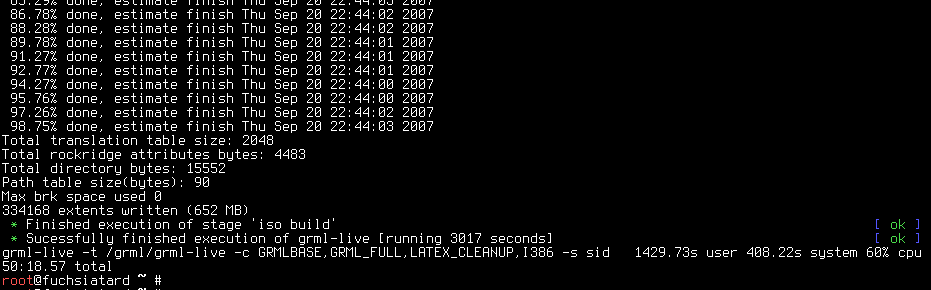
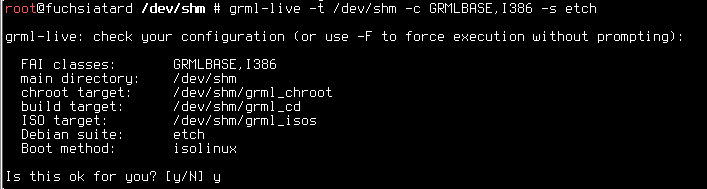
grml-live ist ein Framework, mit dessen Hilfe man mit nur 1 Kommando eine auf grml/Debian basierende Linux Live-CD bauen kann. grml-live baut auf FAI (Fully Automatic Installation) auf und nutzt dessen klassenbasiertes Konzept: Screenshot: grml-live In diesem Beispiel habe ich gerade ein gro es grml-ISO gebaut. Dabei habe ich einfach nur den Debian-Mirror in /etc/grml/grml-live.conf auf meinen lokalen Mirror gedreht (um Traffic und Zeit zu sparen) und dann folgendes Kommando aufgerufen:
# grml-live -t /grml/grml-live -c GRMLBASE,GRML_FULL,LATEX_CLEANUP,I386 -s sid
Ca. 50 Minuten sp ter habe ich im Ordner grml_isos unter /grml/grml-live/ (-t …) ein fertiges grml-ISO. Dieses wurde auf Basis der Klassen (-c …) GRMLBASE (da steckt alles essenzielle drin), GRML_FULL (Software-Auswahl wie auf der offiziellen gro en grml), LATEX_CLEANUP (ein paar sehr gro e LaTeX-Verzeichnisse aufr umen) und I386 (x86-spezifische Pakete wie z.B. der Kernel) gebaut. Als Debian-Suite (-s) wurde sid (unstable) ausgew hlt. Und das war es auch schon. Ein kleinere grml-Version auf Basis von Debian/stable gef llig? Kein Problem, machen wir es doch einfach mal im Shared-Memory (superschnell und mit genug RAM und den Mountoptionen rw,suid,dev auch kein Problem): Screenshot grml-live: der Start Ein ‘grml-live -t /dev/shm -c GRMLBASE,I386 -s etch’ und keine 5(!) Minuten sp ter hab ich dann mein 135MB kleines grml: Screenshot grml-live: done Mit grml-live kann man sich somit seine pers nlich angepasste Linux Live-CD erstellen, ohne sich erst mit Remastering im Detail besch ftigen zu m ssen. Auch muss man dabei nicht zwingend Debian/unstable nehmen, sondern kann auch Debian/stable als Basis ausw hlen. Durch das Erstellen einer neuen Klasse oder das Anpassen einer existierenden kann man auch spezielle Software-W nsche ganz einfach erf llen. Wird damit das offizielle grml-ISO etwa obsolet? Nein, auf keinen Fall. grml-live soll dem grml-Team als Buildsystem dienen (automatisierte Snapshots auf regelm iger Basis z.B. sind schon in Planung) und die langweilige Arbeit abnehmen, damit wir uns auf die wirklich wichtigen Sachen konzentrieren k nnen: Testen, Bugfixing, Implementieren von neuen Features, Arbeit am Kernel, Qualit tssicherung, Dokumentation,… grml-live hat den Anspruch, auf jedem Debian-basierten System zu funktionieren und wer Interesse daran gefunden hat, kann sich das Debian-Pakete aus dem grml-Repository holen. Den Quellcode gibt es nat rlich auf unserer Mercurial-Webseite. Wer jetzt noch Fragen hat oder mehr Details zu grml-live erfahren m chte, der m ge einfach auf die grml-live-Homepage schauen. Falls dort eine Frage noch nicht beantwortet sein sollte, jemand Feature-Requests, Bugreports oder Patches hat: meine Inbox freut sich ber Post! :-)

Ross Burton: Stephen Fry Is My Hero (Even More Than Before)

Stephen Fry has long been a hero of mine for his acting and comedy, but I've just discovered that not only is he a geek, but he also gets it. From his blog regarding the iPhone:
Server side apps only. No, no, no, no, no. This is NOT good. It's one thing to want to keep the proprietary system closed, but to present a device sealed in digital Araldite is a Bad Idea. An Ubuntu flavoured Linux for mobiles is in the works, and you don't get more open source than that.
The full article is rather long but a very good read. Now I just want him to stop fawning over his iPhone and get back to making another series of QI, damnit! NP: Digital Shades Volume 1, M83

Next.

Previous.