Search Results: "tats"

10 December 2007

Steve Kemp: Find me somebody to love

Debian Admin
It looks like the fine DebianAdmin.com site is at it agian: Word-for-word copyright infringement by the user "admin". See the other cisco articles for more infringements. (OK I'm still bitter their site is pimped all over the place, including wiki.debian.org, and their name is confusingly similar to my sites...)
Apache SQL
After yesterdays frustrations with SQL::YASP I moved to parsing logfiles to an temporary SQLite database. I now have a tool which you may use to load an arbitary number of Apache logfiles to, and query via SQL. It looks something like this:
asql> load /var/log/apache2/acc*
Creating tables
Loading: /var/log/apache2/access.log
Loading: /var/log/apache2/access.log.1
asql>   SELECT referer,COUNT(referer) AS number from logs GROUP BY referer ORDER BY number DESC,referer
- 4807
http://localhost/stats/ 2
http://foo.ocm/stats/ 2
asql>
Very useful :) A Debian package is available if you're interested in testing / using it, as is a mercurial repository. The package now stands at 0.4 and is essentially done. It has tab completion on filenames and does enough for me. It might be nice to allow it to auto-read certain files on startup, or persist the database but I'll not bother unless people ask for it.

9 December 2007

Raphael Geissert: Updated: Homepage as a control field debian/control stats

Here are the updated stats about the usage of the Homepage field, comparing with those from my previous post

Using the same procedure as in my previous post (but this time with and without sort -u):

Our first number (# of package using the Homepage field in unstable/main/1386): 1028
Previous number: 335
Difference: 693
Without sort -u: 2441
Meaning: 2.37% of the packages have the same Homepage

Our second number (# of package using the pseudo-Homepage field in unstable/main/1386): 2400
Previous number: 2716
Difference: 316
Without sort -u: 3886
Meaning: 1.62% of the packages have the same pseudo-Homepage field

And the third number (# of source packages in main): 11950

So, if we make those number percentages:


That's a good progress :)
It would be nice if the stats provided by Zack included some percentages and a nice graphic :D

But let's do something different:
egrep -i "^[ \t]+(Website Home Webpage url link):" < Packages wc -l

Number of packages using something other than Homepage: 142
Using sort -u: 76
Meaning: 1.87% of the packages have the same non standard pseudo-field

Comparing this number with the total number of source packages in main:

2 December 2007

Julien Danjou: Testing out rebuildd 0.3.0

awesome beiing in rc state, that leaves me a small amount of spare time. I decided to spend it on rebuildd. I had started the 0.3.0 version back in August, but never touched it again until now. I was afraid because I did not remember in which state I left the code repository. And, good surprise, the code was in a quite good shape! I just implemented and fixed some stuff that were reported on the BTS, and then, I only had to test it out. For that I used the servers kindly provided by TuxFamily.org: I stored the MySQL database on whisky. filled it with rebuildd-job add-quinn-diff (new feature in 0.3.0) and then started rebuildd on each node. And then I saw the 2 hosts starting to grab, lock jobs, build packages on each side. Wonderful. That just works. :-) rebuildd-job stats says that 20 % of the archive is now built in less than 24h, seems fast, cool. Bad point is that I'm building and trashing logs into /dev/null because I've no QA idea to implement right now.

1 December 2007

Romain Francoise: More Vcs-* statistics

Expanding on my previous post, this time with a graph:

The first package to add a Vcs field was amule on June 7th, 2006. And it was Bzr.

30 November 2007

Stefano Zacchiroli: buggy vcs-svn fields

Buggy Vcs-Svn fields around My statistics flu continues (oh, BTW, don't worry, I'll be quiet again on planet RSN). This time I wanted to check how many packages are maintained using some Version Control System in Debian, but at the same time are not declaring a proper Vcs-XXX field in their debian/controls. With the help of Goneri and the svnbuildstat I've managed to cross the data used to actually build nightly packages from subversion repositories with the Vcs-XXX fields declared in Debian source packages. The outcome is yet another daily updated page which lists packages which are missing Vcs-Svn field and/or declare a wrong one (i.e. one which is not in sync with what svnbuildstat is using to build the package). You might want to have a look to the corresponding dd-list to see if some of your packages need to be fixed. Several of mine do for example ... Oh, of course the check is limited to what svnbuildstat knows. If you want to be checked it's a good idea to ask for the addition of your repository to svnbuildstat.

Stefano Zacchiroli: homepage field stats

Some numbers about the Homepage field I've got the statistics flu, it's probably floating around here in Spain. So I've wrote a couple of short scripts to collect numbers about how many packages are using the new Homepage field in debian/control and how many are still using the old pseudo-field in their description. So, here is a daily updated page with the Homepage field stats in Debian. The numbers are better than I had expected, even though about 4'000 packages are still using the old pseudo field, about 2'000 are already using the new one. (Technical) habits in debian can spread quite fast ...

27 November 2007

Steve Kemp: Find me somebody to love

Debian Admin
It looks like the fine DebianAdmin.com site is at it agian: Word-for-word copyright infringement by the user "admin". See the other cisco articles for more infringements. (OK I'm still bitter their site is pimped all over the place, including wiki.debian.org, and their name is confusingly similar to my sites...)
Apache SQL
After yesterdays frustrations with SQL::YASP I moved to parsing logfiles to an temporary SQLite database. I now have a tool which you may use to load an arbitary number of Apache logfiles to, and query via SQL. It looks something like this:
asql> load /var/log/apache2/acc*
Creating tables
Loading: /var/log/apache2/access.log
Loading: /var/log/apache2/access.log.1
asql>   SELECT referer,COUNT(referer) AS number from logs GROUP BY referer ORDER BY number DESC,referer
- 4807
http://localhost/stats/ 2
http://foo.ocm/stats/ 2
asql>
Very useful :) A Debian package is available if you're interested in testing / using it, as is a mercurial repository. The package now stands at 0.4 and is essentially done. It has tab completion on filenames and does enough for me. It might be nice to allow it to auto-read certain files on startup, or persist the database but I'll not bother unless people ask for it.

16 November 2007

Kartik Mistry: Interesting stats

* We love stats. Foss.in Delegate Stat is really interesting!

8 November 2007

Mart&iacute;n Ferrari: I (heart) pkg-perl

After DebConf7, I started to work with the Debian Perl Group, which I think is an example of how good a packaging group can work. We maintain currently 400+ packages, with a log bug-count (0.11 active bugs per source package says asdfasdf, and it's not like we are a lot of people there. To be honest, I haven't been too active on the packaging front, but I spent countless hours on tweaking and modifying what I think it's the most important tool for the group success: a script that generates a webpage where you can instantly see the status of every package in the SVN repository. The great thing about this is that it gives you a visual idea of the status of everything in a moment: which packages have bugs, which one are ready to be uploaded, and —since we keep all watchfiles updated— also which have a new upstream version. Being a group with many non-DDs, it's great that there's no need for maintaining a list of to-be-sponsored packages; we just mark the package as ready to go, and when somebody can do it, reviews and uploads the package. I can hear the cries of people who think that sponsored packages are the incarnation of the devil, but our bugcount backs me :-). I tell you all of this because, first of all, I'm really glad to be part of a healty group of great people, and secondly, because we are finishing a completely new version of the tool, which was thought from the beggining to be used by other groups. In fact, a lot of debugging has been done by checking that it could process correctly other groups' data (it only works with SVN by now, but that's easily fixable as the code is pretty modular). You can see the (static) pages I've done while testing, showing the packages from the Collab-maint, Games, Java, KDE and Python-modules teams/groups. If you find a bug, I'd love to hear about it. So, if you're interested, grab the sources from the repository, and drop in #debian-perl@OFTC if you need help. Tags: Planet Debian, Debian

7 November 2007

David Welton: YUI Compressor

One of the things I love about programming is that you are always learning new things. You have to learn new things to keep up. One of the benefits of using the Plotr Javascript library for the language popularity stats I did is that instead of having to download separate images for each statistic, a user just fetches the library once and then a few small bits of data for each chart, which is probably a net savings, especially when I start to add more statistics. However, Plotr, plus its various supporting libraries, is fairly hefty, so I needed to find a way to compress it. One of the helpful people on the freenode IRC network's #javascript channel pointed me at Yahoo's YUI Compressor, which is a nicely done project that squeezes quite a bit out of Javascript files. I would recommend it to anyone else who needs to pare down their production JS files to the bare minimum. Best of all, it's available under a very liberal open source license! Incidentally, over the course of the language stats project, I was surprised at how much helpful stuff Yahoo provides, first and foremost, a real API for their search engine, something that Google no longer has. Hopefully, it's a sign of better things to come for them (if for no other reason than to keep Google on their toes!). By the way, for those interested in the language stats project, I set up a forum with RSS feeds, where I will be posting updates, and accepting suggestions for further improvements.

6 November 2007

John Goerzen: American Priorities

Number of people killed on Sept. 11, 2001: 2,974
Number of suicides in 2004: 32,439
Number of people killed on American highways in 2006: 38,588
Annual deaths from obesity:300,000
Total deaths from cancer in 2007:559,650
Total deaths from heart disease in 2004:871,500
 
Total military spending in FY2008: $1228 billion
Funding for health research & improvement (NIH):$29 billion
Total support of Amtrak (safer, cleaner than highways):$1.6 billion
National Highway Traffic Safety Admin. spending in FY2008: $0.8 billion
 
WHAT IS WRONG WITH THIS PICTURE?

David Welton: Programming Language Popularity

My latest fun project: http://www.langpop.com Of course, the results aren't very scientific, but they're interesting, nonetheless. I'll be adding some more charts like trends once I have data over a few months. I ran some similar stats a few years ago, but this time I've geared up to automate the whole process, so results should be updated regularly, once everything is up and running.

4 November 2007

Lucas Nussbaum: Some numbers about Debian s history

There’s an interesting article on LWN.net about Gentoo: Who made Gentoo Linux, and when? A commit analysis I was wondering how Debian compared, so I made some stats using the debian-devel-changes archives. First, the number of source uploads per quarter:
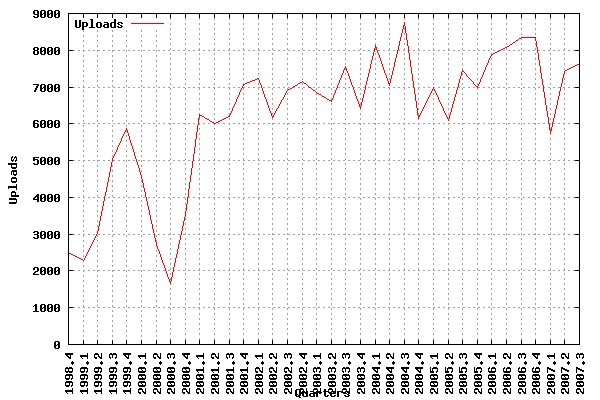
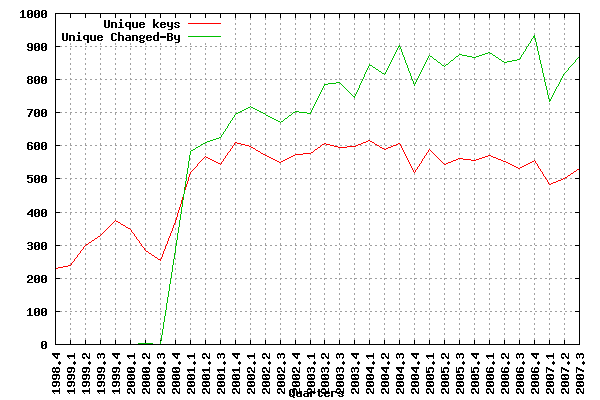
It’s interesting to note that, while the number of packages in Debian increased a lot, the number of uploads basically stayed the same since 2001. Then, I wondered about the number of active developers in Debian. So I counted: I can provide the raw data on demand, if someone else want to work on this. There’s probably a lot of other interesting things to do!

29 October 2007

Lior Kaplan: Debian Installer Hebrew translation reached 100% for levels 1-4

Today I noticed that the d-i translation to Hebrew reached 100% at levels 1-4 on the SVN. This is the first time it happens for levels 3-4 since I started the translation back at 2004. Although the Hebrew translation started as a personal project, in the last 9 months I got help from several people: Amit Dovev, Baruch Even, Katriel Traum and Meital Bourvine. With this joint effort, level 1 was reviewed for typos and levels 2-3 were completed. Thanks you all. As level 5 contains too much technical (error) messages, I decided not to invest time with its translation. So from now on it’s mainly keeping the status quo of translation rate for Hebrew… When Christian suggested to translate d-i to Hebrew:
> Lior Kaplan
> Israel Ahem, by the way….Hebrew installation is missing…:-)
I didn’t imagine reaching this point, as the translation started without any bidi (BiDirectional) support for d-i. Only after Debconf4 I could actually read my translations in d-i’s nightly builds:
We can also mention that hard work was made on BiDirectional languages support, mostly by Steve Langasek, which was jailed by myself for some nights in the “d-i hack lab”… :-).
Working on the translation later triggered more contribution for Debian, which later made me start the NM process. So please “blame” Christian for me becoming a DD (:

23 October 2007

Raphael Geissert: Homepage as a control field debian/control stats

I think by now everybody knows that Homepage: is now a valid debian/control field.

So, let's see how many packages in sid/main/binary-i386 are using Homepage as a description field and how many as a control field.


We fetch Packages.bz2 and unpack...
$ wget http://localhost:3142/ftp.us.debian.org/debian/dists/sid/main/binary-i386/Packages.bz2
$ bunzip2 Packages.bz2 


Now, we count the number of packages using Homepage as a control field:
$ egrep "^Homep" < Packages   sort -u   wc -l

(note the usage of sort -u because I'd say packages with the same Homepage come from the same source package).

So we have our first number: 335
Doesn't look bad, does it? :)

But let's compare it with this:
$ egrep "^[ \t]+Homep" < Packages   sort -u   wc -l


Our second number is: 2716
Wow, that's a big difference.

But hey? how many packages are out there?

$ wget http://localhost:3142/ftp.us.debian.org/debian/dists/sid/main/sources/Sources.bz2
$ bunzip2 Sources.bz2
$ egrep "^Package:" Sources  wc -l


Our third number is: 11820

So, if we make those number percentages:

20 October 2007

Jan Wagner: wordpress plugin and widget packages

Yesterday I was going through the plugins and widgets, if there are any updates or such. I realized again, that updating of plugins (and maybe searching for the relocated download source) makes me mad. Also testing and switching back is annoying much.
So I decided to package plugins and widgets I use. Since some plugins and widgets are not maintained long enought for any debian release cycle or getting obsolet with new wordpress releases, I decided to maintain the packages outside of the debian project. Anyways … some people are also scared about the security situation of wordpress. I guess this isn’t much better for wordpress extensions. Next pity, some extensions or any equivalents aren’t available for wordpress 2.3 (yet). If you run multiple blogs via the stock debian package and wan’t to make use of the new wordpress version in any of your sites, you have update all at once … which maybe not a way you want to go. I decided to repackage wordpress 2.3.0 as wordpress23, which allows you to install wordpress (<<2.3.0) and wordpress23 at same time. If you want to use debian plugin, widget or theme packages or use these from your normal wordpress installation (/usr/share/wordpress) with wordpress23, you need to symlink the dirs. For example:

# mv /usr/share/wordpress23/wp-content/plugins/ /usr/share/wordpress23/wp-content/plugins.orig
# mv /usr/share/wordpress23/wp-content/themes/ /usr/share/wordpress23/wp-content/themes.orig
# ln -s /usr/share/wordpress23/wp-content/plugins /usr/share/wordpress/wp-content/plugins
# ln -s /usr/share/wordpress23/wp-content/themes /usr/share/wordpress/wp-content/themes Remember that package updates of wordpress or wordpress23 may overwrite parts of /usr/share/wordpress/wp-content/[plugins themes] in such situation. BE CAREFULL! You can get the stuff via apt-line:

deb ftp://ftp.cyconet.org/debian wordpress main non-free contrib Or directly from: http://ftp.cyconet.org/debian/archive/wordpress/ The actual package list is: wordpress-plugin-af-extended-live-archive
wordpress-plugin-ald-spa
wordpress-plugin-all-in-one-seo-pack
wordpress-plugin-exec-php
wordpress-plugin-google-sitemap-generator
wordpress-plugin-landingsites
wordpress-plugin-lightbox-2
wordpress-plugin-now-reading
wordpress-plugin-page-links-to
wordpress-plugin-photopress
wordpress-plugin-related-posts
wordpress-plugin-rolemanager
wordpress-plugin-sideblog
wordpress-plugin-spam-karma
wordpress-plugin-stats
wordpress-plugin-ubernyms
wordpress-plugin-utw
wordpress-plugin-utwgooglesitemaps
wordpress-plugins
wordpress-widget-category-cloud
wordpress-widget-samsarin-php
wordpress-widget-utw-cloud
wordpress-widgets
wordpress23 If you want a plugin or widget included and it makes sence to do so, drop me a mail, where to grab. Be aware that UTW isn’t supported since wordpress 2.3 anymore. A tag system was included into wordpress and you need to search replacements for all the nice UTW extension! Stay tuned! , , , , ,

Enrico Zini: liferea-summarise

Automatic feed summaries What do you get if you merge this and this? You get a scary little filter that extract the top 5 keywords from a post content and adds them to the titles. Useful titles for all posts: how about that?
#!/usr/bin/python
# Copyright (C) 2007 Enrico Zini <enrico@debian.org>
# This software is licensed under the therms of the GNU General Public
# License, version 2 or later.
import libxml2, re, math
tokenize = re.compile(r"\W+")
doc = libxml2.parseFile("-")
root = doc.getRootElement()
# Create an xpath context and register the namespaces
xpc = doc.xpathNewContext()
for d in root.nsDefs():
    if d.name == None:
        xpc.xpathRegisterNs("rss", d.content)
    else:
        xpc.xpathRegisterNs(d.name, d.content)
# Collect text stats to generate summaries
doc_tokens =  
for x in xpc.xpathEval("/rdf:RDF/rss:item"):
    res = x.nsProp("about", "http://www.w3.org/1999/02/22-rdf-syntax-ns#")
    tokens =  
    for c in x.children:
        if c.type != 'element' or (c.name != 'encoded' and c.name != 'title'):
            continue
        for t in c.children:
            if t.type != 'text': continue
            for tok in tokenize.split(t.content):
                if tok in tokens:
                    tokens[tok] += 1
                else:
                    tokens[tok] = 1
    doc_tokens[res] = tokens
# Aggregate token counts
aggregated =  
for d in doc_tokens.itervalues():
    for tok, count in d.iteritems():
        tok = tok.lower()
        if tok in aggregated:
            aggregated[tok] += count
        else:
            aggregated[tok] = count
def tfidf(doc, tok):
    "Compute TFIDF score of a token in a document"
    tok = tok.lower()
    return doc_tokens[doc].get(tok, 0) * math.log(float(len(doc_tokens)) / aggregated.get(tok, 0))
def top5(doc):
    # Output the top 5 tokens by TFIDF
    return sorted(doc_tokens[doc].keys(), key=lambda tok: tfidf(doc, tok), reverse=True)[:5]
# Rewrite the titles
for x in xpc.xpathEval("/rdf:RDF/rss:item"):
    res = x.nsProp("about", "http://www.w3.org/1999/02/22-rdf-syntax-ns#")
    for c in x.children:
        if c.type != 'element' or c.name != 'title':
            continue
        for t in c.children:
            if t.type != 'text': continue
            name, content = t.content.split(":", 1)
            summary = ", ".join(top5(res))
            t.replaceNode(doc.newDocText(name+" ["+summary+"]:"+content))
# Serialize the result
print doc.saveFormatFile("-", True)

11 October 2007

Russell Coker: Getting People into IT

Pia writes about the difficulty in getting young women and young people in general into the computer industry [1]. While I agree that having more women in the computer industry would be a good thing, I have difficulty believing some of the claims that Pia makes. For example the claim that “[girls] are more career focused earlier in their school life“. I chose my career when I was about 11 years old [2] and several of my friends made similar decisions at similar ages. I would be interested to read anecdotal evidence from women in the computer industry about how old they were when they decided on their career and if their friends did the same, a reference to any research on this topic would also be useful. I tend to believe that boys are more career focussed at all stages of their life but have little evidence to support this idea. One fact that seems obvious is that the idea that “if you don’t succeed in your career then you can always marry someone who does” is almost non-existent among boys. It seems likely that such ideas have a statistically relevant affect on the focus on career of boys vs girls. Also the Australian Bureau of Statistics reports that the MEDIAN income for women is significantly lower than for men [4], I find it difficult to imagine that girls could be more career focussed from a younger age and yet get significantly lower pay (note the fact that it’s median not mean income is very significant as it removes the “glass ceiling” effect). Phillip Greenspun writes about why there are so few women doing scientific research [6] and makes some good points about why scientific research is generally not well paid and therefore a university student would choose a career in some other area and suggests that it’s a macho thing that guys enter such competitive fields for relatively low wages. Maybe some women correctly assess the costs and benefits of a career in scientific research and then make the mistake of equating Computer Science to other branches of science. But the median income suggests that although there may be some valid reasons for avoiding science that would only cover a small portion of the problem (the difference in median income can not be explained by misplaced attempts to maximise income). One problem that is significant is the quality of school education for girls. Not only is there the issue that boys may crowd-out girls for some subjects that are supposedly traditionally for boys (such as all science) but even girls schools aren’t as good as they should be. Some time ago I was talking to a teacher at an all-girls school, the school was moderately expensive and parents were paying the extra money presumably to give their daughters educational opportunities that they might miss in a co-ed school. However the school did not teach hard maths (”Maths B” was the official name at the time) and only taught the easy maths (official name “Maths A” and unofficial name “Vegie Maths“) because they didn’t have many girls demanding it (which is probably difficult to measure if you don’t offer it as a reasonable option) and the girls who wanted to study it could always move to a different school. So the choice facing girls at the exclusive school in question was “skip the subject that is most useful for further studies in most science subjects” or “go to a different school and miss most of your friends“, this sort of decision would surely discourage some potential female computer programemers. Also I think that the difference between boys and girls in regard to studying computer science has a lot to do with the fact that given a choice between missing most of their friends and missing out on something related to computers would be a no-brainer for most boys. Paul Graham’s article about Nerds has some interesting points to make in this regard - maybe the problem is that girls aren’t Nerdish enough [5]. Pia also writes about parents and teachers advising children not do study IT because of a perceived lack of jobs. I think that the problem here is not just bad advice, but also a bad tendency to take advice. Someone who wants to study in an established field which changes little over time (law and accounting spring to mind) probably should take careful note of the advice that they are given - things haven’t changed much in the last few decades. But someone who wants to study in a field that changes rapidly and where every year has new and significant developments (of which the best example is the computer industry) should probably be quite skeptical of all advice - most advice about the computer industry concerns how things used to be not how things are. Finally when considering whether to accept advice you should consider who is offering it. For example advice from a hiring manager should be carefully noted (as the manager will tell you precisely what factors influence their own decisions on hiring). Advice from people who are successful in the industry should also be noted. Advice from a school career advisor who gets paid about 1/3 what any 25yo can earn in the computer industry should be entirely ignored. I wonder whether being hesitant to ignore advice is a problem for girls in this regard. When I was in year 11 I had to take a subject related to career planning. It covered some things that were of minor use (such as writing CVs) and had an assignment of writing a fictional CV for yourself a few years after leaving university. I received bad marks for preparing a CV that involved changing jobs as companies went bankrupt or projects failed due to bad management, I was told that if your employer fails in the market it makes you look bad! However my fictional CV did bear some resemblance to what really happened… In terms of what industries have jobs available, the best advice I can give students is to actively do some research of their own. It’s not difficult to get the jobs sections of some newspapers and do a quick scan to see how many positions are open in a field, and it’s even easier to do some searches on online jobs sites (which usually tell you how many positions posted in the last X days match your criteria). For example I just visited jobserve.com.au and found 1724 Engineering jobs and 5622 IT jobs advertised. If you compare this to the university intake (I visited the Swinburne university courses list [3] and found 25 IT courses vs 29 Engineering course) it seems that the ratio of Engineering graduates to jobs is not likely to be as good as that for CS graduates. Of course it may be that all the other universities have hardly any Engineering courses and balance the ratio out (but I doubt it). In any case this would be a good way of injecting some facts into a discussion of the relative merits of different career choices and avoiding it being an issue of parents/teachers not liking computers vs children liking them. Determining the relative pay rates of different industries is a lot more difficult (and requires a significant amount of work), some recruiting agencies publish statistics - but those stats only apply to the positions that they fill (which is a sub-set of the actual positions). Finally as a piece of advice for children, try and find a job that you enjoy. If you earn $30K doing something you enjoy then you’ll probably be happier than if you earn $100K doing something you hate. Also if you enjoy your work then you will probably be able to take the extra steps needed to become successful - often it’s not a choice between having fun or making good money but a choice between fun and good money or the absence of both. If someone tells you to avoid doing what you love and instead do something boring for some unsubstantiated belief that there would be more money in it then be a nerd and tell them that their opinion is not relevant (it does tend to make teachers angry though).

2 October 2007

Julien Danjou: git statistics?

I wonder if there are tools to do pretty git statistics, something like that: Linux 2.6 git stats (done on linux-2.6 git repository). I just wrote a quick'n dirty Python script to do that, but I'm too lazy to write a full program for now

Next.

Previous.