Search Results: "nate"

26 February 2021

Ritesh Raj Sarraf: Wayland KDE X11

KDE Impressions These days, I often hear a lot about Wayland. And how much of effort is being put into it; not just by the Embedded world but also the usual Desktop systems, namely KDE and GNOME. In recent past, I switched back to KDE and have been (very) happy about the switch. Even though the KDE 4 (and initial KDE 5) debacle had burnt many, coming back to a usable KDE desktop is always a delight. It makes me feel home with the elegance, while at the same time the flexibility, it provides. It feels so nice to draft this blog article from Kwrite + VI Input Mode Thanks to the great work of the Debian KDE Team, but Norbert Preining in particular, who has helped bring very up-to-date KDE packages into Debian. Right now, I m on a Plamsa 5.21.1 desktop, which is recent by all standards.

Wayland Almost all the places in the Linux world these days are busy with integrating Wayland as the primary display service. Not sure what the current status on the GNOME side is but I definitely keep trying KDE + Wayland with every release. I keep trying with every release because it still is not prime for daily use. And it makes me get back to X11, no matter how dated some may call. Fact is, X11 still shines to me as an end-user. Glitches with Wayland still are (Based on this week s test on Plasma 5.21.1):
  • Horrible performance compared to X11
  • Very crashy, especially when hotplugging secondary display. Plasma would just crash. X11 is very resilient to such things, part of the reason I can think is the age of the codebase.
  • Many many applications still need to be fixed for Wayland. Or Wayland needs to accomodate them in some way. XWayland does not really feel like the answer.
And while KDE keeps insisting users to switch to Wayland, as that s where all the new enhancements and fixes are put in, someone like me still needs to stick to X11 for the time being. So to get my shiny new LG 27" 4K Monitor (3840x2160 60.00*+) to work without too much glitch, I had to live with an alias:
$ alias   grep xrandr
alias rrs_xrandr_lg='xrandr --output DP-1 --mode 3840x2160 --scale .75x.75'
18:31                    

Plasma 5.21 On the brighter side, the Plasma 5.21.1 release brings some nice enhancements in other areas.
  • I m now able to make use of tighter integration with systemd/cgroups, with better organization and management of processes overall.
  • The new Plasma theme, Breeze Twilight, is a good blend of Light + Dark.
I also appreciate the work put in by Michail Vourlakos. The KDE project is lucky to have a developer/designer like him. His vision and work into the KDE desktop is well beyond a writing by me.
$ usystemctl status plasma-plasmashell.service 
  plasma-plasmashell.service - KDE Plasma Workspace
     Loaded: loaded (/usr/lib/systemd/user/plasma-plasmashell.service; enabled; vendor preset: enabled)
     Active: active (running) since Fri 2021-02-26 18:34:23 IST; 13s ago
   Main PID: 501806 (plasmashell)
      Tasks: 21 (limit: 18821)
     Memory: 759.8M
        CPU: 13.706s
     CGroup: /user.slice/user-1000.slice/user@1000.service/session.slice/plasma-plasmashell.service
              501806 /usr/bin/plasmashell --no-respawn
             
Feb 26 18:35:00 priyasi plasmashell[501806]: qml: recreating buttons
Feb 26 18:35:21 priyasi plasmashell[501806]: qml: recreating buttons
Feb 26 18:35:49 priyasi plasmashell[501806]: qml: recreating buttons
Feb 26 18:35:57 priyasi plasmashell[501806]: qml: recreating buttons
18:36                  

OBS - Open Build Service I should also thank the OpenSUSE folks for the OBS work. It has enabled the close equivalent (or better, in my experience) of PPAs for Debian. And that is what has enabled developers like Norbert to easily and quickly be able to deliver the entire KDE suite.

OBS - Some detail Christian asked for some more details on the OBS side of things, of my view. I m updating this article with it because the comment system may not always be reliable and I hate losing content. Having been using OBS myself, and also others in the Debian community who are making use of it, I surely think we as project should consider making use of OBS. Given that OBS is Free Software, it is a perfect fit for Debian. Gitlab is another example of what we ve made available in Debian. OBS is divided into multiple parts
  • OBS Server
  • OBS DoD service
  • OBS Publisher
  • OBS Workers
  • OBS Warden
  • OBS Rep Server
For every Debian release I care about, I add an OBS project per release. So I have OBS projects for: Sid, Bullseye, Buster, Jessie. Now, say you have a package, foo . You prep your package and enable all the releases that you want to build the package for. So the same package gets built, in separate clean environments, for every release I mentioned as an example above. You don t have to manually trigger the build for every release/every architcture. You should add the release (as projects) in OBS, set their supported architectures, and then add those enabled release projets as bits to your package. Every build involves:
  • Creating a new chroot for each build
  • Building the package
Builds can be scattered across multiple hosts, known as workers in OBS terminology. Your workers are independent machine entities, supporting different architectures. The machines can be Bare-Metal ones, VMs, even containers. So this allows for very nice scale-in and scale-out. There may be auto-scaling too but that is something worth investigating. Think of things like cross architecture builds. Let s assume the cloud vendors decide to donate resources to the Debian project. We could enable OBS worker instances on the respective clouds (different architectures) and plug them into the master OBS instance that Debian hosts. Fully distributed. Similarly, big hardware vendors willing to donate compute resources could house them in their premises and Debian could just easily establish a connection to them. All of this just a TCP connection away. So when I look at the features of OBS, from the point of view of Debian, I like it more. Extensibility won t be an issue. Supporting a new Debian release would just be a matter of bootstrapping the Debian release as a project in OBS, and then all done. The single effort of setting of the target release project is a one time job, and then all can leverage it. The PPA was a long craved feature missing in Debian, in my opinion. OBS allows to not just fulfil that gap but also extend it in a very easy way. Andrew Lee had put in a nice video presentation about the same @ Debconf 20

24 February 2021

Dirk Eddelbuettel: RcppSimdJson 0.1.4 on CRAN: Small Bugfix

A quick note to say that we finalized a bugfix release 0.1.5 of RcppSimdJson yesterday which got onto CRAN earlier today. RcppSimdJson wraps the fantastic and genuinely impressive simdjson library by Daniel Lemire and collaborators. Via very clever algorithmic engineering to obtain largely branch-free code, coupled with modern C++ and newer compiler instructions, it results in parsing gigabytes of JSON parsed per second which is quite mindboggling. The best-case performance is faster than CPU speed as use of parallel SIMD instructions and careful branch avoidance can lead to less than one cpu cycle per byte parsed; see the video of the talk by Daniel Lemire at QCon (also voted best talk). This version brings a small fix to Windows where temporary filenames constructed from URLs (as for example constructed by our td package) need an extra sanization for a possible ? character. We will be addressing that properly in due course but for now a simple gsub() will do. The NEWS entry follows.

Changes in version 0.1.5 (2021-02-23)
  • Temporary filenames from request URLs need an extra path sanitization on Windows as seen with package td.
  • A few #nocov tags were added to the code.

Courtesy of my CRANberries, there is also a diffstat report for this release. For questions, suggestions, or issues please use the issue tracker at the GitHub repo. If you like this or other open-source work I do, you can now sponsor me at GitHub.

This post by Dirk Eddelbuettel originated on his Thinking inside the box blog. Please report excessive re-aggregation in third-party for-profit settings.

Rog rio Brito: Alternatives to ikiwiki?

It's been quite a long time since I last posted anything on this blog and I can say that one of the reasons for that I don't feel comfortable using ikiwiki anymore. I am actively looking for alternatives to ikiwiki that allow me, mainly, to write blog posts with the following characteristics (not necessarily in order of importance): Connected to the fact that I only can have static sites (no CGI, no forms, nothing else), I am, at this time, using Disqus to host the comments of my blog. I am also thinking of alternatives to this, like sending people to Twitter (or mastodon or email) or some site similar to Disqus, but with more of a Free Software inclination. Anyway, I am almost ready for any kind of transition, since I have already converted most posts (of course, not yet this one ) with some Python scripts to a format that I feel is a bit more format-agnostic than what ikiwiki uses.

  1. That's not to mention the myriad of hugo themes and theme authors that try to bribe you into using their hosted solutions (despite branding everything as "open source! OMG!"), like "wowchemy" you will have a hard time untangling the instructions of their so bloated themes to be usable on your local computer; so much so to the point that you give up with their convoluted configuration (which, potentially, doesn't "transfer" to other themes, if you are worried about possibly changing themes in the future).
  2. I like the style of fenced blocks that GitHub used, where you prefix the code with the name of the language to give a hint of how to highlight the code snipped.

22 February 2021

Dirk Eddelbuettel: pkgKitten 0.2.1: Now with roxygen2 support

kitten A new release 0.2.1 of pkgKitten hit CRAN earlier today, and has been uploaded to Debian as well. pkgKitten makes it simple to create new R packages via a simple function invocation. A wrapper kitten.r exists in the littler package to make it even easier. This release builds on the support for tinytest we added in release 0.2.0 by adding more optional support, this time for roxygen2. It also corrects a minor documentation snafu, and updates the CI use.

Changes in version 0.2.1 (2021-02-22)
  • A small documentation error was corrected (David Dalpiaz in #15).
  • A new option bunny adds support for roxygen2.
  • Continuous integration now use run.sh from r-ci.

More details about the package are at the pkgKitten webpage, the pkgKitten docs site, and the pkgKitten GitHub repo. Courtesy of my CRANberries site, there is also a diffstat report for this release. If you like this or other open-source work I do, you can now sponsor me at GitHub.

This post by Dirk Eddelbuettel originated on his Thinking inside the box blog. Please report excessive re-aggregation in third-party for-profit settings.

Charles Plessy: Containers

I was using a container for a bioinformatics tool released two weeks ago, but my shell script wrapping the tools could not run because the container was built around an old version of Debian (Jessie) that was released in 2015. I was asked to use a container for bioinformatics, based on conda, and found one that distributes coreutils, but it did not include a real version of sed. I try Debian's docker image. No luck; it does not contain ps, which my workflow manager needs. But fortunately I eventually figured out that Ubuntu's Docker image contains coreutils, sed and ps together! In the world of containers, this sounds like a little miracle.

Russ Allbery: Review: Finder

Review: Finder, by Suzanne Palmer
Series: Finder Chronicles #1
Publisher: DAW Books
Copyright: 2019
ISBN: 0-7564-1511-X
Format: Kindle
Pages: 391
Fergus Ferguson is a repo man, or professional finder as he'd prefer. He locates things taken by people who don't own them and returns them to their owners. In this case, the thing in question is a sentient starship, and the person who stole it is Arum Gilger, a warlord in a wired-together agglomeration of space habitats and mined-out asteroids named Cernekan. Cernee, as the locals call it, is in the backwaters of human space near the Gap between the spiral arms of the galaxy. One of Fergus's first encounters in Cernee is with an old lichen farmer named Mattie Vahn who happens to take the same cable car between stations that he does. Bad luck for Fergus, since that's also why Gilger's men first disable and then blow up the cable car, leaving Mattie dead and Fergus using the auto-return feature of Mattie's crates to escape to the Vahns' home station. The Vahns are not a power in Cernee, not exactly, but they do have some important alliances and provide an inroads for Fergus to get the lay of the land and map out a plan to recover the Venetia's Sword. This is a great hook. I would happily read a whole series about an interstellar repo man, particularly one like Fergus who only works for the good guys and recovers things from petty warlords. Fergus is a thoughtful, creative loner whose style is improvised plans, unexpected tactics, and thinking on his feet rather than either bluster or force (although there is a fair bit of death in this book, some of which is gruesome). About two-thirds of the book is in roughly that expected shape. Fergus makes some local contacts, maps out the political terrain, and maneuvers himself towards his target through a well-crafted slum of wired-together habitats and working-class miners. Also, full points for the creative security system on the starship that tries to solve a nearly impossible problem (a backdoor supplementing pre-shared keys with a cultural authentication scheme that can't be vulnerable to brute force or database searches). Halfway through, though, Palmer throws a curve ball at the reader that involves the unexplained alien presence that's been lurking around the system. That part of the plot shifts focus somewhat abruptly from the local power struggle Fergus has been navigating to something far more intrusive and personal. Fergus has to both reckon with a drastic change in his life and deal with memories of his early life on an Earth drowning in climate change, his abusive childhood, and his time spent in the Martian resistance. This is also a fine topic for an SF novel, but I think Finder suffered a bit from falling between two stools. The fun competence drama of the lone repossession agent striking back against petty tyrants by taking away their toys is derailed by the sudden burst of introspection and emotional processing, but the processing is not deep or complex enough to carry the story on its own. Fergus had an awful and emotionally alienated childhood followed by some nasty trauma, to which he has responded by carefully never getting close to anyone so that he never hurts anyone who relies on him. And yet, he's a fundamentally decent person and makes friends despite himself, and from there you can probably write the rest of the arc yourself. There's nothing wrong with this as the emotional substrate of a book that's primarily focused on an action plot, but the screeching change of focus threw me off. The good news is that the end of the book returns to the bits that I liked about the first half. The mixed news is that I thought the political situation in Cernee resolved much too easily and much too straightforwardly. I would have preferred the twisty alliances to stay twisty, rather than collapse messily into a far simpler moral duality. I will also speak on behalf of all the sentient starship lovers out there and complain that the Venetia's Sword was woefully underused. It had better show up in a future volume! This unsteadiness and a few missed opportunities make Finder a good book rather than a great one, but I was still happily entertained and willing to write that off as first-novel unevenness. There are a lot of background elements left unresolved for a future volume, but Finder comes to a satisfying conclusion. Recommended if you're looking for an undemanding space action story with a quick pace and decent, if not very deep, characters. Followed by Driving the Deep. Rating: 7 out of 10

21 February 2021

Matthew Garrett: Making hibernation work under Linux Lockdown

Linux draws a distinction between code running in kernel (kernel space) and applications running in userland (user space). This is enforced at the hardware level - in x86-speak[1], kernel space code runs in ring 0 and user space code runs in ring 3[2]. If you're running in ring 3 and you attempt to touch memory that's only accessible in ring 0, the hardware will raise a fault. No matter how privileged your ring 3 code, you don't get to touch ring 0.

Kind of. In theory. Traditionally this wasn't well enforced. At the most basic level, since root can load kernel modules, you could just build a kernel module that performed any kernel modifications you wanted and then have root load it. Technically user space code wasn't modifying kernel space code, but the difference was pretty semantic rather than useful. But it got worse - root could also map memory ranges belonging to PCI devices[3], and if the device could perform DMA you could just ask the device to overwrite bits of the kernel[4]. Or root could modify special CPU registers ("Model Specific Registers", or MSRs) that alter CPU behaviour via the /dev/msr interface, and compromise the kernel boundary that way.

It turns out that there were a number of ways root was effectively equivalent to ring 0, and the boundary was more about reliability (ie, a process running as root that ends up misbehaving should still only be able to crash itself rather than taking down the kernel with it) than security. After all, if you were root you could just replace the on-disk kernel with a backdoored one and reboot. Going deeper, you could replace the bootloader with one that automatically injected backdoors into a legitimate kernel image. We didn't have any way to prevent this sort of thing, so attempting to harden the root/kernel boundary wasn't especially interesting.

In 2012 Microsoft started requiring vendors ship systems with UEFI Secure Boot, a firmware feature that allowed[5] systems to refuse to boot anything without an appropriate signature. This not only enabled the creation of a system that drew a strong boundary between root and kernel, it arguably required one - what's the point of restricting what the firmware will stick in ring 0 if root can just throw more code in there afterwards? What ended up as the Lockdown Linux Security Module provides the tooling for this, blocking userspace interfaces that can be used to modify the kernel and enforcing that any modules have a trusted signature.

But that comes at something of a cost. Most of the features that Lockdown blocks are fairly niche, so the direct impact of having it enabled is small. Except that it also blocks hibernation[6], and it turns out some people were using that. The obvious question is "what does hibernation have to do with keeping root out of kernel space", and the answer is a little convoluted and is tied into how Linux implements hibernation. Basically, Linux saves system state into the swap partition and modifies the header to indicate that there's a hibernation image there instead of swap. On the next boot, the kernel sees the header indicating that it's a hibernation image, copies the contents of the swap partition back into RAM, and then jumps back into the old kernel code. What ensures that the hibernation image was actually written out by the kernel? Absolutely nothing, which means a motivated attacker with root access could turn off swap, write a hibernation image to the swap partition themselves, and then reboot. The kernel would happily resume into the attacker's image, giving the attacker control over what gets copied back into kernel space.

This is annoying, because normally when we think about attacks on swap we mitigate it by requiring an encrypted swap partition. But in this case, our attacker is root, and so already has access to the plaintext version of the swap partition. Disk encryption doesn't save us here. We need some way to verify that the hibernation image was written out by the kernel, not by root. And thankfully we have some tools for that.

Trusted Platform Modules (TPMs) are cryptographic coprocessors[7] capable of doing things like generating encryption keys and then encrypting things with them. You can ask a TPM to encrypt something with a key that's tied to that specific TPM - the OS has no access to the decryption key, and nor does any other TPM. So we can have the kernel generate an encryption key, encrypt part of the hibernation image with it, and then have the TPM encrypt it. We store the encrypted copy of the key in the hibernation image as well. On resume, the kernel reads the encrypted copy of the key, passes it to the TPM, gets the decrypted copy back and is able to verify the hibernation image.

That's great! Except root can do exactly the same thing. This tells us the hibernation image was generated on this machine, but doesn't tell us that it was done by the kernel. We need some way to be able to differentiate between keys that were generated in kernel and ones that were generated in userland. TPMs have the concept of "localities" (effectively privilege levels) that would be perfect for this. Userland is only able to access locality 0, so the kernel could simply use locality 1 to encrypt the key. Unfortunately, despite trying pretty hard, I've been unable to get localities to work. The motherboard chipset on my test machines simply doesn't forward any accesses to the TPM unless they're for locality 0. I needed another approach.

TPMs have a set of Platform Configuration Registers (PCRs), intended for keeping a record of system state. The OS isn't able to modify the PCRs directly. Instead, the OS provides a cryptographic hash of some material to the TPM. The TPM takes the existing PCR value, appends the new hash to that, and then stores the hash of the combination in the PCR - a process called "extension". This means that the new value of the TPM depends not only on the value of the new data, it depends on the previous value of the PCR - and, in turn, that previous value depended on its previous value, and so on. The only way to get to a specific PCR value is to either (a) break the hash algorithm, or (b) perform exactly the same sequence of writes. On system reset the PCRs go back to a known value, and the entire process starts again.

Some PCRs are different. PCR 23, for example, can be reset back to its original value without resetting the system. We can make use of that. The first thing we need to do is to prevent userland from being able to reset or extend PCR 23 itself. All TPM accesses go through the kernel, so this is a simple matter of parsing the write before it's sent to the TPM and returning an error if it's a sensitive command that would touch PCR 23. We now know that any change in PCR 23's state will be restricted to the kernel.

When we encrypt material with the TPM, we can ask it to record the PCR state. This is given back to us as metadata accompanying the encrypted secret. Along with the metadata is an additional signature created by the TPM, which can be used to prove that the metadata is both legitimate and associated with this specific encrypted data. In our case, that means we know what the value of PCR 23 was when we encrypted the key. That means that if we simply extend PCR 23 with a known value in-kernel before encrypting our key, we can look at the value of PCR 23 in the metadata. If it matches, the key was encrypted by the kernel - userland can create its own key, but it has no way to extend PCR 23 to the appropriate value first. We now know that the key was generated by the kernel.

But what if the attacker is able to gain access to the encrypted key? Let's say a kernel bug is hit that prevents hibernation from resuming, and you boot back up without wiping the hibernation image. Root can then read the key from the partition, ask the TPM to decrypt it, and then use that to create a new hibernation image. We probably want to prevent that as well. Fortunately, when you ask the TPM to encrypt something, you can ask that the TPM only decrypt it if the PCRs have specific values. "Sealing" material to the TPM in this way allows you to block decryption if the system isn't in the desired state. So, we define a policy that says that PCR 23 must have the same value at resume as it did on hibernation. On resume, the kernel resets PCR 23, extends it to the same value it did during hibernation, and then attempts to decrypt the key. Afterwards, it resets PCR 23 back to the initial value. Even if an attacker gains access to the encrypted copy of the key, the TPM will refuse to decrypt it.

And that's what this patchset implements. There's one fairly significant flaw at the moment, which is simply that an attacker can just reboot into an older kernel that doesn't implement the PCR 23 blocking and set up state by hand. Fortunately, this can be avoided using another aspect of the boot process. When you boot something via UEFI Secure Boot, the signing key used to verify the booted code is measured into PCR 7 by the system firmware. In the Linux world, the Shim bootloader then measures any additional keys that are used. By either using a new key to tag kernels that have support for the PCR 23 restrictions, or by embedding some additional metadata in the kernel that indicates the presence of this feature and measuring that, we can have a PCR 7 value that verifies that the PCR 23 restrictions are present. We then seal the key to PCR 7 as well as PCR 23, and if an attacker boots into a kernel that doesn't have this feature the PCR 7 value will be different and the TPM will refuse to decrypt the secret.

While there's a whole bunch of complexity here, the process should be entirely transparent to the user. The current implementation requires a TPM 2, and I'm not certain whether TPM 1.2 provides all the features necessary to do this properly - if so, extending it shouldn't be hard, but also all systems shipped in the past few years should have a TPM 2, so that's going to depend on whether there's sufficient interest to justify the work. And we're also at the early days of review, so there's always the risk that I've missed something obvious and there are terrible holes in this. And, well, given that it took almost 8 years to get the Lockdown patchset into mainline, let's not assume that I'm good at landing security code.

[1] Other architectures use different terminology here, such as "supervisor" and "user" mode, but it's broadly equivalent
[2] In theory rings 1 and 2 would allow you to run drivers with privileges somewhere between full kernel access and userland applications, but in reality we just don't talk about them in polite company
[3] This is how graphics worked in Linux before kernel modesetting turned up. XFree86 would just map your GPU's registers into userland and poke them directly. This was not a huge win for stability
[4] IOMMUs can help you here, by restricting the memory PCI devices can DMA to or from. The kernel then gets to allocate ranges for device buffers and configure the IOMMU such that the device can't DMA to anything else. Except that region of memory may still contain sensitive material such as function pointers, and attacks like this can still cause you problems as a result.
[5] This describes why I'm using "allowed" rather than "required" here
[6] Saving the system state to disk and powering down the platform entirely - significantly slower than suspending the system while keeping state in RAM, but also resilient against the system losing power.
[7] With some handwaving around "coprocessor". TPMs can't be part of the OS or the system firmware, but they don't technically need to be an independent component. Intel have a TPM implementation that runs on the Management Engine, a separate processor built into the motherboard chipset. AMD have one that runs on the Platform Security Processor, a small ARM core built into their CPU. Various ARM implementations run a TPM in Trustzone, a special CPU mode that (in theory) is able to access resources that are entirely blocked off from anything running in the OS, kernel or otherwise.

comment count unavailable comments

Russ Allbery: Review: The Fated Sky

Review: The Fated Sky, by Mary Robinette Kowal
Series: Lady Astronaut #2
Publisher: Tor
Copyright: August 2018
ISBN: 0-7653-9893-1
Format: Kindle
Pages: 380
The Fated Sky is a sequel to The Calculating Stars, but you could start with this book if you wanted to. It would be obvious you'd missed a previous book in the series, and some of the relationships would begin in medias res, but the story is sufficiently self-contained that one could puzzle through. Mild spoilers follow for The Calculating Stars, although only to the extent of confirming that book didn't take an unexpected turn, and nothing that wouldn't already be spoiled if you had read the short story "The Lady Astronaut of Mars" that kicked this series off. (The short story takes place well after all of the books.) Also some minor spoilers for the first section of the book, since I have to talk about its outcome in broad strokes in order to describe the primary shape of the novel. In the aftermath of worsening weather conditions caused by the Meteor, humans have established a permanent base on the Moon and are preparing a mission to Mars. Elma is not involved in the latter at the start of the book; she's working as a shuttle pilot on the Moon, rotating periodically back to Earth. But the political situation on Earth is becoming more tense as the refugee crisis escalates and the weather worsens, and the Mars mission is in danger of having its funding pulled in favor of other priorities. Elma's success in public outreach for the space program as the Lady Astronaut, enhanced by her navigation of a hostage situation when an Earth re-entry goes off course and is met by armed terrorists, may be the political edge supporters of the mission need. The first part of this book is the hostage situation and other ground-side politics, but the meat of this story is the tense drama of experimental, pre-computer space flight. For those who aren't familiar with the previous book, this series is an alternate history in which a huge meteorite hit the Atlantic seaboard in 1952, potentially setting off runaway global warming and accelerating the space program by more than a decade. The Calculating Stars was primarily about the politics surrounding the space program. In The Fated Sky, we see far more of the technical details: the triumphs, the planning, and the accidents and other emergencies that each could be fatal in an experimental spaceship headed towards Mars. If what you were missing from the first book was more technological challenge and realistic detail, The Fated Sky delivers. It's edge-of-your-seat suspenseful and almost impossible to put down. I have more complicated feelings about the secondary plot. In The Calculating Stars, the heart of the book was an incredibly well-told story of Elma learning to deal with her social anxiety. That's still a theme here but a lesser one; Elma has better coping mechanisms now. What The Fated Sky tackles instead is pervasive sexism and racism, and how Elma navigates that (not always well) as a white Jewish woman. The centrality of sexism is about the same in both books. Elma's public outreach is tied closely to her gender and starts as a sort of publicity stunt. The space program remains incredibly sexist in The Fated Stars, something that Elma has to cope with but can't truly fix. If you found the sexism in the first book irritating, you're likely to feel the same about this installment. Racism is more central this time, though. In The Calculating Stars, Elma was able to help make things somewhat better for Black colleagues. She has a much different experience in The Fated Stars: she ends up in a privileged position that hurts her non-white colleagues, including one of her best friends. The merits of taking a stand on principle are ambiguous, and she chooses not to. When she later tries to help Black astronauts, she does so in a way that's focused on her perceptions rather than theirs and is therefore more irritating than helpful. The opportunities she gets, in large part because she's seen as white, unfairly hurt other people, and she has to sit with that. It's a thoughtful and uncomfortable look at how difficult it is for a white person to live with discomfort they can't fix and to not make it worse by trying to wave it away or point out their own problems. That was the positive side of this plot, although I'm still a bit wary and would like to read a review by a Black reviewer to see how well this plot works from their perspective. There are some other choices that I thought landed oddly. One is that the most racist crew member, the one who sparks the most direct conflict with the Black members of the international crew, is a white man from South Africa, which I thought let the United States off the hook too much and externalized the racism a bit too neatly. Another is that the three ships of the expedition are the Ni a, the Pinta, and the Santa Maria, and no one in the book comments on this. Given the thoughtful racial themes of the book, I can't imagine this is an accident, and it is in character for United States of this novel to pick those names, but it was an odd intrusion of an unremarked colonial symbol. This may be part of Kowal's attempt to show that Elma is embedded in a racist and sexist world, has limited room to maneuver, and can't solve most of the problems, which is certainly a theme of the series. But it left me unsettled on whether this book was up to fully handling the fraught themes Kowal is invoking. The other part of the book I found a bit frustrating is that it never seriously engaged with the political argument against Mars colonization, instead treating most of the opponents of space travel as either deluded conspiracy believers or cynical villains. Science fiction is still arguing with William Proxmire even though he's been dead for fifteen years and out of office for thirty. The strong argument against a Mars colony in Elma's world is not funding priorities; it's that even if it's successful, only a tiny fraction of well-connected elites will escape the planet to Mars. This argument is made in the book and Elma dismisses it as a risk she's trying to prevent, but it is correct. There is no conceivable technological future that leads to evacuating the Earth to Mars, but The Fated Sky declines to grapple with the implications of that fact. There's more that I haven't remarked on, including an ongoing excellent portrayal of the complicated and loving relationship between Elma and her husband, and a surprising development in her antagonistic semi-friendship with the sexist test pilot who becomes the mission captain. I liked how Kowal balanced technical problems with social problems on the long Mars flight; both are serious concerns and they interact with each other in complicated ways. The details of the perils and joys of manned space flight are excellent, at least so far as I can tell without having done the research that Kowal did. If you want a fictionalized Apollo 13 with higher stakes and less ground support, look no further; this is engrossing stuff. The interpersonal politics and sociology were also fascinating and gripping, but unsettling, in both good ways and bad. I like the challenge that Kowal presents to a white reader, although I'm not sure she was completely in control of it. Cautiously recommended, although be aware that you'll need to grapple with a sexist and racist society while reading it. Also a content note for somewhat graphic gastrointestinal problems. Followed by The Relentless Moon. Rating: 8 out of 10

18 February 2021

Dirk Eddelbuettel: td 0.0.2 on CRAN: Updated and Expanded

The still very recent td package for accessing the twelvedata API for financial data has been updated and is now at version 0.0.2. The time_series access point is now vectorised: supply a vector of symbols, and you receive list of data.frame (or xts) objects. See this tweet teasing out the earliest support for this new featire, and showing a quick four-securities plot. We also added simpler accessors get_quote() and get_price() rounding out the basic API support. One first bug report alerting us to the fact that our use of RcppSimdJson requires an additional sanitizing of the temporary filename if used on Windows. We will fix that properly soon in new release 0.1.5 of that package; in the meantime you can get hot-fix binary 0.1.4.1 for Windows via install.packages("RcppSimdJson", repos="https://ghrr.github.io/drat") from the ghrr drat. The NEWS entry follows.

Changes in version 0.0.2 (2021-02-18)
  • The time_series is now vectorised and can return a list of return objects when given a vector of symbols
  • The use of tools::R_user_dir() is now conditional on having R 4.0.0 or later, older versions can use env.var for api key
  • New helper function store_key to save api key.
  • New simple accessors get_quote and get_price

Courtesy of my CRANberries, there is a comparison to the previous release. For questions or comments use the issue tracker off the GitHub repo. If you like this or other open-source work I do, you can now sponsor me at GitHub.

This post by Dirk Eddelbuettel originated on his Thinking inside the box blog. Please report excessive re-aggregation in third-party for-profit settings.

Dirk Eddelbuettel: dang 0.0.13: New intradayMarketMonitor

sp500 intraday monitor A new release of the dang package got to CRAN earlier today, a few months since the last relase. The dang package regroups a few functions of mine that had no other home as for example lsos() from a StackOverflow question from 2009 (!!) is one, this overbought/oversold price band plotter from an older blog post is another. This release adds one function I tweeted about one month ago. It takes a function Josh Ulrich originally tweeted about in November with a reference to this gist. I refactored this into a proper functions and polished a few edges: the data now properly rolls off after a fixed delay (of two days), should work with other symbols (though we both focused on ^GSPC as a free (!!) real-time SP500 index (albeit only during trading hours), properly gaps between trading days and more. You can simply invoke it via
dang::intradayMarketMonitor()
and a chart just like the one here will grow (though there is no state : if you stop it, or reboot, or the plot starts from scratch). The short NEWS entry follows.

Changes in version 0.0.13 (2021-02-17)
  • New function intradayMarketMonitor based on an earlier gist-posted snippet by Josh Ulrich.
  • The CI setup was generalized as a test for 'r-ci' and is used essentially unchanged with three different providers.

Courtesy of my CRANberries, there is a comparison to the previous release. For questions or comments use the issue tracker off the GitHub repo. If you like this or other open-source work I do, you can now sponsor me at GitHub.

This post by Dirk Eddelbuettel originated on his Thinking inside the box blog. Please report excessive re-aggregation in third-party for-profit settings.

15 February 2021

Russ Allbery: Review: Spheres of Influence

Review: Spheres of Influence, by Ryk E. Spoor
Series: Arenaverse #2
Publisher: Baen
Copyright: November 2013
ISBN: 1-4516-3937-6
Format: Kindle
Pages: 576
Spheres of Influence is a direct sequel to Grand Central Arena, which introduces the world background and is also a much better book. There is a detailed recap of the previous volume (thank you!) and a summary of things that happened between the volumes (that was odd), so it's easy to refresh your memory, but there's no point in reading this book if you've not read the first one. In this series, Spoor is explicitly writing a throw-back space adventure inspired by E.E. "Doc" Smith and similar SF from the 1920s to the 1950s. Grand Central Arena was the discovery and exploration story, which in my opinion is where that literary tradition is at its strongest. Spheres of Influence veers into a different and less appealing part of that tradition: the moment when the intrepid space explorer is challenged by the ignorant Powers That Be at home, who don't understand the importance of anything that's happening. Captain Ariane Austin and her crew made a stunning debut into the Arena, successfully navigated its politics (mostly via sheer audacity and luck), and achieved a tentatively strong position for humanity. However, humanity had never intended them to play that role. There isn't much government in Spoor's (almost entirely unexplained) anarcho-libertarian future, but there is enough for political maneuvering and the appointment of a more official ambassador to the Arena who isn't Ariane. But the Arena has its own rules that care nothing about human politics, which gives Ariane substantial leverage to try to prevent Earth politicians from making a mess of things. This plot could be worse. Unlike his source material, Spoor is not entirely invested in authoritarian politics, and the plot resolution is a bit friendlier to government oversight than one might expect. (It's disturbing, though, that this oversight seems to consist mostly of the military, and it's not clear how those people are selected.) But the tradition of investing vast powers in single people of great moral character is one of the less defensible tropes of early American SF, and Spoor chooses to embrace it to an unfortunate degree. Clearing out all the bureaucratic second-guessing to let the honorable person who has stumbled across vast power make all the decisions is a type of simplistic politics with a long, bad history in US fiction. The author can make it look like a good idea by yanking hard on the scales; Ariane makes all the right decisions because she's the heroine and therefore of course she does. I was unsettled, in this year of 2021, by the book's apparent message that her major failing is her unwillingness to consolidate her power. This isn't the only problem I had with this book. Before we get to the political maneuvering, the plot takes a substantial digression into the Hyperion Project. The Hyperion Project showed up in the first book as part of the backstory of one of the characters. I'll omit the details to avoid spoilers, but in the story it functioned as an excuse to model a character directly on E.E. "Doc" Smith characters. The details never seemed that interesting, but as background it was easy to read past, and the character in question was still moderately enjoyable. Unfortunately, the author was more invested in this bit of background than I was. Spheres of Influence introduces four more characters from the same project, including Wu Kong, a cliched mash-up of numerous different Monkey King stories who becomes a major viewpoint character. (The decision to focus on a westernized, exoticized version of a Chinese character didn't seem that wise to me.) One problem is that Spoor clearly thinks Wu Kong is a more interesting character than I do, but my biggest complaint is that introducing these new characters was both unnecessary and pulled the story away from the pieces I was interested in. I want to read more about the Arena and its politics, alien technology, and awesome vistas, not about some significantly less interesting historical human project devoted to bringing fictional characters to life. And that's the third problem with this book: not enough happens. Grand Central Arena had a good half-dozen significant plot developments set among some great sense-of-wonder exploration and alien first contact. There are only two major plot events in Spheres of Influence, both are dragged out with unnecessary description and posturing, and neither show us much that's exciting or new. The exploration of the Arena grinds nearly to a halt, postponing the one offered bit of deep exploration for the third book. There are some satisfying twists and turns in the bits of plot we do get, but nothing that justifies nearly 600 pages. This is not a very good book, and huge step down from the first book of the series. In its defense, it still offers the sort of optimistic (and, to be honest, simplistic) adventure that I was looking for after reading a book full of depressing politics. It's hard not to enjoy the protagonists taking audacious risks, revealing hidden talents, and winning surprising victories. But I wanted the version with more exploration, more new sights, less authoritarian and militaristic politics, and less insertion of fictional characters. Also, yes, we know that one of the characters is an E.E. "Doc" Smith character. Please give the cliched Smith dialogue tics a rest. All of the "check to nine decimal places" phrases are hard enough to handle in Smith's short and fast-moving books. They're agonizing in a slow-moving book three times as long. Not recommended, although I'm still invested enough in the setting that I'll probably read the third book when I'm feeling in the mood for some feel-good adventure. It appears to have the plot developments I was hoping would be in this one. Followed by Challenges of the Deeps. Rating: 5 out of 10

13 February 2021

Dirk Eddelbuettel: RcppFastFloat 0.0.2: New Function

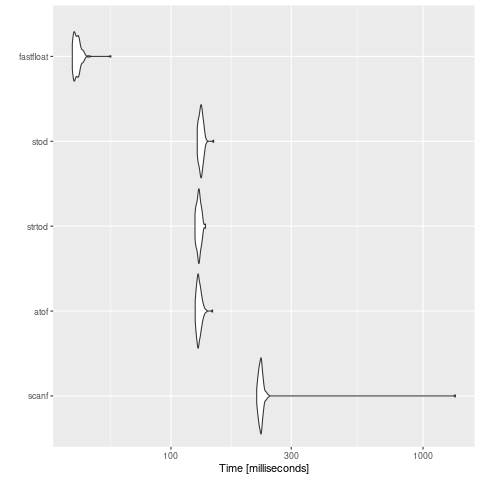
The second release of RcppFastFloat is now on CRAN. The package wraps fastfloat, another nice library by Daniel Lemire who showed in a recent arXiv paper that one can convert character representations of numbers into floating point at rates at or exceeding one gigabyte per second. Thanks to Brendan, this release adds a helper function as.double2() modeled after the base R function but using, of course, the features from fast_float in RcppFastFloat. Release notes follow.

Changes in version 0.0.2 (2021-02-13)
  • New function as.double2() demonstrating fast_float (Brendan in #1)

Courtesy of my CRANberries, there is also a diffstat report for this release. If you like this or other open-source work I do, you can now sponsor me at GitHub.

This post by Dirk Eddelbuettel originated on his Thinking inside the box blog. Please report excessive re-aggregation in third-party for-profit settings.

12 February 2021

Dirk Eddelbuettel: RcppSimdJson 0.1.4 on CRAN: New Improvements

Brendan and I are happy to share that a new RcppSimdJson release 0.1.4 arrived on CRAN earlier today. RcppSimdJson wraps the fantastic and genuinely impressive simdjson library by Daniel Lemire and collaborators. Via very clever algorithmic engineering to obtain largely branch-free code, coupled with modern C++ and newer compiler instructions, it results in parsing gigabytes of JSON parsed per second which is quite mindboggling. The best-case performance is faster than CPU speed as use of parallel SIMD instructions and careful branch avoidance can lead to less than one cpu cycle per byte parsed; see the video of the talk by Daniel Lemire at QCon (also voted best talk). This version brings a new option to always return list types, tweaks to setting option in the the request and other small improvements. The NEWS entry follows.

Changes in version 0.1.4 (2021-02-12)
  • Support additional headers in fload (Dirk in #60).
  • Enable continuous integration via GitHub Actions using run.sh from r-ci repo (Dirk in #61, #62).
  • Add option to always return list to fparse()/fload() (Brendan in #65 closing #64).

Courtesy of my CRANberries, there is also a diffstat report for this release. For questions, suggestions, or issues please use the issue tracker at the GitHub repo. If you like this or other open-source work I do, you can now sponsor me at GitHub.

This post by Dirk Eddelbuettel originated on his Thinking inside the box blog. Please report excessive re-aggregation in third-party for-profit settings.

11 February 2021

Dirk Eddelbuettel: td 0.0.1 on CRAN: New Finance Data Package

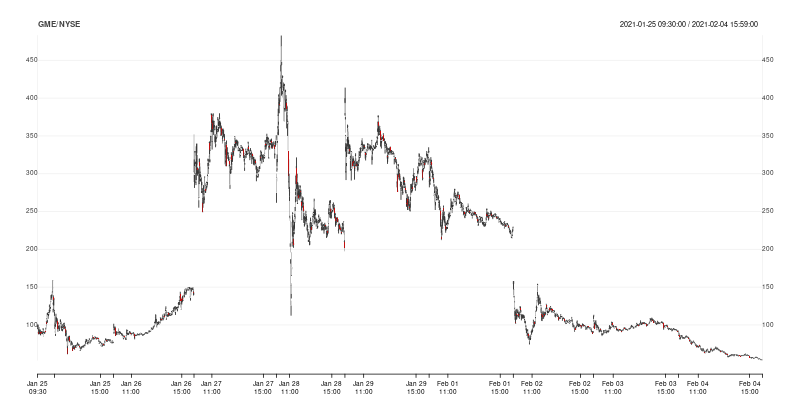
Thrilled to announce that a new package of mine just made it to CRAN: the td package accesses the twelvedata API for financial data. Currently only the time_series REST access point is supported, but it is already supported with all meaningful options (we skipped only JSON or CSV which makes no sense here) so for example any resolution between 1 minute and 1 month can be requested for any stock, etf or currency symbol for a wide array of exchanges. Historical access is available too via (optional) start and end dates. We return either raw JSON or a data.frame or an xts object making it trivial to call high-end plotting functions on the data the project and repo pages show several examples. As just one example, here is GME during the follies. We simply request via
> gme <- time_series("GME", "1min",
+                    start_date="2021-01-25 09:30:00",
+                    end_date="2021-02-04 16:00:00", as="xts")
(where the API key is either in a user-local config file accessed via the new-ish R function tools::R_user_dir("td") pointing at this package s directory, or via an environment variable; either is accessed at package load or attachment) from which we can then plot via quantmod
> quantmod::chart_Series(gme, name=paste0(attr(gme, "symbol"), "/", attr(gme, "exchange")))
which shows how we also helpfully store metadata returned by twelvedata as extra attributes of the object. The chart is You will need an API key to have up to 800 daily accesses for free, higher-performance plans (including websocket access) are available for paying customers too. I have only used the free API so far myself. I plan to add quote and price support this weekend, and generalize the time series access to returning lists of objects as the API does in fact support multi-security access. As always, feedback is welcomed. Please post comments and suggestions at the GitHub repo. If you like this or other open-source work I do, you can now sponsor me at GitHub.

This post by Dirk Eddelbuettel originated on his Thinking inside the box blog. Please report excessive re-aggregation in third-party for-profit settings.

10 February 2021

Dirk Eddelbuettel: RcppSMC 0.2.3 on CRAN: Updated Snapshot

A new release 0.2.3 of the RcppSMC package arrived on CRAN earlier today. Once again it progressed as a very quick pretest-publish within minutes of submission thanks CRAN! RcppSMC provides Rcpp-based bindings to R for the Sequential Monte Carlo Template Classes (SMCTC) by Adam Johansen described in his JSS article. Sequential Monte Carlo is also referred to as Particle Filter in some contexts. This release somewhat belatedly merges a branch Leah had been working on and which we all realized is ready . We now have a good snapshot to base new work on, as maybe with the Google Summer of Code 2021.

Changes in RcppSMC version 0.2.3 (2021-02-10)
  • Addition of a Github Action CI runner (Dirk)
  • Switching to inheritance for the moveset rather than pointers to functions (Leah in #45).

Courtesy of my CRANberries, there is a diffstat report for this release. More information is on the RcppSMC page. Issues and bugreports should go to the GitHub issue tracker. If you like this or other open-source work I do, you can now sponsor me at GitHub.

This post by Dirk Eddelbuettel originated on his Thinking inside the box blog. Please report excessive re-aggregation in third-party for-profit settings.

Dirk Eddelbuettel: RcppArmadillo 0.10.2.1.0: New Upstream Release

armadillo image Armadillo is a powerful and expressive C++ template library for linear algebra aiming towards a good balance between speed and ease of use with a syntax deliberately close to a Matlab. RcppArmadillo integrates this library with the R environment and language and is widely used by (currently) 823 other packages on CRAN. This release brings us Armadillo 10.2 with a few updates as detailed below in the list of changes. Upstream release 10.2 was made a couple of days ago, but we need to balance new upstream updates with a responsible release cadence at CRAN. As we needed a maintenance release in early January, I opted to wait four weeks with this one which hence gets us 10.2.0 and 10.2.1 at once. As tweeted (with a follow-up) it had yet another very smooth passage at CRAN so we again appreciate the excellent work of the CRAN maintainers and say Thank You!. Anybody who desires more frequent updates show look at the RcppCore drat repo which provides more frequent interim updates. Here for example we also had 0.10.2.0.0 available for your testing pleasure. Also of note is that here is now a Python variant pyarma for those who might want enjoy Armadillo with Python. The full set of changes follows.

Changes in RcppArmadillo version 0.10.2.1.0 (2021-02-09)
  • Upgraded to Armadillo release 10.2.1 (Cicada Swarm)
    • faster handling of subcubes
    • added tgamma()
    • added .brief_print() for abridged printing of matrices & cubes
    • expanded forms of trimatu() and trimatl() with diagonal specification to handle sparse matrices
    • expanded eigs_sym() and eigs_gen() with optional shift-invert mode

Courtesy of my CRANberries, there is a diffstat report relative to previous release. More detailed information is on the RcppArmadillo page. Questions, comments etc should go to the rcpp-devel mailing list off the R-Forge page. If you like this or other open-source work I do, you can sponsor me at GitHub.

This post by Dirk Eddelbuettel originated on his Thinking inside the box blog. Please report excessive re-aggregation in third-party for-profit settings.

8 February 2021

Russ Allbery: Review: The Future of Another Timeline

Review: The Future of Another Timeline, by Annalee Newitz
Publisher: Tor
Copyright: September 2019
ISBN: 0-7653-9212-7
Format: Kindle
Pages: 350
Tess is a time traveler from 2022, a member of the semi-secret Daughters of Harriet who are, under the cover of an academic research project, attempting to modify the timeline to improve women's rights in the United States. Beth is a teenager in suburban Irvine in Alta California, with an abusive father, a tight-knit group of friends, and a love of feminist punk rock. The story opens with both of them at a Grape Ape concert in 1992. Beth is hanging out with her friends, and Tess is looking for signs of a conspiracy to alter the timeline to further restrict the rights of women. The Future of Another Timeline has a great science fiction premise. There are time machines buried in geologically-stable bedrock that have been there since before any current species evolved. The first was discovered by humans thousands of years before the start of the story. They can be controlled with vibrations in the rock and therefore don't need any modern technology to operate. Humanity has therefore lived with time travel for much of recorded history, albeit with a set of rules strictly imposed by these mysterious machines: individuals can only travel to their own time or earlier, and cannot carry any equipment with them. The timeline at the start of the book is already not ours, and it shifts further over the course of the plot. Time travel has a potentially devastating effect on the foundations of narrative, so most SF novels that let the genie of time travel out of the bottle immediately start trying to stuff it back in again. Newitz does not, which is a refreshing change. The past is not immutable, there is no scientific or magical force that prevents history from changing, and people do not manage to keep something with a history of thousands of years either secret or well-controlled. It's not a free-for-all: There is a Chronology Academy that sets some rules for time travelers, the Machines themselves have rules that prevent time travel from being too casual, and most countries have laws about what time travelers are allowed to do. But it's also not horribly difficult to travel in time, not horribly uncommon to come across someone from the future, and most of the rules are not strictly enforced. This does mean there are some things that one has to agree to not think about. (To take the most obvious example, the lack of government and military involvement in time travel is not believable, even given its constraints. One has to accept this as a story premise.) But it removes the claustrophobic rules-lawyering that's so common in time travel stories and lets Newitz tell a more interesting political story about the difficulty of achieving lasting social change. Unfortunately, this is also one of those science fiction novels that is much less interested in its premise and machinery than I was as a reader. The Machines are fascinating objects: ancient, mysterious, and as we learn more about them over the course of the story, rich with intriguing detail. After reading this summary, you're probably curious where they came from, what they can do, and how they work. So am I, after reading the book. The Future of Another Timeline is completely uninterested in that or any related question. About halfway through the book, a time traveler from the future demonstrates interfaces in the time machines that no one knew existed, the characters express some surprise, and then no one asks any meaningful questions for the rest of the book. At another point, the characters have the opportunity to see a Machine in something closer to its original form before aspects of its interface have eroded away. They learn just enough to solve their immediate plot problem and show no further curiosity. I found this immensely frustrating, in part due to the mixed signaling. Normally if an author is going to use a science fiction idea as pure plot device, they avoid spending much time on it, implicitly warning the reader that this isn't where the story is going. Newitz instead provides the little details and new revelations that normally signal that understanding these objects will be a key to the plot, and then shrugs and walks away, leaving every question unanswered. Given how many people enjoyed Rendezvous with Rama, this apparently doesn't bother other readers as much as it bothers me. If you are like me, though, be warned. But, fine, this is a character story built around a plot device rather than a technology story. That's a wholly valid mode of science fiction, and that part of the book has heft. It reminded me of the second-wave feminist science fiction of authors like Russ and Charnas, except updated to modern politics. The villains are a projection forward of the modern on-line misogynists (incels, specifically), but Newitz makes the unusual choice of not focusing on their motives or interior lives. They simply exist as a malevolent hostile force, much the way that women experience them today on-line. They have to be defeated, the characters of the book set out to defeat them, and this is done without melodrama, hand-wringing, or psychoanalysis. It's refreshingly straightforward and unambiguous, and it keeps the focus on the people trying to make the world a better place rather than on the redemption arc of some screaming asshole. The part I was less enamored of is that these are two of the least introspective first-person protagonists that I've seen in a book. Normally, first-person perspective is used to provide a rich internal monologue about external events, but both Tess and Beth tell their stories as mostly-dry sequences of facts. Sometimes this includes a bit of what they're feeling, but neither character delves much into the why or how. This improves somewhat towards the end of the book, but I found the first two-thirds of the story oddly flat and had a hard time generating much interest in or sympathy for the characters. There are good in-story reasons for both Tess and Beth to heavily suppress their emotions, so I will not argue this is unrealistic, but character stories work better for me with more of an emotional hook. Hand-in-hand with that is the problem that the ending didn't provide the catharsis that I was hoping for. Beth goes through absolute hell over the course of the book, and while that does reach a resolution that I know intellectually is the best type of resolution that her story can hope for, it felt wholly insufficient. Tess's story reaches a somewhat more satisfying conclusion, but one that reverses an earlier moral imperative in a way that I found overly sudden. And everything about this book is highly contingent and temporary in a way that is true to its theme and political statement but that left me feeling more weary than satisfied. That type of ending is a valid authorial choice, and to some extent my complaint is only that this wasn't the book for me at the time I read it. But I have read other books with similarly conditional endings and withdrawn characters that still carried me along with the force and power of the writing (Daughters of the North comes to mind). The Future of Another Timeline is not poorly written, but neither do I think it achieves that level of skill. The writing is a bit wooden, the flow of sentences is a touch cliched and predictable, and the characters are a bit thin. It's serviceable writing had there been something else (such as a setting-as-character exploration of the origins and purpose of the Machines) to grab my attention and pull me along. But if the weight of the story has to be born by the quality of the writing, I don't think it was quite up to the task. Overall, I think The Future of Another Timeline has a great premise that it treats with frustrating indifference, a satisfyingly different take on time travel with some obvious holes, some solid political ideas reminiscent of an earlier age of feminist SF, a refreshing unwillingness to center evil on its own terms, characters that took more than half the book to develop much depth, and a suitable but frustrating ending. I can see why other people liked it more than I did, but I can't recommend it. Content warning: Rape, graphic violence, child abuse, gaslighting, graphic medical procedure, suicide, extreme misogyny, and mutilation, and this is spread throughout the book, not concentrated in one scene. I'm not very squeamish about non-horror fiction and it was still rather a lot, so please read with care. Rating: 6 out of 10

7 February 2021

Chris Lamb: Favourite books of 2020

I won't reveal precisely how many books I read in 2020, but it was definitely an improvement on 74 in 2019, 53 in 2018 and 50 in 2017. But not only did I read more in a quantitative sense, the quality seemed higher as well. There were certainly fewer disappointments: given its cultural resonance, I was nonplussed by Nick Hornby's Fever Pitch and whilst Ian Fleming's The Man with the Golden Gun was a little thin (again, given the obvious influence of the Bond franchise) the booked lacked 'thinness' in a way that made it interesting to critique. The weakest novel I read this year was probably J. M. Berger's Optimal, but even this hybrid of Ready Player One late-period Black Mirror wasn't that cringeworthy, all things considered. Alas, graphic novels continue to not quite be my thing, I'm afraid. I perhaps experienced more disappointments in the non-fiction section. Paul Bloom's Against Empathy was frustrating, particularly in that it expended unnecessary energy battling its misleading title and accepted terminology, and it could so easily have been an 20-minute video essay instead). (Elsewhere in the social sciences, David and Goliath will likely be the last Malcolm Gladwell book I voluntarily read.) After so many positive citations, I was also more than a little underwhelmed by Shoshana Zuboff's The Age of Surveillance Capitalism, and after Ryan Holiday's many engaging reboots of Stoic philosophy, his Conspiracy (on Peter Thiel and Hulk Hogan taking on Gawker) was slightly wide of the mark for me. Anyway, here follows a selection of my favourites from 2020, in no particular order:

Fiction Wolf Hall & Bring Up the Bodies & The Mirror and the Light Hilary Mantel During the early weeks of 2020, I re-read the first two parts of Hilary Mantel's Thomas Cromwell trilogy in time for the March release of The Mirror and the Light. I had actually spent the last few years eagerly following any news of the final instalment, feigning outrage whenever Mantel appeared to be spending time on other projects. Wolf Hall turned out to be an even better book than I remembered, and when The Mirror and the Light finally landed at midnight on 5th March, I began in earnest the next morning. Note that date carefully; this was early 2020, and the book swiftly became something of a heavy-handed allegory about the world at the time. That is to say and without claiming that I am Monsieur Cromuel in any meaningful sense it was an uneasy experience to be reading about a man whose confident grasp on his world, friends and life was slipping beyond his control, and at least in Cromwell's case, was heading inexorably towards its denouement. The final instalment in Mantel's trilogy is not perfect, and despite my love of her writing I would concur with the judges who decided against awarding her a third Booker Prize. For instance, there is something of the longueur that readers dislike in the second novel, although this might not be entirely Mantel's fault after all, the rise of the "ugly" Anne of Cleves and laborious trade negotiations for an uninspiring mineral (this is no Herbertian 'spice') will never match the court intrigues of Anne Boleyn, Jane Seymour and that man for all seasons, Thomas More. Still, I am already looking forward to returning to the verbal sparring between King Henry and Cromwell when I read the entire trilogy once again, tentatively planned for 2022.

The Fault in Our Stars John Green I came across John Green's The Fault in Our Stars via a fantastic video by Lindsay Ellis discussing Roland Barthes famous 1967 essay on authorial intent. However, I might have eventually come across The Fault in Our Stars regardless, not because of Green's status as an internet celebrity of sorts but because I'm a complete sucker for this kind of emotionally-manipulative bildungsroman, likely due to reading Philip Pullman's His Dark Materials a few too many times in my teens. Although its title is taken from Shakespeare's Julius Caesar, The Fault in Our Stars is actually more Romeo & Juliet. Hazel, a 16-year-old cancer patient falls in love with Gus, an equally ill teen from her cancer support group. Hazel and Gus share the same acerbic (and distinctly unteenage) wit and a love of books, centred around Hazel's obsession of An Imperial Affliction, a novel by the meta-fictional author Peter Van Houten. Through a kind of American version of Jim'll Fix It, Gus and Hazel go and visit Van Houten in Amsterdam. I'm afraid it's even cheesier than I'm describing it. Yet just as there is a time and a place for Michelin stars and Haribo Starmix, there's surely a place for this kind of well-constructed but altogether maudlin literature. One test for emotionally manipulative works like this is how well it can mask its internal contradictions while Green's story focuses on the universalities of love, fate and the shortness of life (as do almost all of his works, it seems), The Fault in Our Stars manages to hide, for example, that this is an exceedingly favourable treatment of terminal illness that is only possible for the better off. The 2014 film adaptation does somewhat worse in peddling this fantasy (and has a much weaker treatment of the relationship between the teens' parents too, an underappreciated subtlety of the book). The novel, however, is pretty slick stuff, and it is difficult to fault it for what it is. For some comparison, I later read Green's Looking for Alaska and Paper Towns which, as I mention, tug at many of the same strings, but they don't come together nearly as well as The Fault in Our Stars. James Joyce claimed that "sentimentality is unearned emotion", and in this respect, The Fault in Our Stars really does earn it.

The Plague Albert Camus P. D. James' The Children of Men, George Orwell's Nineteen Eighty-Four, Arthur Koestler's Darkness at Noon ... dystopian fiction was already a theme of my reading in 2020, so given world events it was an inevitability that I would end up with Camus's novel about a plague that swept through the Algerian city of Oran. Is The Plague an allegory about the Nazi occupation of France during World War Two? Where are all the female characters? Where are the Arab ones? Since its original publication in 1947, there's been so much written about The Plague that it's hard to say anything new today. Nevertheless, I was taken aback by how well it captured so much of the nuance of 2020. Whilst we were saying just how 'unprecedented' these times were, it was eerie how a novel written in the 1940s could accurately how many of us were feeling well over seventy years on later: the attitudes of the people; the confident declarations from the institutions; the misaligned conversations that led to accidental misunderstandings. The disconnected lovers. The only thing that perhaps did not work for me in The Plague was the 'character' of the church. Although I could appreciate most of the allusion and metaphor, it was difficult for me to relate to the significance of Father Paneloux, particularly regarding his change of view on the doctrinal implications of the virus, and spoiler alert that he finally died of a "doubtful case" of the disease, beyond the idea that Paneloux's beliefs are in themselves "doubtful". Answers on a postcard, perhaps. The Plague even seemed to predict how we, at least speaking of the UK, would react when the waves of the virus waxed and waned as well:
The disease stiffened and carried off three or four patients who were expected to recover. These were the unfortunates of the plague, those whom it killed when hope was high
It somehow captured the nostalgic yearning for high-definition videos of cities and public transport; one character even visits the completely deserted railway station in Oman simply to read the timetables on the wall.

Tinker, Tailor, Soldier, Spy John le Carr There's absolutely none of the Mad Men glamour of James Bond in John le Carr 's icy world of Cold War spies:
Small, podgy, and at best middle-aged, Smiley was by appearance one of London's meek who do not inherit the earth. His legs were short, his gait anything but agile, his dress costly, ill-fitting, and extremely wet.
Almost a direct rebuttal to Ian Fleming's 007, Tinker, Tailor has broken-down cars, bad clothes, women with their own internal and external lives (!), pathetically primitive gadgets, and (contra Mad Men) hangovers that significantly longer than ten minutes. In fact, the main aspect that the mostly excellent 2011 film adaption doesn't really capture is the smoggy and run-down nature of 1970s London this is not your proto-Cool Britannia of Austin Powers or GTA:1969, the city is truly 'gritty' in the sense there is a thin film of dirt and grime on every surface imaginable. Another angle that the film cannot capture well is just how purposefully the novel does not mention the United States. Despite the US obviously being the dominant power, the British vacillate between pretending it doesn't exist or implying its irrelevance to the matter at hand. This is no mistake on Le Carr 's part, as careful readers are rewarded by finding this denial of US hegemony in metaphor throughout --pace Ian Fleming, there is no obvious Felix Leiter to loudly throw money at the problem or a Sheriff Pepper to serve as cartoon racist for the Brits to feel superior about. By contrast, I recall that a clever allusion to "dusty teabags" is subtly mirrored a few paragraphs later with a reference to the installation of a coffee machine in the office, likely symbolic of the omnipresent and unavoidable influence of America. (The officer class convince themselves that coffee is a European import.) Indeed, Le Carr communicates a feeling of being surrounded on all sides by the peeling wallpaper of Empire. Oftentimes, the writing style matches the graceless and inelegance of the world it depicts. The sentences are dense and you find your brain performing a fair amount of mid-flight sentence reconstruction, reparsing clauses, commas and conjunctions to interpret Le Carr 's intended meaning. In fact, in his eulogy-cum-analysis of Le Carr 's writing style, William Boyd, himself a ventrioquilist of Ian Fleming, named this intentional technique 'staccato'. Like the musical term, I suspect the effect of this literary staccato is as much about the impact it makes on a sentence as the imperceptible space it generates after it. Lastly, the large cast in this sprawling novel is completely believable, all the way from the Russian spymaster Karla to minor schoolboy Roach the latter possibly a stand-in for Le Carr himself. I got through the 500-odd pages in just a few days, somehow managing to hold the almost-absurdly complicated plot in my head. This is one of those classic books of the genre that made me wonder why I had not got around to it before.

The Nickel Boys Colson Whitehead According to the judges who awarded it the Pulitzer Prize for Fiction, The Nickel Boys is "a devastating exploration of abuse at a reform school in Jim Crow-era Florida" that serves as a "powerful tale of human perseverance, dignity and redemption". But whilst there is plenty of this perseverance and dignity on display, I found little redemption in this deeply cynical novel. It could almost be read as a follow-up book to Whitehead's popular The Underground Railroad, which itself won the Pulitzer Prize in 2017. Indeed, each book focuses on a young protagonist who might be euphemistically referred to as 'downtrodden'. But The Nickel Boys is not only far darker in tone, it feels much closer and more connected to us today. Perhaps this is unsurprising, given that it is based on the story of the Dozier School in northern Florida which operated for over a century before its long history of institutional abuse and racism was exposed a 2012 investigation. Nevertheless, if you liked the social commentary in The Underground Railroad, then there is much more of that in The Nickel Boys:
Perhaps his life might have veered elsewhere if the US government had opened the country to colored advancement like they opened the army. But it was one thing to allow someone to kill for you and another to let him live next door.
Sardonic aper us of this kind are pretty relentless throughout the book, but it never tips its hand too far into on nihilism, especially when some of the visual metaphors are often first-rate: "An American flag sighed on a pole" is one I can easily recall from memory. In general though, The Nickel Boys is not only more world-weary in tenor than his previous novel, the United States it describes seems almost too beaten down to have the energy conjure up the Swiftian magical realism that prevented The Underground Railroad from being overly lachrymose. Indeed, even we Whitehead transports us a present-day New York City, we can't indulge in another kind of fantasy, the one where America has solved its problems:
The Daily News review described the [Manhattan restaurant] as nouveau Southern, "down-home plates with a twist." What was the twist that it was soul food made by white people?
It might be overly reductionist to connect Whitehead's tonal downshift with the racial justice movements of the past few years, but whatever the reason, we've ended up with a hard-hitting, crushing and frankly excellent book.

True Grit & No Country for Old Men Charles Portis & Cormac McCarthy It's one of the most tedious cliches to claim the book is better than the film, but these two books are of such high quality that even the Coen Brothers at their best cannot transcend them. I'm grouping these books together here though, not because their respective adaptations will exemplify some of the best cinema of the 21st century, but because of their superb treatment of language. Take the use of dialogue. Cormac McCarthy famously does not use any punctuation "I believe in periods, in capitals, in the occasional comma, and that's it" but the conversations in No Country for Old Men together feel familiar and commonplace, despite being relayed through this unconventional technique. In lesser hands, McCarthy's written-out Texan drawl would be the novelistic equivalent of white rap or Jar Jar Binks, but not only is the effect entirely gripping, it helps you to believe you are physically present in the many intimate and domestic conversations that hold this book together. Perhaps the cinematic familiarity helps, as you can almost hear Tommy Lee Jones' voice as Sheriff Bell from the opening page to the last. Charles Portis' True Grit excels in its dialogue too, but in this book it is not so much in how it flows (although that is delightful in its own way) but in how forthright and sardonic Maddie Ross is:
"Earlier tonight I gave some thought to stealing a kiss from you, though you are very young, and sick and unattractive to boot, but now I am of a mind to give you five or six good licks with my belt." "One would be as unpleasant as the other."
Perhaps this should be unsurprising. Maddie, a fourteen-year-old girl from Yell County, Arkansas, can barely fire her father's heavy pistol, so she can only has words to wield as her weapon. Anyway, it's not just me who treasures this book. In her encomium that presages most modern editions, Donna Tartt of The Secret History fame traces the novels origins through Huckleberry Finn, praising its elegance and economy: "The plot of True Grit is uncomplicated and as pure in its way as one of the Canterbury Tales". I've read any Chaucer, but I am inclined to agree. Tartt also recalls that True Grit vanished almost entirely from the public eye after the release of John Wayne's flimsy cinematic vehicle in 1969 this earlier film was, Tartt believes, "good enough, but doesn't do the book justice". As it happens, reading a book with its big screen adaptation as a chaser has been a minor theme of my 2020, including P. D. James' The Children of Men, Kazuo Ishiguro's Never Let Me Go, Patricia Highsmith's Strangers on a Train, James Ellroy's The Black Dahlia, John Green's The Fault in Our Stars, John le Carr 's Tinker, Tailor Soldier, Spy and even a staged production of Charles Dicken's A Christmas Carol streamed from The Old Vic. For an autodidact with no academic background in literature or cinema, I've been finding this an effective and enjoyable means of getting closer to these fine books and films it is precisely where they deviate (or perhaps where they are deficient) that offers a means by which one can see how they were constructed. I've also found that adaptations can also tell you a lot about the culture in which they were made: take the 'straightwashing' in the film version of Strangers on a Train (1951) compared to the original novel, for example. It is certainly true that adaptions rarely (as Tartt put it) "do the book justice", but she might be also right to alight on a legal metaphor, for as the saying goes, to judge a movie in comparison to the book is to do both a disservice.

The Glass Hotel Emily St. John Mandel In The Glass Hotel, Mandel somehow pulls off the impossible; writing a loose roman- -clef on Bernie Madoff, a Ponzi scheme and the ephemeral nature of finance capital that is tranquil and shimmeringly beautiful. Indeed, don't get the wrong idea about the subject matter; this is no over over-caffeinated The Big Short, as The Glass Hotel is less about a Madoff or coked-up financebros but the fragile unreality of the late 2010s, a time which was, as we indeed discovered in 2020, one event away from almost shattering completely. Mandel's prose has that translucent, phantom quality to it where the chapters slip through your fingers when you try to grasp at them, and the plot is like a ghost ship that that slips silently, like the Mary Celeste, onto the Canadian water next to which the eponymous 'Glass Hotel' resides. Indeed, not unlike The Overlook Hotel, the novel so overflows with symbolism so that even the title needs to evoke the idea of impermanence permanently living in a hotel might serve as a house, but it won't provide a home. It's risky to generalise about such things post-2016, but the whole story sits in that the infinitesimally small distance between perception and reality, a self-constructed culture that is not so much 'post truth' but between them. There's something to consider in almost every character too. Take the stand-in for Bernie Madoff: no caricature of Wall Street out of a 1920s political cartoon or Brechtian satire, Jonathan Alkaitis has none of the oleaginous sleaze of a Dominic Strauss-Kahn, the cold sociopathy of a Marcus Halberstam nor the well-exercised sinuses of, say, Jordan Belford. Alkaitis is dare I say it? eminently likeable, and the book is all the better for it. Even the C-level characters have something to say: Enrico, trivially escaping from the regulators (who are pathetically late to the fraud without Mandel ever telling us explicitly), is daydreaming about the girlfriend he abandoned in New York: "He wished he'd realised he loved her before he left". What was in his previous life that prevented him from doing so? Perhaps he was never in love at all, or is love itself just as transient as the imaginary money in all those bank accounts? Maybe he fell in love just as he crossed safely into Mexico? When, precisely, do we fall in love anyway? I went on to read Mandel's Last Night in Montreal, an early work where you can feel her reaching for that other-worldly quality that she so masterfully achieves in The Glass Hotel. Her f ted Station Eleven is on my must-read list for 2021. "What is truth?" asked Pontius Pilate. Not even Mandel cannot give us the answer, but this will certainly do for now.

Running the Light Sam Tallent Although it trades in all of the clich s and stereotypes of the stand-up comedian (the triumvirate of drink, drugs and divorce), Sam Tallent's debut novel depicts an extremely convincing fictional account of a touring road comic. The comedian Doug Stanhope (who himself released a fairly decent No Encore for the Donkey memoir in 2020) hyped Sam's book relentlessly on his podcast during lockdown... and justifiably so. I ripped through Running the Light in a few short hours, the only disappointment being that I can't seem to find videos online of Sam that come anywhere close to match up to his writing style. If you liked the rollercoaster energy of Paul Beatty's The Sellout, the cynicism of George Carlin and the car-crash invertibility of final season Breaking Bad, check this great book out.

Non-fiction Inside Story Martin Amis This was my first introduction to Martin Amis's work after hearing that his "novelised autobiography" contained a fair amount about Christopher Hitchens, an author with whom I had a one of those rather clich d parasocial relationship with in the early days of YouTube. (Hey, it could have been much worse.) Amis calls his book a "novelised autobiography", and just as much has been made of its quasi-fictional nature as the many diversions into didactic writing advice that betwixt each chapter: "Not content with being a novel, this book also wants to tell you how to write novels", complained Tim Adams in The Guardian. I suspect that reviewers who grew up with Martin since his debut book in 1973 rolled their eyes at yet another demonstration of his manifest cleverness, but as my first exposure to Amis's gift of observation, I confess that I was thought it was actually kinda clever. Try, for example, "it remains a maddening truth that both sexual success and sexual failure are steeply self-perpetuating" or "a hospital gym is a contradiction like a young Conservative", etc. Then again, perhaps I was experiencing a form of nostalgia for a pre-Gamergate YouTube, when everything in the world was a lot simpler... or at least things could be solved by articulate gentlemen who honed their art of rhetoric at the Oxford Union. I went on to read Martin's first novel, The Rachel Papers (is it 'arrogance' if you are, indeed, that confident?), as well as his 1997 Night Train. I plan to read more of him in the future.

The Collected Essays, Journalism and Letters: Volume 1 & Volume 2 & Volume 3 & Volume 4 George Orwell These deceptively bulky four volumes contain all of George Orwell's essays, reviews and correspondence, from his teenage letters sent to local newspapers to notes to his literary executor on his deathbed in 1950. Reading this was part of a larger, multi-year project of mine to cover the entirety of his output. By including this here, however, I'm not recommending that you read everything that came out of Orwell's typewriter. The letters to friends and publishers will only be interesting to biographers or hardcore fans (although I would recommend Dorian Lynskey's The Ministry of Truth: A Biography of George Orwell's 1984 first). Furthermore, many of his book reviews will be of little interest today. Still, some insights can be gleaned; if there is any inconsistency in this huge corpus is that his best work is almost 'too' good and too impactful, making his merely-average writing appear like hackwork. There are some gems that don't make the usual essay collections too, and some of Orwell's most astute social commentary came out of series of articles he wrote for the left-leaning newspaper Tribune, related in many ways to the US Jacobin. You can also see some of his most famous ideas start to take shape years if not decades before they appear in his novels in these prototype blog posts. I also read Dennis Glover's novelised account of the writing of Nineteen-Eighty Four called The Last Man in Europe, and I plan to re-read some of Orwell's earlier novels during 2021 too, including A Clergyman's Daughter and his 'antebellum' Coming Up for Air that he wrote just before the Second World War; his most under-rated novel in my estimation. As it happens, and with the exception of the US and Spain, copyright in the works published in his lifetime ends on 1st January 2021. Make of that what you will.

Capitalist Realism & Chavs: The Demonisation of the Working Class Mark Fisher & Owen Jones These two books are not natural companions to one another and there is likely much that Jones and Fisher would vehemently disagree on, but I am pairing these books together here because they represent the best of the 'political' books I read in 2020. Mark Fisher was a dedicated leftist whose first book, Capitalist Realism, marked an important contribution to political philosophy in the UK. However, since his suicide in early 2017, the currency of his writing has markedly risen, and Fisher is now frequently referenced due to his belief that the prevalence of mental health conditions in modern life is a side-effect of various material conditions, rather than a natural or unalterable fact "like weather". (Of course, our 'weather' is being increasingly determined by a combination of politics, economics and petrochemistry than pure randomness.) Still, Fisher wrote on all manner of topics, from the 2012 London Olympics and "weird and eerie" electronic music that yearns for a lost future that will never arrive, possibly prefiguring or influencing the Fallout video game series. Saying that, I suspect Fisher will resonate better with a UK audience more than one across the Atlantic, not necessarily because he was minded to write about the parochial politics and culture of Britain, but because his writing often carries some exasperation at the suppression of class in favour of identity-oriented politics, a viewpoint not entirely prevalent in the United States outside of, say, Tour F. Reed or the late Michael Brooks. (Indeed, Fisher is likely best known in the US as the author of his controversial 2013 essay, Exiting the Vampire Castle, but that does not figure greatly in this book). Regardless, Capitalist Realism is an insightful, damning and deeply unoptimistic book, best enjoyed in the warm sunshine I found it an ironic compliment that I had quoted so many paragraphs that my Kindle's copy protection routines prevented me from clipping any further. Owen Jones needs no introduction to anyone who regularly reads a British newspaper, especially since 2015 where he unofficially served as a proxy and punching bag for expressing frustrations with the then-Labour leader, Jeremy Corbyn. However, as the subtitle of Jones' 2012 book suggests, Chavs attempts to reveal the "demonisation of the working class" in post-financial crisis Britain. Indeed, the timing of the book is central to Jones' analysis, specifically that the stereotype of the "chav" is used by government and the media as a convenient figleaf to avoid meaningful engagement with economic and social problems on an austerity ridden island. (I'm not quite sure what the US equivalent to 'chav' might be. Perhaps Florida Man without the implications of mental health.) Anyway, Jones certainly has a point. From Vicky Pollard to the attacks on Jade Goody, there is an ignorance and prejudice at the heart of the 'chav' backlash, and that would be bad enough even if it was not being co-opted or criminalised for ideological ends. Elsewhere in political science, I also caught Michael Brooks' Against the Web and David Graeber's Bullshit Jobs, although they are not quite methodical enough to recommend here. However, Graeber's award-winning Debt: The First 5000 Years will be read in 2021. Matt Taibbi's Hate Inc: Why Today's Media Makes Us Despise One Another is worth a brief mention here though, but its sprawling nature felt very much like I was reading a set of Substack articles loosely edited together. And, indeed, I was.

The Golden Thread: The Story of Writing Ewan Clayton A recommendation from a dear friend, Ewan Clayton's The Golden Thread is a journey through the long history of the writing from the Dawn of Man to present day. Whether you are a linguist, a graphic designer, a visual artist, a typographer, an archaeologist or 'just' a reader, there is probably something in here for you. I was already dipping my quill into calligraphy this year so I suspect I would have liked this book in any case, but highlights would definitely include the changing role of writing due to the influence of textual forms in the workplace as well as digression on ergonomic desks employed by monks and scribes in the Middle Ages. A lot of books by otherwise-sensible authors overstretch themselves when they write about computers or other technology from the Information Age, at best resulting in bizarre non-sequiturs and dangerously Panglossian viewpoints at worst. But Clayton surprised me by writing extremely cogently and accurate on the role of text in this new and unpredictable era. After finishing it I realised why for a number of years, Clayton was a consultant for the legendary Xerox PARC where he worked in a group focusing on documents and contemporary communications whilst his colleagues were busy inventing the graphical user interface, laser printing, text editors and the computer mouse.

New Dark Age & Radical Technologies: The Design of Everyday Life James Bridle & Adam Greenfield I struggled to describe these two books to friends, so I doubt I will suddenly do a better job here. Allow me to quote from Will Self's review of James Bridle's New Dark Age in the Guardian:
We're accustomed to worrying about AI systems being built that will either "go rogue" and attack us, or succeed us in a bizarre evolution of, um, evolution what we didn't reckon on is the sheer inscrutability of these manufactured minds. And minds is not a misnomer. How else should we think about the neural network Google has built so its translator can model the interrelation of all words in all languages, in a kind of three-dimensional "semantic space"?
New Dark Age also turns its attention to the weird, algorithmically-derived products offered for sale on Amazon as well as the disturbing and abusive videos that are automatically uploaded by bots to YouTube. It should, by rights, be a mess of disparate ideas and concerns, but Bridle has a flair for introducing topics which reveals he comes to computer science from another discipline altogether; indeed, on a four-part series he made for Radio 4, he's primarily referred to as "an artist". Whilst New Dark Age has rather abstract section topics, Adam Greenfield's Radical Technologies is a rather different book altogether. Each chapter dissects one of the so-called 'radical' technologies that condition the choices available to us, asking how do they work, what challenges do they present to us and who ultimately benefits from their adoption. Greenfield takes his scalpel to smartphones, machine learning, cryptocurrencies, artificial intelligence, etc., and I don't think it would be unfair to say that starts and ends with a cynical point of view. He is no reactionary Luddite, though, and this is both informed and extremely well-explained, and it also lacks the lazy, affected and Private Eye-like cynicism of, say, Attack of the 50 Foot Blockchain. The books aren't a natural pair, for Bridle's writing contains quite a bit of air in places, ironically mimics the very 'clouds' he inveighs against. Greenfield's book, by contrast, as little air and much lower pH value. Still, it was more than refreshing to read two technology books that do not limit themselves to platitudinal booleans, be those dangerously naive (e.g. Kevin Kelly's The Inevitable) or relentlessly nihilistic (Shoshana Zuboff's The Age of Surveillance Capitalism). Sure, they are both anti-technology screeds, but they tend to make arguments about systems of power rather than specific companies and avoid being too anti-'Big Tech' through a narrower, Silicon Valley obsessed lens for that (dipping into some other 2020 reading of mine) I might suggest Wendy Liu's Abolish Silicon Valley or Scott Galloway's The Four. Still, both books are superlatively written. In fact, Adam Greenfield has some of the best non-fiction writing around, both in terms of how he can explain complicated concepts (particularly the smart contract mechanism of the Ethereum cryptocurrency) as well as in the extremely finely-crafted sentences I often felt that the writing style almost had no need to be that poetic, and I particularly enjoyed his fictional scenarios at the end of the book.

The Algebra of Happiness & Indistractable: How to Control Your Attention and Choose Your Life Scott Galloway & Nir Eyal A cocktail of insight, informality and abrasiveness makes NYU Professor Scott Galloway uncannily appealing to guys around my age. Although Galloway definitely has his own wisdom and experience, similar to Joe Rogan I suspect that a crucial part of Galloway's appeal is that you feel you are learning right alongside him. Thankfully, 'Prof G' is far less err problematic than Rogan (Galloway is more of a well-meaning, spirited centrist), although he, too, has some pretty awful takes at time. This is a shame, because removed from the whirlwind of social media he can be really quite considered, such as in this long-form interview with Stephanie Ruhle. In fact, it is this kind of sentiment that he captured in his 2019 Algebra of Happiness. When I look over my highlighted sections, it's clear that it's rather schmaltzy out of context ("Things you hate become just inconveniences in the presence of people you love..."), but his one-two punch of cynicism and saccharine ("Ask somebody who purchased a home in 2007 if their 'American Dream' came true...") is weirdly effective, especially when he uses his own family experiences as part of his story:
A better proxy for your life isn't your first home, but your last. Where you draw your last breath is more meaningful, as it's a reflection of your success and, more important, the number of people who care about your well-being. Your first house signals the meaningful your future and possibility. Your last home signals the profound the people who love you. Where you die, and who is around you at the end, is a strong signal of your success or failure in life.
Nir Eyal's Indistractable, however, is a totally different kind of 'self-help' book. The important background story is that Eyal was the author of the widely-read Hooked which turned into a secular Bible of so-called 'addictive design'. (If you've ever been cornered by a techbro wielding a Wikipedia-thin knowledge of B. F. Skinner's behaviourist psychology and how it can get you to click 'Like' more often, it ultimately came from Hooked.) However, Eyal's latest effort is actually an extended mea culpa for his previous sin and he offers both high and low-level palliative advice on how to avoid falling for the tricks he so studiously espoused before. I suppose we should be thankful to capitalism for selling both cause and cure. Speaking of markets, there appears to be a growing appetite for books in this 'anti-distraction' category, and whilst I cannot claim to have done an exhausting study of this nascent field, Indistractable argues its points well without relying on accurate-but-dry "studies show..." or, worse, Gladwellian gotchas. My main criticism, however, would be that Eyal doesn't acknowledge the limits of a self-help approach to this problem; it seems that many of the issues he outlines are an inescapable part of the alienation in modern Western society, and the only way one can really avoid distraction is to move up the income ladder or move out to a 500-acre ranch.

6 February 2021

Dirk Eddelbuettel: RcppFastFloat 0.0.1: New Package, Already on CRAN

A new package, once again based on wonderful library by Daniel Lemire, is now on CRAN in its initial version 0.0.1. Daniel, in a recent arXiv paper shows that one can convert character representations of numbers into floating point at rates at or exceeding one gigabyte per second. His tests show a fourfold gain over library functions such as strtod. We put a simply package together showing use of the example parser, and containing a simple all-in comparison benchmark (where we time the function call overhead as well) and get roughly 3x. See the repo for details; we are borring the table and figure here:
> source("comparison.R")
Unit: milliseconds
      expr      min       lq     mean   median       uq      max neval cld
     scanf 218.8936 224.1223 238.5650 227.1901 229.9116 1343.433   100   c
      atof 124.8087 127.3274 129.4104 128.5858 130.9138  146.334   100  b 
    strtod 124.5705 127.2157 129.1238 129.1042 130.7504  137.143   100  b 
      stod 127.1751 129.7343 131.7339 131.4854 133.1425  147.763   100  b 
 fastfloat  40.6219  41.3042  42.5729  42.3209  43.1738   57.788   100 a  
> 
Or in chart form: Not much to say yet for the initial release:

Changes in version 0.0.1 (2021-01-31)
  • Initial version and CRAN upload

While the package was waiting to be added to CRAN, Brendan already added a potential as.double() replacement which will be in the next version. If you like this or other open-source work I do, you can now sponsor me at GitHub.

This post by Dirk Eddelbuettel originated on his Thinking inside the box blog. Please report excessive re-aggregation in third-party for-profit settings.

5 February 2021

Thorsten Alteholz: My Debian Activities in January 2021

FTP master This month I could increase my activities in NEW again and accepted 132 packages. Unfortunately I also had to reject 12 packages. The overall number of packages that got accepted was 374. Debian LTS This was my seventy-ninth month that I did some work for the Debian LTS initiative, started by Raphael Hertzog at Freexian. This month my all in all workload has been 26h. During that time I did LTS and normal security uploads of: With the buster upload of highlight.js I could finish to fix CVE-2020-26237 in all releases. I also tried to fix one or the other CVE for golang packages, to be exact: golang-github-russellhaering-goxmldsig, golang-github-tidwall-match, golang-github-tidwall-gjson and golang-github-antchfx-xmlquery. The version in unstable is easily done by uploading a new upstream version after checking with ratt that all reverse-build-dependencies are still working. The next step will be to really upload all reverse-build-dependencies that need a new build. As the number of reverse-build-dependencies might be rather large, this needs to be done automatically somehow. The problem I am struggling with at the moment are packages that need to be rebuilt but the version in git already increased Another problem with golang packages are packages that are referenced by a Built-Using: line, but whose sources are not yet available on security-master. If this happens, the uploaded package will be automatically rejected. Unfortunately the rejection-email only contains the first missing package. So in order to reduce the hassle with such uploads, please send me the Built-Using:-line before the upload and I will import everything. In December/January this affected the uploads of influxdb and snapd. Last but not least I did some days of frontdesk duties. Debian ELTS This month was the thirty-first ELTS month. During my allocated time I uploaded: Last but not least I did some days of frontdesk duties. Other stuff This month I uploaded new upstream versions of: I improved packaging of: The golang packages here are basically ones with a missing source upload. For whatever reason maintainers tend to forget about this

Next.

Previous.