Search Results: "js"

19 January 2009

Gunnar Wolf: About the recent events and possible outcomes in Israel and Palestine

Several friends, from different groups and backgrounds and with different points of view regarding the current war in Israel (and regarding the Arab-Israeli conflict in general) have asked me for an explanation on what is happening there, what is (my view of) the real conflict, its causes... and any possible answers. And yet I am quite far from being an authority, I do want to write something about it. Be prepared, as this post is quite long.
And yet, after writing frankly a lot more than what I expected... It is by far not enough. I have still much more to add, but I have to say "stop" at some point. So, here you have it: My points of view, as well as some explanation on why are we standing where we currently are.
I am writing this based just on my personal experiencie and, of course, my personal point of view. Furthermore, I wrote a good part of this text while riding a bus, with no network access, so I am offering very few references - In any case, it will allow me to make much more progress. References always take as much time as the text itself! About me Why am I writing this? Why do people ask for my opinion? I must start by explaining who I am, so the rest of this makes sense. I am a Mexican Jew. That means, I was born in a Jewish (albeit secular) family, and grew up in an environment with general Jewish culture. My direct family (say, my parents and brother, and to a lesser degree my closest cousins) are not at all religious, I'd even venture to say most of us are complete atheists. Yet, besides the cultural belonging (which is a mixture of a Eastern European culture with lots of Idish words and dishes and general humor), my family has a strong national identification - In other words, I grew up in a fully Zionist environment, which traces back to Poland.
My grandmother was member of Hashomer Hatzair in Poland, since the early years of its existence, late 1910s and early 1920s. What is it? To make it short, a Zionist Socialist, Kibbutzian youth movement. It has many similarities (and somewhat stems indirectly from) the Scouts many of you will be familiar with, but -obviously- has a way lengthier agenda. And, yes, nowadays I feel it is somewhat out of reach with the current state of the world - It was founded in 1913, and only slightly adjusted its principles since then.
I will talk more about Hashomer later on.
My grandmother arrived in the late 1920s to Mexico, for familiar and economic reasons, but still dreamt about living in Israel for a long time. As they grew up, first my uncle joined Hashomer in Mexico in the late 1940s, when it still pursued a very much Soviet-style ideals for Israel (one of the core points that changed during the 1950s); both my father and my mother joined in the late 1950s (in fact, that's where they met). My cousins and myself were very active in the 1980s and 1990s.
The Iszaevich family has something very unusual, I'd say, engraved in our genes. We live very deeply our ideologies. That's the only explanation I can find to the way we all have led our lives. I won't go into the other family members' details, but just into mine: I was fully convinced of all we taught to our younger members and what we discussed among ourselves. I am among the very few people who really learnt Hebrew at my school, and that was only because I really cared - I know some people that just after 12 years of pseudo-learning could maybe utter a few phrases.
After finishing high school I went with my Hashomer group, together with people my age from other similar-minded Mexican Zionist youth groups, to live and learn for a year in Israel, on what is usually known as shnat hajshar - A year to get ready. To get ready to what? But of course, to come and give back go the younger groups of the movement, and finally go back to Israel and settle there definitively. I came back to Mexico, and after one year I did the only thing that was logical: I became an Israeli and went to live to a kibutz - Zikim, a beautiful place just between Ashkelon and Gaza, very near the sea shore. It was a beautiful period in my life, and I really enjoyed it - But it didn't last for very long - I quickly grew to hate the Israeli society at large. A society full of rage, of hatred. Not just between Arabs and Israelis, as many would think from the outside, but between religious and seculars. And between immigrants and locals. And between leftists and rightists (in several dimensions, as it is one of the countries where you can most easily be a economic leftist while being a political rightist - a complex society it is). A society full of disrespect and intolerance. A very hypocritical society. And one of the things that most shocked me: I wanted to live in a society of proud of its existence, that's what I had learnt Israel was - But Israelis aspire and dream of being anything else (and mostly US-Americans) in a way that made me sick, more than anything I had previously seen in Mexico.
I loved the life at the Kibutz, and I loved being an agricultor, doing hard work every day and literally getting the fruit of it. However, I cannot live isolated to a 300-people universe - At least once a week you have to go to the city if you don't want to become insane. And I could not stand the sick Israeli society.
Anyway, to make things short: After six months as an Israeli, I came back to Mexico. I went through a long period of finding myself, as I could not uphold anymore my Hashomer ideology (if I am not going to live by it, how can I continue teaching it?). Many people do anyway, but for the first months, where my Hashomer work was basically all of my life, I felt really uncomfortable. So, in short, I severed all of my relations to the Jewish community, and even denied for a long time my Jewishness until I found a (I think) better balance.
Today I am at peace. But anyway, I wanted to talk about myself in the critical period that marked me in this regard: The 1990s. Enough, lets get down to business. Zionism 1870-1920 Many people argue that the Jews invaded the Palestinians homeland - And yes, nowadays I cannot counter this. But we cannot judge what happened then based on what we see now.
Modern Zionism started around the 1870s. The Jewish history is full of pogroms and persecution, in different countries all over Europe - And a group of young people decided the only solution was to build a place to call their own. And yes, this was full of idealism and in no small part the foolishness of youth. For several centuries and up to 1920, all of current Middle East were provinces of the Ottoman Empire. Before Zionism began, the population of today-Israel was very sparse, not more than 400,000 people - up to 5% of them Jewish, around 10% Christian Arabs, and the remainder, Muslim Arabs. Of course, the low population was mostly because the country was mostly hostile - A desert in the South, mostly swamps in the North, and some minor towns mostly in the hills. It was a mostly forgotten province, away from the central Turkish rule, and there had been no frictions with the local population. It was a nice place to go, thinking -again- as a fool youngster, or as an idealist. They said, lets take a folk without a land to a land without a folk.
The number of accomplishing Zionists (this is, people who actually went to Israel instead of just talking about doing so) was not high during the first decades. But towards the 1890s, it gained critical mass. The political Zionist movement was born, with Theodor Herzl as a leader, and they started pushing -politically- for different governments to concede a territory to Jews. They went to the Turks, and didn't really get much echo. Went to other colonial powers of the time, and got unfeasible promises with no real backing (i.e. Birobidjan in Eastern Russia, Uganda in Africa)... And, as it happens in strongly ideologized movements, the movement started splitting into different groups with slightly different positions.
And no, I am not talking about the People Front for the Liberation of Judea and the People Judean Liberation Front, but I very well could. Sometimes the differences are as ridiculous as that. But hey, I take that most of my readers are acquinted with the Free Software issues, right? Think BSD vs. GPL vs. OpenSource. To give a broad idea - Only in Mexico City, with a very small Jewish community (~30,000 people), in the mid-1990s we had over 10 such movements, with 50-150 youngsters attending each. And even though some were local, and even though some very important ideologies are not represented in this country, they are all different enough to exist as separate entities. British Mandate The Ottoman empire was divided after the first World War. Its possesions in Europe became independent states, while in Asia (and Africa, if you take the semi-independent Egypt and part of Sudan into account) they were taken over as colonies or protectorates by France and the UK - Evidently, attempting to secure a long-term dominion over the area. In some aspects, they failed. In some aspects, they were (and still are) tremendously successful. The division of people by setting arbitrary boundaries has led to countries sustainable only by force and a harsh rule (such as Iraq, Lebanon and Syria), or doomed to poverty (and thus submission) due to lack of natural resources (as Jordan). Focusing on Israel/Palestine, the UK entered the area by making mutually incompatible promises to arabs and Jews - i.e. the Hussein-McMahon letters and the Balfour declaration, both ambiguous enough to lead to... Well, today. The UK rule was disastrous to the region, both in giving (and taking away) power from all sorts of puppet regimes, and swiftly going away as soon as things started looking too complicated. Yes, typical colonialism.
So, while up to the 1920s there was no real animosity between Arabs and Jews (as i.e. the Faisal-Weizmann agreement shows), during the next decades the seeds of hatred started growing, from both sides.
Many people still quote the 1947 partition plan as the direct antecedent towards Israel's real existence - That was not the first partition plan that existed. Ten years earlier, the Peel commision suggested a similar partition involving forceful population transfer. And many people see the separation of Transjordan (now Jordan) from Palestine in 1922 as a first partition. It is understandable that both partition plans (much more the 1947 than the 1937 one) were accepted by Zionists: Going from having nothing to having something (and against all odds in the environment they lived) is acceptable.
From the Zionist side, two main groups rejected the partitions: The right-wing and religious groups, insisting that the whole of the Mandate should become Israel, and the left-wing groups, which advocated for a single, bi-national state, with equal rights for all of its population. Go over and read this last link, as it was quite interesting (to me at least) to see how this solution has kept existing and regarded by (relatively) many people, and has many interesting links. 1948 onwards: Where did the refugees come from? The November 1947 partition didn't exactly translate to a planned, smooth Israeli independence - It led to six months of revolts (basically, a civil war). By mid May, the UK government and troops abandoned the territory, and one day later, Israel declared its independence. And, of course, all neighbouring countries (and Iraq) sent their troops to invade Israel. The war lasted for over six months (cease-fire was signed in January 1949). There was an intense Arab campaign indicating the armies would enter Israel and devastate it, leaving no stone in place, indicating Arab population to temporarily leave the Jewish-destined areas. The war, they said, would not take more than a couple of months, and they would be able to go back home.
Only that... When the war ended, the results were far from what the Arab governments expected. Not only Israel continued to exist, but it conquered important territories.
Of course, the Israelis were not innocent from said exodus: During the 1947-1948 civil war, and the independence war, some of the existing so-called self-defense forces (some of them were really defensive, while some were quite aggressive, even terrorist) attacked Arab villages in strategic or predominantly Jewish areas to prompt them to leave - yes, what we today call ethnic cleansing.
I had (in my head) the number of 650,000 Arabs (from a total of slightly over a million) fleeing to neighbouring countries. Wikipedia states that it is somewhere between 367,000 and 950,000. A similar number of Jews were expelled from Arab countries, many of which arrived to settle at Israel (and many others went elsewhere - For instance, a good part of the Mexican Jewish community is from Syrian origins - Many of them fleed in those years). Israel didn't accept back the (relatively few) Arabs that requested to resettle, as they were seen as hostile population - but neither did the countries that "temporarily" accepted the Palestinians accepted them as citizens. The Palestinian refugee camps today, mainly in in Lebanon, Syria, and the occupied territories held by Israel have terrible living conditions, and its population -despite living there for over 60 years- have no civil rights at all. Note that I'm omitting Jordan here, although it has several camps as well, as their situation is way better.
The Arab population that didn't leave did receive full Israeli citizenship. No, their living standards are not up to level with the average Israeli. The country and the society do have a sensible degree of racism and segregation. But the situation is nowhere as terrible as it is in the camps.
The areas which were originally to become Palestinian and were not conquered by Israel -this is, current-day West Bank and Gaza- bacame respectively Jordan and Egyptian territory. While Jordan did fully extend its soverignty covering the West Bank, Egypt didn't - Gaza is, since 1949, occupied military territory. Gaza, among the most densely populated areas in the world, has had their inhabitants under military rule ever since. When Israel returned the Sinai after signing the peace treaty with President Sadat, Egypt didn't accept Gaza back - And that's where today's greatest problem is born.
Now, Israel conquered those territories in 1967, along with the very sparsely populated Sinai and Golan. For the first ten years, the territories were basically only administered (yes, under a military rule). In 1977, with the first right-wing Israeli government, an extensive settlement policy began (and led partly to today's seemingly unsolvable situation). In 1980-1982, Israel withdrew from the Sinai. In 1981, Israel claimed full soverignty over the whole of Jerusalem and the Golan. In 1993, the "Oslo Agreement" was signed between Israel and the PLO, and it seemed we were heading towards a bright future. I lived in Israel between 1994 and 1996 - Yes, the most hope-filled period in the country's life.
Since 1996, I have tried to keep up to date with the country's evolution. All in all, even if I won't live there again, it is a country I learnt to love, a society I have long studied (even if in the end I did include many references, I wrote most of this text just off the top of my head, with the data I remember - so it might have several big errata). And yes, I keep the political stand I had 12 years ago: The only solution is to dialogue, to treat the current enemies -and not only their governments- with respect, recognizing their dignity and right to life, to self-determination. Only then we will change the status quo. How not to fight hatred Since 1993, the dream of peaceful coexistence seems to have faded. What we saw during the past three weeks, along to what we saw in Lebanon in 2006, is plainly a gross mistake if the goal is to achieve good, lasting peace.
Try to imagine how could life in Gaza be, even in the total absence of Israeli attacks. Just to set some numbers first: The Gaza strip hosts almost 1.5 million people on 360 km . When I lived in Israel, I was constantly surprised at how small a country it is - Israel tops at 550Km North to South, 150Km east to West (it is amazing, almost wherever you stand, except in the middle of the Negev, you can see the country's borders. Yes, I recognize as the border the so-called Green Line); over half of the territory is a desert, and it hosts seven million inhabitants. And it is hard to imagine how that country can be economically viable.
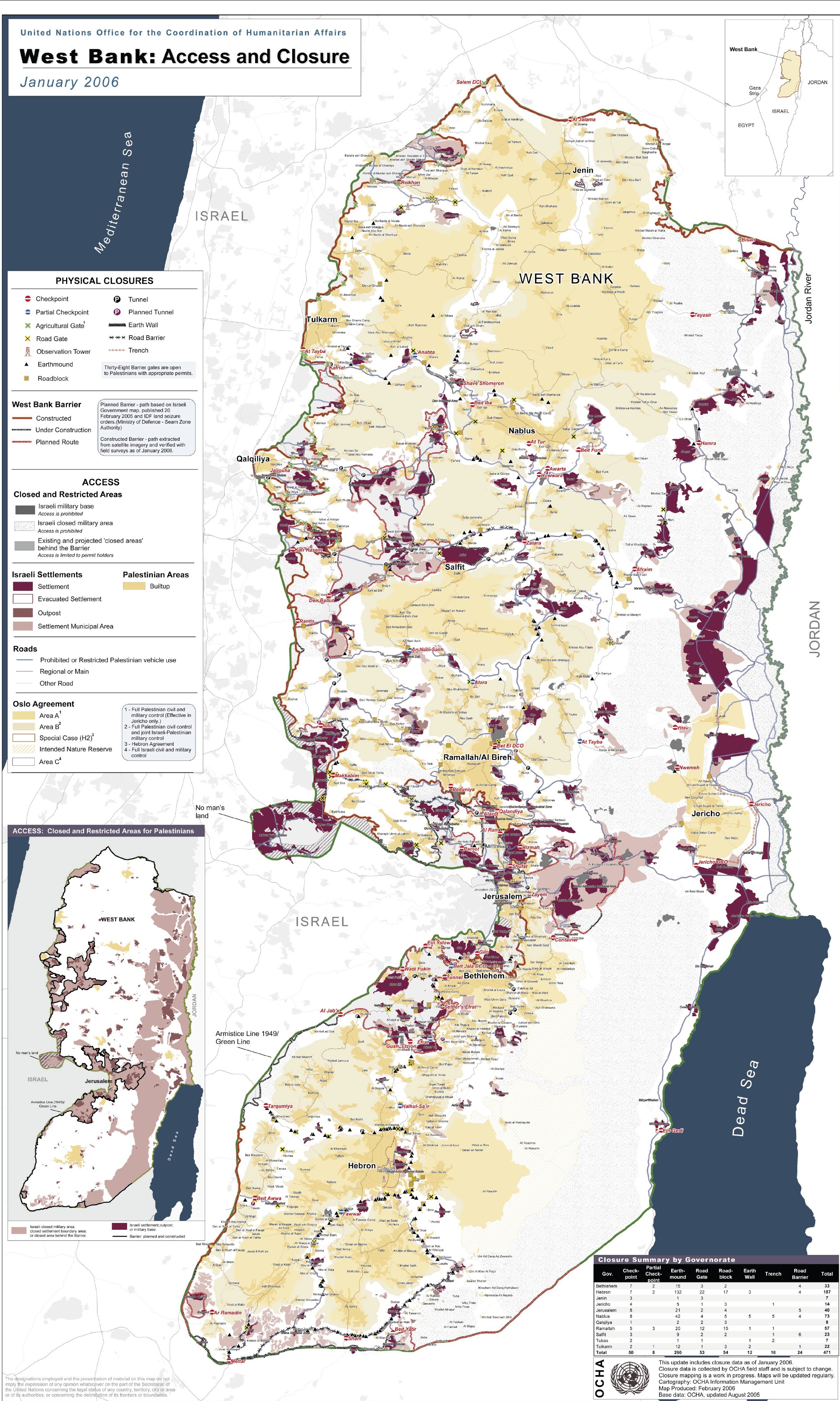
I do not find it feasible to imagine Gaza and the West Bank integrating a single country, and not only because they are separated by ~40Km, but because they are so sociologically different. People in the West Bank, yes, live opressed under military rule and subject to a much more constant, more visible apartheid-like state (as the territory is truly sprinkled with Jewish outposts which many Israelis refuse to recognize as their own, but still, which have incredibly higher living standards). The best land has been taken away from them, yes, but they have some space between cities to have some farming, to communicate, to... Breathe. Besides, West Bank inhabitants -even those in refugee camps- have much better living standards than anybody in Gaza. It is still an overpopulated area, but not nearly as much as Gaza.
Gazan population have been driven towards extremism. And yes, there was a civil war between Palestinian factions, as the world views between both populations are completely different - However hostile a Jenin inhabitant can be towards Israel, he does not lead the life -if it can so be called- you see at Khan Yunis.
But back to Gaza... What Israel is doing (and not only during this military operation terror campaign is wrong, from any rational point of view. Israel wants Hamas to become weaker? Then don't drive the population into supporting them!
Palestinians started giving over 50% of their support to Fatah (ex-PLO), and under 20% to Hamas. That was less than 15 years ago. However, Fatah has shown to be corrupt and inefficient at building infrastructure and improving life conditions, ineffective at negotiating a permanent agreement which secures dignity and sustainability to their people. Hamas stands as a religious, righteous organization. There are no serious corruption charges against any Hamas leaders. Hamas is clearly still at war - They didn't subscribe any peace agreement so far, and their stated #1 goal is to build a Muslim State in the whole of Israel. And the Hamas movement -like Hizbollah in Lebanon- has built quite a bit of infrastructure in the areas they control - Mainly housing. Yes, housing where they mix their own offices, many will accuse, getting human shields for free. But still, they are benefactors to a dehumanized, pauperized population.
I find it obvious that, if living conditions were at a basic level in the region, support of Hamas would decrease. Even more, of course, if they improved due to Israeli support. Israel controls this territory, so it is responsible for the well-being of its population, like it or not. And Gaza is simply too small and low on resources to survive by itself.
I was a bit surprised to find mention -although very brief- of a three state solution - And yes, this is close to what I would expect as a viable outcome. It is clear that Israel will not ever grant full citizenship to the Palestinians, as they would -euphemistically speaking- challenge the Jewish character of the State. Dropping the euphemism, Israel relies on apartheid in order not to become an Arab majority country. I might have some numbers wrong, but AFAIK, there are ~7 million Israelis, 20% of which are Arab citizens (which means, 1.4 million Arabs and probably 5 million Jews, with many other minor denominations for the difference), and ~4 million Palestinians live in the territories. Today, the country is already predominantly Arab, or at least is close to being so. So, Israel should permanently, formally disengage from all of the occupied territories. And in order to ensure violence stops, start a comprehensive, unconditional, long-term aid program. Start with giving them autonomy to regain their sea, as the Gaza port has long been closed. Allow the airport to operate again. Instead of bombing tunnels in the Egypt-Gaza borders, allow Gaza to trade with Egypt - Perhaps even to integrate territorialy, if the conditions are met. Treat their people with respect, and help them ease the terrible situation they have lived for so many decades - and then, undoubtely, terror will stop.
The West Bank? Possibly it could become a Palestinian state by itself. Possibly, it could integrate back to Jordan. That would be up to Jordans and Palestinians to decide. Of course, Jordan has already a large segment of its population defining itself as Palestinians, which counts both for and against. So, I won't venture into this supposition.
But anyway - Back to what prompted me to write this text -yes, a very or maybe even too long text - I hope somebody even takes the time to read it!- is to explain what is my point of view on the current situation, and why.
Today, a cease-fire was announced, after 23 days of murder and destruction. I sadly do not hold very high hopes for it to be lasting, much the less to be enough, to lead to what they call a de-escalation of the conflict. The most I can currently do is to voice my opinion, and hope that mine is just one more voice pointing to a sane solution, to a permanent, dignifying way out, for all people involved. Every people has the right for survival and for safety. We cannot deny this to any others. And certainly, we cannot expect anybody not to fight for their right to live.

Axel Beckert: Traveling plans for the first half of 2009

Since the time between the years is traditionally family time for me, I never were at the Chaos Communication Congress. So I wasn t at 25C3 either. All the more I look forward to HAR2009 this summer (13th to 16th of August near Vierhouten in the Netherlands), but also because, for the last three years I always have been in the Netherlands for one week in summer, sailing with friends on the sselmeer. But before HAR2009, there will be a bunch of other events to visit and people to meet in real life: Then there will be the big summer holidays driving around in the middle of Europe with the 2CV and taking part in most likely: This also means that I ll probably miss: at least unless one of the other events I plan to visit doesn t take place as expected or my plans change heavily. P.S.: Anyone thinks this amount of events justifies a Dopplr account? ;-) Or is there somewhere a free online service similar to Dopplr, but runs software under the GNU Affero General Public License like e.g. identi.ca and many other Laconica instances do for microblogging?

17 January 2009

Jose Carlos Garcia Sogo: Debian on Android phone

A Debian installer and boot loader for Android based phones has been released. It uses Debian ARM packages from standard repositories, so it makes available t you the full plethora of Debian packages. Also, as a bonus, you can still your phone as it was, an Android based device, with all its functionality.

14 January 2009

Jose Carlos Garcia Sogo: Speed up multiple SSH connections to same server

I am copying here the tip I read in Linux Journal so I won t need to google for it when needed. It works by multiplexing connections to the same server in the same TCP connection. For this to work, it needs a socket to track each connection. You have to add these lines to ~/.ssh/config file:
Host *
ControlMaster auto
ControlPath ~/.ssh/master-%r@%h:%p

13 January 2009

Jose Carlos Garcia Sogo: Postfix+TLS+SASL in Debian HowTo recovered

Once of the most visited pages in my site was the Postfix+SASL+TLS for Debian Sid and Sarge Howto, who I wrote 3 years ago. As I hosted it in my old home server, when it broke it went offline, and though there are still some copies around the net, there are a lot of referals still directing traffic to tribulaciones.org.
Now I have recovered it and it is now available here. I will write an .htaccess file to redirect people to the new place and, with some more time, I will review it to see if there are some changes needed for Lenny.
Enjoy! UPDATED 14/01/2009: I have added promised .htaccess file, so every link to old URL (http://www.tribulaciones .org/docs/postfix-sasl-tls-howto.html) will work again.

31 December 2008

Jose Carlos Garcia Sogo: Giver: little util for sharing folders

While searching for different options to share files among different computers in a local LAN I found via Planet Ubuntu giver a little util which uses avahi/zeroconf to publish shared folders or files. It is a easy tool, that works and that serve well its purpose. But its development has stopped some time ago, and that means that nobody has cared to port it to Windows, where it would be an interesting tool to avoid the need of using windows network to share folders, which in an ad-hoc network tends to work problematically. These little gems should receive more care from freedesktop.org, GNOME Foundation, Canonical, Novell, as are the utils that make a difference in desktop expecience. Having a nice visual effects is not enough to attract people to free destops, but having tools that make everyday life is.

27 December 2008

Amaya Rodrigo

gotta love Berlin's DJs.

25 December 2008

Jose Carlos Garcia Sogo: git tips

Git is becoming my main utility for Debian packaging, as I am using it to keep my work on packages I maintain alone or in a team by using git.debian.org facilities. I am not still using tools like TopGit to keep patches, by I also intend to do so in a near future.
What does git give me over svn? Basically two things: branches and having the whole source code at hand. The first is obvious, I can easily create branches to experiment without having to change anything in the way the package is, so if a new upstream release occurs in the time it takes me to implement some change (and that usually happens) I can upload it straight, not affecting my undergoing changes.
Also I appreciate having the whole source code. This could have been also done using svn, but we preferred not to do so, and most packages only have debian dir in their svn repositories. This makes harder work with upstream sources, where they need to be patched. Git provides me the way to have always an upstream source code copy at hand, and the branch power can also be applied to it.
But I wanted to write about a couple of git tips that I found. Seems that they have already appeared on Planet Debian before, but I think that is not a bad idea to remember them (from damog s blog):

1. Changing into a directory that contains a repo and shows you on PS1 what branch you are standing on:

On .bashrc I have:

GITPS1='$(__git_ps1 ":%s ")'
export PS1="$ GREEN \w$ RS $ YELLOW $ GITPS1 $ RS \\$ "

But what I didn t want to lose was the code that was posted to paste.bin after in a comment someone pointed out that this trick was a bit annying if your home dir were also a git repo. This is one solution:

__maybe_git_ps1 ()
local BRANCH="$(__git_ps1 '%s')"
case "$BRANCH" in
master)
# silent
;;
'')
# not a git repo? -> silent
;;
*)
if [ -n "$1" ]; then
printf $1 $BRANCH
else
printf (%s) $BRANCH
fi
;;
esac

2. An alias I like to use on repos that are personal for quick tracking:

[alias]

log1 = log pretty=oneline abbrev-commit
Thanks damog for these tips!

23 December 2008

Emilio Pozuelo Monfort: Collaborative maintenance

The Debian Python Modules Team is discussing which DVCS to switch to from SVN. Ondrej Certik asked how to generate a list of commiters to the team s repository, so I looked at it and got this:
emilio@saturno:~/deb/python-modules$ svn log egrep "^r[0-9]+ cut -f2 -d sed s/-guest// sort uniq -c sort -n -r
865 piotr
609 morph
598 kov
532 bzed
388 pox
302 arnau
253 certik
216 shlomme
212 malex
175 hertzog
140 nslater
130 kobold
123 nijel
121 kitterma
106 bernat
99 kibi
87 varun
83 stratus
81 nobse
81 netzwurm
78 azatoth
76 mca
73 dottedmag
70 jluebbe
68 zack
68 cgalisteo
61 speijnik
61 odd_bloke
60 rganesan
55 kumanna
52 werner
50 haas
48 mejo
45 ucko
43 pabs
42 stew
42 luciano
41 mithrandi
40 wardi
36 gudjon
35 jandd
34 smcv
34 brettp
32 jenner
31 davidvilla
31 aurel32
30 rousseau
30 mtaylor
28 thomasbl
26 lool
25 gaspa
25 ffm
24 adn
22 jmalonzo
21 santiago
21 appaji
18 goedson
17 toadstool
17 sto
17 awen
16 mlizaur
16 akumar
15 nacho
14 smr
14 hanska
13 tviehmann
13 norsetto
13 mbaldessari
12 stone
12 sharky
11 rainct
11 fabrizio
10 lash
9 rodrigogc
9 pcc
9 miriam
9 madduck
9 ftlerror
8 pere
8 crschmidt
7 ncommander
7 myon
7 abuss
6 jwilk
6 bdrung
6 atehwa
5 kcoyner
5 catlee
5 andyp
4 vt
4 ross
4 osrevolution
4 lamby
4 baby
3 sez
3 joss
3 geole
2 rustybear
2 edmonds
2 astraw
2 ana
1 twerner
1 tincho
1 pochu
1 danderson
As it s likely that the Python Applications Packaging Team will switch too to the same DVCS at the same time, here are the numbers for its repo:

emilio@saturno:~/deb/python-apps$ svn log egrep "^r[0-9]+ cut -f2 -d sed s/-guest// sort uniq -c sort -n -r
401 nijel
288 piotr
235 gothicx
159 pochu
76 nslater
69 kumanna
68 rainct
66 gilir
63 certik
52 vdanjean
52 bzed
46 dottedmag
41 stani
39 varun
37 kitterma
36 morph
35 odd_bloke
29 pcc
29 gudjon
28 appaji
25 thomasbl
24 arnau
20 sc
20 andyp
18 jalet
15 gerardo
14 eike
14 ana
13 dfiloni
11 tklauser
10 ryanakca
10 nxvl
10 akumar
8 sez
8 baby
6 catlee
4 osrevolution
4 cody-somerville
2 mithrandi
2 cjsmo
1 nenolod
1 ffm
Here I m the 4th most committer :D And while I was on it, I thought I could do the same for the GNOME and GStreamer teams:
emilio@saturno:~/deb/pkg-gnome$ svn log egrep "^r[0-9]+ cut -f2 -d sed s/-guest// sort uniq -c sort -n -r
5357 lool
2701 joss
1633 slomo
1164 kov
825 seb128
622 jordi
621 jdassen
574 manphiz
335 sjoerd
298 mlang
296 netsnipe
291 grm
255 ross
236 ari
203 pochu
198 ondrej
190 he
180 kilian
176 alanbach
170 ftlerror
148 nobse
112 marco
87 jak
84 samm
78 rfrancoise
75 oysteigi
73 jsogo
65 svena
65 otavio
55 duck
54 jcurbo
53 zorglub
53 rtp
49 wasabi
49 giskard
42 tagoh
42 kartikm
40 gpastore
34 brad
32 robtaylor
31 xaiki
30 stratus
30 daf
26 johannes
24 sander-m
21 kk
19 bubulle
16 arnau
15 dodji
12 mbanck
11 ruoso
11 fpeters
11 dedu
11 christine
10 cpm
7 ember
7 drew
7 debotux
6 tico
6 emil
6 bradsmith
5 robster
5 carlosliu
4 rotty
4 diegoe
3 biebl
2 thibaut
2 ejad
1 naoliv
1 huats
1 gilir

emilio@saturno:~/deb/pkg-gstreamer$ svn log egrep "^r[0-9]+ cut -f2 -d sed s/-guest// sort uniq -c sort -n -r
891 lool
840 slomo
99 pnormand
69 sjoerd
27 seb128
21 manphiz
8 he
7 aquette
4 elmarco
1 fabian
Conclusions:
- Why do I have the full python-modules and pkg-gstreamer trees, if I have just one commit to DPMT, and don t even have commit access to the GStreamer team?
- If you don t want to seem like you have done less commits than you have actually done, don t change your alioth name when you become a DD ;) (hint: pox-guest and piotr in python-modules are the same person)
- If the switch to a new VCS was based on a vote where you have one vote per commit, the top 3 commiters in pkg-gnome could win the vote if they chosed the same! For python-apps it s the 4 top commiters, and the 7 ones for python-modules. pkg-gstreamer is a bit special :)

17 December 2008

Biella Coleman: Going, going (gone) Monastic


Not Ballistic, Monastic, originally uploaded by the biella.
Have you ever gone monastic, taken a step away from the rough tumble of life to throw yourself totally and completely in one or just a few things? I have been in this state a few times before, sometimes by my own volition, other times I was forced into such state, as when I spent nearly a year homebound, sick. The last time I went monastic, I did so to finish my dissertation in 2005 and it worked rather well. In fact, I recall those few months where I barely left home (and as result my PJs) with deep fondness. I just loved the intensity and simplicity of it all, which is why I loved my other periods of self-enforced solitude/simplicity and often yearn for those moments again. The pile of writing projects I am trying to complete (or start) are mounting and honestly, I want the pile to move from a mountain to at least a hill and in order to do so, I think I will have to retreat. So tonight, I declared that upon my return from PR, I will once again go monastic but given that I have a pretty demanding full time job, I can t really go full-on monastic. I can only go semi-monastic, shirking some of my extracurricular activities and duties but I still think that I can enter into a more seclusionary (I know not really a word) mode than has been my life for the last year. I will report back in a few months with a story of success or failure about entering Monastic Mode x

Romain Beauxis: When Rambo meets the Teletubbies..

Some recent discussions made me remember about this very nice trailer... The interesting moment is at 01:45...

Les Inconnus - J sus 2 le retour
envoy par kikkako

14 December 2008

Jose Carlos Garcia Sogo: NAS adapter

I have been always desiring to have a NAS adapter and printer server so I can easily share and use both my USB printer and a USB hard disk from every corner in the house. I was doing that when I had a home server, but when it died I losed that functionality. Once of the main reasons to buy a new one was to have this option again, but today I have discovered in Xataka a little device: Addonics NAS Adapter. This is just what I wanted: NAS adapter, little size, can power 2.5 inch. HDD directly, and USB print server. Files are shared by Samba or FTP client, and can act also as DHCP server. As a bonus it has a little bittorrent client which can track 4 torrents at a time, and download them to attached USB device. The only thing I would like to know if is using an USB hub both a printer and a HDD can be attached at the same time. If that can be done, then for only $55 we have a winner. The only last wish that it uses Linux in their core (probably).

3 December 2008

Jose Carlos Garcia Sogo: Fanatics did it again

Once again, a person died today murdered by terrorists in Spain. He was a businessman, who had a construction company in his town (Azpeitia) at Basque Country region. Close his house, he was murdered by gunshots. Just because his company was a contractor in the construction of AVE infraestructure in Basque Country, which will connect it with Madrid and France. Once again, a family has been hit forever. I was going to include a black strip with the article, but it’s better to see an image.

29 November 2008

Chris Lamb: Re: A timeline view in Django

Alex Gaynor writes about "timeline views" in Django. The abstract problem is to merge already-sorted lazily evaluated lists by some specified attribute. My solution is similar to Malcolm's suggestion in the comments and improves upon Alex's in that has superior space considerations, as well as supporting reverse ordering with the usual Django syntax:
import heapq
def merge_querysets(*querysets, **kwargs):
    order_by = kwargs.get('order_by', None)
    if order_by is None:
        raise ValueError, "Must specify order_by in keyword arguments"
    # Are we sorting in reverse?
    reverse = False
    if order_by.startswith('-'):
        order_by = order_by[1:]
        reverse = True
    class Wrapper(object):
        """
        Hacky wrapper class for custom sorting.
        """
        def __init__(self, sortval, val):
            self.sortval = sortval
            self.val = val
        def __cmp__(self, other):
            if reverse:
                return cmp(other.sortval, self.sortval)
            else:
                return cmp(self.sortval, other.sortval)
    iterables = map(iter, querysets)
    heap = []
    while True:
        for it in iterables:
            try:
                val = it.next()
                sortval = val.getattr(order_by)
                heapq.heappush(heap, Wrapper(sortval, val))
            except StopIteration:
                # This QuerySet has been exhausted
                iterables.remove(it)
                continue
        if not iterables:
            # All QuerySets have been exhausted; just yield from the heap
            # to save cost of insertion.
            for item in heap:
                yield item.val
            return
        yield heapq.heappop(heap).val
def my_view(request):
    tickets = Ticket.objects.order_by('-create_date')
    wikis = WikiEdit.objects.order_by('-create_date')
    changesets = Changeset.objects.order_by('-create_date')
    objs = merge_querysets(tickets, wikis, changesets, order_by='-create_date')
    return render_to_response('my_app/template.html',  
        'objects': objs,
     )

19 November 2008

Runa Sandvik: The IT Crowd season three

Yep, they are back. Starting tomorrow on Channel 4. Don’t miss it.

18 November 2008

Adrian von Bidder: SyncML (new toy)

Q: is a mobile phone (nice hardware, shitty firmware, btw) waterproof? A: I now got this new toy (Sony Ericsson S500i) as aresult. And because I don't really like losing contacts again (I never managed to connect to the old phone from Linux and was too lazy to use the Windows software), I have now fired up kitchensync with the OBEX SyncML client from the OpenSync project. And was very surprised that after only very little fiddling with the configuration I could indeed copy the contacts from the phone to KDE's addressbook. There seems to be a — not so usual anymore in this decade — utf8 problem somewhere (it looks as if the encoding from the phone is converted to utf8 twice, or it is latin1 to utf8 encoded but was already utf8 on the phone), and synchronisation is only one way so far (from the phone to KDE-PIM), with changes on the KDE side being overwritten. No idea which component those bugs are in, and documentation I've found is not very verbose. So, to start with: I've gotten this nice dump with hcidump. Now, how do I extract the actual data streams from that dump? I know I have to use wbxml2xml on the data, but first I need to unwrap the network data, and I haven't found that (probably read past it in the manpage of hcidump because I'm a bit tired.) Of course, if anybody out there has solved my issues I'd be just as happy with information on how that was done instead. In the mean time, I at least have reasonable back up of my phone's contact database again.

4 November 2008

Russell Coker: Basics of EC2

I have previously written about my work packaging the tools to manage Amazon EC2 [1]. First you need to login and create a certificate (you can upload your own certificate - but this is probably only beneficial if you have two EC2 accounts and want to use the same certificate for both). Download the X509 private key file (named pk-X.pem) and the public key (named cert-X.pem). My Debian package of the EC2 API tools will look for the key files in the ~/.ec2 and /etc/ec2 directories and will take the first one it finds by default. To override the certificate (when using my Debian package) or to just have it work when using the code without my package you set the variables EC2_PRIVATE_KEY and EC2_CERT. This Amazon page describes some of the basics of setting up the client software and RSA keys [2]. I will describe some of the most important things now: The command “ec2-add-keypair gsg-keypair > id_rsa-gsg-keypair” creates a new keypair for logging in to an EC2 instance. The public key goes to amazon and the private key can be used by any ssh client to login as root when you creat an instance. To create an instance with that key you use the “-k gsg-keypair” option, so it seems a requirement to use the same working directory for creating all instances. Note that gsg-keypair could be replaced by any other string, if you are doing something really serious with EC2 you might use one account to create instances that are run by different people with different keys. But for most people I think that a single key is all that is required. Strangely they don’t provide a way of getting access to the public key, you have to create an instance and then copy the /root/.ssh/authorized_keys file for that. This Amazon page describes how to set up sample images [3]. The first thing it describes is the command ec2-describe-images -o self -o amazon which gives a list of all images owned by yourself and all public images owned by Amazon. It’s fairly clear that Amazon doesn’t expect you to use their images. The i386 OS images that they have available are Fedora Core 4 (four configurations with two versions of each) and Fedora 8 (a single configuration with two versions) as well as three other demo images that don’t indicate the version. The AMD64 OS images that they have available are Fedora Core 6 and Fedora Core 8. Obviously if they wanted customers to use their own images (which seems like a really good idea to me) they would provide images of CentOS (or one of the other recompiles of RHEL) and Debian. I have written about why I think that this is a bad idea for security [4], please make sure that you don’t use the ancient Amazon images for anything other than testing! To test choose an i386 image from Amazon’s list, i386 is best for testing because it allows the cheapest instances (currently $0.10 per hour). Before launching an instance allow ssh access to it with the command “ec2-authorize default -p 22“. Note that this command permits access for the entire world. There are options to limit access to certain IP address ranges, but at this stage it’s best to focus on getting something working. Of course you don’t want to actually use your first attempt at creating an instance, I think that setting up an instance to run in a secure and reliable manner would require many attempts and tests. As all the storage of the instance is wiped when it terminates (as we aren’t using S3 yet) and you won’t have any secret data online security doesn’t need to be the highest priority. A sample command to run an instance is “ec2-run-instances ami-2b5fba42 -k gsg-keypair” where ami-2b5fba42 is a public Fedora 8 image available at this moment. This will give output similar to the following: RESERVATION r-281fc441 999999999999 default
INSTANCE i-0c999999 ami-2b5fba42 pending gsg-keypair 0 m1.small 2008-11-04T06:03:09+0000 us-east-1c aki-a71cf9ce ari-a51cf9cc The parameter after the word INSTANCE is the serial number of the instance. The command “ec2-describe-instances i-0c999999” will provide information on the instance, once it is running (which may be a few minutes after you request it) you will see output such as the following: RESERVATION r-281fc441 999999999999 default
INSTANCE i-0c999999 ami-2b5fba42 ec2-10-11-12-13.compute-1.amazonaws.com domU-12-34-56-78-9a-bc.compute-1.internal running gsg-keypair 0 m1.small 2008-11-04T06:03:09+0000 us-east-1c aki-a71cf9ce ari-a51cf9cc The command “ssh -i id_rsa-gsg-keypair root@ec2-10-11-12-13.compute-1.amazonaws.com” will then grant you root access. The part of the name such as 10-11-12-13 is the public IP address. Naturally you won’t see 10.11.12.13, it will instead be public addresses in the Amazon range - I replaced the addresses to avoid driving bots to their site. The name domU-12-34-56-78-9a-bc.compute-1.internal is listed in Amazon’s internal DNS and returns the private IP address (in the 10.0.0.0/8 range) which is used for the instance. The instance has no public IP address, all connections (both inbound and outbound) run through some sort of NAT. This shouldn’t be a problem for HTTP, SMTP, and most protocols that are suitable for running on such a service. But for FTP or UDP based services it might be a problem. The part of the name such as12-34-56-78-9a-bc is the MAC address of the eth0 device. To halt a service you can run shutdown or halt as root in the instance, or run the ec2-terminate-instances command and give it the instance ID that you want to terminate. It seems to me that the best way of terminating an instance would be to run a script that produces a summary of whatver the instance did (you might not want to preserve all the log data, but some summary information would be useful), and give all operations that are in progress time to stop before running halt. A script could run on the management system to launch such an orderly shutdown script on the instance and then uses ec2-terminate-instances if the instance does not terminate quickly enough. In the near future I will document many aspects of using EC2. This will include dynamic configuration of the host, dynamic DNS, and S3 storage among other things.

3 November 2008

Enrico Zini: rc-buggy packages sorted by popularity

rc-buggy packages sorted by popularity After doing a round of tag reviews so that we release lenny with the latest tag contributions, I still had a bit of spare time. Since people are urging to fix the last bugs I thought I could contribute a list of RC-buggy packages sorted by popularity:
#!/usr/bin/python
import urllib2
import sys, re #, gzip
PKGRE = re.compile(r'<strong>Package: </strong><a href="[^"]+" name="([^"]+)">')
POPCONRE = re.compile(r'^(\d+)\s+(\S+)')
PKGMAPRE = re.compile(r'^([^(]+)\(([^)]+)')
COMMASPLIT = re.compile(r'\s*,\s*')
# Allow to download other package views
if len(sys.argv) > 1:
    url = sys.argv[1]
else:
    url = "http://bts.turmzimmer.net/details.php"
def read_packages(url):
    "Download the list of rc-buggy packages"
    fd = urllib2.urlopen(url)
    for line in fd:
        mo = PKGRE.search(line)
        if mo:
            yield mo.group(1)
# FIXME: this is a deprecated data source, but at the moment it is just what
#        is needed
def read_bintosrc(url = "http://qa.debian.org/data/ddpo/results/ddpo_packages"):
    "Download the binary to source package map"
    fd = urllib2.urlopen(url)
    for line in fd:
        mo = PKGMAPRE.search(line)
        if mo:
            src = mo.group(1)
            bin = COMMASPLIT.split(mo.group(2))
            for p in bin:   
                yield p, src
def read_popcon(url = "http://popcon.debian.org/by_inst"):
    "Download popcon information"
    fd = urllib2.urlopen(url)
    # It doesn't work on urllib2 objects because it wants tell()
    #fd = gzip.GzipFile(fileobj=fd, filename=url, mode="rb")
    for line in fd:
        mo = POPCONRE.match(line)
        if mo:
            yield mo.group(2), int(mo.group(1))
print "Reading mapping of binary packages to source packages..."
bin2src = dict(read_bintosrc())
print "Reading popcon scores..."
# We actually want the score of source packages, and for it we use the score of
# its binary package with the highest score
scores = dict()
for pkg, score in read_popcon():
    pkg = bin2src.get(pkg, pkg)
    if pkg not in scores:
        scores[pkg] = score
#scores = dict(read_popcon("http://popcon.debian.org/by_inst.gz"))
print "Reading list of rc-buggy packages..."
# The bug page has a mix of source and binary packages: convert all to source
# packages
packages = sorted(read_packages(url), key=lambda x:scores.get(bin2src.get(x,x), 0))
for p in packages:
    print scores.get(bin2src.get(p,p), 0), p
This can be run on people.debian.org as ~enrico/popzimmer (0 is the rank of packages that for some reason cannot be mapped to any rank):
$ ~enrico/popzimmer 
Reading mapping of binary packages to source packages...
Reading popcon scores...
Reading list of rc-buggy packages...
0 roxen-fonts-iso8859-2
2 dpkg
11 pam
61 glibc
61 libc6
123 initramfs-tools
149 bind9
150 grub
180 portmap
213 nfs-common
279 libgl1-mesa-dri
298 libsnmp-base
298 snmpd
309 avahi
397 mysql-dfsg-5.0
408 xserver-xorg-input-wacom
409 xserver-xorg-video-vesa
428 docbook-xml
499 openoffice.org-core
567 xine-lib
600 evolution-data-server
669 eog
671 xserver-xorg-video-intel
691 epiphany-browser
691 epiphany-gecko
695 kdelibs4c2a
698 uswsusp
754 guile-1.6
959 gpm
964 cups
990 kdebase
1002 ghostscript
1069 giflib
1076 xulrunner-1.9
1177 libapache2-mod-perl2
1217 vlc-nox
1229 kernel-package
1311 kdeutils-dev
1520 libparted1.8-10
1767 wireshark
1785 selinux-policy-default
1908 dia
1943 htop
1983 boost
2140 cantlr
2145 transmission
2159 emacs22
2312 swfdec-mozilla
2449 eclipse
2449 libswt3.2-gtk-java
2728 lilo
2898 libnss-ldap
3013 java-access-bridge
3051 blender
3099 libtemplate-perl
3499 fglrx-atieventsd
3602 virtualbox-ose
3619 jfsutils
3806 anjuta
3962 kbuild
4076 libgnustep-gui0.14
4222 libwebkit-1.0-1
4332 rosegarden
4412 matplotlib
4412 python-matplotlib
4950 mail-notification-evolution
5195 nut-cgi
5273 sbcl
5538 ruby1.9
5679 kmymoney2
6076 websvn
6147 miro
6264 gnat-4.1
6431 gallery2
6478 gnome-chess
6512 joystick
6862 istanbul
6937 wordpress
7476 luatex
7635 csound
7635 python-csoundac
8257 libpam-mount
8471 wmcpuload
8631 nbsmtp
8642 oxine
8774 axiom
8949 libengine-pkcs11-openssl
9052 clamav-getfiles
9221 open-iscsi
9262 ptex-bin
9701 egroupware-core
10012 debian-cd
10127 libjogl-java
10453 libjson-xs-perl
10698 gcjwebplugin
10736 request-tracker3.6
11294 python-extclass
11518 rkward
11600 alevt
12929 otrs2
13205 bindgraph
13956 icecc-monitor
14223 netmaze
14505 cdebconf
14526 mumble
14687 fnonlinear
14724 recite
14789 jbidwatcher
15766 libnss-ldapd
15812 glpi
15905 lustre-source
15982 win32-loader
16232 ampache
17168 libghc6-missingh-dev
17311 acl2
17830 apertium
18462 emacspeak
18469 glassfish
19257 isight-firmware-tools
19719 libnagios-object-perl
20144 libwx-perl
20465 dns2tcp
21614 python-kinterbasdb-dbg
21690 hf
21902 libcobra-java
22365 tomcat6
22573 libphp-snoopy
23501 coco-java
23926 boxbackup-server
24009 libghc6-wash-dev
26323 libdesktop-notify-perl
26439 opendb
28426 adolc
28795 xorp
29986 libgdata-java
31262 libjboss-serialization-java
31472 pixelpost
31658 cournol
32939 mediamate
34365 gforge-plugin-scmcvs
34659 libgearman-client-async-perl
42233 libhamcrest-java
48076 mahara
55303 mxallowd
85881 roxen-fonts-iso8859-1

So, if you don't know from what package to start fixing bugs, "Begin at the beginning,", the King said, very gravely, "and go on till you come to the end: then stop."

Kees Cook: days since last incident

If I made one of those work-site signs that tracked “Days since last incident”, and made one for “Days since last in-the-wild remote-root worm” for Windows and Linux, what would they each say? 0 and 7304 respectively? Update: while the post was tongue-in-cheek (everyone suffers when any large subset of computers is being attacked), I should lower the Linux days count to 2783 (for L10n on March 23, 2001, which is slightly newer than Ramen on January 17, 2001). Thanks for everyone’s comments. :)

1 November 2008

Thijs Kinkhorst: Electronisch Pati ntendossier

Today everyone in the Netherlands received a letter about the new national electronic health record (EPD) and the possibility to object against registration. EPD aims to provide access to one's patient data to every care provider through a central information broker. I have submitted the form to disallow my data to be accessed through this system. First of all, there's no clear benefit for me, and I think that goes for the large majority of people. The possible situation where someone has a critical condition and isn't treated by his regular doctor and is unable to inform the stand-in of this and the stand-in has the time to delve through the entire EPD and actually finds and correctly interprets the necessary information seems extremely small for anyone, let alone the big majority that doesn't suffer such critical conditions in the first place. Hence, making it the default for everyone seems very inappropriate. See also this interesting article, written in Dutch by my uncle. Interestingly the same minister was recently opposed to a default-allow for organ donorship, which may address a problem that is much more real. The other concern is security. I am not worried by the technical security of the system, it seems to be of acceptable standard (see this report by my friend Niels). I am more concerned about access restrictions: these are implemented post hoc, that is, anyone can access my file and I can check who accessed my it and whether they had the right to. However, this procedure involves sending in paper forms which I think in practice will not bring about much review. Combined this project reminds me of voting computers - introducing new concerns while solving no actual problems.

Next.

Previous.