Search Results: "evo"

7 May 2009

Biella Coleman: Make our words glisten


glisten vs hardened words, originally uploaded by the biella.
Now that I am (thankfully) done teaching until September, I have time to devour two small mountains of readings that I need to finish before I return to my manuscript, which I will be working on, I hope uber-productively, all summer long. One pile of readings deals with coding, open source, and the commons, such as Scott Rosenberg s Dreaming in Code and David Bollier s Viral Spiral. Another pile of reading edges toward the theoretical side of things, having to do with craft, pleasure, and humor, since it is pleasure in its many many many guises from from the calm feeling of self-satisfaction that underlies pride in one s craft, to the more sublime feeling of ecstatic bliss that powers many creative sprints. If one entertains pleasure, one must also entertain its darker side, for all of this feel good stuff is nonetheless often springs forth from a deep sea of passionate frustration. This seems to be the driving theme of Dreaming in Code and it is also what animates Ellen Ullman s fictional account of pure frustration, The Bug. I am quite fond of native expressions of geek frustration and recently was provided with an exquisite example a rant against the Adobe PSD format. The author of Xee, A light-weight, fast and convenient image viewer for Mac OS X explained his utter contempt for the Adobe PSD in the following way:

At this point, I d like to take a moment to speak to you about the Adobe PSD format. PSD is not a good format. PSD is not even a bad format. Calling it such would be an insult to other bad formats, such as PCX or JPEG. No, PSD is an abysmal format. Having worked on this code for several weeks now, my hate for PSD has grown to a raging fire that burns with the fierce passion of a million suns. If there are two different ways of doing something, PSD will do both, in different places. It will then make up three more ways no sane human would think of, and do those too. PSD makes inconsistency an art form. Why, for instance, did it suddenly decide that *these* particular chunks should be aligned to four bytes, and that this alignement should *not* be included in the size? Other chunks in other places are either unaligned, or aligned with the alignment included in the size. Here, though, it is not included. Were it within my power, I would gather every single copy of those specs, and launch them on a spaceship directly into the sun.
Even if this account represents unadulterated irritation, he leaves us, the reader, with nothing of the irritation, only pleasure. This aftermath of frustration is delivered through the vehicle of humor, which within the hacker context, is the cultural container that best captures the spirit of hacker pleasure or so I will be arguing. Like many humorous rants from the world of hacking (and please send me any others you know of), this text dances with liveliness; it exudes its own rhythm; it glistens to use Ronald Barthes apt phrasing from his short book The Pleasure of Text, which I just finished as part of my theoretical escape into the pleasure-dome. Although there are parts of his book which are to be frank, *really* *not* *pleasurable*, partly due to obscure references to High French Theory, which elide even an academic pair of eyes, the book generally pleases. And one of the most pleasing chunks is his definition of a stereotype:
The stereotype is the word repeated without any magic, any enthusiasm, as though it were natural, as though by some miracle this recurring words were adequate on each occasion for different reasons, as though to imitate could no longer be sensed as an imitation: an unconstrained word that claims consistency and is unaware of its own insistence
In contrast to the stereotype, a string of words that enchants does so by slipping off the page to hit you squarely in the heart or the gut. Unfortunately, while academic writing steers clear of stereotypes, often trying to present the detailed singularity of a phenomena (even when conditioned by social forces), it does not exactly glisten, though there are a handful of exceptions. I think we need more texts that glisten, even if only during sections or parts of our books and articles (much like the rant helped enliven the more staid technical document). In recent years, in large part due to the influence of free software, there has been an explosion, a move toward going open access. All of this is laudable and I fully embrace it (and have gotten into some small battles over it). But without an aesthetic politics that values pleasure in reading and writing we are doomed to obscurity anyway. A move toward making our knowledge public also required a move toward thinking about the literary aesthetics of pleasure.

Biella Coleman: Make our words glisten


glisten vs hardened words, originally uploaded by the biella.
Now that I am (thankfully) done teaching until September, I have time to devour two small mountains of readings that I need to finish before I return to my manuscript, which I will be working on, I hope uber-productively, all summer long. One pile of readings deals with coding, open source, and the commons, such as Scott Rosenberg s Dreaming in Code and David Bollier s Viral Spiral. Another pile of reading edges toward the theoretical side of things, having to do with craft, pleasure, and humor, since it is pleasure in its many many many guises from from the calm feeling of self-satisfaction that underlies pride in one s craft, to the more sublime feeling of ecstatic bliss that powers many creative sprints. If one entertains pleasure, one must also entertain its darker side, for all of this feel good stuff is nonetheless often springs forth from a deep sea of passionate frustration. This seems to be the driving theme of Dreaming in Code and it is also what animates Ellen Ullman s fictional account of pure frustration, The Bug. I am quite fond of native expressions of geek frustration and recently was provided with an exquisite example a rant against the Adobe PSD format. The author of Xee, A light-weight, fast and convenient image viewer for Mac OS X explained his utter contempt for the Adobe PSD in the following way:
At this point, I d like to take a moment to speak to you about the Adobe PSD format. PSD is not a good format. PSD is not even a bad format. Calling it such would be an insult to other bad formats, such as PCX or JPEG. No, PSD is an abysmal format. Having worked on this code for several weeks now, my hate for PSD has grown to a raging fire that burns with the fierce passion of a million suns. If there are two different ways of doing something, PSD will do both, in different places. It will then make up three more ways no sane human would think of, and do those too. PSD makes inconsistency an art form. Why, for instance, did it suddenly decide that *these* particular chunks should be aligned to four bytes, and that this alignement should *not* be included in the size? Other chunks in other places are either unaligned, or aligned with the alignment included in the size. Here, though, it is not included. Were it within my power, I would gather every single copy of those specs, and launch them on a spaceship directly into the sun.
Even if this account represents unadulterated irritation, he leaves us, the reader, with nothing of the irritation, only pleasure. This aftermath of frustration is delivered through the vehicle of humor, which within the hacker context, is the cultural container that best captures the spirit of hacker pleasure or so I will be arguing. Like many humorous rants from the world of hacking (and please send me any others you know of), this text dances with liveliness; it exudes its own rhythm; it glistens to use Ronald Barthes apt phrasing from his short book The Pleasure of Text, which I just finished as part of my theoretical escape into the pleasure-dome. Although there are parts of his book which are to be frank, *really* *not* *pleasurable*, partly due to obscure references to High French Theory, which elide even an academic pair of eyes, the book generally pleases. And one of the most pleasing chunks is his definition of a stereotype:
The stereotype is the word repeated without any magic, any enthusiasm, as though it were natural, as though by some miracle this recurring words were adequate on each occasion for different reasons, as though to imitate could no longer be sensed as an imitation: an unconstrained word that claims consistency and is unaware of its own insistence
In contrast to the stereotype, a string of words that enchants does so by slipping off the page to hit you squarely in the heart or the gut. Unfortunately, while academic writing steers clear of stereotypes, often trying to present the detailed singularity of a phenomena (even when conditioned by social forces), it does not exactly glisten, though there are a handful of exceptions. I think we need more texts that glisten, even if only during sections or parts of our books and articles (much like the rant helped enliven the more staid technical document). In recent years, in large part due to the influence of free software, there has been an explosion, a move toward going open access. All of this is laudable and I fully embrace it (and have gotten into some small battles over it). But without an aesthetic politics that values pleasure in reading and writing we are doomed to obscurity anyway. A move toward making our knowledge public also required a move toward thinking about the literary aesthetics of pleasure.

3 May 2009

Gregory Colpart: Migration from GNU Arch to Git for Horde packages

All Horde packages (horde3, imp4, kronolith2 ) were in GNU Arch repository. After Lenny release, we decided to migrate to Git. Git has a lot cool features, and I was convinced by Pierre Habouzit talk about Packaging with Git. Technically, I used git-archimport to keep all history of packaging. Each package has a Git repository with some branches: upstream, upstream+patches, upstream+repack (if needed), pristine-tar, debian-sid (imported from GNU Arch) and debian-<release>. The hardest step was to set up a common ancestor for debian-sid and upstream branches: I found git-merge-unrelated-branch script to do it automagically. I write guidelines for packaging Horde with Git on Debian Wiki with some notes about migration from GNU Arch to Git. Comments welcome!

2 May 2009

Lior Kaplan: Checking OLPC usability with children


Last semester I took a usability course in my university, as a final project I decided to test the OLPC usability for/with children. The full report is available (in Herew), but I ll summerise the main points. The checks goal was to see how do small children interact with the OLPC, and how does the language barrier affects them. In Israel the children starts to learn reading and writing in Hebrew at the age of 6, and most also start their English (very common as the second language) at the age of 8. So the language also creates another challenge for the child and he must relay on his other skills, as he can t understand the interface language. My target audience were children between 4 and 10, while the official target audience for the OLPC is between 6 and 12. I used 5 children:
  • a boy, age 4.5
  • a girl, age 9.5
  • a girl, age 4
  • a girl, age 7.5
  • a boy, age 7
The test environment was a OLPC laptop running Sugar with an English interface. After some of the tests I found out the mouse pad wasn t functioning all the time, but it was intersting to see how that effected the children. The tests:
  • Can a child find how to open the computer?
  • Can the child find how to use the computer? Mainly understand the main screen icons and open programs.
  • Can a child find how to exit a program back to the main screen? Don t forget he can t look for the butten says exit/quit .
  • Recored the child s first impression for the laptop and his thoughts after using the computer.
  • Check whether the child got some educational benefit from the use of the laptop.
Summery of the results: Only once child (the oldest) succseeded with understanding how to open the laptop without help. The other needed a hint or directions. The small children found in difficelt (physically) to open the laptop. Seems that there should be some marks near the antenas that indicate they should be opened first. And maybe making the antenas to open with less force (but still insuring the locking mechanisem works in the laptop falls to the ground). All the children recognized the general meaning of the icons in the main screen as programs or stuff the comptuer does . Not all the icons are clear to the children (and also to me). The language (English) was the main method the big children found out the meaning of the game, while the small one could only guess or just start the program. Clear icons were paint, maze, memory (although one tought it s tik-tak-toe). Unclear icons were: the snake (python/pippy), the dolphin (distance), tamtam s multipal icons and the browse icon. The exit button was a challenge to all children, the old ones used trail and error while reading the buttons labels, but the other needed direction about how can them exit the program. The icon just isn t clear enough. The mouse usage seemed to also be an issue, partly by been half brokem and partly becuase the young children don t handle it so smoothly and can t always be very accurate. While in most actions that wasn t a problem, in the task of exiting a program that was a big issue. As the exit button is near the frame edges, missing it makes the frame menu to appear and move or hide the exit button. For some children that was a very annoying experience. All the children said the computer is heavy for them, but the degree changed wih the age. The 4 years old children said it is heavier than the 9 years old children. Don t forget the from the first grade (age 6) the children start taking a bag to scholl and carry books. So any improvement in the wieght is good, but I don t think it s critical. Finally, I found out that all the children got some educational benefit from the use of the OLPC. The small one got some math practice with the memory game, or by trying to solve their way out of the maze (I actually saw how they improve while playing). The bigger children got a good practice with spelling words with speak, and one even surprised me and his mother with his spelling. In the end, the OLPC is indeed revolutionary machine and interface (thought Sugar), but some small changes should be made. The overall experience of the children was very good. Posted in Proud to use free software Tagged: OLPC, usability

30 April 2009

Biella Coleman: On Chasing Plastic

Anyone who knew me prior to 2000, knew me as a fanatic Ultimate Frisbee player. I was (mostly) all about chasing a plastic disc on lush green fields. Ultimate Frisbee, which took my attention and soul my first year of college, commanded my attention, time, and body for years. The New York Times just ran a nice short piece piece about Ultimate Frisbee, which apparently has skyrocketed in popularity since 2003. One section of the article caught my attention:
It may be a non-contact sport according to its rules, but Ultimate is hardly free of injuries. The quick cutting and sprinting have made anterior cruciate ligament tears among women players especially common. JOY CHEN, a 33-year-old software developer in Alameda, Calif., considers herself lucky that herniated disks, a rotator cuff tear and ankle sprains have been the extent of her Ultimate injuries. We hit each other and the ground pretty hard, said Ms. Chen, who discovered Ultimate in college after years as a soccer and tennis player. She played with Stanford University s Superfly, which went on a three-year run as undefeated women s national collegiate champions.
Injury goes with the sport as hand and glove and young players tend to wear these injuries as a badge of pride. As much as I adore the sport and there are days I get pretty bummed that I no longer play I think that the UPA and older players should seriously skool the younger generation on the danger of injuries. It is an extreme sport that requires extreme care. Tournaments are usually composed of 4-7 games over the course of 2 days. If that is not demanding enough, the body gets pretty intimate with the the ground while laying out and then there are there all those sprained ankles and broken bones and ligaments from collisions. Today I suffer from bouts of knarly neck pain, for example, which is due in part from playing without taking proper precautions. One of my best friends, who was a stellar player in college, also suffers from pretty devastating back pain. It is an extreme sport that requires extreme care. I say toss out the pride in pain/injuries and in place, instill a healthy sense of fear of the injuries so that people get proper long term and sustained care for their injuries so that they can keep on playing the world s best sport. PS For those that don t know, UF also revolves around an ethical philosophy Spirit of the Game, which unfortunately the article makes no mention of, despite its centrality to the sport.

Martin F. Krafft: The need for a GPG revocation certificate

Do you use GPG or PGP to sign or encrypt your emails and/or files? This is a reminder to those who answered yes: make sure you have a revocation certificate, as well as backups of your private/public key pair, ideally in multiple safe locations. It s always a good idea to keep backups. But what is more important with GPG is the revocation certificate. That s your emergency brake. If someone ever gains control over your key, this is the only way for you to minimise (further) abuse of your key and your identity. However, even a revocation certificate won t be able to prevent all abuse, by nature of the design of the GPG Web of Trust. You also need to exercise utmost care in protecting your key and making sure third parties cannot gain control over it. Do not keep it on machines you don t trust, and make sure to use a safe, non-guessable passphrase! With GnuPG, generating a revocation certificate is as easy as this; replace $KEYID with your 8 or 16 digit hexadecimal key ID:
gpg --gen-revoke $KEYID > $KEYID.revoke.asc

and store it away. Do not import it until you need to revoke your key! In my case, the process was this; lines requiring my input are prefixed with an arrow ( ):
  sec  1024D/330C4A75 2001-06-20 Martin F. Krafft <mail@martin-krafft.net>
  Create a revocation certificate for this key? (y/N) y
  Please select the reason for the revocation:
    0 = No reason specified
    1 = Key has been compromised
    2 = Key is superseded
    3 = Key is no longer used
    Q = Cancel
  (Probably you want to select 1 here)
  Your decision? 1
  Enter an optional description; end it with an empty line:
  > 
  Reason for revocation: Key has been compromised
  (No description given)
  Is this okay? (y/N) y
  You need a passphrase to unlock the secret key for
  user: "Martin F. Krafft <mail@martin-krafft.net>"
  1024-bit DSA key, ID 330C4A75, created 2001-06-20
  ASCII armored output forced.
  Revocation certificate created.
  Please move it to a medium which you can hide away; if Mallory gets
  access to this certificate he can use it to make your key unusable.
  It is smart to print this certificate and store it away, just in case
  your media become unreadable.  But have some caution:  The print system of
  your machine might store the data and make it available to others!

I then printed the file, put it in the safe, stored it on a removable disk and hid it away. Even though I exercise great care over my key material, I can now sleep better at night, knowing that I can at least minimise any damage done by an attacker who compromises my key. Also, that way I can make sure to declare unused keys as such, since there is no other way to revoke a published key for which you ve lost the private key or forgotten its passphrase. I ve left such traces in my past and wish I had known what I was doing at the time: A8FA196E, C22D1C01, 1EF0975C. This is your chance to do it right. Make yourself a revocation certificate now (along with backups)! And always exercise care and keep your key secure. NP: Mono: One More Step and You Die

27 April 2009

Gunnar Wolf: Damn you pigopolists! (or whatever)

We have had a quite strange couple of days... Everything was smooth as usual on Thursday. As I posted here, I cycled to Iztacala to give a talk and back, and basically had a good time. We had heard news some days earlier on the radio that the usual seasonal flu was still present by mid-April, while usually it disappeared by early March... But nothing more. But Friday morning, as I listened to my usual news program, Aristegui repeated over and over that the Health ministry had ordered (in a press conference at 23:00 the previous day) schools of all levels not to hold activities... Quite unusual, but WTF... Got to work as usual, around 9 AM. The first thing I see in the Institute, our Academic Secretary telling us all to finish our most urgent business and head back home, do not pass go, do not collect $200. And... During the morning it started sinking in. This is a very weird and somehow scary situation. We are facing -as you all must know by now- a previously unknown strain of flu virus (influenza porcina H1N1B, AFAICT). During the past couple of days, we have seen the scenes we wondered about during the past decade, mainly in South East Asia (with SARS and with bird flu): Everybody is scared, nobody really understands what they are scared of, people do stay at home. The streets are eerily quiet, and many people are seen with masks covering nose and mouth. I must recognize our federal and local governments are acting very well coordinated (for the first time in probably over a decade, since they were from different parties for the first time). This has been clearly labeled as an epidemic (over 1600 sick people reported at hospitals, and over 100 deceased) and has spread to many of our country's states (as well as to other many countries, although it still seems to be controlled there - But we have got reports from the USA, Canada, France, Spain, Israel and New Zealand so far). I will most probably spend the next full week at home, as my University (as well as all schools and universities in this city and at least the Mexico, Nuevo Le n and San Luis Potos states) will be closed until May 6th. Of course, sports and cultural activities are all suspended as well. Many (most?) bars and restaurants remain closed. Today, my parents came from neighbouring Cuernavaca (where no alerts have yet been emitted, but will surely follow), and we went out for lunch (to a nice Yucatan food place, chosen partly as it had very little concurrence and because we could sit outdoors. Yes, I must specially thank them for being as imprudent as coming over here, given the generalized scare... I know there was nothing I could do to prevent them from doing so :-) And... In this strange climate, I can only thank I am not a party-organizer or anything like that, as I'd have had my plans frustrated. Here I sit next to my laptop, in my halfway-re-windowed house, with a still shrink-wrapped book that looks beautiful (La bicicleta: Rito, t cnica y pasi n), eager to open it (Thanks, Nadezhda! :-* ). Happy birthday to me. Take off the mask, blow 33 candles, put mask back on. Thankfully there is no cake to eat, as it could be messy with the mask on.

22 April 2009

Biella Coleman: They keep on coming

There are two topics that seem to receive a steady stream of comments on this blog. My entry on Edmonton garners a smattering of comments every few months, usually giving E-town a huge thumbs down. The other entry concerns my tribulations with BCBS and here I receive a steady stream of sad stories all of which point to the horrors caused by some branch of BCBS such as my least favorite one Horizon Blue Cross Blue Shield of NJ. Along with the comment posted above, I got this one asking me to reveal the email address of the PR director of BCBS NJ. In the past I advised folks to google it to find it. But I just tried and it is actually a bit harder to find and I wonder if I should post to one of the many press releases that exist on the web with this information? I hope thats some with some sort of time and lots of anger (toward BCBS) to start a website specifically geared toward and against BCBS. Call it Blue Cross No Shield (I think I actually own that and am pretty proud of the name) or something of that nature and throw up some blog and post horror stories in the style of the consumerist. There will be no shortage of them, especially if the blog is national in scope. Get a mailing list going and start a fax campaign among many others. Share contact information about public relations directors and Other People in Power, tips and advice on fighting them, and perhaps even move to the next level of organizing. I am not sure writing this here will do anything to inspire other and I would love to do this sort of rabble rousing as I get immense pleasure from doing so. But I simply am in the red when it comes to time. But I hope that some of the folks that have posted comments on this blog take the initiative to start a larger campaign (or someone can point me to an exisitng one). update: Now that I think of it, The Consumerist should really take up this cause and devote a section JUST to health insurance. They are already a brand name of sorts with lots of eyeballs on the site, everyday.

19 April 2009

Biella Coleman: Paris in June (and better with hackers)

/tmp/lab announces the second Hacker Space Festival
(Paris, 26-30 June 2009) Hacker Space Festival 2009 Call For Proposals HSF2009 In 2008, we organized HSF[1] on the spot, as an ad-hoc meeting for
hackerspaces-related networks, technical and artistic research emerging
from them and social questionning arising from them. This sudden
experiment proved to be a huge success, as much as on the
self-organizing level as on the participants and meetings quality, as
well as the emotionally-charged ambient, the kind of which you make
fond memories. The 2008 edition generated a strong emulation in France, from its
historical role as the first official hack meeting there, and in Europe
with the subsequent creation of the Hacker Space Brussels[2], the
rapprochement with The Fiber in Amsterdam and the hackerspaces.org[3]
network. Initiatives of hackerspace openings in Grenoble or Lille, or
the upcoming FrHack[4] conference show an actual enthusiasm in the
French hackers community that was doomed to the underground not so
long ago. We salute these initiatives and their diversity! Soon enough, we wanted to reiterate the HSF experience : however, it
was out of the question to institutionalize this temporary autonomous
zone, nor make it an ersatz of the previous edition, nor even to wrap
it into an elite or underground aura. On the opposite, we ardently
desire; and especially to explore further, in all directions some
lesser known domains (see below) et foster meeting and sharing around
experiences at the confluence of art, technology and politics. The world financial crisis, the decay of democracy in Europe, the
obscurantism, paranoia and lack of culture presiding over legislation
(Internet and Reaction Err Creation Law[5][6]) seem a fertile
environment for the sensible development of new (social ) life forms.
Quick! Let s rest for a few days in jubilation and ecstasy to take a
deep breathe of freedom under the indelicate smells of the medicine
factory nearby! For if the public space is shrinking to oblivion, where any side-step
becomes suspect, and that, from an early age (deviant behavior
detection in nursery school), where moving without a mobile phone
becomes suspect (hello you Julien Coupat[7], a French political
prisoner in France!), there s a domain that the Leviathan would have a
lot of trouble to contain, and for a reason: that of sensitivity. Even
the desperate attempts of the State to block the free and premonitory
expression of sense (hello you Demeure du Chaos![8]) cannot do anything
against a loud laughter or a knowing glance, a sensual kiss or an
explosion of colors. Sensitivity, we could say, is what is left to a human being when she
has nothing anymore, and differenciates her from the body corporate or
the institution, that are, in essence, devoid of it. Therefore, Art
definitely remains the public space to share between humans, and only
between us. And if it the last one to share, we propose to explore it
and take it over during the upcoming edition of the Hacker Space
Festival, from the 26th to 30th of June, 2009 at Vitry sur Seine[9]. ========================================================================
Keynote Speakers: Sergey Grim and Larry Fake with Eric Schmoudt
Groogle Summer of Crode, Survivor style
VLC, I vote against you because you really fucked up when ========================================================================
== W A N T E D ========================================================= Focus on solutions rather than problems. * The Final (Hardware) Frontier: Open FPGA Cores, Reverse Engineering
* Designer Religions and Creative Beliefs Systems
* WiFiDoors & WiFi System-on-Chip controllers firmware hacking,
infection & backdooring
* Telecom Core Network Equipment Reverse Engineering: MSC, STP,
Switches,
* Algebraic Attacks and Modern Cryptography Attacks
* Autonomous, Parasitic and Viral Drones
* Enhanced or Infected Reality Swarms
* Auto-Builders / Self-Fabrication
* Embedded OS breakins stories & recipes
* Actualization rather than mere concepts
* FPGA & ASIC hacking / backdooring
* Cloud+Privacy+Open Source: O Brave New World?
* Explosion-Proof clothing
* Radio Appz & Hackz: Mesh @ RF Layer 1-3
* Database & Privacy
* Problematic & Ethical Open Source/Content Licenses
* Institutional Relationships: Lobbying or Licking?
* Non Lethal Protection (anti-taser vests?)
* Survival in the Age of the Ministry of Immigration and National
Identity
* Mental asylum improvised visit
* Open Source Legacy Media(TM) Production Solutions (TV, Radio, Press,
DRM)
* Gas Sensors & Environmental Benchmarking
* Building Hackerspaces Without Money
* Milsatcomm hacking: Military satellites shots, broken birds in the
sky
* Other research topics on security and insecurity
* Academics and Hackers
* Organics and Fermentation
* Clean Food in Tainted Environment
* Low Impact Energy & Recycling
* Media Sandwich: layers of crap makes good food?
* Deconstructing Carla Sarkozy
* Knitting DIY Factory (jazzy, eh?)
* Signs of life among industrial wasteland
* Hallucinogenic & Computing: Can you Code on Acid?
* Mesh Networking (Wireless BattleMesh Royal!)
* Legal Sabotage: When Democracy Needs You And anything that does not fit. ========================================================================
== P R O P O S E ======================================================= Send you contributions to HSF2009-CFP@lists.tmplab.org + Type of the proposal: 1. conference (45min. presentation + 10min. for questions)
2. workshop / demo (30min. 2 heures)
3. installation / performance (music, plastic, sound, video) Lightning talks can be proposed and organized until the last moment,
according to available space and schedule, in the form of BarCamps or
Blitz Conferences. + Required Information: * Title of the presentation
* Type (see above)
* Language : French or English
* Name of speaker(s)
* Affiliation (organization / company)
* Short biography
* Abstract (5 to 10 lines)
* Topics / Keywords
* Includes a demo? YES NO
* Release during the festival? YES NO
* Internet connection required? YES NO + Acceptable Formats * Open Document
* PDF
* Plain Text
* RTF + Agenda * beginning of proposals : now
* end of proposals : 01 May 2009
* selection notification : 07 May 2009
* publication of program : 15 May 2009 + Evaluation criteria for proposals: 1. Innovating Topic
2. Open Technology
3. Demonstration / Live Act
4. DIY Reproducibility
5. Fun Potential The Programming Committee resembles that of last year
See : http://hackerspace.net/committee ========================================================================
== V E N U E =========================================================== /tmp/lab
6 Bis rue Leon Geffroy
94400 Vitry sur Seine
France http://hackerspace.net/directions ========================================================================
== P A R T I C I P A T E =============================================== Email : http://lists.tmplab.org/listinfo.cgi/hsf2009-talk-tmplab.org
CFPmail: HSF2009-CFP@lists.tmplab.org
IRC : irc://irc.freenode.net/frlab
Jabber : xmpp:hsf2009@space.cepheide.org?join
Wiki : http://hackerspace.net/hsf2009 ========================================================================
== L I N K S =========================================================== The CFP is available online at http://hackerspace.net/cfp [1] http://hackerspace.net/hsf2008
[2] http://hsb.wikidot.com/
[3] http://hackerspaces.org/
[4] http://www.frhack.org/
[5] http://jaimelesautistes.fr/
[6] http://laquadrature.net/
[7] http://fr.wikipedia.org/wiki/Julien_Coupat
[8] http://www.demeureduchaos.org/
[9] http://hackerspace.net/
Philippe Langlois
Email: philippelanglois@free.fr
PGP Key: 8DAEE244

16 April 2009

Manoj Srivastava: Manoj: Towards a generic, distribution agnostic tool for building packages from a VCS

I have been involved in vcs-pkg.org since around the time it started, a couple of years ago. The discussion has been interesting, and I learned a lot about the benefits and disadvantages of serializing patches (and collecting integration deltas in the feature branches and the specific ordering of the feature branches) and maintaining integration branches (where the integration deltas are collected purely in the integration branch, but might tend to get lost in the history, and a fresh integration branch having to re-invent the integration deltas afresh). However, one of the things we have been lax about is getting down to brass tacks and getting around to being able to create generic packaging tools (though for the folks on the serializing patches side of the debate we have the excellent quilt and the topgit packages). I have recently mostly automated my git based work-flow, and have built fancy porcelain around my git repository setup. During IRC discussion, the gitpkg script came up. This seems almost usable, apart from not having any built-in pristine-tar support, and also not supporting git submodules, which make is less useful an alternative than my current porcelain. But it seems to me that we are pretty close to being able to create a distribution, layout, and patch handler agnostic script that builds distribution packages directly from version control, as long as we take care not to bind people into distributions or tool specific straitjackets. To these ends, I wanted to see what are the tasks that we want a package building script to perform. Here is what I came up with.
  1. Provide a copy of one or more upstream source tar-balls in the staging area where the package will be built. This staging area may or may not be the working directory checked out from the underlying VCS; my experience has been that most tools of the ilk have a temporary staging directory of some kind.
  2. Provide a directory tree of the sources from which the package is to be built in the staging area
  3. Run one or more commands or shell scripts in the staging area to create the package. These series of commands might be very complex, creating and running virtual machines, chroot jails, satisfying build dependencies, using copy-on-write mechanisms, running unit tests and lintian/puiparts checks on the results. But the building a package script may just punt on these scripts to a user specified hook.
The first and third steps above are pretty straight forward, and fairly uncontroversial. The upstream sources may be handled by one of these three alternatives:
  1. compressed tar archives of the upstream sources are available, and may be copied.
  2. There is a pristine-tar VCS branch, which in conjunction with the upstream branch, may be used to reproduce the upstream tr archive
  3. Export and create an archive from the upstream branch, which may not have the same checksum as the original branch
The command to run may be supplied by the user in a configuration file or option, and may default based on the native distribution, to dpkg-buildpackage or rpm. There are a number of already mature mechanisms to take a source directory and upstream tar archive and produce packages from that point, and the wheel need not be re-invented. So the hardest part of the task is to present, in the staging area, for further processing, a directory tree of the source package, ready for the distribution specific build commands. This part of the solution is likely to be VCS specific. This post is getting long, so I ll defer presenting my evolving implementation of a generic vcs-pkg tool, git flavour, to the next blog post. This is continued here.

15 April 2009

Stefano Zacchiroli: xmonad + gnome on Debian

... finally I'm tiling too! Short story: I've just switched to xmonad as my window manager of choice within a Gnome desktop environment; I give some tips on how to achieve that quickly on a current Debian/unstable machine. /me and tiling window managers I switched to Gnome a long time ago. The benefit of that over good old window managers is enjoying an integrated environment and a workplace that you can find on other machines (e.g., the netbook you installed for your mother, the office desktop, the student lab machines, ...). Still, I've never been particularly happy about Gnome's default window manager: metacity. The feature I was missing the most is the ability to configure windows programmatically so that they appear where and how I want by default; sadly enough, the Gnome session mechanism is not yet able to do that properly. Hence, I've tried various time switching to a tiling window manager, imposing the extra requirement that it should integrate with Gnome. The coolest guy on the block of that area seems to be awesome and I gave it a try some months ago. I liked most of its (sometime revolutionary) principles, like window tagging, but I equally hated various aspects of it: People nowadays tell me that awesome works fine with Gnome, so maybe I've just been unlucky back then, but sometime the first impression does count. I've never considered seriously xmonad, thinking (with no sound reason, apparently) that it was a project of the series: "I'm a fan of programming language $LANG, all my apps should be written in $LANG, my window manager is no exception", with LANG=haskell. Then two things happened:
  1. a couple of weeks ago I stumbled upon the xmonad wiki and documentation, and I was impressed by the average quality of the information shipped there. It is not something you usually find in "language showcase" projects.
  2. Patrick blogged about its switch to xmonad + Gnome, with enthusiastic feedback. If that's not a sign I don't know what it can be :-)
Getting started with xmonad + Gnome on Debian There is a page explaining how to use xmonad with Gnome in the xmonad wiki, but a handful of additional tips will help you get started in Debian, even if you know (almost) nothing about Haskell (yet). The (crazy) way in which xmonad works is that you create your config file as ~/.xmonad/xmonad.hs. That file is a full fledged Haskell program, which gets compiled to obtain your own xmonad executable which you run as your own window manager. /usr/bin/xmonad is the executable you initially run, but is just a wrapper around the compilation + run mechanism The modMask setting means that ALT will get delivered to applications, while all xmonad commands are delivered via the infamous windows key: no more conflicts between apps and WM \o/. The default Gnome configuration is quite nice: you can retain your Nautilus desktop (in spite of what is written on the wiki), mod-p will get you a gnome-run dialog box, and appropriate padding for the (upper!) Gnome panel. The only glitch is that you will get 9 desktops which can clutter your workspace switched. My solution is to have the appler show workspaces on 2 rows but beware of bug 524065, which is really annoying. The above example will make the pidgin buddy list and run application dialog box float by default. The commented line is an example of how to deliver specific windows to arbitrary workspaces. To find out window properties on which match in your xmonad.hs, my magic command is xprop egrep "CLASS NAME". Note that you don't need to care about panel placement because it is already taken care of by the default gnome config. Still beware of not using myManageHook as your only management hook, you should update the default one using the <+> monad as I did above. xmonad rant So, what's wrong with xmonad + Gnome in Debian? Well, the fact that it will take about 200 Mb of disk space on amd64 by default. o_O Why so? Because xmonad is affected by the static linking hell which seems to be shared by modern statically typed functional languages, including in the category both Haskell and my beloved OCaml. In short, applications written for those language link statically code written in the implementation language in most cases; they rely on legacy shared libraries only for bindings to C libraries. For xmonad that means that if you are fine with the default configuration you will get a cheap 2 Mb binary package. If you are not, you will need to write your conffile ... which is a Haskell program ... using several contrib libraries ... and needing ghc6 to be compiled and run as your own window manager executable. This is plainly dumb and induces all the usual problems of static linking, like disk consumption due to non-shared (Haskell) code, and worries about staying up to date with the latest library release in case of fixes (including security fixes) need to be propagated to user executables. Truth to be said, /usr/bin/xmonad does a wonderful job in hiding all this to the final user, but still the design choice is an unpleasant one.

14 April 2009

Biella Coleman: Paris in June (and better with hackers)

========================================================================
/tmp/lab announces the second Hacker Space Festival
(Paris, 26-30 June 2009)
======================================================================== Hacker Space Festival 2009 Call For Proposals HSF2009 In 2008, we organized HSF[1] on the spot, as an ad-hoc meeting for
hackerspaces-related networks, technical and artistic research emerging
from them and social questionning arising from them. This sudden
experiment proved to be a huge success, as much as on the
self-organizing level as on the participants and meetings quality, as
well as the emotionally-charged ambient, the kind of which you make
fond memories. The 2008 edition generated a strong emulation in France, from its
historical role as the first official hack meeting there, and in Europe
with the subsequent creation of the Hacker Space Brussels[2], the
rapprochement with The Fiber in Amsterdam and the hackerspaces.org[3]
network. Initiatives of hackerspace openings in Grenoble or Lille, or
the upcoming FrHack[4] conference show an actual enthusiasm in the
French hackers community that was doomed to the underground not so
long ago. We salute these initiatives and their diversity! Soon enough, we wanted to reiterate the HSF experience : however, it
was out of the question to institutionalize this temporary autonomous
zone, nor make it an ersatz of the previous edition, nor even to wrap
it into an elite or underground aura. On the opposite, we ardently
desire; and especially to explore further, in all directions some
lesser known domains (see below) et foster meeting and sharing around
experiences at the confluence of art, technology and politics. The world financial crisis, the decay of democracy in Europe, the
obscurantism, paranoia and lack of culture presiding over legislation
(Internet and Reaction Err Creation Law[5][6]) seem a fertile
environment for the sensible development of new (social ) life forms.
Quick! Let s rest for a few days in jubilation and ecstasy to take a
deep breathe of freedom under the indelicate smells of the medicine
factory nearby! For if the public space is shrinking to oblivion, where any side-step
becomes suspect, and that, from an early age (deviant behavior
detection in nursery school), where moving without a mobile phone
becomes suspect (hello you Julien Coupat[7], a French political
prisoner in France!), there s a domain that the Leviathan would have a
lot of trouble to contain, and for a reason: that of sensitivity. Even
the desperate attempts of the State to block the free and premonitory
expression of sense (hello you Demeure du Chaos![8]) cannot do anything
against a loud laughter or a knowing glance, a sensual kiss or an
explosion of colors. Sensitivity, we could say, is what is left to a human being when she
has nothing anymore, and differenciates her from the body corporate or
the institution, that are, in essence, devoid of it. Therefore, Art
definitely remains the public space to share between humans, and only
between us. And if it the last one to share, we propose to explore it
and take it over during the upcoming edition of the Hacker Space
Festival, from the 26th to 30th of June, 2009 at Vitry sur Seine[9]. ========================================================================
Keynote Speakers: Sergey Grim and Larry Fake with Eric Schmoudt
Groogle Summer of Crode, Survivor style
VLC, I vote against you because you really fucked up when ========================================================================
== W A N T E D ========================================================= Focus on solutions rather than problems. * The Final (Hardware) Frontier: Open FPGA Cores, Reverse Engineering
* Designer Religions and Creative Beliefs Systems
* WiFiDoors & WiFi System-on-Chip controllers firmware hacking,
infection & backdooring
* Telecom Core Network Equipment Reverse Engineering: MSC, STP,
Switches,
* Algebraic Attacks and Modern Cryptography Attacks
* Autonomous, Parasitic and Viral Drones
* Enhanced or Infected Reality Swarms
* Auto-Builders / Self-Fabrication
* Embedded OS breakins stories & recipes
* Actualization rather than mere concepts
* FPGA & ASIC hacking / backdooring
* Cloud+Privacy+Open Source: O Brave New World?
* Explosion-Proof clothing
* Radio Appz & Hackz: Mesh @ RF Layer 1-3
* Database & Privacy
* Problematic & Ethical Open Source/Content Licenses
* Institutional Relationships: Lobbying or Licking?
* Non Lethal Protection (anti-taser vests?)
* Survival in the Age of the Ministry of Immigration and National
Identity
* Mental asylum improvised visit
* Open Source Legacy Media(TM) Production Solutions (TV, Radio, Press,
DRM)
* Gas Sensors & Environmental Benchmarking
* Building Hackerspaces Without Money
* Milsatcomm hacking: Military satellites shots, broken birds in the
sky
* Other research topics on security and insecurity
* Academics and Hackers
* Organics and Fermentation
* Clean Food in Tainted Environment
* Low Impact Energy & Recycling
* Media Sandwich: layers of crap makes good food?
* Deconstructing Carla Sarkozy
* Knitting DIY Factory (jazzy, eh?)
* Signs of life among industrial wasteland
* Hallucinogenic & Computing: Can you Code on Acid?
* Mesh Networking (Wireless BattleMesh Royal!)
* Legal Sabotage: When Democracy Needs You And anything that does not fit. ========================================================================
== P R O P O S E ======================================================= Send you contributions to HSF2009-CFP@lists.tmplab.org + Type of the proposal: 1. conference (45min. presentation + 10min. for questions)
2. workshop / demo (30min. 2 heures)
3. installation / performance (music, plastic, sound, video) Lightning talks can be proposed and organized until the last moment,
according to available space and schedule, in the form of BarCamps or
Blitz Conferences. + Required Information: * Title of the presentation
* Type (see above)
* Language : French or English
* Name of speaker(s)
* Affiliation (organization / company)
* Short biography
* Abstract (5 to 10 lines)
* Topics / Keywords
* Includes a demo? YES NO
* Release during the festival? YES NO
* Internet connection required? YES NO + Acceptable Formats * Open Document
* PDF
* Plain Text
* RTF + Agenda * beginning of proposals : now
* end of proposals : 01 May 2009
* selection notification : 07 May 2009
* publication of program : 15 May 2009 + Evaluation criteria for proposals: 1. Innovating Topic
2. Open Technology
3. Demonstration / Live Act
4. DIY Reproducibility
5. Fun Potential The Programming Committee resembles that of last year
See : http://hackerspace.net/committee ========================================================================
== V E N U E =========================================================== /tmp/lab
6 Bis rue Leon Geffroy
94400 Vitry sur Seine
France http://hackerspace.net/directions ========================================================================
== P A R T I C I P A T E =============================================== Email : http://lists.tmplab.org/listinfo.cgi/hsf2009-talk-tmplab.org
CFPmail: HSF2009-CFP@lists.tmplab.org
IRC : irc://irc.freenode.net/frlab
Jabber : xmpp:hsf2009@space.cepheide.org?join
Wiki : http://hackerspace.net/hsf2009 ========================================================================
== L I N K S =========================================================== The CFP is available online at http://hackerspace.net/cfp [1] http://hackerspace.net/hsf2008
[2] http://hsb.wikidot.com/
[3] http://hackerspaces.org/
[4] http://www.frhack.org/
[5] http://jaimelesautistes.fr/
[6] http://laquadrature.net/
[7] http://fr.wikipedia.org/wiki/Julien_Coupat
[8] http://www.demeureduchaos.org/
[9] http://hackerspace.net/
Philippe Langlois
Email: philippelanglois@free.fr
PGP Key: 8DAEE244

11 April 2009

Benjamin Mako Hill: American Gothic and the Free Culture Imperative

About a year ago, I read American Gothic by Steven Biel and the book has left a surprising lasting impression on me. The book describes the background, history, and life of "American Gothic: America's most famous painting" by Grant Wood. Even if you don't recognize the name "American Gothic", you are likely to recognize the picture or the scene. The book is a serious and -- as far as I can tell -- reasonably comprehensive treatment of the subject that is interesting, insightful at points, and a breeze to read. Thumbnail of the American Gothic Painting Of course, the book is not actually about the painting that hangs in the Art Institute of Chicago -- although it will certainly teach you more than you probably ever wanted to know about that painting, its subjects, its settings, etc. The book is really the story of how that paining has been received, understood, and used. Nearly half of the book focuses on examples of people who have remixed, reworked, reimagined, and reproduced the painting in myriad forms, formats, settings, and ways. The book contains scores of photographs of celebrities posing in American Gothic style settings, dozens of political cartoons based on the paintings, images of talk shows, magazine covers, Broadway plays, product advertisements, toys, gifts, kitch, and more, done up in recognizeable representations of the basic American Gothic form. There is a very incomplete of references to American Gothic in popular culture at Wikipedia that can give a tiny taste of what is out there. The last chapter of the book is devoted to these "parodies" and there's some brief talk of issues around copyright and control of the image. Wood's sister Nan was the owner of the copyright for much of the second half of the twentieth century and is also the woman in the painting. She famously charged several makers of more lurid take-offs with defamation and successfully blocked a number of remixes. In 1988, Nan transferred ownership to the Visual Artists and Galleries Association (VAGA) which will hold the copyright until 2025. VAGA also claims "rights of publicity" in Nan's image which will last until 2060. VAGA takes a very expansive view of its copyright claims and argues that it has both veto power and royalty rights to any recognizably similar work. For example, VAGA does not want the American Gothic image used in alcohol advertisements and has successfully had such ads pulled. Biel's book contains no reference to the amount of money made from licensing the work but one can only conclude that it must be massive. VAGA blocked a plan by Iowa to use the picture on the back of the Iowa state quarter due to licensing disagreements; instead Iowa used a different Wood painting that was clearly in the public domain. What struck me most about Biel's book is related to just how deeply ingrained in American culture the American Gothic image has become. The book cites simple surveys that show that almost every American recognizes the painting (although only a small fraction know the painting's name or who painted it). The thousands of parodies that the book documents are testament to the fact that the painting has become a way of representing something essential about American culture and its values. But in a strange way, the painting's popularity and incessant reuse has also made it part of the culture that it so effectively captured. We can think of culture as a set of shared values and references that help us related to each other and to communicate. Just like idioms in language, culture helps us communicate more effectively, certainly, but also lets us communicate messages that would not be communicable otherwise. When Out Magazine, Coors, or any of several dozen others replace the figures in American Gothic with a gay or lesbian couple, they are succinctly sending a message about homosexual relationships and American traditional values that could not be made any other way. In this way, American Gothic -- both the painting and Biel's book -- represent a strong argument for free culture. If American Society has infused American Gothic with so much value, how can it be fair to let one person or organization own it? Are they not owning an essential mode through which a society can relate, experience, and communicate? I can't help but conclude that it shouldn't matter if VAGA does not like alcohol, advertisements, homosexuality, or wants to make a some money every time someone makes a cartoon parody. These are trivial concerns next to the importance of our society's need to communicate about these issues. If doing so requires the use of a shared cultural reference in VAGA's painting, I find it hard to justify VAGA's position of control. We need to be able to reproduce and reimagine American Gothic because it has become part of us. It's a striking example of the way that art becomes culture and the reason that truly free culture is the only appropriate response. We can't afford to let our experience of the world and each other -- to let ourselves at a very fundamental level -- be owned and controlled.

10 April 2009

Joey Hess: Racing the Beam

I devoured Racing the Beam last night. It does a great job at getting inside the Atari 3600 platform and explaining how it affected the early games that ran on it. Full of great examples, like Yars Revenge displaying its own code onscreen as a visual effect, to avoid needing a random number generator. Teaches how to analyse screenshots of 3600 games and see how the crazily limited hardware was coaxed into drawing them. Highly recommended, just wish it were twice as long. (I also enjoyed that the book itself is a nice recursive hack. Its (fairly cheap) printing process didn't allow reproducing the detailed color photos of the games needed for reference. So they printed them on the inside of the dust jacket instead.)
While I just missed out on the heyday of the Atari 3600, I was writing similar games on my 130XE a bit later, mostly limited by having to use slow BASIC. This was probably the first video game I ever wrote, judging by its filename ("VIDIO").
You're the green dot, zipping across the screen. Each time it reaches the right side, it wraps back to the left, leaving a wall behind. Crash into the wall and you lose a life.
As I've mentioned before, I still enjoy VIDIO, both its simplicity and gameplay. And the key to its gameplay is that the dot moves fast and the controls are not very precise, making it hard to go thru a given hole in the wall. And the controls are not very precise because of a limitation of the platform. The BASIC program can only sample the joystick position occasionally, and so there's little fine control. So, Racing the Beam has helped me realize that the platform made this game what it is.
BTW, here's the code to VIDIO. (more)

8 April 2009

Eddy Petri&#537;or: About the protests in Moldavian Republic

Many people in the western world are completely unaware that in the Moldavian Republic there is an ongoing protest against the current Communist Party which is at power after the parliamentary elections held on Sunday. The protestants accuse the Communists of election fraud and there are numerous reports of dead people being recorded as voters, people which, by religion, chose not to vote, and other several people which couldn't have voted.

Tuesday the protests took a violent turn, apparently "aided" by some instigators which were reported to be seen as recording the protesters, taking notes and, generally, not fitting the picture. During the day the national television broadcasted absolutely no information on the events, and aired documentaries, cartoons and no news on any of the protests. To me, this looked very much alike what the Romanian Television aired during the Romanian Revolution in December '89 when during the fights in the streets of Bucharest the Television aired no images from the centre of Bucharest.

But, back to Moldavia, at the end of the day, sadly, the Parliament and Presidency buildings were devastated, making it easy for the Communist leaders to produce some disinformation propaganda based on real footage.

Yet again, sadly, but it seems under the protection of some of the aforementioned instigators, the flags of the EU and Romania were waved at the highest levels of the Parliament building during the time the protesters allegedly took over that building (there were several reports that the Police forces actually simply let them in, without actually needing/being forced to do that; also the passivity of the policemen seen in the footage from Romanian televisons was obvious).

As many Moldavian students live and study in Romania, some of them wanted to go home and take part at the protests happening in Chi in u. To their surprise, many of them were denied the right to enter their home country. Many, if not all, Romanian journalists were also denied access in the country accusing alternatively technical issues, lack of proper papers (although only the passport or the ID card was officially required), lack of safety, or simply refusing without reason.


Today, the Moldavian president Voronin, accused Romania as being behind the manifestations in Chi in u, Moldova's capital and said it will declare as a persona non grata the Ambasador of Romania in Moldova, and thus forcing him to leave Moldova within 24 hours. He went even further and said that visas will be required from now on for Romanian nationals. As soon as this was announced, it was one of the most invoked reasons by the Moldavian customs as a rejection reason, although, according to Moldavian Embassy officials in Romania, no rules or procedure were known for the release of visas for Romanian nationals.

Also, during Wenesday, Moldavian crossing points were opened and closed alternatively but incosistently accros the entire border for Moldavian nationals. Romanian nationals were denied in most cases (although some Romanian truck drivers were reported as allowed to cross). At some point during the day the Moldavian officials from the customs told the Moldavian students awating at the border that they are offered access on the condition they go direclty home with the buses provided by the Moldavian customs and were warned that going to Chi in u wasn't a smart choice for them. Some of the information from students which managed to enter their home country suggested that is advisable to not enter the country since they were going to be denied of the right to leave the country later, when they were to return to Romania to their studies (after Easter).

What's sadder is that the Moldavian voting system is built in such a way that the vote counting, in the end is done by Government officials behind closed doors, inside a Ministry. OTOH, the international official observed the things which happend in public, but did not see any of the dead voter lists (since they were not present when those votes were casted), and declared the vote as mostly legal and without major or significant incidents.


According to the media, before the elections, the Communists were credited with 35-37% of the votes in an independent poll, while in the exit poll conducted by the Communists themselves they were credited with 42-45% of the votes. In the end the last official partial results credited them with approximately 51% of the votes.

About Vladimir Voronin, it is a known fact that he has double citizenship, Moldavian and Russian and is a reserve general within the Russian Army and currently has a pretty nice pension from the Russian state.


All I can say is that, although the Moldavians' desire to have a real democracy is a legal and reasonable request, the western world chose, due to the international circumstances, to look the other way around and not to incommodate Russia in any way. Moreover, to accuse Romania to have unionist desires an act upon those desires is planly stupid since now Romania is part of the EU and Moldova uniting with Romania is simply impossible now, since Moldavia's economy would sunk even more the fragile and regressing Romanian economy and Romania would instantly fail the EU requirements which would mean disaster for us.

4 April 2009

John Goerzen: Review: Why Religion Matters by Huston Smith

Most of the book deals with things we already know yet never learn. Huston Smith
This is perhaps one of the most enlightening books I ve ever read, and yet I feel like I ve only grasped a small bit of its meaning. It is with that warning that I attempt this review. I should add at the outset that this is one of those books where no matter what you expect it to be, after reading it, you will find that it wasn t what you expected. I heartily recommend it to everyone, from the devoutly religious to the devoutly atheistic. Science and Scientism Smith begins with a discussion of science and scientism. He is a forceful defender of science and of the work of scientists in general. But he is careful to separate science from scientism. Paraphrased, he defines scientism as the belief that science is the only (or the best) route to truth about everything. He points out that, through no explicit fault of scientists, scientism has become so ingrained in our modern psyche that even theologians have started thinking in terms of it. Yet there are some pretty glaring flaws in scientism, particularly where it comes to matters of philosophy, conscience, meaning, and religion. Smith argues that the foundation of science is the controlled experiment and logical inferences derived from it. He then proceeds to make strong case that it is not possible for humans to set up a controlled experiment to either prove or disprove the existence of something more than our material world a transcendence, a metaphysical reality, a spirit, a God. We, with our existence trapped in this finite world, cannot possibly hope to capture and control something so much more than us in every way: intelligence, versatility, and finiteness . Thus science can t even address the question. That hasn t stopped people from claiming that religion is just a helpful delusion, for instance, despite not being able to prove whether it is in fact a delusion or reality. Worldviews Smith then asks us to indulge a moment in considering two different worldviews: one the science-only worldview so common these days, and the other a more traditional religious worldview with a rightful place for science. He defers supporting evidence for each for later chapters. The science-only worldview is pretty familiar to many, and I have even heard parts of it articulated in comments left on this blog. It goes roughly like this: The universe is x billions of years old. It is, so far as we presently know, a vast expanse with mostly dead matter. Earth is the only exception, which contains some living organisms and even sentient beings, though these make up a small fraction of even the earth. This life arrived by accident through physical and biological processes, some of which are well-understood and some aren t. In the end, the universe will again become entirely dead, as our planet will be incinerated when our sun goes nova. Or, in any case, the entire universe will eventually expire in one of various ways. This worldview suggests that it is an accident that we are here and that we have consciousness, and that our actions have no ultimate meaning because the earth will eventually be incinerated anyhow. The traditional worldview holds the opposite: that instead of having our origins in the tiniest and simplest of building blocks, and eventually improving over time, we should more properly think of ourselves as being derived from something greater than ourselves. That greater something is part of our world, but something much bigger than it too. It does not rule out science, but neither is it something that science can ever explain. It suggests that our lives have a purpose, that our work has meaning, and that there are ultimate ends to seek. Smith is a scholar of world religions, and draws on his considerable experience to point out that virtually all world religions, before the Enlightenment, drew essentially the same picture of our world and the more . He reminds us though perhaps less effectively than Marcus Borg that there are other ways of knowing truth besides science, and suggests that we pay attention to what the vast majority of humanity had to say about the nature of existence before a human invention started to squelch the story. The Stories The book is filled with personal stories (Smith spent at least a decade each researching and practicing at least four different religions), quotes, and insights. I consider it the most enlightening book on religion I have yet read. Smith has more than a passing familiarity with physics, and the physicists in the crowd will probably be delighted at his discussions of quantum mechanics and the claim that nonlocality provides us with the first level platform since modern science arose on which scientists and theologians can continue their discussions. One passage reads like this:
Again I will let Henry Stapp say it: Everything we [now] know about Nature is in accord with the idea that the fundamental process of Nature lies outside space-time, but generates events that can be located in space-time. Stapp does not mention matter, but his phrase space-time implies it, for physics locks the three together.
He says that quantum theory of course can t prove that there is a God, but that recent research seems to disprove the old notion that, given enough time, all questions will be answerable by science. Even if you disagree with every one of Smith s conclusions, you ll be along for a fascinating ride through physics, biology, philosophy, and innumerable religions. One of my favorite anecdotes concerns noted physicist David Bohm (who studied under Oppenheimer and worked with Einstein, among others). He gave a lecture at one point, apparently touching on his hidden variable theories to a great extent. At its conclusion, a senior physics professor asked derivisely, What does all this philosophy have to do with physics? Bohm replied, I do not make that distinction. How s that for something to ponder? The Writing The book is fun to read, and the stories make it all the moreso. However, it is not a light read. Houston Smith wrote this near the beginning, without any hint of irony:
The first of these differences is that Gass s is an aristocratic book, written for the literary elite, whereas mine is as plebeian as I can render its not always simple arguments.
I can think of a few simpler ways to express that thought. In any case, it isn t light reading, but it is accessible even if you, like me, have little formal training in philosophy, theology, or quantum physics. Conclusion I would do such a poor job trying to paraphrase Smith s main points that I haven t even really attempted to do so here. Get the book you ll be in for a treat. Incidentally, I had been thinking of buying the book for awhile. What finally made me do so was an NPR story about how he helped preserve the sound of the Gyuto Monks Tantric Choir back in 1964, when he (of course) was sleeping in a monastery in the Himalayas and awoke to investigate something transcendent the holiest sound I have ever heard. I pressed the Buy button for the Kindle edition a few minutes later.

3 April 2009

Russell Coker: Tithing for Open Source

It s common to hear a complaint of the form I get paid to keep computers running not hack an OS coming from someone who uses an Open Source OS such as Linux, BSD, or Open Solaris. It seems to me that part of the job of keeping computers running when using Open Source software IS to hack the source and fix bugs. This takes the place of praying, begging, and having your employer pay arbitrary extra amounts of money to the vendor when you have problems with proprietary software. It s well understood that a good system-administrator will anticipate problems and implement solutions to them in advance. You don t wait for a system to run out of disk space and then fix it - you install cron jobs to compress and remove old log files and have a monitoring system to tell you if disk space really runs low. It seems to me that the approach that many companies take towards fixing software bugs goes against this ideal. They wait for software to fail in production and then file a bug report and hope that someone else will fix it. When allocating time for various tasks it s not uncommon to have various amounts of staff time devoted to different servers, departments, or projects. I believe that having a fixed amount of time devoted to finding and fixing bugs in Open Source software (both current versions and pre-release versions) would save money for a company in the long term. If 10% of the time of the most skilled programmers was assigned to finding and fixing bugs in the OS then the overall quality would improve. If a company depends on Debian then it would make sense to have this 10% time include testing out the production programs on Debian/Unstable, it if depends on Red Hat Enterprise Linux then it would make sense to test them out on Rawhide. This would increase the ability of the future releases of Debian or RHEL to support the applications in question, and might also discover some application bugs. Also it s very important to submit patches with bug reports. It s not uncommon for a bug report to be critically important to a user but not overly important to the rest of the world. Such bugs can stay in a bug tracking system for a long time without getting fixed. But if there is a patch submitted that includes necessary documentation patches and a description of the tests that it has passed then it will probably be easier to include it than to debate whether it s really needed. If a project is only running for a matter of weeks or months (EG a consulting company that comes in, deploys a solution and then leaves) then there is probably no benefit for doing this. But if a company is going to be running servers for many years which will periodically be upgraded then it would be a real benefit to have bugs fixed in future versions.

2 April 2009

Rob Bradford: GNOME 3.0

I really like the 3.0 plan. There are two extra areas in particular that i d like to see us attack: Firstly (the smaller of the two) i d like to see a revamping of the Evolution client libraries, ECal & EBook, in particular ECalComponent is horrible. The work that Chris and I have been doing on libjana is showing some of the direction that such a library for accessing calendaring could go. This requires an ABI & API break to do this effectively (hence being a 3.0 thing.) Ross has also been doing sterling work on the server side of things by migrating the eds-dbus fork into the mainline. This is now basically just waiting on the migration to git and a double review of the calendaring code. The second and more significant thing that I care about is that I think we need to bring web services closer into the desktop. I ve been persuaded that desktop applications are not dead but I think we need compelling, transparent and easy ways to integrate with cloud services. In particular we are entering an age of almost always on connectivity. Many people already find little use for their computers if they are not connected to the Internet. However since the omnipresent and omni-reliable 3G/wireless/wimax utopia is not yet with us we live in a world where we get connectivity in bursts as we travel, socialise and live. Our platform should cunningly pull down interesting content when the user is on cheap and reliable connectivity which they can then peruse when offline or on an expensive and unreliable connection. A project that Ross and I have been working on at Intel to bring social networks to the desktop/mobile is called Mojito. I ll cover this in more detail soon.
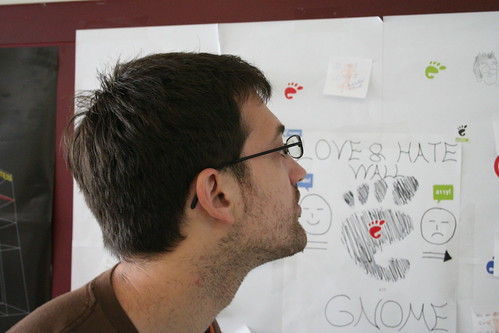
Ross inspecting the wall
Our hero: Ross Burton

24 March 2009

Jordi Mallach: GNOME 2.24 in Debian unstable, and the road ahead

GNOME 2.26 was released last week, and I couldn't help adding myself to the long list of celebrating posts in Planet GNOME. Looking at the release notes, it looks like this release adds a good number of very visible features, and also keeps improving on ongoing transitions like gvfs.

The Debian GNOME team is obviously not ignoring this fact and started to work very hard on updating GNOME for squeeze as soon as the lenny freeze was over. First, the new versions of GLib and GTK+ were uploaded to unstable, and managed to transition to testing very easily. The rest of GNOME 2.24 bits, which had been patiently waiting on experimental for months, has been uploaded with care not to disrupt any of the many transitions the Debian release team is currently dealing with. You can have a quick glance at how things are going in our 2.24 status page, but the summary is that most of GNOME 2.24 is in unstable, with a few notable exceptions which are held back by ongoing testing transitions. Namedly, evolution-data-server is trying to trickle into testing, which is in turn holding the final bits: gnome-panel, nautilus and related packages, but we think this will be over soon. As soon as GNOME 2.24 is safe in squeeze, we'll immediately turn our focus to the new GNOME 2.26 release. Our initial plan is to package the trivial bits and leaf packages which can't break stuff for unstable, and herd the more complex modules via experimental, to avoid breaking unstable at all. There are some exceptions; we plan to keep gnome-session 2.22 in unstable/testing until 2.26.1 is released to avoid getting a broken session saving in Debian. People might wonder why we insist on hitting what would seem a dead horse by first dealing with 2.24 and not 2.26 directly. The main reason is that these packages had been ready for a long time, and were in good shape to transition to testing quickly and with little pain. Preparing 2.26 directly would mean throwing away a lot of hours of packaging and polishing effort, and it's not like we're releasing squeeze any time soon anyway. Enjoy the hopefully not too bumpy road to 2.26!

Sandro Tosi: Reportbug 4.0 is born

I've just uploaded reportbug 4.0 in Sid (wait for the usual replication delay to have it on your machine). There are several changes in it (sadly, always too few than what I wanted):
I hope you'll be satisfied by that; sadly not all the promises are respected, let's hope we can deal with them in the next periods.Link

Next.

Previous.