Search Results: "dom"

1 November 2016

Thorsten Alteholz: My Debian Activities in October 2016

FTP assistant This month I caught up from last month and marked 317 packages for accept and rejected 23 packages. I also sent 5 emails to maintainers asking questions. Debian LTS This was my twenty-eighth month that I did some work for the Debian LTS initiative, started by Raphael Hertzog at Freexian. This month my all in all workload has been 13h. During that time I did uploads of The second upload of bind was an embargoed one. Other stuff I uploaded a new version of greylistd and fixed RC bug #837501. A new version of highlight.js fixed RC bug #830189. With a new upstream version of chktex I could close bugs #782342, #782343 and #819885. I also uploaded the new package node-random-bytes and new upstream versions of alljoyn-core-1604 and duktape Finally, after about 4 years, I managed to upload entropybroker and instantly had to deal with #840018, #840019 and #840020. One cannot overemphasize the importance of our QA stuff! I also uploaded a new version of libctl to solve the -fPIC issue but was asked short time after to revert that again :-(. As already mentioned some days ago I adopted libmatthew-java. At that time about 956 package were orphaned and I asked everybody to adopt one of these packages. Unfortunately now there are 982 package orphaned. I guess I have to clear up a misunderstanding. You should adopt those packages and not oprhan more of them!

31 October 2016

Chris Lamb: Free software activities in October 2016

Here is my monthly update covering what I have been doing in the free software world (previously):

Debian & Reproducible builds

Whilst anyone can inspect the source code of free software for malicious flaws, most GNU/Linux distributions provide binary (or "compiled") packages to end users. The motivation behind the Reproducible Builds effort is to allow verification that no flaws have been introduced either maliciously and accidentally during this compilation process by promising identical binary packages are always generated from a given source.

  • Presented a talk entitled "Reproducible Builds" talk at Software Freedom Kosova, in Prishtina, Republic of Kosovo.

  • I filed my 2,500th bug in the Debian BTS: #840972: golang-google-appengine: accesses the internet during build.

  • In order to build packages reproducibly, one not only needs identical sources but also some external and sharable definition of the environment used for a particular build, stipulating such things such as the version numbers of the required build-dependencies. It is not currently clear how to handle these .buildinfo files after the archive software has processed them and how to make them available to the world so I started development on a proof-of-concept server to see what issues arise in practice. It is available at buildinfo.debian.net.

  • Chaired an IRC meeting and ran a poll to determine a regular time .

  • Submitted two design proposals to our wiki page.

  • Improvements to our tests.reproducible-builds.org testing framework:

    • Move regular "Scheduled in..." messages to the #debian-reproducible-changes IRC channel.
    • Use our log_info method instead of manual echo calls.
    • Correct an "all sources packages" "all source packages" typo.
    • Submit .buildinfo files to buildinfo.debian.net.
    • Create GPG key on nodes for buildinfo.debian.net at deploy time, not "lazily".

My work in the Reproducible Builds project was also covered in our weekly reports. (#75, #76, #77 & #78).

I also submitted 14 patches to fix specific reproducibility issues in bio-eagle, cf-python, fastx-toolkit, fpga-icestorm, http-icons, lambda-align, mypy, playitslowly, seabios, stumpwm, sympa, tj3, wims-help & xotcl.
Debian LTS

This month I have been paid to work 13 hours on Debian Long Term Support (LTS). In that time I did the following:
  • Seven days of "frontdesk" duties, triaging CVEs, etc.
  • Issued DLA 647-1 for freeimage correcting an out-of-bounds write vulnerability in the XMP image handling functionality.
  • Issued DLA 649-1 for python-django fixing a possible CSRF protection bypass on sites that use Google Analytics.
  • Issued DLA 654-1 for libxfixes preventing an integer overflow when a malicious client sent INT_MAX as a "length".
  • Issued DLA 662-1 for quagga correcting a programming error where two constants were confused that could cause stack overrun in IPv6 routing code.
  • Issued DLA 688-1 for cairo to prevent a DoS attack where a malicious SVG could generate invalid pointers.

Uploads
  • gunicorn:
    • 19.6.0-7 Set supplementary groups when changing uid, add an example systemd .service file to gunicorn-examples, and expand README.Debian to make it clearer what to do now that /etc/gunicorn.d has been removed.
    • 19.6.0-8 Correct previous supplementary groups patch to be compatible with Python 3.
  • redis:
    • 3:3.2.4-2 Ensure that sentinel's configuration actually writes to a pidfile location so that systemd can detect that the daemon has started.
    • 3:3.2.5-1 New upstream release.
  • libfiu:
    • 0.94-8 Fix FTBFS under Bash due to lack of && in debian/rules.
    • 0.94-9 Ensure the build is reproducible by sorting injected modules.
  • aptfs (2:0.8-2) Minor cosmetic changes.

NMUs
  • libxml-dumper-perl (0.81-1.2) Move away from a unsupported debhelper compat level 4.
  • netatalk (2.2.5-1.1) Drop build-dependency on hardening-includes.

QA uploads
  • anon-proxy (00.05.38+20081230-4) Move to a supported debhelper compatibility level 9.
  • ara (1.0.32) Make the build reproducible.
  • binutils-m68hc1x (1:2.18-8) Make the build reproducible & move to a supported debhelper compatibility level.
  • fracplanet (0.4.0-5) Make the build reproducible.
  • libnss-ldap (265-5) Make the build reproducible.
  • python-uniconvertor (1.1.5-3) Fix an "option release requires an argument" FTBFS. (#839375)
  • ripole (0.2.0+20081101.0215-3) Actually include the ripole binary in package. (#839919) & enable hardening flags.
  • twitter-bootstrap (2.0.2+dfsg-10) Fix incorrect copyright formatting when building under Bash. (#824592)
  • zpaq (1.10-3) Make the build reproducible.


Debian FTP Team

As a Debian FTP assistant I ACCEPTed 147 packages: ace-link, amazon-s2n, avy, basez, bootstrap-vz, bucklespring, camitk, carettah, cf-python, debian-reference, dfcgen-gtk, efivar, entropybroker, fakesleep, gall, game-data-packager, gitano, glare, gnome-panel, gnome-shell-extension-dashtodock, gnome-shell-extension-refreshwifi, gnome-shell-extension-remove-dropdown-arrows, golang-github-gogits-go-gogs-client, golang-github-gucumber-gucumber, golang-github-hlandau-buildinfo, golang-github-hlandau-dexlogconfig, golang-github-hlandau-goutils, golang-github-influxdata-toml, golang-github-jacobsa-crypto, golang-github-kjk-lzma, golang-github-miekg-dns, golang-github-minio-sha256-simd, golang-github-nfnt-resize, golang-github-nicksnyder-go-i18n, golang-github-pointlander-compress, golang-github-pointlander-jetset, golang-github-pointlander-peg, golang-github-rfjakob-eme, golang-github-thecreeper-go-notify, golang-github-twstrike-gotk3adapter, golang-github-unknwon-goconfig, golang-gopkg-dancannon-gorethink.v1, golang-petname, haskell-argon2, haskell-binary-parsers, haskell-bindings-dsl, haskell-deriving-compat, haskell-hackage-security, haskell-hcwiid, haskell-hsopenssl-x509-system, haskell-megaparsec, haskell-mono-traversable-instances, haskell-prim-uniq, haskell-raaz, haskell-readable, haskell-readline, haskell-relational-record, haskell-safe-exceptions, haskell-servant-client, haskell-token-bucket, haskell-zxcvbn-c, irclog2html, ironic-ui, lace, ledger, libdancer2-plugin-passphrase-perl, libdatetime-calendar-julian-perl, libdbix-class-optimisticlocking-perl, libdbix-class-schema-config-perl, libgeo-constants-perl, libgeo-ellipsoids-perl, libgeo-functions-perl, libgeo-inverse-perl, libio-async-loop-mojo-perl, libmojolicious-plugin-assetpack-perl, libmojolicious-plugin-renderfile-perl, libparams-validationcompiler-perl, libspecio-perl, libtest-time-perl, libtest2-plugin-nowarnings-perl, linux, lua-scrypt, mono, mutt-vc-query, neutron, node-ansi-font, node-buffer-equal, node-defaults, node-formatio, node-fs-exists-sync, node-fs.realpath, node-is-buffer, node-jison-lex, node-jju, node-jsonstream, node-kind-of, node-lex-parser, node-lolex, node-loud-rejection, node-random-bytes, node-randombytes, node-regex-not, node-repeat-string, node-samsam, node-set-value, node-source-map-support, node-spdx-correct, node-static-extend, node-test, node-to-object-path, node-type-check, node-typescript, node-unset-value, nutsqlite, opencv, openssl1.0, panoramisk, perl6, pg-rage-terminator, pg8000, plv8, puppet-module-oslo, pymoc, pyramid-jinja2, python-bitbucket-api, python-ceilometermiddleware, python-configshell-fb, python-ewmh, python-gimmik, python-jsbeautifier, python-opcua, python-pyldap, python-s3transfer, python-testing.common.database, python-testing.mysqld, python-testing.postgresql, python-wheezy.template, qspeakers, r-cran-nleqslv, recommonmark, rolo, shim, swift-im, tendermint-go-clist, tongue, uftrace & zaqar-ui.

James Bromberger: The Debian Cloud Sprint 2016

I m at an airport, about to board the first of three flights across the world, from timezone +8 to timezone -8. I ll be in transit 27 hours to get to Seattle, Washington state. I m leaving my wife and two young children behind. My work has given me a days worth of leave under the Corporate Social Responsibility program, and I m taking three days annual leave, to do this. 27 hours each way in transit, for 3 days on the ground. Why? Backstory I started playing in technology as a kid in the 1980s; my first PC was a clone (as they were called) 286 running MS-DOS. It was clunky, and the most I could do to extend it was to write batch scripts. As a child I had no funds for commercial compilers, no network connections (this was pre Internet in Australia), no access to documentation, and no idea where to start programming properly. It was a closed world. I hit university in the summer of 1994 to study Computer Science and French. I d heard of Linux, and soon found myself installing the Linux distributions of the day. The Freedom of the licensing, the encouragement to use, modify, share, was in stark contrast to the world of consumer PCs of the late 1980 s. It was there at the UCC at UWA I discovered Debian. Some of the kind network/system admins at the University maintained a Debian mirror on the campus LAN, updated regularly and always online. It was fast, and more importantly, free for me to access. Back in the 1990s, bandwidth in Australia was incredibly expensive. The vast distances of the country mean that bandwidth was scarce. Telcos were in races to put fiber between Perth and the Eastern States, and without that in place, IP connectivity was constrained, and thus costly. Over many long days and nights I huddled down, learning window managers, protocols, programming and scripting languages. I became a system/network administrator, web developer, dev ops engineer, etc. My official degree workload, algorithmic complexity, protocol stacks, were interesting, but fiddling with Linux based implementations was practical. Volunteer After years of consuming the output of Debian and running many services with it I decided to put my hand up and volunteer as a Debian Developer: it was time to give back. I had benefited from Debian, and I saw others benefit from it as well. As the 2000 s started, I had my PGP key in the Debian key ring. I had adopted a package and was maintaining it load balancing Apache web servers. The web was yet to expand to the traffic levels you see today; most web sites were served from one physical web server. Site Reliability Engineering was a term not yet dreamed of. What became more apparent was the applicability of Linux, Open Source, and in my line-of-sight Debian to a wider community beyond myself and my university peers. Debain was being used to revive recycled computers that were being donated to charities; in some cases, unable to transfer commercial software licenses with the hardware that was no longer required by organisations that had upgraded. It appeared that Debian was being used as a baseline above which society in general had access to fundamental capability of computing and network services. The removal of subscriptions, registrations, and the encouragement of distribution meant this occurred at rates that could never be tracked, and more importantly, the consensus was that it should not be automatically tracked. The privacy of the user is paramount more important than some statistics for the Developer to ponder. When the Bosnia-Herzegovina war ended in 1995, I recall an email from academics there, having found some connectivity, writing to ask if they would be able to use Debian as part of their re-deployment of services for the Tertiary institutions in the region. This was an unnecessary request as Debian GNU/Linux is freely available, but it was a reminder that, for the country to have tried to procure commercial solutions at that time would have been difficult. Instead, those that could do the task just got on with it. There s been many similar project where the grass-roots organisations non profits, NGOs, and even just loose collectives of individuals have turned to Linux, Open Source, and sometimes Debian to solve their problems. Many fine projects have been established to make technology accessible to all, regardless of race, gender, nationality, class, or any other label society has used to divide humans. Big hat tip to Humanitarian Open Street Map, Serval Project. I ve always loved Debian s position on being the Universal operating system. Its vast range of packages and wide range of computing architectures supported means that quite often a litmus test of is project X a good project? was met with is it packaged for Debian? . That wide range of architectures has meant that administrators of systems had fewer surprises and a faster adoption cycle when changing platforms, such as the switch from x86 32 bit to x86 64 bit. Enter the Cloud I first laid eyes on the AWS Cloud in 2008. It was nothing like the rich environment you see today. The first thing I looked for was my favourite operating system, so that what I already knew and was familiar with was available in this environment to minimise the learning curve. However there were no official images, which was disconcerting. In 2012 I joined AWS as an employee. Living in Australia they hired me into the field sales team as a Solution Architect a sort of pre-sales tech with a customer focused depth in security. It was a wonderful opportunity, and I learnt a great deal. It also made sense (to me, at least) to do something about getting Debian s images blessed. It turned out, that I had to almost define what that was: images endorsed by a Debian Developer, handed to the AWS Marketplace team. And so since 2013 I have done so, keeping track of Debian s releases across the AWS regions, collaborating with other Debian folk on other cloud platforms to attempt a unified approach to generating and maintaining these images. This included (for a stint) generating them into the AWS GovCloud Region, and still into the AWS China (Beijing) Region the other side of the so-called Great Firewall of China. So why the trip? We ve had focus groups at the Debconf (Debian conference) around the world, but its often difficult to get the right group of people in the same rooms at the same time. So the proposal was to hold a focused Debian Cloud Sprint. Google was good enough to host this, for all the volunteers across all the cloud providers. Furthermore, donated funds were found to secure the travel for a set of people to attend who otherwise could not. I was lucky enough to be given a flight. So here I am, in the terminal in Australia: my kids are tucked up in bed, dreaming of the candy they just collected for Halloween. It will be a draining week I am sure, but if it helps set and improve the state of Debian then its worth it.

29 October 2016

Lars Wirzenius: Obnam 1.20 released

I have just released version 1.20 of Obnam, my backup program. It's been nine months since the previous release, and that's a long time: I've had an exciting year, and not entirely in a good way. Unfortuntely that's eaten up a lot of my free time and enthusiasm for my hobby projects. See below for a snippet of NEWS, with a summary of the user-visible changes. A lot of the effort has gone into improving FORMAT GREEN ALBATROSS, but that isn't documented in the NEWS file. I've received patches and actionable bug reports from a number of people, and I'm grateful for those. I try to credit them by name in the NEWS file. Obnam NEWS This file summarizes changes between releases of Obnam. NOTE: Obnam has an EXPERIMENTAL repository format under development, called green-albatross-20160813. It is NOT meant for real use. It is likely to change in incompatible ways without warning. DO NOT USE it unless you're willing to lose your backup. Version 1.20, released 2016-10-29 Minor changes: Bug fixes:

Jaldhar Vyas: Dawkins Weasel

Happy Dhanteras from Bappy Lahiri
It's already Dhan Terash so I better pick up the pace if I want to beat my blogging challenge before Diwali so in this post I'll discuss a program I wrote earlier this year.
I dread to look up anything on Wikipedia because I always end up going down a rabbit hole and surfacing hours later on a totally unrelated topic. Case in point, some months ago, I ended up on the page of the title. This is an interesting little experiment illustrating how random selection can result in the evolution of a specific form. The algorithm is:

  1. Start with a random string of 28 characters.
  2. Make 100 copies of this string, with a 5% chance per character of that character being replaced with a random character.
  3. Compare each new string with "METHINKS IT IS LIKE A WEASEL", and give each a score (the number of letters in the string that are correct and in the correct position).
  4. If any of the new strings has a perfect score (== 28), halt.
  5. Otherwise, take the highest scoring string, and go to step 2.
I had to try this myself so I wrote a little implementation in C++. A sample run looks like this:
  
$ ./weasel
0000 DNCFICBLUZVC JF KKNVJJASCJRW (0)
0001 DNIFICOLUZVC JFLIKNVAJASCJEW (6)
0002 DNNWICKSUZVCRSFLIKNVA ASCJEL (11)
0003 DNNWICKSUZVCRSFLIKNVA ASCJEL (11)
0004 MNNVICKSQZVCRSFLIKNVA WSCJEL (13)
0005 MENVICKSQZVCRSFLIKNVA WSCJEL (14)
0006 MENVISKS ZTCRSFLIKNVA WLCJEL (16)
0007 MENVISKS ZTCRSFLIKNVA WLCJEL (16)
0008 MEDHISKS ZTCISFLIKNVA WLCJEL (18)
0009 MEDHISKS ZTCISFLIKNVA WLCJEL (18)
0010 MEDHISKS ZTCISFLIKNVA WLCJEL (18)
0011 MEDHISKS ZTCIS LIKTKA WLCZEL (19)
0012 MEDHISKS ZTCIS LIKTKA WLCZEL (19)
0013 MEDHISKS ZTCIS LIKT A WLCZEL (20)
0014 MEDHISKS ZTCIS LIKT A WLCZEL (20)
0015 MEDHISKS ZTCIS LIKE A WLAZEL (22)
0016 MEDHIGKS ITCIS LIKE A WLAZEL (23)
0017 MEDHIGKS ITCIS LIKE A WLAZEL (23)
0018 MEDHIGKS ITCIS LIKE A WLAZEL (23)
0019 MEDHIGKS ITCIS LIKE A WLAZEL (23)
0020 MEDHIGKS ITCIS LIKE A WLAZEL (23)
0021 MEDHIGKS ITCIS LIKE A WLAZEL (23)
0022 METHINKS ITCIS LIKE A WLASEL (26)
0023 METHINKS ITCIS LIKE A WLASEL (26)
0024 METHINKS ITCIS LIKE A WLASEL (26)
0025 METHINKS ITCIS LIKE A WEASEL (27)
0026 METHINKS ITCIS LIKE A WEASEL (27)
0027 METHINKS ITCIS LIKE A WEASEL (27)
0028 METHINKS ITCIS LIKE A WEASEL (27)
0029 METHINKS ITCIS LIKE A WEASEL (27)
0030 METHINKS ITCIS LIKE A WEASEL (27)
0031 METHINKS ITCIS LIKE A WEASEL (27)
0032 METHINKS ITCIS LIKE A WEASEL (27)
0033 METHINKS ITCIS LIKE A WEASEL (27)
0034 METHINKS ITCIS LIKE A WEASEL (27)
0035 METHINKS ITCIS LIKE A WEASEL (27)
0036 METHINKS ITCIS LIKE A WEASEL (27)
0037 METHINKS ITCIS LIKE A WEASEL (27)
0038 METHINKS ITCIS LIKE A WEASEL (27)
0039 METHINKS ITCIS LIKE A WEASEL (27)
0040 METHINKS ITCIS LIKE A WEASEL (27)
0041 METHINKS ITCIS LIKE A WEASEL (27)
0042 METHINKS ITCIS LIKE A WEASEL (27)
0043 METHINKS ITCIS LIKE A WEASEL (27)
0044 METHINKS ITCIS LIKE A WEASEL (27)
0045 METHINKS ITCIS LIKE A WEASEL (27)
0046 METHINKS ITCIS LIKE A WEASEL (27)
0047 METHINKS ITCIS LIKE A WEASEL (27)
0048 METHINKS ITCIS LIKE A WEASEL (27)
0049 METHINKS ITCIS LIKE A WEASEL (27)
0050 METHINKS ITCIS LIKE A WEASEL (27)
0051 METHINKS ITCIS LIKE A WEASEL (27)
0052 METHINKS ITCIS LIKE A WEASEL (27)
0053 METHINKS ITCIS LIKE A WEASEL (27)
0054 METHINKS IT IS LIKE A WEASEL (28)

My program lets you adjust the input string, the number of copies, and the mutation threshold. I also thought it might be interesting to implement the Generator design pattern. In C++ this is done by making a class which implements begin() and end() methods and atleast a forward iterator. You can find the source code on Github.

28 October 2016

Matthew Garrett: Of course smart homes are targets for hackers

The Wirecutter, an in-depth comparative review site for various electrical and electronic devices, just published an opinion piece on whether users should be worried about security issues in IoT devices. The summary: avoid devices that don't require passwords (or don't force you to change a default and devices that want you to disable security, follow general network security best practices but otherwise don't worry - criminals aren't likely to target you.

This is terrible, irresponsible advice. It's true that most users aren't likely to be individually targeted by random criminals, but that's a poor threat model. As I've mentioned before, you need to worry about people with an interest in you. Making purchasing decisions based on the assumption that you'll never end up dating someone with enough knowledge to compromise a cheap IoT device (or even meeting an especially creepy one in a bar) is not safe, and giving advice that doesn't take that into account is a huge disservice to many potentially vulnerable users.

Of course, there's also the larger question raised by the last week's problems. Insecure IoT devices still pose a threat to the wider internet, even if the owner's data isn't at risk. I may not be optimistic about the ease of fixing this problem, but that doesn't mean we should just give up. It is important that we improve the security of devices, and many vendors are just bad at that.

So, here's a few things that should be a minimum when considering an IoT device:
  • Does the vendor publish a security contact? (If not, they don't care about security)
  • Does the vendor provide frequent software updates, even for devices that are several years old? (If not, they don't care about security)
  • Has the vendor ever denied a security issue that turned out to be real? (If so, they care more about PR than security)
  • Is the vendor able to provide the source code to any open source components they use? (If not, they don't know which software is in their own product and so don't care about security, and also they're probably infringing my copyright)
  • Do they mark updates as fixing security bugs? (If not, they care more about hiding security issues than fixing them)
  • Has the vendor ever threatened to prosecute a security researcher? (If so, again, they care more about PR than security)
  • Does the vendor provide a public minimum support period for the device? (If not, they don't care about security or their users)

    I've worked with big name vendors who did a brilliant job here. I've also worked with big name vendors who responded with hostility when I pointed out that they were selling a device with arbitrary remote code execution. Going with brand names is probably a good proxy for many of these requirements, but it's insufficient.

    So here's my recommendations to The Wirecutter - talk to a wide range of security experts about the issues that users should be concerned about, and figure out how to test these things yourself. Don't just ask vendors whether they care about security, ask them what their processes and procedures look like. Look at their history. And don't assume that just because nobody's interested in you, everybody else's level of risk is equal.


  • comment count unavailable comments

    27 October 2016

    Russ Allbery: DocKnot 1.00

    I'm a bit of a perfectionist about package documentation, and I'm also a huge fan of consistency. As I've slowly accumulated more open source software packages (alas, fewer new ones these days since I have less day-job time to work on them), I've developed a standard format for package documentation files, particularly the README in the package and the web pages I publish. I've iterated on these, tweaking them and messing with them, trying to incorporate all my accumulated wisdom about what information people need. Unfortunately, this gets very tedious, since I have dozens of packages at this point and rarely want to go through the effort of changing every one of them every time I come up with a better way of phrasing something or change some aspect of my standard package build configuration. I also have the same information duplicated in multiple locations (the README and the web page for the package). And there's a lot of boilerplate that's common for all of my packages that I don't want to keep copying (or changing when I do things like change all eyrie.org URLs to HTTPS). About three years ago, I started seriously brainstorming ways of automating this process. I made a start on it during one self-directed day at my old job at Stanford, but only got it far enough to generate a few basic files. Since then, I keep thinking about it, keep wishing I had it, and keep not putting the work into finishing it. During this vacation, after a week and a half of relaxing and reading, I finally felt like doing a larger development project and finally started working on this for long enough to build up some momentum. Two days later, and this is finally ready for an initial release. DocKnot uses metadata (which I'm putting in docs/metadata) that's mostly JSON plus some documentation fragments and generates README, the web page for the package (in thread, the macro language I use for all my web pages), and (the other thing I've wanted to do and didn't want to tackle without this tool) README.md, a Markdown version of README that will look nice on GitHub. The templates that come with the package are all rather specific to me, particularly the thread template which would be unusable by anyone else. I have no idea if anyone else will want to use this package (and right now the metadata format is entirely undocumented). But since it's a shame to not release things as free software, and since I suspect I may need to upload it to Debian since, technically, this tool is required to "build" the README file distributed with my packages, here it is. I've also uploaded it to CPAN (it's my first experiment with the App::* namespace for things that aren't really meant to be used as a standalone Perl module). You can get the latest version from the DocKnot distribution page (which is indeed generated with DocKnot). Also now generated with DocKnot are the rra-c-util and C TAP Harness distribution pages. Let me know if you see anything weird; there are doubtless still a few bugs.

    26 October 2016

    Steinar H. Gunderson: Why does software development take so long?

    Nageru 1.4.0 is out (and on its way through the Debian upload process right now), so now you can do live video mixing with multichannel audio to your heart's content. I've already blogged about most of the interesting new features, so instead, I'm trying to answer a question: What took so long? To be clear, I'm not saying 1.4.0 took more time than I really anticipated (on the contrary, I pretty much understood the scope from the beginning, and there was a reason why I didn't go for building this stuff into 1.0.0); but if you just look at the changelog from the outside, it's not immediately obvious why multichannel audio support should take the better part of three months of develoment. What I'm going to say is of course going to be obvious to most software developers, but not everyone is one, and perhaps my experiences will be illuminating. Let's first look at some obvious things that isn't the case: First of all, development is not primarily limited by typing speed. There are about 9,000 lines of new code in 1.4.0 (depending a bit on how you count), and if it was just about typing them in, I would be done in a day or two. On a good keyboard, I can type plain text at more than 800 characters per minute but you hardly ever write code for even a single minute at that speed. Just as when writing a novel, most time is spent thinking, not typing. I also didn't spend a lot of time backtracking; most code I wrote actually ended up in the finished product as opposed to being thrown away. (I'm not as lucky in all of my projects.) It's pretty common to do so if you're in an exploratory phase, but in this case, I had a pretty good idea of what I wanted to do right from the start, and that plan seemed to work. This wasn't a difficult project per se; it just needed to be done (which, in a sense, just increases the mystery). However, even if this isn't at the forefront of science in any way (most code in the world is pretty pedestrian, after all), there's still a lot of decisions to make, on several levels of abstraction. And a lot of those decisions depend on information gathering beforehand. Let's take a look at an example from late in the development cycle, namely support for using MIDI controllers instead of the mouse to control the various widgets. I've kept a pretty meticulous TODO list; it's just a text file on my laptop, but it serves the purpose of a ghetto bugtracker. For 1.4.0, it contains 83 work items (a single-digit number is not ticked off, mostly because I decided not to do those things), which corresponds roughly 1:2 to the number of commits. So let's have a look at what the ~20 MIDI controller items went into. First of all, to allow MIDI controllers to influence the UI, we need a way of getting to it. Since Nageru is single-platform on Linux, ALSA is the obvious choice (if not, I'd probably have to look for a library to put in-between), but seemingly, ALSA has two interfaces (raw MIDI and sequencer). Which one do you want? It sounds like raw MIDI is what we want, but actually, it's the sequencer interface (it does more of the MIDI parsing for you, and generally is friendlier). The first question is where to start picking events from. I went the simplest path and just said I wanted all events anything else would necessitate a UI, a command-line flag, figuring out if we wanted to distinguish between different devices with the same name (and not all devices potentially even have names), and so on. But how do you enumerate devices? (Relatively simple, thankfully.) What do you do if the user inserts a new one while Nageru is running? (Turns out there's a special device you can subscribe to that will tell you about new devices.) What if you get an error on subscription? (Just print a warning and ignore it; it's legitimate not to have access to all devices on the system. By the way, for PCM devices, all of these answers are different.) So now we have a sequencer device, how do we get events from it? Can we do it in the main loop? Turns out it probably doesn't integrate too well with Qt, but it's easy enough to put it in a thread. The class dealing with the MIDI handling now needs locking; what mutex granularity do we want? (Experience will tell you that you nearly always just want one mutex. Two mutexes give you all sorts of headaches with ordering them, and nearly never gives any gain.) ALSA expects us to poll() a given set of descriptors for data, but on shutdown, how do you break out of that poll to tell the thread to go away? (The simplest way on Linux is using an eventfd.) There's a quirk where if you get two or more MIDI messages right after each other and only read one, poll() won't trigger to alert you there are more left. Did you know that? (I didn't. I also can't find it documented. Perhaps it's a bug?) It took me some looking into sample code to find it. Oh, and ALSA uses POSIX error codes to signal errors (like nothing more is available ), but it doesn't use errno. OK, so you have events (like controller 3 was set to value 47 ); what do you do about them? The meaning of the controller numbers is different from device to device, and there's no open format for describing them. So I had to make a format describing the mapping; I used protobuf (I have lots of experience with it) to make a simple text-based format, but it's obviously a nightmare to set up 50+ controllers by hand in a text file, so I had to make an UI for this. My initial thought was making a grid of spinners (similar to how the input mapping dialog already worked), but then I realized that there isn't an easy way to make headlines in Qt's grid. (You can substitute a label widget for a single cell, but not for an entire row. Who knew?) So after some searching, I found out that it would be better to have a tree view (Qt Creator does this), and then you can treat that more-or-less as a table for the rows that should be editable. Of course, guessing controller numbers is impossible even in an editor, so I wanted it to respond to MIDI events. This means the editor needs to take over the role as MIDI receiver from the main UI. How you do that in a thread-safe way? (Reuse the existing mutex; you don't generally want to use atomics for complicated things.) Thinking about it, shouldn't the MIDI mapper just support multiple receivers at a time? (Doubtful; you don't want your random controller fiddling during setup to actually influence the audio on a running stream. And would you use the old or the new mapping?) And do you really need to set up every single controller for each bus, given that the mapping is pretty much guaranteed to be similar for them? Making a guess bus button doesn't seem too difficult, where if you have one correctly set up controller on the bus, it can guess from a neighboring bus (assuming a static offset). But what if there's conflicting information? OK; then you should disable the button. So now the enable/disable status of that button depends on which cell in your grid has the focus; how do you get at those events? (Install an event filter, or subclass the spinner.) And so on, and so on, and so on. You could argue that most of these questions go away with experience; if you're an expert in a given API, you can answer most of these questions in a minute or two even if you haven't heard the exact question before. But you can't expect even experienced developers to be an expert in all possible libraries; if you know everything there is to know about Qt, ALSA, x264, ffmpeg, OpenGL, VA-API, libusb, microhttpd and Lua (in addition to C++11, of course), I'm sure you'd be a great fit for Nageru, but I'd wager that pretty few developers fit that bill. I've written C++ for almost 20 years now (almost ten of them professionally), and that experience certainly helps boosting productivity, but I can't say I expect a 10x reduction in my own development time at any point. You could also argue, of course, that spending so much time on the editor is wasted, since most users will only ever see it once. But here's the point; it's not actually a lot of time. The only reason why it seems like so much is that I bothered to write two paragraphs about it; it's not a particular pain point, it just adds to the total. Also, the first impression matters a lot if the user can't get the editor to work, they also can't get the MIDI controller to work, and is likely to just go do something else. A common misconception is that just switching languages or using libraries will help you a lot. (Witness the never-ending stream of software that advertises written in Foo or uses Bar as if it were a feature.) For the former, note that nothing I've said so far is specific to my choice of language (C++), and I've certainly avoided a bunch of battles by making that specific choice over, say, Python. For the latter, note that most of these problems are actually related to library use libraries are great, and they solve a bunch of problems I'm really glad I didn't have to worry about (how should each button look?), but they still give their own interaction problems. And even when you're a master of your chosen programming environment, things still take time, because you have all those decisions to make on top of your libraries. Of course, there are cases where libraries really solve your entire problem and your code gets reduced to 100 trivial lines, but that's really only when you're solving a problem that's been solved a million times before. Congrats on making that blog in Rails; I'm sure you're advancing the world. (To make things worse, usually this breaks down when you want to stray ever so slightly from what was intended by the library or framework author. What seems like a perfect match can suddenly become a development trap where you spend more of your time trying to become an expert in working around the given library than actually doing any development.) The entire thing reminds me of the famous essay No Silver Bullet by Fred Brooks, but perhaps even more so, this quote from John Carmack's .plan has struck with me (incidentally about mobile game development in 2006, but the basic story still rings true):
    To some degree this is already the case on high end BREW phones today. I have a pretty clear idea what a maxed out software renderer would look like for that class of phones, and it wouldn't be the PlayStation-esq 3D graphics that seems to be the standard direction. When I was doing the graphics engine upgrades for BREW, I started along those lines, but after putting in a couple days at it I realized that I just couldn't afford to spend the time to finish the work. "A clear vision" doesn't mean I can necessarily implement it in a very small integral number of days.
    In a sense, programming is all about what your program should do in the first place. The how question is just the what , moved down the chain of abstractions until it ends up where a computer can understand it, and at that point, the three words multichannel audio support have become those 9,000 lines that describe in perfect detail what's going on.

    25 October 2016

    Laura Arjona Reina: Rankings, Condorcet and free software: Calculating the results for the Stretch Artwork Survey

    We had 12 candidates for the Debian Stretch Artwork and a survey was set up for allowing people to vote which one they prefer.

    The survey was run in my LimeSurvey instance, surveys.larjona.net. LimeSurvey its a nice free software with a lot of features. It provides a Ranking question type, and it was very easy for allowing people to vote in the Debian style (Debian uses the Condorcet method in its elections).

    However, although LimeSurvey offers statistics and even graphics to show the results of many type of questions, its output for the Ranking type is not useful, so I had to export the data and use another tool to find the winner.
    Export the data from LimeSurvey
    I ve created a read-only user to visit the survey site. With this visitor you can explore the survey questionnaire, its results, and export the data.
    Username: stretch
    Password: artwork
    First attempt, the quick and easy (and nonfree, I guess)
    There is an online tool to calculate the Condorcet winner, http://www.ericgorr.net/condorcet/
    The steps I followed to feed the tool with the data from LimeSurvey were these:
    1.- Went to admin interface of lime survey, selected the stretch artwork survey, responses and statistics, export results to application
    2.- Selected Completed responses only , Question codes , Answer codes , and exported to CSV. (results_stretch1.csv)
    3.- Opened the CSV with LibreOffice Calc, and removed these columns:
    id submitdate lastpage startlanguage
    4.- Remove the first row containing the headers and saved the result (results_stretch2.csv)
    5.- In commandline:
    sort results_stretch2.csv   uniq -c > results_stretch3.csv
    6.- Opened results_stretch3.csv with LibreOffice Calc and merge delimitors when importing.
    7.- Removed the first column (blank) and added a column between the numbers and the first ranked option, and fulfilled that column with : value. Saved (results_stretch4.csv)
    8.- Opened results_stretch4.csv with my preferred editor and search and replace ,:, for : and after that, search and replace , for > . Save the result (results_stretch5.csv)
    9.- Went to http://condorcet.ericgorr.net/, selected Condorcet basic, tell me some things , and pasted the contents of results_stretch5.csv there.
    The results are in results_stretch1.html
    But where is the source code of this Condorcet tool?
    I couldn t find the source code (nor license) of the solver by Eric Gorr.
    The tool is mentioned in http://www.accuratedemocracy.com/z_tools.htm where other tools are listed and when the tool is libre software, is noted so. But not in this case.
    There, I found another tool, VoteEngine, which is open source, so I tried with that.
    Second attempt: VoteEngine, a Free Open Source Software tool made with Python
    I used a modification of voteengine-0.99 (the original zip is available in http://vote.sourceforge.net/ and a diff with the changes I made (basically, Numeric -> numpy and Int -> int, inorder that works in Debian stable), here.
    Steps 1 to 4 are the same as in the first attempt.
    5.- Sorted alphabetically the different 12 options to vote, and
    assigned a letter to each one (saved the assignments in a file called
    6.- Opened results_stretch2.csv with my favorite editor, and search
    and replace the name of the different options, for their corresponding
    letter in stretch_key.txt file.
    Searched and replaced , for (space). Then, saved the results into
    7.- Copied the input.txt file from voteengine-0.99 into stretch.txt and edited the options
    to our needs. Pasted the contents of results_stretch3_voteengine.cvs
    at the end of stretch.txt
    8.-In the commandline
    ./voteengine.py <stretch.txt  > winner.txt
    (winner.txt contains the results for the Condorcet method).
    9.- I edited again stretch.txt to change the method to shulze and
    calculated the results, and again with the smith method. The winner in
    the 3 methods is the same. I pasted the summary of these 3 methods
    (shulze and smith provide a ranked list) in stretch_results.txt
    If it can be done, it can be done with R
    I found the algstat R package:
    which includes a condorcet function but I couldn t make it work with the data.
    I m not sure how the data needs to be shaped. I m sure that this can be done in R and the problem is me, in this case. Comments are welcome, and I ll try to ask to a friend whose R skills are better than mine!
    And another SaaS
    I found https://www.condorcet.vote/ and its source code. It would be interesting to deploy a local instance to drive future surveys, but for this time I didn t want to fight with PHP in order to use only the solver part, nor install another SaaS in my home server just to find that I need some other dependency or whatever.
    I ll keep an eye on this, though, because it looks like a modern and active project.
    Finally, devotee
    Well and which software Debian uses for its elections?
    There is a git repository with devotee, you can clone it:
    I found that although the tool is quite modular, it s written specifically for the Debian case (votes received by mail, GPG signed, there is a quorum, and other particularities) and I was not sure if I could use it with my data. It is written in Perl and then I understood it worse than the Python from VoteEngine.
    Maybe I ll return to it, though, when I have more time, to try to put our data in the shape of a typicall tally.txt file and then see if the module solving the condorcet winner can work for me.
    That s all, folks! (for now )
    Comments
    You can coment on this blog post in this pump.io thread

    Filed under: Tools Tagged: data mining, Debian, English, SaaS, statistics

    Julian Andres Klode: Introducing DNS66, a host blocker for Android

    ic_launcher I m proud (yes, really) to announce DNS66, my host/ad blocker for Android 5.0 and newer. It s been around since last Thursday on F-Droid, but it never really got a formal announcement. DNS66 creates a local VPN service on your Android device, and diverts all DNS traffic to it, possibly adding new DNS servers you can configure in its UI. It can use hosts files for blocking whole sets of hosts or you can just give it a domain name to block (or multiple hosts files/hosts). You can also whitelist individual hosts or entire files by adding them to the end of the list. When a host name is looked up, the query goes to the VPN which looks at the packet and responds with NXDOMAIN (non-existing domain) for hosts that are blocked. You can find DNS66 here: F-Droid is the recommended source to install from. DNS66 is licensed under the GNU GPL 3, or (mostly) any later version. Implementation Notes DNS66 s core logic is based on another project, dbrodie/AdBuster, which arguably has the cooler name. I translated that from Kotlin to Java, and cleaned up the implementation a bit: All work is done in a single thread by using poll() to detect when to read/write stuff. Each DNS request is sent via a new UDP socket, and poll() polls over all UDP sockets, a Device Socket (for the VPN s tun device) and a pipe (so we can interrupt the poll at any time by closing the pipe). We literally redirect your DNS servers. Meaning if your DNS server is 1.2.3.4, all traffic to 1.2.3.4 is routed to the VPN. The VPN only understands DNS traffic, though, so you might have trouble if your DNS server also happens to serve something else. I plan to change that at some point to emulate multiple DNS servers with fake IPs, but this was a first step to get it working with fallback: Android can now transparently fallback to other DNS servers without having to be aware that they are routed via the VPN. We also need to deal with timing out queries that we received no answer for: DNS66 stores the query into a LinkedHashMap and overrides the removeEldestEntry() method to remove the eldest entry if it is older than 10 seconds or there are more than 1024 pending queries. This means that it only times out up to one request per new request, but it eventually cleans up fine.
    Filed under: Android, Uncategorized

    24 October 2016

    Reproducible builds folks: Reproducible Builds: week 78 in Stretch cycle

    What happened in the Reproducible Builds effort between Sunday October 16 and Saturday October 22 2016: Media coverage Upcoming events buildinfo.debian.net In order to build packages reproducibly, you not only need identical sources but also some external definition of the environment used for a particular build. This definition includes the inputs and the outputs and, in the Debian case, are available in a $package_$architecture_$version.buildinfo file. We anticipate the next dpkg upload to sid will create .buildinfo files by default. Whilst it's clear that we also need to teach dak to deal with them (#763822) its not actually clear how to handle .buildinfo files after dak has processed them and how to make them available to the world. To this end, Chris Lamb has started development on a proof-of-concept .buildinfo server to see what issues arise. Source Reproducible work in other projects Packages reviewed and fixed, and bugs filed Reviews of unreproducible packages 99 package reviews have been added, 3 have been updated and 6 have been removed in this week, adding to our knowledge about identified issues. 6 issue types have been added: Weekly QA work During of reproducibility testing, some FTBFS bugs have been detected and reported by: diffoscope development tests.reproducible-builds.org Misc. Our poll to find a good time for an IRC meeting is still running until Tuesday, October 25st; please reply as soon as possible. We need a logo! Some ideas and requirements for a Reproducible Builds logo have been documented in the wiki. Contributions very welcome, even if simply by forwarding this information. This week's edition was written by Chris Lamb & Holger Levsen and reviewed by a bunch of Reproducible Builds folks on IRC.

    Francois Marier: Tweaking Referrers For Privacy in Firefox

    The Referer header has been a part of the web for a long time. Websites rely on it for a few different purposes (e.g. analytics, ads, CSRF protection) but it can be quite problematic from a privacy perspective. Thankfully, there are now tools in Firefox to help users and developers mitigate some of these problems.

    Description In a nutshell, the browser adds a Referer header to all outgoing HTTP requests, revealing to the server on the other end the URL of the page you were on when you placed the request. For example, it tells the server where you were when you followed a link to that site, or what page you were on when you requested an image or a script. There are, however, a few limitations to this simplified explanation. First of all, by default, browsers won't send a referrer if you place a request from an HTTPS page to an HTTP page. This would reveal potentially confidential information (such as the URL path and query string which could contain session tokens or other secret identifiers) from a secure page over an insecure HTTP channel. Firefox will however include a Referer header in HTTPS to HTTPS transitions unless network.http.sendSecureXSiteReferrer (removed in Firefox 52) is set to false in about:config. Secondly, using the new Referrer Policy specification web developers can override the default behaviour for their pages, including on a per-element basis. This can be used both to increase or reduce the amount of information present in the referrer.

    Legitimate Uses Because the Referer header has been around for so long, a number of techniques rely on it. Armed with the Referer information, analytics tools can figure out:
    • where website traffic comes from, and
    • how users are navigating the site.
    Another place where the Referer is useful is as a mitigation against cross-site request forgeries. In that case, a website receiving a form submission can reject that form submission if the request originated from a different website. It's worth pointing out that this CSRF mitigation might be better implemented via a separate header that could be restricted to particularly dangerous requests (i.e. POST and DELETE requests) and only include the information required for that security check (i.e. the origin).

    Problems with the Referrer Unfortunately, this header also creates significant privacy and security concerns. The most obvious one is that it leaks part of your browsing history to sites you visit as well as all of the resources they pull in (e.g. ads and third-party scripts). It can be quite complicated to fix these leaks in a cross-browser way. These leaks can also lead to exposing private personally-identifiable information when they are part of the query string. One of the most high-profile example is the accidental leakage of user searches by healthcare.gov.

    Solutions for Firefox Users While web developers can use the new mechanisms exposed through the Referrer Policy, Firefox users can also take steps to limit the amount of information they send to websites, advertisers and trackers. In addition to enabling Firefox's built-in tracking protection by setting privacy.trackingprotection.enabled to true in about:config, which will prevent all network connections to known trackers, users can control when the Referer header is sent by setting network.http.sendRefererHeader to:
    • 0 to never send the header
    • 1 to send the header only when clicking on links and similar elements
    • 2 (default) to send the header on all requests (e.g. images, links, etc.)
    It's also possible to put a limit on the maximum amount of information that the header will contain by setting the network.http.referer.trimmingPolicy to:
    • 0 (default) to send the full URL
    • 1 to send the URL without its query string
    • 2 to only send the scheme, host and port
    or using the network.http.referer.XOriginTrimmingPolicy option (added in Firefox 52) to only restrict the contents of referrers attached to cross-origin requests. Site owners can opt to share less information with other sites, but they can't share any more than what the user trimming policies allow. Another approach is to disable the Referer when doing cross-origin requests (from one site to another). The network.http.referer.XOriginPolicy preference can be set to:
    • 0 (default) to send the referrer in all cases
    • 1 to send a referrer only when the base domains are the same
    • 2 to send a referrer only when the full hostnames match

    Breakage If you try to remove all referrers (i.e. network.http.sendRefererHeader = 0, you will most likely run into problems on a number of sites, for example: The first two have been worked-around successfully by setting network.http.referer.spoofSource to true, an advanced setting which always sends the destination URL as the referrer, thereby not leaking anything about the original page. Unfortunately, the last two are examples of the kind of breakage that can only be fixed through a whitelist (an approach supported by the smart referer add-on) or by temporarily using a different browser profile.

    My Recommended Settings As with my cookie recommendations, I recommend strengthening your referrer settings but not disabling (or spoofing) it entirely. While spoofing does solve many the breakage problems mentioned above, it also effectively disables the anti-CSRF protections that some sites may rely on and that have tangible user benefits. A better approach is to limit the amount of information that leaks through cross-origin requests. If you are willing to live with some amount of breakage, you can simply restrict referrers to the same site by setting:
    network.http.referer.XOriginPolicy = 2
    
    or to sites which belong to the same organization (i.e. same ETLD/public suffix) using:
    network.http.referer.XOriginPolicy = 1
    
    This prevent leaks to third-parties while giving websites all of the information that they can already see in their own server logs. On the other hand, if you prefer a weaker but more compatible solution, you can trim cross-origin referrers down to just the scheme, hostname and port:
    network.http.referer.XOriginTrimmingPolicy = 2
    
    I have not yet found user-visible breakage using this last configuration. Let me know if you find any!

    23 October 2016

    Vincent Sanders: Rabbit of Caerbannog

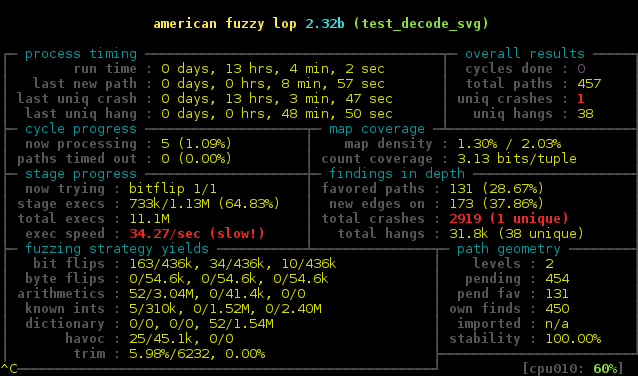
    Subsequent to my previous use of American Fuzzy Lop (AFL) on the NetSurf bitmap image library I applied it to the gif library which, after fixing the test runner, failed to produce any crashes but did result in a better test corpus improving coverage above 90%

    I then turned my attention to the SVG processing library. This was different to the bitmap libraries in that it required parsing a much lower density text format and performing operations on the resulting tree representation.

    The test program for the SVG library needed some improvement but is very basic in operation. It takes the test SVG, parses it using libsvgtiny and then uses the parsed output to write out an imagemagick mvg file.

    The libsvg processing uses the NetSurf DOM library which in turn uses an expat binding to parse the SVG XML text. To process this with AFL required instrumenting not only the XVG library but the DOM library. I did not initially understand this and my first run resulted in a "map coverage" indicating an issue. Helpfully the AFL docs do cover this so it was straightforward to rectify.

    Once the test program was written and environment set up an AFL run was started and left to run. The next day I was somewhat alarmed to discover the fuzzer had made almost no progress and was running very slowly. I asked for help on the AFL mailing list and got a polite and helpful response, basically I needed to RTFM.

    I must thank the members of the AFL mailing list for being so helpful and tolerating someone who ought to know better asking dumb questions.

    After reading the fine manual I understood I needed to ensure all my test cases were as small as possible and further that the fuzzer needed a dictionary as a hint to the file format because the text file was of such low data density compared to binary formats.

    Rabbit of Caerbannog. Death awaits you with pointy teeth
    I crafted an SVG dictionary based on the XML one, ensured all the seed SVG files were as small as possible and tried again. The immediate result was thousands of crashes, nothing like being savaged by a rabbit to cause a surprise.

    Not being in possession of the appropriate holy hand grenade I resorted instead to GDB and electric fence. Unlike the bitmap library crashes memory bounds issues simply did not feature in the crashes.Instead they mainly centered around actual logic errors when constructing and traversing the data structures.

    For example Daniel Silverstone fixed an interesting bug where the XML parser binding would try and go "above" the root node in the tree if the source closed more tags than it opened which resulted in wild pointers and NULL references.

    I found and squashed several others including dealing with SVG which has no valid root element and division by zero errors when things like colour gradients have no points.

    I find it interesting that the type and texture of the crashes completely changed between the SVG and binary formats. Perhaps it is just the nature of the textural formats that causes this although it might be due to the techniques used to parse the formats.

    Once all the immediately reproducible crashes were dealt with I performed a longer run. I used my monster system as previously described and ran the fuzzer for a whole week.

    Summary stats
    =============

    Fuzzers alive : 10
    Total run time : 68 days, 7 hours
    Total execs : 9268 million
    Cumulative speed : 15698 execs/sec
    Pending paths : 0 faves, 2501 total
    Pending per fuzzer : 0 faves, 250 total (on average)
    Crashes found : 9 locally unique

    After burning almost seventy days of processor time AFL found me another nine crashes and possibly more importantly a test corpus that generates over 90% coverage.

    A useful tool that AFL provides is afl-cmin. This reduces the number of test files in a corpus to only those that are required to exercise all the code paths reached by the test set. In this case it reduced the number of files from 8242 to 2612

    afl-cmin -i queue_all/ -o queue_cmin -- test_decode_svg @@ 1.0 /dev/null
    corpus minimization tool for afl-fuzz by

    [+] OK, 1447 tuples recorded.
    [*] Obtaining traces for input files in 'queue_all/'...
    Processing file 8242/8242...
    [*] Sorting trace sets (this may take a while)...
    [+] Found 23812 unique tuples across 8242 files.
    [*] Finding best candidates for each tuple...
    Processing file 8242/8242...
    [*] Sorting candidate list (be patient)...
    [*] Processing candidates and writing output files...
    Processing tuple 23812/23812...
    [+] Narrowed down to 2612 files, saved in 'queue_cmin'.

    Additionally the actual information within the test files can be minimised with the afl-tmin tool. This must be run on each file individually and can take a relatively long time. Fortunately with GNU parallel one can run many of these jobs simultaneously which merely required another three days of CPU time to process. The resulting test corpus weighs in at a svelte 15 Megabytes or so against the 25 Megabytes before minimisation.

    The result is yet another NetSurf library significantly improved by the use of AFL both from finding and squashing crashing bugs and from having a greatly improved test corpus to allow future library changes with a high confidence there will not be any regressions.

    Jaldhar Vyas: What I Did During My Summer Vacation

    Thats So Raven If I could sum up the past year in one word, that word would be distraction. There have been so many strange, confusing or simply unforseen things going on I have had trouble focusing like never before. For instance, on the opposite side of the street from me is one of Jersey City's old resorvoirs. It's not used for drinking water anymore and the city eventually plans on merging it into the park on the other side. In the meantime it has become something of a wildlife refuge. Which is nice except one of the newly settled critters was a bird of prey -- the consensus is possibly some kind of hawk or raven. Starting your morning commute under the eyes of a harbinger of death is very goth and I even learned to deal with the occasional piece of deconstructed rodent on my doorstep but nighttime was a big problem. For contrary to popular belief, ravens do not quoth "nevermore" but "KRRAAAA". Very loudly. Just as soon as you have drifted of to sleep. Eventually my sleep-deprived neighbors and I appealed to the NJ division of enviromental protection to get it removed but by the time they were ready to swing into action the bird had left for somewhere more congenial like Transylvania or Newark. Or here are some more complete wastes of time: I go the doctor for my annual physical. The insurance company codes it as Adult Onset Diabetes by accident. One day I opened the lid of my laptop and there's a "ping" sound and a piece of the hinge flies off. Apparently that also severed the connection to the screen and naturally the warranty had just expired so I had to spend the next month tethered to an external monitor until I could afford to buy a new one. Mix in all the usual social, political, family and work drama and you can see that it has been a very trying time for me. Dovecot I have managed to get some Debian work done. On Dovecot, my principal package, I have gotten tremendous support from Apollon Oikonomopolous who I belatedly welcome as a member of the Dovecot maintainer team. He has been particularly helpful in fixing our systemd support and cleaning out a lot of the old and invalid bugs. We're in pretty good shape for the freeze. Upstream has released an RC of 2.2.26 and hopefully the final version will be out in the next couple of days so we can include it in Stretch. We can always use more help with the package so let me know if you're interested. Debian-IN Most of the action has been going on without me but I've been lending support and sponsoring whenever I can. We have several new DDs and DMs but still no one north of the Vindhyas I'm afraid. Debian Perl Group gregoa did a ping of inactive maintainers and I regretfully had to admit to myself that I wasn't going to be of use anytime soon so I resigned. Perl remains my favorite language and I've actually been more involved in the meetings of my local Perlmongers group so hopefully I will be back again one day. And I still maintain the Perl modules I wrote myself. Debian-Axe-Murderers* May have gained a recruit. *Stricly speaking it should be called Debian-People-Who-Dont-Think-Faults-in-One-Moral-Domain-Such-As-For-Example-Axe-Murdering-Should-Leak-Into-Another-Moral-Domain-Such-As-For-Example-Debian but come on, that's just silly.

    22 October 2016

    Ingo Juergensmann: Automatically update TLSA records on new Letsencrypt Certs

    I've been using DNSSEC for some quite time now and it is working quite well. When LetsEncrypt went public beta I jumped on the train and migrated many services to LE-based TLS. However there was still one small problem with LE certs: When there is a new cert, all of the old TLSA resource records are not valid anymore and might give problems to strict DNSSEC checking clients. It took some while until my pain was big enough to finally fix it by some scripts. There are at least two scripts involved: 1) dnssec.sh
    This script does all of my DNSSEC handling. You can just do a "dnssec.sh enable-dnssec domain.tld" and everything is configured so that you only need to copy the appropriate keys into the webinterface of your DNS registry.
    host:~/bin# dnssec.sh
    No parameter given.
    Usage: dnsec.sh MODE DOMAIN
    MODE can be one of the following:
    enable-dnssec : perform all steps to enable DNSSEC for your domain
    edit-zone     : safely edit your zone after enabling DNSSEC
    create-dnskey : create new dnskey only
    load-dnskey   : loads new dnskeys and signs the zone with them
    show-ds       : shows DS records of zone
    zoneadd-ds    : adds DS records to the zone file
    show-dnskey   : extract DNSKEY record that needs to uploaded to your registrar
    update-tlsa   : update TLSA records with new TLSA hash, needs old and new TLSA hashes as additional parameters
    For updating zone-files just do a "dnssech.sh edit-zone domain.tld" to add new records and such and the script will take care e.g. of increasing the serial of the zone file. I find this very convenient, so I often use this script for non-DNSSEC-enabled domains as well. However you can spot the command line option "update-tlsa". This option needs the old and the new TLSA hashes beside the domain.tld parameter. However, this option is used from the second script: 2) check_tlsa.sh
    This is a quite simple Bash script that parses the domains.txt from letsencrypt.sh script, looking up the old TLSA hash in the zone files (structured in TLD/domain.tld directories), compare the old with the new hash (by invoking tlsagen.sh) and if there is a difference in hashes, call dnssec.sh with the proper parameters:
    #!/bin/bash
    set -e
    LEPATH="/etc/letsencrypt.sh"
    for i in  cat /etc/letsencrypt.sh/domains.txt   awk ' print $1 '  ; do
      domain= echo $i   awk 'BEGIN  FS="."  ;  print $(NF-1)"."$NF ' 
      #echo -n "Domain: $domain"
      TLD= echo $i   awk 'BEGIN  FS="." ;  print $NF ' 
      #echo ", TLD: $TLD"
      OLDTLSA= grep -i "in.*tlsa" /etc/bind/$ TLD /$ domain    grep $ i    head -n 1   awk ' print $NF ' 
      if [ -n "$ OLDTLSA " ] ; then
      #echo "--> $ OLDTLSA "
      # Usage: tlsagen.sh cert.pem host[:port] usage selector mtype
      NEWTLSA= /path/to/tlsagen.sh $LEPATH/certs/$ i /fullchain.pem $ i  3 1 1   awk ' print $NF ' 
      #echo "==> $NEWTLSA"
      if [ "$ OLDTLSA " != "$ NEWTLSA " ] ; then
      /path/to/dnssec.sh update-tlsa $ domain  $ OLDTLSA  $ NEWTLSA  > /dev/null
      echo "TLSA RR update for $ i "
      fi
      fi
    done
    
    So, quite simple and obviously a quick hack. For sure someone else can write a cleaner and more sophisticated implementation to do the same stuff, but at least it works for meTM. Use it on your own risk and do whatever you want with these scripts (licensed under public domain). You can invoke check_tlsa.sh right after your crontab call for letsencrypt.sh. In a more sophisticated way it should be fairly easy to invoke these scripts from letsencrypt.sh post hooks as well.
    Please find the files attached to this page (remove the .txt extension after saving, of course).
    AttachmentSize
    check_tlsa.sh.txt812 bytes
    dnssec.sh.txt3.88 KB
    Kategorie:

    Iain R. Learmonth: The Domain Name System

    As I posted yesterday, we released PATHspider 1.0.0. What I didn t talk about in that post was an event that occured only a few hours before the release. Everything was going fine, proofreading of the documentation was in progress, a quick git push with the documentation updates and CI FAILED!?! Our CI doesn t build the documentation, only tests the core code. I m planning to release real soon and something has broken. Starting to panic.
    irl@orbiter# ./tests.sh
    ................
    ----------------------------------------------------------------------
    Ran 16 tests in 0.984s
    OK
    
    This makes no sense. Maybe I forgot to add a dependency and it s been broken for a while? I scrutinise the dependencies list and it all looks fine. In fairness, probably the first thing I should have done is look at the build log in Jenkins, but I ve never had a failure that I couldn t reproduce locally before. It was at this point that I realised there was something screwy going on. A sigh of relief as I realise that there s not a catastrophic test failure but now it looks like maybe there s a problem with the University research group network, which is arguably worse. Being focussed on getting the release ready, I didn t realise that the Internet was falling apart. Unknown to me, a massive DDoS attack against Dyn, a major DNS host, was in progress. After a few attempts to debug the problem, I hardcoded a line into /etc/hosts, still believing it to be a localised issue.
    192.30.253.112  github.com
    
    I ve just removed this line as the problem seems to have resolved itself for now. There are two main points I ve taken away from this: This afternoon I read a post by [tj] on the 57North Planet, and this is where I learnt what had really happened. He mentions multicast DNS and Namecoin as distributed name system alternatives. I d like to add some more to that list: Only the first of these is really a distributed solution. My idea with ICMP Domain Name Messages is that you send an ICMP message to a webserver. Somewhere along the path, you ll hit either a surveillance or censorship middlebox. These middleboxes can provide value by caching any DNS replies that are seen so that an ICMP DNS request message will cause the message to not be forwarded but a reply is generated to provide the answer to the query. If the middlebox cannot generate a reply, it can still forward it to other surveillance and censorship boxes. I think this would be a great secondary use for the NSA and GCHQ boxen on the Internet, clearly fits within the scope of defending national security as if DNS is down the Internet is kinda dead, plus it d make it nice and easy to find the boxes with PATHspider.

    20 October 2016

    Daniel Pocock: Choosing smartcards, readers and hardware for the Outreachy project

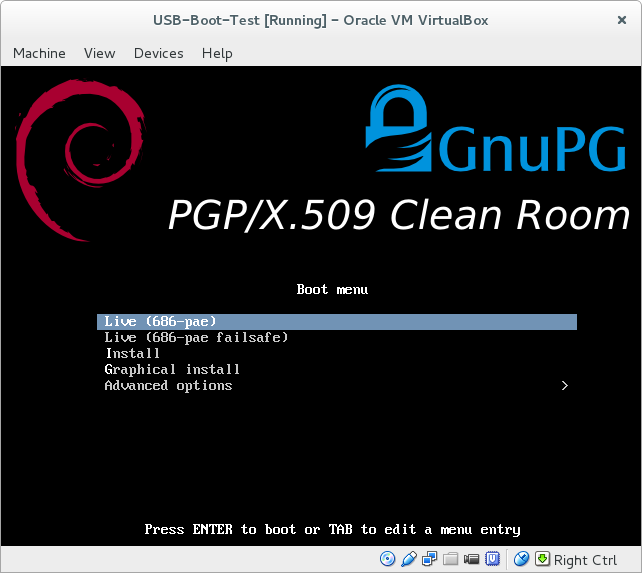
    One of the projects proposed for this round of Outreachy is the PGP / PKI Clean Room live image. Interns, and anybody who decides to start using the project (it is already functional for command line users) need to decide about purchasing various pieces of hardware, including a smart card, a smart card reader and a suitably secure computer to run the clean room image. It may also be desirable to purchase some additional accessories, such as a hardware random number generator. If you have any specific suggestions for hardware or can help arrange any donations of hardware for Outreachy interns, please come and join us in the pki-clean-room mailing list or consider adding ideas on the PGP / PKI clean room wiki. Choice of smart card For standard PGP use, the OpenPGP card provides a good choice. For X.509 use cases, such as VPN access, there are a range of choices. I recently obtained one of the SmartCard HSM cards, Card Contact were kind enough to provide me with a free sample. An interesting feature of this card is Elliptic Curve (ECC) support. More potential cards are listed on the OpenSC page here. Choice of card reader The technical factors to consider are most easily explained with a table:

    On disk Smartcard reader without PIN-pad Smartcard reader with PIN-pad
    Software Free/open Mostly free/open, Proprietary firmware in reader
    Key extraction Possible Not generally possible
    Passphrase compromise attack vectors Hardware or software keyloggers, phishing, user error (unsophisticated attackers) Exploiting firmware bugs over USB (only sophisticated attackers)
    Other factors No hardware Small, USB key form-factor Largest form factor
    Some are shortlisted on the GnuPG wiki and there has been recent discussion of that list on the GnuPG-users mailing list. Choice of computer to run the clean room environment There are a wide array of devices to choose from. Here are some principles that come to mind:

    • Prefer devices without any built-in wireless communications interfaces, or where those interfaces can be removed
    • Even better if there is no wired networking either
    • Particularly concerned users may also want to avoid devices with opaque micro-code/firmware
    • Small devices (laptops) that can be stored away easily in a locked cabinet or safe to prevent tampering
    • No hard disks required
    • Having built-in SD card readers or the ability to add them easily
    SD cards and SD card readers The SD cards are used to store the master private key, used to sign the certificates/keys on the smart cards. Multiple copies are kept. It is a good idea to use SD cards from different vendors, preferably not manufactured in the same batch, to minimize the risk that they all fail at the same time. For convenience, it would be desirable to use a multi-card reader: although the software experience will be much the same if lots of individual card readers or USB flash drives are used. Other devices One additional idea that comes to mind is a hardware random number generator (TRNG), such as the FST-01. Can you help with ideas or donations? If you have any specific suggestions for hardware or can help arrange any donations of hardware for Outreachy interns, please come and join us in the pki-clean-room mailing list or consider adding ideas on the PGP / PKI clean room wiki.

    19 October 2016

    Rapha&#235;l Hertzog: Freexian s report about Debian Long Term Support, September 2016

    A Debian LTS logoLike each month, here comes a report about the work of paid contributors to Debian LTS. Individual reports In September, about 152 work hours have been dispatched among 13 paid contributors. Their reports are available: Evolution of the situation The number of sponsored hours reached 172 hours per month thanks to maxcluster GmbH joining as silver sponsor and RHX Srl joining as bronze sponsor. We only need a couple of supplementary sponsors now to reach our objective of funding the equivalent of a full time position. The security tracker currently lists 39 packages with a known CVE and the dla-needed.txt file 34. It s a small bump compared to last month but almost all issues are affected to someone. Thanks to our sponsors New sponsors are in bold.

    No comment Liked this article? Click here. My blog is Flattr-enabled.

    Reproducible builds folks: Reproducible Builds: week 77 in Stretch cycle

    What happened in the Reproducible Builds effort between Sunday October 9 and Saturday October 15 2016: Media coverage Documentation update After discussions with HW42, Steven Chamberlain, Vagrant Cascadian, Daniel Shahaf, Christopher Berg, Daniel Kahn Gillmor and others, Ximin Luo has started writing up more concrete and detailed design plans for setting SOURCE_ROOT_DIR for reproducible debugging symbols, buildinfo security semantics and buildinfo security infrastructure. Toolchain development and fixes Dmitry Shachnev noted that our patch for #831779 has been temporarily rejected by docutils upstream; we are trying to persuade them again. Tony Mancill uploaded javatools/0.59 to unstable containing original patch by Chris Lamb. This fixed an issue where documentation Recommends: substvars would not be reproducible. Ximin Luo filed bug 77985 to GCC as a pre-requisite for future patches to make debugging symbols reproducible. Packages reviewed and fixed, and bugs filed The following updated packages have become reproducible - in our current test setup - after being fixed: The following updated packages appear to be reproducible now, for reasons we were not able to figure out. (Relevant changelogs did not mention reproducible builds.) Some uploads have addressed some reproducibility issues, but not all of them: Some uploads have addressed nearly all reproducibility issues, except for build path issues: Patches submitted that have not made their way to the archive yet: Reviews of unreproducible packages 101 package reviews have been added, 49 have been updated and 4 have been removed in this week, adding to our knowledge about identified issues. 3 issue types have been updated: Weekly QA work During of reproducibility testing, some FTBFS bugs have been detected and reported by: tests.reproducible-builds.org Debian: Openwrt/LEDE/NetBSD/coreboot/Fedora/archlinux: Misc. We are running a poll to find a good time for an IRC meeting. This week's edition was written by Ximin Luo, Holger Levsen & Chris Lamb and reviewed by a bunch of Reproducible Builds folks on IRC.

    16 October 2016

    Steinar H. Gunderson: backup.sh opensourced

    It's been said that backup is a bit like flossing; everybody knows you should do it, but nobody does it. If you want to start flossing, an immediate question is what kind of dental floss to get and conversely, for backup, which backup software do you want to rely on? I had some criteria: I looked at basically everything that existed in Debian and then some, and all of them failed. But Samfundet had its own script that's basically just a simple wrapper around tar and ssh, which has worked for 15+ years without a hitch (including several restores), so why not use it? All the authors agreed to a GPLv2+ licensing, so now it's time for backup.sh to meet the world. It does about the simplest thing you can imagine: ssh to the server and use GNU tar to tar down every filesystem that has the dump bit set in fstab. Every 30 days, it does a full backup; otherwise, it does an incremental backup using GNU tar's incremental mode (which makes sure you will also get information about file deletes). It doesn't do inter-file diffs (so if you have huge files that change only a little bit every day, you'll get blowup), and you can't do single-file restores without basically scanning through all the files; tar isn't random-access. So it doesn't do much fancy, but it works, and it sends you a nice little email every day so you can know your backup went well. (There's also a less frequently used mode where the backed-up server encrypts the backup using GnuPG, so you don't even need to trust the backup server.) It really takes fifteen minutes to set up, so now there's no excuse. :-) Oh, and the only good dental floss is this one. :-)

    Next.

    Previous.