Search Results: "ah"

27 January 2015

Jingjie Jiang: Yet another post.

In the middle of OPW internship I originally thought taking part in FOSSOPW is a great chance to lift my coding skills and I shouldn t miss it. As time passes by, I now have a new thought towards it. # 1 It do improves your coding skill. Zack, Matthieu and I often have discussions on coding style. For example, once Zack said, For code like this, you should explicitly use an if/else clause, not if-return. I was totally unaware of this sort of issue. Actually I even didn t know how I should call this problem. Matthieu gave me a detailed FYI link on this in no time. Besides, my completeness of thinking is also trained. Recently, I was fixing a HTTP GET Method ?suite=suite-name issue. It s a trivial task. And you know most trivial tasks require lots of scattered modification on the source code base. I did have fixed most places, such as the pages of /src/packagename and /search/ . Zack did a thorough review, and pointed out that the pages rendered by /prefix has some malformed urls in the HTML. Waiiiit, I should have noticed it. But somehow I missed it. Maybe because my mind was wandering at that time? This made me think, I shall have a thorough view of what I should do before getting my hands dirty. Or more preferably, if I could write down what I exactly want to achieve before coding, then silly problems definitely wouldn t occur. This may sound a little bit like TDD. ;). # 2 It makes you look like a (not-that-good) ninja. I use a macbook. It s not my fault! I ve tried several times, but I never successfully find a laptop that is not capable of boiling eggs when running Debian. (and especially KDE+Debian). So I have no way but switched to OSX. The development of Debsources happens on a remote Ubuntu LTS (now Debian SID, haha) virtual machine. Of course I have to install all the dependency on my own, e.g., Postgres, set up port-forwarding, e.g., ssh -D, write automate shell scripts, e.g., dash, but more importantly, I am forced to live under the dark terminal with no GUI. You know the feeling when pain hurts? Yes, exactly! But I survived. How shall I call myself now? A dedicated with-a-lot-of-useless-plugin-installed vimmer? A fond-of-fancy-window tmux-er? Yep, both. I finally found a comfort zone under the black-white-blinking screen. I wonder how people feel when they see a girl hanging out in the library, facing a full-screened black console, typing at a speed of 140wpm (Yeah, I am kidding). I don t know, but please don t call me a geek. Show me your respect, I am a ninja! # 3 It tells you communication is the most important. I bet anyone who has participated in a group-based project would understand what I mean. For one perspective, communication helps to eliminate misunderstanding. So I won t doing some useless stuff for all day and finally find out that it totally doesn t meet the requirement. On the other hand, it speeds up your learning process. I often have problems on git. So in the email I will complain if I mess up with the git repo. After a short while, my dear mentors will reply in detail on how to correctly do the git stuff. My OPW journey is cool! ;).

23 January 2015

Jaldhar Vyas: Mini-Debconf Mumbai 2015

Last weekend I went to Mumbai to attend the Mini-Debconf held at IIT-Bombay. These are my impressions of the trip. Arrival and Impressions of Mumbai Getting there was a quite an adventure in itself. Unlike during my ill-fated attempt to visit a Debian event in Kerala last year when a bureaucratic snafu left me unable to get a visa, the organizers started the process much earlier at their end this time and with proper permissions. Yet in India, the wheels only turn as fast as they want to turn so despite their efforts, it was only literally at the last minute that I actually managed to secure my visa. I should note however that Indian government has done a lot to improve the process compared to the hell I remember from, say, a decade ago. It's fairly straightforward for tourist visas now and I trust they will get around to doing the same for conference visas in the fullness of time. I didn't want to commit to buying a plane ticket until I had the visa so I became concerned that the only flights left would be either really expensive or on the type of airline that flies you over Syria or under the Indian Ocean. I lucked out and got a good price on a Swiss Air flight, not non-stop but you can't have everything. So Thursday afternoon I set off for JFK. With only one small suitcase getting there by subway was no problem and I arrived and checked in with plenty of time. Even TSA passed me through with only a minimal amount of indignity. The first leg of my journey took me to Zurich in about eight hours. We were only in Zurich for an hour and then (by now Friday) it was another 9 hours to Mumbai. Friday was Safala Ekadashi but owing to the necessity of staying hydrated on a long flight I drank a lot of water and ate some fruit which I don't normally do on a fasting day. It was tolerable but not too pleasant; I definitely want to try and make travel plans to avoid such situations in the future. Friday evening local time I got to Mumbai. Chhattrapati Shivaji airport has improved a lot since I saw t last and now has all the amenities an international traveller needs including unrestricted free wifi (Zurich airport are you taking notes?) But here my first ominous piece of bad luck began. No sign of my suitcase. Happily some asking around revealed that it had somehow gotten on some earlier Swiss Air flight instead of the one I was on and was actually waiting for me. I got outside and Debian Developer Praveen Arimbrathodiyil was waiting to pick me up. Normally I don't lke staying in Mumbai very much even though I have relatives there but that's because we usually went during July-August the monsoon season when Mumbai reverts back to the swampy archipelago it was originally built on. This time the weather was nice, cold by local standards, but lovely and spring-like to someone from snowy New Jersey. There have been a lot of improvements to the road infrastructure and people are actually obeying the traffic laws. (Within reason of course. Whether or not a family of six can arrange themselves on one Bajaj scooter is no business of the cops.) The Hotel Tuliip (yes, two i's. Manager didn't know why.) Residency where I was to stay while not quite a five star establishment was adequate for my needs with a bed, hot water shower, and air conditioning. And a TV which to the bellhops great confusion I did not want turned on. (He asked about five times.) There was no Internet access per se but the manager offered to hook up a wireless router to a cable. Which on closer inspection turned out to have been severed at the base. He assured me it would be fixed tomorrow so I didn't complain and decided to do something more productive thank checking my email like sleeping. The next day I woke up in total darkness. Apparently there had been some kind of power problem during the night which tripped a fuse or something. A call to the front desk got them to fix that and then the second piece of bad luck happened. I plugged my Thinkpad in and woke it up from hibernation and a minute later there was a loud pop from the power adapter. Note I have a travel international plug adapter with surge protector so nothing bad ought to have happened but the laptop would on turning on display the message "critical low battery error" and immediately power off. I was unable to google what that meant without Internet access but I decided not to panic and continue getting ready. I would have plenty of opportunity to troubleshoot at the conference venue. Or so I thought... I took an autorickshaw to IIT. There also there have been positive improvements. Being quite obviously a foreigner I was fully prepared to be taken along the "scenic route." But now there are fair zones and the rickshaws all have (tamperproof!) digital fare meters so I was deposited at the main gate without fuss. After reading a board with a scary list of dos and don'ts I presented myself at security only to be inexplicably waved through without a second glance. Later I found out they've abandoned all the security theatre but not got around to updating the signs yet. Mumbai is one of the biggest, densely populated cities in the world but the IIT campus is an oasis of tranquility on the shores of Lake Powai. It's a lot bigger than it looked on the map so I had to wander around a bit before I reached the conference venue but I did make for the official registration time. Registration I was happy to meet several old friends (Such as Kartik Mistry and Kumar Appiah who along with Praveen and myself were the other DDs there,) people who I've corresponded with but never met, and many new people. I'm told 200+ people registered altogether. Most seemed to be students from IIT and elsewhere in Mumbai but there were also some Debian enthusiasts from further afield and most hearteningly some "civilians" who wanted to know what this was all about. With the help of a borrowed Thinkpad adapter I got my laptop running again. (Thankfully, despite the error message, the battery itself was unharmed.) However, my streak of bad luck was not yet over. It was that very weekend that IIT had a freak campus-wide network outage something that had never happened before. And as the presentation for the talk I was to give had apparently been open when I hibernated my laptop the night before, the sudden forced shutdown had trashed the file. (ls showed it as 0 length. An fsck didn't help.) I possibly had a backup on my server but with no Internet access I had no way to retrieve it. I still remained cool. The talk was scheduled for the second day so I could recover it at the hotel. Keynotes Professor Kannan Maudgalya of the FOSSEE (Free and Open Source Software for Education) Project which is part of the central government Ministry for Human Resource Development spoke about various activities of his project. Of particular interest to us are: FOSSEE is well funded, backed by the government and has enthusiastic staff so we should be seeing a lot more from them in the future. Veteran Free Software activist Venky Hariharan spoke about his experiences in lobbying the government on tech issues. He noted that there has been a sea change in attitudes towards Linux and Open source in the bureacracy of late. Several states have been aggressively mandating the use of it as have several national ministries and agencies. We the community can provide a valuable service by helping them in the transition. They also need to be educated on how to work with the community (contributing changes back, not working behind closed doors etc.) Debian History and Debian Cycle Shirish Agarwal spoke about the Debian philosophy and foundational documents such as the social contract and DFSG and how the release cycle works. Nothing new to an experienced user but informative to the newcomers in the audience and sparked some questions and discussion. Keysigning One of my main missions in attending was to help get as many isolated people as possible into the web of trust. Unfortunately the keysigning was not adequately publicized and few people were ready. I would have led them through the process of creating a new key there and then but with the lack of connectivity that idea had to be abandoned. I did manage to sign about 8-10 keys during other times. Future Directions for Debian-IN BOF I led this one. Lots of spirited discussion and I found feedback from new users in particular to be very helpful. Some take aways are: Lil' Debi Kumar Sukhani was a Debian GSoC student and his project which he demonstrated was to be able to install Debian on an Android phone. Why would you want to do this? Apart from the evergreen "Because I can", you can run server software such as sshd on your phone or even use it as an ARM development board. Unfortunately my phone uses Blackberry 10 OS which can run android apps (emulated under QNX) but wouldn't be able to use this. When I get a real Android phone I will try it out. Debian on ARM Siji Sunny gave this talk which was geared more towards hardware types which I am not but one thing I learned was thee difference between all the different ARM subarchitectures. I knew Siji first from a previous incarnation when he worked at CDAC with the late and much lamented Prof. R.K. Joshi. We had a long conversation about those days. Prof. Joshi/CDAC had developed an Indic rendering system called Indix which alas became the Betamax to Pango's VHS but he was also very involved in other Indic computing issues such as working with the Unicode Consortium and the preseration of Sanskrit manuscripts which is also an interest of mine. One good thing that cameout of Indix was some rather nice fonts. I had thought they were still buried in the dungeons of CDAC but apparently they were freed at one point. That's one more thing for me to look into. Evening/Next morning< My cousin met me and we had a leisurely dinner together. It was quite late by the time I got back to the hotel. FOSSEE had kindly lent me one of their tablets (which incidently are powerful enough to run LibreOffice comfortably.) so I thought I might be able to quickly redo my presentation before bedtime. Well, wouldn't you know it the wifi was not fixed. As I should have guessed but all the progress I'd had made me giddily optimistic. There was an option of trying to find an Internet cafe in a commercial area 15-20 minutes walk away. If this had been Gujarat I would have tried it but although I can more or less understand Hindi I can barely put together two sentences and Marathi I don't know at all. So I gave up that idea. I redid the slides from memory as best I could and went to sleep. In the morning I checked out and ferried myself and my suitcase via rickshaw back to the IIT campus. This time I got the driver to take me all the way in to the conference venue. Prof. Maudgalya kindly offered to let me keep the tablet to develop stuff on. I respectfully had to decline because although I love to collect bits of tech the fact it is it would have just gathered dust and ought to go to someone who can make a real contribution with it. I transferred my files to a USB key and borrowed a loaner laptop for my talk. Debian Packaging Workshop While waiting to do my talk I sat in on a workshop Praveen ran taking participants through the whole process of creating a Debian package (a ruby gem was the example.) He's done this before so it was a good presentation and well attended but the lack of connectivity did put a damper on things. Ask Me Anything It turned out the schedule had to be shuffled a bit so my talk was moved later from the announced time. A few people had already showed up so I took some random questions about Debian from them instead. GNOME Shell Accessibility With Orca Krishnakant Mane is remarkable. Although he is blind, he is a developer and a major contributor to Open Source projects. He talked about the Accessibility features of GNOME and compared them (favorably I might add) with proprietary screen readers. Not a subject that's directly useful to me but I found it interesting nonetheless. Rust: The memory safe language Manish Goregaokar talked about one of the new fad programming languages that have gotten a lot of buzz lately. This one is backed by Mozilla and it's interesting enough but I'll stick with C++ and Perl until one of the new ones "wins." Building a Mail Server With Debian Finally I got to give my talk and, yup, the video out on my borrowed laptop was incompatible with the projector. A slight delay to transfer everything to another laptop and I was able to begin. I talked about setting up BIND, postfix, and of course dovecot along with spamassassin, clamav etc. It turned out I had more than enough material and I went atleast 30 minutes over time and even then I had to rush at the end. People said they liked it so I'm happy. The End I gave the concluding remarks. Various people were thanked (including myself) mementos were given and pictures were taken. Despite a few mishaps I enjoyed myself and I am glad I attended. The level of enthusiasm was very high and lessons were learned so the next Debian-IN event should be even better. My departing flight wasn't due to leave until 1:20AM so I killed a few hours with my family before the flight. Once again I was stopping in Zurich, this time for most of a day. The last of my blunders was not to take my coat out of my suitcase and the temperature outside was 29F so I had to spend that whole time enjoing the (not so) many charms of Zurich airport. Atleast the second flight took me to Newark instead of JFK so I was able to get home a little earlier on Monday evening, exhausted but happy I made the trip.

22 January 2015

MJ Ray: Outsourcing email to Google means SPF allows phishing?

I expect this is obvious to many people but bahumbug To Phish, or Not to Phish? just woke me up to the fact that if Google hosts your company email then its Sender Policy Framework might make other Google-sent emails look legitimate for your domain. When combined with the unsupportive support of the big free webmail hosts, is this another black mark against SPF?

21 January 2015

Jo Shields: mono-project.com Linux packages, January 2015 edition

The latest version of Mono has released (actually, it happened a week ago, but it took me a while to get all sorts of exciting new features bug-checked and shipshape). Stable packages This release covers Mono 3.12, and MonoDevelop 5.7. These are built for all the same targets as last time, with a few caveats (MonoDevelop does not include F# or ASP.NET MVC 4 support). ARM packages will be added in a few weeks time, when I get the new ARM build farm working at Xamarin s Boston office. Ahead-of-time support This probably seems silly since upstream Mono has included it for years, but Mono on Debian has never shipped with AOT d mscorlib.dll or mcs.exe, for awkward package-management reasons. Mono 3.12 fixes this, and will AOT these assemblies optimized for your computer on installation. If you can suggest any other assemblies to add to the list, we now support a simple manifest structure so any assembly can be arbitrarily AOT d on installation. Goodbye Mozroots! I am very pleased to announce that as of this release, Mono users on Linux no longer need to run mozroots to get SSL working. A new command, cert-sync , has been added to this release, which synchronizes the Mono SSL certificate store against your OS certificate store and this tool has been integrated into the packaging system for all mono-project.com packages, so it is automatically used. Just make sure the ca-certificates-mono package is installed on Debian/Ubuntu (it s always bundled on RPM-based) to take advantage! It should be installed on fresh installs by default. If you want to invoke the tool manually (e.g. you installed via make install, not packages) use
cert-sync /path/to/ca-bundle.crt
On Debian systems, that s
cert-sync /etc/ssl/certs/ca-certificates.crt
and on Red Hat derivatives it s
cert-sync /etc/pki/tls/certs/ca-bundle.crt
Your distribution might use a different path, if it s not derived from one of those. Windows installer back from the dead Thanks to help from Alex Koeplinger, I ve brought the Windows installer back from the dead. The last release on the website was for 3.2.3 (it s actually not this version at all it s complicated ), so now the Windows installer has parity with the Linux and OSX versions. The Windows installer (should!) bundles everything the Mac version does F#, PCL facades, IronWhatever, etc, along with Boehm and SGen builds of the Mono runtime done with Visual Studio 2013. An EXPERIMENTAL OH MY GOD DON T USE THIS IN PRODUCTION 64-bit installer is in the works, when I have the time to try and make a 64-build of Gtk#.

15 January 2015

Daniel Pocock: Disk expansion

A persistent problem that I encounter with hard disks is the capacity limit. If only hard disks could expand like the Tardis. My current setup at home involves a HP Microserver. It has four drive bays carrying two SSDs (for home directories) and two Western Digital RE4 2TB drives for bulk data storage (photos, source tarballs and other things that don't change often). Each pair of drives is mirrored. I chose the RE4 because I use RAID1 and they offer good performance and error recovery control which is useful in any RAID scenario. When I put in the 2TB drives, I created a 1TB partition on each for Linux md RAID1 and another 1TB partition on each for BtrFs. Later I added the SSDs and I chose BtrFs again as it had been working well for me. Where to from here? Since getting a 36 megapixel DSLR that produces 100MB raw images and 20MB JPEGs I've been filling up that 2TB faster than I could have ever imagined. I've also noticed that vendors are offering much bigger NAS and archive disks so I'm tempted to upgrade. First I looked at the Seagate Archive 8TB drives. 2TB bigger than the nearest competition. Discussion on Reddit suggests they don't have Error Recovery Control / TLER however and that leaves me feeling they are not the right solution for me. Then I had a look at WD Red. Slightly less performant than the RE4 drives I run now, but with the possibility of 6TB per drive and a little cheaper. Apparently they have TLER though, just like the RE4 and other enterprise drives. Will 6 or 8TB create new problems? This all leaves me scratching my head and wondering about a couple of things though:
  • Will I run into trouble with the firmware in my HP Microserver if I try to use such a big disk?
  • Should I run the whole thing with BtrFs and how well will it work at this scale?
  • Should I avoid the WD Red and stick with RE4 or similar drives from Seagate or elsehwere?
If anybody can share any feedback it would be really welcome.

Lunar: 80%

Unfortunately I could not go on stage at the 31st Chaos Communication Congress to present reproducible builds in Debian alongside Mike Perry from the Tor Project and Seth Schoen from the Electronic Frontier Foundation. I've tried to make it up for it, though and we have made amazing progress. Wiki reorganization What was a massive and frightening wiki page now looks really more welcoming: Screenshot of ReproducibleBuilds on Debian wiki Depending on what one is looking for, it should be much easier to find. There's now a high-level status overview given on the landing page, maintainers can learn how to make their packages reproducible, enthusiasts can more easily find what can help the project, and we have even started writing some history. .buildinfo for all packages New year's eve saw me hacking Perl to write dpkg-genbuildinfo. Similar to dpkg-genchanges, it's run by dpkg-buildpackage to produce .buildinfo control files. This is where the build environment, and hash of source and binary packages are recorded. This script, integrated with dpkg, replace the previous debhelper interim solution written by Niko Tyni. We used to fix mtimes in control.tar and data.tar using a specific addition to debhelper named dh_fixmtimes. To better support the ALWAYS_EXCLUDE environment variable and for pragramtic reasons, we moved the process in dh_builddeb. Both changes were quickly pushed to our continuous integration platform. Before, only packages using dh would create a .buildinfo and thus eventually be considered reproducible. With these modifications, many more packages had their chance and this shows: Growing amount of packages considered reproducible Yes, with our experimental toolchain we are now at more than eighty percent! That's more than 17200 source packages! srebuild Another big item on the todo-list was crossed over by Johannes Schauer. srebuild is a wrapper around sbuild:
Given a .buildinfo file, it first finds a timestamp of Debian Sid from snapshot.debian.org which contains the requested packages in their exact versions. It then runs sbuild with the right architecture as given by the .buildinfo file and the right base system to upgrade from, as given by the version of the base-files package version in the .buildinfo file. Using two hooks it will install the right package versions and verify that the installed packages are in the right version before the build starts.
Understanding problems Over 1700 packages have now been reviewed to understand why build results could not be reproduced on our experimental platform. The variations between the two builds are currently limited to time and file ordering, but this still has uncovered many problems. There are still toolchain fixes to be made (more than 180 packages for the PHP registry) which can make many packages reproducible at once, but others like C pre-processor macros will require many individual changes. debbindiff, the main tool used to understand differences, has gained support for .udeb, TrueType and OpenType fonts, PNG and PDF files. It's less likely to crash on problems with encoding or external tool. But most importantly for large package, it has been made a lot faster, thanks to Reiner Herrmann and Helmut Grohne. Helmut has also been able to spot cross-compilation issues by using debbindiff! Targeting our efforts It gives warm fuzzy feelings to hit the 80% mark, but it would be a bit irrelevant if this would not concern packages that matter. Thankfully, Holger worked on producing statistics for more specific package sets. Mattia Rizzolo has also done great work to improve the scripts generating the various pages visible on reproducible.debian.net. All essential and build-esential packages, except gcc and bash, are considered reproducible or have patches ready. After some lengthy builds, I also managed to come up with a patch to make linux build reproducibly. Miscellaneous After my initial attempt to modify r-base to remove a timestamp in R packages, Dirk Eddelbuettel discussed the issue with upstream and came up with a better patch. The latter has already been merged upstream! Dirk's solution is to allow timestamps to be set using an external environment variable. This is also how I modified FontForge to make it possible to reproduce fonts. Identifiers generated by xsltproc have also been an issue. After reviewing my initial patch, Andrew Awyer came up with a much nicer solution. Its potential performance implications need to be evaluated before submission, though. Chris West has been working on packages built with Maven amongst other things. PDF generated by GhostScript, another painful source of troubles, is being worked on by Peter De Wachter. Holger got X.509 certificates signed by the CA cartel for jenkins.debian.net and reproducible.debian.net. No more scary security messages now. Let's hope next year we will be able to get certificates through Let's Encrypt! Let's make a difference together As you can imagine with all that happened in the past weeks, the #debian-reproducible IRC channel has been a cool place to hang out. It's very energizing to get together and share contributions, exchange tips and discuss hardest points. Mandatory quote:
* h01ger is very happy to see again and again how this is a nice
         learning circle...! i've learned a whole lot here too... in
         just 3 months... and its going on...!
Reproducible builds are not going to change anything for most of our users. They simply don't care how they get software on their computer. But they care to get the right software without having to worry about it. That's our responsibility, as developers. Enabling users to trust their software is important and a major contribution, we as Debian, can make to the wider free software movement. Once Jessie is released, we should make a collective effort to make reproducible builds an highlight of our next release.

Noah Meyerhans: Spamassassin updates

If you're running Spamassassin on Debian or Ubuntu, have you enabled automatic rule updates? If not, why not? If possible, you should enable this feature. It should be as simple as setting "CRON=1" in /etc/default/spamassassin. If you choose not to enable this feature, I'd really like to hear why. In particular, I'm thinking about changing the default behavior of the Spamassassin packages such that automatic rule updates are enabled, and I'd like to know if (and why) anybody opposes this. Spamassassin hasn't been providing rules as part of the upstream package for some time. In Debian, we include a snapshot of the ruleset from an essentially arbitrary point in time in our packages. We do this so Spamassassin will work "out of the box" on Debian systems. People who install spamassassin from source must download rules using spamassassin's updates channel. The typical way to use this service is to use cron or something similar to periodically check for rule changes via this service. This allows the anti-spam community to quickly adapt to changes in spammer tactics, and for you to actually benefit from their work by taking advantage of their newer, presumably more accurate, rules. It also allows for quick reaction to issues such as the one described in bug 738872 and 774768. If we do change the default, there are a couple of possible approaches we could take. The simplest would be to simply change the default value of the CRON variable in /etc/default/spamassassin. Perhaps a cleaner approach would be to provide a "spamassassin-autoupdates" package that would simply provide the cron job and a simple wrapper program to perform the updates. The Spamassassin package would then specify a Recommends relationship with this package, thus providing the default enabled behavior while still providing a clear and simple mechanism to disable it.

11 January 2015

Russ Allbery: Short catch-up haul

First weekend back home after being away for the holidays. That was a lot of fun, but it's also nice to be back home with all my stuff and my normal schedule. Apparently nice enough that today I went on a productivity binge and did lots of random chores that had been building up. Quite satisfying. This is a catch-up haul post for a few random things that popped up over the past few months apart from a full book order. Ibraheem Abbas and Yasser Bahjatt HWJN (sff)
Ibraheem Abbas and Yasser Bahjatt Somewhere! (Hunaak!) (sff)
Shannon Appelcline Designers & Dragons: The '70s (non-fiction)
Shannon Appelcline Designers & Dragons: The '80s (non-fiction)
Shannon Appelcline Designers & Dragons: The '90s (non-fiction)
Shannon Appelcline Designers & Dragons: The '00s (non-fiction)
Tor.com Some of the Best from Tor.com: 2014 (sff anthology) The Appelcline four-volume history of RPGs was a gift from a friend, and a lovely set of books. The first two were available for free on the Kindle (as was the last) as part of an effort to publicize Arab SF, and I always like to broaden my cultural reading horizons.

9 January 2015

Uwe Hermann: My GPG key transition to a 4096-bit key

This is long overdue, so here goes:
-----BEGIN PGP SIGNED MESSAGE-----
Hash: SHA1,SHA512
I'm transitioning my GPG key from an old 1024D key to a new 4096R key.
The old key will continue to be valid for some time, but I prefer
all new correspondance to be encrypted to the new key, and will be making
all signatures going forward with the new key.
This transition document is signed with both keys to validate the transition.
If you have signed my old key, I would appreciate signatures on my new
key as well, provided that your signing policy permits that without
re-authenticating me.
Old key:
pub   1024D/0x5DD5685778D621B4 2000-03-07
      Key fingerprint = 0F3C 34D1 E4A3 8FC6 435C  01BA 5DD5 6857 78D6 21B4
New key:
pub   4096R/0x1D661A372FED8F94 2013-12-30
      Key fingerprint = 9A17 578F 8646 055C E19D  E309 1D66 1A37 2FED 8F94
-----BEGIN PGP SIGNATURE-----
Version: GnuPG v1
iEYEARECAAYFAlSwEaIACgkQXdVoV3jWIbQW5QCgoFHVU/D4fKSbvmGv3nNy3MAW
S2UAn075ztmxQ8Y9/22crbUug1sEjfh5iQIcBAEBCgAGBQJUsBGiAAoJEB1mGjcv
7Y+U9PgP/29jPvrNcdWsLI8YK9U6+JzS+TMXNyfp6CQXc8O/+zJwqvvxNpqY3rLM
5otRLIEJ2EVdiF8sCWTDGusS9NkMePzumR0AFAR0iltIkekO5O0HbHhK0sXJQv0s
EipDpFRO9k4/CBpJEy6Pkkxwd3ndtmwrL1/oKeVmM4E62PJd9ofMpQb/gMUsrA8u
F8xoOXY8Os82Rrd759PypSxNecjd6SYaVJTHgFbZ0QIMJkdKaufifzARdw+v5jwg
8Q11BhpYxvUSugZgiciKA6RjRK5bfRnT8VQPFd0zneilsIW13zz/jub9df/vtM5L
vY/6jHvXczYXSG8EGpHJQCD3KtQJPWZ0Nz9rAm4emEPmR2qav6KGARatYAm0RBqZ
Y81YUEuiWzGli6DH1m9SQe8bqM/J94vQAAX9VqUn2gz0Z0Ey25kVQE7NOGsbbGVS
vD/E74FSk1At9/RGpstrfEjsDKPRman2xk/oZe+08sRB22CJl40N4tZV9AkCJNom
HHGZKp+VEKaCEiLUIRjKTHt2HTThg39zmxl+OnoTSFYvloxrDJyi9SxZgCAmBhbD
7kLkaSDmdUj6CmoilGU+gd2zmQl2D+RHinYZBxOUf1vi1MDLWNcLIMgrz4mRXgzE
YKkG0newf9UbyJw42sXe2ukNQBIqBcL/DmAhG7V+r0RD7MQnMEYy
=09bN
-----END PGP SIGNATURE-----
The new key is available from keyservers, e.g. pgp.mit.edu or others. In other news: Yes, I've not been blogging much recently, will try to do updates more often. In the mean time, you can also refer to my Twitter account for random stuff or the new sigrok Twitter account for sigrok-related posts.

3 January 2015

Rhonda D'Vine: Gossip

Happy New Year everyone! How did you celebrate the year change? I've been at the Seestadt Aspern listening to electric:indigo (who is also part of the open:sounds project powered by artists of the female:pressure collective), watching a show called "Laser-City", enjoying the really chilly air. With so much female power mentioned in the former paragraph, it is almost hard to find a matching artist/band to present you today. Almost I said, because Beth Ditto and her band Gossip are definitely up for the challenge. That woman is pure power and has a uniquely great voice. They are definitely worth listening into closer, and here are my suggestions: Like always, enjoy!

/music permanent link Comments: 0 Flattr this

2 January 2015

Simon Josefsson: OpenPGP Smartcards and GNOME

The combination of GnuPG and a OpenPGP smartcard (such as the YubiKey NEO) has been implemented and working well for around a decade. I recall starting to use it when I received a FSFE Fellowship card long time ago. Sadly there has been some regressions when using them under GNOME recently. I reinstalled my laptop with Debian Jessie (beta2) recently, and now took the time to work through the issue and write down a workaround. To work with GnuPG and smartcards you install GnuPG agent, scdaemon, pscsd and pcsc-tools. On Debian you can do it like this:
apt-get install gnupg-agent scdaemon pcscd pcsc-tools
Use the pcsc_scan command line tool to make sure pcscd recognize the smartcard before continuing, if that doesn t recognize the smartcard nothing beyond this point will work. The next step is to make sure you have the following line in ~/.gnupg/gpg.conf:
use-agent
Logging out and into GNOME should start gpg-agent for you, through the /etc/X11/Xsession.d/90gpg-agent script. In theory, this should be all that is required. However, when you start a terminal and attempt to use the smartcard through GnuPG you would get an error like this:
jas@latte:~$ gpg --card-status
gpg: selecting openpgp failed: unknown command
gpg: OpenPGP card not available: general error
jas@latte:~$
The reason is that the GNOME Keyring hijacks the GnuPG agent s environment variables and effectively replaces gpg-agent with gnome-keyring-daemon which does not support smartcard commands (Debian bug #773304). GnuPG uses the environment variable GPG_AGENT_INFO to find the location of the agent socket, and when the GNOME Keyring is active it will typically look like this:
jas@latte:~$ echo $GPG_AGENT_INFO 
/run/user/1000/keyring/gpg:0:1
jas@latte:~$ 
If you use GnuPG with a smartcard, I recommend to disable GNOME Keyring s GnuPG and SSH agent emulation code. This used to be easy to achieve in older GNOME releases (e.g., the one included in Debian Wheezy), through the gnome-session-properties GUI. Sadly there is no longer any GUI for disabling this functionality (Debian bug #760102). The GNOME Keyring GnuPG/SSH agent replacement functionality is invoked through the XDG autostart mechanism, and the documented way to disable system-wide services for a normal user account is to invoke the following commands.
jas@latte:~$ mkdir ~/.config/autostart
jas@latte:~$ cp /etc/xdg/autostart/gnome-keyring-gpg.desktop ~/.config/autostart/
jas@latte:~$ echo 'Hidden=true' >> ~/.config/autostart/gnome-keyring-gpg.desktop 
jas@latte:~$ cp /etc/xdg/autostart/gnome-keyring-ssh.desktop ~/.config/autostart/
jas@latte:~$ echo 'Hidden=true' >> ~/.config/autostart/gnome-keyring-ssh.desktop 
jas@latte:~$ 
You now need to logout and login again. When you start a terminal, you can look at the GPG_AGENT_INFO environment variable again and everything should be working again.
jas@latte:~$ echo $GPG_AGENT_INFO 
/tmp/gpg-dqR4L7/S.gpg-agent:1890:1
jas@latte:~$ echo $SSH_AUTH_SOCK 
/tmp/gpg-54VfLs/S.gpg-agent.ssh
jas@latte:~$ gpg --card-status
Application ID ...: D2760001240102000060000000420000
...
jas@latte:~$ ssh-add -L
ssh-rsa AAAAB3NzaC1yc2EAAAADAQABAAABAQDFP+UOTZJ+OXydpmbKmdGOVoJJz8se7lMs139T+TNLryk3EEWF+GqbB4VgzxzrGjwAMSjeQkAMb7Sbn+VpbJf1JDPFBHoYJQmg6CX4kFRaGZT6DHbYjgia59WkdkEYTtB7KPkbFWleo/RZT2u3f8eTedrP7dhSX0azN0lDuu/wBrwedzSV+AiPr10rQaCTp1V8sKbhz5ryOXHQW0Gcps6JraRzMW+ooKFX3lPq0pZa7qL9F6sE4sDFvtOdbRJoZS1b88aZrENGx8KSrcMzARq9UBn1plsEG4/3BRv/BgHHaF+d97by52R0VVyIXpLlkdp1Uk4D9cQptgaH4UAyI1vr cardno:006000000042
jas@latte:~$ 
That s it. Resolving this properly involves 1) adding smartcard code to the GNOME Keyring, 2) disabling the GnuPG/SSH replacement code in GNOME Keyring completely, 3) reorder the startup so that gpg-agent supersedes gnome-keyring-daemon instead of vice versa, so that people who installed the gpg-agent really gets it instead of the GNOME default, or 4) something else. I don t have a strong opinion on how to solve this, but 3) sounds like a simple way forward.

Russ Allbery: Review: An Imaginary Tale

Review: An Imaginary Tale, by Paul J. Nahin
Publisher: Princeton University
Copyright: 1998, 2007
Printing: 2010
ISBN: 0-691-14600-4
Format: Trade paperback
Pages: 259
Subtitled The Story of -1, An Imaginary Tale is a history of the use of the number mathematicians normally call i. Nahin starts in the 15th century with the discussion of the time on solving cubic equations, specifically del Ferro's solution to the depressed cubic. He walks through how to approach that solution with imaginary numbers, provides a brief introduction to the complex number plane, and then explains that del Ferro didn't follow the logic in those directions at all. Mathematicians at the time were dubious about negative numbers because they were not intuitive representations of real-world quantities. The square root of negative numbers was considered simply impossible. Nahin continues on in this historical vein for three chapters, walking through the mathematical problems that arose from analysis of cubics and the constant appearance of imaginary numbers, the early attempts to find a geometric interpretation, and then the slow development of the modern conception of imaginary numbers in the 19th century. The emphasis throughout is on the specifics of the math, not on the personalities, although there are a few personal tidbits. Along the way, he takes frequent side journeys to highlight the various places complex numbers are useful in solving otherwise-intractable problems. After that initial history come two chapters of applications of complex numbers: vector analysis, Kepler's laws, applications in electrical engineering, and more. He does win a special place in my heart by walking through the vector analysis problem that George Gamow uses to demonstrate complex numbers in One Two Three... Infinity: a treasure map whose directions depend on landmarks that no longer exist. Following that is a great chapter on deeper mathematical wizardry involving i, including Euler's identity, ii, and a pretty good explanation of hyperbolic functions. The final chapter is an introduction to complex function theory. One's opinion of this book is going to vary a lot depending on what type of history of math you like to read. Unfortunately, it wasn't what I was hoping for. That doesn't make it a bad book other reviewers have recommended it highly, and I think it would be a great book for someone with slightly different interests. But it's a very mathematical book. It's full of proofs, calculations, and analysis, and assumes that you remember a reasonable amount of algebra and calculus to follow along. It's been a long time since I studied math, and while I probably could have traced the links between steps of his proofs and derivations with some effort, I found myself skimming through large chunks of this book. I love histories of mathematics, and even popularizations of bits of it (particularly number theory), but with the emphasis on the popularization. If you're like me and are expecting something more like The Music of the Primes, or even One Two Three... Infinity, be warned that this is less about the people or the concepts and more about the math itself. If you've read books like that and thought they needed more equations, more detail, and more of the actual calculations, this may be exactly what you're looking for. Nahin is fun to read, at least when I wasn't getting lost in steps that are obvious to him. He's quite enthusiastic about the topic and clearly loves being able to show how to take apart a difficult mathematical equation using a novel technique. His joy reminds me of when I was most enjoying my techniques of integration class in college. Even when I started skimming past the details, I liked his excitement. This wasn't what I was looking for, so I can't exactly recommend it, but hopefully this review will help you guess whether you would like it. It's much heavier on the mathematics and lighter on the popularization, and if that's the direction you would have preferred the other similar books I've reviewed to go, this may be worth your attention. Rating: 6 out of 10

31 December 2014

Chris Lamb: 2014: Selected highlights

Previously: 2012 & 2013.


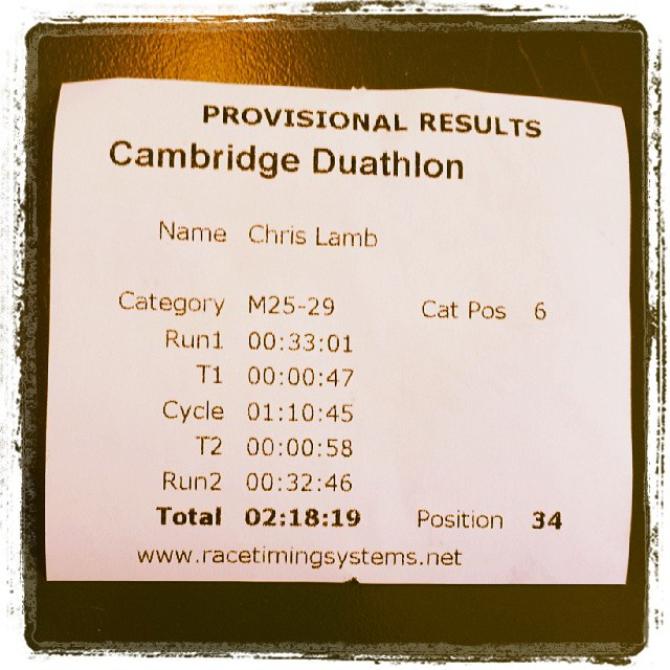
January https://d1icoid1cnixnp.cloudfront.net/yadt/blog.Image/image/cropped/15.jpeg Was lent a 15-course baroque lute. February https://d1icoid1cnixnp.cloudfront.net/yadt/blog.Image/image/cropped/19.jpeg Grandpa's funeral. In December he was posthumously awarded the Ushakov Medal (pictured) for his service in the Royal Navy's Arctic Convoys during the Second World War. March https://d1icoid1cnixnp.cloudfront.net/yadt/blog.Image/image/cropped/14.jpeg A lot of triathlon training but also got back into cooking. April https://d1icoid1cnixnp.cloudfront.net/yadt/blog.Image/image/cropped/2.jpeg Returned to the Cambridge Duathlon. May https://d1icoid1cnixnp.cloudfront.net/yadt/blog.Image/image/cropped/13.jpeg Raced 50 and 100 mile cycling time trials & visited the Stratford Olympic pool (pictured). June https://d1icoid1cnixnp.cloudfront.net/yadt/blog.Image/image/cropped/1.jpeg Ironman Austria. July https://d1icoid1cnixnp.cloudfront.net/yadt/blog.Image/image/cropped/9.jpeg Paced my sister at the Downtow-Upflow Half-marathon. Also released the first version of the Strava Enhancement Suite. August https://d1icoid1cnixnp.cloudfront.net/yadt/blog.Image/image/cropped/3.jpeg Visited Cornwall for my cousin's wedding (pictured). Another month for sport including my first ultramarathon and my first sub-20 minute 5k. September https://d1icoid1cnixnp.cloudfront.net/yadt/blog.Image/image/cropped/11.jpeg Entered a London Oxford London cycling brevet, my longest single-ride to date (269 km). Also visited the Tour of Britain and the Sri Chomnoy 24-hour endurance race. October https://d1icoid1cnixnp.cloudfront.net/yadt/blog.Image/image/cropped/10.jpeg London Paris London cycling tour (588 km). November https://d1icoid1cnixnp.cloudfront.net/yadt/blog.Image/image/cropped/5.jpeg Performed Handel's Messiah in Kettering. December https://d1icoid1cnixnp.cloudfront.net/yadt/blog.Image/image/cropped/18.jpeg Left Thread.com.

Wouter Verhelst: Perl 'issues'

I just watched a CCC talk in which the speaker claims Perl is horribly broken. Watching it was fairly annoying however, since I had to restrain myself from throwing things at the screen. If you're going to complain about the language, better make sure you actually understand the language first. I won't deny that there are a few weird constructions in there, but hey. The talk boils down to a claim that perl is horrible, because the list "data type" is "broken". First of all, Netanel, in Perl, lists are not arrays. Yes, that's confusing if you haven't done more than a few hours of Perl, but hear me out. In Perl, a list is an enumeration of values. A variable with an '@' sigil is an array; a construct consisting of an opening bracket ('(') followed by a number of comma- or arrow-separated values (',' or '=>'), followed by a closing bracket, is a list. Whenever you assign more than one value to an array or a hash, you need to use a list to enumerate the values. Subroutines in perl also use lists as arguments or return values. Yes, that last bit may have been a mistake. Perl has a concept of "scalar context" and "list context". A scalar context is what a sub is in when you assign the return value of your sub to a scalar; a list context is when you assign the return value of your sub to an array or a hash, or when you use the list construct (the thing with brackets and commas) with sub calls (instead of hardcoded values or variables) as the individual values. This works as follows:
sub magic  
    if (wantarray())  
        print "You're asking for a list!";
        return ('a', 'b', 'c');
      else  
        print "You're asking for a scalar!";
        return 'a';
     
 
print ("list: ", magic(), "\n");
print "scalar: " . magic() . "\n";
The above example will produce the following output:
You're asking for a list!
list: abc
You're asking for a scalar!
scalar: a
What happens here? The first print line creates a list (because things are separated by commas); the second one does not (the '.' is perl's string concatenation operator; as you can only concatenate scalars, the result is that you call the magic() sub in scalar context). Yes, seen as how arrays are not lists, the name of the wantarray() sub is horribly chosen. Anyway. It is documented that lists cannot be nested. Lists can only be one-dimensional constructs. If you create a list, and add another list as an element (or something that can be converted to a list, like an array or a hash), then the result is that you get a flattened list. If you don't want a flattened list, you need to use a reference instead. A reference is a scalar value that, very much like a pointer in C, contains a reference to another variable. This other variable can be an array, a hash, or a scalar. But it cannot be a list, because it must be a variable -- and lists cannot be variables. If you need to create multi-dimensional constructs, you need to use references. Taking a reference is done by prepending a backslash to whatever it is you're trying to take a reference of; or, in the case of arrays of hashes, one can create an anonymous array or hash with [] resp . E.g., if you want to add a non-flattened array to a list, you instead create a reference to an array, like so:
$arrayref = [ 'this', 'is', 'an', 'anonymous', 'array'];
you can now create a multi-dimensional construct:
@multiarray = ('elem1', $arrayref);
Or you can do that in one go:
@multiarray = ('elem1', [ 'this', 'is', 'an', 'anonymous', 'array']);
Alternatively, you can create a non-anonymous array first:
@onedimarray = ('this', 'is', 'not', 'an', 'anonymous', 'array');
@multiarray = ('elem1', \@onedimarray);
In perl, curly brackets can be used to create a reference to anonymous hashes, whereas square brackets can be used to create a reference to anonymous arrays. This is all a basic part of the language; if you don't understand that, you simply don't understand Perl. In other words, whenever you see someone doing this:
%hash =  'a' => 'b' ;
or
@array = [ '1', '2' ];
you can say that they don't understand the language. For reference, the assignment to %hash will result in an (unusable) hash with a single key that is a reference to an anonymous hash (which cannot be accessed anymore) and a value of undef; the assignment to @array will result in a two-dimensional array with one element in the first dimension, and two elements in the second. The CGI.pm fix which Natanel dismisses in the Q&A part of the talk as a "warning" which won't help (because it would be too late) is actually a proper fix, which should warn people in all cases. That is, if you do this:
%hash =   'name' => $name, 'password' => $cgi->param('password')  ;
then CGI.pm's param() sub will notice that it's being called in list context, and issue a warning -- regardless of whether the user is passing one or two password query-parameters. It uses the wantarray() sub, and produces a warning if that returns true. In short, Perl is not the horribly broken construct that Natanel claims it to be. Yes, there are a few surprises (most of which exist for historical reasons), and yes, those should be fixed. This is why the Perl community has redone much of perl for Perl 6. But the fact that there are a few surprises doesn't mean the whole language is broken. There are surprises in most languages; that is a fact of life. Yes, the difference between arrays and hashes on the one hand, and lists on the other hand, is fairly confusing; it took me a while to understand this. But once you get the hang of it, it's not all that difficult. And then these two issues that Natanel found (which I suppose could be described as bugs in the core modules) aren't all that surprising anymore. So, in short: What I do agree with is that if you want to use a language, you should understand its features. Unfortunately, this single line in the final slide of Natanel's talk is just about the only thing in the whole talk that sortof made sense to me. Ah well.

27 December 2014

Richard Hartmann: Release Critical Bug report for Week 52

Sadly, I am a day late. This post brought to you by download speeds of ~2-9kb/s and upload speeds of 1 kb/s. Even though I am only a few kilometers away from Munich, I have worse Internet connection here than I had in the middle of nowhere in Finland Also, the bug count jumped up by about 40 between Thursday and today. Else, we would have been ahead of squeeze. The UDD bugs interface currently knows about the following release critical bugs: How do we compare to the Squeeze release cycle?
Week Squeeze Wheezy Jessie
43 284 (213+71) 468 (332+136) 319 (240+79)
44 261 (201+60) 408 (265+143) 274 (224+50)
45 261 (205+56) 425 (291+134) 295 (229+66)
46 271 (200+71) 401 (258+143) 427 (313+114)
47 283 (209+74) 366 (221+145) 342 (260+82)
48 256 (177+79) 378 (230+148) 274 (189+85)
49 256 (180+76) 360 (216+155) 226 (147+79)
50 204 (148+56) 339 (195+144) ???
51 178 (124+54) 323 (190+133) 189 (134+55)
52 115 (78+37) 289 (190+99) 147 ((112+35))
1 93 (60+33) 287 (171+116)
2 82 (46+36) 271 (162+109)
3 25 (15+10) 249 (165+84)
4 14 (8+6) 244 (176+68)
5 2 (0+2) 224 (132+92)
6 release! 212 (129+83)
7 release+1 194 (128+66)
8 release+2 206 (144+62)
9 release+3 174 (105+69)
10 release+4 120 (72+48)
11 release+5 115 (74+41)
12 release+6 93 (47+46)
13 release+7 50 (24+26)
14 release+8 51 (32+19)
15 release+9 39 (32+7)
16 release+10 20 (12+8)
17 release+11 24 (19+5)
18 release+12 2 (2+0)
Graphical overview of bug stats thanks to azhag:

Joey Hess: shell monad day 3

I have been hard at work on the shell-monad ever since it was born on Christmas Eve. It's now up to 820 lines of code, and has nearly comprehensive coverage of all shell features. Time to use it for something interesting! Let's make a shell script and a haskell program that both speak a simple protocol. This kind of thing could be used by propellor when it's deploying itself to a new host. The haskell program can ssh to a remote host and run the shell program, and talk back and forth over stdio with it, using the protocol they both speak. abstract beginnings First, we'll write a data type for the commands in the protocol.
data Proto
    = Foo String
      Bar
      Baz Integer
    deriving (Show)
Now, let's go type class crazy!
class Monad t => OutputsProto t where
    output :: Proto -> t ()
instance OutputsProto IO where
    output = putStrLn . fromProto
So far, nothing interesting; this makes the IO monad an instance of the OutputsProto type class, and gives a simple implementation to output a line of the protocol.
instance OutputsProto Script where
    output = cmd "echo" . fromProto
Now it gets interesting. The Script monad is now also a member of the OutputsProto. To output a line of the protocol, it just uses echo. Yeah -- shell code is a member of a haskell type class. Awesome -- most abstract shell code evar! Similarly, we can add another type class for monads that can input the protocol:
class Monad t => InputsProto t p where
    input :: t p
instance InputsProto IO Proto where
    input = toProto <$> readLn
instance InputsProto Script Var where
    input = do
        v <- newVar ()
        readVar v
        return v
While the IO version reads and deserializes a line back to a Proto, the shell script version of this returns a Var, which has the newly read line in it, not yet deserialized. Why the difference? Well, Haskell has data types, and shell does not ... speaking the protocol Now we have enough groundwork to write haskell code in the IO monad that speaks the protocol in arbitrary ways. For example:
protoExchangeIO :: Proto -> IO Proto
protoExchangeIO p = do
    output p
    input
fooIO :: IO ()
fooIO = do
    resp <- protoExchangeIO (Foo "starting up")
    -- etc
But that's trivial and uninteresting. Anyone who has read to here certianly knows how to write haskell code in the IO monad. The interesting part is making the shell program speak the protocol, including doing various things when it receives the commands.
foo :: Script ()
foo = do
    stopOnFailure True
    handler <- func (NamedLike "handler") $
        handleProto =<< input
    output (Foo "starting up")
    handler
    output Bar
    handler
handleFoo :: Var -> Script ()
handleFoo v = toStderr $ cmd "echo" "yay, I got a Foo" v
handleBar :: Script ()
handleBar = toStderr $ cmd "echo" "yay, I got a Bar"
handleBaz :: Var -> Script ()
handleBaz num = forCmd (cmd "seq" (Val (1 :: Int)) num) $
    toStderr . cmd "echo" "yay, I got a Baz"
serialization I've left out a few serialization functions. fromProto is used in both instances of OutputsProto. The haskell program and the script will both use this to serialize Proto.
fromProto :: Proto -> String
fromProto (Foo s) = pFOO ++ " " ++ s
fromProto Bar = pBAR ++ " "
fromProto (Baz i) = pBAZ ++ " " ++ show i
pFOO, pBAR, pBAZ :: String
(pFOO, pBAR, pBAZ) = ("FOO", "BAR", "BAZ")
And here's the haskell function to convert the other direction, which was also used earlier.
toProto :: String -> Proto
toProto s = case break (== ' ') s of
    (w, ' ':rest)
          w == pFOO -> Foo rest
          w == pBAR && null rest -> Bar
          w == pBAZ -> Baz (read rest)
          otherwise -> error $ "unknown protocol command: " ++ w
    (_, _) -> error "protocol splitting error"
We also need a version of that written in the Script monad. Here it is. Compare and contrast the function below with the one above. They're really quite similar. (Sadly, not so similar to allow refactoring out a common function..)
handleProto :: Var -> Script ()
handleProto v = do
    w <- getProtoCommand v
    let rest = getProtoRest v
    caseOf w
        [ (quote (T.pack pFOO), handleFoo =<< rest)
        , (quote (T.pack pBAR), handleBar)
        , (quote (T.pack pBAZ), handleBaz =<< rest)
        , (glob "*", do
            toStderr $ cmd "echo" "unknown protocol command" w
            cmd "false"
          )
        ]
Both toProto and handleProto split the incoming line apart into the first word, and the rest of the line, then match the first word against the commands in the protocol, and dispatches to appropriate actions. So, how do we split a variable apart like that in the Shell monad? Like this...
getProtoCommand :: Var -> Script Var
getProtoCommand v = trimVar LongestMatch FromEnd v (glob " *")
getProtoRest :: Var -> Script Var
getProtoRest v = trimVar ShortestMatch FromBeginning v (glob "[! ]*[ ]")
(This could probably be improved by using a DSL to generate the globs too..) conclusion And finally, here's a main to generate the shell script!
main :: IO ()
main = T.writeFile "protocol.sh" $ script foo
The pretty-printed shell script that produces is not very interesting, but I'll include it at the end for completeness. More interestingly for the purposes of sshing to a host and running the command there, we can use linearScript to generate a version of the script that's all contained on a single line. Also included below. I could easily have written the pretty-printed version of the shell script in twice the time that it took to write the haskell program that generates it and also speaks the protocol itself. I would certianly have had to test the hand-written shell script repeatedly. Code like for _x in $(seq 1 "$ _v#[!\ ]*[\ ] ") doesn't just write and debug itself. (Until now!) But, the generated scrpt worked 100% on the first try! Well, it worked as soon as I got the Haskell program to compile... But the best part is that the Haskell program and the shell script don't just speak the same protocol. They both rely on the same definition of Proto. So this is fairly close to the kind of type-safe protocol serialization that Fay provides, when compiling Haskell to javascript. I'm getting the feeling that I won't be writing too many nontrivial shell scripts by hand anymore! :) the complete haskell program Is here, all 99 lines of it. the pretty-printed shell program
#!/bin/sh
set -x
_handler ()   :
    _v=
    read _v
    case "$ _v%%\ * " in FOO) :
        echo 'yay, I got a Foo' "$ _v#[!\ ]*[\ ] " >&2
    : ;; BAR) :
        echo 'yay, I got a Bar' >&2
    : ;; BAZ) :
        for _x in $(seq 1 "$ _v#[!\ ]*[\ ] ")
        do :
            echo 'yay, I got a Baz' "$_x" >&2
        done
    : ;; *) :
        echo 'unknown protocol command' "$ _v%%\ * " >&2
        false
    : ;; esac
 
echo 'FOO starting up'
_handler
echo 'BAR '
_handler
the one-liner shell program
set -p; _handler ()   :;    _v=;    read _v;    case "$ _v%%\ * " in FOO) :;        echo 'yay, I got a Foo' "$ _v#[!\ ]*[\ ] " >&2;     : ;; BAR) :;        echo 'yay, I got a Bar' >&2;    : ;; BAZ) :;        for _x in $(seq 1 "$ _v#[!\ ]*[\ ] ");      do :;           echo 'yay, I got a Baz' "$_x" >&2;      done;   : ;; *) :;      echo 'unknown protocol command' "$ _v%%\ * " >&2;       false;  : ;; esac;  ; echo 'FOO starting up'; _handler; echo 'BAR '; _handler

17 December 2014

Keith Packard: MST-monitors

Multi-Stream Transport 4k Monitors and X I'm sure you've seen a 4k monitor on a friends desk running Mac OS X or Windows and are all ready to go get one so that you can use it under Linux. Once you've managed to acquire one, I'm afraid you'll discover that when you plug it in, you're limited to 30Hz refresh rates at the full size, unless you're running a kernel that is version 3.17 or later. And then... Good Grief! What Is My Computer Doing! Ok, so now you're running version 3.17 and when X starts up, it's like you're using a gigantic version of Google Cardboard. Two copies of a very tall, but very narrow screen greets you. Welcome to MST island. In order to drive these giant new panels at full speed, there isn't enough bandwidth in the display hardware to individually paint each pixel once during each frame. So, like all good hardware engineers, they invented a clever hack. This clever hack paints the screen in parallel. I'm assuming that they've got two bits of display hardware, each one hooked up to half of the monitor. Now, each paints only half of the pixels, avoiding costly redesign of expensive silicon, at least that's my surmise. In the olden days, if you did this, you'd end up running two monitor cables to your computer, and potentially even having two video cards. Today, thanks to the magic of Display Port Multi-Stream Transport, we don't need all of that; instead, MST allows us to pack multiple cables-worth of data into a single cable. I doubt the inventors of MST intended it to be used to split a single LCD panel into multiple "monitors", but hardware engineers are clever folk and are more than capable of abusing standards like this when it serves to save a buck. Turning Two Back Into One We've got lots of APIs that expose monitor information in the system, and across which we might be able to wave our magic abstraction wand to fix this:
  1. The KMS API. This is the kernel interface which is used by all graphics stuff, including user-space applications and the frame buffer console. Solve the problem here and it works everywhere automatically.
  2. The libdrm API. This is just the KMS ioctls wrapped in a simple C library. Fixing things here wouldn't make fbcons work, but would at least get all of the window systems working.
  3. Every 2D X driver. (Yeah, we're trying to replace all of these with the one true X driver). Fixing the problem here would mean that all X desktops would work. However, that's a lot of code to hack, so we'll skip this.
  4. The X server RandR code. More plausible than fixing every driver, this also makes X desktops work.
  5. The RandR library. If not in the X server itself, how about over in user space in the RandR protocol library? Well, the problem here is that we've now got two of them (Xlib and xcb), and the xcb one is auto-generated from the protocol descriptions. Not plausible.
  6. The Xinerama code in the X server. Xinerama is how we did multi-monitor stuff before RandR existed. These days, RandR provides Xinerama emulation, but we've been telling people to switch to RandR directly.
  7. Some new API. Awesome. Ok, so if we haven't fixed this in any existing API we control (kernel/libdrm/X.org), then we effectively dump the problem into the laps of the desktop and application developers. Given how long it's taken them to adopt current RandR stuff, providing yet another complication in their lives won't make them very happy.
All Our APIs Suck Dave Airlie merged MST support into the kernel for version 3.17 in the simplest possible fashion -- pushing the problem out to user space. I was initially vaguely tempted to go poke at it and try to fix things there, but he eventually convinced me that it just wasn't feasible. It turns out that all of our fancy new modesetting APIs describe the hardware in more detail than any application actually cares about. In particular, we expose a huge array of hardware objects: Each of these objects exposes intimate details about the underlying hardware -- which of them can work together, and which cannot; what kinds of limits are there on data rates and formats; and pixel-level timing details about blanking periods and refresh rates. To make things work, some piece of code needs to actually hook things up, and explain to the user why the configuration they want just isn't possible. The sticking point we reached was that when an MST monitor gets plugged in, it needs two CRTCs to drive it. If one of those is already in use by some other output, there's just no way you can steal it for MST mode. Another problem -- we expose EDID data and actual video mode timings. Our MST monitor has two EDID blocks, one for each half. They happen to describe how they're related, and how you should configure them, but if we want to hide that from the application, we'll have to pull those EDID blocks apart and construct a new one. The same goes for video modes; we'll have to construct ones for MST mode. Every single one of our APIs exposes enough of this information to be dangerous. Every one, except Xinerama. All it talks about is a list of rectangles, each of which represents a logical view into the desktop. Did I mention we've been encouraging people to stop using this? And that some of them listened to us? Foolishly? Dave's Tiling Property Dave hacked up the X server to parse the EDID strings and communicate the layout information to clients through an output property. Then he hacked up the gnome code to parse that property and build a RandR configuration that would work. Then, he changed to RandR Xinerama code to also parse the TILE properties and to fix up the data seen by application from that. This works well enough to get a desktop running correctly, assuming that desktop uses Xinerama to fetch this data. Alas, gtk has been "fixed" to use RandR if you have RandR version 1.3 or later. No biscuit for us today. Adding RandR Monitors RandR doesn't have enough data types yet, so I decided that what we wanted to do was create another one; maybe that would solve this problem. Ok, so what clients mostly want to know is which bits of the screen are going to be stuck together and should be treated as a single unit. With current RandR, that's some of the information included in a CRTC. You pull the pixel size out of the associated mode, physical size out of the associated outputs and the position from the CRTC itself. Most of that information is available through Xinerama too; it's just missing physical sizes and any kind of labeling to help the user understand which monitor you're talking about. The other problem with Xinerama is that it cannot be configured by clients; the existing RandR implementation constructs the Xinerama data directly from the RandR CRTC settings. Dave's Tiling property changes edit that data to reflect the union of associated monitors as a single Xinerama rectangle. Allowing the Xinerama data to be configured by clients would fix our 4k MST monitor problem as well as solving the longstanding video wall, WiDi and VNC troubles. All of those want to create logical monitor areas within the screen under client control What I've done is create a new RandR datatype, the "Monitor", which is a rectangular area of the screen which defines a rectangular region of the screen. Each monitor has the following data: There are three requests to define, delete and list monitors. And that's it. Now, we want the list of monitors to completely describe the environment, and yet we don't want existing tools to break completely. So, we need some way to automatically construct monitors from the existing RandR state while still letting the user override portions of it as needed to explain virtual or tiled outputs. So, what I did was to let the client specify a list of outputs for each monitor. All of the CRTCs which aren't associated with an output in any client-defined monitor are then added to the list of monitors reported back to clients. That means that clients need only define monitors for things they understand, and they can leave the other bits alone and the server will do something sensible. The second tricky bit is that if you specify an empty rectangle at 0,0 for the pixel geometry, then the server will automatically compute the geometry using the list of outputs provided. That means that if any of those outputs get disabled or reconfigured, the Monitor associated with them will appear to change as well. Current Status Gtk+ has been switched to use RandR for RandR versions 1.3 or later. Locally, I hacked libXrandr to override the RandR version through an environment variable, set that to 1.2 and Gtk+ happily reverts back to Xinerama and things work fine. I suspect the plan here will be to have it use the new Monitors when present as those provide the same info that it was pulling out of RandR's CRTCs. KDE appears to still use Xinerama data for this, so it "just works". Where's the code As usual, all of the code for this is in a collection of git repositories in my home directory on fd.o:
git://people.freedesktop.org/~keithp/randrproto master
git://people.freedesktop.org/~keithp/libXrandr master
git://people.freedesktop.org/~keithp/xrandr master
git://people.freedesktop.org/~keithp/xserver randr-monitors
RandR protocol changes Here's the new sections added to randrproto.txt
                   
1.5. Introduction to version 1.5 of the extension
Version 1.5 adds monitors
   A 'Monitor' is a rectangular subset of the screen which represents
   a coherent collection of pixels presented to the user.
   Each Monitor is be associated with a list of outputs (which may be
   empty).
   When clients define monitors, the associated outputs are removed from
   existing Monitors. If removing the output causes the list for that
   monitor to become empty, that monitor will be deleted.
   For active CRTCs that have no output associated with any
   client-defined Monitor, one server-defined monitor will
   automatically be defined of the first Output associated with them.
   When defining a monitor, setting the geometry to all zeros will
   cause that monitor to dynamically track the bounding box of the
   active outputs associated with them
This new object separates the physical configuration of the hardware
from the logical subsets  the screen that applications should
consider as single viewable areas.
1.5.1. Relationship between Monitors and Xinerama
Xinerama's information now comes from the Monitors instead of directly
from the CRTCs. The Monitor marked as Primary will be listed first.
                   
5.6. Protocol Types added in version 1.5 of the extension
MONITORINFO   name: ATOM
          primary: BOOL
          automatic: BOOL
          x: INT16
          y: INT16
          width: CARD16
          height: CARD16
          width-in-millimeters: CARD32
          height-in-millimeters: CARD32
          outputs: LISTofOUTPUT  
                   
7.5. Extension Requests added in version 1.5 of the extension.
 
    RRGetMonitors
    window : WINDOW
      
    timestamp: TIMESTAMP
    monitors: LISTofMONITORINFO
 
    Errors: Window
    Returns the list of Monitors for the screen containing
    'window'.
    'timestamp' indicates the server time when the list of
    monitors last changed.
 
    RRSetMonitor
    window : WINDOW
    info: MONITORINFO
 
    Errors: Window, Output, Atom, Value
    Create a new monitor. Any existing Monitor of the same name is deleted.
    'name' must be a valid atom or an Atom error results.
    'name' must not match the name of any Output on the screen, or
    a Value error results.
    If 'info.outputs' is non-empty, and if x, y, width, height are all
    zero, then the Monitor geometry will be dynamically defined to
    be the bounding box of the geometry of the active CRTCs
    associated with them.
    If 'name' matches an existing Monitor on the screen, the
    existing one will be deleted as if RRDeleteMonitor were called.
    For each output in 'info.outputs, each one is removed from all
    pre-existing Monitors. If removing the output causes the list of
    outputs for that Monitor to become empty, then that Monitor will
    be deleted as if RRDeleteMonitor were called.
    Only one monitor per screen may be primary. If 'info.primary'
    is true, then the primary value will be set to false on all
    other monitors on the screen.
    RRSetMonitor generates a ConfigureNotify event on the root
    window of the screen.
 
    RRDeleteMonitor
    window : WINDOW
    name: ATOM
 
    Errors: Window, Atom, Value
    Deletes the named Monitor.
    'name' must be a valid atom or an Atom error results.
    'name' must match the name of a Monitor on the screen, or a
    Value error results.
    RRDeleteMonitor generates a ConfigureNotify event on the root
    window of the screen.
                   

13 December 2014

Gregor Herrmann: GDAC 2014/13

not sure if it it's me or debian but today was a quiet day. time to look back & see what has happened this year & this brings up memories of this year's & earlier debconfs, with their pkg-perl BOFs & their outdoor hacklabs. looking through these photos of past events makes me grateful, both to the tireless organizers of debconf, & to the people who can share a bench with me for hours :)
this posting is part of GDAC (gregoa's debian advent calendar), a project to show the bright side of debian & why it's fun for me to contribute.

12 December 2014

Daniel Kahn Gillmor: a10n for l10n

The abbreviated title above means "Appreciation for Localization" :) I wanted to say a word of thanks for the awesome work done by debian localization teams. I speak English, and my other language skills are weak. I'm lucky: most software I use is written by default in a language that I can already understand. The debian localization teams do great work in making sure that packages in debian gets translated into many other languages, so that many more people around the world can take advantage of free software. I was reminded of this work recently (again) with the great patches submitted to GnuPG and related packages. The changes were made by many different people, and coordinated with the debian GnuPG packaging team by David Pr vot. This work doesn't just help debian and its users. These localizations make their way back upstream to the original projects, which in turn are available to many other people. If you use debian, and you speak a language other than english, and you want to give back to the community, please consider joining one of the localization teams. They are a great way to help out our project's top priorities: our users and free software. Thank you to all the localizers! (this post was inspired by gregoa's debian advent calendar. i won't be posting public words of thanks as frequently or as diligently as he does, any more than i'll be fixing the number of RC bugs that he fixes. This are just two of the ways that gregoa consistently leads the community by example. He's an inspiration, even if living up to his example is a daunting challenge.)

11 December 2014

Gregor Herrmann: GDAC 2014/11

is enthusiasm contagious? I think so. a recent example: another advent posting. gracias!
this posting is part of GDAC (gregoa's debian advent calendar), a project to show the bright side of debian & why it's fun for me to contribute.

Next.

Previous.