Search Results: "ag"

24 December 2024

Divine Attah-Ohiemi: Seamless Transitions: Mastering Apache Redirects for a Smooth Hugo Migration

This week, I dove into setting up redirects with Apache to make the transition to Hugo's multilingual system smoother. The challenge? Ensuring that all those old links still worked while I migrated to the new URL format. For instance, I needed to redirect: /es/distrib to /distrib/index.es.html
/es/social_contract to /social_contract.es.html
/es/intro/about to /intro/about.es.html
/da to /index.da.html

To tackle this, I turned to Apache's mod_rewrite. Here s the magic I came up with in my .htaccess file: RewriteCond % REQUEST_URI ^/([a-z] 2 (?:-[a-z] 2 )?)/(.*)$
RewriteCond % DOCUMENT_ROOT /$2/index.%1.html -f
RewriteCond % DOCUMENT_ROOT /$1/$2 !-d
RewriteRule ^/([a-z] 2 (?:-[a-z] 2 )?)/(.*)$ /$2/index.%1.html [last,redirect]

RewriteCond % REQUEST_URI ^/([a-z] 2 (?:-[a-z] 2 )?)/(.*)$
RewriteCond % DOCUMENT_ROOT /$2.%1.html -f
RewriteCond % DOCUMENT_ROOT /$1/$2 !-d
RewriteRule ^/([a-z] 2 (?:-[a-z] 2 )?)/(.*)$ /$2.%1.html [last,redirect]

What s happening here? The rules check if the URL starts with a language code (like /es or /da). Then, they verify whether the corresponding HTML file exists. If it does, and the path isn t a directory, voil ! The user gets redirected to the new format. It s a bit of a dance with conditions and rules, but it s satisfying to see everything working seamlessly. Now, as I continue migrating content, users clicking on old links won t end up in a digital dead end. It s all about keeping the flow smooth and maintaining that user experience. So, if you re also juggling multilingual pages and thinking about making the switch to Hugo, don t underestimate the power of mod_rewrite. It s your best friend in the world of redirects! Happy coding!

Russ Allbery: Review: Number Go Up

Review: Number Go Up, by Zeke Faux
Publisher: Crown Currency
Copyright: 2023
Printing: 2024
ISBN: 0-593-44382-9
Format: Kindle
Pages: 373
Number Go Up is a cross between a history and a first-person account of investigative journalism around the cryptocurrency bubble and subsequent collapse in 2022. The edition I read has an afterward from June 2024 that brings the story up to date with Sam Bankman-Fried's trial and a few other events. Zeke Faux is a reporter for Bloomberg News and a fellow of New America. Last year, I read Michael Lewis's Going Infinite, a somewhat-sympathetic book-length profile of Sam Bankman-Fried that made a lot of people angry. One of the common refrains at the time was that people should read Number Go Up instead, and since I'm happy to read more about the absurdities of the cryptocurrency world, I finally got around to reading the other big crypto book of 2023. This is a good book, with some caveats that I am about to explain at absurd length. If you want a skeptical history of the cryptocurrency bubble, you should read it. People who think that it's somehow in competition with Michael Lewis's book or who think the two books disagree (including Faux himself) have profoundly missed the point of Going Infinite. I agree with Matt Levine: Both of these books are worth your time if this is the sort of thing you like reading about. But (much) more on Faux's disagreements with Lewis later. The frame of Number Go Up is Faux's quixotic quest to prove that Tether is a fraud. To review this book, I therefore need to briefly explain what Tether is. This is only the first of many extended digressions. One natural way to buy cryptocurrency would be to follow the same pattern as a stock brokerage account. You would deposit some amount of money into the account (or connect the brokerage account to your bank account), and then exchange money for cryptocurrency or vice versa, using bank transfers to put money in or take it out. However, there are several problems with this. One is that swapping cryptocurrency for money is awkward and sometimes expensive. Another is that holding people's investment money for them is usually highly regulated, partly for customer safety but also to prevent money laundering. These are often called KYC laws (Know Your Customer), and the regulation-hostile world of cryptocurrency didn't want to comply with them. Tether is a stablecoin, which means that the company behind Tether attempts to guarantee that one Tether is always worth exactly one US dollar. It is not a speculative investment like Bitcoin; it's a cryptocurrency substitute for dollars. People exchange dollars for Tether to get their money into the system and then settle all of their subsequent trades in Tether, only converting the Tether back to dollars when they want to take their money out of cryptocurrency entirely. In essence, Tether functions like the cash reserve in a brokerage account: Your Tether holdings are supposedly guaranteed to be equivalent to US dollars, you can withdraw them at any time, and because you can do so, you don't bother, instead leaving your money in the reserve account while you contemplate what new coin you want to buy. As with a bank, this system rests on the assurance that one can always exchange one Tether for one US dollar. The instant people stop believing this is true, people will scramble to get their money out of Tether, creating the equivalent of a bank run. Since Tether is not a regulated bank or broker and has no deposit insurance or strong legal protections, the primary defense against a run on Tether is Tether's promise that they hold enough liquid assets to be able to hand out dollars to everyone who wants to redeem Tether. (A secondary defense that I wish Faux had mentioned is that Tether limits redemptions to registered accounts redeeming more than $100,000, which is a tiny fraction of the people who hold Tether, but for most purposes this doesn't matter because that promise is sufficient to maintain the peg with the dollar.) Faux's firmly-held belief throughout this book is that Tether is lying. He believes they do not have enough money to redeem all existing Tether coins, and that rather than backing every coin with very safe liquid assets, they are using the dollars deposited in the system to make illiquid and risky investments. Faux never finds the evidence that he's looking for, which makes this narrative choice feel strange. His theory was tested when there was a run on Tether following the collapse of the Terra stablecoin. Tether passed without apparent difficulty, redeeming $16B or about 20% of the outstanding Tether coins. This doesn't mean Faux is wrong; being able to redeem 20% of the outstanding tokens is very different from being able to redeem 100%, and Tether has been fined for lying about its reserves. But Tether is clearly more stable than Faux thought it was, which makes the main narrative of the book weirdly unsatisfying. If he admitted he might be wrong, I would give him credit for showing his work even if it didn't lead where he expected, but instead he pivots to focusing on Tether's role in money laundering without acknowledging that his original theory took a serious blow. In Faux's pursuit of Tether, he wanders through most of the other elements of the cryptocurrency bubble, and that's the strength of this book. Rather than write Number Go Up as a traditional history, Faux chooses to closely follow his own thought processes and curiosity. This has the advantage of giving Faux an easy and natural narrative, something that non-fiction books of this type can struggle with, and it lets Faux show how confusing and off-putting the cryptocurrency world is to an outsider. The best parts of this book were the parts unrelated to Tether. Faux provides an excellent summary of the Axie Infinity speculative bubble and even traveled to the Philippines to interview people who were directly affected. He then wandered through the bizarre world of NFTs, and his first-hand account of purchasing one (specifically a Mutant Ape) to get entrance to a party (which sounded like a miserable experience I would pay money to get out of) really drives home how sketchy and weird cryptocurrency-related software and markets can be. He also went to El Salvador to talk to people directly about the country's supposed embrace of Bitcoin, and there's no substitute for that type of reporting to show how exaggerated and dishonest the claims of cryptocurrency adoption are. The disadvantage of this personal focus on Faux himself is that it sometimes feels tedious or sensationalized. I was much less interested in his unsuccessful attempts to interview the founder of Tether than Faux was, and while the digression into forced labor compounds in Cambodia devoted to pig butchering scams was informative (and horrific), I think Faux leaned too heavily on an indirect link to Tether. His argument is that cryptocurrency enables a type of money laundering that is particularly well-suited to supporting scams, but both scams and this type of economic slavery existed before cryptocurrency and will exist afterwards. He did not make a very strong case that Tether was uniquely valuable as a money laundering service, as opposed to a currently useful tool that would be replaced with some other tool should it go away. This part of the book is essentially an argument that money laundering is bad because it enables crime, and sure, to an extent I agree. But if you're going to put this much emphasis on the evils of money laundering, I think you need to at least acknowledge that many people outside the United States do not want to give US government, which is often openly hostile to them, veto power over their financial transactions. Faux does not. The other big complaint I have with this book, and with a lot of other reporting on cryptocurrency, is that Faux is sloppy with the term "Ponzi scheme." This is going to sound like nit-picking, but I think this sloppiness matters because it may obscure an ongoing a shift in cryptocurrency markets. A Ponzi scheme is not any speculative bubble. It is a very specific type of fraud in which investors are promised improbably high returns at very low risk and with safe principal. These returns are paid out, not via investment in some underlying enterprise, but by taking the money from new investments and paying it to earlier investors. Ponzi schemes are doomed because satisfying their promises requires a constantly increasing flow of new investors. Since the population of the world is finite, all Ponzi schemes are mathematically guaranteed to eventually fail, often in a sudden death spiral of ever-increasing promises to lure new investors when the investment stream starts to dry up. There are some Ponzi schemes in cryptocurrency, but most practices that are called Ponzi schemes are not. For example, Faux calls Axie Infinity a Ponzi scheme, but it was missing the critical elements of promised safe returns and fraudulently paying returns from the investments of later investors. It was simply a speculative bubble that people bought into on the assumption that its price would increase, and like any speculative bubble those who sold before the peak made money at the expense of those who bought at the peak. The reason why this matters is that Ponzi schemes are a self-correcting problem. One can decry the damage caused when they collapse, but one can also feel the reassuring certainty that they will inevitably collapse and prove the skeptics correct. The same is not true of speculative assets in general. You may think that the lack of an underlying economic justification for prices means that a speculative bubble is guaranteed to collapse eventually, but in the famous words of Gary Schilling, "markets can remain irrational a lot longer than you and I can remain solvent." One of the people Faux interviews explains this distinction to him directly:
Rong explained that in a true Ponzi scheme, the organizer would have to handle the "fraud money." Instead, he gave the sneakers away and then only took a small cut of each trade. "The users are trading between each other. They are not going through me, right?" Rong said. Essentially, he was arguing that by downloading the Stepn app and walking to earn tokens, crypto bros were Ponzi'ing themselves.
Faux is openly contemptuous of this response, but it is technically correct. Stepn is not a Ponzi scheme; it's a speculative bubble. There are no guaranteed returns being paid out of later investments and no promise that your principal is safe. People are buying in at price that you may consider irrational, but Stepn never promised you would get your money back, let alone make a profit, and therefore it doesn't have the exponential progression of a Ponzi scheme. One can argue that this is a distinction without a moral difference, and personally I would agree, but it matters immensely if one is trying to analyze the future of cryptocurrencies. Schemes as transparently unstable as Stepn (which gives you coins for exercise and then tries to claim those coins have value through some vigorous hand-waving) are nearly as certain as Ponzi schemes to eventually collapse. But it's also possible to create a stable business around allowing large numbers of people to regularly lose money to small numbers of sophisticated players who are collecting all of the winnings. It's called a poker room at a casino, and no one thinks poker rooms are Ponzi schemes or are doomed to collapse, even though nearly everyone who plays poker will lose money. This is the part of the story that I think Faux largely missed, and which Michael Lewis highlights in Going Infinite. FTX was a legitimate business that made money (a lot of money) off of trading fees, in much the same way that a casino makes money off of poker rooms. Lots of people want to bet on cryptocurrencies, similar to how lots of people want to play poker. Some of those people will win; most of those people will lose. The casino doesn't care. Its profit comes from taking a little bit of each pot, regardless of who wins. Bankman-Fried also speculated with customer funds, and therefore FTX collapsed, but there is no inherent reason why the core exchange business cannot be stable if people continue to want to speculate in cryptocurrencies. Perhaps people will get tired of this method of gambling, but poker has been going strong for 200 years. It's also important to note that although trading fees are the most obvious way to be a profitable cryptocurrency casino, they're not the only way. Wall Street firms specialize in finding creative ways to take a cut of every financial transaction, and many of those methods are more sophisticated than fees. They are so good at this that buying and selling stock through trading apps like Robinhood is free. The money to run the brokerage platform comes from companies that are delighted to pay for the opportunity to handle stock trades by day traders with a phone app. This is not, as some conspiracy theories would have you believe, due to some sort of fraudulent price manipulation. It is because the average person with a Robinhood phone app is sufficiently unsophisticated that companies that have invested in complex financial modeling will make a steady profit taking the other side of their trades, mostly because of the spread (the difference between offered buy and sell prices). Faux is so caught up in looking for Ponzi schemes and fraud that I think he misses this aspect of cryptocurrency's transformation. Wall Street trading firms aren't piling into cryptocurrency because they want to do securities fraud. They're entering this market because there seems to be persistent demand for this form of gambling, cryptocurrency markets reward complex financial engineering, and running a legal casino is a profitable business model. Michael Lewis appears as a character in this book, and Faux portrays him quite negatively. The root of this animosity appears to stem from a cryptocurrency conference in the Bahamas that Faux attended. Lewis interviewed Bankman-Fried on stage, and, from Faux's account, his questions were fawning and he praised cryptocurrencies in ways that Faux is certain he knew were untrue. From that point on, Faux treats Lewis as an apologist for the cryptocurrency industry and for Sam Bankman-Fried specifically. I think this is a legitimate criticism of Lewis's methods of getting close to the people he wants to write about, but I think Faux also makes the common mistake of assuming Lewis is a muckraking reporter like himself. This has never been what Lewis is interested in. He writes about people he finds interesting and that he thinks a reader will also find interesting. One can legitimately accuse him of being credulous, but that's partly because he's not even trying to do the same thing Faux is doing. He's not trying to judge; he's trying to understand. This shows when it comes to the parts of this book about Sam Bankman-Fried. Faux's default assumption is that everyone involved in cryptocurrency is knowingly doing fraud, and a lot of his research is looking for evidence to support the conclusion he had already reached. I don't think there's anything inherently wrong with that approach: Faux is largely, although not entirely, correct, and this type of hostile journalism is incredibly valuable for society at large. Upton Sinclair didn't start writing The Jungle with an open mind about the meat-packing industry. But where Faux and Lewis disagree on Bankman-Fried's motivations and intentions, I think Lewis has the much stronger argument. Faux's position is that Bankman-Fried always intended to steal people's money through fraud, perhaps to fund his effective altruism donations, and his protestations that he made mistakes and misplaced funds are obvious lies. This is an appealing narrative if one is looking for a simple villain, but Faux's evidence in support of this is weak. He mostly argues through stereotype: Bankman-Fried was a physics major and a Jane Street trader and therefore could not possibly be the type of person to misplace large amounts of money or miscalculate risk. If he wants to understand how that could be possible, he could read Going Infinite? I find it completely credible that someone with what appears to be uncontrolled, severe ADHD could be adept at trading and calculating probabilities and yet also misplace millions of dollars of assets because he wasn't thinking about them and therefore they stopped existing. Lewis made a lot of people angry by being somewhat sympathetic to someone few people wanted to be sympathetic towards, but Faux (and many others) are also misrepresenting his position. Lewis agrees that Bankman-Fried intentionally intermingled customer funds with his hedge fund and agrees that he lied about doing this. His only contention is that Bankman-Fried didn't do this to steal the money; instead, he invested customer money in risky bets that he thought would pay off. In support of this, Lewis made a prediction that was widely scoffed at, namely that much less of FTX's money was missing than was claimed, and that likely most or all of it would be found. And, well, Lewis was basically correct? The FTX bankruptcy is now expected to recover considerably more than the amount of money owed to creditors. Faux argues that this is only because the bankruptcy clawed back assets and cryptocurrencies have gone up considerably since the FTX bankruptcy, and therefore that the lost money was just replaced by unexpected windfall profits on other investments, but I don't think this point is as strong as he thinks it is. Bankman-Fried lost money on some of what he did with customer funds, made money on other things, and if he'd been able to freeze withdrawals for the year that the bankruptcy froze them, it does appear most of the money would have been recoverable. This does not make what he did legal or morally right, but no one is arguing that, only that he didn't intentionally steal money for his own personal gain or for effective altruism donations. And on that point, I don't think Faux is giving Lewis's argument enough credit. I have a lot of complaints about this book because I know way too much about this topic than anyone should probably know. I think Faux missed the plot in a couple of places, and I wish someone would write a book about where cryptocurrency markets are currently going. (Matt Levine's Money Stuff newsletter is quite good, but it's about all sorts of things other than cryptocurrency and isn't designed to tell a coherent story.) But if you know less about cryptocurrency and just want to hear the details of the run-up to the 2022 bubble, this is a great book for that. Faux is writing for people who are already skeptical and is not going to convince people who are cryptocurrency true believers, but that's fine. The details are largely correct (and extensively footnoted) and will satisfy most people's curiosity. Lewis's Going Infinite is a better book, though. It's not the same type of book at all, and it will not give you the broader overview of the cryptocurrency world. But if you're curious about what was going through the head of someone at the center of all of this chaos, I think Lewis's analysis is much stronger than Faux's. I'm happy I read both books. Rating: 8 out of 10

23 December 2024

Russ Allbery: Dropping the git protocol

Ever since I started converting my free software repositories to Git and hosting them on git.eyrie.org, I've made them available via the Git network protocol (the one that uses git:// URLs). This protocol doesn't support TLS or any other form of integrity checking on the wire and has been gently deprecated for some time. Recent changes to git daemon broke the way I was managing permissions for my personal repositories, which meant that the git://git.eyrie.org/ URLs have been broken for several months. Since no one has complained or apparently noticed, this seems like a good excuse to drop support entirely and run one fewer service. All of my personal repositories will continue to be accessible via Git over HTTPS, which is now the standard for anonymous Git checkouts. If the prior URL was git://git.eyrie.org/area/package.git, the new URL is https://git.eyrie.org/git/area/package.git. I've updated my web pages accordingly. This protocol provides integrity protection on the wire and a moderate amount of authentication of my server via a Let's Encrypt certificate.

Sahil Dhiman: Debian Mirrors Hierarchy

After finding AlmaLinux mirror sync capacity at Tier 0 (or Tier 1, however you look at it) is around 140 Gbps, I wanted to find source and hierarchy in Debian mirroring systems. There are two main types of mirrors in Debian - Debian package mirrors (for package installs and updates) and Debian CD mirrors (for ISO and others medias). Let s talk about package mirrors (and it s hierarchy) first.

Package mirror hierarchy Trace file was a good starting point for checking upstream for a package mirror in Debian. It resides at <URL>/debian/project/trace/_traces and shows flow of data. Sample trace file from jing.rocks s mirror. It showed, canonical source for packages is ftp-master.debian.org. Checking via https://db.debian.org/machines.cgi, showed it s fasolo.d.o hosted at Brown University, US. This serves as Master Archive Server , making it a Tier 0 mirror. It s entry mentions that it has 1 Gbps shared LAN connectivity (dated information?) but it only has to push to 3 other machines/sites. Side note - .d.o is .debian.org As shown on https://mirror-master.debian.org/status/mirror-hierarchy.html, the three sites are:
  • syncproxy2.eu.debian.org ie smit.d.o hosted by University of Twente, Netherlands with 2x10 Gbps connectivity.
  • syncproxy4.eu.debian.org ie schmelzer.d.o hosted by Conova in Austria with 2x10 Gbps connectivity.
  • syncproxy2.wna.debian.org - https://db.debian.org/machines.cgi entry mentions it being hosted at UBC here, but IP seems to be pointing to OSUOSL IP range as of now. IIRC few months ago, syncproxy2.wna.d.o was made to point to other host due to some issue (?). mirror-osuosl.d.o seems to be serving as syncproxy2.wna.d.o now. Bandwidth isn t explicitly mentioned but from my experience seeing bandwidths which other free software projects hosted at OSUOSL have, it would be atleast 10 Gbps and maybe more for Debian.

                     syncproxy2.eu.d.o (NL) ---> to the world
                    /
ftp-master.d.o (US) -- syncproxy4.eu.d.o (AT)  --> to the world 
                    \
                     syncproxy2.wna.d.o (US) --> to the world
A visualation of flow of package from ftp-master.d.o
These form the Debian Tier 1 mirror network, as all the mirrors sync from them. So Debian has atleast 50 Gbps+ capacity at Tier 1. A normal Debian user might never directly interact with any of these 3 machines, but every Debian package they run/download/install flows through these machines. Though, I m unsure what wna stands for in syncproxy2.wna.d.o. NA probably is North America and W is west (coast)? If you know, do let me know. After Tier 1, there are a few more syncproxies (detailed below). There are atleast 45 mirrors at Tier 2, updates for which are directly pushed from the three Tier 1 sync proxies. Most country mirrors i.e. ftp..debian.org are at Tier 2 too (barring a few like ftp.au.d.o, ftp.nz.do etc). Coming back to Sync proxies at Tier 2:
  • syncproxy3.wna.debian.org - gretchaninov.d.o which is marked as syncproxy2 on db.d.o (information dated). It s hosted in University of British Columbia, Canada, where a lot of Debian infrastructure including Salsa is hosted.
  • syncproxy.eu.debian.org - Croatian Academic and Research Network managed machine. CNAME directs to debian.carnet.hr.
  • syncproxy.au.debian.org - mirror-anu.d.o hosted by Australian National University with 100Mbps connectivity. Closest sync proxy for all Australian mirrors.
  • syncproxy4.wna.debian.org - syncproxy-aws-wna-01.d.o hosted in AWS, in US (according to GeoIP). IPv6 only (CNAME to syncproxy-aws-wna-01.debian.org. which only has an AAAA record, no A record). A m6g.2xlarge instance which has speeds upto 10 Gbps.
Coming back to https://mirror-master.debian.org/status/mirror-hierarchy.html, one can see chain extend till Tier 6 like in case of this mirror in AU which should add some latency for the updates from being pushed at ftp-master.d.o to them. Ideally, which shouldn t be a problem as https://www.debian.org/mirror/ftpmirror#when mentions The main archive gets updated four times a day . In my case, I get my updates from NITC mirror, so my updates flows from US > US > TW > IN > me in IN. CDNs have to internally manage cache purging too unlike normal mirrors which directly serve static file. Both deb.debian.org (sponsored by Fastly) and cdn-aws.deb.debian.org (sponsored by Amazon Cloudfront) sync from following CDN backends: See deb.d.o trace file and cdn-aws.deb.d.o trace file. (Thanks to Philipp Kern for the heads up here.)

CD image mirrors Hierarchy Till now, I have only talked about Debian package mirrors. When you see /debian directory on various mirrors, they re usually for package install and updates. If you want to grab the latest (and greatest) Debian ISO, you go to Debian CD (as they re still called) mirror site. casulana.d.o is mentioned as CD builder site hosted by Bytemark while pettersson-ng.d.o is mentioned as CD publishing server hosted at Academic Computer Club in Ume , Sweden. Primary download site for Debian CD when you click download on debian.org homepage is https://cdimage.debian.org/debian-cd/ is hosted here as well. This essentially becomes Tier 0 mirror for Debian CD. All Debian CD mirrors are downstream to it.
pettersson-ng.d.o / cdimage.d.o (SE) ---> to the world
A visualation of flow of Debian CD from cdimage.d.o
Academic Computer Club s mirror setup uses a combination of multiple machines (called frontends and offloading servers) to load balance requests. Their document setup is a highly recommended read. Also, in that document, they mention , All machines are reachable via both IPv4 and IPv6 and connected with 10 or 25 gigabit Ethernet, external bandwidth available is 200 gigabit/s. For completeness sake, following mirror (or mirror systems) exists too for Debian: Debian heavily rely on various organizations to donate resources (hosting and hardware) to distribute and update Debian. Compiling above information made me thankful to all these organizations. Many thanks to DSA and mirror team as well for managing these stuffs. I relied heavily on https://db.debian.org/machines.cgi which seems to be manually updated, so things might have changed along the way. If anything looks amiss, feel free to ping.

Joey Hess: the twenty-fifth year of my free software career

I've been lucky to be able to spend twenty! five! years! developing free software and making a living on it, and this was a banner year for that career. To start with, there was the Distribits conference. There's a big ecosystem of tools and projects that are based on git-annex, especially in scientific data management, and this was the first conference focused on that. Basically every talk involved git-annex in some way. It's been a while since I was at a conference where my software was in the center like that -- reminded me of Debconf days. I gave a talk on how git-annex was probably basically feature complete. I have been very busy ever since adding new features to it, because in mapping out git-annex's feature set, I discovered new possibilities. Meeting people and getting a better feel for the shape of that ecosytem, both technically and funding wise, led to several big developments in funding later in the year. Going into the year, I had an ongoing source of funding from several projects at Dartmouth that use git-annex, but after 10 years, some of that was winding up. That all came together in my essentially writing a grant proposal to the OpenNeuro project at Stanford, to spend 6 months building out a whole constellation of features. The summer became a sprint to get it all done. Signficant amounts of very productive design work were done while swimming in the river. That was great. (Somehow in there, I ended up onstage at FOSSY in Portland, in a keynote panel on Open Source and AI. This required developing a nuanced understanding of the mess of the OSI's Open Source AI definition, but I was mostly on the panel as the unqualified guy.) Capping off the year, I have a new maintenance contract with Forschungszentrum J lich. This covers the typical daily grind kind of tasks, like bug triage, keeping on top of security, release preparation, and updating dependencies, which is the kind of thing I've never been able to find dedicated funding for before. A career in free software is a succession of hurdles. How to do something new and worthwhile? How to make any income while developing it at all? How to maintain your independant vision when working on it for hire? How to deal with burn-out? How to grow a project to be more than a one developer affair? And on and on. How does a free software project keep paying the bills once it's feature complete? Maybe I am starting to get a glimpse of an answer.

Thomas Lange: Happy Birthday FAI!

A Brief History of FAI, Which Began 25 Years Ago On Dec 21st, 1999 version 1.0 of FAI (Fully Automatic Installation) was announced. That was 25 years ago. Some months before, the computer science department of the University of Cologne bought a small HPC cluster with 16 nodes (each with dual CPU Pentium II 400Mhz, 256 MB RAM) and I was too lazy to install those nodes manually. That's why I started the FAI project. With FAI you can install computers in a few minutes from scratch to a machine with a custom configuration that is ready to go for their users. At that time Debian 2.1 aka slink was using kernel 2.0.36 and it was the first release using apt. Many things have happened since then. In the beginning we wrote the first technical report about FAI and a lot of documentation were added afterwards. I gave more than 45 talks about FAI all over the world. Over the past 25 years, there has been an average of more than one commit per day to the FAI software repository. Several top500.org HPC clusters were built using FAI and many companies are using FAI for their IT infrastructure or deploying Linux on their products using FAI. An overview of users can be found here. Some major milestones of FAI are listed in the blog post of the 20th anniversary. What Happended in the Last 5 Years? Currently, I'm preparing for the next FAI release and I still have ideas for new features. Thanks for all the feedback from you, which helped a lot in making FAI a successful project. About FAI FAI is a tool for unattended mass deployment of Linux. It's a system to install and configure Linux systems and software packages on computers as well as virtual machines, from small labs to large-scale infrastructures like clusters and cloud environments. You can take one or more virgin PC's, turn on the power, and after a few minutes, the systems are installed, and completely configured to your exact needs, without any interaction necessary.

Russ Allbery: Review: The House That Walked Between Worlds

Review: The House That Walked Between Worlds, by Jenny Schwartz
Series: Uncertain Sanctuary #1
Publisher: Jenny Schwartz
Copyright: June 2020
Printing: September 2024
ASIN: B0DBX6GP8Z
Format: Kindle
Pages: 215
The House That Walked Between Worlds is the first book of a self-published trilogy of... hm. Space fantasy? Pure fantasy with a bit of science fiction thrown in for flavor? Something like that. I read it as part of the Uncertain Sanctuary omnibus, which is reflected in the sidebar metadata. Kira Aist is a doctor. She's also a witch and a direct descendant of Baba Yaga. Her Russian grandmother warned her to never use magic and never reveal who she was because people would hunt her and her family if she did. She broke the rule to try to save a child, her grandmother was right, and now multiple people are dead, including her parents. As the story opens, she's deep in the wilds of New Zealand in a valley with buried moa bones, summoning her House so that she can flee Earth. Kira's first surprise is that her House is not the small hut that she was expecting from childhood visits to Baba Yaga. It's larger. A lot larger: an obsidian castle with nine towers and legs that resemble dragons rather than the moas whose magic she drew on. Her magic apparently had a much different idea of what she needs than she did. Her second surprise is that her magical education is highly incomplete, and she is not the witch that she thought she was. Her ability to create a House means that she's a sorcerer, the top tier of magical power in a hierarchy about which she knows essentially nothing. Thankfully the House has a library, but Kira has a lot to learn about the universe and her place in it. I picked this up because the premise sounded a little like the Innkeeper novels, and since another novel in that series does not appear to be immediately forthcoming, I went looking elsewhere for my cozy sentient building fix. The House That Walked Between Worlds is nowhere near as well-written (or, frankly, coherent) as the Innkeeper books, but it did deliver some of the same vibes. You should know going in that there isn't much in the way of a plot. Schwartz invented an elaborate setting involving archetype worlds inhabited by classes of mythological creatures that in some mystical sense surround a central system called Qaysar. These archetype worlds spawn derived worlds, each of which seems to be its own dimension, although the details are a bit murky to me. The world Kira thinks of as Earth is just one of the universes branched off of an archetypal Earth, and is the only one of those branchings where the main population is human. The other Earth-derived worlds are populated by the Dinosaurians and the Neanderthals. Similarly, there is a Fae world that branches into Elves and Goblins, an Epic world that branches into Shifters, Trolls, and Kobolds, and so forth. Travel between these worlds is normally by slow World Walker Caravans, but Houses break the rules of interdimensional travel in ways that no one entirely understands. If your eyes are already starting to glaze over, be warned there's a lot of this. The House That Walked Between Worlds is infodumping mixed with vibes, and I think you have to enjoy the setting, or at least the sheer enthusiasm of Schwartz's presentation of it, to get along with this book. The rest of the story is essentially Kira picking up strays: first a dangerous-looking elf cyborg, then a juvenile giant cat (because of course there's a pet fantasy space cat; it's that sort of book), and then a charming martial artist who I'm fairly sure is up to no good. Kira is entirely out of her depth and acting on instinct, which luckily plays into stereotypes of sorcerers as mysterious and unpredictable. It also helps that her magic is roughly "anything she wants to happen, happens." This is, in other words, not a tightly-crafted story with coherent rules and a sense of risk and danger. It's a book that succeeds or fails almost entirely on how much you like the main characters and enjoy the world-building. Thankfully, I thought the characters were fun, if not (so far) all that deep. Kira deals with her trauma without being excessively angsty and leans into her new situation with a chaotic decisiveness that I found charming. The cyborg elf is taciturn and a bit inscrutable at first, but he grew on me, and thankfully this book does not go immediately to romance. Late in the book, Kira picks up a publicity expert, which was not at all the type of character that I was expecting and which I found delightful. Most importantly, the House was exactly what I was looking for: impish, protective, mysterious, inhuman, and absurdly overpowered. I adore cozy sentient building stories, so I'm an easy audience for this sort of thing, but I'm already eager to read more about the House. This is not great writing by any stretch, and you will be unsurprised that it's self-published. If you're expecting the polish and plot coherence of the Innkeeper stories, you'll be disappointed. But if you just want to spend some time with a giant sentient space-traveling mansion inhabited by unlikely misfits, and you don't mind large amounts of space fantasy infodumping, consider giving this a shot. I had fun with it and plan on reading the rest of the omnibus. Followed by House in Hiding. Rating: 6 out of 10

Simon Josefsson: OpenSSH and Git on a Post-Quantum SPHINCS+

Are you aware that Git commits and tags may be signed using OpenSSH? Git signatures may be used to improve integrity and authentication of our software supply-chain. Popular signature algorithms include Ed25519, ECDSA and RSA. Did you consider that these algorithms may not be safe if someone builds a post-quantum computer? As you may recall, I have earlier blogged about the efficient post-quantum key agreement mechanism called Streamlined NTRU Prime and its use in SSH and I have attempted to promote the conservatively designed Classic McEliece in a similar way, although it remains to be adopted. What post-quantum signature algorithms are available? There is an effort by NIST to standardize post-quantum algorithms, and they have a category for signature algorithms. According to wikipedia, after round three the selected algorithms are CRYSTALS-Dilithium, FALCON and SPHINCS+. Of these, SPHINCS+ appears to be a conservative choice suitable for long-term digital signatures. Can we get this to work? Recall that Git uses the ssh-keygen tool from OpenSSH to perform signing and verification. To refresh your memory, let s study the commands that Git uses under the hood for Ed25519. First generate a Ed25519 private key:
jas@kaka:~$ ssh-keygen -t ed25519 -f my_ed25519_key -P ""
Generating public/private ed25519 key pair.
Your identification has been saved in my_ed25519_key
Your public key has been saved in my_ed25519_key.pub
The key fingerprint is:
SHA256:fDa5+jmC2+/aiLhWeWA3IV8Wj6yMNTSuRzqUZlIGlXQ jas@kaka
The key's randomart image is:
+--[ED25519 256]--+
     .+=.E ..      
      oo=.ooo      
     . =o=+o .     
      =oO+o .      
      .=+S.=       
       oo.o o      
      . o  .       
     ...o.+..      
    .o.o.=**.      
+----[SHA256]-----+
jas@kaka:~$ cat my_ed25519_key
-----BEGIN OPENSSH PRIVATE KEY-----
b3BlbnNzaC1rZXktdjEAAAAABG5vbmUAAAAEbm9uZQAAAAAAAAABAAAAMwAAAAtzc2gtZW
QyNTUxOQAAACAWP/aZ8hzN0WNRMSpjzbgW1tJXNd2v6/dnbKaQt7iIBQAAAJCeDotOng6L
TgAAAAtzc2gtZWQyNTUxOQAAACAWP/aZ8hzN0WNRMSpjzbgW1tJXNd2v6/dnbKaQt7iIBQ
AAAEBFRvzgcD3YItl9AMmVK4xDKj8NTg4h2Sluj0/x7aSPlhY/9pnyHM3RY1ExKmPNuBbW
0lc13a/r92dsppC3uIgFAAAACGphc0BrYWthAQIDBAU=
-----END OPENSSH PRIVATE KEY-----
jas@kaka:~$ cat my_ed25519_key.pub 
ssh-ed25519 AAAAC3NzaC1lZDI1NTE5AAAAIBY/9pnyHM3RY1ExKmPNuBbW0lc13a/r92dsppC3uIgF jas@kaka
jas@kaka:~$ 
Then let s sign something with this key:
jas@kaka:~$ echo "Hello world!" > msg
jas@kaka:~$ ssh-keygen -Y sign -f my_ed25519_key -n my-namespace msg
Signing file msg
Write signature to msg.sig
jas@kaka:~$ cat msg.sig 
-----BEGIN SSH SIGNATURE-----
U1NIU0lHAAAAAQAAADMAAAALc3NoLWVkMjU1MTkAAAAgFj/2mfIczdFjUTEqY824FtbSVz
Xdr+v3Z2ymkLe4iAUAAAAMbXktbmFtZXNwYWNlAAAAAAAAAAZzaGE1MTIAAABTAAAAC3Nz
aC1lZDI1NTE5AAAAQLmWsq05tqOOZIJqjxy5ZP/YRFoaX30lfIllmfyoeM5lpVnxJ3ZxU8
SF0KodDr8Rtukg2N3Xo80NGvZOzbG/9Aw=
-----END SSH SIGNATURE-----
jas@kaka:~$
Now let s create a list of trusted public-keys and associated identities:
jas@kaka:~$ echo 'my.name@example.org ssh-ed25519 AAAAC3NzaC1lZDI1NTE5AAAAIBY/9pnyHM3RY1ExKmPNuBbW0lc13a/r92dsppC3uIgF' > allowed-signers
jas@kaka:~$ 
Then let s verify the message we just signed:
jas@kaka:~$ cat msg   ssh-keygen -Y verify -f allowed-signers -I my.name@example.org -n my-namespace -s msg.sig
Good "my-namespace" signature for my.name@example.org with ED25519 key SHA256:fDa5+jmC2+/aiLhWeWA3IV8Wj6yMNTSuRzqUZlIGlXQ
jas@kaka:~$ 
I have implemented support for SPHINCS+ in OpenSSH. This is early work, but I wanted to announce it to get discussion of some of the details going and to make people aware of it. What would a better way to demonstrate SPHINCS+ support in OpenSSH than by validating the Git commit that implements it using itself? Here is how to proceed, first get a suitable development environment up and running. I m using a Debian container launched in a protected environment using podman.
jas@kaka:~$ podman run -it --rm debian:stable
Then install the necessary build dependencies for OpenSSH.
# apt-get update 
# apt-get install git build-essential autoconf libz-dev libssl-dev
Now clone my OpenSSH branch with the SPHINCS+ implentation and build it. You may browse the commit on GitHub first if you are curious.
# cd
# git clone https://github.com/jas4711/openssh-portable.git -b sphincsp
# cd openssh-portable
# autoreconf -fvi
# ./configure
# make
Configure a Git allowed signers list with my SPHINCS+ public key (make sure to keep the public key on one line with the whitespace being one ASCII SPC character):
# mkdir -pv ~/.ssh
# echo 'simon@josefsson.org ssh-sphincsplus@openssh.com AAAAG3NzaC1zcGhpbmNzcGx1c0BvcGVuc3NoLmNvbQAAAECI6eacTxjB36xcPtP0ZyxJNIGCN350GluLD5h0KjKDsZLNmNaPSFH2ynWyKZKOF5eRPIMMKSCIV75y+KP9d6w3' > ~/.ssh/allowed_signers
# git config gpg.ssh.allowedSignersFile ~/.ssh/allowed_signers
Then verify the commit using the newly built ssh-keygen binary:
# PATH=$PWD:$PATH
# git log -1 --show-signature
commit ce0b590071e2dc845373734655192241a4ace94b (HEAD -> sphincsp, origin/sphincsp)
Good "git" signature for simon@josefsson.org with SPHINCSPLUS key SHA256:rkAa0fX0lQf/7V7QmuJHSI44L/PAPPsdWpis4nML7EQ
Author: Simon Josefsson <simon@josefsson.org>
Date:   Tue Dec 3 18:44:25 2024 +0100
    Add SPHINCS+.
# git verify-commit ce0b590071e2dc845373734655192241a4ace94b
Good "git" signature for simon@josefsson.org with SPHINCSPLUS key SHA256:rkAa0fX0lQf/7V7QmuJHSI44L/PAPPsdWpis4nML7EQ
# 
Yay! So what are some considerations? SPHINCS+ comes in many different variants. First it comes with three security levels approximately matching 128/192/256 bit symmetric key strengths. Second choice is between the SHA2-256, SHAKE256 (SHA-3) and Haraka hash algorithms. Final choice is between a robust and a simple variant with different security and performance characteristics. To get going, I picked the sphincss256sha256robust SPHINCS+ implementation from SUPERCOP 20241022. There is a good size comparison table in the sphincsplus implementation, if you want to consider alternative variants. SPHINCS+ public-keys are really small, as you can see in the allowed signers file. This is really good because they are handled by humans and often by cut n paste. What about private keys? They are slightly longer than Ed25519 private keys but shorter than typical RSA private keys.
# ssh-keygen -t sphincsplus -f my_sphincsplus_key -P ""
Generating public/private sphincsplus key pair.
Your identification has been saved in my_sphincsplus_key
Your public key has been saved in my_sphincsplus_key.pub
The key fingerprint is:
SHA256:4rNfXdmLo/ySQiWYzsBhZIvgLu9sQQz7upG8clKziBg root@ad600ff56253
The key's randomart image is:
+[SPHINCSPLUS 256-+
  .  .o            
 o . oo.           
  = .o.. o         
 o o  o o . .   o  
 .+    = S o   o . 
 Eo=  . + . . .. . 
 =*.+  o . . oo .  
 B+=    o o.o. .   
 o*o   ... .oo.    
+----[SHA256]-----+
# cat my_sphincsplus_key.pub 
ssh-sphincsplus@openssh.com AAAAG3NzaC1zcGhpbmNzcGx1c0BvcGVuc3NoLmNvbQAAAEAltAX1VhZ8pdW9FgC+NdM6QfLxVXVaf1v2yW4v+tk2Oj5lxmVgZftfT37GOMOlK9iBm9SQHZZVYZddkEJ9F1D7 root@ad600ff56253
# cat my_sphincsplus_key 
-----BEGIN OPENSSH PRIVATE KEY-----
b3BlbnNzaC1rZXktdjEAAAAABG5vbmUAAAAEbm9uZQAAAAAAAAABAAAAYwAAABtzc2gtc3
BoaW5jc3BsdXNAb3BlbnNzaC5jb20AAABAJbQF9VYWfKXVvRYAvjXTOkHy8VV1Wn9b9slu
L/rZNjo+ZcZlYGX7X09+xjjDpSvYgZvUkB2WVWGXXZBCfRdQ+wAAAQidiIwanYiMGgAAAB
tzc2gtc3BoaW5jc3BsdXNAb3BlbnNzaC5jb20AAABAJbQF9VYWfKXVvRYAvjXTOkHy8VV1
Wn9b9sluL/rZNjo+ZcZlYGX7X09+xjjDpSvYgZvUkB2WVWGXXZBCfRdQ+wAAAIAbwBxEhA
NYzITN6VeCMqUyvw/59JM+WOLXBlRbu3R8qS7ljc4qFVWUtmhy8B3t9e4jrhdO6w0n5I4l
mnLnBi2hJbQF9VYWfKXVvRYAvjXTOkHy8VV1Wn9b9sluL/rZNjo+ZcZlYGX7X09+xjjDpS
vYgZvUkB2WVWGXXZBCfRdQ+wAAABFyb290QGFkNjAwZmY1NjI1MwECAwQ=
-----END OPENSSH PRIVATE KEY-----
# 
Signature size? Now here is the challenge, for this variant the size is around 29kb or close to 600 lines of base64 data:
# git cat-file -p ce0b590071e2dc845373734655192241a4ace94b   head -10
tree ede42093e7d5acd37fde02065a4a19ac1f418703
parent 826483d51a9fee60703298bbf839d9ce37943474
author Simon Josefsson <simon@josefsson.org> 1733247865 +0100
committer Simon Josefsson <simon@josefsson.org> 1734907869 +0100
gpgsig -----BEGIN SSH SIGNATURE-----
 U1NIU0lHAAAAAQAAAGMAAAAbc3NoLXNwaGluY3NwbHVzQG9wZW5zc2guY29tAAAAQIjp5p
 xPGMHfrFw+0/RnLEk0gYI3fnQaW4sPmHQqMoOxks2Y1o9IUfbKdbIpko4Xl5E8gwwpIIhX
 vnL4o/13rDcAAAADZ2l0AAAAAAAAAAZzaGE1MTIAAHSDAAAAG3NzaC1zcGhpbmNzcGx1c0
 BvcGVuc3NoLmNvbQAAdGDHlobgfgkKKQBo3UHmnEnNXczCMNdzJmeYJau67QM6xZcAU+d+
 2mvhbksm5D34m75DWEngzBb3usJTqWJeeDdplHHRe3BKVCQ05LHqRYzcSdN6eoeZqoOBvR
# git cat-file -p ce0b590071e2dc845373734655192241a4ace94b   tail -5 
 ChvXUk4jfiNp85RDZ1kljVecfdB2/6CHFRtxrKHJRDiIavYjucgHF1bjz0fqaOSGa90UYL
 RZjZ0OhdHOQjNP5QErlIOcZeqcnwi0+RtCJ1D1wH2psuXIQEyr1mCA==
 -----END SSH SIGNATURE-----
Add SPHINCS+.
# git cat-file -p ce0b590071e2dc845373734655192241a4ace94b   wc -l
579
# 
What about performance? Verification is really fast:
# time git verify-commit ce0b590071e2dc845373734655192241a4ace94b
Good "git" signature for simon@josefsson.org with SPHINCSPLUS key SHA256:rkAa0fX0lQf/7V7QmuJHSI44L/PAPPsdWpis4nML7EQ
real	0m0.010s
user	0m0.005s
sys	0m0.005s
# 
On this machine, verifying an Ed25519 signature is a couple of times slower, and needs around 0.07 seconds. Signing is slower, it takes a bit over 2 seconds on my laptop.
# echo "Hello world!" > msg
# time ssh-keygen -Y sign -f my_sphincsplus_key -n my-namespace msg
Signing file msg
Write signature to msg.sig
real	0m2.226s
user	0m2.226s
sys	0m0.000s
# echo 'my.name@example.org ssh-sphincsplus@openssh.com AAAAG3NzaC1zcGhpbmNzcGx1c0BvcGVuc3NoLmNvbQAAAEAltAX1VhZ8pdW9FgC+NdM6QfLxVXVaf1v2yW4v+tk2Oj5lxmVgZftfT37GOMOlK9iBm9SQHZZVYZddkEJ9F1D7' > allowed-signers
# cat msg   ssh-keygen -Y verify -f allowed-signers -I my.name@example.org -n my-namespace -s msg.sig
Good "my-namespace" signature for my.name@example.org with SPHINCSPLUS key SHA256:4rNfXdmLo/ySQiWYzsBhZIvgLu9sQQz7upG8clKziBg
# 
Welcome to our new world of Post-Quantum safe digital signatures of Git commits, and Happy Hacking!

22 December 2024

Junichi Uekawa: Looking at my private repositories for what language I wrote.

Looking at my private repositories for what language I wrote. I'm counting the number of days I wrote a certain file with specific file extension. Markdown was at the top, because I usually have a doc, that's fine. C++ is my top language. Then lilypond and then js. Rust came much lower. Lilypond was for my band scores it seems.

Russ Allbery: Review: Beyond the Fringe

Review: Beyond the Fringe, by Miles Cameron
Series: Arcana Imperii #1.5
Publisher: Gollancz
Copyright: 2023
ISBN: 1-3996-1537-8
Format: Kindle
Pages: 173
Beyond the Fringe is a military science fiction short story collection set in the same universe as Artifact Space. It is intended as a bridge between that novel and its sequel, Deep Black. Originally I picked this up for exactly the reason it was published: I was eagerly awaiting Deep Black and thought I'd pass the time with some filler short fiction. Then, somewhat predictably, I didn't get around to reading it until after Deep Black was already out. I still read this collection first, partly because I'm stubborn about reading things in publication order but mostly to remind myself of what was going on in Artifact Space before jumping into the sequel. My stubbornness was satisfied. My memory was not; there's little to no background information here, and I had to refresh my memory of the previous book anyway to figure out the connections between these stories and the novel. My own poor decisions aside, these stories are... fine, I guess? They're competent military SF short fiction, mostly more explicitly military than Artifact Space. All of them were reasonably engaging. None of them were that memorable or would have gotten me to read the series on their own. They're series filler, in other words, offering a bit of setup for the next novel but not much in the way of memorable writing or plot. If you really want more in this universe, this exists, but my guess (not having read Deep Black) is that it's entirely skippable. "Getting Even": A DHC paratrooper lands on New Shenzen, a planet that New Texas is trying to absorb into the empire it is attempting to build. He gets captured by one group of irregulars and then runs into another force with an odd way of counting battle objectives. I think this exists because Cameron wanted to tell a version of a World War II story he'd heard, but it's basically a vignette about a weird military unit with no real conclusion, and I am at a loss as to the point of the story. There isn't even much in the way of world-building. I'm probably missing something, but I thought it was a waste of time. (4) "Partners": The DHC send a planetary exobiologist to New Texas as a negotiator. New Texas is aggressively, abusively capitalist and is breaking DHC regulations on fair treatment of labor. Why send a planetary exobiologist is unclear (although probably ties into the theme of this collection that the reader slowly pieces together); maybe it's because he's originally from New Texas, but more likely it's because of his partner. Regardless, the New Texas government are exploitative assholes with delusions of grandeur, so the negotiations don't go very smoothly. This was my favorite story of the collection just because I enjoy people returning rudeness and arrogance to sender, but like a lot of stories in this collection it doesn't have much of an ending. I suspect it's mostly setup for Deep Black. (7) "Dead Reckoning": This is the direct fallout of the previous story and probably has the least characterization of this collection. It covers a few hours of a merchant ship having to make some fast decisions in a changing political situation. The story is framed around a veteran spacer and his new apprentice, although even that frame is mostly dropped once the action starts. It was suspenseful and enjoyable enough while I was reading it, but it's the sort of story that you forget entirely after it's over. (6) "Trade Craft": Back on a planet for this story, which follows an intelligence agent on a world near but not inside New Texas's area of influence. I thought this was one of the better stories of the collection even though it's mostly action. There are some good snippets of characterization, an interesting mix of characters, and some well-written tense scenes. Unfortunately, I did not enjoy the ending for reasons that would be spoilers. Otherwise, this was good but forgettable. (6) "One Hour": This is the first story with a protagonist outside of the DHC and its associates. It instead follows a PTX officer (PTX is a competing civilization that features in Artifact Space) who has suspicions about what his captain is planning and recruits his superior officer to help him do something about it. This is probably the best story in the collection, although I personally enjoyed "Partners" a smidgen more. Shunfu, the first astrogator who is recruited by the protagonist, is a thoroughly enjoyable character, and the story is tense and exciting all the way through. For series readers, it also adds some depth to events in Artifact Space (if the reader remembers them), and I suspect will lead directly into Deep Black. (7) "The Gifts of the Magi": A kid and his mother, struggling asteroid miners with ancient and malfunctioning equipment, stumble across a DHC ship lurking in the New Texas system for a secret mission. This is a stroke of luck for the miners, since the DHC is happy to treat the serious medical problems of the mother without charging unaffordable fees the way that the hyper-capitalist New Texas doctors would. It also gives the reader a view into DHC's covert monitoring of the activities of New Texas that all the stories in this collection have traced. As you can tell from the title, this is a Christmas story. The crew of the DHC ship is getting ready to celebrate Alliday, which they claim rolls all of the winter holidays into one. Just like every other effort to do this, no, it does not, it just subsumes them all into Christmas with some lip service to other related holidays. I am begging people to realize that other religions often do not have major holidays in December, and therefore you cannot include everyone by just declaring December to be religious holiday time and thinking that will cover it. There is the bones of an interesting story here. The covert mission setup has potential, the kid and his mother are charming if cliched, there's a bit of world-building around xenoglas (the magical alien material at the center of the larger series plot), and there's a lot of foreshadowing for Deep Black. Unfortunately, this is too obviously a side story and a setup story: none of this goes anywhere satisfying, and along the way the reader has to endure endless rather gratuitous Christmas references, such as the captain working on a Nutcracker ballet performance for the ship talent show. This isn't bad, exactly, but it rubbed me the wrong way. If you love Christmas stories, you may find it more agreeable. (5) Rating: 6 out of 10

21 December 2024

Benjamin Mako Hill: Thug Life

My current playlist is this diorama of Lulu the Piggy channeling Tupac Shakur in a toy vending machine in the basement of New World Mall in Flushing Chinatown.

Dirk Eddelbuettel: anytime 0.3.11 on CRAN: Maintenance

A follow-up release 0.3.11 to the recent 0.3.10 release release of the anytime package arrived on CRAN two days ago. The package is fairly feature-complete, and code and functionality remain mature and stable, of course. anytime is a very focused package aiming to do just one thing really well: to convert anything in integer, numeric, character, factor, ordered, input format to either POSIXct (when called as anytime) or Date objects (when called as anydate) and to do so without requiring a format string as well as accomodating different formats in one input vector. See the anytime page, or the GitHub repo for a few examples, and the beautiful documentation site for all documentation. This release simply skips one test file. CRAN labeled an error M1mac yet it did not reproduce on any of the other M1 macOS I can access (macbuilder, GitHub Actions) as this appeared related to a local setting of timezone values I could not reproduce anywwhere. So the only way to get rid of the fail is to not to run the test. Needless to say the upload process was a little tedious as I got the passive-aggressive not responding treatment on a first upload and the required email answer it lead to. Anyway, after a few days, and even more deep breaths, it is taken care of and now the package result standing is (at least currently) pristinely clean. The short list of changes follows.
Changes in anytime version 0.3.11 (2024-12-18)
  • Skip a test file

Courtesy of my CRANberries, there is also a diffstat report of changes relative to the previous release. The issue tracker tracker off the GitHub repo can be use for questions and comments. More information about the package is at the package page, the GitHub repo and the documentation site.

This post by Dirk Eddelbuettel originated on his Thinking inside the box blog. If you like this or other open-source work I do, you can now sponsor me at GitHub.

Joey Hess: aiming at December

I have been working all year on a solar upgrade aimed at December. Now here it is, midwinter, and my electric car is charging on a cloudy day from my offgrid solar fence. I lived happily enough with 1 kilowatt of solar that I installed in 2017. Meanwhile, solar panel prices came down massively, incentives increased and everything came together: This was the year. In the spring I started clearing forest trees that were leaning over the house, making both a firebreak and a solar field. In June I picked up a pallet of panels in a box truck.
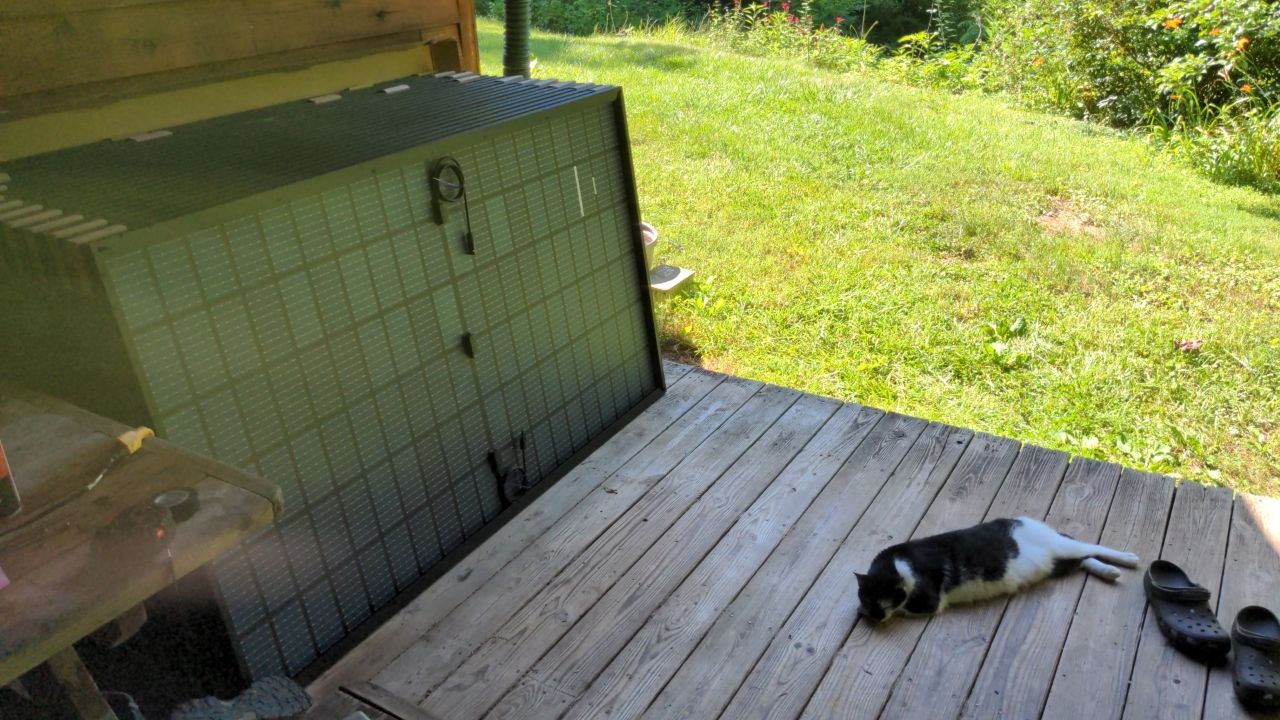
a porch with a a bunch of solar panels, stacked on edge leaning up against the wall. A black and white cat is sprawled in front of them.
In August I bought the EV and was able to charge it offgrid from my old solar system... a few miles per day on the most sunny days. In September and October I built a solar fence, of my own design.
Me standing in front of the solar fence, which is 10 panels long
For the past several weeks I have been installing additional solar panels on ballasted ground mounts full of gravel. At this point I'm half way through installing my 30 panel upgrade. The design goal of my 12 kilowatt system is to produce 1 kilowatt of power all day on a cloudy day in midwinter, which allows swapping between major loads (EV charger, hot water heater, etc) on a cloudy day and running everything on a sunny day. So the size of the battery bank doesn't matter much. Batteries are getting cheaper fast too, but they are a wear item, so it's better to oversize the solar system and minimize the battery. A lot of this is nonstandard and experimental. And that makes sense with the price of solar panels. It costs more to mount solar panels now than the panels are worth. And non-ideal panel orientation isn't a problem when the system is massively overpaneled. I'm hoping to finish up the install before the end of winter. I have more trees to clear, more ballasted ground mounts to install, and need to come up with something even more experimental for a half dozen or so panels. Using solar panels as mounts for solar panels? Hanging them from trees? Soon the wan light will fade, time to head off to the solstice party to enjoy the long night, and a bonfire.
Solar fence with some ballasted ground mounts in front of it, late evening light. Old pole mounted solar panels in the foreground are from the 90's.

20 December 2024

Michael Prokop: Grml 2024.12 codename Adventgrenze

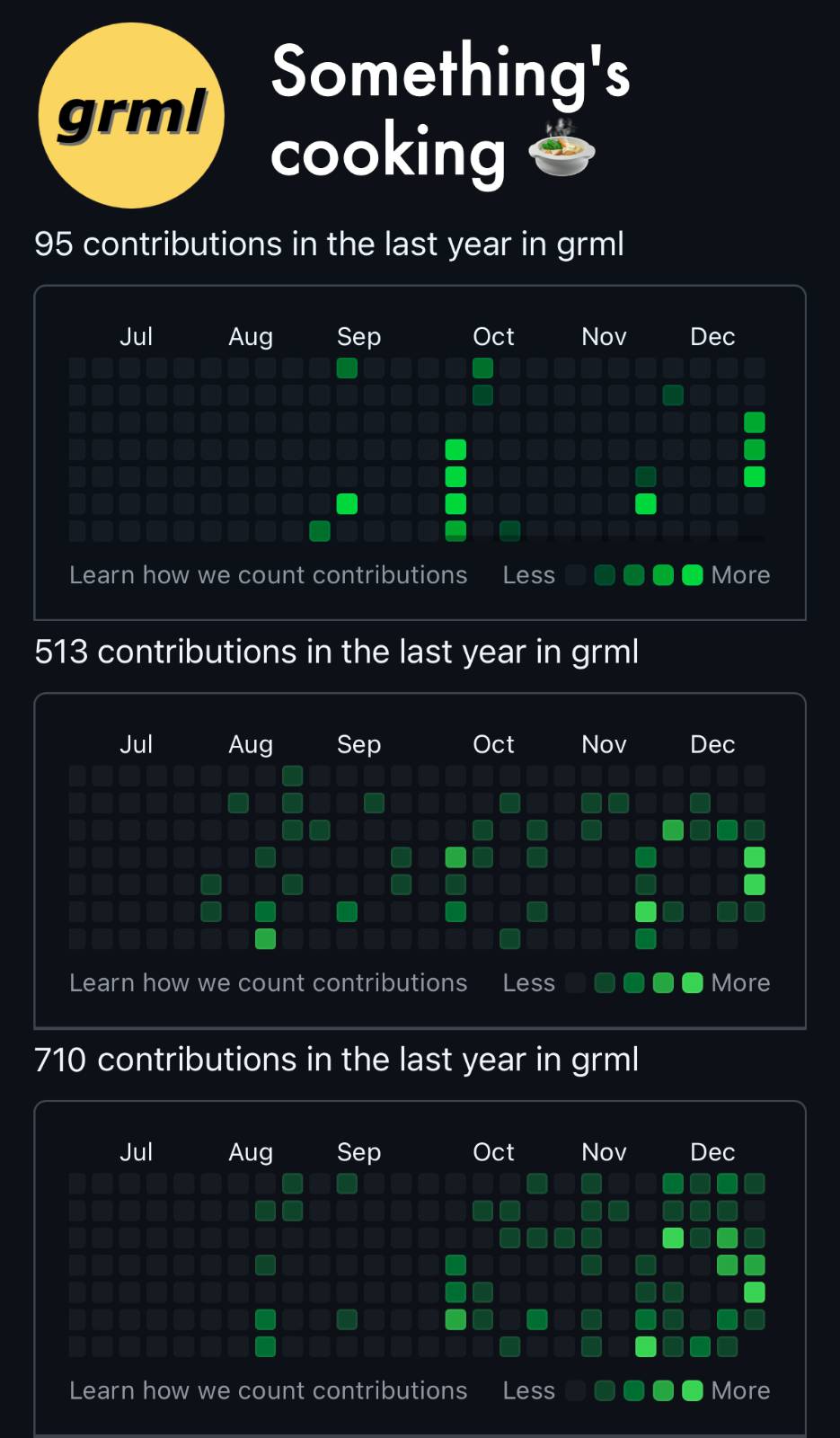
Picture with metrics of three user profiles on GitHub.com, with many contributions especially in the last quarter of the year We did it again ! Just in time, we re excited to announce the release of Grml stable version 2024.12, code-named Adventgrenze ! (If you re not familiar with Grml, it s a Debian-based live system tailored for system administrators.) This new release is built on Debian trixie, and for the first time, we re introducing support for 64-bit ARM CPUs (arm64 architecture)! I m incredibly proud of the hard work that went into this release. A significant amount of behind-the-scenes effort went into reworking our infrastructure and redesigning the build process. Special thanks to Chris and Darsha our Grml developer days in November and December were a blast! For a detailed overview of the changes between releases 2024.02 and 2024.12, check out our official release announcement. And, as always, after a release comes the next one exciting improvements are already in the works! BTW: recently we also celebrated 20(!) years of Grml Releases. If you re a Grml and or grml-zsh user, please join us in celebrating and send us a postcard!

Noah Meyerhans: Local Development VM Management

A coworker asked recently about how people use VMs locally for dev work, so I figured I d take a few minutes to write up a bit about what I do. There are many use cases for local virtual machines in software development and testing. They re self-contained, meaning you can make a mess of them without impacting your day-to-day computing environment. They can run different distributions, kernels, and even entirely different operating systems from the one you use regularly. Etc. They re also cheaper than cloud services and provide finer grained control over the resources. I figured I d share a little bit about how I manage different virtual machines in case anybody finds this useful. This is what works for me, but it won t necessarily work for you, or maybe you ve already got something better. I ve found it to be easy to work with, light weight, and is easy to evolve my needs change.

Use short-lived VMs Rather than keep a long-lived development VM around that you customize over time, I recommend automating the common customizations and provisioning new VMs regularly. If I m working on reproducing a bug or testing a change prior to submitting it upstream, I ll do this work in a VM and delete the VM when when I m done. When provisioning VMs this frequently, though, walking through the installation process for every new VM is tedious and a waste of time. Since most of my work is done in Debian, so I start with images generated daily by the cloud team. These images are available for multiple releases and architectures. The nocloud variant boots to a root prompt and can be useful directly, or the generic images can be used for cloud-init based customization.

Automating image preparation This makefile lets me do something like make image and get a new qcow2 image with the latest build of a given Debian release (sid by default, with others available by specifying DIST).
DATESTAMP=$(shell date +"%Y-%m-%d")
FLAVOR?=generic
ARCH?=$(shell dpkg --print-architecture)
DIST?=sid
RELEASE=$(DIST)
URL_PATH=https://cloud.debian.org/images/cloud/$(DIST)/daily/latest/
ifeq ($(DIST),trixie)
RELEASE=13
endif
ifeq ($(DIST),bookworm)
RELEASE=12
endif
ifeq ($(DIST),bullseye)
RELEASE=11
endif
debian-$(DIST)-$(FLAVOR)-$(ARCH)-daily.tar.xz:
curl --fail --connect-timeout 20 -LO \
$(URL_PATH)/debian-$(RELEASE)-$(FLAVOR)-$(ARCH)-daily.tar.xz
$(DIST)-$(FLAVOR)-$(DATESTAMP).qcow2: debian-$(RELEASE)-$(FLAVOR)-$(ARCH)-daily.tar.xz
tar xvf debian-$(RELEASE)-$(FLAVOR)-$(ARCH)-daily.tar.xz
qemu-img convert -O qcow2 disk.raw $@
rm -f disk.raw
qemu-img resize $@ 20g
qemu-img snapshot -c untouched $@
image: $(DIST)-$(FLAVOR)-$(DATESTAMP).qcow2
.PHONY: image

Customize the VM environment with cloud-init While the nocloud images can be useful, I typically find that I want to apply the same modifications to each new VM I launch, and they don t provide facilities for automating this. The generic images, on the other hand, run cloud-init by default. Using cloud-init, I can create my user account, point apt at local mirrors, install my preferred tools, ensure the root filesystem is resized to make full use of the backing storage, etc. The cloud-init configuration on the generic images will read from a local config drive, which can contain an ISO9660 (cdrom) filesystem image. This image can be generated from a subdirectory containing the various cloud-init input files using the following make syntax:
IMDS_FILES=$(shell find seedconfig -path '*/.git/*' \
-prune -o -type f -name '*.in.json' -print) \
seedconfig/openstack/latest/user_data
seed.iso: $(IMDS_FILES)
genisoimage -V config-2 -o $@ -J -R -m '*~' -m '.git' seedconfig
With the image in place, the VM can be created with
 qemu-system-x86_64 -machine q35,accel=kvm
-cpu host -m 4g -drive file=$ img ,index=0,if=virtio,media=disk
-drive file=seed.iso,media=cdrom,format=raw,index=2,if=virtio
-nic user -nographic
This invokes qemu with the root volume and ISO image attached as disks, uses an emulated q35 machine with the host s CPU and KVM acceleration, the userspace network stack, and a serial console. The first time the VM boots, cloud-init will apply the configuration from the cloud-config available in the ISO9660 filesystem.

Alternatives to cloud-init virt-customize is another tool accomplishing the same type of customization. I use cloud-init because it works directly with cloud providers in addition to local VM images. You could also use something like ansible.

Variations I have a variant of this that uses a bridged network, which I ll write more about later. The bridge is nice because it s more featureful, with full support for IPv6, etc, but it needs a bit more infrastructure in place. It also can be helpful to use 9p or virtfs to share filesystem state between the host the VM. I don t tend to rely on these, and will instead use rsync or TRAMP for moving files around. Containers are also useful, of course, and there are plenty of times when the full isolation of a VM is not worth the overhead.

19 December 2024

Gregory Colpart: MiniDebConf Toulouse 2024

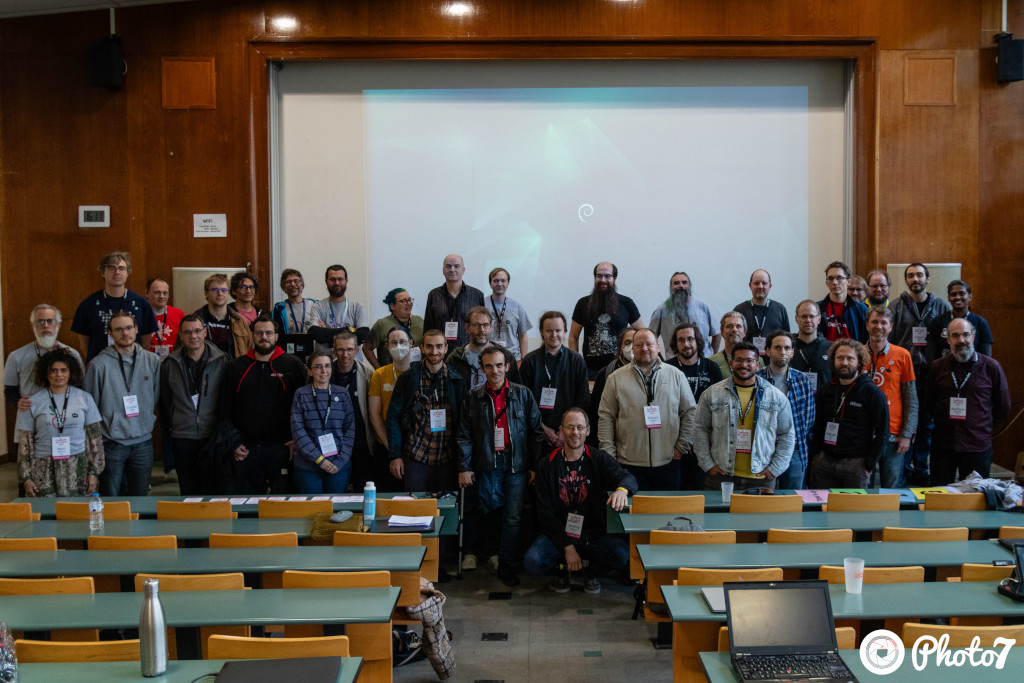
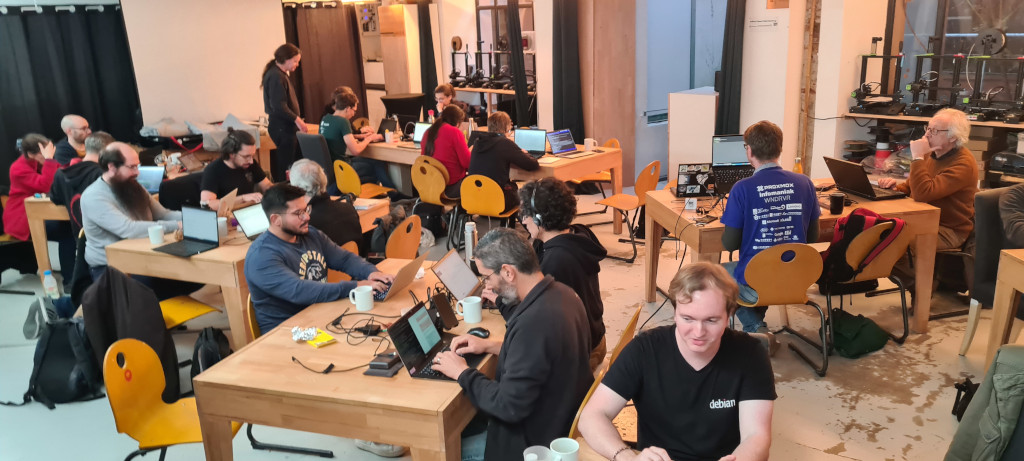
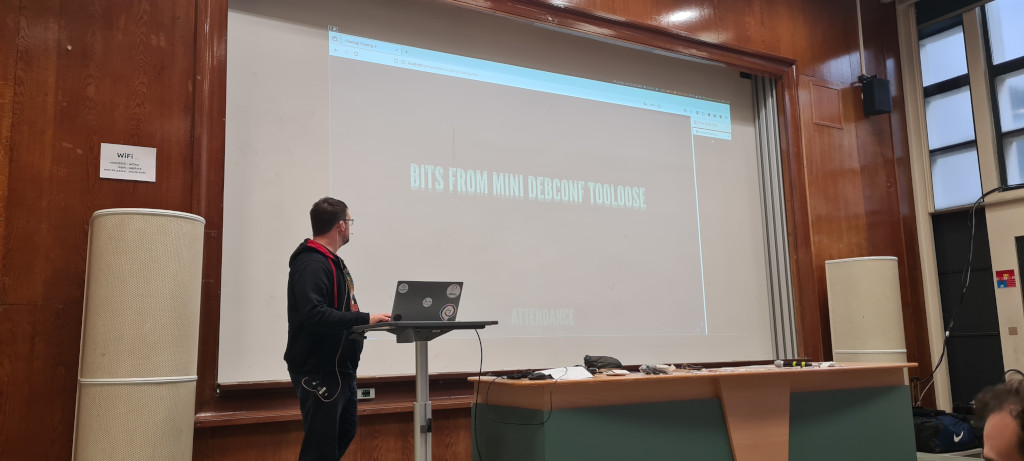
After the MiniDebConf Marseille 2019, COVID-19 made it impossible or difficult to organize new MiniDebConfs for a few years. With the gradual resumption of in-person events (like FOSDEM, DebConf, etc.), the idea emerged to host another MiniDebConf in France, but with a lighter organizational load. In 2023, we decided to reach out to the organizers of Capitole du Libre to repeat the experience of 2017: hosting a MiniDebConf alongside their annual event in Toulouse in November. However, our request came too late for 2023. After discussions with Capitole du Libre in November 2023 in Toulouse and again in February 2024 in Brussels, we confirmed that a MiniDebConf Toulouse would take place in November 2024! We then assembled a small organizing team and got to work: a Call for Papers in May 2024, adding a two-day MiniDebCamp, coordinating with the DebConf video team, securing sponsors, creating a logo, ordering T-shirts and stickers, planning the schedule, and managing registrations. Even with lighter logistics (conference rooms, badges, and catering during the weekend were handled by Capitole du Libre), there was still quite a bit of preparation to do. On Thursday, November 14, and Friday, November 15, 2024, about forty developers arrived from around the world (France, Spain, Italy, Switzerland, Germany, England, Brazil, Uruguay, India, Brest, Marseille ) to spend two days at the MiniDebCamp in the beautiful collaborative spaces of Artilect in Toulouse city center.
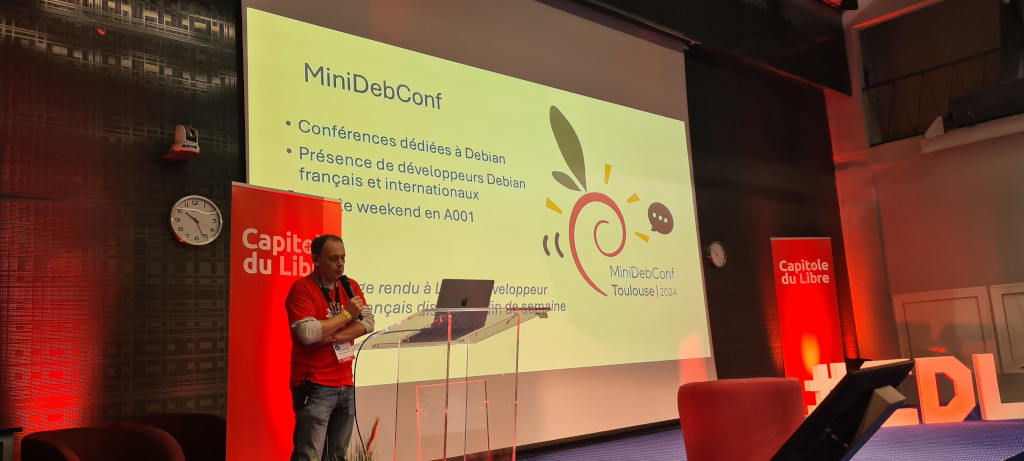
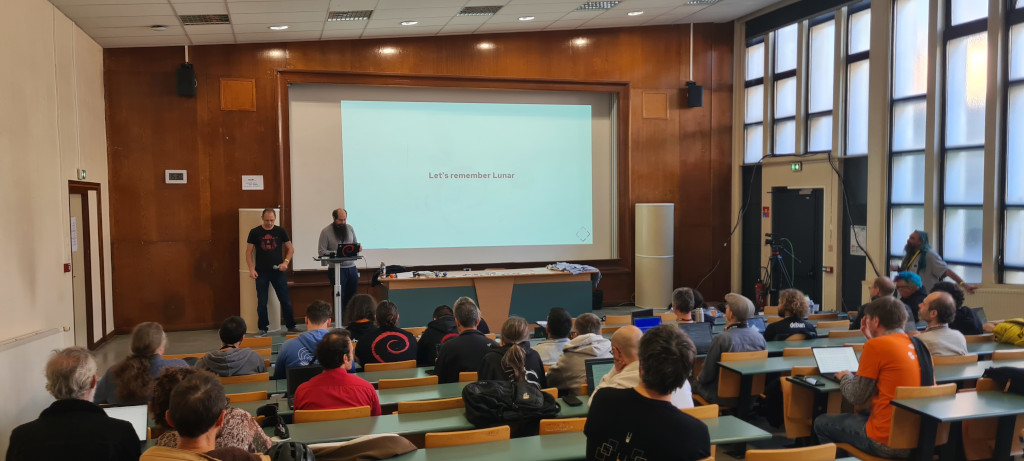
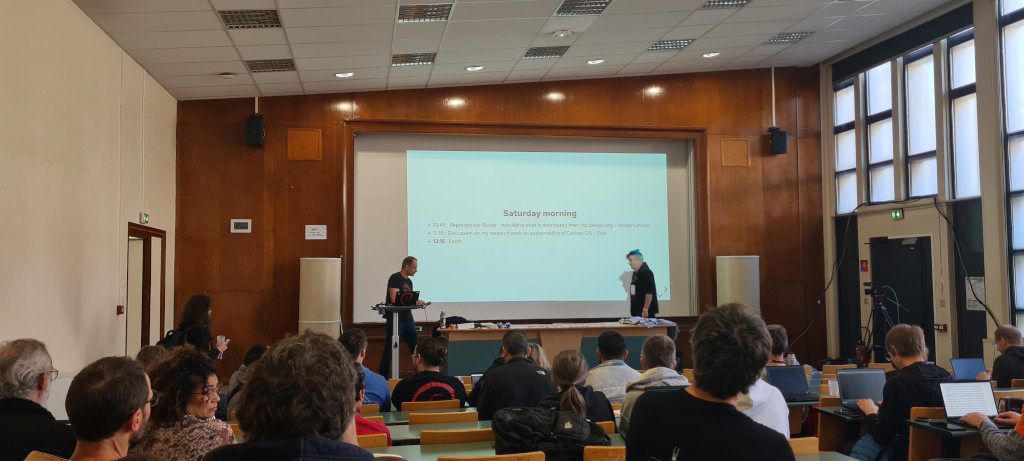
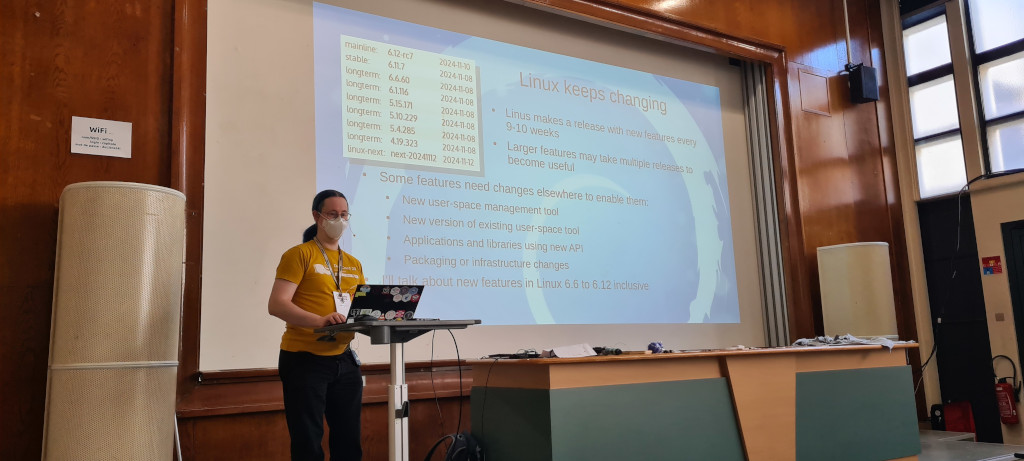
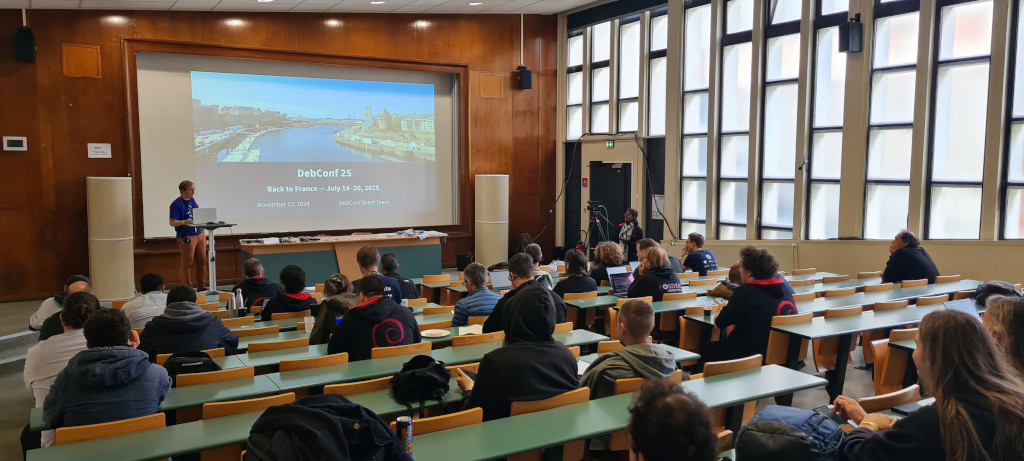
Then, on Saturday, November 16, and Sunday, November 17, 2024, the MiniDebConf took place at ENSEEIHT as part of the Capitole du Libre event. The conference kicked off on Saturday morning with an opening session by J r my Lecour, which included a tribute to Lunar (Nicolas Dandrimont). This was followed by Reproducible Builds Rebuilding What is Distributed from ftp.debian.org (Holger Levsen) and Discussion on My Research Work on Sustainability of Debian OS (Eda). After lunch at the Capitole du Libre food trucks, the intense afternoon schedule began: What s New in the Linux Kernel (and What s Missing in Debian) (Ben Hutchings), Linux Live Patching in Debian (Santiago Ruano Rinc n), Trixie on Mobile: Are We There Yet? (Arnaud Ferraris), PostgreSQL Container Groups, aka cgroups Down the Road (C dric Villemain), Upgrading a Thousand Debian Hosts in Less Than an Hour (J r my Lecour and myself), and Using Debusine to Automate Your QA (Stefano Rivera & co). Sunday marked the second day, starting with a presentation on DebConf 25 (Benjamin Somers), which will be held in Brest in July 2025. The morning continued with talks: How LTS Goes Beyond LTS (Santiago Ruano Rinc n & Roberto C. S nchez), Cross-Building (Helmut Grohne), and State of JavaScript (Bastien Roucari s). In the afternoon, there were Lightning Talks, PyPI Security: Past, Present & Future (Salvo LtWorf Tomaselli), and the classic Bits from DPL (Andreas Tille), before closing with the final session led by Pierre-Elliott B cue. All talks are available on video (a huge thanks to the amazing DebConf video team), and many thanks to our sponsors (Viridien, Freexian, Evolix, Collabora, and Data Bene). A big thank-you as well to the entire Capitole du Libre team for hosting and supporting us see you in Brest in July 2025! Articles about (or mentioning) MiniDebConf Toulouse:

Benjamin Mako Hill: Being a bread torus

A concerned nutritional epidemiologist in Tokyo realizes that if you are what you eat, that means
It s a similar situation in Seoul, albeit with less oil and more confidence.

18 December 2024

Simon Josefsson: Guix Container Images for GitLab CI/CD

I am using GitLab CI/CD pipelines for several upstream projects (libidn, libidn2, gsasl, inetutils, libtasn1, libntlm, ) and a long-time concern for these have been that there is too little testing on GNU Guix. Several attempts have been made, and earlier this year Ludo came really close to finish this. My earlier effort to idempotently rebuild Debian recently led me to think about re-bootstrapping Debian. Since Debian is a binary distribution, it re-use earlier binary packages when building new packages. The prospect of re-bootstrapping Debian in a reproducible way by rebuilding all of those packages going back to the beginning of time does not appeal to me. Instead, wouldn t it be easier to build Debian trixie (or some future release of Debian) from Guix, by creating a small bootstrap sandbox that can start to build Debian packages, and then make sure that the particular Debian release can idempotently rebuild itself in a reproducible way? Then you will eventually end up with a reproducible and re-bootstrapped Debian, which pave the way for a trustworthy release of Trisquel. Fortunately, such an endeavour appears to offer many rabbit holes. Preparing Guix container images for use in GitLab pipelines is one that I jumped into in the last few days, and just came out of. Let s go directly to the point of this article: here is a GitLab pipeline job that runs in a native Guix container image that builds libksba after installing the libgpg-error dependency from Guix using the pre-built substitutes.
test-amd64-latest-wget-configure-make-libksba:
  image: registry.gitlab.com/debdistutils/guix/container:latest
  before_script:
  - lndir /gnu/store/*profile/etc/ /etc
  - rm -f /etc/group
  - groupadd --system guixbuild
  - for i in $(seq -w 1 10); do useradd -g guixbuild -G guixbuild -d /var/empty -s $(command -v nologin) -c "Guix build user $i" --system guixbuilder$i; done
  - export HOME=/
  - export LANG=C.UTF-8
  - guix-daemon --disable-chroot --build-users-group=guixbuild &
  - guix archive --authorize < /share/guix/ci.guix.gnu.org.pub
  - guix archive --authorize < /share/guix/bordeaux.guix.gnu.org.pub
  - guix describe
  - guix package -i libgpg-error
  - GUIX_PROFILE="//.guix-profile"
  - . "$GUIX_PROFILE/etc/profile"
  script:
  - wget https://www.gnupg.org/ftp/gcrypt/libksba/libksba-1.6.7.tar.bz2
  - tar xfa libksba-1.6.7.tar.bz2
  - cd libksba-1.6.7
  - ./configure
  - make V=1
  - make check VERBOSE=t V=1
You can put that in a .gitlab-ci.yml and push it to GitLab and you will end up with a nice pipeline job output. As you may imagine, there are several things that are sub-optimal in the before_script above that ought to be taken care of by the Guix container image, and I hope to be able to remove as much of the ugliness as possible. However that doesn t change that these images are useful now, and I wanted to announce this work to allow others to start testing them and possibly offer help. I have started to make use of these images in some projects, see for example the libntlm commit for that. You are welcome to join me in the Guix container images for GitLab CI/CD project! Issues and merge requests are welcome happy hacking folks!

17 December 2024

Dirk Eddelbuettel: BH 1.87.0-1 on CRAN: New Upstream

Boost Boost is a very large and comprehensive set of (peer-reviewed) libraries for the C++ programming language, containing well over one hundred individual libraries. The BH package provides a sizeable subset of header-only libraries for (easier, no linking required) use by R. It is fairly widely used: the (partial) CRAN mirror logs (aggregated from the cloud mirrors) show over 38.5 million package downloads. Version 1.87.0 of Boost was released last week following the regular Boost release schedule of April, August and December releases. As before, we packaged it almost immediately and started testing following our annual update cycle which strives to balance being close enough to upstream and not stressing CRAN and the user base too much. The reverse depends check revealed six packages requiring changes or adjustments. We opened issue #103 to coordinate the issue (just as we did in previous years). Our sincere thanks to Matt Fidler who fixed two packages pretty much immediately. As I had not heard back from the other maintainers since filing the issue, I uploaded the package to CRAN suggesting that the coming winter break may be a good opportunity for the four other packages to catch up. CRAN concurred, and 1.87.0-1 is now available there. There are no other changes apart from cosmetics in the DESCRIPTION file. For once, we did not add any new Boost libraries. The short NEWS entry follows.

Changes in version 1.87.0-1 (2024-12-17)
  • Upgrade to Boost 1.87.0, patched as usual to comment-out diagnostic suppression messages per the request of CRAN
  • Switched to Authors@R

Via my CRANberries, there is a diffstat report relative to the previous release. Comments and suggestions about BH are welcome via the issue tracker at the GitHub repo.

This post by Dirk Eddelbuettel originated on his Thinking inside the box blog. If you like this or other open-source work I do, you can now sponsor me at GitHub.

Gunnar Wolf: The science of detecting LLM-generated text

This post is a review for Computing Reviews for The science of detecting LLM-generated text , a article published in Communications of the ACM
While artificial intelligence (AI) applications for natural language processing (NLP) are no longer something new or unexpected, nobody can deny the revolution and hype that started, in late 2022, with the announcement of the first public version of ChatGPT. By then, synthetic translation was well established and regularly used, many chatbots had started attending users requests on different websites, voice recognition personal assistants such as Alexa and Siri had been widely deployed, and complaints of news sites filling their space with AI-generated articles were already commonplace. However, the ease of prompting ChatGPT or other large language models (LLMs) and getting extensive answers its text generation quality is so high that it is often hard to discern whether a given text was written by an LLM or by a human has sparked significant concern in many different fields. This article was written to present and compare the current approaches to detecting human- or LLM-authorship in texts. The article presents several different ways LLM-generated text can be detected. The first, and main, taxonomy followed by the authors is whether the detection can be done aided by the LLM s own functions ( white-box detection ) or only by evaluating the generated text via a public application programming interface (API) ( black-box detection ). For black-box detection, the authors suggest training a classifier to discern the origin of a given text. Although this works at first, this task is doomed from its onset to be highly vulnerable to new LLMs generating text that will not follow the same patterns, and thus will probably evade recognition. The authors report that human evaluators find human-authored text to be more emotional and less objective, and use grammar to indicate the tone of the sentiment that should be used when reading the text a trait that has not been picked up by LLMs yet. Human-authored text also tends to have higher sentence-level coherence, with less term repetition in a given paragraph. The frequency distribution for more and less common words is much more homogeneous in LLM-generated texts than in human-written ones. White-box detection includes strategies whereby the LLMs will cooperate in identifying themselves in ways that are not obvious to the casual reader. This can include watermarking, be it rule based or neural based; in this case, both processes become a case of steganography, as the involvement of a LLM is explicitly hidden and spread through the full generated text, aiming at having a low detectability and high recoverability even when parts of the text are edited. The article closes by listing the authors concerns about all of the above-mentioned technologies. Detecting an LLM, be it with or without the collaboration of the LLM s designers, is more of an art than a science, and methods deemed as robust today will not last forever. We also cannot assume that LLMs will continue to be dominated by the same core players; LLM technology has been deeply studied, and good LLM engines are available as free/open-source software, so users needing to do so can readily modify their behavior. This article presents itself as merely a survey of methods available today, while also acknowledging the rapid progress in the field. It is timely and interesting, and easy to follow for the informed reader coming from a different subfield.

Next.

Previous.