Search Results: "Martin"

10 March 2006

Axel Beckert: Which SciFi crew would I best fit in?

In m³’s online pamphlete, I found a new quiz I immediately had to take:

Which sci-fi crew would you best fit in? Before taking the quiz I already wondered which possible answers it offers and what I’d expect as result. The only thing I knew so far was that The Matrix was featured in the quiz since m3 scored as Nebuchadnezzar. Farscape came to my mind. During the quiz some of the questions seemed quite obvious on which crew they would count resp. not count. Since I don’t like military, I knew that Star Trek crews won’t be on the top of my list… Well, it seems as if had guessed quite well:

You scored as Moya (Farscape). You are surrounded by muppets. But that is okay because they are your friends and have shown many times that they can be trusted. Now if only you could stop being bothered about wormholes.
Moya (Farscape)
88%
Babylon 5 (Babylon 5)
81%
Deep Space Nine (Star Trek)
75%
Serenity (Firefly)
69%
Enterprise D (Star Trek)
69%
Nebuchadnezzar (The Matrix)
69%
Millennium Falcon (Star Wars)
63%
Andromeda Ascendant (Andromeda)
56%
FBI's X-Files Division (The X-Files)
56%
SG-1 (Stargate)
56%
Bebop (Cowboy Bebop)
50%
Galactica (Battlestar: Galactica)
44%

Your Ultimate Sci-Fi Profile II: which sci-fi crew would you best fit in? (pics)
Created with QuizFarm.com.

Interestingly the Enterprise D from Star Trek TNG is also in the list and not that far down as I expected it. So there seems to be at least a slight correlation between what SciFi series/movies I like most (Farscape, Star Trek TNG and DS9, the early Star Wars movies, The Matrix, Babylon 5) and with which crew’s philosophy I agree most as well as which ships appeal most to me (Millennium Falcon, Moya and many ships from B5, TNG and DS9) and vice versa: I’m not that big fan of Battlestar Galactica nor Star Gate neither do I like the design of the ships showing up there. Another two things I noticed by this quiz: I should perhaps once have a look at Firefly which I haven’t seen yet nor do I know much about it. And I probably won’t find Cowboy Bebop that appealing if I would watch it once. BTW: Series I missed in the list: Star Trek TOS, SeaQuest DSV and Futurama.

9 March 2006

Gunnar Wolf: My view on DPLship

Several people's blogs have appeared recently in the planet with the different points of view on the different candidates and various rants regarding the DPL office - Well... This time I have not yet been able even to read the platforms of the different candidates (of course, I plan on doing it quite soon), but I follow the posts on the subject with interest. The most interesting post so far is Martin Michlmayr's - Of course, being an ex-DPL, there are important experiences he has that few people do.
A couple of days ago I was talking with one of the candidates with whom I have talked and worked in the past. My main gripe with the whole process is that, although as a project we need a leader, an easily identifiable single contact person who knows the teams, knows the people and can speak on the project's behalf, I have not seen much being done by the past DPLs towards the inside of the project. Of course, it's easy to bitch around when I sit in the comfortable silent majority most of the time - Currently I am devoting quite less time and effort to Debian than what I should, although it is true that setting up Debconf6 in Oaxtepec takes a _lot_ of time and that it will facilitate much more interaction between Debian people (which is good for the project) than me working more and better on my packages and on doing interesting team work.
Maybe something that would make me to vote for somebody, more than the most coherent and best written platforms, is for the candidate to admit the lack of importance of the role to most of the project - or to defend how to make it again a leadership position.
Following Martin's post, maybe we do need a Bruce-like leader who tells us what to do and drives the project. Or maybe not, maybe we could do better with reducing the importance of the post towards the inside and emphasizing it's mostly a confidence vote for somebody to speak on behalf of us all. And even this would be difficult, as a sad flame in debian-private some months ago reminds us that nobody can speak on behalf os the whole project because somebody might be offended by the viewpoint taken by the official?
I am no big believer in democracies. I do think that sticking to much to a democratic constitution (where democracies are very scarce in the Free Software world, where projects tend to have benevolent dictators grown by meritocracy instead of democratically elected) and allowing everybody to voice too much the same opinion in our regular flamewars has lead Debian to the communications swamp it is right now. We do have very effective small teams (quoting Andreas Schuldei' term for the phenomenon that seems to work best and appear naturally in our project), integration between teams is quite good... But having 1000+ people sitting in a big room and shouting at each other is plainly not fun. Maybe we should stop pretending that there is no cabal (forgod'ssake...) and admit that there is and it works, and we (the drones) implement Their decisions? Nah... That sounds it would only create more flamewars.
But seriously: Towards the inside, do we need a leader? Have we ever used it?

Ian Murdock: Well said

Martin Michlmayr: “I think that one of the biggest problems Debian is currently facing is the inability to make decisions. There are so many endless, completely futile (and repetitive) discussions going on. We need someone who comes in, tells people to shut up and makes a decision on behalf of the project. A decision people will follow, even if they personally disagree with it.”

Martin Michlmayr: The role of the DPL... and of you

Since Joey Hess posted a short conversation we had on IRC today about the role of the DPL, I thought it's a good time to express some of my thoughts. Basically, I think that most people have a bad understanding of which tasks are really involved in being DPL (e.g. much more purely administrative crap that nobody else wants to do) and that they're quite naive about what the DPL can achieve, at least in the current climate. Let's just look at the current discussions on the -vote list. It's this time of the year when everyone pretends that its Christmas, expresses their feelings of what's wrong with Debian and where Santa Claus^W^Wthe candidates reassure them that everything will be fine. "Will you fix NM? Fix or replace ftp-master? etc." "Oh, sure I will, all of that (and more)." Honestly, would you elect someone if they told you they won't or can't? The strange thing is that the same questions get asked every year, and yet people don't get the hint and look for other solutions. I'm not overly happy with any of the candidates this year, and I was seriously considering running again, not next year but possibly later. However, this Christmas wankfest reminded me again why that may not be such a good idea after all. I remember how much time I spent answering questions on -vote myself, and while I'm all for transparency, many of the questions were just a waste of time. This year, the questions were relatively sane in the beginning but now it's just a waste of time most questions are posed in a way that it's clear what kind of answer people want to hear. I spent hours and hours answering questions, but at some point I thought "cannot we just stop talking for hours about what I'd do if elected and actually start doing all that stuff?". That would have been so much more productive. Instead of asking the DPL what they'll do to solve All The Problems In Debian, why don't you ask yourself what you can do to improve the situation? There's a bottleneck with the DAM, you say. Right, the chances that you'll be added as DAM are relatively small. But have you ever considered helping the DAM and to make their life easier? How about signing up as an Application Manager and producing such good reports that it'll be a piece of cake for the DAM to approve people based on your reports? Right, it won't fix the bottleneck, but it will make the situation so much better. Instead of bitching about the security team, why don't you prepare a package, write the text for the DSA and get everything ready in a way that a DSA member can simply take your work, recompile the package and issue the advisory? Now I'm sure some people will say that they've tried that and failed. Yes, not every upload for DSA will be accepted as it is, but how hard have you tried? And people always complain about the cabal and how hard it is to join teams. And while I agree that this is partly true, there are so many counter examples too. Look at me as an example. In 2.5 years, I became the most productive Application Manager, joined (and took over) the NM Front Desk, became a "senior" Quality Assurance member, and got elected as project leader. Am I special? No, in no way I just put in a lot of effort. Look at Jeroen van Wolffelaar, who joined at the end of 2004, and who is involved in QA (especially MIA) and lintian, is the co-author of the new packages.d.o code and an ftp assistant. Andi Barth (who got an account in January 2004) has done important QA work (bts2ldap), is a maintainer of the developers reference and a release manager. So it's not possible to join a team, you say? Maybe you're just not trying hard enough (and the right way!). (Hint: "make me a DAM/ftp-master/whatever" doesn't work as well as "how can I make your job easier?"). What I'm trying to say is that people should stop believing that the DPL will fix everything and that they should actually help out themselves. If we all work together and put effort into the areas that need work we might actually achieve something. People have been asking for a strong leader and this urge got stronger over the last few years. But, face it, we currently don't have a culture which accepts a strong leader. Joey Hess mentioned that he wants to see a DPL who pushes technical changes. I did that too, to some degree (mostly in private since that works much better than on a mailing list where a big flamewar is guaranteed). For example, I kindly asked Joey to lower the priority of the non-free question so it would not get asked in a default installation. And he did because Joey is a reasonable guy. (He also told me that me making this request made it easier for him to justify.) However, unfortunately, not everyone is like Joey. And what are you going to do if a maintainer refuses to listen, as many do? I mean, seriously, what can you do? Some are increasingly talking about the good old times of Bruce Perens who would tell people what to do and make decisions. The urge for a strong leader increased over the last years. I think that's partly a reason why Branden got elected last year people expected him to completely shake things up. I haven't talked to him and I wasn't part of the leadership team, so I don't really know what happened, but from what (little) I've heard, it seems that he tried, quickly realized just how rigid some of the structures are and gave up. You have to see things in a historical perspective (and I can only recommend that people who have access to the debian-private archives take the time to read through them). There's a reason we have had "weak" leaders since Bruce. While now a large number of people think that Bruce was the best thing since sliced bread, lots of people were really pissed off back then with him commanding people around. And what was the result? A constitution that would ensure that no leader would ever have such power again. And that's what we're currently stuck with. I think that one of the biggest problems Debian is currently facing is the inability to make decisions. There are so many endless, completely futile (and repetitive) discussions going on. We need someone who comes in, tells people to shut up and makes a decision on behalf of the project. A decision people will follow, even if they personally disagree with it. But seriously, do you think our culture would currently accept such a leader? I can tell you from experience that even people who have been asking for a "strong" leader won't actually follow a leader who tells them to take a certain course of action. We really need to fix this problem, and the problem is in our culture. And since our culture is defined by who we are, you should start with yourself first. Start by asking yourself a few questions. Do you think before posting something to our lists, and ask yourself twice whether it really adds value to the discussion? If there's an area that is problematic, will you try to help out? If asked to do something you're not particularly interested in but which is good for the project will you do it? And most importantly, will you contribute to make our culture something that is fun? The project leader is important, but don't wait for them to fix all of our problems. If there's a problem, try to figure out a way how you can solve it!

Martin Michlmayr: FOSDEM 2006

FOSDEM is one of the events I really enjoy. Unfortunately, I couldn't attend last year because I was at a conference in China. However, this year I was back, and the event was bigger than ever. There's so much going on that it's really hard to keep up. There are a number of people I'd really like to have talked to more but there just wasn't time in those two days which were fully packed. It was nice to meet a number of people again, though, in particular the usual suspects, including Michi Banck (aka Hurd illusionist, "it supports two wireless cards now"), Guillem Jover (Spanish mafia boss living in exile), and Jordi Mallach ("World Domination for Catalan^WValencian"). I also hung around the Spanish free software research people with whom I'm going to spend a few months soon. Crazy Spaniards... I've no idea how I'm going to survive there. Oh, and Neal Walfield, who still stinks, and who thinks I have a British accent now (which he thinks is a bad thing while I took it as a compliment). Regarding new people, I had the great pleasure to meet and talk to Lennert Buytenhek. I talked to him on IRC a bit recently because he's involved in the big-endian ARM port and I've been hacking on the ARM based NSLU2 device. Lennert is quite frustrated because joining Debian is so hard. As it turns out, there's currently a six month wait to be assigned an Application Manager. I haven't really followed NM recently, but when I acted as Front Desk I tried to keep it less than approximately six weeks. Unfortunately, a great number of AMs resigned in the last few months and years, and it has been quite hard to find good new people as AMs. Lennert is the kind of person we really want to have in Debian since he's extremely kind, smart and productive. Given that the current situation seems really bad I decided to act as Application Manager again, but I only intend to do that temporarily. I'm sure I forgot lots of other things. But the summary is that it was a great weekend, with way too much stuff going on at the same time. And while I wish I could have devoted more time to my research, I gained some important insights and did one interview which was really informative.

4 March 2006

Michael Banck: 3 Mar 2006

FOSDEM 2006 This year, the days before FOSDEM were the stressful ones, as I got to organize accomodation. Initially, we wanted to have similar appartments as last year, but by the time I was less busy at uni to actually look into it, most of them were already booked, so we had to put up with a youth hostel instead. The positive sides of this were the much lower expenses and a location in the city centre, making us actually look at Bruxelles a bit in detail this time. "Us" were the Hurd people, including Martin "earliest Hurd adopter present" Michlmayr. I got to FOSDEM by car again, picking up Marcus Brinkmann, Neal Walfield and Olaf Buddenhagen on the way in Cologne. Finding the youth hostel seemed to be pretty hard as we just had a street address and a map without street names, but we managed to find it pretty quickly to my great surprise (driving around in Bruxelles usually ended up being a complete disaster over the last years). After a strange encounter with a Guillem Jover lookalike in front of the hostel, we met the other guys (Thomas Schwinge, Marco Gerards, Stefan Siegl and Ognyan Kulev) and had a discussion about Neal's and Marcus' plan to move to a persistent system. After dinner, I met the other Debian people in the Roi d'Espagne and hat some longer chats with Jeroen van Wolffelaar, Rob Bradford, Martin Michlmayr and Jordi Mallach, who I finally met for the first time and who did not cop out of FOSDEM this year as usual... The pub is getting more and more crowded each year, all the hackers barely fit even though they opened the balustrade this time as well. It was great to see everybody again and have a few beers. Martin and I then managed to find the way back to the hostel by foot. We had no developer room, and no talks in the Debian room either, so FOSDEM was a pretty relaxed event this year. I met some more familiar faces like Noel Koethe and Andreas Mueller and listened to a couple of talks, most notably Richard Stallman's and Jeff Waugh's keynotes and Hanna Wallach's talk about FLOSSPOLS. Stefan Siegl also managed to get GNU Mach working for both my 3Com PCMCIA NIC and my Orinoco PCMCIA WLAN card, confirming his title as Hurd "hacker of the month". On Saturday evening, we (at this time, Guillem Jover, Gianluca Guida, Bas Wijnen and Jeroen Dekkers had joined) had dinner with the french Hurd guys (Manuel Menal, Marc Dequenes, Richard Braun, Arnaud Fontaine and others) in an italian restaurant. At 10:40 PM, the waiter told us in a rather unfriendly tone that they would close at 11 and presented us with the bill, along with handing out the menu again so that we could look up our share. By the time the bill arrived the french part of the table (at 10:55 PM), the guys were pretty surprised by this whole business and complained loudly that they did not have a dessert yet and insistent on having one. After some more minutes of discussion, the waiter gave in and served their desserts, after which each of them paid his share with his carte bleue. I believe we left the restaurant around 11:30. On Sunday evening, we had dinner again (the french guys had left Bruxelles already) and then drove back to Germany after having desserts and coffee in a bar. We left Bruxelles at around midnight and arrived in Duesseldorf at 2:30 PM, so we were glad that Neal offered us to stay at his place. We had breakfast the next morning with him and Isabel and then I proceeded to drive back to Frankfurt in the early afternoon. FOSDEM rocked, as usual. After being with the Debian crowd for the first three years or so, and mostly sticking with the Hurd crowd last year, I think I managed a pretty good balance between the two this year. This will not have been my last FOSDEM.

2 March 2006

Jordi Mallach: FOSDEM 2006

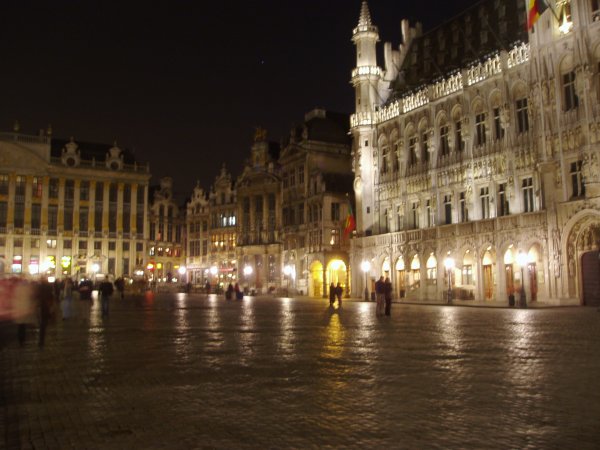
I'm so glad I finally decided to attend FOSDEM this year, as last weekend in Bruxelles was so cool it reminded me of the unforgettable week in Helsinki for DebConf 5 last summer. I travelled early on Friday with Ivan Vilata, the dude who dragged me into the Catalan translations world, and about 12:30 we were finding our way through Bruxelles airport. We had barely no problems getting to Ra l's place in Boulevard Louis Schmidt, thanks to the detailed HOWTO he provided a few days before. We dropped our bags in his appartment and went out with him and Virginia after a well deserved mini-nap. On our way to the Grand' Place, where we'd hook up with the Softcatal crowd and the rest of FOSDEM people, we stopped in A la Morte Subite, where we Ivan and I started our personal training on Belgian beers. The Roy d'Espagne is an excellent name for a place where to meet our friends from Catalunya. I didn't know that was a formal meeting point that kickstarts FOSDEM, so I was really impressed when I got to the second floor and found the place was packed with Free Software people, many of them I already knew in person. Reaching Softcatala's table near the window took about 15 minutes, and after saying hi to most people, we decided we could use a quieter place to have dinner, and then go back.


The Grand' Place was bombed by seb128 in 1695 Ra l and Virginia, our official guides during the weekend, chose a Vietnamese restaurant in the Stock Exchange area they frequent, and for little money we got an enormous meal. Back at the Roy d'Espagne, I tried to say hello to most Debian people I saw around, while at the same time I tried to be with my hosts and the Catalan people. A while after, I spotted tbm and azeem downstairs, who I finally met. I talked to Michael for a long while, and at some point we left as we didn't want to miss the last tram. Ivan, luckily, only snores rarely, so we slept for a while, and then took the tram to the Universit Libre du Bruxelles. The main room was already packed for RMS's keynote, which was pretty good. After that, we went to several talks here and there, while I kept meeting some people around the place. Ivan and I left when the show ended and we met with Virginia and Ra l at the centre. This time, we hooked up with Xevi and Jes s Corrius from Softcatal , as Toni Hermoso had abandoned us for a cheap dinner with the Mozilla.org people. We were taken to a packed bar/restaurant (don't remember the name right now), which had a few interesting features: they wouldn't sell any Coca-Cola, would not accept credit cards in protest for the high fees Visa charges on small businesses, and something I wouldn't expect to see in 2006, their chart of prices hadn't been rounded up when they switched to the Euro. So some plate would be 9.72, others 12.43, etc. After dinner we had a few beers at the Th atre de Toone, located in some tiny alley in the centre and being pretty tired, we went back home at 23:30 or so. Sunday was a busy days, due to the number of interesting Debian and GNOME talks going on. I'd highlight liw's talk on Piuparts, Enrico's on debtags and fjp's on Debian Installer in the Debian room, and kris' on the future of GTK+. There was also a cool demo of Novell's XGL. During a dead slot, I approached Little Daniel and keithp to see if he could point me at some mapping between UTF-8 and XKB symbol names. But Daniel was cool enough to solve a problem a lot simpler than expected. :) jdub's closing talk was just fantastic, and telling him "See you in Vilanova, we left the University, for our last dinner around Bruxelles.


jdub clues the audience about some basic acronyms We managed to rescue madduck from the Debian UK beer trap and went to an Italian for dinner, this time with Josep and Mia, from Softcatal , making a nice mix of German, Valencian/Catalan, and Swedish at our table.


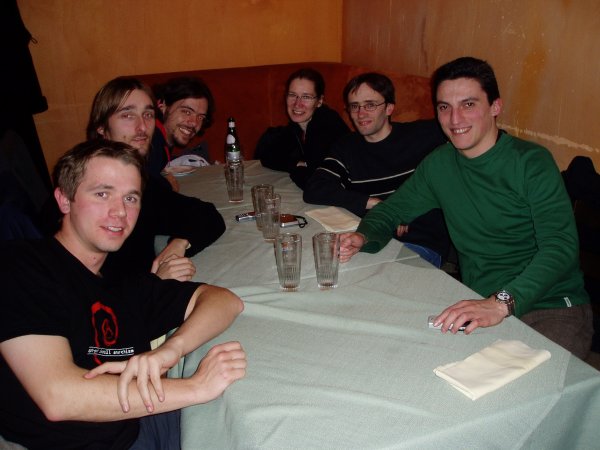
Mia, Josep, Ra l, Ivan, Martin and Jordi after pizza Ra l took us around the city centre and told us about the underground river, the remaining city wall's tower, and the church that leaned against it. That night's beer lesson happened in the "2000 beer bar". We all had a 7 Trappist Westvleteren Bleu 8, apparently "the best beer of the world". It was pretty good, actually. Our weekend in Bruxelles was about to end. After not that much sleep, Ivan and I took a tram and a bus to the Airport, arriving in Val ncia around 10AM, and after seeing the best view of the Pyrenees ever, which were absolutely covered with snow, as well as many other places in the Pa s Valenci and Teruel due to massive snows during the two days we were out. FOSDEM is probably a "can't miss" yearly event now. Thanks to all the organisers for their hard work to make it happen. You rock.

Martin F. Krafft: Social money stuff

You probably hate debts between friends just as much as I do. A friend from college has gone out to solve the problem at BillMonk, a free service which still lacks some functionality I want, but otherwise is very usable. I'll stick with it for a while to see how responsive the "Code Monks" are to the countless emails I sent today. :) On my wishlist:
  • repeating shared bills
  • debt summary converted to default currency
  • SMS service for Europe
  • online payments without it trying to be a bank (like Paypal)
  • automatic regular reminders
  • less of an American interface. "IOU" is incredibly lame, especially if most people "O" me.

Martin F. Krafft: 500% cable service

In my mailbox this morning I found a letter from my provider, Cablecom. No advertisements, no annoying crap, just a note that reads:
Thanks to our highly scalable cable network, we can upgrade your connection from 600/100 to 3000/300 in June without charging you any more.
That's good news, and it's a light at the end of the tunnel to witness companies who don't make you feel like signing a contract is the same as signing your own death warrant. NP: following Ross' passive advice.

Martin F. Krafft: KLM / Air France, or: yet another failure to care for clients

Another airline rant... back when we went to Tanzania, we flew KLM and Kenya Airways, both partners of the Air France "Flying Blue" frequent flyer programme. Our itinerary was Zurich -> Amsterdam -> Kilimanjaro -> Nairobi -> Amsterdam -> Geneva, which is quite a bunch of miles, so we chose to apply for membership and sent in the boarding cards via snail mail to the French Flying Blue office -- Air France seems to be in charge -- to get the miles credited. We never heard from them, and the miles were not credited. The total of miles we are supposed to get would be enough for two free European flights, reason enough for me to follow up. Since the only means of contact they provide is a web form (an alarming trend everywhere), I took on the pain to submit it. I also linked to a PDF of the letter I sent along with the boarding passes. No reaction. I filled the web form out again about a month later and also sent a note to the customer care department. No reaction, despite the confirmation page telling me I would be contacted within 48 hours. Six weeks passed and I tried again. This time I actually managed to dig up a phone number, which I called in addition to submitting the form again and contacting customer care. I was promised someone would get in touch with me. No reaction from any of the three. Also, noone ever picked up the phone behind the number I found ever again (I tried two dozen times or so). Checking my web server logs, I know that the PDF I linked was never downloaded. Today, more than 6 months later, I received three letters from Flying Blue. Every single one contained a new member card with a note that made it seem as if I applied for a replacement for a lost card. The dates on the letters correspond roughly to my attempts to reach customer support. All envelopes are postmarked end of February though. Seems like Flying Blue has some serious internal problems, and that's apart from the people working there, who are apparently so stupid (or trained) to answer any request with a replacement card. Reading the request is prohibited by company policy. I am giving up, and I shall definitely avoid Flying Blue partners in the future. It isn't the first time that Air France let me down.

Martin Michlmayr: MIPS fun, Broadcom quad-core 1480 board

As I mentioned on debian-project recently, Broadcom has been very supportive of our MIPS port. They donated several fast MIPS development boards (dual-core 800 MHz) to a number of Debian developers as well as machines for our mips and mipsel buildd network. Without those boards, we'd have a hell of a time keeping up and certainly wouldn't meet the Vancouver requirements. Broadcom recently released a new chip, the 1480, which is a quad-core CPU, and I managed to get hold of a development board based on this chip. I had some trouble with FedEx because they weren't sure how to handle a shipment worth several grant to an individual who is a volunteer working on a project which legally doesn't exist in the UK. However, the FedEx lady was really nice and said she'd sort it out... and the next day the board turned up. Unfortunately, SMP support in the MIPS kernel was broken so I was only able to run the board in non-SMP mode: it really sucks having a quad-core CPU and then you can only use one core! There were also DMA errors when using an IDE PCI card. Fortunately, the SMP problems got solved in the meantime, and using the generic IDE driver works. Now that I have the board running, I compiled GCC 4.1 and my next step will be to build the Debian archive to see how well GCC 4.1 work on MIPS.

1 March 2006

Martin F. Krafft: Ubuntu ShipIt

I ordered a bunch of Ubuntu CDs on 13 Feb 2006. Today I was running errands all morning when I got a call from TNT telling me about an urgent shipment. I wasn't expecting anything urgent really, but briefly stopped over back home for an hour to receive it: Ubuntu CDs. The package weighs about 4 kg and was delivered from the Netherlands with Next Morning Delivery. I imagine such an international shipment must have cost a fortune -- I once spent 110 to have a single DVD delivered from Switzerland to Germany by the next morning. So now I have the CDs in my hands, more than two weeks after I ordered them. I do not criticise ShipIt for taking so long to review and approve my request (really not). But wouldn't it make sense to choose the carrier method according to the processing speed of the rest of the order handling?

28 February 2006

Martin F. Krafft: It's the time again ...

... of hundreds of emails on debian-vote. Having met all the candidates I'd consider in person makes it a real exciting vote for me. Let the games begin! :) I have been asked to nominate myself -- a little more than I'd expected. Apart from my hands certainly not capable of meeting my talkativeness on certain topics (yet), and this Ph.D. plan of mine, I did not feel it was right: there is still a bunch to be done and thought through before I could consciously ask myself the question whether I'd want to run for DPL or not.

Lars Wirzenius: Travel report: FOSDEM 2006

I went to FOSDEM in Brussels for the weekend. I had a great time. Some scattered notes:

27 February 2006

Martin F. Krafft: FOSDEM 2006

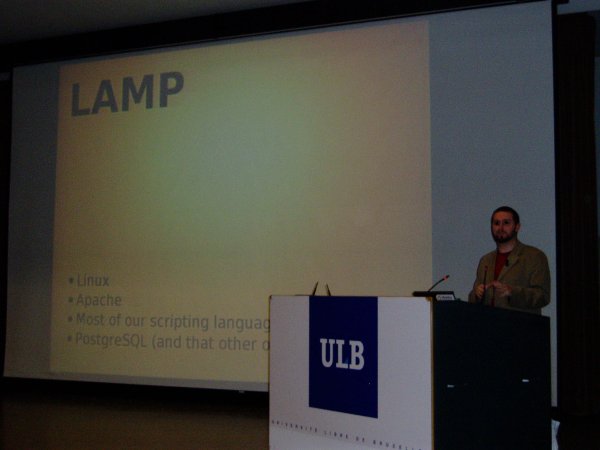
FOSDEM 2006 is over, I am now sitting at one of the weirdest airports I have seen so far: passages are intertwined and long, and it seems like you have to walk several hundred kilometres in circles before you finally end up at the place you ned to go to. I gave a talk Saturday on my Ph.D. research. Having spent almost an entire week preparing it, which involved rethinking my topic, the approach, and fighting doubts several times, I was all too pleased that a new aspect of my research was dawning upon me just in time to change a lot of the slides around a bit on the plane from Zurich. Even though my goal is to work a lot on Debian, I think the question on which I really want to concentrate is along the lines of "how to get volunteers to adopt new models and methods." Debian seems like a perfect environment in which to search for an answer, but I assume I shall also be looking around the Zope and Plone communities. Unfortunately, my talk didn't go as well as I had hoped. Part of it was on the Debian security situation, and having talked to a couple of people up front, and receiving even more feedback to my online personna, which apparently sometimes misrepresents my intentions, I took specific care to do with the delicate topic of Debian security with utmost care (and I think I succeeded; oh, and as a German I have a right to run-on sentences...). As a result though, I lost about 10 minutes of time, and additionally, I got confused about the length of my talk slot somewhere in the middle of the talk. So after giving an overview of my research idea, model, and approach, and the security situation, and just before coming to the exciting meat on possible extensions to Debian package management and the upload process which are geared to making it easier for others to contribute, h01ger kindly pointed out I had 10 minutes (not 25) left, a bunch of people walked into the room, generating noise and switching lights on and off, and on top of it all, OpenOffice crashed with the remainder of my slides -- those that contained graphs and other means to convey the complex ideas I was about to introduce. So everything seemed to be going wrong. I tried to give brief overviews of the ideas from the top of my head, but I didn't manage to piece together all the details that made the ideas interesting in a Debian context, and how the approach differs from Ubuntu's Launchpad and their new tool hct. So at the end of the talk I felt like I hadn't persuaded anyone of anything. Oh well. I was down for a while afterwards, it's been a long time since I felt a talk of mine failing as I did this time, and it wasn't until Hanna and some others consoled me by mentioning that they appreciated the contents I did convey (especially the security stuff), and quite a bunch of people found me afterwards with questions, suggestions, and comments. My slides are available online (~ 4.3 Mib) and I am looking forward to your feedback. I apologise for the size of the PDF and herewith promise never to use OpenOffice.org again. A bzip2-compressed version is available here (~ 1.4 Mib). Saturday night then ended with dinner and a bit of beer drinking, but noone was really up for anything more after the excessive opening party the night before. Sleep. Sunday morning, my laptop was still frozen by OpenOffice, and I rebooted it to find myself dumped into busybox as /dev/hda5 (my root) didn't exist. I quickly found the problem to be a missing udevd and udevsynthesize in the initramfs, but I did not manage to bring the system back up until Tollef gave me a hand to get pivot_root to do what it was supposed to do. Here's approximately how:
busybox mknod /dev/hda5 b 3 5
mount /dev/hda5 /root
mount -o move /sys /root/sys
mount -o move /proc /root/proc
chroot /root /sbin/udevd --daemon
chroot /root /sbin/udevsynthesize
exec run-init /root /sbin/init 2 < /root/dev/console > /root/dev/console
While we were at it, Daniel Silverstone showed us a wonderful way to help debug problems of this sort: /usr/bin/open. If bash only has /dev/console, it won't enable job control. This is exactly where open comes in:
/root/usr/bin/open /root/bin/sh
This will put an interactive shell on the next free tty with job control and all. Thanks, Daniel! I think that the above approach actually failed in the end for some weird reason we did not investigate further, so Tollef resorted to fixing the initrd instead:
update-initramfs -c -t -k 2.6.15-1-686
The important part is -t, which essentially redoes the filesystem so that custom changes are undone. I hadn't made any custom changes, but from the point of view of initramfs, I had deleted the udev binaries. Within an hour I had a working system again, and a
dpkg-reconfigure linux-image-2.6.15-1-686
zcat /boot/initrd.img-2.6.15-1-686   cpio -t   grep udev
verified that the problem was only intermittent (I rarely reboot my laptop but update it often). The T-Shirts Uncle Steve and I were selling pretty much all found new owners. This is great because I had been sitting on about a dozen shirts in XS and XXXL, and I thought I'd never get rid of them. Unfortunately, I sold them at no-profit, but given it was the last batch from Kernel Concepts, I am now thinking of arranging something with Steve to get a bunch of his shirts (which are nicer anyway). With talks coming to an end that day, everyone's departure was a stressful time and I was all the more glad to have had another night to spend in the city. I linked up with Jordi and some of the Debian Catalan people who were staying with a friend, Raoul, in the city. Raoul took us around a bit, showed us some of the historic sites in the centre of the city, and finally lead us to the bar of 2000 beers, where supposedly "the best beer of the world" was served: Trappist Westvletern Bleu 8. We ended the night around midnight for our flights were in the early morning. This having been my first FOSDEM, it was a great experience and I shall definitely try to be in Brussels again next year. Thanks to Wouter and all others who have helped out. Update: My slide links were previously not working. Thanks to all who pointed that out to me. They are fixed now. See above.

26 February 2006

Wouter Verhelst: FOSDEM after saturday

This year's FOSDEM is a success again. Well, at least the Debian side of things—I wouldn't call the network a 'success' this year. But, well; they do their best, I'm sure. For me, personally, the weekend has also been a bit less of a success. On the early bird's meeting at the Roi d'Espagne, on Friday Night, I overdid it on my voice a bit; the result is that my voice was declining all the time on Saturday, until all I could do was barely something more than a whisper. I'm afraid today isn't going to be any better—on the contrary. I think I'll have to find someone else to moderate the talks at FOSDEM. I myself don't have the ability anymore in my current state. Volunteers to do this, please talk to me when you see me. But, like I said, the Debian side of things is doing quite well. Frans Pop set up a babelbox installer demo, which seems to be a success. There are T-shirts and other things being sold at the booth, and they are rather popular, I understand. And the three talks we've seen yesterday—Jeroen van Wolffelaar and Enrico Zini about Project SCUD, Martin F. Krafft about his Ph.D thesis, and Lars Wirzenius about piuparts (sorry, the Finnish Inquisition) were rather successful, with lotsa people attending. Especially Lars' talk. But it's time to go now. On to another exiting day of FOSDEM! hmm, that was a lame sentence. Let's try again. But it's time to go now. Oh, and did I mention that Lars' talk was great? Funny, informative, to the point. Just the way a talk should be. See you in a few hours.

23 February 2006

Martin F. Krafft: Google pages

So Google now has a service for creating homepages. The generated pages are advertised as XHTML 1.0 Strict, but they do not validate as such. Why do they bother pretending XHTML-compliance? Is it l33t to advertise XHTML? So please, Google, if you read this: This is called divitis and apart from being pointless, it's also semantically wrong. div is to be used for divisions and it's a block element per default:
<h1 id="page-title"><div id="g_title">My title</div></h1>
<p class="description"><div id="g_description"><p>My description</div></p>
Another form of divitis is found in the way Google does layouts, although they should be applauded for refraining from the use of tables! There is rarely ever a reason for the br tag in most texts. Specifically not when it occurs like this:
<p>My paragraph<br></p>
Silliness aside, the tag isn't closed, as XHTML tags have to be. The same applies to hr, which should be (note the slash):
<hr/>
And finally, please put CSS into separate files so they can be properly cached. It's alarming to see the Web 2.0 starting off just like the Web 1.0, with the exception that we now actually have the standards in place, but when noone knows and obeys them, it's just about the same as if there weren't any.

22 February 2006

Martin F. Krafft: The market niche

I have open support tickets with e.g. Lufthansa and GMX. In both cases, I provided all information I had about a problem with their site in response to my request to give them money for their services. In both cases, I had to go through the inconvenient means of a web formular, for other means of contact aren't available. I also had to fill out contact information with required fields, even though I was logged in. In both cases, I got back a reply telling me that they could not support my inquiry "at the time", I should instead call a 0900 number (expensive) for support (which I cannot anyway, 0900 is blocked pretty much everywhere these days, at least on my slice of the sphere). In both cases, I wondered why people haven't seen this obvious market niche: use the Internet and cheap hardware to offer service at a modest price, and then treat your customer as an asset, returning phone calls if that seems like the logical next step. Or alternatively, put some clueful people behind your customer ticket system. You know, I'd pay for that (rather than for being told 10 minutes into the 0900 call that they cannot help me "at the time").

Martin F. Krafft: Gr fin Mariza in Budapest

I saw the operetta Gr fin Mariza by Emmerich Kalman tonight in Budapest. It was an awesome performance with great dance elements and a lively audience -- quite unexpected for someone who knew only stiff German and Austrian operas. Seeing the piece really lit up a flame for the Hungarian culture. I am glad I have the entire weekend left in this city!

Martin F. Krafft: Twice

Today (okay, it's past midnight, but tomorrow starts when I get up), my day was made not once, but twice by percussionists (and Boing Boing). Update: I'll raise you Virgil Donati, IMHO the best technical drummer on earth (while Phil Collins remains my favourite), with this solo, which ends like that. Here is more if you dare. I challenge any video codec to be fast enough to accurately picture Virgil in action.

Next.

Previous.