Search Results: "tar"

20 October 2007

Norbert Tretkowski: MySQL Proxy for Debian

Last night I prepared a Debian package of MySQL Proxy. It still lacks an init script and a manpage, but beside that it works fine. I plan to finish and upload the package to unstable within the next days.

For details about using MySQL Proxy read Getting Started with MySQL Proxy by Giuseppe Maxia.

John Goerzen: Short-Term Thinking

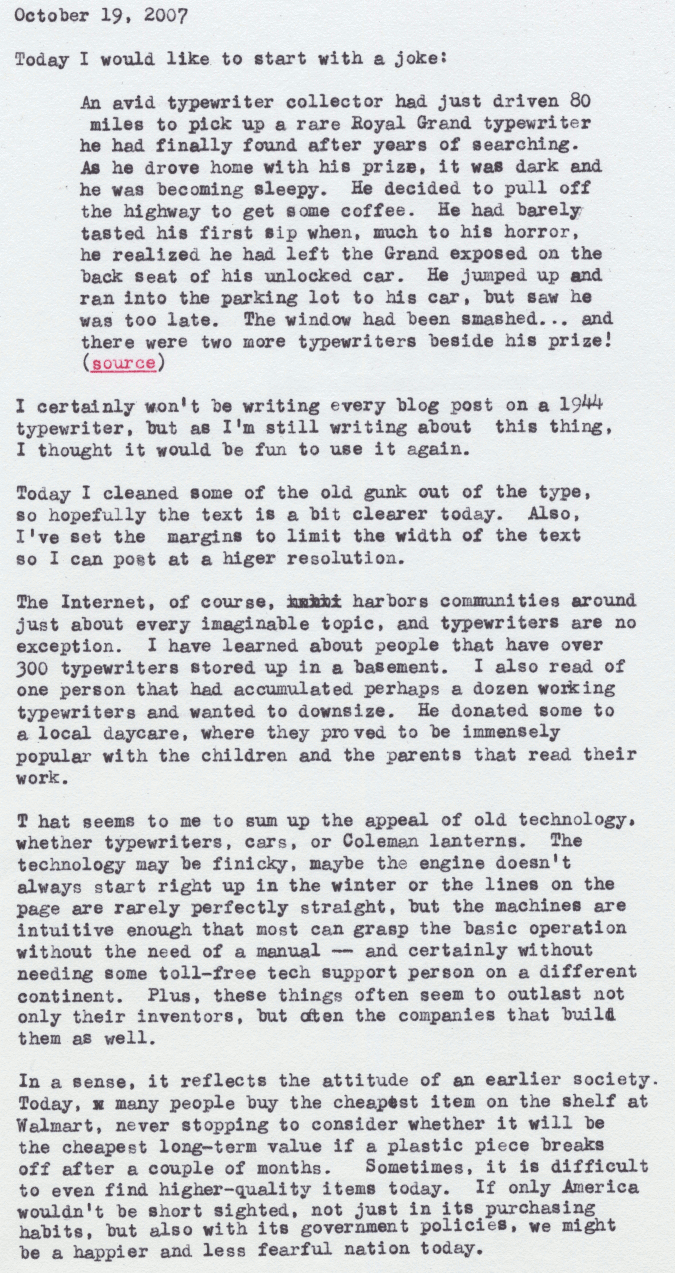
Today I would like to start with a joke:
An avid typewriter collector had just driven 80 miles to pick up a rare Royal
Grand typewriter he had finally found after years of searching.  As he drove
home with his prize, it was dark and he was becoming sleepy.  He decided
to pull off the highway to get some coffee.  He had barely tasted his first
sip when, much to his horror, he realized he had left the Grand exposed on
the back seat of his unlocked car.  He jumped up and ran into the parking
lot to his car, but saw he was too late.  The window had been smashed...
and there were two more typewriters beside his prize!
I certainly won't be writing every blog post on a 1944 typewriter, but I'm
still writing about this thing, I thought it would be fun to use it again.
Today I cleaned some of the old gunk out of the type, so hopefully the
text is a bit clearer today.  Also, I've set the margins to limit the width
of the text so I can post at a higher resolution.
The Internet, of course, harbors communities around just about every
imaginable topic, and typewriters are no exception.  I have learned about people that have over 300 typewriters stored up in a basement.  I also read of one person that had accumulated perhaps a dozen working typewriters and wanted to downsize.  He donated some to a local daycare, where they proved to be immensely popular with the children and the parents that read their work.
That seems to sum up the appeal of old technology, whether typewriters, care, or Coleman lanterns.  The technology may be finicky, maybe the engine doesn't always start right up in the winter or the lines on the page are rarely perfectly straight, but the machines are intuitive enough that most can grasp the basic operation without the need of a manual -- and certainly without needing some toll-free tech support person on a different continent.  Plus, these things often seem to outlast not only their inventors, but often the companies that build them as well.
In a sense, it reflects the attitude of an earlier society.  Today, many people buy the cheapest item on the shelf at Walmart, never stopping to consider whether it will be the cheapest long-term value if a plastic piece breaks off after a couple of months.  Sometimes, it is difficult to even find higher-quality items today.  If only America wouldn't be short sighted, not just in its purchasing habits, but also with its government policies, we might be a happier and less fearful nation today. flickr page

Andrea Veri: BehindMOTU: My interview

Original post can be found here. Interview: Today we are interviewing Andrea Veri, fresh MOTU and eager Ubuntu volunteer. Age: 18
Location: Udine, Italy
IRC Nick: bluekuja How long have you used Linux and what was your first distro?
I started using Linux at the end of 2005 using Red Hat and Fedora distros, contributing on writing several pages for Fedora documentation (mostly server docs) but mainly working on some packaging-related activities (introducing ctorrent, gtorrent-viewer and v2strip packages inside Fedora) for more than 3 months until the beginning of March 2006 when I decided to move definitely to Ubuntu after discovering it at a friend s party. Was love at first sight that made me leaving every Fedora plan and project creating my first personal wiki page on wiki.ubuntu.com some days later. How long have you been using Ubuntu?
In fact, I started using Ubuntu at the beginning of 2006, firstly getting involved inside the Edubuntu family making real the possibility to have an Edubuntu Italian support and website area inside the current Italian LoCo Team. When did you get involved with the MOTU team and how?
Right after joining the Ubuntu brigade I started checking out MOTU documentation, mainly packaging guide plus debian new maintainer s guide, trying to understand every single new word and applying directly to a source package every lesson learned during developer s world travel . After getting introduced and fascinated from an active community, I had to left the project for a while for some small problems, restarting everything on May 2007 with my first sponsored upload inside the archive. My packaging passion increased right after meeting Alexander Sack inside #ubuntu-mozillateam irc channel some days later, deciding to work directly with him as my mentor for both Debian and Ubuntu distributions. What helped you learning packaging and learning how the Ubuntu teams work?
I started with Debian New Maintainer s guide and Ubuntu s packaging guide moving then to package my first applications learning from already-packaged software and asking if needed to Alexander improving and learning every time from him or from other developers a new Ubuntu Team lesson. Favorite part of working with MOTU?
Introducing a fix making tons of users happy is one of the best things I appreciate of being a MOTU. Mentoring, sponsoring, helping out new contributors or students is something special as well. Any advice for people wanting to help with MOTU?
I always suggest to start with a package a new contributor cares about personally, that s useful to improve/fix the package itself during its maintenance.
Reading MOTU and Debian documentation is a great starting point as well to avoid any strange question on our MOTU irc channel. What packages/areas of Universe are you most interested in?
I m currently working on a vast area of packages, but I ll try to focus on p2p (Peer-2-Peer) applications both for Universe and Main. I planned to create a MOTU-p2p team really soon including it inside the existing motu-torrent team, but it will take some months to organize everything up; contributors (testers/packagers) are currently missing. Any Plans for Hardy Heron?
I ll keep working on a large number of packages but as I said before I would like to focus on having an updated situation of p2p applications, introducing libtorrent-rasterbar and its related clients like btg or linkage. Creating a working team with interested contributors and developers will be the first step to work on. Favorite quote?
As for me, all I know is that I know nothing. Socrates
What do you do in your other spare time?
I love going around with my motorbike, listening good music, playing basketball and meeting up with friends around the city centre. Pic of you, your work area, and/or your screen?

Miriam Ruiz: Public transport is not reliable

Yesterday night, a taxi driver was killed in Madrid. The rest decided to go on strike. No taxis are available in the whole city. I had to get my plane to Lyon at half past seven, the check-in finished at 07:00. Metro starts at 6:00, and the airport is quite far from here. Thus, I got to the airport some minutes after seven. Only some minutes, 4 or 5 maybe, but enough for the check-in to be closed. Damn computers, when they decide something, it seems that all the humans can do is obbey. who is the tool and who the user then? I couldn’t get my plane. It doesn’t matter who I got to ask for help, no one seemed to be able to do anything. Computers rule. Check-in is already closed. I’m not the oly one who missed the plane anyway. I’d really love to be able to be in Lyon now. Next time, I just won’t trust public transport at all, I won’t try to get a plane that early and I will do the check-in through the Internet. Have a lot of fun all of you joining JDLL.

MJ Ray: Giro di Lombardia

Coverage of the last ProTour cycle race of the year is live on Eurosport (free-to-air on 19e) 15.15-17.00 CET and on RaiTre (13e) 15:50-17.00 CET. Strangely, I can’t find a French station for this one. There’s also an introduction to digital satellite TV and digital TV in general at the start of BBC’s current Click show: show times on BBC World and on BBC News24 or the video is available in some formats online. Do you have questions about free-to-air digital satellite TV? Leave me a comment - I’ll have plenty of time to reply now the ProTour season is finished.

Andreas Schuldei: Dear Lazyweb: Au-Pair wanted!

So we will move back from Sweden to Germany after 7.5 years. Besides swedish nature and working culture we will surely also miss swedish broadband. On the other hand we survived swedish health care without serious repercussions and look forward to the german alternative.
So after having found a really nice house in L beck's historic center we now look for an swedish Au-Pair. One of the main goals with that would be to help our children to keep their swedish language skills. If anyone reading this knows someone interested in working as an Au-Pair during 2008 please have them contact me.

This years first Extremadura work meeting with people from Debian Edu, FAI, Debian-Science and Debian-Med takes place at time of writing. The group is 20 people (with some locals included). There is a rich supply of good spanish food so I skipped dinner yesterday in order to let my digestive system recuperate and get work done at the same time. I feel tempted to do that again today. Having stared and poked at FAIs new partition framework makes me consider partman as an alternative.

19 October 2007

Ian Haken: Long Time, No Update

So I've clearly neglected giving frequent updates, so I'll try to summarize everything that's been going on and maybe try to post more frequently in the future (I feel like I've said that many times before).

The summer ended very well, I think. My GSoC project vlosuts concluded with a fully working version, and so hopefully some guys over at Quality Assurance can be goaded into giving it a try. Once Lars and I find some time (it seems like both our lives have been quite hectic) we'll be submitting it to the unstable branch. I intend to continue supporting and developing it; in fact last night I just checked in the first update for VirtualBox support, as recommended by Jon in my comments. It does seem to work faster than QEMU and Innotek did a quality job (in my opinion at least) of packaging it. The biggest kink is that it does not support raw disk images, and so vlosuts gets slowed down by having to convert to VMDK and back, for which I am using qemu-img (and does anyone know why VBoxManage unregisterimage doesn't seem to be working for VMDKs?). If it's possible to do a loopback mount of VMDK (without VMware's utility) it would probably make more sense to use VMDK instead of a raw image to begin with, but I'm not familiar with any way to do this. At any rate, first version of VirtualBox is there for anyone who'd like to give it a shot.

Anyone not concerned with the personal going-ons of my life should stop reading right about now. Since my semester started up again at the end of August, I've pretty much hit the ground running. I'm taking 20 units (I think the average is around 15), one of which is a mathematics graduate course. I'm also doing a research project in computer science, working a part time job (which I try to do for about 10 hours a week), and getting my graduate school applications taken care of. For anyone who is curious, the GRE is a terrible thing. Graduate school and fellowship applications have been a particular headache, but fortunately I'm just about finished up with the essays. For the curious I'll be applying to mathematics departments with an emphasis in logic and foundations at the following universities (list subject to change frequently): MIT, Berkeley, Stanford, Carnegie Mellon, Urbana-Champaign, UMich.

Michal Čihař: DRM is here just to upset people?

Being in Japan has also one great feature - even if you are in same DVD region as in EU, you are still unable to play your DVDs, maybe because of PAL/SECAM issue, I don't know. I think it must have been intentionally designed this way. The hardware player I have here at my room just tells me: Disc Error, Playback feature may not be available on this Disc. I have no idea what this error actually means, but I somehow expected I'll be able to play my region 2 DVDs in region 2 DVD player. Good luck that I still have my laptop with illegal dvdcss library, where I can play whatever DVD I put into it. I know this is not real DRM at all, but this has also started as a technology to limit copying or whatever....

Raphael Geissert: DeBaBaReTools: The de-what?

It's been a while since I wanted to post about a project I started.
But today when I read Russell Coker's post about his SE Linux repository I decided it was time to blog about DeBaBaReTools.


So, what is/are DeBaBaReTools?
is: a project which tries to unify different packages-building systems (pbuilder, buildd, etc) and different repository tools (debarchiver, reprepro, etc) in a single system by providing an incoming/ system.

are: Debian Bash-Based Repository Tools.

Or in other words:
DeBaBaReTools handles new packages by:


DeBaBaReTools is NOT a rewrite of a repository tool (like reprepro, debpool or debarchiver), neither yet an other building tool (like buildd or pbuilder). It is rather a glue between those two kind of tools.

So, how does DeBaBaReTools work?
As already said, they are a set of scripts which do all the work.
These are some of the scripts (more might be written later, they are under development):


Note that at the moment these are the only supported backends: gpgv, du, md5sums (all built in checkSums), pbuilder and reprepro.

Sounds interesting, doesn't it? :)

So, here's the magic:

The backends system
DeBaBaReTools doesn't try to re-invent the wheel, but it makes use of all the available tools so it works as less as possible.

This is where the backends take action. They are even more shell (even tough DeBaBaReTools clearly specifies they are Bash scripts they should work on any other POSIX-compatible shell) scripts which are loaded on demand and according to the user settings.

This opens a wide range of possible combinations of backends; making DeBaBaReTools work with almost anything.

The probe.sh script searches different directories for the specified backend (and will soon support user-hinted backends).

I think an example says more than a thousand words:
When needsBuild finds a package that needs to be built in a given architecture, the toBuild shell function is called. In order to provide the already said flexibility, needsBuild will at startup time call probeFile "buildQueue" which will then check several directories for the required backend (buildQueue in this case). Once it finds the given backend (backends/buildQueue/) it will check for any user hint (which will specify the real backend to be used) and then for a default one (default.sh which is a symlink to a real backend, plaintext.sh by default).

So, if somebody at some point wants to use a sqlite database to store all that information, that person would have to write a file called backends/buildQueue/sqlite.sh (or make it available in any of the include paths which can be extended via the EXTRA_PROBE_DIRS env variable) and either set a user hint or make default.sh point to it.
The sqlite.sh script can then call any external tools (or even more scripts) to insert the information in the database, read it and more.

I know this is a lot of blahblahblah but no single line of code is shown.
I've already requested an alioth project but it was denied because the package isn't already in the Debian archive.
If you are a DD and you think this sounds like a good project please contact the Alioth admins and convince them to create a project account for DeBaBaReTools.
Once created, many other people will be able to work on it and make it work with virtually any tool.

Any kind of feedback is very welcomed but I hope they are constructive ideas.

Why did I start this crazy project?
Because AFAIR only dak is able to do such job but I think dak is just too complex for a simple system to manage an a repository with an incoming system. And AFAIK there's no script which is able to do this job besides dak.

I hope this post makes sense because I don't want to review it again (I'm tired) :)

:bye: all
18 October 2007

Russell Coker: My SE Linux Etch Repository

deb http://www.coker.com.au etch selinux The above sources.list line has all the i386 packages needed for running SE Linux with strict policy on Etch as well as a couple of packages that are not strictly needed but which are really convenient (to solve the executable stack issue). gpg --keyserver hkp://subkeys.pgp.net --recv-key F5C75256
gpg -a --export F5C75256 apt-key add - To use it without warnings you need to download and install my GPG key, the above two commands do this. You will of course have to verify my key in some way to make sure that it has not been replaced in a MITM attack. The only thing missing is a change to /etc/init.d/udev to have a new script called /sbin/start_udev used to replace the make_extra_nodes function (so that the make_extra_nodes functionality can run in a different context). Of course a hostile init script could always exploit this to take over the more privileged domain, but I believe that running the init scripts in a confined domain does produce some minor benefits against minor bugs (as opposed to having the init scripts entirely owned). I back-ported all the SE Linux libraries from unstable because the version in Etch doesn’t support removing roles from a user definition by the “semanage user -m” command (you can grant a user extra roles but not remove any roles). Trying to determine where in the libraries this bug occurred was too difficult. Does anyone know of a good document on how to create repositories with apt-ftparchive? My current attempts are gross hacks but I’ve gone live anyway as the package data is good and the apt configuration basically works.

John Goerzen: First Typeblogging Experiment

Now that I have my 1944 Smith-Corona typewriter working, it's time
      to find an actual use for it.  Maybe it wil be fun to blog with a
      typewriter.
      
      I'm calling this typoblogging because I own no correction fluid,
      correction tape, or any other of those things that help a typist
      hide mistakes.  So, by calling it 'typoblogging,' I can pretend
      that all the inevitable mistakes are somehow a trendy part of the
      medium.
      
      Earlier, I was wondering whether using a typewriter would change
      how I write.  I think it has.  Before I started writing this post,
      I gave the overall structure much more thought than I normall would.
      I find I'm even planning out each sentence in greater detail.  I have
      a greater sense of accomplishment after each paragraph that comes
      out of this thing intact, too.
      
      As I was writing this, Jacob's bedtime arrived.  I started thinking
      about the things I needed to do before putting him to bed.  But
      there was nothing.  No documents to save, no place to keep.  Nothing to turn off or lock up.  That felt somehow liberating.
      
      The last question is: how do I provide a text version of this post?  I
      will try gocr on it, but I'm not sure how well it will do.  The letters
      on the typewriter need to be cleaned, and some characters like Note: red underlined links are clickable flickr photo page for this post

John Goerzen: First Typoblogging Experiment

Now that I have my 1944 Smith-Corona typewriter working, it's time
      to find an actual use for it.  Maybe it wil be fun to blog with a
      typewriter.
      
      I'm calling this typoblogging because I own no correction fluid,
      correction tape, or any other of those things that help a typist
      hide mistakes.  So, by calling it 'typoblogging,' I can pretend
      that all the inevitable mistakes are somehow a trendy part of the
      medium.
      
      Earlier, I was wondering whether using a typewriter would change
      how I write.  I think it has.  Before I started writing this post,
      I gave the overall structure much more thought than I normally would.
      I find I'm even planning out each sentence in greater detail.  I have
      a greater sense of accomplishment after each paragraph that comes
      out of this thing intact, too.
      
      As I was writing this, Jacob's bedtime arrived.  I started thinking
      about the things I needed to do before putting him to bed.  But
      there was nothing.  No documents to save, no place to keep.  Nothing to turn off or lock up.  That felt somehow liberating.
      
      The last question is: how do I provide a text version of this post?  I
      will try gocr on it, but I'm not sure how well it will do.  The letters
      on the typewriter need to be cleaned, and some characters like 'e'
      have gunk in them.  Once I have the text, though, perhaps I can put
      it in as the ALT text for the IMG tag.
      
      Anyway, to answer the question I started with: yep, this is fun. Note: red underlined links are clickable flickr photo page for this post

17 October 2007

Russell Coker: Lazyweb Posts

A common practice in the blog space is to write posts that ask a question in the hope that someone else will answer it via a comment or a post. This is known as a “Lazyweb Post”. It seems to me that the way of managing such posts could be improved with a little informal cooperation. From now on I plan to tag each Lazyweb post with a Lazyweb Tag, now any reader of my blog can with a single click see all the unanswered lazyweb posts that I have written (I will remove the tag once an adequate answer has been provided or I have discovered and documented the solution myself). Almost all bloggers want to get more traffic to their blogs, the question is how to get traffic of the nature that you desire. Links from blogs that you like are a preferred source of traffic. If a blogger that you would like to receive a link from has a lazyweb tag or category then it provides a good list of ideas for post topics that will get you the links you desire. Such lists would also be good for determining what information is not generally available and which therefore can be used for the topics of original posts. Such tags or categories should also be good for getting answers to lazyweb posts. I’ll start doing this and see how well it takes off.

Miriam Ruiz: OSI approves two Microsoft licenses as Open Source

The Open Source Iniciative (OSI) has approved two Microsoft license submissions: The Microsoft Public License (Ms-PL) and the Microsoft Reciprocal License (Ms-RL). The Open Source Definition was written after Debian Free Software Guidelines, also by Bruce Perens, and they have a lot in common. What is Hasefroch pretending with this movement? It’s not that I trust them too much, so I just don’t think they won’t have a hidden intention, but then again, they might not have it this time, who knows. It might be just a marketing show, having two OSI approved licenses, but not using them to release any significant code, or maybe they’re discovering that Open Source/Free and Proprietary Software are not exclusive and each of them might have its space. Or maybe… it was “Embrace, extend and extinguish“, wasn’t it? I’ve had a look at the licenses, and apart from some patent-related provisions, I don’t see anything in them that could make them non-DFSG-free, anyway. The difference between them is that the Microsoft Reciprocal License (Ms-RL) has a clause stating that you should release your modifications under the same license. Lets see what the future provides.

Frans Pop: Keeping threads

I currently follow a few Debian mailing lists by scanning the list archives instead of being subscribed. I find that makes it a lot easier to not read everything and to resist the temptation to reply. I've also started following the linux-kernel mailing list, which has anywhere between 100 and 600 posts per day (and next to no spam). First through the archives at lkml.org; later I tried subscribing but that resulted in drowning in mail and some issues with the "ignore/watch threads" option in kmail made me unsubscribe again after a few days. I ended up subscribing to the linux.kernel news group instead, which works well as it's quite easy to tag threads 'ignore' and filter out ignored threads. In both cases the problem was that sometimes you do want to reply to a post, but how to do that without breaking the thread? My news reader is not smart enough that I can tell it to use the original mail headers, and for the list archives a solution is even less obvious. So I wrote a little script that allows me to just paste the subject and headers of a post directly from the Debian list archives. For the kernel list I configured my news reader to display some of the original mail headers, so I can also just paste those. The script will then parse the pasted info and generate correct Subject, To, CC, In-reply-To and References headers. With a few extra lines of code it even generates correct replies to bug reports. After that the script just calls 'mail' with the correct options which asks me to type/paste the body of the mail. Problem solved. So, just in case D-I colleagues were wondering if maybe I'd resubscribed to the d-boot list, the answer is "no".

Steve Kemp: Prepare yourself you know it's a must

After years of on-again-off-again infatuation I now own my very own steam engine. This makes me far far happier than I was expecting. In other news a new release of xen-tools was made to fix some stupid bugs, a release of xen-shell is pending for the same reason, and after declaring I'd not make another release of GNUMP3d again I'm just about to do that too. I am finding myself rather bored working on the same projects for so long. Though thankfully each of those three is essentially complete. If I died tomorrow there would be no real need for future development. I guess I need a new project to work upon. The mail-scanning was going to be that project, but that has been sidetracked as I've been stripping out all the pretty and functional user-interface code with the aim of selling the code to $company as a one-off deal. (Not confirmed. Nice idea though.) So I need a new project. People like Joey Hess who can almost instantly start fun projects (such as moreutils, ikiwiki, pristine-tar, mr) which just seem so obvious, necessary and useful on a whim make me jealous! All in all life is good and steamy. I just need inspiration. And more hours in the day too.

Michal Čihař: I should review better what I upload

Well I somehow expected it will happen to me when I started to use Debian experimental distribution, but now it really happened. I noticed that last Gammu upload went to unstable instead of experimental just when today updating my other development machine and I was surprised that Gammu is going to be updated. Well the version is not that bad, but it is far from being stable. Anyway it is good for something - unstable users will do much more testing than experimental ones ;-).

John Goerzen: Unexpected Interest

A few days ago, I wrote about my recent purchase of an old Smith-Corona manual typewriter built in 1944. Terah and I were at an antique store, and it was $25 and sorta an impulse buy.

Since then, something unexpected has happened: I'm getting interested in using manual typewriters.

I've been busily tracking down ribbons (Nukote BW277 doesn't work on it, even though their website says it does), typing paper (business-supplies.com has it at a decent price with free overnight shipping on most orders over $50), and various tidbits of knowledge (such as: what does the lever numbered 0 to 6 beneath the right ribbon spool do?)

Today I went to a local office supply store. Not OfficeMax or OfficeDepot -- they do carry ribbons for typewriters of this era, but not the right ones for my particular machine. But the store that has been owned by the same family since it opened in 1899 on Main Street, where it remains.

And, surprise, they had the ribbon I need!

It seems that typewriters are experiencing a certain resurgence in popularity. People that have computers -- and perhaps never knew a world without them -- are buying typewriters. Because of interest, novelty, or even usefulness. There are quite a few typewriter repair shops that still exist, most of them happy to work on typewriters up to a century old.

So why am I excited about it?

Part of it is the fun of making a really old piece of technology work.

Perhaps part of it is knowing that I'll be typing at a machine that was built the same year as D-Day, the year when the first German city fell in World War II. Part of it is knowing that this 40-pound machine was built to last, in an era before planned obsolescence. And, to a certain extent, it has outlasted its manufacturer.

Part of it is curiosity: will I write differently on a typewriter than a computer? It seems that most people that have tried both say that their writing is different on a typewriter, and often better. Perhaps it is the difficulty of editing that forces more rigorous thought up front.

Christopher Watkins wrote:

[Manual typewriters] just plain shame me into working. As with any fine instrument, they're made to be used, their very design bespeaks this, and there's been many a night I've caught one of my typewriters glaring sternly at me from the shadows, implicating me in a grand failure to honor their structural destinies. Chagrined and challenged, I dutifully sit down to see what I can do to contribute to the machine-age legacy I've been called on to uphold. . .

When you sit down to write a song at the piano, you're going to write differently than if you have a banjo in your lap. And if one instrument isn't bringing the magic and the muse, maybe another will. Typewriters are the same; they make me write in a different fashion, and also provide an alternate trigger for inspiration. And as an electric guitar is different from an acoustic steel-string guitar is different from a nylon-string classical guitar is different from a national steel resonator guitar; so does each individual typewriter differ. My Underwood is different from my Royal is different from my Remington is different from my Corona is different from my Hermes. And if one isn't giving me the juice, another might.


Brian Drake added (emphasis mine):

Or you print out the document again because someone misplaced it. Misplaced it! When we were on typewriters, let me tell you, no one misplaced a hundred-page contract! That meant another two days of typing, and tying up at least two secretaries to get it done then. . .

Gore Vidal said he could tell when a book had been written on a word processor. I can, too. Sometimes I can see the cut-and-paste.

I've worked as a professional proofreader and copyeditor, and I can attest that the computer has not led to better writing. What it has led to is more writing, acres and acres of it. Books have grown fatter and fatter while their content grows slimmer and slimmer.


These seem to resonate well. More typewriter essays here.

And perhaps a typewritten blog post or two, once I try out my new ribbon.

16 October 2007

Otavio Salvador: noip2 (no-ip) package needing help

I’m looking for someone to help with no-ip package maintainence. It’s hosted on collab-maint Alioth’s project and it does deserves some love. I’m not a regular user of it anymore and I’ve been involved in many other project so lacking the need time to take care of it how it deserves. Please, feel free to start providing patches or even commiting changes on its repository. If you’re not DD or DM I can do the uploads for you and help with anything need. Thank you by any help!

Russell Coker: War is Bad for the Environment

I just read a nutty post claiming that Neo-Conservatism is good for the environment [1]. The first bogus claim is that Saddam had WMD and war was required because he was a despot. The fact is that the Iraqi government was always repressive, there are many factions in Iraq that don’t like each other and a repressive government is the only way to keep such groups in a united country. The current civil war in Iraq and the effective secession of Kurdistan (which currently seems to be involved in an undeclared border war with Turkey) demonstrates this. Saddam was always a despot, but he did improve the living conditions of most Iraqis - the best way to avoid a revolution is to convince the majority of the population that things will get worse if there is change. I suggest reading the Wikipedia page about Saddam Hussein [2]. The best information on Fourth Generation Warfare (4GW) seems to be on the conservative military analysis site Defense and the National Interest [7]. It covers all the issues related to invading other countries from a conservative point of view. Note that Neo-Conservatives are not Conservatives, the real Conservatives hate the Neo-Cons more than anyone else does. The amusing statement is made that “apologists claim it was one of the most advanced Arab nations” and then a link is provided to information on Saudi Arabian censorship. It’s worth reading the wikipedia page about the history of Saudi Arabia [3], among other interesting facts “the U.S. Army Corps of Engineers built the country’s television and broadcast facilities and oversaw the development of its defense industry” (does the US army share responsibility for the censorship?). It’s widely regarded that if the US military support was removed then the Saudi government would be overthrown. Referring to Saudi Arabia hardly seems like something you want to do if trying to justify occupying other middle-eastern states. An unsubstantiated claim is made that under-developed countries produce excess pollution due to inefficient technology. Unlike some people I try to get some facts before posting so I looked up the wikipedia page on CO2 emissions per capita [4]. It seems that the highest ranking first-world country is Luxembourg at #4, the next is the US at #10. The countries on the list that rank higher than the US have a combined population of about 11,000,000 while the US population is 302,000,000 - some quite mental arithmetic suggests that the US produces about 20 times more CO2 than the top 9 countries on the list combined! It doesn’t seem that having the highest technology is helping the US protect the environment, I guess that they just use it to build bigger cars. The next thing I noticed is the countries that are at the bottom of the list - they are the world’s poorest countries. It seems that countries without much money just can’t afford to burn lots of oil, while countries with lots of money can. No real surprises there. The lowest ranking on the list for a country that is unlikely to be regarded as being in abject poverty is India at position #133. The next lowest is Turkey at position #98 followed by China at #91. As a final point of reference Switzerland is at position #69 a produces just under 27% the CO2 that the US does (on a per-capita basis). According to the CIA World Fact Book Switzerland has an infant mortality rate of 4.28/1000 and a life expectancy of 80.62 [5], while the US has an infant mortality rate of 6.37/1000 and a life expectancy of 78 [6]. I believe that the infant mortality rate and the life expectancy are the two factors that are most representative of quality of life as they are the easiest factors for measuring the overall health of the population. Being healthy is one of the most important factors in quality of life. It seems to me that by all objective measures the Swiss are doing better than the people of the US, yet they produce less pollution and never invade other countries. Probably the most ridiculous statement in the post is “see rapidly dwindling resources wasted on jihad and revolution“. A revolution (locals using force to create a new government) takes little resources and most actions that a more simple-minded analysis might call “jihad” takes almost none. Sending an invasion force to the other side of the world and supporting an occupying army for years does however use significant resources, consider that the Hummvee is the least fuel-efficient vehicle on American roads in terms of work done (trucks and buses use more fuel but carry large amounts of cargo or many people), but it’s also the most fuel-efficient vehicle used by the US army in Iraq. There is the possibility that Jaldhar was attempting satire. If so then I suggest that satire be kept separate from serious web content to avoid confusion about where the satire ends. But if you want some satire about oil then I suggest consulting theonion.com. Before someone accuses me of being impolite, over a year ago the best estimate for the death toll from the occupation of Iraq was 655,000 [8]. Current extrapolations from the previous medical research suggest that the death toll has now exceeded 1,000,000. Regardless of whether the original post was intended as satire or not, I’m not laughing and I don’t feel the need to be polite to someone who makes excuses for such loss of life. Finally as a positive suggestion towards the environment (and any other issue that you may want to discuss), I suggest analysing the issues before writing about them and not blindly trusting other people. When you write a post make objective claims with references to back them up. When you read a post consider the points that are made and the references that are cited. Do the references support the claims? Are there other interpretations of the evidence? Are the reference sites reputable?

Next.

Previous.