Search Results: "ed"

17 February 2013

Gregor Herrmann: RC bugs 2013/07

here's the list of my contributions around release-critical bugs for the last week:

Jan Wagner: Server Management

Server management on daily basis in a growing environment could be a challenge. Most of the tasks is here done with ClusterSSH in help with a homebrew mail notification. Unfortunately this workflow is not scaling well for 200+ systems. I had a look into apt-dater but this seems not to fit our workflow. FAI looks a bit overengineered at the first glance. Maybe Puppet is an option? There seems to be many extensions for it. Is there a CTO-compatible overview about puppet, any other alternatives? ;) Hints, rants and comments could be send to 'blog - at - waja - dot - info'.

Guido G nther: GTK+3 CSS for touch screens

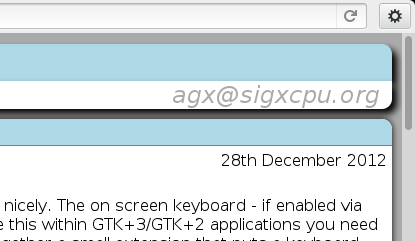
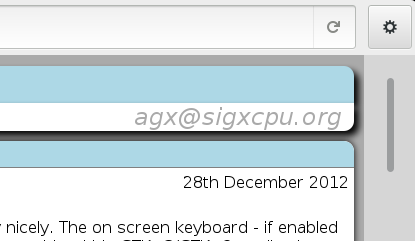
Following up on using Debian on the WeTab with GNOME Shell I've put together a bit of GTK+3 CSS to make it more touch friendly. It's in the same git repo as the OSK extension. If you put the gtk.css into ~/.config/gtk-3.0/gtk.css scrollbars will be a bit larger and the padding between widgets will be increased over the default theme: Larger scroll bar Larger scroll bar This will need more work since some of the sliders look a bit a awkward now so any enhancements will be greatly appreciated. The docs for GTK3's CSS are here. This blog is flattr enabled.

M nica Ram rez Arceda: The DPL Game

I love playing let's play DPL game! My fantastic four:
  • enrico zini
  • gregor herrmann
  • moray allan
  • christian perrier (*)
And I could think in more people, but rules only allow to present four candidates And I am sure there are more people that I could nominate, but it's difficult to know everybody in Debian (*) Sorry bubulle, I had this list before you wrote your post :-P In fact, I like DPLs who don't like the idea of being a leader ;-)

16 February 2013

Hideki Yamane: "Debian Hot Topics"


As I wrote before, I've started a series on "Software Design" magazine to introduce something inside Debian, news items, essay and so on. It's named "Debian Hot Topics" but it was decided after finished writing my article, so it comes to just an essay about distribution development, instead of "Hot Topics" ;-)

Anyway, it's a good chance for advertising (after all, no cost but get fee :)

Ingo Juergensmann: Status of m68k port

Just another short status update on the m68k port and the autobuilders. According to Buildd.Net we have currently 6425 packages installed:
wanna-build statistics - Sat Feb 16 22:52:37 CET 2013
----------------------------------------------------- Distribution unstable:
---------------------
Installed : 6425 (buildd_m68k-ara5: 1011, buildd_m68k-arrakis: 86,
buildd_m68k-elgar: 217, buildd_m68k-kullervo: 52,
buildd_m68k-vivaldi: 123, tg: 3234, unknown: 1701,
wouter: 1)
Needs-Build : 1375
Building : 35 (buildd_m68k-ara5: 1, buildd_m68k-arrakis: 1,
buildd_m68k-elgar: 1, buildd_m68k-kullervo: 1,
buildd_m68k-vivaldi: 1, tg: 30)
Built : 3 (buildd_m68k-arrakis: 3)
Uploaded : 14 (tg: 14)
Failed : 80 (buildd_m68k-ara5: 31, tg: 49)
Dep-Wait : 3 (tg: 3)
Reupload-Wait : 0
Install-Wait : 0
Failed-Removed : 0
Dep-Wait-Removed: 0
BD-Uninstallable: 1750
Auto-Not-For-Us : 187
Not-For-Us : 21
total : 9978 64.39% (6425) up-to-date, 64.53% (6439) including uploaded
13.78% (1375) need building
0.35% ( 35) currently building
0.03% ( 3) already built, but not uploaded
0.83% ( 83) failed/dep-wait
0.00% ( 0) old failed/dep-wait
17.54% (1750) not installable, because of missing build-dep
1.87% (187) need porting or cause the buildd serious grief (Auto)
0.21% ( 21) need porting or cause the buildd serious grief
Considering from where we came we're doing well. Especially given the fact that still some buildds are not working properly because of the missing SCSI driver for NCR53C9XF (espfast) chips. Having that driver working would result in 4 additional buildds and at least one that is currently using slower IDE interface. Oh, even Kullervo is working again! Now it just needs to get relocated to the datacenter again... :-)
Kategorie:

Ingo Juergensmann: right2water.eu - Water is a Human Right

I don't know how the water supply is organised in your country, whether it is a public water supply or private, but when you are living in the European Union it may change soon to private water supply. The EU Commission wants to liberalise the water supply and sanitation in the EU, but this would mean higher prices and less quality for the citizens. There is a citizens' initiative against this plan, because water and sanitation is a human right and not a commoditiy that can be (ab)used by private companies to make money. Please sign the petition on right2water.eu: Currently the petition already reached its goal of 1 Million signers, but unfortunately the rules are somewhat more complex: A certain quorum must be reached in every member country of the EU. At the moment the most signers came from Germany, so the quorum for Germany was reached. But according to a statistic posted on Twitter the quorum needs to be reached at least in 7 countries. Only Germany, Belgium and Austria did so. So please sign the petition on right2water.eu and spread the word in your country! But why is privatization a bad idea? Especially when it is done in a Public Private Partnership (PPP)? As said, water and sanitation is a human right and must not be object for profit. What happens when water supply is done by a private corporation can be seen in the documentary "Water Makes Money" which was aired on French-German TV station "Arte" last week. You can watch it online in German and French. The petition is running until September. There's enough time to sign it and - even more important - to contact your Members of European Parliament and request a "No!" to privatization of water and sanitation!
Kategorie:

Christian Perrier: DPL game or why I'm not your man

I am in some way flattered (en_FR?) that some people think that I should stand as DPL candidate (here, or there, or there). Thank you, ladies and gentlemen, for your confidence, it's appreciated. Still, I won't stand and I feel like I should explain why. Yes, I now have some experience in the Debian Project after more than 11 years as DD. Yes, I like to represent the project and I think I don't do that so badly when I do it (which is not as often as one might imagine). Yes, I feel like I have some experience in acting as a "leader" though I often have doubts about this, probably just like many people who have management duties in their professional life. Yes, I often define myself as a non-technical person which helps in dealing with problems and projects with different perspectives. Still, this is often not so true and that extends to my professionnal activity. I *am* indeed a technical person but I'm more a "specialist of everything and nothing" in this aspect. That's probably good for a DPL. But, still I won't stand. There are indeed many reasons for this and I'll try to give them here. First of all, Debian has always been a hobby for me. A hobby that sometimes ate several hours a day and still eats part of my time. But still a hobby. It can't become the major part of my life. And I think that someone spending one year as DPL "has" to do it as the major part of her his life. I can't free time from my work schedule. My work, though being in IT, has few to relate with Free Software, and I can't divert part of it with Debian duties...or merge it with Debian duties. For about 3 years, I compensate the loss of two people in my team by working hard and VERY fast, in a constant stress....connecting with Onera nearly all time long and maintaining the level of services our users deserve as high as I can. And I like it. I can't free time from my family schedule. Of course, my children don't request much attention right now, they all live their own lives. Jean-Baptiste is now having a full-time paid job and does great things in a geeky style I recognize very well. Sophie will soon be a great graduated social worker and will start working in next Summer. And Magali is studying physical therapy so that she can later help me recovering after too hard running races..:-). However, last and definitely not least, I have a wonderful wife who I want to share as much as I can with. And I can't share Debian with her. Indeed, Elizabeth is the very first reason for my reasoning.....because she is the center of my life for more than 30 years now. You also know that I happen to run a little bit..:-)...and that requires time too. Something I won't sacrifice as it brought more equilibrium in my life (and a great health, at an age where one has to care about one's health, now). All this doesn't leave much room. And I indeed noticed that my involvement in Debian has reduced noticeably in the past months. That is indeed the most important point: I'm "slowing down" in Debian...or, at least, I'm trying to find an equilibrium where it represents only a part of my hobbies....and not an ever-growing one. Last...maybe not least, I'm somehow pessimistic about the future of the project. You may have read that subtly in my writings, here or there. I feel like we are slowing down in innovation and are slowly feeling short of resources. Renewal in project members doesn't come as fast as it used to. You are free to disagree with me and I hope you'll be right to. But, still, that won't remove my pessimism. And, well, it's hard to lead a project when you're partly pessimistic about it, isn't it? In short, all in all, I'm currently "fighting" in some way to keep motivation for something I deeply love being involved in. And that's really important. And that's why I can't stand: it wouldn't be a good service to the project. It would be good for my ego, certainly (yes, I have one....and sometimes not a small one)....but it wouldn't be a good service to the project, and I also feel it could very well lead me to burnout. And, if you "nominated" me...or think I would candidate for DPL, you don't want me to burnout and vanish from Debian, right? So, this is why I won't stand. And this is why you'll continue to have great Cheese and Wine parties at Debconfs....or boring l10n reports....or, here or there, some broken uploads in the archive..:-)....but not another French DPL, at least not /me. PS: by the way, I have my own list of preferred candidates. Not sure I want it to be public, though...:-)...you'll see soon if I change my mind!

Lars Wirzenius: Kickstarter: Maria Eveliina

Soile, my beloved, is running a second Kickstarter campaign to fund her first feature-length movie, Maria Eveliina. This time, she and her producer are seeking funding to pay an editor to do the final, professional cut of the movie. They've found a professional editor who'd like to work on the project, but need some payment. The Kickstarter page explains more. It also has a "Back this project" button if you feel so inclined.

Luca Falavigna: The DPL Game

Playing the DPL Game: here are my nominations for the Fantastic Four: P.S. Sorry Joss, I m not your man ;)

Dirk Eddelbuettel: digest 0.6.3

digest version 0.6.3 is now on CRAN, and I'll upload the Debian package in a minute. This is a minor bug release regarding just the recently-added sha512 support. Turns out the wrong initial buffer size was used on the R side. Hannes fixed that within hours after we got the bug report; but I was a little swamped with multiple deadlines and failed to upload this right away. CRANberries provides the usual summary of changes to version 0.6.2. Our package is available via the R-Forge page leading to svn and tarball access, my digest page, the local directory here as well as via Debian and its mirrors.

Hideki Yamane: Developers Summit 2013 in Tokyo


"Developers Summit 2013" was held in (Meguro Gajoen), Tokyo. I've participated to this event to get information about development method and know-how.

Keyword is: Agile, Scrum, Continuous Delivery, Deploy 1000 times in an hour


Well, some talks were about Agile development (especially Scrum), the experience that how they tried to introduce "Agile" approach to their work to improve thier problems/troubles and what they've learned and got from it. I think it's very exciting if we Debian can deploy (=release) stable anytime we want! To achieve it, we should get Agility by learn their way of values and practice. I hope I'll go to DebConf13 then give a talk about it :)

Some community booth were there, I went and chatted with Vine Linux developer and community member for a while (Vine Linux is a Japanese local distribution since and we Debian get VLGothic font as default Japanese font from them :) They promoted "Handbook for developers" and it looks so good shape. Maybe you know, we also have Debian Develpers Reference(and I've completely translated it to Japanese), but their one is more catchy, of course I think we can borrow something from it to improve our DDR.

And I've got a book about CloudStack named "CloudStack " (Introduction to CloudStack, for beginners, users and professionals) at CloudStack (Japan CloudStack users group) booth, by winning a prize :)

Also bought some books at publishers booth because 10+Tax5% off was so attractive...

Daniel Pocock: Adapting the Swisscom Piccolo (Motorola 7640-47) Router for bridging and other ISPs

Background The Piccolo is actually quite a powerful router. Unfortunately, Swisscom has crippled it, removing fundamental configuration options from the web management interface, and even worse, breaking some of the (undocumented) command line configuration options. At a bare minimum, the router can be turned into a bridge/modem, enabling more powerful functionality to be implemented using a wifi router with OpenWRT or a similar solution. Documentation for the Motorola generic version of this device provides some helpful clues about the configuration and may be a useful resource for anybody adapting it. The undocumented telnet interface The username and password for the web interface also allow telnet access to administer the router. The telnet interface actually has quite a lot of features, many more than the web interface. The normal username is admin. If the admin password is not known it can be reset to 1234 using the factory reset button on the back of the router.
$ telnet 192.168.1.1
Trying 192.168.1.1...
Connected to 192.168.1.1.
Escape character is '^]'.
login: admin
Password: (default 1234)
Terminal shell v1.0
Copyright (C) 2011 Motorola, Inc. All rights reserved.
Motorola Netopia Model 7640-47 Annex A VDSL2 IAD
Running Netopia SOC OS version 9.0.10 (build h2d8)
ADSL/VDSL capable
(admin completed login: Admin account with read/write access.)
Removing the Swisscom backdoor The first step for any Piccolo owner is to remove the backdoor from Swisscom. Swisscom links the routers to a management platform that allows them to change configuration remotely, or even push out firmware updates. Allowing an external party such as your ISP to push updates to your router is a major risk. Just imagine if Swisscom decides to update firmware while you are making an online purchase or checking in to a flight - your router reboots itself and your transaction is hosed. Let's have a look at the default configuration of the router, notice these cwmp settings:
Centro_piccolo> show conf
.
.
.
set management cwmp enable on
set management cwmp acs-url "https://rms.bluewin.ch/cwmpWeb/WGCPEMgt"
set management cwmp acs-username "bluewincustomer"
set management cwmp acs-password "***************"
.
.
.
If you didn't already know that was there, you might be quite unpleasantly surprised right now. Removing it is easy:
Centro_piccolo> conf
Config Mode v1.3
Centro_piccolo (top)>> management
Centro_piccolo (management)>> cwmp enable
Centro_piccolo (management cwmp enable)>> set
      enable (on) [ off   on ]: off
Centro_piccolo (management cwmp enable)>> up
Centro_piccolo (management cwmp)>> up
Centro_piccolo (management)>> up
Centro_piccolo (top)>> save
Configuration data saved.
Centro_piccolo (top)>> exit
Notice that after you make a change, you must type the save command to persist the change. Disable the Piccolo's DHCP server If using a more powerful router (e.g. a TP-Link or Buffalo running OpenWRT) then the DHCP server in the Piccolo is not needed. Furthermore, if bridging from a provider that uses the DHCP (as opposed to PPPoE) mechanism to give you your real-world IP address, then the Piccolo's DHCP server will answer the DHCP requests from your other router, and it will never get the proper IP address from the ISP. This scenario must be avoided by disabling the DHCP server in the Piccolo.
Centro_piccolo (top)>> conn name LAN
Centro_piccolo (conn name "LAN")>> dhcp-server-enable
Centro_piccolo (conn name "LAN" dhcp-server-enable)>> set off
Centro_piccolo (conn name "LAN" dhcp-server-enable)>> save
Now, when you want to administer the Piccolo, you need to manually configure an IP address (e.g. 192.168.1.2/24) on the PC that is connecting to the Piccolo. Putting the router into bridge mode When I purchased the router, I was using it with Swisscom. Their own network operates ethernet over ATM and the router obtains an IP address using DHCP. I subsequently changed my ISP to Init7, an independent ISP. Init7, like most third-party ISPs in Switzerland, uses PPPoE rather than the bridged mode. For either mode of operation, the router can bridge the DHCP or PPPoE packets to a more flexible router, such as a TP Link WR-1043ND running OpenWRT or even a Linux server. In the normal configuration, I discovered two bridges in the router:
Centro_piccolo> show bridge interfaces
Bridge interfaces:
bridge name     bridge id               STP enabled     interfaces
br1             8000.0024c94dfcf0       no              eth0.16
                                                        eth1.16
br2             8000.0024c94dfcf1       no              ptm0
                                                        atm1
Clearly, bridging is possible. The Motorola/Netopia manuals refer to various bridge configuration options that just don't seem to exist on this unit. Nonetheless, it is possible to join those two bridges into one:
Centro_piccolo> conf
Config Mode v1.3
Centro_piccolo (top)>> link name LAN
Centro_piccolo (link name "LAN")>> port-vlan
Centro_piccolo (link name "LAN" port-vlan)>> ports
Centro_piccolo (link name "LAN" port-vlan ports)>> set
        ports ("lan-1 lan-2") [ lan-1, lan-2, ptm, vc-1 ]: "lan-1 lan-2 ptm vc-1"
Centro_piccolo (link name "LAN" port-vlan ports)>> up
Centro_piccolo (link name "LAN" port-vlan)>> up
Centro_piccolo (link name "LAN")>> up
Centro_piccolo (link)>> name WAN
Centro_piccolo (link name "WAN")>> port
Centro_piccolo (link name "WAN" port-vlan)>> view
      port-vlan
        ports "ptm vc-1"
        priority 0
Centro_piccolo (link name "WAN" port-vlan)>> ports
Centro_piccolo (link name "WAN" port-vlan ports)>> set
        ports ("ptm vc-1") [ lan-1, lan-2, ptm, vc-1 ]: ""
Centro_piccolo (link name "WAN" port-vlan ports)>> view
        ports ""
Centro_piccolo (link name "WAN" port-vlan ports)>> up
Centro_piccolo (link name "WAN" port-vlan)>> up
Centro_piccolo (link name "WAN")>> up
Centro_piccolo (link)>> save
Configuration data saved.
Centro_piccolo (conn name "WAN" link-oid)>> exit
and now let's check the results:
Centro_piccolo> show bridge interfaces
 Bridge interfaces:
bridge name     bridge id               STP enabled     interfaces
br1             8000.0024c94dfcf0       no              eth0.16
                                                        eth1.16
                                                        ptm0
                                                        atm1
Any WAN connection parameters (PPPoE or DHCP) should now be ignored by the router, and it should just be bridging PPPoE or DHCP traffic from the ISP to the other router. The Piccolo is now behaving like a modem/bridge.

15 February 2013

Iustin Pop: Garmin Montana

Garmin Montana notes Sometimes, I get waaay too excited about gadgets, and I have to share it. So, sorry, here it goes :) For some reason that is not very important, I was looking for a better solution for GPSes with maps. Side-note: if you ask why Android is not good enough , here's the story: last year, knowing that Google Maps supports caching (finally), I upgraded Maps, preloaded London, and went on a trip. Only to exit the Victoria underground station and to stare ~20 minutes in light rain at my phone, wondering why it doesn't get a fix. I gave up in the end, and used the cached maps for getting around. Later I learned the reason: Maps was not broken, but without data, Android can't get a lock easily; and more-over, the recent Maps update without GPS active even once afterwards, to do whatever it needed, meant I couldn't get a lock until back in Switzerland. Or, alternatively: while on a trip to Japan, it turns out that Google Maps caching is not supported there, probably because of rights over mapping data. So I had location, but only temporary cached maps (from the wifi in the hotels). Due to this kind of problems makes I consider Android maps a toy, so I wanted a GPS device with proper maps (on the device, not in the cloud), and with good GPS capabilities (no fancy A-GPS or anything, just plain good standalone GPS). Having had good experiences with the sport line of Garmin (but which doesn't have maps, so it's out of the question), I looked at Garmin. Many people complained about some things (same all over the place): The latter is something that jumped at me from many of the blogs/fora that I read; I like customisable power tools , not one-button mice. The other thing that I didn't really like was that most devices are very focused on a niche: the n vi line on automotive, the Zumo line on motorbikes, and the hand-held lines with some blurring of hiking/geocaching/etc. So no one-size fits all device Features! Customisation! That is, until I found out the Montana series. My my, I was blown. Both by the price (I couldn't believe how expensive it was, without maps!) and by the features. As it turns out, the Montana has different profiles , and it can act: That is for flexibility. As for performance/features: Now for the downsides. Being a multi-functional device, it's not as good as a dedicated one: But the small (for me) draw-backs aside, it's definitely not a dumbed-down device. It's the first device that I have which I feel it a bit too customisable . From completely changeable menus, to profiles that remember their maps selection, to many dashboards, to almost-programmable shortcuts (e.g. a shortcut to change profile, set destination to a given way point, reset the trip log, and turn track logging on) a bit overwhelming at first. Add the 3-axis compass, barometric altimeter, ANT+ support and you get a very powerful device. Software As to the software, yes it has some bugs - mainly that the device crashes sometimes (abruptly) if you play too much with the routes (didn't happen to me yet on the road , only when testing it at home). On the PC-side, Garmin's BaseCamp is nice, but doesn't hold a candle to Google Maps, for example, in terms of UI; I don't mean shininess, but simply how well the UI works. The most annoying thing is how it doesn't scale detail appropriately with the zoom level. But it works, and I can plan hikes offline, and upload both tracks and routes to it (this is important: it seems other recent Garmins can't replay tracks, only routes). And I can load many maps, and toggle them at will, etc. The many maps feature is not to be overlooked. I could have, for example, standard Garmin maps loaded, but just in case they're insuficiently detailed or out of date (hey, Navteq is slow ), I can also have Open Street Maps from two days ago. The routing is then done on the currently active maps, so you are not restricted to a single mapping provider. And of course you can also have custom POIs (Point of interest) on it. Bycicle use The bicycle mount is solid enough, so that on a rough roads it's held firmly. From my ~20 minute test this morning, a few things to note: Voice output By default, the unit can only beep, but if coupled via a 3.5" jack to headphones or via the automotive mount, it can properly speak; quality varies with voice, and whether it is TTS or not. I managed to find one voice (non-TTS) that sounds really well, but of course with less information, and one TTS voice that sounds OK-ish but gives full info. By full info , I mean the following: the behaviour of the various TTS voices is not consistent. For example, on a simulated route, various voices were saying the following: I don't know why these differences, or if they are consistent across routes. But I'll keep with voice E for now :) Summary So, sorry again for sounding like an ad (I don't have any relation with Garmin the company), but I find this device awesome - powerful, rugged, and working (so far) very well. I'm glad that there still exist companies who don't believe they know better than their customers, and instead offer you with a tool that you can make it work just like you want. Or almost ;-) Garmin's tag line: Big and Tough Goes anywhere, everywhere . I tend to agree :)

Richard Hartmann: Release Critical Bug report for Week 07

Technology Technology is... weird. I am in a cabbin in the middle of Lapland an hour away from the next city to speak of. GPS
N 66 15.958
E 24 59.981

look it up. We haven't had power for the last 60 minutes, the electrical heaters are out and we are trying to keep the main room warm with a wood stove while the wood-burning sauna above is ready to receive us the minute I hI push this post. The cabbin has become noticiably colder already, supply of logs small enough to actually burn is limited, we don't have an axe, but we have a car so we can leave if need be. The next house is about six kilometers away, no idea if they have power or not; the woods are dark all round other than for snowshine. Yet, I am sitting here, LED lamp lighting the room, GPS telling me what location to write into this post, laptop running on battery, cell phone with EGPRS supplying me with bugstats plus picture (even though I had to do most of it by hand as LWP::Simple barfs on the timeout) and allowing me to push to ikiwiki. As I said, technology is... weird. Bugology The UDD bugs interface currently knows about the following release critical bugs: How do we compare to the Squeeze release cycle?
Week Squeeze Wheezy Diff
43 284 (213+71) 468 (332+136) +184 (+119/+65)
44 261 (201+60) 408 (265+143) +147 (+64/+83)
45 261 (205+56) 425 (291+134) +164 (+86/+78)
46 271 (200+71) 401 (258+143) +130 (+58/+72)
47 283 (209+74) 366 (221+145) +83 (+12/+71)
48 256 (177+79) 378 (230+148) +122 (+53/+69)
49 256 (180+76) 360 (216+155) +104 (+36/+79)
50 204 (148+56) 339 (195+144) +135 (+47/+90)
51 178 (124+54) 323 (190+133) +145 (+66/+79)
52 115 (78+37) 289 (190+99) +174 (+112/+62)
1 93 (60+33) 287 (171+116) +194 (+111/+83)
2 82 (46+36) 271 (162+109) +189 (+116/+73)
3 25 (15+10) 249 (165+84) +224 (+150/+74)
4 14 (8+6) 244 (176+68) +230 (+168/+62)
5 2 (0+2) 224 (132+92) +222 (+132/+90)
6 release! 212 (129+83) +212 (+129/+83)
7 release+1 194 (128+66) +194 (+128/+66)
Graphical overview of bug stats thanks to azhag:

Tanguy Ortolo: .diff or .patch?

Silly question: when you use diff(1) to produce a file to be applied with patch(1), do you call the result a diff or a patch? Do you name it foo.diff or foo.patch?

Josselin Mouette: The DPL game

Following the DPL game call for players, here are my nominations for the fantastic four (in alphabetical order) :
  1. Luca Falavigna
  2. Tollef Fog Heen
  3. Yves-Alexis Perez
  4. Christian Perrier
These are four randomly selected people among those who share an understanding of the Debian community, a sense of leadership, and the ability to drive people forward with solutions.

Kartik Mistry: My fantastic four aka #DPLgame

* Inspired by DPL Game post. Not in order,
1. Christian Perrier
2. Martin Zobel-Helas
3. Russ Allbery
4. Cyril Brulebois Pick anyone. All four are capable leaders! Although, I only met Christian personally from list, I ve watched others doing great work in Debian since long time.

Niels Thykier: Das Lintian-overrider 2000 vs unjustified overrides

In January, I did a TV-shop ad -style post on a little script called lintian-overrider and it prompted Simon to ask:
That s a great tool, but don t you fear it makes unjustified overrides too easy ?
In my experience, people sometimes have issues writing overrides (justified or not). In fact it sometimes leaves them really frustrated with Lintian. If that frustration eventually leads to them reject Lintian, then we are doing the project a disservice. I will quote Russ Allbery as I believe he covered when he wrote:
I care most about all of the regular Debian developers [...] continuing to use Lintian, so that Lintian can stay as effective as it is now at getting people to make archive-wide changes. [...] This only works if we can get nearly everyone uploading packages to run Lintian all the time.
If a handful of people adds overrides for tags they should not have, then we can fix that (e.g. by filing a bug against their packages). But it is unlikely that we will ever make them run Lintian again once they have boycott it.

Francesca Ciceri: The DPL game

In his latest bits from the DPL, Stefano wrote:
I'd like to respond (also) here to inquiries I'm receiving these days: I will not run again as DPL. So you have about 20 days to mob\^Wconvince other DDs to run, or decide to run yourself. Do not to wait for the vary last minute, as that makes for lousy campaigns.
Ladies and gentlemen, I am pleased to present you... THE DPL GAME GOALS:
The goal of the game is to let people know you think they'd be nice DPLs.
The point is not to pressure them, but to let them know they're awesome and make them at least consider the idea to run for DPL. The winners are those who have at least one of their Fantastic Four running for DPL. Bonus points if one of them ends being the next DPL. RULES:
Name three persons (plus a reserve, just in case) you'd like to see as candidates for DPL. Publicly list them (on your blog or on identi.ca using the hashtag #DPLgame) or at least let them know that you'd like to have them as candidate for DPL (via private mail).
You may want to add a couple of lines explaining the rationale for your choices. AGE:
0-99 NUMBER OF PLAYERS:
The more the merrier Some suggestions on how to play:
First think of the qualities a DPL needs to do, in your opinion, a good job. Then look around you: the people you work with, the people you see interact on mailing list, etc. There must be someone with those qualities.
Here are my Fantastic Four (in rigorous alphabetic order): In my opinion, they all more or less have: enthusiasm, a general understanding of dynamics inside the project and of various technical sides of the project itself, ability to delegate and coordinate with different people (inside and outside the project), good communication skills and some diplomacy and ability in de-escalating conflicts. These are people I worked with or I observed working and discussing on mailing lists, and I think they'd do a good job. But -hey!- we are almost a thousand of developers and you cannot possibly know everyone or observe all the people who work in the various teams. This is why you should pick your four names!

Next.

Previous.